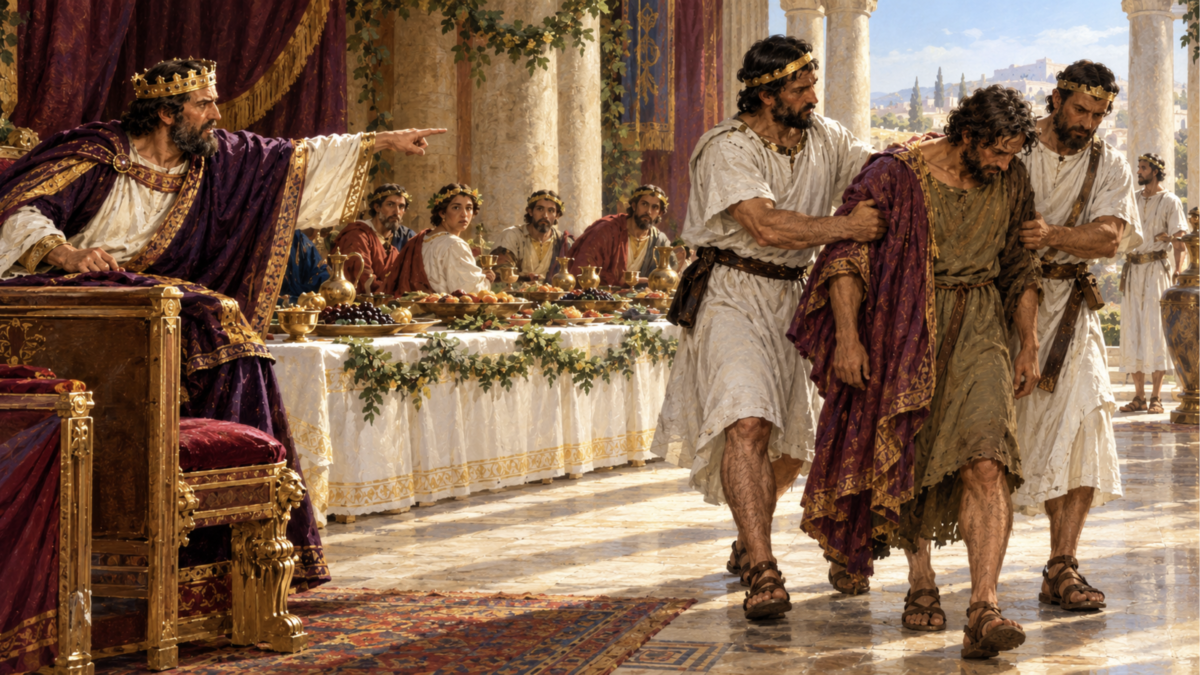
The lectionary gospel for Trinity 19 in Year A is Matthew 22.1–14, the parable of the wedding banquet. This is the third of three parables about judgement in this section of the gospel, and these wider chapters all focus on judgement (we will be hearing more about this before we reach Advent), so you might be wearying of it. But this is the most startling and striking of parables, and the reader can hardly fail to be struck by the drama of both the imagery and its theology.
The epistle is Phil 4.1–9, and you can find the video discussion of that here and linked at the end. The video discussion of Matt 22.1–14 can be found here and also linked at the end.
There is a very similar parable told by Jesus in Luke 14:15-24, but this has different details, and takes place in quite a different context. In the recent history of interpretation, it has often been assumed that there was one original story, probably Luke’s version, and that the other, probably Matthew’s, was changed and elaborated by the community and/or the gospel writer (so, for example, scholar Bart Ehrman sees this as a classic example of where the early Christian community changed and invented the teaching of Jesus). But this assumes that Jesus only ever told stories once, which seems unlikely given that he taught for so long and we have comparatively few examples of it, and that he never adapted stories to illustrate a broad principle in different contexts. So we should take Matthew’s account of Jesus’ teaching here seriously in its own right, and in its context within his gospel.
The parable begins in Jesus’ customary way in Matthew: ‘The kingdom of heaven is like…’ a person. We shift from the example of a master of a household or landowner to a ‘human king’, a phrase only found here and in the opening of the parable of the unforgiving slave in Matt 18.23—a reminder both that we can find insight into the ways of God and his kingdom in the affairs of humans, but that this is a parable, so we need to take care in the way we make sense of the parallels.
Like the preceding parable of the wicked tenants, a son is mentioned, and it is his wedding banquet. There is, perhaps, an important Christological claim being made here; in the previous parable, the son clearly points to Jesus, and the death of the son alludes to Jesus’ coming death at the hands of the Jerusalem leaders. But any Jewish listener will hear in this story, with its mention of the extensive invitation at the end of the parable, an allusion to the Great Banquet of God in Is 25.6–8:
On this mountain the LORD Almighty will prepare a feast of rich food for all peoples, a banquet of aged wine—the best of meats and the finest of wines.
On this mountain he will destroy the shroud that enfolds all peoples, the sheet that covers all nations; he will swallow up death forever.
The Sovereign LORD will wipe away the tears from all faces; he will remove his people’s disgrace from all the earth.
This is important background for the writers of the NT, with Paul alluding to it in 1 Cor 15.54, and John in Rev 7.17 and 21.4. The eschatological feast of God for all nations is the wedding banquet of his son Jesus—though in this parable the figure of the son himself plays no further role.
It is important to read the process of invitation in the context of first century Mediterranean culture, rather than our own customs, since it is easy to misread something quite serious as trivial. Both in this parable and the similar one in Luke, it is clear that there is a double (or perhaps triple) process of invitation. Preparing a feast in Jesus’ day was a costly, time-consuming and strongly communal process. Formal invitations would be issued, and then, on the basis of the number of those who had accepted, the host would slaughter the appropriate number of animals (which itself would be an important communal activity, involving other members of the village), and prepare the meal over several days. Only then would the second invitation, that the feast was ready, be sent out.
Those who now refused would be reneging on their initial acceptance, would be spurning the offer of food that had, at some expense, already been prepared, and would be publicly insulting the host in front of the whole community. The equivalent for us would be coming to dinner in someone’s house, enjoying drinks and aperitifs, and then when the main course is put on the table, taking one look at it and getting up and leaving. Kenneth Bailey, in his wonderful study of the Lukan parable in Jesus Through Middle Eastern Eyes (pp 314–315), notes that the expanded excuses in Luke add insult to injury. The process of buying a field, testing oxen, and getting married (Luke 14.18–20) are all very long-term processes in that culture—you would normally inspect a field through the season, to see where the sun fell, how plants grew, and how fruitful was its produce before embarking on a purchase.
The jolly song that we used to sing about this parable, ‘I cannot come, I cannot come to the banquet, don’t trouble me now…’ suggested that the issue here was busyness and pre-occupation. But read in context, it is clear that these people never really intended to come, and thought the long-term occupations of their present lives much more important than the feast of the king, so much so that they are ready to spurn his generosity and humiliate him in public—particularly significant in a culture where honour and shame were so important.
By refusing to come, the guests insult the dignity of the king who had counted on their attendance and graciously prepared food for them (Craig Keener, The Gospel of Matthew, p 520).
The parable here in Matthew contains an immediate element of judgement that the parable in Luke does not: ‘The king was enraged. He sent his army and destroyed those murderers and burned their city’ (verse 7). It is worth noting that this element of the narrative doesn’t actually fit in the story very well; it seems rather unlikely that a king would invite people to his son’s wedding who are from another city, rather than his own. Most commentators see this as an allusion to the coming destruction of Jerusalem at the hands of the Romans—Josephus, The Jewish War 6.353–355, 363–64, 406–8) describes the city being burned by the Romans, but the temple being burned by the Jewish rebels—which will make most readers feel very uncomfortable with the idea that God has punished the Jews for rejecting Jesus as the Messiah. That will need addressing in a wider discussion—but for the purposes of reading this parable, we need to note that this echoes ‘the robust theology of the OT prophets who hailed pagan conquerors as God’s instrument (Is 10.5–11, 44.28–45.7, Jer 25.9)’
Jerusalem is now no longer God’s city but ‘theirs’, and the community as a whole is implicated in their rebellion and its punishment, as had so often happened in the past when Israel’s sins had led to the city’s destruction by invading armies (R T France, NICNT, p 825).
In both parables, in Matthew and Luke, the anger of the king is transformed into energetic grace; the places at the table will not be left empty, and the generosity of the king will not go to waste. Luke includes a double second invitation, suggesting the opening of the kingdom both to Jews receiving Jesus as their Messiah, and gentiles who are incorporated into the people of God as well, reflecting the mixed nature of his audience. In this parable in Matthew, Jesus includes no such double invitation, consistent with the rest of the gospel where the incorporation of the gentiles is much less of a feature. But here Jesus does emphasis the inclusion of the ‘good and the bad’ (v 10).
This is striking both in the light of Matthew’s emphasis on the importance of ‘righteousness’, by which he means doing the right things that God commands, a term repeated seven times in the gospel in total—but also in the importance of honour and shame in first-century culture. To be invited to the banquet of a king would be an extraordinary social honour, striking in its privilege; those who were first invited ‘did not deserve to come’ (v 8), but neither do the eventual guests either. The gracious invitation of the king has extended to those who would not normally be considered worthy. As John Barclay notes about Paul’s theology of God’s grace:
It was very common in Paul’s world to speak of the worth of the recipient. Gifts should be given lavishly but discriminately, to fitting or worthy recipients. ‘Worth’ could be defined in different ways, according to a number of criteria—ethnicity, social status, age, gender, moral virtue, beauty or success. Just as, today, prizes might be awarded on different grounds (for musical, literary, sporting or academic achievement) but keep their value only if they are given discriminately, to people worthy of them, so the good gift in antiquity was normally given according to some criterion of worth…
For this reason, the most subversive gift is the gift given without regard to worth … If you expect God to give the best gifts to the freeborn adult and educated male, but if you find that, in fact, these gifts are given both to the free and to slaves, both to adults and to children, both to the educated and to the uneducated, both to males and to females, your whole notion of worth, and thus your social values, is thrown into disarray (from the Grove booklet Paul and the Subversive Power of Grace)
And this section concludes with one part of the paradox of the kingdom; even though ‘many are called, and few are chosen’, the wedding hall is ‘filled with guests’.
Bailey points out that this parable offers a very different interpretation of how God will fulfil the promise of Is 25 from others of the time. The translation and interpretation of the passage into Aramaic, the Targum of Isaiah, makes this comment:
Yahweh of hosts will make for all the peoples in this mountain a meal. And although they supposed it an honour, it will be a shame for them and great plagues, plagues from which they will be unable to escape, plagues whereby they will come to their end.
Similarly, 1 Enoch 62.1–11 speaks of a great banquet of the Messiah, where gentiles will be present—but an angel with the sword of death will come and slay them all. The banquet hall will run with blood and gore, through which the believers must wade in order to feast with the Messiah! And the Messianic Rule of the Qumran community also describes a banquet where non-Jews, those who do not keep the law, and anyone with a physical blemish is excluded.
Isaiah’s beautiful vision, which saw faithful Jews and Gentiles coming together at God’s invitation, goes badly awry in these three reinterpretations of the great banquet (Bailey, p 311).
Only in Matthew’s account of Jesus’ parable do we have the codicil about the guest who is not properly attired in Matt 22.11–13. Once again, we need to be careful to read this in its cultural context. For us, wedding clothes are something special, perhaps something expensive which only the wealthiest can afford (and hence the astronomical cost of weddings at the moment). But a hundred years ago even the bride would not buy a special wedding dress, instead wearing the best dress that she already had (I think it was Queen Victoria who set the trend for white dresses at weddings, as well as black at funerals). So if someone does not have the right apparel, it might not be their fault.
But in the first century, the wedding clothes that the guest was expected to wear would be the linen garment that he already had; what was needed was to make the small effort in cleaning it and putting it on. And, once again, in that culture to refuse to do so was not a mere accident, laziness or a limitation of poverty, but a deliberate decision to flout convention and fail to honour the host who had bestowed honour in the invitation. Though there is language elsewhere in the NT in which white garments are a gift from God, signifying new life or righteousness in Christ, in this parable there is no suggestion that the wedding garments are supplied by the king—they belong to and should have been worn by the guest. It is the guest’s act of response.
In the parable, these wedding garments thus signify the appropriate response to the gracious invitation of the king. As Barclay puts it, the grace of God is indeed unconditioned, in that it is bestowed on those who are now worthy, but it is not unconditional, in that it makes demands on us:
Luther was anxious about any language of obligation or obedience if it implied trying to win favor with God. As a result, some Protestants believe it’s inappropriate for God to expect something in return, because it would somehow work against grace. They believe a gift should be given without any expectation of return. However, that can lead to notions of cheap grace—that God gives to us and doesn’t care about what we do. On the other hand, the Calvinist and, in different ways, the Methodist–Wesleyan traditions have rightly understood that the gift of God in Christ is based on conditions, in a sense. While there is no prior worth for receiving the gift, God indeed expects something in return. Paul expects those who receive the Spirit to be transformed by the Spirit and to walk in the Spirit. As he puts it, we are under grace, which can legitimately lead to obedience, even obligation.
And so Calvin comments:
As to the wedding garment, is it faith, or is it a holy life? This is a useless controversy; for faith cannot be separated from good works, nor do good works proceed from any other source than from faith. Christ intended only to state that the Lord calls us on the express condition of our being renewed by the Spirit … and that, in order to our remaining permanently in his house, we must put off the old man with his pollutions … and lead a new life. (Commentary on Mathew, Mark and Luke, vol 2).
This double emphasis in the parable is exactly what we find in Paul—even to the extent of his using the complex issues around the grace towards and judgement of Israel being on object lesson to the Jewish-Gentile messianic community formed in the grace of God around Jesus:
Consider therefore the kindness and sternness of God: sternness to those who fell, but kindness to you, provided that you continue in his kindness. Otherwise, you also will be cut off. And if they do not persist in unbelief, they will be grafted in, for God is able to graft them in again. After all, if you were cut out of an olive tree that is wild by nature, and contrary to nature were grafted into a cultivated olive tree, how much more readily will these, the natural branches, be grafted into their own olive tree. (Romans 11.22–24).
I hope, dear reader, that you can see why I was so excited at the beginning of this piece about how sparkling and startling this parable is—rich with theological themes and insights, encouragements and warnings.
Within the story, the gracious generosity of God looms large, in the form of the king who not only prepares a great feast for his (ultimately ungrateful) subjects, but whose generosity then extends to those who simply do not deserve it. God prepares a lavish feast for all who would accept his invitation, take up the offer, leave their previous preoccupations, and come and sit with him.
But alongside that, there is no shirking from the importance of human action and responsibility in answering the call and responding to the invitation. The language of judgement here is clear and stark:
Many are ‘called’ or ‘invited’ with the message of repentance, but only those who respond worthily will share the inheritance of the chose, covenant people… (Keener, p 523).
Judgement is self-imposed. Those who refuse the initiation cut themselves off from the fellowship of the host and his guests. They choose not to taste the banquet (Bailey, p 320).
Join Ian and James as they discuss all these issues in this week’s video:
and here discussing the epistle from Phil 4.1–9:
 Buy me a Coffee
















The frustrations of Jesus are evoked in his saying “we piped to you weddings, (feasting and merriment) and you didn’t want to play (Jesus)
And then sombre funeral dirges [John the Baptist]
No response!
The whole religious culture of Jewry was predicated on Fasts and Feasts and their various etiquettes.
The whole motif of ransom and redemption began with a feast prior to the Exodus; to some minds a kind of betrothal meal, and being brought into a wilderness free of distractions; too, says God “try you whether you would worship me or not.
That generation did not, so never got to feast in the appointed land “flowing with milk and honey”
God in His faithfulness did not entirely abandon them
But chastened them, sent them times of refreshings.
Jesus commenced his ministry at a wedding feast,
Came eating and drinking, handing out invitations to one and all with one proviso, like the ancient Israel
You can only come through the gate of the alter/Cross
The alter was there before Moses went up Sinai
It was there at the entrance of the Tabernacle,
there before Solomon dedicated the Temple,
There at the rebuilding and restoration of the 2nd Temple. Also at Pentecost at the birth of the Church.
“Clothed in His Righteousness” is the wedding feast garment and inclusion in the Marriage Feast of the Lamb; but the etiquette is, you don’t arrive as “mutton dressed as lamb” Holy garments denote holy people.
The Apostle Paul tells the Corinthian church in 2 Corinthians 11:2 that he has betrothed them to “one husband, that I may present you as a chaste virgin to Christ”. Which echoes our epistle reading for the week.
Folks who think that the Kingdom is all inclusive,
that “just being there” is all that is required will find that it is quite exclusive of some, as this chap found.
For the historists among us Alfred Edersheim has
An excellent paper on Jewish etiquette at weddings
“ The Marriage Feast in Cana of Galilee – the Miracle that is a Sign. ‘ @ biblehub.com
There is an interesting study to be had in noting
The seven occasions when the Glory of God fills the Tabernacle, Temple and Church
The mediatory work of Christ as Alter and priest
The Kingly Sovereignty of the Temple [ built by two Kings]
The Transfiguration of Jesus
The Apostleship of the Church at Pentecost [the sent One/s.
Heb 3:1 Wherefore, holy brethren, partakers of the heavenly calling, consider the Apostle and High Priest of our profession, Christ Jesus;
See @ “The Cross and the Eternal Glory of God” @
Austinesparksnet.
When we are a reproach to God and the world,
When the Glory has departed
When the enemy “treads down the Courts of God”
The recovery is through the cross in all its ramifications, as per Esther – Humbling, fasting,
Purification and prayer was followed by the Glory
“All Israel had light in all their houses” a feast still observed as Purim. Shalom.
Don’t focus on the symptoms, focus on the dis-ease,
The cure of Souls. Shalom
I found the idea that the people who did not come to the feast were not only disrespectful of the host, but could also be seen as in rebellion against a monarch with violent tendencies. It then occurs to me that wearing conspicuously inappropriate clothing would seem to be taking the focus away from the happy couple, never mind the king. The king would not want to be upstaged by anyone
Chris