
The gospel lectionary reading for Trinity 20 in this year B is Mark 10.17–31, the story of the so-called ‘rich’ ‘young’ ‘ruler’. But two of these terms are supplied by Matthew and Luke, and Mark has some significant unique elements to the way he tells the story. We continue to read sequentially through this section of Mark as we come to the end of the lectionary year, and for once we have a complete pericope (passage) in the lectionary reading, demarcated in narrative terms by the journeying phrases ‘as he was setting out on his journey’ at the start in Mark 10.17 and ‘they were on the road’ at the end in Mark 10.32.
We are told nothing initially about this man; as he does elsewhere, Mark defers information about him (in this case his wealth) which creates more narrative tension than describing him immediately. (The classic example of such information deferral is in Mark 5.42, where only at the end are we told that the girl was 12 years old, thus connecting here story with that of the woman with an issue of blood.) Mark alone notes that the man ‘kneels’ before Jesus, indicating that here was someone genuinely seeking to honour him and ask him for help, with the hope of perhaps becoming a disciple (compare Mark 1.40).
Mark consistently depicts Jesus as teacher, despite not actually giving us much of his teaching! He is described as such by his disciples (Mark 4.38), those around him (Mark 5.35), his opponents (Mark 12.14), and even as a reference to himself (Mark 14.14). But to this title the man adds ‘Good’ which, rather than drawing out a reciprocating term of respect, provokes the abrupt rebuke from Jesus. The language here of ‘eternal life’ is not so much focussed simply on the idea of ‘living forever’, but expresses Jewish expectation that after this age—where sin abounds, God’s people are oppressed, temple worship is corrupt—when Messiah comes he will usher in the ‘age to come’, in which God’s people will be delivered, the temple purified, the dead raised, the wicked judged, and God will truly be present with his people. We can see some of the hope for this expressed in the Benedictus in Luke 1.68–79. (For a very helpful outline of this hope, see chapter 10 of Tom Wright’s The New Testament and the People of God.) The language of ‘this age’ and ‘the age to come’ recurs at the end of this episode in Mark 10.30.
Jesus’ response offers an ironic challenge. Only God can grant eternal life, and God alone is the teacher of Israel. So why has this man come to ask Jesus these questions—unless he believes that Jesus is more than merely a human teacher? The man has couched his question in terms of what he must do, and in terms of actions, Jesus reaches for what God has already taught in what is known as the Ten Commandments (though the Old Testament refers to them as the ‘ten words’). Jesus recites those that relate to behaviour towards others, listing the last five in their OT order, then adding the fifth since that also concerns treatment of others. The last, ‘Do not covet’ has been replaced with ‘Do not defraud’; I am not convinced there is much significance to this, since defrauding is the action that arises from the attitude of covetousness.
In his reply, the man drops that adjective ‘good’, but continues to address Jesus as ‘Teacher’. There is no reason why we should question the man’s sincerity, or his belief that he did indeed believe he had kept these commandments. He was someone who ‘lived a good life’. And Jesus takes seriously both his desire to live aright and his conviction of doing so. Mark alone includes the description ‘looking at him, he loved him’. Jesus’ challenge to the man—which leads to him turning away—comes from his love for the man, and not his dismissal of him.
Jesus, who comes from the ranks of the poor and oppressed, loves this man whose wealth gives him opportunities denied others. The rich man turned his back on Jesus, but Jesus did not turn his back on the rich. He loved them enough to help them see the truth. (David Garland, NIVAC on Mark, p 404).
Jesus declares that he lacks one thing—but he does not explain what that one thing is. It is the response to Jesus’ invitation, and the teaching that follows, which will reveal this. Rather, he gives four simple commands: go; sell; give; come. It is striking that Jesus does not deny the importance of the Ten Commandments; he acts as a Torah-observant Jew addressing a Torah-observant Jew. But the part of the commandments that he has not mentioned refer to the worship of God. Though the man acts towards others as required, is he living out the very first, ‘You shall have not other God’s before me’? And the test of that appears to be whether the man will respond to Jesus’ call to follow him.
The description of Jesus ‘looking around’ (the verb περιβλέπω) is characteristic of Mark. Jesus does this before healing a man in the synagogue (Mark 3.5), in response to his family’s call (Mark 3.34), when touched by the woman (Mark 5.32), and when he entered the temple courts (Mark 11.11)—and only once in all the other gospels (Luke 6.10). He wants to see that the disciples are paying attention to the seriousness of the moment.
Now we begin to see what the man lacked. ‘How hard it is for those with wealth to enter the kingdom!’ There are many reasons why the disciples would have found that astonishing, just as later readers have struggled with it. For one thing, is not wealth a sign of the blessing of God (or we might say, providence, or fortune)? Look at Job, who after his trials was blessed as never before with wealth. And surely it is only those with means who have the time and luxury to study what God wants and are able to take care to obey what they find? Yet Jesus has barely a good thing to say about wealth, often using the Aramaic ‘Mammon’ to depict it as a rival god, a spiritual power that draws people from the true God. The importance of this lesson is underlined as Jesus repeats the claims, and for the only time in this gospel addresses the disciples directly as ‘children’. They need to learn this, and they need to be childlike (as in the previous pericope, Mark 10.15), not least because children lack the calculating awareness of the value of money that adults have.
We can see, both in the textual variants, and in the history of interpretation, how we have struggled to hear this hard teaching. Some manuscripts have added in verse 24 ‘how hard it is for those who trust in riches to enter the kingdom of God’. And you might have heard of the story of the small gate in Jerusalem called the eye of the needle, which camels needed to kneel down and shed their load to enter. The lesson there is that it is possible for the ‘camel’ to go through the ‘eye of the needle’, though quite difficult. But no such gate exists; Jesus says it is impossible (verse 27). C S Lewis sums it up in vivid poetry:
All things (e.g. a camel’s journey through
a needle’s eye) are possible it’s true;
But picture how a camel feels, squeezed out
in one long bloody thread from tail to snout. (cited by David Garland, NIVAC p 402)
The reason for this is not simply that wealth creates an issue—though it does. It is because of the nature of the kingdom. The very premise of the man’s question (‘What must I do to inherit…’) is flawed. The kingdom of God comes to us as a gift, an immeasurable treasure that we have stumbled across (Matt 13.44), or some great wealth which another has entrusted to us though we don’t deserve it (Matt 25.14). We cannot do anything to merit this; it comes as pure gift.
But, though it comes as a gift, it is a gift that makes an absolute demand. Some critics point to the hypocrisy of Christians, who do not ‘sell everything’ in order to follow Jesus. But this was Jesus’ command to this man, and not to all. He does not require the same of Zacchaeus whom he meets later on this journey; he accept the support of wealthy women in Luke 8; and people like Joseph of Arimathea use their wealth to support the cause. The question here is of loyalty:
Is God or Mammon to rule over life? Are material possessions to be served or are they to serve? (Garland p 403)
When we get the answer right, then we live with a radical generosity, as Zacchaeus did, and as we find in the programmatic statement by Luke in Acts 4.32–35:
All the believers were one in heart and mind. No one claimed that any of their possessions was their own, but they shared everything they had. With great power the apostles continued to testify to the resurrection of the Lord Jesus. And God’s grace was so powerfully at work in them all that there were no needy persons among them. For from time to time those who owned land or houses sold them, brought the money from the sales and put it at the apostles’ feet, and it was distributed to anyone who had need.
It is striking here how a transformed attitude to possessions sits next to the power of the apostles’ testimony—the material is a sign of the spiritual. And that makes our age an especially dangerous one for those who follow Jesus.
No Christian is immune from the danger of Mammon. Covetousness is like a virus that takes residence in the soul and begins slowly to work it destruction. The love of acquisition and an appetite for self gratification will deaden the instinct for self-sacrifice (Garland, NIVAC, p 403).
The disciples complain that they have indeed done what Jesus commanded—left everything to follow him. And again he takes their complaint seriously. The blessings of the kingdom—the life of the age to come—are already made manifest in this age, as the life of the kingdom begins to break in. The promise here of ‘houses and brothers and sisters and mothers and children and lands’ is no prosperity gospel, for that teaching feeds the spirit of covetousness. No, this is a description of the life of the community of faith, as set out in Acts 4. When we know God as our Father and Jesus as our brother, then we share all with our new family. But we do so against the grain of the world we live in; ‘in this world you will have tribulation’ (John 16.33).
The life of the kingdom begins now, as we receive the gift of God in Jesus by accepting its absolute demands. And it finds its completion in the age to come when Jesus returns.
Come and join Ian and James as they discuss all these issues:
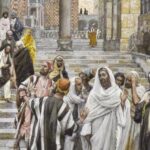
The image above is ‘Christ and the Rich Young Ruler’ by Heinrich Hofmann.
 Buy me a Coffee











In what respect is this man “rich”?
He appears quite rich as regards religious observances in contrast to the Church in Laodicea who thought “they were rich and in need not of nothing more”.
Despite his religious zeal something seemed very lacking perhaps the message of eternal life held an answer.
Was there something else required of him to do? Well yes, obviously, says Jesus
Go and abandon everything and abandon yourself to me by following me.
Yes, Jesus loved him he was doing his best to be devout and godly
But our doing our best falls short of excellence. ” If you want to be perfect” says Jesus
“Go and abandon all and yourself to me.”
Why was he sorrowful? Had he as Chesterton remarked “Tried Christianity and found it too difficult”?
True it is difficult to enter the kingdom,
The disciples marveled “Who then can be saved? If not this very devout chap, who?
The want of faith was the thing lacking, they realized;
so what of them who had indeed left all and abandoned themselves to following Jesus.
Jesus reassures them that such abandonment had great consolation; as Paul testifies
2 Cor 1:5 For as the sufferings of Christ abound in us, so our consolation also abounded by Christ.
Phil 4:12 I know both how to be abased, and I know how to abound: everywhere and in all things I am instructed both to be full and to be hungry, both to abound and to suffer need.
For those of faith who abandon to Christ discover riches beyond imagination.
Too that I can testify, in every aspect of my life, I often feel that I am the richest man alive.
I am not so sure that the change from “you shall not covet” to “you shall not defraud” is insignificant. Exod 20:17 has the Hebrew verb cha.mad which means “desire, delight in,take pleasure in.” The LXX has epithumeō, “to long for”. This is clearly an inward attitude. Defrauding is one possible action flowing from that. That the man has never defrauded someone might have been true. That does not mean that he had no longing for the riches of others.
It is interesting to note that only Mark includes this commandment (in modified form). Matthew and Luke omit it altogether. Matthew adds “you shall love your neighbour as yourself” which then points up the omission of “you shall love the Lord you God with all your heart, and mind, and soul, and strength.” The action of the man does seem to show that his orientation of heart was to Mammon rather than God.