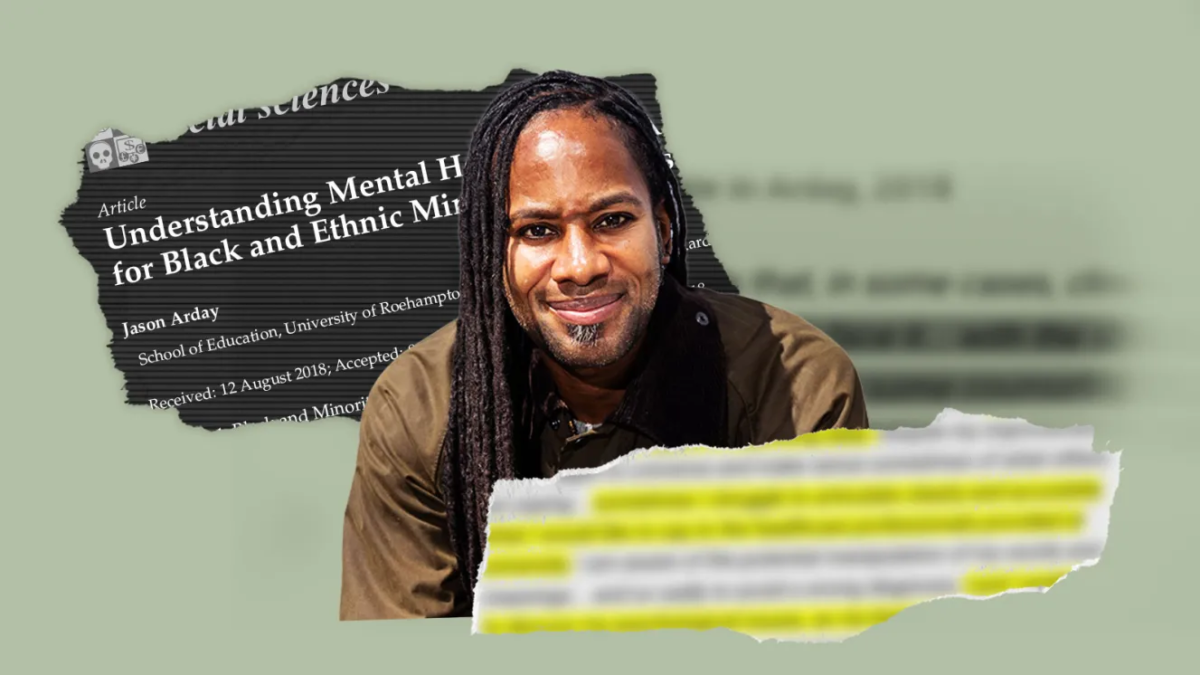
It is hard to say anything original about the tragic affair of Jason Arday, his appointment as a professor in Cambridge, the challenges made to his academic and personal claims, his resignation, and his tragic death by suicide. At the centre of all this is a human being, and someone who has now left wife, children, and friends bereft. If you are someone who prays, pause for a minute to pray for his family and those deeply grieving over his death.
But we need also to remember that compassion and understanding are not opposed, but need each other—in this case as in all others. I keep returning to the words of Dom Hélder Câmara, the liberation theologian and Catholic prelate who worked with the poor in Brazil under its dictatorship in the 1960s to 80s. “When I help the poor, they call me a saint. When I ask why the poor are poor, they call me a communist.” To understand is a key part of compassion, since it makes us attend to the issues that have caused harm and need to be addressed.
Lots of questions have been thrown out around the Arday case, and I can only address the key ones here. The first claim was “He was subjected to disproportionate scrutiny about his academic plagiarism.” As someone who has been engaged in academic work at undergraduate, graduate, and postgraduate level, I can assure you that this is not the case. Plagiarism is the number one, “unforgivable sin” in academic work, for two reasons. First, it claims that you know and understand things that you do not. And secondly, it robs others of credit for their work. Academia is a strange mix of competition and collaboration—competition because there are limited numbers of jobs (especially in my field of biblical studies) and the jobs (in theory) go to the best qualified, and collaboration because all academic work builds on the previous work of others.
For the last ten years, when I have been marking undergraduate and graduate work, all essays have first been put through plagiarism detection software. In a batch of essays, there will always be one or two where are some serious questions that need to be explored, and this involves going to the sources, comparing with the essay in question, and looking at the way the work has been presented. A ‘first offence’ needs help and training, so that students know how properly to give credit for citing the work of others. In graduate work there is less tolerance. But at postgraduate, PhD level, there must be zero tolerance, since a key criterion for a PhD is that the candidate has made an original contribution to knowledge.
Catholic academic Tina Beattie wrote a beautiful piece on the Arday case, but she leaves us in no doubt about the issue of plagiarism.
Jason Arday had vast potential, creative energy and charisma in abundance. He was clever, courageous, generous, imaginative, entrepreneurial and ambitious. He overcame significant difficulties to achieve his dreams, and he acknowledges in his thesis the people who supported him along the way—a loving family and a significant number of academics…
I’ve supervised and examined undergraduate and Masters dissertations and PhD theses by students of different ages, races, cultures, religions, genders and sexual orientations. None of these factors has had any bearing on the academic abilities of the students. There is no kindness in allowing a PhD student to continue if it becomes clear that they lack the analytic and linguistic skills needed to attain a doctorate. Nor should a supervisor or peer reviewer overlook any suspicion of plagiarism or poor referencing of sources. These are the basic tools of academic writing, and lecturers and supervisors must be vigilant at all stages of students’ progression through the academic system and insist that these fundamental rules are respected.
This is the point of the oral exam, the viva voce, in a PhD. One of the main questions of which the two examiners need to satisfy themselves is: is the work original? Does the person demonstrate understanding of the issues and that the work is their own? I do think there is a major weakness in UK PhD examination, because it relies solely on the judgement of the two individuals, who are employed by the institution itself. And I have experienced occasions when the institution has put pressure on me as an examiner to pass a PhD which I did not think was up to standard. In some European countries, the defence is done in the context of a public lecture, which anyone can attend and in which anyone can ask questions. That seems a far more secure process, and one that British academia actually needs.
Some have complained that Arday was subject to scrutiny that others are not. That is not true. Every time I write an academic article (four this year) and every time that I present an academic paper in a conference (three this year) I am open to exactly the same kind of scrutiny. And to have been found to have taken credit for someone else’s work in the form of plagiarism is the worst possible accusation. And his case is not comparable with other academics who have been found to have plagiarised work in published articles. Arday’s issue was in his foundational work—his PhD—which was the entry point for academia at the very beginning. If his PhD was not original work that made a genuine contribution to knowledge, then he should not have been in academia at all.
If you are in any doubt about the extent of plagiarism in Arday’s PhD, it has been laid out clearly by Nathan Cofnas in his substack article here. (Clear evidence of significant plagiarism in other articles can be found here.) It is quite extraordinary that Liverpool John Moores University, Arday’s awarding institution, have said that they explored the claim about plagiarism and found no case to answer—the case is as plain as the nose on your face (and in my case, that is very plain.) Arday’s defence was that, as someone who was neurodiverse, he used mimicry as an intellectual strategy to reach the standard of others. But this is no defence at all; for any kind of disability that affects learning, the standard approach is to provide additional support, in order to allow students to attain the same standard as others—not to amend the standard.
Cofnas was not the first person to raise questions about Arday’s PhD. In 2023, at the time of his appointment, Dr David Harris, professor emeritus at Plymouth Marjon University wrote to both Cambridge University and Liverpool John Moores University (LJMU), which had awarded Arday his PhD, raising concerns about apparent plagiarism in the thesis and in subsequent publications. In 2025, Jack Grove, the Times Higher Education journalist, investigated Arday’s work and assembled a dossier of approximately 63 pages of side-by-side comparisons between passages of Arday’s thesis and earlier works. He commissioned academic David Sanders, a biochemist at Purdue University and an experienced investigator of alleged plagiarism, to investigate, and he concluded that there was extensive plagiarism. Arday’s response to this was to report Grove to the police, who investigated him for four months, and to employ libel lawyers Carter Ruck to threaten to sue THS should they publish the results of their investigation—which of course they didn’t.
Cofnas is himself a controversial figure who describes himself as a ‘race realist.’ He makes two main claims in his approach to ‘race’ or ethnic diversity and academia. The first is that he believes that academic appointments should be made on the basis of merit and qualification alone, and should not be influenced by other factors, such as prioritising certain ethnic groups over others. The second is that he believes that, just as different ethnic and people groups have different abilities in sport (so, for example, long distance running internationally is dominated by East Africans, and basketball in the States is dominated by African Americans), the evidence is that different people groups also have different abilities in relation to Western academic standards. This second idea is highly controversial (and there is a good exploration of it here), but both are connected to a legal landmark case involving Harvard University.
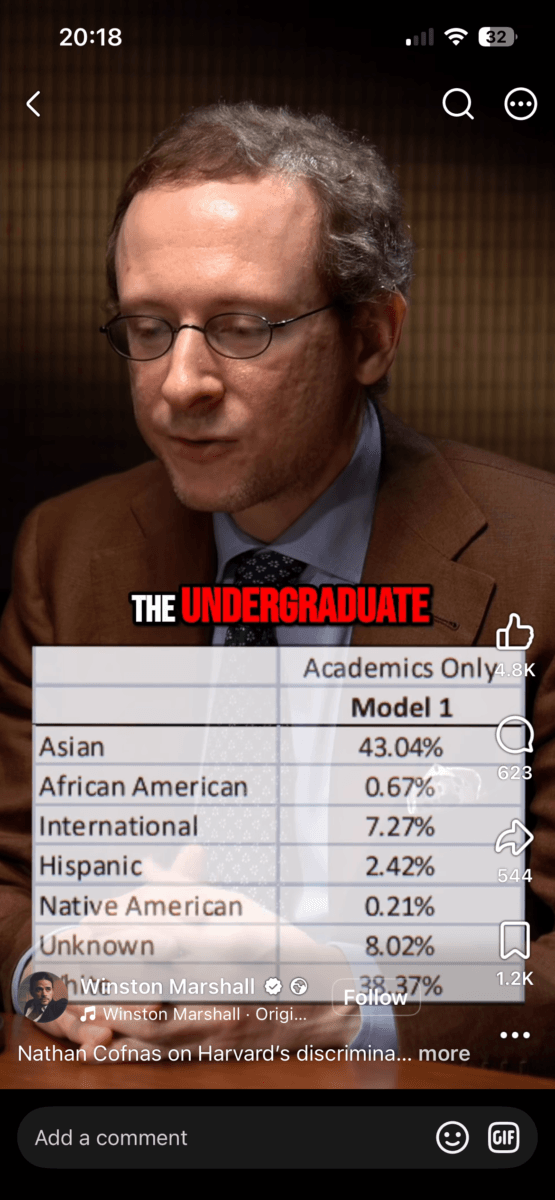 In 2014, Students for Fair Admissions (SFFA) sued Harvard University in U.S. District Court in Boston, alleging that the university’s undergraduate admission practices violated Title VI of the Civil Rights Act of 1964 by discriminating against Asian Americans. They won their case, and in the process Harvard were forced to release statistics about academic performance by different ethnic groups—which were startling. It showed that Asian Americans massively outperformed other groups academically, but that Harvard admissions did not reflect that, and that African Americans underperformed. This was disguised by the policy of Harvard to take affirmative action, appointing African Americans who were less qualified over against Asian Americans who were better qualified in order to improve the ethnic mix of their student body. It is these statistics (and not ideology) which led Cofnas to make his infamous claim that, if all posts were appointed to on merit, African Americans would almost disappear from US academia.
Whatever Cofnas’ own views and his motivations, the question about Arday’s work is: is there the claimed evidence of plagiarism? And a key question in the wider context this is: should universities vary their standards for different groups, in order to encourage those that might have had a background that disadvantaged them? But there is one clear consequence: any action that is ‘affirmative’ of one group will clearly disadvantage another. The historic ruling in the Harvard case effectively ended race-conscious affirmative action policies in higher education across the United States, concluding that race may no longer be used as a specific “plus” or “negative” factor in college admissions. (It worth noting that this was not a “black and white” issue; the case was pursued by Asian Americans, another minority ethnic group in the US.)
Tina Beattie spares no words in her condemnation of such approaches—in part because of the damage that it does to academic integrity, but also in part because of the harm it does to people who are affected by such affirmative action.
To insist upon criteria of academic ability and linguistic fluency for those aspiring to a university education in the Humanities and Social Sciences is not discrimination or prejudice, any more than it would be discrimination to exclude me from a choir on the basis of my atrocious singing, or from a sporting team because of my total lack of athletic ability. Discrimination is a factor in all walks of life and in all ethical decisions and dilemmas, and it is essential for the good of all relationships, institutions, and rules of engagement…
Stir into this a concept of DEI which does the opposite of what it claims to do. Diversity is stifled in the promotion of a homogenising rhetoric of victimhood and oppression that demands conformity to meaningless and sometimes dangerous sloganeering, especially around issues of race and gender. Equity produces gross inequalities, for it amplifies the claims of the loudest “victims” complaining about exclusion and discrimination, and excludes a multitude of legitimately dissenting or questioning voices. Inclusivity is a lie, for every institution, relationship and society must exclude some and include others in order to maintain its principles and raison d’etre, and to define its identity, functions and parameters of representation and engagement. Ask refugees or Muslims about inclusivity and racism. Ask lesbians, feminists or people with DSDs about the inclusivity of the LGBTQIA+ “community”. Ask those of us who have been censored and cancelled by both sides of the culture wars, because we put rational arguments and principled ethical positions before the compulsory rhetoric of either the conservative religious and political right, or the fluffy mantras of the postmodern academy and its vacuous adherents.
Her point about ‘homogenising conformity’ has been made by others. This short video highlights how, in the US, black academics who question the DEI approach to affirmative action have themselves been excluded and marginalised.
And, worst of all says Tina Beattie, it harms those who are ‘favoured’ by such policies.
If he had been white, he would never have risen so fast and so high through the ranks of academia. And if he had been white, he would never have been pushed so hard or fallen so far. No, he is not an Icarus. His own misguided ambition did not cause his downfall. It was the unquestioning obeisance of this country’s academic community to its own ideological captivity that allowed Jason Arday’s brilliance to be obscured by academic mediocrity, and made him prey to the vanities and cruelties of a culture in ethical and intellectual freefall.
Despite all this, it is far from clear that the questions raised are going to lead to a rethink, either by Cambridge University in its approach to admissions, or in its work in this department. (The question of the subject area Arday worked in, and whether it has intellectual coherence, is another whole issue. For a scathing critique from someone who experienced it, see this Twitter thread. For a more general critique of the rise of EDI-type approaches in the UK university sector, see the critique here. And see here for an excoriating analysis of the work of Hilary Cremin, the professor who appointed Arday and called him ‘the best in the world’.)
Rather than unite different views around ethnicity and discrimination, Arday’s case appears to have deepened divisions and made agreement on any of these questions more remote, rather than bringing them nearer.
What does all this have to do with the Church of England? Unfortunately, rather a lot. In three areas, the C of E has swallowed the same ideological approach to ethnicity that created the Cambridge/Arday tragedy—in ‘Project Spire’ and slavery reparations, in its ‘racial justice’ projects, and in its approach to appointments.
The issue of slavery reparations has been highlighted by Sarah Mullally’s recent visit to West Africa.
The Church of England can always be relied upon to walk into a room just as everybody else is leaving…There is something almost endearing about this; the C of E has long been an institution where the eccentricities of the comfortable middle-classes survive long past their sell-by date.
The centrepiece of the C of E’s stubborn persistence to a 2020 mindset is Project Spire, its controversial plan to give £100 million in ‘reparations’ for its role in the transatlantic slave trade.
Images are beamed back from West Africa of the Archbishop perched on an enormous gold throne, next to the King of the Ashanti. Given the C of E’s assiduousness in digging deep into how Georgian churchwardens could afford marble monuments in parish churches across the country, you might have thought a quizzical clerical eyebrow or two would have been raised at this, that the thought, ‘I wonder how the King of the Ashanti got to sit on a big gold throne’ might have entered some minds? Not so.
The Ashanti were among the most enthusiastic participants in chattel slavery; around 10 per cent of the entire Gold Coast slave trade went through, and earned money for, their empire. Rather than condemn this with the same vehemence or use it as a moment of reflection on the universality of the sin of slavery, Mullally instead put out a bizarre video of herself staring across the Atlantic, Caspar David Friedrich-style, accompanied by an apparent re-commitment to Spire.
In doing so, the Archbishop is setting herself up for a fall. Not only is Spire loathed in the pews, church lawyers and bureaucrats privately admit it is immoral and possibly illegal under the laws of the Charity Commission.
Nigel Biggar explains the issues with this project—and the response from the Church Commissioners to resist every question that has been raised, just as Arday and Cambridge tried to suppress the evidence of plagiarism.
Since its public launch in January 2023, the wheels have come off the rationale for Project Spire. Richard Dale, an historian of international banking, has shown that the commissioners misunderstood the data: the 18th-century church fund, the Queen Anne’s Bounty, neither directly invested in nor profited from slave-trading. I, until recently holder of the Anglican world’s premier university chair in Christian ethics, have pointed out the astonishing failure of the commissioners to publish any considered ethical justification. And Charles Wide KC has exposed their failure of due diligence in launching the project before discovering that it’s beyond their lawful powers to divert money from resourcing the Church of England’s ministry to supporting black-led businesses in the Caribbean and Africa.
How have the commissioners and the project’s officers responded? Mainly by retreating into a bunker and saying as little as possible, hoping no one will notice the fuss and the critics will tire and go away. But also by complaining that forensic questioning is a form of harassment and refusing to answer it. By indirectly threatening critics with litigation. By refusing to name them. And on one (aurally recorded) occasion, by publicly defaming them as deliberately spreading disinformation – that is, lying.
Something similar is happening around Racial Justice. For the previous triennium (2023–2025) £20 million was allocated by the Archbishops’ Council to be spent on “Racial Justice”. This figure was mostly pulled out of the air, at the insistence of Lord Boateng (who visited AC in March 2023 at a meeting that I missed because I was abroad) and as a result £9m of it went unspent by the time of the next round of triennium funding in December 2025, my final meeting at the end of ten years on AC. We had two proposals to consider, one on disability provision across the Church, and another on further spending on racial justice, since the two had been lumped together in the review of funding plans. The difference in the two applications was stark. For the disability project, there were clear goals, identification of needs, measurable plans, and evidence that the actions would deliver against the goals. For racial justice, we had none of these—and as a result decided in favour of the disability project. The very next day, without any conversation with AC, Arun Arora and other members of the Racial Justice Board went to the press to complain.
Earlier that year, in March 2025, Norwich diocese decided to set up a racial justice project, appointing a member of the clergy as part-time racial justice officer, and publishing a racial justice toolkit. I was approached by the Daily Telegraph for comment, and I said this:
The good news of Jesus is for all, whatever their ethnicity or background, and it is vital that the Church of England celebrates this diversity and ensures all are included and enabled to participate.
Sadly, this Racial Justice Toolkit won’t deliver this. It makes the same mistakes as the national programme, buying into non-Christian ideologies, and even using the racist language of ‘whiteness’. It repeats the impossible and impractical goals of ‘From Lament to Action’, and points to its statements which claim—without any evidence—that the theological basis of the Church of England is inherently racist.
I am part of a multi-ethnic city church, and we have learned to include all groups at every level of leadership without using any of this language or making these unproven claims.
It seems extraordinary that, in a diocese which is 95% white, money is being spent on this, including a full-time [this was incorrect; it was part-time] racial justice officer, when parishes are crying out for more clergy.
The one good thing about the approach is the use of Prayercast.com, which includes prayers that Muslims would come to know Jesus. The diocese will become more diverse if it actively includes teaching on how to share the good news of Jesus with members of others faiths so that they can become Christians—and I hope that will be included in their future teaching material.
When the Telegraph quoted a sentence from this, not one but three bishops wrote to make a formal complaint about me to the Council, and another bishop convened a group to investigate the complaint. At no time did anyone seek to contact me to ask for my full comment or what I meant by it.
If you have a racial justice project in your diocese, and you are a member of your diocesan synod, then you are very likely in breach of your responsibilities as a trustee. The questions to ask are: what is the evidence of the problem; what is the evidence that the processes being put in place will address that evidenced problem; and how will you know when it has been successfully achieved? I have not heard anyone ask any of those questions in a synod—since people are terrified of being accused of being racist by not supporting the project.
Lastly, on appointments, we find the same kind of thing. The report From Lament to Action claimed that ethnic minorities were under-represented in senior appointments, and that that was the result of institutional racism. It therefore proposed quotas for entry to the senior leadership training which formed preparation for such senior appointments. But the numbers proposed were absurd and unattainable, and of course suffer from all the issues with ‘affirmative action’ appointments that we have seen in academia.
My assessment of FLTA at the time included this comment about the proposal:
Are the House of Bishops and Archbishops’ Council really satisfied that positive affirmative action is really the answer to the racism problem? Racism is an affliction of heart, mind and attitude. Positive discrimination only alters numbers and balance sheets. There is a real danger that positive discrimination:
Lets us off the hook. Quotas remove the incentive to interrogate our own prejudices, which are the real problem. There is a risk that by reserving (for instance) two seats on the AC for BAME people, we allow ourselves to think that we have solved racism and not worry about how we appoint to the remaining however many seats.
Demeans the people of colour appointed. It makes an appointee, however gifted she is, into nothing more than her colour. It says to her “whatever your experience or expertise in x, y, z, we have primarily appointed you because we need a brown body on this committee. Otherwise, we might have chosen someone else.” This is something that is difficult for people who have never been thus reduced to a single characteristic to grasp.
Makes racism worse. Far from improving perceptions of diversity, preferential treatment breeds resentment. This undermines not only the appointees themselves (“they’re only here because we needed a minority”) but also all other people of colour in senior positions, who become tarnished with the perception that they owe their position to their skin colour. I have told people about how brazen e.g. General Synod members were in suggesting that I owed my position on AC only to my race. (One told me, “I’d be in your position if I had a protected characteristic”).
This was written by a non-white colleague, who was named and cited in the original piece. Sadly, though, he asked that his name be removed, since his disagreement with this DEI-type approach would undermine his application for future posts.
If we are unclear that this is having an impact, we might want to ask why it was that David Tudor was not only retained in post, but also appointed and re-appointed area dean, and made a canon of Chelmsford Cathedral, when he was a known sexual offender. And we might ask why John Perumbalath was appointed bishop of Liverpool when there were major questions about him and his ministry.
We currently have a bishop in post who believes that we need ‘new research if necessary, to shed light on the Church of England’s theological foundations of prejudice and discrimination’ (in FLTA), that the nineteenth-century missionary movement was ‘seeking to destroy diverse African traditional religious belief systems’ so we should be seeking to ‘enable all Africans, especially descendants of the enslaved, to discover the varied belief systems and spiritual practices of their forebears and their efficacy’ (para 32, Church Commissioners Oversight Group report).
All the signs are that those in positions of power and influence are doubling down on their commitment to these approaches in each of these areas. The Jason Arday tragedy has shown in broad daylight how damaging these approaches are, and how they fly in the face of the evidence.
Is there any chance that leaders in the Church of England will learn from this?
 Buy me a Coffee












In answer to your last paragraph –
No.
…which will be a disaster…
Sadly, “will be” rather than “would be” is correct.
Treating different people differently is discrimination.
Treating different groups differently is even worse, because it is the people who are doing that who get to choose how the groups are divided up in the first place.
Worse still, they tend to divide them up in irrelevant ways like pigmentation (a form of division that only a toddler might consider relevant) and pretend they are being inclusive when in fact they are being the reverse – limiting themselves to three or four endlessly repeated characteristics out of the 1000s that there are.
The press are relentless and inhuman.
They don’t think individuals have feelings.
They don’t think individuals have families.
They don’t think those families have feelings.
Have they no feelings, or families, themselves? Or does Mammon trump all? When there is an actual death, you pray desperately for lessons to be learnt – but even those who know those lessons perfectly well, succumb to Mammon (newsprint sales figures) or to the editorial policy that drives these. How inhuman, and the 1001st reason why secularism is so dangerous, and Christianity as good as secularism is bad. Lives are at stake. Chatter and collateral human damage are considered more important than lives. Get secularism out. Now.
I am not sure I agree with you about most of the press coverage. I thought a lot of it focussed well on the pertinent issues. I am not aware of anyone doorstepping Arday, are you?
I thought your article was excellent (and I largely agree with it); on the press I think we-
(a) call foul on the way that editorial policy and sales rule all, and on the hopelessness (and effect on truth) of trying to change this;
(b) count the number of times the same points were repeated…
(c) …by people who had done no independent research;
(d) Of course, what then happened was that they had egg on their face, because they assumed that someone who stretches the truth in one thing does so in all things. Each claim needed separate investigation and verification, and their levels of truth may have varied widely.
(e) have a care for families and for feelings. it is only those who have suffered such a barrage who know what it is. It could be 1000s of times worse than any of us imagine. The amorality of the press/media is well known and perennial.
Another point which the press never researched before leaping to their stereotype was-
What academic standard was found in the non-plagiarised parts of his oeuvre? This includes a substantial proportion of his thesis.
Those in IQ cultures patronise others by treating IQ as an ur-characteristic that defines one’s overall worth. They then lie by pretending that of course everyone has the same IQ. I have met people with different IQs, and some of those with ‘high IQ’ are stupid in that they support things like abortion, and also are not the sort of person I would want to marry or have as a friend. I have always treated IQ as one characteristic among many; but where it comes to being civilised or uncivilised it starts being important. What people count as actually being civilised is – it must be admitted – pretty various, and often strange and counterintuitive.
Matthew, Mark and Luke all clearly took a lot of their material from a common source, which they did not acknowledge (we only know there was a common source because substantial chunks of these three accounts of the gospel are so close). Were they guilty of plagiarism?
No, because they were not writing professional academic pieces for which they would get professional credit.
(but is that the biggest takeaway from this…??)
Nope – the biggest takeaway from all of this is that sociology, in its current state, is a tripe subject.
As far as plagiarism goes, Christopher Shell asked the very important question – what of the quality of those parts of the work that weren’t plagiarised? Because J.S. Bach took minuets by Christian Petzold for his ‘Notebooks for Anna Magdalena’ without acknowledging that they had been written by someone else – let alone name the author. That was considered OK at the time – and everybody is well aware that J.S. Bach’s own work was of very high quality.
The remarks by Jason Arday himself don’t inspire much confidence, since he said he used ‘mimcry’ to up the quality of his dissertation. Bach was simply putting together some nice tunes for his wife – and didn’t expect the volume to be published.
The definition of ‘plagiarism’ has clearly changed over the centuries – and yes – Jason Arday did commit the ‘sin that doth not speak its name’. However, the John Moores University in Liverpool has actually endorsed this level of plagiarism as OK within the subject of sociology since, when it was brought to their attention (and they had all the tools at their disposal to check it out properly), they said there was no case to answer. Therefore, we can infer that this sort of thing is quite OK within the subject of sociology.
Also – normally, at a high level university, a lot of checking is done by the recruitment committee before making a high level appointment. So – again – we can understand that the discipline of sociology in its current state operates according to very different standards. (Usually, if someone puts down visiting professor somewhere on their CV, someone from the recruitment committee makes a telephone call to the university asking (a) if this was true and (b) any impressions of the candidate – particularly those that can’t really be committed to writing).
We’re talking about Cambridge University here – of all places – and I reckon that if sociology is such a tripe subject at Cambridge, then it is probably tripe everywhere else too.
And it begs the question: if Sociology is “tripe” at Cambridge, how come everything else there is world class? Why have the rest of the academics not forced Sociology to raise its game or got rid of it? Could it be that, after centuries as a world-leading university, Sociology has exposed a dramatic decline in the whole of Cambridge? When I read stuff about Oxford and Harvard, as well as Cambridge, I can see very wobbly houses of reputational cards.
Derrida, Barthes et al have got right into the bloodstream of the elite universities’ thought years ago. Again, I don’t see sociology itself (Prof Arday’s area) as as much of a problem as the looser social sciences (gender studies, cultural studies, queer studies, critical social theory) and semiotics, literary theory, postmodernism. A proper thinker like Anthony Kenny who just died saw their similarities with Private Eye, Pseuds’ Corner – and the danger of thinking you can blind others with clever-seeming long words still stands. But it was possibly the subject whose advent originally showcased the issue.
The sciences and mathematics are still strong there.
Of course, we cited the farsighted Lewis and The Twilight of the Dons – but also relevant is Howard Kirk, Bradbury’s History Man (1975).
The author’s decision to select a sociology lecturer as his protagonist was not an accident. And secondly, the problem of subjective marking for culture-war reasons (which demonstrates this not to be a hard science) is precisely a central point of this book. However, I reiterate the point that sociology is not nearly so bad as much that came after in cultural and postmodern studies.
Mt and Lk just reverently reproduced the common deposit, but when they thought they could raise it to even greater heights, they did. Mt and Lk, and their contemporaries, would have thought very strange the idea that one should *not* reiterate something so good. (Yes, they weren’t in any originality contest either. Originality is neutral anyway. But you rightly can’t get academic qualifications without being able to think for yourself. I do think that the plummeting of reading and of spelling standards etc, together with the imposition of dogma by schools, makes this issue of academic standards today far wider than the Arday case.)
I think you will get some serious heat for this. I suspect you know that (hence your inclusion of the reaction you had last time you spoke about related issues).
I’m going to call/predict it now…
It wont be for your critique of Jason Arday’s academic credentials, which as you say, seems to have been fairly well-established. Most writers commentating from within academia (and journalism to a lesser degree (pun intended) have said something similar, and nothing you’ve written about this is something I haven’t read elsewhere.
It won’t be for your critique of the institution that put him there either, though they are right to face both barrels of scorn for undermining their own integrity. They will never apologise, they are too well-protected, and to question the foundations of decisions/processes like this is to risk their own positions and influence. I am not anti-academic, but I know a protectionist system when I see it.
Nor will it be for your concerns about the CofEs (apparent) willingness to walk ahead into exactly the same set of mistakes, creating the very same racism they suggestion to challenge.
No, you’ll face heat not for what you’ve said, but for what you haven’t said: namely for the refusal to explicitly condemn Nathan Cofnas.
Almost everything I’ve seen and read about him on social media has been wholly negative; a condemnation and disgusted repudiation of the very nature of his work, and an unwillingness to acknowledge that his work produces direct legal consequences. This isn’t helped by the one or two people I’ve seen lauding him as unsung hero of the right (much as happened to Peterson) being fanatics of the other persuasion. For both, he is the pantomime racist boogeyman looming in the background over poor innocent Arday. The few people I saw attempting to adopt neutrality, ask about his work, or even those daring to ask questions about if any of this vitriol is justified, were all quickly howled into submission with cries of “appeaser*”.
That alone will invalidate the rest of what you’ve said in their eyes.
And that is as much a part of the problem as the issues of academic integrity at the heart of this case.
Thanks–that is an interesting observation. Let us see what happens.
When I have interacted with critics on social media, I have done three things:
a. separated Cofnas observation about plagiarism from whatever other agenda he might have. Is the evidence there?
b. Noted the *two* parts of Cofnas’ argument: 1. people should be appointed on merit 2. what the outcome of that will be
c. Asked them ‘Do you agree that people should be appointed on merit?’
If they say ‘yes’, then I note they agree with Cofnas! (It is rather difficult to say ‘No’ isn’t it?)
PS, I have yet to meet anyone who has commented on this who has actually looked at his arguments. They are too busy judging him.
Nathan Cofnas has appeared on a number of thoughtful internet outlets since, notably Triggernometry (who gave a precautionary health warning) and Gad Saad, who is a fellow (agnostic?) Jew and fellow evolutionary sociologist. Gavin Ashenden also discussed him yesterday, referencing the minefield of global IQ testing (ranging from Africans to Ashkenazi Jews) and what can be confidently predicted on thr basis of IQ. Of course Cofnas is seen as radioactive because he has entered a field declared off limits by the left and usually career-ending. Ashenden atempted a kind of Catholic theological response.
Cofnas was actually subjected to a rampaging emotive badgering by Nick Ferrari on LBC which, as a cautious academic with autism himself, he was singularly ill equipped to handle.
The responses to him from the left have largely been emotive because the IQ data have been stubbornly resistant for years. Ghent University has tried to sack him but it seems to have resiled from this for the moment.
I don’t know which to be more amazed about – the sheer dishonesty about the IQ data (which has knock on effects into one’s overall assessment of people’s honesty) or the idea (itself, ironically, very western; yet, with yet further irony, not evidence based) that IQ is a one-stop measure of people’s worth. Or indeed, the idea that individuals are merely representatives of their group, or rather one of the many groups to which they belong. Or indeed, that their primary group should be determined (and by whom?) by as irrelevant a matter as their pigmentation level.
It is notable how poorly he handles demanding interviews.
Do you mean Cofnas? He is autistic, ss he says so himself. And he’s not a media animal with quick repartee. Nick Ferrari was a pompous bully who shouted him down, no doubt sensing that Cofnas was an autistic who couldn’t punch back.
Yes, quite so.
Like the rather toxic BLM, the present case, which ought never have happened at all, has value because it brings to light the true nature of the truth/ideology contention in the airwaves.
Fascinating article about this very sad situation. I, too, oppose so-called affirmative action in appointments, whether it’s in academia or else where. Rigour, integrity, willingness to recognise our own biases and analyse our own ideas and change them, all are vital.
Also, the role of some of the media in this tragedy is deplorable. As Christopher says, ‘The press are relentless and inhuman.’ Some have been unrelentingly nasty in what they have written and not demonstrated the integrity they accuse Jason Arday of lacking. Sadly the Spectator and the Telegraph have been leaders in this approach; they need to learn some restraint. Writers such as Michael Gove and Madeleine Grant are clearly sharpening an axe in the Spectator and are as open to charges of bias as Polly Toynbee in The Guardian.
Finally (!),i don’t think that the use of words such as, ‘ideological/ideology/ideologies’ is helpful. They always have a) a pejorative sense and b) are terms we never use about our own views or ones we agree with (but which others might.) We can be quick to label and reject others’ views in this way and, perhaps by implication, suggest that we’re free of such bias: ‘I’m objective, they’re ideological. I’m clear-thinking, they’re foolish or unwise.’ Ideology is notoriously difficult to identify in our own thinking, as well as being a very slippery concept with multiple dimensions and a long history.
Tim (on a side-note from your comment) – note that what you say about the universality of ideology is relativism. You are asserting without evidence (correct me if I am wrong) that *everyone* is *equally* ideological. But there are 8bn people in the world, and it is fundamentalism to assert without evidence that every single one of them has the same level of ideology. That would be the most colossal, and impossible, coincidence even if you had provided evidence for it, which you have not. No – people have different levels…
-which means that we do not know what the maximum level of fairness is that can potentially be reached.
-Those who are trained to be aware of it have less ideology;
-Those who can assess evidence have less;
-Those who love truth have less (some people’s conscience does not allow them to lie or be biased);
-Those who handicap against their own known innate biases have less;
And so on.
But I have probably made these points 20 times. Note that I make several sub-points above; and I do not remember anyone interacting with even one of these sub-points. So, as ever, the more detailed analysis, which covers more bases and angles, wins.
it is very disheartening when people say ‘Less than complete honesty is universal’.
-Does this reflect the very particular circles they move in?
-How would they know that, unless they had moved in all circles that exist?
Christopher, I don’t think I used the words ‘everyone’ or ‘equally’, where did you get that from, or, I might say, where is your evidence? I’m only proposing that ideology (a slippery concept) is something we can all be prone to and therefore we all need the humility to be on guard against it. I agree that we can employ strategies to try to combat it in ourselves, e.g. using evidence, self-reflection, dialogue with those whose views we disagree with and whom we believe are being ideological. It is a skill that can be learned, but I doubt that we can ever be certain we’ve avoided it. I was making a slightly different point: that such terms seem to me to be used almost entirely pejoratively about others’ views but never about our own/those we agree with.
It was an implication from the idea that people who criticise bias are thinking they themselves have no bias. That propounds an outlook which we may call ‘everyone has bias’. This is clearly less nuanced and accurate than my outlook, which is ‘degrees of bias vary greatly’.
Thanks Tim. In which Spectator articles did you see this ‘unrelenting nastiness’? In what I read, most of the anger was reserved for the system that appointed him, rather than Arday himself.
But you do realise that affirmative action is absolutely central to the CRT programme? And that is now has a grip on the C of E?
Ian, the tone of the Spectator article you referred us to was at the least unhelpful in my view and I do think the writers you refer to have an agenda that others would refer to as ‘ideological,’ though as you know I don’t think that terminology is useful.
I don’t think I was making a point about affirmative action beyond disagreeing with it and I wasn’t entering into the debate about the views of some in the Church of England. I was, however, raising a question about the use of the language ideology. It’s easy to use and, it seems to me, always in a pejorative sense, and it’s something we always believe we’re free of, unlike our opponents. I think it’s best avoided.
Do you think ‘ideology’ means preconceived evidence-free so-called ‘conclusions’ based on nothing but preference – which is precisely why the scholarly outlook is to be at war with ideology?
Preconceived evidence-free so-called ‘conclusions’ based on nothing but preference will still exist and be common. If we don’t call them ‘ideology’ we will just give them another name. What difference does it make?
It makes a difference if ideology and cognate terms are always pejoratively and if we imply that we are entirely free from the risk of ideological views oursleves. And ‘the scholarly outlook’ is itself hugely varied. There’s a helpful article about ideology on the Stanford Encyclopedia at: https://plato.stanford.edu/entries/ideology/
I simply don’t understand why questioning the use of terms such as ideology raises so many objections. If something is false, mistaken, poorly argued, etc, let’s just say that without calling the ideology cavalry to our aid.
Tim, the reason is that this is a particular ideology which rejects the idea of objective truth and facts. From Gove’s article about Cremin in The Times, from her own work:
Cremin is specifically sceptical of “empirical truth”, which she sees as “favouring a modern, urban, liberal, western view of the world”. Instead of this “epistemology of the north”, Cremin argues that we might want to achieve “cognitive justice” by “foregrounding the epistemology of the south which challenges the dominance of the eurocentric thought of the global north”.
‘The scholarly outlook’ is itself hugely varied.’ This sentence of yours (assuming that you are talking in general terms about topics of study in general) exemplifies the problem. You collapse all the many thousands of topics that may be studied into one, as though the story was the same no matter what topic we are talking about.
It is not ‘hugely varied’. It varies on a spectrum from unanimous to not at all unanimous. Your emphasis on the latter at the expense of the former is itself an example of bias.
We can say something is false, mistaken or poorly argued, but our saying that is just an unsupported assertion. If we use the more specific term ideology, then we are doing something better: identifying what the failure-at-root actually is in its nature (i.e., the failure is the importing of a preferred preemptive conclusion at the expense of doing research or thought).
Yet a further very intriguing angle-
Sociology was not always regarded as a proper academic discipline (I myself have published in no other…).
(a) CS Lewis not without reason has Mark Studdock in That Hideous Strength (1945) be a sociologist;
(b) Colin Kidd, Twilight of the Dons explores what it meant in Oxbridge to be a proper academic discipline in the period 1945-90 when sociology reared its head and the intelligentsia wanted to defend the high standards of rigour exemplified by Classics etc;
(c) Sociology is the classic case of begging the question – if ‘society’ is the bottom line, how come there is existence and life in the first place and why is that overwhelming ur-issue regarded as a mere side issue? (The radical c1970 academics would have been strongly biased in a sociology and proselytising direction – see for example Caroline Cox’s harrowing account.)
(d) Sociology is the classic example of trying to blind people with science, or in this case with long words. Truly intelligent people seek to make the complex understandable; for sociologists the reverse can be true, for they too often seem to think that because they have uttered long words they will be regarded ipso facto as intelligent, and QED. Because they do not lay out what would count as being a good argument and why (something which can scarcely be done unless they simplify the jungle of their argument), it is impossible to judge whether they are advancing thought or making good points.
Kudos to Lewis for being far-sighted yet again.
Christopher – yes, you’re right! I read The Hideous Strength, but quite a long time ago – and remarked (with amusement) at the time that Mark Studdock was a sociologist!
I’d forgotten all about that. If I had remembered it, I’d have stated that sociology is *and always has been* a tripe subject (and I would have omitted ‘in its current state’).
I think it is a great subject in its own place. But it does not half beg the question – the mere existence societies of humans is treated as the bottom line without any acknowledgement of the miracle of how such a thing could be. And in practice those who followed this discipline in the 1970s were emblematic of that godless outlook. I hope things may have improved now? The pretentious long words, and the lack of clarity about what counts as being a good argument, are still banes and symptoms of dishonesty.
The pretentious long words and the lack of clarity (exhibited in the appalling, verbose prose of most sociology essays) are also signs of the general vacuity of much of the subject, at least as is currently practised. Too often it has little to say and takes a long time saying it. Too often, also, it consist of people reporting their experiences of the world in anecdotes and platitudes. This was certainly thd case of Jason Arday’s non-plagiarised work: thin subjective gruel christened as ‘autoethnographies’.
Because sociology is largely about how human groups function and how human beings relate to these groups, it is also the discipline most prone to political manipulation. Its outlook is today largely secularist, materialist and atheistic, so it is hardly a surprise that most of its practitioners are Marxist or leftist in their sympathies.
It is a bankrupt subject if so. How human groups function? Anyone can simply not play ball within their group, in which case automatically the group does *not* function that way. Is it merely the study of conformity? That would be sinister.
I believe, however, there is more to the subject than that.
Indeed James. Anybody who thinks I was overdoing it by saying sociology was not a proper subject should read the takedown of Hilary Cremin – who hired Arday for Cambridge – which is linked to in the main essay above, and also read the Wikipedia page about Arday’s thesis supervisor Phil Vickerman. If anything I was understating it.
It would be helpful to give specific examples of sociological work that come within the scope of your critique. I am a sociologist (and priest) who worked as Professor of Criminology at the University of Sheffield. I know some very poor work by sociologists but your characterisation is simplistic and rather silly. Evidence, please. I am also sceptical of people who call themselves academics but do not work in universities. The test is referenced books and articles in major journals.
Thanks for the comment Simon.
Hoax ‘academic’ papers have got through the net in what one might loosely call the social sciences (or the less rigorous ones only) – gender studies, cultural studies, queer studies and critical social theory.
I think I was right when I called sociology ‘a great subject’ and it is one of those social sciences less culpable in this respect. But it is these looser social sciences, with their semiotics, that are liable to be the problem in degrading academia – because of looser vetting and because of the ‘Emperor’s New Clothes’ aspect that hoax papers can slip through the net only because the theoretical foundation even of the non-hoax papers is to an extent flimsy. (Twilight of the Dons) there are many more rigorous subjects where this could not possibly happen.
As to the other points, it is surely true that merely observing how humans function in a group begs two questions (isn’t the world wider and more majestic than that? and: they don’t have to function in that way, because they could just not do so – they could think for themselves, which would actually be preferable).
To repeat a comment that I read somewhere, our bishops campaign for diversity of culture, race whatever but definitely NOT diversity of opinion. Here in Oxford diocese we await to see this fulfilled yet again in the next bishop.
Indeed we do…and this is the massive weakness in the C of E. There are even fewer ways to check the fairness of appointments than there are in universities…
For me, a major problem with modern discourse is the inability to concede that two different things may both be true at the same time. Jason Arday was either a vulnerable man persecuted by the media or a fantasist and possibly a fraud. Or, just possibly, he might be both.
When I first became aware of this issue, and saw that Nathan Cofnas was involved, my first reaction was to assume that it was a far-right scare story. I had to check myself and find out more before forming a view. It then became clear that genuine questions were being asked by organs such as the TES and that it was not simply a witch hunt.
This type of “bunker” thinking can also be a problem in the Church. You mention David Tudor and John Perumbalath. And this is fair enough in some ways as there is reason to think that their protection might have related to issues concerning race. But they are far from the only figures that have created problems for CofE. John Smyth, Peter Ball and Mike Pilavachi all spring to mind. These figures were often protected because they were part of a faction – Evangelical, Catholic or Charismatic.
Paul’s warning against factionalism in Galatians 5 has much to teach us here.
Yes, I agree that ‘two things can both be true.’ I think that is why I particularly appreciated Tina Beattie’s insights here.
Yes, those figures were protected by factions. But I am not sure they were part of a systemic ideological commitment in the same way, were they?
That feels like a bit of a jump. Most, if not all, factions are based on some sort of ideological position. Some of the other factions are older and their ideological bases may be less visible but they are still present.
My point was more that the loyalty of people to any factional position inclines them to overlook its faults, and to excuse the faults of leading individuals within them. I suspect that this is why Paul thought that they were dangerous enough to be mentioned alongside idolatry, heresies, murder et al.
Well, I wouldn’t deny that! But if you adopt a *systematic* approach of ‘affirmative action appointments’ then you will end up with a systematic problem.
Minor point: the “infamous claim” that, if all posts were appointed to on merit, African Americans would almost disappear from US academia was not originated by Cofnas. He has said many times that he was retailing a complaint made by Harvard itself to explain what would happen if DEI were terminated.
Major point: the plagiarism angle is not the worst of it. Arday was a serial fabulist – in other words, an inveterate liar – whose tales were risible on their face but uncritically accepted solely because he was black. When confronted with his lies, he denied, dissembled, and legally persecuted his opponents. He never showed the least bit of contrition, even in his self-justifying resignation letter. Then, true to character, he took the coward’s way out instead of accepting responsibility, leaving his family to deal with the fallout. This is not “tragedy” in any classical sense of the term. It is instead a devastating indictment of the evil in our society, in which we accept the unacceptable based solely on the race of the actor, and refuse, even after the exposure of our corruption, to acknowledge the perpetual racism that has been permeating society since the advent of “affirmative action” sixty years ago.
We have steeped ourselves and our posterity in hypocrisy, calling it goodness. Nothing could have exemplified this better than a church leader sitting on the throne of slavers to decry slavery. Then we profess bewilderment at the decline of our culture.
Well, whoever came up with the claim was talking rubbish. David Blackwell
https://en.wikipedia.org/wiki/David_Blackwell
is an example of an astounding academic, who was black – and was appointed in spite of (rather than because of) the colour of his skin. So the Havard people whom Cofnas was quoting were not correct.
One example doesn’t counter the ‘almost’ of the claim. As John notes, this conclusion was one that Harvard themselves reached on the basis of their own analysis.
Nope – but it is an important counter example. For example, absolutely everybody who has taken a decent introduction to Statistics will have heard of the Rao-Blackwell theorem.
If Havard are indeed correct, then it would be useful to understand why – and therefore why conditions for black people have degenerated from the time of David Blackwell. In J.L. Doob, he really had a tough supervisor – and he survived this.
Any suggestion that black people need preferential treatment to develop their talents and reach the top of the tree is racism pure and simple – and I’m wondering if all this DEI business (which certainly wasn’t around in 1955 when Blackwell got his professorship at Berkeley) has actually had a negative effect and made things worse.
Yes. CRT is racist as is DEI, which the Harvard case proved in law.
You are correct that suicide can be cowardice or a statement of victimhood or attention seeking or revenge – any of those 4 things or a combination. But in this case, how can the relentless press pressure on a gentle soul (who may for cultural/societal and psychological reasons have tried to gain approval by maximising his life story and capitalising on an existing trend to vagueness and inexactitude) not be a major factor?
The tragedy is that Jason Arday could have been a successful PE teacher in some comprehensive somewhere. He could have told his Baron Munchausen whoppers and been a hero to the credulous kids of Year 8 and we would have been none the worse.
But “the system” impelled him on a course he was intellectually and emotionally unequipped for, and the combination of his own dishonesty and the dishonesty of engaged/PC/woke academia (the adjective keeps changing over the years) brought us to this disastrous pass.
Ian draws uncomfortable parallels with the Church of England. Like sociology in British universities, the sheer lack of diversity of thought in thr hierarchy of the C of E means it is fated to repeat the errors until the money runs out.
James – has it been confirmed that he committed suicide? Or is it possible that he got done in by somebody with a vested interest in silencing him? He could have made a good name for himself and acquired a fortune by writing a book ‘how I took everybody for a ride and fooled the system for so long.’ So I’m sceptical about the suicide theory – since there were many people who had a lot to lose.
Really, Jock – when the police say “there are no suspicious circumstances”, that is code for suicide. Have you actually been following the story?
James – yes, I have been following the story – I tend not to believe everything the police say. Suicide has not (yet) been confirmed by any coroner.
He had a PhD from Liverpool John Moores when he was appointed a sociology professor and if there are any questions they need to be answered there. The man who raised concerns about Arday was clearly a racial supremacist saying in a meritocracy there would be few notable black people outside of sports and entertainment. Some questions therefore about those raising the concerns too.
David Tudor was acquitted in a 1988 court case and although he was suspended he only admitted offences in 2024. The C of E is one of the largest landlords and shareholders in the UK, it just needs to focus its spending better on Parish ministry
No people are either black or white, and most people are quite close to each other in colour if we do a black to white colour spectrum.
In saying what he did about sport and entertainment was he committing a shibboleth or social faux pas or was he trying to interpret data? The second matters while the first does not. Your mistake is that the first matters to you. Your attitude is that one does not need to give data at all (hence, you did not), because diplomacy is all. That is the untruest possible attitude: does science/knowledge progress on the basis of diplomacy of all things? He on the other hand relied on data, Harvard’s data, on university admissions, putting his analysis into the acceptable level. Whereas the ‘little beyond sports/entertaiment’ point was a more informal throwaway remark he made on substack that could not be derived from Harvard’s data or any other referenced data. As such, it could be either true or untrue – I don’t know which, but anyone who investigates will make headway. Whereas you are just assuming untruth (on what grounds?) before having investigated. That is precisely the approach which is the problem.
‘The man who raised concerns about Arday was clearly a racial supremacist saying in a meritocracy there would be few notable black people outside of sports and entertainment.’
Sorry, Simon, most of what you say here is nonsense. Did you not read the article? Concerns were first raised in 2023 by two different academics and the THS, and they were threatened and bullied into silence. Cofnas is not a ‘racial supremacist’ so much as someone who wants to go with the data, even though this leads to controversial views. His comments about ‘few people’ were based on the information released by Harvard.
Well it was untrue, there have been several black people who have been very successful academically at top universities. Kwasi Kwarteng for example who got a double first in History and Classics at Trinity College, Cambridge. He also then obtained a PhD in economic history from Cambridge
It wasn’t just a data based comment was it, had it been it would have had validity. He didn’t need to add the line about meritocracy only really leading to presence in sports and entertainment for black people.
Simon Baker – well, we *know* it is untrue (c/f counterexample of David Blackwell that I gave yesterday). The question is whether it was an invention of Cofnas (which would show that he was despicable) – or whether he really was quoting some official source at Havard (which would show that they were institutionally despicable).
K Kwarteng our excellent ex-MP was in my mind – but surely the question is about averages, Simon? Do honest people cherry-pick? Or indeed think pigmentation (which is so shallow it is literally skin-deep) is a meaningful way to slice populations up?
A simple background check on one of any number of the parade of incredible fabrications would have raised serious concerns. Jason Arday, a young man with driven by underlying mental health conditions feeling he had to build a false self-image to move ahead, or cope with deep insecurities.
I run a business. I interview employees, (not on one of the highest academic levels in the world). One phenomenal life event will make my ears perk up….. virtually an entire existence of miracles and unexplicable occurrences ?
Where is the scrutiny of the universities and institutions that verified, published, celebrated and benefited from his extraordinary story… or did they want to believe the Academic Baron Munchausen?
His wife and children will have to deal with the very things Arday couldn’t face. The university will face getting a black eye….
All of this could have been prevented with a simple, “Wait a minute here…..?”
Yes indeed. Which makes the distortion effected by the ideological commitment of the department even more striking…
I have written to our Diocesan Bishops in detail on this (and Education Director) and did not get positive responses. I’ll be sending this to them. I was not aware of the Trustee aspect!
Thanks. What specifically did you write about?
This is the generalised version: https://knowingthetimes.org.uk/blog/racial-justice-rhetoric !
I like this question:
if a white person in an African country complained to the national media about “the problem of blackness” in schools and how much more must be done to counteract said blackness, what would the response be?
!!
Extremism does have its advantages..
https://www.facebook.com/thejohncleese/videos/john-cleese-on-the-advantages-of-extremism-/2613979595452814/
Research:
This brings to mind two points:
1. Funding. My former retired GP made the observation that it was easier to be funded and accepted for a topic that fitted contemporary societal topics and in science, areas of greatest public concern.
2. The Cochrane Library was established to seek to ensure that research was properly peer reviewed.
As an outsider from the academy thorough disinterested peer review would seem to address questions of plagerism and weight to be attributed to methodology and conclusions drawn, the extent of contribution to ‘original knowledge’.
How relevant is the thesis? And relevant to what? Was there an underpinning teleology?
Para. 32 of the Church Commissioners Oversight Group report seems to imply that either the Church does not think Africans need to know Christ to be saved, or that the Church does not hold that our God is the only God, or both. This may be a bigger problem for the Church than its ideological approach to ethnicity.
absolutely – the root of the problem
Reading this one might be tempted to despair and lose heart at the state of intractable declension currently within the Church and Academia.
God never loses heart nor grow weary. Isaiah 40:28,
He counsels not to lose heart. IS. 7:14
To the returning Remnant eager to recover the temple and city from it’s desolate condition –
“And then their desire, strong as it was, and true as it was, to recover this testimony, this former glory, this former fulness, was beset by enemies on every side.
You know the story – Sanballat, Tobiah and Geshem, and all the rest – enemies all round! A small, weakened, despised, crippled people, of so little account, and enemies everywhere.
“What do these feeble Jews?” All that, I say, constituted a situation, a state of things, very disheartening, and created a need for some refuge from despair, some refuge from overwhelming sense of weakness and hopelessness, some stronghold, into which to flee.
In that context we have these encouraging words: – “Neither be ye grieved; for the joy of the Lord is your strength”. What does that mean, what does the ‘joy of the Lord,’ mean? The Lord’s joy – a stronghold: that is the word here. ‘The Lord’s joy – a stronghold’. Well, see it, as you may from the earthly standpoint; but the Lord is evidently looking upon this in a different way, from Heaven.” Austin – Sparks.
Paul’s proclamation “We do not lose heart”
Afflicted, but not crushed; burdened beyond our strength
A momentary affliction; a light affliction
God has a daily inner renewal for us.
So we do not lose heart. Though our outer self is wasting away, our inner self is being renewed day by day. (2 Corinthians 4:16)
These are end-times realities when conditions will deteriorate alarmingly, increasingly growing colder and harsher.
However, “this is that, that Overcomes the World even our Faith”.
Austin – Sparks has a helpful paper on Nehemiah as the
End -time vessel [at the end of the OT.] for encouragement
in these our end -times.
@.austin-sparks.net/english/001961.html
“The Joy of the Lord is you strength [Lit.stronghold] “
OR .desiringgod.org/messages/do-not-lose-heart-six-reasons. Antidotes to negative thinking Shalom.
The youtube video “The Professor who warned Cambridge about Jason Arday/ David Harris interview” gives the whole background of how the investigation began in 2023 with concerns expressed by a Plymouth Marjon sociologist who was writing a book about CRT and who heard, very late in the day, about Arday, read Arday’s articles, noticed odd things about them, emailed Arday with questions, only to have Arday respond roughly and then make a complaint to Devon and Cornwall Police. Cambridge also stonewalled him. It all began with David Harris, an old and mild mannered academic. Nathan Cofnas came a lot later to this party,
Watch the video, it’s very illuminating.
Jason Arday was a liar, a fantasist, and a devious bully who has done the black community in Britain a grave disservice. Why did he kill himself? Not because of the media pressure. That he knew he was all of those things and could not bear to live with the public humiliation, together with the loss of an £80,000pa salary and the prospect of seeking an unskilled job, is closer to the explanation. But plenty of high-profile people have suffered worse public humiliation and not killed themselves. If anybody in his upbringing played a part in making him so fragile a personality then they bear a heavy responsibility. I doubt we shall ever know. But the pressure had to be maintained until he resigned for the sake of academic standards. After that the pressure should have been moved to Cambridge to account for why it failed to do due diligence on his CV when he was appointed – I agree about that – but this pressure was impossible to apply without continuing to discuss his unsuitability.
Of course this is about sociology, not a proper subject like history or classics or mathematics. But some blame must also be attached to the university that awarded his PhD a decade earlier. The thesis presumably contained the mandatory declaration that it was all his own work except where stated – a lie, for it was full of plagiarism. He subsequently said that he “used mimicry in order to learn”. But you publish in order to teach, not learn. And it was his research supervisor’s job to know the field and be aware of what others had written in it.
It is worth reading in full Nathan Cofnas’ takedown of Arday which sparked the furore:
https://substack.com/@nathancofnas/p-207415162
There is background to Cofnas, who was forced out of Cambridge University three years ago for writing that if Harvard were to dump its affirmative action initiatives then by its own data its proportion of black students would fall from 14% to 0.7%, and on Faculty ‘the number of black professors would approach 0 per cent’. Cofnas will now be aware of the dictum that revenge is a dish best eaten cold. I roundly disagree with his view that black under-representation at Harvard etc is due to a racial component of intelligence, but I also disagree with the Left that it is due to systemic racism. (Thomas Sowell, the smartest man in America, reported experiencing none a generation earlier.) I believe the differences in achievement among communities are related to differences in nurture, not nature.
When people began raising questions about Arday’s work, he lawyered up and contacted the police. The result was that, for years, Arday got away with it. When the journalist Jack Grove emailed Arday some questions, for example, Grove’s reward was a warning from Scotland Yard: stop investigating Arday as it counts as racially aggravated harassment. At Cambridge several students who found him incompetent to supervise their work, and asked for a change of tutor, were accused of racism. Whether or not he instigated these measures, he must have approved them. His suicide is a tragedy but he brought his problems on himself.
‘Of course this is about sociology, not a proper subject like history or classics or mathematics.’ (AW).
Just as a matter of interest, Anthony, is linguistics ‘a proper subject’?
Anthony may answer as he will. For me, ‘a proper subject” has an agreed core of important knowledge and a methodology that has explanatory and predictive powers. It seems to me that the further away from mathematics that you get, the more indeterminate the knowledge. But that’s the nature of empiricism, and Galileo was a better physicist than Aristotle. It’s also important for a method to be independently observable and reproducible. This is difficult when we are talking about personal observations and historical subjects. A lot of sociology is based on self reporting and self interpreting and can appear to be little more than subjectivism with statistics.
Great summary.
I find the title of the article in the photograph (behind the picture of Jason Arday) quite telling, ‘Understanding Mental Health ….’. Those of us who are Christians understand that the only way to sound mental health is to accept our personal sinnerhood, come to faith in Christ, faith that he dealt with our sins on the cross and emerged victorious in the resurrection and will never let us out of his hand. Any discussion of ‘Understanding mental health’ whether it be ‘for black and ethnic minorities’ or indeed for ethnic majorities, completely misses the mark if it isn’t based on this.
I suppose this would be my answer to Simon Holdaway above: Sociology (in general) studies society and tries to find answers without reference to the key issue – coming to faith and transforming of the mind of individuals through the agency of the Holy Spirit, once the individual has come to faith. You would need a special discipline, say ‘Christian Sociology’ – which would have quite a different flavour and aspect.
If the police suggestion ‘no suspicious circumstances’ can be interpreted as a hard-and-fast statement that the death was indeed suicide, then it looks as if Jason Arday was not a Christian and not within the number of the Saviour’s family (since Christians don’t do this – note Elijah asked God to take away his life, he did not commit suicide. Similarly, when Job had advanced elephantitis and hence the prognosis would suggest that he didn’t have long to live anyway and was heading for a painful demise, he certainly indicated that he longed for death (Job 3) – but he did not take matters into his own hands – and it looks as if he never even contemplated this).
As far as sins go, I see Jason Arday’s misdemeanour as very small potatoes on the Richter scale of sin. I have been on the receiving end of real sin (approximately 40 years ago), where the protagonists were all white, middle class (possibly privately educated – they had posh accents), straight English males. This involved somebody telling me a pack of lies which I believed – followed by further lies, slander and character assassination to cover the original pack of lies. The curious thing here was that the original liar was able to incite two fully signed up members of an Anglican charismatic church against me – even though they knew I was a Christian (of a dour Scots Calvinistic variety – one who put great emphasis on obeying all the rules). They have never been able to repent of their sins in this matter, because the price would be too high – it would have involved a confession that would land them in jail. So I have seen at first hand (and been on the receiving end) of the propagation of evil – and what Jason Arday was up to looks like very small potatoes in comparison. I wonder if he ever heard the gospel message – and, if so, why he didn’t appropriate it.
“Those of us who are Christians understand that the only way to sound mental health is to accept our personal sinnerhood, come to faith in Christ, faith that he dealt with our sins on the cross and emerged victorious in the resurrection and will never let us out of his hand.”
Simplistic, dangerous nonsense and the words of someone who doesn’t have the first idea about the severity of mental health issues. It’s like saying “you won’t die from cancer if you believe in Jesus and pray hard enough”. Ask David Watson’s family about that
Andrew – I’ll point out that I did say ‘only way’. I’ll also point out that much of the secular definition of mental health seems to be wrong – since a person who is bothered by their sin and the damage they have inflicted on others is much healthier mentally than someone of a stable disposition who couldn’t care less about the damage he has done and continues to do.
Also, I’ll point out that the congenital liar whom I mentioned above (who never acknowledged the seriousness of his sin), about a decade later, developed ‘mental health’ problems (and was down to 50 percent work time and had to take drugs to deal with his depression and nervous break down) and then (at the time of Covid) went on to catch long-Covid – without ever having caught real Covid beforehand. Very much looked to me like God punishing the unrepentant, who had wrought much evil by slandering God’s people (which he seemed to regard as a light thing).
‘Mental health’ discourse has unnecessarily become a minefield, through dishonesty. People have started to pretend mental problems are unavoidable in the same way as physical illnesses. But a proportion of what is now (has not always been) unhelpfully classified as ‘mental health issues’ are caused by sinful behaviour, and many are also caused by harmful experiences outside one’s control.
So Jock by the same token God was punishing David Watson for some sin that he had not repented of?
Andrew – ‘by the same token’ – I never gave any ‘tokens’ from which you could infer such a thing – so therefore I infer that you are one of those who leaps on any opportunity to slander God’s people – and, in consequence, what the Holy Spirit is working within them. I would advise you to have concerns for our own salvation.
As for David Watson – I have no idea who he is. I did a google search and I discovered that there was a pretty good American footballer by that name – but I don’t suppose that is who you mean. A friend or acquaintance of yours?
You gave all kinds of tokens. And a very specific one about God punishing people with sickness as a way of punishing them for not repenting.
Very surprised you don’t know about David Watson. Classic case…..
“ David Watson, who died in 1984, was an Anglican priest, evangelist, and author. He had a very public ministry as a preacher, a pioneer of church renewal, and in his involvement with the ministry of peace and reconciliation, which brought him into the public eye for several decades. J. I. Packer said he was “one of the best‐known clergymen in England”. John gunstone, writing of him in 1989, declared: “It is doubtful whether any other English Christian leader has had greater influence on this side of the Atlantic since the Second World War.” His ministry was not just national but international, though. Several of his books continue to be in print on both sides of the Atlantic.”
He died of cancer. But everyone was sure God would heal him because he was such a good guy…..
Andrew – I was careful to point out that I was referring to a specific case where the individual had sinned quite horribly in a way that did a lot of gratuitous damage. Don’t be surprised if the descent of such a person to the eternal fire is preceded by some discomfort in this life.
I have prayed for these people – at some stage one has to accept that when Jesus exhorts us to ‘love your enemies’ that there really are enemies – and at some stage one has to accept that people really are hardened to the gospel.
Your deliberate misunderstanding (seeing a token where there clearly isn’t one) is so insulting that it is hardly worth responding to – but it confirms in my mind that you do see your role here as twisting the words of God’s people. You really are playing with fire here.
If the accolades that you have quoted represent the situation, then it was well with David Watson’s soul; he was, and is, within the number of the Saviour’s family (unlike you – or at least the persona you present on this blog).
For the record (as I’m sure you’re aware from previous comments), I’m not one of those who has sympathies with the ‘healing epidemic’ found in some circles within the church – and I’d the view that those who fall under your ‘everyone was sure God would heal him because he was such a good guy…..’ umbrella (probably the empty set) as a bunch of loonies.
If David Watson was as you say, then he did not fear death – and knew that it would lead him directly to the Saviour.
Jock keep your personal comments to yourself.
You made a very clear statement – “the only way”. In other words, there aren’t any other ways. And then you talked about God punishing the unrepentant with ill health – long COVID being the example you used.
Either you think ill health is a visitation from God or you don’t. Or is your God arbitrary in who they visit sickness upon?
That’s a pretty weird God you seem to be presenting.
Andrew – quite simple – I believe in a God who is Sovereign – hence a God who created and uses the laws of nature. In the case of the congenital liar who caused a lot of grief and refused to acknowledge that the damage he did was serious – let alone repent – I can see that the psychological/ mental health consequences that he suffered were simply following the laws of nature (which God has ordained). Scripture gives us good reason to take this view: in Psalm 32:3-5, the psalmist informs us that when refused to repent, his bones wasted away within him – the natural consequence of being in denial (any psychologist, secular or Christian, will tell you that). The nervous breakdown / depression, which resulted in time off work and the antidepressant drugs which led to the health problems which made him susceptible to long covid when covid struck, all follow as natural consequences – which may well have been avoided if he had taken the path of repentance; we see the consequences that can happen when the path of repentance is chosen further on in Psalm 32.
Of course, if you really were in step with the Spirit, it wouldn’t be necessary to point all this out to you – that God has created the laws of nature and how the laws of nature work.
And also, for those of us who are in Him, we do consider the body to be a temporary tabernacle and that sooner or later He will take us home (as with David Watson whom you mentioned earlier) and we do not fear death.
Well you don’t, of course, actually address the direct questions I put to you. No surprise there.
One of the privileges of ministry is walking with people through sickness of many different kinds and simply being present. I can assure you that sickness associated with mental health is a very real thing, and not ‘only’ (your word) connected with repentance, or lack thereof. I can assure you it is terrifying, and often terrifying to witness, especially for family and loved ones. For some, very sadly, it causes some to take their own lives. And I can assure you that quite sincere Christians do attempt that as well. The Church used to not want to recognise that, but thankfully now appreciates that it is a sickness that leads to death in different ways.
Please do not diminish this dreadful illness with simplistic, trite and judgmental approaches.
I can also assure you that God doesn’t arbitrarily visit sickness upon people who God disapproves of. Sickness is part of the flaw in the universe. We have also been given skills, thank God, to help treat it and make people whole. Medicine is a miraculous thing.
Andrew – well, you asked about a guy called David Watson whom I had never heard of – and when I asked you who he was, you never mentioned anything about mental illness – you indicated that he died of cancer (and you also made it clear that when he passed from this life to the next that all the indicators were that he knew and loved the Lord and therefore had eternal life). So I’m now wondering ‘what has this got to do with the price of eggs?’
I said ‘only’ (yes – my words – which I stand by in the context in which I used them) – because coming to faith is a necessary (but not sufficient) condition for mental health. Sin permeates everything. With everything else you write, I’m probably in agreement with you – sin entered the world through the fall and affects the innocent too and, yes, can have devastating consequences on the mental health of believers too.
I’m certainly not disputing that – and I’m prepared to accept that, because of your job as a pastor, you have seen much more of this than I have.
My point here is that Christ is *necessary* for mental health – and (without having read the article) I strongly suspect that this probably doesn’t even get a mention in the article ‘Understanding Mental Health for Black and Ethnic Minorities’ by Jason Arday (and if he did get that point, it would show a remarkable insight that is very unusual in sociology).
Andrew – the other very important point (which I don’t have to make to Christians because they understand it – but in light of the discussion probably has to be spelled out) is that we are not promised perfection in this life – and we’re certainly not promised perfect ‘mental health’; we only get, at best, a foretaste of what is to come – sinless perfection, perfect mental health are only seen in all their fullness in the next life.
I do not want to belittle the very serious problems of people with mental health issues (although, as you rightly point out, I don’t have so much experience of this – and you have a lot of experience which you acquired through being a pastor for several decades). It does seem to me, though, that everybody – absolutely everybody – is twisted to some extent (i.e. we all have rubbish mental health) – which goes quite far in trying to explain why discussions, even on a Christian forum such as this, where the contributors are in general reasonably intelligent and thoughtful people, many of whom are Christians, do often degenerate into unholy bickering.
Coming to faith – and hence getting out of this life alive and in communion with God – is the only issue of importance.
Jock, let me try and explain why I brought David Watson into this discussion. It is quite simple.
You said that “Those of us who are Christians understand that the only way to sound mental health is to accept our personal sinnerhood, come to faith in Christ…etc..”
Your implication seemed to be that sickness from mental health could be quite easily cured by simply coming to faith. You also seem to be making, in your post, the common assumption that sickness from mental health is somehow different from physical sickness. It isn’t. It can be just as severe and can lead to death, tragically, from suicide. Christians are not immune to this. Sickness from mental health is not a psychosomatic illness. It is a terrible thing to witness.
Given that sickness from mental health is no different from sickness from physical health, it follows from your argument that simply coming to faith could cure you from any sickness. The case of David Watson is an absolutely classic case, and very well known, of how being a devout Christian, and having countless devout Christians praying for you, did not bring healing from cancer. It was expected that it would. I think David Watson himself even expected that. The faith of many Christians was challenged when he died.
Of course we all have issues with mental health. We all have issues with physical health too. We all get colds and flu. We all get Covid. We all get aches and pains, etc. But those are different from an aggressive form of cancer. Serious mental health conditions are no different from an aggressive form of cancer and can lead, as I have said, to death. I’ve witnessed it. I’ve sat alongside families who have lost loved ones in that way. I’ve conducted funerals of those who have taken their lives. Sincere Christians included. To suggest that Christians don’t do that kind of thing, or that simply having enough faith will stop you having mental health issues is simply to misunderstand the severity and tragedy that can be associated with serious mental health problems.
Andrew – I’ll gently point out (again) that you were the one who inferred adverbs such as ‘easily’; I never said (or even implied) this. You were the one who inferred that I intended sufficiency; I only pointed to necessity.
As far as people who commit suicide goes: I am not the gate keeper. I personally believe in the reality of Hell – and believe it is for those who sin in a way that involves gratuitous damage to others – where there are real victims of gratuitous acts of nastiness.
I’d agree with much of what you say.
But – with the example of David Watson, I think we should probably stop this discussion right now, because we’re possibly in danger of agreeing too much, particularly on matters (such as charismatic tendency and the healing epidemic) that are of importance to the blog host and we’re therefore in danger of getting booted off. In fact, I’d say that those who seem to be expecting (even demanding) a miraculous intervention are the ones with the real mental health issues.
Jock, ‘necessity’ means you can’t be cured from mental or physical health issues without it.
Ask doctors about that. They won’t agree with you. They will say that well being is important. And faith can be a route to well being. But it won’t cure you. And you can clearly be cured from various sicknesses without it. So you will need to be careful with terms like ‘necessity’.
“As far as people who commit suicide goes: I am not the gate keeper.”
Indeed you are not. But you did make quite a number of judgemental statements, not least about me. And you clearly said that ‘Christian’s don’t do this …’ (suicide). Yet in fact they do. Usually as a means of escape from the living hell that they already find themselves in. And again, if you don’t really believe that, you haven’t sat alongside people with serious mental health issues.
Being a christian does not make one immune from depression or poor mental health. I have come across many people who struggle in their mind who are Christians and yet carry this burden every day. It is not always due to sin in their lives, but more often than not, some kind of complex deep seated trauma they have experienced. In some cases, it can be due to chemical imbalances in their brain.
Pastorally, one needs to walk alongside, support and listen to them and continue to pray that God will work in their lives.
There are no quick fixes.
Thanks Chris. I think that’s exactly right. And it’s why I worry about some of the comment that has appeared about Jason Arday
Well Andrew, you do seem to enjoy slander – just about every inference you made from what I wrote was a simplistic slander, which you knew not to be true, hence I fully stand by all the remarks that you consider ‘judgemental’ and I would encourage you to take them seriously; I do have grave concerns for your spiritual health.
Save one thing: you are (of course) entirely correct that I have not been involved with people who have had clinical psychiatric issues and I do therefore have a naive point of view in such matters.
I’d also add that ‘mental health’ nowadays (which was the matter under discussion) has a different meaning from clinical psychiatric issues – ‘mental health’ often refers to something completely vacuous; it seems to be modern terminology for the ‘every Californian girl needs her shrink’ that was around in the 1980’s.
Also, I do find it difficult to imagine that a Christian would actually commit suicide. I do see examples in Scripture of God’s people who are at the end of their tether, asking God to take away their life (c/f Elijah when he sees that his battle against the prophets of Baal was all for nothing – they’re still servants of Jezebel, who therefore has the power to hound him out of town; also Job in chapter 3 expresses the wish that he had never been born – but importantly he never once contemplates suicide) – but I confess that somebody who really has come to faith, actually committing suicide (rather than asking God to take away his life), is unimaginable to me.
But if you say it happens, then I’m prepared to take your word for it. As I said, I believe that the torments of Hell are reserved for those who perpetrate gratuitous nastiness against their fellow human beings. Suicide does not fall into this category.
Jason Arday does not provide a counterexample; I don’t think there was anything in his work to suggest that he advocated a Christian approach to mental health (in an article all about mental health). If he had professed faith in Christ, it hasn’t been mentioned.
Secular and liberal-Christian understandings are very close to one another, as people normalise the only world they know as though there were no other. Regnerus showed not only how close these two are to each other but how distant from normal-Christian. It demonstrates the truth of Lewis’s Platonic parable of the cave/shadowlands.
In these circumstances when we are tempted to bewail and bemoan the low state and standards of the Church to be mindful of the scriptural word ZAKAR
ISA.62:6 I have set watchmen upon thy walls, O Jerusalem, which shall never hold their peace day nor night:
ye that make mention of the LORD, [ you that are the Lord’s Remembrancers’ – zakar] keep not silence.
62:7 And give him no rest, till he establishes, and till he make Jerusalem a praise in the earth.
For brevities sake, AI has this concerning Zakar-
AI Overview In the Bible, the motif of the remembrancer centres on an active, dual-directional relationship of memory between God and humanity.
Rather than passive nostalgia, biblical remembrance (zakar in Hebrew) is an active catalyst for divine intervention, covenant fidelity, and community revival.
The motif functions across three distinct dimensions in Scripture:
1. The Human Remembrancer (Intercession and Accountability)
Historically, ancient Near Eastern kings appointed a court “recorder” or “remembrancer” (mazkir) to hold records and remind the king
of his edicts, decrees, and promises. In the spiritual realm,
the Bible applies this concept to God’s people:
Reminding God of His Covenant: In Isaiah 62:6–7, prophets and intercessors
are explicitly called “the Lord’s remembrancers”.
They are commanded to “take no rest, and give Him no rest”
until He fulfills His promises to establish Jerusalem [ makes Jerusalem ,the Church, a praise in the earth]
.The Heart of Prayer: Acting as a remembrancer means bringing God’s own Word and character back to Him in times of crisis.
This is not because God literally forgets, but because He delights in
His people actively holding fast to His promises.
2. The Divine Remembrancer (The Holy Spirit)In the New Testament, the motif shifts from a human office to a divine persona.John 14:26:
Jesus promises the disciples that the Holy Spirit will serve as the
ultimate, living Remembrancer: “But the Advocate, the Holy Spirit…
will teach you all things and will remind you of everything
I have said to you
.”The Holy Spirit protects believers from spiritual amnesia, continually anchoring them in the teachings and redemptive reality of Jesus Christ
.3. Rituals and “Stones” of Remembrance God frequently commanded
His people to create physical and cultural “remembrancers” to anchor their faith across generations:
Physical Monuments: After crossing the Jordan River, Joshua commanded the construction of 12 memorial stones so future generations would ask what they meant and remember God’s deliverance.
Feasts and Rhythms: Sacraments like the Passover and the Sabbath served as structural reminders of liberation from bondage.
The Last Supper: Jesus re-institutes this motif globally during communion, commanding, “Do this in remembrance of me” (Luke 22:19), transforming a physical meal into a living memorial of the New Covenant.
See Topical Bible: Remembrancer @ biblehub
The One Hebrew Word You Don’t Want to Forget @ 1517.org.
zakar – A Deeper Treasure @ tucker4cc.wordpress.com Shalom.
The problem today is that the University is the Church for the secular world: it is the dispenser of wisdom and grace, and the professoriate is the high priesthood. Vastly more young people go to something called a ‘university’ than ever frequent a church, so young people define themselves by ‘higher education’ rather than by religious affiliation. The degree is the new baptismal certificate, the doctorate your ordination.
This has been increasingly the case in the past 30 years or more when ever more vocational training (nursing, paramedics, policing, tourism, painting etc) has been absorbed under the ‘higher education’ umbrella and training forced to fit the degree model, however unsuitable that may be. Perhaps this is changing a little, but it still hard to shake off the idea that you are not educated unless you have something called a ‘degree’. At the same time, of course, a ‘degree’ has morphed into something hardly recognisable to the past.
This is inevitable because if 50% go to ‘higher education’, as Tony Blair envisaged, the outcome can never be the same as when the top 10% or so of intellectual ability went into it. Courses had to be adapted to allow everyone to pass, which means of course degree inflation as well as expansion of definition. If the typical result today is a 2:1 when it was a 2:2 forty years ago, then you are plainly not talking about the same thing. Hence the explosion today in Master courses, unheard of in the past.
Further, if intellectual ability is the measure of a person’s worth (and that is the assumption of the world in which ‘the University is the new Church’), then any indication that there is an innate biological link between race and intelligence will cause immense perturbation to the modern liberal project that runs through the idea of mass higher education. The degree is your gateway into ‘life’ (defined as membership of professions), and therefore there must be quotas to ensure the same racial proportions in the population at large are reflected in the professions. If the old syllabus is too demanding for the new cohort of students, it has to be dumbed down so that everyone passes. Of course, quotas don’t apply when it’s about participation in professional sports, music or entertainment. Either you have the ability or you don’t.
It was Nathan Cofnas’s sin to enter this forbidden territory and lay bare its falseness. But it is a dilemma as well for the modern evolutionary biologist with a materialist understanding of the nature of human beings. If blacks outperform East Asians in football and athletics, is there not a genetic component in this? Most people implicitly accept this. But our brains are also part of our bodies and intelligence is chiefly hereditary in nature. There is a great deal of noise and bluster involved in trying to obscure this stumbling block, but we will always trip over it.
There is far greater genetic variety within the human population in Africa than in the entire rest of the world. This is often taken as evidence that humanity evolved there and only a subset moved out to populate everywhere else. How to reconcile that scenario with Genesis remains an interesting subject – but my point here is different, that you would expect Africans to be better at most things that involve a genetic component, but different Africans at different things. I doubt that distance running records will ever be taken from persons with genes from the east African highlands who have undergone Western training routines, for instance. But you want different African genes for sprinters, even though they too are black. It makes little sense to talk of “the black population” – you must specify which black population. Whites are the exception, and their adaptation shows how crucial is Vitamin D and its synthesis by the action of sunlight on skin tissue.
You want people from the eastern highlands
We know about East African distance runners – whose achievement seems to be matched by Moroccans, who are not black. So you don’t have to be from the eastern highlands of Kenya: wiry bodies used to the Atlas Mountains do all right as well.
The interest in this discussion is centred on sub-Saharan blacks and their descendants in US and Caribbean blacks from West Africa. Sudanese, Ethiopians and Eritreans are a different mix ethnically and gnetically and have a very different history. South Africa’s black populations seem to be descended from West African Bantu people groups that moved south through the Congo several hundred years ago. Are there wide discrepancies in ability and achievement among their descendants?
The oldest people of southern Africa are the Khoisan who are not black.
Why do East Asians always seem to score highest on IQ tests, after Ashkenazi Jews?
Just wondering, Christopher Shell, if these two comments meet the standards of your ‘researched and evidenced thought’. And Anthony, you still haven’t said if linguistics is a ‘proper subject’ 🙂
You say you asked “just as a matter of of interest” but I suspect the accuracy of this statement about your motivation.
Things that are true at a macrolevel (such as James and Anthony speak of) are far more easily and readily apparent than things that are true at a microlevel, and consequently are far less in need of statistical studies than are things that exist at the microlevel.
Researched and evidenced thought is not some individualistic standard peculiar to me, but the natural and normal universal requirement. Thought begins with observation, and things that are true at a macrolevel are those that are most easily observed.
No Anthony I am just interested in understanding what you think linguistics (a subject taught in numerous places) is about.
Actually I think you want to drag me into your field of expertise, but as it is irrelevant to Arday I’m not going to comply.
I’m not sure that’s accurate, James: North Africans seem to be the best at middle distance running, Eastern Highlanders at the 10,000m and marathon.
“The Church of England can always be relied upon to walk into a room just as everybody else is leaving…There is something almost endearing about this; the C of E has long been an institution where the eccentricities of the comfortable middle-classes survive long past their sell-by date.”
Does anyone believe this superb article, and the excellent comments below it, will make the slightest dent in our smug, bubble-living leaders? Or will it simply be noted as another tiresome attack from one of the usual suspects, and instantly ignored?
What I hope and what I expect differ markedly, I’m sorry to say.
BRILLIANT analysis James.
Dumbing down seems to be a plague of the latter days as the prophetic NT averts – Jesus and Paul.
Today we can recognise this situation
How can this condition be opposed by the saints?
Do we fight fire with fire?
Do we look at the circumstances [storm etc.] ?
Or do we lift up our eyes like the Psalmist [Psalm 121] a psalm of ascents a going, looking up based on the word Ezer – Help.
“I lift up my eyes to the hills. From where does my help come? My help comes from the LORD, the Maker of heaven and earth” (Psalm 121:1-2). In the original Hebrew, the word for “help” (ʿēzer) connotes active assistance that meets a true need. This phrase underscores the assurance that the Creator of all things-the sovereign and eternal God-acts on behalf of those who trust and are abandoned to Him.
“The phrase “My help comes from the LORD” reflects both worship and dependence, reminding readers that God’s assistance surpasses human limitations.
Scripture describes God as loving, merciful, and righteous, which aligns with offering help to those in need (Psalm 86:5). In both Old and New Testaments, God’s character compels Him to assist His people:” biblehub.
He is the Resurrection and the Life
He is the God of lost causes.
There is an interesting observation on dumbing down elements and solutions
@ https://lightenough.wordpress.com/2012/06/29/the-tragedy-of-the-dumb-church/
@“What does ‘help from the Lord’ mean? Bible hub From the pivotal accounts of deliverance in the Old Testament to the resurrection in the New Testament, Scripture testifies to a God who intervenes in human history. The surety rests on the One who shaped the heavens and the earth and verified His power through Christ’s resurrection. Therefore, in all circumstances, those who echo this phrase can do so with the confidence that the Maker of heaven and earth is near, able, and willing to provide every needed help.
“From the pivotal accounts of deliverance in the Old Testament to the resurrection in the New Testament, Scripture testifies to a God who intervenes in human history. The surety rests on the One who shaped the heavens and the earth and verified His power through Christ’s resurrection. Therefore, in all circumstances, those who echo this phrase can do so with the confidence that the Maker of heaven and earth is near, able, and willing to provide every needed help”. Bible hub.
Shalom.
I have experienced plagiarism of my secular ideas where line managers have profited without reference to me.
Concerning “plagiarism” spiritually;
Theological Academia insists on attributing theological
insights to people who often base their living on their writings.
We must beware making merchandise of God’s gifts whether preaching , academia or worship leaders.
Revelatory insights are God’s gift and enabling;
Paul with all his understandings yet remained a Tent maker.
DEUT. 29 V 29 reminds us –
“The secret things belong to Yahweh our God, but the things revealed belong to us and to our sons forever, that we may do all the words of this law. . Legacy Standard Bible
The what when and how of God’s end time actions are in part hidden;
“The ways and judgements of God, he says, though never unjust, are often hidden from us, unsearchable by our shallow capacity, and matter for our admiration, not our inquiry: but the things which are revealed by God in his word must be attended to and considered, that we may be duly influenced by them.
Thus Moses concludes his prophecy of the rejection of the Jews, just as St. Paul concludes his discourse on the same subject, when it began to be fulfilled, exclaiming, in a manner equally pathetical, How unsearchable are his judgements, and his ways past finding out! Romans 11:33.” Benson et al.
Corporately “IF anyone has a psalm or a revelation “is for the benefit of all. The people are given to judge what is said,
To try the spirits to see if they are of God, to search the Scriptures if these things be so; as Paul says “Judge you what I say”. Shalom
‘intelligence is chiefly hereditary in nature’. What do you man by ‘chiefly’? I thought research indicated although genetics is a very important factor in an individual’s intelligence, environment and particularly education is also very important. I would also argue not only are a parent’s passed -on genes important, their attitude towards their child and education is too.
Yes, l think you are right- much more so than genetics.
The problem is quantifying what ‘much more’ means. I certainly want to believe that innate intelligence is distributed evenly across the planet (say, within five points of IQ) and any differences can be attributed to environmental factors (nutrition, education); but the empirical basis for my wish is hard to find.
The other disturbing question that Cofnas reported relates to studies that indicated that in interracial adoption cases in the US, IQ can be boosted by focused attention and special stimulus in early years but seems to regress to the mean by early adulthood. In other words, these children *learn more in their early years – and this is reflected in IQ scores that give preference to knowledge – but the benefit doesn’t seem to persist in later years.
Taking population groups as a whole, comparing for example African sub-Saharan blacks with East Asians, there are significant differences in bone mineral density, length of limbs, rates and time of development, and other physical factors. These differences are clearly hereditary in nature.
I think you are clearly right in your last paragraph James, but l am not so sure your assertions carry over to developmental intelligence.
Chris, I don’t want to believe that either, but what evidence is there for thinking otherwise? Is it because we find the idea politically distasteful and fatalistic? Or is there hard evidence that all the testing we do in schools and elsewhere is just wrong?
Understandably, nobody wants to detonate their career – or their life.
If black children continue to underperform in school relative to East Asian children, are we going to continue saying this is due to some hazy entity called ‘racism’ which selectively favours East Asians – and even more, Ashkenazi Jews?
I think there may be a number of reasons James. It is my observation that Asian families and Jewish families value education – they really do value it. Also they have strong deferential respect for their parents and have high expectations, where l do not see the same degree of ethos among black families. We are also starting to see the same cultural ethos at work among white families.
Yet when there is strong parental and high expectations in black families and these conditions exist, then there are plenty of examples of very intelligent, highly achieving black individuals. The current leader of the opposition is but one example.
So l am inclined to see it as a cultural rather than a genetic phenomenon. There are probably other factors as well such as poverty, but l think the home environment is a strong factor here.
Chris,
I have no doubt at all that valuing education and having family and school values and practices that encourage formal education have a great impact on a child’s development. The Michaela School in London has demonstrated this for some years – although I do not how much of their catchment is South Asian descent rather than African. Maybe somebody will do a study of that place.
But there are two qualifications to what you say.
First, any population group has extremes of achievement and there have always been high achieving Africans. I know several in my very middle class church. But the question has always been: where does the *mean lie? That was the point about Ashkenazi Jews who seem to have an *average IQ of 110 or above – about one SD above non-Jewish whites. Why is it so consistent? Is it predominantly a cultural matter – as we would like to believe, since all our educational policy is posited on this assumption – or is it predominantly hereditarian?
And how would we know the answer to this question?
The second problem is the one Cofnas has drawn attention to: the regression to the mean of black children in interracial adoptions in early adulthood. I haven’t seen the studies or the data, but I would like to know the explanation.
Was the same experiment done with underachieving white kids with a measured IQ then boosted, and measured again in adulthood? If not then such results say nothing about race differences.
I don’t know, Peter, this is the first study I have heard of that suggests that IQ isn’t permanently boosted by focused education. Perhaps the same outcomes have been found with children of other races, I don’t know. I imagine someone must have studied this across the races but I have never investigated it. Maybe somebody here knows of such studies?
As I recall, James, Kemi Badenoch asserted that fatherlessness was the key factor, i.e. its effects had been studied by comparing whites from stable and unstable families, and that when those findings were exported to the black British population – in which fatherlessness is greater – it explained their academic underperformance and therefore ruled out the Left’s preferred explanation of racism. I don’t know what studies she was citing but they clearly exist and hopefully these facts are enough to feed into google to get an answer.
Anthony,
Fatherlessness is certainly an important part of the picture. Among South Asians, having children out of wedlock is considered a great disgrace, whereas among Afro-Caribbean Britons it’s the norm. I have heard that school failure is highest among boys of the white underclass – a term that causes some people conniptions but is true and wouldn’t bother anyone if we were talking about the 19th century. The current goings on in Middlesborough are an instance of this: school failure, early and unmarried pregnancy, and criminality existing as a sub-culture which is just now having the lid taken off it.
It is a disgrace to have such neglect of children that you don’t care to give them (or indeed yourself and spouse) the marital stability that is a bare minimum to prevent repercussions. The lying sexual revolution (all families are precisely the same in value just because we said so – whoops, forget the mathematics) is guilty of the utmost selfish neglect.
I believe that Mosaic Law is the deepest reason why, when the Jews were permitted to leave Europe’s ghettos two or three centuries ago, they contributed to Western civilisation out of all proportion to their number. Jews had retained a high literacy rate, and the study and discussion of Mosaic Law were staples of their conversation. This provided the equivalent of a university education, for Europe’s first university (at Bologna), was founded to extract the wisdom from a code of law: Justinian’s 6th century Digest of Roman Law, following the discovery of a copy after the ‘Dark Ages’. The university at Paris was founded from Bologna, Oxford from Paris, Cambridge from Oxford etc. Jews got a better education because they studied a better legal code.
Also, Jewish children had to learn not only two languages but two alphabets – Hebrew and the local European language – and learn the Hebrew scriptures virtually by heart. A large proportion of the parts of the brain that are more developed in humans than primates – the parts that govern intelligence – is given over to language, so this was an invaluable training of the mind. The current generation of Western Jews, brought up mostly in secular Jewish households which do not study Mosaic Law systematically, do not perform so well, as measured by admissions to elite universities; see the section named ‘The Strange Collapse of Jewish Academic Achievement’ in Ron Unz’s 2012 essay ‘The Myth of American Meritocracy’, which has been available online. These Jews are probably second or third generation secular, not first, but *epigenetic* heritability often declines at roughly that rate.
Anthony,
I have long believed there is very close connection between brain development and a strong and early focus on literacy; the adage I quoted asserted that learning a foreign language, music and maths were the three disciplines with the greatest impact on the development of the young brain, and this is surely right, since all three are fundamental codes or languages themselves. In Israel, Hasidic Jews who have spent their lives labouring over the text of the Torah and Talmud have been drafted into the workforce as coders in the country’s booming computer industry.
I do not know if secular Jews involve their children much in the Hebrew language but they have often excelled in classical music and mathematics. We certainly see a great “over-representation” of Jews anong classical musicians, physicists – and Nobel laureates.
An evolutionary approach to intelligence would, I imagine, see Jews as an endogamic population that has preserved these practices and genetic traits among themselves. Secular Jews are more likely to be exogamous, and Jewish identity may have faded by the third generation.
So, James and Anthony, how do your ‘observations’ here apply to multilingual pre-literate groups of people throughout the world?
Not a subject I have given much thought to, Bruce, and most IQ tests presuppose literacy and numeracy. Do you have views or research on this?
I was concerned to hear today claims that functional illiteracy seems to be growing in South Africa despite universal education, as children are advanced through the school years without passing tests. Most South Africans, I think, are multilingual to some extent.
Bruce,
To amplify my last point: while 90% of South African adults are considered literate, 81% – read that again: 81% – of Grade 4 pupils cannot read for meaning in ANY language. South Afranked the bottom of 57 nations surveyed. This is an astonishingly bad figure and shows how far South African primary education has collapsed in the past generation compared to the previous generations.
I didn’t believe this at first but these figures are easily available on the internet. The country is in a crisis in many ways,
Grade 4 typically means a 10 year old in the fourth year of school in South Africa. ‘Adult literacy’ means those over 15. ‘Functional literacy’ means understanding a written sentence in any language in South Africa,
So, Bruce – what are your thoughts on pre-literate (illiterate) multi-lingual folk, seeing you raised the question?
Possibly innumerate as well?
And how would you evaluate their intelligence?
Because they are human beings, James, why would I need to ‘_evaluate_ their intelligence’? (my emphasis).
Bruce,
I answered your question. Why did you ask yours? What did you have in mind?
By ‘evaluate’ I simply meant ‘measure IQ’, just a house valuers tell you how much it would get on the market. You may not be interesting in measuring someone’s IQ, but plenty of other people are, since IQ is a good measure of a person’s potential and likely future.
Still no answer from Bruce. Ah well, no surprise really.
Because there was no answer from James or Anthony on the intelligence of preliterate (not illiterate) multicultural people. No surprise really 🙂
You seem to think I am under some compulsion to answer a question you put to me. This is not your courtroom (and you are not my judge). Your question was not even about the subject of the essay above. In contrast I don’t mind in the slightest if you don’t answer a question I put to you.
Sorry, ‘multilingual people’
Anthony, this is what you said:
‘Also, Jewish children had to learn not only two languages but two alphabets – Hebrew and the local European language – and learn the Hebrew scriptures virtually by heart. A large proportion of the parts of the brain that are more developed in humans than primates – the parts that govern intelligence – is given over to language, so this was an invaluable training of the mind.’
Why the limitation here? Arn’t most children in our world actually multilingual? And you both seemed to be saying that learning and knowing a language depends on (and can be _measured_ by) literacy. Obviously false.
‘seemed to be saying’? I was not. You are putting words in my mouth and then attacking them. That has nothing to do with me.
Anthony,
Usual off-tangent nonsense from Bruce, who is incapable of following and contributing meaningfully to a conversation.
He entirely missed your point about literacy and its impact on the brain’s development, confusing it with oracy.
As you say, he puts words in people’s mouths and then attacks things they never said. If only he understood how human communication actually works.
“And you both seemed to be saying that learning and knowing a language depends on (and can be _measured_ by) literacy. Obviously false.”
Neither of us said anything of the sort. What Anthony said was, being *literate in two very different languages (a European one and Hebrew) and operating with two very different alphabets has a powerful effect on the parts of the brain dedicated to language development, which is where intelligence is largely focused. Hebrew is very unlike Indo-European languages, with a different alphabet, very different grammar, no cognate words, and is written from right to left. So I can readily understand that learning Hebrew is a mind-expanding experience – it was for me as an adult learner, because I had to learn a whole new paradigm for languages.
As for measuring the IQ of illiterate of pre-literate children, I don’t know how one would do this but presumably ways exist. AFAIK, most IQ tests depend on some level of literacy and numeracy. The news from South Africa that 81% of Grade 4 pupils (aged 10) cannot understand a sentence in any language is gravely worrying for the future of that country. Primary education does seem to have seriously deteriorated there.
There have been times and places in Africa where parents would slog their guts out to pay to get their children a better education than they had, because they recognised its value. Will that come back after a period of chaos?
OK let me get back to a very simple straightforward question. Are people who can read a language more or less intelligent than those who can’t?
You both are saying that learning a language is a valuable thing to do because it develops our thinking ability etc. Yes, OK. All I am doing is pointing out that most children by the age of 5 or 6 (Jason Arday may have been one of the exceptions to this but there has been no discussion in the comments here about that) have ‘learned a language’ and are using it. And that many (most?) children in the world are multilingual by that stage. Also that many people in the world are pre-literate (adults, that is. I didn’t say ‘children’ as preliterate or illiterate). But still James you seem to say that we are unsure of their ‘intelligence’.
I think we have a different view of what ‘knowing a language’ means as well. So, James, I note that two of your differences between Hebrew and Indo-European languages have to do with the *written language, not the language itself. And I’m not sure how recognising ‘cognates’ helps with learning a language.
Bruce,
First, you need to withdraw your false assertion about what Anthony and I were saying. You were not reading with attention.
Second, Jason Arday was a fabulist who repeatedly lied about his own life, so I don’t know why you mentioned him here.
Third, I specified three fundamental differences between Hebrew and IE languages: alphabets, grammar and the lack of cognate vocabulary. To me it is very obvious how recognising cognates helps with language learning: from English I moved easily into learning German, from French and Latin I moved easily into learning Spanish, from Spanish and Latin into Italian. There is no such route that I know from IE languages into Hebrew.
Fourth, I have said repeatedly that I don’t know how one measures the intelligence of preliterate or illiterate people. Of course they have intelligence; but I don’t know how this is measured without a test that involves reading and writing, which includes numeracy, since mathematics is also a symbolic system. I think you have been confusing oracy with literacy.
‘For a more general critique of the rise of EDI-type approaches in the UK university sector, see the critique here.’
Link missing?
What has been exposed in the Arday revelations – once again – is that academia has been deeply corrupted by an ideology that is deeply anti-God and anti-Christian. Christians, including the institutional, national embodiment of Christianity, the Church of England, have largely been content to sleep through what has been a social revolution on a par with the Bolshevik revolution of 1917-1920, just without the violence and bloodshed. The universities have become secular madrasas and corrupted the foundations of morality and of reason itself, while the churches, all too happy to dumb down their own teaching, have turned a blind eye and thought to themselves, “the academic sphere is beyond us, it’s not our role to grapple with these intellectual debates.” As a consequence, they have not been ‘salt and light’ and have allowed the children of many Christian parents to be indoctrinated in things that turn them away from God. It’s appalling.
Try reading one of Arday’s academic papers.
Listen to this YouTube short from a black man who lived through what Cambridge is now offering young minds: https://www.youtube.com/shorts/Zu6LwTazJ1A
If someone asked me where I went to university, I would be ashamed to say.
Just waiting, with bated breath, for James Orr’s resignation …