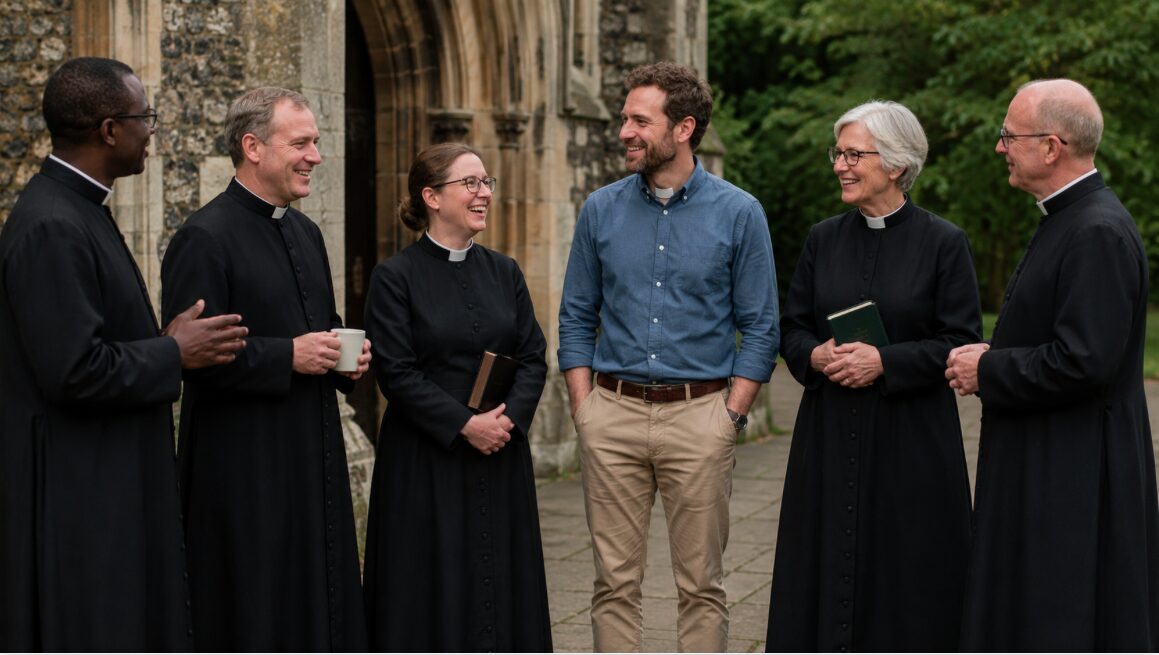
What we wear sends a particular message. But, ironically, the message that conventional clergy attire (clerical collar, cassock, and so on) sends is actually the opposite of what it was designed to communicate. And what message do we actually want to convey?
I was interested to read, two weeks ago, Angela Tilby’s column in the Church Times, How clergy dress sends a message. I think she makes some astute observations about the importance of our attire.
In our class-conscious society, there will be many who regret the association of clergy with “status” and believe that they are more accessible in ordinary clothes. This assumes, of course, that there are “ordinary” clothes. But clothes are always coded symbols. Jeans and trainers send a particular message, as do jackets and chinos, suits and shorts, dresses, skirts, tops, and jeans.
She is correct that our clothing does send a message, and she clearly believes that clerical attire should send a particular one.
In a society that has lost touch with scripture and, with it, all kinds of “habits” of understanding, there is something to be said for the clergy to be visible, even if the first sight of oneself in a clerical shirt causes a frisson of panic.
It is worth noting that the message we convey in Western culture is much less clear that it has been in the past. Going back to the origins of the Church of England, we need to note that Elizabeth I inherited and enforced a long tradition of sumptuary laws—laws regulating what people of different ranks could wear. Their purpose was not primarily economic but social and political: to preserve the visible hierarchy of English society—though they did also sometimes have an economic purpose. (The Statute of Caps in 1571 required every male over the age of six (with some exceptions) was required to wear a cap made of wool on Sundays and holy days. The cap had to be made in England by someone registered in the trade of Cappers, and the law was designed to protect the wool trade.)
Thus, in historical paintings and decent historical dramas, you can often tell what occupation people had by the clothes they wear—you can distinguish shepherds from carpenters from blacksmiths from shop keepers very easily and quickly. Of course, some of these originated as functionally appropriate—but the particular tradition of dress then becomes an end in itself and a marker of identification.
But we have no such laws today! There are often unwritten expectations in different contexts, so if you work in business, you dress in a particular way, and if you are a ‘customer facing’ employee, there will be exceptions. (When I worked in business, in Mars Confectionery in Slough, there was a rather hilarious set of unspoken and unwritten expectations about what to wear in the office. Two-piece suit was fine, but three-piece was definitely frowned upon. And having a beard was definitely taboo!)
So we have moved, over the centuries, from a culture where dress was defined, was hierarchical, and was designed to communicate the social hierarchies of the time. Within this context, where did clerical dress fit?
Angela notes, correctly, the origins of the cassock:
It is, perhaps, worth remembering that the technical name for a Church of England minister is “clerk in holy orders” (hence terms such as “clergy” and “cleric”). The phrase is a reminder that, in the Churches of the Reformation, the clergy are, indeed, “clerks”: those who are “educated” in scripture and are, therefore, capable of teaching the flock and offering pastoral care. That is why the choir dress of the English clergy is a form of academic dress, complete with university or college hood, and usually worn with a surplice.
In fact, its history goes further back than that. The cassock ultimately derives from the long tunics (Latin tunica) worn throughout the late Roman Empire. I remember being struck by this the first time we visited Morocco on holiday a few years ago: all the men appeared to be wearing cassocks! I suddenly thought that, if I wore my cassock, I would fit in rather well! The main difference is colour; where the tunica could be different colours (and in Morocco they still are), at the Reformation black gradually became dominant after the Reformation because it conveyed, sobriety, learning, seriousness, and humility—but it also reflected the dress of university scholars and educated professionals.
As secular fashion gradually shortened and became more varied during the Middle Ages, clergy tended to retain the older, longer style of clothing. This is a common pattern in history: institutions often preserve older forms of dress after the general population has moved on.
So for the cassock, there has been a double preservation—from ordinary clothes, to academic wear, and from academic wear, to the clerical. (I suspect I am relatively unusual in having attended a school where teachers wore an academic gown to teach in the classroom…! But it used to be the norm.)
The key thing we need to note here: the purpose of the cassock was not to be distinctive but to conform—to conform to a particular class within the hierarchy (the educated) so as to be an indistinguishable part of them. When fashions moved on, the institutionalised practices of the Church were cemented, and so the distinctiveness which Angela thinks is a virtue arose completely by accident.
The same is true of the clerical collar. The white clerical collar has a much shorter history than the cassock. Although it now seems quintessentially ‘traditional’, it is largely a nineteenth-century development. Ironically, what many people think of as the timeless badge of Anglican clergy would have been unknown to most English clergy before about 1850.
As you might have discerned from watching Jane Austen adaptations (the 2005 Pride and Prejudice with Matthew Macfadyen and Kiera Knightley remains my favourite) high collars with a white cravat was the distinctive dress of gentlemen. It was to fit in with and be indistinguishable from this class that clergy adopted the same fashion.
During the nineteenth century, men’s fashion changed dramatically. High, stiff detachable collars became common because they were easier to wash than shirts (though, as Angela notes, it was unlikely that it was the men doing the washing or ironing!), they were cheaper to replace, they could be heavily starched. Clergy adopted these collars in black shirts, and eventually, instead of wearing a complete white collar, they began wearing only the visible white front attached to a black collar—which gradually evolved into the familiar “dog collar.” (The main virtue of this, as any cleric will tell you, is that if you have forgotten to slot one in, you can quickly adapt a plastic washing-up bottle or a piece of white card in an emergency…!)
Once more, something that was intended to be a sign of conformity to a particular class became a sign of difference, since fashion moved on, whilst the Church stayed still.
It turns out that this dynamic—of institutional conservatism in contrast to societal change—is found in all sorts of institutions and organisations. Judges’ wigs are a good example (and are also the subject of a similar debate). In seventeenth-century England, wigs were simply fashionable men’s wear. Judges, barristers and gentlemen all wore them. When wigs went out of fashion in the late eighteenth century, lawyers kept wearing them because they were part of professional dress, they marked continuity, and they came to distinguish the legal profession. But the original reason lawyers wore wigs was simply that everybody respectable did!
(Soldiers’ ceremonial uniform is similar. The bearskins of the Guards have a complex history! Soldiers normally wore wide-brimmed hats, but grenadiers (who threw grenades) needed something to allow free movement of their arms. They thus wore ‘mitre hats’, first adopted by the Prussians, and these developed into tall hats that looked imposing and made soldiers seem taller and more intimidating. The British guards adopted them after they defeated Napoleon’s Imperial Guard at Waterloo—they basically stole them as a trophy of victory! Now, of course, they have no practical function.)
This is how the process goes:
- Everyone wears X because it is ordinary.
- Fashion changes, but one institution is conservative.
- That institution continues wearing X simply because it always has.
- X becomes distinctive.
- Later generations ask, “Why do we wear X?”
- Symbolic or theological explanations develop. These explanations are entirely post hoc and actually have nothing whatever to do with the origins of what is worn.
So let’s return to Angela’s original question: what message does distinctive clerical dress now convey?
She was prompted to write, because this is ‘ordination season’, and those ordained will be wearing—for the first time—distinctive clerical dress. This has a significant psychological impact, since when a caste has a distinctive dress, adopting that dress has a powerful psychological effect in a person’s induction into that caste. That is why ordinands wearing cassocks feels so important.
I had a similar experience when working at Mars. After a spell in the national office, I ran a production line in the factory, and for that you had to wear ‘whites’, a clean white work shirt and trousers, with black DMs, which was provided for you for the purposes of food hygiene. But everyone had their own name sown on to the whites. I can still remember the feeling of opening my locker for the first time, taking out the whites, and seeing my own name stitched on them. I suddenly felt like I really belonged!
And there is no doubt that distinctive dress has an impact on the sense of identity for those who are ordained. Social identity theory tells us that wearing distinctive clothing increases a person’s sense of belonging to the group, increase role salience (people become more conscious of acting consistently with the role represented by the clothing; this is sometimes called “enclothed cognition”), and encourage conformity—uniforms tend to reduce individual variation and reinforce institutional norms.
Whilst there are clearly some benefits to this—is this what we want in our clergy? Greater institutional conformity?
And what impact does distinctive dress have on those outside the group? How does it affect perception of others? Angela notes that, if you wear a collar, then sometimes people feel able to talk to you, and it is possible to say and do things (as a member of a ‘respected’ profession—though this is increasingly less the case) that you otherwise would not.
But it also can create distance, and put other people off, especially those who have a lower view of the Church and the Christian faith in general. Besides, I personally find that smiling and saying nice things to people is perfectly sufficient to open up trust and conversation!
The creation of distance is especially pronounced when clothing is ornate. From a psychological point of view, human beings are remarkably sensitive to costly signals. Expensive clothing communicates authority, prestige, wealth, power, and institutional importance. This is sometimes discussed in terms of the Costly signalling theory (yes, there is such a thing!): because elaborate dress is difficult or expensive to acquire and maintain, it signals high status or commitment. This then makes people perceive that the person dressed expensively and elaborately is elevated, remote, and ‘not one of us.’
More seriously, there is clear evidence that such dress also creates ‘authority bias’. Research consistently finds that people (quite unconsciously) attribute greater competence and authority to individuals dressed in expensive or formal clothing. Again, this results in increased compliance, greater deference, and a reduced willingness to challenge.
Dear reader, as you have got this far in the article, I am sure you are asking yourself ‘Why hasn’t Ian talked about bishops wearing mitres yet?!’ Well, that is a whole other subject, and there are very good reasons for bishops to throw away their mitres, because they are simply not historically Anglican, because they are derived from dubious symbols of power and dominance—and also they look silly.
But they fit exactly, psychologically, with the aspects of expensive dress I have listed above.
A confession: I have generally been a fan of wearing a dog collar, and I don’t mind wearing cassock and surplice (though I find them hot and not very comfortable). But the more I reflect on their origins, their first meanings, and their impact today, the more I am inclined to think again.
Does Jesus call us to be distant, in a hierarchy, and set apart socially from those around us? Does he ask this of those called to distinct ministries? I remember once reading a father of the church say ‘I would rather people knew I was a bishop by my lifestyle rather than my dress’; I cannot now find the quotation, but it is a good instinct.
Additional note: I am grateful to Anthony in the comments below who found the quotation I was thinking of:
In 428AD Pope Celestine I wrote a letter to the bishops of Vienne and Narbonne in Gaul (France), castigating them for wearing fancy vestments: “We [clergy] should be distinguished from the common folk by our learning, not our garb; by our behaviour, not our clothes; by the purity of our minds, not our attire…”
And within the Church of England, with its excess number of leaders, and trust at a low ebb, do we really need more institutional conformity and a greater culture of deference?
Angela is right: we need to think about how clergy dress sends a message.
 Buy me a Coffee

















Since Jesus himself said “Take no extra tunic” to the people he was sending out to do ministry in his name, and since Jesus was the last priest (we are presbyters in a church which clings onto a priesthood that ceased on the cross), I have never been able to fathom why those charged today with doing ministry in Jesus’ name should spend many hundreds if not thousands of £’s on dressing up in their version of ‘priestly attire’ with many many extra tunics.
I have always believed and will always believe that we are to dress in our normal clothes. Respectfully? Yes. Extravagently? No. Ecclesiastically? Absolutely not.
I agree. I remember watching a communion service during lockdown held in Welby’s kitchen. There he was fully togged out in his robes. Why not look smart in ordinary clothes? And that applies to all C of E clergy.
As the C of R is a Catholic but Reformed church with bishops of apostolic succession. It has robes for its clergy and mitres for its bishops to reflect that
As the C of E is a Catholic but Reformed church with bishops of apostolic succession. It has robes for its clergy and mitres for its bishops to reflect that
Well said!
I think very few of us have any idea how subtly ‘coded’ our ‘casual’ clothing is.
It is just when we are at our most ‘normal’ that we are sending unintended symbols of what we consider ‘normal’ to be. And it is nothing at all to do with how ‘ornate’ clothing is. When we assume our personality has been neutralised and our demeanour generalised.
I hate to break it to some, but the ‘Chinos, button down collar and smart tennis-shoes look’ is not by any means nationally ‘normative’ clothing.
Mr Blair famously, for instance, was the first to remove his tie in politics and declare the class system finished, even as actual inquality took off again in national life. Hypocrisy and conceit of this sort really is our national ague. We are never more self-deluding in this land than when we think we are being candid – in speech, in manner and in dress
So I think I take a very low view of the church, of the ministry and the hierarchy but a minister is a minister and I like them to dressed like a minister. I find that courteous and I appreciate it.
Not because I believe in a sacerdotal priesthood as a caste apart, but because I like things to be done “decently and in order” and in the accepted national idiom of dress to which centuries have accustomed us.
Brother, I am not persuaded that Jesus is giving advice about what clothes to wear in that passage.
It is much, much deeper calling to trust, spiritual humility and simplicity.
Not what clothes you should or should not wear.
The related issue of liturgical dress shuold be considered. The cassock-alb serves a particular function in liturgy. It is worn to anonymise the person presiding. You don’t see the man (or woman) but rather a priest. This is helpful as the very human clergy often get things wrong, make stupid mistakes, behave badly. It can therefore be helpful to have a visual clue that enables you to look beyond the limitations of the individual and rather see the function they are fulfilling – standing as a priest before you.
I find it helpful too, as it reminds me of what I am about to do, act in a very particular role. For these reasons, I think it is very helpful.
You might also consider why God himself took an inordinate interest in how his priests were to be dressed under the Old Covenant. If it was all pointless, why did God pay so much interest to it?
Thanks for commenting Stephen. But a few observations.
First, I think you are kidding yourself when you say people see the role! They see you! And why should they not? Are we not presiding as the president of the community, in relation with them?
Secondly, as the ordinal makes clear, there are now only two kinds of sacerdotal priesthood: that of Jesus, and that of the whole priestly people of God.
In NT terms, we are not hierei, but presbyteroi, not ‘priests’ but ‘elders’. And there is no dress code for such people anywhere in the Bible…
Still think it is valid and helpful. Nothing you have said changes my mind. There is also the sensory dimension that reminds us that we are entering a mystery. Jeans and chinos don’t help with that!
The problem is that blue shirts and chinos are very class coded; vestments are anonymous, classless, and sexless. They orientated us towards God in a way on which lounge suits or jeans never could.
If you don’t think clergy robes are class coded, then you need to get out more…
I completely agree.
It allows the personality of the officiant to recede from view.
Ian
What class do vestments belong to?
To the historic learned, professional, gentleman class.
Penelope
What class did the clergy traditionally come from?
Vestments?
You didn’t have to be learned to wear vestments!
Lounge suits and chinos are, however, irredeemably middle-class. The HTB caste of priests and believers – mainly white, mainly straight, mainly professionals, mainly comfortable.
Anthony
Depends how far back you go, and on which countries.
Duck for lunch, Penelope?
The mystery is that we, the people of God, are his holy temple and his priestly people. Does that mean we cannot wear casual clothes?
And it all depends on whether you accept my observation that clergy are presbyteroi and not hierei.
Do you…?
With respect, I don’t think your hard dilemma fits.
It is not a question of the role and function of the minister at all but simply a question of good order.
Clerical dress – the surplice and cassock – happens to have been the inherited and habituated conventional dress of those in the ministry in this Kingdom for 500 years.
A set form of dress, a minimum standard of decorous habiliment of some kind, seems to be inescapable if we are to conform to the Apostles command to “Let all things be done decently and in order”. Now who can agree on what constitutes ‘decent’ attire today? I think you would be surprised by the lack of consensus.
Therefore any unilateral departure from the priceless gift of an inherited, uncontested standard is to be avoided most scrupulously unless it proves itself unarguably and obviously necessary.
Any departure, thereforem, from the blessed peace of an accepted order, whether it be Mitre and Chasuble or Shorts and T-shirt, represents a needless novelty and just one more thing to disagree over.
Thanks William. I can only see three issues with your comment.
First, there is nothing indecent about ordinary apparel.
Secondly, the Apostle was clearly not making a comment on distinct clerical dress.
Thirdly, you appear to be conveniently forgetting the historical reality: what we have today is an institutional conservation of what was *normal* apparel in the past and *not* distinct. It was designed to conform to culture! At what magical point did the theology sudden arise that we need to be distinct…?!
Surely this is more problematic, not less so.
If the liturgical vestments remove the humanity from the ‘priest’ and place them in that role as mediator between man and God, then all human failings of that priest beneath the clothes get transferred to God? Here is a figure representing God to us supposedly, yet we all know, as Ian mentions above, that this is really still that same person. We know them, warts and all, and yet here somehow is a representation of God’s stand-in?
That doesn’t work for me in the slightest. It is far far worse.
Yes indeed. In the New Testament all believers are priests and Jesus Christ is our High Priest and the sole mediator between God and man.
Please note typo early in the article: “you can often tell what occupation people had by the clothes they were”.
I am a Reader in a team of four churches. In one, I wear full robes, in another just a cassock and in the other two I wear a suit.
I’m happy with all three modes, as two of the congregations take comfort from the authority shown by robing where as the other two are very low church and don’t like “High Church” stuff.
I’m much more interested in an area you don’t really explore: how do clergy in the street relate to non-Christians? Are they put off by the collar or do they feel this is someone I can trust? Do you have much experience of either?
Hi David
I robe for one service and don’t wear a collar for two. I rarely wear a collar, except for something special like a hospital visit to someone I’ve not met.
I find a collar opens doors with some BUT it closes it with others. I’ve had some people say they wouldn’t have spoken to me if I was wearing a collar. My parish had a RC priest in it, a few days decades ago who is now in prison for abuse. The parish has never had an evangelical in place and I decided from the beginning to do something different. It has not hindered our growth on a white working class estate, in fact the Lord has done remarkable things.
One time in my curacy I sat on a bench on the high st in s e London – the only conversations I had were with those who knew me. I then took off the collar, took my child to the park, had a long conversation with a parent I’d never met and invited him to Church. It’s anecdotal but it did make me smile.
I regularly have people comment about me being down to earth or normal (they don’t know me that well) and perhaps that would work with a collar, but in my context and my personality etc I expect less so.
However I know some people use the collar powerfully for evangelism.
Pete Greig in the vision poem says we wear clothes to communicate and celebrate but never to hide….
I also don’t want to diminish the priesthood of all believers or imply I’m some special class if Christian. I just have a particular calling and have been authorised to do certain things
Thanks Andy—what fascinating reflections!
Thank you Ian, I agree with your reflections on how clergy dress can be perceived.
I am not sure how to understand canon C 27 “Of the dress of ministers” – I would love to hear your and other people’s thoughts on this. Especially that the apparel shall be such as to be a ‘sign and mark of his holy calling’. Doesn’t this imply that the clothing must be distinctive in some way? We might think the canon is wrong, but every ordained minister has sworn before God to obey it.
Canon C 27 “Of the dress of ministers”
The apparel of a bishop, priest, or deacon shall be suitable to his office; and, save for purposes of recreation and other justifiable reasons, shall be such as to be a sign and mark of his holy calling and ministry as well to others as to those committed to his spiritual charge.
I think yours was the most salient and insightful response to the question. Thank you for bringing it to our attention.
After seeing picture of an ordination service in our diocesan news letter I rather let rip about the bishop all dressed up like a Christmas tree. The faux medievalism of it all. Look at the paintings of the coronations of George III onwards to Victoria. Not a cope or mitre to be seen. One of our bishops responded that ‘it was expected’! Oh dear, one longs for some saboteur to hide the key to the diocesan dressing up box. Could someone who reads this let me know if the ‘fancy dress’ was an innovation from the early 20th cent.
The later 19th century, when high church notions became influential in the Church of England, due largely to the ‘Oxford movement’.
Certainly, within CofE circles the style of clerical dress sends coded messages: ‘One of us?’ Determining churchmanship by clerical collar style is less a thing of the present. I do remember Evangelical vicars from way back who distinguished their churchmanship by wearing a high starched collar virtually up to the chin and looking like a Giles cartoon vicar. Tonsure collars for ‘Spikes’ and wannabe ‘Spikes’ and for anyone who hasn’t got OA in their fingers and can manage the studs. For the rest, the safe plastic slip-in, except for those days when you can’t find any and hurriedly fold up and insert a sheet of paper, or cut up the Fairy liquid bottle making sure you put it in the correct side out! The cassock style can be more of a give-away: DB or central buttons, 39 buttons? I don’t have a biretta, but I can think of a few people who bother me so having a beretta might come in handy.
Joking aside, I’ve found clerical attire helpful for ‘outside’ ministry. Several times I’ve been stopped by strangers asking for a chat and prayer. And always there’s an oil stock in my pocket for prayer for healing. Some encounters are very touching and moving, others are sadly hilarious. ‘Mike’ called me over in the High Street.
‘What are you, Anglican or Catholic?’
‘I’m Anglican.’
‘I prefer Anglican prayers; they’re much better.’
I prayed for Mike. At the end he said, ‘Amen,’ then added, ‘I can’t stand those JWs, and as for those effing Mormons!’ As I said, sadly hilarious.
Wearing the gear is not about me, but if the visible sign of my vocation encourages another to reach towards God, then that’s good. But a discerning ear is needed when a stranger calls out, ‘Morning, Father!’ For most, usually it’s a courteous stranger’s greeting, but for others their tone marks a response to clerical authoritarianism, or worse, abuse. Whatever is our outward appearance, most importantly we need to tread lightly, it is God’s ground, not ours.
In 428AD Pope Celestine I wrote a letter to the bishops of Vienne and Narbonne in Gaul (France), castigating them for wearing fancy vestments: “We [clergy] should be distinguished from the common folk by our learning, not our garb; by our behaviour, not our clothes; by the purity of our minds, not our attire…”
Napoleon would later deliberately send a Pope a triple tiara that was too heavy to be worn.
THANK YOU FOR FINDING IT!
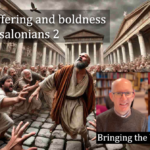
Quick aside: is that an AI-generated image? The low church clergyman appears to have a dog collar suspended mid-air around his throat and not actually connected to his shirt in any way…
Well spotted. If you can find a better image, let me know.
Around the throat….Sometimes it feels that way.
Head “extirpated” by collar… word discovered in the New English Bible some years ago.
Some quick points:
Often forgotten today but at the time of the reformation clothes coloured black might be a sign of seriousness but not really of humility. Black was one of the most expensive colours to wear because it requires a lot of dye – you have a bit of leeway with other colours, but if you go for a different shade of black you’ve got grey.
There’s a distinction between what you wear in a church service and what you wear out and about. And this applies to people other than clergy. My dad for example, if he was distributing communion that week would without fail wear a suit and tie to church that Sunday. I myself won’t wear shorts in church ever. And it used to be fairly common for people to go to church in their ‘Sunday best’.
As has been pointed out above the canons say clergy apparel should be a mark of holy calling. There’s something to that. And the early Church was familiar with it – after all didn’t Polycrates of Ephesus tell us that St John wore the sacerdotal plate? Personally I have a preference for plain cassocks and chasubles etc., which give a mark of distinction, and underscore that something important is happening at the Eucharist. The recent coverage of the Society of St Pius X has given ample opportunity to see what happens when this sort of thing gets way out of hand.
Even ultratrad Catholics are amateurs at dressing up compared to the Orthodox. This is the ordination in Orthodoxy of a mere subdeacon:
https://www.youtube.com/watch?v=ZFlxl36W9L0
I doubt anyone can surpass Cardinal Raymond Burke though with his penchant for being bedecked in the most elaborate robes, not to the mention the infamous cappa magna. Oddly enough Burke has strong views on changes to Catholic liturgy, worrying that the Mass is now too priest-centred and becoming a ‘priest show’….
So your advocacy here of High Church ceremonial does have its limits – it’s just that you want your limits and not anybody else’s. That at least is consistent with your theological viewpoint on various matters.
Or maybe I just pay heed to the virtue of moderation.
Upon which you consider yourself the sole arbiter?
I argue my own views. Are you making arguments you don’t personally believe in?
If you just did that it would be OK. But you tell others to quit the C of E if you don’t like (among other things) High Church stuff.
Sure you’re not confusing me with Simon?
I do love a bit of ecclesiastical tat though.
One of the strong points of agreement between Ian and I is our visceral dislike of mitres.
There’s a lot to be said for some form of distinctive dress, ie comfortable dog collar, for at least some of the time. It might attract abuse, but might also provide an opening. Robes and vestments seem rather different to me, and should I think be kept for special occasions.
Where professional dress is expected in church there really seems no point in needlessly upsetting people. Like David Sherman, I’ve varied my practice as a reader. Then there’s the issue of what to wear instead. A dark suit or dated jacket also send a message. Bright or light colours in gloomy buildings, please!
Except our challenge in the C of E is *not* ‘do people talk to clergy’ but ‘are the laity empowered to share their faith?’
The whole repeated discussion of ‘People talk to me when I have my collar on’ actually makes witness and evangelism the province of the clerical class. We need less of that, not more!
Maybe we should all go back to what they wore in the Garden of Eden before the fall..
Chris, are you aware that that is/was a serious theological movement? Called Adamism.
https://en.wikipedia.org/wiki/Adamites
Yes l think l have. I think their faith grew cold..
Especially in this heat.
They would thrive in this heat Penelope. As the climate changes maybe we will see a resurgence of them.
I think the point which Anne is making that if one is out and about with a ‘collar’ on, people will feel that they can initiate a conversation with you about serious matters.
Two examples: the late Andrew Watson once related that, when a vicar, he was on a train going to a meeting in Church House. “I suppose I ought to wear a collar” he had thought. A young man sat down next to him, and was looking at his phone. “Are you a minister?”, the young man asked? “Yes”. Then the young man shared something about his mum, how she was unwell or something (I cannot remember the details). Without the collar, this young man would not have initiated the conversation with the stranger next to him.
When the Grenfell Tower disaster happened, Graham Tomlin, then bishop of the Kensington Area, sent his clergy out, wearing a collar, to be available to anyone who needed to talk. People did.
For sure. But it *always* cuts both ways. See Andy Bond’s comment below.
And again: many of these comments are about clergy. The issue in the C of E is about laity speaking about Jesus, not clergy.
Perhaps in that case we should be telling the laity that they should always wear a small lapel cross and be identifiable?
I did when working as a chartered accountant: it initiated many conversations in the office and outside, and was important in preparation for priestly vocation.
Being signed with cross, a symbol of shame, on the forehead, where your allegiance is proclaimed, is part of baptism. As Christians we should all proclaim our allegiance and be prepared to give account of the hope that is in.
But that lack is no argument for making presbyters less recognisable, but for making all Christians more recognisable.
Agreed! Empowering the laity – a whole new topic. We need teaching/reminding, and practical encouragement. So many opportunities missed by all of us – what has happened to Ascension Day and the opportunity to revisit Acts1:8? People vary: in the present climate there are still those who are more likely to approach someone they see as having credentials.
If you want to empower the laity, tell them that they are priests just as much as chap up at the front, and audit them to find which of the gifts of the Holy Spirit they have.
My immediate thoughts when reading the article turned to the message in our hearts and on our lips, and how we convey that. Can you imagine Billy Gaham wearing a cassock? His message was in his heart and on his lips.
What did the Apostles wear.
A good question!
Interesting comments and historical content. Like yours, Ian, at my school the masters wore academic gowns to teach (save the art and PE masters), and hoods on special occasions.
Which may be why I have never felt particularly comfortable in choir dress, not being a graduate.
However, at the altar I always dress in a 3rdC Roman gentleman’s “Sunday best”, as a part of “putting on” the priest and setting aside self. (And, yes, “priest” is a shortening of presbyter; it is god’s people which is the “sacred people” collectively.)
Perhaps it is my background and experience, but I have always found that dressing according to my office opens opportunity – even if that be for being mocked or abused, as we were warned – and for real spiritual encounters and opportunities for “ghostly advice and counsel”; I have heard confessions on trains and once on a night bus, simply by being there and identifiable.
The attire of the cleric in the centre would hinder, since it says, to me, “I can’t be bothered, I don’t take my office seriously, nothing matters ” (and I don’t own an iron)
The attitude of those who say that when ordained they took all their non-clerical shirts etc to the charity shop is also somewhat odd to me!
George Herbert in ‘The Collar’ poses the question ‘Shall I still be in suit?’ and by the end of the poem, after a divine revelation to the heart, he submits to God and the answer is ‘yes’. Ian Paul suggests that if he is obedient to God’s calling, the answer may be ‘no’.
There’s several sides to this question: first, what do I wear leading worship that does not cause those being led in worship to be distracted with what I am wearing – this applies to worship leaders, musicians and anyone taking part; what we wear on our feet when giving communion as well – trainers, flipflops, or clean shoes- whether there’s sloppiness, or unkempt can detract others… John Leach in “Liturgy and Liberty” (first edition) has a chapter on this which is well worth a read. Second, what we wear out of our leading roles – when we live in the anointing of the Holy Spirit, others will notice immediately that we somehow stand out (had that at a recent funeral of a dear cousin – FD immediately spotted that I had ” that air” about me). Who we are, full of the Holy Spirit, is what others notice – our demeanour, attitude, expression – we don’t need to wear crosses or clerical collars to live in the Spirit. Third, sometimes wearing something which is designed to “hide” us is a good thing – no sartorial competition, and with both sexes involved, there is a need for some sort of decorum to get others focusing on Christ and not on us. A friend of mine who worked with YWAM went out to Siberia and Mongolia and shared the gospel out there. One of them wore a particular type of cross; when they returned a year or so later, all those who had come to Christ wore copies of this cross because they’d thought that’s what Christians do. Paul wrote “Be imitators of me as I am of Christ” and it was taken very literally… just a few additions to the conversation….
There’s several sides to this question: first, what do I wear leading worship that does not cause those being led in worship to be distracted with what I am wearing – this applies to worship leaders, musicians and anyone taking part; what we wear on our feet when giving communion as well – trainers, flipflops, or clean shoes- whether there’s sloppiness, or unkempt can detract others… John Leach in “Liturgy and Liberty” (first edition) has a chapter on this which is well worth a read. Second, what we wear out of our leading roles – when we live in the anointing of the Holy Spirit, others will notice immediately that we somehow stand out (had that at a recent funeral of a dear cousin – FD immediately spotted that I had ” that air” about me). Who we are, full of the Holy Spirit, is what others notice – our demeanour, attitude, expression – we don’t need to wear crosses or clerical collars to live in the Spirit. Third, sometimes wearing something which is designed to “hide” us is a good thing – no sartorial competition, and with both sexes involved, there is a need for some sort of decorum to get others focusing on Christ and not on us. A friend of mine who worked with YWAM went out to Siberia and Mongolia and shared the gospel out there. One of them wore a particular type of cross; when they returned a year or so later, all those who had come to Christ wore copies of this cross because they’d thought that’s what Christians do. Paul wrote “Be imitators of me as I am of Christ” and it was taken very literally.
For some years now, I have been wearing shirts with ordinary collars and a white slip-in 1″ collar sewn with waist elastic and a popper to keep it in place. I normally where shirts of colours that match the season we are in.
I now minister in a church with a large African element, so my wife has made me shirts with African print material to make the folks feel at home. They have gone down well.
The advantage to this arrangement is that you don’t need to buy clergy shirts and if you don’t require the slip-in collar you can remove it and become a normal person again.
You raise some interesting points, especially around the origins of some Anglican dress. However, I feel despite those origins, there is something to be said for taking personality out of ministering and anonymising it. I think my collar gives permission for entering into particular space and conversation that would never happen without it. Much to ponder but ultimately a personal choice?
Yes, possibly. But just make your decisions fully aware that whole generations in the past not only thought this was unnecessary—but that they would do exactly the opposite!
Interesting insights, thanks Paul.
I similarly find a dog collar useful…only last night I had numerous conversations and prayed with one very anxious young man while I was trying to find a parishioner in hospital.
I do confess to finding some of the dress of my Anglo Catholic brothers a tad off putting and at times even pharisaical. Modest set apart seems to strike the balance for me.
Thanks Hamilton. But why the need to be ‘set apart’ when it was not felt to be needed by our forbears and when our non-conformist brethren (many of whom have growing churches) appear to manage without…?
I recall going to a christian festival sometime ago (can’t remember which) where you could by a T shirt with these words boldly emblazoned on the front
POWERED BY THE SON
Seemed rather in keeping with the move to reduce our reliance on fossil fuels.
That sounds like Greenbelt.
Very thought-provoking and informative as ever, thank you.
It has challenged me – an habitual dog-collar wearing cleric for 32 years+ – to ask why I do what I do and what it signals.
I think it has a personal meaning – ‘I’m at work today’ – so my time and being are public in a different way from my day off, when I wear ‘normal’ clothes.
But the signals – about separation from the laity, and the barriers that it can create, require some reflection from me.
On the question of vestments etc, there are some forms of worship -formal, liturgical – which they help, IMO. But I do wonder if their elaboration (and the elaboration of ceremonial) is sometimes a compensatory mechanism in the face of insecurity of role and status in a post-Christian culture?
Thanks Derwyn. I think you have rather hit the nail on the head in your last comment!
Is there a question of liturgical importance, of bringing a weightiness to services?
A friend, a retired CoE minister said that he knew one retired minister who was bereft as he mo longer had an altar! Along with the altar is the garb.
Why do ministers wear some of the garb as they go about everyday matters, traveling, walking about, though it seems less common today?
I didn’t see anything inclusive before I was a Christian, now if anything, I’m more likely to question their beliefs, as I may of JW’s standing around with their stalls.
On a different note I attended a funeral a couple of weeks ago, which took place in an Anglo/Catholic church- it had plaster casts of the stations of the cross on the walls. It had some liturgical formality and some scripture, ending with a not so common passage from Revelation, chosen by the family.
The whole device, I found surprisingly, offered reverential ballast to believers.
And after our service last Sunday, (Habakkuk) it stimulated discussion amongst a few of us about the modern day push for funeral celebrations, led by celebrants.
To address Ian’s other point about appropriate clothing for the laity and the whole people of God, I refer to the example of the Lord Jesus Christ, and specifically to John 19:23 “They took the robe, which was made of one piece of woven cloth without any seams in it.” I infer that Jesus was slightly better-dressed than the soldiers expected from a travelling rabbi and ex-building-contractor. So we can dress to fit in, but – as we are always to some extent public representatives of the Faith – we might aim to look just a tad crisper than the public expect for someone of our social and economic status.
That is quite an unusual thing to take from that text…!
Aiming to take the text at face value: “The soldiers said to one another, ‘Let’s not tear it; let’s throw dice ….'” – in other words, they had done crucifixions before and dividing the clothing into 4 was standard practice. But the situation now before them – in terms of the goods on offer – was unusual enough to justify a deviation from the standard practice.
The prosperity preachers make a lot of this pricey seamless robe too. As they do of God owning the cattle on a thousand hills, and the promise that we will be the head and not the tail.
As someone brought up in low church contexts, I have always found clerical dress off-putting; I don’t believe that ministers of any sort (high, low or middling!) stand between me and God. I have one High Priest, Jesus, who stands between me and the Father. Special dress (whether intended to or not) suggests a priestcraft that I thought the Reformation had put paid to.
I have always been amused by the moniker ‘dog collar’; I don’t know any canine that wears anything similar!
PS Why the requirement for a website when posting?
This reminds me of a few decades ago when a well known
Missionary outfit sent out an instruction to it’s missionaries
“To adjust to the cultural lifestyle norms of their situation as possible”
[I forget the wording of their missive]
Two missionaries sent in replies saying something like “Hallelujah, we are working amongst Japanese millionaires!”
Hudson Taylor of Chinese fame adopted Chinese dress and hat.
We are not informed as to what “normal dress” is for the switched on ,dropped out,Cool, wicked clerics should wear.
The consensus seems to me to be “horses for courses”
Some seem to me to be coming from left field, much like our nearly new PM
Man of the people, black T shirt Andy, how will it play out on the International stage? Seriously?
Much ado about nothing?
Volodymyr Aleksandrovich Zelenskyy wears battle fatigues as a statement but changes for serious diplomatic occasions these days.
People recognise the meaning of uniforms, folks from left field hate any kind of uniform.
Traditional dress for Church of Scotland ministers for worship has been cassock, academic gown and hood over clerical collar and vestment. Interestingly, this has been abandoned by many ministers in favour of ‘everyday’ clothes (although sometimes retaining the collar). All Moderators of the
General Assembly are entitled to continue wearing a more ceremonial gown with tassles, called ‘frogs’. This year’s Moderator, however, has decided against wearing this traditional dress, and only wears a suit, black vestment and clerical collar. It is not clear what has brought about this large scale rejection of traditional dress.
‘If I but touch the tassels of his garment, I shall be made well,’ Jesus’ sartorial choices were obviously not run-of-the-mill Greco-Roan. Why should we conform?
Lorenzo – unless I’ve misunderstood, your quote doesn’t seem to make your point for you – it makes the opposite one.
This is important because Jesus *was* wearing clothing that an observant Jew would wear – because an observant Jew is what he was. (He was certainly not Graeco-Roman.) One of the values of this passage is to underline that very point. We lose track of such details to our loss, and that losing track is related to the neo-Marcionism that pervades too much Christian thinking.
The tassels are specifically called tzitzit (plural; singular: tzitzis). The tallit is a four-cornered garment or garment-like cloth with tzitzit attached to its corners. Now known as a Jewish prayer shawl.
The command to wear the tzitzit comes from the Torah in the Book of Numbers, Chapter 15, verses 37-41. In this passage, God instructs Moses to tell the Israelites to make fringes (tzitzit) on the corners of their garments and to bind a blue thread among the fringes *as a remembrance to keep all the commandments of the Lord*.
Is it not important to know that Jesus wore “a remembrance to keep all the commandments of the Lord”!
The relevant passage states: “37 The Lord said to Moses, 38 “Speak to the Israelites and say to them: ‘Throughout the generations to come you are to make tassels on the corners of your garments, with a blue cord on each tassel. 39 You will have these tassels to look at and so you will remember all the commands of the Lord, that you may obey them and not prostitute yourselves by chasing after the lusts of your own hearts and eyes. 40 Then you will remember to obey all my commands and will be consecrated to your God. 41 I am the Lord your God, who brought you out of Egypt to be your God. I am the Lord your God.’””