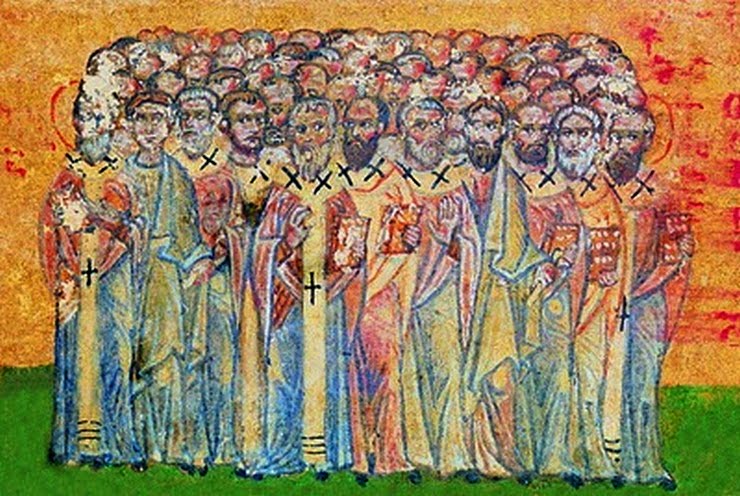
This week Sunday lectionary reading for Trinity 3 Year C is Luke 10.1–11, 16–20 which records Jesus sending out the seventy-(two) on ‘mission’ and their return. I include at the foot of this article the video discussion of this passage, together with the (new) video discussion of the NT epistle for this week, Galatians 6.
(Fora. further exploration of mission in the New Testament and the teaching of Jesus, see my Grove booklet here.)
The gospel reading from Luke 10 is passage that is rich with material for reflection on issues of ministry and pastoral theology.
1 After this the Lord appointed seventy-two others and sent them two by two ahead of him to every town and place where he was about to go.
There is some textual uncertainty about whether the number is 70 or 72, which I suspect is due to the sense of parallel with the 70 elders appointed by Moses in Numbers 11.16–25. This suggests Jesus is not doing something new, but repeating a pattern of God’s dealings with his people in the past—or, perhaps, better, that this radically new thing is the same radically new thing that God has always been doing.
He sends them out ‘two by two’; mission is never undertaken by individuals, but only in teams. That is why Paul never works alone—except in Athens in Acts 17.16–34, the only place where he fails to establish a congregation. This is a constant challenge to our persistent individualism. (I wonder if there is also a connection with the biblical emphasis on plurality of witness, in line with Deut 17.6.)
They were sent to the places ‘Jesus was about to go’ though in fact he does not appear to have gone there subsequently in Luke’s narrative. So the 72 actually function as Jesus’ presence in those places, which is confirmed by his later statement. The ‘kingdom of God’ is present in the ministry of Jesus, but now it becomes present in the ministry of the 72. Contrary to the current vogue saying ‘Mission is finding out what God is already doing and joining in’, this is much more like ‘Mission is finding out what God wants to do but cannot until we go there for him.’
2 He told them, “The harvest is plentiful, but the workers are few. Ask the Lord of the harvest, therefore, to send out workers into his harvest field.
In the West, it feels to me as though our conceptualisation of the missionary task is that we are more than ready, but it is jolly hard work and people are just not interested. In other works, the workers are willing but the harvest does not appear to be ready. Jesus here says exactly the opposite; the harvest is there, and ready, and all that is needed is for workers to go out and reap it! This in turn raises questions about what we are willing to do, and whether, despite our best efforts, we are really engaging in the kind of mission that Jesus has in mind.
3–4 Go! I am sending you out like lambs among wolves. Do not take a purse or bag or sandals; and do not greet anyone on the road.
It is worth noting here that mission is seen as inherently risky; if there is a power relationship, then those sent are the ones without power, which seems to be the opposite of most recent history of mission. There is a certain recklessness in the task, since those sent do not plan for their own provision. In a discussion at a conference I was at a few years ago, which included people with experience from Africa and the Middle East, the command ‘not to greet anyone’ was baffling and very difficult to make sense of in cultures where greeting was important. But it exactly reflects the sort of determined focus on the task that has marked Jesus’ journeying since Luke 9.51.
5–7 When you enter a house, first say, ‘Peace to this house.’ If the head of the house loves peace, your peace will rest on that house; if not, it will return to you. Stay there, eating and drinking whatever they give you, for workers deserve their wages. Do not move around from house to house.
I was struck here by the sense of reality that this section assumes. Those whom Jesus sends make a tangible difference; if they bless people, those people are truly blessed. Perhaps the most fascinating aspect of this reality is that the good news of the kingdom is almost a commodity, in the sense that people who receive it will be willing to support you because they appreciate the value of what you bring. The idea that we should receive from and even depend on the people to whom we are preaching is quite shocking; I think most of us assume that we need to do good to them in other ways as a recompense for the fact that we are asking for the privilege of preaching, or that the good we do is buying the right to be heard. Jesus here assumes that the good news is in itself enough of a blessing—and that those who hear it will be so grateful for it that they will be more than happy to recompense us. Paul makes the same point in 1 Tim 5.18, citing the Old Testament saying from Deut 25.4—but on face value also appears to know this phrase from Luke and includes it in the ‘scriptures’ that he cites!
Staying in one place has, I think, been made much of by Mike Breen who has talked extensively of the ‘person of peace’, the sympathetic recipient of the gospel we might find in the places that we go. We are to focus not on the crowds but on significant individuals in the communities to whom we are sent who respond positively.
8–9 When you enter a town and are welcomed, eat what is set before you. Heal the sick who are there and tell them, ‘The kingdom of God has come near to you.’
To ‘eat what is set before you’ would be a shocking thing for Jews who wants to observe the food laws and who visits those who are less kosher than they are, but is completely in line with Jesus’ other teaching which prioritises relationship over the niceties of legal conformity. In many parts of the world, being willing to receive hospitality is essential in establishing relationships; I wonder if Christians in the West need to learn more humility in receiving…?
One of the things I left behind when leaving the Roman Catholic church was the idea that the institution of the church is coterminous with those who are saved—in other words, that the kingdom of God and the institutional church should be identified. Whilst I would continue to reject such identification, it is challenging here to see that the kingdom is understood as being present in the embodied ministry of Jesus’ followers. This comes very close to Paul’s idea of the Christian community as ‘the body of Christ’, but because Paul’s language relates to the gathered community, we often forget that here Jesus applies the idea to the scattered community as well. We are Christ’s presence not just when we meet, but wherever we are. This idea is also powerfully present in the parable of the sheep and the goats; those who have welcomed, fed and clothed us (as we come to them on mission?) will inherit the kingdom. (The same idea is found in the saying about ‘whoever gives you a cup of cold water’ in Matt 10.42 and Mark 9.41.)
10–12 But when you enter a town and are not welcomed, go into its streets and say, ‘Even the dust of your town we wipe from our feet as a warning to you. Yet be sure of this: The kingdom of God has come near.’ I tell you, it will be more bearable on that day for Sodom than for that town.
If the earlier verses hold challenges for evangelical or pietistic understandings of mission, then these closing verses of Jesus’ commission contain a stark challenge to ‘liberal’ ideas of mission. Once again, the lectionary excises the uncomfortable verse, in this case verse 12—but there is no doubt that this verse is integral to the passage. (To be fair, the lectionary does include the difficult v 16.) The reality of the kingdom of God in the presence and ministry of the people of God means the departure of the kingdom on the rejection of the message. The command is simply to ‘wipe the dust off’; the idea that this is a ‘warning’ is an interpretive expansion in the NIV, possibly based on the parallel in Luke 9.5 ‘as testimony against them.’ The phrase also occurs in Acts 13.51, with a similar interpretive expansion in the NIV. The symbolism of the act arises from the Old Testament understanding of the Land of Israel as the place of God’s blessing; when God’s people return to the land from Gentile territory, they shake the dust off their feet so that the land of blessing will not be contaminated. The act thus becomes a sign of Jewish rejection of Gentile values and lifestyle, and signals a clear sense of separation between the two groups. So, ‘inclusive’ Jesus, who ate with ‘tax collectors and sinners’, is clear that rejection of the message of the kingdom will lead to symbolic and actual separation—to ‘lostness’ if you will.
16 Whoever listens to you listens to me; whoever rejects you rejects me; but whoever rejects me rejects him who sent me.
The saying appears to function as a summary of the judgement pericope in the previous three verses, which have been omitted by the lectionary selection. It continues the theme of the judgement saying at the end of the instructions to the seventy-two, that wherever those sent by Jesus go and proclaim the kingdom, Jesus himself is in some sense present, and he is at work in the ministry of those he has sent. It is striking, though, that the identification goes even further, so that rejection both those whom Jesus has sent and Jesus himself is also to reject the one who has sent Jesus. We often assume that the language of ‘I have been sent…’, with its assumption of pre-incarnate existence and Jesus being ‘sent into the world’ is a purely Johannine phrase, but it in fact occurs a number of times in the Synoptics and indicates that belief in Jesus’ pre-existence is present here too.
17–20 The seventy–two returned with joy and said, “Lord, even the demons submit to us in your name.” He replied, “I saw Satan fall like lightning from heaven. I have given you authority to trample on snakes and scorpions and to overcome all the power of the enemy; nothing will harm you. However, do not rejoice that the spirits submit to you, but rejoice that your names are written in heaven.”
It is striking that those returning thought that the most significant confirmation of Jesus’ words to them, and his granting to them of authority, was the power he had given them over demons. There is some clear confirmation that Jesus was known as an exorcist, in that Jewish sources from the first and second century thus associate Jesus with magic. What is striking here, though, is that Jesus connects this ministry with the defeat of Satan (in anticipation of the cross), and with the presence of the kingdom, as he does in the next chapter in Luke 11.20 (‘If by the finger of God I drive out demons, the kingdom of God has come amongst you’). As was anticipated in the Benedictus, the coming of the kingdom means freedom from every foreign power that occupies the human soul, freedom to worship God without fear. This association between the kingdom of God and exorcism appears to be entirely without precedent in the existing Jewish tradition.
But, once more, Jesus insists on keeping the main thing the main thing: for all those involved in Christian ministry, the focus and celebration is not to be on the ‘success’ of that ministry, but on the security that comes from knowing the love of God within the participation in the kingdom.
 There remains an important interpretive question: To what extent is this teaching, which Jesus gives to particular people on a particular occasion, really paradigmatic for mission today? First, it is worth noting that the word ‘mission’ does not appear in English translation here, or anywhere else in the NT for that matter. (In Acts 12.25 in the NIV, the word ‘mission’ translates diakonia, elsewhere translated ‘service’ or ‘ministry’.) But our word ‘mission’ comes from the Latin mittere ‘to send’, itself a translation of the Greek apostello—which Luke has Jesus use here, and which is a cognate of ‘apostle’. To say we are an ‘apostolic’ church means both to be rooted in the apostolic teaching and testimony, but also to be ‘sent’ on mission as the apostles (and the 72) were.
Luke emphasises the importance of this pattern by repeating it, first with the 12 in Luke 9, and then here with the 72. Matthew conflates Jesus’ teaching from more than one occasion (as is his habit, for example, in the Sermon on the Mount) in Matt 10, and interlaces it with what looks to be later teaching that relates to the period after Jesus’ death and resurrection. These all suggest that Luke and Matthew see this pattern as a template for the communities they are writing to, and not just of historical interest concerning Jesus’ practice.
It is also worth reflecting on the best ways to preach on this exemplary passage. It would be tempting to give a list of things we ‘ought’ to be doing or ‘ought’ to be thinking—which just leads to a hardening of the oughteries! We need, instead, to recognise that all the practices commended here flow from what Jesus has already done for us, in winning the victory over the powers of evil, inviting us into his victory, and commissioning us to share that victory with others.
(Tradition has not been able to resist naming all the seventy sent out by Jesus, and ascribing them histories, most of which appear to be pure invention.)
Come and join the conversation! Here is the video discussion of this passage, followed by the discussion of the epistle for the week, Galatians 6.
 Buy me a Coffee






















Is it applicable today? I think some of it is sometimes.
The person of peace idea works in much of life too. If you fancy swimming in the North Sea like I do, only some folk will do it with you and chat about life in a café afterwards, which often includes God talk and stories.
Going among folk needing their provision and giving what you have is also appropriate in some situations. Years ago I though God wanted me to join an allotment. I did and needed help from the start, even how to dig out grass, use a fork, plan the space. Yet maybe 25% of the time folk wanted to talk about God and would do so in the rain (in summer). Once and only once that led to a person being healed by The Lord.
Another time, I joined a working men’s club as the local vicar…and folk didn’t let me buy a drink for years! They bought me pints and talked about God every week and one or two joined the church.
The miraculous like Luke 10? It’s hardly seen much like that and I don’t really think Scripture supports it either. It’s rare for folk to go round healing like that though healing still does happen. In Acts, the 120 (all the first Christians?) did not go round doing it, neither did the 72 that Jesus had previously sent out. The apostles and a couple of others did for some years at least. The prophetic seems more widespread.
Not the same context, but perhaps indicative of different ways…the Good Samaritan didn’t miraculously heal, in the Sheep and The Goats, the righteous cared and provided rather than healed.
In the Galations 6 commentary, you mentioned ‘spirituals’ as being the same as in 1 Cor 12. I think that is programmatic for today. Gifts of healing are listed and I have been healed of a very debilitating illness by a christian praying for me briefly. So although in the first years maybe 14 went round with ‘signs of an apostle'(?) gifts of the Spirit were encouraged widely.
Thank you for some realism.
Re the “hardening of the oughteries”; I once went on a programme at Scargill House where the person leading talked about the DOOMS – Duties, Obligations, Oughts, Musts and Shoulds. Subsequently I had the opportunity to bring this into a sermon, and I handed out slips of paper to the congrgation that had written on one side,
Duties
Obligations
Oughts
Musts
Shoulds
and on the other side, the antidote,
God’s
Riches
At
Christ’s
Expense
both with the initial letters in bold type!
Yes!
Although there are a load of imperatives in the New Testament.
I’m not disagreeing with anything you say Ian, but I always feel people interpret verse 2 as if Jesus had said “the harvest is always plentiful…” But he didn’t. If modern preachers find the harvest difficult, it isn’t necessarily their fault.
As an attempt to make the passage relevant, the commentary is about as good as it gets. However, I can’t help questioning whether the passage really is prescriptive/normative for the way we should be sharing the good news – especially in a post-Christian world which has received the gospel and been profoundly changed by it but which now, by and large, rejects it. Such a reading keeps on colliding with particular details that are hard to reconcile with the present situation (in the West especially).
1) ‘The harvest is plentiful’ – this is not the reality, as Penelope and Dave have acknowledged.
2) We don’t live in a society where it is normal for a stranger entering a village to be recognised as a stranger and offered hospitality.
3) ‘Heal the sick’ – hardly anyone is able to obey this command, and
4) without ‘mighty works’ of healing, no one should be wiping the dust from his feet and saying, “Why didn’t you listen? Now judgement will come” (though see below).
I therefore think it better to restrict the passage to the context of AD 28–70, with the judgement warned about being the ‘wrath to come’ that John the Baptist refers to (partly) in Luke 3:7 and Jesus refers to (wholly) in Luke 11:50, 13:9, 13:35 and 19:43f. Only in the run-up to the destruction of Jerusalem and many other towns and villages in AD 70 could it truly be said that Chorazin and Capernaum would suffer the same fate (or worse) as Sodom and Gomorrah.
That was specifically the Jewish context. In the present Gentile one, as I delineate in When the Towers Fall, we have reached the same point. As Paul says, ‘Fury and wrath, tribulation and distress, will come upon every human soul [on earth] who does evil, the Jew first, also the Greek.’ The kingdom of God really is near.
Ian
70 / 72 are interchangeable in Hebraic numerology and have co-existent symbolic meanings. So traditionally the Septuagint was translated by 72 elders, but is always referred to as LXX. The Seventy sent out may or may not be arithmetically accurate, that is not what the text is saying, it is the Hebraic symbolism which matters.
The Seventy mission was preparation for Jesus’ post-Resurrection ministry in Galilee, which would serve as the major power base for the great evangelistic outreaches to the East, (Syria, Armenia, Parthia and beyond) fronted by Matthew, Thomas and others, of which the Western church is largely ignorant, but to which the Eastern & Syriac churches bear testimony.
Ian
70 / 72 are interchangeable in Hebraic numerology and have co-existent symbolic meanings. So traditionally the Septuagint was translated by 72 elders, but is always referred to as LXX. The Seventy sent out may or may not be arithmetically accurate, that is not what the text is saying, it is the Hebraic symbolism which matters.
The Seventy mission was preparation for Jesus’ post-Resurrection ministry in Galilee, which would serve as the major power base for the great evangelistic outreaches to the East, (Syria, Armenia, Parthia and beyond) fronted by Matthew, Thomas and others, of which the Western church is largely ignorant, but to which the Eastern & Syriac churches bear testimony.
36 pairs go out. Thats all 360 degrees = all the world.
Somebody help me! I don’t understand the ‘hardening of the oughteries’ stuff.
Take Gal 6:1,2 If we said “you ought to carry each others burdens” does invalidate “carry each others burdens”?
I think by “oughteries” we mean putting wrong burdens on people by telling them they “ought” to be doing things which God has not called them to do, does not ask them to do, and therefore will not give them the enabling grace to do. At least that is my potted take on it. It manifests in a variety of ways, can crush folks, induce burdens of false guilt, leave them trying to do the wrong things in their own strength, take away their joy, even destroy their faith. We have probably all experienced it in practice.
My pet hate is we all “ought” to be doing evangelism, which almost destroyed my faith and my sanity as a young Christian.
I once heard a helpful talk on Galatians 6 (by a Bishop!); briefly “burdens” (v2) comes from “crushing weight”; while “load” (v5) was literally a “soldiers backpack”, ie bearable and useful.
A very loose paraphrase could perhaps render “deliver folk from false oughteries and each of us carry the individual and manageable responsibilities God allocates to us on a personal basis”,; although of course bear each others “crushing loads” (burdens) can refer to all sorts of things, bereavement, redundancy, serious illness, depression, etc etc.
Make any sense ?
Thanks. Easy to remember That fits with “my yoke is easy/fits”
I’ve heard many of the imperatives in scripture rejected by folk just saying that’s an oughtery So “perhaps we ought to share good things with our teacher” rejected because the sentence has ‘ought’ included. Even though Gal 6:6 says that without the ought. Or ‘we ought not become weary of doing good ‘ rejected because it is not “let’s not grow weary…”