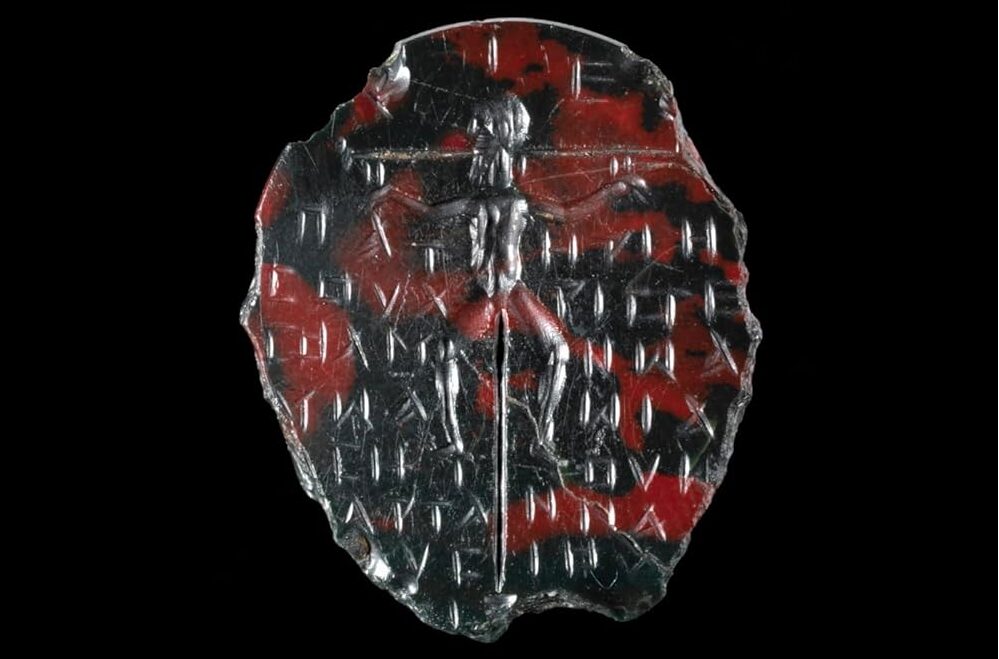
Dr Tim Murray offers this review of Bruce Longenecker’s latest book, The Materiality of Early Christ Devotion
Our historical imagination matters
Most of what we know about early Christianity we know from texts. Indeed, the degree to which these Jesus-communities engaged in textual activities (reading, writing, memorising, teaching, copying) and the variety of their literary output (gospels, letters, apocalyptic, apologies, collections of teaching, sermons, law-codes) is one of the most notable and important features for us to get our heads around if we want to understand them and imagine them well.
Imagination matters in history. Everyone who wants to say something about the early church will be working with some kind of imaginative reconstruction in their heads – of what those communities were like and what kind of world they lived in. The way we imagine that world will affect how we interpret their texts, including the New Testament. To somewhat oversimplify – the more accurately we imagine early Jesus-communities and their social context, the more sensitive and rich our reading of their texts will be. Thus good historical imagination matters for contemporary Christians who want to read their Bibles well!
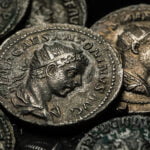
Although texts remain our primary source of knowledge, scholars of early Christianity have also helped us to become aware of the what we can gain from material artifacts that have emerged from archaeological excavations – coins, inscriptions, buildings, tombs, jewellery, decorations, graffiti, pottery, furnishings… and so on. Over recent decades Bruce Longenecker has been at the forefront of this effort, most recently in his The Materiality of Early Christ Devotion.
What the book covers
The book tackles four sites making stand-alone arguments for each one as to the presence of Christian artifacts and the best way of interpreting them, thus Longenecker argues that:
- In late-third century Ostia cryptic Christian symbols were placed in a room of the public baths, possibly where slaves waited for their masters.
- In mid-third century Syria at Dura-Europos the Christians converted a house into a building specifically for their purposes. Paying particular attention to the art preserved on the walls of the room used for baptism, Longenecker marshals the evidence to offer an imaginative reconstruction of some of the kinds of Christ-devotion and ritual this building facilitated.
- In late-second to mid-third century Smyrna we find (possibly) Christian graffiti, but Longenecker’s argument particularly focusses on a partially preserved word-square, for which he proposes a reconstruction and argues is best interpreted as an ingenious expression of Christ-devotion.
- In first-century (70s) Pompeii Christ-devotion can be seen in basic and emerging ways in graffiti and a cross-shaped stucco on a bakery wall.
Although each of these studies is maintained independently (and can be critiqued independently!), Longenecker does draw some synthetic conclusions – primarily that the evidence demonstrates that early Christians were creative in their expressions of their beliefs, willing to innovate, taking and reforming common means of expression to serve their devotion to Jesus in ways that were responsive to their local context. It is also worth saying book also contains a very helpful summary of Longenecker’s previous work on the pre-Constantinian cross symbols in early Christianity.
The Imagination of Longenecker
One of the outstanding strengths of this book and Longenecker’s scholarship more generally is the way he combines relentless curiosity, fertile imagination and attention to detail. Where most scholars (including myself) would shrug our shoulders and say “well, that’s probably as much as we can know about this” Longenecker pokes and prods, turns over the possibilities and finds a way to discover a bit more!
This is evident throughout as he updates, synthesises and corrects previous scholarship, including on relatively minor matters. The result is that if you want to disagree with him, Longenecker forces you to provide an alternative account that can handle the details of the evidence. “If not my explanation, then what else could it be?” is the refrain that my imagination often places in his mouth as I bring my unfortunately-natural scepticism to his arguments.
In summary, I found Longenecker’s reconstructive suggestions about the make-up of the Christ-group attached to the Dura-Europos building plausible and helpful, as well as his redescription of what a baptismal service might have been like. I was equally convinced by his arguments for interpreting the symbols in the bath-house at Ostia as Christian and enjoyed his suggestion as to why and how they may have found their way there.
His treatment of the word-square in Smyrna is ingenious and a great introduction to these kind of devices and gematria (the way that letters-representing-numbers allowed words to have numerical values in the Greco-Roman world) for those who are not familiar with them. I was less convinced by the chapters on Pompeii (could the bakery stucco not be an unusual Ankh, rather than an unusual cross? Given the nature of the evidence, any reading of the ‘Christianos’ inscription seems somewhat fragile and provisional) and remain somewhat agnostic on whether there is evidence for some kind of Christ-devotion there.
 I suspect that Longenecker is by inclination a maximalist. He likes to travel down the ‘what if?’ road and create as full a picture as he can from the evidence that we have. This is a wonderful gift in helping us form a vivid historical imagination, but carries the risk of saying too much on the basis of too little. One example of this is his retraction of an argument he made in his earlier book (The Crosses of Pompeii, 2016). In that monograph Longenecker argued that crosses he had observed in some of the paving stones are best understood as apotropaic Christian symbols; he now considers them survey marks. The public retraction is to Longenecker’s credit, but also shows how fragile arguments are when based on such minimal evidence. On the whole, though, Longenecker is careful to distinguish between when he is arguing for what the evidence establishes and when he is imagining what cannot be proved.
Innovation in early Christianity
There is lots to learn from Longenecker’s book about the specific sites and archaeological evidence he deals with, for which he manages to make the data accessible and interesting. His reconstructions are brilliant examples of controlled creativity and a helpful stimulus to our historical imagination. One of the most important take-aways for me, though, was the evidence in each of the sites for substantial Christian innovation. There are two unhelpful extremes I have seen: on the one side is a kind of Christian exceptionalism in which everything the early church said and did was in complete contrast to other Greco-Roman groups, whereas on the other we have scholars asserting that we should be suspicious of claims for novelty and difference in the early church unless we have evidence of the same phenomena in other groups.
 What Longenecker’s book demonstrates is the futility of both these positions. Of course the early Christians expressed themselves in ways that were similar to others in their social context – in the way they conceived of space (Dura-Europos), displayed their symbols (Ostia) and used conventional devices (Smyrna). But they didn’t only replicate what already existed – the whole point of the artifacts examined in this book is that they are evidence of people trying to express their beliefs by adapting material objects in innovative ways. Christian artifacts are neither ‘nothing like’ other forms of devotion to a deity, nor are they ‘nothing but’ Greco-Roman conventions. The same argument can (and has) been made with regard to early Christian texts. We can be grateful to Longenecker for demonstrating it with regard to material culture.
 Dr Tim Murray received his PhD in New Testament from Nottingham University before joining Amblecote Community Church where he serves as one of the pastors. He is released to pursue ongoing academic research and writing as part of his role. He is part of the leadership team of the Kingdom Scholarship Network, which seeks to connect and encourage those called to a bivocational ministry as scholar-pastors, and the Tyndale New Testament Study Group.
 Buy me a Coffee









There are constant archaeological discoveries that are confirming the authenticity of biblical narratives in recent days. Indeed “the stones are crying out “.
“I tell you that if these should hold their peace, the stones would immediately cry out”.Luke 19:40
Occurring just days before His crucifixion, crowds enthusiastically hailed Jesus as the Messiah. The religious leaders viewed this as blasphemous and demanded he rebuke the crowd.: Jesus was stating that the truth of His identity and mission was so undeniable and monumental that if humans were forced into silence, inanimate creation itself would testify to His glory. It is a poetic expression emphasising that worship of the King is both appropriate and inevitable.
Habakkuk 2:11says “The stones of the wall will cry out, and the beams of the woodwork will echo it.” In this context, stones cry out to testify against the injustice and oppression of the wicked.
In Luke 3:8: John the Baptist warns religious leaders that “God is able from these stones to raise up children for Abraham”. Indeed the very stones may well bring some to the faith of Abraham.
These tenuous examples might convince some .However there are numerous more positive examples being uncovered as we speak even when Gospel truth is being suppressed.
Shalom.
FYI
For recent archaeological discoveries around the biblical narrative
see -.nationalgeographic.com/history/article/bible-archaeology-christianity-discoveries?utm_source=firefox-newtab-en-gb
Thanks Tim for those good reflections. I always benefit from your probing thoughts. Two things. First, if the cross-shaped artifact in the bakery of Pompeii were simply an Ankh, it would require a circular handle at the top, which it doesn’t have; responsible imagination can’t stretch as far as you’re suggesting. Second, I am not a maximalist; if I were, I would have foregrounded the ROTAS square from Pompeii and the cross-shaped artifact in the House of the Bicentenary in Herculaneum — neither of which have a presence in my argument. For a maximalist argument, wait for Richard Bauckham’s forthcoming book, which will leave my argument about Pompeii looking minimalist!! Thanks again for your good reflections!
Natural scepticism is not unfortunate.