
The gospel lectionary reading for the so-called Last Sunday after Trinity in Year C is Luke 18.9–14, the parable of the Pharisee and the Tax-collector, and the epistle is 2 Tim 4.6–8 and 16–18. You can see the discussion of the gospel passage here, and of the epistle here, and both are linked below.
We are now (as we have been for a few weeks) in the thick of distinctively Lukan material. There are various claims as to how many of Jesus’ parables in Luke are unique to this gospel, varying from 12 to 17; I think it rather depends on how you define a parable, and I have not yet found a definitive list.
 The Wikipedia page on the Parables of Jesus suggests 14 unique to Luke’s gospel; the table to the right here (click to enlarge) from Mark Allen Powell supports this. Allen Powell’s table does show how extensive this Lukan section of Jesus’ journey to Jerusalem is—and note that all but one of the unique parables occurs in this section.
Once more, Luke introduces the parable with his own comment on why Jesus told it. This is distinctively Lukan: he has already done this for the previous parable (Luke 18.1) and does it again soon after (Luke 19.11) and I don’t think this happens anywhere in Matthew or Mark. Two questions arise: why does Luke includes such explanatory comment? And is he correct in his explanation?
Why does he do it? It might be that, writing for a more explicitly Gentile audience, Luke does not think he can assume that his readers will be so familiar with the themes of eschatological expectation (the context of the first and third comment) or the relation of Pharisees and tax collectors (though he has already introduced them earlier in the gospel). Perhaps more significant: the explanation then links the parable to material that comes before or after. As we noted previously, the introduction to the parable of the persistent widow links it to preceding material about eschatological delay; and the introductory comment here links the question of presumed righteousness to the incident with children that follows. Mikeal Parsons, in his Paideia commentary, links the parable with the next two episodes, the encounters with the children and the (rich young) ruler, as all exploring issues around righteousness and justification.
But is Luke correct, and how would he know? A ‘hermeneutic of suspicion’, reading critically and noting that Luke could not have been an eye-witness, might say that this reflects Luke’s own concerns in his community, and that this is quite separate from Jesus’ own possible intention. But a ‘hermeneutic of retrieval’, reading faithfully and noting Luke’s stated concern to engage with eye-witnesses in his research (Luke 1.2–3), might take this at face value, and then note the coherence between this introduction and Jesus’ own conclusion to the parable. (Some ETs hide the connection here, by using the non-cognate terms ‘righteous’ and ‘justified’ at the beginning and end, when both terms in Greek have the root dikai-.)
It is striking how many of Jesus’ stories and parables, particularly in Luke, include two contrasting figures; even when there are three or ten (in the parable of pounds and the story of those healing from their skin disease) they divide clearly into two options. It seems as though a consistent feature of Jesus’ teaching is that there are two ways (Matthew 7.13–14) without any middle ground, so that we are provoked and challenged to decision.
The moment we encounter what could become ‘stock’ figures, here the Pharisee and the tax collector, we need to put this in its historical context and be alert to the function in the wider narrative of the gospels. On the one hand, Pharisees were generally admired, and so they should have been, in that their stress on obedience to Torah was the obvious response to the story of the Old Testament, where judgement had come with the destruction of the Temple, because of the people’s lack of obedience. Josephus Jewish Wars 1.110 also criticises them—strikingly, for the same things we have read about in Luke, their superiority and of money:
And now the Pharisees joined themselves to her, to assist her in the government. These are a certain sect of the Jews that appear more religious than others, and seem to interpret the laws more accurately. Now Alexandra hearkened to them to an extraordinary degree, as being herself a woman of great piety towards God. But these Pharisees artfully insinuated themselves into her favour by little and little, and became themselves the real administrators of the public affairs: they banished and reduced whom they pleased; they bound and loosed [men] at their pleasure; and, to say all at once, they had the enjoyment of the royal authority, whilst the expenses and the difficulties of it belonged to Alexandra.
But here is the paradox, or perhaps the tension. Though he has some harsh words for them (Luke 11.42–43), Jesus himself says that we should follow the teachings of the pharisees (Matt 23.3), not neglect the details, and our ‘righteousness’ (that is, our observance of these things) should exceed theirs (Matt 5.20). And surely is it a good thing that the Pharisee is not an extortioner, unjust, or an adulterer; should we not aim for the same thing?
So the lesson of this parable cannot be ‘Don’t engage in the practices that the Pharisees practise’. We need to feel the weight of Jesus’ unexpected inversion: the person to whom we ought to look as a role model actually has the wrong attitude. If we read this already knowing that the pharisee was the ‘baddie’ then the whole point it lost, and the parable just confirms our prejudice.
Quite a lot is often made of the phrase ‘he prayed to himself’ (Luke 18.11), often not translated in English but there in Greek. Some say that this shows he was not actually praying to God, or his prayer was ineffective. Again, reading in historical context, we need to remember that silent prayer was unknown in that culture; all praying would be out loud (hence, eg Hannah’s lips moving as she prays in 1 Samuel 1.12–13). So the comment ‘to himself’ might mean he was not praying loudly for others to hear, as was Jesus in Luke 10.21, but quietly to himself. Yet the whole tenor of the story is that his perspective is very much on the horizontal—how he compares with others—rather than the vertical and how he relates to God.
The comment on fasting reflects a particular interest of Luke. It is Luke 5.33 that gives tells us that John the Baptist’s and the pharisees’ disciples fast ‘often’, and one manuscript tradition had corrected Matt 9.14 to line up with this. And it is Luke who tells us that the ekklesia in Antioch were ‘worshipping and fasting‘ (Acts 13.2).
Whilst some commentators suppose that in fasting twice a week, the Pharisee is boasting that he exceeds the requirement of the law, in fact I have shown that this was common practice in the first century, and was continued by the first Jesus-followers. So his claim is nothing exceptional—and we even know which two days he fasted on from Didache 8:
But let not your fasts be with the hypocrites, for they fast on the second and fifth day of the week [ie Mondays and Thursdays]. Rather, fast on the fourth day and the Preparation [ie Wednesdays and Fridays].
For much of his ministry, John Wesley practiced fasting on Wednesday and Fridays in line with this teaching, and would not ordain anyone who didn’t do the same.
It is reasonably well-known why tax-collectors were despised. On the one hand, the role was awarded on the basis of an auction, so whoever claimed to be able to raise the most taxes was awarded the franchise. This meant that tax-collectors were seen as exploitative, taking more than was strictly necessary. On the other hand, there was an important theological issue at stake. Tax-collectors were colluding with the very power from which pious Jews sought God for liberation (Luke 1.68–75).
The descriptions of the two men are similar in length—36 words for the Pharisee, and 29 for the tax collector. But the difference is striking, not least that 29 or the 36 words about the Pharisee are devoted to the content of his prayer, whilst the tax-collector’s prayer consists of only six words in Greek. 19 of his 29 words describe his posture—he stands far off, will not lift his eyes to heaven (those this is a common attitude in prayer, Mark 6.41), and beats his chest in repentant (compare Luke 23.48). For the Pharisee, what matters is his own words and actions; for the tax-collector, what matters is his attitude towards God. Some commentators say that this parable is about our attitude to others, as evidenced by the Pharisee’s comparative comment. But the difference in description suggests that the parable is primarily about our attitude to God and to spiritual practices and disciplines; when that is wrong, our attitude to others is corrupted.
If the tax-collector is sincere in his repentance, then it will in fact cost him dear, as the story about Zacchaeus in the next chapter sets out. For the Pharisee, on the other hand, his prayer costs him nothing.
The concluding phrase is very interesting. Most translations make it a comparative:
I tell you that this man, rather than the other, went home justified before God. (TNIV)
 Luke is distinctive in using the verb ‘to (be) justify (ed)’, one of Paul’s favourite terms. And Howard Marshall, in his magisterial and still useful commentary, notes that the phrase ‘rather than the other’ ‘par’ ekeinon’ is unusual. He believes that is it is a translation into Greek of an Aramaic phrase ‘one from the other’. This offers some evidence that the parable goes back to Jesus, against some who have argued it is a creation of Luke. But it also means that Jesus’ point is not that God prefers the tax-collector over the Pharisee (‘this one in preference to the other’) but simply that the one was justified, and the other not.
Putting all this together means that the parable does not support an antinomian position. It is not that the Pharisee is mistaken in his devotional practices, and that the tax-collector is right to do nothing other than throw himself on the mercy of God—despite this being quite a common reading! As Luke’s introduction highlights, the issue that Jesus is focussing on is the attitude to such practices. Good practices are worth nothing without right attitude, and even if the good practices are absent, right attitude to God is the thing that really counts. And the heart of that right attitude is recognising that God’s grace comes to us, by whatever means, as pure gift.
Each morning I go around our house, opening the curtains. It is a more laborious job than in our previous houses, because in 2013 we moved into a house where lots of the curtains have draw cords and tiebacks, so it takes quite some time and effort. But when I put the effort in, I am rewarded with the sun streaming in and lighting up the room. Does the sun stream in because I have made the effort to pull back the curtains? In one sense, of course. But should I be proud that my effort has merited the sun streaming in? Of course not! It still comes as gift.
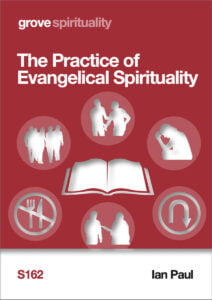
When we follow the disciplines of life that the Spirit of God forms in us (as we surely should; see my recent Grove booklet exploring these), God’s presence still comes to us as unmerited gift.
(The illustration at top is a detail from the painting of the parable by James Tissot.)
Come and join Ian and special guest Mark as they discuss this passage and its application here, and Ian and James on the epistle for the week from 2 Timothy 4:
 Buy me a Coffee
















This always reminds me of the story of the Sunday School class who looked at this story. At the end the teacher said, “now children, let us pray and thank God that we are not like the Pharisee.”
Indeed – and I have never forgotten the school headmaster who in an assembly where this was the reading (that tells you how old I am!) pointed out that our laughing at the story of the Sunday school teacher is the non-verbal equivalent of much the same statement!
I think the difference between Luke and Mark/Mathew is that Luke is more explicit. It isn’t that Mark and Mathew aren’t teaching the reader what Jesus’ point is, but that they do it more contextually – probably, as you say, assuming more knowledge of the culture on the reader’s part.
However, I think the answer to “Why can we trust Luke’s theological understanding in his comments in his gospel?” is because Luke was inspired by the Holy Spirit to write God-breathed scripture. (Which is the same reason why we can trust Mark and Mathew’s structures, contextual clues and the details that they have chosen to stress)
Indeed. It seems a strange thing to say “hermeneutic of suspicion” in relation to the author of about a quarter of Christian sacred scripture.
In his introduction Luke tells his readers that the main focus of the parable is righteousness and those who believe they can reach that pious goal by means of their own efforts.
In Ps 143:2 David answers asking God “do not enter into judgment with Your servant, for in Your sight no man living is righteous.”
Solomon adds “there is no man who does not sin.” (1 Ki 8:46) Cf. (Isaiah 64:6)
An Englishman by the name of Ebenezer Wooten had just concluded a preaching service in the village square. A young man approached him and asked, “Mr. Wooten, what must I DO to be saved?” Sensing that the fellow was trusting his own righteousness, Wooten answered in a rather unconcerned way, “It’s too late!” The inquirer was startled. “Oh don’t say that, sir!” But the evangelist insisted, “It’s too late!” Then, looking the young man in the eye, he continued, “You want to know what you must DO to be saved. I tell you it’s too late now or any other time. The work of salvation is done, completed, finished! It was finished on the cross.” (See “It is finished! Paid in full!”) Then he explained that our part is simply to acknowledge our sin, repent and receive by faith the gift of God’s forgiveness.
It does not matter a jot how perfect you imagine your doctrine to be, Job’s friends’ feverish prognostications were useless in God’s eyes but Job was commended for speaking the things of God that were true. Take care with the leven of theologians.
See .preceptaustin.org/luke-18-commentary#18:9 Shalom.
Ian has emphasized previously of counting the cost before choosing to follow Jesus. Do you agree?
Peter
Not sure if this is a question for me?
If so what is your point? Thanks.
‘Then he explained that our part is simply to acknowledge our sin, repent and receive by faith the gift of God’s forgiveness.’
is it that simple?
I’m Glad I’m Not Like Him! @ engediresourcecenter.com has this comment on the passage.
“We all stand in need of God’s forgiveness, even the best of us, and we should always be on the look out for when our prayers [ note – and our comments on some blogs ]
are more concerned with other’s sins than our own in God’s sight.
Shalom.