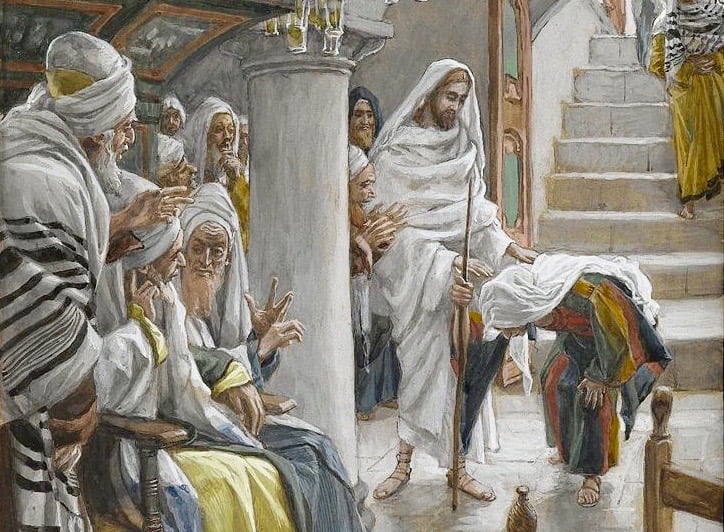
The lectionary gospel reading for Trinity 10 Year C is Luke 13.10–17, a short but remarkable account, unique to Luke, of Jesus healing a crippled woman on the Sabbath.
For video discussion of the issues here, together with a new discovery about the text, watch here.
There are multiple layers to the meaning of this story, and an interesting and important challenge is how we might, in our own local context, enable exploration of all these layers. A particularly striking feature of this passage is the way that several aspects of it have one kind of significance in the original context of Jesus’ ministry, but added significance in the Graeco-Roman context of Luke’s readers.
The context of this passage is the continuing mix of Jesus’ miracles and his teaching ‘on the way’ from Luke 9.51 until Jesus reaches Jerusalem in chapter 19. Because we don’t have in the narrative some of the obvious structural markers, like Matthew’s division of Jesus’ teaching into five sections, or the key turning point in Mark of the confession at Caesarea Philippi in Mark 8, it is easy to see the material here as a slightly amorphous mixture, and our only markers are the well-known episodes such as the Parable of the Good Samaritan in Luke 10 and the parables of the lost, including the so-called prodigal son in Luke 15.
Given this, and the fact (as we have previously noted) that Luke’s geographical markers are very general, we need to sit up and take notice when Luke introduces this incident as taking place ‘in one of the synagogues’. This is the first mention of Jesus teaching in the synagogue since Luke 6.6, when he also heals someone there on the Sabbath, and he never does so again in Luke—in fact, synagogues are mentioned less in Luke than they are in Acts, when Paul consistently proclaims the good news about Jesus in synagogues first, making it clear that the Jesus movement is primarily a Jewish renewal movement before it is a Gentile movement.
The most prominent mention of Jesus teaching in this context is back in the synagogue in Nazareth in Luke 4.16, and we are therefore reminded of this programmatic incident. The connection is reinforced with the language that Jesus uses both to the woman in Luke 13.12 and about her in Luke 13.16 of ‘release’, echoing the language of ‘release of captives’ in Luke 4.18 (though using slightly different vocabulary). Within Luke’s overall narrative, this synagogue incident is once more enacting and demonstrating the kingdom ministry that Jesus proclaimed in the first synagogue incident.
The story itself has remarkably coherent literary structure to it, which some have likened to a diptych, composed of two panels, in art.
| First panel | Second panel |
| Bent woman gets Jesus attention (13.11) | Synagogue ruler’s words get Jesus’ attention (13.14) |
| Jesus calls the woman and cures her (13.12–13a) | Jesus reacts to the ruler’s words (13.15–16) |
| Twofold results of Jesus’ action (13.13b) | Twofold results of Jesus’ words (13.17) |
| a. Immediately she is made straight | a. Jesus’ adversaries are put to shame |
| b. and she praises God | b. and all the people rejoice |
This structure has two main effects. First, it puts Jesus himself centre-stage in the narrative, emphasised by Jesus calling the woman to her rather than Jesus going to the woman. The story is all about the action of Jesus and reaction to Jesus. The second effect is that the enacting of the kingdom rule of God is put in stark parallel with the opposition that the coming of the kingdom will provoke. This correlates with the other way that the ‘synagogue’ has featured so far in Luke’s gospel; other than being a locus of Jesus’ teaching, its most frequent mention has been as the context in which Jesus’ followers will face opposition (see Luke 12.11 and 21.11), since it is the place where the Pharisees and teachers of the law love to elevate themselves (Luke 11.43 and 20.46). Given that this ‘journeying’ section of Luke appears to be all about discipleship, it is quite odd that the disciples feature so little in this middle part—but the Pharisees are quite prominent, and Luke’s main point here appears to be that to follow Jesus means to face opposition.
If you are enjoying this article, why not  Buy me a Coffee
Within the Jewish context of the original setting, two issues come to the fore.
The first is the question of the woman’s illness and its relation to the work of Satan. Various discussions of her medical condition consistently conclude that she suffered from ankylosing spondylitis, an arthritic inflammation of the vertebrae which leads to curvature of the spine and progressive inability to flex the joints. There is still no cure for the condition. But Luke uses some striking language in relation to he illness and its cure: she has a ‘spirit of weakness’ (NIV: ‘has been crippled by a spirit’, v 11) and Jesus’ healing released her whom ‘Satan has kept bound’. However, there is no sense in which Luke records this (or that Jesus or others in the narrative perceive this) as exorcism from demon possession; the language of ‘demon’ or ‘unclean spirit’, and the actions of ‘possession’ and ‘expelling’, found in other gospel accounts of exorcism, and are all absent here. Rather, Jesus (with Luke) sees the physical and the spiritual as inextricably interlinked; it is striking that when she is physically able to stand and look up, she immediately breaks into praise to God. Joel Green comments (in his NICNT commentary, pp 521, 525):
From this ethnomedical perspective, then, this woman’s illness has a physiological expression but is rooted in a cosmological disorder… [Jesus] regards his act of healing as an act of liberation from satanic bondage, as direct engagement in cosmic conflict, through which God’s eschatological purpose comes to fruition (see Luke 11.20).
The second question is the interpretation of the Fourth Commandment, to ‘keep the Sabbath’, and in the background are the verses from the Torah:
Observe the Sabbath day by keeping it holy, as the LORD your God has commanded you. Six days you shall labor and do all your work, but the seventh day is a sabbath to the LORD your God. On it you shall not do any work..(Deut 5.12–14; compare Exod 20.9).
The language of the synagogue leader is slightly obscured in freer English translations; his comment that ‘there are six days on which it is necessary (dei) to work’ alludes to the command of God to work then and rest on the Sabbath. The question then becomes: who is the one with authority to interpret the Torah, the ‘law’? Luke is clear in his answer to this by describing Jesus here as ‘the Lord’, not just the Lord of the Sabbath (as Luke 6.5) but also the Lord of the meaning of the Torah, the authoritative interpreter. Luke here communicates something implicitly that is more explicit in, for example, Matt 5–7, in which a very Jewish Jesus brings out the full meaning of the scriptures, and emphasises that he is not in any sense nullifying them or setting them aside. Here, Jesus’ interpretative strategy is to read on, and more fully, to understand the theological principle of Sabbath observance rather than offering a mere surface reading. His response simply continues reading Deut 5 into its immediate context:
On it you shall not do any work, neither you, nor your son or daughter, nor your male or female servant, nor your ox, your donkey or any of your animals, nor any foreigner residing in your towns, so that your male and female servants may rest, as you do. Remember that you were slaves in Egypt and that the LORD your God brought you out of there with a mighty hand and an outstretched arm. Therefore the LORD your God has commanded you to observe the Sabbath day. (Deut 5.14–15)
Sabbath means rest and liberation, not only for God’s people but also for the ‘ox and the donkey’ that Jesus mentions. He argues here from the lesser to the greater; if you are prepared to offer Sabbath rest to your animals, surely you cannot withhold this from a person? The Sabbath itself is a reminder of the release from captivity that God has effected—and so Jesus’ release of this woman is a sign of the new Sabbath as a result of the new Exodus that Jesus will accomplish (Luke 9.31).
In the Graeco-Roman context of Luke and his readers, two rather different issues arise.
The first is the issue of physiognomics, by which ancient writers, physicians and philosophers believed that different parts of the body, and their condition, indicated something about a person’s inner life and identity—so, for example, ankles were supposed to indicate something important about character, with strong ankles indicative of a strong and reliable character (think Achilles and his arrow). Despite claims to the contrary, it seems that our visual culture, shaped by the internet, also values people in relation to their appearance.
The connection between the inner and the outer in Luke’s language of the ‘spirit of weakness’ being the apparent cause of the woman’s condition might at first look as though it plays into this perception of the world. Mikeal Parsons, in his Paideia commentary (p 217) notes the comment of pseudo-Aristotle’s Physiognomics:
Those whose back is very large and strong are of strong character; witness the male. Those which have a narrow, weak back are feeble; witness the female.
Physiognomy would also extend to the mention of the ‘ox and the ass’; pseudo-Aristotle comments:
Those that have thick extremities to the nostrils are lazy; witness cattle…and those with thin faces are careful, with fleshiness are cowardly, witness donkeys and deer (cited in Parsons, p 218).
And yet Jesus defies this kind of stereotyping in two ways. First, the affliction of the woman comes from without, from a spirit and the bondage of Satan, and not from within, the result of her own character flaw. Secondly, in response to the criticism, Jesus describes the woman as a ‘daughter of Abraham’, a unique designation used of no-one else, but connected with a consistent theme of the question of true Jewish identity introduced in the language of ‘Abraham and his offspring’ in Luke 1.55 and in the teaching of John the Baptist in Luke 3.8–9.
The second is the issue of honour and shame in the Roman world. Where the crippled woman would have been an object of shame, and those in the places of power would be people of honour, Jesus’ action and teaching effect a reversal in these two states. The woman now is honoured in the way Jesus describes here, and it is very striking that the crowd rejoice in the fact that, through Jesus’ words, ‘all his opponents were shamed’ (Luke 13.17). This is not about mere petty vengeance; it is about Luke communicating who is truly honoured and shamed in a social context where this values were of defining importance. Despite the dominant cultural view, it is actually (before God) those who follow Jesus who have the place of true honour, in contrast to all appearances to the contrary.
Three final issues are worth noting.
The first is another fascinating example of numerology. The number 18 occurs only in this chapter in the whole New Testament, and Luke emphasises it not only by mentioning it twice here (in verses 11 and 16; it also occurs in the previous episode in Luke 13.4) but by using two different phrase on the two occasions, δεκαοκτὼ and δέκα καὶ ὀκτὼ (ten-eight and ‘ten and eight’). Why might this be significant? Because, as Mikeal Parsons shows in a fascinating study in numerology, 18 is the value of the first two letters of Jesus’ name, iota and eta, and in one manuscript tradition, the number eighteen is actually written iota-eta, with a line over it, which corresponds to a nomen sacrum, an abbreviation commonly used in manuscripts for the holy name of Jesus and of God. In emphasising this number, Luke is claiming that Jesus is the appointed cure of her ailment.
This interpretation is reinforced by one of the earliest papyrus witnesses to Luke, Chester Beatty Papyrus I, better known as P45…At both 13:11 and 13:16, the number “eighteen” is written as ιη, with an over stroke to indicate the letters are serving as a number. Likewise, in 13:14, the name of “Jesus” is written in the same way, ιη, also with an over stroke, here though to indicate the nominum [sic; should be nomen] sacrum. The result is a purely visual phenomenon in which the reader of P45 would encounter the same abbreviation, ιη, for both “eighteen” and “Jesus,” reinforcing our Christological interpretation of the number eighteen in Jesus’ response in 13:16…
Given the presumed propensity to equate the number eighteen (or better “ten and eight”) with Jesus, at least in some circles, this form drew attention to the number and was the aural equivalent to the visual phenomenon. Thus, an audience hearing Luke 13 could have the experience in identifying the eighteen years of Luke 13:16 with Jesus, an experience not altogether unlike the one enjoyed by the actual reader of the symbols on the page. In this reading, not only is the woman’s true character made manifest in the healing, so is the identity of Jesus revealed in the very number associated with the length of her illness.
Secondly, and related to that, James noticed a link with the number 18 in the Old Testament—one that we have not found in any commentators on this passage.
In Judges, there are two occasions where the people of Israel are oppressed for 18 years. In Judges 3.14, ‘the people of Israel served Eglon the king of Moab eighteen years’, and they then cry out and God raised up Ehud as a saviour. Later, in Judges 10.8, the Israelites living across the Jordan are oppressed by the Ammonites for eighteen years.
Interestingly, the two mentions take two different forms in the LXX, the Greek Old Testament, just as Luke uses two different terms in this passage—though they are not quite the same pair of different terms.
καὶ ἐδούλευσαν οἱ υἱοὶ Ισραηλ τῷ Εγλωμ βασιλεῖ Μωαβ ἔτη δέκα ὀκτώ. (Judges 3.14)
καὶ ἐσάθρωσαν καὶ ἔθλασαν τοὺς υἱοὺς Ισραηλ ἐν τῷ ἐνιαυτῷ ἐκείνῳ ὀκτωκαίδεκα ἔτη (Judges 10.8)
If Luke was aware of this time period, then Jesus’ healing of the woman is further connected with God’s act of delivering his people from oppression.
(Note that there is some fascinating further discussion about numerology in the comments to the article on this passage three years ago here.)
Thirdly, although the kingdom and eschatological hope are not mentioned within this passage, it is implied from the context of the surrounding passages which emphasise the division that will come with God’s judgement—and the verses that immediately follow. Again, English translations, and the divisions in the lectionary, might throw us off the scent—but Luke is quite clear, when he introduces Jesus’ teaching about the kingdom as a mustard seed and as yeast in the flour with a strong ‘Therefore…’ in Luke 13.18. This teaching needs to be read as an exposition by Jesus of what has just happened in his kingdom-demonstrating ministry.
Set in relation to the healing episode of vv 10–17, this parable [of the kingdom and the yeast in flour] declares that satanic domination is being repealed and the kingdom of God is made present even in such seemingly inconsequential acts as the restoration of an ill woman who lived on the margins of society. (Joel Green, NICNT, p 527).
How might we enable our congregations to explore all these fascinating issues? Again, Mikeal Parsons anticipates this problem in his study of numerology and the use of the nomen sacra as the number eighteen:
The reception of early Christian texts was primarily in an oral and communal context, that is, the texts were read aloud by a lector to a community probably gathered together for a meal and some kind of edifying activity (e.g.,worship, etc.). Thus, Luke surely assumed that his text would have been read aloud and then discussed, as was the custom of the day. This process would have allowed for the subsequent examination and explication of the text. This context would have provided the occasion for the interpreter to communicate orally this visual phenomenon. The manuscript evidence supports this position.
Perhaps we should be doing the same?
Additional note:
In online discussion, I have been asked how we might preach on some of these ideas, especially the observation about numerology. I offer here several brief observations.
The links in the passage to the earlier teaching of Jesus in the Nazareth synagogue makes a connection between Jesus’ words and his actions. The breaking in of the kingdom of God does involve proclamation, but it also involves things happening, and the two need to match each other. As Paul says in 1 Cor 4.20, ‘The kingdom of God is not about talk but about power’. We live in an age where talk is easy, especially online; whether actions match our words is another matter. And a key frustration of outsiders with Christians and the church is when they are all talk and no action. Does Christian faith actually make a difference in our life?
The symmetry between Jesus’ response to the woman and Jesus’ response to his critics is part of Luke’s consistent emphasis that the kingdom will bring opposition so Jesus’ followers, faithful in kingdom living and proclamation, will face hostility. Of course, it is always possible that this will arise because we are being crass and insensitive! But if we are seeking to live faithfully to Jesus, we should not be surprised when difficulties comes.
The fact that the woman’s healing is for Jesus a sign of the presence of the kingdom of God demonstrates once again (and in line with the ‘Nazareth Manifesto’) how broad the concerns of the kingdom are. ‘The kingdom of God is creation healed’, so we need to be open to God’s working by his Spirit in all sorts of aspects of life.
Jesus is presented as the authoritative interpreter of the Old Testament law. Jesus neither sets aside Torah nor simply follows it slavishly in the way his contemporaries do, but reads it holistically and theologically, drawing out its full meaning. We need to avoid separating Jesus and the call to follow him from the teaching of the Old Testament which he comes to ‘fulfil’.
It is worth noting the way that Luke tells the story in a way that makes sense in his cultural context, and brings out implications for his readers—for we are in a similar situation of being in a context removed from the original setting. But we too live in a world that is shaped by physiognomy: tall people are more likely to be promoted to positions of leadership; people with deep voices seem more trustworthy to us; ugly people are more likely to be convicted in court; and we might notice how differently we respond to attractive people that we meet. Those who exercise influence in media, sports, business and politics do so in large part because of their appearance, and this has been accentuated in our highly visual media and internet age. ‘The LORD does not look at the things human beings look at. People look at the outward appearance, but the LORD looks at the heart’ (1 Sam 16.7).
The numerology might be the most challenging to make use of in preaching. But finding a way of explaining it does help us to be aware that the Bible is written in another culture from us, and in some important senses is a ‘strange’ text to us. But the implications are anything but strange; in making this connection between the woman’s condition and the name of Jesus, he is saying to us that Jesus was always going to be the only answer to this incurable condition. I think Paul would say the same about our sin and alienation from God.
The illustration at the head of this article is a section from a painting by James Tissot, a nineteenth-century French painter and illustrator who moved to London in 1871. He was close to the Impressionists, and was invited to be part of the first Impressionist exhibition in 1874, but he declined and (in contrast to other French painters), moved to a more realistic, rather than impressionistic, style of painting. After moving to London, in 1885 he experienced a renewal of his Roman Catholic faith, and devoted himself to painting scenes from the Bible, aided by travelling to the Middle East. He created a series of 365 painting of the life and ministry of Jesus, of which this is one, and was working on a series on the Old Testament when he died. I love the dynamic and light of the picture, and the way the two scenes either side of the pillar match the ‘diptych’ narrative structure of the passage. Jesus would, of course, have been sitting to teach, but perhaps he stands to heal the woman.
Join James and Ian as they discuss all these issues in the video here:















Ian
‘But Luke uses some striking language in relation to he illness and its cure: she has a ‘spirit of weakness’ (NIV: ‘has been crippled by a spirit’, v 11) and Jesus’ healing released her whom ‘Satan has kept bound’. However, there is no sense in which Luke records this (or that Jesus or others in the narrative perceive this) as exorcism from demon possession; the language of ‘demon’ or ‘unclean spirit’, and the actions of ‘possession’ and ‘expelling’, found in other gospel accounts of exorcism, and are all absent here.’
Im not so sure there is much difference in reality. Does not a ‘spirit’ imply the demonic or similar? And in this case not just the demonic, but satan himself! Seems to be very strong language, on a par with previous encounters, even if specific language such as ‘possession’ (which I understand isnt actually found in the Gospels iro the demonic, so ‘demonised’ is probably better) is not used.
Ive recently been listening to some who are experienced in dealing with the demonic (theyre not wackos!), and they use this lady as an example of how a ‘believer’ can be afflicted, if not ‘possessed’, by a demon or spirit, and apply that to Christian believers today. Though they do sometimes describe such encounters as the demon/spirit ‘leaving’ or ‘coming out of’ the person. It seems in their ministry having to deal with demonic/spirit affliction/influence is relatively commonplace in the believers they minister to. And often physical healing is accompanied by such ‘releases’.
Would you agree with this understanding?
Thanks, Peter
Peter,
I can’t refute your argument and I’m certainly not a competent interpreter. But with a little help from AI, I have compiled some points to consider.
Biblical Hebrew would normally describe “a cowardly man” as “a man of cowardice”. When the noun is “spirit” (ruach), this construction creates an idiom that denotes a total, defining condition of a person’s inner or outer life. These clear biblical examples show where “spirit of…” denotes a human condition or mindset, rather than an invading demon:
A Spirit of Jealousy: In Numbers 5:14, if a husband becomes uncontrollably suspicious of his wife, the text says “the spirit of jealousy [ruach qin’ah] comes upon him”. Translators universally agree this refers to an overwhelming psychological state of envy, not a literal “jealous ghost” flying into his body.
A Spirit of Whoredom/Harlotry: Hosea 4:12 describes Israel’s chronic unfaithfulness by saying “a spirit of whoredom has led them astray”. It refers to a dominant, cultural mindset of rebellion.
A Spirit of Heaviness/Faintness: Isaiah 61:3 promises a “garment of praise instead of a spirit of heaviness” (or a faint spirit). This is the classic Hebrew poetic construction for a state of deep grief or despair.
I
Apparently New Testament Greek mimics this exact Hebrew structure. For example, 2 Tim.1:7 refers to a spirit of timidity, and Gal.6:1 refers to a spirit of gentleness. In these cases Paul does not hint that a Christian needs exorcism for being timid or that a gentle person has a “gentle ghost” inside him. He is using the Semitic idiom for a defining personal condition.
After healing the woman Jesus said that Satan had bound her for eighteen years. I have pondered that and here is my own opinion: Might it be possible that the Lord was merely saying that Satan had a hand in her suffering, inasmuch that (1) all illness is a result of the fall which Satan was instrumental in precipitating, or (2) Satan had earlier challenged God to afflict her like he had afflicted Job? I wonder if the dramatic description of her being bound by Satan was a primarily a rhetorical device to highlight the comparison/contrast between a human being and a sheep in a critical condition and needing help.
Respectfully,
Phil
Ian
Given your interest in the deliberate repetition (I would agree that repetition is normally a significant device in Biblical narrative art) of the number 18 in Luke’s narrative, I wonder what you would make of Mark’s repetition of the number 12 in Mark 5: 21-43 ? (I have a view which I will reserve for now). Incidentally a passage which while in a completely different context has some interesting overlapping features, although that is a side issue not worth discussing for now.
Interesting question. Have you checked my commentary on that passage?
Hi Frank,
AfterReading 5his blog I wrotea short story about the two twelves . I suspect you have had the same idea.
Just checked the passage—yes, I comment on this in the written commentary and the video. What is interesting is the way Mark delays the ‘reveal’, where in fact Luke does not.
Apologies, did not realise you had a commentary on Mark. In that case I shall have to find out why you think that Jairus & his wife were strictly charged not to tell anyone, when it was blatantly obvious the whole village knew already, with mourners parading around everywhere. A bizarre instruction, and totally at odds with the previous pericope when the Gadarene was told to go back home and tell everyone. Neither of my current commentaries (James Edwards & Dick France) have anything useful to say. Perhaps you have solved this riddle as well.