
This Sunday’s lectionary reading for Year A, Epiphany 3, is Matt 4.12–23. The epistle is 1 Cor 1.10–18, where Paul gets into the issues of factions and divisions. The video for that reading can be found here, and is linked at the end of this piece, as is the video on Matthew 4.
The gospel passage begins the account of Jesus’ ministry in Galilee, which continues until Matt 16.20 (compare ‘from that time on’ in Matt 4.17 with Matt 16.21), and now Jesus takes centre stage as the main actor in the drama. But from the beginning, he does not act alone, but calls a community of disciples to himself, and in Matthew they are with him throughout—until he is deserted in Matt 26.56.
Mark’s account of the start of Jesus’ ministry is quite stark and factual—but Matthew makes it more specific and personal. His ministry begins, not merely ‘after John was arrested’ (Mark 1.14), but ‘when he [Jesus] heard that John had been arrested’. We know from John 3.22 and John 4.1–3 that Jesus had spent some time in the southern area, apparently involved in ministry in parallel with John; as part of the undesigned historical coincidences in the gospels, this fits well with Matthew’s depiction of Jesus as part of John’s renewal movement. The word translated ‘withdrew to Galilee’ (ἀναχωρέω, anachoreo) can in fact mean ‘return to’, but Matthew typically uses it to refer to an escape from danger (as in Matt 2.12, 2.14, 2.22, 14.13). The movement from the danger of Herod Antipas in the South back to Galilee echoes the journey he took with his family when they first came back from Egypt.
Matthew gives us more geographic detail than Mark, though adapts it to suit his purposes. Nazareth was then a small village, whereas Capernaum was in a busy fishing area and on a trade route around the ‘sea’ of Galilee (which Luke corrects to being a ‘lake’), and at that time had a population of at least 10,000 according to archaeological excavations of the site. So it was a natural centre for a ministry which would have an impact on the whole area; it had its own centurion (Matt 8.9) who would have overseen a wide area, as Roman troops were spread comparatively thinly, as well as its own custom post (Matt 9.9) indicating its importance for trade.
The tribal areas of Zebulun and Naphtali covered lower Galilee from the Mediterranean across to Lake Galilee, and in fact Nazareth was in the former region and Capernaum in the latter (these tribal designations were not of much practical use by this era). But Matthew conflates the two to match his next ‘fulfilment’ proof, the longest so far. Matthew only ever mentions the specific writer when citing Isaiah and Jeremiah, and here he has abbreviated the text, which is closer to the Hebrew than the Greek, but does not exactly follow either—with a resulting focus on the geographical reality by ending with a string of place references.
Within the source text in Isaiah, the areas of Zebulun and Naphtali appear to be contrasted with the ‘way of the sea, beyond the Jordan, Galilee of the Gentiles’ which would naturally be taken to refer to the area to the east of the lake. But, as previously, Matthew doesn’t adapt his history to fit the text, but the other way around; the ‘way of the sea’ (in Latin, the Via Maris) no longer refers to the Mediterranean, but Galilee, and we note Capernaum is ‘by the sea’; and ‘beyond the Jordan’ now means beyond from the vantage point of John’s ministry on the east bank, so that it is on the west! This part of Galilee did indeed have a very mixed population; although Capernaum was Jewish, the bigger towns of Sepphoris and Tiberias were Hellenistic as evidenced by the remains of their buildings and layout. Although Matthew emphasises that Jesus ministry is to the ‘lost sheep of the house of Israel’ (Matt 15.24), the fact that the ‘light’ of his ministry first shines in the land ‘of the Gentiles’—in contrast to the darkness of opposition and betrayal when he reaches Jerusalem—gives us another hint of where the story will end up.
The fact that Matthew uses aorist (past) tenses—the people have seen a great light—shows that he believes that this text has been fulfilled in the ministry of Jesus. In Matt 4.16 the light has ‘dawned’ or ‘risen’, different from Isa 9.2 ‘shone’, perhaps reminding us of the star which has ‘risen’ and guided the Gentile magi to Jesus in chapter 2. The wider context of Isa 9 includes the celebration that ‘unto us a child is born, a son is given’ which we associate indelibly with Christmas because of Handel’s Messiah—but which, remarkably, is cited nowhere in the New Testament!
The connections with the earlier chapters of Matthew continue in the description of his preaching, where the content of his proclamation exactly match that of John the Baptist in Matt 3.2.
The account of Jesus calling the first disciples matches almost word for word the parallel account in Mark 1.16–20. ‘Simon’ was one of the commonest names at the time (along with Jesus, Joseph, John and Levi), and so he is distinguished from others by his nickname, which Matthew assumes he has already been given; we hear of an earlier meeting and the giving of this appellation in John 1. By contrast with the Jewish name Simon, his brother has a Greek name, Andrew, reflecting the mixed Jewish/Gentile culture of the area. Although settled in (Jewish) Capernaum (Matt 8.14), it appear that the family originated from (Gentile) Bethsaida (John 1.44). The early followers of Jesus were clearly of mixed pedigree!
 It seems slightly off that both Matthew and Mark note the detail that Simon and Andrew were throwing a casting-net (amphiblestron; see on the right a modern example I spotted in our restaurant in Dubrovnik last year) into the sea ‘for they were fishermen’; is there some significance to the specific action? Apparently so, and the relation between their fishing for fishing and the call to fish for men has both theological and personal significance. In a fascinating reflection derived from Peter Leithart, Chad Bird notes the symbolic significance of fish in relation to God’s call on Israel and the nations:
Throughout the Old Testament, fish, great sea creatures, the sea and raging rivers were all emblematic of the Gentile world. For instance, deliverance from “the waters” is deliverance from “foreigners” (Ps. 144:7). The thundering of the Gentiles is like the thundering and roaring of the seas (Isa. 17:12). Gentile kingdoms and their rulers were likened to great oceanic creatures like legendary Rahab (Dan. 7; Isa. 51:9). Even in the New Testament, John echoes this imagery when he says “the waters” are “the peoples and multitudes and nations and languages” (Rev. 17:15).
He goes on to see the symbolic significance of fishing as further hints towards the ultimate reach of Jesus’ good news about the kingdom of heaven:
When Jesus called his disciples, his choice of several fishermen—and the context in which they were called—was not by chance. They let down their nets into the deep and caught so many fish that their nets were breaking. Jesus told them not to fear. From now on they would be “catching men” (Luke 5:11). In Matthew, Jesus calls them “fishers of men” (4:19). These new 12 patriarchs, the apostles, would not be conquering Gentile nations with the sword as did Israelite tribes of old, but would be fishing for Gentiles in the “seas” of the nations, using the net of the Gospel (cf. Matt. 28:18-20).
But this transformative call would change the individuals involved as much as it would change the vocation of Israel. Mike Higton of Durham University wrote a short theology of higher education a few years ago in a Grove Ethics booklet (and later a longer book I think). He draws a parallel between the process of education and the call the first disciples experienced as they went about their business as fishermen on Lake Galilee:
Jesus sees what these two men currently are, and calls them to a transformation—to a strange fulfilment of what they are. They are fishermen (halieis), but he calls them to become fishermen (halieis anthropon: fishers of people, ‘fishers of men’ in an older translations). Simon and Andrew respond by leaving what they are, and beginning their journey towards this mysterious fulfilment—towards what they will be. They become, in that moment, disciples. They become learners. This is already clearly not about their desire to accumulatesome extra information, or gain some skills. It is about a deep re-making of what they are—a process that will engage with the selves they are now, and which will lead towards the transfiguration of those selves. They are captivated by the possibility of transformation. (p 4)
Although it is unlikely that this was the first encounter between Jesus and those he called, Matthew, like Mark, emphasises the immediacy and urgency of their response, something also echoed in the longer account in Luke 5. In Jewish etiquette, a disciple was expected to literally walk behind the rabbi, and Jesus’ call to them—more a demand than an invitation—is literally to ‘come behind me’. Yet Jesus is very far from a conventional rabbi, not least in choosing his disciples rather than letting them choose him, something that ends up being of key theological significance (John 15.16). His summons is more like that of a prophet than a rabbi (compare the call of Elijah on Elisha in 1 Kings 19.19–21).
And it is striking that, in Matthew, contrasting both John and Luke, the disciples continue to be associated closely with Jesus throughout his ministry.
From this point on we shall not read stories about Jesus alone, but stories about Jesus and his disciples. Wherever he goes, they will go; their presence with Jesus, even if not explicitly mentioned, is assumed. While the Twelve will not be formally listed until Matthew 10.1–4, the stories from here on will assume a wider group of disciples than just these first four. They will be the primary audience for his teaching (Matt 5.1–2) and witnesses of his works of power, but they are also called to be his active helpers in he task of ‘fishing for people’… Until [Matt 26.56], Matthew’s story is not only that of the Messiah, but also of the messianic community which is being formed around him. (R T France, Matthew NICNT p 145).
The illustration at the top is another of the mosaics from Ravenna. It forms part of an early and stable iconographic tradition that Peter had blond curly hair—which rather undermines racial stereotypical depictions of the disciples.
For an exploration of all these issues, join James and Ian as they discuss them here:
 Buy me a Coffee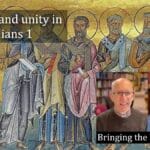













Nazareth is now known to have been much more sophisticated than once thought – evidence of Roman baths from the 1st C. BCE, and a Roman theatre, had recently been unearthed when Carsten Peter Thiede wrote ‘The Cosmopolitan World of Jesus’, London, 2004, pp13-15.
Is it not time to stop talking of Nazareth as a village?
The calling of the disciples is well documented and historically accepted.
The question arises “WHY does Jesus call them” and for what purpose?
To be fishers of men Probably only significant for the four fishermen
amongst them.
It seems that this is a foundational moment
Ephesians Chapter: 2:20 And are built upon the foundation of the apostles and prophets, Jesus Christ himself being the chief corner stone;
2:21 In whom all the building fitly framed together groweth unto an holy temple in the Lord:
Rev 21:14 And the wall of the city had twelve foundations, and in them the names of the twelve apostles of the Lamb
Upon what foundation?
Too what purpose, to be Witnesses unto/about Christ
What kind of witness? Witnesses of HIS Glory?
Matthew uses aorist (past) tenses—the people have seen a great light—
shows that he believes that this text has been fulfilled in the ministry of Jesus.
In Matt 4.16 the light has ‘dawned’ or ‘risen’,
John “we beheld his Glory” John who was very much spiritually “one” with Jesus;
When in the Revelation saw the Glorified Jesus {not like the prophets who only saw the Glory of God described as “one like”,”the appearance of”, an estimation}
“H e fell at His feet as dead”.
The Apostles ministry had little reference to the Historical Jesus;
Rather 2 Cor 5:16 Wherefore henceforth know we no man after the flesh: yea, though we have known Christ after the flesh, yet now henceforth know we him no more.
… But we behold Jesus… who was made for a little while lower than the angels… that He by the grace of God might taste death in the behalf of every man. Crowned with glory and honour…”
. 1 Pet 2:9 But ye are a chosen generation, a royal priesthood, an holy nation, a peculiar people; that ye should shew forth the praises of him who hath called you out of darkness into his marvellous light
In “The Burning Fire of the Spirit”
Chapter 3 – “The Unveiling of Jesus Christ”
T. Austin-Sparks expounds the vision of the Glorified Christ
to great profit @ austin-sparks.net/english/books/004797.html
Shalom
This reminds me of the blind man that required a “second touch”
No doubt the disciples “saw something in Jesus” which is quite
common, even some convinced atheist acknowledges that the Jesus of
History’s ethic has a beneficial effect in society.
Some hearing a half Gospel, discover that they are Loved;
[this is Maslow’s highest human desire/need.]
“This is my concern. Do we make clear to people over and over again that yes, they should feel loved because Christ died for them; and yes, they should feel loved because they are undeserving and he loves them anyway; and yes, they should feel loved because their sins are forgiven and God’s wrath is removed through Christ; but to what end?
Died for while undeserving. Forgiven. Wrath removed.
But to what end?
.” Oh how gloriously good this feels! What a precious gospel! And it’s all merely natural. There’s nothing supernatural about it. It looks like recovery and healing! It works. But at root, it is not “to the praise of the glory of his grace.” It’s all to the praise of the glory of his affirmation of me”.[Piper]
But Paul speaks of that “second touch”
That the God of our Lord Jesus Christ, the Father of glory {note well}
may give unto you the spirit of wisdom and revelation in the knowledge of him:
1:18 The eyes of your understanding being enlightened; that ye may know what is the hope of his calling, and what the riches of the glory of his inheritance in the saints,
1:19 And what is the exceeding greatness of his power to us-ward who believe, according to the working of his mighty power,
To see that Glory and be changed into it.
Moses asked to be shown God’s Glory when He did have his eyes
opened he “fell at His feet and Worshipped”
(the first mention that we read of him doing so)
The Father [The Father of Glory] seeks Worshipers!
To see the Glory is the full Gospel.
Shalom