Tyndale NT Study Group 2025: Eschatology in the New Testament

Eschatology—the question of the ‘last days’ or ‘last things’—is a central theological theme in the New Testament. It frames Jesus’ proclamation of the kingdom of God in the gospels, and in the epistles provides the grounding of our understanding of both discipleship in the present and hope for the future. In previous generations, its importance has often been marginalised, and in contemporary scholarship and popular reading, many aspects of eschatology are highly contested.

The Tyndale New Testament Study Group is meeting to explore this from Monday 30th June to Wednesday 2nd July 2025 at The Hays Conference Centre in Derbyshire. It is close to the M1 and can be reached by train to Alfreton station.

It is an excellent site, with good accommodation and beautiful grounds, and within easy reach of the beautiful Peak District for walking. We will be meeting simultaneously with other groups, so there a chance to interact with members across the whole of the Tyndale Fellowship.

It promises to be a fascinating exploration, with an international cast of contributors—we hope you can join us! You can book online here, and there are discounted rates available until 7th February 2025.

The programme will include the following:

Discussion: Eschatology in the Thessalonian Letters

 In this session we welcome Bruce Longenecker and Sydney Tooth to share their ongoing research in this area following their 20204 publications. Sydney’s monograph addresses the compatibility of the eschatology of 1 and 2 Thessalonians (Suddenness and Signs: The Eschatologies of 1 and 2 Thessalonians, Mohr Siebeck 2024) and Bruce’s articles reimagine the socio-historical context of the founding of the Thessalonian church (“The Rupture of an Association: Social Conflict and Its Management in the Thessalonian Christ Assembly.” Journal of Biblical Literature 2024; “The Wrath of the Deities and The Privileged Deceased: Narrating Death in the Associational Rupture at Thessalonica.” NTS 2024). We will have a chance to unpack, discuss and debate their work with them as part of our time together.

Other papers:

Aminta Arrington (John Brown University, Arkansas): The Last Shall Be First: Overturning Banquet Etiquette and Enacting Eschatological Reversal in Luke 14

Armin D. Baum (Freie Theologische Hochschule, Gießen, Germany): Where Do the Persistent Disagreements between German-speaking and English-speaking Biblical Scholarship Come from? A Sociological Answer Based on the History of Research on 2 Thessalonians

Belonging and interdependence in the body of Christ in 1 Cor 12

The lectionary readings for Epiphany 3 in this Year C are 1 Cor 12.12–31a, and Luke 4.14–21, where Jesus returns from the desert ‘in the power of the Spirit’ and reads from Isaiah in the synagogue at Nazareth. If you are using the gospel reading, you can find commentary on that passage (together with a video discussion) here.

The passage in 1 Cor 12.12f flows directly on from last week’s reading, so if you are using this, then you will have a strong sense of continuity. The lectionary is not design to offer continuous readings, but it is nice when it happens! This does give the opening of the reading a slightly odd feel if you are reading it on its own, since it starts with a typically Pauline strong logical connective ‘For…’ or ‘Therefore…’ (Gk gar) ‘…just as…’

The previous section, from 1 Cor 12.4–11, has held together the diversity of gifts and ministries within the community of faith and their common bond by means of the image of the one Spirit giving many diverse gifts. Here, Paul shifts the image to make similar and related points by focussing on what it means to be ‘in Christ’; he does not use this favorite phrase in this passage, but this is the implication of being ‘part of the body’.

We are so used to the metaphor of the people of God as ‘the body of Christ’ that we fail to recognize how novel and striking this is.

Paul will go on in chapter 15 (which we will look at in two weeks’ time) to rehearse the things ‘of first importance’ which centre around Jesus’ bodily death, burial, and resurrection, and how so many, most of whom are still alive, saw Jesus in his risen body. So talking of the Christians gathered together in their meetings in Corinth as ‘the body of Christ’ is actually striking and jarring. Imagine talking about the church you are in as ‘the body of the vicar’! It would be rather startling.

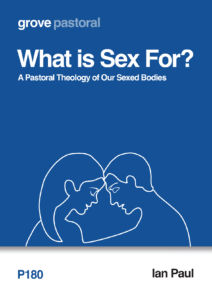
Does sex matter? What is it for?

In 2017, I was invited to a church in Hull to do a morning’s teaching giving an overview of what the Bible said about sex. It was fascinating to have to offer such an overview—not least because it made me realise how important this is, and how rarely it is done. I turned this into … Continue Reading
Belonging and interdependence in the body of Christ in 1 Cor 12 video discussion

The NT epistle for Epiphany 3 in this year C continues reading 1 Cor 12.12–31a. Here, Paul expands his themes of unity and diversity of ministry, but shifts the register from ‘gifts of the Spirit’ to ‘members of the body’. In doing so, he makes surprising use of an existing metaphor from ancient politics, but … Continue Reading
Richard Hays: Theologian of the Cross, Member of the New Community

Wesley Hill explores why the New Testament scholar’s legacy echoes beyond the halls of the academy: “[T]he meaning of Scripture is ultimately written on the tablets of fleshy hearts,” wrote Richard Hays in the conclusion to his groundbreaking book Echoes of Scripture in the Letters of Paul. This statement was true not only of the … Continue Reading