
In 2017, I was invited to a church in Hull to do a morning’s teaching giving an overview of what the Bible said about sex. It was fascinating to have to offer such an overview—not least because it made me realise how important this is, and how rarely it is done. I turned this into two articles on this blog on the biblical understanding of sexuality, and continued to teach the material.
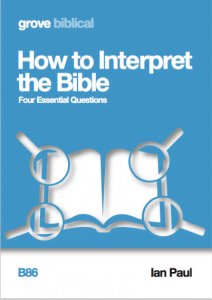
Last week I published a Grove booklet, developing this teaching as a pastoral theology of sexuality, which you can buy here (post-free in the UK, or as an electronic text). I offer here the first chapter and the beginning of the second as a taster. The next chapters of the booklet set out what I think are the eight affirmations of what Scripture tells us about sex—beginning where we should with understanding it as a good gift from God in his creation plan.
Does sex matter? That might sound like an odd question to ask—but it is important, because in both our culture and our reading of the Bible, people give very different, often contradictory, answers.
In contemporary Western culture, it is often claimed that sex does not matter. Anyone can do any job—be an executive, lead the country, play football—without their sex making any difference. In much contemporary discourse, it is implicitly claimed that there are no significant differences between the sexes, and that men and women are interchangeable in almost every role. But because of that, sex matters very much: it is seen to be important that we ensure that both sexes are equally represented in all the prominent roles in society, so that women and men feature equally prominently in the board room and on the billboard.
And sex, in terms of sexual relations and activity, is also often seen as paradoxically important and unimportant. It appears to be assumed in many discussions and policy decisions that everyone will be having sex—after all, surely that is natural?—and the idea that our sexual activity should be limited is puzzling, strange and even harmful. On the other hand, we are offered regular reminders of the lasting damage done by sexual abuse, and there are emerging voices arguing that consent is an inadequate bar for sexual activity in the light of the power of sexual forces.
Turning to the Bible, it is often claimed that sex is not that important, and in particular that Jesus focuses on the ‘weightier matters’ of justice, poverty and inequality in the gospels. Yet our nature as sexed creatures, made male and female in the image of God, is the beginning of the story of humanity in Genesis 1 and 2, as well as the beginning of Paul’s theological expression of the gospel in Romans 1. And in Jesus’ teaching about the life of discipleship in the Sermon on the Mount (Matt 5–7), sexual ethics is the second issue he addresses after the question of murder and anger.
In fact, it is not surprising that questions of sex feature all through the biblical narrative. The historical context of Scripture is premodern culture, and in any premodern society questions of marriage, family, procreation and inheritance are key elements of that culture’s priorities and values. In the modern West we are in an historically anomalous position in thinking about questions of sex and sexuality detached from these basic questions.
But thinking about Scripture’s wider vision of sex and sexuality is a vital context for the particular challenges that most churches are facing, and the specific question of (for example) same-sex sexual relations. Differing answers to the specific questions we face usually arise from very different understandings of what Scripture says more broadly, so we need to explore this wider vision. And it will offer us both surprises and challenges, as well as some very good news!
The Pastoral Challenge
The debates about sex in church and culture are often framed in doctrinal or ideological terms. But in this booklet I want to address the pastoral issues. This demands not mere care or therapy (important as these are) but clear pastoral teaching. When Jesus saw the crowds and had compassion on them, his first response was to teach (Mark 6.34), since good teaching creates the context for effective pastoral care.
Many in church leadership felt for some years that there was no need to talk explicitly about sex and sexuality, since the teaching of the church was clear and known. Then, suddenly, as culture has shifted, the need has become urgent—but in the meantime, the views of church members has changed so quickly that the conversation has become contentious and difficult. The vacuum of teaching here has created tensions which has made addressing this vacuum deeply challenging.
I am very conscious that the Questions for Reflection that I have included contain some big issues which will be pastorally challenging. They are questions that need addressing, but in each context they will need to be handled with great care and sensitivity. And it is vital that all eight of the affirmations that follow are held together; our greatest mistakes in the past have come when we have focussed on some of them at the expense of others.
In reflecting on Scripture’s vision of human sex and sexuality, I have organized my observations around eight affirmations. The first four of these are couched in positive terms, whilst the second four are more negative—or, perhaps, offer important qualifications or constraints.
1. Sex is a Good Gift from God
The first conviction (in terms of priority and importance) of sex and sexuality is that it is a good gift of God in creation. This is the basic assumption made by the biblical narrative which surfaces at key points in the text—but it is something of a surprise, both because of the impression many have that the Bible (and the Christian faith) are negative about sex, and because of anxiety in relation to sexuality in our culture.
The positive role of sex is set out in the creation narrative. God creates humanity ‘male and female’ and then immediately commands them to ‘be fruitful and multiply’ (Gen 1.28)—meaning ‘have sex and bear children.’ If that sounds rather functional, the second creation story offers a counterpoint: sexual union is the means by which the first adam finds his loneliness ended, and in which he finds an existential encounter with the other who, though different, shares so much with him: ‘This at last is flesh of my flesh and bone of my bones!’ (Gen 2.23).
Sex thus has both ‘vertical’ and ‘horizontal’ dimensions. It is the God-given means by which humanity both fulfils the commission of dominion, exercising God’s rule over creation on his behalf, and also the means by which humanity is at peace with itself, working in companionship and fruitful partnership in this vocation. This double divine imprimatur is captured well in the Church of England marriage liturgy:
The Bible teaches us that marriage is a gift of God in creation and a means of his grace, a holy mystery in which man and woman become one flesh. It is God’s purpose that, as husband and wife give themselves to each other in love throughout their lives, they shall be united in that love as Christ is united with his church.
A few years ago I was driving my youngest daughter to London as she headed off abroad prior to going to university, and we had several hours to fill. When deciding what to talk about, I asked, ‘Have we talked with you enough about sex?’ She gave me a withering look, and replied immediately, ‘Dad, no Christian parents ever talk to their kids enough about sex!’ So I shared the material here, beginning with these four affirmations. I had not got past the first one before she said, ‘I have never heard anything positive like this before!’ Too often, if we do say something, we start with the negatives, especially with young people: sex is dangerous, and more or less something that you should avoid. But if we start where Scripture starts, then we see that, from the beginning, sex was God’s good idea. And when we do that, we might have something radical and positive to offer to the culture around us.
The wider church’s struggle with the goodness of sex is evident in the history of the translation of 1 Cor 7.1: ‘Now concerning the things about which you wrote: It is good for a man not to touch a woman.’ Earlier English translations do not put the second sentence into inverted comments, and so read this as a statement of Paul: sex (for which ‘touch’ is a euphemism) is an unfortunate necessity, and is to be avoided where possible. But the consensus of recent interpretation is that this is not the view or statement of Paul, but of the Corinthians with whom he is arguing. Their position is that if you are truly ‘spiritual’ (a theme that Paul picks up explicitly in 1 Cor 12.1, ‘Now, about the “spiritual”…’) then you will leave behind the mundane, earthy realities of sex. Against that, Paul makes this remarkable statement:
The wife does not have authority over her own body but yields it to her husband. In the same way, the husband does not have authority over his own body but yields it to his wife. Do not deprive each other except perhaps by mutual consent and for a time, so that you may devote yourselves to prayer. (1 Cor 7.4–5)
This is remarkable because, in Paul’s only explicit statement about authority in the context of marriage, he is clear that authority is exercised equally and symmetrically by wife and husband over each other. But it is also remarkable because he is quite clear that sex is a non-negotiable aspect of married life, and that there is no spiritually mature position which supersedes it. His language of ‘Do not deprive…!’ is emphatic; sex is for the spiritually mature! He does concede that some might be like him, single and celibate, but he is clear that, for most, the expectation is that they would be married and have sex. This perspective is summarized well by Annabel Clarke of the Engage network:
The Bible values singleness and marriage. Single people are equally valuable and competent as married people. At the same time, God’s design from the start has been for marriage to reflect his covenant relationship with the church, to be foundational to society, and to be personally experienced by most people.
This emphasis in Paul on the goodness of the physical life is in line with the life of Jesus, who is accused of being ‘a glutton and a drunkard’ in contrast with the austerity of John the Baptist’s life (Matt 11.19; Luke 7.34). It is clear that Jesus was someone who fully enjoyed the pleasures of bodily life, to the extent that it caused something of a stir amongst those who criticized him. Like Paul, Jesus was celibate and single—but like Paul, he affirmed the goodness of pleasurable bodily experiences.
One of the most startling things about the canon of Scripture is the inclusion in this narrative testimony of the story of God’s dealings with his people of the Song of Songs, with its quite explicit and detailed celebration of intimate bodily pleasure between the lover and the beloved.6 There might well be some deeper spiritual significance to it—but on the surface it certainly looks like a celebration of intimate sexual pleasure. I remember being quite surprised when I discovered it as a teenager newly come to faith!
All of this is rooted in the origins of sex in God’s creation of humanity as male and female. Having made Adam and Eve in their bodily distinctiveness, it is quite hard to imagine God being either shocked or surprised when ‘Adam knew Eve, and she conceived’ (Gen 4.1, AV).
 But we struggle with the idea of sex as a good gift from God both within and outside the church. Talks on sex and relationships for teenagers rarely start at this point; most often we are afraid that they already think about sex too much, and we need to warn them away! And in the wider world, sex is often seen as something that brings harm and whose misuse leaves lasting scars; the idea that it is good and a gift is a long way from the experience of many.
Questions for Reflection
- How good is your church at talking about sex as a good gift from God, especially to young people?
- How can we create space for these positive conversations whilst caring for those who have had negative experiences in the past?
- Have you engaged with the mutual exercise of authority of husband and wife in marriage?
- What steps can we take to help people see sex as part of integrated relationships?
For the remaining seven of the eight affirmations, along with questions for reflection and application, you can buy the booklet here, post-free in the UK or as an electronic text.
 Buy me a Coffee













I think that one of the main drivers for sex is a craving for intimacy. To know and be known. However, intimacy is still possible without necessarily the need for a physical relationship.
“To be loved but not known is comforting but superficial. To be known and not loved is our greatest fear. But to be fully known and truly loved is, well, a lot like being loved by God. It is what we need more than anything. It liberates us from pretense, humbles us out of our self-righteousness, and fortifies us for any difficulty life can throw at us.” – Tim Keller
Wonderful quotation, thanks.
Sex reveals a link between joy/pleasure and creativity. Sex is for humans, not God, but imagine God’s joy in creating the entire universe!
Good perspective. What has been conceptualised as two is really all the same one reality.
Yes, and this is vital: God does not have a body. So God is not sexed. And God does not need Another in order to be fruitful. God is creative and fruitful in Godself.
Humans, by contrast, are bodily and sexed, and need both sexes to be fruitful. We cannot be fruitful in terms of procreation without partnership with the Other.
Jesus the Son has a body so…
Some quick thoughts (though I agree with much of this).
One Flesh:
This is an important idea. It’s conclusion of the story in Genesis 2 and gets quoted by Christ in Matthew 19. But interestingly, Adam has already declared in Genesis that Eve is the same flesh (his). So what might we be talking about. I suggest that one flesh is making the point that the two spouses are a true family (Eve isn’t just some woman Adam has sex with and can dispose of, she’s one flesh with him). St Paul is maybe picking this up in Ephesians 5 where he cites the idea of one flesh, but says he’s talking about Christ and the Church: by faith and the resurrection we are adopted into God’s family and attain eternal life.
A second idea is that marriage, particularly through sex, is about intimacy. Is that perhaps why adultery is such a betrayal? And does it help explain why St Paul can so quickly talk about spouses having authority over each other – it assumes a close intimacy.
Christ and the Church Metaphor:
I worry about the inference that marriage between spouses here is supposed to teach us about Christ and the Church. That would mean God institutes marriage in large part at least in order to give St Paul a handy metaphor for his letter to the church in Ephesus. Whilst it may flatter us to give our marriages such a cosmic significance, does that match with the God who worries about our hardened hearts in Matthew, Adam’s loneliness in Genesis, the reality of singleness in Ecclesiastes etc.? And if marriage really is to provide this cosmic metaphor, how can it be ok for Paul to reject it? Rather when we read Ephesians, Paul sets out what he means by using the Christ/Church for marriage – husbands are to love their wives as their own bodies (one flesh again), feed and care for her as Christ does the Church. It’s worrying how often we hear the Ephesians passage but with that part cut off.
Thanks for this Adam.
On one flesh, I think the narrative logic is clear: Adam was one flesh; the woman was taken from him, so this ‘one flesh’ was divided; in sexual union in marriage, the divided flesh is reunited.
Yes, the question about adultery is at least in part around intimacy, but in its pre-modern context I don’t think we can ignore issues around inheritance as well. And I don’t think those pre-modern concerns are irrelevant today either.
I don’t think it is Paul (or us) who presume to grant marriage ‘cosmic significance’. I think the biblical narrative does this, not least my making the creation of humanity ‘male and female’ as the climax (no pun intended!) of the repeated theme of division and ordering.
Paul sees that marriage points to the final union of God with humanity. When that comes, marriage will no longer be needed. This future is breaking into the present, hence celibate singleness becomes a possibility for some, and will be true for all in the new creation.
I explore exactly this in the final of my eight affirmations in the booklet.
Ian,
“On one flesh, I think the narrative logic is clear: Adam was one flesh; the woman was taken from him, so this ‘one flesh’ was divided; in sexual union in marriage, the divided flesh is reunited.”
I know that Christians are keen to read a metaphysical concept into this I am not denying it might be possible — but I don’t think the Bible anywhere actually teaches it.
I think it is safer to run with a more prosaic interpretation — that the biblical author is exploiting the semantic domain of ‘basar’ — which can mean our literal bodily flesh or ‘family’. Thus, marriage creates a new family unit, not a metaphysical entity?
Ian,
There is also a danger of misunderstanding metaphoric principles when seeing a cosmic dimension in Ephesians 5:31–32 (a fact that I know you will be aware of).
The source domain of this conceptual metaphor is mundane marriage (Gen 2:24 not Gen 2:23, Greg Beale and others get confused about this) — which illustrates the relationship of Christ and the church. And I do not think it is safe to read the metaphor in reverse unless Scripture actually does so.
Thus, ordinary seeds can illustrate the word of God without our understanding of seeds changing.
And also, as you know, I believe that the point being made in Ephesians 5:31–32 — is that the volitional loving covenantal union of husband and wife creating a new family unit illustrates the volitional loving covenantal union of Christ and his church. And even more significantly — that the wife leaves her family — and in the West usually takes her family name to indicate that she now belongs to her husband’s family.
As Jesus Christ is the ‘seed of Abraham’ (Gal 3:16) it means the Gentiles can be brought into the Abrahamic seed via the marital affinity union — and be ‘counted as’ the seed of Abraham (Rom 9:8) and thus heirs to his promise.
Judaism didn’t see that one coming.
Greg Beale bases his whole book on the misunderstanding that in Ephesians 5:31 Paul is referring to Adam and Eve, but that is Genesis 2:23 — not Genesis 2:24 that Ephesians quotes.
He is not the only one to make this mistake:
Beale, G. K., and Benjamin L. Gladd. Hidden but Now Revealed. Nottingham: Apollos, 2014
I don’t think I am making a metaphysical claim. I don’t believe in the ontological union of marriage. But that is just the shape of the narrative.
If not, what does the ‘therefore’ mean in ‘Therefore, a man leaves and cleaves…’?
How does anyone see hope in having a passionate base desire removed? The sadducees question assumed that all God’s laws were eternal, forgetting that some were simply to regulate conditions that only exist because of sin. They thought that not fulfilling the levirate law in the resurrection would be sin as well as polygamy which would be forced to happen with the men to fulfill the levirate law, so to avoid sin there wouldn’t be a resurrection. Jesus saying no one will marry or be given in marriage is simply addressing marriage customs that exist only because of what sin did. The levirate law was about continuing a specific family lineage, wich is much more specific than simply being married. Jesus’s point was that no more death makes the levirate law no longer applicable, since it depends on death, but marriage was created to make creation complete, before anyone could die. That’s why Lukes record specifies the contrast with angels was about not being able to die. It says people were amazed at Jesus’s answer, but why would people have been amazed at the idea of no more sex forever? Isaiah 65:17-25 says people will be married and still having children and this is durring after the fist resurrection. Jesus didn’t say there would be a time after the resurrection when people would still want sex but then that desire would be taken away after creation is completely restored, so that prophecy is one of many evidences contradicting the no more marriage belief.
That would also be manipulation of free will to take away a desire for any sensation God made us to have. It’s not like with sin, which is simply a way of trying to get satisfaction for a desire but is missing something, which keeps people wanting more and not being fulfilled. It’s not accurate to compare no more sex with no more sin. That would make the restoration prophecies pointless, because then there’s still is no guarantee as to what we can hope to be restored besides saved people. The wife of the lamb in Revelation is a symbolic description of the restored relationship with God. It can’t be a replacement for human marriage because they’re relationships that fulfill different desires. God is described as a husband in Hosea 2:7, Isaiah 45:5, Jeremiah 31:32 and Ezekiel 16:8. That didn’t replace marriage either because they’re analogies. Creation is an expression of who God is, and his standard for good is unchanging because he’s timeless and spaceless. If sex and marriage was needed for creation to be very good, which is so important, it’s the only thing God said wasn’t good to be without before creating it for humans, it will be part of the restored creation. Some parts that make us the genders we are would be wasted because they’re used only for reproduction or sexual pleasure, like sperm, egg cells, the uterus, clitoris, and some of the reasons women have breasts and wider hips than men. That’s all part of what makes us in Gods image. Without that, the sea and animals that live in it, or night time as some people interpret as being literal in Revelation, then there’s a contradiction with who God is and with the prophecies of all creation being restored.
All the things God made to give pleasure are part of how we relate to him. It says in genesis that the reason for marriage was not to be alone, in the sense of having no marriage partner for a unique intimacy. It’s not one of other reasons. Jesus repeats this in Matthew 19:4-5 and Mark 10:6-7 and Paul does in Ephesians 5:31. Reproduction and representing God’s relationship are not reasons stated anywhere in scripture. It’s not a tool for reproduction or it would be strange to compare something mainly utilitarian to a relationship with God. If marriage is a representation of Jesus’s relationship with the church, then people would have had to sin for marriage to be fulfilled by our relationship to Him by His redemption. God is not going to create something that requires what He hates. Adam and Eve had the relationship with God that people will have with Him after creation is restored. There was nothing missing from that relationship before Adam and Eve sinned, so it makes no sense to think marriage is a representation of a relationship that was already had when God made it.
Another:
“When we undervalue sex, we dehumanise others. When we overvalue sex we dehumanise ourselves.”
Timothy Keller. Tweet 05/03/21
Ian says:
“Paul sees that marriage points to the final union of God with humanity. When that comes, marriage will no longer be needed. This future is breaking into the present, hence celibate singleness becomes a possibility for some, and will be true for all in the new creation.”
– Yes. No sex in heaven it seems.
Then God said, “Let us make man in ‘our’ image, after ‘our’ likeness.” (Genesis 1:26a) It seems clear (as KJV indicates in its plurals in Gen 3:5, Gen 3:22) that this is a reference to God’s ‘divine council’ of ‘elohim’ (angels).
But in verse 27 we have something different: “God created man in his own image, in the image of God he [singular] created him; male and female he [singular] created them.” (Genesis 1:27)
This is surely a to the ‘Most High God’ (e.g., Deut 32:8; Mark 5:7) — elsewhere called YHWH (e.g., Gen 2:4) and often translated as ‘LORD God’
So, in what way are we made in the image of YHWH? I suggest the clue is here: ‘male and female he created them’ (v. 27). The ‘elohim’ (angels) are not male and female; such is unique to YHWH, and he ‘communicates’ this attribute to humankind in our corporeal state, and with it, the ability to procreate.
Taking the two verses together it seems clear that we are in the image of both the elohim (angels) and of God himself, in that via our human bodies, he gives us the special gift of human sexuality and its associated procreation. It is our innate bodily existence with procreative capacity that distinguishes us from the elohim (angels).
However, it appears we lose this key distinction at the eschaton:
“For in the resurrection [humankind] neither marry nor are given in marriage but are like angels in heaven.” (Matthew 22:30)
Thus, no families? — or just no new families?
This understanding makes it clearer what it means to be ‘in the image of God’.
God first created the elohim, then man, and both were given God’s spirit (ruach). The unfolding Bible story demonstrates that the elohim also possess: agency, volition, a moral compass, and can do wrong (Satan, an elohim, being the archetypal example) — and our own story demonstrates that we have precisely these same characteristics.
But we are not made in the image of YHWH who is eternal (with no beginning or end), omniscient, omnipotent, the creator of all things, and ‘incapable’ of wrongdoing — except for our male/female identity.
And I think this analysis — that ‘male and female’ in the unseen realm is unique to YHWH lends weight to this comment by Ian (without suggesting a sacramental view of earthly marriage): “I don’t think it is Paul (or us) who presume to grant marriage ‘cosmic significance’”
But it is not clear how that works out in God’s creation if we lose that distinction at the eschaton — do the animals also lose it?
I think this is an entirely implausible interpretation.
In narrative terms, the act of creation is a fulfillment of the stated intention.
Ian,
“In narrative terms, the act of creation is a fulfillment of the stated intention.”
– I am not sure what that means – or which particular post it refers to?
Ian,
Is your comment about my view being implausible related to humanity being in the image of the elohim? But they, and we, possess the ruach, and volition, agency, and the ability to do wrong.
As Instone-Brewer comments: “The Bible restricts the word ‘spirit’ [Hebrew = ruach, Greek = pneuma] to humans, God, and angels. In contrast, ‘soul’ (Hebrew = nephesh, Greek = psuchē) is used for humans and animals, but not for God or angels.” David Instone-Brewer, Science & the Bible: Modern Insights for an Ancient Text (Bellingham, Wash.: Lexham, 2020), 158.
And what do we make of these verses:
“Where were you when I laid the earth’s foundation? … while the morning stars sang together and all the angels [Hebrew = elohim] shouted for joy?” (Job 38:4, 7, NIV)
Then God said, “Let ‘us’ make man in our image, after our likeness.” Gen 1:26
(Not that the elohim were creating anything, anymore than when when King Charles in his speech refers to’ my’ government means he’s part of that government.)
“For God doth know that in the day ye eat thereof, then your eyes shall be opened, and ye shall be as ‘gods’ [Hebrew = elohim], knowing good and evil.” Gen 3:5 KJV
“Behold, the man has become like one of ‘us’ in knowing good and evil.” (Genesis 3:22)
“God has taken his place in the divine council; in the midst of the gods [Hebrew = elohim] he holds judgment.” Psalm 82:1
It seems indisputable that elohim were in Eden, including Satan and the cherubim that guarded the gate. Also, it is widely accepted, based on the ANE context, that the elohim formed a divine council — the concept was the subject of Michael Heiser’s PhD and central to his subsequent work.
So — if I’ve correctly understood your comment to apply to my comments about being in the image of the elohim — are the KJV and Heiser implausible about this?
I can understand the KJV getting it wrong, but Heiser did years of study on it and a great many biblical theologians think he is right.
And I have had detailed feedback on this from John Ronning — he quotes extensively across the OT the NT and the Targums to support the concept that it was understood that the elohim were in Eden and the reference to ‘us’ in the Genesis Edenic account is to the elohim.
Ronning, John L. “The Curse on the Serpent (Genesis 3:15) in Biblical Theology and Hermeneutics.” PhD, Westminster Theological Seminary, 19
In Genesis 3:5, “God” is “elohim” – a word plural in form – but “God knows” has the verb as a masculine singular particple. The “you” verbs and participles are masculine plural, because, I presume, the serpent is referring to both the woman and the man.
The same is true of Gen 1:1-2:3. All the verbs describing God speaking and making are third person male singular. This includes Gen 1:27: “So God created man in his [sic] own image.”
The one exception is the first person direct speech in Gen 1:26, which is 1st person plural. If this ‘we’ is an inclusive ‘we’, involving other agents, then the jussive “let us make” is in conflict with the 3rd person singular of “God made” in the next verse. “They”, for some they, did not make.
It seems to me that the simplest explanation is that ‘elohim’ is a “plural of majesty”, and this is reflected in the self-reference in v26.
As Queen Victoria didn’t say, “we are satisifed with this.”
Read my reply to Ian above.
Or it is a glimpse, an opening into the pre creation counsel and covenant of and within the Trinity – a covenant of unifying redemption of separation and division to be as one. John 17
Ephesians 5:31-32.
This is from an old time/ school theologian.
While he considers alternative constructions he settles on this:
“The first part of the verse has no reference to Christ and the church, and the passage is quoted solely for the sake of the last words ‘the two will become one flesh’. The meaning and connection then are, ‘As Eve was formed out of Adam’s body, and therefore it is said that a man will leave his father and mother and be joined to his wife, and the two shall become one flesh, so, since we are members of Christ’s body ‘therefore’ Christ and the church are one flesh”.
This view is in complete agreement with the context which are unavoidable if the first part of verse 31 is understood to refer to Christ. It satisfies the demands of verse 32, which asserts that the words ‘one flesh’ do refer to Christ and the church.
And it is in accordance with the apostles use of quotations from the Old Testament. They often recite q passage of scripture as it stands in the OT, for the sake of some clause or expression in it, without intending to apply any other part of the quoted passage to the case before them”.
(More could be added…)
Charles Hodge, Ephesians
The Crossways Classic Commentaries 1994, Alister McGrath, JI Packet series editors
Geoff,
Yes certainly ‘old school’ — and what a muddle? The conflation of Gen 2:23 with Gen 2:24 writ large.
Ian Paul is a rarity among theologians in that he has studied metaphor theory — most theologians have not. This despite George Caird claiming that “all (or nearly all)” the language of the Bible that describes God is based on metaphors.
A metaphor is ‘A is B’ without it being literally true, and a conceptual metaphor takes concepts from the source domain ‘A’ to apply it to the target domain ‘B’. Thus, ‘Jesus is the good shepherd’ — in that sentence the source domain comes second.
The source domain in the Ephesians 5:31–32 metaphor is Gen 2:24 —not Gen 2:23 which refers to Adam and Eve. Their marriage was specifcally made by God, was not volitional, and no covenant was involved. Their ‘one flesh’ union was literal.
All subsequent marriages are totally different. These ‘one flesh’ (one family) unions are metaphoric (affinity unions versus blood unions – families have both) and such are the basis of all human families. The power and strength of a metaphor is taking something that is clearly known to illustrate something that is less familiar – often a more abstract concept. That is why the Jesus employed them so frequently sometimes to the dismay of his disciples.
The ‘mystery’ this metaphor illustrates is how the Gentiles can be included in the Abrahamic promise – this is the very theme of Ephesians — how ‘the two can become one’— count how many times Paul makes that point — he has already mentioned ‘mystery’ five times before he gets to Ephesians 5, when he says his metaphor illustrates a profound mystery — not that the mystery was in humn marriage. Augustine believed that any marriage itself is a ‘profound mystery’ – in his Latin Bible it was ‘sacramentum’ – so he taught marriage is a scarament. One his many inventions based on his Graeco-roman philosophy.
Paul makes no reference in Ephesians to the Adam and Eve marriage.
The first three chapters of Ephesians. are in the indivative ‘grammar’ of the Gospel of what God has done; a believers union, a covenant oneness in Christ, (now revealed).
BTW are you aware of the alternatives considered by Hodge and his settled poistion that you look to dismiss..
He also follows through by considering RC view of marriage as a sacrement.
Geoff,
“BTW are you aware of the alternatives considered by Hodge and his settled poistion that you look to dismiss.”
I have studied this, and the related passages for more than 10 years now, and have read just short of 1,000 articles and books associated with the concepts articulated.
My interpretation of Ephesians 5:31–32 was a central aspect of my PhD which has been endorsed, in print, by Craig L. Blomberg, Distinguished Professor Emeritus of the New Testament at Denver Seminary in Colorado, William A. Heth, Professor of Greek and New Testament at Taylor University in Indiana, and David Instone-Brewer (PhD on biblical Hebrew, Cambridge University) — who at my PhD viva described it as a significant contribution without precedent in the literature.
Geoff,
David Instone-Brewer’s comment was specifically about my analysis these two verses, Ephesians 5:31–32.
Geoof,
Specifically on Charles Hodge, it is not usual in the academy to cite generalists like Hodge (not to belittle his abilities) — the focus is on those who have studied at a tertiary level in the academy and focused on a particular field of study.
And how about chapters 1-3. Union with Christ i indicatives? On which the the rest of Ephesians is based, and understood along with their imperatives, Colin.
Probably too basic for you Colin is the excellent Banner of Truth publication, Ephesians by contemporary Biblical scholar theologian Sinclair Ferguson.
I’m not particularly persuaded by self-authority
referencing per se or an exegesis that is not consequent on the first three chapters.
Oof! What a telling comment, “No Christian parents ever talk about sex enough with their children.” – And btw what a clever question – “Have we talked enough about sex?”
I have ordered the book. And may I also recommend “Sex and You” by Lance Pierson – Kingsway Publications, revised 1992, originally published under the title “Sex and Young People.”
I hope you enjoy it. Do pass on the message.
I am not sure I should take too much credit, as it mostly belongs to my daughter.
In the Victorian era sex was taboo and death was talked about freely. Today it is the reverse. Given that Christians are inevitably influences by the prevailing culture, do we talk enough to our children about death?
Anton: that would be deemed child abuse now. Not helped by the fixation a lot of young males have with knives (and not the pocket knives our generation used for whittling).
I don’t think it’s that contemporary culture says there are no differences between men and women, only that women should not be denied access to agency, employment, earnings etc just because they are a woman.
We have an interesting debate in the US right now. Should women be banned from combat roles even if they meet the same physical requirements as men have to?
They are not able to meet the necessary physical requirements. But, even if they were, only in a sick society would women actually wish to fight rather than be defended by their men. War isn’t fun. Ask the Ukrainians (and the Russians).
There is an underlying monist tendency in modern secular/pagan sexuality.
We all have a duty to support our nation in time of war (through taxes, medical help, logistics etc), but nobody has a “right” to a combat role. Serving there depends on pragmatic questions, whether individuals enhance or hamper efficiency. Even in the IDF, women play only a very small combat duty role.
On the whole, putting women (even those who could meet the rigorous physical requirements – which have been consistently downgraded in the US military) in combat roles imposes extra burdens on the military because provision must made for privacy, for protection from sexual harassment and pregnancy. In addition, women in uniform are the special target of terrorists, as happened to IDF women in the Israel-Gaza war.
James
I’m interested in your claim that the US downgraded standards (so that women could meet them?). Do you have any evidence of this? I have t on very good authority that this isn’t true, but I’m happy to be corrected if you know better
Took me about 5 seconds to find this: https://thehill.com/policy/defense/599459-army-approves-reduced-physical-fitness-standards-for-women-older-soldiers/
Anton
The US military currently has women in combat roles who were able to meet the same standards required of men
Low standards. See James’ link.
The era of hand to hand combat is not entirely over. Would you back a woman against a man, both trained? Recall the Olympic boxing fiasco.
There was a short video clip on the news recently showing the body-cam footage of I think a Ukranian soldier just after he’d been stabbed by a Russian. He asked the Russian to leave him and let him die alone. Reminds you of the reality of war. Awful.
The Church is just pretty weird about sex. Although I suspect that practically the Orthodox countries take a much more open view about the matter and the Orthodox Church in those countries follows suit in practice, even if not in theory.
Under a new law in Belgium – the first of its kind in the world – Sex workers will be entitled to official employment contracts, health insurance, pensions, maternity leave and sick days. Essentially, it will be treated like any other job. There are tens of millions of sex workers worldwide. Sex work was decriminalised in Belgium in 2022 and is legal in several countries including Germany, Greece, the Netherlands and Turkey. But establishing employment rights and contracts is a global first.
One sex worker whom the BBC news story names as Victoria, notes that only about 10% of sex work involves sex. “It’s giving people attention, listening to their stories, eating cake with them, dancing to waltz music,” she explains. “Ultimately, it’s [about easing their] loneliness.” The award-winning film Good Luck to you Leo Grand, explores the relationship between a bereaved religious studies teacher, played by Emma Thompson, and a male sex worker. Again, it is clear that the great majority of the sex relationship that they contract is to do with exploring what it means to be human, rather than what it means to be sexual. I commend watching the film to those who want a better understanding.
If Christianity is concerned with what it means to be fully human, how might we put limits on an appropriate vocation to sit alongside the vocation to be a Christian? If one of our criteria is to do with morality, how is that we might rule out a sex worker but include an investment banker?
The Church is just pretty weird about sex. Although I suspect that practically the Orthodox countries take a much more open view about the matter and the Orthodox Church in those countries follows suit in practice, even if not in theory.
The Church is just pretty biblical about sex, despite the efforts of paid churchmen to tear it from God’s word. (What will God have to say about that?) The noisy debate of the last 30 years is simply due to a reaction from faithful churchmen against this attempt to import the world into the church.
What is your evidence that Orthodox churches aren’t biblical in practice?
If Christianity is concerned with what it means to be fully human, how might we put limits on an appropriate vocation to sit alongside the vocation to be a Christian? If one of our criteria is to do with morality, how is that we might rule out a sex worker but include an investment banker?
You and I evidently share the same view of Big Finance. Prostitutes who show an interest in getting to know Christ should be helped to change their occupation, for nobody does that job willingly. The deeper question is why they do it, given the generosity of the Welfare State today. Some are effectively slaves to their pimps, who threaten them with (among other things) exposure of their illegal immigrant status. Others are drug addicts. And those things are harder to address.
In the 3rd Century there was a mania for offering sex workers a way out of the status of sex worker (slaves who were the lowest form of life imaginable in the Roman world). The radical equality with citizens and kings they were offered was conditional on leaving sex work behind. They couldn’t be equal under Christ and keep a client list on the side. I’m sure many tried to be half in and half out Christians – as many have done down the ages and still do today – but that wasn’t and still isn’t the gospel message. Sex and bodies do matter – in some strange way (at least by contemporary mores).