The gospel reading in the lectionary for the last Sunday before Advent (now also known as ‘Christ the King’) is Matthew 25.31–46, the so-called ‘parable of the sheep and the goats’. But it isn’t actually a parable (since there is no suggestion that ‘the kingdom of heaven is like this’), and isn’t really about sheep and goats (as we shall see). But it is very well known, and is most commonly interpreted as an encouragement for followers of Jesus to care for the poor—which it isn’t.
It comes as the conclusion to this long section of Jesus’ teaching about The End, answering the second part of the disciples’ two-part question about the fall of the temple, and the ‘sign of your coming and the end of the age’ in Matt 24.3. That answer began with a parallel with the time of Noah in Matt 24.36 (when Jesus teaches that we should want to be left behind), and the theme of his coming being unexpected; it continues with three parables (Matthew likes to organise things in threes) about the wicked servant, the wise and foolish girls, and the talents/bags of gold.
In the narrative, there are three groups of people: the ‘sheep’ who are placed on the king (= Son of Man)’s right; the ‘goats’ who are placed on his left; and the ‘least of these my brethren’ who are the ones who are hungry and thirsty, strangers and naked, sick and in prison. The story itself is very memorable; many years ago I learnt it by heart and performed it as the Bible reading in an all age service, and I noticed the four-fold structure of dialogue (the king to those on his right, their response, the king to those on his left, and their response), and the six experiences of the ‘least’ which are grouped into three pairs (hungry/thirsty; stranger/naked; sick/in prison). In each of the four repetitions in the dialogue, this list of six things gets slightly compressed at the end. This kind of structuring to Jesus’ teaching is common, especially in Matthew’s gospel, and it makes it very memorable. (You should try memorising and performing this reading—it makes it highly engaging for your audience, especially any sitting on your left!)
The most common interpretation of the narrative allocates the people groups in the following way. The ‘least of these’ are the poor in general; the sheep are those (probably followers of Jesus, obeying his teaching here) who care for the poor rather than just having a theoretical faith; and the goats are those who neglect Jesus’ teaching. Thus this becomes a general argument of the importance of caring for the poor, and the judgement scene focusses on God’s people rather than the nations.
But this interpretation is a modern innovation. The most comprehensive study of how the teaching has been interpreted is the academic monograph by Sherman Gray entitled The Least of My Brothers: Matthew 25: 31-46 : A History of Interpretation. Gray surveys, in some detail, patristic, medieval, Reformation, and modern commentators, and notes that the ‘universal’ reading (that the ‘least’ are the poor in general) is rarely found, whilst the vast majority read the ‘least’ as being the followers of Jesus and how they are received (we will explore the textual reasons for this below).
In the Patristic Period, you can find the narrow interpretation in Clement of Alexandria, Origen, Tertullian, Chrysostom, Jerome, Ambrose, the Venerable Bede, and (most notably) Augustine…
In the Medieval Period, the narrow interpretation is found in Anselm of Laon, who says that “the least” are not the poor in general, “but only those who are poor in spirit who, having put aside their own will, do the will of the heavenly Father” (p. 168). It is also in Bonaventure, who “clearly identifies ‘the least’ as Christians” (p. 175). The most influential theologian of this period is obviously Aquinas, and he also comes down clearly identifiying “the least” as Christ’s disciples (p. 180).
In the period of the Renaissance and Reformation, you can find this interpretation in a number of figures including Erasmus, Zwingli, Luther, and Calvin.
[Gray] concludes that if one sets aside references to the “least of these” that are unspecified, “then it is clear that the narrow interpretation of ‘the least’ is the predominant viewpoint throughout the centuries” (p. 349).
It turns out that most popular reading of this text has only widely been adopted since the Second World War. But this reading has some major obstacles to it.
The first is the issue at the heart of the narrative itself. Although it is often passed over, in favour of focussing either on the two groups or on their reported activities, the central feature of the whole narrative is Jesus himself, described in the most exalted terms.
First, he is the ‘Son of Man’, Jesus’ favourite self-description in the gospels, and a term primarily taken from Dan 7.13, where it refers to the vulnerable corporate figure of Israel, exalted to God in the face of the trampling beasts of the earlier part of the vision. This personification of faithful Israel ‘comes with the clouds of heaven’ to the throne of the Ancient of Days, and is given an everlasting kingdom. It is therefore not so surprising that in Matt 25.31 the Son of Man ‘sits on the throne of his glory’ and thereafter is referred to as ‘king’ as he exercises judgement.
As Craig Keener notes (Commentary p 602), in rabbinical parables, the figure of the king is nearly always God, and it is God’s role to exercise judgement over the nations. The attendance of ‘his angels with him’ is an allusion to Zech 14.5, there the ‘holy ones’ accompany Yahweh, ‘my God’. Lastly, this Son of Man/king/judge also takes the role of shepherd; in Ezek 34, whilst the leaders are supposed to shepherd God’s people, the chief shepherd is God himself. Jesus is making some truly astonishing claims here. Thus France comments (p 959):
The debate about the criterion of judgment, however, theologically important as it is, should not be allowed to distract the reader from what is surely the main thrust of this passage as the climax of the discourse on judgment, its portrayal of the ultimate sovereignty of the Son of Man as the universal judge.
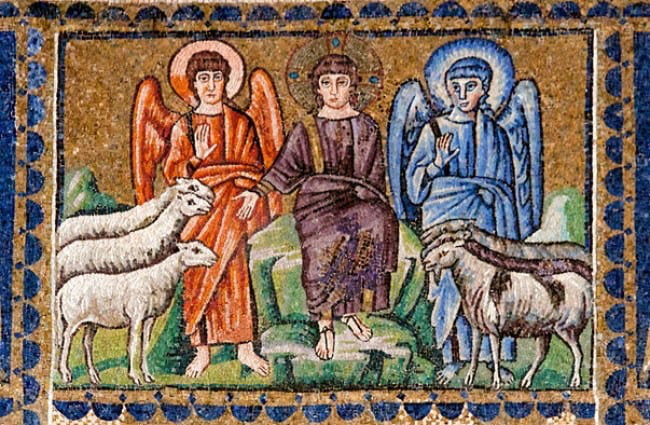
Why is the division of sheep and goats a suitable metaphor for judgement here, and what does Jesus have against goats? In richer pasture further west in the Mediterranean, the land is good enough to support single-species herds. But further east, where the grazing land is scrubbier, then mixed herds are essential, since the goats can graze the harder ground.
Why then does Jesus appear to have a negative view of the goats in Matt 25? This passage has almost universally been read in the light of the parable of the wheat and the tares in Matt 13:24–30, so that the emphasis of the contrast is between the good ones and the bad ones. But in Rabbinic literature, goats are seen as of equal value with sheep, and in some cases more valuable. Goats have a higher milk yield than sheep, and so the idea of the promised land as ‘flowing with milk and honey’ is actually most likely a reference to the benefits of a land where goats graze. Interestingly, many commentators think that Jesus’ teaching in Matt 25 has been influenced by Ezekiel 34:17–22, a passage which mentions the action of separation as judgement, and includes a reference to both sheep and goats:
As for you, my flock, this is what the Sovereign LORD says: I will judge between one sheep and another, and between rams and goats. Is it not enough for you to feed on the good pasture?
So what is going on? Goats reproduce faster than sheep, and if a herdsman is going to keep his flock properly balanced, then as a matter of course he will need to cull the male kids (baby goats), since otherwise they will outnumber the sheep, and with too many males he will not have a supply of milk (a small herd would typically only need a couple of males). When we look at Matt 25, we see that the word translated ‘goat’ is actually the word eriphos in v 33 and the diminutive eriphion in v 34, the male term for a baby goat—also used ironically by the elder brother in Luke 15.29 (‘you never even gave me a kid’). So Jesus’ reference to the separation appears to be drawing on a well-known and regular occurrence in herding—the separation out and culling of the young male goats the herdsmen would do as a natural part of their work. We also know that shepherds separated the goats in the evening because goats need warmth at night.
In other words, whatever the reason, the focus is not on the different types of animals, but on the process of separation. This is supported when we read on in the parable; beyond Matt 25.32–33, the two groups are not again referred to as ‘sheep’ and ‘goats’, but as those on the king’s right and on his left. Reading the text carefully in its cultural context actually drives us back to read the text itself more carefully. A modern equivalent which could have been used a few years ago might be: ‘The king will separate the nations as easily as a housewife separates apples from pears’. This no longer applies, since all sorts of people do shopping, and fruit now comes in separate bags—but it illustrates the point.
Another major difficulty with the popular reading is presented by the shape of the narrative, and its emotive effect. The king invites those on his right to ‘Come, you who are blessed by my Father; take your inheritance, the kingdom prepared for you since the creation of the world…’, they respond with complete surprise, and the king has to explain that ‘Whenever you did this for the least…you did it for me’. Likewise, those on his left are also surprised to have encountered the king in his moment of need. Neither group has recognise the king in the person of ‘the least’. If the narrative were about helping the poor, then those who helped the poor (having read this story!) would hardly be surprised to find that they had been doing as the king asked.
And the language here challenges the notion that entrance into the kingdom is a ‘reward’ which has been merited by a life of good works. Rather, the language of ‘inheritance’ echoes God’s promise to Israel, for whom the land is an ‘inheritance’, granted to them not because of their virtue, but because they are God’s son, and they inherit as a son inherits from a father in the ancient world (and in the modern world until quite recently). In order to inherit, you don’t need to be good, you just need to be a son, and this image—of adoption by God, and so receiving the inheritance because of God’s gracious generosity—is found all over the New Testament.
And there are further problems with the popular interpretation, when it is read in the context of Matthew’s gospel as a whole. As Dick France points out in his commentaries (NIC and TNTC), Matthew never records Jesus referring to his ‘brothers’ or sisters as anyone other than those who do the will of God by becoming his followers. This is particularly clear in Matt 12.49, when Jesus is rather radically proposing that his new family are the disciples gathered around him (which of course includes women). And Jesus uses this language consistently throughout the gospel: in his teaching about life in the community of faith, it is our ‘brother’ that we learn to correct and forgive (Matt 18.15, 21); those who call Jesus teacher are all ‘brothers’ (Matt 23.8); and the women who meet Jesus at the tomb are instructed to ‘go and tell my brothers’ in Matt 28.10. And it is the ‘little ones’ who believe in Jesus in Matt 18.6, 10, 14.
Moreover, Jesus is clear that to follow him might well mean facing the possibility of being homeless; in reply to a teacher of the law who would follow him, Jesus replies:
Foxes have dens, and the birds in the sky have nests, but the Son of Man has no place to lay his head (Matt 8.20 = Luke 9.58).
In other words, if you follow Jesus you will be like him, and this could involve being without home, and being a wandering stranger, reliant on the charity and provision of others. Some therefore interpret the ‘least of these’ as itinerant missionaries, sent out in the manner of the 12 and the 72 in Luke 9 and 10, who are indeed reliant on the charity of those they go to. But in the gospels, Jesus never draws a hard line between these groups and his disciples in general, so focussing on ‘missionaries’ is to make the reference too narrow.
Put together, all this data points to the ‘least of these’ not being the poor in general, but being Jesus’ own followers. Thus those on the king’s right are people who have welcomed his poor followers, and in doing so have welcomed Jesus. At the end of Jesus’ second block of teaching in Matthew (which Matthew attaches to the sending out of the 12 in chapter 10) we have a very similar idea—whoever receives the disciples in effect receives Jesus, and how they treat the disciples is in effect how they treat Jesus. (These verses, Matt 10.40–42, don’t have an exact parallel in the other gospels, though there is a similar saying in a different context in Mark 9.41). France, in his comment on Matt 25, describes this as the closest Matthew gets to a Pauline notion of the believers as the body of Christ, and it is likely that Paul was shaped in this by the words he heard on the Damascus Road. Persecuting Jesus’ followers, he hears Jesus ask: ‘Why do you persecute me?’
So the division is not between those who care for the poor or don’t (and there is plenty of encouragement to do that elsewhere in the gospels), but those who receive and care for the followers of Jesus or don’t—and in doing so reveal their attitude to the king himself.
This gives rise to some challenging lessons from this better reading of the narrative:
- To coin a cliché, it is all about Jesus. He is the exalted Son of Man, who takes the concerns of the people of God into the presence of God, and now sits on God’s throne as rightful king. He is the true Shepherd of Israel, and in him God exercises his reign and his just judgement.
- To follow Jesus means (to risk?) being hungry, thirsty, naked, as stranger, sick and in prison. This has not been hard to imagine for many Christians in many parts of the world in many times in history. In fact, it is perhaps only in a rich West that Christians could have misread this teaching, by naturally reading themselves in the role of the powerful helper rather than the powerless in need of help.
- It raises big questions about the status of those who don’t appear to have named Christ as Lord (Romans 10.9), but have responded to Christ in being the ‘sheep’ who have assisted his disciples because they are his disciples. This question was raised by someone listening to me teach on this, who worked in inner cities primarily with Muslims. ‘If my Muslim friend helps me out are they counted as sheep?’ In a sense it asks the bigger question of whether it is possible to become a Muslim follower of Jesus rather than become a Christian.
- But as a complement to that, we need to note that the judgement doesn’t just take place on the grounds of whether people like us and help us, or not. It is on the grounds of whether they receive us as we are living the lives Jesus called us to, in particular, whether we are healing the sick, driving out demons, calling people to repentance, and proclaiming the kingdom. It is how people receive us as disciples of Jesus, that is, while we are doing the things he calls us to. This means that there is not perhaps quite the gap between response to us and faith in Jesus that at first we might think.
- It suggests a rather different model for mission. We are not going as the strong with resources to help the weak, but we come as the weak ready to receive from those to whom we have been sent. And of course this is the idea behind the idea of finding the ‘person of peace’, taught by Mike Breen and others from the sending of the 12 and the 72 in Luke 9 and 10 and Matt 10. You can read about this in my co-authored Grove booklet How to be Fruitful.
- Jesus as judge will separate those who have responded to him, in whatever way they were able, from those who have rejected him. We might not be able to tell the difference now (since we do not know the secrets of people’s hearts), but he will be able to do so just as easily as a herdsman separates his flock for culling. He is a competent and a just judge, and we can trust him to do his job.
Come and join Ian and James as they discuss these issues and think about preaching on this passage…