
General Synod is planning to have a debate about the Kairos II Palestine document on Sunday night. In theory, it is claimed to be a listening to the voice of our Palestinian Christian brethren. But in reality, it proposes a selective and distorted account which is potential going to do irreparable harm to Jewish-Christian relations and likely to contribute to worsening antisemitism.
On Sunday night, 12th July, General Synod is due to discuss a Diocese Synod Motion from Carlisle Diocese headed ‘Kairos Palestine.’ (General Synod is a public assembly, like Parliament, so you can download and read all the papers on the Church of England page here.)
At one level, the motion looks as though it is ‘balanced’ and concerned to listen to all sides. It includes the comment ‘We lament the loss of Israeli and Palestinian lives and the violations of human dignity and rights on both sides, as well as the displacement of population.’ And it includes the welcome comments:
In particular, we:
a) reject antisemitism, anti-Muslim hostility and all forms of prejudice based on religious affiliation and ethnicity;
b) pray for all victims of the current conflicts in Israel and the occupied
But the problem comes not only with other wording in the motion, but in its central call, which is to ‘receive…the Kairos Palestine II’ document, from which the motion gets its name.
The first problem comes in the opening sentence.
That this Synod respond to the call of Palestinian Christians to stand in solidarity with them and their fellow Palestinians in non-violent resistance to the ongoing occupation.
It is less the wording and more the assumption the wording makes which is the problem: that Palestinians are committed to non-violent resistance to ‘occupation.’
Historically, Palestinian Christians as a group have been deeply involved in violent terrorism as their rejection of the State of Israel, and have been deeply involved in the PLO, whose founding charter rejected the right of Israel to exist, and claimed the whole region as an Arab homeland. (We need to be aware, too, that before the mid-1960s, there was no campaign for ‘Palestinians’, since this was a regional term, and mostly used by Jews who lived there. It was created as a political label as part of the Cold-War conflict in which the Arab-Israeli conflict was a proxy for the Soviet Union’s battle with the West.)
Thus the great uncle of Layan Nasir (whom both Sarah Mullally and other bishops visited), Kamal Nasser, was the director of communications for the PLO in the 1960s, and was believed to be the person who organised the 1972 Munich massacre of Israeli athletes at the Olympics.
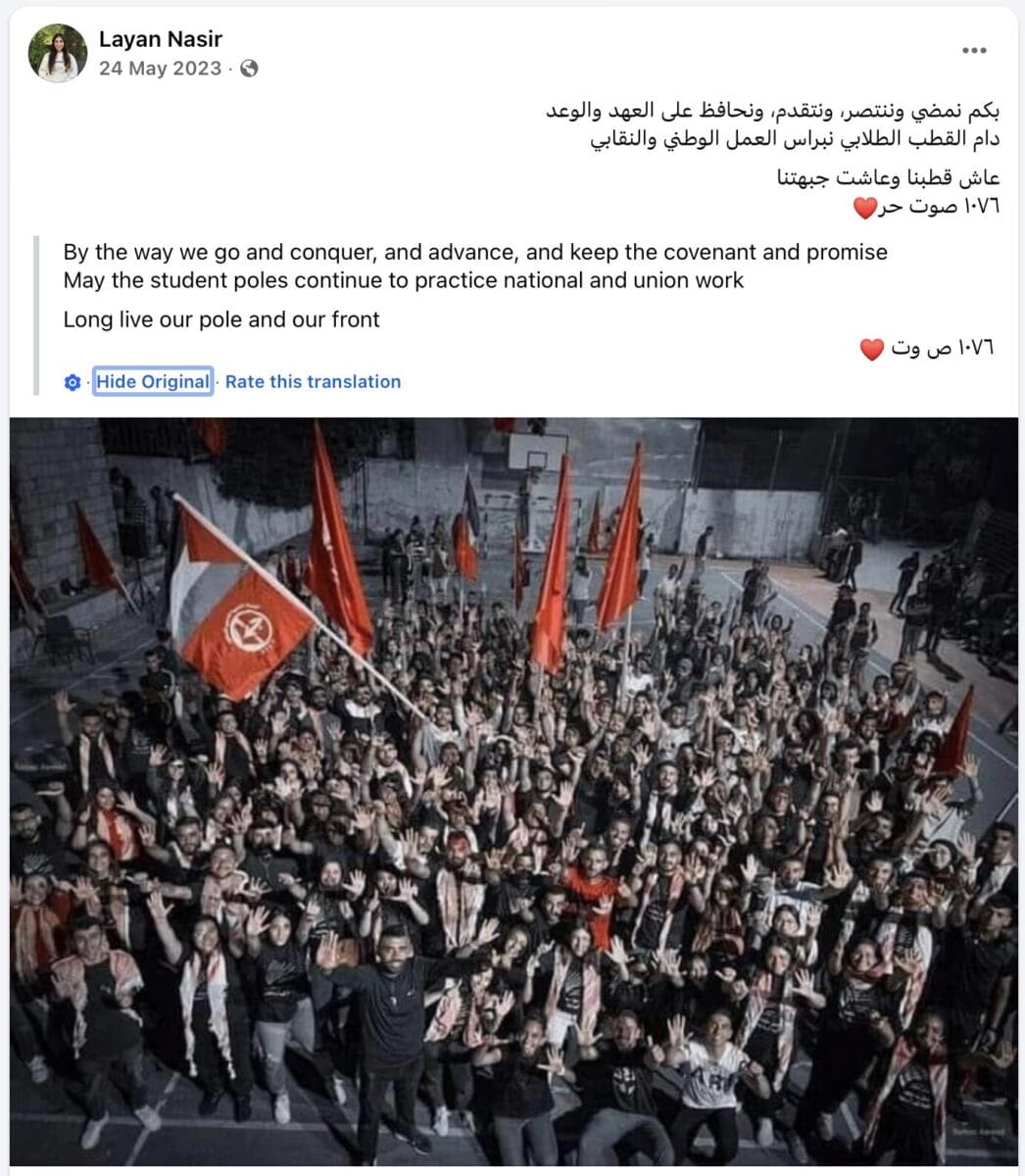
As I mentioned in my previous article on this, Layan Nasir herself has been a member of Democratic Progressive Student Pole (DPSP), the student wing of the Popular Front for the Liberation of Palestine (PFLP), which took part in the October 7th 2023 massacre of over 1,000 Israelis. You can see here her posting on her Facebook account of her support for both organisations, which I screenshot before she hid the post.
George Habash, another Palestinian Christian, was in fact a radical Marxist and the founder of the PFLP. (This is where we need to remember that, in this region, ‘Palestinian Christian’ often functions as a group label in a way that we are not used to in the UK.)
Another person that Sarah Mullally met on her visit was Zeina Barbar; she is not named explicitly, but you can see a video of the two of them in conversation on Twitter/X. Her father planted a car bomb in the Mea Shearim district of Jerusalem; she has been arrested on terrorism charges; and she has posted online her support for Samer Arbid, who commanded a PFLP terror cell that carried out a bombing against Israeli civilians, murdering 17-year-old Rina Shnerb, and injuring her father and brother.
The motion would have been fine if it either included ‘those…who’, recognising that many Palestinian Christians are not engaged in or supporting ‘non-violent resistance, or if it included a call for them to renounce violence, as well as calling for an end to violence on the part of Israelis.
Without this, the motion either lacks any historical awareness, or is functioning as propaganda for one side of this complex and contested issue.
There are other highly contentious terms used to frame the motion, including ‘Palestine’ itself, used to refer to an ethnic group and a state, despite there having been no such group or nation in previous history. (I should note here that you, dear reader, might well take a different view from me on the use of the term—but here I want to note that it is used in the motion without any indication that it is at all contentious). And the word ‘occupation’ is also used as though it were a factual descriptor. The Palestinians have indeed been occupied—by Egypt in Gaza, and in the West Bank when it was annexed by Jordan, which was in fact the very reason the country changed its name from Transjordan!
But the most contentious element of all is the invitation to ‘receive’ the Kairos II Palestine document. I do hope you will read it for yourself (a copy is on the Synod page I linked above).
The whole document is framed in terms of the ‘genocide’ that is happening in Gaza. To realise how calculating this term is in its offence to Jews, we need to remember that the word itself was coined to describe the unprecedented slaughter of Jews in Europe, when 6 million out of 9 million Jews were gassed and shot. In a period since then when the global population has multiplied fourfold, the global Jewish population has still not returned to what it was before the Holocaust. That is genocide.
When up to 1.5 million Armenians were killed in 1915–16, that is genocide.
What is happening in the war in Gaza is appalling, and might well be judged to be unjustified and disproportionate. But the deaths of 70,000 people out of a population of 2.1 million is not ‘genocide’.
In fact, the population of Palestinians has exploded, both within the state of Israel and beyond its borders. The 150,00 Muslim Arabs who stayed in the state of Israel after the war of 1947–49 have grown to more than 2 million, who have full democratic rights (so to call this, the only democratic state in the region, ‘apartheid’ is astonishing). And the global population of Palestinians now stands at around 15.5 million from the 700,000 who left the territory.
When 6 million out of 9 million are killed, that is genocide. When you grow from 700,000 to 15.5 million, that is not. The term has been deployed here to create maximum offence.
What is truly offensive is that, in the context of Gaza, there is only one mention of Hamas, in para 1.6—and that is to justify what happened on 7th October as ‘the right of a people under occupation to resist their occupier and oppressor’.
There are many, many other issues with Kairos II that I could analyse, though that would be long, complicated, and contested. For reflection on the Church of England and the General Synod debate, we simply need to listen to how the Jewish community in Britain has responded to the proposal to ‘receive’ this document.
The Chief Rabbi, commented:
The content of Kairos II is deeply concerning and I would hope the Synod will see it for what it is. While it is important to recognise the suffering of Palestinian Christians, this document does so in a way which can only harm the cause of peace.
It presents a one-sided account of a complex conflict, downplays the historical experiences and legitimate concerns of Jewish people, and offers little more than political activism dressed up as theology.
It is truly shocking that a document which purports to speak in the name of truth, contains so much falsehood – using extreme rhetoric to challenge the very concept of a Jewish state, and to oppose existing peace agreements in the region.
At a time when Christian-Jewish relations require nuance, trust and a willingness to engage with complexity, Kairos II risks undermining decades of careful relationship-building.
Meaningful progress begins when the dignity, aspirations and suffering of all peoples are acknowledged. Kairos II takes us further away from that goal, not closer to it.
It is worth noting that, when Carlisle Diocese debate this, passed the motion, and then passed it on to Synod, they consulted not one single Jewish leader to get their response or reaction. I am not sure that there was any such consultation before it was tabled for Synod business either.
The Jewish Board of Deputies also made a separate public statement.
We understand the motivations of Church members to express solidarity with Palestinians and to hear their voices in the current devastating circumstances. We recognise the ties of kinship of Christians in England to Palestinian Christians and to the Holy Land. We also note with profound respect the Anglican Communion’s affirmation of peace-making as a Christian vocation. We condemn extremism and violence whether perpetrated by Israelis or Palestinians, including violence perpetrated by extremist settlers, and we support all efforts to advance peace and security for both peoples.
Unfortunately, dissemination of the Kairos documents will do more to perpetuate conflict than make peace. Specific distortions and falsehoods in Kairos II are too numerous to be detailed here. However, a central libel of this text – that Zionism is a settler-colonial movement built on “Jewish supremacy” and with genocidal intent – is so false and destructive that the only responsible action is to reject it…
Synod Members might reflect on the threat posed to Jewish-Christian relations, which have advanced positively in recent times. They might consider how Jews will view a decision of the Church to engage with a text that so thoroughly eviscerates the faith, personal history, cultural identity, and lived experience of Jewish families here and around the world. They might further consider the impact of disseminating a document that appears to justify the October 7 massacre, and that spreads hateful attitudes towards Israel and Diaspora Jews, at a time when we see such attitudes leading to murderous violence against Jews here and in other countries.
The Kairos II document directly undermines the struggle against antisemitism, as well as Christian-Jewish dialogue. It attempts to restrict the understanding of antisemitism in ways contrary to how it is understood and experienced by most Jews around the world. No less damaging is the call to “to boycott dialogue with Zionist voices,” which jeopardises decades of Christian-Jewish relationship building.
The Jewish Chronicle reported the response of the Council for Christians and Jews, in which the Church of England has been deeply involved:
Responding to the document’s publication, the Council of Christian and Jews (CCJ) warned in guidance to churches that “the unqualified use of the terms ‘colonial’ and ‘settler-colonial’ can be heard as denying the historic and spiritual connection of the Jewish people to the land of Israel and denying the legitimate establishment of the State of Israel by the United Nations in 1948”.
It called on churches to “affirm Jewish indigeneity and historical connection to the land” and to “avoid adopting unhelpful language, including that which appears to erase one people’s story in order to affirm another’s”.
The CCJ also warned that statements about Zionism in the document could be “heard as a rejection of Jewish identity or belonging or right to self-determination” and prove “extremely damaging” in the UK when Jews were facing rising antisemitism.
In a statement this week, the CCJ said it had been working to raise Jewish concerns with the Methodist and other churches, urging UK Christians to listen to a broad range of Jewish views.
There was language in the Kairos Palestine document that was “deeply harmful to these aims, including statements which deny the historic and spiritual connection of the Jewish people to the land of Israel,” it said.
And the Churches Ministry Amongst the Jews (CMJ) raised major question about the bias inherent in the report, and the lack of consultation with or listening to other voices.
We welcome the Synod papers’ commitment to justice, peace, reconciliation, and their unequivocal rejection of antisemitism and anti-Muslim hatred. We also affirm the importance of hearing the witness of Palestinian Christians, whose suffering and faith deserve the Church’s careful attention.
Our concern is not that these voices are being heard, but that they are presented largely in isolation from other faithful Christian perspectives. We were surprised that papers intended to shape the Church’s theological engagement with Israel and Palestine appear to have been prepared without consultation, so far as we are aware, with CMJ, Jewish believers in Jesus, Israeli Christians, Hebrew-speaking congregations, or others whose experience forms an equally important part of the Church’s witness. We therefore believe it is important that the resources commended to the Church reflect the breadth of faithful Christian concern on these questions…
Zionism is a contentious term, but for the vast majority of Jews it is not about Jewish supremacy or unconditional support for all actions of the state of Israel, but instead the hope that a Jewish state could exist as a safe harbour in times of rising antisemitism – very much like the one we find ourselves in. Our Society (CMJ) has had over 200 years of experience engaging with Jewish perceptions of the church and must definitively express that we expect this to be a barrier to their engagement with the Church of England. As a Society we are concerned it will be interpreted as a threat to the Jewish community. To quote the Chief Rabbi of London in the Jewish Chronicle “Meaningful progress begins when the dignity, aspirations and suffering of all peoples are acknowledged. Kairos II takes us further away from that goal, not closer to it.”
Our Lord Jesus Christ, Himself born a Jew, looked upon Jerusalem with compassion and wept over the city. His ministry united truth with mercy and called His followers to become ministers of the gospel of peace. We believe that same spirit should guide the Church’s witness today.
We therefore respectfully ask that future theological work on Israel, Palestine and the Holy Land be informed by broader consultation with Palestinian Christian leaders, Jewish believers in Jesus, Israeli Christians, representatives of the Jewish community, Anglican theologians from differing traditions, and organisations such as CMJ, whose historic vocation has been to strengthen understanding between the Church and the Jewish people.
It might be worth reflecting on how the Church of England, its episcopal leaders, and the General Synod, have managed to get themselves into such a situation. How have we managed to create so much offence?
British Jew Yaakov Chaliotis highlights the problem with Sarah Mullally’s recent visit to Israel/Palestine—but this applies equally to the Synod debate and the way the motion has been proposed.
A Christian leader can care about Palestinians without erasing Israelis. You can oppose the hardship of the West Bank without minimising Hamas’s genocidal ideology. You can pray for Gaza without forgetting the hostages. But when a pilgrimage offers the world one people’s tears and not the other’s, it does not heal. It teaches the watching world that Jewish suffering is secondary — politically inconvenient, morally less urgent…
The Jewish people are not foreigners in Jerusalem. Israel is not a colonial accident. And Israel’s security measures did not appear out of nowhere. Peace will not come from one-sided lament. It will come when Palestinian leadership accepts that Israel is permanent, that Jewish self-determination is legitimate, that terror is not resistance, that hostages are not currency, and that Jewish life is not expendable. Call for justice for Palestinians — please do — but hold to the same moral standard those who murder Jews, glorify violence and seek Israel’s end.
A credible path forward must defend Palestinian dignity and Jewish safety together. Anything less is not peace. It is moral evasion dressed as compassion — and the Holy Land has had enough of both.
 Buy me a Coffee







Ian,
Thank you for your forensic analysis of the GS papers.
I was shocked and dismayed at the shallowness of the thinking that has got Synod to such a place of confusion.
If you are at Synod on Sunday and get the chance to speak you will be doing the church – and the ancient people of God – a very considerable service
Thanks. I will be there and I plan to speak.
Ian,
you might want to wear something luminous or dye your hair pink.
That seems to guarantee getting called to speak in this deeply disappointing Synod
I have packed my ‘call me to speak’ Synod shirt.
Who is occupying whom?
It’s all hot air so far as I am concerned.
General Synod has no power whatsoever to effect meaningful change in this situation, however one is compelled to understand it. Any expression of solidarity (be that with Palestinians or Jews) is meaningless without commitments to action, and no real action seems to be being proposed. A brief look through the past resolutions at the bottom of the briefing paper makes this clear.
Yes, but it does have power to create deep offence and destroy trust. And it is looking very capable of that.
Your Facebook comments (that is, others’ Facebook comments on your posts, rather than your comments specifically) would suggest that there is precious little trust left to destroy 🙁
Sure. But perhaps it could be salvaged…
General Synod seems to be moving the CofE further and further from truth in so many areas of debate. Is there anything we can do about it other than walk away?
Give up on the Church of England as a denomination – it never got back to the New Testament, only the fourth century compromise of the church with the world – but do not walk out of one of its good congregations if you happen to be in one. Make your view quietly and courteously clear.
I don’t know how much power General Synod has but I do know that the Church of England has an enormous amount of influence. If General Synod accepts this motion then it will send a clear message of solidarity to Palestinians (including, I regret to say, Hamas) and rejection to Jews. Honestly, I don’t think the Israeli government will care, if it even knows. But the Jewish community in this country most definitely will know AND care. Just read those responses from the Chief Rabbi and others. Those aren’t formal responses to something which doesn’t matter to them. Those are heartfelt responses to something which DEEPLY matters to them. The past resolutions weren’t passed less than twelve months after Jews were killed in this country for being Jews. This motion comes at a time when the Jewish community is deeply fearful of rising antisemitism and sensitive to societal attitudes – in a country which has been a safe haven for many generations and especially during the Holocaust – and with tragically good reason.
Judith, you are quite right. It is disastrous.
Yes. Jews are an asset to Britain, anti-semites a liability.
That’s courageous, Ian. My sermon on Islam has just gained me a rap on the knuckles from my Archdeacon. Kairos II is a complete rewriting of history and an apology for murder, but the ignorance of Middle-Eastern history by the CofE might just give it the few votes it needs. And just as our PM in waiting says that we should sanction Israel further. I mean, beyond recognising a ‘Palestinian’ state right after the biggest pogrom since the Shoah?
Well done you. It is truly shocking—and as you say is founded in ignorance.
Totally agree, Lorenzo!
Let us not forget that the Rev Dr Bernard Randall’s totally orthodox sermon responding to those who would “smash heteronormativity” cost him his job, shunning by the Bishop of Derby (who referred him to ‘safeguarding’ and took away his licence), and seven years of hardship and struggle until he was finally vindicated.
I hope Ian will feature this case soon, along with a discussion of the horrific abuse of ‘safeguarding’ by C of E hierarchy, using this as a cover for advancing anti-Christian doctrine by transgenderists.
James Thomson – so if you’re aware of all of that – then what is a nice Christian boy like you doing in a place like the Church of England?? Surely the Rev Dr Bernard Randall should have regarded getting kicked out of the C. of E. as a badge of honour.
I have asked myself that sometimes. But why should I abandon buildings and funds to which I have contributed many thousands of pounds over many years to those who don’t believe and do not contribute sacrificially? But all around me I see liberal parishes with aging congregations and no children slowly closing their doors while the number of Muslims continues to grow – look at the enormous number of little Muhammads in England now- and I don’t want to throw away a lifetime’s efforts when our own parish is doing well. It is Libby Lane who must be censured for abuse of power.
Only 6% of the UK population is Muslim, the only reason there are many Muhammad’s is almost every other Muslim boy is called Muhammad. Liberal churches ie the ones which want to perform full same sex marriages not just PLF, tend to be concentrated in inner cities and university towns which have younger populations than the national average
It follows the trajectory of theological and religious (inclusive) syncretism, that seems to be established in the CoE, so it of little surprise Lorenzo, if deeply and personally galling. And it is at the heart of this whole greivous farrago.
An excellent post Ian. The C of E shows that its leaders are not on the side of the Jews nor on the side of Christians. A Palestinian Christian doesn’t describe a Palestinian with a living relationship with God through Jesus. It describes a group of people that may or may not be true Christians and some are clearly anti-Christian. Shame that the C of E can’t differentiate.
Hardly surprising that the C of E can’t differentiate as the same description applied to it during the period of institutional protestantism. It lobbied for persecution in various ways of nonconformists right through until the 19th century.
Notice how a Roman Catholic priest who wants to become an Anglican minister is admitted without (re-)ordination but a non-conformist whose ministry is recognised by the C of E has to be episcopally re-ordained.
This shows that the C of E doesn’t really accept the orders of non-Anglican Protestants but, bizarrely, does accept Roman Catholic priests.
No explanation is given for this inconsistency.
But I think I know why: Rome and Canterbury are both institutional churches that are historically in the law business (i.e. social control) as well as the grace business (despite the Pauline incompatibility of these approaches). Part of the system of control is that you have to have an ordained person to administer Holy Communion. Not so in Free churches.
Isn’t about being an episcopal church? Roman Catholic and Orthodox orders are recognised, as are ACNA, Free Church of England etc..
The Kairos I Palestinian document of 2009 was no better, calling for Boycott of, Divestment from and Sanctions against Israel (BDS).
Canterbury’s long suicide continues…
It’s a long suicide by remorseless metamorphosis from a religious institution to a political one. Which also can be said of mainline Protestant denominations in America, who have been following the C of E into irrelevance since the 1970s using the same mode of self-annihilation. Christian belief is supposed to be transcendent from secular politics, not a morally preening adjunct to it. History has shown that when the Church follows this ruinous path – as it has episodically through the centuries – it seldom redounds to the glory of Christ.
Has this motion grown out of mendacity or stupidity? Maybe a generous helping of both.
Whilst I hope Synod rejects the motion, and in particular the ask to receive Kairos II, getting to read Kairos II does help show why peace seems so distant. It sets out, amongst a lot of troubling material, the believe that the existence of Israel is itself a genocidal act born of the same mentality as the slave trade, and is clear that its authors are not for a second seeking peace with Israel as they want Israel itself to be dismantled and reject any suggestion that Israel has any right to self-defence.
This has been clear for a long time. Most Anglicans in Israel or Palestine are Arabs, and often converts from Greek Orthodox or Catholic churches. The outlook of these documents simply reflects Palestinian Arab politics, along with the hope that a Muslim majority will be kind to loyal Christians.
They have good reasons for such fears because Christianity has almost disappeared from Gaza under Hamas. The Vatican plays a similar but less obnoxious game because of the Catholic communities in Lebanon and Syria, as well as the quietly growing Catholic communities in the Gulf, fueled by Indian and Filipino emigres.
Adam, I think you have put your finger exactly on the issue. Supporting this document pushed the possibility of peace further away.
Have you read The War of Return? Explains again why Palestinian demands and Western support have made peace impossible.
The Arab demand has consistently been all or nothing. They point out that they can afford to lose a few wars but Israel cannot afford to lose a single one.
Not more than 650,000 Arabs were made refugees during the fighting in the area of Mandatory Palestine between December 1947 and March 1949. (I can explain where this figure comes from.) Although the number still alive 77 years later is tiny, more than 5 million Arabs demand the inaccurately named ‘right of return’ today. They are the descendants of those ~650,000, and the United Nations Relief and Works Agency (UNRWA) counts the descendants of those 650,000 as refugees – something it does not do for other conflicts. They demand this for two reasons: antisemitism (J’Accuse), and the stone-hearted refusal of Israel’s Arab neighbours to let these people integrate into the identical culture within their borders. Instead these 5 million are kept in ‘camps’ (actually shanty towns) near to Israel’s borders, as a weapon. The leaders of Israel’s neighbours do not give a damn about these Arab brethren, who have been kept alive in false hope by Western aid agencies. If the West had not done that, they would not have starved but would have integrated into the Arab populations of Israel’s neighbours.
All of that is before we speak of the (similar) number of Jews who were forced out of Arab countries as an act of pure revenge during the several years after 1949. Israel let them in and integrated them.
Who is ‘occupying’ Gaza ? It is Hamas which is occupying and oppressing Gaza. Some of the actors in the movement to blame Israel and others have to description ‘Christian’ applied to them. In what sense are they Christian? Are they believers saved by the death and resurrection of the Lord Jesus Christ, dedicated to His mission as true disciples, or are they historic Arab Christians, who hide under the title and who are political and often committed to terrorism. What on earth is the Church of England standing for?
The language could be rephrased but there are Palestinians, including Christians, facing Israeli settlers encroaching on their land. What is needed is a viable two state solution for Israelis and Palestinians
I condemn encroachment on land that has been farmed for many years by Palestinian Arab families who have never taken up arms. But much of the so-called West Bank is public land, and you need to distinguish between who owns the rights to a plot of land and who has political hegemony over it.
Some is public land but but Palestinians who own land in the West Bank and farm it are entitled to retain it without Jewish settlers taking it over. Jewish settlers should focus on public land
I agree! But we need to look closely at what proportion of land built on by Jewish settlers saw Arab farmers driven off it for that purpose. I don’t have very much confidence in figures from either side. Please see, for example, the YouTube video which I have linked to below about ‘settler violence’.
Ideally there would be some objective analysis on that
RIP Too to Ann Widdecombe after news of her awful murder today. She was a woman of strong traditional views, firmly anti abortion and opposed same sex marriage and who left the C of E for the Roman Catholic church after ordination of women. Politically too she made the move to the right from the Conservative Party to Reform. However by all accounts she treated everybody kindly and was a woman of great personal Christian compassion too
She didn’t move to the Right. The Tories moved to the Left and Reform filled the gap.
She joined Farage’s Brexit Party as she believed Theresa May’s Brexit Deal made too many concessions to the EU. Kemi to be fair to her is now pretty rightwing anyway and indeed on some issues like opposing nationalisation of steel and keeping the 2 child benefit cap even right of Farage
Her views were not ‘traditional’ – as though stances being old or new could be a significant factor rather than a factor of no importance whatever.
This is the fundamental misunderstanding. While it persists, your side will be operating from a sandy basis.
Her views may however have been commonsensical, coherent, evidence-based, etc..,
Do you honestly think that some spurious ‘traditional’ basis would make someone oppose foxhunting so strongly as she did?
An interesting response from Jonathan Chaplin:
Ian Paul has again written a profoundly unhelpful and misinformed piece criticizing the CoE for planning to debate a motion (this Sunday evening) commending Kairos II (among other documents), and defending the Chief Rabbi for attacking it, partly because it will damage ‘interfaith relations’. I posted this on his thread but I’m also posting on mine so Ian Paul cannot entirely control the narrative and so that those who refuse to post on Ian’s threads (because of the belligerent responses they get) can post here if they wish. “General Synod members should not allow themselves to be swayed by Ian Paul’s tendentious misrepresentations, skewed history, and unverified allegations, on which he has a long track record on this issue. The Church of England’s internal debates or substantive positions are not be constrained or determined by Chief Rabbi Mirvis, the Board of Deputies, or the other organisations Ian Paul quotes, including the Council of Christians and Jews. These bodies do not represent anything like all, perhaps not even the majority of, British Jews, many of whom are supportive of the Palestinian cause (why are we not worried about ‘interfaith relations’ with them?). I quote another post which sums up exactly how the Church of England should respond to the Chief Rabbi’s improper intervention (which the CofE would never presume to do to a Jewish body): “The issue here is not interfaith dialogue. It is whether interfaith dialogue is to be used as a veto over Palestinian Christian speech. The Church of England is not being asked to canonise every word of Kairos II. It is being asked to receive and engage with the testimony of Palestinian Christians living through occupation, siege, displacement and mass death. That distinction matters. To threaten damage to Christian-Jewish relations if the Church listens to Palestinian Christians is not dialogue. It is disciplinary power dressed as dialogue. A Church that cannot hear the Christians of Palestine because Zionist institutions object has not protected interfaith relations. It has revealed who is allowed to speak, and who must remain silent.”
Penelope – could you post the link to this article? I can’t find it. Thanks in advance.
On the one hand, Ian Paul’s analysis may be correct – but on the other, I’m sceptical of those who dismiss out-of-hand serious scholarship by serious academics.
Sorry, Jock it’s on FB. I thought I had posted the link. But I simply pasted his response.
Regarding Chaplin’s words, “It has revealed who is allowed to speak, and who must remain silent”, he might apply them to those Palestinian Arabs who prefer peace but who are bullied by the men of violence who lead their community.
This raises the question: why is it that the leaders of the Palestinian Arabs are men who advocate violence? Western Romantics like to think it is because they have just cause against an intransigent enemy. But there are other reasons: failure of nerve among the men of peace; too many men of violence; verses in the Quran assserting that land that was once Islamic must be retaken; corrupt Western NGOs and foolish Western leaders subsidising weapons.
Chaplin also states: ” the Chief Rabbi’s improper intervention (which the CofE would never presume to do to a Jewish body)…” Perhaps he has forgotten the CoE’s stance against the Jewish Naturalisation Act of 1753 which led to rioting.
Plenty of abuse towards Ian there but no attempt to engage with his arguments; just dismissal of them because they originate from one of the awkward squad.
The arrogant elite encapsulated in one post.
Spot on. No attempt to engage with the arguments, points made. Not that I know who he is, which matters not one jot. But he does appear to be rattled for some reason.
PCD talks about “unverifed allegations”:
– and then claims “Chief Rabbi Mirvis, the Board of Deputies, or the other organisations Ian Paul quotes, including the Council of Christians and Jews. These bodies do not represent anything like all, perhaps not even the majority of, British Jews, ”
– well what is true is that there are Jews who are supportive of what we call in this discussion “the Palestinian cause” – but the contention or implication that the those organisations don’t represent the vast majority of Jews worldwide is in my view entirely false;
– The implication that these Jewish bodies are doing anything in any way improper is also in my view absurd – these Jewish bodies are rightly opposing a motion that is specifically antisemitic in the terms of both IHRA examples 7 and 8 – when the CofE committed itself to the IHRA definition of antisemitism in 2018 “and all of its examples, without exception or qualification”.
– The writer asserts “The Church of England is not being asked to canonise every word of Kairos II. It is being asked to receive and engage with the testimony of Palestinian Christians”
– Read the motion: The actual Kairos Palestine motion before General Synod in its clause 3 says: We:
“Receive the Kairos Palestine Declaration (2009), the Cry for Hope (2020), the Call for
Repentance (2023) and Kairos Palestine II (2025) as heartfelt expressions of the lived
experience of Palestinian Christians and:
a) encourage the Church of England at all levels to engage with those documents as
part of a quest for greater understanding of the situation.
– So the engagement that this motion requires with these one-sided and antisemitic documents is one that endorses, disseminates and amplifies them, making them the lens through which the church sees the entire situation in the Middle East.
Christian, thank you for highlighting this—you are quite right.
The language of ‘settler colonial project’ is specifically a denial of the legitimacy of the State of Israel, and is antisemitic by the House of Bishops’ own standard.
Regarding the reference to “the Chief Rabbi’s improper intervention (which the CofE would never presume to do to a Jewish body)” – I don’t think the Chief Rabbi’s intervention was improper. He was commenting on something which directly impacts his community at a time when their individual and community wellbeing is already threatened in this country. The Church of England isn’t a small, independent congregation with little or no influence. It’s the national church of this country with an extraordinary amount of influence. The decision to accept or reject this motion will directly and quickly impact the Jewish community including but not limited to Orthodox Jews, secular Jews and Jews who believe in Jesus and attend C of E or other churches. The fact that the Chief Rabbi never / rarely comments on what the C of E says and does but DID on this occasion testifies to the concern that he and his community feel. He had a right to comment as the leader of his community and he was also a lot more gracious and understanding towards the C of E than the C of E is currently being towards the Jewish community.
Penny, I repeatedly asked Jonathan to identify exactly what he thinks in my comments are misleading or inaccurate.
He repeatedly refused to do so.
What do we say to someone who makes those claims, then cannot back them up with any evidence.
Can you?
I can’t help but wonder how Jonathan Chaplin hopes the Church of England engages with:
– saying Israel has no claim to self-defence
– condemnation of the Palestinian Authority but not a peep about Hamas (except to excuse October 7th as being born of the Nabka in 1948)
– denouncing Israel as a settler-colonial, and therefore genocidal, state by definition and built on racism, and stating that “true solutions begin with dismantling oppressive, racist systems”
– reject that what is happening is a “conflict” (preferring the description “tyranny”) and rejecting talk of a “balanced” peace as moral evasion.
In Ian’s article it’s good to see the Board of Deputies statement criticising extremist settlers’ violence in the Occupied West Bank. It would be good if they could also codemn the Israeli Government’s collision with this violence through the actions of the Israeli army. I look forward to the Chief Rabbi taking a similar approach. In addition, there’s a letter in yesterday’s Church Times on behalf of the Jewish Network for Palestine which adds another perspective to this tortuous debate, showing that there’s more than one Jewish voice that needs to be heard . Things are clearly more complex and nuanced than the binary approaches that are often shouted at us.
Things are indeed more complex and nuanced. You might be surprised who the UN counts as a ‘violent settler’ – not excluding you if you have visited the West Bank as a tourist:
https://www.youtube.com/watch?v=1VTGlnzt9fI
Isn’t the main point of Ian’s two articles on this matter, that there is a substantial imbalance in the CoE heirarachy, a predominantly lopsided, one sided stance, that takes little to no account of history, nor philosophical or religious world views of the main protagonists, and ‘drivers’.
Hardly. The range and number of formal and informal contacts between the CofE and the Jewish communities in England is huge. It happens at every level from local interfaith groups and visits to synagogues by ordinands to the Archbishop of Canterbury and the King. Sometimes cathedrals provide a meeting space for people of different faiths who might struggle to meet on their own ground. Again, to criticise the actions of the Government of Israel and it’s army is not automatically antisemitic. Take a look at the Jewish Network for Palestine website.
It is, however, if the government of Israel is held up to consistently different standards to other governments. And this is frequently the case.
Israel is condemned because it is safe to do so, being a democracy.
Contrast the fury directed at Boris Johnson over the British-Iranian woman who got arrested there when she went to encourage opposition to the regime (yes, that is why she went – a risky, even foolish thing to do).
There is a soft bigotry of low expectations when it comes to Muslim, along with a reasonable fear that they will respond with terrorism.
Though Lorenzo is rebuked for for a sermon on Islam.
Though I clearly don’t know it’s content and Christianity is to centre on the person of Jesus, the Christ it is not unimportant to distinguish, separate Christianity from Islam.
One elephant in the room is the question: Is Islam a religion of peace?
Another is Islam primarily a theocracy?
And another is, what was its formative methods of spread, for conversion?
Saying Israel is, by definition and from its existence, genocidal and ought to be dismantled, probably is antisemitic though, right?
Yes, certainly. I will explain this in my planned post tomorrow.
With this, and the bishops voting down Helen King’s motion on same-sex relationships, you’ve got plenty to write about…
If Iran hits ships in the Strait of Hormuz whenever Israel takes action against Hezbollah – an organisation which the UK government categorises on its website as terrorist – then this could turn the USA against Israel. Then just about the whole world would be against Israel. Where have I read that before?
It would be cathartic and make for a much safer world if we in the West could grow up, throw off the primary school shackles of political correctness and talk to each other in the kind of adult terms where insults are scorned as trivial nonsense and objective truth is the only game in town. In such a world insults like ‘antisemitism’ would carry zero weight as truth silencers, and the actions of the State of Israel would be subject to exactly the same moral judgement as those of the Palestinian people.
In particular we would all recognise that within our own sinful selves we are, in the right circumstances, capable of committing every possible atrocity: war-mongering, genocide, murder, lying, stealing, corrupting, bullying, and abusing other people in every kind of overt or subtly psychological way. And the horrible truth is that this applies no less to those of us who call ourselves Christians.
None of this is to excuse vile, wicked, and mildly unkind behaviour – whoever commits it. Our sinful nature is indeed born in us but we Christians have the amazing task of telling the world about God’s unbelievably merciful and generous solution. And that is our number one priority, particularly so when we are speaking publicly as a Christian body. The idea of making public statements in regard to political policies or the behaviour of other nations, as if what we say defines ‘the Christian response’, is foolish in the extreme. If we suspect it’s packed with potholes, history leaves no doubt.
This is by no means a suggestion that Christians should ignore the real world or refrain from political engagement. As and when conscience and God makes clear, we need as individuals to get involved, speak truth to power, expose wickedness. This obviously may mean aligning with people of other faiths or none. Is that not also an opportunity for gospel witness?
In the case of GS motions I really do think that, even if none of the above is thought to apply, there are many serious (existential) problems within our own church which demand as much time as possible for prayer, intelligent reflection, and radical change of policy. Putting the C of E’s own house in order is a responsibility no other body than GS can address. That is what it should be doing.
Of course some Israelis are doing nasty things to some Arabs.
That sort of thing happens in times of war and suspicions. Israelis are not saints.
But they are a democracy and more freedom of speech and belief exists there than anywhere else in the Middle East.
But on the scale of oppression in the world, where should we place these acts of injustice?
– worse than Chinese Communist Party treatment of Uighurs?
– worse than Burmese treatment of Rohingya Muslims?
– worse than most conflicts in Africa, including Nigeria, Congo and Sudan?
– worse than the violence and rapes in South Africa and the violent acts against immigrants there?
– worse than Azeri treatment of Armenians and the ethnic cleansing of Nagorno Karabakh?
– worse than the Saudi war in Yemen?
– worse than Iranian government treatment of the Iranian people – 40,000 killed in January?
I don’t mean this as an exercise in ‘whataboutery’. But if the General Synod of the Church of England wants to insert itself into a regional conflict, it really should try to cover all the bases.
Or maybe pray instead of pretending to be a diplomatic agency.
Thank you for a courageous and thoughtful reflection on General Synod and Kairos II Palestine. I especially appreciate you sharing the responses from the Chief Rabbi and others so allowing their voices to be heard in your space. I’m Jewish but also Anglican – I believe in Jesus and am a confirmed Anglican (literally!) – and I think this motion is, frankly, heartbreaking. The timing of this motion is especially unfortunate since Andy Burnham has promised to be “tough” on Israel, which the Jewish community fears will provoke more antisemitism, by giving tactic support to those who hate Israel and Jews. With the civic AND religious authorities in this country turning away from them, the Jewish community cannot but feel increasingly isolated and threatened, which is tragic. Yet it doesn’t have to be this way. The Church of England could even now reject this motion, hear the words of the Chief Rabbi and others with grief and repentance for the hurt and offence they have caused and pledge to stand in love and solidarity with the Jewish community in their own country, dioceses and parishes: to, in other words, love their actual, present neighbour.
Well that was a pretty ghastly debate in Synod, ending with the whole thing being adjourned until who knows when (I’m assuming the answer isn’t tomorrow morning).
Personally I was pretty shocked and appalled by the arguments that it’s ok to receive Kairos II because it said it didn’t support antisemitism (although the real anger was for those who “exploit and support the charge of antisemitism”) and people acknowledged in the debate that Kairos II had troubling elements. Would that wash with any other report? If we had a report that was deeply homophobic, would Synod be ok voting to receive that as long as a bishop got up in the debate to say it was troubling and the authors had remembered to write at the top that they weren’t homophobic? What if it was racist against another group? What if it was virulently anti-Catholic? Of course not. No one would dream of making such a daft argument. But for some reason, it’s a bit different when it comes to antisemitism.
Is there a recording or transcript?
It gets livestreamed on YouTube:
https://www.youtube.com/watch?v=WhirWQ2M-AY&t=6397s
Well, I was mistaken – it came back this morning:
https://www.youtube.com/watch?v=wlxqmhhC5Y8
Motion (amended) went to a counted vote by Houses:
Bishops: 25 for, 0 against, 5 abstained
Clergy: 115 for, 20 against, 30 abstained
Laity: 130 for, 27 against, 35 abstained
Thank you Adam. The ‘real anger’ that you mention requires much (self) examination. We are to love the truth, even when it reveals much about ourselves that we don’t like, though will defend and justify to the hilt, that requires change. At root, it is sin, even though we may cover it with respectability, intellectual, even ‘disinterested’ discourse.
‘The heart is deceitful above all things’. It is an idol factory.
CS Lewis’s, Rats in the Cellar, comes to mind, as here:
https://www.cslewisinstitute.org/resources/reflections-february-2008/
Yes thanks Adam. I have a long-standing connection with Carlisle Diocese and this result fills me with a mixture of frustration and anger. I look forward to Ian’s response.
how do I find out which way our bishop votes?
The electronic voting results get published here:
https://www.churchofengland.org/about/governance/general-synod/groups-sessions/general-synod-july-2026#na
I imagine they’ll be put there in a couple of days (some poor person has to be check and format it).
Appalling outcome: when Judea and Samaria were under Jordanian control and Gaza Egyptian, they certainly did not talk of occupation; and the ‘Palestinians’ there still fought the Jews, not their occupiers. And how are the settlements illegal if they are located within the areas agreed by the Oslo accords? Sorry, but I’m not ‘standing in solidarity’ with that kind of historical revisionism.
Illegal? ‘Law’ means a body of legislation decreed or recognised – and enforced – by an authority, binding on specified people (by birth or within a territory), publicly known, with process in trials and specified penalties for violation. International criminal law fails these criteria, for there is no authority behind it. There are only international treaties and conventions, and signatory nations; maritime law is an example. The actions of a nation may be deplored, but it can be held only to its own signature (even then: how?) The United Nations wishes to claim authority over nations, but that is vanity. When you hear pomposities about ‘international law’, ask which code of law passed by what body, what clause is invoked, and who it binds.
Under Jordanian rule between 1948 and 1967, Jewish cemeteries in the ‘West Bank’ suffered desecration. The 6-Day War of 1967 in which the Jews regained control of Jerusalem after 1897 years was a major event on God’s clock.
Thanks for highlighting that. I don’t think I had twigged until doing some digging: 97% of Palestinians live in Areas A and B, and only 3% in Area C—where all the settlements are.
The Bishop of Winchester, the Rt Revd Philip Mounstephen, was among the 25 bishops who voted in favour of the amended motion on Kairos Palestine during the General Synod debate. The House of Bishops recorded no votes against the motion and five abstentions.
Thank you! I have also written a few things which I think agree with what you are saying, https://colinbarnesblog.blogspot.com/2021/08/palestinian-christians-are-they.html looks at are the Palestinian Christians faithful witnesses. https://colinbarnesblog.blogspot.com/2026/04/a-history-and-theology-of-palestinian.html is a much longer history/theological reflection on Palestinian Christian communities, while https://x.com/ColinBarnes16/status/2076853705920696732 is a reflection on post-Holocaust theology. Thanks again, and God bless!
Thanks for these. I look forward to reading them…
Perhaps some of us clergy (since the Bishops are unanimous in their support) should team up with Jewish and Israeli friends, Arabs and Christians included, to offer an alternative way to “encourage the Church of England at all levels to engage with those documents.”
There’s CMJ, an Anglican organisation founded in 1809 (under a different name) and the oldest Christian ministry to the Jewish people in the world.
https://cmj.org.uk/
I am beginning to do just that.
Will gladly lend a hand if I can.
Great idea – but one correction. Whilst it’s true that no Bishops voted against, five abstained. So they are not “Unanimous in their support”.