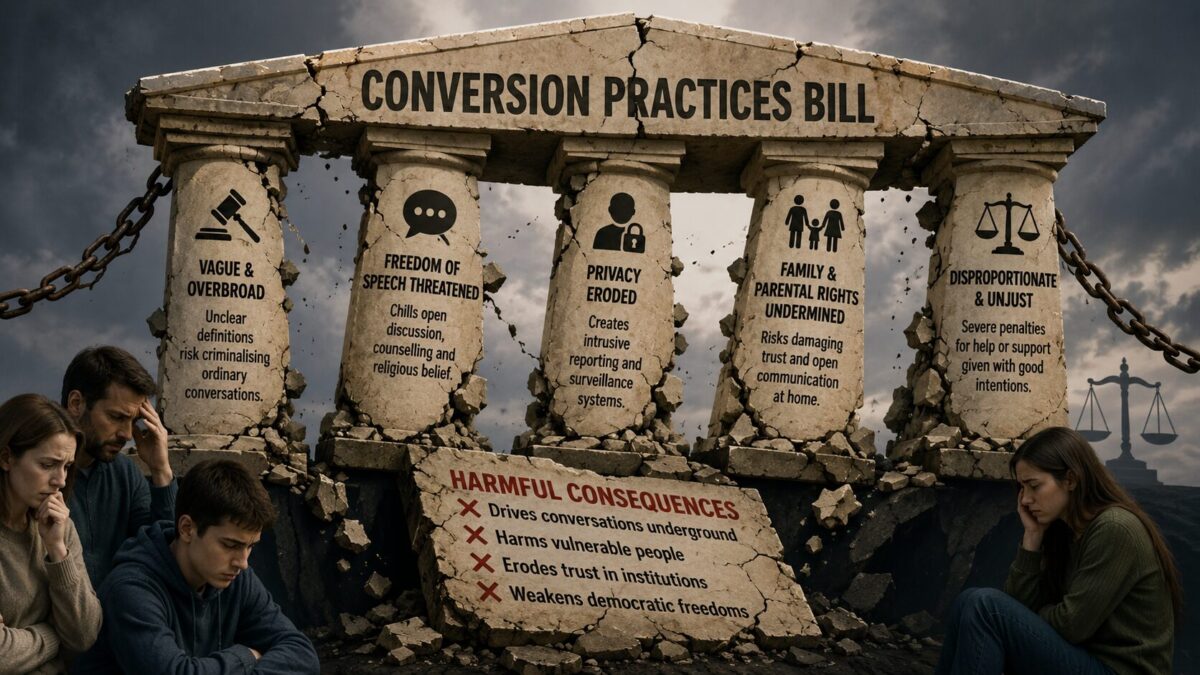
Mark Bratton writes: The long-awaited draft Bill on conversion practices (‘the draft’), recently released for pre-legislative parliamentary review, is fundamentally flawed. According to the Preamble, the draft aims, among other goals, to establish new offences related to abusive conversion practices on individuals. However, rather than preventing abuse, the draft risks reinforcing harmful conversion practices, particularly the manipulation of many children away from accepting their same-sex orientation towards a vague ‘transgender identity’ and endorsing irreversible and damaging medical interventions—such as drugs and surgeries—that fall under the so-called ‘gender-affirming care’ (GAM).
This draft legislation is poorly written, excessively broad in scope, and introduces new legal classifications that conflict with established principles in related legal fields. It risks encouraging vexatious litigation initiated by ideologically driven activists targeting individuals and public organisations that express obvious truths about sex and the best interests of gender-confused children facing developmental challenges linked to their natural growth. Additionally, it may suppress the speech and language used by parents, teachers, and youth workers who are trying to support children through their difficulties. The legislation also significantly undermines parental rights, potentially violating human rights law, particularly the right to private and family life under Article 8 of the European Convention on Human Rights (ECHR).
As outlined in the Explanatory Notes accompanying the draft, the proposed gender conversion Bill upholds the current Labour government’s manifesto pledge to implement a trans-inclusive ban on conversion practices, ostensibly aiming to address legal gaps related to such practices. However, this proposal is moot for two reasons.
Firstly, the original circumstances that prompted the proposal of such a Bill are now obsolete. The methods once condemned—aversion therapy, electric shock treatment, nausea-inducing drugs, and chemical castration used to attempt to “cure’ homosexuality—are now historical footnotes. Additionally, Malcolm Clark has convincingly argued that the evidence supporting UK conversion practices is weak, exaggerated by influential yet self-selecting surveys that broadly interpret discussions of LGBT issues in families and peer groups as part of an overly broad definition of ‘conversion practices’.
Second, as long as the targeted conversion practices persist, existing criminal laws covering sexual offences and coercive and controlling behaviours are adequate to address and penalise them. The draft states that, when assessing whether conduct constitutes criminal abuse in all circumstances (see Clause 1(5)), words or behaviour of a sexual nature, violent or threatening conduct, and controlling or coercive actions should be considered (Clauses 1(6)(a)(b)(c)). However, there is a problem: under the draft, the maximum penalty for charges of abusive conversion practices is an unlimited fine and/or up to five years of imprisonment (Clause 2(2)(a)(b)). As criminal barrister Dennis Kavanagh has noted, these penalties are woefully insufficient for certain abusive practices, such as ‘corrective rape’ of lesbians, which could otherwise attract life imprisonment under existing sexual offences laws. For these, the proposed Bill is effectively useless.
As Kavanagh observes, the draft has not received proper consideration. It originates from the Office for Equality and Opportunity, whose staff seem to have misused terminology from road traffic law (Clause 1(3), “conduct which…falls below the standards reasonably expected of a person in their position”), bribery regulations (Clause 5(2), failing “to take all reasonable steps to prevent the commission of an offence”), and family law (Clause 1(5), “whether conduct amounts to an abuse of the individual is a question of fact to be determined by reference to all the circumstances of the case”). The inconsistency and lack of review by criminal law experts only heighten suspicion that an ideological agenda underpins these legal and conceptual inconsistencies. It is hard to believe that successive governments would have delayed enacting and implementing a conversion practices Bill if the risks were as significant as activists claim. Instead, the true aim appears to be introducing a trans-inclusive Bill that would allow activists to fulfil various legal and social aims that courts and the growing public awareness of transgender issues are preventing.
This ideological bias is clear throughout the draft. It defines a ‘conversion practice’ very broadly as ‘any conduct’ (my emphasis) intended to cause an individual to acquire, reject, or believe they have or lack a particular sexual orientation or transgender identity (Clause 1(2)(a)(b)). Regarding sexual orientation, the binary opposition (have/not have) extends the concept beyond the definition in the Equality Act 2010 (EA), which regards sexual orientation as attraction toward persons of the same sex, opposite sex, or either sex. The draft’s definition would include someone not attracted to anyone (e.g., ‘asexuals’, as the Explanatory Notes make explicit), representing an expansion of identity that encompasses natural variations in human sexual interest. This raises troubling parallels, such as the recent addition of a ‘eunuch’ identity to the World Professional Association of Transgender Health’s (WPATH) Standards of Care (SOC 8).
The draft limits this broadly constructed definition of conversion practices within the context of conduct “carried out in the course of providing health care services to the individual concerned” (Clause 1(3)(b)), but only as long as the person does not act “in a way that falls far below the standards reasonably expected of a person in their position.” This sets a high threshold, arguably higher than the professional standards of care outlined in medical law. However, defining what a ” reasonable expectation ” is becomes complicated given the highly ideologically charged and divisive nature of paediatric gender medicine. The principle of GAM is to ‘follow the patient,’ whereas opponents emphasise the importance of medical judgment and exploratory therapy, as recommended by the Cass Report. This fundamental disagreement cannot be easily resolved through the application of an ‘objective test.’
Despite this therapeutic ‘carve-out’, it immediately presents a troubling dichotomy of standards. What can be said professionally without fear of repercussions may still carry severe criminal penalties if expressed outside the medical setting. For example, teachers telling children they are not “born in the wrong body”, parents refusing to fund experimental treatments like puberty blockers or cross-sex hormones or advocating for mental health treatments addressing issues such as autism, same-sex orientation, trauma, or other mental health conditions—these could be considered criminal conversion practices if spoken outside a therapeutic context, though they may not be viewed as such within it.
The implications of this draft concerning the scope of parental discretion are deeply troubling. To be considered an offence under the draft, an individual must engage in “an abusive conversion practice.” The term “abusive” is not explicitly defined but can be understood from its consequences: “serious harm to the individual’s physical or mental health” (Clause 2(1)(a)) or, more problematically, “serious alarm or distress to the individual, which has a substantial adverse effect on their usual daily activities” (Clause 2(1)(b)). As a result, a parent could face criminal liability simply for withholding testosterone if a child becomes profoundly upset over the denial.
This could also apply beyond parental contexts to situations such as a wife telling her husband to stop wearing her clothes or using funds for gender-affirming surgery, or a teacher addressing a student by reference to their sex. Furthermore, the draft indicates that such conduct may be evaluated by considering “the use of economic pressure” (Clause 1(6)(d)) and “the use of psychological or emotional pressure” (Clause 1(6)(e)), both of which are vague and legally ambiguous concepts—deficiencies rarely seen in carefully drafted legislation.
Several legal experts, including Dennis Kavanagh and Akua Reindorf KC, have observed that the restrictions on parental discretion proposed by the draft could contravene the right to private and family life protected by Article 8 of the ECHR. This article defends private conversations and family matters, such as discussions about sexuality or gender identity, which naturally fall within their scope. It is unlikely that an English court would deem it necessary or proportionate to override this right. This again underscores the draft authors’ failure to fully consider these issues.
The most contentious part of the draft is its inclusion of the concept of a ‘transgender identity’ (Clause 1(2)(b)). The draft offers an overly broad and potentially limitless definition of transgender identity: “The circumstances in which an individual has a transgender identity include (but are not limited to)(my italics) ” three categories. The first category relates to individuals claiming the protected characteristic of gender reassignment outlined in the EA because they are “undergoing, proposing to undergo, or have undergone a process of gender reassignment” (Clause 1(8)(a)). This clause effectively confers a right to be recognised as a transgender person—an identity issue—rather than simply a right to non-discrimination, as specified in the EA.
The second category references the terminology of the EA and the Gender Recognition Act 2004 (GRA) to denote individuals with the specified protected characteristic and/or those pursuing certification for a sex opposite to their natal sex, based on a diagnosis of gender dysphoria and the established recognition criteria.
The third scenario—where someone has a transgender identity—effectively incorporates gender self-declaration into English law for the first time. It explicitly states that “the individual identifies as neither male nor female or as not solely male or female” (Clause 1(8)(c)). This contradicts the longstanding common-law stance, upheld by the highest court, that the law recognises only two gender categories—male and female—based on biological criteria. This was clearly affirmed in the Supreme Court’s ruling in the For Women Scotland case last year. English law has not hitherto recognised a non-binary, let alone any other, transgender identity.
Thus, describing these three circumstances as a basis for a transgender identity is pointless, even just for illustration. The draft’s definition is entirely open-ended. This open-endedness is reflected in the inherently expandable LGBTQA+ acronym, which implies an almost limitless range of gender identities that the draft could anticipate endorsing.
Overall, the draft is a flagrant violation of a long-established principle of statute law that laws should be clear, predictable, knowable in advance and sufficiently precise that people can regulate their conduct. This is closely linked to the European human rights law requirements that laws should be accessible and foreseeable. The offences newly minted in the draft are neither of these.
The draft’s publisher, Equality Minister Olivia Bailey MP and her supporters view it as potentially progressive legislation addressing serious abuses against homosexual, bisexual, and transgender people. However, the supporting evidence for abuse is weak, and as law, it may cause gender-nonconforming and anxious children to shift from accepting their same-sex attraction to embracing diverse and subjective gender identities, which could harm them physically and psychologically. Studies related to the ‘Dutch Protocol,’ therapists from the now-closed GIDS, the Cass Report, and various international research demonstrate that many children seeking these services are actually same-sex oriented. For this reason, the draft potentially constitutes a gender conversionist charter rather than offering effective protection against abusive practices.
The draft’s promoters overlook recent legal and political developments that oppose the integration of gender identity ideology into English law. The resistance from some groups to the recent Supreme Court ruling in the For Women Scotland case and to its implementation through the Equality and Human Rights Commission’s Code of Practice demonstrates a persistent ideological refusal to distinguish between legal rights and political views. The draft appears as a ‘Trojan Horse,’ pretending to be a progressive step forward for gay rights, while secretly advancing a more radical agenda that could eradicate the concept of ‘sex’ entirely and disrupt the societal organisation based on it.
Indeed, if enacted, the draft Bill would immediately override many recent successful efforts to protect women and children from the consequences of gender identity ideology. It would also motivate trans activist groups such as the Good Law Project and Nancy Kelley’s Trans-solidarity Alliance to pursue private prosecutions against individuals and organisations they dislike (see Clause 5). The draft does not require prosecutors to seek the approval of the Director of Public Prosecutions or the Attorney General before initiating charges. This omission is both startling and, perhaps, unsurprising. As a criminal and safeguarding matter, ordinary family and professional discourse outside the therapeutic context could trigger a local authority investigation or the initiation of care proceedings. Chilling examples of such are replete in Canada and certain American states.
As Helen Joyce of Sex Matters points out, this draft embodies ‘Stonewall law’, shifting its focus from workplaces and services—areas it has struggled to influence—to homes and classrooms, where it seeks to expand its reach.
We must do all we can to prevent it from doing so.

Revd Dr Mark Bratton is the Rector of St John Baptist Berkswell and an Honorary Canon of Coventry Cathedral. Formerly a practising barrister, Mark holds a PhD in Medical Ethics and Law from the University of Warwick and is an Honorary Fellow of the Warwick Medical School, where he teaches on a sessional basis. He is a Core Member of LGB Christians, an organisation dedicated to challenging ideas which replace the biological reality of the two sexes with self-defined gender identities.
 Buy me a Coffee











There is so much in this article, but the basics of Criminal law are that a crime is an act against the state (not as opposed to a civil personal claim) and the high standard of proof applies, standard on which DPP guidance for prosecution is based, along with ‘public policy’, basics which should be guard-rails to contain and restrain, limit private prosecutions to exclude what would in effect be ‘class actions’ in criminal law, which would be contrary to the nature and purposes of criminal law.
Here is an article on the draft:
https://www.christian.org.uk/press_release/government-unveils-controversial-conversion-therapy-ban-draft-bill-amid-renewed-puberty-blocker-trial-plans/
It is not attempts to align mind with body that should be outlawed, but mutilations that attempt – impossibly – to align body with mind.
When a society stops believing in God, it doesn’t believe in nothing – it believes in anything. (attrib GK Chesterton, probably wrongly)
Thank you for a clear exposition of this.
I feel so angry that the Labour Party, in the face of recently-passed legislation that is in opposition to this, are still pushing this through.
No plastic surgery then? Or hair dye? Ot tattoos and piercings? Or make up. Or spectacles? Or weights?
What I am concerned about leads to this: please read this report on children’s trans-themed books, which I found distressing:
https://www.transgendertrend.com/childrens-trans-themed-books/
You seriously are conflating the application of hair dye with the mutilation of healthy sex organs?
Reductio ad absurdum.
Who’s mutilating the healthy sex organs of minors?
FGM is barbaric.
Circumcision is medically wise among desert peoples.
Puberty blockers stop breast development and other secondary sexual development. That is a clear abuse of medicine and an attack on a healthy body.
Penelope, no matter what one thinks about those things, are you seriously suggesting that they are any way comparable to encouraging children to believe the lie that it is possible for them to “transition” to the other sex, to stunting their normal physical and mental development with puberty blocking drugs, and to irreversibly distorting it with extraneous hormones? Kindly stop being so daft.
Are you equally concerned with all the cis children taking puberty blockers?
No such thing as “cis children”. The Commonwealth of Independent States dissolved years ago.
Neo-Marxist garbage continues to rule the anti-Christian and anti-scientific minds of American lesbians. Neo-Marxism belongs in the garbage can, along with Paleo-Marxism and Freudianism, the corrupter of psychology,
Puberty blockers are a disgraceful interference with heslthy bodies. They are he Mengele of pharmaceutics.
There are no such people as “cis” children, Penelope. There are just children. There are certain rare conditions that may justify giving puberty blockers to children (albeit with reluctance and with extreme caution, because of their undesirable side-effects), e.g. precocious puberty and life-threatening cancers fed by sex hormones. A child’s delusion or fantasy that his or her immutable natal sex is somehow the “wrong” one, and that it needs changing to the other one (a biological impossibility), is very definitely not one of those conditions.
James
Do you would block them for cis children too?
I agree with Penelope that tattoos and piercings (other than discreet ear piercings for ladies) should be banned. But in practice impossible to enforce because there are too many do it yourself “artists” out there. Long ago, prisoners used to tattoo themselves with needles and a bottle of ink. I knew one young women who had beeninside and had decorated her hands with inky stars. (Now that dates me – when did you last see a bottle of ink?). She stayed with us when she came out, and it was painful watching her trying to remove ghe tattoos with needles and milk.
The worst thing about summer is that you see so many women with unsightly permanent scribbles on their arms and legs.
It is horrible seeing overweight cops with arms festooned with tattoos. The men are even worse.
I have 3. Bottles of ink, that is, for my fountain pens.
At school we had ink wells on desks with dipping pens, with horrible scratchy nibs. Moving from print to learn joined-up, cursive writing wasn’t so straightforward.
But by comparison the introduction of ball pens was horrible and keyboard even worse.
While some pupils tried to scratch, inked images on their arms, most used, ink stamps, or coloured water transfers which would quickly wear or wash off. Such times of innocence. Today, the abundance of tattoos is frequently inspired by the occult and paganism.
Ah, yes. Nostalgia isn’t what it used to be.
You could always pass a law banning local government from employing the tattooed.
Stay classy James!
Stay untattooed Penelope!
I probably will. I’m very conservative.
Oh no Christians being throw to lions again, must read Daniel again.
Hmmmm.
When the draft of this bill was first proposed, I remember defending it, in principle, in the comments here. I still do believe there is an advantage in naming and creating a specific offense for something that’s previously been somewhat nebulous and subjective to define, even if in theory the offenses it would create are covered by existing legislation. This is true particularly from the victims’ perspective, as it can give a framework to properly discuss and unpack what has happened to them. The crime of ‘upskirting’, now part of the Voyerism act, is a good example of this recently, as it’s legislation that’s only about 5 years old and had a similar purpose in clarifying an offence that already existed.
I remember arguing that a conversion practices bill should, in theory, bring that clarity to this issue as well.
However, I was clearly a little naive (#notalawyer) as this draft seems to be doing the opposite: and rather than offering clarity, has lumped a lot of things together that any sensible clarifying work should have separated. The trend to copy-paste from other legislation is worrying to me, as a legal layman, as generally I trust that these sorts of things have the oversight and input of people who know what they’re doing. Evidently not always…
Frustrating. Let us hope (and pray) that this draft is revised into something less open to abuse by idealogues, and which actually helps people.
Mat
Indeed. Thanks for the repentance!
Worst piece of ideological inspired proposed legislation I’ve seen. It’s imperative that as many as possible respond to the consultation
https://www.gov.uk/government/news/government-pushes-forward-with-conversion-practices-ban-to-protect-lgbt-people-from-abuse#:~:text=The%20government%20is%20banning%20abusive,from%20physical%20and%20psychological%20harm.&text=Government%20publishes%20a%20draft%20bill,practices%20in%20England%20and%20Wales.
The above document is almost illiterate.
-It prejudges issues;
-It is cliche-ridden when so doing;
-It is emotional not official;
-It is scandalised in a situation where everyone knows that anything bad is already covered by the law;
-It is definitionally poor (LG are treated as essences and settled ones, which is exactly the issue; B, and not just B, has necessarily to include undiscriminating self indulgence; T covers everything from confused and changing thoughts or traumas to amputation; + is meaningless yet unquestioned.
-It fails to quote science;
-It does not contextualise: the endless previous attempts were thwarted by some of the above-named problems and more, but it does not mention that;
-It continues the born gay fallacy that its fellow secularists invented.
However, the Bishop of Manchester, for example, abandons Christian and scientific positions in favour of this, which shows little signs of educatedness.
Just what we have come to expect from this ignorant government.
This article omits the elephant in the room. At a time when we are learning that the number of vulnerable girls that have been gang-raped in the UK over the past few decades is in the hundreds of thousands, and not a single authority figure who let it happen has suffered any penalty or other reckoning and probably never will, the UK is embroiled in a conversation with itself over – a “gender conversion bill”. This is beyond parody. It is degenerate. It is demented.
It is true that they have been manipulated, sometimes drugged, sometimes threatened, plied with tempting substances etc. – but…
You are omitting two further elephants in a now crowded room:
(1) This culture like so many others has not distinguished sex from marriage till recently. Doing so blurs lines and makes abuses inevitable. Most are guilty of neglect, treating the youngsters as though they were not worth a better culture than that.
(2) Where were the parents? I mitigate this by (a) there will be instances of ‘We know where you live and we won’t give your family a moment’s peace; (b) by the time the girls realise what is happening, it is too late sometimes perhaps.
But (2) would never arise in the first place if (1) were not in place.
“This culture like so many others has not distinguished sex from marriage till recently.” (CS)
Evidence?
Tabu creates greatly reduced opportunity and simultaneously also a mindset with moral scruples.
That can go together only with a much reduced incidence of extramarital intercourse.
So, Christopher, no evidence??
It is the first time that I have met anyone who thinks that the big picture is not evidence. The big picture is everything.
You cannot do retrospective paternity tests, but that is something you already knew. The only way you could fail to lose the argument would be to make a case – a case which won the day – that (a) the obviously greatly increased opportunity for extramarital intercourse post sexual revolution and (b) the extreme lessening of societal shame/taboo at this post sexual intercourse were not realities (!) or alternatively were realities that did not have the expected effect. (c) You would have to show that the massive increase in admitted extramarital intercourse and birth was an actual decrease. We await.
When I say ‘You cannot do retrospective paternity tests’, understand ‘You cannot do pre-sexual-revolution systematic paternity tests on a large scale’.
Tabu creates greatly reduced opportunity and simultaneously also a mindset with moral scruples.
Hardly. Taboos and a moral mindset were never more loudly proclaimed than in the 19th century, but that was also when we had an explosion in prostitution and an epidemic of venereal disease.
Please give some statistics which demonstrate your claims per capita of city dwellers.
I wish we had statistical records, but they began only 100 years ago, and generally before that ‘venereal diseases’ were analgamated in the public perception, without the modern level of medical specific knowledge either. What I wrote was the startling disjunction between pre sexual revolution and post sexual revolution – i.e. people had got to a very good place statistically and then blew it and regressed, all for a mess of pottage.
‘amalgamated’
Adam, please provide some statistics that make good your claim that there was an explosion of prostitution in the 19th century. As population growth and urbanisation were then proceeding apace, please make the comparison per capita of urban dwellers.
As usual Christopher has no evidence for his wild claims. Except, of course, the big picture.
Adam writes:
‘Hardly. Taboos and a moral mindset were never more loudly proclaimed than in the 19th century, but that was also when we had an explosion in prostitution and an epidemic of venereal disease.’
To be accurate; that is when we had an ‘explosion’ of data – along with a rapid growth in population and urbanisation. The first census in England was in 1801, when the population was under 10 million. This had tripled by 1901. By 1851 London had over 2.5 million people and was the largest city in the world.
I don’t think Adam can tell us whether relative rates of prostitution and VD increased or decreased compared to the 18th century because the statistics just don’t exist. Historians can guess, of course. People like Swift and Hogarth don’t give us a pretty picture of London in the 18th century.
For hundreds of years the age of consent in England was 12, only being raised to 13 in 1875. Josephine Butler was the most prominent campaigner in the defence of girls who were being sold into prostitution and were so often the victims of rape. Only in 1885 was the age raised to 16.
That is because the big picture is big evidence in proportion to its size.
I appeal to the big picture, which by its nature is bigger than any other evidence, only when everyone agrees on what the big picture is.
We can produce stats for periods when stats are available.
Christopher, I was asking for evidence for your claim “This culture like so many others has not distinguished sex from marriage till recently.” As evidence for that claim would you not have to identify at least one language where the vocabulary items SEX and MARRIAGE are identical (and I mean *identical). Can you do so? If not, then this is simply another example of your naive misunderstanding of what language is like and how people use it — an argument that sounds *linguisticky but isn’t.
All language is slightly inexact, but what I mean is ‘married love’ in Marie Stopes’s words ( or ‘the act of marriage’, 2 becoming one/married, fusion). ‘Sex’ not being some separate entity that belonged in any other context.
The thinking is:
‘If your culture has no self respect and does not care for or protect its children pre marriage, your culture is actively teaching us not to bother about considering its children as of any value.’.
And the Sikhs fought back, if you read Rupert Lowe’s report.
The Sikhs know that group violence plus playing the ethnic card is a fatal combination that the white-English-working class-hating establishment is terrified to oppose. That’s how rioting Sikhs stopped a play ‘Bezhti’ in Birmingham in 2004 that presented Sikhs in an unflattering light. The Muslims certainly learned from this and nobody who wants to stay alive dares to challenge Muslims in public in Britain today. The British police will only take on Christians because they know there will be no riots. They won’t try the same with mosques, where no doubt Quranic conversion goes on. This has been tried with Iran’s SSA Supreme Leader, not yet seen in public (and probably never will be).
The conversion therapy that is really abusive is the state-mandated conversion therapy practised on impressionable young minds with compulsory LGBT indoctrination in RSE and PHSE lessons at school. Get rid of that and there would be no need of the ‘conversion therapy’ the Government is taking aim at, which is no more than seeking to undo the brainwashing received in school, and ‘convert’ them back to a more normal, healthy understanding of things sexual.
Yes. Wokism is incredibly unnecessarily costly. It creates human and monetary costs and then treats the recouping of these as an issue as though they themselves had not created it in the first place.
People becoming gay in their sexuality is much deeper than ‘brainwashing in school’. I grew up in an era when homosexuality was still often viewed with disgust and suspicion, even more so in schools at the time. Though many managed to laugh at the ‘camp’ comedians, so long as they never discussed their actual sexuality. And you only have to think of the many celebrities who never admitted to their sexuality. Yet I am gay despite all the ‘anti’ feeling in society, both in school and at home.
Teaching children about the reality of LGBT people is no more indoctrination than teaching them the reality of French grammar or the reality of the earth’s seven continents.
There speaks one who has been indoctrinated on nature/nurture.
As I have asked before who indoctrinated you onto being straight?
Creation? Biology? Evolution? God? A combination of these? You make the error of thinking there is a unitary ‘you’ that has biology-deviant desires. We exist in process, in becoming and in adaptation/reaction to circumstances, not in an instant. If there were a unitary ‘you’, some babies would be ‘gay’. It is a chief characteristic of secularism (together with spreading a culture of death) to want sexual content and categories in children’s spaces. However it is not the 1st ( not the 101st?) time this obvious point has had to be made.
No such thing as a biology deviant desire. Biology is neutral.
Wrong, of course, because it is far from neutral in its directedness. Some people act in accordance with what their body is made to do, others don’t, others act against it. Different degrees.
All this developed in all its wonder over millions of years, and some are not a bit grateful. What better universe is there that can they sidestep into instead?
There are six continents, actually. Europe is not a continent, it is a peninsula of the Eurasian landmass.
I taught French grammar for years. I don’t know what ‘the reality of French grammar’ means. I know there is the model that textbooks teach and there are the ways Francophones actually write and speak. Not exactly the same.
The cat’s out of the bag now…
Christian Concern have set up a fringe event and exhibition stall for General Synod with Core Issues Trust (complete with Mike Davidson and Matthew Grech), in the wake of the closure of the Living in Love and Faith project, to challenge prevailing assumptions and hear about the power of God to transform sexual identities.
The effort to re-establish the ex-gay movement is back, just as we feared, and just as we were told wouldn’t happen.
It is incredible how the most innocent things in the world can get twisted and treated as scandals.
Adam is presumably opposed to reality, equality, and happiness all at once.
He seems opposed to reality because pursuing a narrative that the elites impose on us lies about the way things are in the real world, and imposes a two tier ‘one size fits all’. You exist, so long as your reality fits our mould. Matthew Grech does not exist in that sense, even though the world is so huge that its 8bn people can scarcely all experience reality in the prescribed way.
Secondly he seems opposed to equality. Be a ‘straight’ person investigating ‘gayness’ and you will be embraced and encouraged. Be the opposite, and you will be in danger. Very equal. Never mind that everyone has to have these polar desire based categories imposed on them at the expense of biological categories. Says who?
Thirdly, he seems opposed to happiness. Fred is someone who got seduced and told ‘you’re gay now’, and couldn’t throw it off, even though it produces confusion and unhappiness within him. Bill is someone who has learnt from a lax society to follow his multifarious desires, and has therefore become captive to that attitude even though he knows diversifying his desires so as not to be exclusively attached to his beloved wife will prove to be hell for himself, her, and all his cherished family. That is a road that leads to misery. As selfishness generally does. The anti Christian selfishness which this bill promotes.
Your caricatures of gay men would be utterly hilarious if they weren’t also vicious and harmful.
What caricatures?
I gave two examples which are likely to happen. I gave no indication on whether I considered them typical / atypical.
So that is another failure to understand.
Aside from which, are you saying that those two scenarii have never happened since the world was made? Yes/no.
They may have. Just as men or women may have been seduced/raped by members of the other sex in ways which affected their later sexual development. This is, however, not the aetiology of a healthy sexuality. Your understanding of gay male sexuality depends on a model of seduction and addiction. You cite it often. It is a tawdry caricature.
How can it be a caricature when it involves two random examples which give the lie to the ‘official’ position, not a norm?
A caricature would be to say that the norm was XYZ when it wasn’t.
There is no reason to think there is a single norm at all. However, the official position assumes that, and is one size fits all. That is the measure of its inaccuracy.
Moreover, this is now the third time that I have made the point that what I cited were examples only, the sort of examples that are bound to be instantiated. Is that the measure/rating-level of your comprehension?
As for ‘a healthy sexuality’, that runs foul both of the ambiguity in that word (do you mean orientation or sexualness, and why didn’t you see the ambiguity in advance?) and of NT thought.
Christopher
They are the examples you always cite.
Outdated and offensive.
Subjectively so to some (i.e., who want to hide reality), but subjective reactions are random and are not science.
I most certainly always cite them. That is because they are the ones most relevant to those who are forgetting how immoral and anti-family, anti-integrity, anti-reality the present proposals are.
What would those people say to Fred and Bill? That question – the only question at the time – was sidestepped.
I would advise Bill and Fred to find a therapist who could explore why they felt shame about same-sex intimacy and help them overcome their trauma.
So it is impossible that they are addicted to something that, they discover, harms and depresses them?
And it is impossible that a libertarian culture makes people and families less happy longterm?
These are highly possible and real scenarii.
You somehow disagree?
I note you say both Fred and Bill are ‘gay really’. It’s always that way round, right? Never the other way? 100pc vs 0pc. The definition of – ahem – equality?
It’s checkmate, and even now I fully expect the points to be avoided.
So Penelope says (re Fred) that people who do not like their experience of homosexuality should be forced to continue it.
And Penelope also says (re Bill) that people should prioritise their temptation to bisexual indulgence, which would never have been an issue for them had not their culture engrained temptation in them, over the entire happiness from this day forth of each of their utterly precious family members one by one.
Family happiness is only the highest priority of every loving husband and dad.
It is appalling. Thank God for Jesus.
“Be a ‘straight’ person investigating ‘gayness’ and you will be embraced and encouraged.”
What makes you think that a ‘straight’ person is likely to investigate ‘gayness’ in the sense that I take it that you mean, i.e. ‘trying it out’?
Be the opposite, and you will be in danger.”
Really? In danger of what?
My only point here was to note the highly uneven playing field, so all I need to know is that you acknowledge that it is indeed uneven, since the bill is one sided in this respect and treats the reverse situation entirely differently, which is a contradiction in anyone who (unlike Christians) sees ‘gay’ and straight’ as equal options.
Trying it out? No- I was thinking of the situation where people verbally explore options which, it is sensed, might be preferable to their present situation. In such circumstances, gay can be allowed to be preferable to so-called straight, but not vice versa. Inequality. Own goal. Don’t they see it? The point has frequently been made. This speaks ill of their honesty.
What danger? Danger of falling foul of the proposed law, of course.
Are you suggesting that conversion therapy is being practiced in the UK to try and turn straight people gay?
No, since ‘conversion therapy’ is not a coherent concept anyway, so all sentences containing it are not speaking about anything.
However, I was speaking about the counselling (in or outside family) scenario. People willingly seek others when they wish to escape things that (a) promised happiness, (b) delivered happiness short term, (c) delivered misery longterm.
At least they could be consistent rather than being biased in saying that the traffic must always be towards ‘gay’.
Even for those who are seeking traffic in the opposite direction.
Is it really true that such simple things are hard to understand?
Your fantasies are so odd Christopher.
Who’s saying Grech doesn’t exist? No one has said that. It’s all in your imagining.
Desire based categories at the expense of biological categories? Are you trying to say sexual orientation isn’t real or should be ignored? i.e. in your view there no straight men and women and gay men and women, there are only men and women? Argue that if you wish, but you have to actually argue it not hide behind your usual insufferable word games.
As for the Fred and Bill fantasies – you seem to be implying that you believe Fred and Bill are straight men who have inexplicably fallen into homosexuality and for some unknown reason can’t get out of it. What do you mean Fred “couldn’t throw it off”? What is “it”? What does it mean to “throw it off”? It sounds possibly like Fred’s sexuality is disintegrated – i.e. he hasn’t integrated it into his person. I would suggest that telling him it’s all his choice and a matter of willpower would be a destructive and harmful lie, when what is required is integration of sexuality into the person to achieve unity of the person, and it’s the double life and duplicity that is harmful and to be avoided. The Bill fantasy is even more opaque and weird – captive to an attitude to diversify desires? – what are you talking about?
Lol, I am talking about things as common as can be.
Fred was seduced – that is very common because sexual desire is strong.
Having been seduced, he did not like what he had been seduced into. Why would he? His seducer had not cared that he would.
Nevertheless, sexual experience is core, so his experience is now felt to be part of him and comes to form a repetitive cycle, maybe for psychological reasons. That is addiction. Addiction (and addiction to things that are not liked) is common.
So you see that every aspect is something that will commonly happen.
Bill is in a common position too. He inhabits a society where maximum indiscriminate indulgence is not shunned. And he has human weaknesses. That too is common(!)
He adores his family- they are his everything. How common or universal is that?
Deep down in his better moments he wishes he had undergone more disciplined character formation in earlier years. We all want to be a better version of ourselves. Very common.
He finds it hard to resist his extra-family desires. The strength of wrong desires is uncommon?
Take Fred. Take Bill. Their entire situations are built of elements every one of which is very common.
Take Adam. Take Penelope. In their assessments of Fred, both side automatically with the seducer and against the seduced. It is impossible to grasp how ugly that is. WWJD?
In their assessments of Bill, their concern for his family members’ entire future lives each being ruined is nil. That callous lack of care (neglect) is a safeguarding issue.
The biblical claim is clear: persons who commit to Christ can have their sexuality changed from non-biblical models to the biblical model.
How? God makes the committed believer a new man. But the old self will still be present until bodily death, and meanwhile it retains its appetites; until then, committed believers are given grace to withstand those appetites if they so wish. That is St Paul’s teaching in many passages. The questions are (1) how many churchgoers are genuinely committed to follow Christ wherever he may lead, and actually get a new self installed, and how many are deluding themselves; and (2) how many genuinely wish to renounce their flesh? I suspect the proportions are different in our post-Christian culture and in pagan cultures such as India and China.
sexuality is not the same as sexual behaviour.
Indeed, and I meant what I said.
God himself is a conversion therapist. You might outlaw his earthly representatives, but trying to outlaw God is an exercise in vanity and futility.
Sexuality means two separate things: ‘orientation’ and ‘being sexual rather than nonsexual’.
Neither of these things is part of biblical thought anyway, because biblical thought assumes a lack of essential diversity in both these matters.
Why should people want their speciality changed? Why should God want their sexualities changed? What is a biblical model of sexuality?
You have to be very highly educated indeed to find what the Bible has to say unclear.
Just wondering if it’s ok to found a ‘nation’ on the descendants of brothers born from two wives and two raped slaves?
It is what happened. God therefore permitted it, but what makes you think He approves of all that is simply *described* in the Old Testament?
It is not hard to find God’s view of various types of sexual relations from what he prohibits in the written laws of Moses.
And what God mandates is even scarier.
Do give us an example, Penelope. I’ve an idea which verses you are misunderstanding but it is up to you to make good your claim.
Many students want to change their speciality. But they must not be allowed to convert.
The biblical claim to change sexuality is clear? You can’t keep it clear inside a single post. It would be startling to say that Scripture teaches us that sexual orientations of Christians are changed. But you’re only sneakily implying that, and a couple of sentences are denying it – we retain our appetites as you put it. Not much of a change then.
Interesting that you claim this St Paul’s teaching. It isn’t in 1 Corinthians. There, he’s quite plainly denying what you’re saying. Far from saying good Christians have their sexualities changed, and are given grace to “withstand those appetites”, he warns against taking that thinking into sexuality. He warns married couples against abstinence, and he warns single people against trying to embrace celibacy if its not their calling – it is better to marry than burn with passion.
This discussion is really more about who is and is not a Christian. In Western post-Christian culture it is easy to think you are a Christian yet not be one. It is such people who demand that our churches change their view of sexuality from one which has 3000 years of biblical support to one which has less a single generation behind it. That is a tragedy for the church and also, ultimately, for such persons.
God makes the committed believer a new man. But the old self will still be present until bodily death, and it retains the appetites it received when our ancestors fell (Genesis 3). Meanwhile, committed believers are given grace to withstand those appetites if they so wish. That is the message of such passages as
Ephesians 4:22-24
Romans 6:3-12, 8:2-9, 12:2
Galatians 2:20
Colossians 3:2-5
2 Corinthians 4:10
You would presumably agree with this point in relation to desires condemned in scripture such as getting drunk and cheating in commerce. Why do you disagree with it in relation to the desire to have sexual relations with somebody of the same sex, which scripture also condemns?
What a remarkable perversion of the Gospel you preach.
Your sexuality is changed… but actually not changed at all. God grants grace to believers to “withstand those appetites”, so if they didn’t withstand them, God denied them His grace, and they are not actually Christians? Does that mean Sam Allberry isn’t a Christian for example? I assume this grace to withstand is applied to all sins, so does that sincere Christians simply don’t sin any more? That would seem to make a mockery of having confession in church every Sunday. Or is it your contention that this only applies to very particular sins such as sexual and romantic behaviour?
I think I’ve been fairly clear: St Paul himself cautions us against imposing celibacy rules or imagining that being a Christian means you can or should repress your sexuality. He warns, quite directly, that this dangerously opens you to sin. Hence, in 1 Corinthians he cautions against believing you have to remain single if you’re not called to that, cautions against married couples abstaining from sex, and in 1 Timothy frets about young widows remaining unmarried.
Hence, the bishops who wrote Issues in Human Sexuality were adamant that celibacy could not be imposed and had to a choice with purpose. And in the Catechism of the Catholic Church it explains that sexuality affects all aspects of the human person in the unity of his body and soul, especially affectivity, that everyone should acknowledge and accept his sexual identity, and that we need to successfully integrate sexuality within the person and avoid a double life or duplicity in speech.
You affirm the biblical principle that celibacy cannot be opposed, while rejecting the same authority when it comes to what sexual behaviour is good and which is sinful. Tying self in knots.
Adam,
Do you agree or disagree with what I am preaching in relation to sins generally? Set sexuality aside. And please keep in mind that a new ‘you’ is installed when you become a committed believer, which means acknowledging what the Bible tells you is wrong in your life and believing in Jesus Christ. This is so deep that what ‘you’ means gets changed.
I disagree with your inference that Christians do not sin because God gives his grace to stop you sinning, so if you do sin you were denied that grace and are not really a Christian. You’re flirting with Pelagianism.
That conclusion does not follow from what I said: the old self will still be present until bodily death, and it retains the appetites it received when our ancestors fell (Genesis 3). Meanwhile, committed believers are given grace to withstand those appetites if they so wish.” Sadly we don’t always do that, as 1 John 1:8 makes clear.
Now, are you again going to duck my questions?
Oh Anthony, why the dishonesty? I’ve answered your questions directly. You, as is typical, have ignored the questions put to you.
I am content for readers to judge between us.
And he exhorts ‘gay people’ to embrace their instincts, doesn’t he?
They’re terribly afraid that their mendacious narrative and their abusive practices are going to be stopped. Last ditch attempt to appear respectable and mainstream.
That is the greatest misunderstanding that I can recall.
You actually think that Christians care a jot about whether they are respectable? Or mainstream, of all things?
How can anyone who cares for the truth prioritise things like respectability and mainstreamness, which will both sometimes cut across truth considerations?
And those who imagine that most people prioritise those two things – that is an interesting psychological insight into them. If the cap fits, wear it?
I think there’s more to it than that. If you listen really carefully what starts to peek through is a belief that what you and I would call bisexuality is far more common than usually acknowledged – not only are those who say they’re gay perfectly capable of entering into happy straight marriages, there are a lot of people who are nominally straight and could be tempted into homosexuality (and we need to stop that).
I’m put in mind of the (fairly old now but still very good) documentary Trembling Before G-d about homosexuality and orthodox Judaism. One of the rabbis interviewed made this point: that they had to be concerned about the people who could ‘go either way’ and shut down the possibility of gay relationships in case they chose it. I don’t know that fits with Jewish ethics, but I would suggest such utilitarian thinking has nothing to do with Christian ethics and the dignity of the individual as child in the image of God.
One of the dead giveaways is the belief that if being gay is a choice, or if someone is bisexual, they should always choose the straight option. It completely gives the lie to the claim that homosexuality is not intrinsically disordered. Con evos cannot bear the idea that a gay relationship may be both chosen and holy.
“Con evos cannot bear the idea that a gay relationship may be both chosen and holy.”
That’s because the Bible rejects the idea that homosexuality is God-like and God-pleasing. It isn’t hard to understand. The Bible is unanimous on this. Roman Catholicism agrees. Even liberal non-believers agree. Pretzel logic that makes Jesus and the NT say the opposite of what they said is, OTOH, hard to understand. But the details are all there in Gagnon and don’t have to rehearsed here.
Gagnon is the ideologues ideologue
James
The Bible never mentions ‘homosexuality’.
Stop press. Concepts do not always coincide between cultures, languages and times.
Stop press again. Where it is anthropological issues that are being talked of, they can have little essential change between times and cultures.
PCD is highlighting something unimportant (trivial and inevitable *conceptual* malalignments) when all the while the *reality* in question (men sleeping with men) is transcultural and historically ubiquitous.
Concepts have no existence were it not for prior actual realities. Concepts are only there to evoke and point at actual realities.
And yet PCD mentions mere *concepts* and says ‘QED, no more to be said.’.
Christopher
I wasn’t referring to men having sex with men. Or, ditto, women. You rarely mention women. I was referring to what is now recognised as an orientation. A concept alien to ancient west Asia.
If people willingly do things, that is the same thing as their desiring to do them. An orientation equals a desire. West Asia or wherever, it is never denied and always known that people can have/manifest such a desire. So it has always been known that they can have such an orientation. Same thing.
Your point is the difference between orientation and action. That difference has always been the most basic one and has lain at the root of this interminable debate. And now you are speaking as though I were unaware of it.
Er – in a ‘take what pleasure you wish when you wish’ society, it is unaccountable why increases in levels of claimed bisexuality, especially among young females, should skyrocket. David Lammy’s flag-flying at least gave some comfort to this beleaguered minority.
Certainly there are men who, unable to control their lusts in prisons or, historically, on board male-crewed sail-powered ships, resort to same-sex relations. When they are released or their ship put into a foreign port, however, they head for the brothel. Do you consider them bisexual, or over-sexed?
Adam writes:
“I think there’s more to it than that. If you listen really carefully what starts to peek through is a belief that what you and I would call bisexuality is far more common than usually acknowledged – not only are those who say they’re gay perfectly capable of entering into happy straight marriages, there are a lot of people who are nominally straight and could be tempted into homosexuality (and we need to stop that).”
I personally know of four cases of church people, all involved in leadership, who have left their marriages to enter homosexual relationships. Three of the four were parents. Three of them were men. All had been married for about 15 or more years. I was never able to learn what was going on in the thought-worlds and lives of these persons when they decided to end their marriages, but evidently they succumbed to temptation, such as heterosexual do who give in to adultery.
One thing is sure: whatever people tell you about their lives is bound to be a long way short of the truth. Marriages rarely just break down without a lot of mental (pornography) and physical infidelity first.
But these are the very things people are loath to admit, it spoils the image we have of ourselves.
Looking at the ‘Thinking Anglicans’ website, I discerned that this reflected the experience of a number of the contributors there: about half of the regular commentators there are gay and some of them had been married themselves for a while before leaving their marriages for a homosexual relationship. One of these was Colin Coward, who was once married to a woman, and latterly to a man, a relationship which ended in divorce. It seems to me that these folk were in fact bisexual but felt the attraction of a homosexual relationship too strongly to resist.
Some of the people on ‘Thinking Anglicans’ admit to being troubled and challenged by the ‘Living Out Movement’ of Christians who admit to SSA who are married to the opposite sex. They want to maintain that the traditional Christian ideal is impossible, instead of just hard.
Any port in a storm.
James
At least one of the men to whom I think you refer was coerced by con Evo peers into a straight marriage. Like many such lavender marriages, it did not last. He did not leave the marriage for a gay partner. So, it wasn’t adultery. I hope that this practice will cease. It is abusive for both partners.
“Gagnon is the ideologues ideologue”
The words you are looking for are ‘ highly accomplished biblical scholar’.
But if he’s too unsettling to read and you lack the means of refuting him, I understand. He is a difficult one for post-Christians to grapple with.
Colin Coward was married to his wife for five years, I believe. I think he had a choice in the matter, it wasn’t an arranged marriage. What went on his mental and private life then, no one knows, only Colin.
Similarly with his same-sex ‘marriage’, which ended in divorce. Surprised to hear he was influenced by conservative evangelicals – his own religious beliefs are now decidedly post-Christian.
But this often happens to gay clergy – they ditch orthodoxy for an amorphous universalism (‘God is love’), usually with a fairly unloving attitude toward evangelicals.
Recently Colin has been showing up at HTB churches on Sunday mornings to have fierce arguments with unsophisticated people on the greeting teams, then writing about this on his blog. Not the mark of a mature Christian, I would have thought. He needs to stick with his own at Southwark Cathedral. Church on Sunday morning is no place for arguments.
Penelope,
Fonseca 1994 will do fine for me.
James,
This is the point though – historically, gay people have been pushed, pressured or conned into entering straight marriages. Either because they felt the social expectation, or believed that if they just tried really hard they could make their orientation change (or at least be repressed enough to not bother them). The ex-gay movement was a massive part of that for Christians in the 80s, 90s, and 00s. Given the disastrous outcomes, not least a litany of wrecked marriages, do we really want to go down that path again?
The SSA distinction is interesting. The thing about saying you’re SSA is that it applies equally, without modification, to people who are gay and people who bisexual. Both groups are equally SSA. And this is where the ex-gay deception starts with a pretence that the situation and options for both groups are the same.
Out of interest, do you believe that there are more people who are basically bisexual but in straight relationships than we commonly realise? What percentage are you worried about?
In an ‘if it feels good, do it’ culture, it stands to reason that the number of claimed bisexuals/pansexuals will shoot up.
Not only that, it has demonstrably done exactly that as the taboo has been removed.
An ‘if it feels good, do it’ culture is the greatest antithesis possible to Christianity. It is self-worship incarnate.
James
Just to warn you your inference is wrong
Pleased to hear it 🙂
No. He is a fairly accomplished biblical scholar with a huge agenda; as his books amply illustrate (and his FB page even more).
Everyone (apart from those who do not care) has an agenda. Typically, that agenda will be the promulgation of good truths and findings.
Can anyone explain what is wrong with having an agenda? Is there also something wrong with having a raison d’etre?
It’s an emotive conjugation:
I am a scholar
You are an ideologue
Xe has an agenda
As I said elsewhere, there is no “view from nowhere”, although we may all be tempted to speak that way. The best we can do is be honest about our commitments and presuppositions and listen to the criticisms from without. Even liberals like Luke T. Johnson agree that Gagnon correctly represents the New Testament’s univocal witness. They just don’t believe the NT is correct, and that’s where we part company.
There IS an absolutely correct view. It is God’s view. The argument is over what that view is.
Gagnon’s agenda is conservative far right Christian nationalism. He is ideologically wedded to MAGA and viscerally loathes all Democrats. His major book is spoilt by at least a one third (it’s a while since I read it) rant about the ickiness of homosexuality. That isn’t scholarship; it’s polemic and polemic based on his own disgust.
If he had any claims to academic disinterest, he has lost them in the last few years. His rants are unhinged and rather pathetic.
It’s a while since you read it.
The entire point about his final chapter is that it is statistical, so the findings that it cites stand regardless of so called ickiness.
You are out of your depth, since every page is full of substance, whereas you on your side just generalise without the slightest specifics. Could there be a more comprehensive loss in a debate?
I didn’t see an ickiness section in the book. Those who care will speak with the appropriate degree of passion, which will sometimes of course be high, higher than it is in Gagnon. Those who don’t won’t, and will thereby show themselves bad writers and human beings by giving a false impression of how un/important the topics are.
I don’t know why you focus on Gagnon. Very many writers have been struck by the compelling statistical and exegetical patterns and have written their own books too. Schmidt, Satinover, the Whiteheads, ML Brown, de Young.
I don’t concentrate on Gagnon. James cited him. Yes, it’s a while since I read this particular polemic, but I see his rants nearly every day on FB.
If person A spoke with precisely the appropriate emphasis for the importance of the topic, and person B ranted, (a) how would anyone tell the difference, (b) supposing that there were no difference, then both of them would be doing the right thing: assigning emphasis to important subjects rather than risk fallout to precious people.
Since you know that ‘rant’ is a simplistic word and subjective to boot, then you also know that such words are not part of accurate analysis.
However, if anyone did speak *without* emphasis about important topics, they would be the deviants, while the emphatic people would be in line with what is right and commonsensical.
Yep, looks like there’s a bunch of people who can’t wait to bring back ex-gay ministry to the Church of England.
Well, that is not what they believe.
So I guess you must be referring to someone else…?
Holding that telescope up to your blind eye again Ian?
Adam, do you honestly think that anyone (I.e. Christians) to whom it has never occurred that there is such an essence as ‘gay’ (first because life does not begin at 13, and most impressions you have, you have before that age; and secondly because classifying people primarily in sexual-orientation categories is secular and not a little perverted) is going to make a lot of sense of that question?
‘Gay’ can be defined in different ways, which you don’t seem to be acknowledging. Take men sleeping with men, for example- which is actually a very central component often. If you don’t let people be ex gay who experienced such and found it a bad or harmful experience, does that not make you an advocate of torture when you should be caring for people?