
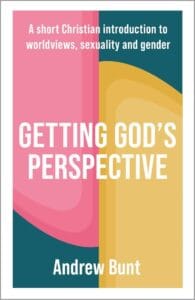
Andrew Bunt has just brought out a new book, Getting God’s Perspective: A Short Christian Introduction to Worldviews, Sexuality and Gender, and I had the chance to ask him about it.
IP: As a member of Living Out, you clearly have a concern for teaching about issues around sexuality. But why do you think this is still such an important issue in our culture? Why do we need to keep talking about it?
AB: The main reason that motivates me is that there will always be people like me: those who want to follow Jesus and who experience same-sex attraction. Walking that path isn’t always easy, especially in a culture that thinks so different about sexuality, and so I think it’s important that we continue to seek to equip churches to handle the topic of sexuality well.
But two other things also make me think sexuality is a topic we need to keep talking about. One is that for lots of people in our culture, Chrisitan teaching on sexuality is one of the big stumbling blocks that would stop them from following Jesus. If we can’t communicate God’s perspective well and build churches where those with different experience of sexuality can flourish in following Jesus, it will impact the mission of the church.
The other is that young people today are looking for wisdom that will help them to live well and I think they’re fast realising that the sexual revolution hasn’t delivered on the utopia of wellbeing it promised. They’re looking for a better perspective on sex and relationships, and we have that better perspective. I think sexuality actually has the potential to be a way we can help young people see the goodness of following Jesus.
IP: I was fascinated to see that you begin your book what most people will think is a completely unrelated issue—that of ‘worldviews’. What do you take this approach?
AB: I have lots of conversations with people about Christian teaching on sexuality and often people have big questions and objections to that teaching. But I’ve noticed more and more that a lot of the time the issue isn’t actually about sexuality. Often the real issue is about understandings of freedom, or identity, or authority – worldview level beliefs. Part of why we struggle with Christian teaching on sexuality is that we don’t have a solidly Chrisitan worldview in place to underpin them.
As I had that realisation, I then looked back on my own story. I reflected on my teen years when I had to work out what I believed God says about sexuality and how I was going to live in response. I realised how much having Christian worldview foundations firmly in place had helped me then. I’ve become convinced that worldviews are the fundamental foundations we have to consider before we think about sexuality and this book is my attempt to help us lay those foundations.
IP: You contrast a ‘secular materialist’ worldview, with a Christian one. Is it possible to be binary about these different approaches? In reality, are we not all a mixture?
AB: We probably are, yes, but’s why it’s so important that we check our worldview. I think we find Paul pointing us in this direction in Romans 12:2. There he warns us of the risk of being conformed to the world and challenges us to instead be transformed by the renewal of our mind. We’re often a mixture of these two worldviews because it’s so easy to be shaped by the world around us (where the secular worldview is dominant) rather than be transformed so that our mind is renewed to have a worldview shaped by God’s word. Heeding Paul’s warning and challenge is a lifelong task, but one thing that helps is to be aware what we want to avoid being conformed to and what we want to be transformed into. That’s why understanding key elements of these two worldviews is so helpful and important.
IP: I was interested that, amongst other issues, you explore the questions of authority and freedom. Why do you think these have an impact on our discussions about sexuality?
AB: Freedom felt important to tackle because it’s such a prominent cultural theme around sexuality. Arguably, the Sexual Revolution was all about establishing a new vision of true sexual freedom. It’s been pretty successful in establishing that answer in the modern west, even if that supposed freedom hasn’t delivered the flourishing expected. Everyone has a vision of what it means to be truly sexually free. The question is whether that vision is true and good. I think there is a strong case to be made that western culture’s vision is not true or good, but God’s is.
Authority is one of the most important worldview foundations for our discussions about sexuality. In the end, all discussions on sexuality come back to who has the authority to tell us what is right and what is good. Everyone follows an authority when it comes to sexual ethics – whether it’s themselves, their culture, or God. But we rarely stop to consider what authority we’re following and whether it is right or good for us to follow that authority. We’re also living in a culture that tends to see external authorities as oppressive (one of the reasons people see Christian teaching on sexuality as harmful). We need to consider whether that is true.
The view of western culture is that we should be our own authorities, guided by our desires, but most of us can see that isn’t working out to well. When it comes to sexuality, we say that the need for consent is the authority that offers us protection, but consent is insufficient – we can consent to things that harm us or others and often we consent not really knowing the true long-term impacts of our decision. We need a better authority to guide us on sexuality and that authority is the word of God.
IP: I was less surprised to find you talking about ‘identity’ in relation to our understanding of sexuality. One of the great changes in recent discussion has been to collapse issues around sexual ethics into issues around identity. Why do you think this has happened, and how does a Christian worldview engage with this?
AB: The linking of identity and sexuality can be traced through key influential thinkers, especially from the 17th century onwards. There was first an inward turn – placing our desires as central to our personhood and identity – and then a sexualisation of identity – making our sexual desires central to our personhood. (Carl Trueman has done a great job of tracing that journey in some of his writings). More simply, I think it’s also partly because of the sheer power of sexual desire and sex. It’s hardly surprisingly that such powerful forces have grabbed our attention and made us believe they should be central. The result is a perspective that sees sexuality as core to identity and in turn leaves us effectively enslaved to our sexual desires: if you are your sexual desires, you need to act on those desires to be true to yourself, and that leaves you as good as enslaved, obligated to act on your desires lest you be denying who you really are.
A Christian worldview is so helpful because it enables us to step back and consider the topic of identity apart from sexuality. The centre point of the Christian worldview is the reality that there is a creator God and that gives us a radically different (and better) approach to identity: we don’t find identity in our desires; we receive identity from our creator. That foundation allows us to know who we are which allows us to then acknowledge the reality of our sexual desires – with all their force and power – and receive God’s expert guidance on how best to respond to them. The Christian worldview helps us to separate identity and sexuality such that we no longer have to be enslaved to our sexual desires.
IP: What difference does it make to shift the conversation into one based on worldview? Does this unlock some of the ‘talking past each other’ that often happens in the debate?
AB: I think it can, and I hope people will find that being equipped to think on the worldview level will do exactly that – help us get beyond the feeling that we’re ‘talking past each other’ when we engage with those who have a different view on sexuality.
The reality is, if we’re engaging with someone who has a totally different perspective on sexual ethics to us, we’re unlikely to get very far in our conversation. It’s not even that we talk past each other, often it’s that’s we’re metaphorically banging heads. But if we can spot what’s underlying those different perspectives on sexuality and talk about those topics, it can be much more productive. Maybe it’s a different vision of freedom. Let’s talk about that. What are the different visions, which works best, what are the reasons to believe one or the other? Maybe it’s a different vision of progress. How do those visions differ, where do they come from, which better aligns with reality?
My belief is that not only does going down to the worldview level potential help us get beyond some of our conversational clashes, but it can also help us show people how good the Christian worldview – and the perspective on sexuality built on it – actually is. The Christian worldview makes better sense of the world we live in and it gives us better answers to our deepest longings. If we learn to think in worldview terms, we might find that some of the conversations we most dread become some of our best evangelistic opportunities.
IP: What do you hope for from your book? Who do you hope will read it, and with what outcome?
 AB: I’ve got lots of hopes for it. I hope Christians will be helped to live out Romans 12:2 – not being conformed to the world but being transformed by the renewal of their mind so they can know God’s will and what is good and can live his way – in the areas of sexuality and gender and in all of life.
I hope Christians will feel better equipped for conversations with others about sexuality and gender and that they might find there are ways of making those conversations not awkward or argumentative but fruitful and gospel-centred.
I hope any who read the book who are not yet Christians find it provokes them to think deeply about what they believe and whether the Christian perspective has something better to offer them – and ultimately whether Jesus gives us a better way of living in the world.
And I hope that people will take the worldview framework I have applied to sexuality and gender and apply it to some of the other big topics of life in the 21st century.
IP: Thank you for your time—talking about the book, but also taking the time to write it! We hope and pray that it will achieve these things too.
 Andrew Bunt is Emerging Generations Director at Living Out, a charity that helps people, churches and society talk about faith and sexuality. He studied theology at Durham University and King’s College London and loves helping people to understand and live out biblical teaching. He is also the author of Finding Your Best Identity: A Short Christian Introduction to Identity, Sexuality and Gender (London: IVP, 2022).
He has also written Grove booklets on Polyamory and Consensual Non-monogamy and shares his personal story in his Pastoral booklet People not Pronouns: Reflections on Transgender Experience here.
 Buy me a Coffee

























Yes this is exactly right. We’ve wasted years in the church arguing about sexuality in isolation from all other areas of theology that inform our worldview. Our disagreement over sexuality is a symptom of our hidden disagreement on other more fundamental features of our worldview. “Homosexuality” and transgenderism etc are not a moral topics that we approach from a perspective of ethical reasoning – they are the tension points where our anthropology and epistemology throw up different answers.
Yes indeed. And I have realised that over the last few years in discussion. Those wanting to change the understanding of marriage just have a completely different view of a whole range of things.
It is a symptom, the presenting issue of a much bigger difference.
This was perfectly obvious at the start, and I said so.
Well said, Sir.
The situation you describe is often a product of living in a poorly discerned world of actually-existing-heathenism – the strangeness of which we often do not recognise because of its superficial orthodoxy. Assuming broad agreement where there is none.
The residual cultural and philosophical ‘spolia’ left over from conventional Christianity which still give shape and form to our Post-Christian society deceive us into thinking we have a common ‘anthropology and epistemology’, Creed and Confession with all sorts of people when we simply do not – even (especially) within our own church.
And it is also, as ever, about the way we use and understand that word – ‘church’.
This realisation, in my own faith, has been a great liberation. To realise that I am very often not arguing about the same things, or even using the same words in the same way – with other ‘Christians’ in the first place.
It allows me to conceive of even certain ‘Christian’ writers, preachers and thinkers in the same way I would Unitarians or Jehovah’s Witnesses or even Muslims.
That has allowed me to perceive that very often these arguments can be more properly understood, despite the labels, as works of (and opportunities for) basic Christian evangelism to lost souls rather than as arenas of formal controversy within the church.
Corinth rather than Antioch.
William, do you think we need to address the issue of universalism head on?
Yes, I do, however I also believe as Anglicans that we already have addressed it vry emphatcially- for all time – in the 18th Article of Religion “Of obtaining eternal Salvation only by the Name of Christ”.
“They also are to be had accursed that presume to say, That every man shall be saved by the Law or Sect which he professeth, so that he be diligent to frame his life according to that Law, and the light of Nature. For holy Scripture doth set out unto us only the Name of Jesus Christ, whereby men must be saved.”
That ‘(E)stablished’, the question then becomes how to interact with people who have either never heard of the Articles, don’t understand their significance and importance or would reject them at a first reading- despite belonging to the Anglican fold.
That, it strikes me is more a question of re-evangelisation and re-confessionalisation than formal or set-piece controversy. For those who can be saved, it is a question of rehabilition rather than disputation.
Thus I say it is Corinth, not Antioch if that makes sense.
I may be wrong, it may be a distinction without much difference and I write only as a layman,
Distracting typo in paragraph 1, where Ian’s name is missing. Reads for a moment like Andrew “had the chance” to ask himself about his own book.
> Andrew Bunt has just brought out a new book, Getting God’s Perspective: A Short Christian Introduction to Worldviews, Sexuality and Gender, and [Ian Paul?] had the chance to ask him about it.
ooh, thanks. Corrected! If there is only one typo in the piece, I will take that as a win!
There is all the difference in the world between worldviews that are the result of thought, analysis and research and ”worldviews” that are lazily inherited from a random surrounding culture in ignorance that any others might exist.
So long as we do not start from the basis that these two are even close to being equally good, we will be fine.
In fact, to adopt the idea that mere ‘difference’ between worldviews is somehow a badge of merit or even acceptability is to adopt the contrary (and, more importantly, wrong) worldview.
The emphasis on ‘difference’ per se is either cynical or ignorant or both, but most importantly rejects a basis in evidence.
in progressive ideology/worldview ‘evidence’, AKA truth, is the enemy!
Yes. Which is why the starting point cannot be ‘You have your worldview, I have mine.’ Relativism is the apogee of uneducatedness. The starting point is always properly – what does the evidence say?
I mean, honestly, on most topics most of us have not yet done enough thinking to have a proper ‘view’ yet at all.
No. The starting point is: “what is the question?”
Otherwise you’re just assembling random, irrelevant, and misleading evidence (which is obviously a terrible approach).
The starting point is: ‘What has God said?’
I know you liberals reply: ‘We don’t know.’
That’s why these debates go round in circles.
But we have only one life to life and after that judgment.
But liberals would probably disagree with that, too.
Adam, whatever the question is on a given occasion, then that is the question for which evidence is or needs to be assembled.
You want to stop progress in its tracks by raising objections so that nothing gets achieved? What is at the root of that?
Is the concept “sexuality” about what people experience as their identity, eg straight, gay etc; or does the book cover wider issues of sexual morality, eg longterm commitment and faithfulness, and celibacy outside of marriage? Surely this is arguably an even bigger issue? Interesting points about the basic-ness (if there’s such a word!) of worldview.
**** BTW Ian, when I click ‘Save my name, email…’ it doesn’t – I can see in my Cookie Manager, that the cookies that hold the data are being written, but are not being applied when the page is loaded.
Sorry to hear that. I can check what is going on…
Jo, having check with my tech man, I think the issue might well be with the settings on your computer.
‘I think that might be to do with Jon’s browser. If he’s got it set not to save form info, it won’t!’
This is excellent. I’m currently reading a similar book but on masculinity rather than sexuality, pointing out the imprtance of culture. It is Reclaiming Masculinity by Matt Fuller, a vicar in central London.
I had spotted that book, but don’t know the author. Would you recommend it? Why?
Because, having read it, it is good. He is a vicar in Mayfair!
Carl Trueman touches on this in his ARC talk in London the other day: ‘When did sex get political?’
https://www.youtube.com/watch?v=vuTKuGlNWXU
If you hang around long enough you’ll hear everything, even a supposed Calvinist at a conference urging a return to the ideals of the Western enlightenment bewailing the loss of the medieval Catholic Church and feudalism…
That’s because ARC isn’t a church, it’s a broadly conservative movement that includes agnostics and atheists bewildered or dismayed by what the modern world has become. Matthew Syed, for example, spoke at it. Carl Trueman in his most recent book draws attention to Roger Scruton as an example of this: one who commended Christianity but didn’t apparently take the step of faith himself. I don’t think Trueman ‘bewails the loss of the medieval Catholic Church and feudalism’. You need to read him carefully- if you have tried.
I don’t mean that Syed is an agnostic or a liberal – I don’t know what his religious beliefs. I know he once sought to be a Labour MP. Carl Trueman is certainly a conservative Presbyterian but he has a lot of connections with conservative Catholics and writes for First Things.
I know of conservative agnostics who were at ARC, while the intellectual heft was largely given by Christians.
Did you not listen to his talk?
Did you not read his books? a 12 minute talk is hardly comparable. I don’t think you understand what ARC is.
The talk is what you presented to us James…
I have met Carl Trueman and chatted with him, and have watched his videos read a number of his books and many of his articles in First Things, Themelios etc, so I think I have a fair idea of what he would say if he was speaking for more than 12 or 15 minutes.
It’s all on the internet, including his lectures in Catholic universities in the US.
Hang on – are you saying you didn’t watch this talk before recommending it to the rest of us?
Recommending a speaker means that the speaker is reliably/consistently worth listening to.
Adam
Of course I listened to this 12 minute talk. And in it, Trueman does none of the things you allege in your above comment. To judge from your comment, you clearly haven’t listened to it with any attention.
Nor have you read his major book ‘The Triumph of the Self’, that this 12 minute talk is riffing off.
This is why your comments are often unhelpful, Adam: you deflect and misrepresent people all the time and when you are called up on it, you accuse others of bad faith. You don’t objectively engage with viewpoints you don’t like, looking at the Scriptures. You prefer ad hominems. Not good,
What constitutes a “world-view”?
Partly, and I think significantly, it is Imagination.
An imagining and perhaps endeavouring to bring to reality one’s ideal world.
For instance one might have as an ideal of a reformation of one’s church,as many have desired; However that particular horse
has long since bolted.
God has moved on, something more radical is required.
Imagination is a fundamental motif of all Scripture
The Negative Motif: The Heart’s Inclination
In the Old Testament, imagination is frequently linked with human rebellion and the deceitfulness of the unguided human heart.
The Hebrew word often translated as “imagination” or “device” is machashavot (thoughts, plans, or schemes).
The New Testament View: In the New Testament, particularly in 2 Corinthians 10:5, believers are exhorted to “cast down imaginations” (or reasonings) that exalt themselves against the knowledge of God, bringing every thought into the obedience of Christ.
Perhaps start at Imagination @ biblehub also there
“Imagination in Prayer”Lord Teach Us To Pray — Alexander Whyte
is a masterful work on personal Imagination.
However, what seems a go to work on imagination for many people is
“The Power of Imagination” written by Andrew Wommack @ AWMI.net
Superb! Shalom, Shalom Glory to His Name.
Imagine Christ asking you and your church “What do you want
me to do for you” where does your imagination take you?
Understanding the worldview of those we are talking to is really important if we want to have a productive conversation, but I fear what’s being presented here are strawmen. Is the current Western culture characterised by sexual freedom to do what you like? That doesn’t sit easily with the #MeToo movement. It doesn’t make sense of the massive shift in cultural views towards cheating/affairs – go back a hundred years and divorce made you a social pariah but men having affairs was perfectly tolerable (as long as they were discreet). Even as late as the 90s Francois Mitterrand’s funeral would be attended by both his wife and his mistress. Today, cheating and affairs are scandalous, but divorce is perfectly ok. And we’re much, much more concerned about sexual abuse of children than we were before sexual revolution.
What I think we have is an emphasis on honesty. You don’t have a right to demand, but you should be honest and open. As long as you’re honest, so the cultural thinking goes, lots of different choices and approaches are possible – e.g. affairs are out because they are deceitful, but open relationships might be ok (if you agree) because there is honesty about what’s happening. But that honesty is not a licence for anything goes. It just opens up a conversation about what you want, what would work, what’s good etc.. And that conversation allows a much more religiously informed approach to be the path. Far from being obligated to embrace some 70s sexual liberation idea that everyone is free to do whatever they like because they’re fundamentally free agents, you can say I have a spouse to whom I am obligated and loyal and who matters.
This mistake is where I think the confusion about identity comes in. The identity is, at best, a red herring. Not only are Christians completely fine with having identities (nationalities, religious sects, identity as a parent, disabilities, etc. etc.) there is a weird refusal to actually listen to what people are saying. The only people I’ve ever known in the Church to describe themselves as “an LGBT person” (making quite a hard identity statement) are those on the conservative side of this discussion. The so-called liberals like me (though I don’t regard myself as a liberal of course) reject the suggestion that being gay is the absolute centre of my identity. What it is is an unchangeable and unchosen facet of who I am, and one facet amongst many. As an integrated part of me, it’s not super important – in contrast to when I clung to a conservative view that to SSA meant secrecy and lifelong celibacy, when it was much, much more central to my life because that meant policing myself constantly and not give myself away.
But honesty in sexuality comes into it, not because I need to act on my desires, but that I need to be honest about my sexuality if I am to integrate it within my person.
I’ll read Bunt’s book with interest, but I am sceptical that we can boil this down to a simple Western vs Christian worldview. What is being characterised as the Western view sounds more like the 70s liberation school, which I suppose still has some adherents, but I would argue is far from the prevailing culture. And the description of the Christian worldview is not exactly clear in this interview, but there are hints that it is fundamentally about repressing/rejecting sexuality and doing so as an act of obedience to authority. That to me is at odds with any hope of integration. And I would suggest that today’s emphasis on honesty, like so much of Western culture, has distinct Christian roots: in 1 Corinthians, St Paul, in his discussion of sex and marriage makes the startling pronouncement that when it comes to sexual relations not only do husbands have authority over the bodies of their wives, but the wives have authority over the bodies of their husbands. I suggest if that is true, then it requires a lot of honesty.
A major problem with the ‘anything goes provided it is consensual’ view is that sex might be consensual for man and woman but it is not consensual for children who get conceived. We hear a lot about human rights today. What about the human rights of children to be born to a man and woman who are committed to each other in a way that involves at least some accountability?
Fear of the Lord is the beginning of wisdom.
Then they make a big thing of how praiseworthy it is to ‘consent’ to following animal instincts.
Animals as in hares or as in penguins, or as in swans?
Tell that to all the children neglected and abused by their cishet parents.
And to the baby tortured and murdered by his gay non-parents.
Indeed. But rather more children are tortured by their non trans straight parents. Since you believe cis and heterosexual to be neo Marxist or Marxist. Are these your terms for things of which you disapprove but have no notion of their origin or context?
The perversion of giving babies to homosexual male couples is only of recent vintage, so the damage level there has only just begun.
Of course I disapprove of the global evil of Marxism and its American university spin off in sexual psychology. ‘Neo-Marxist’ is not my term, it has been around for a long time, as you well know. It all goes back to the Frankfurt school.
I would add that subjectivist qualitative psychology is 50% or more rubbish, pullulating ideas masquerading as science. Real science is objective and hard.
You might disapprove of what you believe to be the global influence of Marxism (wrongly IMHO) but it has nothing to do with the adjective cishet which merely uses two old words (one of much greater antiquity than the other) to describe someone who aligns with their birth gender and fancies people of the other sex. Yes, it’s a neologism. Yes, it is an observation that not all humanity conforms to this cishet ‘norm’. Not all neologisms are Marxist.
And why are gay male parents perverted? That’s a rather extraordinary slur.
It is a perversion of parenthood deliberately to deprive a child of mothering. Babies are programmed by God to bond with mothers, preferably their birth mothers, but another nurturing woman if that is not possible. Motherhood is sacred and created by God. Motherhood is not fatherhood.
‘pervert’ means to turn a thing away from its true purpose and good. Putting a helpless child in the care of two men in a sexual relationship is a perversion of parenthood for a godless ideology that denies creation.
Christians understand this. Non-Christians usually understand this too, but some don’t. Such is the noetic effect of sin.
Not only does it deny creation, which is as comprehensive and holistic a denial as anyone could make, but 2ndly it also ignores the wonderful mess of said creation, which is another huge and all encompassing datum. It is like a competition for who can pretend to fail to see the biggest thing.
Motherhood is neither sacred nor programmed by God. Wherever do you get these paganbifeas from?
Pagan ideas
1 Tim 2:15?
Penelope,
Read carefully. I didn’t say motherhood is ‘programmed by God’ but that babies are, to bond with their mothers.
Of course motherhood is a sacred calling: ‘Be fruitful and multiply and fill the earth’. Everyone should feel reverence for their mother.
Motherhood is not sacred??
That is an odd, disenchanted and seemingly ungrateful point of view. Both fatherhood and motherhood are sacred.
Christopher
Christian source for that belief please?
Anthony
Apart from being one of the less edifying verses of scripture, that doesn’t claim that motherhood is sacred.
You can inhabit a gratuitously existing (as Christians and commonsense people both believe), awesomely majestic (as Christians and commonsense people believe) universe, and not think that some of the higher callings (as Christians and commonsense people believe) of its highest inhabitants of all (as Christians and commonsense people believe) are at all sacred?
All the great Christian thinkers’ writings are suffused with the glory and majesty of it all.
Penelope,
1 Timothy 2:15 not edifying? I am reminded of the tourist who exited the Uffizi Gallery in Florence – containing many of the world’s greatest Renaissance paintings – by saying to the doorman “I don’t think much of that lot.” Came the reply: “Here, Sir, the paintings judge the viewers.”
It is not the easiest of verses to work out. Notice that faith – which brings justification – and holiness, i.e. sanctification, are required. Childbearing is the divinely ordained primary role of woman, cursed by God with increased painfulness in Genesis 3; just as work to support wife and children – the divinely ordained role of man – is cursed by being made much harder. A woman who chooses not to marry (and to stay celibate) is not sinning, but is very much the exception, and Paul is writing about the susal course of things. Pain, and the knowledge that it lies ahead again and again in the normal course of marital relations, will either move a woman toward or away from God. Paul is describing the former.
Christopher
Paul isn’t. Nor many of the Church fathers.
Anthony
Cracking bit of mainsplaining to a child free married woman there !
Who are cishet parents? You know, and we oft repeat because people do not digest or dislike what they are told (which further means you must be acting as devil’s advocate – and of all the people to be advocate for…) that the bad treatment of children is massively disproportionately in stepfather/live-in boyfriend/uncle households. Robert Whelan, Broken Homes and Battered Children. Which is also common sense. Before such homes were common – which apparently is what you approve of? Family-shape diversity? – the levels of bad treatment were, naturally, far lower. So they do not need to be any higher, and precious children would be so much safer as a consequence. But they are higher, because of all the people who say family diversity (which also involves wrenching parents from children) is a ‘positive’.
‘cishet’ is one of Penny’s neo-Marxist obsessions, warring against creation and natural law. It is difficult to converse with people who hold to other religions like neo-Marxism.
Adam Bell writes ‘Today, cheating and affairs are scandalous, but divorce is ok.’
When you have recovered from reading that, then the analysis:
1. He calls an abomination ok.
2. He sees himself that the transient fashions of public opinion swing vertiginously from side to side…
3. Meaning that there is nothing reliable or stable in them…
4. And nevertheless recommends the transient fashions of public opinion (which are probably self-justifying anyway) as the first place to look if we want to know the way things are.
Wow!
Still struggling with comprehension I see.
I’m offering a characterisation of how Western culture today views sex and relationships, because I think the characterisation put forward by Andrew Bunt is incorrect. It’s really not that difficult.
My points 2-4 show that I do understand that you see the transient fluctuations of fashion as significant, when in reality they are the opposite.
What are the ‘first order’ questions of life and death?
Q. what is “a Christian world-view and how does it differ from other world-views?
We really need to avoid jargon statements,the article
seemed to say that we need to understand the other persons world -views rather than expressing the fabulous riches of our divine mandate
to preach the Gospel of the Kingdom of God and our King.
If you actually want to share the Gospel you need to talk with people not talk past them.
If you want to share the Gospel, you need to be clear what it actually is and what it requires of people.
‘What is a worldview’?
Important question. James Sire in Naming the Elephant, p20, identifies a worldview as the answer to 7 basic worldview questions,
1. What is prime reality/ultimate being?
2. What is the nature of external reality – that is, the world around us?
3. What is human being?
4. What happens to a person at death?
5. Why is it possible to know anything at all?
6. How do we know what is right and wrong?
7. What is the meaning of human history?
David Burnett defines a worldview as: “the shared framework of ideas held by a particular society concerning how they perceive the world … The worldview gives shape and order to the multitude of outward manifestations of a culture.” Clash of Worlds, p13.
Tom Wright identifies for criteria for navigating the world effectively: 1. A worldview provides the stories with which we understand reality. 2. The worldview stories enable us to answer the basic question of human existence. 3. We express our answers to such questions through cultural symbols. 4. Our worldview provides ways of living in the world. N. T. Wright, The New Testament and the People of God, pp123–24.
Anderson, Clark, and Naugle, An Introduction to Christian Worldview: Pursuing God’s Perspective in a Pluralistic World, pp97-179, identify four world core world questions: 1. What is our nature?
2. What is the world?
3. What is our problem?
4. What is our end?
For the more philosophically minded, there is the larger tome from JP Moreland and William Lane Craig, Philosophical Foundations for a Christian Worldview.
Thanks Graham—really helpful.
“I had to work out what I believed God says about sexuality and how I was going to live in response.”
At least this recognises that there are different interpretations about the matter. The bible is not unequivocal about the matter of human sexuality by any means.
Nor is the matter of what ‘God says’ limited to the bible.
It is unusual to read a protestant dismissing sola scriptura, but that is a side issue to the point here, which is that God will not contradict his own scriptures. As to whether these scriptures are unequivocal on the subject, would you care to be more specific?
Anythony you only need to read swathes of the Hebrew bible to get the idea that sexuality was pretty widely interpreted.
As to sola scriptura – no thanks. God didnt stop speaking when the canon of scripture was fixed and human beings are much wider than a narrow Protestant definition – thankfully.
Andrew Godsall knows better than Jesus on the nature of the Scriptures. That’s very reassuring to know. Welcome to the Church of One.
As they used to say in Andrew’s church:
‘This is the Word of the Lord.’
‘Well, not really.’
Oh I keep forgetting that Jesus was a white English no sex please we are British type of Christian. So silly of me when we are reminded of it time and time again here.
Yes, Andrew,
You have forgotten the Christ revealed in the Scriptures – long before England and the English language existed. Your vision of Jesus is only a passing fashion of late modernity, destined to die.
So dad. Not the faith of the Apostles – whom you would fault.
So ‘sad’.
And so deeply uninformed about first century Judaism. If Jesus had advocated Andrew’s libertinism, you can be sure it would have featured at his trial.
That is true – but why would anyone think he did in the first place?
It can only be wishful thinking, in which case we have people *wishing* for moral disorder and debauchery.
Actually James on the evidence of your comments here over a long period I would say that is exactly the person you have forgotten.
Anyway …be well!
You are (deliberately?) misunderstanding me about sola scriptura, . I accept that prophets may speak God’s word into local situations and that such words are not necessary for all Christians to know. But God will never contradict his scriptures.
As for what the scriptures say… I reckon you can’t make good on your claim that they are equivocal on the subject.
A bit rich for you to insist someone else explain their views.
“But God will never contradict his scriptures.”
I see. God speaks in king James English does he?
If you can’t be bothered to read the Hebrew bible and the many stories of multiple wives, concubines, lovers etc etc whom those who apparently spoke for God possessed then I can’t help.
Anthony you are just another like James who invents God in your own image and that of middle class white simplistic Protestantism.
Very unappealing and deeply unchristian
You need to learn how to read the scriptures, Andrew. God nowhere *approves* of polygamy in the OT; he simply permits it in a fallen milieu where wealthy men could afford to keep multiple wives. Probably for the sake of children born to single mothers if he insisted on monogamy. His plan for unfallen man, you can find in Genesis 2:24 in which husband and wife become one flesh. You can’t become one flesh with two women – the verse means a lot more than sexual relations. Within the church (and from the 1:1 ratio of male and female births) we also learn what He actually approves of.
So Andrew favours polygamy now, does he?
He truly has forgotten the Christ of the Scriptures and follows a god of his own imagination. Andrew’s idiosyncratic beliefs explain the irreparably fractured mess the Church of England is in.
The other religious supporters of polygamy in England are biding their time.
God doesn’t simply approve of polygamy. They mandate it. Perhaps you should stop sneezing at others’ reading of scripture.
Penelope,
Like Andrew, you are entitled to your own personal religion. But I took an oath in good faith to affirm and teach the Christian faith as the Church of England has historically received it and I intend to keep it.
I am bound by the New Testament as the definitive and summative statement of the will of God revealed in Jesus Christ and lens through which I must understand the Old Testament. Members of other religions and their sources of authority are not my concern.
You are not bound as I am. But you are a good teacher of scorn.
‘So Andrew favours polygamy now, does he?’
No I don’t. And nowhere do I say so. I am clearly pointing out that God favours it in some of the Hebrew bible.
Andrew Godsall,
So why have you rejected polygamy if it is accepted in the Old Testament?
The discussion here James is about what God ‘thinks’ about human sexuality. I’m glad you now acknowledge that the OT gives us a mixed picture and it’s pretty clear that God isn’t quite so bothered about the matter as some of those who love to comment here seem to think God is.
Andrew, as has long been pointed out, the OT is much more concerned with issues of sexual morality that other ANE texts. It appears that it does matter to God.
No, the one thing God never is is laissez-faire, passively tolerant, neglectful, failing to care, without passion, and lazy.
Modern secularists are that way, but they exalt tolerance only because they want tolerance of their own peccadilloes.
Andrew Godsall gets it wrong again, chiefly because he cannot think as an apostolic Christian and as an Anglican. The Old Testament dispensation permitted various things “for hardness of heart”, as our Lord told us, such ss polygamy and divorce; but the Lord in his gospel and as the embodiment of thd Kingdom of God, forbade polygamy and divorce. This is clear from Matthew 19.4. That isn’t hard to understand unless one is obtuse and disinclined to obey.
Fur3t, it is narratively clear from tr OT thst polygamous unions are usually marked by dissension and trouble.
Andrew newds to learn some Anglican basics about thr nature of Scripture and the authority of Christ. He needs to give up the self- defeating subjectivismof his Church of One. Revelation did not begin with Andrew.
Hi James
I thought that when you were studying for the priesthood you were taught the Hebrew Bible. If you were taught that polygamy was a dispensation rather than directly mandated (on certain occasions) by God, then you were not taught it very well. This is not a different religion, James, it’s scholarship. It is possible to be an HB or NT scholar and be a Christian. I know lots.
I know many women who might disagree with that!
Penelope,
I was using ‘dispensation’ in its theological sense of a religious system that prevailed in a particular historical era, not in the judicial or administrative sense (an exemption from a rule or usual requirement). It’s the same way in which we speak of ‘the Mosaic Dispensation’ with its priesthood and sacrifices: a God-ordained order for that time that was consummated and fulfilled in Christ. The same with marriage.
As for ‘being taught Hebrew’, I basically taught myself the language (from Weingreen, Lambdin etc) and then I went on to teach it to undergraduates while doing my doctorate. Language teaching as such hardly existed in theological colleges, and as a former MFL teacher and classicist, I aimed for a far more rigorous (and detailed) approach in my own teaching. Reading Hebrew and Greek (and sometimes Aramaic) every morning has been my discipline for years, and the deficiencies in my knowledge are the fault of my teacher.
James
Yep, I know. But that ideology not scholarship.
Kudos for learning Hebrew, though. I didn’t mention it. But good for you.
Penelope,
Do you think you can neatly draw a line between ‘ideology’ and ‘scholarship’? But one can so easily return the compliment: what you consider ‘scholarship’ to another can appear as ideological pre-commitment, a way of seeing the world.
It’s there in our different approaches to the nature of the Bible. I see it as the faithful Word of God (which has, of course, to be interpreted in a historical, canonical and self-consistent way). This is not to debate that claim here; but a good, concise contemporary statement of this historic view, represented in the 39 Articles, is found in Timothy Ward’s 2009 monograph ‘Words of Life’, and much more extensively, in his ‘Word and Supplement: Speech Acts, Biblical Texts and the Sufficiency of Scripture’ (his Oxford dissertation, I think). These are restatements of the historic, pan-Christian orthodox view of the Bible, and ultimately they go back to what we believe was Jesus’s own understanding of the nature of Scripture, as the words of God faithfully delivered by prophets. That this was Jesus’s view is not hard to demonstrate from the Gospels.
Unless you think the Gospel writers are lying or otherwise mistaken.
Or perhaps you take the kenotic view that Jesus, as a man of his times, was mistaken about the nature of the Bible? I think this view is popular in many liberal circles.
Whereas you, if I am correct, think of the Bible as a human *witness (or collection of witnesses) to the Word of God, and like all human witnesses, a gallimaufry to be weighed up, with some (most?) to be discarded. What is your own interpretive grid that guarantees the truth and objectivity (“scholarship”) of your own judgments? Freudianism? Neo-Darwinianism? The Neo-Marxist Frankfurt School? Feminism? American university queer theory? Whatever your standpoint, you liberals have, on the face of it, an easier task than historic orthodoxy, because whatever sits ill with modern views can be rejected as the intellectual and/or moral deficiencies of the old writers who polluted God’s inspiration with their own limitations.
So we can shout ‘Ideology!’ or ‘Scholarship!’ at each other until the cows come home. But let us remember, as Thomas Nagel has trenchantly noted, there is no “View from Nowhere”, no mythical point of clear-sighted objectivism (‘scholarship’, even) unclouded by ignorance, will or sin. The best we can do is be clear about our own commitments. For some, this means rejecting the historic orthodox viewpoint and embracing a new version of Christianity – until this is also superseded by time’s ever-rolling stream.
James
No, you can’t draw a clear line between ideology and scholarship, which is why they’re isn’t such a thing as disinterested scholarship and one must always be mindful of one’s hermeneutic. If I utilise a queer lens, I am always aware that this is only one of many ways of reading scripture. (I was reading James this morning and much impressed with his Marxist views!)
What I meant was that we are all deploying ways of reading scripture that might be quite contrary to the aims of their original authors. The scribes argued that their God clearly mandated ethnic cleansing, sex with slaves, even child sacrifice. We do not think the Bible (or the God of our Bible) teaches such things, but in order to believe this, we are required to interpret the texts in a particular way. And that way is always ideological.
But here’s the problem, Penelope:
Of course I dispute your understanding as simplistic and literalistic and lacking attention to context and canon. You are certainly not the first to make these objections (Richard Dawkins has been saying this stuff for years and has been answered by John Lennox and William Lane Craig, as well as Paul Copan). But let that be for the moment.
You find parts of the Old Testament – and no doubt parts of the New – morally objectionable, which means:
1. you have your own moral standard of right and wrong (where did this come from? from you? your social circle? directly from God?)
2. you claim to know already and finally what these passages mean in their canonical place.
But this should trouble you in your modern western liberal outlook for at least two reasons:
1. Most people of your outlook are universalists. I don’t know if that’s your view or whether you actually believe in life after death. I assume you do, because you appear to believe that we evangelicals are going to be severely punished, along with Catholics and Orthodox, for our unloving ways. You can answer for yourself. But you surely know that Jesus warns about hell more than anyone else in the Bible.
How do you square this with your belief in a ‘God of love’? Why would such a God punish people eternally for sins committed in time? Isn’t Jesus guilty of attributing great cruelty to God?
2. You may also know that the one OT book Jesus quoted most frequently from, after the Psalms, was the Book of Deuteronomy – I estimate about 56 times across the four Gospels – which he affirms as the Word of God (‘It is written’ etc). But the trouble is, it’s the same Book of Deuteronomy that Jesus affirms that mandates also all this ‘ethnic cleansing’ and other disreputable behaviour.
So this puts you in an intolerable position. Either:
a. Jesus supports intolerable behaviour; or
b. Jesus misunderstood the book he called the Word of God; or
c. Jesus never said any of this stuff and the Gospel writers made it all up.
How does Penelope answer these terrible dilemmas?
James
Apologists for rape, ethnic cleansing, genocide, slavery, polygamy, always cite context and culture as ameliorating factors. But context and culture are never mitigating in other areas. I wonder why?
God might not contradict their scriptures, but the authors sure do.
The Gospel says Paul in 2 Corinthians 4:4, where the apostle Paul speaks of “the light of the glorious gospel of Christ”, and 1 Timothy 1:11, which refers to “the glorious gospel of the blessed God.”
“The ultimate aim of the Gospel is the glory of God. Through the redemption of sinners, God’s grace, mercy, and justice are displayed. Ephesians 1:12 states that believers are “to the praise of His glory.” The Gospel not only brings individuals into a right relationship with God but also calls them to live lives that reflect His glory. This transformative aspect of the Gospel is a testament to its glorious nature.” [https://biblehub.com/topical/ttt/t/the_gospel_is_called_the_glorious_gospel_of_jesus_christ.htm
Further Paul says “14:10 There are, it may be, so many kinds of voices in the world, and none of them is without signification. However, 14:8 “For if the trumpet give an uncertain sound, who shall prepare himself to the battle?
It is not a case of talking past but the proclamation of “a more excellent Way”
The rich young ruler was wonderfully religious but he lacked one thing, aka abandonment.
But in Acts 17 St Paul makes a real effort to engage with the worldview of the Athenians, don’t you think?
Not the Athenians. Athenian philosophers – a right bunch of weirdos according to Acts 17:21. Paul makes plain from this encounter what he thinks of them at the end of ch.1 of 1 Corinthians; remember that he moved on next to Corinth.
Acts 17 is an interesting passage regarding the world views of Jews and in this case Greeks. Adam.
Both had a “view” about God but did not “know” God in the biblical sense of the word,an intimate union and fellowship.
As Jesus taught, Paul focused on a local common practice.
An Alter “to the Unknown God” what a gift for Paul!
The Greeks felt that there was an “unknown god” as one or two of their Poets e.g . Aratus, and Cleanthes said-
The quotation has a special interest as being taken from a poet who was a countryman of St. Paul’s. Aratus, probably of Tarsus (circ. B.C. 272), had written a didactic poem under the title of Phenomena, comprising the main facts of astronomical and meteorological science as then known. It opens with an invocation to Zeus, which contains the words that St. Paul quotes.
Like words are found in a hymn to Zeus by Cleanthes (B.C. 300). Both passages are worth quoting:—
(1)“From Zeus begin; never let us leave
His name unloved. With Him, with Zeus, are filled
All paths we tread, and all the marts of men;
Filled, too, the sea, and every creek and bay;
And all in all things need we help of Zeus,
For we too are his offspring.”
—Aratus, Phænom. 1–5.
(2)“Most glorious of immortals, many-named,
Almighty and for ever, thee, O Zeus,
Sovran o’er Nature, guiding with thy hand
All things that are, we greet with praises. Thee
’Tis meet that mortals call with one accord,
For we thine offspring are, and we alone
Of all that live and move upon this earth,
Receive the gift of imitative speech.”
—Cleanthes, Hymn to Zeus.
The fact of the quotation would at once quicken the attention of the hearers. They would feel that they had not to deal with an illiterate Jew, like the traders and exorcists who were so common in Greek cities, but with a man of culture like their own, acquainted with the thoughts of some at least of their great poets.
We are also his offspring…. —We too often think of the quotation only as happily introduced at the time; but the fact that it was quoted shows that it had impressed itself, it may be, long years before, on St. Paul’s memory. As a student at Tarsus it had, we may well believe, helped to teach him the meaning of the words of his own Scriptures: “I have nourished and brought up children” (Isaiah 1:2).
The method of St. Paul’s teaching is one from which modern preachers might well learn a lesson. He does not begin by telling men that they have thought too highly of themselves, that they are vile worms, creatures of the dust, children of the devil. The fault which he finds in them is that they have taken too low an estimate of their position. They too had forgotten that they were God’s offspring, and had counted themselves, even as the unbelieving Jews had done (Acts 13:46) “unworthy of eternal life.” { Ellicott’s Commentary for English Readers}
In conclusion, Paul returns to this proclamation in Romans 1 V 18ff with more emphatically,
especially for those preferring the carnal “knowledge” of humans above their lust for the “knowledge” of God. {Jer. 9 vs 23,24}Romans
1:18 The wrath of God is being revealed from heaven against all the godlessness and wickedness of men who suppress the truth by their wickedness. 19For what may be known about God is plain to them, because God has made it plain to them. 20For since the creation of the world God’s invisible qualities, His eternal power and divine nature, have been clearly seen, being understood from His workmanship, so that men are without excuse.
21For although they knew God, they neither glorified Him as God nor gave thanks to Him, but they became futile in their thinking and darkened in their foolish hearts. 22Although they claimed to be wise, they became fools, 23and exchanged the glory of the immortal God for images of mortal man and birds and animals and reptiles.
24Therefore God gave them over in the desires of their hearts to impurity for the dishonouring of their bodies with one another. 25They exchanged the truth of God for a lie, and worshipped and served the creature rather than the Creator, who is forever worthy of praise!f Amen.
26For this reason God gave them over to dishonourable passions. Even their women exchanged natural relations for unnatural ones. 27Likewise, the men abandoned natural relations with women and burned with lust for one another. Men committed indecent acts with other men and received in themselves the due penalty for their error.
28Furthermore, since they did not see fit to acknowledge God, He gave them up to a depraved mind, to do what ought not to be done. 29They have become filled with every kind of wickedness, evil, greed, and depravity. They are full of envy, murder, strife, deceit, and malice. They are gossips, 30slanderers, God-haters, insolent, arrogant, and boastful. They invent new forms of evil; they disobey their parents. 31They are senseless, faithless, heartless, merciless.
32Although they know God’s righteous decree that those who do such things are worthy of death, they not only continue to do these things, but also approve of those who practice them.
Shalom.
PS
The mention of Dionysius a member of the Areopagus; conversion shows the gospel penetrates power structures and his darkened imagination pulled down, illuminated and brought into captivity to the obedience of Christ.