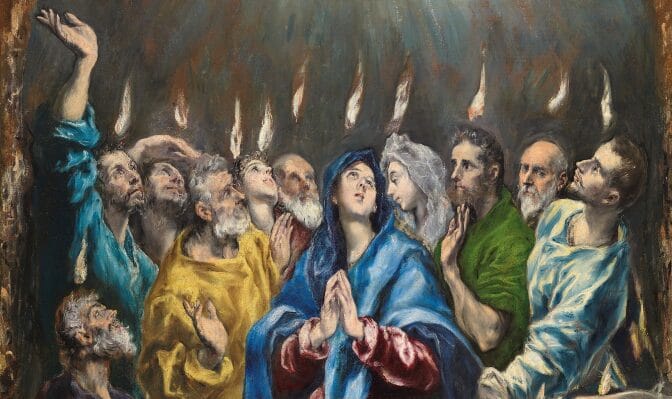
The lectionary New Testament readings for the Pentecost, this coming Sunday, are 1 Corinthians 12.3b-13, Acts 2.1-21, and John 20.19-23—but the first or second reading must be from Acts. So I suspect most churches will read Acts and 1 Corinthians 12. Written commentary on Acts 2 can be found here, and video discussion here.
Here I offer commentary on 1 Corinthians 12, from last year’s reading in Epiphany 2, with the link to the video discussion at the end.
What we call Paul’s first letter to the Corinthians is clearly part of an exchange with the faith community there, since Paul makes reference to the previous correspondence back and forth; we actually have Paul’s second and fourth letters (depending on how you reconstruct the exchange). This because significant at key points in this letter, as Paul makes it clear that he is responding to questions asked or issues raised by the Corinthians themselves—but of course we don’t know what they have said, and can only speculate. It is an important window into Paul’s exercise of authority; I wonder if today, in a Church of England church, we could imagine the congregation challenging and questioning their bishop in an exchange of correspondence!
We can know fairly precisely when Paul wrote this letter from his mention in 1 Cor 16.8 that he will ‘remain in Ephesus until Pentecost’, which apparently is near. From Acts 18–19, we know that Paul’s first brief visit there was in 54 (dated from what we know about Gallio’s time as proconsul of Achaia); Thiselton thus dates this letter to Spring of 54, but it could have been when he returned in Spring 55. We need to realise how unusual it is to know the precise dating of ancient texts in this way. Even the most sceptical scholar agrees that the letter was written by Paul—but note that Paul always writes with others (this letter is from him and Sosthenes, 1 Cor 1.1, who was beaten in public because of Paul in Acts 18.17!) and that he always uses a scribe, adding his own signature by hand in 1 Cor 16.21.
The opening formula here Περὶ δὲ (translated ‘Now, about…’ or ‘Now, concerning…’) peppers the second half of the letter, being found at 1 Cor 7.1, 7.25, 7.37, 8.1, 12.1, 16.1 and 16.12. It only occurs elsewhere in Paul in 1 Thess 4.9 and 5.1, but these are in response to reports Paul has heard, not from correspondence.
But what does Paul want to talk about? There is a long tradition of translating the subject as ‘spiritual gifts’, as if that is a question the Corinthians have raised, and so many readers infer that Paul uses the term charismata. But that does not occur for several verses. Paul in fact uses the term πνευματικῶν, which could be genitive masculine plural, or genitive neuter plural, so either ‘spiritual people’ or ‘spiritual things’. What Paul is addressing is the question of what it means to be ‘spiritual’, and in particular the question of spiritual maturity.
This appears to have been a question underlying many of the issues in Corinth. The division into groups that Paul notes in chapter 1 appear to be related to the question of who is the most spiritual, and whether there are superior ‘spiritual’ leaders that each group follows. But it also underlies the mistaken asceticism that Paul critiques in chapter 7, ‘It is good for a [spiritually mature] man not to touch a woman’. By contrast there, Paul says that being ‘spiritual’ does not mean you transcend the obligations of bodily married life.
Here, Paul radically reconfigures what it means to be spiritual in two ways—firstly, by providing a theological context for understanding what it means to be spiritual, and secondly by using the language of ‘gifts of grace’. In both these, Paul is concerned that the Corinthians have full understanding; he does not want them to be ‘ignorant’ or ‘uninformed’ (1 Cor 12.1) but wants them to ‘understand’ (1 Cor 12.3). As with Jesus, so with Paul: a key response to pastoral issues is to teach well.
Paul appears here primarily to be addressing gentile converts, rather than Jews, by talking of them having been ethne. The translation ‘pagan’ is misleading, in that (whilst accurate) it sounds rather derogatory now. In fact, this points to the paradox of the inclusion of gentiles into the Israel of God in Jesus. They have not become Jews in order to be saved and follow Jesus, so ethnically they remain gentile believers. But spiritually they are not longer ‘mere gentiles’ but part of the Israel of God. (We see this paradox up front in Rev 7; the people are heard being counted out as the Israel of God in twelve tribes, but John turns to see that they are gentiles from every nation.) It is striking that, despite being gentiles, Paul has earlier (in chapter 8) assumed that the scriptures of Israel are now their scriptures. They were gentiles, but of course still are gentile believers. They are not Jews, but are now part of the Israel of God!
Many of the gifts of the Spirit are gifts of speech, and Paul contrasts the dumbness of the idols (a regular trope in the OT) with the speech that the Spirit brings. But he goes further, and roots this within a Trinitarian theological context. So the Spirit is ‘the Spirit of God’ (and of course elsewhere the Spirit is described as ‘the Lord’ and ‘the Spirit of Jesus’), and the speech empowered by the Spirit is speech that affirms Jesus as Lord.
There is some debate in scholarship about the significance of the phrase Ἀνάθεμα Ἰησοῦς. Does it mean ‘Jesus is cursed’? Or ‘Jesus curse [you]’? And is this about people attacking believers, or people seeking to use the power of Jesus’ name over others? What practice is Paul drawing from?
I think that the answer to this comes from noting the structure of what Paul writes, as a kind of revised chiasm.
A no-one speaking
B in the Spirit of God says
C anathema Jesus
A’ no-one is able to say
C’ Lord Jesus
B’ except in the Holy Spirit
The point here is that the delineation between those who have the Spirit (the ‘spiritual’) precisely matches the delineation of those who confess that Jesus is Lord. In other words, all who follow Jesus are ‘spiritual’, in that we have all received the one Spirit to drink (1 Cor 12.13). There is therefore no hierarchy within the people of God, and in fact all receive the gifts of the Spirit and so have a ministry within the body.
We should also note that Paul’s language here is implicitly eschatological. To proclaim that ‘Jesus is Lord’ is a challenge to the claim that ‘Caesar is Lord’ within the empire—and thus a proclamation the that longed-for kingdom of God is, in some sense, presence. For any Jew, this signifies the end of this old age, and the breaking in of the age to come. This aligns with Paul’s (and Luke’s) understanding of the Spirit as the ‘end times’ gift of God; it is ‘in these last days’ that the Spirit is poured out on all flesh (Acts 2.17) and so the Spirit is the first fruits, the foretaste, and the downpayment of the new creation that is to come.
Paul now makes his second move in the discussion of ‘the spiritual’ by recasting it as being about charismata, gifts of grace. Any standing that individuals have, and any ministries that we exercise, are not the result of our own effort or virtue, but come about as the gift of God, as indeed has salvation itself. ‘The gifts of the Spirit are not badges of honour but tools for the job’.
This is reiterated by Paul’s next, threefold and Trinitarian summary: the varieties of gift are expressed as varieties of ways to serve, which are varieties of ways of God working in power. And these are from the Spirit, to be used following the servant example of the Lord Jesus, and empowered by God (the Father). Throughout this section, Paul uses the dynamic of ‘same’ and ‘diversity’ to emphasis the unity that holds together different ministries. This is not an institutional unity that is supposed to contain a diversity of beliefs, but a unity of belief that holds together a diversity of ministries. The Spirit is at work in ministry through each person, but all of this is ‘for the common good’.
(Note here too that ‘every member ministry’ is not merely about keeping everyone busy on a Sunday…!)
In his differentiation, Paul uses two different words for ‘another’ which is obscured in English translations but appear to demarcate the gifts of the Spirit into three groups. The two terms are allos meaning ‘another of the same kind’ (as in the English ‘alliteration’), and heteros meaning ‘another of a different kind (as in the English ‘heterodox’). I put allos in italics here, and heteros in bold underline.
To one there is given through the Spirit a message of wisdom, to another a message of knowledge by means of the same Spirit,
to another faith by the same Spirit, to another gifts of healing by that one Spirit, to another miraculous powers, to another prophecy, to another distinguishing between spirits,
to another speaking in different kinds of tongues, and to still another the interpretation of tongues.
This groups the gifts into ones of understanding and insight, into ones of ‘supernatural’ actions, and the ones of speaking in tongues and interpretation. Incidentally, this clarifies what Paul here means by the ‘gift of faith’—not believing in Jesus (since that is effected by the presence of the Spirit, as he has just said) but the faith that God will bring someone healing.
(There is some debate about the nature of ‘tongues’. We forget that this is the usual word for ‘another language’, and some have suggested that this is just speaking in another human language in the context of a multi-ethnic congregation; where I am, we use for different languages, and so there is the need for translation, which is the same word in Greek translated here as ‘interpretation’. Yet Paul here is describing this as a ‘gift of the Spirit’ and not a simply human phenomenon, and his language of ‘the tongues of angels’ in 1 Cor 13.1 argues against such a sense.)
Paul concludes this discussion by reiterating that all these diverse gifts and ministers have a single source, the Spirit. Thus any who proclaim Jesus is Lord must have received the Spirit, and having received the Spirit must have been given gifts, since the Spirit gives to all.
Despite Paul’s later language of desire gifts, particularly the gift of prophecy, he is clear that it is the Spirit who decides who receives what. Our primary question then needs to be ‘What gifts has the Spirit chosen to give me?’ and ‘How can I then use these in the service of others?’.
Paul’s theology here offers a powerful critique of church cultures where there is either a formal or implicit hierarchy of those who are ‘most gifted’ or ‘most authorised’, or cultures where there are some who are active in ministry, and others who are passive. This fits precisely with Robert Banks’ characterisation in Paul’s Idea of Community (chapter 13):
Paul’s dissolution of traditional distinctions: between priest and laity
Within the church, distinctions between priest and layman, mediatorial and common service, cultic ritual and secular activity, do not and cannot exist…
Between officials and ordinary members
Paul rejects the idea of certain members of the community possessing formal rights and powers…
Between holy men and common people
Paul has no place in his view of community for the traditional distinctions between its members along cultic, official or religious lines…
This vision is as challenging to the church today as it has ever been!
Come and join James and Ian as they discuss these issues here:
 Buy me a Coffee











I remember reading Bank’s “Paul’s idea of community” for an essay in college a few years ago. We (fellow students) affectionally called it “Paul’s Baptist Identity”. It’s a good book. 🙂
In a more productive comment, I am intrigued by you letting the question of ‘tongues’ hang.
“Yet Paul here is describing this as a ‘gift of the Spirit’ and not a simply human phenomenon, and his language of ‘the tongues of angels’ in 1 Cor 13.1 argues against such a sense.”
I quite agree that A) it is a contested subject and B) that tongues usually means human language, but would you care to venture an opinion on what Paul is talking about, giving that it is probably the dominant sticking-point in discourse about this passage? How would you describe the form these tongues take, and what interpretation of them looks like them in practice? Have you written on this on the blog?
Mat
Mat, is it possible that the gift of tongues were in fact, actually foreign languages? The early church had a diversity of believers from many nationalities so could this not be an extension of what happened on the day of Pentecost?
A divine translation for the benefit of foreign attendees of what the Holy Spirit was saying to the church if you like?
1 Cor 14:2, “For those who speak in a tongue do not speak to other people but to God; for nobody understands them, since they are speaking mysteries in the Spirit.”
Wonderful Guys , really opens a debate on what are spirituals/spiritualities?
Very redolent of Tom Schwanda’s Biblical Foundations for Growing in Intimacy with God @ C.S. Lewis Institute Alongside. Watchman Nee THE CROSS AND THE AFFECTION OF THE SOUL facebook.com/groups/101109273311701/posts/8865909220164952/
Each church seems to me to have it’s own versions of S/S and many are not without their perils as here.
What are the spirituals of the Apostles? Or of the OT.?
Some seem to entertain a need for control by someone,
However Paul does suggest that there be limits on the use of the gifts [ “let there be two or three such expressions”]
One that has me pondering is the vogue of the quasi- Quaker practice of silence and the relating of “pictures” to the company. Are these spiritual gifts ?
I have no idea of Quaker spiritualities or how they arose at this moment. Any clues?
On the gift of tongues in my own case when hands were laid on me I started glorifying God in Spanish. Ever since I speak in tongues throughout the day much I presume as Paul who claimed to “ speak in tongues more than you all”. For me they keep me very much in contact with God.
Quakers seem more like a cult than Christianity. Id stay well away.
‘in fact all receive the gifts of the Spirit and so have a ministry within the body.’
I am not sure how speaking in tongues is a ministry? Most people in charismatic churches typically use it in their own private prayers, and as Paul indicates that only benefits that individual and noone else. I get the impression an interpretation of tongues is rarely given in a public setting, so where is the ‘ministry’?
‘Incidentally, this clarifies what Paul here means by the ‘gift of faith’—not believing in Jesus (since that is effected by the presence of the Spirit, as he has just said) but the faith that God will bring someone healing.’
I dont see any particular connection between the gift of faith and healing specifically.
Also how do you understand the plurality of ‘gifts of healing’, the only one in the plural?
Although some have argued Paul’s list of gifts is not exhaustive, he gives no indication that is the case. In your years of ministry Ian, have you witnessed other gifts in use which Paul doesnt mention in his letters? Do you see all of these gifts being used in your own congregation, leading to multiple ministries?
Finally how do you understand the giving of the gifts – is it, for example, the case if someone is given the gift of the word of knowledge it is not a one off ‘word’ but a gift that consistently plays out in the life of that believer?
Thank you.
The best book I ever read on the gifts and ministries of the Holy Spirit was written by Reinhard Bonnke who had a vision of a blood washed Africa. [available on Amazon]
He viewed spiritual gifts not as badges of honour to be boasted about, but as dynamic, situational tools given by the Holy Spirit. He taught that the Spirit provides exactly the right gift needed for the specific task at hand—much like a workman using different tools.
Key aspects of his teaching include: Tools, Not Medals: You do not need to possess all the gifts continuously. Just as you need a saw for wood and a hammer for nails, God equips believers with the exact spiritual tool required for the mission at hand.
Accessible to the Weak: Bonnke taught that personal perfection is not a prerequisite for operating in the gifts. The only qualification is being cleansed by the blood of Jesus, and the Holy Spirit often empowers the weakest individuals to manifest His greatest power.
Not Personal Power: The power associated with these gifts is not
something an individual stores up. It flows through the believer much like water through a faucet. Believers are conduits, releasing God’s power as they remain connected to Him.
Audio and transcript of “Moving In Gifts of the Holy Spirit (1) available @
https://www.youtube.com/watch?v=JBfgkDeNAmg&t=118s
The gifts and ministries of the Spirit scares some people witless but in point of fact it is the demonstration of the Soveignty of the Holy Spirit
in magnifying Christ to the Glory of God.
Shalom.
PS. I did bone up on Quaker spiritualities Originaly there were mighty demonstrations of the Spirit but seem to dissipate when “Experiences”
superceded the authority of the Scriptures, a very dissipating of the Holy Spirits energise and dynamic. We need a recovery of understanding
the Sovereignty and workings of the Spirit in theology and the dynamic of the Churches’ ministry.
Thank you for an excellent study on Gifts/Spirituals.
I would add that an unfortunate consequence of (the otherwise excellent) use of the Lectionary is that when an argument follows throughout a Biblical book, or, as in this case three books (1 Corinthians, Romans, & Ephesians), we can miss the development of Paul’s thought (never mind supporting input, e.g. in Acts 13.1, 1 Pe. 4.10, Heb. 2.4, 1 Tim. 4.14, 2 Tim. 1.6, & James 1.17).
Specifically: in 1Co.12 there are 9 ‘spirituals’/’gifts’/‘gifted persons’ in vv 8-10; 8 (3 ‘gifted persons’ & 5 ‘gifts’) in 28; & 6 (all ‘gifted persons’?) in 29-30. In Ro. 12.6-8 only 7 (2 ‘gifts’ & 5 ‘gifted persons’).
Romans also adds slightly enigmatic ‘instructions’(?) as to how each gift should be used, (e.g. ‘hilarity’). [Fascinatingly, in Ro. 16.7 Junia (♀) is called an “Apostle”, a reading attested by John Chrysostom, in his sermon as to why Paul cannot really mean ‘Apostle’].
The development reaches its final form in Ephesians 4, where there are only 4/5. all ‘gifted persons’ (ambassadors, prophets, ‘Good-Newsers’, and ‘shepherds & teachers’).
Always the emphasis is about how all are using (/being encouraged to use) their particular gifting for the building up of the ‘body of Christ’?
If I may add some extras? –
(1) I put ‘ambassadors’ in for ‘apostles’. ‘Envoys’ (from French envoi – ‘to send’), or perhaps ‘Special Envoys’ (as currently in world news), would convey the character of ‘apostoloi’ much better.
(2) One should note that ‘pastor’ and ‘shepherd’ are fully interchangeable (‘pastor’ still is the Spanish for ‘shepherd’.) However Middle-Eastern shepherds did not (and still don’t?) use sheep dogs, but led by voice; see, e.g., John 10.3.
(3) Paul is not abandoning ‘gifts’ such as ‘healing’ or ‘prohistamenoi’ (→ Ro. 12.8 & 1 Th. 5.12; 1 Tim. 3.4 & 3.12.); but is assuming they are subsumed under the key ‘gifts to the assembly’. Even James, the least charismatic N.T. writer(?), assumes that ‘the elders’ are on call to ‘pray over’ the sick and ‘anoint with oil’.
Thank you Richard, a very clear sound,
Tongues are a language given by the spirit which the person speaking in tongues does not understand. It is usually a gift given to those who are “baptised in the spirit” but is not a necessary sign given to all baptised in the spirit. People who do not speak in tongues are misled to believe that they are actual languages because very exceptionally and in particular at Pentecost, people did speak in actual languages. Usually they are unknown languages given by the spirit. Praying in tongues is part of praying in the spirit. Tongues benefit others apart from the speaker because in prayer and in the healing ministry, those who pray in tongues enable the spirit to pray effectively for a person without being given understanding as to how to pray while so doing. Interpretation of tongues happens when a speaker is led by the spirit to declare something by speaking in tongues in a congregation where others are able to discern the sense of what is being said and provide an interpretation of what is being said. The leader in a congregation will ask for an interpretation when this happen. Paul advises speakers in tongues to do so privately and not to speak publicly unless those with the gift of interpretation (another gift of the spirit allied to prophecy) are present in the congregation.