This week, the Church of England released headline figures for church attendance in 2025. This is collated from the parish returns done in October each year, and Ken Eames and the statistics team in Church House do a great job.
Before plunging into the numbers and offering some reflection, it is worth addressing the common objections to doing this at all.
‘We shouldn’t be obsessed with numbers.’ Yet we should be obsessed with people, and numbers represent people. Every number stands for a person who has come to church, and (hopefully) comes to living faith in Jesus. If your numbers in church are going down, you can be sure that fewer people are encountering his life-changing grace.
‘Weighing pigs doesn’t make them heavier.’ No, but unless you weigh them you don’t know if you are feeding them aright, and seeing a change of weight might prompt you to change their diet. The Church of England is in the remarkable position of having substantial historic assets, and has choices to make about how those historic assets are used. We have a duty before God to make decisions that might lead to people coming to faith, rather than not. And we have a duty before the Charity Commissioners to make decisions in the best interests of our organisation—based on evidence. Counting attendance numbers provides that evidence.
‘Paul planted, Apollos watered—but God gave the growth.’ Quite so. In the end, it is only God who provides the growth—but planting well and watering regularly can make a big difference, and if your plant dies because you have not been watering it, you cannot blame God.
With those clarifications, let’s look at the numbers.
The headline was confident, though not as exuberant as last year (fortunately).
Church attendance grows for fifth year in a row
Church of England congregations saw their fifth year of growth in a row in 2025 with steady increases in weekly and Sunday attendance and strong growth in Christmas and Easter services, an early snapshot of official figures shows.
As I noted this time last year, to understand the figures, you need to be aware of the four metrics the Church uses:
1. Average Weekly Attendance (AWA) The average number of people attending all services (not just Sundays) in a typical week. This includes: Sunday services, midweek services, and school services if they’re acts of worship. This is used to reflect total weekly church activity and reach.
2. Average Sunday Attendance (ASA): The average number of people attending church services on Sundays. This includes all Sunday services (morning, evening, and so on) but it excludes midweek services.
3. Usual Sunday Attendance (USA) (less commonly used today): Historically, this was a more informal estimate of how many people usually attended Sunday services. It was often self-reported or estimated, rather than calculated over specific data periods, but it has largely been replaced by ASA for more consistent reporting.
4. Worshipping Community Attendance (WC): The number of individuals (not the weekly average) who attend services regularly, not necessarily every week. It is defined as the number of people who attend at least once a month or are otherwise known to be part of the worshipping life of the church. This reflects the breadth of engagement, not just weekly attendance; it is a controversial figure statistically, but it compensates for the fact that you might have the same number of people attending, but they might attend slightly less frequently. This would show as a decline in the above statistics, even though the same number of people are coming.
The press release offered the main headline numbers:
Overall, there were an estimated 1.023 million regular worshippers across Church of England congregations last year, up 1.4 per cent on 2024, according to preliminary returns for the annual Statistics for Mission report.
It is the fifth year in a row in which attendance both on Sundays and across the week have risen – the first time this has been seen since current records have been kept.
Just under two million people (1.96 million) joined services on Christmas Eve and Christmas Day last year – up 5.5 per cent – in addition to 4.8 million attendances over Advent, a 2.0 per cent rise.
Easter attendance was up 7.8 per cent to just over one million (1.03 million).
Over a typical week an estimated 707,000 people attended Church of England services, up 0.7 per cent on the previous year, and 15.5 per cent higher than 2021 when attendance rebounded after Covid.
Meanwhile average attendance at Sunday services stood at 590,000 – up 1.6 per cent on the 2024 figure.
Despite this recent growth, attendance and participation remain below pre-pandemic levels.
There are some serious encouragements here, especially in the significant increases in Christmas and Easter attendance. The final qualification is good and important—though it actually needs to say more, which we will see in due course.
To make sense of these numbers, we first need to put in the in the context of what has been happening for the last few years, and then make observations about the nature of the growth that we are seeing. To do that, I added these headline figures to the full table from last year (which you can find here), looking at the percentage changes, and drew some graphs. This is what I ended up with (you can click on each image to see them in more detail):

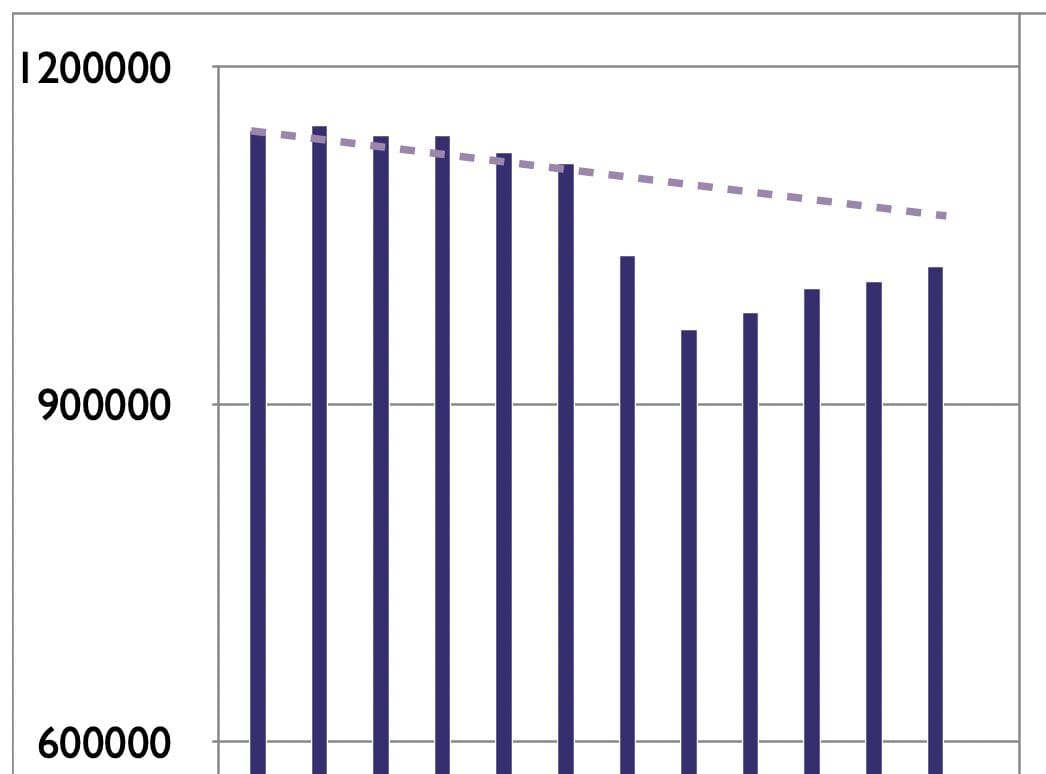
You can see that, to the table going up to 2024 (I have omitted the previous years before 2019), I have added the 2025 numbers as reported, but then also added some basic analysis: the percentage changes over the last three years, plus the ‘expected decline’ figure over the last five years and over the last ten years. This has simply drawn a straight line from the previous figures, so we can see where we would be if decline had continued at the same rate (decline has been slightly steeper over the last five years than the previous five).
There are several things that fall out quite quickly from this simple analysis.
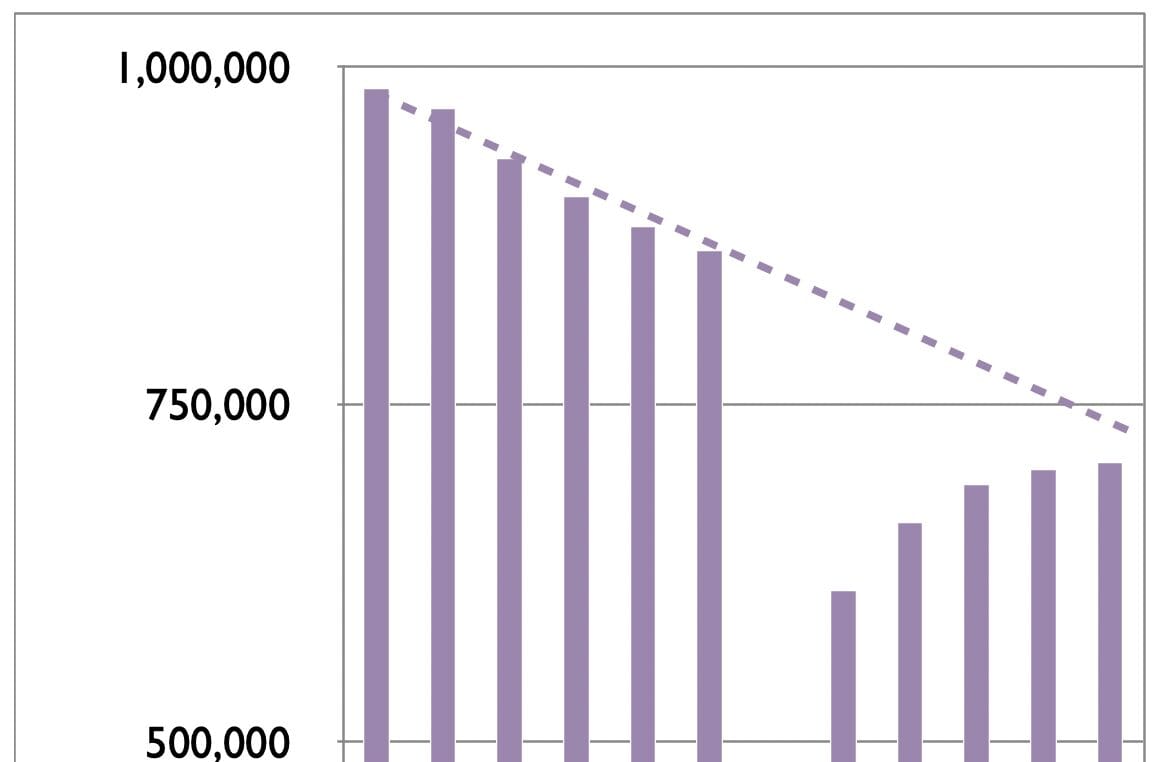
First, there is growth! That is exciting and important—but the key question, following Covid-19, is what kind of growth this is. To answer that, we need to note two things: the shape of the curve; and the predicted pre-Covid trend.
The shape of the curve is concave, that is, the growth upwards is slowing down. You can see that by comparing the percentage increases over the last three years. This is most clear in the Average Weekly Attendance line, where the percentage increase has steadily dropped. It is less clear in the Average Sunday attendance line, and it might be that the trend is actually changing in the Worshipping Community line—but this is the least reliable of the three measures.
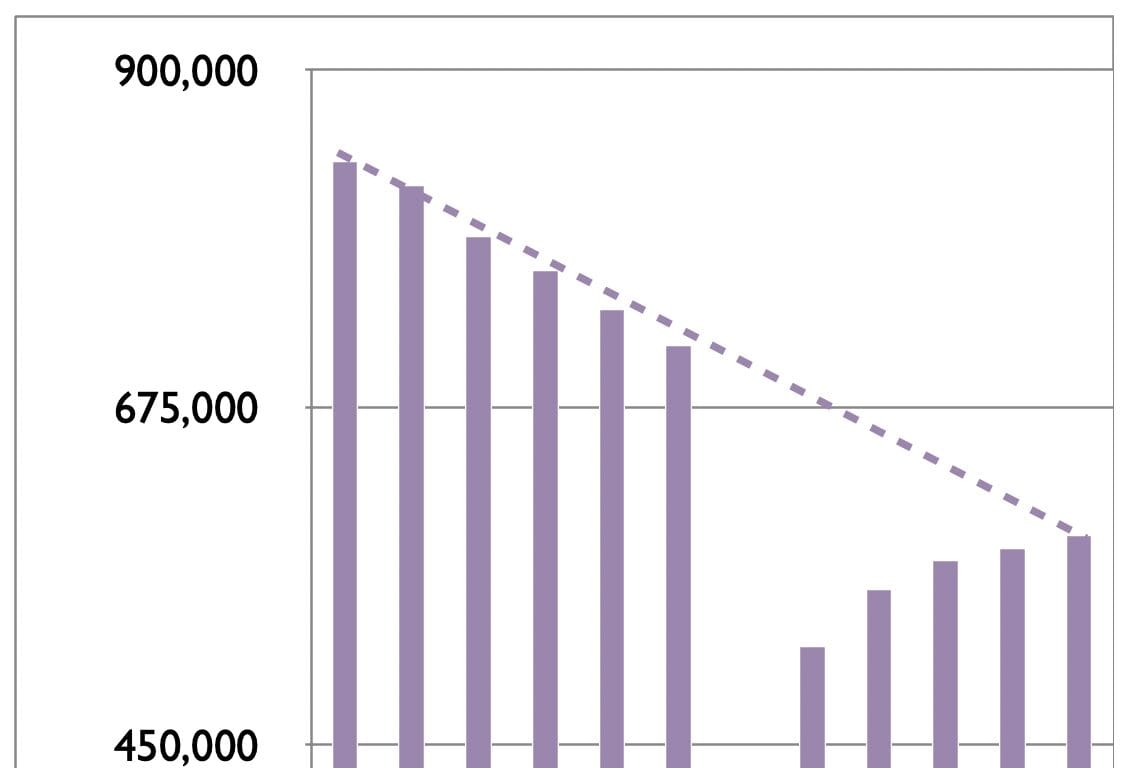
What is more sobering is comparison with the predicted line of decline from the pre-Covid numbers. On each graph, I have just added a line by eye; on the table, I have actually calculated the five-year and ten-year trends, and put in the number we would expect to see in each of the three lines if those trends had continued (the ten-year decline is slightly less steep than the five-year, hence the expected number is slightly higher).
The sobering reality is that we have still not, in any of the three measures, even met the place we would expect to be if decline had continued at a steady rate, uninterrupted by Covid.
ASA is quite close to the steeper of the two declines—and I think there is a real possibility that, next year, it might cross the decline line—but the other two are still some way off. Together, these observations suggest that, despite the slight increase in numbers, we are still not seeing overall ‘growth’, but a final recovery of pre-Covid habits overlaid on a continuing trend of decline.
The key word here is ‘overall’: these are aggregated numbers across dioceses, and across town, outer urban, inner urban, estate, and rural areas. The rural/urban mix is key, since the demographic challenge in rural areas is acute: the church population there is quite a bit older, and the lack of young people involved is more severe.
 So what are the signs of different growth and decline across dioceses and locations? I offer two sets of observations, one from David Goodhew, author of the fascinating study Desecularisation of the City: London’s Churches from 1980 to the Present, and formerly part of the church growth research team based in Durham.
In his presentation at the Church Times conference on the Quiet Revival in January, he highlighted the very different results over the longer term for different dioceses (USA, in thousands):
1990 | 2019 | 2022 | 2023 | 2024 | 1990 v 24 | 2019 v 2024 | |
| Bath and Wells | 33.5 | 16.9 | 14.3 | 14.9 | 14.9 | -56% | -12% |
| Chelmsford | 43.9 | 27.0 | 21.1 | 22.2 | 22.7 | -48% | -16% |
| Manchester | 35.1 | 18.4 | 14.0 | 14.2 | 14.5 | -59% | -21% |
| Ely | 17.7 | 13.6 | 11.2 | 11.8 | 12.1 | -32% | -11% |
| Southwark | 40.5 | 31.6 | 25.0 | 26.3 | 27.1 | -33% | -14% |
| London | 51.8 | 53.6 | 43.1 | 45.4 | 47.0 | -9% | -12% |
The comparison that stands out is how Manchester was double the size of Ely in 1990, but is now nearly as small as Ely (and Ely may well soon overtake Manchester). Remarkably, London has almost entirely bucked the trend of decline, in contrast to its neighbour Southwark. Why? Because it has, long term, been committed to working across different traditions, refused to close for good many church buildings, waiting to replant into them—and embraced working in partnership with church planting movements, notable HTB and the Church Revitalisation Trust.
The wider issues here are why are some doing so much better than others and how this is reshaping the CofE—notably the collapse of the CofE in parts of the north and west and the way different parts of the CofE across London are faring. East London has seen massive numbers of new non-Anglican churches, but very few generated by Chelmsford Diocese, which covers most of East London—though for that information you would need to look outside C of E stats and at David’s research in his book.
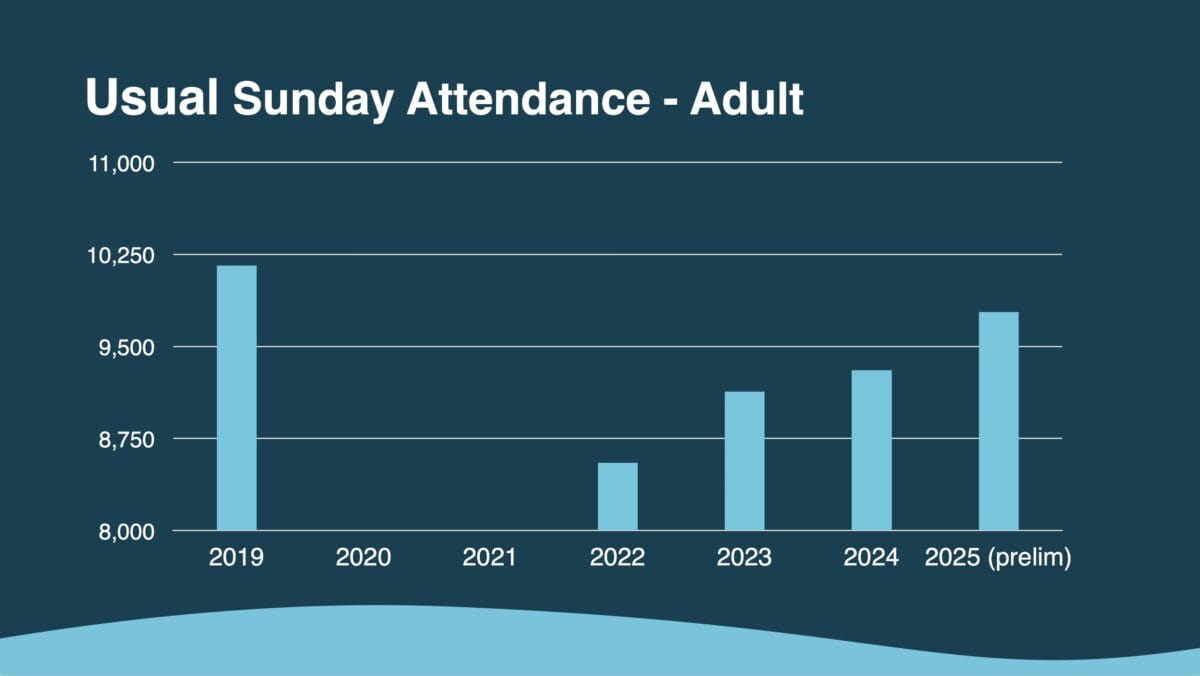
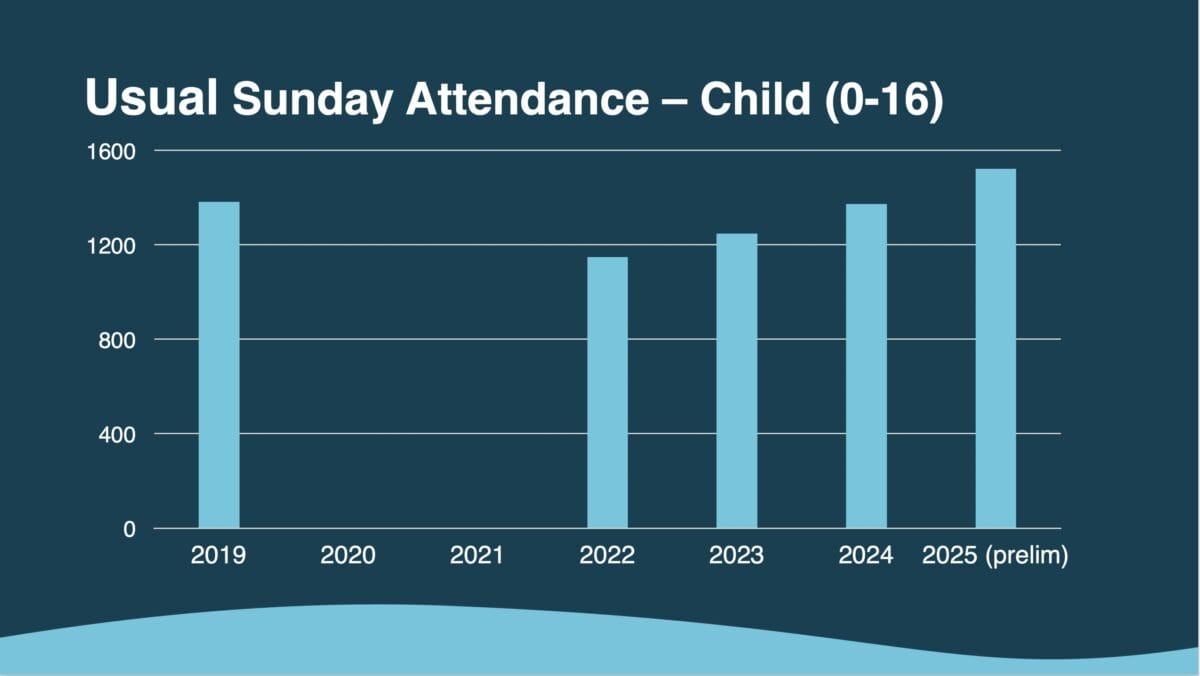 And here is one other comparison, which turns out to be rather encouraging: my diocese of Southwell and Nottingham. At our diocesan Synod last Saturday, we were shown the detailed numbers in the return for our diocese, and I share these with permission. (I think slides labelled USA should actually be ASA.)
The diocese has deliberately made a number of key commitments. Central to this (and contrary to many dioceses around us) we have committed to not reduce the number of stipendiary clergy. This has been a challenge, and we continue to have quite a few vacancies. But it is in line with all the research evidence—that the one key constant in seeing churches grow is to invest in stipendiary ministry that has an intentional focus on growth.
And we have refused to combine parishes into groups and teams, which many are doing—despite it being proven to be a disaster in terms of church growth.
 We have also been enthusiastic applicants of grants from first SDF and now SMMIB. And we have just been awarded another £22m grant. It has been a lot of work—but appears to have been worth it.
And, thirdly, we have had a very conscious focus on working with young people, including in partnership with church schools, alongside other denominations.
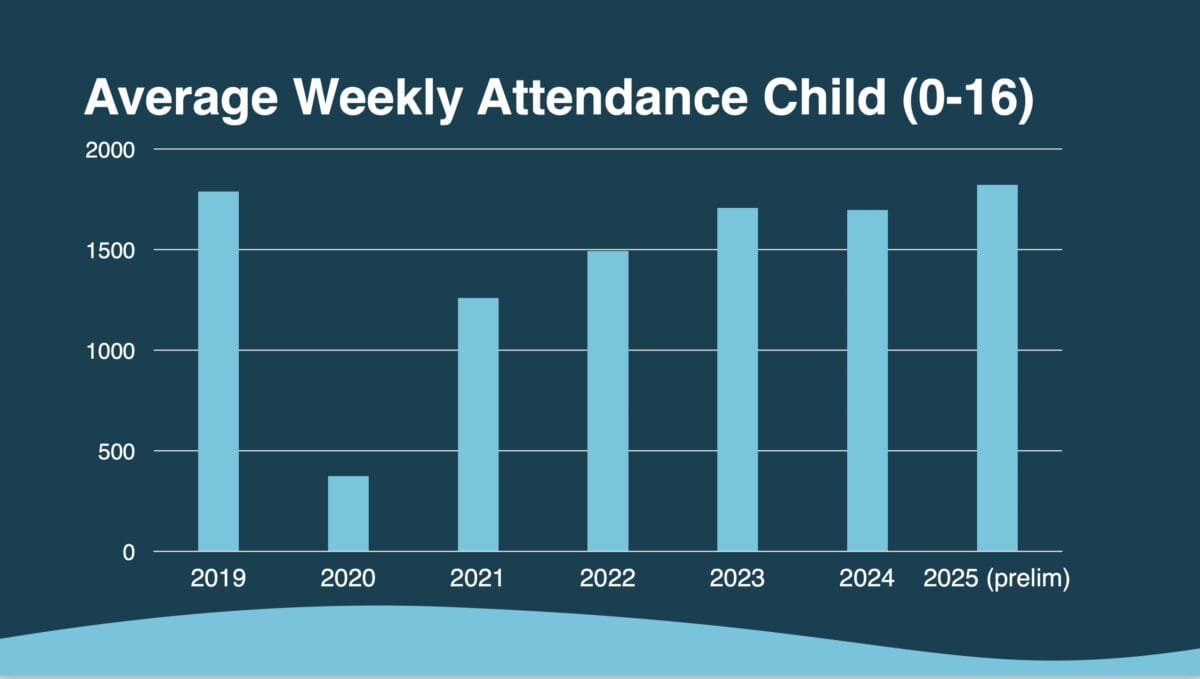 And the outcome has, this year, been very encouraging indeed. In 2025, we saw an 8% increase in adult attendance, and an 11% increase in child (under 16) attendance. It will be interesting to see overall diocesan figures when the full data is released in October, but I would be surprised if there are many other dioceses in a similar situation. In 2024, Canterbury diocese had lost half the children it had in 2019; we have now passed our 2019 number.
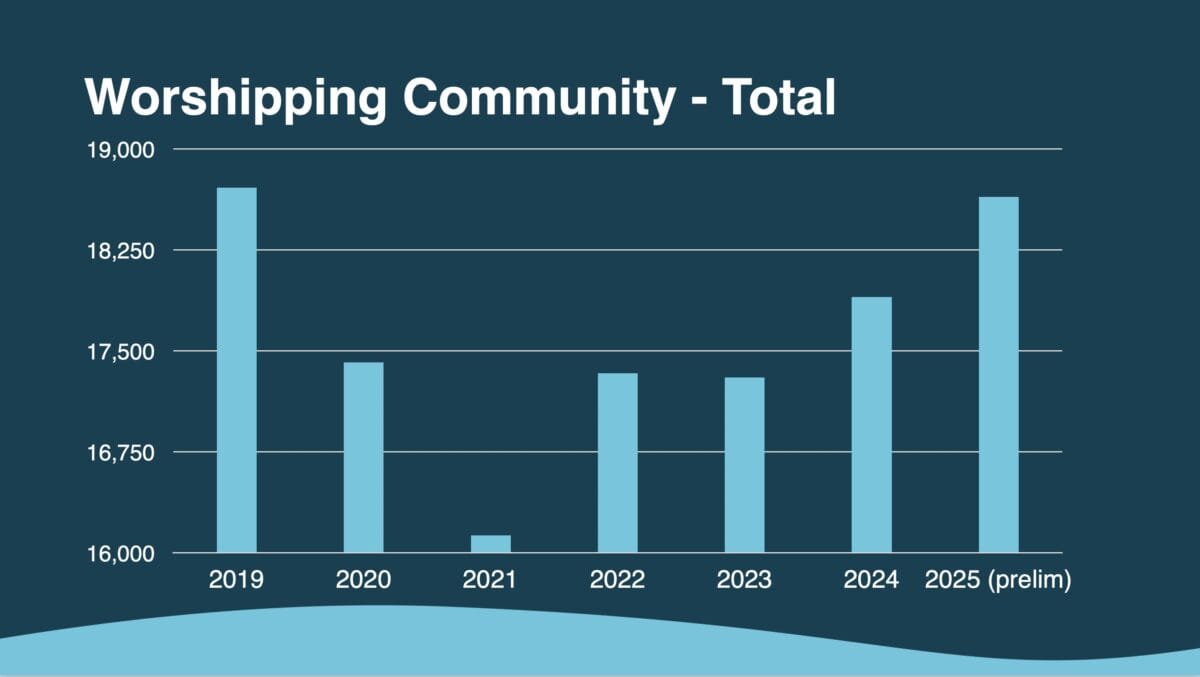 What is notable in these graphs is, in contrast to the national figures, the shape of the line: it is not concave, but more linear, suggesting a real growth trend rather than post-Covid recovery. And we have managed to do this without having a long-term and unsustainable budget deficit.
It is worth qualifying these encouraging figures a little. One swallow does not a summer make, and one set of statistics is not, on its own, a trend. But given the obstinacy of decline in the C of E overall, it is not unreasonable to believe that the things we are doing which have led to this increase in one year will continue to have an effect.
I continue to have questions (which I ask at every diocesan synod!) about both our asset management strategy, the clarity of our accounts, and the large number of central staff posts (which I have written about here before).
But what our example does show is that it is possible to see significant growth, with a commitment to the right long-term strategy, without pushing ourselves into deficit. We have chosen to plant and water well, and we have been encouraged that God has given the growth.
So the question remains, in the light of this, and of David Goodhew’s analysis, why are not more dioceses doing this, and how might we actually make sustainable growth the norm across the Church of England?
 Buy me a Coffee













As a vicar in Southall West London, we did an analysis of our historical Church records from 1908 to 2025 for average Sunday attendance. With the exception of Christmas and Easter, we are now at the strongest point in the whole history of the Church. One could assign that to Mission prioritisation and evangelical faith. However, my own analysis is that as an intercultural Church the growth has been the result of migration of Christians into the UK. My suspicion is that the positive outlook for the diocese of London is also a reflection of this. Has anyone done an analysis along these lines? Is it possible that we are analysing our growth and assigning it to the wrong factors?
Thanks Chris. How encouraging! I don’t think you are typical, in that much migration has led Christians to joining non-Anglican churches. And note David Goodhew’s comments above; his book about London gives all the details.
After so many discouraging occurrences in the C of E, this is a pleasant contrast, and, I believe, a reflection of the movement of the Holy Spirit which is occurring worldwide at present. It would be most interesting to know the figures for growth in free churches. I don’t believe they are available, but suspect them to be significantly higher.
The Church of Scotland has just reported that the number of new members joining by profession of faith (as opposed to transferring from other congregations) has almost doubled since the Covid-19 Pandemic. 27% of congregations have grown in membership over that same period. Overall membership has reduced by 5% over the past year, the main cause being death, not unexpected in a Church with ageing membership. Unfortunately the Kirk does not have the same range of statistical measures as the CofE, and weekly attendances , where they occur, are merely self-reported estimates.
By contrast, the Scottish Episcopal Church appears to be in freefall….
The Church of Scotland like the SEC church both perform same sex marriages though now unlike the Free Church of Scotland
…and it has been a disaster for SEC.
The SEC hardly had a huge membership beforehand and unlike in England it is not the national church in Scotland. The Church of Scotland is the national church in Scotland protected by the King and its now performing same sex marriages doesn’t seem to have done it too much home. Most of those most anti same sex marriages had already gone to the likes of the Free Church of Scotland anyway
Simon, ‘The Church of Scotland (the “Kirk”) has experienced a severe, sustained decline in membership and attendance over the last 20 years, with membership dropping by more than half since 2000.’
The next step would be to find out what demographic left the CoE during lockdown and what demographic is driving the increase.
Hi Christopher, isn’t the presence of a ‘control’ (in the form of the Diocese of Southwark) a reassurance here? They will have experienced very similar levels of migration – and, incidently, what a hole they’d be in without it.
One salient feature of growth/decline is the length of interregna. I notice now (as an RC) that interregna tend to be six days (i.e. a new priest next Sunday). When I was bishopping in the C of E one archdeacon (Bob ‘the Builder’ Jackson) used to say that C of E interregna tended to cause palpable decline in numbers and income.
It seemed to me then – and now – that virtually abolishing interregna (not always possible, but sometimes) would be a good policy.
Yes, Bob has pressed that and others (including me) have argued for it. But to no avail…
The difference is though in the RC church priests get no choice where they are sent by their Bishops. Whereas in the C of E Vicars have to be interviewed by the PCC and churchwardens before appointment by the Diocesan Bishop
Why cannot they do that before the previous incumbent leaves?
Well if they can get enough applicants in the time between the incumbent announcing their departure and the incumbent leaving maybe they could
They can… but…
Pre retirement at my final parish I deliberately gave a lengthy period of notice. My hope was that the PCC could to get their act together promptly and that the Diocese would “get on with it”. I need not have bothered. The Diocese was positively sloth-like. ÌMHO they also took far to long “adjusting ” the job description etc… and ended up with a ridiculously poor appointment journey. It took ages.
My observation (not merely my own experience) otherwise is that repairs to (sometimes neglected) parsonages are delayed until just before the new incumbent starts…. or not done properly… or not at all. I know (including as twice a Rural Dean) that clergy occasionally leave their houses in a very poor/unreasonable state but that’s no reason for Diocesan delay. They have the responsibility to sort it out.
PS1…some Teams work well and do grow. But what “team” means is rather varied. Merging parishes is usually and primarily financial… “team” can be gaslighting and without missional meaning. “Cost Saving Group” would be honest.
PS2… exactly right that churches need clergy not self destructive cuts.
I’m trying to do the same thing at the moment, having given notice of my leaving a couple of months ago. The parish are up for getting everything ready for the new appointment in the next 2-3 months, but everything from the Diocese comes with a colossal handbrake. It’s almost as if they can’t think why any parish would not want a 12 month gap between vicars, even as they advertise for a new Archdeacon 2 months before the outgoing one has even left.
It is diocesan madness, David. I don’t understand why they are so detached from the actual evidence.
Untrue. Bishops sometimes have to be quite persuasive. Very few priests are moved against their will. There is, however, very little – if any – consultation so far with parishes. Something for ‘synodalism’ to tackle maybe.
Plenty of priests get another post, maybe get promotion to Archdeacon or Bishop or retire. There is almost always an interview day by candidates with the PCC and church wardens too before any Vicar is appointed, unlike the RC church the Bishop does not act alone on the appointment but takes note of the PCC preferred candidate
Simon, Andrew is talking about the RC.
Noted
For comparison with the Church of England numbers: last year I did a weekend of teaching for the regional group of New Frontiers churches. They told me that (in 2025) their Sunday congregation size was 50% above its size immediately before Covid. For the Church of England, if I have my numbers right, we are 20% below our pre-Covid size. The New Frontiers churches also said their leadership was younger and more diverse.
That is excellent. Re ‘diverse’ I neither know (a) what is the definition of ‘diverse’, which seems an impossibly vague word, nor (b) why diversity is seen as a good thing rather than neutral.
I think I saw that FIEC say 74% of their churches are growing. Whats the common factor…?
This is good news, though as the article states much of it is just a reversal of the decline during Covid. I agree too with Ian that ensuring Parishes have stipendiary priests and not merging too many Parishes together and having a commitment to ministry for children too is the best way for church growth. That also requires Church Commissioner funds going down to Parish level, which to be fair it has started to do and not be focused too much centrally and on grand projects.
While London has the best record on retaining and in some ways even increasing its congregations, helped by Christian immigrants from Africa for example, good to see largely rural Ely diocese second best on congregation retention. Ely is ahead of urban Southwark and partly rural Essex Chelmsford diocese is ahead of urban Manchester diocese too. Showing that there is no need for rural dioceses to decline and no guarantee that urban dioceses won’t decline. What that may suggest is that C of E congregations don’t want too much wokeism as they get in Manchester
Except that I suspect the growth in Ely might well be in Cambridge and other towns.
Ely is one of the most rural dioceses in England, it certainly won’t all be growth in Cambridge. Even Cambridge has a population only a quarter that of Manchester and just 2% that of London. Remember too rural dioceses also often have members of other denominations in them, even Roman Catholics as there are often only C of E churches in villages and hamlets which is not the case in towns and cities where there are churches from plenty of denominations to choose from
Simon, I am afraid that is simply not true.
In broad terms:
about 1 in 5 people in the diocese live in Cambridge;
about 3 in 5 live in Cambridge or another town;
about 2 in 5 live in villages or more rural settings.
Growth in Cambridge and other towns will have a big impact on the diocese overall.
Yes, I know you have next to no interest in rural ministry and those of us in rural parishes Ian so will interpret any stats to reinforce your obsession with urban ministry. However, on your own stats only 20% of Ely diocese live in Cambridge, 40% live in villages and rural areas. England wide only 17% live in rural areas, so Ely is a far more rural diocese than the English average, yet still has done better than any diocese after London in retaining its congregation since 1990 and of the dioceses you quoted better even than London since 2019
Why do you start with your prejudice about my views?
As I point out, 60% of the diocesan population live in the city or towns. So, contrary to your claim, it could well be growth there that is helping the diocese.
To add to that, there are villages round Cambridge which are ‘dormitories’ for Cambridge itself. For these pages, Histon is notable among these 🙂
‘Why do you start with your prejudice about my views?
As I point out, 60% of the diocesan population live in the city or town’.
So, given as I pointed out to you 83% of the English population live in cities or towns, Ely diocese is far more rural than the English average and far more rural than the average C of E diocese too. Yet Ely has kept a higher percentage of its congregation regularly attending its churches than any other diocese you included in your header, even London.
So that shows quite clearly that more rural than average dioceses can retain significant congregations. Cambridge is less than a quarter of the population of Ely diocese so it cannot be Cambridge alone shoring up Ely diocese’s congregations. Our fantastic rural churches (as well as our ancient cathedrals which Ely also has) are the backbone of the Church of England, with rural churches having the highest percentage of grade listed buildings and with the broadest congregations, often including high church Anglicans and evangelicals and even Roman Catholics in the same church. Ely diocese’s success is a great tribute to our rural parishes
May I be permitted an anecdote? Some years ago, I visited my sister for Christmas. She lives in a rural corner of NW Shropshire. I went to the local church (in the multi-church benefice) being used for the Christmas Day service. It was taken by a retired clergyman who had been in London. It was awful (in the modern sense). There was no heart at all in the liturgy, and the sermon was unspeakable. No hint of wonder at the incarnation.
For New Year’s Eve I was invited to stay with some friends for a party. They lived in a village north of Cambridge as they both worked in the city. The next day was Sunday, so we went to the church literally the other side of the Green. Another retired clergyman was taking the service, as is often the case on ‘Low Sunday’. He was in his 80’s, I was told. The contrast to the previous week could not have been greater. The words of the liturgy had a weight which conveyed the truths they contain. In his sermon he was enthusing about learning something from having read the passage in Greek.
There was a lesson for me in how one can have an effective ministry even when older and in retirement by keeping being a disciple, i.e. life long learning. I know which of the two I would like to emulate in the years to come (which are getting all too close).
But in the present thread, perhaps the villages near Cambridge attract a better calibre of clergy because the city provides a nexus for encouragement in ministry.
In terms of status, after cathedral posts and parishes in West or North London, clergy posts in Oxford and Cambridge and the surrounding area will always have the most prestige for C of E priests. As along with London they are where a well above average percentage of our nation’s elite live. So yes you would expect the highest quality sermons to often be found there but that does not mean good priests cannot attract rural congregations as Ely diocese shows
Simon, the notion that clergy still apply for things on the basis of ‘prestige’ demonstrates why the C of E is in such a poor state.
Numbers? Why this fascination with Numbers? To what purpose I wonder?
The saints are small in numbers; however, it is the sound that they make that is most significant.
For example the Church of Thessalonica –
1 Th 1:8 For from you sounded out the word of the Lord not only in Macedonia and Achaia, but also in every place your faith to God-ward is spread abroad; so that we need not to speak anything.
2 Thessalonians 1:4 So that we ourselves glory in you in the churches of God…..
Romans 1:8 First, I thank my God through Jesus Christ for you all, that your faith is spoken of throughout the whole world.
What is the sound and where is it coming from?
The {g} voice of rejoicing and salvation is in the tabernacles of the righteous: the right hand of the LORD doeth valiantly. Geneva Study Bible Psalm 118 v 15
Psalm 44:3 For it was not by their sword that they took the land; their arm did not bring them victory. It was by Your right hand, Your arm, and the light of Your face, because You favored them.
“when the righteous are in authority, the people rejoice”, Proverbs 29:2. Shalom
Did you read my introductions?
A demographic breakdown of new attendees – which almost certainly isn’t available – could be instructive. Whether you attach credence to the so-called ‘Quiet Revival’ or not, I’ve seen clear evidence in our 250-300 member church and heard reports from acquaintances in other large churches to support its findings that much of the growth is amongst young men. Most of them are single. But where will this demographic be 5-10 years from now when they cannot find girlfriends or wives in our churches? Growing denominations tend to be orthodox in opposing SSM, but orthodoxy here seems to correlate increasingly with male headship thinking, a view which drives away from our churches the sort of young, professional women these young men need to meet if we are to see a healthy number of children a few years from now, and a next generation.
the church shouldnt be thought of as the place to meet your significant other. If those new young men really have that mindset, dont expect to see any of them in a few years time.
The only alternative is to deprioritise that extreme priority: that your spouse be Christian (and also that your children have an integrated and uncomplicated upbringing).
Church is just the local community in a Christian society (which is what societies should be unless we cruelly fob them off with less than the best). As such, it is the arena and stage for birth, baptism, graduation, courtship, marriage, childbirth, commissioning, care, burial.
Did you read my introductions? {Ian}
Not sure who are you addressing there Ian?
Perhaps you are taking something personally here.
My remarks were addressed to the Company.
In general my point is allied to the Sovereignty of God , Christ and the Holy Spirit.
I think we need a recovery of the same because The Sovereignty seems absent in many such conversations.
In the Lord’s battles and initiatives Praise and acclamation often precede the conflict not after it. That is why it is reckoned a Spiritual warfare.
God’’s emphasis for me is “to glory in and to know and understand
that He is/ I am Lord.”
For[ as Paul remarks] we preach not ourselves, but Christ Jesus as Lord; and ourselves your servants for Jesus’ sake 2 Cor 4 v 5.
Shalom.
I was addressing you Alan, as you appeared to have completely ignored my opening paras.
Is the link working for the full table – or is it a problem at my end. Thanks
Yes; the link is to the C of E page with all previous reports, on the second line ‘Church attendance’ and when you click + you get a list of the diocesan tables for previous years. The full table for 2025 will be published in October, which is why I created my own for the headline national numbers.
Does that make sense?
It’s positive… i just wonder what influence transfer growth has.
We’ve certainly seen this (non kingdom) growth since lockdown. There is other growth but my quick analysis is that the transferees are in the clear majority.
What is a practising Anglican? Do they believe? On the TV quiz show, Pointless, this week, one former Prime Minister was described as Jewish, but Practicing Anglican.
Are there any surveys of the beliefs of church attendees.
Or is there a tacit understanding that there is a difference between the ‘visible church’s and the ‘ invisible church’ and it is altogether too offensive to try to find out?
As far as FIEC is concerned and probably New Frontiers, it is easy today to find out the beliefs they subscribed to, before attending, and those beliefs will be integrated in the service.
David Wilson’s illustrations show the variability, in attending an Anglican church, even when liturgies are followed. And it is not merely a matter of outward form, but of substance, or weight.
When was the last time we could say that God was present, the glory of Christ. Even in a lavish liturgical service ( or maybe especially in such a service): Ichabod.
The Anglican church is the established church in England so of course it contains a wide range. From those who attend every week, to those who only attend at Easter and Christmas and Remembrance Sunday, to those who only attend for weddings, baptisms and funerals. It also has a wide range of worship styles, from churches which are even more high church and filled with incense and Mary than the Roman Catholic church to very low church evangelical churches.
Disraeli was the PM who was born a Jew but converted to C of E
How about responding to the other points I made Simon?Converted to Christ is the only conversion established in history, in eternity. The rest, per se, is mere structural formalism, a type legalism of liturgury.
Surely, know the difference! Though you have never on this site been able to set out what the Gospel of Christ is, nor your own testimony of conversion.
Conversion to Christ and following the Gospel of Christ is something every Christian denomination does, it is the liturgy and formalism which helps distinguish denominations, including the C of E. Most notably via the BCP
But the improtant difference between denominations is over fidelity to the New Testament (or not).
If fidelity to all of the New Testament is key for you, you may as well be Roman Catholic. The Vatican still doesn’t allow divorce and remarriage except with a strict annulment, it still doesn’t allow women priests or bishops and it doesn’t perform same sex marriage services either
Simon, fidelity to all of the New Testament makes you a reformed Christian, perhaps an Anglican, not a Roman Catholic.
It is the Church of England whose doctrine is defined by the NT and not tradition (see Canon A5).
And the New Testament does allow both divorce under certain circumstances and women in leadership.
So I think you are confused on every part of this comment.
If you believe Mark, Jesus does not allow divorce under any circumstances. Even if you believe Matthew he only allows it on grounds of sexual immorality. Paul made clear he thought a woman should not teach or have authority over a man
What Catholics count as conformity to the roots is often second century. Ignatius and the Didache. What scholars have called early Catholicism. I have never understood why they point at those documents to show what is earlier while comparatively ignoring the extremely well known first century documents which obviously trump the second century ones in earliness.
Simon, you keep repeating this nonsense, and ignoring my response to it. In that regard, you are being quite fundamentalist.
I noticed you did not dispute the text of Mark on divorce for example. Nor Paul, although you interpret it differently. I am not a New Testament fundamentalist but if I was I would be Roman Catholic not Anglican
I prefer not to worship Mary, thank you.
After the Quiet Revival was questioned, the Bible Society sent me further statistics. They stated that half of all 18-34 year olds attend church at least once a month. That’s about 5 million folk once a month.
I find that data very hard to believe. The vast majority of people I come across, of various ages, rarely if ever go to church.
Is that in the public domain, i.e. on their website or elsewhere?
In every church there are Professers and Confessers and Possessers.
Some remain as Professers some are transitioning to Confessers then
becoming Possessers of divine Resurrection life, Overcomers and not just
Apologists. The distinctions are fundamental for an in,dividual or a company of saints. Shalom.
I recommend theschoolofchrist.org
The Secret of Spiritual Power
Chip Brogden
God led His ancient people through “fire and water and allowed kings to ride over their heads [and brought them into a whealthy place”]
Christ leads His people to fountains of living water.
Those “led” of the Spirit, where is He leading them to?
To the Throne, to reign in Life by Jesus Christ who has made us Kings and priests to God. Shalom.
I’ve been reflecting since reading this. At the risk of hair-splitting, I think there’s some challenging issues hidden in among all this.
“We have a duty before God to make decisions that might lead to people coming to faith, rather than not.”
Yes indeed.
“And we have a duty before the Charity Commissioners to make decisions in the best interests of our organisation—based on evidence.”
Not sure about that. The duty is to further the charitable objectives; to act in the best interests of their furtherance, which inherently encompasses the sacrificial. Sometimes those best interests even mean giving all the money away and closing up shop. Acting in the best interests of the organisation is something of a blight, in fact. I am aware that in large and well-resourced charities it’s really hard to prevent smart and capable senior staff from essentially acting in their own interests under the guise of charitable activity, and how hard it is for trustees to spot that, or do anything about it if they do. It’s often an asymmetric situation, awash with complex legal duties. This is a general issue in the charitable sector.
“Based on evidence” also sounds nice and solid, but it hides the questions about what evidence you look for, is given to you, and how you interpret it. Most evidence in the world of charities is pretty significantly flakey, and needs a huge dollop of wisdom and personal judgement. I’d go so far as to say there’s a weird exceptionalism and lack of self-reflection among organisational leadership in general, treating today’s evidence as uniquely exempt from the obsolescence that overtook every prior evidence base.
In the case of the AC, there’s some very important choices about not only what is decided, or on what basis, but also the manner in which it is done. It would be hard to argue, for example, that the AC could be acting properly if it did so in ways that did not embody the beliefs and practices of the CoE. For example, prayerful discernment can lead such a body to take a decision, based on their judgement as trustees. They can believe that to be the best furtherance of their charitable objectives, at odds with some other factor or conventional appraisal. It’s not for the Charity Commission to adjudicate on what factors a trustee board decides, and can’t intervene if a trustee board is clearly taking appropriate and reasonable care.
There’s a pretty scary Bonhoeffer quote that puts this in sharp relief:
“Whoever is mindful to build the church is surely well on the way to destroying it, for he will build a temple to idols without wishing or knowing it. We must confess, he builds. We must proclaim, he builds. We must pray to him, and he will build. We do not know his plan. We cannot see whether he is building or pulling down. It may be that the times which by human standards are the times of collapse are for him the great times of construction. It may be that the times which from a human point are great times for the church are times when it’s pulled down.”
If you believe that then it is quite a challenge to put into practice – albeit possible, and lawful. It’s a much higher personal risk though – or at least, it feels that way. Doing something faithless, cynical, but entirely conventional is – sadly – a very low risk path. For avoidance of doubt, I’m not implying anything – just saying that a system that fails to prevent self-interest while also making bad choices lower risk inevitably leads to bad, self-interested choices.
“Counting attendance numbers provides that evidence.”
It’s possible to believe both that counting attendance numbers is useful, but also problematic. There’s lots that could be said about collection and interpretation, but also about the correlation between bums on seats and mission / discipleship. I’m sure we could all think of churches that attract a large attendance around the world and yet have very deep issues.
I realise you were making a passing remark about this, so apologies if this is nit-picking. It’s just niggled at me!