Professor Richard Dale writes: KICKING IN THE CATHEDRAL DOOR
How the Church Commissioners relied on bogus history to denounce their predecessors and vilify their own Church
It is over three years since the Church Commissioners published their controversial report on the Church’s links to the slave trade. Since then critics have challenged the Commissioners’ historical research while both the Church Commissioners and their historical advisers have published their separate responses to such criticism. However, in the light of recent academic research it is now clear beyond doubt that the Commissioners’ historical analysis is deeply flawed and their conclusions mistaken. The Commissioners therefore have a moral responsibility to withdraw their report and correct the record before a false historical narrative, to which they have lent their full authority, becomes further embedded in Google, AI and in schools and colleges throughout the world.
In February 2021 the accountants, Grant Thornton, were instructed by the Church Commissioners to review the ledgers of Queen Anne’s Bounty to “determine the extent to which the origins of the Endowment Fund may have been derived from the profits of the slave trade.”
Grant Thornton’s verdict was devastating:
We found that Queen Anne’s Bounty had purchased investments in an entity called the South Sea Company which is known to have transported 34,000 enslaved persons across the Atlantic. The South Sea Company ceased trading in enslaved people in 1739 at which point the Bounty had invested £443 million (in today’s terms).
These findings were incorporated into the Church Commissioners’ report on the Church’s links to slavery, publicised in the press and cited as the basis for Project Spire, a proposed £100 million impact investment fund, that was announced in January 2023.
The central argument of the Church Commissioners and their historical advisers is that Queen Anne’s Bounty profited hugely from their slavery-linked investments, derived principally from interest on its holdings of South Sea Annuities. Church leaders were understandably shocked by the Commissioners’ report. The then Archbishop of Canterbury publicly apologised for the fact that the Church had profited from slavery, and the Bishop of Manchester, who was also deputy chair of the Commissioners, wrote an open letter to Save the Parish in support of Project Spire. He said:
Having come to the full understanding of the extent of the involvement of Queen Anne’s Bounty in investing in the slave trade through research and forensic analysis…we cannot hold on to money gained so wrongly, any more than a burglar can hang on to profits from their activity.
Here, then, is the historical narrative propagated by Church leaders and invoked as justification for Project Spire. However, this narrative is demonstrably false. The Church Commissioners’ historical advisers have misled the Commissioners, the Commissioners have misled Church leaders and Church leaders have misled the public at large. Because there is incontrovertible evidence that Queen Anne’s Bounty’s investments earned not one penny from the slave trade.
The Commissioners’ Report makes three related mistakes that distort its historical account.
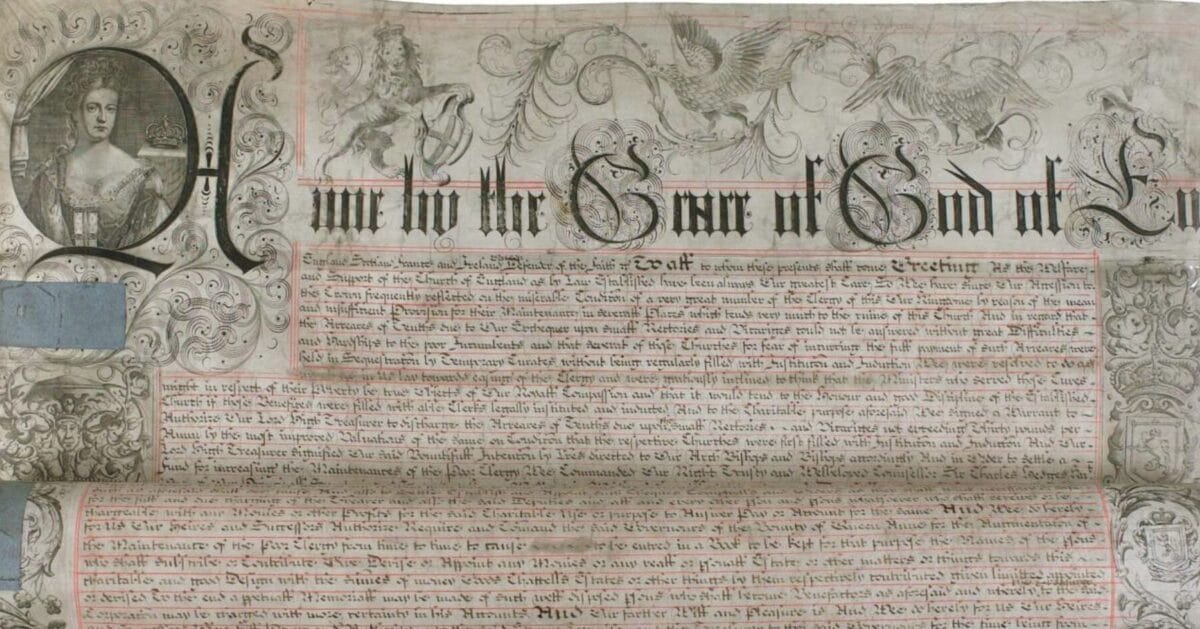
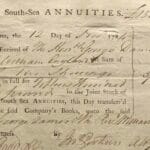
First, although the Report refers to the South Sea Company stock splits in 1723 and 1733 that separated the Company’s trading operations from the newly created South Sea Annuities, it fails to examine the legislative framework governing the latter (9 Geo 1 c.6, 1723 and 6 Geo 11 c.28, 1733). In 1723 Parliament established a new annuity company, the Joint Stock of South Sea Annuities which, according to the statute’s preamble, legally insulated investors from “future frauds, abuses, errors and mismanagement” of the South Sea Company. The Annuity certificates stated that the contracting party and issuer was the Joint Stock of South Sea Annuities and not the South Sea Company. The Annuitants were entitled to receive their pro-rata share of interest from the government at a specified rate in perpetuity and were ring-fenced from the risky and generally loss-making operations of the South Sea trading Company.
The Company’s capital was split again in 1733 when, according to its chief clerk, Adam Anderson (An Historical and Chronological Deduction of the Origin of Commerce, 1764), “the proprietors of the trading stock becoming uneasy on account of their late losses by the Asiento and Greenland [whaling] trades” petitioned Parliament to divide the Company’s capital 25/75 in favour of South Sea Annuities. The intent behind the legislation was made clear in a ‘general court’ (shareholders’ meeting) of the South Sea Company in March 1732 when it was proposed that three quarters of the Company’s capital be
…entirely severed from the trade, and not liable to any debts or incumbrances of the Company …. and be a clear fund or annuity (cited in Armand DuBois, The English Business Company after the Bubble Act 1720-1800, 1938).
Following this second stock split there was a nominal distinction between Old and New South Sea Annuities.
The failure of the Commissioners to address the legal basis of the South Sea Annuities contributed to a second serious error. The authors mistakenly categorise South Sea Annuities as investments in the South Sea Company and the interest thereon as earnings related to the slave trade. This, despite the fact that the Annuities, as the Report acknowledges, were invested exclusively in government debt and therefore equivalent to government bonds. Furthermore, Francois Velde, an authority on 18th century English finance, states in a recent paper that after the stock split of 1723 the Annuities represented the only form of liquid government debt available and that “if the Bounty wished to invest in government funds, there was no choice” (“An Institutional Investor in 18th Century Britain,” Federal Reserve Bank of Chicago, October 2025). It is preposterous that the Bounty managers should be castigated for investing in the slavery related assets when they were opting for a low risk investment strategy that explicitly avoided exposure to the South Sea Company’s trading activities. Even more extravagant is the Report’s assertion that “anyone [including Annuitants] investing in the Company before 1740 was consciously investing in [slavery] voyages.” Of course, the precise opposite was the case: Annuitants could be sure that they were not investing in such voyages.
This consideration leads to the third major error—which is also the most outlandish. Although the South Sea Annuities were government bonds in all but name the Commissioners’ advisers claim to have found a direct linkage between these assets and the South Sea Company. Their wording is significant: Grant Thornton’s website refers to its research into “Annuities issued by the South Sea Company” and the Report itself refers variously to the South Sea Annuities as “South Sea Company investments”, “investments in the South Sea Company”, “South Sea Company securities” and, in the glossary, as “Annuities in the South Sea Company”. Here, the Commissioners’ advisers have confused two different companies, each with the words “South Sea” in their name: the South Sea Company and the separately incorporated annuity company, the Joint Stock of South Sea Annuities. Furthermore throughout the Report the authors incorrectly refer to South Sea Annuities as South Sea Company Annuities, a descriptor unknown in contemporary records, whether this be the ledgers of the Bank of England, the Bounty’s ledgers, Chancery proceedings or the Annuity certificates themselves. Once more, the report is guilty of an elementary gaffe by conflating two legally separate entities.
From the above it is clear that South Sea Annuities had no connection whatsoever with the South Sea Company’s trading activities. As the parliamentarian and banker, John Brocklehurst, explained to the House of Commons in 1834:
the South Sea Annuities had nothing to do with the South Sea Company beyond receiving at their hands the dividends as they became due from the government.
The annuities were payable at an office called South Sea House in much the same way that other publicly held government debt was payable at the Bank of England.
The Bounty did, for a time, have a much more limited investment in South Sea Company stock. This was acquired in April 1720 when the South Sea Bubble was beginning to inflate, England was at war with Spain, and, with its trade suspended, the South Sea Company had become “of necessity a naked finance corporation” (John Carswell, The South Sea Bubble, 1960). Quantitatively, this one-off investment in stock was a small fraction of the Bounty’s Annuity investments. In the period 1708-1793 dividends from the South Sea Company represented a mere 0.1% of the Bounty’s total income against nearly 30% for Annuities, First Fruits and Tenths accounting for most of the balance. Nevertheless, though limited in both amount and duration—the stock was largely disposed of in 1728—the investment became a direct exposure to the slave trade when this was resumed in 1722—28.
However, the dividends the Bounty received from its holding of stock were not derived from profits from the slave trade because the trade was loss-making. A committee, appointed by the South Sea Company’s shareholders to examine the Company’s accounts, shows that in the period 1720 to 1732 (which covers the time when the Bounty held stock) the loss on the trade account was over £385,000 (The Report of the Committee appointed to Inspect and Examine the Several Accompts of the South Sea Company, 1733). The books of the Company have not survived but on the basis of these summary accounts Velde finds that the Company was forced to issue bonds to cover its losses and then, when in 1732 the bond debt had reached £2 million, to slash its dividend to a level below the interest it received from the government. (After the stock splits the South Sea Company continued to receive its pro-rata share of the interest paid by the government on its debt.) Stung by its losses the South Sea Company declined in 1748 to take up Spain’s offer to renew the Asiento Contract on unchanged terms.
Velde also shows that when the Bounty invested in South Sea Company shares in 1720 it did so by exchanging its existing holdings of government debt, (eg. lottery loans) for stock. This was done on terms that proved to be highly unfavourable, prompting the Bounty’s Treasurer to set out the losses the fund had incurred through this transaction. According to Velde “[the Bounty’s] involvement in the South Sea Company was financially costly and within a few years it disposed of its equity and bond interests in the company.”
In summary, the Bounty’s investments, whether in stock or annuities, earned no money from the slave trade. Additionally, the Commissioners’ advisers dropped a clanger when they assumed that it was the South Sea Company that issued South Sea Annuities. In fact the Company was neither issuer, vendor, counterparty or guarantor of the Annuities which were issued by a legally separate company with its own investor base and investment objectives. The whole point of the stock splits of 1723 and 1733 was to create a new class of asset that had nothing whatsoever to do with the South Sea Company’s commercial activities. In propagating a false historical narrative around the Bounty’s alleged earnings from and links to the South Sea Company and the slave trade, the Church Commissioners’ and their historical advisers have deluded themselves and misled everyone else.
It was not long before criticism of the Commissioners’ historical research appeared in print and on line. See my own article in the Church Times, Slavery did not benefit Bounty; The Church and Slavery: the Facts, an anonymous article in The Critic, May 30 2025; and articles on the History Reclaimed website. Nigel Biggar brings many of these criticisms together in his book Reparations: Slavery and the Tyranny of Imaginary Guilt, 2025; see the interview with him about it here.
Criticism was also raised privately in April 2024 with the then Archbishop of Canterbury, Justin Welby, in the hope of finding a diplomatic route out of a situation that could be damaging to the Church. However, after some preliminary exchanges, the Archbishop decided to delegate the matter to Gareth Mostyn, Chief Executive of the Church Commissioners, who refused to engage with his critics. In June 2024 Mr Mostyn published a Comment piece in the Church Times in which he reiterated that the Bounty
invested significant sums in, and derived a material amount of its income from, the South Sea Company
(in fact dividends from the Company represented 0.1% of the Bounty’s total income in the 1700s.) He also stated that the degree of profitability was no longer the issue, a departure from the Commissioners’ original remit to Grant Thornton, and that what mattered was unspecified “historical connections”, “financial involvements”, and “tangible links” to enslavement.
But not everyone was singing from same hymn sheet. On April 14th 2025, the Archbishop of York gave a keynote address to a UN sponsored forum on historical injustices in which he focussed on the Commissioners’ research into the Church’s links to slavery: “How we invested in the South Sea Company and the very significant amounts of money we made from this.” Here again there was an assertion that the Church had made large profits from the slave trade.
The Commissioners’ historical advisers, Professor Richard Drayton and Dr Helen Paul, released their own defence of the Commissioners’ research in June 2025. However, once again there were serious errors, some of which are identified below (for a longer engagement, see here):
1. South Sea Company and annuities.
Dayton and Paul renewed the claim that the South Sea Company was a counterparty to and issuer of South Sea Annuities. Apparently, the South Sea Company “could issue a financial instrument or contract called an annuity to investors. The investors would be entitled to an annual payment (ie. an annuity payment) from the South Sea Company”. This rash assertion is contradicted by the wording of the Annuity certificates (no mention of the South Sea Company) and the stated objective of the 1723 and the 1733 stock splits which was to relieve Annuitants of any risk exposure (including counterparty risk) to the South Sea Company. The D and P assertion does not qualify as evidence based research, the authors having failed to identify a single Annuity certificate on which the South Sea Company is named as counterparty.
2. Asiento
Dayton and Paul proclaim “the myth of the unprofitability of the Asiento”. Their assertion that the South Sea Company made profits from this gruesome slaving contract relies on an (outlier) article by Price and Whatley who base their findings on the capital asset pricing model. The econometric formula makes heroic assumptions about investors (all are rational, have the same access to information, have the same expectations of future returns on all assets, can borrow without limit at the riskless rate of interest and so on) which limit the technique’s relevance even to today’s markets, let alone the unregulated mayhem of Exchange Alley in the early 1700s.
In any event there is no need to rely on controversial mathematical formulae when there exists a contemporary shareholders’ report on the South Sea Company’s accounts published in 1733 (The Report of the Committee appointed to Inspect and Examine the several Accompts of the South Sea Company). As already stated this shows large losses on the Company’s trade account. Price and Whatley do not cite, mention or reference this crucial document or indeed other primary sources such as Adam Anderson’s classic contemporary account. Evidence based research surely requires that the best evidence be used, a principle which D and P have failed to follow.
3. Reciprocity
Dayton and Paul suggest that “at the level of the firm” there was “reciprocity” between the South Sea Stock and the South Sea Annuities, the one (stock) risky and the other (annuities) secure, as if we were dealing with a single corporate entity diversifying its income stream. In reality, as anyone who has read the relevant legislation should know, there were two companies with separate balance sheets, legally separated assets and liabilities, separate revenue streams and separate proprietors. There was no “reciprocity”.
4. Fungibility
Dayton and Paul claimed that money is “fungible” and that the sums to be paid out to annuity holders “was not neatly separated from other moneys held by the Company.” The South Sea Company was therefore free to divert such funds to its own use and then use profits from the slave trade [!] to pay the Annuitants. The authors have evidently not understood the relevant legislation which makes clear that interest received from the government by the South Sea Company on behalf of Annuitants was to be held separately “in trust and for the benefit of the annuitants” before passing to the Annuitant beneficiaries.
5. Administration
The government paid an annual fee of £14,500 to the South Sea Company for acting as registrar and paying agent for government debt. This sum, equivalent to less than 0.1% of assets administered, was intended to cover the enormous costs of maintaining an army of clerks: we do not know how many but no doubt considerably more than the Bank of England which, in 1720, with a much smaller balance sheet than the South Sea Company, employed around 100 clerks on a minimum salary of £50 per annum. Allowing for the higher salaries of senior clerks and supervisors, the administration fee does not appear exorbitant. However, D and P state that the annual fee provided “a steady income stream” for the South Sea Company which could be used for any purpose they chose, as if it were a net profit rather than payment for (costly) book-keeping services.
6. Scholarship
There are several lapses of scholarship in the Dayton and Paul response, notably a reference to the historian Victoria Sorsby. She is cited as authority for Dayton and Paul’s insistence that a payment of £100,000 to the South Sea Company in 1750 was not made as compensation for the Company’s losses on the slave trade. However, the abstract of Sorsby’s excellent thesis states unequivocally that “in 1750 the Asiento Contract was terminated and the South Sea Company paid £100,000 to cover their losses on the trade.” It is quite a feat to seek to rebut ones critics by citing a source that proves their point.
7. Cross subsidy
Dayton and Paul cast around for any conceivable connections between the Annuities and the South Sea Company’s slave trade. Such speculation includes hypothetical cross-subsidisation involving the South Sea Company’s administration fee and the suggestion that some clerks at South Sea House may have been tasked with book-keeping for the Company’s trading activities as well as the legally separate Annuity function. However, no evidence is offered and all is surmise. Perhaps there was even occasional sharing of quill pens?
The responses of the Commissioners and their historical advisers to criticisms of their research simply serve to raise fresh questions about their version of history. Nevertheless, though the Commissioners have grossly exaggerated its connection with the slave trade the 18th century Church, in common with so many others, looked on passively while this abominable traffic in humans was in full swing. Furthermore, the Bounty managers did make one foray into the stock market during the South Sea Bubble, which, for a limited time, exposed them directly to the slave trade. Finally, the Bounty may have received significant tainted funds from benefactions as the Commissioners have alleged—though at 4–5% of the Bounty’s total income such slavery related donations were surely no greater than the tainted funds received by other charitable institutions in the 18th century. (Charles Wide has shown that the methodology used by the Commissioners to identify tainted benefactions is highly speculative. See Wide’s comments cited in Biggar, Reparations pp. 133/4.)
In short, the Church, with all its faults, was a reflection of society at the time rather than a malign actor profiteering from the slave trade.
The question that arises is why the Commissioners have shown such willingness, even eagerness, to accept an ill-founded version of history so damaging to their predecessors. Certainly church leaders may feel that by denigrating their 18th century forebears, they are placing themselves and the modern church on a higher moral plain than would otherwise be the case. Such virtue signalling has an ancient history as evidenced by the biblical warning from the Sermon on the Mount:
Beware of practising your piety before others in order to be seen by them; for then you have no reward from your father in heaven. (Matthew 6: 1)
When the Commissioners were confronted with compelling evidence of major flaws in their research different forces came into play. No doubt convinced that they were pursuing a righteous cause, their behaviour exhibited all the signs of “cognitive dissonance”. This may arise when discomfort is triggered by beliefs clashing with new information. In the words of Leon Festinger, the eminent American social psychologist who originated the theory: “Tell them you disagree and they turn away. Show them facts or figures and they question your sources. Appeal to logic and they fail to see your point.” Another tell-tale manifestation of this condition is “Belief Disconfirmation” where those affected double-down on a belief when confronted with evidence that it is wrong.
What should happen now? Some may take the view that although the Commissioners’ research is flawed and misleading too much reputational damage would be incurred by a formal admission of error on their part. Therefore it might be better to let things stand. This however would be a grave mistake.
In the first place the Church Commissioners are appointed to uphold their publicly declared principles which include a commitment to transparency, accountability and evidence-based research. Failure to demonstrate this commitment would be a betrayal of their office.
Second, the Commissioners’ allegation that the Bounty was deeply complicit in the slave trade provided their justification for launching Project Spire. It would surely be morally wrong if not illegal, to seek charitable status for such a project on the basis of a false historical prospectus.
Finally, and most importantly, the widely publicised historical misrepresentations to which the Commissioners have lent their full authority are now embedded in Google and AI and no doubt relied upon by schools and colleges worldwide. For instance, Google/AI put the Church’s earnings from the slave trade at between £400 million and £1.4 billion, the higher figure equating with the Bounty’s total revenue from South Sea Annuities.
The consequences of the Commissioners’ false historical narrative have therefore gone well beyond the remit of Church leaders and must be viewed as nothing less than a national scandal. If the Commissioners will not appoint a truly independent legal panel to look into this matter it would surely be appropriate for Parliament to intervene and conduct an investigation into how the Commissioners came to rely on deeply flawed research to damage the global reputation of the established Church and distort this country’s national history.
 Dr Richard Dale is an Emeritus Professor of the University of Southampton and a Fellow of the Royal Historical Society. His books include The First Crash: Lessons from the South Sea Bubble (Princeton University Press, 2016).
 Buy me a Coffee













How keen they are to engage in virtue-signalling with other peoples’ money!
Alas, MENE, MENE, TEKEL, PARSIN (or Upharsin) DAN. 5.
yes: ‘false-guilt, unbalanced views of society & history, grievance elevated over resolution, hypocrisy, raised anxiety, polarisation, misallocation/waste of resources, talent suppressed, false-virtue!’
How do we square the presumption that these Church decision-makers are Christians with their seeming inability to bear true witness!
The problem is that nobody ever gets sacked.
Thank you Dr Dale for this very helpful expose of the iniquitous Church Commissioners’ report.
So what next? Will General Synod members be sent this, and will anyone elected to the new Synod be prepared to fight this until finally the truth becomes the message rather than the lies?
How can we, ordinary members of our churches, act to bring those who prepared this evil report to admit their wrong doing and get the Project Spire cancelled? how does the GS get the man behind this to come to synod and face the critics?
Thank you Ian for the work you do to publish this and so many other commentaries and explanations – your ministry has been hugely helpful.
Thank you.
We had a fringe meeting at Synod; questions will continue to be asked; and we will be gathering resources on this too.
In the meantime, I hope many readers will pass this on! Find out who the Commissioners are, and write to those near you, or whom you know, or who are in your diocese!
By subcontracting the historical research to Grant Thornton the Commissioners had a golden opportunity to blame someone else when it proved wrong. Instead, with remarkable folly, they backed the error and must now accept direct responsibility for it. They might nevertheless be asked how much they paid Grant Thornton for shoddy research, and did they exercise due diligence in requiring relevant expertise of the Grant Thornton researchers?
“The question that arises is why the Commissioners have shown such willingness, even eagerness, to accept an ill-founded version of history so damaging to their predecessors.”
You could ask that same question about the entire course of the West for almost half a century in its slow-motion suicide, and the answer would be the same: shame for its own civilization and culture, borne of a self-loathing that is the unmistakable sign of a terminally decadent society.
Yes. Every culture should have its own internal critics – Jesus Christ himself was such – but criticism should proceed from love rather than hate, otherwise it is best ignored.
I wish that the people who trumpet the joys of multiculturalism would live for a few years in subsaharan Africa or China or India without any lifeboat of a Western bank account or an open flight ticket back to the West.
If it is the case that the South Sea Annuities had no connection with the South Sea Company’s trading activities and that there were no profits from investments in the slave trade, then surely this must be raised at the next General Synod? Given Gareth Mostyn has also stepped down as Chief Executive of the Church Commissioners, now would be an ideal time for the new leadership of the Commissioners to be thoroughly questioned on what funds the Church received from the slave trade. Plus ensuring that no funds of redress are made beyond those and only those which can be proved to be from slavery
It is the case. It has been raised. The Commissioners are doubling down on their untrue claims. The new CEO has also stepped down.
Why don’t you write to Stephen Lake, the bishop of Salisbury, and send him this link, asking what is being done?
I will certainly look to contacting Bishop Lake on social media over it. Pressure also needs to be put again on the Commissioners at the next Synod both in the hall and on the fringe
I see it reported in the Church Times that Stephen Lake has resigned as a trustee of the Church Commissioners whilst an audit of some sort takes place. I don’t know any details of what this is about, but such news further dents one’s confidence in those making decisions about things in the C of E.
Yes it does. And the communication about it was distinctly odd.
Reading this from abroad, I was reminded of the church’s complicity in the attack on the reputation of Bishop George Bell, the friend of Dietrich Bonhoeffer, also during Bishop Welby’s tenure. How to explain such an eagerness (or vulnerability) to misinterpret the historical record? And the unwillingness to take responsibility for such misuse? Fortunately, thanks to the tireless efforts of Prof. Andrew Chandler and others, the church (and Welby) eventually apologized for its failure. Let’s hope for a similar outcome. This repetitive behavior of the church tarnishing its own forebears with tainted scholarship is worth further reflection. Perhaps a faux moral earnestness eager to repent the sins of our parents, is the twin error of lionizing the past. According to CS Lewis, “The devil always sends errors into the world in pairs—pairs of opposites. And he always encourages us to spend a lot of time thinking which is the worse. You see why, of course? He relies on your extra dislike of the one error to draw you gradually into the opposite one.” (Mere Christianity)
Prof. Dale stated: “The central argument of the Church Commissioners and their historical advisers is that Queen Anne’s Bounty profited hugely from their slavery-linked investments, derived principally from interest on its holdings of South Sea Annuities.”
Whatever his credentials as a historian, his statement is demonstrably erroneous. The 2023 Church Commissioners’ report (https://www.churchofengland.org/sites/default/files/2023-01/church-commissioners-for-england-research-into-historic-links-to-transatlantic-chattel-slavery-report.pdf) stated:
1. “Queen Anne’s Bounty invested heavily in several assets that were linked to the South Sea Company.” (p. 7–8)
2. “About 30% of the income was derived from interest and dividends from its South Sea Company investments.” (p. 8 )
3. “Queen Anne’s Bounty did not benefit from any capital appreciation on the South Sea Company Annuities over the period it held these investments.” (p. 8 )
4. “It is also apparent that a significant portion of the Bounty’s income during the 18th century was derived from sources that *may be linked* to transatlantic chattel slavery, principally interest and dividends on South Sea Company Annuities and benefactions from wealthy individuals” (p. 8 )
N.B. the wording is “linked to”, “may be linked”, neither of which implies a “false claim about directly tainted money” or “profits from slavery.” Instead, the wording implies institutional entanglement.
I’ll ask out loud for quotes in which the Church Commissioners have claimed:
a) that annuity income was *generated by* slave voyages
b) that the annuities were *issued by the slave‑trading arm*
c) that the Bounty “profited hugely” from slavery
d) that the annuities were “directly tainted”.
In fact, the report explicitly avoids such claims by only stating that:
1. the Bounty invested in South Sea Company securities
2. the South Sea Company was a slave‑trading corporation
3. therefore the Bounty’s assets are historically linked to slavery
Therefore, for Prof. Dale to state that “the central argument of the Church Commissioners… is that Queen Anne’s Bounty profited hugely from their slavery‑linked investments, derived principally from interest on its holdings of South Sea Annuities” amounts to a whopper of a straw man argument.
The Church Commissioners have stated: “We found that Queen Anne’s Bounty had purchased investments in an entity called the South Sea Company which is known to have transported 34,000 enslaved persons across the Atlantic. The South Sea Company ceased trading in enslaved people in 1739 at which point the Bounty had invested £443 million (in today’s terms)”. However, establishes a historical link between the Church’s predecessor fund and a corporation whose chartered business included the slave trade.
That statement neither implies that the annuity income came from slave voyages, nor that the annuities were funded by slavery, nor that Queen Anne’s Bounty “profited hugely” from slavery, nor that the annuities were “directly tainted”, nor that the annuities were “issued by the slave‑trading arm”.
There are robust moral arguments against reparations, but this post doesn’t make any of them.
If I am reading your points correctly, what the Church Commissioners’ report states is that the Queen Anne’s Bounty received income from a source which is not the South Sea Company, but is ‘linked’ to it. Some, but not all, of the money received by annuity holders was from this company. This company engaged in the slave trade.
However, a key point in the article above is that the South Sea Company did not profit from the Slave Trade. As a result, none of the money received by the Queen Anne’s Bounty was profit from the slave trade. Rather, some of the money was from the South Sea Company, which, as a company, has been in our day tainted by association with the slave trade.
Is this indirect taint sufficient grounds for spending a large sum of money on what seems to be an ill-conceived project?
Thanks. To clarify, the CC report does not argue that Queen Anne’s Bounty (QAB) received ‘profits from the slave trade’. In fact, it explicitly states that the Bounty did not benefit from capital appreciation on the annuities.
The CC’s point is not about profitability but about institutional linkage:
Queen Anne’s Bounty invested in securities issued and administered by the South Sea Company; a corporation whose chartered business included the transatlantic slave trade.
The issue of the CC’s proposed response is an important, but separate question; but it should be addressed on the basis of what the CC actually stated, rather than on the basis of a profit‑based criterion that they never used.
That said, the moral issue of investing in those securities doesn’t simply disappear because QAB didn’t directly profit from the slave trade per se.
In the 20th century, several German firms paid compensation for using forced labour that was unprofitable, or for supplying goods or services to the Nazi state at a loss.
I have my own moral objections to reparations (https://www.e-n.org.uk/comment/2026-03-the-moral-case-against-slavery-reparations/), but a lack of profitability isn’t one of them.
The critical scrutiny of my posting deserves a proper response.
First point (and your last): my remarks are not framed as a case for or against reparations but as an argument against misusing history as a justification for reparations/Project Spire.
Your main criticism is my statement you have italicised. However, every word is justified by the Commissioner’s Report.
The Bounty’s Annuity investments are stated (p 8) to be “linked to transatlantic chattel slavery”. The then Deputy Chair of the Commissioners, whom I quote, goes further when he refers to the Bounty’s Annuity investments as “investing in the slave trade”.
The Bounty’s investments in and income from the allegedly slavery related Annuities were undoubtedly “huge”—as shown in table 2 p 28 of the Report.This is the case whether measured absolutely or as a proportion of income from all sources.The capital appreciation point is irrelevant since investors buy annuities for income not capital gain.
I agree with you that phrases such as “linked to” are troublesome although your preferred “institutional entanglement” is also questionable.
Some of the quotes I do not recognise but I agree that your last quote from Grant Thornton does not imply that the Annuity income came from slave voyages (clearly it did not). However GT state in the headings of their press release that the Annuities were “issued “ by the South Sea Company, a claim repeated by the Commissioners historical advisors. That would, if true, create a direct linkage between the Annuities and the SSC’s slave trade.
This misrepresentation is at the centre of my critique of the Commissioners Report.
Thanks for your reply.
Any estimate of the size of the annuity income doesn’t change that fact that the Commissioners never claimed that this income was derived from the slave trade.
The report says the annuities were linked to the South Sea Company because the SSC was a slave‑trading corporation. That is not because annuity income came from slave voyages.
Furthermore, the quotation from the Deputy Chair isn’t part of the forensic report and doesn’t alter what the report itself claims.
The report does not say that annuity income was ‘investing in the slave trade’ or that the annuities were issued by the slave‑trading activity.
Whether the income was ‘huge’ or modest doesn’t change the fact that the CC made a linkage claim, not a profit‑flow claim.
Your critique depends on treating ‘large income from annuities’ as equivalent to ‘income from slavery’, but the forensic report never makes that leap.
It is indeed worth considering whether they were investing in the *hope* of profits from the slave trade, but (1) if so, we may be glad they got none, and (2) how could one answer that question?
By way of contributing to an answer, a little historic context. There is huge survivor bias in the way the history of the filthy trade is usually told. One sees stately homes and the like part-funded by slavery profiteers. What disappears from this survivor-bias version is the financial devastation that befell other investors. The slave trade was a massively risky private enterprise. Investors borrowed to invest, insurers backed it, off the ships went. Losses could then ensue at every stage. 1 in 8 such ships sailing from Liverpool was lost at sea. Horrendous. They would pay African leaders for their human chattel, but easily 25% of them could perish on a successful (!) crossing, along with up to 20% of crew dying too. Shocking stuff. On arrival in the Americas, they didn’t sell slaves for gold. They sold them for futures in future harvests of tobacco etc. The following year, ships return only to be told the harvest failed, and returned to Liverpool with a pittance worth of harvest. Disaster. Leveraged investors went bankrupt. Insurers went bust. Lenders couldn’t recoup. They lost their shirts. So losses were easily and regularly made in this filthy trade. But the version we are told is the survivor-bias tale of statues and stately homes of those who gambled big and won.
Colin, that is really fascinating and important, and something I don’t think I was really aware of.
What do you think the is best account of all this?
David, in their first report they actually estimated the amount of the current CC fund that derived from profits from slavery at £440m.
So they are making the claim very directly.
Under challenge, they changed their wording, but that was the original claim, and it *was* the basis for Project Spire.
Ian,
You wrote: “in their first report they actually estimated the amount of the current CC fund that derived from profits from slavery at £440m.”
That is incorrect. The mention of £440m was not a provenance claim (e.g., “£443m of today’s fund comes from slavery”). Instead, it was a historical-value conversion, i.e., “£204k in 1739 ≈ £443m today”.
That historical-value understanding of the £443m figure is underscored by other statements in the report: “Queen Anne’s Bounty did not benefit from any capital appreciation on the South Sea Company annuities.”
“It is not possible to track South Sea Company annuities to specific investments today.”
So the notion that the CC “estimated the amount of the current CC fund that derived from profits from slavery at £440m” and that it was the basis for Project Spire is erroneous.
Who cares? The actual amount is zero.
As you yourself agree, the actual amount the CC have received from slave trading is zero.
You have not answered Ian’s point.
I did answer Ian’s point, because his point was a factual claim about what the CC report said.
He stated that the Commissioners ‘estimated the amount of the current CC fund derived from slavery at £440m’.
That is simply untrue.
The £443m figure is a modern‑value conversion of an 18th‑century holding, not a provenance estimate of the current fund.
The report explicitly says the annuities cannot be traced into today’s assets.
Whether the actual amount today is zero is a separate question.
The issue here is that Ian attributed to the CC a claim they did not make.
The answer to your rhetorical “Who cares?” is “People who value truth more than advancing their cause through a baseless accusation.”
You’re still digging, David.
You agree and I agree that the CC today derived no financial benefit from whatever Queen Anne’s Bounty was doing then.
You also agree that a baseless guilt by association accusation was made in the report that was used to justify Project Spire.
So you also agree that Project Spire has no moral claim on the C of E.
Just come out and say it, David.
Thanks for pressing the questions. I appreciate it.
You have made me go back and read again. This is what I notice:
1. The original initial statement has been removed, which is interesting in itself.
2. Going back to the next report, you are right that GT are consistent in using the words ‘links to’, rather than ‘profited from’. However, they do go to quantify what that ‘link’ was worth, and come out at a figure of £443m. I think any ordinary reading would interpret that as meaning ‘profited from’—though you are right that the extant GT report does not use that word.
3. How does Justin Welby interpret that GT language? ‘The fact that some within the Church actively supported and profited from it [slavery] is a source of shame.’ Justin clearly interprets the GT work as claiming that QAB directly ‘profited’ from slavery. Why did he so misread GT, and why did they not correct his claim is that is not what they meant?
I would add to that the quotation from David Walker above: ‘Having come to the full understanding of the extent of the involvement of Queen Anne’s Bounty in investing in the slave trade through research and forensic analysis…we cannot hold on to money gained so wrongly, any more than a burglar can hang on to profits from their activity.’ This is clearly a claim that QAB invested in slave trading and profited from it.
4. When you read the report itself, it says clearly that its aim was to ‘research into our endowment fund’s history and whether it *profited* from historic transatlantic slavery.’ That is stated as the goal. Then is says: ‘Three years later, the research was clear: the origins of the fund partly came from the abhorrent practice of enslaving people 200–300 years ago.’ That is not ‘having links’; that means that part of the fund was derived from slave trading.
5. Then it says ‘The Church’s involvement in the trade in enslaved people in this way shocked us.’In other words, the QAB was ‘involved’ in slave trading. That is not ‘having links with’. It is active involvement.
6. Then in summary it says: ‘It is also apparent that a significant portion of the Bounty’s income during the 18th century was derived from sources that may be linked to transatlantic chattel slavery, principally interest and dividends on SouthSea Company Annuities and benefactions from wealthy individuals.’ Linking these two together gives the clear impression that involvement in SSC involved making money from its slave trading activities.
Either GT is being accidentally very careless; or they are being deliberately misleading; and either way, given that all involved from the C of E have freely used language of ‘profited from slave trading’, why did GT not correct this if that is not what they meant?
And if you are right about GT’s claims, and there was no actual profit from investment in slave trading, what is the basis for Project Spire at all?
“And if you are right about GT’s claims, and there was no actual profit from investment in slave trading, what is the basis for Project Spire at all?”
I have put this to David myself and he agrees there is no basis for Project Spire at all.
Where does he agree to that?
Ian Paul Thanks. I still think that you are reading linkage language (‘linked to’, ‘involved with’) as if it were causal language (‘derived from’, ‘profited from’). Certainly, the forensic report never makes that leap.
I’ve reflected on the points you’ve made and they appear to conflate three different things, viz. the forensic findings, the public communications, and the interpretations made by others.
GT is only responsible for the forensics findings.
1. You stated correctly: “The original statement has been removed”. That relates to the communications strategy, rather than the forensic findings.
It certainly doesn’t show that GT ever claimed QAB “profited from slavery”.
2. “However, they do go to quantify what that ‘link’ was worth, and come out at a figure of £443m. I think any ordinary reading would interpret that as meaning ‘profited from’.”
Quantifying the scale of an 18th‑century holding (in today’s money) is not the same as claiming that the income was derived from slave trading.
“An ordinary reading” should be informed by
GT’s explicit statement that the annuities cannot be traced into the modern fund and that QAB did not benefit from capital appreciation.
That would imply a historical‑value conversion, rather than a provenance claim.
3. “Justin clearly interprets the GT work as claiming that QAB directly ‘profited’ from slavery.”
Showing that Justin Welby interpreted the report in that way should lead us to question his rhetoric.
Certainly, his interpretation does not retroactively change the content of the forensic report.
4. “When you read the report itself, it says clearly that its aim was to ‘research into our endowment fund’s history and whether it *profited* from historic transatlantic slavery.’ That is stated as the goal.”
You’ve correctly stated the research question.
However, the forensic report did not contain the statement: “Three years later, the research was clear: the origins of the fund partly came from the abhorrent practice of enslaving people 200–300 years ago.”
That was an interpretive gloss in the CC’s narrative introduction, rather than part of GT’s forensic findings.
GT’s research concluded that:
a. QAB did not profit from capital appreciation, and
b. the income cannot be traced to slave voyages, and
c. the annuities were linked to a corporation involved in slavery.
5. “Then it says ‘The Church’s involvement in the trade in enslaved people in this way shocked us.’In other words, the QAB was ‘involved’ in slave trading. That is not ‘having links with’. It is active involvement.”
GT’s actual forensic findings (a, b and c above) indicate that QAB was “involved” in the sense that it invested in SSC securities. It was not “involved” in the sense of running or financing slave voyages.
To read “involved” as if it meant “actively participated in the slave trade” contradicts GT’s stated forensic findings.
6. “derived from sources that may be linked to transatlantic chattel slavery, principally interest and dividends on SouthSea Company Annuities and benefactions from wealthy individuals. Linking these two together gives the clear impression that involvement in SSC involved making money from its slave trading activities.”
You only get that impression by collapsing two distinct categories, viz. income from annuities vs. income from slave trading.
Yet, GT never equate them. Even GT’s phrase “may be linked to” is deliberately cautious. It does not say “derived from slave trading”. So, you are inferring a causal connection that GT do not assert.
In all this, GT have neither been careless nor misleading. GT’s responsibility was to present the evidence accurately, which they did.
They were not responsible for policing how bishops or communications teams provided their own subsequent interpretation of that evidence.
Project Spire was not based on a finding of ‘profit from slave trading’. Instead, it was based on institutional entanglement: that QAB invested in securities of a corporation whose chartered business included the transatlantic slave trade.
As I explained in an earlier comment, In the 20th century, several German firms paid compensation for supplying goods to the Nazi state at a loss. The key consideration was institutional entanglement, rather than profitability.
While profitability can be a basis for action, it was never the CC’s stated basis for Project Spire.
My February Evangelicals Now article (https://www.e-n.org.uk/comment/2026-03-the-moral-case-against-slavery-reparations/) provided robust moral reasons for opposing slavery reparations (which align with Menachem Begin’s principled objections to Holocaust reparations).
Nevertheless, in my comments on this post, I’ve shown that the CC report didn’t claim ‘£440m of today’s fund comes from slavery’. This does not imply that Project Spire has no moral basis. It only shows that the report has been misquoted.
The CC’s rationale (whether we agree or disagree with it) was institutional entanglement, rather than profit.
‘Institutional entanglement’ is a political weasel expression, not a legal term. If I put my money in a bank and the bank, as part of its varied business interests, decides to invest in arms trading, I cannot be fairly accused of arms trading, any more that as a taxpayer, I can be accused of funding abortions on the NHS.
Furthermore, as you know, David, the Atlantic slave trade was facilitated by the kingdoms of west Africa, whose rulers enslaved their own or neighbouring peoples and sold them to various European businesses. If anyone was primarily at fault, it was the slave states of west Africa, and those seeking ‘compensation’ for the sufferings of slaves in the West Indians in the 18th and 19th centuries (how you can compensate people who have been dead for two or three hundred years, I don’t really know) should be petitioning the descendants of those African kings in Nigeria, Ghana etc.
I know for a fact that none of my (recent) ancestors in Ireland, Scotland and England was a slave trader, though some of the Irish may have ended up in indentured captivity in the West Indies.
Thanks, David, but I think all you have done is confirm my observations: GT use the work ‘link’ but not the word ‘profit.’
But all C of E who received the report and acted on it interpreted the work of GT as demonstrating clearly that the QAB ‘profited’ from it.
You say ‘Project Spire was not based on a finding of ‘profit from slave trading’.’ But you are quite mistaken here: this is the explicit claim and rationale in all the C of E comms.
You say ‘GT are only responsible for their report’, but that is not the case. If their report is being used quite explicitly, publicly, and controversially in a way they did not intend, they have a duty to challenge that. And they have not.
That is correct: David is mistaken about what the report actually states and he misrepresents it.
As for the comparison he draws with German companies and their “institutional entanglement” with the Nazi government and QAB and the SSC (which he distinguishes from profit-making), this is an erroneous comparison.
German companies were deeply embedded in the Nazi war effort and were making armaments, uniforms and the wherewithal of the war machine. If they didn’t make a profit, that was because most people in Germany didn’t. That’s what losing a war does to people.
these companies still existed in 1945, as did most of the French, Polish and other people they exploited as forced labour in their factories. Compensation for harm done by the actual exploiters to the actual victims makes sense: criminal and tort law is based on this obvious principle.
The South Sea Company had in fact several components, of which the slave trade was only one part. Of the 30,000 slaves it took to the Spanish Indies, practically all of these went to South America, not to the West Indies. The CC are not QAB and the people of the West Indies are not the descendants of the slave trading of the SSC in the 1720s. Those persons have for centuries been immersed in the gene pool of Latin America.
A simple principle of law that we can all appreciate.
No. You’re still misstating what I’ve said.
What I’ve shown is simply this:
1. GT did not claim that QAB profited from slave trading
2. GT did not claim that the modern fund contains slavery‑derived assets
3. GT used the language of linkage, not profit
4. The CC’s public communications used broader moral language, which is not the same as GT’s forensic findings.
You’re treating the CC’s pastoral/moral framing as if it were GT’s technical conclusion.
Those are different layers, and GT is responsible only for the latter.
You wrote: ” If their report is being used quite explicitly, publicly, and controversially in a way they did not intend, they have a duty to challenge that. And they have not.”
That’s not how responsibility works. Grant Thornton’s duty is to ensure their own report is accurate. They are not responsible for every rhetorical or political spin others put on it.
That would be like saying the ONS is responsible for whatever interpretation a government minister puts on employment statistics.
The producer of the data is accountable for accuracy; the user of the data is accountable for interpretation.
ONS have indeed spoken up when their information has been misused.
But I think what we agree on is:
a. People associated with CC have claimed that QAB ‘profited’ from slavery’
b. That has been the basis of Project Spire
c. This is not supported by the evidence
d. Therefore Project Spire has no basis in fact or history.
@James Thorton,
The example of German firms paying compensation for supplying goods to the Nazi state at a loss just demonstrates that profitability is not the sole basis for reparative action.
To demonstrate that institutional entanglement does not require active participation, I can cite Swiss banks (UBS and Credit Suisse) that held dormant Jewish accounts and eventually paid a $1.25B settlement in 1998, despite neither participating in the Nazi regime, nor running concentration camps, nor using forced labour, nor supplying the war machine.
They were still held responsible because they were institutionally connected to a system of atrocity. That is the same category of responsibility the CC is invoking: historical connection, not operational participation.
You wrote: “these companies still existed in 1945, as did most of the French, Polish and other people they exploited as forced labour in their factories”.
That statement misunderstands how legal persons work. Corporate and institutional entities persist across centuries. That is the whole point of legal personality.
The Church Commissioners today are the legal successor to QAB in exactly the same way that UBS and Credit Suisse in 1998 were the legal successors to those banks in 1942. It’s the continuity of the legal person that matters, rather than continuity of individual actors.
@Ian Paul,
No, that summary doesn’t reflect what I’ve said.
a. It’s true that some people in CC comms used the word ‘profited’. However, that is their moral‑theological framing, not GT’s forensic finding.
b. Project Spire was not based on a finding of profit. The CC’s own documents state the basis as historical institutional entanglement with a corporation involved in the slave trade.
Profit was never the threshold.
c. It is not correct to say this is ‘not supported by the evidence’. The evidence does support institutional linkage: that QAB invested in SSC securities. What the evidence does not support is the claim that QAB’s annuity income was derived from slave voyages. GT never made that claim.
d. Therefore your conclusion does not follow. Correcting a misreading of GT’s report does not imply that Project Spire ‘has no basis’. It only implies that the basis is institutional connection, rather than profit‑flow.
While the ONS has occasionally clarified when ministers have misquoted specific statistical findings, those intervention are when the data itself is being misstated, not when someone uses broader political or moral language to frame that data.
GT’s forensic findings have not been misquoted. Their forensic report itself is intact and clear. What varies is the interpretive language used by CC communications to frame those data.
Expecting GT to police that is like expecting the ONS to correct every ministerial soundbite that uses rhetorical framing rather than statistical terminology.
Am I completely missing the points here: the whole question in historical reality is based on what is considered to be a ‘link’ between separate legal companies, without any evidence, or ‘guilt by association’ an ethically reprehensible association or relationship, between separate legal companies/people ( to be clear a Company is a legal ‘person’, with its aims and objectives set out in it Memorandum and Articles of Association – BTW what were they and has any consideration been given to any question of ‘ultra vires’?) such association having been moneytised? How, on what basis, and metrics?
It altogether seems to be a far too nebulous enterprise for the CoE to engage in with any degree of certainty, even with 20/20 hindsight vision!
There seems to be modern day illustrations, that have embroiled the UK government and Royal Family.
(Just one or two thoughts from a long in the tooth former generalist solicitor).
What does ‘link’ mean, anyway? Does my saving with a particular bank that may do also business with, say, arms dealers mean that I have a ‘link’ with arms dealing? That is stretching language past breaking point.
Time to tell these grifters to get off.
The issue isn’t ‘guilt by association’ and it isn’t about monetising a vague relationship.
It’s about the well‑established principle that a legal person (a corporation, trust, or statutory body) bears responsibility for its historical institutional entanglements, even when the connection was indirect, the entity did not actively participate in the wrongdoing, and the individuals involved are long dead.
This is not nebulous. It is exactly how legal persons work. I know you understand legal personality.
It’s only those who don’t understand it who will conflate the responsibility of a legal personality with their individual responsibility.
Is ‘institutional entanglement’ actually a legal term? Is it defined in law? Or is it just a catch-all political term that won’t stand up in court?
The Church Commissioners are NOT ‘entangled’ in a company that hasn’t existed since 1853. Nobody is.
I think you are intentionally muddying the waters after Ian corrected your mistaken claims.
You’re assuming that reparative action only has legitimacy if it rests on a legally actionable claim, i.e., something that would ‘stand up in court’.
Whatever intentions you choose to project onto me, the fact remains that Holocaust reparations didn’t work that way, and the Swiss banks’ eventual ‘out of court’ settlement didn’t work in that way.
Instead, they were institutional responses undertaken precisely because the law does not and cannot reach back that far.
David,
No, you are mistaken in my assumptions. I am not talking simply about legal liability but moral responsibility, a religious duty that is not co-terminous with the law, but not distinct from it, either.
You used the vague, catch-all expression ‘institutional entanglement’ and I questioned whether this was a legal expression of a subjective political one. I conclude that it is the second, and because ‘entanglement’ is a negative word it carries a negative connotation. But an investment of money in a private company is not an ‘entanglement’, whereas something like sitting on its board and deciding its policy is. My bank account with Natwest is not ‘institutional entanglement’, making me somehow responsible for the actions of that bank; that is altogether too loose a way of speaking.
The Church Commissioners are NOT the legal continuation of Queen Anne’s Bounty, the South Sea Company was wound up in 1853 and no longer exists in any legal sense, and the black inhabitants of the West Indies are NOT the descendants of the slaves the South Sea Company brought to South America.
So there is no foundation legally OR morally for the ‘Project Spire’ advocates to demand money from the Church of England. In Christian theology reparation is due to those who were harmed from those who did the harming. It doesn’t extend endlessly into the future, legally or morally – otherwise the West Indies, which has a far higher and safer standard of living than west Africa, would owe an unpayable debt to Great Britain for all the free benefits received through being part of the British Empire. The paradox of history is that the descendants of slaves in the West Indies have a far better life materially and socially than the descendants of west Africans who were not enslaved. I think that covers all the bases.
If West Indian politicians want to press a claim for ‘reparations’ for their ancestors (if such an idea is meaningful), their first port of call should be the Governments of Nigeria and Ghana as successors of the kingdoms which enslaved fellow Africans; and then any extant companies (if they exist) which sent slaves to the West Indies.
As I said, your comparison with Nazi Germany fails because the culprits and (many of) their victims were still alive in 1945 and so were the Swiss banks which knowingly (if not always willingly) helped the Nazis. Your attempts at historical analogies fail for these crucial reasons.
James,
You wrote: “You used the vague, catch-all expression ‘institutional entanglement’ and I questioned whether this was a legal expression of [sic] a subjective political one.”
That’s a false dichotomy that suggests that the sole alternative to objective legal expression is subjective political expression.
In fact, while institutional entanglement isn’t a courtroom term, it’s a standard analytic category in historical‑justice work.
For example, the 2015 Truth and Reconciliation Commission of Canada, Final Report, Vol. 1 repeatedly uses the concept of institutional involvement and institutional complicity to describe how churches and government bodies were connected to residential schools, even when they did not design the system or directly commit every harm. This is especially evident in the Introduction and “The Churches and Residential Schools” chapters.
The TRC Report was not a subjective political initiative. It was shaped by longstanding legal and moral precedents: https://publications.gc.ca/collections/collection_2015/trc/IR4-7-2015-eng.pdf
The Report’s framework for institutional responsibility is one the most widely referenced in the English‑speaking world.
You wrote: “My bank account with Natwest is not ‘institutional entanglement’, making me somehow responsible for the actions of that bank; that is altogether too loose a way of speaking.”
That’s because the responsibility of individuals should not be conflated with responsibilities flowing from an institution’s legal personality. To refer to an individual as having an ‘institutional entanglement’ is a category error.
You wrote: “As I said, your comparison with Nazi Germany fails because the culprits and (many of) their victims were still alive in 1945 and so were the Swiss banks which knowingly (if not always willingly) helped the Nazis. Your attempts at historical analogies fail for these crucial reasons.”
The fact that perpetrators and victims were still alive in 1945 is not the reason that the 1998 Swiss‑bank settlements or post‑war reparations were justified. They were justified because institutions can bear responsibility for their historical connections to harmful systems, regardless of whether the individuals involved are still alive.
If your criterion were correct, then US and Canadian churches could not address residential‑school involvement, banks could not address apartheid‑era ties, because in all those cases the original actors are long dead.
Institutions routinely undertake this work because moral responsibility is not limited to situations where living perpetrators and victims overlap. That’s why your objection doesn’t hold.
You wrote: “The Church Commissioners are NOT the legal continuation of Queen Anne’s Bounty, the South Sea Company was wound up in 1853 and no longer exists in any legal sense, and the black inhabitants of the West Indies are NOT the descendants of the slaves the South Sea Company brought to South America.”
1. The Church Commissioners are the statutory successor to Queen Anne’s Bounty. That is why Parliament transferred QAB’s assets and responsibilities to the Commissioners in 1948.
Successor bodies inherit institutional histories even when the original entity no longer exists.
2. The claim was never that the Church Commissioners are the legal continuation of the South Sea Company. The point is that QAB invested in SSC securities. That is a historical connection, not a claim of corporate succession.
Institutions routinely address such connections without asserting legal continuity.
3. Your demographic point is irrelevant. Reparative action is not constrained to proving a one‑to‑one genealogical line from specific victims to specific modern descendants. For example, part of Germany’s post-war reparations included upgrades to Israel’s railway and electricity infrastructure. There was no proof of a one-to-one genealogical line between every beneficiary of those infrastructure upgrades and Holocaust victims and survivors.
You wrote: “In Christian theology reparation is due to those who were harmed from those who did the harming. It doesn’t extend endlessly into the future, legally or morally – otherwise the West Indies, which has a far higher and safer standard of living than west Africa, would owe an unpayable debt to Great Britain for all the free benefits received through being part of the British Empire. The paradox of history is that the descendants of slaves in the West Indies have a far better life materially and socially than the descendants of west Africans who were not enslaved. I think that covers all the bases.”
That argument is a red herring. Christian theology doesn’t limit reparation to situations where the original perpetrator and victim are alive, nor does it base moral responsibility on modern GDP comparisons.
The issue isn’t inherited guilt or compensating specific descendants, but rather institutional responsibility for institutional entanglement, which churches, banks and governments, as legal personalities, routinely address even when no legal liability survives.
So the West Indies’ present‑day living standards are irrelevant to whether an institution should reckon with its history.
David,
It is you who is conflating, perhaps not understanding the basics of Company Law and legal liability of the Company which is separate from board and members and which ceases when the Company ceases to exist. (Having studied Company Law as part of my LLB and subsequently as part of Solicitors qualifying exams, many moons ago.)
In the past you have fervently argued for a moral and scriptural basis for making payments, and above you have said that there is a moral basis for not doing so. Which is it? Which carries the greatest weight? I think I know the answer from you many comments on this matter over time.
As Ian Paul has answered you clearly, and without response, rejoinder from yoy, unfortunately I think you are seeking to press your points erroneously, beyond legal evidential merit.
I’m with James Thomson in his comment below.
You’re still assuming that the only meaningful category here is legal liability.
Reparative action, and institutional responsibility do not operate on the same threshold as tort law or company‑law liability.
Your claim that responsibility ‘ceases when the company ceases to exist’ is only true in the narrow sense of legal liability. No one is claiming that the Church Commissioners are legally liable for the acts of the South Sea Company. Institutions are not limited to acting only where a court would impose liability.
If they did, virtually every modern institution’s historical‑justice work would be impossible (whether Swiss banks addressing dormant Holocaust‑era accounts, or US and Canadian churches addressing their complicity in providing residential education for indigenous children that institutionalised their forcible removal from their families).
Such claims do not depend on a legal cause of action. Instead, they depend on institutional continuity and moral responsibility, not legal liability.
The Church Commissioners are the statutory successor to QAB. That is the same kind of legal continuity that allows modern corporations to inherit rights and responsibilities from predecessor bodies.
You may disagree with the moral reasoning, but the continuity of the legal person is not in dispute
“In the past you have fervently argued for a moral and scriptural basis for making payments. ”
That is a false statement. I have consistently opposed reparations. In doing so, there is no inconsistency in also evaluating the merit of specific arguments against slavery reparations, including the OP.
“As Ian Paul has answered you clearly, and without response, rejoinder from you”
That’s erroneous. I’ve already responded point by point to Ian Paul’s comment. If there are further replies from Ian, I’ll respond to those too,
David writes:
“Such claims do not depend on a legal cause of action. Instead, they depend on institutional continuity and moral responsibility, not legal liability.”
And David keeps ignoring the fact that the South Sea Company did NOT send slaves to the West Indies but to South America. This has nothing to do with the West Indies and their peoples.
Wot David?
You did argue strongly for reparations based on scripture, particularly Zacchaeus, and on WW2.
There is no continuity here: it is not only a question of legal liability of companies and their cessation, but you are dismissing that out of hand by mere assertion.
As for continuity of liability of Church Commissioners, please set out your legal case. Your argument seems to stand or fall on continuity of institution, that is the CoE, a continuity of moral responsibility with consequent financial entailments (which to be clear from all of the article, and comments there are Not Any) and dismisses all else including legal liability let alone statute of limitations, which you have have discussed at length in earlier blog comments on this matter).
Sadly, for some reason you seem, to me, to be continuing to argue for argument’s sake, to win?
The last word is yours.
Yours in Christ, Geoff
James,
That’s a red herring. The claim was never that the SSC sent enslaved people to the West Indies.
The moral question isn’t about geography or tracing descendants. It is that QAB invested in a company whose chartered business included the slave trade. That historical connection to the slave trade exists regardless of where the ships went. Institutions routinely address such connections even when no legal liability survives.
Geoff,
You wrote: “You did argue strongly for reparations based on scripture, particularly Zacchaeus, and on WW2.”
I refer to my reply here: https://www.psephizo.com/life-ministry/we-need-to-talk-about-race-and-historical-facts/#comment-395016. I concluded: “Regardless of such humble status, moral responsibility concerning slavery should acknowledge that “part of one’s wealth and certain advantages have been inherited through the generational money-laundering of ill-gotten gains.”
The personal moral consequence of this acknowledgement is neither reparation, nor inertia, but active and vocal promotion and implementation of policies and practices that resist/prevent further dubious dealings and the inequalities that persist because of them, whether in the Church or wider society.
That is not an argument for reparations. Correcting errors about what I’ve said is not “continuing to argue for argument’s sake, to win”.
David Shepherd keeps repeating the same errors and ignoring thr inconvenient basic facts.
1. QAB is not the Church Commissioners. QAB hasn’t existed for a long time. The Church Commissioners are not legally or *morally reliable for the actions of a defunct body three hundred years ago – although David absurdly thinks it is.
2. The SSC hasn’t existed since 1853. Nobody alive today can make a moral or legal claim against the SSC.
3. The Church Commissioners are not morally or legally responsible for what QAB and the SSC did 300 years ago. The passage of time *does make a difference in moral decision making – just as it does in law. That’s why we have statutes of limitations and why you can’t prosecute the dead.
4. In Christian morality, reparations are only due to those who were harmed from those who did the harming. David’s attempted analogy with German businesses and Swiss banks in 1945 fails for precisely this reason, but David fails to see it.
5. “Institutional entanglement” is a political term, not legal or moral – and it isn’t true in any case. QAB was not directing the SSC.
6. My point about the West Indies- the obsession of British people today – is that it is impossible to trace the South American victims of the SSC’s slave trading. So any talk of ‘reparations’ is doubly impossible.
7. If David really cared about making compensation for the evils of the past, he would be demanding the west African nations pay money to the West Indies and to South America. But he never says a word about this.
8. There is no legal or moral case at all for Project Spire to claim the assets of the Church of England. This is grifting and theft by legerdemain.
James,
1. QAB and the Church Commissioners
The Church Commissioners are the statutory successor to QAB. That is why Parliament transferred QAB’s assets, powers, and responsibilities to them in 1948. You’ve provided no evidence that contradicts this. Until you do, my point stands.
Successor bodies inherit institutional histories even when the predecessor no longer exists. That is not a moral claim; it is simply how corporate personality works.
2. No one is claiming the SSC still exists. The point is not corporate succession. It is that QAB invested in SSC securities, which established a historical connection.
Institutions routinely address such connections without asserting legal continuity. You’ve asserted, but provided no evidence that contradicts this. Until you do, my point stands.
3. The passage of time does not erase institutional responsibility. If your principle were correct, then the Church of England would not have formally apologised to Jewish people for its role in fostering antisemitism in England, including events such as the 1290 expulsion of Jews.
4. As that example shows, Christian theology does not restrict reparation to living perpetrators and victims.
Your criterion is simply not the one the Church uses.
5. ‘Institutional entanglement’ is not a political slogan
It is a standard analytic category in historical‑justice work.
The Canadian TRC Final Report (led by senior legal figures: Justice Murray Sinclair and Chief Wilton Littlechild) uses the parallel concepts of institutional involvement and institutional complicity throughout its analysis of church‑run residential schools.
This is mainstream transitional‑justice methodology, not political rhetoric, or grifting.
6. Geography is irrelevant
Whether the SSC sent enslaved people to South America or the West Indies has no bearing on QAB’s historical connection to the slave trade.
Reparative action is not based on tracing a one‑to‑one genealogical line to modern descendants. That’s amply demonstrated by Germany’s reparations paying for the upgrade of Israel’s civil infrastructure. I bet you wouldn’t malign Israel with those grifting and legerdemain pejoratives. Your selective outrage is rank bias.
7. West African kingdoms
Pointing to African complicity does not negate British or institutional responsibility.
Historical responsibility is not akin to carbon offsetting.
8. Project Spire
You keep assuming that the only valid basis for action is legal liability. It isn’t.
Institutions often choose to address their historical connections even when no legal claim exists. I’ve provided examples. You’ve yet to provide counterexamples.
That is the entire point you have not engaged with.
In summary, you are arguing against a position no one has taken.
The question is not legal liability, nor tracing descendants, nor corporate succession.
It is whether an institution chooses to reckon with its own historical connections. This a category recognised across law, ethics, and transitional‑justice practice.
Until you cite examples that support your position, I’ll leave you to repeat your unsubstantiated assertions that amount to selective outrage over slavery reparations.
Point 1. It is not how corporate bodies work. It is the opposite to what you say, which you have repeatedly denied. Your case falls at the first point. Corporate law (persons), which is separate from its members, and board, even in Charity law, where trustees have a personal fiduciary duty, which doesn’t pass on to others) which you have repeatedly denied above, legalities you don’t wish to engaged with, and seek to move away from, David.
David,
I’m really not too sure where the original outrage resides.
In the past you have said that you do not subscribe to Critical Race Theory, which underpinned peak BLM.
There, however, seems to be a deep seated grievance which motivates your personal contributions in support of what, at law, may be termed a ‘class action’.
@Geoff,
Your claim about corporate law is contradicted by the primary legal sources.
Parliament’s own briefing states that the Church Commissioners were created in 1948 by merging Queen Anne’s Bounty and the Ecclesiastical Commissioners under the Church Commissioners Measure 1947.
https://researchbriefings.files.parliament.uk/documents/SN05044/SN05044.pdf
That is statutory succession: the transfer of assets, powers, and institutional history from predecessor bodies to a successor corporate person.
This is confirmed both by the House of Commons Library and by Grant Thornton’s forensic investigation.
So the Church Commissioners are the legal successor to QAB, and your distinction between corporate personality and succession simply does not apply here.
David,
Contrary to my first thoughts, I’ve downloaded your link in my phone, and dear oh dear, your have provided a link that again is evidence of your arguments falling at the first point;
The preamble, in para 1 Introduction and para 2 History, sketch out the purpose of the charity: to make a profit!
While to fully interpret the legislation, which seeks to consolidate the legislation, there would be a need to go back and look at that legislation.
NOTE: What is clear is that there was no historical actual profit made ! –
And now the charity is subject to current charity law as well is it’s specific purpose!
That includes, not to act, ultra vires, nor the trustees, personally to act in breach of their fiduciary duty.
I have already argued that to make any payments would be to
1. act ultra vires the charity
And it would be,
2. act in breach of the trustees, personal fiduciary duty, liability.
Geoff,
That’s a straw man, if ever there was one.
The Parliamentary source I provided establishes statutory succession: that the Church Commissioners were created by Parliament in 1948 by merging Queen Anne’s Bounty and the Ecclesiastical Commissioners.
That is the only point it was offered to prove, and it proves it conclusively.
Your new argument about ultra vires and fiduciary duty is a different issue entirely, and it rests on several misunderstandings:
1. Statutory succession is a matter of corporate structure, not profit‑making
The House of Commons briefing confirms that QAB’s assets, powers and responsibilities were transferred to the Commissioners.
Whether QAB made a profit is irrelevant to the question of succession.
2. Fiduciary duties of trustees do not erase institutional history
You keep conflating:
i) personal fiduciary duties (which do not pass to successors), with
ii) corporate succession (which absolutely does pass assets, powers, and institutional identity to successors).
These are different legal categories. The Parliamentary briefing addresses the second, not the first.
3. ‘Ultra vires’ is irrelevant unless someone is claiming a legal obligation
No one is arguing that the Commissioners must make payments as a matter of law.
The question is whether an institution may choose to reckon with its historical connections, which many institutions do without breaching fiduciary duties, because:
Voluntary moral actions are not ultra vires, if authorised by the governing instrument, and the Commissioners already fund non‑profit, mission‑aligned initiatives.
It’s a straw man because you’re are opposing a legal claim no one has made.
4. Moral responsibility is not constrained by charity‑law fiduciary duties
Your argument assumes that the only valid form of responsibility is legal liability. However, the Church of England itself has repeatedly apologised for historical wrongs where:
i) no legal liability survived,
ii) no living perpetrators or victims remained, and
iii) no fiduciary duty required it.
Examples include the 2022 apology for medieval antisemitism, and the Anglican Communion’s apologies for residential schools in Canada.
These are all institutional moral actions, not legal obligations.
5. You have not addressed the actual point.
The question is not:
“Are the Commissioners legally obliged to pay reparations?”
The question is:
“Does the institution have a historical connection it may choose to address?”
Your fiduciary‑duty argument does not touch that question at all.
David,
Historical Justice is a form of politics.
You are in error in correcting James by asserting that historical justice is not politics
David writes:
“3. The passage of time does not erase institutional responsibility. If your principle were correct, then the Church of England would not have formally apologised to Jewish people for its role in fostering antisemitism in England, including events such as the 1290 expulsion of Jews.”
There are many stupid things the Church of England has done. Justin Welby, for example, prostrated himself at the Amritsar massacre memorial – an example of the absurd C of E practice of apologising for things it had nothing to do with and avoiding responsibility for the things it has actually done.
It is not for the modern reformed Protestant Church of England to apologise for the actions of Catholics in the 13th century. Bishops cannot issue apologies in my name for events in the 13th century.
With reference to the Church Commissioners, you use the strange expression “inheriting institutional history”. This is absurd and has no meaning in law or morality.
@James,
‘Inheriting institutional history’ is not absurd — it is how corporate personality works. When Parliament merges or restructures a statutory corporation, the successor body inherits:
– the assets,
– the powers,
– the responsibilities,
– and the institutional identity of the predecessor.
That is why the House of Commons Library briefing states that the Church Commissioners were formed by **joining together** Queen Anne’s Bounty and the Ecclesiastical Commissioners.
This is standard corporate succession.
If you think, in so doing, Parliament has done something illegal or immoral, then I’d suggest that you take up that issue with your MP.
In the light of all this, it is suggested that any payment(s) would be ultra vires the CoE, Church Commisioners, unlawful, maybe with some legal personal, fiduciary, liability. Maybe a court prohibitory injunction could be saught. Yes, proceedings would be highly unlikely in the CoE even setting aside the political connotations and cultural hubris.
To back-track now would also have political and cultural consequences, short term, in any event.
‘We got it wrong’ doesn’t seem to be in the CoE vocabulary, expect where to say so would be showing compliance with current secular socia and moral and norms, values.
The Church of England hierarchy (not the actual Church of England, the ordinary people who turn up each Sunday to hand out the books and hand in the money) only believes in repentance for things it hasn’t done (like the slave trade) or things that never happened (the ‘crimes’ of George Bell). Rather like the way it polices itself over ‘safeguarding’.
I believe the hierarchy of the CofE (bishops and Church Commissioners) come from “good” families by and large and will be sensitive to Jesus’s strictures about the harm that wealth can do. I presume none of them has the authority to distribute their wider family assets amongst the poor, therefore giving away wealth of which they are stewards makes them feel a while lot better about themselves.
I think there is too much focus on fact and logic in both the article and the comments, with too little reflection on how much even the most intelligent amongst us is driven by emotion.
Wealthy white guilt certain appeared to shape Justin Welby’s decisions.
But unless we bring people back to the facts, how are we to engage with the irrational emotion…?
Indeed. Cognitive Behavior Therapy, is base on this sequence: before there is a feeling/emotion, there is a thought on which it is based. The thought is then tested, checked against the evidence/fact/reality on which it is based.
Bringing people back to the facts is a very western and rational concept. Emotion can override all sense. Unless you give it due weight, your arguments (though reasonably based) will simply be ignored.
I can cite Trump, gender, BLM and many other preoccupations over this.
To carry modern westerners, you need to engage their emotions as well as their reason: maybe an idea for an evangelism article?
“Wealthy white guilt certain appeared to shape Justin Welby’s decisions.”
Justin Welby was born to wealth and privilege and went to Eton, which paved his way to Cambridge and a lucrative life as an oil executive. His mother, with whom he had a very fractured relationship, which he spoke about with disturbing candour, still left him £3 million in her will.
If he really believes in making amends for past wrongs and his talking isn’t just performative, he has vastly more wealth than most of us will ever have and he can do something about it now.
After many strange and ill-considered things he said and did, it was this report that really broke the camel’s back for me. Sadly he didn’t stop there in his unwisdom and evasion of responsibility, which he maintained until his farewell speech from the House of Frauds.
https://www.dailymail.co.uk/news/article-13179387/Archbishop-Canterbury-Justin-Welby-reveals-scolded-son-initially-refused-forgive-mother-deathbed-messing-life.html
Crikey. I hadn’t seen that.
Which indeed…?
The story tries to twist itself into a condemnation of JW, who had done nothing except say ‘There is nothing that needs forgiving; that you are forgiven is taken as read, insofar as you need to be.’. Far from being a heinous sin on his part, it is not even a sin at all, but an act of graciousness.
If his son (who is portrayed here as wise, to accentuate the intended portrayal of the father as stupid – when in fact he completely fails to acknowledge his father’s entirely good and gracious intentions) upbraids him for being socially tone deaf, then (a) this was entirely unintentional on his part, (b) if people will not speak straight, then it is not surprising that people do not at first gauge where they are coming from; had they spoken straight in the first place, then it would have been easy for their interlocutors to do so.
And social tone deafness is far from being a sin, even before we come to the fact that the unclarity of the other almost entirely caused it.
Emotion is not derided, certainly not in the scriptures, with head and heart; desires that are Godly and desires that aren’t. Anger is one. None of which is irrational, without reason, understanding.
There is a beauty to holiness. There is the redponse to the Glory of God in Jesus, which is beyond mere intellectual assent; life transforming conversion.
BTW on what is the view that Bishops are basically good people, based?
David Shepherd kicks up some prodigious quantities of dust to obscure matters in the posts above. This matter is too important for such semantic sophistries to be allowed to prevail.
The reality could not be clearer. Richard Dale (and others) have comprehensively shown that botched history has been used to defame the Church of England, divert huge resources from their proper purpose, and to foster division and recklessly provocative acrimony across the Church.
David,
Your understanding of interpretation of consolidatating legislation is erroneous. Which canons of construction are you seeking to employ?
I have not conflatef anything They are separate relevant matters which you do not address.
I’m done here. We’ve been over this a number of times over the years on this blog site of Ian Paul, our host.
We disagree profoundly, scripturally, legally and morally. It seems that your motives are pre-grievance based, then looking to build a case and seeking to be employed in a historical grievance based, what is akin to, a ‘class action, ‘ at law. And I am truly weary of the adversarial methodology, that doesn’t follow the legal system of pleadings and counter pleadings, that I looked to leave behind years ago, no longer having a need, that you seem to require, to keep and recite an electronic ‘paper trail’ of correspondence.
I have no influence in this whole question, an influence of significance which seems to drive you.
Any persuasive influence, any of us may have in the comments, in reality may indeed be counterproductive.
Certainly, Peter, below has drawn one conclusion from your comments.
Others, who have the perseverance, will have drawn conclusions from and about any of my comments, presupposing they are not put off by my name in the first instance and ignore, do not read, them.
Bye. Yours in Christ, Geoff
!It seems that your motives are pre-grievance based, then looking to build a case and seeking to be employed in a historical grievance based, what is akin to, a ‘class action, ‘ at law.”
If my motives were “pre-grievance based”, then I would have expressed support for reparations.
And you even insisted that I had previously expressed support for reparations by writing: “You did argue strongly for reparations based on scripture, particularly Zacchaeus, and on WW2.”
However, I demonstrated that you were erroneous in this regards by referring you to my reply to you here: https://www.psephizo.com/life-ministry/we-need-to-talk-about-race-and-historical-facts/#comment-395016.
I reminded you that I concluded: “Regardless of such humble status, moral responsibility concerning slavery should acknowledge that “part of one’s wealth and certain advantages have been inherited through the generational money-laundering of ill-gotten gains.”
“The personal moral consequence of this acknowledgement is neither reparation, nor inertia, but active and vocal promotion and implementation of policies and practices that resist/prevent further dubious dealings and the inequalities that persist because of them, whether in the Church or wider society.”
Furthermore, others here have replied to me: “You are in error in correcting James by asserting that historical justice is not politics”.
Here’s what I actually wrote (https://www.psephizo.com/life-ministry/truth-history-the-church-commissioners-and-reparative-justice/#comment-511012):
“You wrote: “You used the vague, catch-all expression ‘institutional entanglement’ and I questioned whether this was a legal expression of [sic] a subjective political one.”
“That’s a false dichotomy that suggests that the sole alternative to objective legal expression is subjective political expression.”
So, my point addressed the false dichotomy of objective legal expression vs. subjective political expression. I went on to state: “The TRC Report was not a subjective political initiative. It was shaped by longstanding legal and moral precedents: https://publications.gc.ca/collections/collection_2015/trc/IR4-7-2015-eng.pdf“.
So, to remove the adjectives that qualified my statement in order to claim that I’m erroneously “asserting that historical justice is not politics” (omitting qualifying adjectives entirely or mention of false dichotomy) is just another straw man argument.
You sign off “Yours in Christ”, but Christ has no part in the baseless accusations that you’ve levelled at me, but which get an unmoderated ‘free pass’ in these comment threads.
Perhaps, Ian Paul can explain why such baseless accusations get an unmoderated ‘free pass’ on his blog.
Geoff,
Grievance politics is a pernicious ideology and you are to be thanked for your efforts to repudiate it
Morality is integral to all law!
And off we go on a course of Jurisprudence… focussing on the English legal system and it’s historical development, including Constitutional and Administrative law.
I’m still struggling to work out what was the bad thing that Queen Anne’s Bounty is meant to have done, and what it ought to have done instead.
You and me both, brother.
David Shepherd seems to believe in something called “institutional entanglement” and also the idea that comparatively new organisations like the Church Commissioners “inherit institutional history”.
Apparently David believes that a defunct Government body investing money in a company (defunct since 1853) which, among other business activities, bought slaves from African kings and took them to South America 300 years ago, constitutes “institutional entanglement”, which will be news to anyone who has a bank account.
I do not know what David means when he says the Church Commissioners have “inherited institutional history”. I think he means that the Church Commissioners inherited the archives of Queen Anne’s Bounty, but actually these are held by the Church of England Record Centre.
David,
People are perfectly entitled to reach general conclusions about your argument.
Your “rebuttals” on the grounds of semantic nit picking fail to convince.
Furthermore, your repeated attempt to insist that people do not understand your view on reparations (that you do not support reparations) is an exercise in sophistry.
You are obviously engaging in the politics of grievance. It is a free country, if you want to advocate that particular form of politics that is your choice.
However, please stop claiming moral, historiographical and legal authority which you do not have.