The lectionary epistle for Lent 5 in Year A is Romans 8.6–11, a slightly odd choice in cutting out verse 5, or even in missing verses 1 to 4.
 Paul is expounding here different aspects of the two ‘realms’ of flesh and the Spirit, corresponding to ‘this age’ and ‘the age to come’, this fallen world and the kingdom of God. He explores different aspects of this contrast from different angles, and each has important pastoral implications.
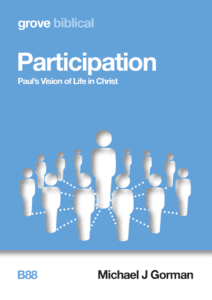
Michael Gorman’s Grove booklet on Participation (mentioned in the discussion) can be found here.
The gospel reading is the raising of Lazarus in John 11.1–45. The written commentary is here,
 Buy me a Coffee








So, is the contrast between living in Adam or in Christ (this seems to be what is said) — or as per the diagram shown, where the contrast is between living in Satan’s world versus living in Christ?
And the capital ‘S’ for sin is ‘the power over us’ – you seem to define it as ‘the power of the sinful human life’— and thus, it seems, follow Dougals Moo:
‘We should not conclude from this language that Paul views ‘sin’ as a personal power of some kind. He does not personalise sin, but he personifies it [e.g. you might call your car ‘Susan’] viewing the persistence of human sinning as a force that controls humans’: Douglas Moo, he Letter to the Romans (2d ed.; NICNT; Grand Rapids, Mich.: Eerdmans, 2018), 322.
Rather than what seems to be the consensus in the non-Confessional academy (public Universities) that Paul is referring to Satan, a concept which Moo denies throughout his Romans commentary.
But the concept of living in a ‘realm’ as you suggest, would seem to reflect Colossians 1:13, ‘He has delivered us from the domain of darkness and transferred us to the kingdom of his beloved Son’ — and give support to what the non-Confessional academy seems to be saying?
If so, ‘sarx’ can be safely read as ‘the world’ in these Romans 8 verses? That is, Satan’s world / realm (John 12:31)?
Once again, the Lectionary compiler has linked us
two passages, too my mind he is surly divinely inspired.
He cuts out the extraneous to concentrate on the specific similarities.
The word of his focus here, I believe, is the word “IF
“Lord IF you had been here”!
“Did I not say to you that,IF thou wouldest believe, thou shouldest see the glory of God?
[the pure in heart shall see [the Glory of] God]
Paul’s IF’S
8:9 But ye are not in the flesh, but in the Spirit IF so be that the Spirit of God dwell in you. Now if any man have not the Spirit of Christ, he is none of his.
8:10 And IF Christ be in you, the body is dead because of sin; but the Spirit is life because of righteousness.
8:11 BUT IF the Spirit of him that raised up Jesus from the dead dwell in you, he that raised up Christ from the dead shall also quicken your mortal bodies by his Spirit that dwelleth in you.
“christians“ are a rum lot, often rummer than ancient Israel at times. (Consider 1 COR.)
Consider the Carnal and the Spiritual mind.
The carnal mind is exemplified by social media;
Secular media’s set up a person (usually a politician
Faction or party)
A wolf call calls to the dogs of war;
Invariably the dogs turn on each other. Phil 3:2
Alas, some Christian blogs mimic this spirit.
The Gospel is jettisoned. “For to be carnally minded is death, but to be spiritually minded is life and peace”.—Romans 8:
However Rom 5:20 & 2 Cor 9:8 Rom 16:24 Shalom.
Meanwhile, for the 4th consecutive year, Bristol Cathedral hosts a meal implicitly validating Islam as an alternative path to truth and righteousness, and the Prime Minister does much the same in Westminster Hall.
https://www.youtube.com/watch?v=H0sutYjg1g8
It is paradoxical that people today presume to become critics of the Bible when it should really be the other way around.
There are textual critics who sort through the various ancient manuscripts of the Bible, trying to arrive at the original text; there are the “higher critics” who critique vocabularies and concepts, trying to show that the traditional authors did not actually write the books attributed to them; and then there are many other purely destructive critics who criticize the Bible’s miracles, morals, and everything else, hoping thereby to justify their rebellion against the Word.
But the Bible still stands! It stands in judgment on our lives and our subconscious motives.
It will have the final word when “the books [are] opened…and the dead [are] judged out of those things which were written in the books” (Revelation 20:12)
.{Note- I wonder if the books are those of the bible and how we measure up?}
It is far better to heed the constructive criticism of the Word now than to hear its condemnation” Prof. Henry M. Morris
Commenting on the Gospel passage and Mary and Martha
T. Austin – Sparks remarks
“the standard of life of the practical temperament is quick and direct returns. We must see something for our money very quickly! It is the business temperament, the temperament of commercial life. The things which govern this temperament are quick successes.
‘Success’ is the great word of the practical temperament. It is success that succeeds.
The successful are the idols of this particular kind of make-up.
There is not much sentiment here. These people cannot stop for sentiment.
Things that are not what they call practical are regarded by them as just ‘sentimental’. (Prosaic ?)
They are not so, of course, but that is how Martha reacted to Mary. Mary was not sentimental, but Martha thought she was, because Martha was so pre-eminently practical. Again, there is very little imagination in this make-up.
It rides roughshod over all sensibilities. It does not stop to think how people feel about what is said; it just goes right on.
And then it sometimes makes terrible mistakes – it confuses things. For instance, it mistakes inquisitiveness for depth, because it has always to be asking endless questions.
The ‘practical’ people are always asking questions, questions, questions; they keep you going with questions all the time, thinking that this is an evidence of spiritual depth.
They think that they are not just taking things at their surface value, they are being very practical, as well as deep. But there is a good deal of difference between inquisitiveness and depth. It is very possible to confuse things”.
I’m confused by your condemnation, it seems, at least of “textual critics”. The NT is rightly said to be the best attested collection of ancient texts. The reason it is that is because of the large number of ancient manuscripts we have, some closer to However, this is then the sting in the tail. These manuscripts do not agree with each other in every details. There are many variations. There are some significant ones, e.g. the woman caught in adultery in John, the ending of Mark. It is not clear to me why reasoning about the original wording is to be condemned. Surely that is a good thing – unless, of course, the best guess for a passage does not support one’s prior theological commitments.
Note that Paul explicitly says that the Holy Spirit is not a god, co-equal with the other two in Trinitarianism’s threesome. Rather (italics added):
‘[You who are born again] are not in the flesh but in [the] Spirit, if in fact God’s spirit dwells in you. Anyone who does not have Christ’s spirit does not belong to him. But if Christ is in you, although the body is dead because of sin, the Spirit is life because of righteousness. If the Spirit of him who raised Jesus from the dead dwells in you, he who raised the Christ from the dead will also give life to your mortal bodies through his Spirit who dwells in you.’
To be born again is to be in Christ, and Christ the Holy Spirit to be in you.
The Holy Spirit is not some alien being somewhere up there in heaven. He is the spirit whom the Father sent, so that we might be like his Son and adopted as his children.
‘… heirs of God and fellow heirs with Christ, provided we suffer with him in order that we may also be glorified with him.’
What do Muslims, or the priests of Bristol Cathedral, know of this?
‘Paul explicitly says that the Holy Spirit is not a god’ Huh?
God is in you if and only if Christ is in you if and only if the Spirit is in you. The Spirit is the Spirit of God and the Spirit of Jesus.
And Holy Spirit can be blasphemed.
And union in Christ, is Triunion. John 17.
Following the I am’s of Jesus, 7 rolled- out from “before Abraham was, I am.”
Jesus, the Shekhinah Glory, of God.
Ian, exactly so. The Spirit is not a third divine person/god, but the Spirit of God and the Spirit of (distinct from God) Jesus. Paul could hardly be clearer.
Indeed Steven. Paul was Trinitarian. Believe in the Trinity is not about believing there are three persons, in the usual sense—that is Tritheism, and Paul is a monotheist, as are all Trinitarians.