
Andrew Atherstone has continued the tradition of being the biographer of our archbishops. He published two on Justin Welby, and has brought his proficient pen to bear on Sarah Mullally, producing his volume in remarkably short time—from a standing start when her appointment was announced (October 3rd 2025) he has produced this biography in time for her enthronement in two weeks’ time [correction from first comment]. (In fact, the volume will only be out next Thursday; I was sent a pre-publication copy for review.)
There are three other things that are impressive in this volume. The most striking is the remarkable detail that has clearly gone into Atherstone’s research. The six chapters between them have 550 footnotes, and Andrew cites from Sarah’s own sermons, her blog, proceedings of Synod, and even PCC agendas and minutes from the 1980s and 90s. The record-keeping here is meticulous.
Despite this, it is very readable; the 160 pages only took me a couple of evenings. But the detail, clarity, and thoroughness create an interesting effect: it feels as though Atherstone is holding out information about Sarah with an open hand. In contrast to the other volume on Sarah Mullally, edited by Tim Wyatt, which almost appears to offer a progressive shopping list of what the authors want the Church to be, Andrew does not offer us speculation or evaluation. He offers us Sarah’s own words, and invites us to make our own judgement.
Sarah and I were born in the same year, and so the early chapters—about her coming to faith as a teenager, and church involvement whilst an undergraduate—felt very nostalgic to me. It was a world where the issues seemed simpler, faith was there to be grasped, and evangelicals in the Church of England had a robust confidence in what they believed and how they shared it.
I think this section will surprise many for whom this is an unknown world. Sarah came to faith in a clearly evangelical context, and continued in that as a student studying nursing, and in the early years of her professional life.
St John’s Woking, where she came to faith, was a thriving bastion of evangelical faith. Like other churches at the time, it ran regular ‘guest services’, invited evangelists to speak, and sent teams out to do mission weeks in other parishes.
Bowser [Sarah’s maiden name] was raised in a church environment of intense evangelistic fervour (p 11).
And Sarah appears to have owned this for herself, not least in becoming President of the Christian Union at the Polytechnic of the South Bank, where she studied nursing.
This background will inevitably draw comparisons with Justin Welby—but what is also striking in the early years is the major differences between them. Whereas Justin came from a privileged but deeply broken and dysfunctional family, Sarah is the opposite in every regard.
Her father Michael was an electrical engineer who trained as an apprentice, and her mother Ann was a hairdresser. When they moved to Woking, they stayed in the same house for 50 years, until their deaths, and this functioned as a beacon of stability for the children. With both sets of grandparents retiring to live close by, this was a happy and stable home environment.
Despite that, Sarah was always somewhat anxious and worried about failure, and that appears to have formed in her a serious work ethic; later in the book it is noted that she divides her day into 15-minute segments, to ensure she is always making good use of time.
And her dyslexia has made her cautious about speaking out without careful consideration of what she wants to say—a striking contrast to Justin’s habit of confident improvisation without thinking through the consequences.
The other striking contrast—perhaps shaped by these anxieties—is her commitment to consultation and team working.
Mullally observed that the best leaders were always ‘team players’ who empowered others. They could ‘see the whole picture’ and had the ability ‘to bring together people from diverse backgrounds to work together on a common concern…’ (p 46)
This again will be a refreshing contrast to Justin Welby, who was much more inclined to bring his own ‘genius’ to the table to effect change.
In the context of nursing, Atherstone cites a fascinating quotation:
She asserted that large organisations often suffered from ‘too many leaders and not enough leadership’ (p 47).
She has already commented about the Church of England that its organisation is far too complex, with too many separate silos. Given that the Church is half the size that it was 30 years ago, but still has the same number of bishops and archdeacons, it will be fascinating to see how this observations plays out.
Atherstone traces her rise through nursing management to become a surprising appointment as Chief Nursing Officer, and in doing so uncovers some surprises. It is not entirely clear that she is a good fit for the role; when she started, one commentator noted:
We need a risk-taker who can revitalise nursing’s sense of its own worth, mobilise its leaders, and instigate non-hierarchical, empowering processes that start to heal our internal divisions. (p 42)
By her own admission, Mullally is not much of a risk taker, and some reviews of her short tenure (of five years) were less than flattering. She demonstrated
‘lacklustre’ leadership…she ‘gave little colour to the role’ and had ‘failed to persuade many within the profession that she was pushing the nursing agenda forward’ (p 49).
On her departure, the role was cut in scope and responsibility—which was one of the things that encouraged her to move on. In fact, Atherstone notes, she has never stayed in any role for long; her six years in her incumbency in Sutton was the longest she had been in any job prior to being bishop of London.
What remains unclear during her time in nursing is what happened to her faith. The ‘evangelical fervour’ of her upbringing appears to have made a quiet departure. In Sutton, the language of ‘inclusive’ begins to dominate; she wanted to appoint a colleague with an ‘inclusive’ leadership style, and the tradition of the parish was to be ‘diverse’.
That is not to say that she does not speak about Jesus—quite the opposite. She says in a hypothetical letter to her teenage self that ‘your decision to follow Jesus is the best decision you will ever make’. There is a danger, she tells those in Salisbury Cathedral, that they think the building is what matters:
‘It is not the Cathedal which enables us to touch heaven’…but rather it is Jesus Christ who ‘brings the kingdom of heaven to touch us—let us hope we learn the same in the Church of England’ (p 73)
But it becomes clear what the content of that following has become.
If the kingdom of God is about peace, justice and love, about welcoming the stranger, caring for the poor and healing the sick—do we know what must be done to bring the kingdom of God to our community? (p 57).
And this is most clearly seen in her preaching whilst in Salisbury. Atherstone samples from her sermons during this period, and I have no reason to think this is not a fair summary. The gospel is about
inclusion not exclusion, dignity not denigration, empowerment rather than exploitation, and affirmation rather than marginalisation (p 83).
Atherstone notes several times that Mullally’s career in nursing and her ministry have run in parallel, which each affecting the other. But it feels much more that it is the social dimension of nursing that has shaped her ministry, so that she sees it almost exclusively in terms of its social impact. She does talk about ‘the difference faith makes in our life’ and the need to express that (p 85), but there appears to be little or no mention of the idea of repentance as part of the good news of Jesus, or the need for personal transformation—unless it is in these terms of inclusion. I was actually surprised to find how often she used this term, much more so that I have heard her use it in person in, for example, debates in Synod.
The other feature of her ministry is her lack of engagement in theology. The kingdom of God is, for her, primarily one of working things out in practice.
The attractional power of the Church is in its ‘practical actions in the world’ (p 86).
Jesus was not concerned with ‘rules and regulations’, only with the ‘values of the kingdom of God’ (ibid).
And she openly admits that she has little interest in theology itself. She notes that in Salisbury they realised over the three years that she was
more of Martha than a Mary. Whether it is from the sound of my feet down Rosemary Lane, my silhouette as I disappear across the close, or from the time that email was sent, I more naturally seek to do than to be (p 92).
As bishop of London, she has more than once claimed that ‘the Church of England has always been an intentionally broad church’. I was fascinated to pick up the phrase, since it is one which I had noticed, and written to her about. When I cited the numerous historical examples which demonstrated the opposite, she kindly noted that I clearly knew a lot about this (I really don’t think she was being sarcastic!).
But I honestly think that it is not possible to claim this if you know very much at all about either ecclesiology, or the history of the Church of England before about 1967. And even if you do think that we are (by accident or design) a ‘broad’ church, it is worth asking both whether that is an asset or a liability, and however broad it is, where are the boundaries? This arises not just from issues around canon law, and the obligations of clergy, but is also sharply raised by questions relating to safeguarding.
Two particular issues drew my attention in Atherstone’s description of her time in London—the longest she has stayed in any post.
The first is that she was a surprise appointment. It was leaked by the Telegraph (and has never been contradicted) that the four candidates were Christopher Cocksworth, bishop of Coventry, Graham Tomlin, area bishop of Kensington, Paula Vennells (Justin Welby’s preferred candidate), the now disgraced former leader of the Post Office, and Mullally.
The criteria for the appointment included ‘a generous and firm grasp of Christian orthodoxy’, ‘an able and rigorous theologian with outstanding communication skills’, and an inspiring preacher and teacher (p 116). Tomlin would certainly have ticked those boxes, as would Cocksworth. But by her own admission, these do not describe Mullally at all.
What has drawn people to her is her humanity, kindness, and commitment to due process, and this was seen as a clear contrast to her predecessor in London, Richard Chartres, who often operated with a patrician eccentricity.
The other contrast to Chartres immediately came in her appointments of suffragan bishops. Between 2018 and 2023, all four area episcopal posts fell vacant, and this was a perfect opportunity for Mullaly to shape the diocese according to her own agenda. Chartres had made nine appointments to these posts in his time in office; eight of those were white men, one exception being John Sentamu, who went on to be Archbishop of York.
By contrast, Mullally’s appointment two women, Joanne Grenfell and Emma Ineson, and two non-white men, Anderson Jeremiah and Lusa Nsenga Ngoy. With the high ethnic mix of London, this surely made sense.
Yet in doing so, she appointment in Jeremiah someone who wrote both the theological section of From Lament to Action, which asserts that the theological foundations of the Church of England are inherently racist, and the theological section of the Church Commissioners Oversight report, which says that the nineteenth-century mission movement was Afriphobic, and that we should be encouraging Africans to rediscover their ‘traditional religions.’ I understand that she appointed him against the advice of the consultation group—so in this case, her inclusive agenda won out over her commitment to due process.
Joanne Grenfell has now been appointment as diocesan in St Edmundsbury and Ipswich, and almost immediately has become a clear campaigner on the divisive issue of sexuality and marriage. She wrote to her diocese in February:
I hope that I have been appropriately clear about my own views. I believe that gay people should have the same opportunities as straight people to have their faithful, loving, and stable relationships blessed in church, and to know that the Church wants to support and celebrate the God-given love that is contained within their relationship.
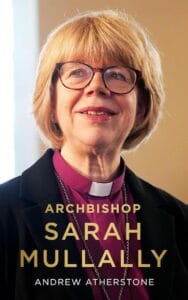 Andrew Atherstone has done us a great service in this readable, thorough, and fair account of Mullally. It very clearly raises the issues which will face us as a Church over the next six years.
Mullally has promised that she has no big ideas or creative schemes, in sharp contrast to Justin Welby. Unlike him, she is committed to following due process, working with others, and building teams.
But how will this sit with her ‘inclusive’ agenda, and commitment to a ‘broad’ Church? Is arguing that we can ‘agree to disagree’ going to be enough to hold us together?
And what will happen when due process and her inclusive agenda pull in opposite directions? Which will win out?
And how will we fare as a Church being lead by someone who is a doer not a thinker, who understands the Church and kingdom almost solely in terms of its action and not its theology?
Come back here in six years, and I will offer some reflections…!
 Buy me a Coffee

























The conscientiousness apparent in the division of a day into bite-sized periods is extremely heartening. There cannot be many who are equipped to perform the three great roles that she has been in, but any who do would need this work ethic – and recent Canterburies have all had that.
Re the Bp of St Edmundsbury’s statement: what someone’s ‘own view’ is is utterly irrelevant:
-First, the word ‘view’ is meaningless because it covers everything between selfish desire and hard-won research conclusion.
-Second, this shows a tendency to fall into the unexamined cliches and mantras of the day.
-And third, it does not matter what view you have but only where it comes in the scale of how well grounded it is in evidence and argumentation.
This is the giving of conclusions without showing working. Would that that were possible.
She knowingly chose as suffragan bishops a man who wants to encourage Africans to return to ‘traditional religions’ and a woman who believes that men can marry each other? Thank you Andrew; that is more than enough information to form an opinion not only of their faith, but hers.
Multiple millions of Africans have gratefully had their lives transformed by Christ. Compare the oppression of animism and witch doctors. A return to *what* is postulated?
Liberal Christianity gravitates to secularism. Not to sense.
Different systems will be more or less beneficial, and different worldviews will be more or less true whether or not they were first introduced by natives.
How on earth are people to introduce better lives and truer beliefs to anyone if they are not allowed access to them. That means that those who are in spiritual and material penury would have to stay that way. Boo to that.
And multiple millions have had their lives destroyed by Christian endeavours.
Wherever Christianity is now, it once was not. What do you think should have happened? The gospel should have been withheld? What would have been the ideal scenario? Africa is bursting with those who regret only that the gospel did not arrive there earlier. Secondly, do you agree with societies persisting with the witch doctors? And is that not worse than Christianity in your eyes, just different and equally good?
I don’t think we should have raped and pillaged and enslaved peoples in the name of Christ.
Where those things happened I don’t think they were done in the name of Christ.
Anthony
Of course they were. Colonising huge parts of the world and enslaving people weren’t incidental to Christianity, they were intrinsic to Christian conquest. Hence the need for reparative black, liberation, and decolonial theology.
What utter nonense, Penelope. Empires are founded by adventurers out to make their name and a fortune. God may use empires to spread his word, as he did the Roman Empire and the British Empire, and some Christians may recognise this in real time. But anybody who dares to say that they are conquering in the name of Christ, or worse still take slaves in the name of Christ, is going to have to answer to Him for that on the day of judgement, and the only answer acceptable is: “I was wrong and I repented of it.”
Please relate the theologies you name to the gospel.
Anthony
And what religion were those conquerors and in whose name were they conquering? You can’t absolve Christianity from its sins by pretending that’s not ‘real’ Christianity. Christians slaughtered Jews and Muslims and aboriginal heathens because they believed it was God’s will. Some still do. Cf. the US rhetoric around the war on Iran.
The idea is that the sexual revolution is the way to go, and that a retreat from Christianity is also the way to go for Africa?
I don’t know what kind of academic standing such a harmful perspective translates into, even if it comes from an atheist. From a Christian is another thing, from a Christian leader another again.
“I understand that she appointed him (Jeremiah) against the advice of the consultation group—so in this case, her inclusive agenda won out over her commitment to due process.”
This is the crux of the concern. A liberal-progressive leader is not an insurmountable problem if the institution’s check and balances (‘due process’) work as they should to restrain excesses or novelties in both the development and application of doctrine. This is, of course, just as true the other way round.
The bringing to a close of the PLF process, and the apparent shutting of the door of any further expansion to the blessings of Same-Sex relationships broadly or SSM specifically, does seem to to demonstrate that on this most divisive of issues, the Archbishop recognises which commitment is greater.
One of the weaknesses in our appointments system is the lack of consistent and mandatory process in the appointment of suffragans.
And, of course, the inevitable path that they follow towards being Diocesans ….
Tim,
It hasn’t worked that way for Rose Wilkin of Dover.
She was appointed suffragan by Justin Welby (when everybody thought she had retired) and set about making the place even more liberal, with a gay dean and ‘progressive’ female clergy in emptying churches.
She has been trying to drive out evangelicals from the Cathedral Chapter and aggressively pushed the LGBT cause.
Meanwhile the Cathedral has been hosting ‘silent discos’ and stupid graffiti displays that drew criticism from the Vice-President of the United States.
The number of children attending Canterbury diocese churches is les than half when she was started.
Rose has tried at least four times to become a diocesan but each time she has been turned down. They know what a calamity she is.
What a cocktail of multiple disgrace.
Well, criticism from Vance is a recommendation. I thought the display rather jejune, but its hardly a salvation issue.
You’re right, a clergyman in a same-sex relationship is, though.
I just love the way you present your particular views as ‘the truth’.
So everything is just as relative and unclear as everything else? And that stance is neither unnuanced nor totalitarian?
What a shame, Penelope, that the church misunderstood its scriptures for 2000 years and had to be corrected by the world.
Anthony
Well, according to the Reformers, it misunderstood them for 1500 years!
But that, of course, is not what I was saying.
Acording to the Reformers it withheld them from the people for 1000 years.
Anthony
Well, they would say that, wouldn’t they?
Great review, how do we understand what the Lord is saying to us, especially Evangelicals, in all this?
Just been reading JC Ryle’s ‘Five English Reformers’. Even at a space of 500 years (a short time) one thing is clear – it’s Acts all over again. We need to pray for a return to that level of commitment and love born of the the Holy Spirit. There is little ambition, zeal or obvious anointing among us, or willingness to bear the cost – something only God can give us.
It would be interesting to know, what motivations drew her into nursing, and how they are the same, similar or different from those which drew her into CoE ministry.
From this review it would appear that they are primarily social and at root, unchanged.
As far as the Public Sector roles are concerned, in the heirarchal multidisciplinary systems and structures, with Government priorities, where I’ve heard at a much lower level in NHS management, that unless set goals are reached, it would be career limiting it would be extremely difficult to form balanced conclusion, especially from those of us who have not experienced the structures and systems, imposed by changing Governments.
And as far as the discipline of nursing is concerned, there seemed to be something of a split, between, ‘upskilling’ to take on more medical roles, and the ingress of the social aspect of nursing being uppermost.
But, any of the posts she in habited would have to operate through, knowledge and training, including senior management training.
Maybe the higher, the less knowledge is needed!
It would be interesting if 36O degree assessments which were a large part of Senior management training, were to be available. As well as personality profiles, such as Myers-Briggswhich were flavour of the month for a period of time.
(Interestingly, I was informed by an independent senior management trainer, that personality types in NHS senior management, came within a narrow band of personality types. Not sure which came first, the types required, with appointment accordingly).
Put slightly differently, I’d agree that there is a difference between, leadership and management!
And the question is, can leadership be taught?
A friend’s brief opinion as Dean/ prof of Business Studies of a Russell Group University, was that although in the USA it was thought that leadership could be taught, he didn’t think that it could. Management, yes: leadership, no.
Similarlarly, there is a difference between research methodology and improvement methodology. But both require ‘disinterested’ evaluation.
In summary: it seems that just as in nursing she has embraced the social model, not the medical model, in the CoE she has embraced the social model, not the theological model.
And the appointment corroborates the model adopted by the appointees.
One more social charity, it seems.
She’s a product of the mess created by Justin Welby – even though he tried to push the cause of Paula Vennells, another woman of minimal theological education and limited pastoral experience.
Welby was absolutely smitten by the idea of corporate power, hence his advocacy of Vennells, a woman who oversaw the life-destroying prosecutions of many innocent sub-postmasters. She returned her CBE (given for what, exactly?) but kept the huge pay she received. That Welby championed such a person to be Bishop of London indicates the awful poverty of his judgment.
Thanks for this article, even if it leaves me rather nervous at what kind of leader she will be.
A big challenge will be this one you highlighted: “Given that the Church is half the size that it was 30 years ago, but still has the same number of bishops and archdeacons, it will be fascinating to see how this observations plays out.”
Just as the MOD has more admirals than ships (134 vs 60), the CofE has far too many senior clergy and dioceses. But how on earth will she get bishops to give up their jobs for the sake of the Church? Maybe she should set out a plan for the future so that some bishops know their diocese will be amalgamated with others when they retire (I am in the North West and we could easily amalgamate Manchester, Liverpool and Blackburn. Indeed, Liverpool is vacant now, so could be a starter for 10).
If she turns out to be theologically lightweight and a poor communicator, she may at least be a Martha who gets things done.
I will pray for her in full assurance that God can work wonders with those who are humbly led by Him.
Maybe start by merging suffragans when one falls vacant?
It’s not their positions falling vacant that bothers me. It is their falling -failing – in terms of theology, due process, canon law and, yes, even morality, that is of concern.
Yes, but maybe start with the smaller (by population) Dioceses? Sodor & Man with Carlisle, say? Or Hereford with Worcester? The first of these 2 pairs each has less people than some Deaneries (eg Hull).
The ‘courageous’ choice to create the super-diocese of Leeds was so protracted and painful that it’s put everyone off trying it anywhere else. But in the end it has to be the way to go.
It’s not just the number of Diocesan bishops, suffragans & archdeacons that’s the issue, it’s also the Diocesan offices & their ever-mushrooming staff (safeguarding/ comms/ diversity/ social media officers, green/ racial justice/ disability advisers, etc). All very important, but surely they could cover larger areas?
“With the high ethnic mix of London, this [diversity appointments] surely made sense.” We say things like this frequently, even though it seems to make little sense in a church where there is no more Greek or Jew, male or female. We reflexively adopt the zeitgeist that leadership, even ecclesiastical, must be carefully tailored to “look like us”. Furthermore, we (Christian or otherwise) undermine or own ideological tic by conspicuous exclusion: the implicit expectation that white males must have no objection ever to being governed by someone who does not “look like them”, whether at home in the majority or abroad in the minority. True diversity is a universal grace that has been bestowed by God (as Peter recognized); artificial imposition through human politics undercuts the concept of unity through Christ.
Evangelistically, I think it’s useful to have leaders from different backgrounds who more people can identify with more easily.
‘Diversity’ is a nonsense, because there are 1000s of ways in which people are diverse, but it is only the same two or three (gender, pigmentation and sexual yearnings) that are really meant, with (disability) in reserve as a punt to give the facade of mature acceptability.
2 or 3 out of 1000s is as un-diverse as you can get.
If you have 4 choices, 2 male and 2 female sounds fine. All either female or ethnic-minority is unrepresentative, because those are the ‘approved’ classes, and therefore to some extent privileged. To be representative is to give a majority of posts to any majority and a minority of posts to any minority. I now expect to receive a Nobel prize for stating the utterly obvious.
Good leadership involves courage. This is what is conspicuously lacking in Church of England, civil service and local government leadership and in Westminster, and sadly it shows.
Only if people are susceptible to peer pressure. Not everyone is.
(But of course, if they are, they are not leaders.)
In 2012 Sarah Mullally had this to say about abortion: “I would suspect that I would describe my approach to this issue as pro-choice rather than pro-life, although if it were a continuum I would be somewhere along it moving towards pro-life when it relates to my choice and then enabling choice when it related to others.”
1 Corinthians 14:8
Well, she did, compounding the shallowness (and, from a nursing/nurturing point of view, abominable nature) of this cliched, culture-bound, uncaring and superficial ‘stance’ by misspelling ‘pro-life’ as ‘pro-live’ (the very framing and polarisation of the way the debate is conceived here is just a swallowing whole of what society served up to her and to us).
However, since then she has said that she takes the view of the Anglican church. Thus prioritising some institutional statement over the killings of actual humans, the crown and glory of creation.
I don’t know that intellect is the first priority in a Christian leader, but you sure notice the difference when clever-but-not-the-cleverest take up the top positions.
I was in the Lords last night (7 remained in the gallery till 11pm), and how dire.
So there are 333 voters and almost no-one had the slightest awareness of the elephant in the room – ‘Bishops’ included, as though they have any authority to be treated as such – all thinking that killing the young up till 24 weeks was fine. The viability lie everywhere found its dupes. Philippa Stroud spoke beautifully – yet if you measure how compromised even she was, it was very.
So-called ‘abortion’ itself is illegal (with exceptions, including a weasel one), yet the headline was that its full-term variety is legal – or non-prosecutable if the mother is the perpetrator.
The Archbishop said she supported dropping the clause, yet agreed that a mother who killed full-term son or daughter should not be prosecuted. Is that not a self-contradiction?
She (she, at least) spoke of the fundamental value of each individual human life – would that more people had done. Her agreement with ’24 weeks’ belied that totally.
Sickness (partly as a result of neglect, lack of care, indulgence, blindness to what is precious and valuable) breaks out in Canterbury.
This is just a rehash of your unpleasant HIV myth. What makes the Meningitis outbreak due to neglect, lack of care, and indulgence?
It’s a double meaning, the meningitis reflecting the spiritual sickness. The virtually total lack of caring resides in not caring to protect the young from intimately kissing each other in a mass setting, never suggesting it could be dangerous, just like the results of divorcing sex from marriage, causes of HPV etc are unmentioned, because the lack of care, the neglect, is almost total.
People can get meningitis from sharing spaces and things like glasses and cutlery – which happens in the happiest of families.
Not that there’s anything wrong in kissing in nightclubs of course. It’s where the young go to meet partners, dance and have fun.
What a dangerous attitude which wilfully ignores that different actions have very different levels of risk. You know perfectly well that they do. Some actions are the main accelerators that transform a disease into an epidemic. If someone read your remark, they would be put at risk, just as the media by not being straight with the truth show their neglect for the lives of the young, neglect which in Christian circles would be far less likely.
The cynical sexual revolution, which thinks only of fodder and despises souls, strikes again. Unless people hear the lone voices.
What is dangerous? Since you are just as likely to catch an infection from a stranger on a crowded tube train or from a common communion cup, I can’t see the particular danger that nightclubs represent. Unless, you think kissing in nightclubs is particularly immoral (as opposed to kissing anywhere else, for example).
As a former nurse and a Chaplain, as well as an academic theologian and researcher, this appointment intrigues me. I enjoy the rigours of theology as much as the peace of presence, and I am certainly something of a “Martha” – although I prefer not to be. I am interested to see how things transpire – trusting always the ultimate head of the Church. I do share many of the new Archbishop’s expressed values about inclusivity (and do not equate them with putting safeguarding in peril, as seemed to be implied) – but then I have a gay Christian stepson and a transgender Christian elder child – both of whom find themselves unwelcome in some of the churches I preach at for some reason I fail to understand, whereas my daughter who has learning disabilities but sings like an angel is universally welcomed. Are the two others any less God’s creation or less “made in His likeness” for some reason? If so, I do not see it – but others do. My call, as a Chaplain, is to love every person I encounter as I am loved – no matter who they are – for God so loved the world that He sent His only Son. He did not come into the world to condemn the world, but that the whole world should be saved. While I regard conversion as God’s concern (so not within my power) I am called to witness to that most wonderful love that I know in my behaviour and in my attitude and attendance to others. I’m not a plaster cast saint. I get it wrong and like all of us there are just days when I “get out of bed on the wrong side” – then I picture Jesus, standing behind the other person, with his hand on their shoulder, looking me in the eye and reminding me, “I died for them too…” I do not know God’s mind, but in the thirty years I have seriously studied theology, God for me has simply become “more” – loving, awesome, glorious, personal, majestic, intimate, powerful. Whatever, and I am increasingly concerned by those who study theology or scripture in order to confirm what they already know (think about it) – because they confine God to a box which is not of His making – and it enables them to exclude others who do not fit into their box either. God is love, writes John – and I’m not sure that is love, are you?
Thanks for commenting.
I am quite surprised that you say you don’t understand why anyone has an issue with questions around gay and transgender identity. I have engaged with them quite a lot on this blog, though perhaps this is your first time here.
The consensus of the church catholic, in every age, every tradition, every branch, and every culture until very recently is that God created humanity in his image, male and female, and that marriage is therefore between one man and one woman.
To love is to will the best for the other, and the teaching of the Good Shepherd of our souls teaches us this pattern of life in relation to our bodies, our sexuality, and marriage. Why would we not teach others what he has taught us?
I am happy to suggest introductory reading if that would help—there are some good Grove booklets, some written by me, on the subject.
“He did not come into the world to condemn the world, but that the whole world should be saved – ” but you left out “THROUGH HIM” which implies what Jesus said was important, particularly about repentance and turning away from the ways of the world.
Thank you Lesley for your wonderful and helpful comment here. Note the immediate response is that even though you have studied theology for 30 years and have a Ph.D that you obviously can’t have studied it correctly else you would have come to a different conclusion!
Thank you for daring to say what so many have come to know Lesley, and for sharing your own situation as well as your own understanding. So refreshing.
And also that Ian’s own view and the Grove booklets are the only response to gender and sexuality ‘issues’. I think Ian’s beliefs on gender and those of the EA are not officially those of the CoE which recognises transgender persons, marries them and ordains them
Penny, odd that you project your view onto my comment.
I nowhere said that my responses were the only ones available. Lesley says he cannot understand the view that disagrees with his; I offered to point his to some reading.
The C of E does not have a coherent view of trans issues.
Lesley is a woman.
It is your view that the CoE does not have a coherent view on transgender people. Just that. A view. The Church marries and ordains trans people. That, to me, is quite a coherent view.
I have not yet met a bishop who can tell me the sex of someone who calls themselves a ‘trans woman’. That failing is incoherent.
I’m sure they can. A trans woman is a woman.
Nope. A ‘trans woman’ is a biological male, whose bodily sex identity is unchanged by surgery and hormone treatment.
Repeating ideological mantras like this does not change reality.
Pray tell me what a ‘biological’ male’ is while we’re dealing with ideology.
Wow, Penny—you don’t know what a biological male is…? I can see why you have problems!
It is the parroting of a Zeitgeist-birthed, highly time specific and culture specific mantra, and you never said it before the Zeitgeist told you to. It is especially full of vocabulary and illogical leaps that many can make no sense of (while those who say they can show little evidence of thought, only of inability not to conform to Zeitgeist). Which is probably why the sentiments of this mantra were not the sort of thing that occurred to most people and times in history at all. In ours they are all of a sudden front and centre – a suspicious discontinuity- because when there is an obvious untruth that you desperately want to sell as a truth, the only thing to do is to repeat it relentlessly. Whereas if there were any truth in it, it would not need to be repeated at all, because people would agree with it.
I don’t have problems Ian. You seem to. Because you cannot give me a definition of a biological male (or female) which would cover all males (or females).
Christopher
Um … did you see my response (made many times before) that it has nothing to do with the Zeitgeist. Trans people have been around in most cultures, in most eras.
Do you think I don’t know you asserted that? – but you must be an unusual individual if assertion confers truth.
What you could not grasp is that the point concerned which things were part of the Zeitgeist (i.e. topical), not which things existed.
And in any case, things that are ill-defined can neither exist nor fail to exist until they are better defined.
Even when they are defined, the question will arise whether the entities defined have ever been instantiated.
You must know that the following has been endlessly repeated: There is this odd plea ‘You are denying my existence’, which has three obvious answers: (a) ‘However many people are standing here, not a single one will not affirm your existence, and what is more, you know it.’; (b) ‘Why did you confuse existence with self-description, which is not even close to being the same thing?’; (c) ‘Why did you try and force people to agree that every self-description ever given must be accurate, when everyone knows to what high degree that is nonsense?’.
Christopher
It may surprise you to learn that people don’t disappear from the pages of history simply because you don’t believe in them
So far your intelligence has coped with zero of the points a, b, c. Worse, it has not even addressed any of them. I have heard it is capable of more.
Penny,
There is no such thing as “transgender persons”, there are just men and women with gender dysphoria, the strong desire to be something that they are not. A man who thinks he’s a woman or pretends to be one is still a man, even if he puts on women’s clothing and calls himself ‘Rachel’ or ‘Susannah’ or whatever. It’s a mental condition, not a physical fact.
And it’s always blokes claiming they are women, as well. I have never met a woman who claims she’s a man (I know some exist, but not yet in the ranks of the C of E or on General Synod), although I have come across a couple of unhappy teenage girls who say they are ‘non-binary’, an absurd expression which even they don’t understand. They’re still girls.
You really should widen your acquaintance then James, especially amongst your fellow clergy.
Oh, Penny – you are ever helpful with social advice, as well as advice on how to improve my education! But I have to say I have never knowingly met a “trans man” (a woman with gender dysphoria); although I know they exist, they are far outnumbered by men with gender dysphoria. Over the years I have met the occasional ‘butch lesbian’, as the expression goes, but none of them has ever claimed to be a male, and quite rightly so. And I’ve come across a few gender-dysphoric men (and known two, slightly), but never a gender-dysphoric woman. Women’s bodies always tell them otherwise.
And it’s easy to see why “transmen” are so rare. A cross-dressing woman is no danger to men; she is considered at best as strange and in need to help, at worst in physical danger herself. Like ‘transgenderism’, homosexuality is much more a male phenomenon than a female (probably 70:30), another indication to me that paraphilia is primarily a developmental failure among males to acquire a secure male identity.
You probably wouldn’t know. Despite the prejudice evinced by most GCs, you can’t always tell!
PCD (sometimes) writes as if mantras were arguments!
Worse, she gives no consideration to the fact that bald shutdown assertions are so desperate to shut things down for the very reason that they would not be able to face comeback.
And worst of all, the particular mantra that she espouses (t.w.a.w.) is, by complete coincidence, entirely in step with the Zeitgeist of this tiny period of history. Which is a good example of the obedient Zeitgeist conformity that I have always noted to be the chief nature of liberalism.
Christopher
It’s not a mantra. And, as I have pointed out before, this has absolutely nothing to do with the zeitgeist, trans people have always existed, in many cultures and across many eras.
James bald assertion that trans women are men is much more truly an ideological statement (in addition to being untrue and inflammatory).
The number of times PCD cannot address or seemingly understand the difference between existence and self-description is an index of her prowess.
Do you honestly think that people *did not know* that people who understood or described themselves thus (although in different socially constructed variants) have existed in many times and places? Honestly.
Their self-description is infallible, right? (‘The New Fundamentalism.’)
And people who have undergone surgery are exactly the same as people who have ended up with a particular self perception, right?
And that claimed self perception is no way affected by cultural fashions, right?
Andrew, you seem to be reading your own view into my response. That is not what I said.
Ian you could not even discern that Lesley is female – you refer to her as being male twice in your comment above to Penny. I doubt you fully read Lesley’s very helpful and observant comment fully.
Andrew, there is nothing in the comment to tell me what sex Lesley is.
And if you are judging from appearances in the photograph, that is very sexist and stereotyping of you.
I make no such presumption.
You presumed it was a he! What is that if not presumption.
And as Lesley is open enough to give her name it isn’t exactly hard to check.
Ian
There is. The spelling of her name.
And her Facebook page.
Also Ian what she said she didn’t understand was the ‘*unwelcome* in some of the churches’ experienced by her family members (my emphasis but clearly her intention). Is there a Grove booklet that addresses *this* issue?
Lesley: St John does say ‘God is love’ (1 Jn 4.8). He also says, ‘God is light’ (1 Jn 1.5). Do you know how to hold these two truths together?
To be love means to will the good of the other.
To be light means to expose evil and error (John 3.19-22).
The task of Christian theology is to hold together all the teachings of the Bible together as a coherent whole, not as an antagonistic conflict.
In all the time you have studied theology, has God become more *holy to you? Is He King as well as friend? Is He Judge as well as sin-bearer? Is He Law-giver as well as pardoner?
True Christianity is not a smorgasbord in which we choose the dishes we like and pass over the ones we haven’t developed a taste for.
To affirm with St John that God is love and God is light means that He loves us so much and so wisely (as a Father to His children) that He does not want darkness to remain within us.
Good point david…i think its interesting what bits of scripture we choose or leave out or edit, to suit our thinking.
We all know what bad leadership looks like from life experiences.
What is good leadership?
For Christ it was as a man “under authority” hence he could
speak with authority and not as the Scribes, which drew and inspired followers, and give them authority to deal with unclean spirits.
Not complete and effective in ministry until being “endued with power” and “ given utterance”.
Exemplified, by Paul who asked for prayers of the church “that utterance might be given to him to boldly preach the Gospel as he ought i.e. to proclaim the unsearchable riches of Christ.
May God grant the AB of C such mercy and grace to
comfort His saints that we may “walk in all the comfort
{strength} of the Holy Spirit” and to pray for godly leadership
2 Cor 1:11 – Philippians 1:19 – 1 Thessalonians 5:25
As an aid to such perhaps see:-
https://quarterdeck.co.uk/articles/leadership-quotes-godly/
Shalom.
It is curious that individuals that start out with a strong evangelical ethos and faith, often tend to lose much of this when they enter high office in the Church of England.
It never seems to be the other way round.
This is what I mean by peer pressure. The deeper into the institution, the more the ‘pull’ to kowtow to it, as it is providing your daily bread.
Thus – listen to those who have no paymasters.
And the trouble with an Established Church in which the King isn’t really a Christian and none of the Royal Family makes any pretence to be one, and neither is the nation Christian, is that the Established Church, in order to maintain a facade of ‘relevance’, must quietly ditch the Gospel and its call to repentance and faith in Christ, and replace it with a benign moralism about being a ‘good person’ – whatever that means. Usually a diffuse kind of Pelagianism that avoids anything remotely contentious, like abortion.
That’s why Sarah Mullaly, never one much for theology, looks to the NHS moralistic ethos for her guiding star – nothing deeper than the BBC’s Children in Need (but without Jimmy Saville, I hope).
Did she Chris? Sometimes what is hidden in the term evangelical is a strong works based salvation, theology.
Is not her belief expressed in what she considers to be the Kingdom of God, which is not the evangelical position.
The kingdom of God can be brought about seemlessly on a spectrum from nursing, Public Sector career, to CoE career with little, if any, discernable, notable, difference merely a change in institutions.
That is a reply to Chris Bishop, not Shell.
I don’t know Geoff. the article does not give a great amount of detail about her early christian experience. I know that St John’s Woking has (or had) a strong evangelical fervour (I lived in Woking once many years ago, and knew of many of the churches round there). Clearly, a deep theological reflection had never been a strong point with her.
Chris Bishop: that sounds about right to me. Thriving evangelical churches with good youth work are a magnet for young people who enjoy the fellowship without bothering much about the theology. From this account, she sounds pretty superficial theologically to me (but so was Welby!) and shaped much more by the ethos of the NHS than the BCP. Thr samples of her preaching given above reflect the cliches of secular care and managerialism, no more Christian than Oxfam.
Her own theological training was only a thin part-time course. A preacher who doesn’t care much for theology can only care for institutions and moralism – and that is a long way short of understanding the sacred nature of the Church and the true character of Christian ethics. Her grasp of the ethics of abortion is shockingly poor.
And then there is that little business of her safeguarding failures …
Antinomianism and Libertinism are two of the most plausible and recurrent degradations of Evanglicalism when it becomes divorced from rigorous Biblicism.
Even as, on the other hand, formalism and ritualism are to the High view of the Sacrament.
The doctrine of salvation by grace alone through faith can so very easily be distorted to suggest that moral law is of secondary importance. Then it becomes culturally specific. Eventually it so easily becomes irrelevant to the believer’s life.
Imagine a senior cleric, so deep in the world, called to such a high eminence, under such pressure to resolve issues so that no party is offended.
How heavy must he temptation be to say “Peace, peace; when there is no peace.”
I can very easily see how the temptation would come about.
Archbishop Sarah has my pity and my prayers.
Synodical government has made this denomination just another form of politics.
It has become all about pleasing different sides, compromising so that everyone gets some of what they ‘want’. As though a perspective that centralises what we ‘want’ were anything other than the enemy of the perspective that centralises what God wants. Now the Catholics are making the same synodical mistake.
There is nothing wrong with Synods in theory and everything right in calling on the expertise of masses of people; but in practice, things end up getting political and that is the death-knell.
I would suggest it often happens to many who become Christian during their university years or at that age. How many of those still hold evangelical views 20 or 30 years later?
There is always a degree of gravitating to whatever ‘style’ reflects your psyche at the particular age you are. I have never been a fan of that, because segregating the ages is precisely the problem, and in a healthy family setting they are all together.
Perhaps they just mature and realise that the evangelical approach doesn’t really work once you actually properly grow up?
So, let me get this straight Andrew: you are mature and grown up, and I am a naive stupid infant? Inclusion and good disagreement anyone?
The only other problem with your claim is that your so-called immature approach is just about the only one that sees people come to a living faith in Jesus.
Actually I do find your reply remarkably immature. But you missed the point. People mature all the time. But the The evangelical approach doesn’t. The worship is generally rather trite. It doesn’t generally allow for any disagreement. And it’s not good at living with questions that can’t be answered.
Andrew, what a patronising and insulting assessment. I do find it fascinating how exclusive and intolerant ‘inclusive’ liberals like you are in practice.
Andrew G:
Liberalism is a good way of leaving Christianity or not bothering to commit oneself. Liberalism works like this:
“Traditional Christianity expressed in the Creeds makes a lot of strong claims about God, Jesus, human beings and our destiny.
It promises a lot – an eternity of bliss – but it makes a lot of demands upon you and can be very hard to live up to.
It often conflicts with people’s sexual desires or their wish to find fulfilment in other ways.
A lot of its truth claims are miracle-based and seem hard to square with what we believe about science. It seems impossible to prove its truth claims.
A lot in the Bible looks morally doubtful, to say the least.
Also, there are a lot of other different religions in the world making counter-claims, and many of the adherents of these religions can look like nice people Who is to say they are wrong?”
These are (among others) the ‘difficult questions’ that Andrew Godsall refers to. How do we deal with these ‘difficult questions’ as people who are ‘maturing’? There are two basic ways of resolving the conflict.
1. ‘Maturity’ means going *deeper into Christian orthodoxy, without ever losing your grasp of fundamentals – in an analogous way that a young person with a good grasp of algebra may realise that Calculus is simply (!) the application of algebra to the problem of infinitesimal limits (like the area under a curve or the rate of acceleration at a precise moment) – something that Archimedes intuitively grasped c. 250 BC but didn’t know how to do (the Greeks didn’t have algebra), and we would have to wait about 1900 years until Newton and Leibniz discovered how to do it. Nothing in calculus contradicts arithmetic. But you have to pay attention for a long time and be reasonably smart, and most kids won’t get there. They are happy to keep playing their MP3 files without any idea that it took the discovery of calculus to make that and many other things of modern life possible.
It’s the same with orthodox catholic and evangelical belief about the Bible and Creeds. There are answers to the questions – if you are patient and smart enough to work them through. (That’s why bishops really should be smart teachers who know the faith deeply, not just pleasant administrators.)
Or you can take the Liberal Option;
2. “‘Maturity’ means understanding that Christian orthodoxy was a good but off-centre attempt to understand God and the mystery of human existence. We can affirm the parts in it that agree with our contemporary reason and our sense of right and wrong, while correcting the parts that conflict with the progress of the human spirit. Some people will be more conservative than others in this project and will hang on to traditional language and some traditional ideas, but in the end they will probably come round to the progressive viewpoint.
In the end we will likely ditch the myth of Christian distinctiveness (and the uniqueness of Christ) and arrive at a more enlightened kind of monotheism based on an ethic of universal love and salvation. We can call this (if you like) ‘the Abrahamic religion’, binding Christian, Jew and Muslim together’. We can even have an Iftihar in Bristol Cathredral to show how this idea pans out.”
This second idea of ‘maturity’ is the fruition of the kind of liberalism that Andrew espouses.
Andrew is right on one point: modern worship words are very unskilfully written a lot of the time, even primary school level, being written by music specialists. This represents a philistine dereliction of a glorious poetic heritage. It also makes it impossible to worship to them, unlike the scripture in song types. A lot of the charismatic evangelical decline I would associate with this forcing everyone to sing doggerel and to pretend they were deeply moved by it. Andrew’s view of ‘maturity’ (which looks compromised, conformist, and ineffective and lacking in power) seems the same as his namesake’s in The Magician’s Nephew, an individual whom no doubt he would otherwise repudiate.
High Anglicans and modern charismatics have something unlikely in common: they both confuse the emotional with the spiritual in worship. Highs suppose that being deeply moved by Bach chorales and Mozart’s Requiem is an experience of God; charismatics suppose that being deeply moved by ecstatic worship with simple words and weak tunes gives an experience of God. Both are incorrect. Charismatics also extend the confusion beyond worship, and Highs are (unlike me) in practice cessationists concerning the gifts of the Spirit.
Music combined with words is rightly seen to go beyond words alone and is superior to words alone. Anthony is correct that people confuse ‘mystery per se’ with ‘the specific mystery that is God’. At its worst, this involves saying ‘it was impenetrable, therefore it must be God’.
If Andrew thinks that many modern worship songs are unskilfully written with inferior music, I can only agree. I have been making this complaint for at least ten years and can’t bring myself to sing doggerel.
I suspect this view is held by a lot of people, especially when they get the chance to sing an intelligent hymn that engages their minds, emotions and aesthetic sense.
Yes Chris. We can only go on what is presented, and from the review it is not a definition nor description of the Kingdom of God that MLJ would accept nor recognize as evangelical it seems from his book and sermons. Social ‘gospel’ yes, Good News in Jesus, no.
In short summary, John Stott saw the Kingdom of God, as God’s reign and authority. Is it more likely than not that Stott would have been of substantial influence in any CoE evangelical church, of that time?
and yet Stott largely rejected God’s gifting to His people, except of course teaching. I thought that was a real shame and a disservice to the church. The gifts are one of the key ways God demonstrates His reign and authority.
He saw:
what kind of context they were associated with and originating from.
The idea of prophecy is a red rag to those who want to show off and/or be unaccountable. Are records of reliability even kept?
Paul in 1 Cor at great length is relegating the relative significance of unidentified speech talk, and also banning its uninterpreted or multiple public airing.
And never mentions it in his many other letters. He mentions it only to relegate it.
It is not associated with the mature, quite the reverse; the self-possessed are far from it and the dissociative near to it.
Whereas outpouring to God from the heart without being shackled by artificial conventional words is very good. In a public setting this would be adulterated and seems showy-offy – one edifies oneself but de-edifies others.
Michael Green thought absolutely tons of things could be spiritual gifts, and none of the lists is comprehensive.
Because JS was formed in a setting that emphasised character, he could immediately apply the character test and see all these things, which I have never understood why so many do not view as obvious.
I completely disagree.
The argument that as Paul referred to gifts in only one letter therefore they cannot be of much importance is a poor argument. I am surprised you are making it. They are so unimportant that Paul can say ‘ you should desire the gifts, especially prophecy.’
‘It is not associated with the mature, quite the reverse; the self-possessed are far from it and the dissociative near to it.’
Either you have contradicted yourself in your own comment, or you believe the likes of Michael Green was ‘immature’ as he clearly endorsed the use of the gifts in the church.
It is obvious in his letter Paul’s concern was not the gifts but how that particular church was exercising them. It was about order. Hence his specific instructions. He viewed the main purpose of the gifts was to build up and encourage the church. Hardly unimportant to Paul or God who gives them.
I didn’t mention ‘the gifts’ apart from to say how large is the number of those we should endorse. My specific points about prophecy needing checks and accountability, and about unintelligible public verbiage being fraught with problems and associated with immaturity are precisely some of the main points made in the NT.
The thing he referred to in one letter was glossai not gifts.
There were others such as Michael Green and David Watson, who’s influence was more than local and would not have recognized Mullally’s description of the Kingdom of God.
While there is a depth of teaching on how to be a Christian influence, distinctive, presence, in the world place, it would be interesting to know of her contribution.
For depth read dearth.
I wondered what on epth you meant.
It’s quite a relief that SM’s expectations of her time in office are fairly low. I like the idea of having a quiet AofC for a while, after the feverish/anxious leadership of JW. It was exhausting just watching him get by. Of course no leadership is neutral, she will leave a legacy of some kind. Perhaps the higher stakes issue is who is appointed as Bp of London. The potential for division is huge as is the risk to losing missional energy in a growing diocese. I assume there will be a new Bishop of Islington at some point too.
Yes I agree on that.
And yes the London appointment will be key.
Islington will not be filled.
They could scarcely do better than stick with the present interim, whereas Southwark will hope for someone like Edmonton, maybe next time round (if the denomination is intact by then).
I’m pleased to hear that Islington won’t be filled – I never understood what the point of that post was.
Then there is the fact that a bishop (episkopos) is to be, as St Paul wrote, a man of one woman who must run HIS family well (1 Timothy 3:2-4); and that earlier in the same letter (2:11-14), Paul wrote,
A woman should learn in quietness and full submission; I do not permit a woman to teach or assume authority over a man; she must be quiet. For Adam was formed first, then Eve. And Adam was not the one deceived; it was the woman who was deceived and became a sinner.
Verse 11, when read with verse 12, means that a woman should not challenge the authority of the teacher. The Greek word for ‘quiet’ in these verses does not mean totally silent. A woman who disagrees with a teaching is free to say so provided that she maintains an attitude of respect to the (male) teacher. Next, verse 12 states that Paul, who was writing under the inspiration of the Holy Spirit, does not permit a woman to teach, in mixed gatherings at least. In the apostolic church, ‘teach’ meant ‘teach scripture’. The reason Paul gives shows that this is a general prohibition, for Paul cites the situation between the first couple. In Genesis 3, Satan singled out Eve to deceive, for Adam could have retorted “God himself told me not to eat from that tree” whereas Eve would have been wondering who the serpent was and whether she had remembered correctly what Adam had passed on from God. Instead of consulting Adam, she distorts the divine command and leads Adam – who should have known better – to break it. Independence from God began with these events. God’s resulting curse on Eve and womanhood includes this (Genesis 3:16): “You will desire-your-way [tshuqah in Hebrew] with your husband, but he will master [mashal] you.” The same construction appears shortly after in Genesis 4:7 when God says to Cain, “Sin desires-its-way [tshuqah] with you, but you must master [mashal] it.” So this much mistranslated phrase means that the woman will desire to dominate the man, but will not succeed. The Fall is the start of the unhappy ‘battle of the sexes’ in which woman undermines man and man bullies woman.
Men from a New Age/pagan background tend to convert wholeheartedly or not at all, whereas women are more likely to seek accommodation and pollute the church with syncretism. That is why they are not to teach in the church. In the Mind of Anglicans 2002 survey, 2/3 of female Church of England ordained priests who replied to a questionnaire did not believe without question in Christ’s virgin birth, 25% more than for men.
The apostle Peter recognises the same point as Paul when he says that a woman who comes to faith is not to win her husband to Christ by instruction but by showing him greater love, of which she becomes capable (1 Peter 3:1). Women are free, of course, to take part in the discussions of scripture that follow a teaching.
The question of women speaking has nothing to do with whether a service is taking place. The idea of a service stems from liturgy, which is not in the Bible but was introduced into meetings partly for pedagogical reasons. In a meeting in somebody’s home with no liturgy, there is not a clear boundary between social talk and talk for Christian purposes. It would make no sense that women must fall silent as soon as they enter someone else’s home, or even a room in their own home. Holy Communion was taken in home meetings according to Acts 2:46; imagine a meal at which half the people around the table may not give their testimonies, or say a word even with their husbands present! The boundary *is* clear, in contrast, between Bible teaching and other Christian speaking, such as prophecy. If women must be totally silent in church assemblies then this passage wouild be in contradiction with 1 Corinthians 11:5 about women praying and prophesying in gatherings that are evidently mixed. Female prophets are mentioned in Acts 21:9, moreover.
Admittedly the word episkopos has mutated from its New Testament meaning of ‘overseer’ in which there were several in a congreation, to one man overseeing multiple congregations; but the principle of oversight remains clear, and masculine. So Sarah Mullally should not be in this position.
Our blog host Ian has described exegesis that prohibits female church leadership/oversight on the basis of these verses as ‘wooden literalism’, and referred us to his blog essay on 1 Timothy 2. But similar wooden literalism guides him in his view of homosexual church leadership,and I found no exegesis of 1 Timothy 2 in his essay about the chapter published on June 18, 2018, but rather a series of quotes highlighting obnoxious misogyny in the writings of certain Church Fathers and other exegetes. What is wrong with my exegesis above, please, Ian?
Paul did not write 1 Tim.
If Paul was opposed to women leading what on earth was he doing with Prisca, Phoebe, Junia, Lydia, Mary, Tryphaena, Tryphosa, and Persis?
Yes – though is ‘leading’/’leadership’ a NT category?
Leadership language doesn’t, I think, deserve the hegemony of discourse about Christian ministry which it sometimes receives. I remember an ordination where the only description used to elucidate the offices which the ordinands were entering was that of ‘leader’. Teacher, shepherd, sacramental symbol, servant etc. were all sidelined.
But, how should Kuberneesis (I Cor 12) and Heegeomai (Heb 13) be rendered? Does the presence of these words in the NT validate some aspects of our focus on ‘Leadership’?
Yes, I think so, provided we don’t see through modern eyes.
You say that Paul did not write 1 Timothy because you have no commitment to the accuracy of the scriptures and because you trust theologians who prefer to doubt the accuracy of scripture than do a little work so as to dispel the difficulties.
The women you name were in servant roles within the church to their apostolic husbands or to the overseers/episkopoi, the latter role being acknowledged and called Diakonis (deacon). Women may be prophetesses, as is clear from the NT, and may speak prophetic words which are then to be evaluated by other prophets/prophetesses as stated in 1 Corinthians 14.
According to the letters to Timothy and Titus, Paul has visited Crete and has visited Nicopolis, visits he never made in Acts, which closes with Paul awaiting trial and possible execution. Moreover: Timothy is now in Ephesus, having been left in Asia; Demas has deserted from Rome although in Acts he was somewhere else; Mark is in Asia, Tychicus in Ephesus and Luke with Paul in prison in Rome. These letters to Timothy and Titus are also different in style. And the churches already have episkopoi and teachers who are paid.
In Acts and his letters to congregations, Paul made clear that he expected to make further missionary journeys, despite his capture and impending trial. He wished to evangelise the Western Mediterranean, including Spain. We are told by Eusebius, by Clement, by John Chrysostom and by Jerome that Paul made further missionary journeys having been acquitted and released after Acts; two of these four early churchmen (Clement, Chrysostom) affirm that Paul reached Spain. But after that the persecution under Nero caught up with Paul and he was beheaded.
The discrepancies you use to disparage holy scripture have been known for centuries and what I am saying is nothing new. It is doubt among peole who call themselves Christian that is new. You can read the history of the early church, including Acts and the Letters written out, in a timeline in the interesting book The Untold story of the New Testament church by Frank Viola (2025).
So Paul wrote to Timothy and Titus well after Acts, and this explains the discrepancies. As for style, he had matured; also the letters were to individuals, rather than to be read out to congregations.
Goodness gracious! You are shocked that Paul didn’t write the Pastorals and then play fast and loose with the texts by claiming that women leaders and deacons were servants to their ‘husbands’. Phoebe’s husband, if she had one, is never mentioned. She is a deacon and Paul’s patron, so clearly above him in some sense. Prisca always precedes her husband which indicates her seniority or importance. She also taught Apollos.
Acts is not entirely historical and, in any case, is, like the Pastorals, written long after Paul’s death (probably in Rome, but he may have travelled to Spain).
I don’t know why you disparage theologians. Paul was one, as was the writer of Acts, and the Church Fathers whom you mention. And, in any case, it is biblical scholars, not theologians who present evidence for the dating of the NT, the presence of pseudepigrapha, etc. Nor do their conclusions undermine the ‘accuracy’ of scripture. Indeed, they make the study of the NT more enchanting and engaging. You should try reading some reputable biblical scholarship.
Acts is not entirely historical and, in any case, is, like the Pastorals, written long after Paul’s death… You should try reading some reputable biblical scholarship.
Name whom you consider some reputable biblical scholars.
I have no idea what parts of the New Testament you believe and don’t, or why. Why should anybody consider you a Christian?
Dear Anthony, re your last question, no, we are not supposed to do personal attacks on this blog.
Anthony
James Dunn
Raymond Brown
Margaret Mitchell
Richard Bauckham
Douglas Campbell
Dale Martin
Jonathan Tallon
Ian Paul
David Horrell
Louise Lawrence
Tom Wright
Zetterholm
Seyoon Kim
Cranfield
Fee
Justin Meggitt
Eddie Adams
Luke Timothy Johnson
Dodd
Knox
Sowers
Lincoln Blumell
Aaron Higashi
Hugo Mendez
I’ve probably left a few out. And that’s only the NT. Not the HB.
The early church certainly thought the Pastoral Epistles were Pauline.
We know Paul’s life and ministry didn’t end with the last verse of Acts in AD 62.
How you write to an individual leader (with or without an amanuensis) is likely to be different how you write to a congregation. Stylometrics only gets you so far. Lutheran Protestantism starts with the idea of ‘the true Paul’ found in Romans and Galatians and judges everything as true or false according to that litmus test. Not a good procedure, as my patron St James would agree. Which is why I’m not a Lutheran.
Dear Jamie Wood,
I asked a question rather than making an assertion, and in any case this is not your blog. If Ian wishes to rebuke me then I’ll heed him.
Paul’s mission may have ended much earlier than 62CE. Depends if you rely on the timeline of the Letters or of Acts. The language of the Pastorals is quite different from the genuine Pauline epistles. And much of the NT is pseudepigraphal.
Penny, it is very strange that you dish out patronising comments to others about their need to ‘widen their reading’—whilst yourself demonstrating your lack of breadth and understanding of NT scholarship.
You parrot as fact theories about the NT from 80 years ago as if there has been no scholarship since then, and ignore the mountain of scholarship which undermines the position you take.
It’s odd, and doesn’t sit well here. At the very least you need to apply the same standard to yourself as you apply to others: widen your reading. And bring it up to date.
Yes Penelope, the style is different – because Paul was considerably older and because he was writing to an individual, not a letter to be read out to congregations. Why do you find this explanation unsatisfactory?
Anthony: Penelope finds that answer unsatisfactory because the Pastorals say a lot of things that she doesn’t like, and neither did Schuessler-Fiorenza with her imaginary history. So out they must go!
And because some late 18th century and 19th century German Lutherans, influenced by Rationalism and later Hegelianism, devised a (for them) canonical understanding of “Pauline Theology” based on Romans and Galatians and anything that didn’t fit this cookie cutter couldn’t be Pauline. So out they must go!
For feminist theologians, the important thing is not what the first century was actually like but what it *should have been.
So “re-imagining” the past is more important than what actually happened.
Anthony: the 19th century Lutheran radicals in Tuebingen weren’t interested in feminist questions. But they discerned in the Pastoral Epistles worrying signs of ‘Fruehkatholizismus’ which was a declension from the pure Pauline faith of Romans and Galatians, so evidently they could not – must not – be by Paul.
The ‘Kulturkampf’ between Lutherans and Catholics was also underway in the unifying Germany of the 19th century, and they wouldn’t brook any of that Catholic stuff in the Pastorals about the Church as ‘the bulwark of truth’.
Thank you James. Lutherans have often tended to think that Paul wrote the Epistle to the Romans to the mediaeval Catholic church, as I recall.
Ian
I’m not being in the least patronising. Few mainstream scholars (apart from conservative evangelicals) believe that Paul was the author of the Pastorals. Anthony seems to believe that he wrote them as an old man. He would have to have been extremely aged considering their probable date, and by tradition, he was martyred before old age.
Anthony amd James also seem to believe that my views are novel and entirely my own (although James also thinks I am unduly influenced by Campbell). My views on the probable dating of Paul go back to Knox. But they are both, of course, ignoring my long, but not exhaustive, list of NT scholars because it doesn’t suit their ideologies.
And if you want to police people’s sneering perhaps you might remark on Anthony’s personal comment about me.
Well, Tom Wright and those who agree with him see the Pastorals as Pauline.
But that is not really the point. You repeatedly assert your views as ‘the truth’ and as reality. But every one of these hypothetical claims are, can be, and should be contested.
You appear to treat biblical scholarship as though it were physics or maths, where things can be proved. They cannot.
As it happens, both writing culture and practice (including the use of secretaries, and the preservations and circulation of copies as part of writing), growth in the understanding of ordinary literacy, and statistical stylometric studies, all present major challenges to the sceptical rationalism which underpins the views that you cite.
Scholarship often takes generations to shift, since most scholars have a professional vested interest in resisting new insights.
But we are now in the era where the person holding what is arguably the leading chair in biblical studies believes John’s gospel was written very early and is a reliable eyewitness account.
This appears to have passed you by.
James
If you are interested in reimagining the past you should, as I suggest elsewhere, read Richard Bauckham’s ‘Gospel Women’. He is particularly good on reimagining Joanna and Chusa re-emerging as Junia and Andronicus.
Anthony amd James also seem to believe that my views are novel and entirely my own
If only you were the only one believing what you do, Penelope! I never believed that nor, therefore, wrote as if it were the case.
I have never believed Penelope’s views were novel or entirely her own. I came across them years before she started her formal studies at King’s.
The list given of NT scholars is a small sampling of mostly leading exponents, but it doesn’t seem that those listed particularly agree on the points in question.
Ian writes:
“But we are now in the era where the person holding what is arguably the leading chair in biblical studies believes John’s gospel was written very early and is a reliable eyewitness account.”
Who is this, Ian?
Not only the leading NT chair, but a superb international scholar.
His arguments are strong for John 5.2 meaning exactly what it says, and his article on that is breathtakingly good. I with my (well grounded) perspective that John and Revelation are co-authored point out that both books do the very precise and unusual thing of framing/bookending the text with words (actually in the same style) which are avowedly outside the text that they are presenting to the world (Rev 1.1-3, 8-21; Jn 1.1-18, 21.24-5 with first person plurals; note the 1.19 double meaning). If an earlier text is being presented by the gospel author, it follows that the text date and publication date are different from one another.
Several others – most recently Goodacre, Bauckham, Bond et al. – have looked into John’s use of Mark (e.g., especially Mark’s numbers – John is into numbers), and I would say that given John’s thorough evisceration of and repurposing of the body of Mark’s Gethsemane sayings one by one (what could be more distinctive than that, and what could be more absent from most of the rest of John or from all the other evangelists?) it is clear that he at times used Mark quite closely and was in dialogue with him. Whether this dialogue is reflected in the second half of 2 Peter 1, I don’t know.
For Mark’s dating c72 (cannot be more than a year earlier, unlikely to be more than a year later) see others of my comments in other discussions, re Vitellius, Vespasian, the 71 Triumph etc..
The other historic presents at the start of John 5 temper/leaven -perhaps deliberately- the impact of 5.2, a verse which absolutely means what it says in implying a year 68-70 source.
The kite-shaped family tree of gospel relationships in appendix 1 of George van Kooten’s superb book Reverberations is the same shape and general content I forwarded with extended essay to 20 scholars in 1992 (which caused us hilarity) but I do not now believe in the top half of it, since it implies John/Mark independence. Which unfortunately destroys the possibility of a neat shape like a kite.
There are a lot of competing gospel-order theories at present (disregarding Q, as it deserves):
van Kooten Jn-Mk-Mt-Lk
Shellard (after Robinson Smith) Mk-Mt-Jn-Lk
me and Robert Morgan ‘Mk-Jn-Mt-Lk’ (my 1992 title)
Goodacre, after Goulder Mk-Mt-Lk-Jn (a weakness of his excellent recent book could be no attention to the Jn-Lk authors)
Bauckham Mk-Jn-Lk-Mt – see earlier discussion about the Elijah and Deut redactions.
(I think there are certainly compelling enough arguments for each transition from first gospel to second, 2nd to 3rd, 3rd to 4th, to view Mk-Jn-Mt-Lk as a done deal rather than just a theory, but certainly face all comers and questions.)
Read Rev 1.1-3, 22.8-21.
Ian
I know nothing can be ‘proved’ which is why I use the terms ‘belief’ and ‘view’. It is my belief that the Pastorals weren’t written by Paul. As I also said, it is usually conservative evangelical scholars who argue for Pauline authorship. Hence Tom Wright
. Anthony asked me for a list of reputable scholars I had read and who had influenced my thinking. I provided one.
I can’t see any problem with the argument that John is early. Judith Lieu has that view 30 years ago.
James
Of course my thoughts aren’t novel. They are bound to be influenced by my teachers and my reading. Only Anthony seems to think they are ex nihilo
There’s no such date as ‘early’. Do you mean ‘earlier than one or more of the other gospels’?
However, I thought Lieu’s dating was just standard for her times, not particularly early.
Penelope,
Others have done a good job of shredding your list of theologians and were faster than me off the mark, saving me the trouble. (I had fun working out which Knox you meant; I’d like to see you tangle with John Knox…)
As for your comment of 5.44pm on March 16 stating, “my thoughts aren’t novel. They are bound to be influenced by my teachers and my reading. Only Anthony seems to think they are ex nihilo”, you evidently missed mine of 9.36pm on March 15 commenting, “If only you were the only one believing what you do, Penelope! I never believed that nor, therefore, wrote as if it were the case.”
Last, please summarise what you consider to be wrong with the explanation I am putting forward why people whom Paul names to Timothy and Titus are in different places than in Acts, why Paul has visited Crete and Nicopolis, and why the style differs from the letters to congregations. In Acts and his letters to congregations, Paul made clear that he expected to make further missionary journeys, despite his capture and impending trial. He wished to evangelise the Western Mediterranean, including Spain. We are told by Eusebius, by Clement, by John Chrysostom and by Jerome that Paul made further missionary journeys having been acquitted and released after Acts; two of these four early churchmen (Clement, Chrysostom) affirm that Paul reached Spain. But after that the persecution under Nero caught up with Paul and he was beheaded. So Paul wrote to Timothy and Titus well after Acts, and this explains the discrepancies. As for style, he had matured; also the letters were to individuals, rather than to be read out to congregations. For the third time here, what is wrong with this explanation?
They were both called John Knox.
The way the issue gets decided is different to that. One does not just list all the factors that occur to one but rather attempt a comprehensive list of all the ‘patterns’ one finds in the textual evidence, the more the better. This is the only way of ensuring one is not being selective. The combination of patterns will prove to be highly distinctive and sui generis. Whereas several theories may fit a single factor, it may well be that there is just one that will fit a distinctive combination of patterns. At least, it would be remarkable if there were as many as two, since that would mean that the amount of evidence for a false theory was equivalent to the amount of evidence for a true theory. And when one is talking numerous patterns viewed simultaneously, that is not likely to happen.
Hi Anthony
No-one has “shredded” my list of reputable and mainstream scholars. Ian has pointed out that Wright agrees with him that the Pastorals were written by Paul. I responded that you had asked me for a list of reputable scholars. They have all influenced my thinking. I don’t agree with all their arguments. Which brings us once again to Pauline authorship. I wrote that I believed Paul was imprisoned in Rome and martyred there. But I did acknowledge that he may have reached Spain and died much later. That still does not mean that he wrote the Pastorals. Not only is the lexicon very different, but so is the theology. James asserts that I don’t like the Pastorals because I am a feminist liberal; I might respond that Ian and Tom Wright do argue for their authenticity because they are conservative evangelicals.
NT Wright a conservative evangelical? If only!
In any case it’s a lousy label because most such are cessationists.
People intelligent enough to think for themselves (and who are critical of groupthink, quite rightly) do not kowtow or fall into ideological boxes. Wild horses would not make them sacrifice their integrity in that way.
There is a certain amount of evidence outside of the NT that women had leadership positions of some form in the early church.
In his writings, Pliny, the governor of Bithynia-Pontus, wrote to Emperor Trajan regarding his legal proceedings against Christians. He stated that “he found it necessary to investigate the truth by torturing two female slaves who were designated as ministrae (a Latin term often translated as “deacons,” “ministers,” or “servants”)”.
When the Roman Empire perceived possible threats against its rule from various movements, it always went for the leaders in order to neutralise them i.e. imprisoning or executing them.
‘minister/-ra’ may mean nothing more than a helper or assistant, such as in poor relief and other practical help to the congregation (cf. Acts 6). Do you have any examples of it being used in the early first century for church leaders and teachers?
Diakonia tou logou Acts 6.4
What on earth do you think Junia did, except teach and preach to all?
In the post-NT church in the late first century, we find from the Didache, for example, that there were three itinerant roles: Apostle, Prophet and Teacher – and that is in decreasing order of precedence. All took precedence over the local eldership in the celebration of the Eucharist. So, a woman who is a prophet is considered of higher authority than a man who is merely a teacher.
Yes–prophecy was an authoritative ministry in the NT church.
“The apostle Peter recognises the same point as Paul when he says that a woman who comes to faith is not to win her husband to Christ by instruction but by showing him greater love, of which she becomes capable (1 Peter 3:1).”
That seems a very odd interpretation of the verse. Who is ever won for Christ by ‘instruction’? In many circumstances, particularly where there is a power imbalance, it is the manner of life which softens the other’s heart rather than challenging words. This applies to both men and women wanting to win their family or friends to Christ. Peter a few verses latter says:
“..but in your hearts honour Christ the Lord as holy, always being prepared to make a defence to anyone who asks you for a reason for the hope that is in you; yet do it with gentleness and respect, having a good conscience, so that, when you are slandered, those who revile your good behaviour in Christ may be put to shame.”
Clearly here he is speaking of how we live, displaying the hope which is in us, prompting inquiry.
Any attempt to understand 1 Tim 2:8-15 (and that is the pericope) has to address various interesting issues. For instance, there is the shift from speaking of ‘men’ and ‘women’ in vv8-9, to the singular ‘woman’ in v10-15a, but back to women in v15b.
There is the important issue of the meaning of authentein in v12. It is the only use of this in the NT, and I believe the evidence from other writing is that in the 1st century it carried a sense of violence. The KJV’s “usurp authority” captures the idea. So, this is not about women, or ‘a woman’ being recognised as a teacher, but someone coming in an taking over.
(It seems that the meaning softened later, which is interesting. A softer meaning would imply a later date, which means that Paul could not be the author.)
In Ephesus, where Timothy was one of the elders – not “the leader” :-), the temple of Artemis was run by women. It is possible that in this place at the time, there was a woman, who Paul does not deign to name, who was atempting to take control.
The use of Genesis 2 & 3 is interesting. If it is the order of creation which determines authority, then the fall is irrelevant. The most convincing reading of this part I have read is that Paul uses this story as an illustration. The man, created first, receives the instruction, but fails to teach the woman properly. As a result of this,she is disceived (and he goes along with it, BTW). The problem is not that women should not teach, but that a badly taught woman should not teach. So, he says, “let a woman learn quietly with all submissiveness”. We miss the radical nature of this very statement. Did women commonly learn in the 1st century?
Something has always puzzled me about those who use this to say women should not teach. Actually, they think that women can teach, but just cannot teach men. However, taking simply Paul’s statement, this must disbar women from any teaching. If a woman is incapable of teaching the Bible to men, she must also be incapable of teaching other women or children. So, only men can teach in Sunday School. OK?
Or is the basic issue that there are men who don’t like listening to women telling them things?
P.S. The Roman Catholic Church, which is not really the place to find strong feminist ideas, has the concept of “Doctors of the Church.” These are not medical people, but those who have had a significant role in teaching the Church. Four of the 38 are women.
Indeed. I also find it very odd that women are supposedly not allowed to teach men, but are typically allowed to teach male children, just when their ideas and understandings are starting to develop. I would have thought it is precisely then that women should not teach, as it’s rather dangerous!
No, it’s not that strange. The Book of Proverbs is very clear that mothers are teachers of their sons in the ethical path of wisdom, along with fathers.
But a woman on her own teaching adult men who are not her sons would be an odd phenomenon in first century Judaism and early Christianity, and I cannot think of any clear examples of this being a regular or normal practice. It would very easily give rise to scandal where Christians were already widely suspected of adulterous conduct. Prisca and Aquila are evidently a married couple instructing young but misinformed Apollos, as parents are depicted in Proverbs. Why is Prisca named first? Who knows? Perhaps because Luke was closer to her than to Aquila.
There is evidence that women led and presided in the early church, cf. Phoebe who was the first commentator on the Letter to the Romans, right up until the fifth and sixth centuries.
Penelope: interesting.
Genuine question: where is Phoebe’s commentary?
Who were these women “leading and presiding until the fifth and sixth century”? I’m reading through Eusebius (4th century) right now.
Phoebe’s commentary was given live to the Roman church as she read Paul’s letter to them. Do you think they received it in complete silence? Perhaps you ought to eiden your reading on the NT and the early church.
Penny,
You’ve been reading too much Doug Campbell. A very long and repetitive book abounding in unproven assumptions and false ideas, and quite surgically dissected by Barry Matlock, in a review he kindly sent me (‘Zeal for Paul but not according to knowledge’, JSNT IIRC). Do you think nobody could read in Rome? Maybe you should widen your knowledge of first century literacy before teaching grandfather to suck eggs. Sneering isn’t debating.
To repeat my first question, who were the women ‘presiding and leading until the 5th and 6th centuries’? This is a genuine question.
This is the link to Barry Matlock’s long review (in JSNT 2011) to Doug Campbell’s interminable book and his strange theory that Phoebe wasn’t just a messenger but a mime artist who mocked ‘justification theory’ (Romans 2-4):
https://www.academia.edu/2114494/Zeal_for_Paul_but_Not_According_to_Knowledge_Douglas_Campbells_War_on_Justification_Theory
Perhaps you don’t realise that most letters were read out loud in late antiquity. Indeed, most texts were read out loud. Sadly, I haven’t read Douglas’s latest book. I’ve lost the time to keep up with Pauline scholarship, having moved to the dark side with theology. But, yes, I am greatly influenced by Douglas and have been since I was first taught by him over 26 years ago. He is a great scholar. I also admire Barry, but one doesn’t have to agree with everyone in order to admire them.
It would not be unfair to say that even mainstream scholars view Campbell’s work as highly eccentric.
He deploys Sachkritik with a firehouse, and is utterly confident that he knows the ‘real’ meaning of what NT writers expressed much better than they themselves did, so he can correct every part of what they wrote in the light of what they should have said, which he has special access to.
It is an entirely unconvincing approach at every level, and demonstrates how immune even ‘leading’ scholarship can be to logic, actual evidence, and common sense.
Penny, perhaps you didn’t realise that I am rather aware that Paul’s Letter to the Romans was written to, er, the Romans and they didn’t have a copy of it in their pew Bibles. I did rather imagine it was read out to the gathered congregations in that city – and that from the get-go, people who could write started making their own copy of the letter from the beloved apostle, adding it to their own collection. Which is pretty much what Colossians 4.16 says. Heck, I even had a hunch Paul wrote in Greek and not English, but thanks for the heads-up on first century communications.
It’s a pity none of the copies contain any of the stage directions Doug Campbell thinks Phoebe the mime artist must have followed in ‘performing’ this letter: “When you read chapter 2, don’t forget to put on a silly voice and grimace to show that chapter is NOT what Paul believes but the silly ideas of his nasty Jewish opponents that he is sending up.”
Yes, Douglas Campbell actually claims this in his book! I imagine this is where you got the idea that Phoebe was “the first commentator on Romans”.
This idea is daft enough – phoeble, even. But here’s the rub, Penny:
Just about all the commentators you esteem don’t think Romans 16 was originally part of this letter at all but a random piece from another letter that got stuck on to Romans, which ends nicely enough at 15.33. Since Paul had never been to Rome, how is he greeting all these folk in ch. 16? If you’re consistent in your ideas, you should admit there really isn’t any evidence that Phoebe of Cenchrae came to Rome, let alone “performed” the letter to the gathered churches. You can’t change the rules just to suit what you want to believe.
No, a clear and substantial majority these days thinks Romans 16 is in the right place. Paul having so many friends in the capital is also unsurprising though a great insight into him.
“These days”, maybe, but probably not the older critical writers that Penelope prefers. The manuscript evidence is pretty divided (the oldest, Chester Beatty, has the chapter in a different place).
But in any case, even assuming its originality (which is no problem to me), it doesn’t even say that Phoebe was the bearer of the letter (contrast all the explicit references to Tychicus ‘the apostolic postman’ in Col 4.7, Eph 6.21, 2 Tim 4.12, Titus 2.120, let alone a mime artist “commentator” on Romans, as Campbell imagined.
Incidentally, some people here have suggested that the locution ‘Prisca and Aquila’ meant that she was the ‘stronger’ one of this power couple. What then are we to make of Paul’s usage in 1 Cor 16.19, ‘Aquila and Prisca’? Nothing at all. What is interesting is that this married couple are always mentioned together in the NT, whatever they actually did in the church (the 4th century ‘Apostolic Constitutions’ says that Aquila became a bishop). Similarly, it is likely that Andronicus and Junia were a married couple (Rom 16.7), as missionaries were usually accompanied by their wives (1 Cor 9.5).
That should be Titus 3.12 .
It is no good saying someone is ‘a great scholar’. One has to assess their arguments piecemeal.
There are, also, all kinds of problems (mainly due to myopia and artficial delimitation of evidence, which itself is sparse) in restricting oneself to the epistles for the dating of the epistles. The match-up between the Acts and Epistles evidence at so many points shows Knox’s not to be a good approach.
Christopher
I disagree strongly. I think that Knox dod excellent work. He may have minimised the usefulness of Acts, but the primary source is usually to be preferred to the secondary.
Campbell is an excellent scholar because his apocalyptic reading of Paul is more convincing than the ‘Lutheran’ reading or Wright’s salvation history model.
Ian
Sometimes, great scholars are eccentric.
James
Are you just copying Ian when you assume that I have only read scholars from 80 years ago? Oh no, you can’t be because you go on to ridicule Campbell. And you now claim that you know Letters were read aloud, even though you asked me if I thought no-one could read in Rome. As I said, I haven’t read Douglas’s latest work, so my observation about Phoebe being the first commentator on the Letter came from the man himself over 26 years ago. Wonderful stuff.
Also, for once I agree with Christopher that Romans 16 is part of the original Letter. Paul knew those people because folk moved around. Prisca and Aquila had moved from Corinth to Rome.
Eh? – why would you NOT agree with me? Agreement or otherwise is not a matter of which people you like but which evidence you rate. (Or it is for the honest and intelligent.)
Knox makes an interesting experiment in seeing what happens if you stick to Paul, as does Campbell in his wake; but this is methodologically only a first stage, and because they do not progress beyond it they are at a disadvantage since others have done so. Prefer and prioritise the epistles by all means ( this is, for example, L Alexander’s approach), though goodness knows ‘preferring’ only kicks in where there is chronological disagreement, which there generally is not – but don’t jettison all subsequent stages and all other evidence.
The Reformation was, in some ways, bad for women in Europe. The Hildas of Whitby, Catherines of Siena, and Hildegards von Bingen were replaced by the Katherines von Brora.
Well, you could still become a nun like them, y’know!
Mother Church will happily take the prodigals back – if it will receive Tony Blair, no one is beyond salvation!
(von Bora, not ‘Brora’ – who was herself a nun before she became Frau Luther.)
Yes. The Reformation turned clever women into submissive wives. Luther was a terrible misogynist in spite of his disinclination for celibacy.
So they shouldn’t have married and become mothers but stayed nuns. I see.
I always thought the essence of being a nun was to be a submissive obedient woman who obeys her Reverend Superior. Poverty, chastity and obedience and all that.
Yep. There were some terrific Mother Superiors.
Mother Superiors who didn’t try to become priests or rewrite the Bible.
James
They were theologians, composers, mystics. Some had a very imaginative relationship with God and with scripture.
I suppose you call that rewriting the Bible (whatever that means).
Have you read Andrew Bartlett’s book? If not it would be a good idea, to at least see the other argument spelt out in a clear way.
And now documentary hypotheses are asserted
as fact!
Just as an assertion that all scripture isn’t God breathed but is a human construct, to be deconstructed and reconstructed from and by culture to culture, era to era eisegesis.
Is there any evidence that any of woman in in the NT taught, let alone became ‘priests’?
One example, in Acts 18 we encounter (v2) “a Jew named Aquila, a native of Pontus, recently come from Italy with his wife Priscilla”, but then in v18 we find “and with [Paul] Priscilla and Aquila.” Why the wife first? And then in v26 we have Apollos “began to speak boldly in the synagogue, but when Priscilla and Aquila heard him, they took him and explained to him the way of God more accurately.” It seems to many that Priscilla is taking the lead here, including in teaching Apollos. In addition, Romans 16 mentions “Prisca and Aquilla”, in that order and most consider that Prisca is a variation of Priscilla.
Taking a keen but misinformed evangelist aside with one’s husband and clearing up the errors in his understanding of the Gospel is not really the same as exercising a regular teaching ministry to a congregation. Writing epistles is a clearer sign of the latter ministry (think of Clement of Rome).
We mustn’t read too much into this account. What is notable is that two are regularly mentioned together, like a parental couple working together to nurture believers. Its a lovely model.
I would have thought ‘clearing up the errors in his understanding of the Gospel’ is a pretty important task in God’s eyes, and in this case the female may very well have taken the lead. And what exactly is the difference in doing that with a single man and a group of men?
She may have ‘taken the lead’ – or she may not have. You don’t know and neither do I.
The fact that she’s always paired with her husband is interesting.
What do you think that signifies?
But let me tell you that a married woman being alone with a single young man would have been fairly scandalous in the first century.
As for your second question: I have never heard of a woman being a rabbi with a band of male disciples in the first century. Have you?
I don’t know, either, of any example in the first century Hellenistic world of a female teacher (of any cult) with male disciples. Do you? They may have existed – but I’ve never heard of such a thing, and I do know how it would have been perceived: as a sex cult.
We mustn’t imagine that some 21st century western ways and mores would have been found in the first century Hellenistic world. Christian teachers, and Christian teachers on the fringe, like Montanus, did have female disciples, but I’ve never heard of the reverse.
Yes. Prisca taught Apollos.
Yes, with Aquila. Did she lead a congregation or write epistles, as Clement of Rome did?Was she ever a ‘bishop’? (Was there such a thing in the early church?)
We don’t know. She probably led the church in Corinth at some point. She might have written letters. How many were lost, including some of Paul’s?
So that’s a no, then. Thanks!
You should try reading Richard Bauckham’s Gospel Women for an imaginative reading of scripture from a somewhat conservative scholar. Sometimes imaginative leaps are perceptive, as the author of Luke/Acts realised.
Again, Penny, (for the third time of asking) who were these female church leaders until the fifth or sixth century? I’m genuinely interested to know. I know there were nuns and consecrated virgins (and I’ve read Egeria’s Travels in the original Latin) but were there any female priests or female bishops in that era?
My knowledge of the ecumenical councils of that era and my reading of Eusebius hasn’t come up with much so far.
And where did they get any teaching from? Was it their own? Not as priests!
Is presumed that synagogue authority was granted or assumed to publically address Appollos ? Would that be a known or regular occurrence in synagogues of that time?. Or was it a private discussion?
Even so, if it were an exception, it is is not a precedent, of itself, for a general rule or principle for preaching/teaching scripture.
For a particular purpose, in a particular place, a particular person, a particular Acts milieu, the spread of the Good News of Jesus.
And was not the contrast and comparison of the ministry of Appollos and Saul/Paul, the background setting?
“Wow, there are 80 comments now, there were only 20 when I last checked on Friday. I wonder if any one has any interesting insights.”
**reads comments**
“Ah, business as usual I see…” 🙂
Such an astonishing, superior, insight, if somewhat reiterative.
I take it youre including yourself in that observation given you also comment here. Perhaps a mirror would be helpful?
I am well aware of my own hypocrisy, although I’m not usually the one engaging in the same back and forth about something other than the subject of the article. 😉
A reminder that … ‘ sometimes the best answer to doctrinal questions isn’t the newest’
A change of mind of Preston Sprinkle in his book ‘From Genesis to Junia: An Honest Search for What the Bible Really Says About Women in Leadership’ is reviewed by Thomas Schreiner here:
https://www.thegospelcoalition.org/reviews/from-genesis-junia/
Geoff, have you read Preston Sprinkle’s book or Mike Bird’s response to Tom Schreiner’s review?
Why don’t you post a link or summarise and evaluate?
Why, James? I think it’s more important for Geoff to read the actual book. Especially (as Andrew Bartlet points out) Tom Schreiner’s review might have holes in it.
Because this is a public forum and if you have information and considered views it is good to share them with others. If it’s “important for Geoff” it will be important for others. I assume you have read Michael Bird’s views and have an opinion of them. Or you could just have a private conversation with Geoff offline.
Yes of course it’s a public forum. So why should readers of Ian’s blog not be informed about reviews which might not agree with Tom Schreiner’s, in fact which might be quite critical of that review.
Sorry, Andrew, for misspelling your name. And sorry, Geoff, if my assumption is not correct. The assumption, based on your first sentence, that you agree with Tom Schreiner’s review.
So you agree with me, Bruce. If you have a link (and a POV), publish it.
For anyone who is interested, I responded to Tom Schreiner in “Holey Exegesis: Schreiner vs. Sprinkle” on Terran Williams’ website here: https://terranwilliams.com/schreiner-vs-sprinkle/
I would love to republish that!
I would second that! As a great example also of ‘doing’ exegesis with a ‘human language in communication’ understanding. Thanks Andrew.
Instead of looking at creation in seven days look at it as the ten creative sayings +/- .
Roughly- Light, water, earth, plants, wild animals, domestic animals, man , woman.
Creation is like a Russian doll. In this way of reading the story woman is the final, most complex, apex of creation but needs to be protected by man who in turn is only able to function within the outer shells.
Genesis uses the great word BARA for ‘create’ three times in the opening: for the creation of matter, of life and of man. As I recall, there is a less emphatic word for the making of the rest.
You mentioned BARA. ASAH is the less emphatic/divine word, which can still be used for the divine. Think: ‘make’. QANAH has as one of its meanings ‘create’/’found’. All three are in the start of Genesis.
Anthony, that’s why I wrote ±. I’d love for there to be exactly 10 but some are subclauses.
How fascinating to awake with a pile-on from Australia.
One or two points from aa long in the tooth former solicitor of the Supreme Court of England and Wales:
1. Shreiner is reviewing a book. Whether the book is comprehensive in all aspects, or the review is, covering all matters, or merely deals with certain points, I do not know.
2. We’ve been here before with Andrew Bartlett and his book, some 2-4 years ago. I no longer keep a ‘paper trail’ record of correspondence but I do recall taking up the matter of canons of statutory construction and how they may or not have been applied.
3. The elephant in the room is the effect on the church, in its teaching, and direction and growth or decline. The division between the South and ‘western’ church is stark.
4. Our host Ian has said that although permitted by scripture, in hindsight it was a political error to ordain women.
And that is where he draws a distinction with ssm, which has no scriptural warrant. To conclude that scripture doesn’t support women ordination, would be to admit that the CoE can and has changed its doctrine in opposition the scriptures.
4 Can anyone tell me simply where the NT supports ordination of women priests in a teaching role, as a priest!
I can’t find the ordination of men!
Geoff – I can’t, although I really do want to, because I believe in the priesthood of all believers and have a broadly charismatic understanding of ministry and calling. On the other hand, the NT does speak of an order of eldership in Ephesians 4, the Pastoral Epistles and the accounts of Paul’s practice in Acts, and I really can’t see there women functioning as ruling ‘presbuteroi’. If they did, that would be quite remarkable in the first century Greco-Roman world (let alone the Jewish Christian churches in Judea and Galilee), but I just don’t see the evidence for such an innovation. I have tried for a long time to understand this fact, and I have concluded that it isn’t about misogyny, as the liberal critics claim, but the fundamental nature of marriage as the basic human relationship. Put simply, husbands are meant to love their wives (to the point of dying for them), as Christ loved the Church.
And pastors are meant to be spiritual fathers of their flocks.
Men are not women and fathers are not mothers. The identities and callings are not interchangeable, as egalitarians claim. I have had excellent women doctors and outstanding female colleagues when I was a teacher, from whom I learned a lot. But in being and living as a Christian man, I need a man to model that for me. That point functions of course at the psychological level, and it does raise the parallel question of how far a man can adequately pastor a woman. I don’t know, which is why the married couple model of Prisca and Aquila sounds good to me. Or the model described in the Pastoral Epistles.
A woman presbyter who asserted to be the spiritual head of her husband would be a very strange phenomenon in the New Testament world.
I think Andrew Bartlett gets into some rather strained exegesis on 1 Timothy, but I haven’t read him yet with close attention.
On the ordination of women, when this was effected in the C of E, I remember we were told this presaged the release of many hitherto unappreciated gifts in ministry. But the reality has been that the ordained ministry of the C of E has become increasingly theologically liberal (some will welcome this because it agrees with their liberal politics) as thousands of older women on part-time courses were ordained to lead small congregations, while the C of E itself has lost half its members and men have deserted it in droves.
I think this was an unintended (but not unforeseen) consequence of an already very feminised church not really appreciating how men think and act, and actively disliking male energy at work in the world – which can be brutal at times.
And evangelical egalitarians will not like this, but the influx of ordained women (whose interests are usually pastoral and almost never evangelistic) has greatly advanced the LGBT cause in the C of E.
Why so? Because feminists see themselves are oppressed and hurt by men and homosexuals as fellow sufferers who have been excluded. Because the arguments for women’s ordination do blend into arguments for same-sex relations (‘Thinking Anglicans’ contributors are clear on this). And because compassion, sympathy and a desire to ‘include everyone’ are strong maternal traits, and ‘being together’ is seen as the sum of the Church’s purpose. ‘Doctrine divides, fellowship unites’ might be one way of putting this outlook – and an easy one to follow if one doesn’t care much for theology in the first place.
Which is why you end up with Muslim prayers and meals in Bristol Cathedral.
It was the male bishop and dean of Bristol who allowed Muslim prayers and meals in Bristol Cathedral. PLF came in under Welby, Mullally has now paused the process going any further and just left as is and agreed by Synod.
The idea there was a huge number of men Church of England churches every Sunday who left as soon as women were ordained is also ludicrous. Indeed given the sex abuse scandals of male clergy in recent decades parents often feel more comfortable now with women clergy with their children and women with them than male clergy. Pentecostal churches are also the fastest growing in the UK and many of them have female clergy
Sorry, the Bishop of Bristol is female but the male Manchester Bishop and Dean certainly allowed the call to prayer in Manchester cathedral in 2023 to much controversy
Then they have broken canon law and disregarded the doctrine of the Church.
Simon Baker writes:
“Sorry, the Bishop of Bristol is female but the male Manchester Bishop and Dean certainly allowed the call to prayer in Manchester cathedral in 2023 to much controversy”
Yes, and Manchester diocese is extremely liberal and pro-gay, with a “transgender” canon called Rachel Mann. Having Muslim prayers in that cathedral makes perfect sense for a place that has lost the plot and plays at religion.
David Walker has been a disaster as Bishop, as even people on ‘Thinking Anglicans’ recognise. Anglican church attendance has fallen from 31,400 when he became bishop to 14,500 in 2024 – just 46% of the original figure. Catastrophic is the only word.
And you think this is the way to go?
But they know that this will happen; it is like a death wish (much as with those companies who know they will go broke if they go woke). Canon Law is not regarded by the secular-radicals, who gravitate (irrationally, because of the contradictions involved) towards much that is woke or muslim and away from most of the content of Christianity. E.g., St John’s Waterloo may apologise for aspects of their muslim worship, but are quite content to showcase a Christian-Muslim (maximally married) kiss on the lips before the altar.
The reason canon law is disregarded by the liberals, Christopher, is that it is selectively enforced – just like criminal law outside the church door. ‘Two-tier’ has become the phrase for this.
I don’t know much about who can complain that it is not being enforced, who decides whether to enforce it, and how. Information welcome!
Although I am tone deaf to canon law, promotion of immorality should be debarred by church mechanism.
No I disagreed with Manchester cathedral holding a Muslim call to prayer, Muslims can visit it of course as members of the C of E can visit mosques but they should be for worship only for their own faith
Simon,
I have been in and served large or largish Anglican churches most of my adult life, all led by men, and not once have I ever heard of parents having any anxiety that the male clergy might harm their children. In one of them (a couple of years before my time), a homosexual youth worker did molest a couple of teenage boys, offences which came to light many years later and for which the vicar gave a long and fulsome apology for the failure in oversight by his predecessor more than 20 years previously. A painful reminder that homosexual men should not be in church youth work. Of course, his orientation was not known when he was appointed.
I doubt there are many children at all in the country churches you know. I think you’re projecting there, Simon.
Oh really? Have you completely ignored the press and news and social media after Ball, Tudor, Smythe, Pilavachi, Perumbalath etc? All men. There are plenty of children in our country churches with female priests, which also offer childrens’ clubs female led. Even the youth club you mention was again a case of sexual assault by a male youth worker
Gay men are no more likely to molest young men than straight men are. This is a dangerous fallacy.
Sleight of hand. ‘Gay’ if it means anything means SSA. If you define those ‘drawn’ to younger as an entirely separate category from those ‘drawn’ to adults (entirely forgetting that the cusp is an especially ‘popular’ age), as though they were somehow chalk and cheese, then you have already defined that possibility out of existence. Your categories are too fuzzy for your stance to have worth. All we can actually measure re this abominable subject, as a firm datum, is the proportions of minor abuse which are SS and the proportions which are OS; firstly in terms of events and secondly in terms of pairings (the two give vastly different results). None of which gives findings anywhere close to what you say.
Anyway, you did not state a position.
1. What are the actual proportions?
2. Why are you speaking as though by coincidence they were precisely equal? Are they actually?
I’m not going to get into this, but knowing how you love statistics:
The vile suggestion that gay men ought to be banned from church youth work rests on several faulty and worrying assumptions: that boys are primarily at risk, that abusers of boys are gay, and that a sufficiently large proportion of gay men are child abusers that this constitutes a risk.
In fact, girls are significantly more likely that boys to be abused. The NSPCC reckon (according to their surveys) that 7% of girls and 2-3% of boys aged 11-17 experience contact sexual abuse (as defined by criminal law) at some point in their lives. When looking at children under 11, it was 0.8% of girls and 0.2% of boys. (Radford et al, 2011)
Data on the orientation of abusers is harder to come by, but there are some old studies: Jenny, Rosler, and Poyer (1994) looking across child abuse cases in Denver, Colorado where the abuser could be identified, found that that the abuser was gay man or lesbian woman in fewer than 1% of cases. Freund (1989) did a particularly grim study examining whether men would be sexually aroused by children, which found gay men were no more likely to respond to male children than straight men were to female children.
Adam could easily have done some up to date googling but even the NSPCC statistics he quotes makes the point he is eager to deny. If heterosexuals outnumber homosexuals 44 to 1 (the usual figure quoted), you would expect criminal sexual abuse of girls and boys 11-17 to reflect these figures. But the NSPCC 7 : 2-3 ratio of female to reported abuse is 13 to 18 times higher than you would expect – which is not what anyone calls a ‘statistical anomaly’.
(I think this is the point that Christopher Shell was making, but Christopher often comments in a ‘telegrammic’ way without statistics and using acronyms, so the point is not often clear to the casual reader.)
Some of the homosexual molestation of children and youths comes from men who are married (to women, one has to specify today). This reflects the fact that probably the majority of people with SSA are actually bisexual.
As regards work with teenagers, the point is so obvious one wonders it has to be made. Most of the high profile cases of youth or child abuse that have roiled the Church of England or the Church in Wales in recent years – Trevor Devamanikkam, Bishop Peter Ball, John Smyth, Pilavachi, the now-in prison bishop of Brecon – have had a homosexual or homoerotic element in them.
I should also add that sexual abuse of children and youth, despite all the publicity, is in fact quite a statistically small phenomenon, and is far more likely to be committed by school teachers. But I don’t hear press campaigns against schools because of this. Outrage is often selective.
James, the dishonest typical response to such points is usually:
(1) You or someone else points out the statistical monstrosity. (And as I found during and before What Are They Teaching The Children? monstrosities are the norm not the exception.)
(2) The interlocutor ignores. For obvious reasons.
(3) A few months later they pop up again as though nothing had happened. They make their original point over again, having digested nothing since.
This means their dishonesty has long since made them relinquish participation in the debate.
Adam, the number of girls who suffer is much more than for boys, while the number of occasions that boys suffer is much more than for girls.
James, you assume that any man who abuses a boy must be gay. That just isn’t backed up by the evidence. The National Research Council in the US made the point in 1993: “The distinction between homosexual and heterosexual child molesters relies on the premise that male molesters of male victims are homosexual in orientation. Most molesters of boys do not report sexual interest in adult men, however”. Abel (1987) estimated in his experience that only 21% of men who molested boys were homosexual. Once you remember that the clear majority of abuse is of girls, those numbers start to look more like the general population proportions. Which is why I cited Jenny et al and Freund who looked across the population and they found no link between homosexuality and proclivity for child abuse.
As Survivors UK put it: “Sexual assault is about violence, anger, power and control over another person, not lust, desire or sexual attraction.”
Adam writes:
“James, you assume that any man who abuses a boy must be gay. That just isn’t backed up by the evidence. The National Research Council in the US made the point in 1993: “The distinction between homosexual and heterosexual child molesters relies on the premise that male molesters of male victims are homosexual in orientation. Most molesters of boys do not report sexual interest in adult men, however”.”
Which EXACTLY makes my point above, that most homosexual men are actually BISEXUAL – and quoting something from 33 years ago (or 39 years) shows Adam hasn’t done his research or kept up to speed.
Let me spell out the sanguinary obvious point: male sexual abuse of another male is homosexual abuse.
A man sexually abusing boys IS Homosexual – whatever he calls himself (‘do not report sexual interest in adult men’). Some of these abusers are ‘respectable’ married men – I met one in prison once, a Salvationist – and they don’t like to admit their sexual proclivities.
You can read this all for yourself in Paul Sullins’ 2025 analysis of all the attempts to refute Mark Regnerus’s 2012 study on gay parenting and related issues. The same claim that Adam makes is dealt with in Sullins’ analysis.
https: //www.thepublicdiscourse.com /2025/07/98359/
Adam has also missed out the point made by Chris Shell that male sexual abuse of girls and teenage girls normally entails more victims but fewer incidents per victim, whereas male sexual abuse of boys and adolescent males normally entails fewer victims but more incidents, often over an extended time.
Just showing the *number of victims doesn’t give you much idea of how deep or long lasting the abuse was. The homosexual abuser of teenage boys, for example, may develop a relationship with a lonely boy and exploit a relationship of trust, for example, as a priest or youth worker, which allows the two to be alone together and open up about their emotions. This is how Peter Ball worked. An older male in a ‘in loco parentis’ relationship being alone with a teenage boy wouldn’t normally raise eyebrows, but an older male being alone with a teenage girl would.
Another point is that teenagers with SSA or sexual confusion report very high levels of anxiety and poor mental health, as well as experiencing higher levels of some kind of sexual abuse. Abusers easily exploit these emotionally vulnerable young persons.
James, I don’t think you actually read the article by Regnerus (2012). It was trying to look at outcomes for children of gay and lesbian parents (e.g. for this study you would be the child of a gay parent, if your father at any point was in a same-sex romantic relationship with a man, irrespective of whether he lived with you or raised you), not whether gay men are more likely to abuse children. Regnerus is also clear that when he considers abuse he isn’t looking for causation, and it can’t be found in his study. In fact he himself makes the point that “It is entirely plausible, however, that sexual victimization could have been at the hands of the [lesbian mother] respondents’ biological father, prompting the mother to leave the union and – at some point in the future – commence a same-sex relationship.” This is no evidence at all that gay men are threat to children.
Simon Baker writes:
“The idea there was a huge number of men Church of England churches every Sunday who left as soon as women were ordained is also ludicrous.”
Nobody said that but you. Men have been disappearing from the C of E for a long time but the process has certainly accelerated since women’s ordination.
Three indicators:
– the majority of ordinands now seem to be female, and the total numbers are well down from what is needed to replace those who are retiring.
– the liberal residential training colleges in Oxford and Cambridge (and elsewhere) seem to be well down on numbers (they don’t reveal these numbers on their websites) and majority female now.
– in growing numbers of the ‘central’ or liberal catholic churches with female vicars, you struggle to find male church wardens.
Many of these village churches that Simon extols are really women’s clubs now – with hardly any children to mention.
Does Simon know why these things have happened?
It is dishonest not to reveal numbers on a website. Men will not be interested unless there is challenge, adventure, large-scale thinking, a call to be the best husband and father and to centralise families, and training (cf. synagogue being referred to as shul or school).
The residential colleges always used to publish on the website how big the number of ordinands was. Typically they would range from about 50-60 to about 120.
Now you can’t find any of these details published, nor how many are FT, how many are PT, and how many male and how many female. Not a good sign of institutional health.
All I could judge by was photos on their website, and on one of them (Cuddesdon), I don’t think I saw a single male student depicted.
I don’t think it’s their fault; I think they are victims of the excellent St Mellitus’s success. I do not envy crammer-course ordinands nor their families.
I meant Westcott House, which looks like a basically female college now. Ripon Cuddesdon is probably on the same trajectory.
Yes. There were times when they sowed the wind.
So what? Men can now not only earn more than they can as Vicars elsewhere in most jobs but even the grand rectories of Georgian times were sold off decades ago so even the status gained from those has gone as they were replaced by more modern buildings which while nice to have are not much bigger than the average house. Whereas a century ago the average rectory was far grander and bigger than the average house. Being a member of the clergy is also increasingly part of the caring professions so again will attract more women less bothered by status than men
For centuries most bishops also lived and worked in grand palaces, now only the Bishop of London, the Archbishops of York and Canterbury and the Bishops of Chichester, Hereford, Worcester and Winchester and Bath and Wells really work and sometimes live in a palace
Simon,
You have a very strange and materialistic view of what the ordained ministry is about – as if we lived in the days of Jane Austen and clergy were like Mr Collins, looking for a big house and social status.
You seem to be quite unbothered about the fact that an feminised church soon becomes an elderly female church, shrinking in numbers and of no interest to men.
So be it. You have chosen the road to irrelevance.
This is exactly why Anglican churches ending up hosting Muslims. This was presaged in that rather awful ecclesiastical ‘comedy’ “Rev” in which the empty church is given over to that nice Muslim lady to teach the kids their Quran lessons.
The church has been accused of being feminised for 2000 years. It’s always a threat for fragile men who think patriarchy is God’s will rather than a result of the Fall.
Penny,
The fragile men are the feminised ones, and more usually associated with celibate Catholicism and a lacey cult of the Virgin Mary. (Anglo-Catholicism was like this too, but has now largely disappeared.) It is no accident that homosexuality became so prominent in the ranks of American Catholic priests, for example, leading to the catastrophe of abuse that has devastated the American Catholic Church to this day.
Protestantism transformed the ministry by turning priests into family men with parental responsibilities. Katharina von Bora helped in this by creating the first proper vicarage since celibacy was imposed on the western church – never an issue in the east.
The challenge has always been to know how to harness male energy in the cause of the Gospel. The Church of England doesn’t even try now.
You’re confusing fragility with effeminacy. It’s usually the macho men who are very fragile whenever their authority is challenged. Trump is an apt contemporary example.
John Smyth was a macho man, a KC no less and married with children and a conservative evangelical who organised very sporty physical camps. Did not stop him being an abuser
James Thomson, no the church does not need to become a misogynist church to be relevant. Pentecostal churches are flourishing with female pastors for example. After male clergy sex abuse of women and children having more women in the clergy is much needed and reassuring for women and parents in the congregation.
The Bishop of Manchester is MALE as I said and it was him and the MALE Manchester dean who allowed Muslim prayers in the cathedral not a woman. I did not agree with that but there is nothing to stop Muslims visiting churches and cathedrals as Christians can visit mosques
Penny: effeminacy in a man is also fragility, because it is usually associated with high levels of anxiety, as well as hypochondria.
The uber-macho type also has a fragility but this is more of the ego and the desire to be admired as powerful and always correct.
Simon: John Smyth was a QC, not KC, but no matter, lawyers always know how to award prizes to themselves. What was going on in his mind, I cannot tell. Inflicting pain on others can easily be a power trip and it may – or may not – be linked with homoeroticism. Was it for Smyth? I really don’t know. Do you?
British male-only institutional life – the public school, the armed forces, prisons – were traditionally quite brutal and violent places for men – just watch ‘Sharpe’ or ‘Hornblower’ if you don’t know what I mean. Dickens knew about as well, in ‘Nicholas Nickleby’. The strange thing about Smyth was not so much his conduct as the century in which it happened.
The psychology of violence is a complex thing – I do not know any conservative evangelical who is not utterly appalled and shocked by his conduct. In no sense was it typical of anything I ever came across in all my years of teaching and pastoral ministry. What was the point you were making?
Smyth was a powerful figure in UK conservative evangelical circles of the muscular Christianity type for decades.
Simon writes: “Smyth was a powerful figure in UK conservative evangelical circles of the muscular Christianity type for decades.”
Not the ones I’ve moved in. I never came across the Iwerne camps. I’d never heard of him, and neither had George Carey, although Smyth was apparently enrolled part time at Trinity. But that was George for you – not one for details.
Anyway, Simon, do you think Smyth was homoerotic or just into violence? I would like to know your opinion.
The connection between being ‘very sporty’ and violent is not strange. After all, sport is largely ritualised combat. And a lot of young women athletes and gymnasts have complained that their male trainers have been aggressive and even violent to them.
Which adds to my doubts about the rightness of some obsessive sports training for girls that only harms their developing bodies.
Probably a bit of both but it rather ends your theory that the problem of abuse in the Church of England came mainly from effeminate Anglo Catholics! There were plenty of macho conservative male evangelicals like Smyth abusing too. What there haven’t been are female clergy and bishops abusing or any I am aware of
Simon Baker writes:
“There were plenty of macho conservative male evangelicals like Smyth abusing too”
That is simply not true, and Simon Baker should withdraw this slander.
I have never heard of any evangelical leader beating young men until the Smyth case. Not one. And I know the evangelical world a lot better than Simon does.
It is not hard to find out who the errant clergy and authorised church workers are. Just look up the CDM website and judicial rulings. You won’t find anyone like Smyth there.
John Smyth was a macho conservative evangelical, so that is one already proven. Pilavachi was a conservative evangelical too, so that is two and David Tudor I believe also leaned to the evangelical wing of the C of E.
The vultures are at the ready for the individuals that they can make fit their stereotypes.
Thus they suddenly say someone is the most famous XYZ in the church if it suits their purposes. This happened with Vicki Beeching and Richard Coles, neither of whom I, as someone incredibly steeped in all things Christian, had heard of at the time.
Because Iwerne inhabited its own world, those not in the world were not very aware of it; and yet somehow anything Iwerne is said to be something panevangelical, central to the evangelical world. This is because the writer wants this to be the case (see para 1).
The lies about age in years, consent, degree of criminality to interest the police as opposed to the gossipmongers, deviance or lack of it from the norms of the day and from what was acceptable to onlookers at the times – have all been rehearsed.
Gosh, you do like a stereotype!
I certainly have an impulse to expose them.
Thanks James.
That was for your comment @11:28 am. James.
I think you’re passing the buck of bad decisions often made by men onto women.
Geoff, re: your 9.52am March 26, asking if you had read the book or a comment (https://michaelfbird.substack.com/p/preston-sprinkle-and-tom-schreiner) on the review you linked is hardly a ‘pile-on’. And now you also have Andrew Bartlett’s comment on the review you linked — have you read that?
Maybe a few comments from a long in the tooth former linguistics teacher:
Yes, ‘we’ve been here before’. I also don’t keep a paper trail, but I seem to recall discussions on Matthew Bates’s book, Tom Wright’s books, the Sanders, Pinnock & Co’s books. In each case your discussion has been (it seems) completely based on reviews you have read usually from Gospel Coalition-type reviewers (e.g. John Piper, Bruce Ware). In each case there have been available serious ‘reviews’ of those reviews, including from the authors themselves. In each case these reviews of reviews have (more than) adequately answered the questions that you raised. In each case I have asked you if you have read the actual books and encouraged you to discuss the ideas presented from the books themselves which (as I recall) you didn’t do. Geoff, can you see a pattern here?
Yes there is an elephant in the room. The basic question about whether we can acknowledge that our prior thinking about God, faith, the world, scripture might be inadequate and that the ‘canons of statutory construction’ might be completely useless in interpreting scripture.
As for ‘the effect on the church’ I would have thought that semper reformanda through constantly reflecting on what scripture might be/is saying would be rather desirable. What evidence do you have of the effects that Bates, Wright, Open Theism and now Sprinkle (/Bartlett) have had on people’s understanding of God and on the church?
And where now is there to truly be male oversight for those male ministers who seek it? With a female Archbishop that has been jettisoned, notwithstanding some typical CoE mental gymnastics that seek to but fail to prove otherwise.
2/3 of Synod voted for female priests in 1993 and 2/3 for female bishops in 2013. The will of Synod is final in the C of E but there are still flying bishops for those who want male only bishops like the Bishop of Richborough and the Bishop of Fulham and Bishop of Beverley on the Anglo Catholic conservative wing and the Bishop of Ebbsfleet on the conservative evangelical wing
Decision-making body goes against God’s scriptures, church subsequently declines, how surprising!
You refuse to respect the will of Synod you should not be in the C of E and must leave it for another denomination I am afraid.
The fastest growing churches in attendance globally are Pentecostal and plenty of them have women priests and ministers so your theory is also wrong
None of them has priests. But yes.
You are exceeding your authority and I shall not comply with your demand. Synod is exceeding its authority too, in going against God’s.
Then bye bye, off you go to your nearest Baptist or Pentecostal or independent evangelical church if you refuse to respect the will of Synod!
Simon, that is weird. The doctrine of the Church is found in Scripture mediated to us by the Formularies.
If Synod voted to do something contrary to Scripture, are you saying that we must obey Synod and not the teaching of Jesus?
It’s worse than that. I refuse the authority of the bishop of my diocese. And so does the vicar of the congregation I am in.
No, The doctrine of the Church is now found in Synod as it was in its predecessor the National Church Assembly under the Church of England Assembly (Powers) Act 1919 passed by Parliament. Any old denomination roots itself in scripture but Synod is how the C of E now interprets it.
Your last sentence is laughable, the Church of England was set up in contravention of scripture to allow King Henry VIII to divorce his wife as the Pope refused and marry Anne Boleyn, in contravention of scripture and the teachings of Jesus in Mark. St Paul in scripture opposes women priests but the Church of England now has a female Archbishop. The C of E has never been a church of biblical purity on everything and if you want that without even alternative episcopal oversight you should leave it.
Simon, I think this is the weirdest, most incoherent, and most unAnglican thing you have said amongst all your comments.
Canon A5: ‘The doctrine of the Church of England is grounded in the Holy Scriptures, and in such teachings of the ancient Fathers and Councils of the Church as are agreeable to the said Scriptures. In particular such doctrine is to be found in the Thirty-nine Articles of Religion, The Book of Common Prayer, and the Ordinal.’
So, no, the doctrine of the Church is not found in Synod.
Article XX: ‘THE Church hath power to decree Rites or Ceremonies, and authority in Controversies of Faith: And yet it is not lawful for the Church to ordain any thing that is contrary to God’s Word written, neither may it so expound one place of Scripture, that it be repugnant to another.’
So, no, Synod is not free simply to decide what it thinks scripture says.
And you need to read up your history: the whole point about Henry VIII’s marriage was that it was nul and void *according to Scripture* (in his view), and *contary* to the tradition of the Church. So you have this entirely back to front.
The C of E looks to scripture as its supreme authority, and (as Justin Welby said to Charles at the coronation) expounds a Protestant and Reformed faith.
If want a church where Synods and bishops exercise supreme authority, there are other options. But the C of E is not such a church.
Anthony
You can’t really call yourself a member of the CoE then, can you?
Penelope,
I go to the best congregation within a reasonable distance of me and I ignore all hierarchies above congregations. The one I attend happens to be Church of England. I have not been asked to pledge loyalty to any bishop, and the vicar knows my views. I could argue this position from the New Testament but I care little what others think of my attitude or label me.
Penny,
Anglican clergy have to make a promise of canonical obedience to the Ordinary to obtain a licence to officiate.
No promise to any clergyperson is required of any layperson attending the C of E.
No it is very Anglican, Synod alone is all powerful in the C of E and the doctrine it produces since the UK Parliament passed the Church of England Assembly (Powers) Act 1919 and its renaming as Synod under the Synodical Government Measure 1969.
Crown in Parliament is sovereign in the UK so no Canon or Article can override the power of Synod given to it by Act of Parliament. The Scriptures the C of E is grounded in are therefore interpreted by Synod alone under Canon A5 and Article XX whose decision is final. So yes, the doctrine of the Church of England IS now found in Synod and has been since 1919.
So on your argument even Henry VIII spun scripture the way he wanted it to be seen, which was certainly not the way the Pope of the time interpreted scripture. It is now just Synod who has ultimate authority over interpretation of scripture in the C of E not the King. If you want a church where Synods and bishops exercise supreme authority the C of E is already it!!
Simon, ‘the church may not decree anything contrary to scripture’ and ‘Councils (synods) do err’.
Yet you appear to be contradicting both.
You do live in a strange world!
James
Where did I claim an oath was necessary?
You can attend any church, synagogue, or mosque you like. But if you and your priest are out of communion with your bishop, that’s what you are: an attendee. Nothing wrong with that. But Anthony likes to prescribe who is a Christian.
So I’m having my faith questioned by someone who believes that God ratifies SSM? What do you understand by the word ‘irony’, Penelope?
Since 1919 the Canons and Articles have mainly been symbolic, the actual power in the Church of England was passed by Act of Parliament from that date to its Assembly now the Synod. As already pointed out by allowing Henry VIII to divorce the C of E by one of its first acts acted in contravention of scripture as determined by the Pope
Simon, that is nonsense. The 1919 Act moved powers from Parliament to the Church, NOT from the Canons and Articles.
If you think ‘the Canons are mainly symbolic’, then you have no understanding of the Church as Established by Law. The Canons form part of the Law of the Land.
The issue for the Reformers was precisely that a pope (or bishop, or synod) was claiming a higher authority than Scripture, as you are. It is that that they rejected, which is why the C of E is ‘Reformed and Protestant’.
Do you disagree that the C of E is ‘Reformed and Protestant’?
Ian, you are wrong. The 1919 Act meant Parliament gave the Church Assembly now Synod full powers to decide C of E doctrine, as Synod has full authority under parliamentary statute from that point Synod also was supreme even over the Canons and Articles from centuries before.
Synod’s powers form part of the law of the land, the C of E’s canons don’t as Canon laws of the Church of England are not parliamentary statutes
The Reformers Henry VIII used were specifically rejecting Jesus’ prohibition on divorce in Mark, not just papal authority
“You refuse to respect the will of Synod you should not be in the C of E and must leave it for another denomination I am afraid.”
The will of Synod……. after or before its mind changes?
Shouldn’t you have left years ago then?;-)
You can try and change Synod’s mind by getting elected members of Synod who agree with your position but you have to respect a clear vote of Synod and what it means for C of E doctrine as long as it stands
Anthony
Where did I question your faith?
Simon, you tell me I ‘must leave’ the CoE and ‘have to’ respect Synod. I won’t and I don’t. How will you enforce your commands?
By ensuring your views on the C of E remain irrelevant, unless you can elect enough Synod members to agree with you on its doctrine
So you can’t make me leave the CoE, can you? Your rhetoric was an example of bluster.
If you want to rant from the sidelines that is up to you, the will of Synod stands not yours and your rants will still be utterly irrelevant to C of E doctrine as determined by Synod
You were the one who was ranting (at me as it happens). I merely called your bluff.
You didn’t, I called yours. If you stay in the C of E you will have to accept the will of Synod, your personal views will be ignored on its doctrine certainly C of E churches like mine will continue holding prayers in church services for same sex couples and we will broadly welcome our new female Archbishop whatever you may whinge about
I may or may not remain within the Church of England. But you have no authority to force me to leave, contrary to your posturing words of command to me. You over-reached yourself as readers may verify.
I have authority to ensure your views on these matters can be completely ignored if they do not conform with the will of Synod. As in the C of E the will of Synod prevails over all in doctrine and service structure and rules for clergy and bishops
Sounds like you are treating the ‘Will of Synod’ as infallible.
Odd when the doctrine of the C of E itself does not. Not very Anglican.
The doctrine of the Church of England does now treat the will of Synod as infallible. That has been the case since the 1919 Church of England Assembly (Powers) Act 1919 confirmed by Act of Parliament affirmed the power of Synod to pass its own measures, canons and liturgy. As the will of Crown in Parliament is unchallengeable in UK law once an Act of Parliament has been signed by the sovereign, I am afraid if you refuse to accept the will of Synod you cannot be an English Anglican now
‘The doctrine of the Church of England does now treat the will of Synod as infallible. ‘
I will suppress my giggles at the this idea so that you can point me to the Canon or Liturgy in the C of E which states this.
The Church of England Assembly renaming itself the General Synod via the Synodical Government Measure 1969
Simon,
Do you believe that Synod is divinely preserved from error in doctrinal matters, in the way that Rome hubristically claims it is? Please include a Yes or No in any answer.
Yes, in the Church of England its Synod is divinely free from error as the collective body of its Archbishops and bishops, clergy and laity, it is the core governing body and the body which decides format of its services and doctrine now. In the Church of England the will of Synod is final, as in the Roman Catholic church the will of the Pope and Vatican is final
Act of Parliament says it, literally the 1919 Act and Parliamentary statute overrrides any other Canon or liturgy of the C of E as any lawyer will tell you! Synod has supremacy over C of E doctrine and that has been the case since 1919 when Parliament granted that power to its predecessor Assembly
Yes, the Church of England is divinely free from error as the collective body of its Archbishops and bishops, clergy and laity, it is the core governing body and the body which decides format of its services and doctrine now. In the Church of England the will of Synod is final, as in the Roman Catholic church the will of the Pope and Vatican is final
Nope. That is not the doctrine of the C of E.
But it IS the doctrine of the Roman Catholic Church.
I think you are in the wrong denomination.
(I am now wondering: is there no such person as Simon Baker, and this is a parody account?)
The Church of England is divinely free from error??
It’s never done anything wrong?
It never *could* do anything wrong?
Passing odd.
The Catholic Church makes the same ‘error-free’ error, but at least it does not change its mind.
The Anglicans are always changing their minds (or indeed changing their voting numbers), so completely opposite rulings are *both* infallible in quick succession with monotonous regularity.
This makes sense.
It does.
Really.
Yes that is the doctrine of the C of E and has been since Parliament passed the 1919 Act giving the Assembly and its successor Synod full authority over the C of E. Though going even further back it was Convocations of Bishops and Clergy who largely controlled the C of E’s doctrine, they are now just represented in Synod.
It is NOT the doctrine of the Roman Catholic church as they have the Pope and Vatican controlling their doctrine not Synod. I am in the right denomination though as I accept the will of Synod, if you reject the will of Synod it is maybe you who need to start looking for a new denomination!
The Church of England has not changed its mind on issues such as female ordination, indeed it now has a female Archbishop
Who is the bishop’s Archbishop?
And her appointment refutes, overrides, synod’s decision to provide male oversight for those who seek it as all male bishops are subject to her appointment. Was it not a condition for female ordination?
No it doesn’t, there are still bishops providing alternative episcopal oversight like the Bishops of Ebbsfleet and Richborough. Nonetheless once Synod passed female bishops by the required 2/3 majority a female Archbishop of Canterbury was always on the cards ultimately and would have a mandate from Synod. Conservative Anglo Catholics for whom that is not enough still and refuse to accept a female Archbishop are welcome to cross the Tiber to Rome or go Orthodox and conservative evangelicals for him it is still too much are welcome to go Baptist (though most evangelical churches now welcome female pastors and ministers, even many of the Pentecostal churches who refuse to recognise same sex couples and our own Ian Paul is fine with Sarah Mullally’s appointment)
Simon , you have probably made the same point 60 times, which shows a narrowness in the number of angles you are able to see.
Anyone who cared about truth or souls would not say ‘Each to their own.’
If you really believed the way you espoused was correct and saving, you would not be sending people elsewhere.
I can only conclude that you do not believe it, or that it does not particularly matter to you. In which case, pursue instead the life and death causes that DO matter to you. Unless nothing at all matters to you?
Yes they would. There are a wide diversity of Christian denominations, if you really refuse to accept what Synod decides you really should not be in the Church of England and should find yourself another denomination instead!
Article XX quite clearly says Synod has no authority to decide. Are you in the wrong church?
In the UK Parliament is Sovereign and once Parliament passed the Church of England Assembly (Powers) Act 1919 and that was signed by the King that took supremacy over all C of E Articles beforehand in the governance of the established church. So Article XX has no authority now to override the will of Synod (the successor of the C of E Assembly). Synod alone interprets scripture for the C of E. Though by the very act of allowing Henry VIII to divorce Catherine of Aragon and marry Anne Boleyn the C of E had arguably acted contrary to God’s word and scripture
The lawyers of Jarndyce and Jarndyce certainly knock the authority of Jesus Christ into a cocked hat in this presentation of things….
That makes 61. We are not looking for tunnel vision and a one track mind, but for an ability to see the range of issues.
Also your comment proves my point, as opposed to answering it. You did not address the points I made about your (as it were) monomania.
Thank you for this, Ian. I’m looking forward to reading the book.
Just to be fair to Tim Wyatt, he is not described as the editor of the other book, but simply as the author of the biography which forms the first part of the book. No editor is named, so presumably it was edited by someone at DLT.
Whether or not you believe in women being leaders, Sarah Mullaly has hardly started in the job. The real question to my mind is whether she will be any good.
Only time will tell.
We need to pray for her.
We should indeed. I believe her pilgrimage is a great start. She isn’t a theologian. But the great Rowan Williams was. And he was fairly disastrous as ABC.
I can agree – but only up to a point – on your last sentence, Penny. But Rowan Williams was infinitely better than the disaster that was Justin Welby.
Well, for once, we agree James 🙂
“You refuse to respect the will of Synod you should not be in the C of E and must leave it for another denomination I am afraid.”
The will of Synod……. after or before its mind changes?
Shouldn’t you have left years ago then?;-)
I respect the will of Synod as it stands, hence I will always be in the C of E. Those who refuse to respect it can go Baptist or Pentecostal or rightly be ignored. We now have women bishops and an Archbishop, here to stay, we now have prayers for same sex couples in services, here to stay, all approved by Synod
Firstly, if e.g. it demanded child sacrifice (oh, wait…) would you blindly obey?
And do you accept that your position of unquestioning obedience is (a) fundamentalist and (b) could easily be held by those without a brain, while you have brainpower that you are deliberately forswearing?
Well it wouldn’t as it would be against UK law as well as against the teachings of Christ and the Bible but in theory if that was the will of most of Synod then that would be C of E doctrine