Contrary to popular tradition, Jesus was not born in a stable! Why? Because the ‘manger’ where he was laid was at the bottom of the main living area of a house in any normal first-century Jewish home. The guest room on the roof was not big enough for Mary to give birth, so she did so in the main room, assisted by the women of the village.
I explore the fabulous children’s book Bethlehem Town in this four-minute video.
And you can tell this to children using this charming storybook from Lost Sheep. You can read the book for yourself at their website here.
And you can buy it online wherever you get your books, like here.
And to understand in full why Jesus was not born in a stable, see here.
And here is Luke’s account of the events:
In those days Caesar Augustus issued a decree that a census should be taken of the entire Roman world. (This was the first census that took place while Quirinius was governor of Syria.) And everyone went to their own town to register.
So Joseph also went up from the town of Nazareth in Galilee to Judea, to Bethlehem the town of David, because he belonged to the house and line of David. He went there to register with Mary, who was pledged to be married to him and was expecting a child. While they were there, the time came for the baby to be born, and she gave birth to her firstborn, a son. She wrapped him in cloths and placed him in a manger, because there was no space for them in the guest room. (Luke 2.1–7)
Enjoy!
 Buy me a Coffee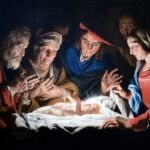










I have no pretence to be a Greek scholar but I do appreciate the value of exploring the Greek text
So I understand ‘the inn’ in Luke 2 7 to be;
inn.
καταλύματι (katalymati)
Noun – Dative Neuter Singular
Strong’s 2646: An inn, lodging-place. From kataluo; properly, a dissolution, i.e. a lodging-place.
And ‘the manger’ to be;
a manger,
φάτνῃ (phatnē)
Noun – Dative Feminine Singular
Strong’s 5336: A manger, feeding-trough, stall. From pateomai; a crib.
I also understand the basic layout of. House of that time ie animals and feeding stations on ground floor, possibly near the family living space.
Your translation here of v 7 does not appear accurate ie the removal of ‘the inn’ in favour of ‘guest room’.
And your explanation that ‘ The guest room on the roof was not big enough for Mary to give birth, so she did so in the main room, assisted by the women of the village.’ seems speculative and not justified by the Gk text in respect of the reason why Mary had to use the main feeding area for animals – which would have been very similar to a stable……. Following their rejection for accommodation the local hostelry.
Thanks John. For the full discussion, you need to read the linked piece. In particular, scholars have noticed that the Greek of v 7 is odd: οὐκ ἦν αὐτοῖς τόπος ἐν τῷ καταλύματι. ‘There was not for them space [or a place] in the guest room.’
Scholar Stephen Carlson looks in detail at the phrase often translated ‘there was no room for them in the kataluma‘ and argues that the Greek phrase ouch en autois topos does not mean ‘there was no room for them’ but ‘they had no room.’ In other words, he thinks that they did stay in the kataluma, but that it was not big enough for Mary to give birth to Jesus in, so she moved to the main room for the birth, assisted by relatives.
You can read his academic paper on this passage here: http://www.hypotyposeis.org/papers/Carlson%202010%20NTS.pdf
(Quite fun to note that the first challenge to ‘inn’ came in 1584!)
Tx Ian!
John
The problem with this is the idea of “…following their rejection for accommodation the local hostelry”. That logically implies the totally weird situation of Joseph (and his family with him) being sent to register for tax in a place where he has only ancestral connections and no actual current land or similar interest, and so needs to stay in “the local hostelry”.
Read ‘kataluma’ as a ‘guest room’ rather than as a whole ‘inn’ and you see the totally sensible situation that Joseph has returned to his ‘own city’ as Luke says, to a place where he was almost certainly the head of the household, and for some reason the ‘guest room’ was not available and things had to be improvised.
Note that the other use of kataluma in the NT is the room of the Last Supper. It has been suggested that the idea of an ‘inn’ came during early Latin renderings where a general room for a ‘staying place’ could also mean an ‘inn’.
Joseph in our terms was not simply ‘the village carpenter’ but a “have Transit will travel” jobbing builder – just his ‘Transit’ came with four legs and long ears, and was possibly displaced from it ‘stabling area’ to accommodate the birth. He will have been plying his trade in the profitable ‘new town’ of Sepphoris in the Galilee near his fiancee’s home but would need to return to his own home for the tax registration….
I do think Ian has arguably slightly slipped by focussing on the ‘stable’ – the animal accommodation in these old houses (including the similar later ‘bastel houses’ of northern England) could quite reasonably be called a ‘stable’; the point is it was a stable in a private dwelling rather than the different style of stable in public ‘hostelry’.
Thanks. Except that every other occasion of the use of ‘stable’ means ‘a separate building’. I have never found anyone call the lower part of a house, in one building, a ‘stable’.
By “every other occasion” do you mean in Scripture, or more generally? (I imagine the latter as I’ve done a quick word search for “stable” in Bible Gateway in three translations, and found only one occurrence: Ezekiel 25:5 in the New King James.)
Your “Jesus was not born in a stable” piece has been part of my Christmas reading for several years now, but this year my thinking has been along the lines of Stephen’s last paragraph above. For many years I was a leader at Scripture Union camps in a former croft cottage in the Trossachs, where one of the dorms (until it had to be rebuilt) was called either the “outer dorm” or the “stable dorm” (although “byre” would have been more accurate); although separated from the rest of the house by an internal stone wall and having a separate entrance, it was part of the main building and in its days as a croft was where the cow(s) was/were kept. So although not an integral part of the living area as you describe Joseph’s family home, it wasn’t entirely separate. I’m not aware of “stable” being used to describe the animals’ portion of a house in the Bethlehem way, but it doesn’t seem impossible.
“Inn”, however, remains definitely out in my view. (Pun intended.)
But if you don’t have a stable, where do you put the children?
Best not ask Herod for advice…
Brilliant stuff! There’s also no stable in the version of the Christmas Story on my Christmas info website (which the first ‘non video’ on Google if you search for ‘christmas story for kids’)! https://www.whychristmas.com/story/the-christmas-story
I am very glad to hear it! Hope your site is doing well again this year…!
or, pace Carlson, so many had returned to B’lehem their home town cos of the Census, that there was no space for also Joseph and Mary in the guest room? Where born – prob main room. Where laid – nice warm manger.
Justin Martyr and Origin allegedly said Jesus was born in a cave, not in a house or a stable.
Scholar Scott Hahn:
“Constantine the Great, the first Christian emperor of Rome, erected the original Church of the Nativity at this place in 326 A.D., over the very grotto that had been identified as the true site by the early church father Origen and, before him, Justin Martyr. Writing in 150 A.D. Justin stated that Jesus was born in a cave that was used as a stable – not the typical stone or wooden stable so familiar in Christian art. (In the Fullness of Time, 38-39)
“Justin Martyr…was born around AD 100…some forty miles north of Bethlehem. He knew the people and the area quite well, and he knew the site of a ‘certain cave’ that the locals venerated as the place of Jesus’ birth – even at that early date. He simply mentions that local Christians took care to preserve the historical memory of the nativity. In the century after Justin’s account…Origen made his own pilgrimage to Bethlehem and wrote: ‘At Bethlehem the cave is shown where he [Jesus] was born…and this sight is greatly talked about in surrounding places, even among the enemies of the faith. They say that in this cave Jesus was born….” (Joy to the World, p. 17).
Origen…
Thanks Gary. But this is clearly a later tradition with little contact with the text of Luke 2.
Are you saying that Justin Martyr was not aware of the birth narrative in Luke 2? Scholars believe that the Gospel of Luke was written in circa 80-90 CE. Justin was born in circa 100 CE. If he was aware of this text and believed in its apostolic/divine origin, why would he believe that Jesus was born in a cave?