John Hudghton writes: Around this time of year my nerdy mind turns to constructing an authentic biblical nativity scene. This amuses my family, to say the least. I try to take on board the lessons of biblical scholarship that Ian Paul has usefully and consistently emphasised for years now. Sadly, this is something which is usually lacking in commercially purchased nativity scenes or even those featured in many churches.
Surely, all readers of this blog must be familiar with the scene of Jesus born into a very modest Bethlehem dwelling. Constructed of fieldstone; mud mortar; a roof of timber; brush; more mud and perhaps embedded into a hillside, as were many homes in the vicinity. Not all had a guest room but the place where Jesus was born did, although for whatever reason (either already occupied or just too small) regarded as unsuitable for the birthing. We can probably assume that Jesus’ delivery either took place in the family room of a typical modest two main-roomed house, or in the lower level normally reserved for animals. These are the most common homes unearthed by the archaeological digs and analysis of these in Bethlehem. Bethlehem was known to be a poor agricultural community.
It is interesting to note that in first-century homes, the upper (living) area and the lower (stable) area were often separated by a stone wall. Set into this wall was a manger, designed so that it could be reached from both sides. Of course, the child born into the family was not ritually unclean, (even though the mother was) and a stone manger was probably advantageous too in this respect. The warmth of the animals would rise and help heat the living area. Such interior detail, familiar to the original audience, is often omitted in a trite retelling of the birth narratives.
There was nothing unusual about this either—it was quite ordinary—although by today’s modern western standards we might consider it smelly and primitive. Let us remember though, that it was not that long ago in Britain that families still semi-shared their living spaces with their livestock.
This arrangement persisted in many places until the 18th and 19th centuries where a long house, housebarn or byre-dwelling was common. People lived at one end of the building and animals at the other, with a cross-passage separating them. Like the examples in first century Judea, the living quarters were up-slope and the animal byre down the slope, so effluent from the livestock ran downhill. While ministering in rural areas of Cheshire and Derbyshire, I visited several homes where historically this arrangement had been the case, even though the dwellings were now modified into two dwellings, a garage, or a storeroom.
Unusual this was not but, theologically speaking, it speaks volumes about the work of God. God started as he intended to go on. Emmanuel—God with us—born into the heart of the home. No better place for God’s presence to dwell than the most basic building block of the Jewish faith. Forget the temple or synagogue: God chose the place where faith in Judaism is primarily nurtured and indeed was born in the first Passover.
We also see how God chooses to dwell in and amongst mortal beings. Yes—ordinary industrious people. It is a profound expression of incarnational theology at its grittiest. The day-to-day struggle of living “hand to mouth” and the presence of God incarnate injected into this scenario. Right from the get-go, Jesus shared these common experiences, “tears and smiles like us he knew.”
The vulnerability of the afore planned kenosis receives a further emphasis as Jesus is not born into a well-guarded, protected, or privileged background. He is like most people, of very modest means from day one. This also speaks volumes about his accessibility—something that Jesus maintained during his ministry, apart, perhaps, for the occasions when he needed spiritual retreat.
The nativity is of course a profound critique of human power structures and accepted values. God chooses poverty over prestige and thus questions the narrative that wealth equates with value. Expectations profoundly reversed in the place God chose to be born.
So, what an answer to the question, “Where is he who is born King of the Jews? We have seen his star in the East and have come to worship him.” Where is he? Here in this ordinary, average, breadline home where hospitality is offered and received. We receive the lesson, if God incarnate can dwell here, then he can dwell in your home too. He makes his home in human dwellings that are unexpected, unglamorous, with a dodgy pong and on the surface unattractive and we don’t just mean houses, do we?
My exploration also took me to the macro detail of the setting. What was the landscape surrounding the nativity story? Why did the magi have to take a detour after visiting Jesus?
When I was a Chaplain in the RAF, I served 1996–1998 at RAF Aldergrove, Northern Ireland. A wonderful Roman Catholic (Flt Lt Matt McKevett) in charge of the General Engineering Flight, answered my plea for an outdoor crib scene. It turned out to be the mother of all nativity scenes—a Judean diorama of Bethlehem and the countryside displayed in a huge ISO container, 40 feet long, 8 feet wide and about 9 feet high.
It wasn’t just massive; it sang and danced. It played carols; it had a daytime phase and a nighttime phase; and there was a fountain just for fun! Mary and Joseph with a donkey were on a Hornby track and moved through the countryside during the daytime phase, to reach the house where Jesus would be born. In the nighttime phase, amongst a background of twinkling stars, a mechanism brought a magnificent star across the top of the scene and when it stopped over the place of Jesus’ birth, a spotlight illuminated the crib with the Christ child resting there.
This nativity scene had a collecting box and raised thousands of pounds for charity. Only the eagle eyed could spot what OC GEF and I missed at first: the airmen engineers had placed Palestinian snipers in some of the houses of Bethlehem!
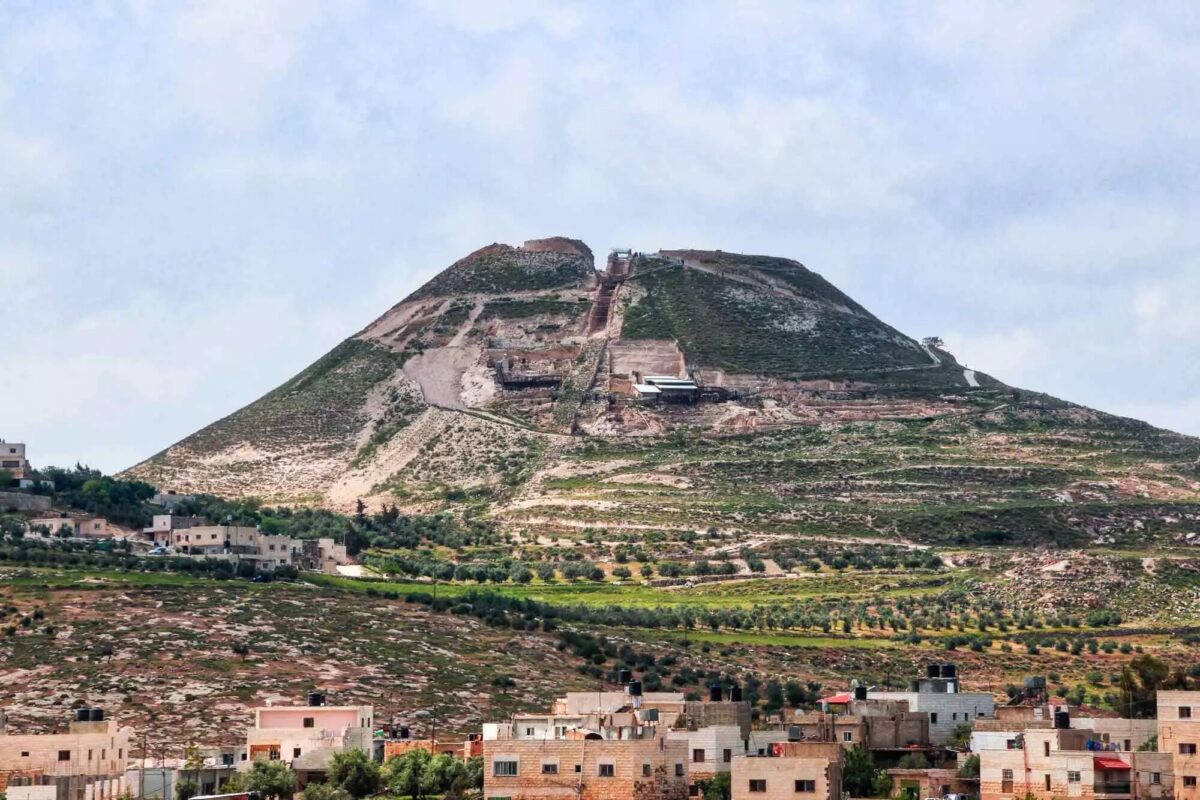
 There is no way could I now repeat the triumph of Aldergrove, but all the same I researched the landscape. To my astonishment I discovered there was a massive structure imposing itself on the Bethlehem panorama, of which, until this year, I had been completely unaware. In the sixty-nine Christmases I have lived through, this was the like of which I had never heard nor read about in relation to the narratives. I am, of course, talking about the fortress-palace of Herodium (Herodian). I wonder if this has ever entered your Christmas consciousness?
This is not surprising because for many years, following Herod’s death, many of the key features of Herodium had been re-shaped or covered over. Much of Herodium was smoothed off to the shape of a volcano, by the infilling of rubble, at the order of Herod himself. There were features of the inner sanctum of this palace that he did not want disclosed. The imagery of people and animals, pleasing to his Roman guests, was abhorrent to the non-Hellenistic Jews of the day. The subsequent turmoil of Jewish rebellions post Herod, the desecration of the despised tyrant’s tomb and monument of the mountain, the consequences of refortification and battle, also disfigured and shrouded the original building and its purpose.
Only relatively recent (1972–2010) archaeological excavations, led by Prof Ehud Netzer of the Hebrew University, have revealed the extent of the luxury, sophistication, size and military might of this royal retreat and administrative centre. It is well worth seeing for yourself via YouTube!
Possibly the newness of archaeological discovery is the reason there seems to be a knowledge deficit regarding Herodium? I cannot help thinking that there has also been some degree of slackness surrounding many approaches to the birth and epiphany narratives. I had heard of Herodium but I had never connected it with Bethlehem. I knew next to nothing about it and I never communicated anything about it to my congregations. I wish I could turn the clock back in this respect.
Connected to Bethlehem it certainly is. Herodium lies just three—yes only three miles—southeast of Bethlehem. Like the proverbial “elephant in the room” it imposes itself on the landscape and dominates the ancient road running from Jerusalem (six miles north of Bethlehem) through to Hebron, the Patriarchs Road, along the limestone ridge. Some of its water supply comes from Bethlehem.
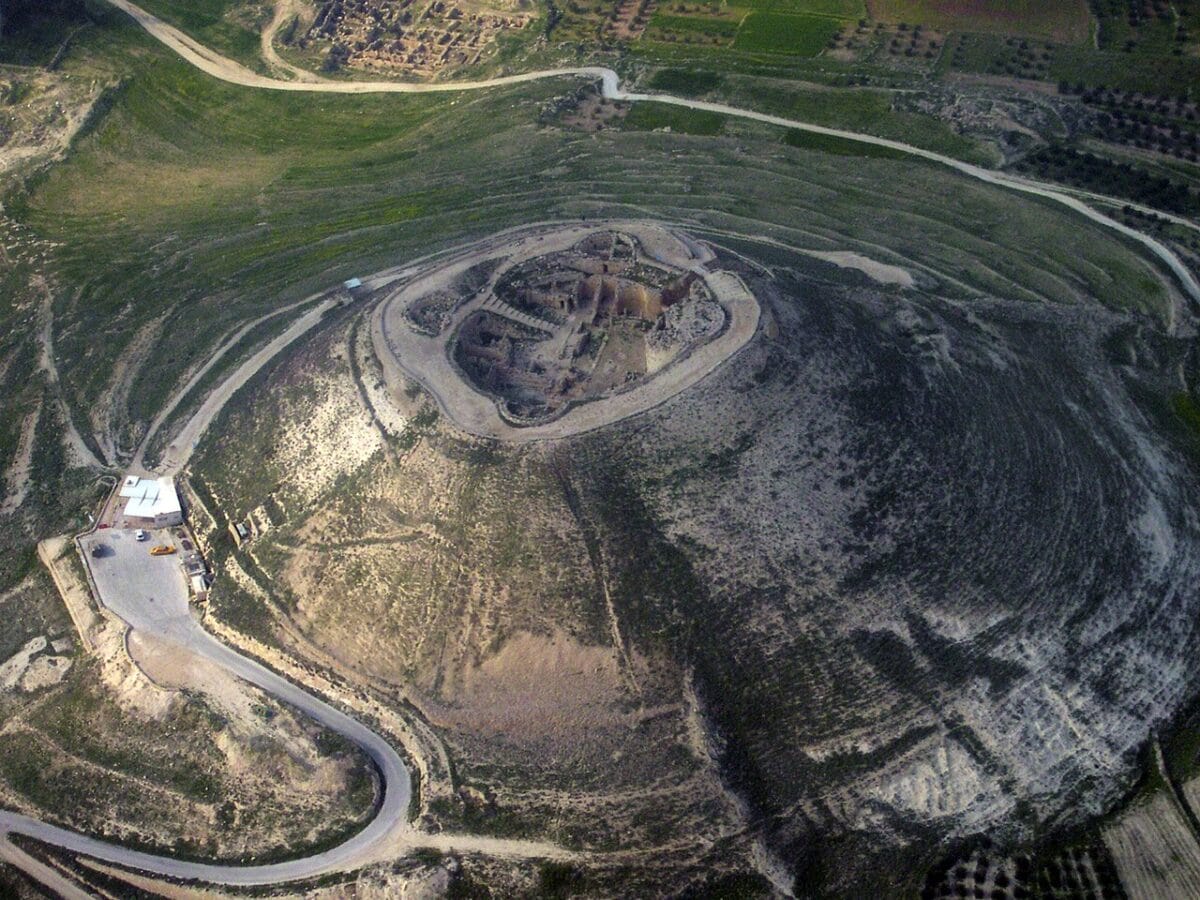
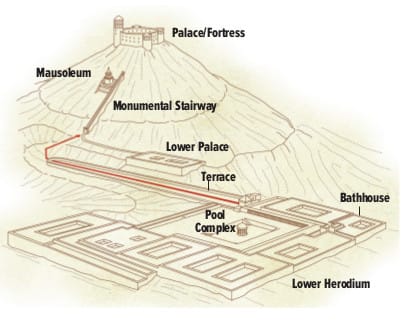 Impose and dominate it certainly did. Herodium rests on, in and around a massive, partially man-made hill, rising to 2,500 feet above sea level, making it one of the highest peaks of the Judean desert. The hill was, from foot to upper surface, 164 feet tall. On top of this was the upper fortress standing 260 feet from the top of the hill to the highest point of the wall. The upper fortress of the complex consisted of a casemate wall, the outer diameter being 206 feet and the inner courtyard being 183 feet, with just over an 11-foot gap between the walls. The wall complex was multi-storey with as many as seven levels, including two underground, wherein cellars and water cisterns were located and five above. Here were: living quarters; reception suits; banquet halls; kitchen facilities; a fully equipped Roman-style bathhouse and other rooms appropriate to luxurious palace style living. Three semi-circular fortified towers built into the wall and a fourth fully circular Eastern tower stood above all. This served as Herod’s penthouse, with its own private facilities and water cistern and offered a 360-degree view of the surrounding landscape for military and surveillance purposes. The tower alone measured 59 feet in diameter according to Josephus.
This was but the top of the fortress, at the base of the hill was “Lower Herodium” which included: a lower palace; garden; courtyards; a massive pool (big enough to sail boats); aqueducts; administrative; further supply buildings and accommodation for those who lived and worked there. Herod even had an extensive wine cellar with the remains of dehydrated wine, unearthed in the excavation bearing witness to this. Really, it was a small fortress town, much more than a castle or a keep.
The quality of the build was first class, like most of Herod’s enterprises, with no expense spared—at the burden of the oppressed and brow-beaten taxpayers! The structure was extremely well engineered and has stood the test of time and battle. Every stone face stuccoed, cisterns made waterproof through hydraulic plaster, mosaics, frescoes, opulent furnishings with gold and silver leaf, stone sculptures, hypocausts heating Roman style baths, gardens with imported plants and trees and a small theatre for performances and entertainment, were the order of the day.
There were 20 families plus other “staff” who serviced this fortified retreat, which could also accommodate up to 80 troops. What an utter contrast, when you compare this luxurious magnificence with the crude and smelly existence in Bethlehem. This manner of living, we know, was replicated in every place where Herod chose to lay his head and the twisted ambitions that lay therein.
Those who first received this Gospel account of the magi visiting Herod will have known that the answer to “Where is he who has been born King of the Jews?” was indeed “not in palaces of luxury and opulence built on the oppression of God’s people.”
Considering the form and function of Herodium, we have a clue as to why the magi were particularly circumspect during their pilgrimage to see the true King of the Jews born in Bethlehem. Herod was in Jerusalem and the Christ Child was immediately under threat. Herodium, towered over the landscape like the Tolkienesque tower of Barad-dur (the dark tower), the gaze of Sauron keeping watch over Middle Earth. Or to use another analogy often broadcast at Christmas, the fortress was like the presence of the death star brooding over the planet of Dantooine.
From Herod’s covert interrogation and well knowing (as everyone did) his extreme paranoia, the Magi must have had an inkling that the countdown to murder had started. They would need all their wisdom and cunning to deceive Herod’s watchkeepers and agents. Thus, divinely warned in a dream, instead of reporting back to Herod, “they returned to their country by another route.”
If, as some suspect from the first century context, Magi were senior officials of Parthia (a nation which had already put Herod, the Roman client, to flight on at least one occasion), they would be quite happy to usher in the demise of the Herodian dynasty and lessen Roman influence in the region. This explains why Herod and all Jerusalem were “disturbed,” they had experienced Parthian interference before, supporting their own rival Judean kings and suspected further intrigue.
For their measure, the magi saw through Herod’s pretense of desiring to worship the newborn king. They would do no unholy political favours for the ally of their sworn enemy. They duly exited Judea, diligent to avoid Herod so as not to “give the game away.”
Once again the identity of the magi, the political context of the birth and epiphany narratives and the brooding juxtaposition of Herodium, will have been well known by the original recipients of this story. However, these are features which over the course of time have, for many, become lost to “the sands of time”.
I rejoice as the archaeologists physically uncover the treasures of Israel, bringing into public view items buried for hundreds and thousands of years. They so often affirm what is in scripture and inform us of the context that gave birth to our faith. Herodium certainly brings the Christmas and Epiphany stories into even sharper relief. Herodium illustrates how the kingdom of Herod shimmered with architectural magnificence yet trembled with fear. It heightens the contrasts of luxury and power and amplifies the immediacy of the danger portrayed in the narratives.
I give thanks to God for Prof Ehud Netzer of the Hebrew University who, in uncovering Herodium, brought this ancient “mega structure” into public view. His work has brought to us what the ancients will have naturally known concerning Bethlehem and its vicinity. Maybe it is worth a thought?

Revd John Hudghton is a retired Anglican clergyman, having been ordained for 42 years. He is married with six adult children and 14 grandchildren. He lives on the Yorkshire coast and currently enjoys allotmenteering and motorcycling, and is one of the leaders of Bikers Church UK.
 Buy me a Coffee










Awesome John, thank you so much for sharing this. God bless you and your loved ones. Merry Christmas!
Thank you John
Very interesting – I eagerly read hoping to find the elephant (of the pachyderm variety) until I grasped it was a metaphor – and kept reading, of course. I knew of the Herodium but hadn’t connected it with Bethlehem before – good maps are so important in visualising the Bible!
I hope this will provide some background to some sermons this season – with preachers always being careful, of course, to stress that the Magi came some time AFTER the birth (nativity plays notwithstanding).
I think the Herodium features in Flaubert’s novella ‘Herodias’ where it is the scene of Salome’s infamous dance.
Real elephants were actually seen near Bethlehem in 162 BC, in the Battle of Beth Zechariah when Eleazar Avaran, younger brother of Judas Maccabaeus, died under a war elephant he had stabbed, as recounted in 1 Maccabees. In the Middle Ages Eleazar’s death was seen as prefiguring Christ’s sacrifice of himself for mankind. So this year our living room crib set (alas, not historically accurate) also has a couple of visiting elephants in memory of Eleazar.
https://en.wikipedia.org/wiki/Eleazar_Avaran
My mistake: the imprisonment and execution of John the Baptist is located by Josephus in Machaerus, the hilltop fortress and palace on the eastern side of the Dead Sea, and Flaubert follows him in his novella “Herodias”. Machaerus was also one of the building projects of Herod the Great (expanding a site built by Alexander Jannaeus).
Herod Antipas was the son of Herod the Great, and Antipas’s son was Herod Agrippa (Acts 12) – three generations of infamy and opposition to Christianity in the New Testament! A map and a timeline can be helpful when reading the NT.
Mary’s imminent uncleanness would have meant that no one would want risk being subject to the ritual restrictions imposed on their own activities.
This post is about the Magi; may I put in a word for the Shepherds?
Why did God choose to alert the shepherds and no one else?
How do you think Joseph might have being anticipating the birth?
Was there a midwife? Who delivered the baby?
Bearing in mind that Mary shared her story with Luke, might he have glossed over one important detail for ‘decency’s sake’: viz. who were accustomed to delivering lambs in the cold and dark, wiping them down with wisps of straw before wrapping them up and presenting to the mother? Why, the shepherds! – and why not, for the Lamb of God?
The shepherds were on watch outside at night (Luke 2:8). Sheep can be outdoors all year in Bethlehem’s climate (as they were in the 20th century). Sheep for sacrifice in the Temple came from Bethlehem, and Jesus is the sacrificial Passover lamb – which is perhaps why John the Baptist prophetically called Jesus the “lamb of God” (John 1:29). Why, though, were the shepherds watching – taking turns to watch – their sheep at night? If several shepherds met, was it the norm to guard their amassed flocks at night, which solitary shepherds were unable to do because they needed to sleep? Were wolves or sheep-stealers in the area? Were sheep that were bred for the Temple always watched? Was this the lambing season, which for the Awassi fat-tailed sheep kept in Israel is December/January?
A very imaginative piece I must say John. I note the oblique references to Incarnational Theology that you make.
Jesus born in a guest room, a sort of cave at the back of a house, a stable, an animal enclosure as part of a typical dwelling;
A modern Oberammergau type nativity play saying that Jesus was Born, became “incarnate” [for the more intelligent] is it important what kind of “background curtain” one chooses to perform in front of? Why? What more does it tell us of the actual incarnation?
I do wonder some times.
Here is the best archaeological summary of Bethlehem I know of:
https://www.youtube.com/watch?v=LTRFJBvB_sw
I quite like much of his stuff. But it is really odd that he takes as gospel Justin and Origen on the cave tradition. There is simply no reference to that in the gospels.
No, but he shows that it is consistent with the gospels.
You still have a problem with the cave, don’t you Ian !
Luke’s narrative lacks any meaningful theological punch if it is not around the Lamb of God motif, or to put it the other way, it certainly gains a wealth and depth of theological coherence once the Lamb of God born in a lambing cave, which is where the cryptic message “wrapped in lambing cloths and lying in a manger” would lead the shepherds to find him.
Why should Luke need to spell out a well known fact which by cultural inference may have been patently obvious to his first century readers, (just not to us), and be common knowledge amongst those living in Bethlehem.
The uninspiring theology which you attempt to draw out of the ‘normal middle class dwelling’ scenario I find limp and unsatisfactory. There is nothing about it which rings true about a first century gospel message, where the Lamb of God motif is far more compelling and in line with Gospel theology.
Theology and first century context shouts “cave” !
All references to ‘Cave’ in the Old Testament do not seem to have positive prophetic allusions. They all seem to point to failure. They point to the Crucifixion.
Whereas God’s tent, Solomon’s Temple have plans that reflect common dwellings. Prophetically they seem to say “ look for a house in which to find God”. I think therefore Jesus was born in the courtyard of home with the same plan as the Temple but only smaller. Under an awning, next to the wall, between the cistern and the bread oven. All necessary amenities to hand, just between the ox and the pregnant sheep. They were probably moved into the inner chamber later when all guests could be reallocated to different positions. “ Joseph! Cousin! Please come up to the top table today I’ve moved the guests who grabbed the prime spot further down…echoes of a parable in proto.
Frank, the language of ‘middle class’ is entirely anachronistic.
Nowhere in the text is the mention of ‘lambing cloths’.
And nowhere in the text is there even the slightest hint of a cave. The magi are told they will find him ‘in a house’.
Ian
Yes, I was being very tongue in cheek about the “lambing clothes”! On the other hand though, given the angels presumably spoke in Aramaic and we only have a Greek approximation to go on, does anyone really know precisely what their phraseology meant? It is not beyond possibility there was a cultural nuance we no longer have. The inference seems to be they were giving a clear sign where to look.
Matthew’s reference to a house has no bearing on Luke’s narrative, as you well know. The Magi’s visit is usually considered to be days, weeks or even months after the birth, so has no relevance. If it was not unusual for one of the lambing caves to be used as a short term maternity suite, as I envisage, then they would be back in the house within 24 hours.
There is still a question of the bigger picture, the theological intention of Luke’s narrative. The local Bethlehem economy was based around producing sacrificial lambs for the temple. Luke was not telling us a nice historical narrative. He was presenting a theological apologetic to deal with the scandalous problem of a crucified messiah, and the sooner he could hit that issue head on the better. A narrative based on the Lamb of God born to be our sacrifice fits perfectly. The historical details of shepherds, lambing community, lambing cave, works in a way an ordinary house scenario doesn’t. The detail that the lambing clothes doubled as burial clothes for the burial caves further down the valley, intones the coming death, in the same way as Matthew’s myrrh. Both authors intend to show a birth pregnant with overtones of future death, because the big issue they have to tackle is to show an intentional Divine purpose in the eventual crucifixion. Lambing cave works in a way ordinary house has nothing meaningful to say.
My interest in scriptural interpretation is always a literary one, not simply the nuts and bolts of translation, which is the angle I continue to press here.
Why are traditional nativity plays called trite? Isn’t it possible to claim poetic license? You could have chosen to talk about the sheer poetic beauty of the Christmas story, but somehow each year. Theologians are determined to remove beauty, mystery awe and wonder from the biblical narrative. You are of course, absolutely correct in your assertion.
Historicity is integral, essential, otherwise it is just a story with some sort of derivative moral or social message(s).
Or tradition based on myth according to skeptics, secular or otherwise.
The video linked in this piece is well worth watching, as not only does it give you an idea of the scale of the Herodium (and the odium of Herod) but also at 18 minutes it displays a ring found there with the name of Pontius Pilate.
So it is remarkable that the structure ‘commemorates’ the first ruler who tried to kill Jesus and the second one who succeeded. This ought to feature in a Christmas or Easter sermon!
https://www.youtube.com/watch?v=ShKf3h_1H0g&t=1475s
I did a picture quiz recently with some teenagers. Taking a typical “manger scene ” and asking which “things” might actually have been there at the birth. It got stripped pretty well …though I decided the rabbits could stay. Didn’t the Romans introduce them to Britain? So not impossible to be in Bethlehem … 😉
You decided the rabbis could stay?
Oy veh …
Rabbits aren’t mentioned in the Bible, but I see there is now a Rabbit Village near Bethlehem, and fortunately for them, rabbits are not considered kosher because they don’t have split hooves. Good news for the Bunny Yisrael.
Ho…ho…
I thought you were joking about a Rabbit Village near Bethlehem…. but no!
No NT reference to Gaderine Rabbits though…. apparently… must read harder between the lines…
I thought it was all underground!
As should all none gospel churches as they delve further and further down rabbit holes, even, or particularly, during the Christmas season.
I recall reading once that in a primary school, the children had each been asked to paint a picture of the nativity. As well as the usual pictures of stables, donkeys and wise men etc. one child had painted a picture of an airliner.
When asked why he said it showed Mary and Joseph’s flight to Egypt and Pontius the Pilot..
Perfect!
None of the above.
National tv news yesterday, showed what it was really like. A huge ‘Christmas tree’ festooned with lights, star atop, dominated the winter scene in Bethlenhem. Little wonder the magi knew where to go!
Such a stark contrast with Judaism and Islam: a different religion indeed!
The Magi – Parthian ruling caste – were known as “king makers”. One of their functions was to institute and anoint new kings.
In 40 BC Parthia gained control of Judea and installed a pro-Jewish ruler – Antignous (Antigonus II Mattathius). They employed Jewish Magi, (that is members of the Jewish Parthian diaspora who like Daniel were among the Magi) at Antigonus’ installation to garner support of the Jewish populace. When the Romans regained control in 37 BC they again used Jewish Magi at the installation of their puppet King, Herod (the Great). From then on it appears that Jewish Magi continued to be involved in some way both at Herod’s court and the Jerusalem Temple.
There is no reason to doubt that the visiting Magi from “the East” were from the Jewish diaspora, who however they learned of the Messianic King, would see it as their “king maker” function to play a part in anointing his kingship.
According to Josephus “tens of thousands” of pilgrims from the Parthian diaspora regularly made pilgrimage by camel train to the Jewish feasts, (so Richard Bauckham, Gospel Women p89). Indeed Acts 2:9 attests that Parthians, Medes and Elamites were among the diaspora Jews at Pentecost who heard their own native languages in the Spirit filled “tongues”. So it would have been quite normal for Jewish Magi to regularly travel amongst such diaspora pilgrims to the various feasts. [The journey by camel train need be no more than say four weeks in each direction, not the ‘many months’ often spouted.]
Matthew’s early missionary activity was understood to include the Parthian diaspora, where presumably he would have gained corroboration of the details included in his narrative.
Matthew’s theological intention is not about unknown mysterious Gentiles appearing out of nowhere, but around Jewish “king makers” anointing the new King of Israel. No wonder Herod was upset.
Nor would any of this be a mystery to his first readers, they would be well aware of the cultural background context which subsequently became lost to us.
Frank,
Where can I find information about these “Jewish Magi”? This is a very interesting notion. I have been refreshing my knowledge recently about Herod the Great and thf circumstances that led to his rise to power. The fact that Judea was on the very edge of the Roman Empire in a conflict zone (as it still was for Herod’s grandson) is a significant factor in understanding these events.
James
On the Persian diaspora in general, Richard Bauckham has an excellent section pp77-107 of “Gospel Women”.
On the Jewish Magi specifically, the details were taken from a talk by my vicar last year. I have asked him for his sources, and will let you know if I find out more. Sorry I cannot be more helpful.
Really interesting comment Frank. I have always been wondered who exactly the Magi were. The Bible does not provide much information about them.
There is an additional note on the Magi at https://www.psephizo.com/biblical-studies/myth-and-history-in-the-epiphany-of-matthew-2/ .
He doesnt say they were Jewish Magi so it would be interesting to see where that idea comes from if Frank can provide the sources.
Peter
Agreed ,
A great comment from Frank Booth.
It would corroborate the underlying OT significance of the gifts. And immediately tie together the OT and NT canon in its continuity.
I’ m aware that some Jewish believers have come to Christ through Matthew’s Gospel.
I agree with the positive sentiments expressed re Frank Booth’s comments. And yes Geoff, Jewish believers are coming to Christ and, it should be added that one of the key factors for many of them has been the literal starting point of Matthew’s gospel: the account of the genealogy of Jesus; thus leading to the recognition (believe it or not) that Jesus was(is) Jewish !
However the basis of the wider spiritual and numerical growth is, I believe, linked to the growing understanding within the Messianic movements that, not only is Jesus Jewish, but the emerging and developing awareness within these bodies of the significant Jewish input into the NT! At a personal level, in recent years I have come to the realisation that not only has much Western Christianity (deliberately?) failed to appreciate this, it continues to propagate a ‘Jesus’ denuded of his historical, social, theological roots and re-imagined in ‘universal’terms; acceptable to all? – but worthy to *sav* all?
correction ” to save all”
Hello Colin,
That is an important point but probably to large to take on in the comments.
‘ Fulfilment theotology is not the same as replacement theology.
But the idea of the ‘church age’ is strong.
And without a fuller explanation, it could be granted some credance in this:
a good number of years ago N T Wright over a 3 day conference on the Resurrection (I still have the cassettes!) was asked in the Q+A session about replacement theology. I still recall the answer, (N T Wright being a good verbal communicator) that the Bible could be likened to a space rocket, with each stage being jettisoned) It was a simple yet vivid and memorable illustration.
I’m really unsure whether, without more, that really represents his view of the whole protestant canon of scripture, a view that comes across in the totality of the body of his written work.
It is not a view, a biblical theology, I subscribe to, but of it is held by such an influential theologian, it may be little wonder it filters through, rather than being being filtered out through explanation, teaching.
I’m also aware that the ‘church age’ is held by many in Reformed protestantism.
One hugely significant point, when discussing this whole topic is the Trinity. While Messianic Jews believe Jesus is the Messianic King, I’m unsure whether they accept the Trinity, or the Fall??
Geoff are you saying that N T Wright believes in a ‘replacement theology’?
Could someone please explain to me what the difference is between Replacement Theology and Fulfillment Theology? Either I am very thick (quite probably), or they sound like more or less the same thing under different labels.
Tom Wright is a wonderful man, theologically speaking a million miles above my pay grade, but occasionally we lesser mortals need to ‘speak truth to power’, and his (dispensationalist?) rocket theology has sadly led many in the Church seriously astray concerning Israel.
Personally, I think all labels in this discussion are unhelpful as they are too simplifying.
‘Replacement theology’ says that ‘the church’ has replaced ‘Israel’ in the economy of salvation. ‘Fulfilment theology’ says that ‘the church’ fulfils, and does not replace, Israel.
I think the premises for both of these are dodgy, not least because the Greek term translated ‘church’ (ekklesia) is actually used of Israel in the OT. See here: https://www.psephizo.com/biblical-studies/why-we-should-stop-using-the-word-church/
What Paul describes is gentiles now being incorporated into the Israel of God, since Israel itself is now redefined—its identity is no longer ethnic, based on loyalty to the law, but based on allegiance to Jesus as the one to whom the law points and who alone is the authoritative interpreter of the law.
And this is in fulfilment of what the purposes of ethnic Israel always was.
I think Tom Wright sits fairly clearly within this understanding, though he sometimes uses slightly loose language, and his critics often seize on this.
Does that help…??
I do not use fulfilment theology in the sense that the ‘church’ fulfills the OT in the much mentioned ‘church age’.
I use it in the sense that it is the incarnate Jesus the Jew, Himself, who fulfills all of the OT categories as confluence of redemptive biblical history, Jew and Gentile. One, (gentiles grafted into the Vine who is Jesus) in Jesus the Christ, in the Triunity of God.
I do not recognize that it is the Christian Church that either fulfills or replaces Israel (son) even as the term the ‘ the church age’ is banied about regularly.
Ian’s take is strong and well worth reading slowly.
Thank you Ian, for very kindly taking the trouble to reply.
I still don’t really understand the distinction between replacement and fulfilment in practical terms, but let it pass. However I willingly accept your point about the inadequacy of labels in any context.
I certainly appreciate your point concerning ekklesia, indeed would understand that ekklesia as representing the Septuagint translation for the Qahal of Israel is arguably the main reason why Paul & the NT community chose to use the term. This is all fine as far as Salvation history is concerned, (although it does raise some interesting questions about whether Jews can still be saved under the Law, but let’s not go there either).
The real issue (as far as those who choose to use the term Replacement Theology are concerned) is whether it denies or denigrates the commitment of the Holy One of Israel to fulfilling His historic promises concerning a People and a Land in our generation.
There are three main theological errors why many in the church deny that temporal Israel is still important to the God of Israel. I would describe these as the Nehemiah Fallacy (the temporal promises have already been fulfilled), the Black Stocking Syndrome (because the promises apply spiritually under the Gospel their temporal fulfilment has been abrogated) , and Covenant Confusion (because the Jeremiah 31 covenant fulfills the Law the Patriachal promises are no longer extant).
There is also a Serious Theological Concern as to why it actually matters; why if the Living God is acting existentially He is not impressed by a church which persists in being in denial.
I would be more than happy to expand on all these points if you were willing to allow me. Thank you again for your time and attention.
Thanks. Just a brief response to some of your questions in turn:
‘whether Jews can still be saved under the Law’. No of course not. The whole NT is clear on this: ‘there is no other name under heaven by which people can be saved’. The Lord on whom we call for salvation in Joel 3.22 is now known to be hte name of Jesus. This does not itself answer the question as to whether Jews should still continue to observe the law, but it is clear that law-obedience is not saving (Jesus is) and gentiles therefore do not need to become Jews to be saved by Jesus.
Again, Jesus being God’s final word to us (Heb 1.1) means for Paul that all God’s promises are fulfilled in Jesus (2 Cor 1.20). The promise of the land was not, as many seem to reduce it to, a real estate deal! It was always about God giving his people freedom to worship him, freedom from slavery, security from oppression, and peace from their enemies. See the Benedictus in Luke 1. And *all* these promises are fulfilled in Jesus. That is why, for the OT, both promises and obligations are found ‘in the land’, but for Paul, they are all now found ‘in Christ’. The centre of the land is Jerusalem; the centre of Jerusalem is the temple; and the centre of the temple is the holy of holies, God’s dwelling place on earth. Jesus now is that temple (John 2); we are incorporate in him, so we are his dwelling place (1 Cor 3, 1 Peter 2); and that is why in Revelation we are cube-shaped (144,000 in Rev 7, 12,000 stadia cubed in Rev 21).
That is why there is not a single verse anywhere in the NT which even hints at the idea of a restored temple or ethnic Jews returning to the land. Both would suggest that there is salvation outside Jesus.
On the land in detail, see here: https://www.psephizo.com/biblical-studies/does-the-state-of-israel-have-a-divine-right-to-the-land/
On all peoples being ‘gathered’ into Jesus as the fulfilment of OT promises eg in Ezekiel 38, see here: https://www.psephizo.com/biblical-studies/why-and-how-does-jesus-gather-his-people/
Hope that is all clear.
Ian,
I think that ‘replacement theology’ is a helpful and meaningful label (albeit a position I disagree with). It is essentially the view that the church has permanently replaced Israel in God’s purposes so that the church is the ‘new Israel’, and that the Jewish nation has, for its rejection of Jesus, been thrown by God on the scrapheap of history. It is also known as supersessionism because the church supposedly supersedes the nation of Israel in God’s purposes. This viewpoint is exactly what mediaeval institutional churches believed.
Replacement theology is to be contrasted with what has been well named ‘enlargement theology’, which holds that the covenant with Abraham is still in force with the Jews in exactly the sense Abraham would have taken it to mean, and that gentiles are now spiritually grafted in through their faith in Jesus Christ.
Thank you Ian, for once again graciously taking time out of your busy schedule to pen a long and considered reply.
It is all wonderful stuff of course, pristine NT theology from a top expert. Who am I to dispute a word of it? And yes, I am quite familiar with your previous posts, thank you.
However you are still unconsciously evading the point. We are not talking about NT salvation theology, however wonderful that is, we are talking about what the Living God is doing experientially in our generation in fulfilment of his Holy Word.
Well over two millenia ago the Holy One of Israel set in place a series of prophetic scriptures which he determined when fulfilled would glorify His Holy Name. Now is the Day and now is the time when those scriptures are being fulfilled. In all nations simple believers in simple churches are glorifying the Holy Name of Israel’s God as He intended, but in Western churches where scholars and theologians have talked themselves into denial, the Lord is not receiving the glory He purposed for His Name.
This is an extremely serious matter. “Hallowed be Thy Name” precedes “Thy Kingdom come”. It is no good saying “but we are preaching the Gospel” and expecting God to bless our evangelism, when the church is denying and denigrating the glory the Lord has purposed for Himself in our generation, which is precisely what is happening. Is it any wonder that Western churches are falling apart when they refuse to glorify the Lord in the way he purposed over two millenia ago? He has been watching over His Word to perform it, and the scholars of the Western churches are in in denial.
Jesus was hugely critical of the scholars and theologians of his day whose theology prevented them from seeing what the Living God was doing in their generation. Chorazin and Bethsaida were dismissively compared unfavourably to Sodom and Tyre. AD 70 and AD 135 were to follow. Now exactly the same syndrome is being re-enacted in our generation by those who are wise in their own sight, but refuse to glorify the Holy One of Israel in the way that He intended.
John Wesley could see it, Simeon and Wilberforce could see it (and 200 years ago prophetically planted an Anglican church in Jerusalem to proclaim the Gospel when the Jewish people returned), Bishop Ryle could see it. But now with Israel back in the Land before their eyes, so-called Evangelicals in our own day choose to be blind to what the Lord is doing in their generation. There will be a price to be paid. It is not for me to say what that might be, but I have lived long enough to know there will be a price to be paid.
There is so much that could be said. How the Lord has dealt with me personally on this topic for over 60 years now. The testimonies of those called by the Lord to bring His people home, people I know followed by the KGB but supported by angels. Books are available. Your wonderful NT theology is predicated on the testimony of those who experienced the Lord in their generation, but were despised by the religious leaders of their day. Stephen, Peter, so many others.
You would be wise to carefully consider what kind of Evangelical you claim to be. One who takes note of what the Lord is doing in our generation, or one who is evangelical in theology only.
May the Lord bless you if you choose to seek His face over this.
Thanks Frank. You comment: ‘we are talking about what the Living God is doing experientially in our generation in fulfilment of his Holy Word’.
So my question is: what does his Holy Word say that is being fulfilled? As I think I have shown, there is simply no evidence at all that the New Testament has any expectation of a ‘return’ to the physical land of ethnic Jewish people.
The existence of Israel today is remarkable, and is in part the result of the work of people who *do* believe that the New Testament has that expectation. But the fact that they believed that does not make it so!
I will change my mind if you can point me to even one verse that says this!
Ian: you are careful to specify the New Testament as saying nothing about a return of the Jews to Eretz Yisrael.
But the Old Testament has plenty to say on that.
Are the Old Testament prophecies no longer valid?
Have they been jettisoned in space, so to speak?
I do not think one can dismiss as mere oddities of history the one event of the past 80-90 years that has obsessed the world more than anything, and even more so in the past three years, causing great convulsions in world politics completely out of proportion to the geopolitical facts:
First, the attempted annihilation of the Jewish people by the German state;
Second, the astonishing revival of a Hebrew speaking Jewish state in the Holy Land;
Third, repeated attempts to annihilate this state, leading to wars across Asia;
Fourth, the obsession with the left in Europe and America with destroying Israel.
Why is Israel the lightning rod for the world’s hatreds?
It is these astonishing facts – along with OT prophecy and the NT prophecy in Romans 11.26 that Israel will turn to Christ – which have convinced me that the existence of the State of Israel is not some inconsequential fact no more meaningful than the existence of Botswana, but part of God’s purpose for the world.
There are plenty today (buoyed up by political Islamism) who want the State of Israel to be destroyed, and some professing Christians are in that number.
Let us ask ourselves: Why is hatred of the Jews so common today?
Hi James, yes, the OT has plenty to say about it—and Jesus fulfils all those promises. If that were not the case, how come the return to the land after the destruction of Jerusalem (which clearly features) is mentioned nowhere?
In Romans 11.26 Paul says not a thing about any kind of return to the land. You will be aware of the debate about this text—but Paul’s comment is about manner, not time (‘in this way’ and ‘and then’), and he is saying that the gentile mission *is* the way in which ‘all Israel will be saved’, that is, the whole Israel of God, both Jew and gentile who trust in Jesus.
I agree with you that the hatred of Jews and the state of Israel is a remarkable thing. But please let’s not read back into scripture things that are not there.
James, here is a question: what do you think ‘the land’ means theologically in the OT? Is God just a real estate agent? Or does it mean something more? If so, what?
Christopher,
Will you be watching Channel 4 at 9pm tonight, i.e. Smyth – the documentary?
James – I think Ian believes there is no OT prophecy that is yet unfulfilled, and that those which had not been fulfilled by the first century BC were fulfilled in Christ’s first coming, aka the Incarnation, and the founding of His church in the immediate aftermath. This seems an arbitrary assertion to me, and like you I believe that some OT prophecies await fulfilment in the events associated with His Second Coming. But it is why Ian asks for NT prophecies of a return of the Jews to the Holy Land.
I don’t know how much clearer you can get than Isaiah 11:11-12 prophesying a SECOND return of the Jews – so not the return from Babylon – and this time from all parts of the world. This matches the Zionist era and our own times, and matches nothing else. It raises in turn the question of how many prophecies of return in the OT are ambiguous between the return from Babylon and the Zionist return, and therefore cannot be insisted on as referring exclusively to the former.
Ian – You ask for NT prophecies. Two of Christ’s own are “O Jerusalem, you will not see Me again until you say ‘Blessed is he who comes in the name of the Lord’ “, and in response to the disciples’ question about whether He, now risen, would claim Israel’s crown (Acts 1), “It is not for you to know the time.” I don’t think you can consistently demand a NT prophecy written with wooden literalness while spiritualising Isaiah 11 into near-meaninglessness.
Thanks Anthony, but I think you are illustrating why I feel very confident! You have picked out a lone word from Is 11 ‘second’, and on that constructed a massive scheme that just isn’t there. There is no mention of ‘exile, return, second exile, second return’, and you have to complete detach these verses from the immediately preceding ones—which the gospels see as fulfilled in Jesus.
And it is the NT writers, not me, who see all the promises of the OT fulfilled in Jesus. That is what it means to say Jesus is God’s last word to us.
And Jesus’ answer to the disciples’ question, for Luke, comes in the narrative of Acts—that it is the gentile mission which fulfils the promise of God. That is why they simply never ask the question again, not anywhere in Acts, nor anywhere in any of the NT letters.
It really is an astonishing claim that something you regard as so central and important figures nowhere in the teaching of Jesus or any of the apostles.
Ian – no, not just one word in Isaiah 11 (‘second’ return), but also the fact that this return will be from all parts of the world, cf the return from Babylon. I am aware that the uniquely good fit of this prophecy to the Zionist era is apt to induce cognitive dissonance in persons who have built a hermeneutic into which it does not fit, but that isn’t my problem.
Your hermeneutic demands that all prophecies not fulfilled by about 10BC were fulfilled in Christ’s lifetime on earth and its immediate aftermath. Upon what verses do you base that demand?
I base it upon the consistent way that the whole NT reads these texts, as I set out in the other article.
Ian asks:
“James, here is a question: what do you think ‘the land’ means theologically in the OT? Is God just a real estate agent? Or does it mean something more? If so, what?”
I think ‘the land’ means just that – but of course the promise of the land is given in a religious, covenantal context, and I understand that Zionism, at least originally, was not a religious movement (a ‘teshuvah’ to YHWH) but was born out of 19th century nationalism. I know a lot of Haredim Jews didn’t support the State of Israel but may have changed their minds (but not about serving in the IDF).
I know a lot of Christian commentators have treated the promise of the land as defunct and obsolete (some even talk about ‘Christified space’) and Chris Wright treats these promises as being expanded to embrace the whole earth (and therefore losing their particularity). I used to think that way as well, but recently have come to question this. To ask about the land of Israel is really to ask: Why do the Jews continue to exist today?
A question for you, Ian: what do you make of Ezekiel 38-39?
Have these events already happened?
Or have they been shelved and will never happen?
Or is it an end=time prophecy of war focused on the land of Israel?
I have similar questions about Zechariah 14, which depicts a war against Jerusalem.
James, if you think ‘land’ means ‘just that’, then you do indeed believe God is a real estate agent.
But I find that really puzzling—because of what the OT says about the land. It signifies: freedom from slavery (not Egypt); security (not the wilderness, not wandering); proximity to the presence of God (his presence in the temple). That is the *meaning* of the land. Now we find those promises of freedom, security, and proximity in Jesus. So what would the land mean now?
Specifically, Jesus explicitly claims he is now the temple, which is the centre of ‘the land’ and its justification. That is why Paul now talks of us being ‘in Christ’; he is the place we inhabit.
The promised gathering of Ezekiel 38-39 happened in Jesus, as John 11.52 ‘to gather into one the children of God who are scattered abroad’ makes explicit, as does Revelation 7.9. The whole of Revelation in fact does this, taking the promises to Israel and turning them into promises fulfilled in Jesus. See my whole article on ‘gathering’.
And Revelation does the same with Zechariah, in a systematic way. We are encouraged by the NT to take the promises made to Israel as promises now to those who are in Christ; this is Paul’s consistent hermeneutic ‘These things were written for our instruction’.
But do you (Ian) rule out that any OT prophecy unfulfilled by 10BC might refer to events later than the apostolic era? And if so, why?
It would be arrogant of gentile believers in Jesus to suppose they can settle these questions without heed to the views of modern-day Jewish believers in Him, especially those resident in what scripture calls the land of Israel. He was sent specifically to the lost sheep of Israel (Matthew 15:24).
PS Ian – we end up with new bodies, not as disembodied spirit. So we need a land and/or city to inhabit. Jesus is not the New Jerusalem described at the end of the Book of Revelation, surely?
The New Jerusalem is a cube; the whole space is occupied by the presence of God, as a giant holy of holies.
I agree Ian, but I think that this sidesteps rather than addresses my question and point.
I think it answers it rather precisely!
It would be great, Ian, if you would go to the Holy Land, preach your theology of the land to a congregation of brothers and sisters in Christ there, and engage in the resulting discussion.
Geoff, [a utube] “A Jewish defence of the Trinity” Seth Postell and Golan Broshi (both Messianic academics).
Postell has also published a book : “Reading Moses, seeing Jesus” Published by ‘One For Israel’org
Thanks Colin,
That is helpful and more than interesting.
Jesus as the new Moses is one Biblical theology fulfillment, type and antitype.
At my age, I don’t think I’ll be buying many more books, but I ‘d be interested in listening/watching if you have any links, thanks ( one per comment allowed by our host).
I no longer have any personal connections (friends of friends) with any of the local Messianic Jews, who are shunned by their own Jewish communities.
Ian,
A comment here as the thread above was getting too long to follow.
1. Ezekiel 38-39 seems to be about a global war focused on the land of Israel. Similarly Zechariah 14. Is this a false prophecy or has it been completely misunderstood?
2. If the promise of land to the patriarchs has been spiritualised into a relationship with the Messiah, then is the Second Coming also to be spiritualised, i.e. demythologised?
Ezekiel 38 and 39 are about forces of supreme evil, ranged against the people of God, whom God alone defeats, and so his people dwell in safety.
We now know that the real forces of evil are not empires (like Rome) but Satan and sin. And we know that the true battle was won on the cross and in the resurrection. That is how the NT portrays our situation. Thus we can dwell safely in new life in Christ. That is how Revelation 20 reinterprets Ezekiel in the light of Jesus.
The victory is won on the cross, so Satan is cast down from heaven in Revelation 12. But his victory will not be consummated until he returns. So he names Gog and Magog in Rev 20, but as places rather than people, showing he is re-reading it, as we also must do.
(If you don’t believe this, then you are denying that Jesus’ death is sufficient to save us.)
The promise to the patriarchs has not been ‘spiritualised’, it has been fulfilled. Jesus gives us all the things that the land was intended to.
Why would that lead to a ‘demythologising’ of his return?
Thanks Ian.
Rest assured, I am quite convinced that Jesus’s death (and resurrection!) is sufficient to save us. (Your comment sounds a little polemical to me.)
Ezekiel 38-39 does read like an actual war in the Middle East. Do you think this is wholly metaphorical or parabolic?
I would add that Ezekiel 40-48 speak about the actual land divided and distributed and a new temple such as never happened in history. I don’t know what Jews make of these passages, nor how Christians have understood them historically- although I know typology was popular in the early centuries of the Church.
If “Jesus gives us all the things that the land was intended to”, that suggests that our bodies (which occupy space and need food and shelter etc) are not really important, because that is what a homeland provides for us. This also suggests that the literal promise of land to the Jews is now become obsolete and the literal Jerusalem has no more significance that Jarrow. Isn’t this what replacement theology holds – that all the promises in Scripture regarding Israel have been fulfilled in the Church and Israel after the flesh has no more significance for God?
I should add that by saying a promise is “spiritualised” means that the physical promises – land, food, children etc – are transformed into spiritual promises of forgiveness, promise of eternsl life etc. To say promises are demythologised is to say thst they will not have a physical or historical fulfilment but symbolically depict a relationship with God. Those who deny the Second Coming, for example, say it “really means” post-mortem survival of the soul or something comparable.
Jesus said he was the true manna from heaven.
Is he ‘demythologising’ Exodus?
James
No, that is ‘fulfilment theology’ if you want a label. The clue is in the word ‘fulfilment’…!
The writer of the fourth gospel saw Ezekiel 40 to 48 as fulfilled in Jesus, including the use of the number 153 in John 21, as I have pointed out often. I don’t really understand why you would think something which is clearly eschatological and symbolic, and which the gospels read as fulfilled spiritually in Jesus, should be read ‘literally’.
But you still haven’t said whether the war described in Ezekiel 38-39 will really happen or not – or the war in Zechariah 14.
Fulfilment Theology isn’t so different from Replacement Theology as you may be suggesting if you think that the Jews no longer have any particular meaning to God and all the promises to the patriarchs have been fulfilled in Jesus and no longer have any reference to the historic Jewish people.
This is the conundrum for me: what does it mean to be Jewish today? Is it now obsolete in God’s economy? Is that covenant now defunct? If so, you have Replacement Theology, don’t you?
Or is there still a covenantal relationship between Yahweh and believing Jews? If so, what does it amount to?
James, according to the NT, that battle happened on the cross.
‘is there still a covenantal relationship between Yahweh and believing Jews?’ Believing in what? Jewish Peter says to his fellow Jews: ‘there is no other name under heaven by which we can be saved.’ (Acts 4.12).
What do you think he meant by that? Peter doesn’t seem to allow any kind of salvation for Jews outside of faith in Jesus.
Ian, can you interpret spiritually every detail written materially of the prophecies that remained unfulfilled materially after the apostolic era? You should be able to.
Why?
What else are they doing in scripture?
James, you ask: ‘Do you think this is wholly metaphorical or parabolic?’ But isn’t God’s judgment and restoration a very powerful conceptual metaphor throughout the whole Bible — a way of understanding and ‘describing’ what God has done and will do? So Ezek 38-39 is ‘fulfilled’ in some sense in what is ‘described’/’prophesied’/’imagined’ in Rev 20-21?
Why do you insist on ‘literal’ meaning only?
Bruce,
Where do I ‘insist on “literal” meaning only’? I can’t see where I have done this. I have simply asked whether Ezekiel 38-39 and Zechariah 14 (and I could add Daniel 12.1) prophesy an actual war ‘in the last days’ in the Holy Land or not – and if I understand Ian correctly, he thinks they don’t, that this is somehow a great extended metaphor for the Cross.
I don’t see any verbal connection between Ezekiel 38-39 and Revelation 20 (much less ch. 21). What do you mean by this?
James, you ‘don’t see any verbal connections’? Seriously?? How about ‘Gog and Magog’? And the language of the birds from the air feasting on the defeated armies in ch 19 is straight from Ezekiel 38.
I have checked the best technical commentaries I have on Ezekiel 38-39. The surface meaning of the passage is that at some date after the prophet Ezekiel’s time, Gog of Meshech and Tubal will attack the actual land of Israel and its people but be miraculously defeated. Since we know of no such warfare in the 2500 years past, it seems to me there are three possible approaches:
1. Ezekiel describes an event which will never happen (a prophecy refuted by experience, as in Robert Carroll’s ‘When Prophecy Failed).
2. Ezekiel describes, in proto-apocalyptic terms, an even for the future, when Israel exists again in the land.
3. The whole account is really an elaborate metaphor for the work of Christ on the Cross and has nothing to do with the land of Israel and the Jewish people.
Are there other possibilities?
The first approach obviously doesn’t appeal to evangelicals but may agree somewhat with those who see the OT in general mythic terms.
The second approach has probably been more common in Christian tradition (that is how Luther interpreted it), although it is not clear how far the details are pressed. Modern Dispensationalism has connected the passage with the modern State of Israel, an association rejected by other modern commentators, especially those who think God’s covenant with Israel has now elapsed.
Revelation 20-7-10 refers to an end time event, after the millennium, when Satan leads ‘Gog and Magog’ and a vast global army against ‘the camp of the saints and the beloved city’ but is defeated miraculously. Again, is this talking of an event still to come in the Holy Land? Or is this all symbolic of the cosmic struggle against Satan and doesn’t correspond to anything historical or geographical? I find it hard to read these passages as timeless and purely symbolic. Revelation 20 does read as a prophecy, highly symbolic in form, of the end of human history. The Church and Israel exist in a unique (if problematic) ‘special relationship’ – symbiotic, even – and will do so, I think, until the Second Coming.
James, what an odd set of alternatives. You don’t appear to have read mainstream evangelical commentary like that of John B Taylor.
‘the language is the language of apocalyptic: it is largest symbolic and at times deliberately shadowy and even cryptic but though the details are vague, the main thrust is clearly and boldly expressed.’
He goes on to explain that this significance is that
a. Israel’s oppression by its enemies is within God’s sovereignty and not beyond
b. The God is working his purposes out through this
c. The God’s people will ultimately be vindicated, and
d. That this vision of the future as an eschatological battle sits in tension with the ‘golden age’ motif that follows.
This matches both the life of Jesus (his death was not a triumph of his enemies, but was within God’s plan, and leads to vindication) and his followers after him (the tribulation they experience in life is not beyond the sovereignty of God). And the tension between final battle and golden age is replicated closely in the contrast between Rev 19 and Rev 21.
Of course this is set ‘when Israel is again in the land’ since they have not yet returned from exile. But the message of Jesus is that, although they are physically in the land, they are still under the occupying power not just of Rome but of sin and Satan too. Jesus’ death alone ends their exile from God.
“Why do you insist on the literal meaning only?”
Yes! The victory is won on the cross and the resurrection. And yes, it awaits its connsumation – but through a ‘spiritual” Jesus? -hardly a picture painted in the gospels and 1Corinthians 15! And what is meant by ‘ a spiritual body ‘ : an ethereal humanoid floating in cyberspace?
Personally I am neither a literalist or a ‘spiritualist’. I see myself as a contextualist : scriptural passages (OT and NT) should be viewed in their respective theological , social, literary [et al.] contexts! Then it might help to clarify the meaning of the terms we employ.
Now I for one am totally convinced that whether ‘Jew or Greek’, there is “no other name under heaven given among men by which we must be saved.” But if the issue involves *ethnic* Israel, I turn to Paul of Tarsus – specifically to Romans 9-11, which, while making the foregoing truth abundantly transparent in distinguishing between believing Israel and ethnic Israel, at the same time it expounds the great hope that awaits the latter at the end of the age – and yes, through Jesus Christ! To me, this is clear, despite specious attempts to explain it away!
Moreover, when Ian questions where one finds ” an expectation of ethnic Jews returning to a physical piece of ground”, then one must assume that certain promises made in the OT no longer have validity because they no longer conform to the revelation of (and in) Christ, then that must include the Abrahamic declaration:” I will establish my covenant, an everlasting covenant between me and you and your descendents after you—— .The whole land of Canaan —- I will give as an *everlasting possession” to you and your descendents after you. [Gen 7 &8]. Evidentally, on this basis, divine promises are no longer deemed to have *eternal* significance. It would seem that ‘eternal’ no longer has a relationship with ‘everlasting’ – but maybe that sentiment does not apply to the NT?
As I have argued before , the late John Stott in his otherwise excellent commentary on Galatians argues ( on the question of Canaan) :” Paul realized that both the ‘ land’ *which it was promised* and the seed to to whom it was promised *were untimately spiritual* (‘Only one way’-p88′).And pray tell me: where does it say that :Paul realized this? And more to the point perhaps, is there anywhere in the NT where *Jesus* declares the blessings of the Kingdom will no longer be in any sense political (or even physical ?) – but ‘spiritual’ ?
So, Colin, do you think that Jesus succeeded spiritually to defeat Israel’s enemies, but failed politically? Luke 1.74 looks like a clear political victory over Rome, no less than Ezek 38 looks like a military victory.
Are Christians who are in Christ ‘sons of Abraham’? If so, why do we not expect to go and live in the physical land, since the land was given to Abraham’s offspring?
What is specious about noticing:
a. Paul’s comment that not all who are Jews outwardly are Jews inwardly. What do you think Paul means by this? Can I be a Jew ‘inwardly’ without being an ethnic Jew?
b. Paul says ‘in this way all Israel will be saved’. How can gentiles being grafted in be the *means* by which ‘all Israel’ is saved, if ‘Israel’ means ethnic Jews? And what about all those ethnic Jews who have died unbelieving over the last 2,000 years? Are they saved retrospectively? If not, in what sense would any ‘end times’ turning of Jews to Jesus be ‘all’?
And why, then, does Paul still make *no* mention at all of a ‘return to the land’?
Ian,
I have read every word of Taylor’s commentary. I know he rejects Scofield’s dispensational interpretation (p. 243) but his own view remains unclear: “These can be either taken at their face value … or they can be seen to symbolize the mythological forced of darkness (“the north”) ranged against Yahweh and His people.” (p. 244). He does see a strange juxtaposition in these chapters between the “golden age” of restoration versus the picture of eschatological warfare (p. 243).
‘Where do I ‘insist on “literal” meaning only’? I can’t see where I have done this.’ (JT)
James, you actually seem to be doing that in the same message:
‘I don’t see any verbal connection between Ezekiel 38-39 and Revelation 20 (much less ch. 21).’
Why would a ‘trope’/’conceptual metaphor’ require ‘verbal connection’? (But, in this case, as Ian points out, there are verbal links anyway between Ezek and Rev.)
Communication simply doesn’t work like that. Otherwise my wife could not understand that ‘Will I put the kettle on?’ and ‘Do you want a cup of tea?’ are asking the exact same question. (However in the second question she would be struggling — since she rarely drinks tea! 🙂 )
Ian,
Where does the New Testament say that the Cross ‘fulfilled’ the prophecy of Ezekiel 38-39? I can certainly see how the Cross is the atoning sacrifice for sins but I don’t see how it destroys armies attacking the land Israel – unless you treat Ezekiel 38-39 as purely metaphoric and nothing to do with actual events in the world. Is that how you see these chapters?
Do you think believing Jews (Jews who believe in Judaism, not Messianic Jews) no longer have a covenantal relationship with Yahweh? That’s what I thought your last remark indicated.
If so, that is Replacement Theology.
James, all the text in the NT which interpret the cross as Jesus’ defeat of Satan belong to this trope.
Ezekiel is a thoroughly symbolic, apocalyptic work. Why are you reading *any* of it literally? Is God literally on a wheeled throne chariot? Did John literally eat a Scroll? Did angels with swords literally go through Jerusalem to kill people? I confess I find your approach here rather baffling!
And the names in Ezekiel 38 are either unknown, or come from mythic pre-history. All these things should lead us to read this non-literally.
Thanks Ian for your persistently good questions. ‘Trope’ would be probably a more helpful expression than ‘conceptual metaphor’, but you and I are using these to refer to the same idea. I guess anything using the word ‘metaphor’ is scary since it seems to suggest, to some people, language using metaphor is not ‘real’ but, rather, ‘spiritual’. Rather ironic really … who would have thought that something ‘spiritual’ is not ‘real’?
Bruce, well indeed. And *all* language about God in the Bible is metaphorical. If you are scared of that, then you are scared of talking about God.
James, and what do you mean, ‘do [nonbelieving] Jews no longer have a covenantal relationship with Yahweh’? Are you proposing that Jews can have a saving relationship with God outside of faith in Christ?
Ian,
Do you consider it a mere accident of history that the Jews, unlike any other people, survived for 1800 years without having any form of hegemony over any piece of land? Every other people has lost its identity in less than half that time. Do you also consider it another sheer accident of history that, having survived, they have returned to their ancient land and run a good deal of it?
If you believe these to be accidents of history, would you not say it was an extraordinary coincidence?
Anthony, I think it is remarkable. But that doesn’t change the fact that there is zero expectation of ethnic Jews returning to a physical piece of ground in the NT.
I’m glad you think it is remarkable. Do you think it has any theological implications?
I don’t agree that there is zero expectation of ethnic Jews returning to a physical piece of ground in the NT. I have already given above two quotes from the lips of Jesus suggesting otherwise, “O Jerusalem, you will not see Me again until you say ‘Blessed is he who comes in the name of the Lord’ ” (Matthew 23:39), and in response to the disciples’ question about whether He, now risen, would claim Israel’s crown (Acts 1:6-7), “It is not for you to know the time.”
You evidently consider that you have successfully dismissed the implication of those sayings that the Jews will return, so we shall have to leave it to readers to decide between us. But when Jesus returns to this earth in power, where will He return to and why – Vatican City, Lambeth Palace, or the Mount of Olives in Jerusalem?
To none of the above, since the old heaven and earth have passed away, and we inhabit a new heavens and earth. Surely you are aware of that..???
Just been reading Joel.
Israel and Judah will be brought back together. So where are the other tribes?and tribes are supposed to keep to their allotments. Ezekiel specifies their boundaries. This hasn’t happened yet.
Ian, Jesus comes back to THIS world. The New Jerusalem is a millennium after that. Revelation 20 is not a recap of the church age.
Anthony, you can only believe that if:
a. You treat John’s sequence of visions as a vision of a sequence of events, which works nowhere else in Revelation
b. You treat the 1000 years alone amongst all the numbers of Revelation as literal rather than symbolic.
c. You think Jesus comes back four or five times
d. You think that when Jesus comes back and conquers all evil (chapter 19) he doesn’t actually conquer evil (chapter 20); and
e. You ignore everything else in the NT which says that there is a single, simple event: the return of Jesus and the coming of the new age.
The new creation in Rev 21 already begins now for those who are in Christ (2 Cor 5.17). The final resurrection of the dead already starts now, because we have been baptised into Jesus death *and* resurrection (Romans 8).
Have you read my commentary on Revelation?
Rev. 22
The tree, singular, is on both sides of the river.
Here we have two things describing metaphoricaly one reality.
I take this to mean that the One on the throne and the Lamb are the Father and the Son. The tree/river is the Holy Spirit proceeding from both.
This is a spiritual reality for all dwellers in heaven… you and me.
The fruit of the Spirit in the believer effects the healing of the nations. The wealth of the nations is the saved coming in.
BTW some of the other coins with two sides in Revelation are the stars/lampstands = the Holy Spirit in the gatherings
Horns/eyes = the sevenfold Spirit of power and wisdom as a crown on the Lamb.
Are the lost tribes of Israel really lost?
https://www.youtube.com/watch?v=ojhJIG3JolI
The New Jerusalem is coming down all the time. It’s our focus. We look up and see it . All the Christians from every point of the compass are streaming into it. It’s real. It’s where the martyrs repose, where all who have gone before dwell. It is the bride covered in jewels. It’s Christ Himself. It’s Solomon’s palanquin. The millennium started the day Jesus ascended into the cloud (the presence of God).
All references to a thousand ‘X’ in the Bible are never meant to be understood as 999+1. Neither is the millennium in Revelation.
You could try reading Revelation 20 for the Millennium. It is the passage that gave rise to the term, after all.
You say that the New Jerusalem is Christ himself. How then do you explain Revelation 22 stating that His throne will be in the city and that a river will flow from it? You are spiritualising this passage into complete meaninglessness.
Ian,
We might have a more constructive dialogue if I tell you what I believe and you tell me what you believe. I object to you telling me what I supposedly believe.
Accoding to my Amazon account, I bought your commentary on Revelation in November 2020. I read it and I disagree with a good deal of it. I am happy to email you my 12,000-word essay on eschatology which sets out my own views.
While there is no book that I agree with all parts of, my preferred work on eschatology is “When Jesus Returns” by David Pawson. Have you read it?
If you disagree with a good deal of it, then I am not sure a simple exchange here is going to resolve that.
On the simple question here: do you then read everything in Revelation as ‘literal’? Are you expecting four literal horses, coming literally one after the other? if so, how can you make sense of the contradictions between them?
If you don’t read them literally, on what grounds do you choose what to read literally and what not to?
In rabbinical fashion, question for question:
• If the book of Revelation depicts only spiritual battle between good and evil in the heavenly places, then why does the action in its midpart alternate between heaven and earth? What does each detail mean?
• If the book looks ahead prophetically but is entirely spiritual, how could you know when these prophecies have been fulfilled?
• If the book is prophetic mainly about the early church era in which John lived (the preterist view), then to what in the history books does each detail of those prophecies correspond?
• Where on this earth will Jesus Christ return to, and why there and then?
I have come to the conclusion that the best way forward in eschatological dialogue is for each party to summarise what they take to be the endtime scenario in their own words, rather than comment verse by verse on Daniel, Revelation etc. That is why I wrote my essay.
‘Literally’ is a confusing word. Scripture is literature. Do you really mean ‘material account’ when you write ‘literal account’?
Antony, I have answered all these questions in my commentary.
I have found the Bible Project’ s overview of Revelation very helpful in getting the overall gist and structure of Revelation.
Ian- your commentary is on my Christmas present list.
Yes, but we differ about whether your answers are convincing.
A summary of one’s eschatology on one or two sheets of A4 paper is a lot more helpful than a book-length commentary on the Book of Revelation alone.
Ian,
If a man rises to become dictator over the whole world except Israel, and if in Israel the Temple is rebuilt but before it can be inaugurated by animal sacrifice this dictator succeeds in crowning himself in it, would you then change your mind?
Anthony, I am not sure why I would change my mind, since this thing happened in 167 BC. And it would not change what the texts of the NT say—it would neither remedy their complete omission of any reference to Israel and the land, nor their consistent depiction of Jesus as the new temple where the Israel of God who trust in him find their home.
You might attribute Daniel’s prophecy of such an event to the actions of Antiochus IV, but you can’t do that with Jesus’ prophecy of it on the Mount of Olives since that came 200 years after Antiochus. That will be the major fulfilment.
Where is God?
The presence of God is a longitudinal canonical theme which come to a head, with his appearing, Emmanuel.
It is not geographically, static.
With his people, in ( the midst of his people as they wandered, tabernacling with them.
In the midst of the in the Temple.
And now, indwelling his people, wherever they are, or as AW Tozer entitled an essay: “Man, the Dwelling Place of God”. (In it he posits, perhaps controversially, that humanity is first spirit, with a body.)
From where do we get our identity, our safety, our security, our acceptance, our status, as Jews, as Gentiles…?
Do we long for His appearing, reappearing. Why, or why not?
What stops Jews reading the New Testament. Does not arrogance, cut both ways? How are the Jews to be ‘provoked to jealousy’?
Is it as we worship in Spirit and in truth?
What would distinguish a synagogue sermon, from a Christian sermon, or would they, at nub, be the same: try harder, do, do, do; not, done, done, done.
Would a new Temple see a return of the sacrificial system, and the ark of the covenant,not found in dispersed synagogues?
As the sun is everywhere appearing, so will God the Son reappear, uncreated light, expelling all darkness.
The whole canon biblical theology of land is the subject of the book ‘Bound for the Promised Land – the land promise in God’s redemptive plan’ (208 pages) by Oren R. Martin in the NSBT series, ed D. A. Carson
In the preface Carson writes that theologies of land have taken various forms but have not attempted a biblical synthesis including attempts to tie the various ‘land’ promises to the refounding of the nation of Israel. “Dr Martin paints his biblical theology of the land on a grander scale. He argues that the land promises constitute part of a trajectory that begins with loss of “land” at the expulsion from Eden and ends, finally, in the new heaven AND the new earth.
The resulting synthesis of the land promises, Kingdom promises and eschatology is thought-provoking and sometimes moving.”
The book does not accept that fulfilment in Christ, is only spiritual, is only physical. It culminates from creation to a new creation, where humans live in the presence of their Lord, an even more glorious new creation where all of the redeemed dwell with the Lord and his Christ…
The Promised Land is the place where God’s people will once again live under his lordship and experience his blessed presence… anticipating an even greater land, Kingdom, prepared for all God’s people, that will result from the person and work of Christ- and will be enjoyed in the new creation for eternity. (Abstracted from the rear cover of the book.)
Dear Ian,
Apologies for not replying to your response to my contribution to this edition [Dec 11 – 3:19pm].
Unfortunately, the fact that you had moved on to another post on the same day scuppered my plans. But rest assured, I hope to reply if and when the opportunity arises; assuming it is no longer feasible at this stage. Best wishes and Happy Christmas.
Books
The two best books I know carrying testimonies of those called by God to bring the Jewish people home are –
Exodus II by Steve Lightle, possibly out of print and later re-issued as Operation Exodus II;
and Operation Exodus by Gustav Scheller.
I never met Gustav although I knew many people who worked with him closely (including his PA); I did meet Steve and heard him speak many times, and again knew many folk who worked with them both, so know that their testimonies are valid.
From 1974 Steve travelled for 15 years throughout the Soviet Union, followed (even arrested by) the KGB, but so very often could see the angels sent to protect him. I never met anyone who saw angels like he did, but then his was a unique and dangerous ministry. He constantly preached that God would bring the Soviet Union to its knees to allow the Jewish people to go home. When that happened in 1989 an ex-KGB officer showed him an inch think file, and said we knew everything about you, but could never find your money (they knew all about his bank accounts but assumed he must have a war treasury) and we could never find your army. Steve had no money and his army was the one Elisha saw on the hills of Samaria, the Army of the Lord of Hosts, the heavenly Armies of Israel.
Steve and Gustav were called by God to start a shipping line to bring the Jewish people home, in accordance with Isaiah 60:9. They each put in a dollar and with 2 dollars in the kitty signed a contract for a million dollars for the first sailing. Momentarily hesitant Steve looked round the room and saw it was lined with angels, watching to see what would happen. He signed and the angels applauded, so Gustav signed too. With initially two dollars in the kitty the sailings ran for some 18 years, (Odessa to Haifa) several sailings a year, because this was God’s enterprise, not man’s. I can remember when (I think it was about 2009) God called the sailings to cease and no-one understood why. A month later unrest broke out in Ukraine, and from then on sailings were impossible.
An 18 year time window when prophetic scripture was being fulfilled in my lifetime. I count it a privilege to have been able to contribute in a small way through finance and prayer. I never went on the ships but I knew folk who did. I can attest these testimonies are valid. Dear Steve was a wonderful man of God, a Messianic believer, full of amazing testimonies, he went to be with the Lord in his eighties, in March 2023.
My own testimony I have shared here before. Very, very briefly, for 2 hours in 1991 I was on the floor weeping and praying in tongues, with no idea why. I don’t know how many of you have heard God speak in an audible voice. I have on a very few occasions in my life. This was one. The Lord told me I was interceding for Israel (I had no idea that is what I was doing), and made it clear I was called to stand with Israel in the Last Days. It has been the premier call on the latter half of my life. A matter of obedience or disobedience, which is why I am pleased to testify now. I am now in my eighties, but love to testify in whatever time I have left, as to what the Lord is doing in our generation.
Thank you for your testimony of obedience to your understanding of God’s call on your life.
I would just note that, in all the teaching of Jesus and the rest of the NT, our true home is found not in a piece of land, however important that might be, but in God himself (see John 15).
Absolutely. That is not in question.
But if God is working in our generation He expects us to be aware.
To clarify
For the avoidance of doubt, by “audible voice” I did not mean an external voice; internal but with discernible words and even tone of voice. I would not like to claim something that was inaccurate.
For me, twice in 35 years since my conversion (and I was an adult convert). Once, to make a personal promise which He kept wonderfully 19 years later, and another time with a message for the church in my culture: Listen, O my people, if *you* will not purify my church then I will do it. The bride *must* be made ready for her wedding. The wording is exact and I am not free to change it. The message is an explanation of what is going on for Christians who will be wavering under the coming persecution.
Clarification again.
I do not think anyone confuses a Return to the Land with salvation, and I am not sure why you think people do. They are separate issues.
Having said that, there is a firm view, which others can expound from scripture far better than I can, that it is only once they are back in the Land that the Jewish people’s eyes will be opened to see Yeshua as Messiah. So in that sense there is a link, Israel is returning in order to be saved. And in that context it would be argued that the slow but clear growth of Messianic communities in Israel and elsewhere is the evidence of that process.
correction –
or rather the beginning of that process.
Thanks. Where does Scripture say that Jews need to return to the land before they will turn to Jesus?
That was true for none of the diaspora Jews Paul preached to who became the core of early Christian communities around the Roman world.
Ezekiel.
I think you will find that Ezekiel doesn’t actually mention Jesus.
There is not a single person in the NT who tells Jews in the diaspora that they must return to the land before believing in Jesus.
No, Ezekiel didn’t mention Jesus. But Ezekiel 36:24-26 spoke of a return without faith followed by a spiritual cleansing, which does not match the return from Babylon and does match the zionist return given the steady rise of faith in Jesus among Jews in the land. Are you not choosing your questions as a sieve to protect your position from how closely the events of recent history match ancient prophecy?
Anthony, I don’t see in what way these verses speak of ‘a return without faith’. But surely you can see that the promise of a ‘new heart’ and ‘put my Spirit on you’ (here and in its parallel in Jer 31) is exactly the promise that the whole NT sees fulfilled in Jesus??
How can this be about Jews who do not believe in him??
And anyway, Abraham looked forward, presumably beyond any plot of land, to a city not made with hands. Therefore the Land is only a metaphor for a place where the righteous dwell, where the ‘sea’ cannot reach.
The bible can be summed up like this:
LAMP
LAMB
LION
LAND
Each one is a metaphor which gets fulfilled and built upon.
I see we’ve opened up again! If the land is only a *metaphor* then how can it be a place where the righteous *dwell*? Moreover, since all these metaphors begin with an ‘L’, presumably ‘ Lord’ is also a metaphor?
Hi Colin,
We dwell in Him, the Land of milk and honey.
We should stay in metaphor mode until we need metaphors no longer.
Sarah called Abraham Lord.
We call Jesus Lord.
In the age to come we will call him by the name only he knows. the metaphor ‘lord’ will not be needed then.
Lord is not a metaphor!
is too!
It sums up some aspects of God while omitting others and is therefore a metaphor that gives us something true about God but not everything. I thought the way I used it conveyed the meaning. Of course it’s a noun too.
I don’t know where you get the idea that I am suggesting the land is ‘only a metaphor’.
It isn’t. It is a place—but it is a place with meaning. And that meaning is peace, protection, security, and proximity to God.
Jesus is the one who now gives us all these things. We have no need of a temple, since Jesus is our temple (metaphorically!)….and so on.
When we are resurrected we have a body. We are not pure spirit. Where does that body live?
When you sow, you do not plant the body that will be, but just a seed, perhaps of wheat or of something else. 38 But God gives it a body as he has determined, and to each kind of seed he gives its own body.
I take from this that we will be beyond comprehension in our resurrection bodies inhabiting a new , remade land …. Definitely *not* anywhere east of the Mediterranean or west of the Euphrates.
Well Jesus did for a while.
Some of us believe scripture describes a 2-stage endtime scenario, Jesus return to inaugurate the ‘millennium’ (I am open to how long it is in clock time), THEN the New Jerusalem.
Anthony, how odd then that no other text in the NT even hints at such a two-stage scenario.
To me, purely speculatively, Jesus’ resurrection body was an improvement on his pre resurrection body. It needed time to heal and then it continued, and continues to grow, like the tree of life He is. Those who die in the Lord are incorporated into the Temple, flowing in like a river. Living stones like cells in a body.
The whole of creation is one huge metaphor for what is to come.
Greek symbol for a thousand is the X. The cross years. We are born again into the millennium. Jesus has come to us. He rules with us in the kingdom of heaven. When this age of grace ends the millennium will be over.
The Spirit of Jesus came down at Pentecost to start the millennium.
The NJ has been coming down ever since.
That’s how I see it.
Except that John uses the number 1,260 for the time between Pentecost and Parousia, not 1,000
Ian ,
Coming with the clouds… I agree with you. John reminds us Jesus has been taken up to the throne. Revelation shows us what is going on up there.
1000 ….thinking off the top of my head… is the same thing as 1260 but from a different pov. 1260, 3.5, etc. is the perspective from the world’s pov. It’s half seven , it’s incomplete. It’s Daniel’s writing on the wall. It’s tribulation. A 1000 is the same time but described from God’s pov.
He is out Captain of a thousand. Look at all the ways the Bible uses 1000.
I’m probably wrong but I just can’t believe in an exact 999+1 years coming.
Er, I dont think so! 1,000 is a cube, meaning the perfection of God’s presence.
1,260 and 42 are rectangles, the overlap of square and triangle, the age in which we experience both tribulation and kingdom.
Ian, there is no evidence that Revelation 20 is a recap of the church age. John’s vision continues.
Indeed, there is not. It isn’t. As I set out clearly in my commentary. And in my comments here…
I’m back from chores…
Oh dear, I don’t know where to start…
20 cubits cubed is 8,000. = the holy of holies=Jesus. 8=Jesus. 1000 is the glory. We sort of agree?!
1000 years is the glory of the Gospel age with Jesus in it, with us. We are seated in the heavenliness right now, in the 1000 years.
1000 is God’s perspective of us in Christ. The 8th Day. The 1st day of a new age, Jesus.
1260 is the age in which the rest of humanity works out its destiny in.
um, this is off topic aint it!
Revelation, in the first chapter, says, “look, He is coming with the clouds..” and at the end John concludes by saying he saw the bride coming…the NJ… the whole vision in between is about Jesus, His Bride, and the struggles He and us go through in the time …the millennium. Satan being let loose is just that short time when a prisoner is brought up to the dock to rant and rave before being sentenced and taken away forever.
But note that the ‘coming’ in Revelation 1 is Jesus coming *to* the Father on his throne.
The above re-definition of standard English leads me to the realization that now is the time to challenge the criticism levelled at me by Ian .
(1) I am perfectly aware of what Paul is saying in Romans 9: 6f ; and I take it literally. But I also take vv 1- 5 literally. Moreover I take Romans 11:1f literally (verse 1 setting the scene) and I take v26 literally; not as suggested on the basis of that verse alone , but linked to the preceding passages, not least v25. Yes “all” is debateable, but still, I believe, “all” linked to ethnic Israel; and *as indicated here is in God’s hands* (c.f. John 15:16, alse Ephesians 1:3 f).
(2) Why then in stressing Romans 9:6 f is Romans 9: 1-5 ignored?
(3) I might answer the reference to Luke 1:74 if I understood what “spiritual” means . What is the “spiritual”truth behind Luke 1: 68, 71 and 74. What are the spiritual truths behind what is written in the Magnificat which, in my estimation are also are political /physical?
(4) And what of the Abrahamic *eternal*covenant?Now superceded?
(5) And “why do ‘we’ not expect to live in the physical land , since the land was given to Abraham’s offspring” ? But is the land , in your estimation not now part of the “spiritual” ; just as the New Jerusalem? Or even more to the point the new heaven and the new earth?
I previously stated clearly that I am not a literalist, but I refuse to subscribe to a mantra which re-invents the term “Israel” in order to re-create a gospel which is based on an understanding rooted in the following: “Paul realized that both the land which was promised and the seed to whom it was promised were ultimately *spiritual*. I refuse to accept the first premiss where *spiritual* is not defined. And more to the point, I see no basis for this understanding anywhere else in the NT!
Thanks Colin. Paul says very clearly, in ch 2 and here in ch 9, that being a physical descendant of Abraham is not enough to be an inheritor of the promise to Abraham.
On the other hand, in chapter 4, he demonstrates that both Jew and Gentile, who are justified by faith, are offspring of Abraham and heirs to the promise.
In Eph 2, he says clearly that the ‘two’, Jews and gentiles, are made ‘one’ when (and only when) they believe in Christ.
The promise to Abraham has not been superseded, but it has been transformed by Christ, who is our place of promise and protection.
What is unclear in my comment?