
In September, Dr Logan Williams (University of Aberdeen) published a truly fascinating open-access academic article ‘The Stomach Purifies All Foods: Jesus’ Anatomical Argument in Mark 7.18–19‘ in the prestigious journal New Testament Studies. The essay won the Paul J. Achtemeier Award for New Testament Scholarship from the Society of Biblical Literature (the main global Anglophone biblical studies academic conference) in 2022. His argument has very important implications for our understanding of the teaching of Jesus and the continuing relevance of Torah (the ‘law’), and so I interviewed him about it, in order to make his important claims accessible to a wider audience.
IP: How is the passage in Mark 7.14–23 usually interpreted? How is it translated, and what does that imply about Jesus’ relationship with Torah?
LW: Many scholarly and non-scholarly readers of this passage suppose that the assertion “nothing that goes into a person can defile them” (7.15, 18–19) constitutes an all-encompassing declaration that undermines “Jewish food laws” (a vague and unhappy phrase we should do away with), especially the laws of permitted and prohibited animals in Leviticus 11 and Deuteronomy 14.1–21. In this construal, Jesus claims that all purity laws and/or “food laws” are now, or always were, irrelevant.
Such an interpretation can be classified as the “antinomian” reading, since it contends that Jesus opposes or overturns Torah (ie the Law of Moses) in some way. A major feature supporting the antinomian interpretation is the notion that the final phrase in Mark 7.19 should be translated as “Thus he declared all foods clean”, signalling that Jesus is doing away with laws pertaining to impure (that is, prohibited) animals.
IP: There have recently been some voices challenging this reading. What is the basis of the disagreement—how is this rooted in a better understanding of Jewish thinking around purity?
LW: A growing chorus of scholars have been arguing that Jesus’ claim that ingestion cannot cause defilement does not relate to laws about prohibited animals but rather attacks the Pharisee’s extra-biblical conception of impurity and their extra-biblical practice of handwashing. [Editor’s note: I think I got some way towards this in my discussion of Mark 7 a couple of months ago.]
To understand this, we need to put some basic matters about Jewish law on the table.
First, scholars have raised the point that not a single verse in the Torah prescribes handwashing before eating; not a single verse requires that ordinary food must be eaten in a state of purity; not a single verse prohibits ingesting ordinary food that has acquired impurity; and not a single verse even suggests that a person can acquire impurity by ingesting food defiled by an impure entity. Therefore, the Pharisaic practice of handwashing before meals, as well as the notion that one should avoid ingesting ordinary food that had become (ritually) defiled, are both extra-biblical traditions. Thus, when the Pharisees see Jesus’ disciples eating with unwashed hands, they ask not “Why are you disciples sinning” but rather “Why do your disciples not behave according to the tradition of the elders” (Mark 7.5)
Second, the kind of impurity that is transmissible between entities and ameliorated by the passing of time, immersion in water, and various other rites is commonly called “ritual impurity” in scholarship. Although Leviticus 11 and Deuteronomy 14.1–21 utilise the language of impurity to classify prohibited animals, scholars familiar with Jewish law have noted that Jews generally did not think that eating prohibited animals transmitted ritual impurity to the eater. The impurity language in those passages was understood to indicate something prohibited, which if ingested would constitute an immoral action. The exclusion of the topic of prohibited animals from the domain of ritual impurity was, I think, derived from observing that the Torah does not offer any prescriptions for how to ameliorate the “defilement” caused by ingesting prohibited animals—an omission that may have led Jews to think that the text is not talking about transmissible (i.e. ritual) impurity at all. Many Christian readers will find this confusing, but such is the interpretation of Torah in ancient Judaism.
So, Jesus claims that nothing that a person eats can defile that person; more specifically, he says if someone eats food ritually defiled by unwashed hands, this food cannot cause the person to share (Gk koinoō) in its impurity. Jesus’ assertion therefore specifically addresses the transmission of ritual impurity through ingestion, not the laws of permitted and prohibited animals. Jesus’ statement impinges in no way on those regulations as found in Leviticus 11 and Deuteronomy 14.1–21.
The contribution of my article concerns how Jesus’ appeal to the digestive system works in Mark 7.18–19 and how to translate that final phrase in verse 19.
IP: You note in your article that there are, quite separately, grammatical problems with the traditional reading of this verse. What are these, and why do they matter?
LW: Our English Bibles often render the last bit of Mark 7.19 as a complete sentence in parentheses:
“(Thus he declared all foods clean)”.
This expansive, generous, and questionable rendering obscures that what we have here is a participle—which cannot constitute a complete sentence in Greek—with no new subject introduced. Most scholars have supposed that the implied subject of this participial phrase must be Jesus. But this would require the participle to pick up on the verb “he said” in Mark 7.18 after a long quotation of Jesus’ speech. Those who know Greek can read the article for a fuller explanation of why I object to this, but for those who do not know Greek, we can illustrate the problem if we render Mark 7.18–19 a bit woodenly and take out punctuation and capitalisation:
καὶ λέγει αὐτοῖς· οὕτως καὶ ὑμεῖς ἀσύνετοί ἐστε; οὐ νοεῖτε ὅτι πᾶν τὸ ἔξωθεν εἰσπορευόμενον εἰς τὸν ἄνθρωπον οὐ δύναται αὐτὸν κοινῶσαι 19 ὅτι οὐκ εἰσπορεύεται αὐτοῦ εἰς τὴν καρδίαν ἀλλ̓ εἰς τὴν κοιλίαν, καὶ εἰς τὸν ἀφεδρῶνα ἐκπορεύεται, καθαρίζων πάντα τὰ βρώματα
he said to them then do you also fail to understand do you not see that whatever goes into a person from outside cannot defile since it enters not their heart but the stomach and goes out into the sewer purifying all the food
The usual translation requires that “purifying” to modify the verb “he said”. I find this profoundly unlikely. In my article, I offer another possibility that has not been considered by other interpreters: the subject of the participle is the “person” who is eating, and the final phrase should be understood as a part of Jesus’ speech. I therefore suggest the following translation:
Do you not understand that whatever goes into a person from outside cannot defile, since it enters not their heart but the stomach, and goes out into the latrine, (the person) thus purifying all foods?
As I put it succinctly in the article, Jesus’ argument is that “ritually defiled food cannot defile humans through ingestion because humans purify all foods from ritual impurity through digestion.” This reading can be buttressed with a good deal of historical data about what ancient Jews believed about excrement, impurity, and digestion, which you can read more about in the article.
IP: Is there support in the text itself—in the comments it makes about the nature of the disagreement between Jesus and the Pharisees—which supports your proposed reading?
LW: First, as noted, the passage is explicitly framed as a dispute over the validity of the extra-biblical practice of handwashing invented by the “elders” and the corresponding notion of impurity underlying it, so it would be strange if Jesus was suddenly making statements about prohibited animals, which are simply not in view.
Second, and more crucially, Jesus objects to Pharisaic tradition more generally on the grounds that it “makes void” the Torah of Moses, which he calls “the word of God” and “the commandment of God” (Mark 7.9–13). This places a nearly back-breaking burden of proof on the antinomian reading: is it really that plausible that Jesus denounces the Pharisees for undermining Torah, only to then shortly thereafter say that the laws of prohibited animals don’t matter? Hardly. This doesn’t per se prove my reading of Mark 7.18–19, but it at least should make us deeply sceptical of any reading that has Jesus throw out swathes of legislation from Torah.
IP: How does your reading affect our understanding of Jesus’ attitude to Torah, and the nature of the debates we read about in the gospels?
LW: My claim that Jesus is not chucking out a major feature of Torah in Mark 7.18–19 should not be shocking or objectionable to attentive gospel readers. Jesus claims that people should do “as Moses commanded” (Mark 1.44), that one can only enter eternal life by keeping the commandments (Mark 10.17–19; Matthew 19.17), that anyone who relaxes obligation to the commandments will be called least in the kingdom of heaven (Matthew 5.19), that Israelites in the land should tithe spices (Matthew 23.23), and that the Pharisees stand condemned for their disobedience to Torah (Mark 7.9–13; Matthew 23.23 again). The antinomian reading of Mark 7.19 creates unnecessary tensions with all these texts (and more).
The standard misreading of Mark 7.19 has also distorted how people read the passages wherein Jesus engages in legal disputes with others. These disputes should generally be understood as disagreements over the interpretation and application of Torah; that is, Jesus’ disagreements with others about matters of Torah assume its ongoing validity. Removing the distorting effect of the antinomian view of Mark 7.19 will help these passages come into fresh clarity.
IP: What impact does this have on the question of the gentile mission, and the issues that are considered in the Council of Jerusalem in Acts 15?
LW: You’ve brought me to one of my favourite topics—the Jerusalem Council! On the basis of a complicated yet fascinating combination of prophetic and legal texts, the council decrees that gentile messiah-followers must obey four regulations from the Torah at all times:
- Not to eat meat in an idol’s temple;
- Not to eat meat that has not been fully drained of blood; and therefore also
- Any animal that has been “strangled”; and
- To abstain from sexual immorality (Acts 15.20, 29).
An increasing number of scholars (including myself) are convinced that with these four regulations the Council requires gentile messiah-believers to obey the laws for “the sojourner that dwells in your midst” in Leviticus 17–18, which includes prohibitions against serving foreign gods (Lev 17.7), meat that has not been drained of blood (Lev 17.10–14), and various sexual behaviours deemed illicit (Lev 18.6–23). The Council therefore does not require gentiles to obey the regulations regarding prohibited animals in Leviticus 11 and Deuteronomy 14. Some may think this conflicts with my reading of Mark 7.1–23. Does it?
I would say no. It is important to recognise that the Council assumes that Jewish messiah-believers would continue to obey Torah as they usually have, while gentiles obey Torah differently. This may seem confusing to many modern Christians who are not familiar with Jewish law, but the Torah obligates different people in different ways. For example, only Israelites are obligated to obey the regulations of Leviticus 11 and Deuteronomy 14. These passages prohibit certain animals as unclean “to you”—that is, Israelites—and Deuteronomy 14.21 even permits feeding non-Israelites meat that is prohibited to Israelites. Non-Israelites can therefore obey the Torah as non-Israelites, and the Torah never requires sojourners to become Israelites (note that the widespread notion that the Torah indiscriminately “excludes” gentiles is complete rubbish).
It is crucial to recognise that the Jerusalem Council never says that gentiles don’t have to obey Torah. The Council’s question is not “Do gentile messiah-believers need to obey Torah?” Everyone at the Council agrees that they must do so. The question concerns the nature of their legal status with respect to Torah, which is raised by a few Pharisees who claim that they must be circumcised (i.e., become Jews) and obey Torah as Jews (15.5). The council disagrees and concludes that gentile messiah-believers have the legal status of “the sojourners who dwell in [Israel’s] midst” and must accordingly obey the Torah as such. This doesn’t really brush up against my reading of Mark 7.1–23 in any way. The ruling of the Jerusalem Council assumes that Jews will continue to obey the Torah as native Israelites are obligated to do, and the rest of Acts plays out this assumption (Acts 21.24, 23.1). That Jesus doesn’t do away with the regulations of Leviticus 11 and Deuteronomy 14.1-21 doesn’t mean every follower of Jesus is suddenly obligated to obey these regulations, since they are not addressed to gentiles in the first place.
IP: Some ordinary readers might feel unsettled by this debate. Does it mean that we cannot trust our Bible translations? How does your reading fit with the wider picture of Jesus that we see in the gospels?
LW: I’ve had a few people respond to my article by objecting that I am contradicting “the” church tradition. Naturally, as a New Testament scholar, I think we should be willing to critique any long-standing interpretation if it doesn’t hold up to scrutiny. But it is worth recognizing that the now widespread English translation of 7.19c—“Thus he declared all foods clean” or some such—didn’t become popular until about 150 years ago; the Authorized Version of 1611 translates it: ‘[the food] entereth not into his heart, but into the belly, and goeth out into the draught, purging all meats.’ In my article I show that the earliest translation of the New Testament that we have (among others) aligns with my view.
Can people trust their translations? I think most of our translations are pretty good most of the time. Naturally, as a scholar, I have my quibbles. Translations are always imperfect reports about what a small group of scholars thought about how best to translate a text, and readers should keep in mind that behind every translation stand interpretative decisions that are potentially controversial and contestable. I have a vain hope that Christian communities will do a better job at democratising access to learning resources for Greek/Hebrew and will normalise laypeople learning the languages (Orthodox Jewish communities seem to do a great job of this with Hebrew).
But until that happens (likely never), I would recommend at the very least to make a practice of reading different translations. Consider changing your translation every few years. If you are looking closely at a particular passage, compare various translations. More to the point, we are always better readers when we read together and share our resources with each other, and this will be far more beneficial than reading on your own. (I certainly couldn’t have written my article without the help of many friends, both scholars and non-scholars). Our translations might be wrong at many points, perhaps even key points, but we should remember and press into the fact that translation and interpretation are never a heroic act of a singular individual but rather a communal, dialogical process.

IP: thanks for these fascinating answers. They raise other important issues—which perhaps we can explore further on another occasion!
Dr Logan Williams (PhD, Durham University) is the Kirby Laing Research Fellow in New Testament at University of Aberdeen. His research focuses on Jewish law, ethics, and Christology in the New Testament.
 Buy me a Coffee









The Pharasaical tradition of washing hands before a meal is indeed not part of the written laws of Moses. (Forgive me but ‘Torah’ is far too vague a term, and even the ‘laws of Moses’ is taken by Orthodox Jews to include the so-called oral laws.) But a jolly good tradition it is. By chance I was re-reading part of David Landes’ book “The wealth and poverty of nations” earlier his evening, and he has this to say in the Introduction, regarding increased life expectancy in the last 200 years:
<iClean water and expeditious waste removal, plus improvements in personal cleanliness, have made all the difference. For a long time the great killer was gastrointestinal infection, transmitted from waste to hands to food to digestive tract… The best avenue of transmission was the common privy, where contact with wastes was fostered by want of paper for cleaning and lack of washable underclothing…. So hands were dirty, and the great mistake was failure to wash before eating. This was why those religious groups that prescribed washing – the Jews, the Muslims – had lower disease and death rates…
Landes’ book is an excellent read, I greatly enjoyed it a few years ago for the mass of information and the clear storyline it gave on how the culture, laws, scientific and financial innovations and personal sacrifices of English people in particular (but also other European peoples) helped to create the modern world. A great rejoinder to the widespread ignorance today about how the modern world was created. I will have to read it again.
It is very much part of the written Torah, see Lev 15.11, you had to make sure not to spread impurity if you’d had a discharge or your wife her periods, or you had been in contact with people who were ritually impure. Meals were communal affairs and cutlery seldom used, if at all.
The priests had to wash their hands and feet on entering the Tabernacle or before approaching the altar of burnt offerings Ex 30.19-20
@Lorenzo – yes, though this cannot establish a requirement to wash hands prior to eating hullin. Later rabbinic texts attempt to relate netilat yadayim to Lev 15.11 (Seder Eliyahu Rabbah 15, though he admits the connection is weak iirc), but the vast majority agree that netilat yadayim is a practice d’rabanan, not d’oraytah.
sure the netilat yadayim is d’rabanan but I was taught the practice was instituted so the Temple’s washing ritual would not be forgotten, which is d’oraita and the Lev 15.1 mitzvah is still is binding… then again, I have not read t. Hullin in a long time.
I was being specific. There is nothing in the written laws of Moses applying to everybody about washing their hands before eating. Do you not agree?
You are correct. Netilat yadayim is a decree d’rabanan, even if in some later Jewish texts they relate it to Lev 15.11.
You are correct, but decency decreed that you should not intentionally or inadvertently ‘contaminate,’ for want of a better word, your neighbours with ritual impurity. It’s very much still the case.
Or indeed with biological impurity, as Landes points out.
I’m not entirely clear whether the suggestion above is that the stomach purifies all foods. If so, this would be via secretion of hydrochloric acid. The acid kills most bugs in food, but not all – in particular, the bacteria in undercooked pork and in seafood that is only slightly gone off remain dangerous. Is it coincidence – and relevant – that these are prohibited in the written laws of Moses?
Great food for ruminants, thanks.
The digestive system of itself as cleansing and expelling food impurities is an observable reality even if not understood in todays scientific terms.
So this sets aside the the misunderstanding and misapplication of the seat and site of impurity and that is the ‘heart’.
And what is missing is an exegesis of what is meant by ‘heart’.
The distinction between Jew and Gentile explored by the Council is also helpful, but needs to be developed in line with the contention between Peter and Paul, and Peter’s food vision ( which would seem to confirm the explanation of cleaning as food passes through the digestive and excretory bodily systems.
Not sure yet on first exposure to this where the dispute between Peter and Paul fits, unless Peter is advocating through eating that gentiles have to comply with with the Torah as Israelites , to whom the Torah is not addressed rather than as gentile sojorners among them.
Hower where do gentiles who were not among them fit into this thesis system, a category Paul seems to be concerned about, and a category which Peter’s food eating would represent a requirement a stepping stone for a further action – circumcision, when the true circumcision is of the heart, circling back to true, purity, cleansing required is of the heart.
Thanks.
Many prohibitions in the OT get reversed by Jesus. Priests were made unclean by contact with the sick or dead. Jesus makes the sick well and gave life to the dead. Blood was a prohibited food but Jesus instructs us to drink His. It seems likely that unclean (kosher) food would be made clean by Jesus eating it. As we are in Him we too operate in the same way? The Law was there for Jesus to keep, like the rules of a competition, so that He could be declared the winner, the ONLY winner. Jesus’ resurrection vindicated Him. Am I off in commenting , I do have a bad cold 🙂
I think youre on to something there Steve.
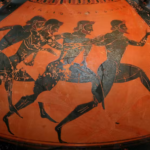
I am thinking that the OT Israel project was set up by God like the Olympic Games. A venue, athletes, prizes . When nobody won and after many were disqualified Jesus entered the Game, declared the ‘beatitudes’ He would participate in (all of them) and won. Then the Game was declared over. The tent pulled down. We follow Jesus home to the New Jerusalem. There is no point in flinging javelins anymore because the prize has been awarded.
Anglican Unscripted no. 888 on youtube discusses the subject of the previous thread, Justin Welby’s false teaching about Christian sexual purity and how he got to this place of contradiction.
George Conger and Kevin Kallsen outline the story,
Yes, tumah and kashrut are governed by different set of laws https://www.myjewishlearning.com/article/introduction-to-the-jewish-rules-of-purity-and-impurity
Had Jesus abolished kashrut, you’d expect the disciples to have noticed whereas it remained a debate in the early church. This said, I’m not sure he did away with purity laws altogether either. He assumed that contact with corpses would render one impure (hence the comment on whitewashed tombs). Also wetting your hands or foodstuff is a sure way of transmitting impurity rather than preventing it, it’s not so simple. But the debate became obsolete anyway as without the temple, many of the purification rituals could not be performed.
Jesus was addressing a tradition of Jewish that unclean hands would defile food and make the eater ceremonially unclean. He teaches this isn’t true, for any dirt contaminating the food would pass out of the body without bringing about spiritual uncleanliness.
I’ve always understood when Mark wrote at the end of Jesus’ response: (In saying this, Jesus declared all foods clean), that it was in parenthesis because it is Mark’s application of Jesus’ teaching to the different question of kosher foods. Mark did not feel free to invent a teaching of Jesus.
Yes, tumah and kashrut are governed by different set of laws https://www.myjewishlearning.com/article/introduction-to-the-jewish-rules-of-purity-and-impurity
Had Jesus abolished kashrut, you’d expect the disciples to have noticed whereas it remained a debate in the early church. This said, I’m not sure he did away with purity laws altogether either. He assumed that contact with corpses would render one impure (hence the comment on whitewashed tombs). Also wetting your hands or foodstuff is a sure way of transmitting impurity rather than preventing it, it’s not so simple. But the debate became obsolete anyway as without the temple, many of the purification rituals could not be performed.
One last thing: there is a Scriptural injunction to wash one’s hands: ‘And whoever the zav / person with a discharge touches, without having rinsed his hands in water, he shall wash his clothes, and bathe himself in water, and be unclean until the evening.’ Lev 15.11
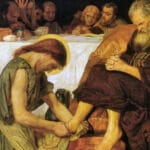
The washing of feet at the Last Supper was a ritual act too.
Was that not a recapitulation of the High Priestly role being executed by Jesus at Passover? Some writings of Messianic Jews, draw out more from Jesus at Passover.
Peter didn’t need a full body wash.
Is there not a macro and micro context, a setting within the systems of cleansing for sacrifices, for the ordained, festivals feasts, a system for cleansing of human (priests) and material.
vessels in dedication to God.
(Micro -level, hand washing for daily food was an addition.)
But key to any or all of it, was the heart, heart cleansing, motives a whole life dedication cleansing, which required a new heart conversion – (Jeremiah.) as opposed to mere external ritual cleansing.
And any liturgical system can exist for its own purposes and hide true, inner ‘heart’motives, of stone, of flesh.
So scripturally what is heart, the totality of mind, will, emotions, of body?
Nomian v Antinomian.
They are equal but opposite errors based on the same corrosive belief, a belief that God in Triunity is not Good.
Grace of God is the corrective, antidote. (After Sinclair B Ferguson, The Whole Christ)
I think this is a persuasive argument by Logan Williams.
Re Acts 15: Christopher Miller I think would agree — in his PhD (details below, well worth reading) he argues that the four prohibitions agreed in Acts 15:20 are from Leviticus and were applied to the gentiles in that original context (91, 102, 108).
As regards the statement by Logan, ‘“Do gentile messiah-believers need to obey Torah?” Everyone at the Council agrees that they must do so.’ — I think I can agree with this, but I would also agree with this statement by Chris Miller:
‘The truths revealed in the book of Hebrews [i.e. the complete abolition of Mosaic law] had not yet been given and that understanding was not a necessary prerequisite for the Gentile mission (124, 145).
‘Jewish believers, in the transitional period AD 30 to AD 70 rejoiced in their salvation through the Messiah and expressed their worship in the best way they knew, i.e., obedience to the law.… each book of the NT should be interpreted in its chronological context.’ (4−5, 126)
Miller, Christopher A. “The relationship of Jewish and Gentile believers to the Law between A.D. 30 and 70 in the Scripture.” PhD, Dallas Theological Seminary, 1994
How interesting, thanks. Is the thesis available online?
Yes, I think so. I will email you a copy.
What need was there for a Jewish believer in Jesus to present animals for sacrifice in Jerusalem for his sins after the Crucifixion? Let alone a gentile believer in a distant land.
That is a good point regarding the timing of any given writing. Would you therefore, Colin, effectively ignore the Law in your daily life, eg not keeping the Sabbath, eating black pudding etc?
Sabbath is ancient Israel only; I am not sinning if I don’t keep it. But I avoid black pudding.
Hi PC1,
Yes.
Regarding the Editor’s note, I covered similar ground in my comment following the Editor’s piece. To repeat more or less verbatim, the Greek is mistranslated and should read in English ‘since it enters not his heart but his stomach, and goes into the sewer, which cleanses all the food.’ The verb ‘go’ here is ἐκπορεύομαι, the same verb as in v. 20, 21 and 23 – more literally ‘proceed/go forth’. The use of the same word is deliberate on Luke’s/Jesus’s part, to accentuate the contrast between the outward physical things and the inward matters of the heart. The Greek word ‘cleansing’ agrees grammatically with ‘sewer’ [not the ‘person’ of v. 18]. ‘Thus he declared all foods clean’ is an inept paraphrase arising from not understanding the text. There’s no ‘thus’, the word for ‘sewer’ is ignored, and καθαρίζω does not mean ‘declare clean’. The AV is correct if ‘purging’ there qualifies ‘draught’ (i.e. sewer).
If Jesus had explicitly declared all foods clean, Peter would have ceased to have qualms about the clean/unclean distinction and would not have objected vehemently when in Acts 10 he was told to regard all foods as clean – for so he understood the vision. It turned out, of course, that ‘all the quadrupeds [not ‘all kinds of animals’] and reptiles [creeping animals] and birds of the air’ were symbolic of the nations.
Acts perhaps gives us the clue to understanding why certain foods considered acceptable after AD 30 were previously deemed unclean – unclean for Israel and Judah. The food laws were one way in which Israel could recognise that they were to keep themselves apart from the nations. This was the essence of them, not the intrinsic properties of the foods themselves. When, by his atonement, Jesus abolished the Jew/Gentile divide, the distinction between clean and unclean foods necessarily went too.
The covenant represented by the ‘Torah’ applied only to Israelites, and to those non-Israelite inhabitants in the land who wished to be part of the covenant. In the covenant the Israelites were obligated to obey the Torah, and in return God would bless Israel in material ways. Inadvertent infraction of the law, and sin generally (as Jesus emphasised in Matt 5–6, it was not possible to fulfil the moral law perfectly), was covered by the sacrifice system. God would bless the land, and defend the nation against its enemies, thereby ensuring it would remain in the land. The covenant was not a promise that Israelites would inherit eternal life. The covenant was abolished in AD 70. The Jews were expelled from the land (in accordance with the covenant), and all the promised blessings associated with the land of Israel ceased to be available.
I therefore don’t agree that the Torah obligates different people in different ways. And the ruling of the Jerusalem Council is not about Gentiles (selectively) obeying the Torah.
RE: “The Greek word ‘cleansing’ agrees grammatically with ‘sewer’”
This view has been popular among German scholars at least since Joseph Knabenbauer’s 1894 Latin commentary on Mark, but in my article I explain why I think it is not tenable. The participle does not agree with “sewer”. Agreement would require the the participle to be in the accusative. Is it, however, in the nominative.
Note also that the KJV cannot be taking the participle to modify “sewer” because it is working with the Received Text, which has a neuter participle there (which therefore cannot be modifying “sewer”, since the noun is masculine). The KJV, like most interpreters before it, took the neuter participle to be appositional to the entire previous clause.
I agree. Mea culpa.
‘I therefore don’t agree that the Torah obligates different people in different ways. And the ruling of the Jerusalem Council is not about Gentiles (selectively) obeying the Torah.’ Yet that is the way Jewish tradition has always read its Torah, as containing different covenants made with different people: with Noah (hence the Noahide laws reiterated by the Jerusalem council as binding on all humankind), with Abraham and with Moses, for the people of Israel only.
https://www.sefaria.org/sheets/270814?lang=bi
תנו רבנן שבע מצות נצטוו בני נח דינין וברכת השם ע”ז גילוי עריות ושפיכות דמים וגזל ואבר מן החי
Sanhedrin 56a:24
§ Since the halakhot of the descendants of Noah have been mentioned, a full discussion of the Noahide mitzvot is presented. The Sages taught in a baraita: The descendants of Noah, i.e., all of humanity, were commanded to observe seven mitzvot: The mitzva of establishing courts of judgment; and the prohibition against blessing, i.e., cursing, the name of God; and the prohibition of idol worship; and the prohibition against forbidden sexual relations; and the prohibition of bloodshed; and the prohibition of robbery; and the prohibition against eating a limb from a living animal.
It should be clear from the context of the discussion that we are discussing the Mosaic covenant, not the covenant with Noah, or Abraham.
Steven The Torah (without quotation marks) embraced much more than the Mosaic Covenant; it incorporates , the creation account and of course the Noahic and Abrahamic Covenants. This latter covenant has made a profound impact (as has the Mosaic) on NT theology . “The covenant was abolished in AD70” and “the Jews expelled from the land( in accordance with the covenant)”. I assume you are operating from a “Christian! perspective. It’s certainly not a Jewish one!
Moreover, assuming that you base your statement that in AD70( ” all the promised blessings associated with the land were abolished”)in relation to the Mosaic Covenant, the concept of the land actually originated in the *Abrahamic* Covenant – [Genesis 17: 7 – 8]. For reasons other than those you proffered, there will be many who agree with your proposition but for other reasons. At this juncture, I simply make the following observations: first, this covenant is described as everlasting (unless you believe this term simply means ‘a very long time). And secondly, whilst the New covenant heralds the extension of the Gospel beyond the confines of Israel to embrace the fulness of humanity in Christ, and a ‘new heaven and a new earth’; as the original promise referred to the land of Canaan, alternative interpretations would require a re-interpretation of the original. Is this exegetically valid?
Hi Colin,
“this covenant is described as everlasting (unless you believe this term simply means ‘a very long time).”
If you are referring to the mosaic covenant, we cannot ignore the fact it was conditional.
Try writing down the number of times in the Pentateuch regarding that covenant that the Bible writers use the word “if” – you will need a big piece of paper. And the Old Testament makes it repeatedly clear that Israel didn’t fulfil their part of the covenant.
In other words, the land promised Israel was lost. The land promised to Abraham was not – it belongs to ‘a better country’ – Hebrews 11:16.
Yes Colin – And he has also prepared a *city* for them (Hebrews11:16) . And that city is – the New Jerusalem (Revelation)! . Of course if you follow the logic of ” Covenantal Theology” et al. , all of this will be “spiritual”. In Hebrews 11: 19 we are told that ‘Abraham reasoned that God could raise the dead”. In NT terms, the dead in Christ will be raised in the form of a ‘spiritual body” [1 Corinthians 15]. But here, given that this body can eat bread and fish, not to mention the risen Lord’s appearing in the locked room ; in this context ‘spiritual’ surely refers to a body created directly by an act of God! Otherwise we are dealing with ‘material ‘ bodies existing in the context of a ‘spiritual Jerusalem’ and by extension perhaps – a *spiritual* world order!
I do not dispute that” Israel didn’t fulfil their part of the covenant”. However , the fact that the Gospel declares that God’s *final* word is that He has “not rejected his people” [Romans 11:1], coupled with the declaration that in spite of being” enemies of God for your sake” , paradoxically, as regards *election, they are loved* on account of the patriarchs [Romans 11:28]”. And “they too have now become disobedient in order that “they too may receive mercy as result of God’s mercy to you (Gentiles) [11:31].
Finally, Scripture postulates that post resurrection, all shall be transformed and as Revelation 21 indicates: there will be a new heaven, a new earth – and a new Jerusalem! Then ,at the very least, the New Jerusalem could be surrounded by the land that encircled it in the first place; the land promised through the everlasting covenant of Abraham. If “the gifts and calling of God are irrevocable” [Romans 11: 29], then I for one believe that if Abraham uttered this promise at the behest of his heavenly Father ,then at the very least, I am not prepared to see “plan A” substituted by an ethereal “plan B”!
PS By Plan A, I do not exclude the New Covenant. Likewise I am aware that Hebrews speaks of The Mosaic Covenant as obsolete; and likewise I am aware the New Covenant as outlined by Jeremiah is cited virtually verbatim in Hebrews – but is addressed in this context to “the house of Israel and the house of Judah” – not the “New Israel”.
Hi Steven,
“I therefore don’t agree that the Torah obligates different people in different ways.”
I agree.
“And the ruling of the Jerusalem Council is not about Gentiles (selectively) obeying the Torah.”
But if you had a struggling alcoholic friend to whom you were trying to be a witness you might avoid alcohol when you were with him?
Havent we moved on from the Jerusalem Council?
Isn’ t a main point of this thesis, as circumscribed by the interview format of the article, to counter antinomianism, Peter – a school many revisionist seem to subscribe to?
Oooh, I agree.
But there lies the problem. Hebrews seems to say the old covenant with the Jews is ‘obsolete’. That included the Law, in fact Hebrews refers to stone tablets which is a bit of a clue.
I’d have to look at sat the detail and maybe a commentary, Peter.
Hebrews draws together the OT completed in Jesus, Prophet Priest and King, so while the Torah is fulfilled in Him it finds its expression in him as as the Word of God, made flesh to be followed and obeyed.
Neither antinomianism nor nominanism, but only by Grace of our insurmountably Good Triune God to please and enjoy. Why would we want it to be otherwise, doing what is right in our own unenlightened, finite eyes, view and skewed perspectives?
Stone tablets… “A clue”? … I’m not sure you can read it that way.
They would unlikely to be on paper (of any kind)… Possible on clay tablets… Not likely on an ipad…
Stone, on the other hand, is extremely durable, fireproof, waterproof and required no batteries… has a permanence rather than transience. (I call on numerous churchyards to witness)
So I would not read much either way into what Moses to hand. Or to what flimsy stuff the Gospels were written on.
I find that part of Dr William’s argument is anticipated not only in the older English translations (Tyndale, Wycliffe, AV), but also in the older commentators who relied on those translations (e.g. Matthew Henry, Albert Barnes). Among modern commentators, I have only found (so far) one who develops a similar case – France (NIGTC). I’m by no means competent to judge on such matters, but France writes:
‘The masculine nominative participle, “cleansing” (katharizon, with an omega), would modify the verb “he says” in 7:18. A well-attested variant reading, however, has a nominative neuter participle (katharizon, with an omicron). It is the hardest reading and may be the best. It would affirm that the food has somehow become clean in the process of its elimination.’
that’s a great spot. Thanks!
I’d be interested to know how Logan would view Romans 14, especially vs 14 and 20. Also, Luke 10:7-8 are relevant passages given that some households did not strictly follow Torah food laws in the second temple period.