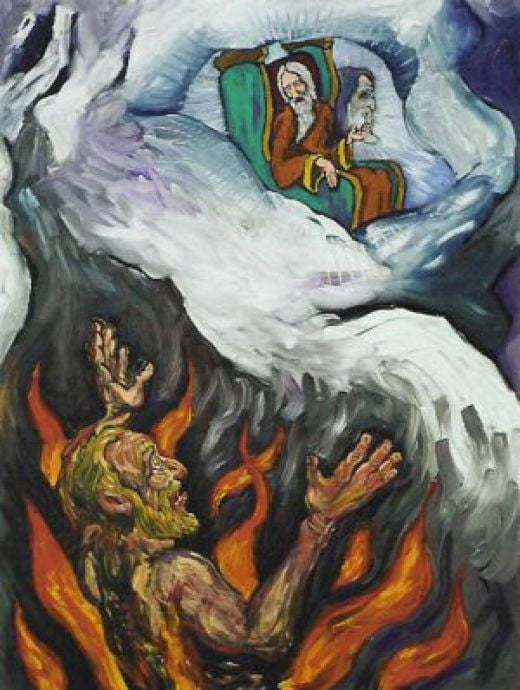
How should Luke 16.19ยญโ€“31 shape our view of heaven and hell?

The story of the rich man and Lazarus appears on first reading to depict a detailed โ€˜mapโ€™ of โ€˜heavenโ€™ and โ€˜hellโ€™, but is this the right way to read it?

First, it is worth noting that the words โ€˜heavenโ€™ and โ€˜hellโ€™ themselves do not occur in the parable. The NT talks about post-mortem life in a range of ways, not all of them easy to reconcile with one another. Perhaps the most controlling one would be the idea of ‘sleep’ as used by Paul in, for example, 1 Cor 15. ‘Heaven’ in the NT mostly appears to refer to the realm of God’s presence, reign and reality, and the central NT hope is not that we will leave the earth to go to heaven, but that Godโ€™s realm will come down to the earth (see Rev 21). (See Tom Wright’s Grove booklet for the most accessible exposition of this.)

Continue Reading

The Spirituality of John part (ii)

This is the second half of an article; part (i) can be found here. 3. A Spirituality of Conflict and Decision Whilst seeming to be the most โ€˜reflectiveโ€™ of the gospels, John is also the one which contains the sharpest conflicts. Jesus is in constant debate with โ€˜the Jewsโ€™โ€”not usually, in fact, the Jewish people … Continue Reading

The Spirituality of John part (i)

It feels like a natural thing to be reflecting on the spirituality of St Johnโ€™s gospel; after all, it has been referred to as โ€˜the spiritual gospelโ€™ since the early church. Markโ€™s driving narrative presents us with Jesus as a man of action, making clear who he is through what he does. Matthewโ€™s organised presentation … Continue Reading

Preaching on narrative

Last week I had the interesting experience of preaching on Mark 14โ€“15.15, which covers the anointing at Bethany, Judas agreeing to betray Jesus, the last supper, Gethsemane, Peter’s denial, Jesus’ trial before the Sanhedrin, and Jesus before Pilate. Whew! But I learnt a lot from the experience.

1. This is not the usual way we treat these passagesโ€”most of the time I would imagine we aim to preach on each episode in detail. That is one way to read them, but another (and probably more common) way of reading in the early centuries would have been to have heard larger pieces of narrative, and so have a better feel for the whole ‘shape.’ At St Nic’s we have been working through Mark, and

Continue Reading

Hosea: shocking prophecy

I am working with Celia Kellett atย BBC Radio Nottingham on an idea to present most of the books of the Bible, one a week, during 2011 as part of theย celebrations of theย King James Bible.The plan is to read some verses from the book, to give a one-and-a-half minute summary, to hear a human interest story which relates, and then include a short discussion making the connections.

Here are the key verses and summary for the prophet Hoseaย to beย broadcast this Sunday 10th April from around 8.20 am:

Verses: Hosea 1.2โ€“3 and 11.1โ€“4, 8
When the LORD began to speak through Hosea, the

Continue Reading

Lost and found in translation

Last night we were greeted with the tragic news that the person killed in Jerusalem by a terrorist bomb was not only a British citizen, but a Wycliffe Bible translator. Mary Gardner was there to learn Hebrew in order to improve her skills in translation work. Our thoughts and prayers are with her family and colleagues at Wycliffe.

Why would someone risk their life, or at least suffer considerable personal sacrifice, for the sake of translation? The answer is that translation of the Bible is at the heart of Christian faith, for two reasons.

The first relates to the Christian faith’s unique global vision. There is no ‘Wycliffe Qur’an Translators’ or ‘Translation Committee for the Bhagavad Gita.’ This is because, from the very beginning, the followers of Jesus had a centripetal (rather than centrifugal) desire to make the good news relevant to others. The roots of this can be found in Jesus’ restlessness to move on to other villages early in his ministry in Mark 1.38, and in John 10.16 in his declaration that ‘there are sheep who are not of this

Continue Reading

Why I want to be Left Behind

Matt 24.36โ€“41 is one of the two key passages used to teach the doctrine of the ‘rapture’, the idea that believers will secretly be taken up to be with Jesus at some point before his ‘return.’ (The other passage is 1 Thess 4.13โ€“18.) But close reading shows that Jesus teaches no such thing. The passage … Continue Reading