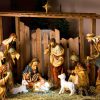
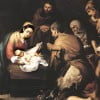
Jesus was not born in a stable

I am sorry to spoil your preparations for Christmas before the Christmas lights have even gone up—though perhaps it is better to do this now than the week before Christmas, when everything has been carefully prepared. But Jesus wasn’t born in a stable, and, curiously, the New Testament hardly even hints that this might have … Continue Reading
Interpreting the sheep and the goats in Matt 25

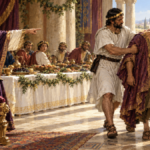
Jesus’ ‘parable’ of the sheep and the goats in Matt 25.31–46 is very well known and widely misinterpreted. It forms one part of the extended teaching about ‘the end’ distinctive to Matthew (compared with Mark and Luke). It is most commonly interpreted as an injunction to help the poor; most Christians (in the West at least) read … Continue Reading
How do young (and old) people read Bible stories?

The latest Grove Biblical booklet, Interpreting Bible Stories with Children and Young Teens, is a fascinating exploration of the challenge of reading Bible stories with young people, by Melody Briggs. Melody begins by setting out the practical challenge that we might face: You are a church children’s work volunteer and it is your turn to lead the next … Continue Reading
Did John ‘see’ Jesus?

Revelation has been hugely influential on the history of Christian art. If you are in the habit of visiting church buildings that have stained glass, you won’t have to travel far to find images drawn from the book. But what is striking in the images of Jesus, based on Revelation 1, is that Jesus is … Continue Reading
Resolving tensions in our reading of Scripture

Following my previous observations about Tony Campolo no longer calling himself evangelical, Tony himself responded on Christian Today. Every once in awhile unfair judgments are made. That was the case when Christian Today contributor Ian Paul wrote that I, along with other Red Letter Christians, emphasised the red letters in the New Testament, which in many Bibles highlight … Continue Reading
When is God ‘coming on the clouds’?

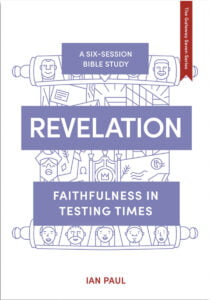
Quite early on in Revelation (1.7) we find the phrase ‘I am coming with the clouds’, and it is striking that the near universal view of commentators on this verse is that it is a reference to the return of Jesus to earth, as promised in Acts 1 and elsewhere. (Note that the New Testament never uses the now-popular phrase ‘second coming’ of Jesus, since this pairs the future with his ‘first coming’ in the incarnation, whereas the NT always pairs his return with his departure, as in ‘he will return in the same way you have seen him go’ in Acts 1.11).