The Bishops on LLF: how good a diagnosis of our pain?
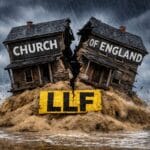
Summary: the statement from the House of Bishops is much as anticipated in terms of drawing the LLF process to a close with none of the further promised changes being introduced but putting a new process in place to report to Synod sometime between February 2027 and July 2028. There is therefore much here to encourage those committed to current teaching and practice in contrast to most statements in the last three years or more.

But there are also concerns about the statement. These relate to the lack of pastoral provision and the possible restarting of a new process with similar goals albeit now following due process. More seriously, the statement makes starkly clear the depth of pain and division the LLF process has now produced across the whole church and particularly for gay, lesbian and same-sex attracted Christians whatever their convictions. However, in its account of unity and disagreement the statement fails to offer anywhere near an adequate analysis of why this disagreement has caused so much pain and ended as it has done.

There is also little evidence that the House collectively has a sufficiently clear sense of its episcopal responsibilities and how to exercise them better in future in the light of what has happened and where we now are. This means major concerns must remain that we are still some way from avoiding a repeat of the difficulties of the last three years when the bishops bring something back again to the new Synod to be elected this summer.

Andrew Goddard writes: After the House of Bishops met yesterday (14th January 2026), it issued an important statement on Living in Love and Faith (LLF) in the form of a 9-page, 41 paragraph “letter” which had the support of 35 bishops, 1 dissenter and 4 abstaining. This vote signals what the letter refers to as “a high degree of consensus” as evidenced in the accompanying press release with extensive quotations from the Archbishop of York and the bishops of Winchester, Sheffield, Chelmsford, Blackburn and Oxford (but none from the Archbishop of Canterbury-designate).

Running on empty in the PLF journey?

The following article by Andrew Goddard provides a historical overview and critique of the Church of England’s protracted and divisive struggle to implement the Prayers of Love and Faith (PLF) for same-sex couples. It argues that despite years of debate and shifting promises, the House of Bishops has largely failed to find a consensus, ultimately … Continue Reading

Who Owns Jesus? Tommy Robinson and The Dirty Revival

The fury over a Christmas carol event exposes the ideological gatekeeping hollowing out British Christianity. Jason Clark writes: Over the last few days, my social media feeds—shaped by the strange, selective algorithms we all live under—have been replete with progressive and left-leaning Christians condemning the upcoming “Christ in Christmas” event in London linked to Tommy … Continue Reading

The elephant in the nativity room?

John Hudghton writes: Around this time of year my nerdy mind turns to constructing an authentic biblical nativity scene. This amuses my family, to say the least. I try to take on board the lessons of biblical scholarship that Ian Paul has usefully and consistently emphasised for years now. Sadly, this is something which is … Continue Reading

Can the BBC be re-enchanted?

David Campanale writes: It was in a one-to-one union meeting with BBC management where I met the darkness. In the wake of the post-Jimmy Savile BBC Trust investigation into a culture of bullying, harassment and control inside the BBC, I had gone on behalf of the National Union of Journalists to read out evidence from … Continue Reading

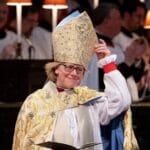
Is the Archbishop of Canterbury head of the Church and the Communion?

Martin Davie writes: The announcement of the choice of the Bishop of London, Dame Sarah Mullally, to be the next Archbishop of Canterbury has been accompanied by frequent references to the Archbishop of Canterbury as the ‘head of the Church of England’ or the ‘head of the Anglican Communion.’  In this post I shall explain … Continue Reading

Is ‘Christian nationalism’ a contradiction in terms?

Martyn Whittock writes: Where should we stand on the subject of ‘Christian nationalism’? As a Christian historian (with a very eclectic set of interests, and having written about early-medieval national origins, attempts at theocracy in the 17th century, and modern European dictatorships) I am very conflicted about the combination of faith and nation. And I … Continue Reading

Do we have a ‘polyphonic’ God?

John Root writes on: Polyphonic God: Exploring Intercultural Theology, Churches and Justice, edited by Israel Oluwole Olofinjana, David Wise, and Usha Reifsnider. This book is a goldmine. Several of the contributions are brilliant; none is without merit. Church leaders in multi-ethnic communities will find the book invaluable, despite its fairly hefty price. Contributions come from … Continue Reading

Writing out the Bible by hand

I was fascinating to learn, on social media and in personal conversation, that my friend and General Synod colleague Kate Wharton has for several years been writing out the Bible by hand in personal notebooks. So I asked her about the project. IP: What has this project involved? How much time has it taken so … Continue Reading