
Dear Stephen
I read with interest your address to York Diocesan Synod on 5th July, and one word leapt out for me: ‘final’. Near the end of your address, you comment:
The Living in Love and Faith process is not yet complete. Some final proposals will be brought to the February 2026 meeting of the General Synod.
If that is the case, I am and countless others (on all sides of this debate) will be delighted. This has been a disastrous and divisive process since 2017; I wonder whether you realise how damaging it has been, and whether you will ever publicly acknowledge that. It sprang out of Justin’s spontaneous and ill-conceived phrase “radical new Christian inclusion rooted in scripture and Christian theology” which was both incoherent (how can this be new if it’s rooted in existing theology?) and immediately open to misinterpretation—almost everybody who wanted to see change forgot the second half of the phrase.
And this summer’s ‘consultation’—which has been widely rejected, since there have been no new proposals to consider—have amply illustrated that. In every diocese that has discussed it, as far as I can tell, the discussion has highlighted how divided we are, and that the LLF process, far from enable us to ‘live with difference’, has exacerbated division. I suspect the conversation in York won’t have been much different.
But there were other comments in your address that I feel I need to respond to.
The church was divided on how to receive and celebrate the presence in our congregations and the ministry of people in stable, committed same-sex relationships.
Well, this all depends on what you mean by ‘the church’. The Church of England is not divided at all in its doctrine. As you know very well, canon law is very clear on both where we get our doctrine (that is, our understanding and our teaching; ‘doctrine’ is just the Latin-based word for teaching), and what our doctrine of marriage is:
A 5 Of the doctrine of the Church of England
The doctrine of the Church of England is grounded in the Holy Scriptures, and in such teachings of the ancient Fathers and Councils of the Church as are agreeable to the said Scriptures.
In particular such doctrine is to be found in the Thirty-nine Articles of Religion, The Book of Common Prayer, and the Ordinal.
B 30 Of Holy Matrimony
1. The Church of England affirms, according to our Lord’s teaching, that marriage is in its nature a union permanent and lifelong, for better for worse, till death them do part, of one man with one woman, to the exclusion of all others on either side, for the procreation and nurture of children, for the hallowing and right direction of the natural instincts and affections, and for the mutual society, help and comfort which the one ought to have of the other, both in prosperity and adversity.
The implications of this (that sexual intimacy outside the context of the marriage of one man and one woman is sin and should be met with a call to repentance) has been reiterated both by statements in the House of Bishops and by answers to questions on General Synod on multiple occasions, including in LLF debates. You have been part of the HoB which issued such statements.
So where is the ‘division’ here? It can only be that the Church of England on the ground is divided on whether it knows, understands, and believes the doctrine of the Church itself. And you yourself are part of this. When you made your statement after the February 2023 debate, on Radio 4, that sexual intimacy is appropriate for anyone in a ‘permanent, faithful, stable’ relationship (without defining any of those terms), you contradicted the doctrine of your own Church, something you vowed to uphold.
When I have challenged you on this, you have denied that they are contradictory, and claimed that you still believed the doctrine of the Church, and that in February 2023 you ‘misspoke under pressure’. Stephen, these claims are not credible! The heart of our problem is that we have bishops and archbishops who do not believe the doctrine of their own Church!
You then go on to say:
I believed that this was not an issue that should divide the Church; that I respected and valued the conscientiously-held theological convictions of those who saw the issue differently.
On what basis do you believe this? Where has the theological work been done on this? You appear to be saying, by archiepiscopal fiat, that this subject is a ‘thing indifferent’, one of the adiaphora, despite the fact that, all through scripture, and all through the history of the Christian church, it certainly is not. Liberal, critical scholar, the late E P Sanders, commented:
Homosexual activity was a subject on which there was a severe clash between Greco-Roman and Jewish views. Christianity, which accepted many aspects of Greco-Roman culture, in this case accepted the Jewish view so completely that the ways in which most of the people in the Roman Empire regarded homosexuality were obliterated, though now have been recovered by ancient historians…
Diaspora Jews had made sexual immorality and especially homosexual activity a major distinction between themselves and gentiles, and Paul repeated Diaspora Jewish vice lists.
In other words, the belief in marriage as between a man and a woman was the ethical distinctive in the first-century world, and the first followers of Jesus, even if they were gentile, adopted the same (Jewish) position. On what grounds should we dispense with this? I cannot find anywhere where you have given an answer to this.
But I’ve always also said that actually, this is the real business of preaching the gospel. The gospel of Jesus Christ is about breaking down barriers of separation, confessing our sinfulness and our need of God.
Breaking down barriers is indeed the gospel of Jesus Christ, which is why the term ‘reconciliation’ is, I believe, at the centre of Paul’s theology. But breaking down barriers between whom, and about what? I cannot see any evidence that Paul (or Jesus) are concerned to make central issues of the gospel unimportant, and pretend we can ‘agree to disagree’ on vital matters—rather the opposite! The heart of Jesus’ message (according to the gospels) is that the holy God is coming; we need to turn from our sin to be ready to meet him; and he offers forgiveness and new life to those who do so.
This whole debate is precisely around what does indeed constitute the ‘sinfulness’ that we need to repent of—and it cannot be reduced to ‘disagreement’. All our canons, all our liturgy, and all the previous statements of the House have been clear on this. Why are you confused?
You continue:
Sisters and brothers, the Bible is clear on this: we are each of us fearfully and wonderfully made. We are all precious to God. God has a purpose for everyone’s life. God does not make mistakes. Each of us is made in God’s image. We know that sexual orientation is part of who we are and how God has made us.
Stephen, you are making an extraordinary claim here. First, you appear to be claiming that sexual orientation is something we are born with, when all the scientific evidence says this is not so. (Babies are not born even knowing there are two sexes; this is something they must learn. So how on earth can we be ‘born’ with our sexual orientation?)
Secondly, you appear then to be claiming that whatever we are is what God intended us to be. Are you serious? Are you suggesting that our sexual orientation is the one area of our life that is free from sin and its effects? And which particular sexual orientations are you referring to? Are all patterns of sexual attraction and desire part of ‘how God has made me’, or only some? And how might we tell the difference? Are not these the kinds of questions that the LLF process should have explored—notwithstanding the Church’s own already well-formed answers to these questions?
Not prayers of blessing on the union itself, but recognising the many goods that are clearly evident in people’s lives, the Church can gladly bless these people and pray for them.
Thank you for noting what was actually agreed by Synod; if it has not said this, then this would be indicative of a change of doctrine of marriage. But presumably, when we ‘pray for them’, we pray that they will grow to be ‘full mature in Christ’ (Col 1.28)—which must include accepting his teaching on the nature of marriage?
However, while I also know it is not enough for many people in our Church, it is too far for others who, because of their theological conviction, do not want to exclude people of same-sex relationships from their church, but do not feel able to offer the Prayers of Love and Faith.
Stephen, in saying this, you demonstrate that you do not understand the position of those who disagree with you. This isn’t a matter of personal ‘theological conviction’; it is a matter of whether we believe our own doctrine and the teaching of Jesus himself. This is not about ‘feeling able’ to do one thing or another. It is about whether or not the Church of England has the integrity of its own convictions.
I want the Diocese of York to know that I and my colleagues, Bishop Flora, Bishop Barry and Bishop Eleanor, will support and defend the right of clergy in the York Diocese to use the Prayers of Love and Faith according to the House of Bishops’ guidelines.
And what action will you take then they are used outside these guidelines, and in a way which is indicative of a change of doctrine? In York Minster a few months ago, Canon Tim Goode presided over an act of blessing a same-sex couple, in which the service appeared to be a special occasion, it involved the exchange of rings over which Tim prayed a pray of blessing (in secret, except for posting a picture on Facebook), and afterwards there was a celebration described as a reception. All this is outside the guidelines, and will have been experienced by those attending as a quasi-marriage celebration. I know you know about it because I wrote to you at the time.
What action did you take? If none, how can we take seriously your commitment here?
These prayers are what are sometimes called a ‘pastoral accommodation’.
No, they are not, and to claim so it to misappropriate this term. Oliver O’Donovan expounds this idea of ‘pastoral accommodation’ as a pastoral strategy in Christian ethics where the Church temporarily makes allowances for human weakness or immaturity, while still upholding the full moral ideal of the Christian life. By contrast, you are setting this out as a permanent provision which affirms an alternative view of the doctrine of marriage. For O’Donovan, the goal is that those who are thus accommodated should, in time, return to the unchanged teaching of Jesus. You seem to take a different view.
But I also realise it increases anxiety for clergy who are opposed to these developments, and they wonder what provision they will receive if they consider themselves to be out of step with their bishop or their diocese on something which, from their perspective, seems to fundamentally threaten the Church of England’s doctrine of marriage. I understand this concern.
No, you don’t appear to understand it, and your language here about ‘anxiety’, ‘from their perspective’, and ‘threaten’, betray this. ‘Clergy who are opposed to these developments’ do so because they are indicative of a departure from the doctrine of the Church, they are being pushed by people (like you) who clearly don’t believe the doctrine of the Church, and there has been manipulation, secrecy, and dishonesty in the process.
We will do all that we can to ensure that every parish can flourish, whatever their theological conviction.
So you see your role as encouraging all parishes to flourish, whatever their view on the doctrine of the Church to which they belong? Whether they accept or reject the teaching and discipline of the Church? And presumably that includes clergy, regardless of whether they uphold or deny their own ordination vows? What became of your solemn commitment expressed at your ordination:
Will you teach the doctrine of Christ as the Church of England has received it, will you refute error, and will you hand on entire the faith that is entrusted to you?
You then go on to say:
I welcome the documents offering theological underpinning for our decision-making. They will be available soon and I rather wish we had had them earlier.
This is a very odd claim! For, with Justin, you were surely responsible for the rush to bring things to Synod in 2023 without the proper theological work having been done. And when you were given theological and legal advice, you refused to publish it—presumably because what was being said did not support the ongoing aims that you wanted to pursue. The whole process has been back to front, and should have started with theology. The idea that you now welcome this is, again, completely unconvincing.
As ever, I will continue to be guided by my reading of scripture, my discernment of the theological advice, and my concern for the unity of the Church, which means actually that my views haven’t changed much over 21 years.
How can you claim you are ‘concerned for the unity of the Church’, when you have been one of those pressing ahead with a process that has been so divisive? To act in a way which creates division, and then claim you are doing the opposite—and then appearing to suggest that it is those who are pointing out the division you are creating who are the problem, has a term, which I think is ‘gaslighting’. You constantly portray those who highlight the seriousness of the issue as the ones who are the problem. Just look at the impact that the LLF process that you and Justin have driven has had on the Anglican Communion—deeply and possibly definitively divided.
I do believe you that your view has not changed over 21 years—but of course this implies that, in all that time, you have never actually believed the doctrine of the Church as set out in Canon B30.
No one in the York Diocese needs to feel that they must sacrifice their deeply held theological conviction. But nor do we need to retreat into parallel jurisdictions which end up creating churches within churches.
Those who ask for ‘parallel jurisdictions’ are not ‘retreating’; they are seeking to maintain the ‘doctrine of Christ as the Church has received it’, and asking you not to bulldoze us into something different. But why do you think you can tell us what we should and should not do? Did you not read the recent paper from the Faith and Order Commission, whose theology you say you welcome? They make it quite clear in para 139:
It is a failure of Christian love for one side to declare what kind of disagreement is being experienced by the other. It must surely be the case that those who disagree with a given decision are themselves determinative of what kind of disagreement is in view, not the content majority. Those who dissent from the majority view or decision get to define the nature of their disagreement: if it is widely held that such-and-such a belief or practice calls into question apostolic communion or ecclesial communion, then the disagreement simply is a first- or second-order disagreement, regardless of whether the majority think it merely strains communion (third order).
Please read this carefully: ‘a failure of Christian love’.
As we head into General Synod in York, those of us who do believe ‘the doctrine of Christ as the Church has received it’ on questions of marriage and sexuality are faced with being led by an archbishop who does not actually understand our concerns, who does not appear himself to believe that doctrine, who has created immense division in the Church of England and the Anglican Communion, who has led a process that has avoided starting with theology, and who fails this test of love by telling us how we ought to feel about it.
Is it any wonder that clergy feel stressed and demotivated? Stephen, I implore you, change direction, and allow us to return to focussing on the gospel of Jesus in love and true unity around his teaching.
Very sincerely
Ian
 Buy me a Coffee







A fair, firm and factual request. I watch from the outside looking in to see how things will develop. However, it seems almost inevitable that the trajectory has been set.
But that’s the irony—the direction is not set. We cannot go in the direction: canon law will not allow it.
So all this damage is futile. Doctrine will not change, but the whole church will be damaged.
Where does canon law forbid prayers for same sex couples within existing Church of England churches?
It depends on what sort of same-sex couples, what sort of prayers, and how the latter square (or do not) with the doctrine of the Church.
Where does it oppose fracking?
Though one could wish that it opposed the practice of your (and others’) hoping people did not notice they were not capable of answering that and similar questions, and had therefore lost the argument.
Ian, a superb letter. But I agree with Sandy. I too ‘watch from the outside,’ and whilst canon law will not allow it, the experience of other Churches is that whatever the denominational superstructure or framework or ‘safety harness’ happens to be – canon law, creed, doctrines, articles, confession etc – it will simply be ignored or cleverly set aside. The trajectory does seem to be very firmly set.
The direction of greater pastoral accommodation is definitely set. And by the time further development is proposed the CofE will have become the purity cult you so longingly desire. With a tiny number of people.
What a bizarre comment Andrew.
It is churches upholding the doctrine of the C of E which are growing. The whole shape of the C of E is changing as a result.
Do you think that following the teaching of Jesus makes you a ‘purity cult’?
Churches like St Bartholomew the Great back PLF and have big congregations
The fact that St Bartholomew is a cause celebre among the 16000 Anglican church buildings in the UK says it all. Evangelicals/charismatics could name hundreds of vibrant churches.
Hundreds out of 16000 is less than 10% of C of E churches and cathedrals
Ian
You only need to look at Hillsong or Soul Survivor to see that bums on seats does not make a church right or moral. Indeed its easier to grow a church if you’re not trying to be moral/right/truthful
Indeed, if your primary focus is growing big planted evangelical megachurches you should be a Baptist or Pentecostal or independent NOT an Anglican. The focus of the Church of England should be on traditional parish ministry, especially its historic rural and market town churches and ancient city cathedrals and preserving those and the services and weddings, funerals and baptisms they offer to the local community. With the exception of a few church plants largely self funded by the likes of HTB NOT taking central church commissioner funds which should be directed to parishes and stipendiary priests
‘if your primary focus is growing big planted evangelical megachurches’. Mine isn’t. Is there any chance you could engage with real people, and not these straw men you keep constructing?
Peter, your analysis is at the high level of inaccurate aka the high level of vague. Hillsong is virtually a denomination, and much larger than a high proportion of denominations. People were very keen to ‘get’ Brian Houston and consequently acted like the worst tabloids and saw everything in Spitting Image terms, not understanding the detail or realities. You say that a USA megapastor wipes any credibility from all the other churches not connected to them. How do they even wipe the credibility from their own flock, let alone any other flocks? That is the simplistic untrue way the tabloids (who are trying to gain secularist territory in the public space at the expense of Christians) operate. Rather than doing things in a Christian way instead, in line with accuracy, you are simply swallowing whole this undetailed sledgehammer stereotyped way the tabloids do things. The worst possible approach, therefore.
Mike Pilavachi has not done anything that interests the police anyway, but it is not as though the other thousands connected with Soul Survivor are dependent on any leader for their own Christian witness. So your argument is hard to follow but easy to identify (as a possibly innocent and unknowing parroting of the dishonest tabloid approach).
‘Hundreds out of 16000 is less than 10% of churches and cathedrals’, writes T1.
My use of ‘hundreds’ is intrinsically highly imprecise, but we thank GOd for them all.
You, however, disparage ‘hundreds’.
That must be because you yourself could achieve thousands off your own bat.
I have come late to this discussion and the tone of the arguments saddens me greatly. There seems to be a concentration on Anglican church doctrine at the expense of the love that Jesus demands of us to show to each other and our fellow man. Our God is a relational God and when Jesus interprets scripture for the Pharisees when they get it wrong, it is usually because they have become focussed on rigid doctrine at the expense of receiving and expressing God’s love. Whatever our individual beliefs on this really important issue, we need to hold onto humility and remember that, like Paul, we see through a glass darkly.
So what do you think Jesus taught about marriage and sexuality? And why?
The final proposals will just complete the process. PLF has been approved by majorities in ALL 3 houses of Synod.
What must come to an end is conservative evangelicals who should really be in a Baptist or Pentecostal church NOT the established church of a nation where same sex marriage is illegal trying to overturn a clear vote of Synod which was supported by Parliament and I am sure the King as head of the C of E.
Conservative evangelicals have an opt out from PLF but be assured liberal Catholics and open evangelicals and the majority of Synod ain’t giving them an inch in terms of backing down from PLF. We expect the next Archbishop of Canterbury, most likely the Bishop of Chelmsford, Salisbury or Bath and Wells ALL of whom back PLF to be with us on that
Sorry ‘what must come to an end is conservative evangelicals who should really be in a Baptist or Pentecostal church NOT the established church of a nation where same sex marriage is legal trying to overturn a clear vote of Synod which was supported by Parliament and I am sure the King as head of the C of E.’
The “approval” of which you speak was over an issue – PLF – that should not have been the subject of a “simple majority”. The recent use of the Canon B2 process over issues that are far less contentious make incredulous the efforts to progress LLF without going down the way of a two-thirds majority in each House requirement.
Without B2 there can surely be no recognition of any aspect of the LLF proposals. If the belief is that the support is there and the objections are only held by a minority, from where does the fear of using the B2 process arise, I wonder?
No two thirds majority was required. PLF was NOT a new standalone service, only prayers for same sex couples within an existing service.
PLF was also NOT same sex marriage in a C of E church, it makes clear holy matrimony is reserved for heterosexual couples ideally for life
My point exactly, if you had understood my comment. I do not deny that the PLF vote was carried albeit without B2. However, it was far too much a “hot potato” to not elicit the B2 process.
No it isn’t. If it had been same sex marriage in C of E churches maybe B2 would have been needed, it wasn’t. It wasn’t even prayers for same sex couples in stand alone services but within services
‘Maybe’, just maybe….
You are still saying that birds of a feather should flock together – exactly the circumstances where they will enter an echo chamber and develop *least* in their understanding. And you are presenting that as being a *good* thing. Please explain.
Secondly, you are saying that everyone begins with a position which they never adapt nor refine.
The truth for truthful people is that they begin with an open mind and look at the evidence. Refining is all.
It must therefore be untruthful people of whom you are speaking.
But who would listen to *them*?
There is, however, a ‘position’ which people have from the very start, in advance of any investigation, and which they stick to. That position is called a desire, sometimes a ‘selfish desire’. And that desire you wish to *trump* all scholarly, open-minded and honest investigation.
Nothing could be more of a non starter. There is no need to read further.
Your position appears to be that since so many “good” people (liberal Catholics and “open evangelicals”) are in favor of overturning church doctrine, then the question is settled, and the “bad” people who disagree should take a hike elsewhere. In other words, that the only thing that defines correct doctrine is majority vote unshackled from scriptural concerns. I like democracy as much as the next man but this strikes me as taking it a bit too far.
Democracy does have its limitations, such as when two wolves and a sheep are deciding what to have for lunch.
Where is your information that the next Archbishop is most likely to be one of those three. Bishop Lake of Salisbury I have never even heard spoken of in this connection. Are you sure you are being honest, rather than just speaking of those you *want* to be in post? How would you know who is likely to be appointed?
Those three were in a recent Sunday Times article as being the front runners now based on what some insiders knew. After evangelical Welby a liberal Anglo Catholic is likely and Salisbury, Chelmsford and Bath and Wells are in that category
What it is to be an insider. Not like us plebs.
Ian
Excellent letter in my view summarising what so many of us feel. As for the comments above, suggesting that those of us who believe in the biblical doctrine of marriage and the Anglican church’s own doctrine have no place in the Anglican church, they are offensive and as usual carry no theological arguments.
The Anglican Church is established church of a nation where same sex marriage is now legal, headed by the King and accountable to Parliament. It is therefore in a unique position only shared by a few other churches which are still established worldwide like the Lutheran church of Denmark and hence political as well as theological arguments apply as it is the official church of the state in England
So if the British State introduces chattel slavery, we should support it? If not, why not? And if your argument as to why not rests on something on anything other than the CofE being a State Church, please at the same time explain why being the State Church should lead us to endorse same-sex marriage but not chattel slavery if both are the law of the land?
Spot on!
The Church of England did of course support slavery until the nineteenth century, indeed it often profited from investing in plantations
‘The Church supported slavery’. Did it? Where? Can you cite formal statements to that effect?
Its investments in the South Sea Company, a 1751 Act of Parliament references reducing the interest on the capital stock of the Company
Do you think it was right for someone like William Wilberforce to oppose the slave trade even though he was a faithful member of the Church of England?
If so, why was that appropriate, while it’s not appropriate for faithful Anglicans today to oppose PLF? What are the criteria that Anglicans should use for determining if they should oppose a law or a common cultural phenomenon?
Peter
I dont think the church should support everything the British government decides to do, but I think the church can hardly claim moral leadership when it has taken more than a decade to come up with pretty fundamental answers about gay people’s place in Christianity and specifically same sex marriage.
I think the failure to respond meaningfully raises other questions, such as why would anyone become a Christian when leading Christians dont understand the basics of their faith and are even embarrassed into lying about it (Justin Welby)?
Well, at least that would be biblical.
Assisted dying is on its way to being legalised. Should the Church of England fully support that because it is the established church?
Not relevant as priests are not doctors and wouldn’t give a lethal injection to the terminally ill
Of course it is relevant. Should the Church support this?
In terms of the Lords most Bishops opposed assisted dying but some former Bishops like Lord Carey voted in favour. Either way it is medics who would implement it not clergy
Yet an Anglican hospital chaplain may be called to the bedside of someone seeking religious approval of them seeking a lethal injection. At that point a chaplain/priest who holds Biblical convictions about the sanctity of life will be totally opposed to state sanctioned killing. I believe your argument lacks consistency, T1.
And what if an Anglican Chaplain wants to question why a doctor or medical procedure is torturing a patient whose life has effectively come to an end but is being prolonged by treatment they would not wish to have had they the capacity to say so.
It is very clear to me that much medical treatment is interfering with the timing of death.
I am always uncomfortable with that line of debate. There is a real tension between being a distinct Holy people and being part of the states infrastructure.
State churches run the danger of being too tied to the dominant political culture of the day. When I became a Christian my dad accused me of siding with the enemy of our people. The reason being the Lutheran Church in Germany at best had stood by as millions went to the concentration camps. That’s what Jewish heritage does for you and that is example of why being to tied to the state and its values is not always healthy.
Finally your earlier statement that Conservative evangelicals should just be Baptists I disagree with. The Churchb of England would be poorer and less broad without them . If you want an inclusive church, then it has to include the Conservative evangelicals too.
Thanks Vernon.
Vernon I agree with your plea for inclusively. Sadly that is not what Conservative evangelicals want. Their goal is the removal of anything remotely liberal or inclusive in this matter and that has been the case ever since they forced the resignation of Jeffrey John.
What orthodox Anglicans want is bishops who believe in and live out the doctrine of Christ as the Church has received it.
Jeffrey John did not.
If you want to be fully orthodox that means removing women bishops too. You will never win as the establishment church has the King and Parliament behind it both of whom want a national church not a cult and as the Synod PLF vote showed liberal Catholics and open evangelicals now have a narrow majority over conservative evangelicals, most conservative Anglo Catholics have gone RC or Orthodox after female ordination sim
‘If you want to be fully orthodox that means removing women bishops too.’
Nonsense—or at least only by means of your wooden proof texting.
If you want an inclusive church, then it has to include the crypto-satanists who desire an altar, the Bahai, the syncretists, the Christian fascists, the genocidal, and the anonymous Christians too.
All but (one hopes) the first of these are not at all unknown in Christian congregations, particularly of the national-church type.
Will anyone tell us how much the LLF process has cost? It strikes me as having been a very expensive way of ensuring that no-one is happy.
At least £1m, probably a lot more.
They dress the wound of my people
as though it were not serious.
‘Peace, peace,’ they say,
when there is no peace.
Are they ashamed of their detestable conduct?
No, they have no shame at all;
they do not even know how to blush.
So they will fall among the fallen;
they will be brought down when I punish them,”
says the Lord.
This is what the Lord says:
“Stand at the crossroads and look;
ask for the ancient paths,
ask where the good way is, and walk in it,
and you will find rest for your souls.
But you said, ‘We will not walk in it.’
I appointed watchmen over you and said,
‘Listen to the sound of the trumpet!’
But you said, ‘We will not listen.’
Therefore hear, you nations;
you who are witnesses,
observe what will happen to them.
Hear, you earth:
I am bringing disaster on this people,
the fruit of their schemes,
because they have not listened to my words
and have rejected my law.
Beautiful.
A fair letter, faithful to the historic doctrine of the Church of England.
Ruefully, one has to note that in Welby and Cottrell, the Church of England has had probably the weakest theological leadership in its history. Welby was a lawyer with no interest in theology as far as could tell, and Cottrell is a graduate in Media Studies who is very quickly out of his depth in theological discussion.
So what do you do when your ideas are thin and you don’t have the confidence to debate them?
You resort to power: my way or the highway.
This is what friends in Canterbury diocese tell me is the modus operandi of the Bishop of Dover Rose Hudson-Wilkin, who silences any dissent because she is intellectually not up to debate; and this is what Cottrell did when he was challenged over the propagation of evil transgender ideas among schoolchildren in C of E schools by the Mermaids “charity” in Chlemsford: he drove a faithful vicar out. Now that successive events (e.g. the Cass report, the Supreme Court ruling on definition of ‘woman’) have fatally hit the transgender project, what has Cottrell said by way of apology? Nothing at all.
Both Welby and Cottrell have been dismal as teachers of the Faith.
It is this ‘resort to power’ which is so damaging and deceitful
But that is what a church hierarchy is for, Ian: enforcement of doctrine. The problem is that Welby and Cottrell have the wrong doctrine.
Stephen Cottrell has written several books on the Cross which show theological depth.
The head teacher and the judge (sic) Victoria Butler in the Bernard Randall case both had as part of their case against him that (in effect) they were not intelligent enough to understand what he was saying.
Guess who won and guess who lost.
Come on, folks. There’s a new world coming.
I’m not sure about ‘weakest’. I think they are deceivers who know exactly what they have been doing. And I’m not sure they are the worst deceiving archbishops in the history of the CoE.
My point exactly, if you had understood my comment. I do not deny that the PLF vote was carried albeit without B2. However, it was far too much a “hot potato” to not elicit the B2 process.
After, under so much pressure, and speaking off the cuff, the conciliatory and appeasing Bp Welby promised ‘radical Christian inclusion’ – with highly appropriate if contradictory proviso added – many leapt on it and treated this little phrase which had been badgered away for for so long (much like Pope Francis’s ‘Who am I to judge?’) as holy writ.
Which is ironic, given that holy writ is something that they could not give a fig for.
An ‘incisive’ piece, which cuts through the dishonest cliches that had never made any sense if one dug a foot deep.
More of the same needed from all quarters.
Exasperated. That’s the clear tone of this letter, and I sympathise. The Bishops should be the trustees of the doctrine of the CofE, instead they are it’s principle critics (at best) and the very means of its destruction (at worst).
Well interpreted! But I am also self controlled…!
‘Are you suggesting that our sexual orientation is the one area of our life that is free from sin and its effects?’
This would be particularly astonishing, given that it is precisely the one area where feelings would be likeliest to trump reason.
Not only different from the suggestion, but its precise opposite, then.
Jonathan Haidt – conservatives understand liberals far better than the reverse.
This is because conservatives have a human nature against which they must fight; and a lot of liberalism is simply a matter of foregrounding and surrendering to that human nature.
A lot of the common liberal misapprehensions are present in what Abp Cottrell says above. This is in spite of the fact that it has been pointed out numerous times that these are misapprehensions:
First, everything is represented as the conservatives being emotional and anxious. As though their emotional part transcended their rational part. Speak for yourself, one is tempted to reply to the liberals at this point. There seems to be no conception that individuals exist who are not primarily emotional more than rational. Whereas in normal people’s experience it is only children, adolescents and the hormonally affected for whom that is the case. What on earth would emotional opposition be or mean or weigh? To be opposed to something is, of course, to see that there are reasons against it. It is that word ‘reason’ that seems so much of a foreign body to the liberals.
Second, everything is represented as the conservatives wanting to be ‘faithful’ – simply taking things on trust even though they cannot defend them in argument (?!). This commits the chronological snobbery fallacy. There is no intrinsic benefit in anything’s being old (or new).
I thought you didn’t approve of generalisations with no evidence.
Alas, everything is stated at a level more general than the realities, and I refer to Haidt’s book for more detail.
Thank you Ian for a great letter and a really good incisive comment on the current position.
The irony of the first commentator is that it is conservative evangelicals and those holding a traditional orthodox view on marriage who are standing squarely on the foundations of Scripture and upholding the long-held traditions and doctrine of the Church of England as this nations established Anglican church.
It is those who wish to take a more liberal and progressive line who are departing from it, leading to a position which is both biblically and doctrinally unholy, uncatholic, and unapostolic causing irreputable damage to the reputation of the Church of England in England and across the Anglican communion. Perhaps, to answer our first commentator, it would be more appropriate for those who wish to change the church, to start a ‘church’ of their own rather than ruin the one that we have all valued for so long.
Why? The Church of England ceased to be a purely biblical church when it ordained women and arguably when it remarried divorcees. Even though Jesus himself never opposed women priests Paul did and allowed divorce on grounds of sexual immorality alone. Jesus also never mentioned same sex couples.
Liberal Catholics will stay in the Church of England regardless, it is the closest church to their theology
Most people have not done enough thinking to have a theology. You allow people to have a theology on the basos of little or no thought, and yet you wih that so-called theology to be respected as highly as that of a long term professor.
And secondly, can you name a single instance where these theologies of which you speak are at odds with their proponents’ desires?
If not, isn’t something fishy and dishonest going on? I am surprised you want anything to do with it, let alone endorsing it.
Christopher
You can make the same critique of conservative theology, which basically gives (wealthy) SWMs power over everyone else!
I googled SWMs and it came up with whisky and weight-managment.
management
The final sentence of Ian’s presentation envisages a closing of Pandora’s box, an uneating of the Edenic fruit, and a retraction of the Dolorous Blow.
Which is precisely why it would be so powerful a thing to do.
In terms of the Church of England yes Parliament has affirmed its doctrine is a matter for the majority of the General Synod to decide. Of course before the twentieth century Church of England doctrine was literally decided by Parliament, if that still applied today Parliament would certainly vote to impose same sex marriage on the Church of England as established church given its sizeable Labour majority in the Commons at most with an opt out for parishes that disagreed
In its services for ordination and consecration, and other occasions, it is stated that “the Church of England is part of the One, Holy, Catholic, and Apostolic Church”. If someone does not agree with that, then they should not be part of the leadership in the Church of England. That the CofE is part of the world-wide Church would imply that its doctrine should be in agreement with that world-wide Church. It cannot make up its own doctrine to suit its agenda.
Perhaps Parliament sensibly recognised that it is not a competent body to determine Christian doctrine.
General Synod should recognise that it should not change doctrine without consideration that the Church of England is not an autonomous organization, but merely part of a (much) larger body.
The Church of England was created by Henry VIII precisely to break away from the then global Christian church headed by the Pope. It would keep the English King as it’s head though and have bishops and cathedrals still to prevent it becoming too radical and nonconformist though
The C of E was not ‘created by Henry’. If anything, it was created by Cranmer. You should read his stuff.
How did Cranmer justify breaking his vow of celibacy?
The C of E was created by Henry VIII to be headed by him not the Pope so he could divorce Katherine of Aragon and marry Anne Boleyn after the Pope refused. Cramner and Thomas Cromwell just implemented it for him while maintaining royal sovereignty over the new church. Cramner ultimately of course burnt at the stake by Mary Tudor for treason and heresy
Spot on, David.
Women’s ordination, no celibacy requirement for Bishops, an easy-going approach to divorce and remarriage – the views of the worldwide Church didn’t seem to matter when we’re changing our views on other topics. Why is that?
Being in an LGBT couple, even faithful committed ones, is the ultimate sin of sins for the conservative evangelical. At least Roman Catholics are consistent in sticking to rejecting all sin based on scripture in equal manner
‘Being in an LGBT couple, even faithful committed ones, is the ultimate sin of sins for the conservative evangelical.’
Sorry, that is just nonsense. It is not very helpful for you to keep posting up these straw men.
‘no celibacy requirement for Bishops’ It was called the Reformation. Have you heard of it…?!
A rather shocking breach of agreement with the worldwide Church don’t you think?
Why would the worldwide church at some random snapshot point in time (and why that point in time rather than any other?) weigh more than foundational principles?
Ian
Being gay might not be the sin of sins for all evangelicals, but it certainly is for some.
No, it’s just the one they talk about the most, because the liberals in contemporary context have forced such a conversation by treating it especially differently from the biblical way compared with other sins.
It’s ELEVEN years since same sex marriage became legal in England ‘n Wales. The CofE continues to say gay people must not marry, but offers no guidance on how single gay people can thrive in a country and church that values marriage status so highly. If you are lucky enough to be clergy or have found the way into a secret support group then you might get some support, but we know from testimony that even for these people, the support isn’t nearly enough.
And then the whole thing gets undermined by the (former) ABC saying he never really believed gay people shouldn’t get married. A jest by him while other people structure their entire lives, have intense pain, lose family members…but of course nobody expects Christians to listen to bishops so it doesn’t matter.
It doesn’t matter that gay clergy who preach celebacy and claim to live by it have actually been lying to the people who follow them or that some of them have been assaulting and harassing young people. It’s unfortunate, but who cares that little people’s lives are wrecked – it’s more important that the church is seen as a success and its leaders all get MBE’s and seats in the Lords
Most liberal Catholics in the Church of England would allow gay couples to wed in their churches tomorrow as would most open evangelicals. Most conservative evangelicals think even PLF goes too far and would not accept gay marriage under any circumstances and the few remaining Forward in Faith conservative Anglo Catholics who did not cross the Tiber or go orthodox after female ordination and women bishops opposed same sex marriage too.
Neither block will give in to the other, so PLF within services rather than standalone was the only measure PLF could get clear support for
The only measure a clear majority of Synod would vote for
L.L.F.*
The brake released,
the clutch let out,
we move inexorably
down the slippery slope
towards a brave new world
where no complexity of
sex or gender is condemned
and, buoyed by Church approval,
we’re free to be ourselves.
We couple now with whom we please,
discharged from Godly rules
which once restricted us.
Looking within, we celebrate the essence
of our lives but find –
nothing but self.
Meanwhile, behind closed doors,
the Spirit weeps;
having no heads to halo
and no hearts to fire.
This is an excellent letter. But it will only achieve something if it is repeatedly and publicly pushed in his face.
I’m relatively new to this blog (which Im very much enjoying), and sorry for the slight tangent, but I’m interested in the potential consequences of a female archbishop on the unity of the CofE and anglican community. To me that seems a more urgent matter than PLF and i havent seen anything written on it. Or am I wrong?
Synod voted by 2/3 majority for women bishops a decade ago so there can no quibbles over a female Archbishop as there has been over PLF, which got a simple not 2/3 majority.
After all the sex scandals of males associated with the Church and the male bishops who had to resign most English people would welcome a female Archbishop of their establishee church to improve safeguarding.
The Anglican communion was a product of the British Empire less relevant now. Talk is head of the Anglican communion will soon rotate amongst its Archbishops for each province rather than be held solely by Canterbury anyway. Much like the Prince of Wales said he may not head the Commonwealth as King but rotate the post amongst Commonwealth heada of state
Open letters like this attempt to frustrate all kinds of Christian principles and we know that ever since Conservative Evangelicals sensed the power they could have at the time of the Jeffrey John debacle they have been prepared to frustrate due process as well. Conservative Evangelicals have money, which of course is linked to power, and they are prepared to use both to empty the Church of England of anyone who does not agree with them and make it an exclusive, small minded club.
The House of Bishops and General Synod are the bodies where this due process takes place and Stephen will properly read this open letter and then commit it to the circular file. The President of General Synod is not like Donald Trump and able to dictate and command and control. If he were, LLF would have achieved a great deal more inclusion by now. And then you would have had good grounds for more than an open letter.
No doubt St Paul received critiques similar to yours.
‘anyone who does not agree’
A: Firstly, they may or may not agree, but they will not know either way till they do the reading.
B: Secondly, 90% of people just go with the cultural flow anyway. To go with the cultural flow is not to hold an opinion; it is something unthinking and sometimes also fearful.
‘Inclusion’
C1 …is not intransitive,
C2 nor (secondly) a self-explicatory word.
C3 And (thirdly) there are many, many other contexts than the one you have in mind (the ‘LGBT’ one – unless you are *approving that it become a black hole that swallows all else).
To use the word ‘inclusion’ in an *absolute* manner, it would be necessary that no other contexts existed anywhere than this one context. (Rather like abortionmongers use the word ‘choice’ as though only one context existed anywhere. The two usages have in common that they, rather secretively and suspiciously, conceal more than they reveal.)
C4- Even then, it has to be added that the people employing this usage for the word ‘inclusion’ are showing themselves not smart enough to know that a distinction needs to be made between including people and including behaviours (unless they are trying to sneak the one in with the other – which would make them dishonest).
C5- They are also trying to set up a no brainer ‘inclusive’/’exclusive’ binary which (if it were really that simple) would prejudge which was the right side to be on right from the start; and to trick people into having this as one of their presuppositions.
C6- And finally (as ever) they are hoping we will not notice their ignoring – or inability to address – all the many previous times that all the above points have already been made.
Your usual general waffle Christopher.
Your bias never allows for the fact that others have done the reading and have come to a different conclusion.
Then give me some liberals to debate who have done even the most basic reading. I have been looking for them for years.
I have done more than the basic reading. Much more. But I am not interested in a sixth-form debate with someone who:
a) constantly moves the goalposts
b) indulges in wild generalisations
c) believes that people’s lives can be the subject of a contest in which there are winners and losers
d) can never admit to their own biases and their own negotiations with text and tradition.
My emphasis on statistics (as published) is obviously the refutation of all those four points. The 4 things you mention are the 4 most anti-statistical things one could imagine.
How does that compare with your own attention to precise facts and realities?
Because
a) as has been pointed out (often) you have a tendency to misread or misrepresent the research you cite
b) you have rather proved my point – people’s lives can’t be reduced to statistics. Nor is exegesis, hermeneutics, and theology (not to mention linguistics, archaeology, and history) reducible to statistics.
I am afraid that there is more in heaven and earth than is dreamt in your philosophy.
Penny thank you. Your comments are spot on.
Christopher
Id bet you all the money in my pocket that I know more ad have read more widely on this topic than you have.
Have you read any of
The Cross in the Closet
The Plausibility Problem
More Perfect Union
Undivided
Torn?
Do you know any gay people? Have you listened to someone’s coming out story? Have you been to a same sex wedding? Have you provided meaningful support to any gay person committed to a single abstainant life?
Christopher
Your statistics are from decades ago based on unrepresentative sample data and then, by your own admission, reanalyzed by you to make them as damning as possible. You are not a neutral arbiter
PJ, given that I have quoted so many statistics (and on several different subtopics related to homosexuality – to hear you talk, it would seem that only one subtopic had been looked at), it follows that they cannot be generalised about as though they all came from the same date-range.
The book titles you quoted are not studies. Which are the journal studies you are drawing my attention to?
Peter, you cited 5 works, every one of which is at least two levels below the precision level of scientific papers. The direction is backwards, therefore. I think ‘More Perfect Union?’ should have a question mark in it. If you scroll back through the years you will see that the author never answered the points I made to him online. Second, he tried to divert attention by pointing out that the things I mentioned were icky to him; third, he says that the entire science regarding homosexuality (which has at least 10-20 main subsections) is sorted because of what he says about non human animals.
Anyway, a structured multi-point reply is the exact opposite of waffle. It doesn’t magically become waffle by your copying and pasting your all-purpose reply of ‘that’s waffle’.
The fact that you react negatively to every single thing I write -while not interacting with it either, and generally not even reading or understanding it- shows you are biased, and therefore not worth debating with.
Bringing matters, truth, into the light, is rarely welcomed by those uncovered. Is what is revealed laudable or contemptible?
How much more so in the nakedness of God’s judgment. Never apologise, never explain as it will be unanswerable before God. Repentance is needed, a turning.
I think that this letter is ill advised on many fronts.
Neither Jesus, nor Saul now Paul, shied away from publically calling out error, false teaching.
The warnings against false teaching (ers) are ominous with eternal ramifications. Are they negated by unbelief? Hardly.
Let alone the prophets as cited above by Paul Burr.
Are the bishops, the Archbishops to be subject only, exclusively so, to secular interrogatories?
Given the current position of the Church of England, I think it’s not unreasonable to say that it’s approaching an existential tipping point – if not already beyond saving. Stephen Cottrell is emblematic of the situation with his undeniable record of abysmal human management and his current inability or unwillingness to think through and defend the church’s doctrine on sex and marriage – and then to repent for the impossible position into which his and Justin Welby’s joint actions on that issue have placed the church.
It would be fair to say the chaotic spaghetti of the church’s organisational structure has been long in the making, and no one can be blamed for a mess they have inherited from other people. However, whatever has been handed to the leadership at any particular time requires of them that they get to grips with understanding the position they are in, what their vision for the future needs to be, and then reforming/repairing whatever is needed to turn that vision into reality. It essentially means focusing tirelessly on helping the churches in every parish to flourish once again. In particular, the national leadership’s instinct should always be to avoid putting impediments and distractions in the way of local churches. How are they doing on that score?
What we’ve had over the past decade has been the mother of all distractions. A heretical innovation has been driven through no careful regard to the doctrinal issues involved; it has largely been in response to external secular pressure. Due process and the most basic common sense about how it would affect the clergy and congregations at parish level have been brazenly ignored. Never mind that it involved a shocking departure from biblical teaching, biological reality, and almost universal human understanding of family and its contribution to stable societies; it has been an exercise of faithlessness, incompetence and idiocy at every stage. And all at a time when British families and individuals are under serious stress from political abuse and ideological propaganda from malign forces all around them. Even the drums of war can be heard on behalf of the dark interests and useful idiots who see the lives of other people’s children as a good price to pay for their own strategic benefit and financial gain.
For a church to be arriving at an existential tipping point at such a time is not the sign of being ‘led by the Spirit’ or ‘God doing a new thing’; it smacks of judgement. And that means it’s time for repentance, admitting failure, asking for forgiveness, and starting over. One thing’s for certain: we certainly can’t go on like this much longer.
What I don’t understand is how they ever thought the ‘resistance’ would be so much less than it was absolutely guaranteed to be. (See above on liberal lack of understanding of conservative.) Could have saved millions of hours and expenditure.
PLF was actually passed by majority vote in all three houses of Synod. No Parish church has to perform PLF within services if they don’t want to either, they can opt out, PLF are entirely voluntary but a great comfort for same sex couples in a Parish of the established church which is willing to perform them
What is sin? What is Holiness of God? And his imperitive to be holy.? Does it include lies and deception? And who decides? How do we know?
Is it determined by the king in parliament? And their secular a-christian belief systems?
For Christians whose understanding of scripture and concern for the minds of children places them directly at odds with what is implied by PLF, the issue cannot be ignored or even tolerated. The division thus caused can run right down the middle of congregations, PCCs or even the mind of a vicar who has to choose whether or not to be involved with them. And it’s not a simple case of choosing instead to move to another church: there may be no other suitable church within realistic distance; or the same vicar may be in charge of several parishes, each with a different balance of views on the issue. If a vicar is willing to lead the PLF his/her liberal position may put a whole swathe of churches beyond acceptance for some people to join – and vice versa in the case of a vicar who is unwilling. This is not simple: it has division built in.
Concern for the minds of children?
And same sex Christian couples in England have been denied any recognition of their relationship in any Parish church before PLF even if the Vicar agreed to do it. The vote of Synod for PLF now gives them that chance in their established church while their are still plenty of churches not doing PLF for conservative evangelicals to attend and even churches doing PLF don’t require members of their congregation who disagree to attend services with PLF
Don
Please can we stop this “gay people are a vague danger to children” nonsense
AJ and Peter, Whether intentional or not, the PLF unavoidably present a narrative about romance, sex, marriage, and God which has its origin in the atheistic ideology (cultural Marxism) which lies at the heart of the global Fascist movement which is increasingly dominating the politics and even daily lives of most Western nations and their citizens.
It’s a narrative which challenges God’s word in the Bible and the observable creative order over which he is sovereign. It’s a narrative of half truths and distortions, and that makes it a wickedly effective tool for capturing the minds of people (not least Christians) who fail to think through and recognise its deviation from what can be plainly observed and its logical fallacies. What is noticeable is that minds which fall captive to this ideological scam really are damaged in terms of their ongoing ability to think straight, weigh their own observation against dogma, and even to think freely on other issues as they would once have done.
So when I express concern for the minds of children who encounter PLF at a local church, it is on account of what I’ve just explained above. You may of course disagree with me but you should be clear that it’s the ideology’s harmful effect on children’s minds which concerns me rather than any sweeping implication that every same sex attracted person is a danger to children. I hope that puts your mind at rest!
Given same sex marriage is legal in the uber capitalist USA but not legal in communist China or North Korea I would hardly say it is Marxist.
Don
Gay people are not Marxists either and same sex marriage has nothing to do with Marxism.
Marxism is an economic dogma which is frequently involved with driving the totalitarian control of a population by the state.
‘Cultural Marxism’ (which is not Marx’s invention) is a social ideology which broadly aims to undermine the identity and loyalty inherent to normal heterosexual families; it is also used as a route to bringing about totalitarian control.
Totalitarian control can be either Fascist or Communist in character; the difference broadly is that Communism is driven solely by the state, whereas Fascism is a collaboration between the state and big private corporations.
Our present situation in the Western world is actually the growth of a global Fascist movement which currently extends its program via the governments of individual nations. And this explains why exactly the same mantras and programs – social, medical, economic, environmental, military (preparations for war), limits to free speech and information – are magically appearing everywhere all at once across the West. Interestingly, Russia stands in the way of this – hence the proxy war against Russia by the West in Ukraine (for which the West sowed the seeds long before 2022).
If that worry’s you or angers you, it should. It’s time to start praying and campaigning if God tells you to do it! That might involve asking why Christians are so silent on the issue…
Russia is the great defender of free speech and bulwark against fascism? Russia’s invasion of Ukraine is really the fault of the West? Fascists and Marxists are interchangeable and driven by pro-gay ideology? Sorry Don, this is crackpot conspiracy theory stuff.
AJ Bell: Russia’s history which has involved huge suffering (caused by those outside its borders as well as from within during its own disastrous communist period) has left it fiercely defensive of itself as an independent sovereign nation state. It is that instinct for defending its own borders and its own interests which makes it stand in the way of the global Fascism of the West which in essence sees the nation state and borders as something to be dissolved in favour of a globally directed Fascist project.
The Russians launched their SMO in 2022 because they concluded that the West’s build up of Ukraine’s military capability (over a number of years) and the undisguised intention for Ukraine to join NATO were the final straw in going back on the 2014 Minsk agreement. Russia saw what was happening as an existential threat and finally launched the SMO; they almost immediately came to a peace agreement (the ‘Istanbul Agreement’) with Ukraine which Ukraine then walked away from before officially signing it after Boris Johnson went to Kiev and told them they should fight on and could militarily defeat Russia. It was cynical and cruel advice and a disastrous decision which has cost an estimated over one million Ukrainian lives so far – shocking bloodshed by any standards.
Nowhere have I suggested that Russia is the fount of perfection. But for you to start talking about ‘crackpot conspiracy theory’ suggests you really need to investigate some pretty basic facts about what’s going on the world. You may of course swallow the West’s narrative without question but there are some pretty challenging facts out there which are available to anyone with genuine curiosity and an open mind.
I’ve responded out of courtesy, but perhaps this is not the place to continue with this as we’re now very far off topic and Ian could be excused for shutting us down!
Well, we’re finally getting onto the real disagreements. It’s only taken 10 years…
Perhaps the most revealing part of Abp Cottrell’s remarks were his characterisation of those who oppose PLF (or has he puts it “do not feel able to offer the Prayers of Love and Faith”) do nonetheless “not want to exclude people of same-sex relationships from their church”. I think he’s quite wrong about this. Excluding people in same-sex relationships from their church is exactly what some people want. If Abp Cottrell has been believing that this isn’t case for all this time then no wonder he can’t quite grasp the level of upset. He maybe imagines everyone is doing some fun and compromised theological gymnastics – those who want to allow gay marriages, have to have some blessings that aren’t marriages and can’t look like them; and those who want to not have any blessings, nonetheless want to keep people in same-sex relationships in the church. But perhaps it’s not entirely his fault. Even in this rebuking letter, you Ian don’t respond to this point.
Second revealing point was where you attributed a claim to Abp Cottrell that he did not make. He said that sexual orientation is part of who are and how we’re made. You turned that into an accusation that he was sexual orientation was present at birth and babies have it. That’s not the claim that was made, and you’re a careful enough reader to know that. So it begs the question as to why use a sleight of hand like that – to dismiss sexual orientation because you don’t observe it in babies as if that makes a difference. Not for the first time, we’re wandering into the real point of disagreement – is sexual orientation real or imagined, important or trivial, chosen or fixed. AS Osborne Report back in the 1980s laid out, the answers to that change the ethical questions quite a bit. Again, I suspect Abp Cottrell simply doesn’t realise that his opponents aren’t convinced that sexual orientation is real, unchosen, and important. But again, it’s not really his fault when they go to such lengths to dodge the discussion.
I would go further than that. If sexual orientation was chosen (I don’t think it s, but bear with me), that would only be problematic if one believes that homosexuality is intrinsically wrong or disordered. I don’t believe that and nor does the CoE. Thus, if a person chose a partner of the same sex, vowing fidelity and mutual support, I can’t see the theological or moral difference from a mixed sex partnership. And sub platonic readings of Genesis don’t convince me otherwise.
This is not new, we’ve been here umpteen times.
I couldn’t agree more.
The Church of England believes that marriage is, ‘according to the teaching of our Lord’, between one man and one woman, and that sexual intimacy outside of that is sinful.
I wasn’t suggesting sex outside marriage.
The Church of England is also quite clear that there are those who in good conscience take the view that sexual intimacy in relationships other than marriage is good and holy and that intrusive questions are not to be asked of those who do so believe. Such people are welcomed as church officer such as churchwardens or Readers. There is no suggestion that lay people who choose to order their lives in this way are to be excluded from the sacraments or life of the Church in any way. So what you claim there Ian us not the whole story.
Ian
But cant you see thats not enough of a response either to gay people or that SSM has been legal in England for over a decade?
So things become truer / more coherent the longer they have been legal?
No, they just become more part of the accepted fabric among those who do not analyse any deeper!
Dear AJ Bell, the situation is complex. Detailed discussion might include these points:
1. “Excluding people in same-sex non-sexual relationships from their church is exactly what some people want” – Correct, but that exclusion is extreme. If a same-sex couple want to come to church holding hands, I think Dr Paul allows this. After all, he allows an opposite-sex couple to come to church holding hands.
2. “Excluding people in same-sex sexual relationships from their church is exactly what some people want” – Again, true, but the exclusion is extreme. If a same-sex couple living together want to come to church, I think Dr Paul allows this. After all, he allows an opposite-sex unmarried couple living together to come to church. (And yes, to allow the one couple, and not the other couple, is hypocrisy.)
3. Your second paragraph refers to “the real point of disagreement” – but there are multiple disagreements here, not just one. Is sexual orientation real or imagined, important or trivial, chosen or fixed, binary-straight-or-gay or on a sliding scale? – and surely the last question is the most contentious. If someone accepts that a man or woman can be 50% gay and 50% straight (or 20-80 or 80-20) then they might also accept that that orientation is likely to change, at least in percentage terms, over the years. The resisting of temptations (of both kinds), or giving-in to temptations, might even influence that change of orientation-in-percentage-terms.
I think it depends on whether or not those coming to a church call themselves Christians. If they do, then I would imagine at the very least clergy like Ian would restrict the activities of an unmarried opposite-sex couple who were living together, for example if they wanted to take any roles, they would be refused. There does indeed need to be consistency in how churches relate to those sinning sexually, otherwise what’s the point?
But it’s for Ian to comment himself as he wishes.
PC1
This is going back about a decade but I know of a charismatic evangelical church that banned a gay man from playing in the band because he had a boyfriend who he wasn’t having sex with, but allowed multiple unmarried straight people who were sexually active to play in the band.
There are also literally thousands of churches in England where remarried divorcees are welcome to the fullest participation and unmarried gay people are restricted, let alone married gay people.
I keep saying that a lot of the strife would go away if evangelicals just thought of gay people as remarried divorcees
Solved in one step by *not letting multiple unmarried sexually active ‘straight’ people play in the band. Sounds an odd church.
Christopher
Im my experience that kind of thing is pretty typical in churches. The root cause is having favoritism – people the church wants to retain (young people from middle class backgrounds) and people it wishes would not exist (gay people).
But since your experience covers much less than 1% of churches, it is not relevant as no-one can see from your testimony whether it is *typical of the broader picture or not. Thank God we have large scale studies.
Ian has no business asking intrusive questions about the sexual lives of those people who attend his church. That has been clear guidance for many years.
Lay people are quite free to order their lives in accordance with their conscience and are not to be excluded from the life of the church. That has also been clear advice.
Solved in one step by not speculating about people’s sex lives.
Andrew G, so clergy have no role in passing on the teaching of Christ in any area? What a strange view!
Oh Ian of course clergy need to do that.
But they will also be aware of the pastoral advice of their bishops, which has been in place for many years and is quite clear.
Clergy are not entitled to ask intrusive questions about the sex lives of members of their churches and must not exclude those who conscientiously choose to order their lives in relationships which are not heterosexual marriage.
Jamie
Ian Paul may be fine with a gay couple in church, but hes actually fairly moderate on this issue.
I know multiple people pushed out of their churches for being gay, even those who were single, never mind a couple.
And this is a key issue for the CofE, because local churches will be encountering not just gay couples, but gay families, some established for a decade. They need to have more to say to them than “you should not have got married”.
Jamie
The problem with the last point about changing percentages is that very few people have any meaningful change in orientation in their entire lifetime and attempts to forcibly change orientation have resulted in exactly zero people being changed. There are zero people in the world who claim that their orientation was changed by SOCE. Many are saying that it didn’t change their orientation but did cause them physical or mental illness
So, although its possible to conceive that theoretically all bisexuals could become more heterosexual and, perhaps even gay people could become slightly attracted to the opposite sex, theres no known method for achieving this.
Thank you Peter for a very sensible and accurate comment here.
And, even if people do change, why?
There is nothing intrinsically moral in heterosexuality.
The first point’s truth will not become any less simply because people sidestep to a second point. In fact the reason they did sidestep may have been to avoid facing the first point’s truth.
Peter, research evidence says the opposite. Male same-sex attractive is mostly (but not completely) stable, but female same-sex attraction is highly unstable. The two have quite different causes.
And even if something is unchanging, that is not a moral argument for claiming it is ethical.
Heterosexuality is ethical?
Ian’s point about female same-sex attraction being highly unstable is a very important one. I have often wondered why this is so. Is it because the psychosexual life of women is so different from men, because women’s biology and life cycles are so different (with periods, pregnancy and menopause), and women are much more inclined to want emotional intimacy, more so that sexual intimacy, and a same-sex relationship may offer this more one with a man? I’m not sure why, but I have known a couple of cases of middle aged women who were wives and mothers leaving their marriages for relationships with other women. I have read that lesbian relationships often become non-sexual.
Men’s sexual responses are more immediate and less personal than women’s. This may explain why male homosexuals are far more likely to be promiscuous, even with strangers, than a female homosexual would. Sexual behaviour also reinforces itself, which makes leaving a gay lifestyle difficult.
Ian
Im sorry but thats really a wishful thinking based on a very poor reading of studies into lifelong orientation.
Yes women are more likely to experience change than others, but mostly change is degrees of bisexuality, not gay to straight and **crucially** theres no known way to force this.
That is not what the research says. See my linked piece and the linked research.
Ian what is the cause of female same sex attraction? What is the cause of male same sex attraction? Who told you?
There’s masses of research out there. See my article linked in the piece ‘Am I born straight or gay?’
Jamie,
Ian can speak for himself, but there are plenty of people from ‘his’ side of the aisle that do not think being in a romantic but sexless same-sex relationship is open to faithful Christians. If it was (in their view) then we wouldn’t have seen the sabotaging of the covenanted friendships in PLF, and we wouldn’t hear the calls for rescinding the permission of clergy to enter civil partnerships. Would people scream and shout if a same-sex couple walked into a church holding hands? Probably not, we’d all be very British about it. But don’t kid yourself, the debate is whether the Church should tell that couple they need to break up their relationship.
Although there are of course many points of disagreement, I call this the real point of disagreement as in my experience of the debate so much flows from this point: if you think sexual orientation is a malleable psychological or social construction, and something you choose, or essentially trivial thing that doesn’t matter, then lots of the problems reported by gay people are not really problems. If a man is upset he can’t marry his boyfriend, then the answer is to just stop being gay, choose a heterosexual orientation instead (or simply put away the notion of an orientation), and hey presto! you can find yourself a nice woman to marry. Problem solved! As St John Chrysostom might put: they have no excuse of being denied legitimate intercourse. On the other hand, if you take the opposite view, that your sexuality is not chosen or malleable, nor is it a minor thing, but rather it is something that as the Catholic Catechism might say it’s something that affects all aspects of a person, especially their affectivity and capacity to love, and we all ought to accept our sexual identity, then problems come into sharp relief. Pushing gay people into straight marriages lacks integrity, and has a history of being disastrous for the people involved. Commanding people to commit to lifelong celibacy is hard to square with the words of Jesus and St Paul who warned against taking just such an interpretation.
Adam, thank you for this interesting comment, but I think I need to push back on almost everything that you say.
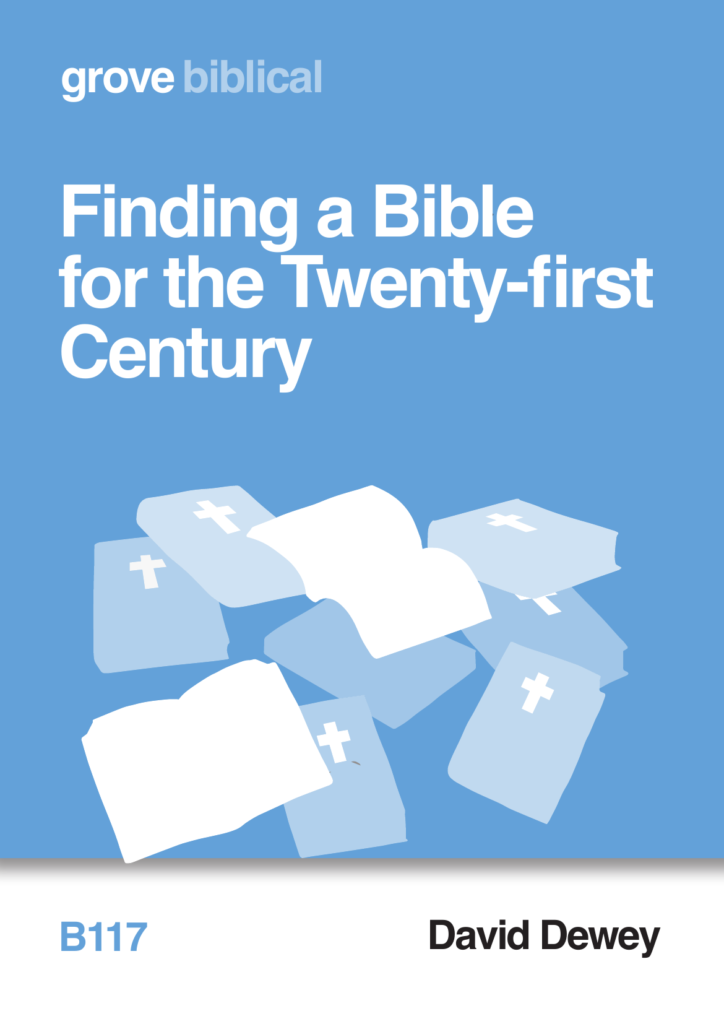
1. No, it has not ‘only taken 10 years’. On the one hand I and many other orthodox Anglicans have been engaging with these theological issues for a very very long time. My Grove booklet on this subject, which looks at biblical theology and biblical texts, was written 11 years ago. The person who failed to engage with it, and who still fails to engage with it, is Stephen Cottrell.
2. The phrase “people of same-sex relationships” is a very odd one, unclear, and misleading. I have many many “same sex relationships;” they are my male friendships. The question is not about same-sex relationships, the question is about sexually active, quasi marital, same-sex relationships. I don’t know any responsible evangelical or leading orthodox Anglican who wants to “exclude” people in such relationships. What we all want for all our congregations and for ourselves is to “grow up into the full statue of Christ”. This means growing in holiness and obedience, including obedience to Jesus’ own teaching on marriage, which Paul amplifies in his letters. The teaching of the Church of England itself, which Stephen is supposed to be leading, and whose teaching he is supposed to believe and pass on to others, is that sexual same-sex relationships are sinful, and pastorally should be met with a call to repentance. I don’t quite understand what is so complicated about that.
3. In my experience, within the debate, the claim that “God made me this way” is universally tied with the idea that sexual orientation is something we are born with. I have literally been assaulted in rage by someone when they heard me point out that research evidence shows that our sexuality was the product of a long process of development. ‘Are you telling me that my gay teenagers were not made this way by God?!’ But the reality of sexual development is hardly surprising and is not news to anybody who is even thought about it for a short period of time.
4. Again, in the debate, the question of how we are born, what is unchosen, and how we live, are very often (on the liberal side) all collapsed down together. But if you have a visited a sex offenders prison, as I have, you will discover that every single person there, experiences their desires as unchosen, and a deep sense part of who they are. From a moral and ethical point of view, the question of what is unchosen, what is unchangeable, and what is ethical, cannot be collapsed together. Almost every aspect of who I am, in large part I inherited from my parents, and is therefore entirely unchosen. How I respond to these characteristics is another question entirely.
5. It is truly bizarre when you suggest that those who disagree with Stephen are the ones who have “gone to such length to dodge discussion”. I don’t know who you’ve been speaking with over the years, but in the circles I move in we’ve been engaging with these questions for a very long time indeed—and have been frustrated that liberals will not. I first started thinking about them in the 1970s!
The one person who has gone to great lengths to dodge these questions and discussion is Stephen Cottrell himself! As many commentators from the outside observed: if only the LLF process started by actually engaging in theological reflection, we would not have gotten into this mess. But it’s now been eight years and this is the first time that Stephen Cottrell has actually talked about theology. It’s a bit of a farce!
In the fringe meeting last night, an evangelical was sitting next to a liberal, and when Stephen Cottrell said, we really should’ve done the theology earlier, the liberal turned to my friend and said “theology is pointless; let’s just get on with it.” That is the problem we’re faced with in the church of England
We’ve been doing the theology for decades. The LLF resources are, as Helen King points out, testament to that. So let’s get on with it.
There is indeed a great deal of theology that has been done over many decades about this. To say we haven’t done the theology is just extraordinary. And of course is said by conservatives who simply don’t agree with the theology that has been done.
We have a process to move this on and we simply need to get on with what has already been agreed and progress the changes to Issues which are already underway.
So where was it in LLF? Where has it been since Feb 2023?
You are seriously saying that the LLF book – all 400 pages of it – and the other resources and the various publications since 2023 don’t have any theology in them? When the LLF core book explores issues in the bible and ecclesiology and human experience it isn’t doing any theology at all? Or just not the sort of theology that reaches the conclusions you like? None of the resources have any theology in them? Really?
Ian
It’s in the LLF resources. A goldmine of theology and biblical studies from various readings of text and tradition. If you aren’t familiar with its riches I suggest you cannot claim that the work hasn’t been done.
Which manages in multiple hundreds of pages to avoid or minimise the most basic questions of all: comparative health outcomes, morality levels in origins, comparative disease levels, comparative promiscuity levels.
If even things so basic as that are scarcely touched on despite the number of pages, then….
Christopher
I very much doubt that you have read all the resources, but are simply making unfounded generalisations again.
Furthermore statistics on ‘disease rates’ are a rather silly red herring in discussions about biblical studies and theology.
Where did the ‘read all the resources’ come from? Do you mean all the LLF resources? I was talking about topics (omitted topics), not about reading cited resources on a variety of topics. So the point on omitted topics needs to be dealt with.
‘Silly’ it certainly is to care about protecting people from disease, and to care that people share, rather than hiding, the information that would enable their protection.
‘Biblical studies and theology’ is not the topic of LLF, though it includes a lot of both. It ranges wider and attempts to be multi-dimensional.
You are struggling to follow a basic argument again Christopher. The point under discussion is whether LLF had any theology in it. Ian claimed there was not and had not been any discussion of it since, and myself and Penny answered that. Theology. Not medical issues.
Ian
Sorry but I think your number 2 point is naive.
If CofE churches had been fully including LGBT people, but only disapproving of same sex sex then there would never have been all the tension l, anger and heat ache. Id challenge you to find any conservative or liberal gay Christian who hasn’t experienced exclusion based only on their orientation.
‘ Id challenge you to find any conservative or liberal gay Christian who hasn’t experienced exclusion based only on their orientation.’
Ed Shaw, Vaughn Roberts, Sean Docherty.
Sean Doherty is bisexual and married to a woman.
Ed Shaw talks about the struggles of being a gay Christian in his book
Vaughn Roberts was certainly denounced by many when he came out,but he was already in a position of power in the church by that point.
Peter, you are creating your own classifications to support your own argument. That is not how Sean describes himself.
You asked me to name some people. I did.
‘sexual same-sex relationships are sinful, and pastorally should be met with a call to repentance.’
if a gay couple was attending your church, and ignored the above call as they believed their sexual relationship was good in God’s eyes, what is next from a pastoral pov?
Peter there is clear pastoral advice from the House of Bishops in such a case and there has been for 20 years or more. People in good conscience might order their lives in such a way and must not be asked intrusive questions about their intimate lives. And they must not be excluded from the life of the church in any way. The advice is absolutely clear.
Thanks for replying Ian. I doubt you’ll be surprised that I feel compelled to push back against your pushback…
I’m not sure pointing to Grove booklets cuts the mustard when we have the actual debate going on in front of our eyes. As I’ve said many times before, I think both sides get this debate badly wrong. The Bishops act as if the question is how can the Church stay together with two views. Their opponents act as if the question is does the Bible marriage is between a man and a woman. Neither take much trouble in the actual debate we’re having in the CofE right now to ask what should the Church be telling gay people about how to order their lives. So, when the Bishops produce their theological paper it’s about Church unity, and their pastoral guidance is about when to use the PLF. When their opponents produce the Beautiful Story video it says nothing about how gay Christians are to live, and when we debate the Bishops report or the PLF, no one even mentions the work the Bishops want to do on celibacy and singleness, and the covenanted friendship proposals are taken apart behind closed doors without a murmur of discussion.
I don’t think anyone’s unclear about what Abp Cottrell means by “people of same-sex relationships”. Whilst I think I know (from time engaged in discussion on here) what you mean by saying such people need to grow in obedience and be met with a call to repentance – that they should split up / divorce, and either embrace lifelong celibacy, or seek to change their sexuality (or at least their outlook on it) in order to marry someone of the opposite sex instead – it is a source of puzzlement to me that you consistently don’t take that final step and prefer to avoid spelling it out. It is doubly remarkable when you say this is a first-order Gospel issue.
There is an element of talking past each other with the “born this way” argument. The advocates of that argument are not claiming that babies have a sexual orientation. Trying to pretend they do is a debating straw man. What they are saying is that it’s unchosen, and unchooseable, and in that sense hardwired. The catastrophic experience of the ex-gay ministries from the 1970s to the 2010s are testimony to that. But again, it’s never quite clear to me what critics like yourself are really saying. You’re picking away at points that aren’t being said (gay babies) but without taking on the central point (can you choose to change your sexual orientation or not). Settling this doesn’t necessarily win the argument, but it does (as Osborne Report made clear I think) focus the question onto what the issue really is.
I would suggest that if you’re really struggling to see the moral difference between a man marrying his boyfriend, and cases of rape or child abuse, then you probably haven’t done as much theological work as you think you have. The more I think about it, the more it alarms me. If we really think the problem with sexual offences is that they just happen to be on God’s arbitrary naughty list, then we really are lost. I think Jesus and St Paul make it very clear – Jesus summarises the law as loving your neighbour (Matthew 22, Galatians 5), and Paul expands on that that this is because love does no harm (Romans 13). So the harm principle really matters. Child abuse does massive harm to the child. Rape does massive harm to the person who is raped. Does the man who marries his boyfriend do massive harm to his boyfriend, or is it his boyfriend who is doing massive harm to him? Or are they actually not harming each other and we maybe need to think more about how this fits with saying the whole law can be summarised by “love your neighbour as yourself”?
In looking at the questions being dodged – I simply observe the LLF discussions, the PLF debates in Synod, the Beautiful Story from CEEC, the letter from the ‘conservative’ Bishops, the missives from the Alliance and so on. As the Bishops pushing for PLF have dodged revising Issues in Human Sexuality in favour of thinking a lot about Church unity, their opponents have been dodging questions about the teaching for gay people in the Church in this debate we are actually having within the CofE. There are planks in eyes all round.
As a gay man, I can choose to let the birds fly around my head or let them make a nest in my hair, or however that saying goes. In other words when it comes to sexual temptation, I can choose to act on it or not. Do my best to dismiss them or indulge in them. Yes it’s much easier to act/indulge, but I still have that choice. The Bible’s condemnation of same sex sexual relations is all about behaviour. Straight people have their own sexual temptations, whether married or single, and choose to act or not on those feelings and attractions. So it’s pretty irrelevant whether one’s sexuality is innate or developed (I suspect a bit of both), or whether it’s fixed or more malleable (personally I cant really remember having sexual feelings about women, perhaps once when I was about 13, and not since). The issue is your own behaviour as an adult.
You refer to rape and child abuse. Everyone, I think, agrees these are wrong by any measure. But does that mean you also cant say in God’s eyes same sex sex is also wrong? It isnt about a hierarchy of sin. And is sin only measured by the harm it does to other humans? What about God? Are we not snubbing our noses at Him, the Creator?
I get that argument PC, but I would point out that neither Jesus or St Paul are so casual about issuing a command to lifelong celibacy. When the disciple say it is better not to marry, Jesus is quick to correct them (Matthew 19). St Paul is very clear that he doesn’t think you can just tell people to resist temptation – instead he counsels that it is better to marry than to burn with passion (1 Corinthians 7). Indeed, he goes further to caution against young widows staying unmarried (1 Timothy 5) or married couples abstaining from sexual relations (1 Corinthians 6). The Church used to understand the seriousness of this. In Issues in Human Sexuality the Bishops wrote: “The single state becomes celibacy only when it is freely and deliberately chosen in order to devote oneself completely to God and his concerns… To prescribe celibacy, therefore, for all those for whom marriage, for whatever reason, is impossible is a misuse of the term. Celibacy cannot be prescribed for anyone”.
I’m not saying that believing rape and child abuse are deeply, deeply wrong means you can’t say same sex sex is wrong. I am saying that allowing same-sex marriages does not open the door to saying rapists have a right to rape, or child abusers a right to abuse children (and it’s absurd and worrying to suggest it might).
Well, AJ, if Celibacy is too spiritual a term, let’s talk about abstinence. And yes, abstinence is an appalling thing to have to do, whether gay or straight or in-between. And, irrespective of orientation, Jesus, and St Paul, and traditionally the churches. require abstinence for
(a) those between puberty and the age of their marriage
(b) women who never get the opportunity of marriage because they are believers and there aren’t enough male believers to go round.
As I say, this is an appalling requirement. But it applies to a much bigger group of people than those affected by issues around their orientation. And it seems to me it’s a requirement there in Jesus and in St Paul. And wrt group (b), I feel deeply guilty that, in my 20’s and 30’s, I didn’t make more efforts to recruit more men to become believers and so push the male:female ratio nearer to 50:50.
Hi Jamie,
Celibacy is the right term. As someone who has lived it, and single chastity, I think it’s important to recognise that they are profoundly different. Gay people told that they are locked into a rule of lifelong celibacy are not in the same boat as people who are hoping/waiting to get married. For one thing, a celibate life is not simply not having sex. You’re avoiding all romantic relationships and you know that is the future for the rest of your life. That bears no relation to, say, young adults who are dating but waiting until marriage to have sex. It’s not even like people who could date or marry, but aren’t and haven’t. The bishops in writing Issues in 1991 understood this and were clear about it. One of the ways we’ve lost our footing in this discussion is that we appear to have forgotten it.
Just an aside – since when was there a rule that Christians are obliged to only marry other Christians? I accept that that may be easier, but there is no restriction.
AJ Bell – I’m hesitant about commenting here for two reasons. (a) the same-sex-attraction business is not something that is anywhere near my own radar or life experience – so I can only understand it (and comment on it) in some sort of ‘theoretical’ sense. (b) when considering a *Christian* response, I’d like to think that I am dealing with Christians – i.e. people who have reached a Luke 18:13 understanding of themselves (the corollary of which is Salvation – seek and you *will* find; ask and you *will* receive – he is asking God for forgiveness, knock and the door *will* be opened to you). I have asked you personally if this describes you and you did not give a positive answer – so I’m not sure if ‘conviction of sin’ is something at the heart of your own faith.
But I get the impression that what you are looking for is absolutely not possible within a Church of England framework. As soon as you have ‘canon law’, and brainy theologians trying to turn the statements of Jesus, which are eschatological statements, presenting an ideal, into a set of rules and regulations, you have a problem. The problem is that people want some sort of order, they want the church to order their own lives – and other peoples lives. When they go to church, they want to belong to an ordered ‘community’. One of the problems (that you point out) is ‘Excluding people in same-sex relationships from their church is exactly what some people want.’ Well, same-sex relationships certainly don’t lend themselves to married couples where the women breed like cattle in order to increase the size of the church, to help ‘Christians’ win the open competition which seems to be going on against Muslims.
Your main problem here is (I think) infant baptism and confirmation – the process whereby people become members of the C. of E.. There is no requirement to reach the sort of understanding of self (i.e. sinnerhood) that we see in Luke 18:13 and I think that if the church was, and understood itself as, a community of forgiven sinners, you might find that the attitude towards same-sex attraction could be different.
I do not in any way suggest that sin is not sin, but it is important to understand that there are besetting sins – and that Romans 7:14-25 (the ‘wretched man’ discourse) is written in the present tense, as the current experience of a mature Christian (the apostle Paul at the time of writing).
The ‘order’ of canon law is (of course) pure pretence, as can be seen by Ian Paul’s very weak justification of re-marriage of divorced heterosexuals.
Hi Jock,
To answer your first question – I would consider myself to have a Luke 18 understanding of myself. I will often pray the Jesus prayer – “Lord Jesus Christ, Son of God, have mercy on me, a sinner”. Where I think we’ve differed in the past (and this is possibly talking past each other rather than a real disagreement) is where I think you can’t only focus on that or start the Gospel there – rather I take my lead from John 3, and am firm that you start with God’s grace and love. I was going to write more about theosis, Romans 8, God condemning sin in the flesh, etc. but that’s taking us down a tangent.
Just an aside – Archbishop Cottrell was pleasantly direct about this I thought: “But I’ve always also said that actually, this is the real business of preaching the gospel. The gospel of Jesus Christ is about breaking down barriers of separation, confessing our sinfulness and our need of God, and seeking God’s way for our lives and for the life of the world, living in that new humanity, as Paul describes it, which God has won for us in Christ through Christ’s dying and rising.”
On the more specific points I don’t think I’m after the Church policing the communion rail or similar. The catholicity of the Church is vitally important: the door is open to all. But I do think the Church can and should provide teaching to people. We’re happy to do it on other things, and we currently do have a teaching (even if I think it is inadequate and in error).
AJ Bell – well, yes I agree – the article is primarily about the duplicity and dishonesty of a senior bishop – and hence anything of a ‘fundamental’ nature of how the C. of E. deals with gay people is secondary and probably off-topic for this thread.
I think I can figure out what you were thinking of saying about Romans 8 – namely that in Romans 8 the whole of creation is ‘groaning’ for the redemption. In Genesis 2, we see the ‘ideal’ (although note that evil is already present in Genesis 2 – tree of knowledge of good and evil), but when Adam fell, the whole of creation fell.
We all suffer the down-drag of ‘sinful flesh’ which results from this. That does not give anybody an excuse for sinning, since Jesus came in sinful flesh – and yet he did not sin. But there seems to be a much greater intolerance within church groups of people perpetrating sins caused by same-sex attraction than people who sin in other ways.
I’m convinced that if a *requirement* of church membership was an acknowledgement from the person that he had reached an understanding of himself along the lines of Luke 18:13 (which, according to Scripture is a necessary and sufficient condition for salvation), then you might find a different set of attitudes. Right now the debate seems to be polarised – one side stating that things that Scripture tell us are sin – aren’t sin at all. The other side attempting a Pharisaical pursuit of imposing an order that isn’t possible after the fall.
It doesn’t matter if AJ Bell or any other random person is in favour of ‘policing the communion rail’. Paul was in favour of that, and – on an even greater scale – was in favour of ”policing” the bounds of membership. He understood that things matter. To those to whom nothing matters very much [!], even the things that matter massively matter only a little – which is both inaccurate and uncaring, giving the impression of inner deadness.
One big picture, after Golsworthy, is God’s Kingdom: God’s people, in God’s place under God’s rule.
The CoE is myopic if it under the rule of culture and the king in parliament, not the King of Kings over the whole cosmos.
Where the Glory of God is no longer central to the CoE in its own, pomp circumstances and ceremony it has forgotten and left it’s place in God’s world kingdom people.
The Kingdom of God is not the kingdoms of the world.
No it isn’t, the whole reason the Church of England was founded was to be headed by the English King and accountable to Parliament, otherwise it may as well have stayed Roman Catholic headed by the Pope as God’s representative on earth or become a nonconformist Baptist or Pentecostal church.
The C of E has always been a church which has combined being established church of the Kingdom of England with representing the Kingdom of God. Don’t like that, simple answer don’t be in the Church of England
That sadly and tragically says it all. Unbelief in knowing what the Kingdom of God is, and in the God whose kingdom it is.
And here, the incarnate Jesus revealed the reality of the Kingdom of God, ability and inability:
John 3:3
And his non optional imperative.
T1/Simon
But “being established church of the Kingdom of England” and “representing the Kingdom of God” are contradictory goals because the NT does not teach such national churches and does positively teach a different way to do ‘State and Church’.
The Church of England’s original aspiration, stated in the Articles and the BCP, is to be a church whose doctrine is decided by the Bible. Understandably by the vagaries of history it didn’t fully achieve that aspiration either in Henry VIII’s version or in the later version under Elizabeth – but that should still be the aspiration. Getting closer to that aspiration by getting disestablished would be good and totally in line with the original principles; going further away by departing from the Bible over sexuality cannot be good.
Yes I know you don’t agree with the Church of England being an established church headed by the King, hence you are in the Baptist church not the C of E.
Getting disestablished would of course defeat the whole point of the C of E, which was founded by Henry VIII precisely to be an established church. Nor would it see it become more conservative on sexuality, indeed I would expect most evangelicals to become Baptists or Pentecostals if the C of E was disestablished, leaving a largely liberal Catholic English Anglican church with a few open evangelicals like the US Episcopal Church of the Scottish Episcopal Churches both of which now perform same sex marriages in their churches. Unlike, still, the C of E which only now does PLF
like the US Episcopal Church or the Scottish Episcopal Churches
T1/Simon
“Getting disestablished would of course defeat the whole point of the C of E, which was founded by Henry VIII precisely to be an established church.”
If that is “the whole point of the C of E”, then the whole point of the CofE has been to disobey God for the benefit of one of England’s less satisfactory monarchs (I’m being rather polite about him …) Henry was not God, nor have any of his successors been so. He (and they) therefore have no possible authority to contradict God’s word in the Scripture, which teaches a very very different way to do the State-and-Church thing. And of course a church confused about that is likely to get other things wrong because of its attempts to “let the world around you squeeze you into its own mould”, taking for example a worldly vieew of sexuality, when what the Church should be doing is “but let God re-mould your minds from within, so that you may prove in practice that the plan of God for you is good, meets all his demands and moves towards the goal of true maturity”.
The whole point of the C of E is to be established church, with Parishes across the country and providing weddings, baptisms and funerals to all in said Parishes who want them. If your obsession is talking a literal view of scripture on everything, which of course includes rejecting female ordination and remarriage of divorcees, which the C of E has done for decades, not just rejecting same sex couples then of course you should not be in the C of E but a Roman Catholic, Orthodox, Baptist or conservative Pentecostal church
Far from being the whole point, it is the only point that has so far occurred to you. So, with more thinking, others will spring to mind.
Others include: Christianising a nation (because Christianisation improves any given nation), for which the every-village parish is excellent. Your proposal – that the church follow and copy the unchurched – is not merely different, but the precise reverse. What is the point of a church that is less advanced than its non members? And how does the latter’s record of family stability show that it actually IS less advanced?
T1/Simon
First, just to be clear what I (and basically the original Reformers) mean by
” taking a literal view of scripture on everything…”
https://stevesfreechurchblog.wordpress.com/2013/01/31/a-brief-word-on-biblical-interpretation/
And interpreting the Bible that essentially commonsense way, the Bible does NOT teach establishment of the CofE or any other church, but proposes a very different way. By creating an ‘established’ church Henry VIII and his successors were disobeying God, which really makes the whole exercise illegitimate – a point which you have nowhere near answered. Neither Henry nor his successors could have the slightest authority to contradict the Bible, so they are simply arrogantly sinfully wrong and endanger the souls of all involved – again a point you have nowhere near answered…..
Evangelicals might actually find it easier to remain in a disestablished and therefore more biblical church – I wonder whether other groups would find it as congenial without the nominal worldly influence?
Yes, we know you don’t even think there should be a Church of England. So as well as sticking to your Baptist church you shouldn’t really even comment on it. The experience of Anglican churches in the US and Scotland and most of the western anglosphere is that disestablished Anglican churches have fewer conservative evangelicals than the English Anglican church does. Most of them are dominated by liberal Catholics, hence the US Episcopal church and Scottish Episcopal church for instance now even perform same sex marriages in their churches which the C of E still doesn’t
Stephen, thank you for the reference to your article and in that article your quote from Tyndale in which he said: ‘but that which the proverb, similitude, riddle or allegory signifieth, is ever the literal sense’. I’m not sure how this helps us to see what non-figurative language seems to be ‘about’. Doesn’t this idea require that *everything* for understanding a text has to be contained in the text itself?
One question I wonder about for those who insist on the ‘plain sense’ of Scripture is: why was Arius wrong?
Bruce Symons – thanks for your response.
As I explained in the article a lot of recent evangelical thinking has tended to see ‘literal’ interpretation as meaning what I call “dumb wooden literal”, a rather 19thC idea of literal; whereas to Reformation era scholars it was reading by the ‘letter’ of the text as opposed to some more exotic styles of interpretation. I once found – but have somehow lost track of – two allegorical interpretations by my namesake the Archbishop which were a bit OTT and would have been rather misleading if considered as ‘the’ interpretation.
To the late medieval and early Reformation scholars the ‘literal’ was something like ‘read it like an ordinary book’ in which all kinds of literary devices may be used, and in an ‘anthology’ like the Bible one may expect different genres needing slightly different approaches – history and poetry may be in different styles. You don’t have too much difficulty in reading ordinary literature with appropriate allowance for (and enjoyment of) the various ‘devices’ used to make the point – the Bible should be similar.
Agreed that some ‘fundamentalists’ got too woodenly literal – as far as I can work out the original writers of the early 1900s ‘Fundamentals’ took a view closer to Tyndale and were often quite scholarly.
T1/Simon
“So as well as sticking to your Baptist church you shouldn’t really even comment on it”.
Sorry mate but if you’re calling yourself a Christian other Christians are totally entitled to comment on how you represent or misrepresent our faith. And by the way you need to properly respond to their points, not just keep on repeating slogans about Henry VIII’s purposes which may well not be God’s purposes according to God’s Word.
I think a disestablishment sought by the Church in the interests of being more biblical might have a good chance of then remaining basically evangelical – other examples elsewhere in the world are not quite parallel.
Bruce Symons – re ‘Arianism’ Two reasons Arius was wrong
1) in a full trinitarian view the atonement represents ‘God IN Christ’ as forgiving truly at His own expense; any view dividing Jesus from God ends up portraying God as doing the atonement at the expense of an innocent third party, a rather morally questionable idea I suggest….
2) And as I’ve recently been pointing out to Jehovah’s Witnesses there is at least one verse in the NT which really clearly identifies Jesus/’the Son’ as truly God/Jehovah/Yahweh. That text is in Hebrews ch1 v10. It deserves to be better known as does the whole of that epistle in relation to current issues regarding the Jews and Israel.
Over a third of the global population is Christian, it is not that uncommon. I don’t comment on Baptist affairs as it is not my denomination, nor should you nose too much into Anglican affairs
A disestablished Anglican church in England would be dominated by liberal Catholics as I said, as it is North America, Scotland, Wales and Oceania. Conservative evangelicals could become Baptist, Pentecostal or Independent, open evangelicals could become Methodists, Quakers or Lutheran. Conservative catholics could become Roman Catholic or Orthodox.
Liberal catholics however have no other denomination to go to but Anglicanism, even in Lutheranism they are a minority, as they are in the RC church
T1/Simon
You keep going on as if the CofE was still Henry VIII’s church. It isn’t – the “Catholic without the Pope” institution which Henry founded actually lasted only as long as he did, and in his son’s reign was superseded by what was clearly intended to be a Bible-based Protestant church. At that stage people were still taking for granted the idea of some form of a state-entangled church, though different to the RC version and also not quite like eastern Orthodoxy. So at that stage they didn’t fully follow the Bible, though the Articles made clear that was the aspiration.
After the ‘blip’ of Mary’s attempt to restore full Roman Catholicism, Elizabeth returned to the basic Protestant model in a slightly more moderate form (which in the end didn’t satisfy the Puritans). This ushered in a long period (arguably still ongoing) of a tension between the wish of the monarch/government for a national religion and the biblical teaching of a very different model. Ideally the church would have further reformed in line with God’s Word and so eventually would have separated from the state. Monarchs should have listened to the Word and realised it was not appropriate for them to govern the Church. Should have realised they have NO authority to contradict God’s Word.
Elizabeth produced the Catholic but Reformed settlement for the C of E. That was affirmed at the Restoration of Charles II with the 1662 BCP.
Apart from arguably the reign of Edward VI, the C of E has never been a purely bible based, evangelical Protestant church. Even today it ranges from ultra high church Catholics in Walsingham to low church evangelicals but with the largest group in the Church of England now liberal Catholics. Hence Synod has passed by majority female ordination, which the Roman Catholic and Orthodox churches still does not do and prayers for same sex couples, which conservative evangelical Baptists and Pentecostals still don’t do
T1/Simon – first off, the word ‘catholic’….
AI search gave me this
“In the Apostles’ Creed, “holy catholic Church” refers to the universal Christian church, encompassing all believers throughout history and across geographical boundaries, united by their faith in Jesus Christ. The term “holy” signifies the church’s sacredness and its set-apartness by God. “Catholic,” derived from the Greek word meaning “universal,” emphasizes the church’s all-encompassing nature, not limited by ethnicity, culture, or time.
Here’s a more detailed breakdown:
• Holy:
The church is considered holy because it is set apart for God’s purposes and its members are called to live holy lives.
• Catholic:
The term “catholic” emphasizes the church’s universality, meaning that it is not confined to a specific place, time, or cultural group. It signifies the unity of all believers in Christ.
• Church:
The church is understood as the community of believers in Jesus Christ, called out from the world to follow him.
Therefore, when Christians recite the phrase “holy catholic Church” in the Apostles’ Creed, they are affirming their belief in the one, universal church of Christ, a community united in faith and set apart for God’s purposes.”
Trouble is, after the Roman Imperial hijacking of the Church as a state religion, the word acquired a slightly different connotation, meaning something like ‘totalitarian’ as in a Nazi or Stalinist state, a compulsory belief enforced by law. Anabaptists like me will prefer in saying the creed to use the totally legitimate alternative rendering ‘universal’ rather than ‘catholic’ to avoid that later connotation. The CofE was definitely founded to be a ‘totalitarian’ church though thankfully it now only has ragged remains of that status. For further confusion the word ‘Catholic’ has become associated with specifically the ROMAN Catholic church and with what might be called ‘Romanizers’ in Anglicanism, particularly the 19thC ‘Tractarian’ movement led by Newman who eventually had the honesty to realise that the CofE was supposed to be Protestant and ‘crossed the Tiber’.
Precisely because it is ‘established’ or more accurately ‘unbiblically entangled with (the English) state’, the CofE has never been really Protestant and has always been in tension between various factions, despite the Articles making VERY clear that it at least aspires to be Biblical. The slight majority of ‘liberal Catholics’ is I think precisely because their rather niche and far from ‘universal’ beliefs have nowhere else to ‘belong’.
Ultimately the issue here is of ‘authority’; and on that I don’t find you to be very coherent. For example you keep going on about the ‘apostolic succession’ and Peter, not to mention using the term ‘Catholic’ – and yet you seem not to accept the obvious logic that you should belong to the Roman church which is rather clearly derived from Peter, you don’t accept many items of Catholic belief either. There are times you seem to give the Kings of England more authority than God himself.
In the end, even if just by the authority Jesus gives it (so far as it was written in his time), the Bible is THE authority; not even the Pope, and certainly not so minor a figure as the English monarch, can have the authority to contradict the Word of God. At the same time, it is the whole Word that is the authority; the Bible is written in a history centuries long, 2000 years at least, and it is clear that over that time things develop, God ‘starting where people are’ and leading them to better places as their ideas and the culture change. Slavery is accepted (though hardly approved) in a time when the economic structure meant much modern style employment was difficult – but in the NT we see that being changed at first in and by the Church.
Here’s the thing – in the ‘new covenant’ one of the things Jesus changes is the church/state or church/world relationship. Israel as a religious state was necessary to prepare for the coming of Jesus and for what he did to be understandable and public. But Jesus makes clear that his kingdom will not be the same kind of kingdom as his ancestor David – it will be a kingdom of voluntary faith not enforced by human laws. God’s ‘holy nation’ in the NT is not any worldly kingdom that thinks it would be nice to have ‘God on our side’, but the international/supranational community of the ‘born again’, a ‘diaspora’ of the citizens of the kingdom of heaven living throughout the world as ‘resident aliens’ (Peter’s word ‘parepidemoi’ translates almost exactly to ‘resident alien’). Jesus’ kingdom has the power of God’s Holy Spirit – it does not need worldly power and the attempt to use such power only confuses things.
The CoE is through unbelief and apastacy did establishing itself from the Kingdom of God.
Not able to see it, what it is, whose Kingdom, if T1 is anything to go by.
Apologies. Correction to autocorrect: to read, is disestablishing itself.
Thank you Ian for your support at Synod in getting rid of Issues in Human Sexuality at last. What a triumph of common sense
Wow. Carried without a counted vote:
“That this Synod request that the House of Bishops remove any requirements relating to Issues in Human Sexuality from the Vocations (Shared Discernment) Process and replace it with an interim requirement of living consistently with the Guidelines for the Professional Conduct of the Clergy (GPCC) during the period of discernment and training, and complete work on the package of the Pastoral Guidelines, Code of Practice, and Bishops’ Statement, as agreed at General Synod in July 2024.”
I can only hope that Paul Waddell is right that we’ve managed to find a new and more helpful tone to these debates.
Per the above guidelines, “Sexual intercourse, as an expression of faithful intimacy, properly belongs within marriage exclusively.”
Will the clergy be required to abide by this, ie no sex outside marriage, and no same-sex sexual relationships? If they dont, what are the consequences?
The guidelines already apply to clergy.
They might apply but are they followed? If not why not.
Well Jeremy Pemberton had his PTO withdrawn.
To be honest it’s probably worth watching the debate in Synod:
https://www.youtube.com/live/9msrW6Of9Qc?si=Y3FXDo6bXXfm89vq&t=8286
Issues in Human Sexuality is not a disciplinary document for clergy. It’s been a gatekeeper for ordinands, but part of problem being that even those who are opposed to LLF/PLF (like Vaughan Roberts say) don’t actually agree with Issues or like it. The Guidelines, which point towards the relevant Canons and teaching statements etc., are the expectation for the clergy and so it logically makes sense that this is what we ask ordinands to be consistent with rather than a document no one in Synod argues is adequate any more.
Given PLF and ending of Human Sexuality Vocations then clergy in same sex relationships will be allowed with no further questions asked provided faithful unions. That includes those married in English law both heterosexual and same sex , even if only the former can still marry in church in the C of E
In other words theyre not following the guidance quoted by AJ. Which makes such guidance meaningless.
I would not bet on that T1.
That is extremely different from what is said the guidance that they are now following, T1.
How do you account for that difference?
This rather precious emphasis on recent and heavily-denominational guidance documents is hard to take seriously when the people involved could easily be a lot more familiar with the actual foundational documents than they actually are. It really is cocooned, and putting the cart before the horse.
Synod has voted for PLF for same sex couples in the established church and Synod has voted for clergy in faithful same sex unions to be entitled to remain in such unions post ordination with no further questions asked. That is C of E doctrine now
Does ‘marriage’ include a civil law non- church ceremony?
And do disciplinary measures apply for breach? How has been effected? If at all?
As doctrine on marriage has not been changed, the application and execution of discipline is the measure of conformity to CoE doctrine.
No discipline to enforce, C of E clergy can now get married is same sex marriages in English civil law, just can only have a PLF in a C of E church not a full marriage