Mike Starkey writes: It’s early afternoon on Friday 16 October 2026. I enter the public transport office in central Strasbourg, next to the Alt Winmärik tram stop. Alt Winmärik means Old Wine Market in the old Germanic Alsace dialect. From the 14th century onwards, this street was the place wine was bought and sold. A genial, middle-aged man asks me how he can help.
‘I’ve just paid one of your machines for a 10-trip book of electronic tickets to be added to my travel card,’ I say. ‘See, here’s my receipt. But when I tap my card on the red machine before getting on a tram, it says I only have two trips left.’
‘Ah yes’, he replies with a Gallic shrug. ‘The red machines can’t count above nine.’
I try an exaggerated look of French incredulity. ‘What?’
‘Well, double-digit numbers don’t show when you swipe your card on the red machines. Let’s check on my big machine here how many trips you have left. Look, you actually have 32 trips on your card.’
‘But that’s crazy and misleading’.
‘Yes’, he beams. ‘It is.’
A Night of Rioting
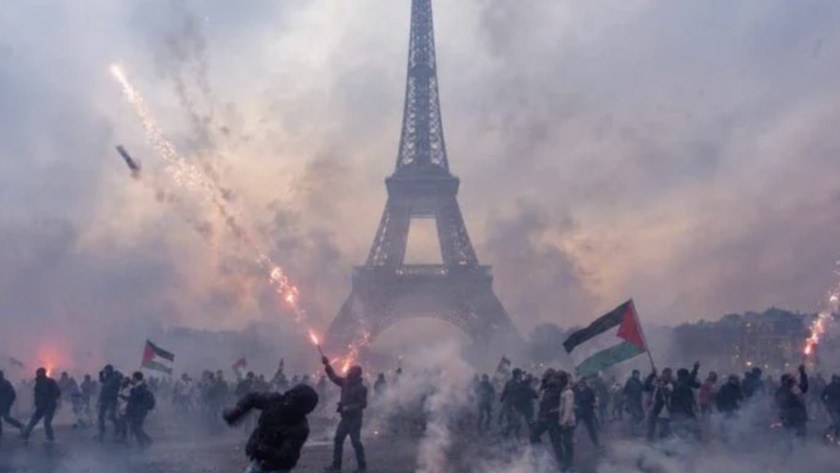
The following evening, Saturday 17 October, the same public transport office is destroyed in the riots erupting across French cities. Youths in black hoodies and balaclavas kick in the windows, smash furniture and daub the walls with graffiti. Colourful transport leaflets spill out onto the pavement.
The rest of that evening and long into the night, I can’t tear my eyes away from French media and social media. Limoges’ historic Town Hall burning. Lyon’s ornate tourist information office in flames, with local police saying ‘hostile individuals’ are preventing firefighters from tackling the blaze. Stores in central Lyon looted. Marseille looking like a war zone. Restaurants and cars on fire near Paris’s Place de la République. The stunning Galéries Lafayette department store smashed up. A Parisian couple in their 80s standing shivering and vulnerable in the street in their underwear, as masked youths steal not only their phones and wallets but their clothes too.
As Sunday 18 October dawns, further images and footage emerge. Lyon shopkeepers and restaurateurs weeping as they survey the ruins of businesses they put their lives into. A young Parisian woman tearfully begging looters to stop. Footage of an elderly man telling a gang of youths they have no right to destroy property, while they jeer and call him a racist. More than 600 police and firefighters injured.
I sit on a tram heading across Strasbourg, to lead the morning service at the city’s multi-ethnic Anglican Church—27 nationalities, meeting in a beautifully austere Dominican church near the University and Botanic Gardens. They’re currently without a full-time priest, and I’m the locum minister for October.
Strasbourg is my current crush in a lifelong love-affair with France. My university degree was in French. I’ve worked in a high school and radio station in Orléans, the Paris offices of Peugeot-Citroën, and churches in Grenoble, Versailles and Paris. This morning I sit on the Strasbourg tram feeling numb, uncertain how I feel about that love affair now. My tram goes past the destroyed remains of the transport office, where wooden hoardings cover the smashed windows. It passes shattered tram and bus shelters. The apocalyptic scenes from the night before, and the tears of its victims, replay in my mind.
Just the French Being French…?
The French nation, and a horrified world, are rightly asking hard questions about who the rioters were, why they were rioting, and what the main underlying issues were. The two most popular answers on offer are both true, but limited.
One is that it’s just the French being French. This is, after all, a people whose national mythology and self-image was shaped during the French Revolution in the late 18th century. The French still idealise its spirit and energy. The revolutionary slogan Liberté, Égalité, Fraternité, the tricolour flag, and Marianne (the personification of the Republic as a young woman) remain iconic.
More recently, in May 1968, the streets of Paris erupted in civil unrest, student occupations and strikes. Police crackdowns in the Latin Quarter were met with street battles and barricades. Like the French Revolution, 1968 shaped French self-image and provided a cultural template for dissent ever since. The language and imagery of ’68 are still readily seized on to give an air of legitimacy to any street protest.
As a consequence of the Revolution and 1968, the French have a high cultural tolerance for direct action in the streets, property damage, burning cars, and violence towards the police. There’s a lingering sense that protesting in the streets is noble and liberating. But this backdrop still doesn’t tell us much about why these people, and why now.
Disgruntled Students
The other popular explanation for the 2026 riots is that these are disgruntled high school and university students complaining about dilapidated buildings, overcrowded classrooms and general underfunding of education. This is the banner under which the recent protests were organised, and has been the line taken in many media outlets including the BBC. Even as the rioting turned apocalyptic, some media outlets were still saying the rioting was due to a shortage of textbooks.
Most French people readily admit education provision is a valid concern, that it has been sadly lacking for some time. The state of French education is certainly the reason many of the protesters were out on the streets, including those I met in Strasbourg.
But while true, this fails to account for the sheer wanton scale of the destruction in the recent riots. The starkest irony concerns the Lycée Nelson Mandela in Nantes. Built in 2014, at a cost of 65 million euros, it’s one of France’s state-of-the-art high schools—with a soaring bioclimatic glass roof, landscaped gardens, amphitheatre, two gyms and a climbing wall. On 1 October, rioters burnt it down. The media, with a straight face, said it was burnt down in the name of under-resourced education provision.
Three Other Elements
The party line that the rioting is the work of disgruntled students fired up by nostalgic revolutionary zeal is partly true, but only partly. Three further groupings became involved and shaped outcomes:
1 Hard Left and Anarchists. The protests on 17 October were expanded from earlier student protests by the addition of populist ‘yellow jacket’ protestors and trades unions into a national day of action. They also drew vocal support from Jean-Luc Mélenchon, the prominent French hard-left politician and leader of the La France Insoumise (LFI) party. A significant proportion of the new protesters on the 17th were hard-left agitators, and much of the graffiti reflected this. A common scrawl in Strasbourg was ACAB (All Cops Are Bastards), a slogan popular with far-left and anarchist agitators. This phrase, tellingly in English, dovetails with the leftist call in the United States for the police to be defunded.
There’s a long tradition in Marxist and revolutionary circles of seeing violence as redemptive, particularly in France. The French revolutionary writer George Sorel wrote in his 1908 work Reflections on Violence that working-class violence was heroic and moral, a way to purify bourgeois society. Similarly, the phrase, ‘You can’t make an omelette without breaking eggs’ comes from 18th century France. It’s particularly associated with Maximilien Robespierre, who oversaw the Reign of Terror when thousands of so-called enemies of the Revolution were guillotined, including Marie Antoinette. Violence is easily reframed as virtue when when it thinks it’s on the right side of history.
Meanwhile, actual working-class people are the ones sweeping up broken glass, boarding up windows, and rebuilding their shattered communities. And they will be paying for the repairs to public buildings and street furniture through their taxes.
2 Israel/Gaza. Most of the graffiti on 17 October reflected the current international preoccupation with Israel and Gaza. Watch almost any footage of the rioting: you will see countless black-and-white keffiyeh scarves being worn, and Palestine flags waved. The walls and billboards of Strasbourg, like other French cities, were covered in Free Gaza graffiti.
Whatever one’s views of the politics of the Middle East, one thing is unquestionable. The flag of Palestine and the keffiyeh have become the default symbols not only of opposition to Israel, but hatred of Western culture and heritage—which is seen as irredeemably arrogant, colonialist and bigoted. This fundamental despising of Western culture by a wide international cohort of young adults, and a cultural mood that sees its destruction as a virtuous cause, unquestionably fed into the protests.
More sinisterly, the next day French police released evidence that some rioters had on their person lists of addresses of Jewish-owned stores. In one Marseille street, Jewish-run businesses were set alight, while others weren’t. There is evidence that Islamists with an agenda of ‘globalising the Intifada’ latched onto the riots as a way of targeting Jews.
3 Disaffected Youth. A third group must not be forgotten. In French culture there’s a group of disaffected youth, particularly from the poorer suburbs of large cities, who are not particularly motivated by class politics or the rights of Palestine. They just love to burn cars, and get free stuff by looting shops. When their football teams loses, they riot and burn cars. When their team wins, they still riot and burn cars. When there are major street protests, they latch onto them for more opportunities to riot and burn cars.
The most traumatic footage from 17 October illustrates well the madness of crowds—amoral, driven by pure appetite, violent. In one clip, a masked youth faces a female shop owner who begs him not to loot her premises. Far from showing compassion to the pleading woman, he grips her so she can’t move while his friends invade her shop, loot the goods, and smash the place up. Then he lets her go.
This is a particularly sinister element to the riots. Many of the rioters seem genuinely indifferent to any underlying ideology at all—be it politics, social justice, the French Revolutionary spirit, or political Islam. They’re not motivated by any cause beyond the thrill of getting free stuff, and burning stuff. The more luxury the goods, the better. The grander and more imposing the buildings burnt, the more entertaining.
French Philosophical Roots
But even this volatile blend of hedonism and arson didn’t emerge from a clear blue sky. I’d argue this too has French roots, particularly in French philosophy. It might seem odd to link looters burning Volvos and nicking Hermès scarves to currents in scholarly philosophy. But it’s precisely trends in philosophy and worldview that filter down and establish a plausibility structure in which we all live.
France has a long and distinguished heritage of thinking and debating. But from the 1960s on, certain corrosive emphases took centre stage. To name just one, the philosopher and historian Michel Foucault was born in Poitiers exactly 100 years before the recent riots. Foucault taught that what we think of as truth-claims are merely power-plays disguised as knowledge. All systems of truth are constructed by interest-groups, and used to govern and brutalise others.
French academics in corduroy jackets and turtlenecks like to debate ideas – as much as French youth in balaclavas and hoodies like to burn cars. In France, ideas such as Foucault’s remained as relatively harmless debating-points. But then they crossed the Atlantic. And American culture is impatient with intellectual ideas for their own sake (in 1963, historian Richard Hofstadter explored why in his book Anti-Intellectualism in American Life).
American Shoots
The ideas of Foucault and other French contemporaries took root in American universities in the 1980s, but American soil was different from French. America was a consumer society fascinated by the shaping and construction of personal identity. And it was a society carrying a burden of racial guilt. A wave of American writers applied Foucault’s idea of truth-claims-as-power to real-world areas such as identity, race and gender.
Institutions, cultures, traditions, faiths, identities: all became viewed as human constructs and masks for power. Truth claims: about power. Moral absolutes: about power. Factual statements about biological sex: about power. Interpreting the Bible: about power. Culture, history and national pride: about power. This is the heart of the philosophy exported from France, and McWeaponised in American universities from the 1980s on.
Truth, Beauty, Goodness
Through history, most cultures have seen Truth, and the search for Truth, as the pearl of great price, and considered Beauty and Goodness meaningful categories. Some of us still do. But in a world where Truth, Beauty and Goodness can never be more than opinions, we’re seen as dangerous imperialists. Haters.
It’s hard for today’s young adult to be gripped by a Truth bigger than their own inner psychodrama. It’s hard for them to see Beauty as more than an attack on somebody or something else. It’s hard for them to see Virtue as more than an morbid urge to control others. But a culture that deconstructs even the possibility of Truth, Beauty and Virtue is a dying culture. For this is nihilism, and nothing will come of nothing.
Turns out those masked youths who jeered and shouted ‘raciste!’ at an elderly man telling them they had no right to destroy property were living out core values of French philosophy, repackaged and reimported. Who was that old man to impose his regressive bourgeois values, his cultural imperialism, his hatred, on them? Fascist.
 Revd Mike Starkey a London based writer and ordained Anglican minister who frequently works in France. He contributes to BBC Radio 2’s Pause for Thought, and writes features on culture and faith at Flaneur Notes.
 Buy me a Coffee