There has been a growing movement claiming that Christianity calls for a certain kind of masculinity, protesting against a perceived feminisation of the faith. Is there any grounds for this? What kind of language do we find in the New Testament?
This article explores the issues around Paul’s language ‘act like men’ in 1 Cor 16.13; digs into its Old Testament origins; relates it to Paul’s other language about discipline and struggle; and teases out the pastoral implications for all of us.
Towards the end of his second letter to the Corinthians, which we have in our New Testament as 1 Corinthians, as Paul wraps up his travel plans and greetings, he gives a short string of commands:
Be on your guard; stand firm in the faith; be courageous; be strong. Do everything in love. (1 Cor 16:13–14, NIV)
The words in Paul’s Greek read: grēgoreite, stēkete en tē pistei, andrizesthe, krataiousthe; panta hymōn en agapē ginesthō (γρηγορεῖτε, στήκετε ἐν τῇ πίστει, ἀνδρίζεσθε, κραταιοῦσθε· πάντα ὑμῶν ἐν ἀγάπῃ γινέσθω). (It is worth noting in passing the connections here with the teaching of Jesus. The verb gregoreo is his consistent command in the light of our anticipation of his return at an unknown hour in Matt 24.42, 25.13 and elsewhere, and krateo describes the way Jesus holds the seven starts in Rev 2.1).
The word the NIV translates ‘be courageous’ is the Greek verb andrizomai (ἀνδρίζομαι), here in the plural imperative andrizesthe (ἀνδρίζεσθε). It comes from the word for a man (anēr, andros; ἀνήρ, ἀνδρός), and so older translations rendered it quite literally. The AV has ‘quit you like men’, and the ESV still has ‘act like men’. It is the only time the word occurs in the New Testament—a hapax legomenon, something said only once.
(An earlier verse also used highly gendered language in a similar way—’In understanding be men’, 1 Cor 14.20, KJV—which was then used as the title of a well-known book about Christian doctrine. However, the Greek here is not gendered at all; the term is teleios meaning ‘complete’ or ‘mature’.)
It is not hard to see why the translation matters here. Read in one way, Paul is calling the church to a particular kind of masculinity, and the verse regularly turns up in that context in some circles. Read in another, the gendered root is incidental and the NIV’s ‘be courageous’ captures the sense. How do we decide?
The best way in, dear reader, is to ask where Paul learned the word. The answer lies in the Greek Old Testament he read and preached from, rather than in the gymnasium or the moral philosophers of Greek and Roman culture. Once we look there, the verse opens up in some quite striking ways, both for how we read Paul and for what it means to follow Jesus faithfully now.
Where Paul found the word
In the Septuagint (the Greek translation of the Old Testament, usually abbreviated LXX), andrizomai (ἀνδρίζομαι) occurs around twenty times. It usually translates the Hebrew verb ʾamats (אָמַץ), ‘be firm, be bold’, and most often appears in a fixed pair: ischue kai andrizou (ἴσχυε καὶ ἀνδρίζου), ‘be strong and courageous’. English readers will know the phrase from Joshua 1—and might even have sung it in a children’s chorus!
The occurrences fall into a few clear groups.
Handing on the task. The formula first appears when Moses is about to die. He says it to all Israel as they face the nations across the Jordan (Deut 31:6), then to Joshua in front of the people (31:7), and then God says it to Joshua himself at the tent of meeting (31:23). God repeats it three times at the start of Joshua (Josh 1:6, 7, 9), and each time it is grounded in something: the promise of the land; careful obedience to the law; and above all God’s presence (‘the Lord your God will be with you wherever you go’). Then the people say it back to Joshua (1:18), and Joshua says it to his commanders after a victory (10:25). The words of commissioning become the shared language of the whole community.
Building the temple. David uses the same formula when he hands over to Solomon the task of building the temple (1 Chr 22:13; 28:20). Again it is tied to keeping the law of Moses, and again to God’s presence: ‘he will not fail you or forsake you until all the work… is finished.’ This is clearly modelled on Moses and Joshua. Hezekiah uses it too, when Jerusalem is besieged by Sennacherib: ‘be strong and courageous… with him is an arm of flesh, but with us is the Lord our God’ (2 Chr 32:7–8). We should note that, being in Chronicles, this is in a quite different theological and narrative tradition from the Deuteronomistic history of which Joshua is a part.
On the battlefield. Joab says to his brother Abishai before battle, andrizou kai andrisōmetha (ἀνδρίζου καὶ ἀνδρισώμεθα), ‘be strong, and let us be strong’ (1 Chr 19:13; similarly 2 Sam 10:12), and adds, ‘may the Lord do what seems good to him.’ There is also one rather dark use. Absalom tells his servants to murder Amnon and stiffens them with the same word (2 Sam 13:28). Resolve can be put to evil purposes, and the Bible does not pretend otherwise.
In worship. Two psalms use it, both in the context of waiting on God: ‘Wait for the Lord; be strong, and let your heart take courage’ (Ps 27:14), and ‘Be strong, and let your heart take courage, all you who hope in the Lord’ (Ps 31:24). The second is addressed to the whole worshipping community.
In the prophets. The most surprising use comes in Micah 4:10, where the Greek reads ōdine kai andrizou… thygater Siōn (ὤδινε καὶ ἀνδρίζου… θύγατερ Σιων), ‘be in labour and be courageous, daughter Zion’. A woman giving birth is told to andrizou (ἀνδρίζου), ‘act like a man’! It is clear that for the translator the word meant endurance and resolve, without any sense that it was limited to men. (This is a key text behind the image of the woman in labour in Rev 12, which shows she stands for the expectant (pun intended!) people of God who ‘give birth’ to the Messiah, and is not a reference to Mary.)
Nahum 2:1 uses it ironically, summoning Nineveh to brace itself for a defeat it cannot avoid. And in Daniel 10:19 (in the Theodotion Greek text) the angel says to the overwhelmed Daniel, ‘peace be with you; be courageous and be strong’ (eirēnē soi; andrizou kai ischue, εἰρήνη σοι· ἀνδρίζου καὶ ἴσχυε), and Daniel finds that, as the words are spoken, he is strengthened.
Under persecution. Finally, and beyond the canonical Greek Old Testament, in 1 Maccabees 2:64, the dying Mattathias tells his sons, ‘be courageous and be strong in the law’ (andrizesthe kai ischysate en tō nomō, ἀνδρίζεσθε καὶ ἰσχύσατε ἐν τῷ νόμῳ). This comes from the period of resistance to the Seleucid persecution, and so is the use closest in time to Paul.
What this means for reading Paul
There are good reasons to think Paul has this tradition in mind, rather than Greek ideals of manliness (andreia, ἀνδρεία).
The first is the pairing. Paul writes andrizesthe, krataiousthe (ἀνδρίζεσθε, κραταιοῦσθε), ‘be courageous, be strong’. That is almost exactly the language of the two psalms (Ps 27:14; 31:24), which pair andrizou (ἀνδρίζου) with krataiousthō hē kardia (κραταιούσθω ἡ καρδία), ‘let your heart be strong’. A Greek moralist would not naturally put the words together like this. Someone who had prayed the Greek Psalter all his life would.
The second is the audience. The command is plural, and it is addressed to the whole church in Corinth. That church included Chloe’s people (1 Cor 1:11) and the women who prayed and prophesied in worship (1 Cor 11:5). Paul is quite capable of distinguishing between men and women when he wants to, as chapter 11 shows. Here he doesn’t. Like Psalm 31 (‘all you who hope in the Lord’) and Micah (‘daughter Zion’), the command belongs to everyone.
The third is the setting. The verse is bracketed by ‘be on your guard’ (grēgoreite, γρηγορεῖτε, ‘keep awake’, as we saw, a word Jesus uses about watching for his return) and is followed immediately by ‘let all that you do be done in love’ (1 Cor 16:14). That last phrase matters a great deal in Corinth. The church there was full of people who thought themselves strong, wise and already reigning (1 Cor 4:8), and who were dividing over it. Paul is not asking for more of that. Whatever courage he means, it has to be exercised in love, and verse 14 acts as a deliberate check on anyone who would hear verse 13 as a licence to be assertive.
There is also a narrative echo, which we should perhaps not press too hard, but which is suggestive. The Deuteronomy and Joshua passages all come at a moment when the leader is leaving and others must carry on. That is exactly the situation of 1 Corinthians 16. Paul is absent, his plans are uncertain (1 Cor 16:5–9), and he is commending Timothy and Apollos to them. He even asks them to make sure Timothy can be with them ‘without fear’ (aphobōs, ἀφόβως, 1 Cor 16:10). In Joshua, ‘be strong and courageous’ always came alongside ‘do not be afraid’ (mē phobou, μὴ φοβοῦ). Paul seems to be giving something like a Moses-to-Joshua charge to a church which must stand firm without him—notwithstanding his later relationship with them and other letters.
Strength and struggle elsewhere in Paul
This fits a wider pattern in Paul’s letters. He often speaks of being strengthened, and the strength almost always comes from outside. ‘I can do all things through him who strengthens me’ (tō endynamounti me, τῷ ἐνδυναμοῦντί με, Phil 4:13). Abraham ‘grew strong in faith’ (enedynamōthē tē pistei, ἐνεδυναμώθη τῇ πίστει, Rom 4:20). Timothy is to ‘be strong in the grace that is in Christ Jesus’ (2 Tim 2:1). And most strikingly, ‘when I am weak, then I am strong’ (2 Cor 12:10).
Paul also loves the language of the athletic contest, the agōn (ἀγών), and of military service. Here he does borrow from the Greek world, and we should admit that the line between Jewish and Greek ideas of courage was not watertight. 4 Maccabees, written around Paul’s time, describes the endurance of the Jewish martyrs both as a divine contest and as an expression of andreia. In this very letter Paul pictures the Christian life as a race and a boxing match, and says that ‘everyone who competes (agōnizomenos, ἀγωνιζόμενος) exercises self-control in all things’ (1 Cor 9:25–27). He tells the Philippians to ‘stand firm in one spirit, striving side by side (synathlountes, συναθλοῦντες) for the faith of the gospel, and not frightened in anything by your opponents’, since they share the same struggle (agōn) as he does (Phil 1:27–30). That is very close to 1 Corinthians 16:13—standing firm, in the faith, without fear. He describes his own ministry as ‘struggling (agōnizomenos) with all his energy that he powerfully works within me’ (Col 1:29), and near the end of his life he can say, ‘I have fought the good fight’ (ton kalon agōna ēgōnismai, τὸν καλὸν ἀγῶνα ἠγώνισμαι, 2 Tim 4:7).
The military images point the same way. ‘The weapons of our warfare are not of the flesh’ (2 Cor 10:4) sounds very like Hezekiah’s ‘arm of flesh’. And Ephesians 6 gathers together the whole cluster we find in 1 Corinthians 16: be strong in the Lord (endynamousthe, ἐνδυναμοῦσθε, 6:10), put on God’s armour so that you can stand (stēnai, στῆναι, 6:11, 13–14), and keep alert in prayer (6:18). In all of these the struggle is real, and it demands discipline and effort, but the strength for it is given. Paul’s athletes and soldiers train hard, and they compete in the power of another. That is exactly the shape of andrizesthe, krataiousthe.
Gentile believers and Israel’s story
There is much debate about how the ‘church’ relates to ‘Israel’ in Paul’s theology; we need to note that the Greek term ekklesia is used of both. But 1 Corinthians he is doing something highly significant: drawing a largely Gentile congregation into Israel’s story as if it were their own.
So he tells these former pagans that ‘our fathers were all under the cloud’ (10:1). The wilderness events happened as examples (typoi, τύποι) and ‘were written down for our instruction, on whom the end of the ages has come’ (10:6, 11). Christ is ‘our Passover lamb’ (5:7). He can even describe their past as ‘when you were pagans’ (12:2, literally ‘when you were Gentiles’, ethnē, ἔθνη), as if they were no longer belonging to that non-israelite group.
Seen in that light, andrizesthe (ἀνδρίζεσθε) addresses the Corinthians as a people standing where Israel stood at the Jordan, on the edge of the promise. What I find most striking is that Paul doesn’t argue for this—he simply speaks Israel’s scriptural language to Gentile believers and expects it to make sense to them. Their identity is assumed in the grammar of his exhortation.
The passages from Chronicles add another layer. There, ‘be strong and courageous’ is said to the one who will build the temple. Earlier in this letter, Paul describes himself as a ‘skilled master builder’ who laid the foundation (3:10), and tells the Corinthians that they themselves are God’s temple, in whom God’s Spirit dwells (3:16). The words once spoken to Solomon are now spoken to people who are both the builders and the building.
Presence, Spirit and the end of the ages
In almost every Old Testament use, the reason for courage is God’s presence. ‘The Lord your God goes with you.’ ‘I will be with you.’ ‘He will not leave you until the work is finished.’ Courage is the human response to a promise that God will be there.
For Paul, that promise has now been kept in a new way. The God who went with Israel now lives in his people by the Spirit (3:16; 6:19). That changes the character of the command in at least three ways.
First, courage is something received as well as something we do. Paul’s second verb, krataiousthe (κραταιοῦσθε), is passive in form: ‘be strengthened’. Daniel had already discovered that the word spoken by God’s messenger itself gave him strength. Paul spells it out when he prays that believers will be ‘strengthened with power through his Spirit in the inner being’ (krataiōthēnai dia tou pneumatos, κραταιωθῆναι διὰ τοῦ πνεύματος, Eph 3:16). The command is real, but it is a command to become what the Spirit makes possible.
Secondly, Hezekiah’s contrast between ‘an arm of flesh’ and ‘the Lord our God’ runs through the whole of the Corinthian correspondence. The Corinthians wanted impressive speech and spiritual status. Paul insists that God’s power is made perfect in weakness (2 Cor 12:9) and that God chose what is weak in the world to shame the strong (1 Cor 1:27). So when he says ‘be strong’, he can only mean the strength of people who know that they are weak.
Thirdly, the setting has shifted from conquest to waiting. Joshua’s courage was for taking the land. Paul’s readers live between the resurrection and the return of Jesus, and the letter ends with the Aramaic prayer marana tha (μαρανα θα), ‘Our Lord, come!’ (16:22). That is why ‘keep awake’ comes first. The courage now needed looks more like Psalm 27 (‘wait for the Lord’) and Micah 4 than like Joshua’s battlefield. It is the endurance of people in labour. Paul uses exactly that image when he says that creation groans in the pains of childbirth (Rom 8:22), and when he tells the Galatians that he is in labour until Christ is formed in them (Gal 4:19).
And the long chapter just before this one provides the content. ‘Stand firm in the faith’ (16:13) picks up the gospel ‘in which you stand’ (15:1) and Paul’s conclusion to his argument about the resurrection: ‘be steadfast, immovable, always abounding in the work of the Lord, knowing that in the Lord your labour is not in vain’ (15:58). Joshua could be courageous because the land had been promised. The Corinthians can be courageous because death has been swallowed up in victory.

What this means for discipleship
What difference does all this make for us? Several things follow.
Courage is a response to a promise, not a personality type. Scripture never says, ‘Be courageous because you are that kind of person.’ It says, ‘Be courageous because God is with you.’ That is good news for the timid, and a challenge to the naturally bold. Following Jesus does not require us to manufacture a temperament. It asks us to put our weight on what God has said.
It belongs to the whole church. The word is said to Zion in labour, to ‘all who hope in the Lord’, and to the whole congregation in Corinth. Any account of discipleship that reserves courage and steadfastness for men, or for leaders, has misread the text. At the same time, the word resists a version of Christian faith that is all gentleness and no backbone. ‘Act like men’ sounds odd to modern ears, and it is tempting to soften it in translation. But the force is there, and it is given to all of us.
It is shaped by obedience. In Joshua and Chronicles, courage is tied to keeping the law. In Maccabees, it is courage ‘in the law’. For Paul, it is standing firm ‘in the faith’ and acting ‘in love’. Christian courage is rarely about innovation or defiance. Much more often it means not moving from what we have received (15:1–3) when there is pressure to drift.
It is governed by love. Verse 14 is the decisive check. Courage without love quickly becomes the kind of factionalism that Paul spent most of this letter taking apart. That has obvious relevance whenever the church argues. Paul does not set contending for the truth against love. He asks for both, in the same breath.
It often looks like waiting. In Psalm 27, Micah 4 and Daniel 10, nobody does anything. They endure, they wait, and they are strengthened by a word when they feel overwhelmed. That is a useful corrective to very activist models of discipleship. Much of the courage asked of us is simply staying faithful through long seasons when nothing seems to be happening.
It is passed on. The people of Israel said the words back to Joshua. Joab and Abishai said ‘be strong, and let us be strong’ to one another. Paul asks the Corinthians to receive Timothy so that he need not be afraid. Courage in the Bible is mutual; we strengthen one another, and we strengthen our leaders. Encouragement, which literally means putting courage into someone, is not a pleasant optional extra in church life. It is one of the ordinary ways in which the Spirit makes Paul’s command possible to keep.
It has a horizon. ‘Be strong and courageous’ was always said with a future in view: the land, the temple, deliverance from the enemy. For Paul, that future is the resurrection and the coming of the Lord. Marana tha (μαρανα θα) is the setting for andrizesthe (ἀνδρίζεσθε). Discipleship without that hope tends to become either grim duty or anxious striving. With it, steadfastness makes sense, because, as Paul puts it, our labour in the Lord is not in vain.
So when we read ‘act like men’ in 1 Corinthians 16, we are not being handed a lesson in gender roles. We are being given the words Moses gave Joshua, David gave Solomon, and the psalmist gave every worshipper who waited on God. Paul now gives them to a mixed and messy congregation in a pagan city, filled with the Spirit and waiting for their Lord. And he gives them to us.
(Thanks to Mike Crees for asking the question about this term in the first place! The article has turned out to be considerably longer than originally intended…)
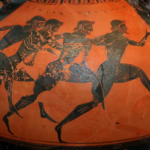
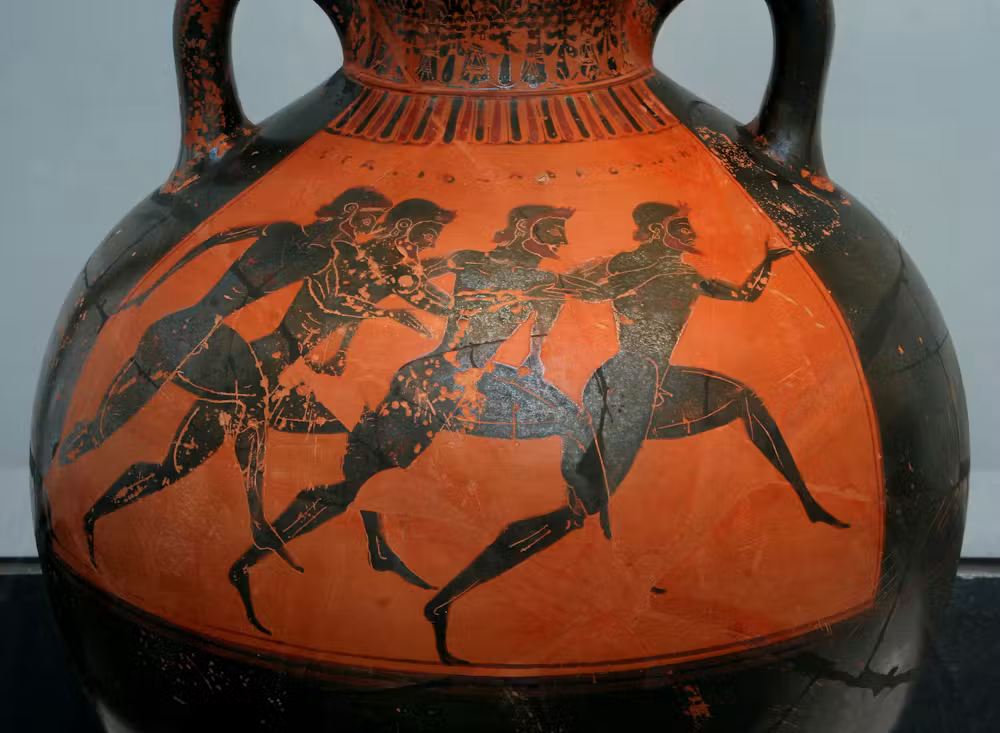
(The image at the top is of a Greek vase depicting runners at the Panathenaic Games c. 530 BC)
 Buy me a Coffee