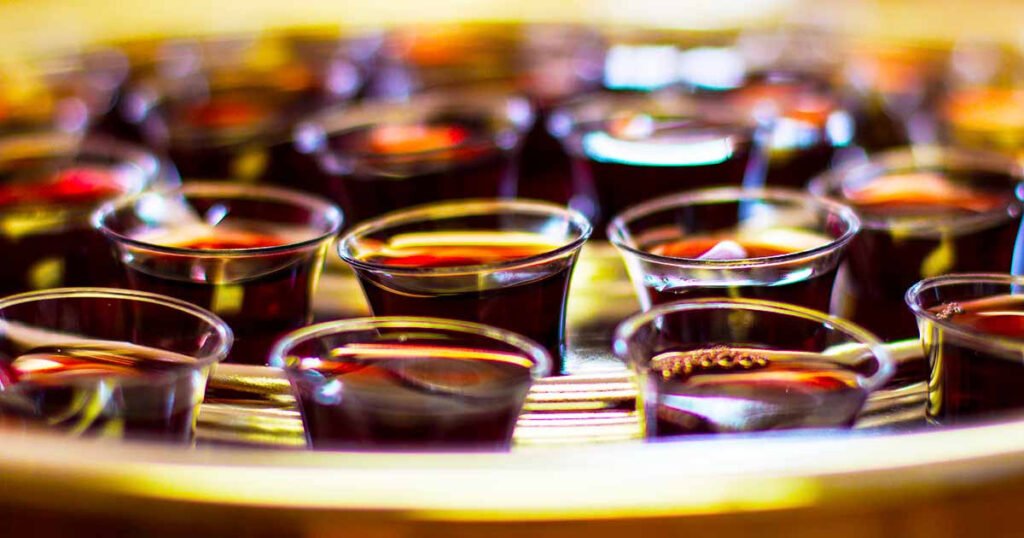
The use of individual cups at Holy Communion is again being hotly debated in Church of England parishes and PCCs. I asked Prof Andrew Atherstone about the fruits of his latest historical research into the topic.
IP: As you and others have pointed out in the past, the command of Jesus is to ‘drink you all of this’, so ‘drinking’ seems to be an important part of sharing Communion, and individual cups are an obvious way to allow this when people are concerned about contagion. So why are individual cups still causing controversy?
 AA: Five years ago, at the height of the early Covid lockdowns, the House of Bishops caused consternation by declaring that individual cups were illegal. They were relying on a former opinion from the Church of England’s Legal Advisory Commission (LAC). This shocked many parishes who wanted to use individual cups during the global health emergency, or had already been using them for years. There was an avalanche of newspaper articles and General Synod questions on the subject. Andrew Goddard and I wrote a short primer for clergy and PCCs, which we sent gratis to the House of Bishops and every member of General Synod: “Drink This All of You”: Individual Cups at Holy Communion (Grove Books). Many parishes simply got on with introducing individual cups, and it seemed like the heat had gone out of the question.
But the saga rumbles on, because there is a steady stream of reports in 2025 of bishops and archdeacons across the Church of England trying to persuade parishes to abandon individual cups and go back to a common cup. It seems that they have not yet caught up with the evolving advice of the Legal Advisory Commission.
IP: What does the Legal Advisory Commission say now?
AA: In June 2024, the Legal Advisory Commission added a significant clarification at the front of its earlier opinion against individual cups. It now accepts that “there are two respectable views on the matter of the use of individual cups at Holy Communion” (Legal Opinions Concerning the Church of England, part 15, Holy Communion: Administration of the Sacrament). This is a succinct way of saying that the question remains open, or “moot” in lawyer-speak. It is therefore reasonable for parishes to follow either opinion. The use of individual cups has never been tested in a tribunal. It is not true to say that they are “illegal” in the Church of England. But this recent clarification from the LAC does not yet seem to have reached some of our Anglican policy makers. It’s a vital development, which now enables Anglican parishes to use individual cups with a clear conscience.
As a historian, I’m a great believer in trying to understand the broader historical context to help us navigate our current controversies. Rather than focusing just on what is immediately in front of us, we need to widen the lens and take a longer view. So I’ve spent the last year researching early Church of England debates about individual cups between the 1890s and the 1920s. This has convinced me, from the perspective of Anglican history, that the LAC’s new openness to alternative views is correct. Our Anglican great-grandparents left individual cups as an open question, without pronouncing on them legally one way or the other.
IP: What was it that gave you the idea for this research? Were there hints in the current conversation what past debates had looked like?
AA: I stumbled into it by accident! There has been nothing at all written on Church of England debates over individual cups at the turn of the twentieth century—in fact, it’s almost as if those debates never happened, erased from our Anglican memory. It’s a gaping hole in the literature. So I was very surprised, sitting in the Bodleian Library one afternoon, to discover an advertisement for individual communion cups in The Official Year-Book of the Church of England for 1907. This was not some wild, marginal outfit—it was the Church of England’s “official” annual, published by SPCK, a highly respected Anglican publisher. And the advert sat alongside other adverts from established church suppliers like Mowbray’s and Wippell’s, from whom we are all used to buying our Anglican clerical shirts, candles, and communion wafers.
But even more surprising was what the advert claimed. Printed in bold letters was the verdict of the Archbishop of Canterbury, Frederick Temple, that there was “nothing illegal” in the use individual cups. This seemed all wrong. I had to keep rubbing my eyes and check what I was reading. Hadn’t we all been told by the House of Bishops that individual cups were illegal and un-Anglican? I asked a question about Temple at General Synod, but no one seemed ever to have heard of this archiespiscopal endorsement, or that individual cups had been advocated in the Church of England 120 years ago.
This led me to Archbishop Temple’s manuscript correspondence in Lambeth Palace Library, where I was delighted to find the letter in question. William Finch, a layman from Battle in Chichester Diocese wrote to the Archbishop in 1902 to express the “considerable apprehension” felt by communicants in his parish at the possibility of catching tuberculosis from the Communion cup. Finch observed that it was wrong to attend Holy Communion without receiving, and that to withdraw the cup from the laity contradicted Jesus’s command that we should “drink”. Therefore he asked the Archbishop to grant dispensation for communicants to drink from a small individual glass into which consecrated wine was poured at the communion rail. Written on the top corner of the original letter is Temple’s reply, communicated formally through his chaplain, that there was “nothing illegal in the suggested practice”. I was amazed to read this. It blew out of the water everything we had been told about the Church of England’s longstanding, never-changing rejection of individual cups.
From there I have followed the leads, step by step, digging into a wide range of historical sources from Convocation reports to Cathedral Chapter minutes to Anglican newspapers. And the result is an 11,000-word research paper!
IP: I think we are all aware why this has become a hot topic in the present. But why was this subject so hotly debated by our Anglican great-grandparents? Were they facing similar challenges?
AA: There are striking parallels between our public health anxieties in the 2020s, since the Covid-19 pandemic, and the “germ panic” which swept across the globe at the turn of the twentieth century. Germs were a brand new science, thanks to the pioneering research of microbiologists like Louis Pasteur, who developed “pasteurisation” to kill bacteria in food, and Joseph Lister, after whom “Listerine” is named. They discovered that many of the most dangerous illnesses are contagious—cholera, tuberculosis, diphtheria, typhoid, pneumonia, meningitis, leprosy, scarlet fever. For the first time, medics realized that microbes could be passed from person to person through close contact, not only by coughing and sneezing, but by everyday greetings like kissing and shaking hands. Invisible killers were lurking everywhere, on bannisters, door handles, shop counters, cutlery, toilet seats.
So everyone suddenly became more cautious, about sharing beds or sharing cups. Parents began to teach their children the importance of regular handwashing, hotels began to change linen between customers, women began to wear shorter skirts so they didn’t drag along in the dust, men began to shave off their beards and moustaches because they might be a breeding ground for germs, bathroom designers removed carpets and fabrics replacing them with smooth washable tiles. It was a social revolution. I like the way American professor Kari Nixon puts it in her book Kept from All Contagion (2020), that by the dawn of the twentieth century germ theory had “gone viral”!
Doctors and dentists discovered that the human throat and mouth are teeming with microbial life. So now they realized it was risky to share drinking vessels, especially with strangers. In Victorian times, well-meaning philanthropists often erected public drinking fountains, with a cup on a chain, so that passersby could quench their thirst. But these rapidly fell out of favour in the early 1900s. Children were taught not to share cups or spoons or water bottles. And, of course, Christians were just as alert to these public health concerns as everyone else. It seemed mad to promote better hygiene at home and school, but then go to church on Sunday and drink from the same cup as 100 other people! Roman Catholics weren’t too fussed, because the laity didn’t drink at Holy Communion anyway.
But it alarmed Protestants of all stripes, including the Anglicans. Respected periodicals like The Lancet and the British Medical Journal discussed the dangers of a common cup, and many congregations began to experiment with alternative methods of drinking. The most popular solution, individual Communion cups, began in North America in the 1890s and quickly spread to Britain. Those who resisted individual cups were viewed as anti-science—like the Christian opponents of Galileo or Darwin—because they remained wedded to old church rituals as if modern microbiology didn’t exist.
IP: It is fascinating that individual cups were so popular across other Protestant churches. So why didn’t individual cups take off in the Church of England?
AA: Every other Protestant denomination now uses individual cups, so much so that they have become identified in the public imagination as an inherently “Nonconformist” practice. But 120 years ago, Anglicans were at the forefront of this new experiment. They didn’t take off in the Church of England because Temple’s successor, Archbishop Randall Davidson, was a brilliant diplomat who knew how to defuse controversy. Davidson’s papers at Lambeth Palace Library are a treasure trove.
His post box was flooded by concerned Anglicans all over the world—from mothers who refused to take their families to Holy Communion any more, from parishioners who were alarmed because their curate had tongue cancer, from chaplains in sanatoria, from doctors who found themselves kneeling at the communion rail next to their contagious patients, and from bishops on the mission field (where disease was rife) who worried that converts were deserting Anglicanism because of the common cup. The question was discussed energetically at the Lambeth Conference in 1908, and the debate transcripts reveal a wide range of opinions about individual cups from bishops in diverse cultures across the globe, from Brazil and Ireland to Australia and Zanzibar.
IP: What was Davidson’s response? Did he call for a legal ruling to settle the issue once and for all?
AA: No! In every instance Archbishop Davidson was a genius at deflection. One of the striking features from his correspondence is that he always tried to ratchet down the tensions. When asked for advice, he consistently turned to medical specialists from the Royal College of Physicians, not to ecclesiastical lawyers or liturgists. Throughout his long tenure at Lambeth Palace—25 years!—the Archbishop kept gently dissuading parishes from individual cups, not because they were illegal or contrary to the canons and Prayer Book rubrics, but because the common cup was medically safe so individual cups were unnecessary.
Importantly, since there had never been a legal judgment one way or the other, he refused to lay down a Church of England rule and advised local diocesan discretion. He also worried that if the Church of England publicly endorsed individual cups it might lead to a national panic and parishes who kept the common cup would be put in a very difficult situation. Legally speaking, individual cups remained an open question 100 years ago. This confirms the latest LAC advice, that individual cups remain an open question today.
I have been impressed by Davidson’s cautious approach compared to our current House of Bishops. He never pronounced on the law. He never said individual cups were illegal. Instead, by repeating authoritative medical reassurances, he took the sting out of the debate and as a result most Anglican parishes decided to keep the common cup. By contrast, our House of Bishops in the 2020s gave a knee-jerk reaction to public health anxieties by running straight to lawyers and liturgists, making strong, divisive statements to the General Synod, and then doubling down on them in Ad Clerums. Our bishops boxed themselves into a corner, leaving parishes bruised and confused. There is a great deal the next occupant of Lambeth Palace can learn from Davidson the diplomat.
IP: That is all fascinating! Where can we find out more?
AA: My research paper is entitled “Germ Panic and Chalice Hygiene in the Church of England, c.1895-1930”. It’s not a polemical piece – it aims to be dispassionate, critical, historical analysis, deep in the archives. But it’s a fascinating story! The full version is published by the Journal of Religious History, and is free to download here.
IP: Thank you, Andrew, for your research, and these fascinating insights into the history and law behind the current situation.
 Dr Andrew Atherstone is Professor of Modern Anglicanism at the University of Oxford, and Latimer research fellow at Wycliffe Hall, Oxford. He is a member of the Anglican Consultative Council and a consultant to the Inter-Anglican Standing Commission on Unity, Faith and Order (IASCUFO).
 Buy me a Coffee


























Do you mean “diffuse” or “defuse”?
The latter, I think.
Well, if he defused the arguments, then this would have diffused the sense of pressure…?
As opposed to the duff use we have now.
Er, I’ll get my cope.
As a Scottish Presbyterian, I’m amazed that this is even a ‘thing’ worthy of debate. We have always used individual cups in every church that I have been part of, with only occasional common cup usage at services with small numbers of people [and that not really now at all, since the pandemic]. Some churches used communion spoons, where everyone dipped their spoon into a common cup which was passed along the pew – a bit of a faff, and not really done now. But then we also don’t view the communion elements as consecrated [any left overs get poured down the sink], and we don’t receive them from a ‘priest’, but share them together….so lots of differences!
Well, I think you might have hit the nail on the head there!
But many of us share your question: why have bishops made a big deal of this? It looks like it is out of ignorance of actual history and actual law.
Well, a common bread would give the same symbolism (replacing multiple wafers) while multiple cups can keep the hygiene lost by a common cup. I wonder if this issue was discussed during the Spanish Flu in the 1920’s? How did they solve it?
Thank you for this paper, and all the research involved. It sounds like a wonderful, but energetic paper chase. I appreciate. Here in the northern region Church of Uganda it is normal to receive the elements of Holy Communion by intinction, and apparently this was the case even before Covid. At least, so I have understood. I think that the same practice is common across the CoU. Priests tend to be assiduous in handwashing and sanitising where possible, but to receive the wine soaked wafer into hands which have been active since the last washing is problematic, and then sometimes the whole wafer is soaked. We are, I am sure, familiar with the issues associated with intinction! However in a situation such as here with congregations of 500- 1000 at a time the number of individual cups and the issue of washing up is probably prohibitive.
Bring your own family cup?
Some churches do that here.
thanks! But I bet you don’t just use one actual cup…!
Andew Atherstone writes that
at the height of the early Covid lockdowns, the House of Bishops caused consternation by declaring that individual cups were illegal. They were relying on a former opinion from the Church of England’s Legal Advisory Commission (LAC). This shocked many parishes…
What interests me is why the Legal Advisory Commission believed at that time that individual cups were ‘illegal’? (Also, do bishops not trust themselves to spend a few hours together searching the scriptures on a fairly simple matter?) Nothing in the New Testament or XXXIX Articles says anything which precludes individual cups. There is only Jewish tradition, then Christian. When I am told that something is illegal (especially under ‘international law’…) I ask by what statute. Jesus himself used the words “It is written that…”.
I’m not surprised that no parish priest brought this to a head by declaring publicly that during Covid he would use individual cups no matter what his bishop, the Archbishops or their Legal Advisory Commission said. But in the long term it might have been helpful.
Andrew, even if the LAC now takes a more sensible view, what was their earlier advice based on, please?
Actually, I don’t think even Jewish tradition believes in ‘one’ cup. The phrase has the sense of ‘shared commitment and experience’, it is not about the actually number of cups involved. Just as Jesus says to James and John ‘Can you drink the cup that I will drink?’
Full exploration here: https://www.psephizo.com/biblical-studies/did-jesus-use-multiple-cups-at-the-last-supper/
I appreciate all scholarship but find the controversy unnecessary. I feel more strongly about the liquid used. I used to think it was a mistake to use red grape juice (for the sake of recovering alcoholics) rather than red wine (from an approved ecclesiastical supplier rather than the off license?), but now I believe this doesn’t matter, for in 1 Corinthians St Paul speaks only of the ‘fruit of the vine’. Mindful of Communion being taken in the pre-modern era in some northern climates, I wouldn’t mind if it wasn’t from grapes but from blackcurrants or some other local red berry. (I believe Ribena was used during the War when red wine from the Continent was in short supply.) The point, surely, is that it be red, like the blood it symbolises. I am baffled and I regret the frequent use in Church of England congregations of a tawny or golden fortified liquid. It was pagan Greek gods who bled a gold liquid, ichor.
Yes, Paul talks about the fruit of the vine, and the real issue here is that in Hebrew the juice of the grape is called its blood. Judgment is often expressed in the metaphor of pressing the grapes, not fermenting the juice, and that is what is important.
Isn’t the tawny effect a result of water being added to the wine?: a very old tradition recalling the blood and water when Christ’s side was pierced on the cross, and the union of humanity and divinity.
No, what I am talking about is more like sherry.
Then I’ve no idea. I can only guess it’s a quirk of tradition – wine in England historically was always with a much higher alcohol content than you’d find on the continent, because it had to be to survive being transported (so we drank claret, sherry, and port). Even though now you can move wine about quite happily at much lower alcohol content levels without it spoiling, people are probably used to the old heavier alcohol wine for communion and get grumpy if someone tries to change it.
Aside: trying to find an answer to this I found people selling white wine for communion, which really blew my mind.
It has to be red, like blood. I don’t mind if it is port or red wine or red grape juice (the ‘fruit of the vine’, 1 Cor 11), or even blackcurrant when and where wine isn’t readily available. But the symbolism is wrecked by this golden sherry-like stuff, and for the same reason I wholeheartedly agree that using white wine is absurd.
My understanding is that the real impetus for white wine was from altar guilds, who found it much easier to wash purificators if the wine was not red.
How remiss of St Paul not to specify the size and design of purificators in the New Testament! A toilet roll would do.
Cathedrals seem to use white/tawny wine. I know some churches use champagne for feast days!
Years ago whilst my wife and I were serving with the Torajanese [Presbyterian] Church in Indonesia there was a lively debate as to the single chalice / individual cups. As one gently probed, this wasn’t so much a matter of hygynie but social caste. For the descendents of aristocrats it wasn’t appropriate to drink from the same chalice as descendants of slaves. Happily the single chalice continued.
There is other evidence that the desire of white Christians to avoid drinking from the same chalice as black Christians may have been a factor in the introduction of individual cups. This blog post examines that along with other issues: https://allthingslawfulandhonest.wordpress.com/2020/09/12/a-shot-of-salvation/
The author of that post wrote (during Covid):
It must be assumed, therefore, that if those advocating these changes feel it is impossible to celebrate the Eucharist without receiving the chalice, they are proposing a doctrine of the Eucharist which is different to that which the Church of England has taught until now… The sharing of a common eucharistic cup rather than individual glasses is a vital sign of the unity all Christians share in Christ, irrespective of background, wealth, identity, or culture.
We are one body of Christ through sharing the bread and wine in the same service. I am concerned solely about hygiene and disease. The article reveals an unsavoury piece of ecclesiastical history, but nobody brought up the idea of individual cups in today’s increasingly multiracial congregations until Covid hit.
The logic you cite there is bizarre.
It does not prevent large churches from using many chalices. And Nonconformists who use individual cups point out that they all drink at the same time, which is arguably a greater demonstration of unity.
‘Drink one cup’ is primarily a metaphor for sharing values, beliefs and experience. I find the literalising here odd.
I have participated in communion services in Mennonite churches. Some have practiced processional communion like Anglicans, but in others the communion cups were passed out to the people until everyone had a cup in hand. All then drank at exactly the same time. I found this common moment of drinking every bit as powerful a symbol of our unity in Christ as the common cup.
What is worth challenging is the shameless but now almost universal substitution of wafers for real bread. What does the cup represent? The blood of Christ. What does the bread represent? The body of Christ. And what does a pale, tasteless, cardboard-like wafer represent? Not his nourishing, life-giving body, but an insipid church that has completely lost sight of who Jesus is: the true bread from heaven who gave life to the world.
As someone said, “You are the salt of the earth, but if salt has lost its taste, how shall its saltiness be restored? It is no longer good for anything except to be thrown out and trampled down.”
Worse than that: wafers are individual! How can you argue *for* individual wafers (certainly not ‘from one loaf’) but argue *against* individual cups?!
Indeed.
I’m all for abandoning the wafers in favour of some actual unleavened bread.
With or without yeast?
I think the point here is that in the ‘prototype’ Passover meal the bread would be ‘unleavened’ without yeast, and the wafers are unleavened. Unleavened bread can actually however be quite ‘rough’ and can be tasty in a way the wafers aren’t. On an everyday basis I don’t think it matters too much – but perhaps occasionally someone might bake an unleavened loaf for the communion to illustrate the Passover origins of our rite….
But it was also in the context of a real meal. Isn’t that more important to recover?
Yes of course it is. But that means in homegroups, opening a can of worms for those worried about having an ordained priest running it or whether it should be in a church building. It’s not a problem for me, but I’m an ecclesiastical anarchist who attends a CoE congregation.
Christ’s instructions were not “go and have a real meal in remembrance of me”.
It’s actually a complex issue, but what do you make of “Do this as often as you drink it in remembrance of me”?
Very briefly:
Generally 1 Corinthians 11 doesn’t read to me as an endorsement of ‘real meals’ – Paul says it all gets very unequal, out of hand, and you ought to be eating and drinking your meals in your own home.
Key is having a view about what is the “this” and what is the “it”. “It” to my reading of the Gospels is a cup that is passed around. “This” is the sharing of bread and wine in a Eucharist ceremony. The point is the sharing: as Paul says we’re supposed to be discerning the body of Christ. So, “do this as often as you drink it in remembrance of me” is saying pass the cup to share the wine amongst yourselves when you drink wine which is Christ’s blood of the new covenant. In discerning Christ’s body in the Eucharist we also acknowledge that we the Church are one body.
Aside: I think the “we’re just being practical” argument is lent on too easily – for example, it’s why Roman Catholics often don’t give the chalice to the congregation at all. We’re talking about a sacrament instituted by Christ which is all about his body and blood and the new covenant. It’s extremely central.
Adam, what do you make of:
‘When you come together, it is not the Lord’s supper that you eat. For in eating, each one goes ahead with his own supper, and [consequently] one goes hungry, another gets drunk.’ ?
So far as I can see, people were gathering in the church for a meal, but it was buffet-style, and coming at different times, so that those who came early had plenty to eat and those who came late found there was nothing left and went hungry. Paul says for that reason they were not eating the Lord’s supper. He said people should wait until they were all together and could eat together (v. 33). If they were hungry and could not wait, then they should first eat something at home (v. 34).
When Jesus modelled the sacrament, he modelled the eating of an entire meal, and it was ‘as they were eating’ that he took bread and then wine. He looked forward to the end of the age when he would lay on a great banquet – not merely some bread and wine – for all his disciples (Luke 22:18, Rev 19:9).
Thayer’s Greek Lexicon apud Jude 12 says of the agape feasts that they are
My reading of 1 Corinthians 11 is that they’re getting together as a church (not in a church) to eat a full blown dinner and saying that’s the Lord’s Supper. St Paul sharply criticises this because it breaks down into different groups having their suppers amongst themselves, differing quantities and selections of what’s on offer, and it all gets out of hand. What it should be is shared bread and shared wine, discerning the body of Christ.
I’m wary of talking about the sacrament ‘modelling’ as I think you wander into saying it’s all just symbolic, which it isn’t. Nor is it about looking forward to a great banquet a la Revelation. It is about Jesus’ sacrifice as the new covenant, and us sharing in his victory over death by partaking of his body and blood. Christ is the true Paschal lamb.
I don’t think you have addressed my points.
As well as claiming to outlaw multiple cups, I have heard of bishops issuing recently edicts (as in Canterbury, I am told) purporting to prohibit clergy from conducting Holy Communion services anywhere than within parish churches.
Has anybody else come across this as well? Do bishops have such a right? I wonder what prompted this assertion of power.
Regarding individual cups, the practice in Sydney Anglican Cathedral is to use individual cups: one person serves from a tray, another holds a tray to receive the empty cups. It seems to work OK.
And who does the washing up? Does Sydney Anglican Cathedral have a proper kitchen in which to do the washing up?
Well, they offer a cuppa and biscuits after every service,and the cathedral hosts a men’s prayer breakfast every month, so they must be coping. But as to who does the washing up, well, Austrslian men, what can you expect? …….
If you are talking about the Church of England, Canon B40 limit where Holy Communion services can be held:
B 40 Of Holy Communion elsewhere than in consecrated buildings
No minister shall celebrate the Holy Communion elsewhere than in a consecrated building within his cure or other building licensed for the purpose, except he have permission so to do from the bishop of the diocese: Provided that at all times he may celebrate the Holy Communion as provided by Canon B 37 in any private house wherein there is any person sick, or dying, or so impotent that he cannot go to church.
In most parishes that will mean Communion is limited to the parish church and the houses of sick, dying or disabled people.
From 1985 to 1995 I attended a Baptist Church. At the start, a common cup was used (well, two cups, one for each aisle). Then HIV arose, and there was a debate about the use of the common cup. This was resolved by reverting to the “wee cuppies” which had remained in the cupboard [sic], but only for the morning service. The evening service retained the common cup(s).
It was prohibited to bring alcohol into the chapel. However, there was one occasion when this was violated. It was the practice for the home groups to take turns in providing the bread and grape juice. However, one Sunday those responsible had forgotten. So, instead of the grape juice, some homemade wine was brought. It was rather rough. As is common, the congregation was invited to drink from their cups togther. You can imaging the shock and coughing. I missed it, being out with the Sunday School. Shucks!
People here seem to be all of one mind that there are no valid reasons for not using individual cups/ But what all this conversation omits is that for some there are good theological reasons for not using small cups, relating to the practicalities of ensuring that all the consecrated wine is consumed . For people of a Higher Church disposition than those who have contributed here, it really matters that all the wine including drips left in the cup etc is drunk – with a common cup this is relatively easy to do this, but very impractical to do ablutions with lots of small ones to ensure that all wine is consumed. Putting used cups straight into a washing-up bowl while the remains of wine are still in them is not for them theologically acceptable.
This is clearly not a view of those here, but it is one reason why people don’t accept communion in individual cups. It is all related to the theology of what actually happens in communion, for which there are many, varied views across the C of E. What is normal for those here is not the same for others and an awareness of this needs to be part of the conversations.
Thanks Sarah. But why not simply rinse the small cups with a little water, and consume all the water? Why is that a problem?
Dilution of doctrine?
Yes, that way you can get everybody’s germs.
Of course, Anglo-Catholics do this with the chalice in any case.
A church I once served in used to pour the unused wine back into the bottle – not very hygienic, I think.
Helping in a school service once where most of the kids didn’t take communion but there was a lot left over, I decided to reverently ‘bury’ the wine in the grounds. I understand Catholics would put unconsumed hosts in the ground under their churches.
Or use them at the next service, or burn them? I certainly thought that Catholics burnt cloths that had been used to absorb any of the wine that was spilt or was left undrunk.
‘proper’ Anglo Catholics would consume left over consecrated elements. I one drank a whole chalice of bad wine left on the altar by a low clergyperson!
‘‘proper’ Anglo Catholics would consume left over consecrated elements.’
That’s not a particularly Anglo-Catholic rule:
‘‘…but if any remain of that which was consecrated, it shall not be carried out of the Church, but the Priest, and such other of the Communicants as he shall then calls unto him, shall, immediately after the Blessing, reverently eat and drink the same.’’ – 1662 BCP
Tim you are right. But the BCP doesn’t imagine the kind of fastidiousness of ensuring every molecule is consumed because each one is the actual body and blood of Jesus!
But neither is it any old bread and wine that you can just throw away.
What effect do you believe consecration has upon it, Adam?
Sorry Anthony, didn’t see this until now.
I think consecration sets the bread and wine apart for the purpose of the Eucharist, and that is a serious thing. To receive the consecrated bread and wine is to partake of the body and blood of Christ (as He says in Scripture – “Take and eat, this is my body” (Matthew 26)). In short, I’d describe myself as believing in the real presence.
Consecration is not, however, a magic spell nor is the priest a wizard. It’s not unleashing God as if he were trapped and we set His powers free. The consecration is really for us, to keep us disciplined, and to ensure we understand correctly. So you don’t mess with it. And you don’t get to pretend it’s all symbolic and not real.
Thanks Sarah. Common cup man here, but spent reading the entire article baffled at why this is a controversy at all. Until your comment I couldn’t see any reason whatsoever for resistance to individual cups other than some shadowy custom never really explained. But your explanation seems correct. If the wine is consecrated it must be consumed, not poured down the sink, and it is obviously harder to ensure the correct thing happens with individual cups. Ian’s proposed remedy isn’t quite convincing. Happy to be instructed further.
What effect do you believe consecration has on the wine?
And the wine that stains the purificator. As a young, not-really-believing Catholic, I knew the Catholic doctrine was that the wine became (transubstantiated into) the literal blood of Christ and the bread became the literal body. So Catholic practice was to talk of the bread as the Host (a word I didn’t understand then). I couldn’t understand how you could wash or pour away something so holy.
Later as an Anglican I came to understand Cranmer’s receptionist teaching (which Dix wrongly called Zwinglianism) that through faithfully receiving the bread and wine (“by faith with thanksgiving”) we feed on Christ “after an heavenly manner”, so there is no question of a physical change in the elements. They are instruments of faith, not objects. That is why the Thirty-nine Articles prohibit didplaying or ptocessing the bread, as in Catholic Eucharistic Adorstion. But those who hold to transubstantiation because of Anglo-Catholic teaching are inclined to that belief. I think it is a holdover of these scholastic ideas which explains liturgical conservatism about ‘one cup”.
It’s not harder. One pours the expected number of glasses.. if it runs out then its extremely easy to pour a few more.
No different from guessing how much wine to pour into the chalice (s) at the outset
I appreciate (from a quite different perspective) the sensitivity in this for others.
My experience is that a) there’s very little left in small cups but b) it’s impossible to drink every last drop. That’s why the “ablutions” still actually wash and wipe the (often 2 or more) chalices. There’s plenty of drips of wine in any purificator.
I’d thoroughly agree that it should all be done dignified way but I’d put the command to “drink” above everything else.
We are not all of one mind. I’m firmly in the shared/common cup camp. I do find it amusing though to see so many supposedly orthodox Anglicans, who fret about unity with the Church catholic, adherence to Scripture and early tradition, and lecture on the impossibility of dissent from the formularies of the BCP being so adamant about moving to individualised cups (and that’s before we touch on doing away with the Eucharist service itself).
Adam: and I find it amusing – no, tragic, really – that those who want to change really fundamental things like the doctrine of marriage or Christology are those who want to maintain a faux “unity” by a boring conformity to the rituals of 1930s liberal Catholicism.
Do you also get upset by the abandonment of clerical dress?
An observation I made many years ago: those who sit the loosest to the doctrine of the Anglican Church are nearly always the most conservative in liturgy and ceremonial. The less they believe, the more thry like to dress up.
Pascal commented in his Pensées that judges liked to dress up richly to conceal the thinness of their jurisprudence. Ceremonialists in religion do something similar.
Sorry to puncture your prejudices, but I’m not especially bothered by clerical dress. I suppose I object to some of the more modern takes on mitres and stoles but mostly I think on aesthetic grounds.
Thanks, Andrew – a very helpful corrective on the subject where there seems to have been quite a lot of misinformation circulated.
When the controversy broke out in 2020, I was struck by the discontinuity in approach between the use of bread and wine by Anglicans of a more catholic persuasion. They got very upset about the use of individual cups but seemed more than happy for congregations to be given little individual wafers. Surely there is a contradiction here. The explanation is surely that liturgically catholic anglicans are upset about individual cups because they are a non-conformist tradition but are more than happy about individual wafers because they are a Roman Catholic tradition (and since the Oxford movement we all want to become a catholic as possible, don’t we?).
My wife says that she would never go back to using a common cup which means that she is essentially disenfranchised from half of the sacrament. I personally would be delighted for everyone to have individual cups which we can drink together as a sign of our unity in Christ. That means we are all sharing in one cup together.
Yes, I have long suspected that opposition to individual cups is probably psychological in nature, the desire of Anglo-Catholics not to like like Baptists.
The legal advice in 2020 citing the Sacrament Act 1547 was pretty desperate stuff, since the Act makes no mention of ‘one cup’; but it does state this:
“the preist which shall ministre the same shall at the least one day before exhorte all persons which shalbe present likewise to resorte and prepare themselfs to receive the same”;
a godly admonition I have never heard in any Anglican church.
* ‘look like Baptists’.
What’s wrong with Baptists?
I think we should be told.
A Baptist Bishop? This is difficult to process ….
But an excuse for me to tell my Baptist joke. A new Baptist minister stood in a baptistery, taking his first baptism. He began, ‘The Lord gave us this command: Go into all the world and’ – here, in his nervous confusion he turned to the wrong page of his BCP (Baptist Common Prayer and continued) – ‘Drink ye all of it.’
It took them three hours to finish.
Wasn’t the introduction of wafers to do with the desire to reserve the sacrament after the service? Wafers don’t go state and mouldy as fast as real bread, therefore…
We can drink, in individual cups, from one large cup or flagon, from which the wine is poured.
Problem solved…?
Fidgety and time consuming filling the cups during the service.
Sydney Anglican Cathedral uses little cups in trays.
Not that I’m a fan of the wafers, but they are at least all held together on the paten when distributed.
I’m not sure about the logic of getting rid of a shared cup meaning we are all sharing one cup…
I am linked with two CofE parishes, one conservative evangelical and one HTB church plant. In the first individual cups were used without controversy before 2020. But now the Bishop has put his foot down and a common cup is used in both churches. Whatever the rights of a vicar, in practice he needs to have a compelling reason to go against the wishes of his Bishop. It seems to me that Covid has caused a step-change in how our (English) society operates. Bishops discovered they had power to order and forbid all kinds of things and it was rather fun to use it. Governments discovered they could make all kinds of rules about who had to wear facemasks in care homes even when everyone else was allowed to stop wearing them. None of this is new, of course:
For some of the last Platonists had founded
That city of old. And masterly they made
An island of what ought to be, surrounded
By this gross world of easier light and shade.
All answering to the master’s dream they laid
The strong foundations, torturing into stone
Each bubble that the Academy had blown.
(Dymer, CS Lewis, 1926.)
(I contribute under a pseudonym in order to avoid identifying any specific congregation or Bishop.)
Thanks—but I am not sure that the vicar had no choice. Bishops have done this, by claiming that individual cups were illegal and unprecedented. As the interview highlights, neither of these things are true.
So was the command of the bishop ‘lawful and honest’. I don’t think so.
What about Canterbury diocese declaring that services of Holy Communion outside parish churches are illegal? Is this correct or over-reach?
Did the declaration actually use the word ‘illegal’, and if so then could the diocese cite the appropriate part of ecclesiastical law; state whether it applies also to other denominations; and state whether Anglicans are permitted to take Communion within Canterbury diocese boundaries in Methodist and Baptist congregations?
The cost of not doing joined-up thinking!
Thanks for the update.
I’m genuinely puzzled as to the missives being sent out by whoever. Apart from the historical ignorance, the vague theology and the double think regarding wafers (i could go on..) the line being given seems to me to be pastorally tin eared.
It’s an argument built on sand which has the effect of refusing some communion.. “unless you do it my way” says a Bishop. Does it not turn on it’s head the admonition regarding not coming to the Lord’s Supper?
What a strange, pointless and distressing thing to die in a ditch over. Separate wafers is ok but individual cups not? It’s nonsense.
I was once in favour of returning to the Common Cup. I still do but time has moved on . Some will never return to it and flexibility is all that’s required. It’s not rocket science.
Separate wafers and common cups makes sense if you are high church and concerned that none of the bread or the wine is wasted or treated irreverently. It’s easier to rinse the chalices and drink the water you’ve used in rinsing with chalices than it is with small glasses. And the difficulty with using real bread in holy communion is that the crumbs get everywhere when you tear pieces off the loaf. So, not really inconsistent practices at all – a common concern underlies both.
It’s easy to ridicule others’ practices when you don’t understand them.
I do understand them. No ridicule was intended.
Though wafers instead of “real bread” ?
Our PCC a the time of the lockdowns supported unanimously my suggestion of obtaining shot glasses and paddles for communion wine, and I consecrated wine in a small jug and then poured the wine into the individual glasses. Everyone thought it was a great idea, as I thought that the idea that the priest alone would take the wine ( which had been suggested by episcopacy) was idiotic- either we all took communion in both kinds or none of us.
Whenever I’ve been to cathedrals there are multiple cups in use – so when I heard a bishop insisting “one cup”, clearly he couldn’t count- and I understood it was not the receptacle that counted but the wine contained within it. I took the cups home and washed them for next use.
Frankly many of us thought it was time the House of Bishops entered the real world….
What did you use the paddles for? Playing ping pong with the shot glasses?
Big paddles with holes drilled in them to hold a number of shot glasses – you sometimes see them in heavy drinking nightclubs (should you frequent such places…)
Surely badminton?
Adrian Plass once related a story where he went to speak at a Baptist church where the ‘ Baptist’ sign outside had the third letter missing (it had fallen off).
The moral?
Do not take the ‘ p ‘ out of Baptist.
I find the whole debate about the legality or permissibility of this practice bizarre, especially -as several comments point out- because the Bishops seem quite happy with a ‘many loaves’ arrangement. I fail to see how one can permit individual wafers, but not individual cups. Hence, I agree that this debate is politically/power motivated, rather than based in any meaningful sacramental theology.
….
One slightly different angle for contribution which hasn’t been touched on yet, is that the use of individual cups in my Baptist setting enables simultaneous consumption of the ‘wine’. It means that when I invite people to “drink together as a sign of our unity in Christ”, we are literally doing so in unison and I find it liturgically pleasing (as I do the ripple of ‘clinks’ as people put their cups down).
It’s not a many loaves arrangement though. The wafers are distributed from a common paten. The wine is distributed from a common cup.
So consecrate a flagon and pour it out?
For what it’s worth at a large Eucharist it’s entirely normal to have multiple patons, for multiple distribution points
Adam: what do you mean ‘the wafers are distributed FROM a common paten’? In our church al least three people give out thr bread from three plates and three give the wine, in three chalices. There is no common paten or common cup and never has been.
Further, we are always telling people there is gluten free bread for those who desire it and this kept separate from the rolls. We have never eaten “of the one bread”.
It is also the case that in all our church meals, we have to specify ingredients (nuts, possible allergens etc).
On communion, I perceive the visual symbolism debate. Evangelical Anglicans have very largely abandoned robes and even clerical shirts in services, while liberals and high church insidt on robes and symbols, and a beautiful gold or silver chalice is a powerful badge of office. A lot of this debate is really functioning at the psychological level, which is how much of Anglicanism publicly works (by appearance, not by deep agreement).
Unless you’ve got a priest with a congregation of two, the patens and chalices are shared/common.
Gold and silver chalices as a badge of office? What? At every Eucharist I’ve ever been at the priest officiating has distributed the bread rather than the wine. Who has a gold chalice in their church? I’ve never seen one. Having a silver one is part of having beautiful and precious things in the worship of God (hardly an alien concept in Scripture), and comes with the handy bonus that silver is a natural antibacterial. Whilst there is a general symbolism debate, the Eucharist is not merely symbolic. It is a sacrament, instituted by Christ, where we partake of the body and blood of Christ, which is given, taken, and eaten in a spiritual and heavenly manner.
Now you have quite lost the point. There is no ‘one bread’ in almost all communion services I have been to. And Scripture does not say ‘we al eat of the one paten’. The ‘one bread’ means Jesus Christ, it does not refer to a sacramental object.
I assure you there are plenty of gold chalices around, but mostly under lock and key now because of their value to thieves. And in Anglo-Catholic circles, the presentation of chalice and paten does indeed happen at ordination.
Nobody said the Eucharist is “merely symbolic”. But there is definitely a symbolism debate going on here, just as there is over vestments and who may/must wear them. But evangelicals have moved on from this.
‘One’ is a straw man. It’s about whether the distribution is common/shared or individualised. So, it’s often the case (just about every church I’ve ever been to) where we use a common cup for there to be at least two chalices: distribution is shared, but using more than one individual chalice. And if there’s more than one communion rail / distribution point, more than one common/shared paten from which you are given the bread or wafer.
I think you’ll find scientifically speaking that the length of time silver is in contact with water determines how antimicrobial it is. It is a slow process. There is therefore little chance of it being antibacterial given how long water and wine are in a chalice. So an old wives tale? Pretty much. I’ll stick with individual cups and a hot wash.
Adam, you are stretching the meaning of ‘common’ to breaking point! All the wine, in all situations, comes from a common flagon. So what is the problem?
You’re sharing the plate but not sharing the cup.
‘plates’ – plural. We use at least three in our church. No ‘one bread’, never has been.
This does nothing to change the substance of the argument though.
If the idea that one whole divided into several parts is permissible for the ‘bread’, then the same must be true for the wine also. As Thomas says above, why not simply consecrate a flagon/jug and pour it out? (though, in practice, this is what happens anyway when the wine from one bottle is transferred to something else!)
I no longer have a dog in this fight, but Ian as a fellow statistician will be amused by the argument advanced to me when I suggested a church at which I ministered should use large wafers then broken up so that we would share in one bread. (Just large wafers not necessarily the ones with remarked divisions)). I was told (honestly I really was) that we couldn’t do that because it would no longer be possible to count the number of communicants for the service register and hence statistical reports. The moral: if you don’t like something but can’t say why, find a statistician to blame…:-)
People don’t like statisticians because of all their mean tweets.
Sorry..”premarked” not remarked
Question – the original ‘Last Supper’ was a Passover meal during which Jesus ‘repurposed’ two of the courses or stages of the meal. In a Jewish Passover do the participants pass round a shared cup, or would ‘the cup’ simply refer to that stage of the meal, with all drinking from individual cups?
I’m personally quite happy with the practice of our Baptist church with individual cups distributed to the congregation and all drunk simultaneously.
We know what happens in a modern seder (everyone’s got their own cups). We’re a lot less sure about practice in the first century, and I’d be very cautious about assuming the Last Supper is simply someone writing up a seder rather than Jesus instituting something new with a new practice. However, I think the Gospels are very clear that the cup was shared:
“Then he took a cup, and when he had given thanks, he gave it to them…” (Matthew 26)
“Then he took a cup, and when he had given thanks, he gave it to them, and they all drank from it.” (Mark 14)
“After taking the cup, he gave thanks and said, “Take this and divide it among you.”” (Luke 22)
Having many cups is one step removed from the one cup. A fitting symbol of priestcraft I think. Therefore Baptists should swap their method with the High Church so that the symbolism reflects the tradition more faithfully. Tongue in cheek.
I may have missed this in the reams above but is there actually any evidence of any disease being spread by the common cup? – having used it throughout my ministry and always consuming the left over wine I’m still here and I personally think is there is great significance in each person drinking from the same cup…
Good question David, I am not sure there is. I think much of it is about fear.
OK, then I am afraid. And if someone considers such fears to be evidence of a lack of faith, then so be it.
Much more important is the effect on witness and evangelism. Nobody in the 21st century drinks out of a common cup unless they are Freemasons or belong to an esoteric college dining society. And is this really want we want to say to potential church members? – “Join us and start behaving like a weirdo.”
Not an issue for Roman Catholics, of course, because the laity don’t get the cup.
But you are right that drinking from the same vessel simply doesn’t happen in any other setting today, and no school or institution would lay itself open to any liability case. That’s why the Bishops wanted communion suspended during covid, and why some people today will still not take the cup, whether with good reason or not.
Weirdos can certainly misbehave at communion (spitting in the cup, for example), while some people insist on intincting their bread, a custom that can lead to a mess.
RCs do share the cup now, but many older Catholics (like mt late parents) hated it.
If you think sharing the cup is the ‘weirdest’ thing about Christianity, or indeed just the Eucharist, you’re in for a big shock.
To everyone. I have read all the discussions during COVID my consultants advised strongly in health grounds that I shouldn’t drink common cup. Now I can’t dip a wafer in the cup. As I go to another church using small glasses I shall only take Holy there. What would Jesus say? He knows my heart wants to be still and remember His sacrifice through communion. That’s what matters to Him. I find all these unclear rules and regulations distressing and discriminatory. Let’s love each other as brothers and sisters in Christ. Amen
Thanks. I agree with you that the lack of clarity has been unhelpful and unloving…
Some more info. https://ramblingruminations.com/dipping-sipping-or-something-else/
Thanks for this. I’m afraid (we) clergy often spar above our actual knowledge weight.
I suppose in the end, like most of today’s questions and debate, the basic thing is all about our attitude to the NT writings and what authority they do or do not have…
Well Ian a few hours have passed and no comment yet on Sarah Mullally and the outright rejection of her by Gafcon.
I looked up her CV on Wikipedia and was concerned to how theologically thin and insubstantial her qualifications are – a certificate from a part time course.
The Church of England clearly doesn’t think theological knowledge matters in bishops.
And it shows in her threadbare liberalism.
Mullally is an outstanding choice. First woman Archbishop of Canterbury which was much needed after the male sex abuse cases in the C of E. She is someone who will not reverse LLF either given she helped author it and is committed to Parish ministry. An Anglican Communion spokesperson also welcomed her appointment, though she is only symbolic head of the global Anglican church beyond England. As a former midwife she will also have compassion and executive experience as Chief Nurse
She will close what is left of a dying organisation.
Truly a counsel of despair.
Even on the liberal ‘Thinking Anglicans’ site they don’t know what to make of this: an over-promoted nurse with minimal theological qualifications who is widely blamed – by liberals – for covering up the circumstances that led to the suicide of the homosexual priest Fr Alan Griffiths.
And there are plenty more skeletons like that in London (like the ‘Two Cities’ embezzlement scandal).
I thought this was a thread about the administration of Holy Communion?
Sarcastic and negative comments about the appointment of the next Archbishop are entirely out of place. Instead as Christian brothers and sisters we pray and support each other.
You don’t have to comment here if you don’t want to, Tim.
There is plenty of critical comment over of ‘Thinking Anglican’, especially about Fr Alan Griffiths’ suicide. Maybe you can rebuke them there for their lack of good manners.
In the meantime, while Ian is working up a response to Mullally’s appointment, we can be glad that he exercises a light hand over comment here – unlike the control freakery at ‘Thinking Anglicans’, the echo chamber where unwanted orthodox comments go to die.
I know Britain is becoming an increasingly censored society where free speech is muzzled (but not enough for Establishment figures), but we who believe in freedom must resist this.
This is a “Prevention of Futher Deaths Report” by the Coroner who led the inquest into the death of Alan Griffin:
https://www.judiciary.uk/wp-content/uploads/2021/07/Alan-Griffin-2021-0243-Church-of-England-Published.pdf
Every word is worth reading to the end and it fills in a lot of background.
But not, surely, ‘freedom’ to misrepresent things, James.
‘I looked up her CV on Wikipedia and was concerned to how theologically thin and insubstantial her qualifications are – a certificate from a part time course.’ (JT)
In addition to the ” “Prevention of Further Deaths Report” to which I link immediately above, there is the information about the case in Anglican Unscripted 934, the 8 minutes from 10:45mins at
https://www.youtube.com/watch?v=E83Bk4xMSLw
Chief Nursing Officer. Whatever you think of + Sarah’s theological education or her safeguarding record, try to refrain from misogyny. It just makes your more reasonable points look like cheap jibes.
No a female Archbishop after many male sex abuses scandals will be welcomed by most English people for their established church. She will also ensure central C of E funds and investment income are directed to Parish ministry
I’d be astonished if there wasn’t a reflective piece coming, but give the man a break. It takes some time to process.
Done. Sorry it took more than a couple of hours…!! (not)
If I remember correctly Ian doesn’t think much of Gafcon.
For my part I thought Abp Mbanda’s statement extraordinarily disingenuous. We’re invited to believe that if only someone more to Gafcon’s liking had been appointed they’d come flocking back to recognise Canterbury as the “spiritual and moral leader of the Anglican communion”. Pull the other one – it’s got bells on!
Adam: Who invited you to believe ‘they’d come flocking back’ to their colonial masters? I think you are making that one up.
The days of the British Empire are gone, Adam. World Anglicanism no longer cares much what goes on in Lambeth and about a church that struggles to get 600, 000 or less than 1% of England to come to its services.
The individual parish links will remain but that’s it.
The Church in Wales and the Scottish Episcopal Church are close to death as well. The centre long since moved south, to sub-Saharan Africa, to Southeast Asia and to South America.
As well as Gafcon, the Global South Fellowship of Anglicans have expressed their opposition and will not look to Canterbury for their leader:
https://www.thegsfa.org/news/gsfa-statement-on-the-appointment-of-the-rt-revd-dame-sarah-mullally-bishop-of-london-as-the-archbishop-of-canterbury
Bye to them then. We are meant to be the Church of England not the Church of the Global South and most English people will welcome a female Archbishop of their established church after recent male sex abuse scandals in the church. Note too that the head of the Anglican communion will be rotated amongst Archbishops of Anglican provinces going forward anyway
I note that a female bishop in Kenya has enthusiastically welcomed Bishop Sarah’s appointment which is a positive sign and indicates that GAFCON is not of one mind when it comes to the full inclusion of women in ordained ministry. They have their own theological divisions just as any group does.
Now you’re getting hysterical again. Who’s meant to be hankering for the Empire? Have a cup of tea and calm yourself down.
Don’t you know when you’re being teased?
But many a true word is spoken in jest. The Anglican Communion spread with the British Empire, and the assumption that the Archbishop of Canterbury was the spiritual father-in-God of the colonial Anglicans was a natural assumption to make as England was seen as the source of missionaries and money and the Archbishop of Canterbury was seen as the source of spiritual authority. And Canterbury was very happy to play along with this, through the Lambeth Conference (a highlight in the life of a poor rural Afric3sn bishop), the Archbishop’s semi-papal visits, and most recently, the creation of an International Centre in National Lottery funded buildings in the grounds of Csnterbury Cathedral: a chief purpose of which was to train up new African bishops in liberal theology to make them proper Anglicans. The Americans would pay for this, and the English would deliver the correct education.
The next step was the four “Instrumrnts of Unity” : the Lambeth Conference, the ACC, the Primates’ Gathering and the Archbishop of Canterbury as “primus inter pares”. But all this progressively fell apart as Canterbury failed to discipline the Americans and Welby pushed the liberal line. By this point, the Global South had grown in confidence and education (African bishops are generally better educated than English ones) as well as numbers, and could break free from colonial apron strings.
The British Empire ended in the middle of the last century. Even Prince William has said he won’t head the Commonwealth when he becomes King of the UK and remaining Commonwealth realms but rotate the role amongst Commonwealth heads of state.
The Anglican Communion should do the same and rotate its symbolic leadership amongst the Archbishops of each province and just let the Archbishop of Canterbury focus on leading the Church of England
The Commonwealth was a consolation prize for the late Queen and time to wind it up. Maggie was right about that.
The Church of England is still the second biggest Anglican province by attendance after the Church of Nigeria. There are more Anglicans in North America than South America and in Oceania than most of Asia with a few exceptions like Singapore
Her response when asked about abortion was a classic of Sir Humphrey:
“I would suspect that I would describe my approach to this issue as pro-choice rather than pro-life although if it were a continuum I would be somewhere along it moving towards pro-life when it relates to my choice and then enabling choice when it related to others.”
In fewer words, Yes she supports abortion on demand. And she brought forward LLF to Synod.
I am glad that I can reject her authority at no cost (even in a CoE congregation!)
Just because she does not want to ban abortion again does not mean she wants it on demand. If anything as she said her personal view is probably life
It’s either banned or it isn’t. Or do you think it is OK for private patients only?
Very clearly she would not seek the ban that all true Christians should support.
1 Timothy 3:2 states that the episkopos is to be a man of one woman (carefully translated).
Anthony, even with your ‘careful’ translation you have only told us what 1Tim 3:2 *states*, NOT what it *means*.
You have to be very highly educated indeed to find the meaning difficult.
What will the appointment of Sarah Mullally as archbishop mean for the Church of England, the Anglican Communion, and the testing questions of finance, safeguarding, and the debates on sexuality?
https://www.psephizo.com/life-ministry/what-challenges-face-sarah-mullaly-as-the-new-archbishop/
Our hosts brief contribution the essential criteria, for the appointment (before the announcement was made) was heard on yesterday’s BBC radio 4’s Today programme.
I’m not sure the criteria has been met.
As there has been a system for alternative Bishop oversight for ministers who seek a male Bishop, is there going to be an alternative, male, ABoC, or will the ABoY take on that role?
Given two thirds of Synod voted for women bishops over a decade ago, certainly not. If a few more cross the Tiber so be it but I think those conservative Anglo Catholics who were going to go to Rome already largely left after women priests and bishops came in anyway.
Conservative evangelicals tend to be more anti recognition of same sex relationships than women priests, a few have flying bishops for both but as Mullally is married to a man with children her being a female Archbishop is likely less of a bother for them
You can vote for what you like but you are voting against St Paul (1 Tim 3:2).
During Covid, after being advised by our bishops that individual cups were ‘illegal’ due to the (risk of) a time amount of consecrated wine in the bottom of each cup being left unconsumed, I introduced edible ‘wafer’ cups (“croustades”) which meant congregants could ‘drink’ the wine at the rail (5-10ml) – all the people at the rail at the same time, thus preserving the principle of ‘commonality/communion’. The edible cup (including any unconsumed wine) was then consumed back at their seats at the congregants’ discretion.
These cups were filled by the president from a single decanter of wine consecrated at the table.
The non-legal objection that there was no ‘common cup’ was obviated by the fact that we had a long tradition of using 4-6 chalices at the main Sunday services (though this was knocked into a cocked hat by the dozen plus chalices used – including by the bishops – at the Minster!).
We continued with our practice of always using ‘one bread’ (pieces torn from a single bun).
Curious that individual wafers (which could easily not be from the same ‘one bread’) seem never to have been an issue with the LAC. I’d always felt it was ‘doublethink’ to ask the congregation to intone “we all share in one bread” and then offer wafers – until the few months when we were reduced to ‘spiritual communion’ only and I finally twigged (and explained to everyone) that the ‘one bread’ was Jesus, not the literal elements(!)
Amazing! You have to drink it fast before it disintegrates?
Now in my eighties, I grew up in a small Brethren Assembly where a common cup was used at the remembrance service (Breaking of Bread) and a small bread roll. These were passed around the gathered company.
Although now adjusted to individual cups and appreciating the need because of the dangers of virus infection, I do miss the commonality and true fellowship of participating of the ‘one’ cup.
One of the most meaningful communions I have participated in was in Papua New Guinea. There was no bread or wine – to the dismay of some local people. Instead we broke a coconut, caught the coconut water in one half to pass round and took out the coconut flesh from the other half to break up and pass round. The breaking, spilling and sharing out of the coconut – seemed very symbolic – despite losing the symbolism of red liquid.