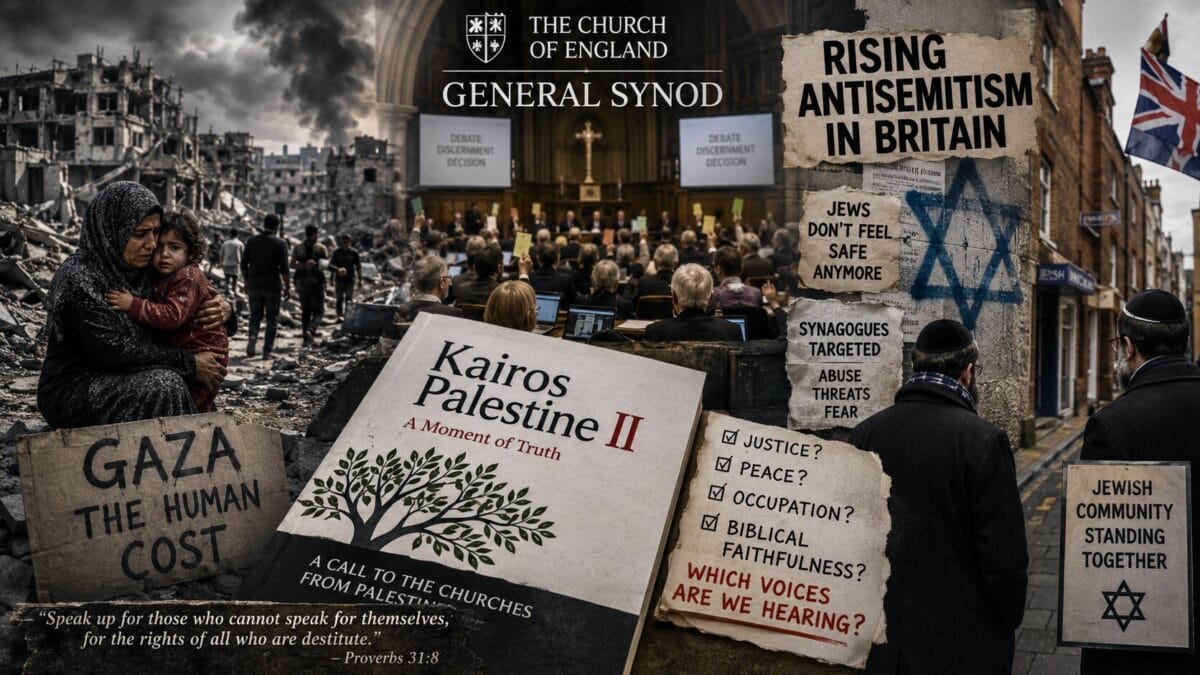
In July of this year, the General Synod voted to ‘hear’ the Kairos II Palestine document as a ‘cry’ of their Palestinian Christian brothers and sisters. This caused serious offence amongst the Jewish community, and was claimed to be deeply antisemitic by some commentators, whilst others welcomed it as a necessary step in listening to those who are being oppressed.
To make sense of this, Jason Swan Clark offers this analysis and critique of Kairos Palestine II document, and explains why it has divided opinion and presented such a challenge for the Church of England.
Jason Swan Clark writes: I am not an Anglican. I have no vote in the General Synod, no stake in its standing orders, and no institutional interest in how the Church of England spends a Monday morning in July. So I was surprised by how closely I found myself following a debate in York about whether a body of Christians should ‘receive’ or merely ‘hear’ fourteen pages written by Palestinian Christians in Bethlehem, Jerusalem and Nazareth.
The motion passed, amended, by 253 votes to 47, and carried in all three houses.1 Members had changed one word. The Church would no longer receive the Kairos declarations; it would hear them, as “heartfelt expressions of the lived experience of Palestinian Christians.” The Bishop of Lichfield, a former chair of the Council of Christians and Jews, said what everyone understood the amendment to mean: “If it is to be more than cosmetic, it must mean while we recognise the Kairos II document as springing from the trauma of the Palestinian people, we are not recognising all its language as language we as a church accept to be used by ourselves.”2 The Archbishop of Canterbury put it more simply: to hear does not mean to agree.3
What struck me was not the vote itself. It was what happened around it, in the days before and after, among people I know.
Friends of mine who have long argued for Palestinian rights treated Kairos II as prophetic before it had been read — a word from the Spirit, morally binding, and any hesitation about it a species of complicity. Friends of mine who have long defended Israel treated it as a libel before it had been read — antisemitic in effect if not intent, a document whose acceptance was a scandal. Both groups accepted, broadly, the same categories. Both agreed that the document was a test. They disagreed only about which way you would fail it.
Almost no one seemed to have actually read it.
That is the regular and ordinary fate of documents like this. They become instruments. A church body votes, and thereafter, the vote is now the argument: your own Synod has heard this, so you must accept my position, or your Synod has endorsed a libel, so you have no standing to speak. The fourteen pages themselves become a social media-fueled rumour with a footnote to the vote.
So I read it. Several times. Not to decide whether to be for or against the Palestinians, which is not a coherent thing to be for or against, and not to arbitrate a conflict over which I have no authority. I read it to ask a narrower and more answerable question: how accurate is it? A document commended to congregations for theological study is a document that has entered the order of things that can be verified. That is not hostility. This is the minimum courtesy owed to a text anyone proposes to take seriously.
The following is my reading. It is critical of the document, and I think rightly so. However, I want to be precise about the target of my concerns. My argument is not that Palestinian Christians should be quieter, that their suffering is exaggerated, or that the Church of England was wrong to listen to them. My argument is that Kairos II is a poorer instrument than either of its constituencies believes, and that the reasons for this are visible in its text.
I begin with what is true in it because a great deal is, and because critics of the document often pass over this in a sentence to reach the parts they want to attack.
The suffering described in Part I is real and documented. As of February 2026, the Gaza Ministry of Health recorded more than 72,000 people killed, with independent statistical work suggesting that these administrative records function as a conservative floor rather than an inflation.4 The claim in §1.1 that “tens of thousands of children were killed” is, on the available figures, accurate: agencies counting separately arrive at figures above 20,000 children.5 Gaza’s health, education, and water infrastructure has been destroyed on a scale that will take a generation to rebuild. The document does not need to exaggerate this and, on the central facts of the last two and a half years, does not.
The West Bank material in §1.9 is likewise not invention. Settler violence against Palestinian villages, crop destruction, water seizure, home demolition, and the army’s protection of and occasional participation in these acts are documented by Israeli, Palestinian, and international monitors. The detention figures in §1.13 — thousands held, roughly a third under administrative detention without charge or trial, children among them, deaths in custody, and documented torture — track UN reporting.6 The Jerusalem material in §1.8 is corroborated by an independent Israeli-Palestinian body: the Rossing Centre recorded 155 attacks and incidents against Christians and Christian property in Israel and East Jerusalem during 2025 alone, including 61 physical assaults.7 When Palestinian Christians say their presence in the land is under threat, they are not being self-dramatising. They are describing the arithmetic of their own parishes.
More impressive, and almost entirely unremarked in the controversy, is the document’s willingness to turn its criticism inward. Sections 1.14 to 1.17 are unsparing about Palestinian politics: political division, rivalry, and exclusion; a leadership in which the majority of Palestinians have lost confidence; a Palestinian Authority “trapped in serving the interests of the occupier”; the spread of “intimidation, land encroachment, tribalism, favouritism, and corruption”; and “acts of violence, revenge, chaos, and theft” within Gaza itself, adding to the suffering of the people. Section 1.20 condemns “extremist and terrorist religious groups” and those who fund and arm them. Section 2.2 warns explicitly against “giving our national struggle a religious character or turning it into a religious issue that pits religions against one another.” Section 2.8 refuses the reduction of Palestinian women to “women and children,” “faceless victims stripped of agency and will.” Section 3.8 condemns genuine antisemitism, “which still exists in our world,” alongside Islamophobia. Section 4.4 rejects a religious state outright — “for it constricts the state within narrow confines, favors one citizen over another, and excludes and discriminates among its people” — and calls instead for “a civil, democratic state grounded in a culture of pluralism — not numerical dominance.”
These are not the moves of a document indifferent to fairness. Anyone who tells you that Kairos II is simply a propaganda tract has not read past Part I, and §4.4 in particular is a genuine theological achievement, all the more so for being written by a religious minority who might have been expected to seek confessional protection rather than common citizenship.
Despite its importance, I now want to detail the document’s major failings. Here is the simplest way to view its problems, with a counting exercise. And whilst counting is a blunt instrument, I offer it as a first indication rather than complete proof.
In fourteen pages, some variant of “genocide/ethnic cleansing” appears twenty-nine times, three of those in the title and the headings to Parts I and IV.8 Some variant of “Zionist” appears twenty-seven times. “Hamas” appears once. “Hostage” appears not at all. “Holocaust” and “Shoah” appear not at all.
The word “terrorism” appears six times, and its distribution is worth tracing precisely. Twice it names false accusations levelled against Palestinians — against UNRWA (§1.11) and against Palestinian human rights organisations (§1.12). Twice it names Israeli settlers: “the terror of settlers” (§1.14) and “settler terrorism” (§2.4). Twice it names extremist religious movements in Syria and Iraq, which the document condemns along with their funders and armers (§1.20).
Therefore, the document possesses the category of religious terrorism. It applies it to ISIS. It applies it to settlers. Yet it declines to apply it to Hamas.
Word counts do not settle arguments. Absence is not always evasion; a testimony has the right to speak of what it has suffered rather than what others have suffered. But this is a document that has now been commended by a national church for study, in a motion that in the same breath reaffirms that church’s commitment to Christian–Jewish dialogue. At that point, what a text makes present and what it leaves absent stops being a matter of genre and becomes a matter of formation. Congregations that study Kairos II will encounter a Jewish people who exist in it almost exclusively as Zionists, as objects of an ideology critique, or as approved dissenters. They will not encounter European Jewish history at all. And it will find no naming of Hamas for what they most definitely are—genocidal terrorists.
Then there are the mistakes. Kairos II makes at least one that is simply, completely wrong, and it is not a minor one.
Section 1.2 states that “arrest warrants have been issued against Israeli political leaders based upon rulings of the International Court of Justice.” They were not. The warrants against Benjamin Netanyahu and Yoav Gallant were issued in November 2024 by the International Criminal Court, for alleged war crimes and crimes against humanity.9 The ICC and the ICJ are different institutions with different jurisdictions. The ICJ adjudicates disputes between states and determines state responsibility. The ICC prosecutes individuals. No ICJ ruling can produce an arrest warrant, as the ICJ does not issue them.
The document knows this. Section 3.10 correctly names both courts and asks governments to press for prosecutions “under the jurisdiction of the International Court of Justice and the International Criminal Court.” Therefore, §1.2 is a slip, not an ignorance. However, it is an uncorrected slip in the second sentence of the document’s central factual claim, in a text that has been through translation, publication, and eight months of international circulation, and that is now going to be studied in parish groups by people with no independent means of catching it. Defenders of Kairos II have spent considerable energy correcting the formulations of its critics. It is odd that none of that energy has gone into correcting this.
The confusion of the courts is not an isolated slip, and this is where a document being commended for study invites a kind of attention it has not so far received. Kairos II carries seven footnotes. Three of them are sound: the UN OCHA reporting on West Bank movement and access behind §1.9, the OHCHR report on detention behind §1.13, and the Fides survey of Christian institutional employment behind §2.14 all say what the document says they say.
The other four are weaker than the claims resting on them. The footnote to §1.2, attached to the sentence about arrest warrants and the ICJ, points not to any court but to the UN Commission of Inquiry. The footnote supporting “decades of apartheid” in §1.3 points to a Human Rights Watch dispatch which itself states that the Court’s language was “a compromise, limited to separation,” and that the apartheid conclusion is HRW’s reading of it — a reading two of the fifteen judges expressly rejected.10 The footnote to §1.6 cites a General Assembly resolution as though it settled a question of binding law. And the footnote to §3.3, beneath the claim that Israel continues a European colonial enterprise built on racism, points to an online petition. A petition is evidence that people hold a view. It is not evidence for the view.
None of this is fatal to the document’s testimony, and I am not suggesting the footnotes were laid down in bad faith. But a text whose citations point mostly to advocacy characterisations of legal findings, rather than to the findings, is a text whose confidence exceeds its apparatus. That matters far more, and not less, once a church has told its parishes to study it.
A subtler problem is associated with the genocide claim itself. Section 1.2 states that “human rights organisations, legal institutions and international experts have been unequivocal” — and the supporting footnote in the document points not to a court at all, but to the September 2025 finding of the UN Independent International Commission of Inquiry.11 This is a real and serious finding, and it does not stand alone: Amnesty International and the Israeli organisation B’Tselem have reached similar conclusions.12 Anyone who dismisses this as fringe is not arguing in good faith.
However, “unequivocal” is doing work that the evidence does not support. There is no judicial determination of genocide. The most frequently cited legal authority for one — the ICJ’s provisional measures order of January 2024 — has been explicitly and publicly disowned as such by the judge who presided over it. Joan Donoghue, then the Court’s president, said on the BBC: the Court “did not decide — and this is something where I’m correcting what’s often said in the media — it didn’t decide that the claim of genocide was plausible.”13 What the Court found plausible was a right: the right of Palestinians in Gaza to be protected from genocide, and South Africa’s standing to bring the claim. That is a meaningful finding. But it is not a finding of genocide.
One further point of precision, and it cuts against me as much as for me. Section 1.3 refers to “Israel’s decision to annex the West Bank” as an accomplished fact revealing colonial intent. When Kairos II was written in November 2025, that was not accurate: a sovereignty bill had passed a narrow preliminary vote in the Knesset in October and had then been frozen. But on 8 February 2026 the Israeli security cabinet approved seven measures — opening the West Bank land registry, repealing the restriction on land sales to non-Palestinians, extending Israeli enforcement into Areas A and B, stripping planning powers from the Palestinian authority in Hebron — which Peace Now, Haaretz and a range of Israeli analysts have since described as annexation in all but name, and as a legal reality rather than a proposal.14 So the document asserted as accomplished a thing that had not yet been accomplished, and the record has since moved a long way toward it. I set that down because it is true, and because a critique that could only ever find this document overstating would be practising its own version of the essentialism it complains about.
None of this makes the genocide question illegitimate. It is being litigated by serious institutions, and the answer may well go against Israel. What Kairos II does is close a question that is open, and then — this is the crucial move — make the closure a test of Christian standing. Section 3.4: those who deny the genocide “deny the very humanity of the Palestinian people,” and the document asks “how can one speak of Christian fellowship or communion” with them.
Consider what that does to the Synod’s decision. The Church of England has commended for parish study a document that defines disagreement with its central contested claim as a denial of Palestinian humanity and a possible bar to communion. You cannot study a text on those terms. Study requires the possibility of arriving somewhere else.
The treatment of Zionism is where the document’s method becomes most visible.
Section 1.3: “Exposed today is the true face of Zionist ideology.” Section 3.3: “Our present Palestinian reality is the inevitable outcome of Zionist ideology.” Section 3.3 again: the State of Israel is “a continuation of that same colonial enterprise built on racism and the ideology of ethnic or religious superiority.”
This is essentialism, and it is the kind of move the Church of England’s own teaching document on Christian–Jewish relations was written to warn against — the collapsing of a plural tradition into a single hostile essence.15 The historical record does not support it. The Basel Programme of 1897, Zionism’s founding statement, sought “a home in Palestine for the Jewish people, secured under public law.”16 A home, secured in law. The demand for a Jewish Commonwealth became official Zionist policy only with the Biltmore Programme of 1942, forty-five years and one European catastrophe later. Between and around those dates, Zionism contained statist, cultural, religious, socialist, revisionist and binationalist currents that fought each other bitterly. Brit Shalom in the 1920s and Ihud in the 1940s — Judah Magnes, Martin Buber — argued for a binational state with political parity and no Jewish majority. Ahad Ha’am attacked the movement’s treatment of the Arab population as a moral failure from within. Much of Orthodox Jewry opposed political Zionism as blasphemy.
To acknowledge that diversity and then define Zionism by its most coercive expression is not analysis. It is the selection of a selective essence. And that selection is inconsistently applied. Palestinian nationalism, in this document, is granted its full internal complexity—it has factions, failures, corruptions, an unrepresentative leadership, internal violence, competing strategies. All of that is candidly set out in §§1.14–1.17. Zionism gets no such interior life and recognition. One movement is given a history. The other is given a traduced ideological and flattened nature.
That asymmetry is the document’s governing method, and once you see it you see it everywhere.
Consider 1948. Section 3.3 describes the establishment of Israel as a project that “settled Palestine and worked to displace the indigenous people of Palestine from the time of the Nakba until today.”
The facts underneath this are grave and must not be minimised. Roughly 700,000 to 750,000 Palestinians became refugees. Israeli forces carried out expulsions, at Lydda and Ramle among other places. Hundreds of villages were destroyed or repopulated. Israel then legislated to prevent return and to absorb the property of those who had fled. Nothing in what follows is intended to soften any of that, and Christians who reach for context here in order to avoid the moral weight of it are doing something contemptible.
But a single causal mechanism is being asserted where several operated. Direct expulsion, flight from combat, flight from atrocity and rumours of atrocity, the collapse of Palestinian urban institutions and leadership, the intervention of neighbouring states, and subsequent Israeli policy on return are distinct things with distinct moral valences. Compressing them into the execution of a pre-existing plan requires the omission of a good deal: that the Arab Higher Committee and the Arab League rejected the partition plan; that a civil war followed that rejection; that five Arab armies invaded after Israel declared independence; that Jordan annexed the West Bank and Egypt held Gaza, so that the territory allocated to an Arab state was withheld from Palestinian sovereignty by Arab governments for nineteen years.
These facts do not excuse the Nakba. They are not offered as a defence. They matter because a catastrophe with several causes cannot be presented as the unopposed unfolding of one intention without ceasing to be a part of history. This is propaganda in the place of accurate and readily available history.
The same compression runs in the opposite direction. Where the document reaches for the pre-1948 period, coexistence is the frame. There genuinely were long periods and durable practices of coexistence between Arabs and the small Jewish minority, and they deserve to be remembered. So do the Arab riots of 1920 and 1921, the Hebron massacre of 1929 in which sixty-seven Jews were killed by their neighbours, and the Arab Revolt of 1936–39. A history in which only one community ever initiates violence is not a history.
The most consequential absence is Jewish history itself.
There is no Holocaust in Kairos II. Not a mention. A document that locates the origin of genocide in “the minds of the settler-colonial powers of Europe” (§3.3) and traces a single line from European colonialism to Gaza passes over the European genocide of the Jews in silence. Whatever one concludes about the relationship between the Shoah and the founding of Israel — and there are serious arguments that Palestinians were made to pay a European debt — a theological account of this conflict that never names it has left out something it cannot afford to leave out. Not because Jewish suffering cancels Palestinian suffering. Because a document about how peoples with extant good reason come to fear annihilation has omitted the twentieth century’s central instance of it.
The Jews of the Arab and Muslim world appear with no agency behind their displacement. Where such displacement is acknowledged in the wider Kairos discourse, it is framed as a consequence of Israel’s establishment. The conflict was certainly a catalyst. However, anti-Jewish violence preceded Israel: the Farhud in Baghdad in June 1941 killed approximately 180 Jews two years before the Biltmore Programme had any purchase and seven years before Israeli independence.17 The departures that followed involved persecution, denaturalisation, confiscation, expulsion, fear, and Zionist recruitment in different proportions in Iraq, Egypt, Yemen, Libya, and Morocco. Arab governments and societies had agency. To make their actions wholly derivative of Zionism is to apply, in reverse, exactly the causal reduction the document rejects when Israel applies it to Palestinians.
This produces the asymmetry that troubles me most, because it is not historical but political, ideological and concerns the future rather than the past.
Section 4.4 rejects a religious state and calls for a civil, democratic state grounded in “a culture of pluralism — not numerical dominance.” Read as a universal principle, this is admirable. However, read against §§1.3 and 4.2, where Jewish majority sovereignty is named as supremacism, and its dismantling is the precondition of any political future, it functions differently. Palestinian majority rule appears as the natural form of justice. Jewish majority rule appears as an ideology to be dismantled. One people is offered national self-determination; the other is offered protected communal existence within someone else’s state.
That is not neutrality. It is a settlement that is presented as the mere absence of supremacy.
This brings me to October 7 and §1.6, which is the most revealing paragraph in the document.
Israel commits these crimes by invoking the events of October 7, 2023, claiming that its actions are an act of self-defense — forgetting that the Hamas attack of that day was itself born out of decades of injustice, oppression and displacement since the Nakba of 1948, and more than sixteen years of an immoral, suffocating blockade on Gaza.
Read that construction carefully. The attack is the grammatical object of history. It was born out of conditions. It has causes but no author. The paragraph does add: “Mentioning the context does not justify the killing or capture of civilians, the violations of international law and norms, and war crimes.” That sentence is there, and critics who claim that the document offers no condemnation at all are misreading it.
But look at what it condemns and how. “The killing or capture of civilians.” Not the abduction of civilians. Not hostage-taking. Capture — a term from the law of combatants, applied to two hundred and fifty people taken from homes, a music festival, and their beds.18 The word “hostage” does not occur in the document. Neither does any account of Hamas’s ideology, its charter, its stated aims, its decision-making, or the planned and documented character of what was done that day, including sexual violence. Hamas is named once, as the subject of a verb in the passive voice of history.
Set beside this the document’s language about Israeli violence: the “true face” of Zionism (§1.3), the “inevitable outcome” of Zionist ideology (§3.3). One party’s violence discloses an essence. The other party’s violence discloses a context.
Section 2.4 compounds this. “We reaffirm the right of all colonized peoples to resist their colonizers,” and creative resistance is located in “popular Palestinian movements confronting occupation, settlement expansion, settler terrorism and apartheid,” in civil society, legal work, culture, students and labour. That list is almost entirely nonviolent, and the document’s own supporting citation is UN General Assembly Resolution 37/43 of 1982.19 Two things need saying about that. A General Assembly resolution is not binding law. No principle of self-determination in international law licenses attacks on civilians, indiscriminate rocket fire, sexual violence, or hostage-taking; international humanitarian law binds every party to a conflict, regardless of the justice of its cause, and the illegality of an occupation does not suspend that obligation for those resisting it.20 Kairos II never says otherwise. It also never says so.
A church studying this document will come away with a rich account of Palestinian nonviolent resistance and no framework at all for thinking about Palestinian armed violence against civilians and their participation in October 7th. That is a formation problem, not a nuance.
I have left theology until last because I think the real weakness lies there, and because it is the part least discussed by either of Kairos II’s constituencies.
Section 3.2 is, on its own terms, seems to me to be unobjectionable, and stands on ground held in common by Orthodox, Catholic, Anglican and Protestant alike: God the Creator of all humanity, incarnate in Christ, “stands in solidarity with and takes the side of the oppressed and the downtrodden, the victims of all forms of injustice and tyranny from every nation regardless of race, religion or nationality.” That is Luke 4. It is the Christian tradition. I have no quarrel with it.
The difficulty is the step that follows, and it is never argued, only performed.
If God takes the side of the oppressed, and we are the oppressed, then our reading of this conflict is God’s reading of it. Suffering becomes not merely a claim on the Church’s attention — which it certainly is — but a source of authority that settles historical, legal and political questions. Section 4.5 names the document “a prophetic cry.” Section 3.5 hears in agreement with it “a sign of the Holy Spirit.” Section 3.4 makes disagreement with its central claim a denial of Palestinian humanity and a question mark over the dissenter’s Christian communion. Section 3.7 declares that once Christian Zionists have been invited to repent and have not, “moral, ecclesial and theological responsibility requires that they be held accountable and that their ideology be rejected and boycotted.”
This is a specific and serious ecclesiological move. It makes a contested political and historical judgment into a condition of fellowship. And it inverts the order of the Church. Communion is not a reward for correct politics—at least as far as I understand Anglican ecclesiology. It is the means by which people who cannot yet agree are held in one body long enough to be changed. A theology that makes agreement the entry condition has abolished the very thing it claims to be defending.
There is a second, deeper problem. God’s identification with the oppressed is not an epistemology. It does not confer accuracy. The God who stands with the crucified is not thereby a guarantor that the crucified have got the history right — and the whole Christian account of the cross depends on that distinction, because the crucified Christ does not respond to injustice by producing a superior political analysis. He gathers his enemies into himself. That is what makes the Paschal mystery unavailable as a partisan resource. Any theology of this land that cannot hold Jewish memory and Palestinian memory in one body has not yet reached the theology of the Body.
This is why the standard defence of Kairos II collapses under its own weight. The defence runs: Kairos II is prophetic contextual theology, and therefore carries authority; but Kairos II is not a theological or exegetical document, and therefore should not be subjected to theological or exegetical criticism. Both halves are asserted, often within a paragraph of each other. They cannot both be true. Its title is Faith in a Time of Genocide. It invokes God, Scripture, sin, repentance, the Holy Spirit, the mission of the Church, the nature of communion, and the theological status of Christian Zionism. It instructs churches on their liturgical, investment, dialogical, and diplomatic practices. It is a theological document, and theological documents are answerable to theology.
The parallel move on history has the same shape. Kairos II is testimony, we are told, not comprehensive history, and testimony has different obligations. That is true, and it is a real principle. However, the document does not confine itself to testimony. Testimony says: this is what was done to us, this is what we saw, this is what we carry. Kairos II also says that Zionism has an essence, that Israel’s founding was a colonial enterprise built on racism, that Western silence is explained by Gaza’s offshore gas, that arrest warrants issued from ICJ rulings, that 7th October was born of oppression, and what the political future of the whole land must be. The moment a document moves from this is what we suffered to this ideology inevitably produced genocide, it has entered the order of claims answerable to evidence. Trauma gives testimony its urgency and its right to be heard. It does not confer historical infallibility. No one would say otherwise about a document written from the other side of this conflict, and that is the test.
Which is the test I would put to anyone defending this document: would you accept an Israeli Christian statement as “contextual testimony,” immune from historical scrutiny on grounds of trauma, if it made no mention of the Nakba, described settler violence principally as a reaction to terrorism, and treated Palestinian nationalism as an essence rather than a history? If the answer is no, then trauma is not functioning as a principle. It is functioning as a permission.
Finally, I return to York, because the Synod’s decision has a structural problem that neither the document’s supporters nor its critics have quite named.
The motion the Synod passed asks the Church to hear the Kairos documents as expressions of lived experience, and to engage with them in study, at every level, with resources commended by the Faith and Public Life Division.21 The amendment to “hear” was intended, transparently, to avoid endorsement. Fair enough.
But Kairos II itself does not ask to be heard. It asks and demands to be obeyed. Section 3.10 asks churches to press their governments to isolate, sanction, boycott and embargo. Section 3.7 asks the churches of the world to repudiate Zionist theology and boycott those who hold it. Section 3.12 asks churches to “boycott dialogue with Zionist voices,” and to amplify instead the Jewish voices it deems prophetic.
And the same motion, at point two, commits the Church of England to “reaffirm our commitment to inter-faith dialogue, including Christian-Jewish dialogue.”22
These two things cannot be done at once. A Christian body that lets another Christian body determine which Jewish interlocutors are legitimate has not entered into dialogue; it has delegated it. This is also why the frequent claim that Kairos II is simply not about Jews or Judaism cannot be sustained from the text. It criticises churches for prioritising Jewish–Christian dialogue over truth (§1.5). It describes “Jewish supremacy” (§1.3). It discusses antisemitism and the relation of Jews to Zionists (§3.8). It tells churches which Jewish partners to boycott and which to amplify (§3.12). It is right to insist that not every Jew is a Zionist and not every Zionist a Jew — that distinction is worth defending. But drawing it does not remove the subject from the document’s agenda. Drawing it is an intervention in the subject.
The Synod chose a word to protect itself. It could not change the genre of what it was voting on by choosing a word. Once a cry is commended for parish study, it becomes a curriculum—for teaching and instruction.
That is the honest difficulty in the argument, made from the floor of Synod, that we would not tell survivors of trauma “you can’t use that language; you are wrong; this is not true.”23 Of course we would not. That is precisely how one ought to receive a disclosure. However, receiving a disclosure pastorally and adopting it as a study text for a national church are different acts, and the latter carries obligations that the former does not. The trauma argument is unanswerable in the first case. It is not available for the second.
So the questions I would put, kindly and without hyperbole, to those on both sides who have made this document into a weapon:
1. How can Kairos II be prophetic theology when it speaks, and not theology when it is examined?
2. How can it be unconcerned with Christian–Jewish relations while instructing churches which Jewish voices to boycott?
3. Why must Zionism be treated as a single essence while Palestinian politics is granted its full internal complexity — a complexity the document itself sets out with real honesty?
4. Why has so much energy gone into correcting the formulations of the document’s critics, and none into correcting its confusion of the ICC with the ICJ?
5. Why does Palestinian trauma excuse the omission of Jewish history, when Jewish trauma is never permitted to excuse the omission of Palestinian history?
6. And to those who have used this vote to dismiss the entire Palestinian Christian witness: what have you actually read? Because the document you are condemning contains a sharper critique of Palestinian political failure than most of its opponents have managed, and a firmer rejection of religious nationalism than most of its supporters have noticed.
Summary
A full endorsement of Kairos II is difficult to justify. It confuses the ICC with the ICJ. It presents contested legal judgments as settled facts. It reduces the diversity of Zionism to a single genocidal project. It gives almost no attention to Jewish history, Jewish persecution, or the legitimate question of Jewish self-determination. It elevates one nationalist reading of the conflict into God’s own perspective, so that Palestinian suffering becomes a source of theological and political authority, while Jewish suffering and memory are interpreted chiefly through the lens of colonial power.
A full dismissal of it is also difficult to justify. The suffering it describes is real, documented, and significantly corroborated by Israeli and international bodies. Its internal self-criticism is more honest than that of most national churches. Its rejection of the religious state is a genuine theological achievement. The people who wrote it are burying their own dead.
Both of these things are true, which is why the document is a poor weapon and why almost everyone reaching for it has reached for something other than what is actually on the page.
Palestinian Christians must be heard. The Nakba, the occupation, settlement expansion, and the devastation of Gaza demand an honest Christian response, and the Church of England was not wrong to say so. However, listening to a witness is not the same as endorsing every historical, legal, and theological claim the witness makes. Christian solidarity does not require the suspension of critical judgment. Neither suffering nor trauma places a political theology beyond critique.
Solidarity requires truth. It cannot replace it.
One last thing, and I set it down in advance so that it cannot be claimed afterwards as hindsight.
This article began with an observation: that people I know had judged Kairos II before reading it, in both directions, and that the document had become a badge rather than a text. I expect the response to demonstrate the point. I expect to be told that I have provided cover for genocide, and to be told that I have gone soft on a libel, by readers who will have taken from several thousand words the one sentence that confirmed what they held before they arrived. If that is what happens, then the comments will not be a reply to the thesis. They will be its proof – QED.
I would genuinely rather be wrong, so let me say plainly what would be worth reading.
Show me where the history is wrong. Tell me that §1.2 does not confuse the two courts — or that it does, and it does not matter, and say why. Show me that the essentialism I describe is not in the text, and give me the section number. Defend §3.12’s instruction to boycott dialogue partners on its own terms; there is a serious case to be made there, and I would like to see someone make it. Tell me the theological step from God sides with the oppressed to our reading is God’s reading is not the step I say it is. Argue with me from the document.
That is a conversation, and I will take it seriously wherever it lands. Anything else is two prepared positions being recited at each other while the dead go on being counted.
Additional Note: A word about the sources, since I have just spent several thousand words asking a document to be accurate.
I have drawn on a good many of them: the text of Kairos II itself, the Synod record, court documents, UN reporting, Israeli and Palestinian monitoring organisations, and the press. I have checked what I could and rechecked what seemed substantive. Where a figure is contested, I have tried to say so rather than take the number that suited me, and where the record has moved against my own argument I have said that too.
But this is a blog post, not a journal article. It has no peer reviewers and no fact-checking desk, and the situation it describes changes weekly — some of what I cite here will likely have been superseded by the time you read it. Several of my sources are secondary where a primary would have been better, and I have flagged those in the notes. Readers will know things I do not.
Accuracy is expensive. It takes time and a sort of cold, unhurried attention that a cry — written under bombardment, by people burying their own dead — does not have and cannot reasonably be asked for. Which is the genre question again, arriving from the other side. Nobody asked Kairos II for footnotes that would survive an audit. The Synod asked for exactly that, implicitly, the moment it commended the document to parishes for study. Having now spent a while on a small fraction of that burden, I find I hold the document’s authors more gently than when I started, and the vote rather less so.
So: if you find an error here, tell me, and I will correct it in the text rather than in the comments, and say that I have. That is the standard I am asking Kairos II to be held to. It would be incoherent to exempt myself from it.

Dr Jason Swan Clark directs the London Centre for Spiritual Direction and leads the Doctor of Leadership programme at Portland Seminary. Drawing on 25 years of experience as a church planter, his work explores identity formation at the intersection of ecclesial life, culture, and political theology. His writing and work can be found at his website here.
- “Synod votes to stand in solidarity with Palestinian Christians and ‘hear’ their voices in amended motion,” Church of England, 12 July 2026. Voting: Bishops 25 for, 0 against, 5 abstentions; Clergy 115 for, 20 against, 30 abstentions; Laity 113 for, 27 against, 35 abstentions.
- Michael Ipgrave, Bishop of Lichfield, speaking in the debate; quoted ibid.
- Sarah Mullally, Archbishop of Canterbury: “To hear the heartfelt expressions of the lived experiences of the Palestinian Christians does not mean we agree with everything in these documents.” Ibid.
- Gaza Ministry of Health figure of 72,063 as at 16 February 2026, reported in “Gaza death toll exceeds 75,000 as independent data verify loss,” Al Jazeera, 18 February 2026. The “conservative floor” characterisation is that of the Gaza Mortality Survey: Michael Spagat, Jon Pedersen, Khalil Shikaki, Michael Robbins, Eran Bendavid, Håvard Hegre and Debarati Guha-Sapir, “Violent and non-violent death tolls for the Gaza conflict: new primary evidence from a population-representative field survey,” The Lancet Global Health 14, no. 4 (April 2026): e552–e559, doi:10.1016/S2214-109X(25)00522-4, PMID 41722607. The survey interviewed 2,000 households across 200 sampling locations between 30 December 2024 and 5 January 2025 and estimated 75,200 violent deaths between 7 October 2023 and 5 January 2025, some 34.7 per cent above the Ministry’s figure for the same period. Its sampling method has been contested — see the commentary “From enumeration to inference: what the Gaza Mortality Survey reveals — and misses — about counting deaths in the Gaza Strip,” The Lancet Global Health (2026) — which is a reason to cite it as corroboration of the Ministry’s floor rather than as a replacement figure. An Israeli army official was reported in January 2026 as accepting a figure of about 70,000.
- Save the Children International, “Gaza: 20,000 children killed in 23 months of war“; and UNICEF State of Palestine, Humanitarian Situation Update, which records at least 21,289 children killed to 3 February 2026.
- OHCHR, “UN report: Palestinian detainees held arbitrarily and secretly, subjected to torture,” July 2024 — the source cited by Kairos II at §1.13.
- Rossing Centre for Education and Dialogue, Attacks on Christians in Israel and East Jerusalem: Annual Report 2025, launched 30 March 2026; figures as reported by Middle East Eye, 14 July 2026.
- Counts are of the English text of Kairos II as published (KP-2-Final-English.pdf), taken across the whole document including its title and part headings, and excluding the URLs in the document’s own footnotes — one of which contains the word “genocide” in the OHCHR web address. Counting the running text alone, and setting aside the title and the headings to Parts I and IV, the figure is twenty-six. The twenty-nine break down as “genocide” (24) and “genocidal” (5); the twenty-seven as “Zionist” (14), “Zionism” (9) and “Zionists” (4). Of that second set, five are “Christian Zionism” or “Christian Zionists” (§§3.5, 3.7), where the target is a Western Christian theology rather than Jews or Israelis — a distinction the document is entitled to, and which I note so that the count is not doing more work than it can bear.
- International Criminal Court, Pre-Trial Chamber I, warrants of arrest issued 21 November 2024 in Situation in the State of Palestine. The Chamber found reasonable grounds to believe both men bear criminal responsibility for the war crime of starvation as a method of warfare and the crimes against humanity of murder, persecution and other inhumane acts, and as civilian superiors for the war crime of intentionally directing an attack against the civilian population. A warrant was issued the same day for Mohammed Diab Ibrahim Al-Masri (Deif), including for hostage-taking, rape and other forms of sexual violence.
- International Court of Justice, Legal Consequences arising from the Policies and Practices of Israel in the Occupied Palestinian Territory, advisory opinion of 19 July 2024. The Court found that Israel’s measures maintaining separation between Palestinians and Israeli settlers in the West Bank breach Article 3 of the Convention on the Elimination of All Forms of Racial Discrimination, which obliges states to eradicate racial segregation and apartheid. Clive Baldwin, writing for Human Rights Watch — the source Kairos II cites at §1.3 — states that “though the court’s language is a compromise, limited to separation, the finding means that Israel is responsible for apartheid,” and records that President Nawaf Salam and Judge Dire Tladi said as much in separate declarations, while two of the fifteen judges, including Judge Georg Nolte, held that the Court should not find apartheid. The opinion treats apartheid as a human rights violation, not as a crime.
- UN Independent International Commission of Inquiry on the Occupied Palestinian Territory, September 2025 — the source cited in Kairos II’s own footnote to §1.2.
- Amnesty International and B’Tselem have each published findings of genocide; for a summary of the converging assessments, see Middle East Eye, 14 July 2026.
- Joan Donoghue, former President of the International Court of Justice, BBC HARDtalk, April 2024.
On the preliminary Knesset vote of 22 October 2025 and its subsequent freeze, and on the seven security cabinet decisions of 8 February 2026, see Foundation for Middle East Peace, Settlement & Annexation Report, 13 February 2026, which reports the cabinet as having “approved seven new measures that result in the annexation of the entire West Bank,” and collects the responses of Peace Now (“de facto annexation”), Haaretz (“Israeli annexation is now a legal reality”), and the Yesha Council (“entrenching Israeli sovereignty on the ground, de facto”).
- God’s Unfailing Word: Theological and Practical Perspectives on Christian–Jewish Relations, Faith and Order Commission of the Church of England (London: Church House Publishing, November 2019), 144 pp., ISBN 9780715111611 — the first attempt to set out the Church of England’s teaching in this area in a single volume.
- Basel Programme, First Zionist Congress, 1897: “Zionism seeks to establish a home in Palestine for the Jewish people, secured under public law.” Herzl’s formula “secured under public law” was itself a compromise, adopted after younger delegates pressed for “secured by international law” in order to sharpen the political character of the movement — evidence of the internal contest the essentialist reading erases. The 1897 text is cited in its original form, rather than through a later commentary, because the argument turns on what the movement’s founding statement actually said at its founding; the wording is what is at issue. Two independent repositories carry it, one Palestinian and one Jewish, and they agree: Interactive Encyclopedia of the Palestine Question (palquest), “Basel (Zionist) Program,” ; and Jewish Virtual Library, “First Zionist Congress & Basel Program (1897).”
- On the Farhud of 1–2 June 1941 in Baghdad, see United States Holocaust Memorial Museum, Holocaust Encyclopedia, “The Farhud.” An Iraqi government commission of inquiry recorded at least 180 Jews killed; the Babylonian Jewry Heritage Center puts the figure considerably higher once unidentified victims buried in mass graves are counted. See also Orit Bashkin, New Babylonians: A History of Jews in Modern Iraq (Stanford: Stanford University Press, 2012), ISBN 9780804778756; and Moshe Gat, The Jewish Exodus from Iraq, 1948–1951 (London: Frank Cass, 1997), ISBN 9780714642239, now Routledge, doi:10.4324/9781315037677. Gat remains the standard monograph-length treatment of the Iraqi departures and of the proportions between persecution, expulsion and organised emigration; it is cited here for that archival work rather than for currency, and nothing in the subsequent literature has displaced it as the point of entry to the primary record.
- 251 people were taken into Gaza on 7 October 2023. Of these, 168 were subsequently recovered alive and 87 recovered dead; 36 were children, the youngest nine months old.
- UN General Assembly Resolution 37/43 (1982) — the authority cited in Kairos II’s own footnote to §1.6, and cited here in its original form because it is that instrument, and not a later gloss on it, which the document invokes.
- Geneva Conventions of 1949, Common Article 3; Protocol Additional to the Geneva Conventions of 12 August 1949, and relating to the Protection of Victims of International Armed Conflicts (Protocol I), 1977, Articles 48 and 51 — the principle of distinction and the prohibition of attacks on civilians. These are cited in their original form because they are the founding instruments of international humanitarian law and remain in force as such; they bind all parties to an armed conflict irrespective of the legality of the underlying cause.
- Motion as amended and passed, points 4 to 7; see note 1.
- Motion as amended and passed, point 2: “acknowledge with repentance the Church’s historic contribution to antisemitism and to the situation now affecting the Palestinian people, reaffirm our commitment to inter-faith dialogue, including Christian-Jewish dialogue and encourage a deeper understanding of Judaism and other faiths.” See note 1.
- The Ven Stewart Fyfe, Archdeacon of West Cumberland, moving the Diocese of Carlisle motion: “Would we, in any other circumstances, say to survivors of trauma, ‘you can’t use that language; you are wrong; this is not true?’ Would we not receive their disclosure and seek understanding? That is what this motion calls for.” See note 1.
 Buy me a Coffee








To flesh out the consequences of this very careful analysis, here was the reaction in their leader from the Jewish Chronicle:
The Church of England’s decision to hear Kairos II, a document that portrays Israel as an inherently racist enterprise and challenges its very legitimacy, has provoked deep concern within the Jewish community. Chief Rabbi Sir Ephraim Mirvis called the Synod’s vote “shameful”, warning that the document is “full of falsehood” and “can only harm the cause of peace”.
In her support for engaging with Kairos II, the Archbishop of Canterbury has rightly stressed the importance of hearing Palestinian voices and recognising their anguish. No responsible engagement with the conflict can ignore the devastation of war or the plight of civilians caught within it.
But that is not the question raised by the General Synod’s decision to hear Kairos II. The question is why, from among the many Palestinian Christian perspectives, the Church of England chose to elevate one of the most extreme manifestos.
The document does not merely criticise the policies of the Israeli government but depicts the Jewish state as founded upon genocide, ethnic cleansing, apartheid, racism and Jewish supremacy. It denies that the conflict involves two peoples with legitimate rights, presenting it instead as the straightforward oppression of blameless victims by an inherently illegitimate and racist coloniser. It rejects the Jewish people’s historic and indigenous connection to the land and, in substance, denies Israel’s right to exist as a Jewish state.
Criticism of Israeli policy is not antisemitic, and no serious defender of Israel claims otherwise. But the IHRA definition of antisemitism, which the Church of England has itself adopted, identifies denying the Jewish people their right to self-determination – including by claiming that the existence of Israel is a racist endeavour – as an example of modern antisemitism.
The Church has therefore chosen to confer standing upon a document whose central claims are in direct tension with its own declared understanding of antisemitism. Indeed, it is precisely this kind of demonisation of Israel that has fuelled antisemitism in Britain and across the West.
Kairos II is especially troubling in its treatment of October 7. By presenting Hamas’s massacre within the context of the occupation, even though Israel withdrew from Gaza in 2005, it comes perilously close to an apologia for the sadistic mass murder, torture, kidnapping and sexual violence inflicted upon Israeli civilians. The Hebrew Bible teaches that God created humanity in his image, a belief Christianity inherited from Judaism, and one that confers upon us all moral worth as well as moral agency. Any serious effort to understand Palestinian suffering must include an equally serious discussion of Islamist extremism and Palestinian rejectionism.
The document’s opposition to dialogue with Zionist voices is equally troubling, as it would exclude most of this country’s Jewish community. A text that demands to be heard while declaring most Jewish interlocutors morally disqualified is a poor foundation for reconciliation.
In his response to criticism of the Synod’s decision to engage with Kairos II, which we published today, the Reverend Robert Thompson is plainly sincere in his concern about antisemitism, his belief in Israel’s right to exist in peace and security, and his desire that the Church should hear the testimony of Palestinian Christians. Those convictions deserve to be acknowledged in the same spirit in which they are expressed.
Reverend Thompson points to amendments that he himself introduced, intended to place the Synod’s engagement alongside a call for repentance for the Church’s historic contribution to antisemitism and a commitment to a deeper understanding of Judaism. Those amendments are welcome, but repentance is not merely a matter of acknowledging past wrongs – it also requires vigilance when ancient patterns reappear in contemporary language: the portrayal of the Jewish state as uniquely malign, Jewish self-defence as inherently criminal and Jewish national claims as fraudulent.
A document whose core message is to deny one side its history, legitimacy and humanity cannot be redeemed by critical analysis, and any effort by the Church to promote understanding is fatally compromised by choosing it as a starting point. By deciding to hear this document, the Synod did not engage with the “difficult truths” that friendship may sometimes require but with outright defamation.
The Church had an opportunity to promote understanding by hearing the full diversity of Christian voices from Israel and the Palestinian territories, especially those committed to coexistence and dialogue. Proper engagement would also have required hearing from Israeli Jews, as the Anglican theologian Ian Paul told the Synod. Instead, the Church chose to hear a document that reduces a conflict between two peoples to a morality play of absolute guilt and innocence.
The objection, then, is not that the Synod listened to Palestinian Christians but that it chose this document as the vehicle through which to do so. Listening to suffering is our shared duty – giving legitimacy to extremism is a serious misunderstanding of that duty.
It is also here worth commenting on the three words in KPII that the Jewish community here and around the world have found most offensive.
‘Genocide’ means the intentional killing (-cide: Latin suffix derived from caedere, meaning to cut, kill, or slaughter, similar to words like homicide or infanticide) a people group (genos: Ancient Greek for race, tribe, family, or kin). When there is ‘genocide’, you expect the number of people in that group to diminish. The European population of Jews went, from 1935 to 1945, from 9.5 million to 3 million, and the global population of Jews has still not recovered to its level of 1935 during a time when the global population overall has grown fourfold. That is ‘genocide’—and of course the term was coined to specifically describe this event.
Since 1948, the total population of Palestinians (that is, Arab Muslims living in areas of the UN partition plan) has gone from 750,000 to 15.5 million, a growth of 20-fold. According to UNRWA’s own reports, the number of ‘refugees’ in the region grew between 2022 and 2025 from 5.8m to 5.9m.
Military commentator John Spencer refutes the claim of genocide from the actual evidence on the ground:
‘Israel has taken extraordinary steps to limit civilian harm. It warns before attacks using text messages, phone calls, leaflets, and broadcasts. It opens safe corridors and pauses operations so civilians can leave combat areas. It tracks civilian presence down to the building level. I have seen missions delayed or canceled because children were nearby. I have seen Israeli troops come under fire and still be ordered not to shoot back because civilians might be harmed.
Israel has delivered more humanitarian aid to Gaza than any military in history has provided to an enemy population during wartime. More than 94,000 trucks carrying over 1.8 million tons of aid have entered the territory. Israel has supported hospitals, repaired water pipelines, increased access to clean water, and enabled over 36,000 patients to leave Gaza for treatment abroad.
The IDF has coordinated millions of vaccine doses, supplied fuel for hospitals and infrastructure, and facilitated the flow of food and medicine through the UN, aid groups, and private partners. The U.S.–Israeli Gaza Humanitarian Foundation alone has delivered more than 82 million meals—one to two million a day—while weakening Hamas’s control over aid. This is not genocide. It is responsible and historic mid-war humanitarian policy.’
https://x.com/SpencerGuard/status/1948010761957052628
The accusation of ‘genocide’ appears to be deployed to cause maximum offence to Jews and Israelis. In the case of South Africa, it appears to be used to deflect attention from the government’s scandalous corruption as well as South Africa’s own antisemitic past. https://en.wikipedia.org/wiki/Antisemitism_in_South_Africa
is the reason then that so many civilians have been killed is because they simply didnt move out of their homes when advised to do so?
One of the reasons is that Hamas military commanders, when they know they are targets, gather their families around them so that they can all be martyred together…
And this is one of the greatest tragedies of the Gaza situation which is largely unremarked by the western world. Being killed by a bullet or a bomb fired by a country with which your country is at war is horrible. Being killed by aforementioned bullet or bomb because your father (or husband or brother …) knew it was coming your way and forced you to stay put and take it is horrible beyond words.
Ian, thank you for your explanation of ‘genocide’. But I trust you arn’t saying that this word always means this because *this* is what this *word* means. 😉
And please note, I am *not* saying that using the word ‘genocide’ is not being understood as offensive. (In case I am accused of misquoting) 😉
Well, words do change in use over time.
But how do we distinguish between natural changes in usage, and pernicious manipulation of language for political ends? Do we label the language in 1984 as ‘Well, words change their meaning’?
How can ‘genocide’ refer to a group that is rapidly *growing* in numbers?
I suppose some would view it as ‘attempted genocide’ as in killing as many as possible, but I agree it is not genocide and many are misusing that word.
Thanks Ian. But you ask ‘How can ‘genocide’ refer to a group that is rapidly *growing* in numbers?’ Well, in the same way that when we say ‘God is a rock’ we are not discussing what God is made of. Words are (always?) used more or less loosely.
Changes over time and ‘pernicious manipulation of language’ are not the only possibilities that need distinguishing. And yes, ‘words change their meaning’ if you like. The better approach may be to look to whole utterances for ‘meaning’ rather than individual words. And the marvel of language and its creativity, its subtlety, its beauty is that as humans we cope with this all the time (and without a dictionary in sight).
No Bruce, it is not at all the same.
‘God is a rock’ is a metaphor. Within metaphor is both a predication and a contradiction. God is not actually a rock, just as when I say ‘my friend John is a real pig’ the whole point of the metaphor is that he is not actually a pig.
If you are claiming that ‘Israel is committing genocide’ is a metaphor, then I think you are living on another planet, and a strange one at that.
The claim is designed to draw an exact parallel with what Jews experienced under the Nazis. As such, it is not only manifestly untrue, it is also a calculated insult of the deepest and most pernicious kind.
Thanks Ian. No I am not actually thinking of ‘genocide’ as a metaphor. Don’t metaphors rely on only a *limited number of characteristics (maybe even only one) between what we know about the two terms. So for ‘rock’, permanence, stability is the point. There is something about our encyclopaedic knowledge of ‘pigs’ that makes the statement *relevant. Or, ‘my neighbour is a dragon’ (ex. from Diane Blakemore) says nothing about his having a long tail.
I am suggesting that when ‘genocide’ is used in some utterances, it could be an example of ‘loose talk’ in the same way as ’round’ in ‘my uncle has a round face.’ ‘Exact parallel’ thus might be too strong.
Genocide means killing a people. I don’t quite know how you can talk ‘loosely’ of a people being exterminated. The Jews were; Palestinians are not.
If you know about language, I am a bit baffled as to how you are not noticing the polemical, insulting, and ideological use of this term by Palestinians.
‘the statement *relevant’ should be ‘the statement about your friend *relevant’.
‘…I am a bit baffled as to how you are not noticing the polemical, insulting, and ideological use of this term by Palestinians.’
But I’m not ‘not noticing’ that Ian. I said: ‘And please note, I am *not* saying that using the word ‘genocide’ is not being understood as offensive. (In case I am accused of misquoting) ‘ (10:40pm 29July). I can see that this wasn’t the clearest statement, sorry. I was meaning there, that in any one instance, a speaker might be being intentionally offensive or a hearer may well understand that to be the intention. I am not talking about that intention/inference.
I am questioning the understanding that ‘words *have* meaning’, so that any word (in this case ‘genocide’) HAS TO mean X rather than the concept *GENOCIDE being constructed on the fly as we interpret a particular piece of text. The two-way distinction between ‘literal’ and ‘metaphorical’ is simply not adequate to explain what we are doing with words. ‘Loose use of language’ is the term given to the examples that are not to be regarded as literally true.
Can I point you to a clearer statement of what I am trying to talk about? Gene Green ‘Lexical Pragmatics and the Lexicon ‘ *Bulletin for Biblical Research 22.3(2012)315-333. (But be warned he does conclude ‘This field of linguistics [Pragmatics], and especially RT, [Relevance Theory] is a domain ripe for rich new research and teaching.’ 😉 )
‘the concept *GENOCIDE being constructed on the fly as we interpret a particular piece of text’
I think that is the Humpty Dumpty approach to language.
It is the disastrous assertion of postmodernism, and is not actually how language functions.
Except Ian, Humpty Dumpty talked about ‘word’, my statement was about ‘concept’. And a postmodern approach to ‘meaning’ is expressly argued against within RT. Earlier, James Barr was also not being postmodern.
Interestingly there was a discussion in the programme ‘Philosopher’s Zone’ on the A(ustralian)BC this morning that was discussing the same sorts of things about ‘Intelligence’ as used by AI promoters as the discussion here. There was a lot of discussion about the word ‘intelligence’ not *meaning X and so being used ‘improperly’. I do see the issue but the seemingly *linguistic analysis is not really relevant to the problem. So the interviewee’s suggested solution was to maybe ban the word. Good luck with that!
PS. And (I hope) *you were able to construct a concept A(ustralian)BC even though you have (probably) never seen that sequence of letters before.
PPS. Maybe Humpty was right about ‘words’ but not about ‘concepts’?
Bruce, I am afraid I have no idea what you are talking about now.
Either ‘genocide’ means something or it does not.
If it does, it means the extermination of a people. That is clearly not happening in Gaza.
If it does not, what is the point of conversation?
Sorry, Ian. I am still talking about my point in my 6:37 am 1 August: ‘I am questioning the understanding that ‘words *have* meaning’… (etc.) which you objected to as postmodern.
Will this help: In your last comment: ‘If it [the word ‘genocide’, OK?] does, [mean something] it means the extermination of a people.’
No! the whole utterance that includes the word ‘genocide’ does not necessarily mean that the speaker/writer thinks every person is being or will be killed. ‘Genocide’ (the word) could be understood to talk about the same thing as Roger Olson this morning: ‘I think the government of Israel is wrong to bomb Gaza to smithereens.’ (https://www.patheos.com/blogs/rogereolson/2026/08/should-christians-support-israel/). If you want a label for it — ‘hyperbole’.
Your argument about words, in this case the word ‘genocide’ even using its Latin etymology(!) is commonly used. It might look like a a good *linguistic* argument, but it actually isn’t 🙂
Bruce, you cannot use the word genocide hyperbolically. The reason is that it is forever attached to the Nazi final solution for eradicating the Jews.
It is used as Islamist propaganda in order to tell us ‘The Jews are as bad as the Nazis’.
At the same time they deflect from their literally genocidal aims to clear Israel of Jews ‘from the river to the sea’.
Your nice arguments are not doing much more than colluding with Islamist terrorist propaganda.
It is perfectly possible to ‘think the government of Israel is wrong to bomb Gaza to smithereens’ without resorting to such propagandist language. (Though you will have to do your homework on why buildings are being demolished, viz that Hamas has built terror tunnels under them and booby trapped them.)
Ian, we may well be saying the same thing here. Can we try to unravel this?
You have objected to my *labels ‘loose talk’ and now ‘hyperbole’. But these come into Relevance Theory’s examples of we human beings using inference in understanding language rather than ALL the ‘meaning’ being contained in the words we use. This is what Sperber and Wilson wrote in 2012 in *Meaning and Relevance*.
‘Do we need four different kinds of analysis for literal, vague, loose and figurative meanings? [‘Hyperbole fits somewhere in ‘vague, loose’]. Relevance theory is unique in proposing a *unified* account of *all* these cases.’ [my emphasis]. ‘We are not denying that words do encode concepts (or at least semantic features) and that they are (*at least partly*) decoded during the comprehension process [that’s why it isn’t like Humpty Dumpty]; however, we are claiming that the output of decoding [from me: “reading the words”] is merely a point of departure for identifying the *concepts* intended by the speaker’ (20-21). [that’s how we can cope with ‘rock’ not ‘carrying’ all its possible semantic features and the approximation (loose talk) ROUNDISH (not literally(!) ROUND) when we hear ‘My uncle has a round face’ or ‘The Netherlands is flat’ (FLATTISH) or ‘I need to run to the bank’ (RUN is a fastish walk) (all examples from RT literature).
So can I remark on your last comment:
1. ‘It is used as Islamist propaganda in order to tell us “The Jews are as bad as the Nazis”.’ Yes, certainly that is what a number of people might be doing.
2. ‘At the same time they deflect from their literally genocidal aims to clear Israel of Jews “from the river to the sea”. Yes, certainly, some people could be being hypocritical.
3. ‘The reason is that it [the word genocide] is forever attached to the Nazi final solution for eradicating the Jews.’ If by ‘forever’ and ‘attached’ you are saying ‘this abhorrent activity from the 1930s-40s’ is the only ‘meaning’ of ‘genocide’, then ‘Ummm, no’, because of an RT based approach to understanding utterances (as above). And also the Google search results for ‘Genocide meaning’ would seem to deny this.
4. ‘Your nice arguments are not doing much more than colluding with Islamist terrorist propaganda.’ Sorry, but I do hope my ‘nice arguments’ are about how we *use language — which is what your blog posts usually do as well. So no colluding with terrorism.
Bruce ‘ And also the Google search results for ‘Genocide meaning’ would seem to deny this.’
Your argument appears to be ‘If a group of people hijack a term for political purposes, and use it to mean the opposite of what the word started out as, then that now becomes its meaning’.
I hope you can see the problems with this approach.
If I could add to my remark 3. The killing of people in the 1930s and 1940s could certainly be part of a number of people’s encyclopaedic knowledge associated with GENOCIDE (the concept) but this does not mean that it is the ‘meaning’ of the word.
Bruce, how can you say that, when it was precisely this situation which led to the word being coined in the first place?
Ian, would it be ok to say ‘these acts (or this activity) by government X is like genocide’?
* The 15.5 million estimate for the global Palestinian population is reasonable.
* The 5.8–5.9 million UNRWA registered refugee figures are also broadly accurate.
* The comparison beginning with 750,000 in 1948 is not an accurate like-for-like comparison, because it compares a much narrower 1948 population with the worldwide Palestinian population today.
A more accurate statement would compare either:
* the total Palestinian population in 1948 with the total Palestinian population today; or
* the population within the same geographic area at both dates. That avoids mixing different populations and gives a more meaningful measure of demographic change.
Except, David, the Palestinian demand is that all 15.5 million have the right of return, since, unlike *every other single* displacement every in history, for some reason distant descendants are deemed to be eligible to return.
And of course you miss my main point: there is no genocide.
The other two offensive and untrue terms are ‘apartheid’ and ‘racist’.
The claim that Israel is an ‘apartheid’ regime is based on the different treatment of Palestinians in the Oslo Accord areas compared with Israelis citizens. But of course within Israel, there is no legal distinction between different groups, and Israel is a multi-cultural, multi-ethnic democracy. Even Jews who has migrated there come from different ethnic backgrounds. There are no separate spaces, separation of travel, or any of the separation found in apartheid South Africa. But those who read KPII who have not been to Israel or understand the situation do not realise this, and so are sold a lie.
Israel does treat those in the West Bank differently—as it is required to under international law. Noting this does not diminish the significance of the suffering and mistreatment which Jason notes in his article. But deploying the term ‘apartheid’ is misleading at best, and deceptive at worst.
KPII also describes the State of Israel as an endeavour with a ‘racist foundation’. This is a reference (though it is not made clear) to the Law of Return, which allows those of Jewish identity to migrate and apply for citizenship. Note that this is not a determination on ‘race’ as such, since Jews today are racially diverse. And if I married a Jew, or converted to Judaism, I would also be eligible.
But this claim, that the foundation of Israel as a homeland for Jews, does fall foul of the IHRA definition of antisemitism (example clause 7). It also halts the peace process, since it demands the dismantling of the State of Israel as a homeland for Jews as a requirement for the self-determination of Palestinians.
The Church of England according status to KPII thus inhibits rather than supports any peaceful solution for the region.
If only Synod had amended the motion to “listen” to the document rather than “hear” it!
I am a Zionist Christian (a term I prefer to Christian Zionist as my Christianity is primary). I happen to believe in an old earth and a rigorous view of the divorce-remarriage scriptures. But I am happy to get along in the congregation I am in with young-earthers and those who take a less rigorous view of the remarriage scriptures. They are Christians and the unity in Christ is foremost. I am happy to share the congregation also with anti-Zionist Christians. But if these tell me I must repent or be put out, my response is not going to be to propose a theological debate, but (1) No Way, and (2) try it.
I do not believe there is the remotest possibility that the vast majority of the people who voted at General Synod had any material understanding of the issues.
Ian Paul and one or two others are obvious exceptions and they should be admired for their courage and intelligence.
What happened in York was a display of pathological empathy by a group of people who were reassured by the presence of a sufficient number of like minded people.
I have been closely involved with the Church of England for forty years. It has become a group radicals who I think are genuinely incapable of seeing themselves for what they are.
What do you think they would reply if you asked them why God was causing the Church of England to decline? After you have got past their attempts to blame the secular world and the devil, both of which are no match for their Creator, and asked what is in it for God, what would they suggest?
They would certainly insist that God is grieved at the resistance to their radicalism and it will only be when their ideas prevail that He will bless the church.
They call good that which is evil, and evil that which is good.
I do not know how Ian Paul finds the strength to go on facing it all, to be frank
There are still good individual congregations within the Church of England. I am in one. But, having been in a free congregation before that, I have no commitment to the Anglican system, only to that congregation. It would not pain me as it would some in the congregation if CofE leadership did things that casued God to say (to all who have ears to hear), “Come out of her, my people”.
As for the hierarchy, they are despicable. My principal regret is that the faithful have not used the tactic of peaceable public embarrassment. We should be demonstrating with placards and leaflets outside every engagement of the Archbishops and many of the bishops, pointing out with short punchy quotes their deviations from scripture, their salaries, and contrasting the number of parishes in their diocese that have lost their own vicar since their tenure began, against the rise in employees at diocese HQ. (A website could easily maintain these figures.) Local press should be invited to turn up. I believe that most of them are bullies and cowards and that enough pressure of this type over long enough would cause change.
Anthony,
I agree with much of what you say. My recollection is that we would disagree over aspects of eschatology, but that is not exactly unusual between believers. (Forgive me if I am confusing you with somebody else).
You have a high view of Scripture and of the Ancient people of God which is solid common ground between us.
I am afraid I am not with you on your tactics, though I can see the arguments for them. I am of the view that a point can be reached (and probably has been reached) where the right strategy is to stop casting pearls before swine.
I can live with differences in eschatology too; I have been in a free congregation with an Elder who believd in the pre-Tribulation rapture. I don’t. But it was no problem.
I think Synod is far too polite. I don’t advocate the use of Anglo-Saxon insults, of course, but it is time to start openly calling apostates and heretics what they are. We’d probably get the same back, but who cares when God is on your side?
The Save to Parish movement is already campaigning and standing for Synod on a platform of more funds to Parishes. Though as the article states, Kairos was voted for by all 3 chambers of Synod not just the bishops. General Synod elections this year are an opportunity to elect candidates who are pro Parish and anti Kairos II if you wish
Kairos also dismisses any Jewish claim to indigenousness and the fact that the land was deserted but for a few, little urban centres where Jews were already present, even if a minority. It also glosses over the fact that many Arabs were recent immigrants, not ‘Palestinians.’ There never was a Palestinian national identity before 1948.
There wasn’t a Palestinian national identity before 1964 at the earliest—hence the lack of protest at the annexation of the West Bank by Jordan and the occupation of Gaza by Egypt.
I think that is correct. I cannot find any reference to Palestinian identity prior to the 1960s, and I think the catalyst for this new national identity was probably the catastrophic defeat of the Arabs – Egypt, Syria and Jordan – in 1967. When Gaza, Jerusalem and the West Bank ceased to be Arab-ruled, it was then that Palestinian identity seems to have been born.
They would obviously have called themselves Palestinian Arabs during the interwar British Mandate. When the Jews started calling their land Israel after 1948 I expect these people simply knocked the ‘Arab’ off – perhaps when talking to other Arabs, to whom the Arab part of their identity would have been too obvious to need saying but where they lived might have neede clarification. I find this more convincing than conspiracy theories involving Kremlin ideologist Mikhail Suslov in the 1960s.
I don’t think that is quite right Anthony. my perception is that the concept of a people called “Palestinians” only gained any real currency after the 1973 Yom Kippor War. It may have been mooted earlier, but had no real traction, that I can recall.
Previously it was not needed, fundamentally it was invented as a false narrative to de-legitimise Israel.
In 1967 I was a student at London University living in an international students hall. I had two friends who were Arab Christians. I liked them and we got on well. They lived in the West Bank. They never referred to themselves as “Palestinians”; they called them selves Arabs, Jordanians, or Jordanian Arabs, never Palestinians or even Palestinian Arabs. Why should they? The West Bank was part of Jordan and they were quite happy with that.
Palestine at that time was a loose term, often used interchangeably with “The Holy Land”, or even the “Levant”, covering a vague area comprising Israel, Jordan, Lebanon and parts of Syria and Iraq. (I am not referring to any technicalities of the territories of the British Mandate, just how I recall the term in popular usage in the ’50’s & ’60’s.)
My friends saw themselves as Jordanians. They did not see themselves as any different from other Jordanians East of the Jordan. That all came later.
What is significant to the current debate is this. During the Six Day War they were, understandably, very distressed. However despite being intelligent lads living in London, they refused to accept the Western Media reporting of events. The preferred to believe Arab radio stations which told them the war was being won not by the Israelis but by the US Sixth Fleet stationed in the Med.
In other words the insistence of the Arab mindset to invent and believe a counter narrative runs deep. It is not just Kairos which distorts and misrepresents the truth. The deep desire to invent & believe a counter narrative that suits their purpose (which is to de-legitimise and destroy the State of Israel) has been endemic, sadly even among the Christian community, ever since the formation of the State of Israel.
Kairos is just the latest instalment in an anti-Israel PR Offensive – more than that a cultural denial of reality – which has been running and escalating since 1948, if not before.
What is deeply sad to my mind, is that Christian brothers and sisters are (willingly?) caught up in this deception.
‘they called them selves Arabs, Jordanians, or Jordanian Arabs, never Palestinians or even Palestinian Arabs’
Indeed—because Jordan had annexed the West Bank (illegally, though I don’t recall anyone protesting…) and thus changed its name from Transjordan.
Frank,
Thank you. The question is, very simply, when and why did most of the Arabs in the Holy Land start calling and thinking of themselves as ‘Palestinians’. After all, in Ottoman times – which ended less than 110 years ago – they thought of themselves as Syrian Arabs. I’ve stated my best guess and argued for its plausibility, but I freely admit that it’s a guess. And you use the passive, in saying “it was invented as a false narrative to de-legitimise Israel”. Very possibly – but I would then ask by whom and when?
And yet there’s a long history of Jewish indigenousness! For example charred remains of wooden beans from the First Temple (built by Solomon and destroyed by the Babylonian army) have recently been discovered in Jerusalem! Touchingly, in my oppinion, they were found just before Tisha B’Av which commemorates the destruction of the First and Second Temple. But they’ve been there for a looong time and do beautifully complement the biblical record of Jews living in Israel for thousands of years …
This is a very good and excellent analysis by Dr Clark which makes things clear.
I just wonder if he has sent a copy to the ABC or if there is a way in which it can be disseminated to members of Synod.
Yes, I wonder. I am not sure how.
Besides Kairos 2, another deeply troubling matter is ‘the call for urgent action to end the occupation of Palestine’. The following is a letter written to the Archbishop of York concerning this, but his reply refused to address any of the issues.
Dear Archbishop,
I hope you are well and appreciate the demands of the ministry you fulfil.
However, I have been dismayed to read in the Church Times about your ‘call for urgent action to end the occupation of Palestine’. It is difficult to know what you mean by this? The Israelis withdrew from Gaza in 2005, and handed over the territory to the Palestinian Authority. Hamas brutally assaulted Fatah in order to gain power, imported arms and built tunnels with the intention of annihilating the Jewish people. This in effect was a Palestinian State, with all the opportunity to build a flourishing civil society. But Hamas has no intention of achieving this, and Israel can never again allow Hamas to gain the ascendancy in Gaza.
If you are referring to the West Bank, I think you are very naïve in understanding the current situation. Mahmoud Abbas holds an ambivalent position. He maintains peaceable intentions, but engages in inflammatory rhetoric, glorifying violent acts, and giving financial support to Palestinian terrorists. He is also under pressure from hard-line factions, such as Hamas. In July last year the official Palestinian Authority Television Service urged its citizens to ‘kill Jews one by one’.
The United Nations Partition Plan in November 1947 marked out land for both Israel and the Arabs. But five Arab armies refused to accept this and immediately attacked Israel, in order to drive them out from their ancient homeland. Jordan annexed the West Bank, and East Jerusalem at this time, but in joining the Arab war against Israel in 1967 were overcome by the Israeli army.
The Oslo Accords in 1993 and 1995 divided the West Bank into three territorial zones. Area A, – Ramallah, Nablus and Jenin, – are under full Palestinian civil and security control. Area B contains rural Palestinian villages and towns, and is under Palestinian civil control, with security managed by the PA and Israel. Area C encompasses Israeli settlements, military bases and state lands, and is under full Israeli civil and military control.
It is very unclear as to what you are demanding as regards ‘the ending of the occupation of Palestine’. Are you wanting to tear up the Oslo Accords? This initiative does sound very hostile to the Jews, and oblivious to the malevolent actions of both Fatah and Hamas. The Balfour Declaration of 1917 posited a national home for the Jewish people, and indeed a return to their ancient homeland. This laid the groundwork for the creation of the State of Israel. It is very easy for Christian leaders to sound anti-semitic, a very different position to the Apostle Paul who says in Romans 9 vv. 4-5: ‘Theirs is the adoption as sons; theirs the divine glory, the covenants, the receiving of the law, the temple worship and the promises. Theirs are the patriarchs, and from them is traced the human ancestry of Christ, who is God over all, for ever praised.’ He was prepared to be cut off from Christ, if this resulted in the salvation of the Jews.
Also you completely overlook Palestinian attacks on legitimate Israeli settlements in the West Bank under the Oslo Accords.
At the present time, because of Fatah and Hamas leadership, it is impossible to envisage any kind of Palestinian State in Gaza, and Areas A and B on the West Bank. Maybe a better calibre of Palestinian leadership will emerge, one that is deeply accepting and respectful of the Jewish people.
Very much hoping that you, and other coalition partners will rethink your position. This is especially important at a time when Jews in this country are under constant intimidation and attack. In effect, and with respect, you are in danger of contributing to this.
Yours sincerely,
Graham Cotter.
(Prebendary Emeritus of Exeter Cathedral).
Graham, that is an excellent letter setting out the issues. What did his reply say?
He replied? He certainly did not reply to me when I challenged his report of ‘being intimidated by Israeli militias.’
When did he say that? What did you write?
Thank you, Ian, and thank you for your faithful and courageous advocacy on Israel’s behalf, – in your speech at Synod, and in your critique of Kairos 2.
Disappointingly it was a standard reply, sent out to many, telling us to get behind ‘the urgent action’.
It went into recycling! But because it was such a poor response, I have re-sent it, hoping for a more substantial addressing of the issues.
I wonder if the ABY has actually read it and it was intercepted by one of his aides.
When you resend it try marking it FINAL TAX DEMAND and see if that makes any difference..
Good idea, Chris, but have already posted it. I think it did come from one of his staff, and probably hadn’t been read.
Well done! Sounds like ‘Don’t confuse me with facts; I have made my mind up.’
I don’t have access to the Kairos document but read with interest the lengthy comments of Jason Swan Clark and your other correspondents; my impression is that many of his historical comments are selective- for instance no reference to the Balfour declaration or to the killing of British personnel by Jewish terrorists in the King David hotel attack.
Christian Zionists are blind to anything but the distorted view of history they have , based on a misinterpretation of certain Biblical passages.
Nothing justifies the Hamas attack of 2023 but nothing equally justifies the fact that the Israelis have killed 73000 civilians including 20000 children, have destroyed 85% of the buildings in Gaza and have managed to kill a further 1100 Gazans since the so-called ceasefire was signed. An explicit aim of several parties in the Israeli government is to drive Palestinians from Gaza so that it can be incorporated in a greater Israel. The same aim drives the illegal settlement of more than 700000 Jews in the West Bank, the constant harassment of Palestinian villagers and the undermining of Palestinian institutions, despite the fact that Palestine is recognised by the UN and many Western countries (including UK and France) as an independent state. In these circumstances I think it is entirely reasonable that the Church of England (and other churches) should reflect on this document and the issues it raises.
The Kairos document is available in the hyperlink in the very first paragraph.
Do make sure you read the first couple of comments on the article from me.
Graham,
British and American bombers killed 500,000 German civilians in their campaign to end Hitler’s reign of terror.
Do you assert that should not have happened ?
War is terrible. It does not therefore follow it is always wrong.
Graham, I think also if you are going to mention numbers as part of a moral argument, you do need to know what those numbers mean.
What do you count as ‘children’? Hamas use teenagers to fight. Does a 17 year old firing an RPG count as a ‘child’ or as a ‘combatant’? In Hamas figures, such a person is counted as a ‘child’.
So what do your numbers mean morally?
Civilian deaths in war are a tragedy. But the ratio of civilian to combatants in Gaza is actually lower than in recent Western comparable urban warfare, which is remarkable considering Hamas’ use of human shields.
And what do you mean by ‘building illegally’? The Oslo Accords, which divided the West Bank into Zones A and B, which include 97% of the Palestinian population, and Zone C, containing 3%, included the right of Israel to build in Zone C, and the PLA agreed to that.
graham,
You write, “Christian Zionists are blind to anything but the distorted view of history they have , based on a misinterpretation of certain Biblical passages.”
As a gentile Zionist Christian, might I ask you either to include why you believe Christian Zionism is wrong when you assert it, or simply to say that you believe it to be wrong? How would you react to a bald statement that you are misinterpreting various verses? Of course I am happy to discuss those verses with you.
Unhappily you then go on to assert that Christian Zionists believe that their view justifies misbehaviour by Israelite Jews toward Arabs. I don’t know a single Christian Zionist who believes that. We are all aware that Jesus came in order to offer to deal with the sins of Israel – which continue, as do Britain’s, Iran’s and so on.
I might not share your view of what is and is not reasonable for Jews to do in the Land. That is a further discussion, however. Harassing peaceable Arabs who have definitely farmed one plot of land for generations (eg Daher Nassar farm) is reprehensible. How common it is, I’m unsure – please note the two conditions in my preceding sentence.
Whenever someone says that something is ‘illegal’, I ask under what code of law. There is no such thing as international (criminal) law. There are only treaties. I consider the UN a disgraceful democracy of dictatorships.
‘Unhappily you then go on to assert that Christian Zionists believe that their view justifies misbehaviour by Israelite Jews toward Arabs.’
Anthony, you wouldn’t be misquoting graham here, would you?
I wasn’t quoting him at all. I was summarising what he said. Accurately, I believe.
Anthony, the question really is what you mean by ‘Zionism’, and I think you need to specify. It actually means a range of things, from the secular desire for Jews to have a safe homeland, to the religious belief that the State of Israel fulfils OT prophecy. These are very different views with different consequences.
I hadn’t realised there was ambiguity and am happy to clarify. I take aZionist to be comeone who believes that the Jews are entitled to political hegemony in an area of land roughly specified in Numbers 34 and roughly corresponding to interwar British Mandatory Palestine.
I take this view based on biblical exegesis – principally the Abrahamic covenant, never abrogated unlike the Mosaic. That is why I am a Christian Zionist (although I prefer ‘Zionist Christian’), and why I regard periods of exile as exceptions to the rule – even if they last 1800 years. Secular Jews, such as Theodor Herzl, were/are Zionists on other grounds.
I am always willing to discuss exegesis.
Yes—the fact that they were Zionists ‘on other grounds’ is key.
For me, the promise of the land—a place of peace, of blessing and flourishing, and of protection—is fulfilled in Jesus. As Paul says in Romans 2, 4, and 9, the offspring of Abraham are those who believed the promise made to him, and not an ethnic group. ‘Not all of Israel are Israel’.
I believe that Jews have a right to a homeland, and historic Israel has been established by due process and international law, and that they have a right to peace and self-determination like any other nation.
Ian,
I disagree that “the promise of the land—a place of peace, of blessing and flourishing, and of protection—is fulfilled in Jesus.” Israel always meant a land and a people, indivisible. Any Jewish believer in Jesus would look at the covenants and regard your statement as antisemitic. I don’t think you are, but I do think you have drunk at theological wells that are polluted by it, and I wish very much that you could have these conversations with some of our brothers in Christ who fight in the IDF. Which reminds me: believers in Jesus are promised persecution on this earth, not peace.
I could repeat some of my deprecating comments about international law (it doesn’t exist as there are only international treaties), and as for due process the League of Nations which ratified the British Mandate did not contain a single Arab nation. But God often works out his purpose through the means of this world – the Roman and British empires were founded by adventurers out to make their name and a fortune, andwere then run for profit and to spread Roman or British ways of doing things. But God used both empires to spread the faith , first around the Mediterranean and then around the world.
But a question for you: do you regard it as a mere accident of history, wihout theological significance, that the Jews are back in the land where most of the Old Testament happened, after maintaining their identity with no hegemony over any plot of land for 18 centuries? I’ve done my best to phrase this as a binary question.
‘I disagree that “the promise of the land—a place of peace, of blessing and flourishing, and of protection—is fulfilled in Jesus.”’
In which case, I think you are disagreeing with what every part of the NT says—that Jesus is God’s last word to his people, that Jesus is the fulfilment of all God’s promises, and that Jesus is everything that his people need.
Paul was a Jewish believer in Jesus, and that is what he himself said.
I think that the refounding of the State of Israel was for Jews the fulfilment of their hope of ‘next year in Jerusalem’ and for Christians was the fulfilment of what they believed scripture taught, as you do. That does not mean that Scripture teaches that!
Ian,
You are looking at only one question: How does a person get saved from the wrath to come, which is the just consequence of his or her sins, and live in God’s favour? Jesus Christ is the only answer for Jew and gentile alike. But that is not the only question addressed in the OT covenants – or raised by the disciples. When Jesus replied to “Are you now going to restore the kingdom to Israel”, his reply (in Acts 1) was essentially “Yes but not yet”. If you accept my paraphrase, what are the implications of his positive response?
You didn’t give me a reply that included an explicit Yes or No to my binary question, but it follows from what you say that your answer is No. Put explicitly, it is that God has thrown the Jews *as a race* onto the scrapheap of history, and that it is an accident of history – a pure coincidence – that the Jews retained their identity for 18 centuries without hegemony over any plot of land – something no other ethnic group (and there are lots of them) has ever come close to doing; and it is a coincidence that they have returned to the land they were promised forever apart from periods of exile for disobedience (and despite the exact match to “God’s hand will a second time recover a remnant of his people… he will… gather together the dispersed of Judah from the four corners of the earth” in Isaiah 11 ). This is supersessionism – that the church has superseded Israel in God’s purposes so that the church is the ‘new Israel’ – a phrase nowhere in the New Testament.
Do the scriptures say anything about where Jesus will return to this earth in power, and why?
‘You are looking at only one question: How does a person get saved from the wrath to come, which is the just consequence of his or her sins, and live in God’s favour? ‘
I am not looking at that question at all. I never mentioned it.
‘This is supersessionism – that the church has superseded Israel in God’s purposes so that the church is the ‘new Israel’ – a phrase nowhere in the New Testament.’
You cannot use ‘church’ and ‘Israel’ in these ways, not least because the term ‘ekklesia’ is used for both.
As Paul (and all the OT) clearly say: God’s promise was not a guarantee of a piece of real estate to an ethnic group, regardless of their response. It was the promise of a homeland to those who responded in faith to his call of salvation and blessing.
As Paul says, that homeland is Jesus, and those who respond in faith are both Jews and Gentiles.
Ian,
If you take all of the OT covenantal promises to be fulfilled in Jesus, then what does it mean to assert that the covenant with Noah promising no future global flood is fulfilled in Christ? Should you be worried when it at last starts to rain this autumn?
If you take only SOME of the OT covenantal promises to be fulfilled in Christ, such as those relating to the land, what (and from whence) is your criterion for which promises are fulfilled in Christ and which are not?
Also, please may I read your answers to my two previous questions:
1. When Jesus replied to “Are you now going to restore the kingdom to Israel”, his reply (in Acts 1) was essentially “Yes but not yet”. If you accept my paraphrase, what are the implications of his positive response?
2. Do you believe the scriptures say anything about where Jesus will return to this earth in power, and why?
‘1. When Jesus replied to “Are you now going to restore the kingdom to Israel”, his reply (in Acts 1) was essentially “Yes but not yet”. If you accept my paraphrase, what are the implications of his positive response?”
No, he says ‘Yes—but not in the way that you think.’
2. Do you believe the scriptures say anything about where Jesus will return to this earth in power, and why?
It says that when he returns, the old heavens and the old earth will be gone.
It doesn’t, Ian. The phrasing of Acts 1 could not be any clearer than that Christ will return in a way that looks like a videotape of his ascension from the Mount of Olives played backwards. That is what Luke was striving to say without the word ‘videotape’ available to him – not that at the moment of touch down the earth vanishes from beneath his feet and is replaced by the New Jerusalem.
Zechariah says that He will stand on the Mt of Olives. Why do you suppose that there is a Mt of Olives in the New Jerusalem? Certainly there is no more sea. And Christ said “You will will not see me again until you say Blessed is He who comes in the name of the Lord”. This implies that Jerusalem in the sense we understand it will see him again – No? When does the lion lie down with the lamb and children play with snakes, as Isaiah prophesies – do you believe these animals inhabit the giant cubic city that is the New Jerusalem?
You always deny that you are adhering to replacement theology, but the effect of your theology is no different from it. I’ve said this before, but I believe that if you were to have to defend your views before a group of Jewish believers in Jesus in the Holy Land, it would be an educative experience. I’m really only a proxy for such men.
‘The phrasing of Acts 1 could not be any clearer than that Christ will return in a way that looks like a videotape of his ascension from the Mount of Olives played backwards.’
Hardly. He went ‘with the clouds’ and the angel’s message is that he will return ‘with the clouds’. In biblical symbolism, ‘clouds’ mean the glory and presence of God.
‘Zechariah says that He will stand on the Mt of Olives’. He did!!
‘You always deny that you are adhering to replacement theology, but the effect of your theology is no different from it.’ Nonsense. The ‘church’ does not replace ‘Israel’. The word ekklesia is used for both.
Israel is no longer merely ethnic Jews, but now also incorporates gentiles, grafted in to the olive tree. This is what God always intended as expressed eg in Is 2 when *all nations* will be drawn to Zion to worship God.
There is no replacement. But neither are there two routes to salvation, being a gentile trusting in Jesus, or being Jewish, as you appear to suggest. There was never any path to salvation other than justification by faith, and Jesus has come as the presence of God to his people.
Ian, you say I “appear to suggest” that there two routes to salvation: being a gentile trusting in Jesus, or being Jewish.
I have stated repeatedly when discussing Israel on Psephizo that faith in Jesus is the only path to salvation. Granted that I didn’t repeat it on this thread, and that you can’t be expected to remember everything on previous threads, but “appear to suggest” lets you get away with quite a lot. Do my words on this thread imply it or not?
You say Zechariah’s prophecy that Jesus will stand on the Mt of Olives was fulfilled during his life on earth 2000 years ago. He certainly did stand on it, but Zechariah’s prophecy (in ch.14) runs as follows:
“I will gather all the nations to Jerusalem to fight against it… then the Lord will go out and fight against those nations, as he fights on a day of battle. On that day his feet will stand on the Mount of Olives, east of Jerusalem, and the Mount of Olives will be split in two from east to west, forming a great valley.”
I must have missed the description of that in historical accounts!
Dr Clark is to be thanked for this exhaustive analysis – and sadly, I think Pedro is correct that the majority of General Synod really understand little about the history of this dispute or its many sides.
These issues in particular from the document come to mind:
1. The lack of curiosity about the emergence of Palestinian nationalism.
I cannot find any reference to a Palestinian Arab identity prior to the 1960s. I think the catalyst for this new national identity was probably the catastrophic defeat of the Arabs – Egypt, Syria and Jordan – in 1967. When Gaza, Jerusalem and the West Bank ceased to be Arab-ruled, it was then that a Palestinian identity seems to have been born. If the Six Days War hadn’t happened, there would be no ‘Palestinians’, just west Jordanians and NE Egyptians.
2. The lack of analysis of the background to the ‘Nakba’ (Arab defeat in 1948).
The Arab nations tried to destroy Israel at its birth. They failed and many local Arabs became refugees. Does Kairos consider why the Arab states tried to destroy Israel, against the UN partition plan? Does Kairos consider that from its beginning Israel has faced the existential question, will it go on existing? Does Kairos consider for one moment why IRAN has been plotting to destroy Israel and bankrolls Hama and Hezbollah? The whole document seems wilfully ignorant of the religious dimension that supersedes local ethnicity.
3. As for the dispossessed: does losing a war give your grandchildren and great-grandchildren a right to the homes you abandoned? Millions of people were displaced from Germany, Russia, Ukraine, Poland etc in WW2. A million white French people – the Pieds Noirs – lost their homes and possessions in Algeria in 1960 and became refugees in France. All these people’s grandchildren had no right to claim long lost homes; instead, they got on with their lives. Why are Palestinian Arabs who backed the losing side in 1948 any different?
4. About 700,000 or more Jews were expelled from Arab lands after 1948 and found homes in Israel. Should they be ‘returned’ to Morocco etc?
Such are the questions that arise when one investigates history in its actual complexity.
That last figure should read 900,000
“A document commended to congregations for theological study”
I’m unconvinced that many congregations will bother…. not because of the subject or the “poor” handling of it. There’s a huge gulf between Synod and pew which may limit the damage….
How anyone can be so naive about HAMAS is unbelievable.
Ian,
I am sure you are right to the extent that few parishes will be running study days on the issue.
However, there will surely be a profound and pernicious impact. People praying for an end to the genocide in prayer meetings and during Services. Monthly prayer diaries referencing Israeli atrocities. Diocesan and deanery synods putting items on their agendas directly arising from the General Synod debate.
There is also the general corruption of discourse. Lies presented as truth. Malignant empathy presented as love. Cowardice presented as courage.
It is one of the darkest chapters in the life of the Church of England
Dr Clark has certainly made an impressive study of Kairos. In my view, it has two major flaws.
The first is his position that the Church of England was not wrong to listen to Palestinian Christians. That misses the point. Anyone can listen to anyone they please; formally “listening” as a Synod to a specific, curated document is much different. This was the own goal the C of E needlessly committed and a more prudent handling of this issue would have obviated any need to analyze Kairos after the fact. A larger question is why would a Church in existential decline and embroiled in profound theological disagreement with itself (as illustrated by the sexuality debate) go this far afield in search of another problem?
The second is his ingenuous acceptance of evidence from authorities in both Gaza and the UN to support many of the claims in Kairos. We no longer live in a pre-Covid world in which many of us, me included, might have automatically accorded government institutions credibility. I could be wrong about doubting the specific statistics Dr Clark retails but doubt them I do, particularly when it comes to anything emanating from the ancient hatreds in the middle east. Some might call this hopeless cynicism, but I believe it is prudent skepticism to demand sources with better credibility than Gaza ministries and UN agencies. And by better sources I do not mean an alphabet soup list of quangos whose conclusions can be confidently predicted in advance. The sad truth is that we live in a world in which IRGC pronouncements can be counted upon with the same confidence as White House pronouncements, making the task of well-meaning fact-focused researchers like Dr Clark invariably battling headwinds of skepticism.
I think his inclusion of Hamas-sourced statistics about the number of deaths in Gaza was a rhetorical move to appear a disinterested commentator. What the 70 000+ number fails to disclose is how many of those deaths were actually Hamas fighters because, unlike the IDF, the borderline between Hamas and civilian is completely obscured: scores of thousands of Gazan men were moving seamlessly from active militants to their day non-job. This is because Gaza was essentially a giant welfare case dependent on UN (our) money and Iran, the principal broker of terrorism. Hamas’s control of every level of society, through uncontested terror tactics, including mass use of executions and the complete absence of a free opposition, meant that the radicalisation of the population could go apace and hundreds of thousands of unemployed men could be drawn into violent activity – not unlike the way the IRA controlled some neighbourhoods in Northern Ireland. It is also the way that the IGRC controls Iran.
The complete absence of analysis of the tactics and goals of Hamas is one of the worst failings of this document, and the reception of it displays the wilful ignorance of General Synod.
As I have said before, there are a dozen crises across the world, from Ortega’s dictatorship in Nicaragua to the Chicoms’ enslavement of the Uighurs, but only Israel/Palestine grabs the attention of the left. Why? To tap into the world’s oldest hatred.
Hamas also recruits teenagers then add their deaths to the children count, as well as the numbers they themselves execute.
John, I agree with you, and that is why I included the information I did in the first three comments—so as not to break the integrity of Jason’s piece.
I think there are two important issues here.
On the first, I agree there is a significant difference between listening to Palestinian Christians and receiving a particular political-theological document as though it carries special ecclesial authority. My point was never that the Church of England handled this well. Quite the opposite. The Church should absolutely listen to Palestinian Christians, just as it should listen to Israeli Jews, Messianic Jews, Palestinian Christians with differing perspectives, and others. The problem is that listening is not the same as suspending critical judgement. Kairos II should have been subjected to the same theological, historical and moral scrutiny as any other document before being commended to the Church. And I made this claim in the article.
On the second point, I share your instinct for caution. The fog of war makes certainty difficult, and every serious researcher should approach statistics from all sides with appropriate scepticism. That is why I tried to rely on sources that are widely used across academic, governmental and journalistic contexts, recognising that none is infallible. I never set out to validate this data. That was not the point of my article.
But I also don’t think my argument ultimately depends on casualty figures or disputed statistics. Even if particular numbers were revised tomorrow, my central critique of Kairos II would remain exactly the same (personally, I dispute the numbers and think they are far lower for real civilian casualties).
KP2’s deepest problems are theological and moral, not statistical. It presents a profoundly one-sided reading of history, largely absolves Hamas of meaningful moral agency, treats Zionism as an essentially sinful project, and elevates one contested political narrative into something approaching theological truth. This was the focus of my article.
In the end, I think that is the real issue. The Church’s responsibility is not simply to hear voices from conflict zones—which it should—but to exercise careful theological discernment about the claims those voices make. Compassion should never exempt a document from critical examination. In fact, the more emotionally compelling the appeal, the more carefully the Church should test it.
What all of this demonstrates to me is the the total unsuitablity of Synod’s parliament as a mechanism, a forum to debate, and decide on matters of such political magnitude as this.
As for laity, let alone clergy and bishops having a grasp of this, a patch of nettles in foreign fields, is beyond me, especially if the main or only source of influence is national BBC and ITV news and journalism.
Was there any form of briefing of substance to all houses, jointly or severally?
Gad Saad has just published a new book.
Suicidal Empathy: dying to be kind.
It should be essential reading for the new Synod.
His thesis is that empathy can be enormously destructive when separated from facts. I think Ian Paul is making a similar case with his critique of affective individualism.
Yes, wisdom involves heart and mind working together; neither alone.
Digby Anderson had a book in the 1980s called The Kindness That Kills.
Forgive me if this is a little bit beside the point but I’m struck by the fact that the Kairos II document doesn’t mention “hostages”. For obvious reasons that word it is emblazoned on the hearts and minds of Jews since October 7th. Did you know that Jewish children in this country are afraid of being taken hostage? No child should have to live with the fear of being kidnapped, tortured and confined – maybe even killed – underground and totally isolated from their home, family and friends because of who they are. And yet they fear that fate because the atmosphere in this country has become so antisemetic that Jewish schools and synagogues have to be defended against possible attack and even tiny children in Jewish nurseries have to practice hiding from potential terrorists. By ignoring the voice of the Jewish community about Kairos II – and encouraging its members to boycott any Jewish voices deemed “Zionist” which realistically means “most Jewish voices” – the Church of England is adding to this toxic culture of hostility on one side and fear on the other. And it doesn’t do anything to actually, really, truly help the Arab Christians who are suffering in the Israel and Gaza region. Personally I think it’s heartbreaking all round.
I agree. Well said.
Well said: the wedge placed between Zionists and Jews is only there to allow old-fashioned antisemitism. If people say they only hate Zionists, it means they only hate 95% of Jews.
Zionism scripturally defined: Psalm 87
A vision of the new City of God with citizens from every tongue, tribe and nation, former enemies reconciled, we his former enemies, through faith in Christ are recorded in the book of life, (Philippians 4:3) where we are already citizens of that future city (verse 6; Philippians 3:20) Timothy Keller – My Rock, My Refuge, August 1
Ian
I broadly agree with you on eschatology and Israel.
I would offer one comment. Surely the Covenants and Promises are fulfilled in the New Heavens and the New Earth – with Christ at their centre – rather than fulfilled only in the Person of Jesus, exalted and Glorious though He will be
Peter