
On Sunday evening, General Synod debate the Carlisle Diocesan motion (which they had passed in 2021) asking us to ‘receive’ the Kairos II Palestine document, which you can read here. The debate did not finish in time on Sunday evening, so (to some howls of protest) was adjourned until Monday morning, when the debate concluded, and Synod voted in favour of the motion, amended to add some more words of listening to both sides, and changing ‘receive’ to ‘hear’ the Kairos document—though as Philip North said in his speech of opposition, that nicety will make no difference to its impact.
The vote was Laity: 113 for, 27 against, 35 abstentions; Clergy: 115 for, 20 against, 30 abstentions; Bishops: 25 for, 0 against, 5 abstentions.
I was called fourth, which meant that I had five minutes to speak, though I had planned a speech of three minutes. This is my text, though you can see from the YouTube video below that I improvised some additions.
This motion raises some awkward and challenging questions for us.
How can we claim to speak for ‘a just and lasting peace’, when we are listening to the pain of one side only in this complex, contested conflict, which we must — but we refuse to hear from the other—the bereaved and the maimed of 7th October and the second intifada? Why was the other voice not invited? If it is good enough for our archbishop, why not us?
How do we avoid the charge of hypocrisy, when we meet Palestinian Christian leaders as our brothers and sisters in Christ, as we should, yet stay silent while some of those same communities celebrate terrorist violence, and their children post that celebration online?
How can we claim to stand against antisemitism when para 3.3: “We consider the State of Israel, established in 1948, to be a continuation of that same colonial enterprise built on racism and the ideology of ethnic or religious superiority.” IHRA bishops antisemitism. ‘the existence of the State of Israel is a racist endeavour.’
How do we avoid the charge of anti-Israel bias, when we single out for censure the one democracy in the region — the only one that protects the rights of women and of gay people — yet have never once debated the oppression of women in the Arab world, the suffering of the Kurds, the Yazidi, the Uyghurs, the Yemenis, or the Christians of Nigeria?
How can we call this ethnic cleansing, when Israel’s first leaders urged Palestinians to stay and build a shared state, when 2.1 million Palestinians hold full democratic rights in Israel today—and when Jews were ethnically cleansed from every inch of the Palestinian Territories, and 900,000 more driven from neighbouring Arab states? As a Synod we were silent then. Did we protest then? Did we propose a debate, or a diocesan motion?
And how do we live with ourselves in a country where Jewish schoolchildren are jeered at daily — “you have no place here, leave the country” — and we say nothing?
When you head to the station on Tuesday, you will pass the castle tower, where the last Jews of York died in 1190, prior to the expulsion of all Jews from Englandin 1290.
What will we say when the last Jew leaves Britain this time? Will we listen to them then?
The reaction to this from Jewish leadership in this country was unsurprising. The Board of Deputies commented:
The motion passed at General Synod today is highly problematic. Kairos Palestine may come from a place of genuine pain, but the falsehoods and distortions of Kairos II, including its erasure of Jewish identity and experience, is a prescription for more division and not the answer to conflict in the Middle East. There is also a clear tension between the incendiary wording of the document and the Church’s expressed aim of tackling antisemitism.
We thank our allies across the Church of England who worked to share our concerns and mitigate the harms associated with the Synod motions relating to Kairos Palestine, including by calling for dialogue with the Jewish community.
We remain committed to working with Christians, Jews, Muslims and others in this country to tackle hatred and extremism, and build a better future for all at home and abroad. We must not import conflict, but export peace instead. We will be stepping up that work over the coming days.
And the Chief Rabbi, Sir Ephraim Mirvis, expressed similar concerns.
It is shameful that the Church of England General Synod has recommended engagement with Kairos II. This is a document full of falsehood, which openly rejects dialogue, uses extreme rhetoric to challenge the very existence of Israel and objects to existing peace agreements in the region.
Though it poses as a route to understanding, Kairos II in fact functions as an egregious barrier to it, reducing one of the world’s most complex conflicts to a single, warped narrative, which can only harm the cause of peace. This is a sad day for Jewish-Christian relations.
We were told repeatedly in the debate that this was simply concerned with ‘listening to our brothers and sisters who are suffering’, and that not supporting the motion would be a slap in the face to them and a failure of compassion. So why was a simple listening exercise so controversial?
The answer is in the content of Kairos II. Although it was presented as nothing more than ‘the testimony of those suffering’, it is in fact something much more—a political statement, expressed in Marxist binaries of the oppressor and the oppressed. You can see this in Para 1.3:
Zionists do not want us to remain on our land. Their plan for us is displacement, death or submission. The genocidal war on Gaza is the continuation of the Zionist project to seize all of Palestine, emptied of its Palestinian people. Ethnic cleansing and the denial of the right of return to those forcibly displaced are ongoing policies practiced in Jerusalem, the West Bank, Gaza and the territories of 1948.
‘Genocide’ was a term coined specifically to describe the gassing and shooting of 6 million Jews in the Holocaust, and the global population of Jews has still not recovered to where it was in 1935, despite the population of the world growing fourfold. The war in Gaza, started by Hamas, is horrific, but 70,000 casualties in a war out of a population of 2.1 million is not ‘genocide’. The proportion of civilian casualties is actually lower than in recent Western-led conflicts—so if this is ‘genocide’, then all recent wars have been. This is a degrading of the meaning of the term, and appears to be calculated to cause maximum offence to Jews and maximum appeal to the West.
In fact, the population of Palestinians in every area has grown phenomenally. There were 750,000 in the land in 1947; that number now totals 15.5 million. And in Israel itself, the 150,000 who remained have grown to 2.1 million who are citizens with full democratic rights. The claim that Israel has been ’emptied of its Palestinian people’ is a straight lie.
Worse than that, Kairos II comes very close to offering an apologia for October 7th in 1.6:
The Hamas attack of that day was itself born out of decades of injustice, oppression and displacement since the Nakba of 1948.
That is the sole mention of the role of Hamas in this situation.
It was pointed out to me in comments on my previous article that the wording which describes Israel as a racist endeavour falls foul of the IHRA definition of antisemitism, at its bullet point seven, which the House of Bishops have themselves affirmed. I raised this question with the Clerk of Synod, asking whether it was either legal or in order for Synod to be discussing a document which was believed to be antisemitic. The answer I received was astounding.
The IHRA definition of antisemitism includes the following example:
‘Denying the Jewish people their right to self-determination, e.g., by claiming that the existence of a State of Israel is a racist endeavour.’
There are places in parts 1 and 2 of the Karios II document (Final_Kairos_document_II_English.pdf) that refer to ‘settler-colonial’ activity by Israel, ‘apartheid’ and ‘genocide’. I would not consider these allegations/characterisations themselves to be within the above example of antisemitism.
However, there is material in part 3 which may actually do so, in particular the following sentence in para 3.3: “We consider the State of Israel, established in 1948, to be a continuation of that same colonial enterprise built on racism and the ideology of ethnic or religious superiority.”
If that passage does fall within the definition of antisemitism, what then? The College of Bishops has adopted the IHRA definition. But the Synod itself has not done so. Unsurprisingly, there is nothing in the Standing Orders specifically about antisemitism. There is a requirement in SO 18 for the Chair to call a member to order for “unbecoming language”. A speech which reiterated the above sentence from para 3.3 of Kairos II might be considered unbecoming language, but that would be a decision for the Chair at the relevant moment, taking account of precisely what was said.
SO 4(5) requires the Business Committee to exclude from the Agenda and any notice paper relating to it “any business the language of which the Committee considers to be libellous, insulting or unseemly”. The focus here is on the language used rather than on particular concepts being discussed. There is a separate requirement for the BC to exclude business “the discussion of which would … be mischievous”. The only matter contained in the Agenda is the motion at item 14 itself. I cannot see any language in the motion itself which could reasonably be considered “libellous, insulting or unseemly”. The only notice papers that relate to this business are those which set out the amendments of which notice has been given. The same goes for them, I think.
In other words, although Kairos II is indeed antisemitic, since the words are not actually printed on an order paper in Synod, and since no-one is reading out those words, we have no process that prevents its being tabled. However, if I had stood and read the words of Kairos II out, then I would have been ruled out of order for using antisemitic language.
Can you make sense of that? I cannot.
I have always been careful, in this complex and contested conflict, to ensure that I listen to all voices in this painful debate. As I mentioned in my speech, on my last visit, I was able to meet people from all sides. Without Synod doing this in the session, they would have neither authority nor credibility to make any judgement. Moreover, as Ray Gaston has pointed out, this whole approach is at odds with the work the Church of England has previously done in this area.
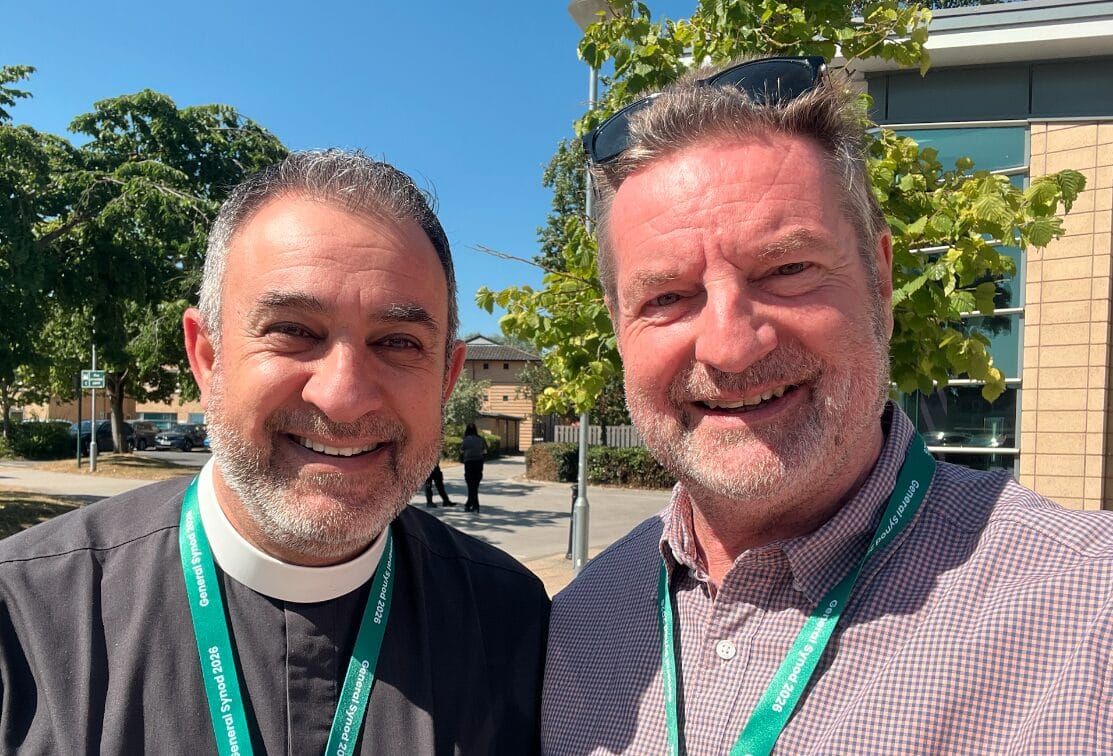 Some who have criticised me on social media challenged me to meet with Fadi Diab, the Anglican priest in Ramallah who has been a leading figure in inviting bishops to visit, and contributed to the writing of Kairos II.
On my way to my room between debates, I bumped into him; we embraced, exchanged details, agreed to meet up, and had a brief conversation. Even in a short conversation, I could sense how charming and persuasive he was. ‘All we are asking is to be listened to’ he said. ‘But Kairos II is highly problematic’ I replied. ‘The law of return in 1950 is racist’ was his response—and then we parted.
There is nothing quite like actually meeting those you might disagree with, and hearing from them exactly what they believe—and even this brief conversation was a revelation to me.
If Fadi, his supporters, and Kairos II believe that the Law of Return is racist and illegitimate, then they are saying that they do not believe in the existence of Israel as a homeland for Jews who have become refugees as a result of pressure and persecution in other countries—including the 900,000 who have been driven out of the neighbouring Arab countries since 1948.
And it also means that they do not believe in a two-state solution, since Israel as it currently is constituted would have to cease to exist.
Connected with this is the counter-claim, belief expressed in Kairos II at 1.3, cited above, in the ‘right of return to those forcibly displaced’ in 1948. The claim is made that, not only those actually displaced, but their descendants in perpetuity have the right to return to the land—all 15.5 million of them. UNWRA has made the unique claim that all descendants of those displaced should be categorised as ‘refugees’. So, if I am born in the UK, to parents born in the UK, whose parents (my grandparents) were also born in the UK, but my great-grandparents left the region as a result of the 1948 (started by the Arab leaders), then I am classed as a refugee, and am entitled to UNWRA funding.
Does that make any sense at all?
 In the period after the end of WW2, around 15 million people were forceably displaced. Every single other group settled in their new homes, and none were offered any kind of ‘right of return’. So why are the Palestinians here granted this unique status?
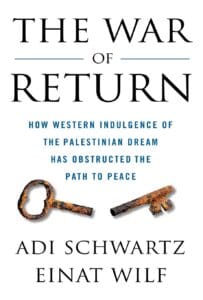
In fact, as the excellent book The War of Return sets out, this demand is what had scuppered every peace negotiation since 1948, and it is what prevents any possibility of a two-state solution. And so any in the West who support this are actually preventing peace, not enabling it. (I plan to write a review of this book very soon; I recommend it as essential reading.)
So why has the General Synod, and bishops in the Church of England, got this so badly wrong? Why did we not seek to listen to the other side before making our decisions?
I honestly believe that, in this debate, we have been conned and manipulated. A highly political document was presented to us as merely an exercise in listening, and too few people understood what they were reading in order to challenge this claim.
But, to be duped, you have to be vulnerable. And many, especially in the leadership, are terrified of being accused of ‘to listening’ to those who feel abused and oppressed. Despite one bishop, Philip North, speaking against the motion, and another, Michael Ipgrave, expressing concerns, not a single one voted against the motion—terrified of being accused of ‘not listening to your brethren who are suffering.’
As far as I can see, that means that the whole House of Bishops is complicit in the deep offence to the Jewish community, and to supporting a position which will make peace even harder to achieve (insofar as the view of the C of E has any impact).
But there are two deeper problems. One is that so many in Synod are in the grip of affective individualism, in which someone’s feelings trump all other reflective engagement, and critical theory, in which all differences are reduced to simplistic power dynamics.
And General Synod is simply not competent to make judgements in such complex, highly politicised, and deeply divisive situations. But then again, why should they be? Why are we even discussing such political situations at all? Our role is governance in the Church—but too often we are driven into making statements of virtue about things we do not properly understand.
The damage is done, and it will take many years and much effort to undo it.
 Buy me a Coffee








Well said. A damaging misstep by our leaders in the C of E.
Ian wrote: “And General Synod is simply not competent to make judgements in such complex, highly politicised, and deeply divisive situations. But then again, why should they be? Why are we even discussing such political situations at all? Our role is governance in the Church—but too often we are driven into making statements of virtue about things we do not properly understand.”
Exactly my view. Thanks Ian for this helpful article, for your considered speech at Synod, and for having the integrity and courage to speak out.
Thank you, Ian
Ian: ‘So many in Synod are in the grip of affective individualism, in which someone’s feelings trump all other reflective engagement, and critical theory, in which all differences are reduced to simplistic power dynamics.’
… and all ‘solutions’ are about works-based re-distributions of power, resource, esteem etc. which preserve, entrench and at best re-configure the differences.
No room for grace or gospel to break down the walls.
Well said.
It is one example of winning the argument, but losimg the case, usually due to deep rooted and unchallenged preconceptions. Indeed, what is the CoE for? ‘Why are we discussing it?’
Is it because the CoE is agnostic, even opposed to it’s core purposes, expressed in it’s core beliefs which are no longer fulfilling and not filling it’s time?
Thank you Ian
It seems that the affective individualism taking hold is yet another way the church seems to be reflecting culture rather than reshaping it.
Thank you for giving clear expression to your work and understanding in this, which takes mine much further. We are so culturally engulfed in affective individualism we desperately need objectivity and information such as you bring.
Ian,
I am very much in agreement with what you have recounted above. This Kairos document is deeply antisemitic and engages in a terrible and fallacious revision of history.
It also continues the absurdity of labelling all the grandchildren and great-grandchildren of those who fled in 1948 as ‘refugees’.
This is a as crazy as calling the many millions of descendants of people ethnically cleansed or displaced in Europe in 1945 as ‘refugees’.
War has consequences, and one of these is that borders are often rewritten.
I have long stated that one of the chief culprits of the mess in the Middle East is the United Nations, with its creation of ‘refugee camps’ for Arabs who fled after Israel was attacked on every side by Arab states in 1948.
The attempt in the document to downplay the atrocities, rapes and murders of 7 October only betrays its antisemitism. The deaths of civilians in Gaza were terrible – but these could have been easily avoided if Hamas had simply released the hostages took (many of whom it tortured and murdered).
October 7th showed the world what Hamas is really like – absolutely evil and satanic.
But it also showed us what the world is really like, ranging from the cowardly mealymouthed to the insane allies of Hamas in our universities (and MPs).
Hamas and Hezbollah (and the Houthis) are the creation of Iranian radical Islamism, and their conduct shows how that religious pathology actually operates in the world: by terror and violence. The Israelis made a big mistake when they left Gaza, leaving the vile surrogates of Iran in control, and the West allowed this cancer to continue unchecked for years.
The West should have gone into Gaza in 2008 and crushed Hamas, preventing the tunnels and arm smuggling that went on for years.
The English Bishops who approved this document are even bigger fools than I imagined.
Thank you Ian, for being a voice in the wilderness.
Thank you, Ian for this masterful presentation. The failure of the Church of England to condemn a clearly antisemitic document is a blot on its life and work and will gravely imperil Christian-Jewish relations in this country. It reveals any statements made by the Church condemning antisemitism and merely pious platitudes. When the chips were down the C of E failed to stand with the Jews and took the side of the antisemites. This is indeed a dark day for the Church which I loved and served for over fifty years.
It is truly shocking.
Ian, as you wrote, the change from “receive” to “hear” will make little difference. Synod affirmed Kairos II as a “heartfelt expression of the lived experience”, which will be seen as an endorsement. To be blunt, the only right-minded response to such a vile piece of antisemitic lies is to reject it. I pray this is the outcome of the requested “engagement”, but I’m not hopeful. Thanks for your efforts – I wish there was more like you.
The voting figures for the House of Bishops leave one speechless.
Thank you very much. Ian. Very grateful for your cogency and clarity and courage at Synod. Deeply disillusioning that this document is being ‘listened to’.
It was a pretty grim debate. A few things stood out to me:
– what is the point of the various inter-faith groups and dialogues? Are they meant to inform anything, and are we meant to learn, or are they just an empty exercise in self-indulgent halo polishing? I nearly fell off my chair at home when one speaker opined that it may have been wise that her local inter-faith group declined to make any comment about the Hamas attacks on October 7th (even if that damaged some relationships) but that we should absolutely vote for this motion with Kairos II.
– there was an underlying argument that the Church of England had a particular responsibility to listen to and side with the Palestinian Christians because they were Christians. That I think is why the motion and papers it cites are all from that one group, and the perspectives from Israel, Jews more generally, or Hebrew Christians (as the Catholic Church likes to call them) specifically are completely absent. I can’t quite shake the Parable of the Good Samaritan from my mind. That would reject the suggestion that we elevate our co-religionists to being our ‘true’ neighbours more than anyone else. Aren’t Israeli Jews as much our neighbour as Palestinian Christians?
– what really got me was the excusing of Kairos II. We were told that the language was “troubling” and “not the language I would use” by several speakers. We were assured that this did not endorse Kairos II, merely hear it. Well Kairos II denounces Israel as an act of genocide by its mere existence, as a racist colonial-settler enterprise that must be dismantled, and rejects on principle any suggestion of a ‘balanced’ peace. As was pointed out it fell foul of our own definition of antisemitism. But that is apparently not a problem if we’re said it’s troubling, not language we would use, and only being heard. Putting to one side what the proper language to use would be to describe Israel as a racist enterprise, genocidal by its existence, which ought to be dismantled (I shan’t hold my breath), on what other topic would such arguments be accepted? If someone put forward a deeply homophobic report and asked Synod to hear it, what would happen? What about a stridently anti-Catholic report? What about a report that was racist against another group? Would anyone in Synod stand up to say it was all ok because we said it was troubling, and not our language, but we ought to hear it and engage? It’s ridiculous. But for some reason the same standard doesn’t quite apply when its antisemitism.
Indeed. It is a complete failure of process, as well as everything else.
Yes indeed, the Church of England needs also to hear from Jewish believers in Jesus who are resident in the land. There are tens of thousands of them.
James when “the west” gets involved in Middle Eastern conflicts it usually causes more problems than it solves. Our church bible overview group just looked at the Apocrypha and noted how Israel was occupied by the Persian, Greek and Roman empires in that period. At the meeting of 3 continents conflict is and has been endemic and we struggle to understand the complexities
Richard,
When the west steps back, Iran steps in. And Russia is happy for that to happen, too.
And when Iran steps in, we all suffer.
It’s not a coincidence that the land of the chosen people is at that meeting point! From there the message could go out across all of the world except the Americas.
The C of E is getting even worse and further away from the Bible. The motion was against Christ’s teaching.
Thanks Ian for standing up to this.
In Old Testament terms maybe the C of E should be more supportive of Israel. In New Testament terms would Jesus not want Palestinian Christians to have their lands protected from encroachment by some Jewish settlers?
Simon, do you know which Oslo zones the new ‘settlements’ (towns) are being built, and why? And how many Palestinians live there?
Well they should be only in Zone C although even there part of it should have been handed to the Palestinians by 1999
They are all in Zone C. And almost no-one lives there, which is why it was designated thus. 97% of the Palestinian population live in Zones A and B.
In theory, in practice some Jewish settlements are expanding into zones A and B
https://www.972mag.com/israel-settler-outposts-west-bank-area-b/
Whilst not denying some of the problematic aspects of the Kairos document I think blaming the decision on many in Synod being ‘in the grip of affective individualism, in which someone’s feelings trump all other reflective engagement, and critical theory, in which all differences are reduced to simplistic power dynamics’ won’t do. Both these theoretical traditions are multi-faceted and not reducible to such a short statement. It suggests that everyone who voted for the motion has been duped, is lacking in critical awareness or cannot see the issue in its complexity – ‘If only they did see truly they’d agree with me.’ The Jewish Network for Palestine, although it might not endorse the Kairos Document, offers another Jewish perspective on the complexities of the situation across Israel-Palestine-Gaza. Their website is worth a look: https://jewishnetworkforpalestine.uk/
If some Synod members’ votes were not the result of being duped, but, rather, acts of clear-eyed understanding and convinced support of this document, its authorship and its political and ideological foundations – isn’t that all the more worrying?
One of the reasons I pray for the State of Israel’s wellbeing is the vibrant breadth of Jewish and Israeli thought and opinion.
Tim, Re “another Jewish lobby”: I have had a look -but only a look! It appears that their objective is “to counter the lies of the Israel lobby”. I can only draw the conclusion that your observations are somewhat shaky; based upon foundations lacking in critical credibility. Nowhere in your desire for “reflective engagement” do you adduce support for your thinking. Ian Paul has for his!
What you have produced is a sophisticated version of “all religions are the same!
Where do I speak of other religions all being the same? I do speak of the range of Jewish voices in this debate. Another voice is that of Embrace the Middle East (formerly the Bible Lands Society.) They have huge and long standing experience of this region and its tragic violence and they have many ecumenical partners on the ground in different countries. Their voice is also worth listening to. But I’m not prepared to slip into the binary approach that a lot of this thread seems to have adopted.
Have they produced a list of ‘the lies of the Israel Lobby’ or is this just generalised slander?
It isn’t hard to find English people who hate England today; go to a university humanities department. The Jews will not be immune to the same disease.
When Jesus Christ criticised the Jews no tongue could be harsher, but He did it out of love, not hate.
As Tim Evans knows, it isn’t that hard to find Jews who hate Israel, because Judaism is a cultural identity as well as a religion, and for centuries there have been secular atheist Jews who hate the Jewish religion.
It isn’t an accident that atheist Jews were among the founders of communism, and this radicalism continues today. Now, as the left had embraced Islam and identity politics, attacking the State of Israel is quite normal for secular Jews in the west.
Tim Evans know this, while offering a sidelong apologia for this antisemitic document.
The Leftist tradition in Judaism began because the revolutionary Left in the Russian Empire was the main challenge to the Tsarist system under which the Orthodox Church fomented pogroms, and because the Left was not antisemitic in those days. It was far more about anti-Tsarism than anti-rabbinism.
There have been atheist Jews at least since the time of Spinoza and two of the most prominent figues in modern culture, Karl Marx and Sigmund Freud, were atheist Jews. Freud was very anti-religious – as was Marx. Atheist Jews like Joe Slovo were prominent in South African communism. The Milibands are also the product of atheist Jewish communism. So it isn’t hard to find cultural (or biological) Jews who hate the State of Israel.
A lot of North American Jews are like Leonard Cohen – liberals who can embrace Buddhism but not Christianity. They call them ‘Jubus’.
The Zionists were originally secular Socialists but religious Jewry has outbred them.
James
Plenty of religious Jews – including Orthodox Jews – oppose the actions of the State of Israel.
Plenty of Jewish Christians too.
James – there was a 20ft statue of buddha on an equally high dais at the 2023 Nova festival. When I went to the Nova exhibition about the October 7th atrocity I was willing to say that this was asking for it in Eretz Israel, but I received no prompting.
Penelope – there are even religious Jews who believe they should not be in the Holy Land, because they have adopted as authoritative a mediaeval tradition – clearly born of despair – that Messiah will come to lead them back in.
Penny,
You know the old saying, ‘Two Jews, three opinions.’
The State of Israel is also the only democracy in the Middle East with relative freedom of speech and religion.
It’s not perfect – but people facing the threat of imminent murder from their neighbours are not always laidback.
The existence of Israel is an affront to Islam’s failure to join the modern world. But the Global Left don’t care about that.
James, yet again you misunderstand. Jews who don’t agree with your point of view don’t automatically hate Israel – in fact I know of those who hold it to a high biblical standard and long for Israel to be more truly faithful to its biblical inheritance. They consider it is currently falling well below that standard. I’m not offering a sidelong apology for anything; please stop interpreting what I say through your own views. But it remains the case that among faithful Jewish people, both in Israel and across the world, there is a huge range of views on this issue. So Judaism is pluriform and capable of multiple traditions, some of which are passionately pro the current state of Israel and its leadership, others are equally passionately opposed. More generally, why on this blog is it so often so difficult to exchange and learn from differing opinions with generosity and humility? Why the recourse to sneering criticisms which I presume we would not tolerate in any church meeting?
Israel will always fall below the biblical standard (as would any other nation). That is why Messiah came.
Bad enough for a Christian church to obsess with politics. Worse is when they land on the conspicuously wrong side. If the Anglican Church in the UK and the Episcopal Church in the US were deliberately trying to accelerate their slide into oblivion, I don’t know what they’d do differently.
Thank you, Ian, for your courage and clarity at the Synod. This vote is not a modern aberration. It sits in a long, dark lineage of British establishment bias. From the York massacre of 1190 and the royal expulsion of 1290, to twentieth-century Foreign Office policies that actively worked against Jewish self-determination, the UK establishment has often preferred a polite form of exclusion. The Church of England’s decision to sanitize the Kairos II document under the guise of “listening” continues this legacy. When the national church refuses to call out blatant prejudice, it proves that institutional bias remains deeply entrenched.
Thank you Ian for your incisive speech and for sharing it here. I found the document – and Synod’s receiving / hearing it to be deeply troubling. Please keep on.
“Why are we even discussing such political situations at all?”
I think this is one of the most bizarre things I’ve ever read on this website!. Back in the 1980s the Church of England authored two reports that were really influential in the thinking of the state. The first was the church and the bomb. The second was faith in the city. Both of those were debated thoroughly by general synod and were models of how to discuss matters that affect society and the world. The idea that general synod should not be discussing political situations shows just what a tiny sectarian little organisation it has become. That sectarianism is a mark of the conservative evangelical group.
Sorry Andrew, that is partisan tosh. I have no objection to the Church of England discussing things. Faith in the City was a major piece of work including a book.
This was a hasty debate about a radical political document without any proper preparation or briefing.
In that case don’t ask the question “Why are we even discussing such political situations at all?”. The Church must never shy away from political situations. The bible is full of political situations into which the people of God speak.
Faith in the City was decried as Marxist by people who said the Church shouldn’t discuss political situations.
Didn’t Synod vote to ‘hear’ it? I can’t see any problems with that. It’s not affirming the statement in its entirety. We should listen to those voices.
Reminds me of that well known phrase ‘I hear what you are saying’:
Firstly, it claims credit for doing what it would be unacceptable not to do.
Secondly, it is ever so ambiguous, as is always the way with deviousness.
Third, it stops (rather than starts) at hearing! A fat lot of good that is.
Yes, it’s dishonest and devious – and a way of letting the camel get its nose in the tent.
Hearing without responding and critiquing falsehood is unworthy of a Christian.
Helen King tried the same thing with her deliberately ambiguous motion on same sex relations, which the Bishops contrived to kill instead of dissecting its dishonesty.
Every appeal to tolerance, diversity, inclusion, kindness (as they call it) is also likewise an attempt to get a foot in the door or a nose in the tent. Because if everything is respected, our selfish/ignorant agendas will receive respect too, even equal respect.
They probably think we haven’t noticed.
Is that a formula and standard we’d apply to any other issue though?
‘Didn’t Synod vote to ‘hear’ it? I can’t see any problems with that.’
Penny, suppose a deeply homophobic document which said that gay people should not have the freedom to live safely was tabled at synod. Would it be ok to vote to ‘hear’ this document?
If not, why is it ok to table and vote to ‘hear’ an antisemitic document?
I have no idea what Synod said about the Church of England document ‘The Church and the Bomb: Nuclear Weapons and Christian Conscience’ (1982) which recommended unilateral nuclear disarmament. But I can tell you what I thought about the concomitant statement “Better Red than Dead”. It was a false dichotomy, since at the time we were neither Red nor Dead. One could equally well have said to Moscow, “Better Capitalist than Dead.” And so it proved.
Communist Russia, not content with imposing misery on Eastern Europe, was aggressively expansionist and, with Germany on the naughty step after World War 2, a Red Army invasion westward could not be stopped by conventional forces. That is why Russia offered never to use nuclear weapons first, a trick that those unilateralist bishops fell for. The NATO response to an invasion was to identify the main thrust, slow it and harry its flanks, and if it continued at the French border to resort to tactical nuclear weapons, then if that did not deter the advance to go strategic.
I owe the freedom of my childhood to the nuclear deterrent possessed by my own country and the USA under the NATO doctrine. My sincere gratitude to all the brave soldiers who were ready at a moment’s notice to go from their barracks in Germany to their pre-chosen lay-up points just west of the border with East Germany and fight to the death as part of this plan. The freedom enjoyed by those bishops was also due to these men, but scant thanks they received from them.
making mock of uniforms that guard you while you sleep
Is cheaper than them uniforms, an’ they’re starvation cheap…
it’s Tommy this, and Tommy that, and Chuck him out, the brute!”
But it’s “Saviour of his country” when the guns begin to shoot
The bishops presumably believed that it was all a dreadful misunderstanding that could be sorted out over a cup of tea on their lawns with Russia’s leaders if only they would come and listen. Today the situation is worse: Dim and Dhimmi.
Very well said Ian. Did you see the response from CMJ to the debate? CMJ was the second oldest organisation within the Church of England ,and I have supported it for many years. Sadly quite some ago it was ousted from the communion,which I found upsetting,but I gather that it has flourished on its own and in its own time ,and has been greatly used and blessed…praise God! I now support Jews for Jesus as well ,and it will be interesting to see their take on this….
Not following the debate, though I share their comments before it in my previous article.
“Let not your hearts be troubled, you believe in God believe also in me”
The motif of Trust is a foundational facet of Faith throughout Scripture. It is an invitation to enter into God’s Rest ,mental and spiritual tranquillity.
The Bible acknowledges that life is fraught with challenges, yet it calls believers to trust God in all circumstances. Isaiah 26:3-4 assures, “You will keep in perfect peace the steadfast of mind, because he trusts in You. Trust in the LORD forever, because GOD the LORD is the Rock eternal.” Trusting in God provides peace and stability, likened to a rock, amidst life’s storms.
Job’s account is a profound narrative of trust in the midst of suffering. Despite losing everything, Job declares in Job 13:15 , “Though He slay me, I will hope in Him.” Job’s trust in God’s ultimate justice and goodness exemplifies faith that transcends understanding.
In summary, trust is a central theme in the Bible, integral to the believer’s relationship with God, the community of faith, and the navigation of life’s challenges. Through trust, believers experience God’s faithfulness, guidance, and peace, affirming the truth of His promises and the hope of eternal life in Christ.
The battle is not against adverse, overwhelming circumstances, the battle is within ourselves, the battle is for our own souls.
To Trust in God and not be afraid is the epitome of true worship
Ps 3:6 I will not be afraid of ten thousands of people, that have set themselves against me round about.
Ps 18:4 The sorrows of death compassed me, and the floods of ungodly men made me afraid.
Ps 56:11 In God have I put my trust: I will not be afraid what man can do unto me
112:4 Unto the upright there ariseth light in the darkness: he is gracious, and full of compassion, and righteous.
112:7 He shall not be afraid of evil tidings: his heart is fixed, trusting in the LORD.
112:8 His heart is established, he shall not be afraid, until he see his desire upon his enemies. Shalom.
I found Ian’s article informative and helpfull.
After many decades of full time ministry (WRU not C of E) I have met many situations at many different levels of complexity where I have had to say, “we must trust in God”.
Alan has put it more intelectually.
I agree that much of what you say is highly concerning. But can you explain why it is unreasonable to say that the great-grandchildren of those Arabs displaced in 1948 should be allowed to return, but not unreasonable to allow any Jew to come to this small land, on the grounds that their very distant ancestors were dispossessed in the first century AD? (Or is this no longer the rule?) The Jewish people need a homeland because otherwise (history shockingly teaches us) the Europeans and Russians are likely to oppress or even massacre them, often in the name of God; but did it have to be that homeland? (I know this is getting off the immediate point.)
Thanks Penny.
1. Nowhere else in the world do we say that where our great-great-grandparents lived determines our right of citizenship. As an addendum to that, it is worth noting that many ‘Palestinians’ actually have Egyptian, Syrian, and Iranian descent, as you can tell from surnames. Under the Ottomans, there was significant mobility.
2. The Law of Return is a different thing. It is about Israel being a safe haven for Jews, who have been persecuted in every country in the world.
Does that make sense?
Furthermore, during the Arab uprising in British Mandatory Palestine (1936-9) Jewish immigration was severely restricted in number (1935 – 66,000; 1936 – 30,000; 1937 – 11,000; 1938 – 31,000). In contrast there was relatively unrestricted illegal Arab immigration into Palestine, upon which the British Governor of the Sinai, C.S. Jarvis, passed tart comment to the effect that “This illegal Arab immigration was not only going on from Sinai, but also from Transjordan and Syria, and it was very difficult to make out a case for the misery of the Arabs if at the same time their compatriots from adjoining states could not be kept from going in to share that misery” (United Empire magazine (London), vol. 28 pp. 632-3, 1937).
Not quite. As I said, it does seem as if the Jews have to have a safe haven somewhere, but why in the land where all these other people had been living for hundreds of years, and without their permission? Not every country has persecuted the Jews, surely. I know it’s difficult to find an empty-ish space, but Palestine wasn’t one.
Penny, because
a. Jews were living there long before the recent inhabitants
b. Jews were in fact continuously living in the land
c. eg Jews were the majority in Jerusalem in the mid nineteenth century
d. Jews pray every year ‘Next year in Jerusalem’.
e. There’s quite a lot in the Bible about Jews living in the land.
But the question you are asking is whether the agreed decisions over the last 100+ years were right. Every international authority has supported Jews having this as their homeland.
There are more pressing questions at the moment…
Oh, and worth remembering: Israel was not created as a country in place of other people or another country.
In the long aftermath of the end of the Ottoman Empire, countries were being created. All Israel’s neighbours were also post-imperial creations.
And the declaration of the State of Israel defined it, uniquely in the region, as a liberal democracy where all would be welcome.
(Have you checked the constitutions of her neighbours…?)
Stalin was keen to pack them off to Siberia – he died just as he was planning a major antisemitic persecution. Do you consider Siberia empty enough?
Permission from people who had been living in Palestine for centuries? Please remember that the Arabs of Palestine had not known self-determination for centuries. Palestine had been part of the Turkish Empire (the Seljuk dynasty, then the Ottoman) since the Crusaders were kicked out at the end of the 13th century. There was no love lost between Arab and Turk – think of Lawrence of Arabia. Egypt invaded Palestine and ran it during the 1830s, but this actually made things worse – many Arabs fled to other Arab lands to avoid being drafted into the Egyptian army, and settled there. Not many of the Arabs resident in Palestine when we conquered it from the Turks in the First World War had roots in the land stretching back more than 80 years.
We ruled Mandatory Palestine between the wars and invited the Jews back, implementing the Balfour Declaration. We guaranteed freedom of religion and constructed modern roads and water systems. That is why so many Arabs came – economic migrants who welcomed a better economy and a less corrupt justice system while still being able to follow the teachings of their prophet. They even got some Jews whom they could scapegoat. Governor Jarvis knew what he was talking about.
A couple of answers:
– do we really expect Israel to be open to allowing Hamas, Islamic Jihad, and Hezbollah to move into downtown Tel Aviv? One of the things we tend to say is that peace needs Israel to be and feel secure – I don’t see how the right of return does that.
– what is supposed to happen to the Jews who had to flee Egypt, Syria, Iraq, Lebanon, Yemen, Algeria etc.? No one suggests a right of return for them.
– Israel’s Law of Return (that allows any Jew to emigrate to Israel) is not about distant ancestors. It’s for anyone who has a Jewish grandparent (historically the test for anti-Jewish laws) as well as anyone who converts to Judaism, and does not apply to those to convert to other religions.
– the Jewish population of Israel did not land out of nowhere in 1948. Jerusalem had a Jewish majority in the 1890s and there had been Jewish immigration throughout the 19th century. If your solution is to move the entire Israeli population out, where do you intend for them to go, and why do you expect them to accept that? Would we make a similar ask of any other nation?
In 1903 Britain offered the Zionist movement some land in the Kenyan/Ugandan highlands, comprising about half the total area of what later became Mandatory Palestine. It would have remained part of the British Empire. This offer divided the Zionists; thanks were given, but the offer was formally turned down at the 1905 Zionist Congress.
The long exile, the galut, may be taken to have begun with the devastating Roman response to the revolt of AD132-5 in which Simon bar-Kochba proclaimed himself the Messiah. Jerusalem was destroyed and Jews were forbidden to live in or near it after it was rebuilt as a Roman city. No Jewish puppet ruler was installed. The land became a desert backwater of the Empire for 200 years and, being near the Empire’s border, was subject to political turbulence. It received little protection from Rome, which was facing increasing troubles of its own, but it still had to pay Rome’s taxes. Many Jews left for Arabia or for the Parthian empire, where lay Babylon. After the fourth century U-turn in which Christianity became the only religion recognised throughout the Empire, Jews were presecuted for rejecting it. In exile – and often under persecution – they continued to hold the Passover feast, which acted as a continual reminder that they had once trekked to a land which they made their own and where they had been able to practise their unique religion. Study of their scriptures (Tanakh) and traditions (Talmud) kept Jerusalem and their land continually before their eyes. From the 14th century the (much older) Jewish adieu ‘Next year in Jerusalem’ closed the Passover Seder. These reasons are why even the secular Jews who comprised a majority of the Zionist movement came to the conclusion that it had to be Jerusalem or nothing. Their yearning is summed up in the anthem HaTikvah (‘the hope’) which after 1948 became the national anthem of Israel. Do read an English translation of it to get the feel.
It’s better in Hebrew! 🙂
Also, the music is in a minor key, which gives it the feel of a lament.
Here is a declaration against the Kairos II document that one may sign:
https://declaration-against-kairos.com/
I wonder what level of rhetoric St Paul or Jesus Christ would use against our bishops? If it is good enough for Him…
The Anglican Church in Canada, it seems to me, has shown similar support for the Palestinian cause in an unbalanced way. In 2023, at the General Synod, there was a motion called “Resolution on Peace and Justice in Palestine and Israel.” Synod invited Rabbi Gila Caine to address the gathering. You can find an interview with her at Canadian Jewish News – thecjn.ca . The article is “This Canadian rabbi taught the Anglican Church in Canada why its anti-Israel policy was offensive.” Keep in mind this was before the events of October 7. You can find the resolution via an internet search Anglican Church of Canada General Synod 2023. There is also a report on the synod at CIJA (Centre for Israel and Jewish Affairs. These references might help in finding a wholesome perspective and consolation in knowing that the Church of England is not alone in this debate.
Personally, I feel that the Anglican Church of Canada has abandoned true support of Jews in this terribly anti-Semitic time. On October 16, 2023, the Toronto Board of Rabbis issued a statement asking why faith leaders hadn’t condemned the brutal attack. They had a valid complaint.it is time for the Church to speak out against anti-semitism and to reach out to the Jewish community.
Yes it is.
As a British Jew with most of my family living in Israel, I thank you for your willingness to express the deeply problematic nature of Kairos II and the synod vote.
For the first time in my life, I am having to consider my place in the UK. If the CoE is turning their backs on Jews, history suggests the future doesn’t look great for us.
Actually if England is turning against the Jews, history suggests that the future doesn’t look great for England. But we will miss you. Jews are an asset to a nation, antisemites a liability.
My family has an ongoing conversation about this too.
Said as nicely as possible – saying you’ll miss us is lovely but what are decent, nice, wellmeaning people like you (collectively) going to do to make sure we don’t have to leave? <3
I know exactly what needs to be done (and so does Rupert Lowe). The problem is getting it done.
There is another facet. I weep for my country but at my age I think also of the eternal. I have a close Jewish secular friend whom I love and therefore wish to see acknowledge Jesus as Messiah. I deplore coercive preaching and I have got nowhere in several decades of talk over meals and drinks about religion, politics and many other subjects. I believe he stands a better chance if he goes back to Israel. But I would miss him, and England would miss Jews. What is in God’s providence?
Anthony, hello, I’ve been thinking about my comment here on and off all day. I’m sorry I allowed my fear and frustration about the current state of affairs to come out sideways at you here. I don’t even know you and asking you what you’re going to do about it was unreasonable.
Rupert Lowe is an interesting character. I read an article (in the Jewish press) about one of his people saying all Jews would be asked to leave the country as foreigners if Restore came to power. Personally I’m more than a bit uneasy about him but I appreciate that he loves this country.
It’s discouraging when conversations and prayers seem to lead nowhere fruitful. Especially so when they’re been going on for years! I’ll pray for your friend. A lot of us are very worried about our future here. Many of us, however, are still resolutely hopeful because we love this country too.
Judith,
I didn’t mind at all. Thank you for your honesty in airing your fear and frustration.
I think Rupert Lowe is aware of which minority lives quietly and keeps the law and which minority pack-rapes vulnerable teenage white girls. But *if* RestoreUK policy is to expel Jews then that would instantly terminate any support I give it. I suspect – and hope – that any such comment was by a bad apple who is not in any position of influence in Restore.
And right on cue the Abp of Canterbury’s statement on Kairos II is already quoted by pro-Pal pressure groups. See the letters to The Guardian today, from people who would not otherwise pay any attention whatsoever to what the church says.
The hatred of the Jews and of Israel does seem to be a constant of world history and gathering pace.
Much contre coeur and the habits of my education, I find myself reading Ezekiel 38 and wondering if it is end time prophecy.
Opposing genocide carried out be the Israeli government is not ‘hatred of Jews’. Though Zionists find it a very convenient slur since honourable people are rightly afraid of being antisemitic.
Arguing that the very existence of Israel is an act of genocide kinda is hatred of Jews though.
Calling the current war a genocide is hatred of Jews, a war that was not begun by them is, by definition, not a genocide. A war that can be stopped at any time by the people you claim are being victims of a genocide, is not a genocide. A war where the enemy country feeds, provides water and electricity and vaccinates the population’s children is not a genocide. Calling it so is a blood libel.
I don’t think a lot of people understand the concept of a blood libel which is probably one reason why it’s being allowed to rear its head in public discourse again. The blood libels of the 1100s – in which it was said that Jews killed Christian children for religious purposes – contributed to the Jewish massacre at York in 1190 which Ian mentioned in his speech. Now it is said that Jews kill Muslim children for religious purposes and antisemitism is the predictable result.
Yes, it’s the contemporary version of ‘baby killers’ chanted down the streets.
No, I don’t really buy that, Penny. People who are very happy with the idea of Arab Republics and Islamic Republics – of which there are quite a lot – get apoplectic at the idea of a Jewish State, which must on on account be allowed to happen.
Israel was no problem to Iran – in fact they were quite friendly – until the Islamic Revolution and the nightmare that followed. Then the Ayatollahs set about trying to destroy the Jews through their proxies, Hezbollah, Hamas and the Houthis.
British Pakistanis are not threatened by Jews. But they are obsessed with them.
I can think of a dozen countries off hand (Congo, Burma, China, Saudi Arabia, South Africa, North Korea, Iran etc) who treat minorities much, much worse than the Israeli government treats Palestinians.
But they get a pass from the Global Left in its fury with Israel – a country fighting for its own survival.
The only explanation for this – and for murders in synagogues in England and beaches in Australia and wherever Jews gather – is monomaniacal hatred of Jews, indeed, the world’s oldest hatred (which always had a good rational explanation: Jews are not Christians, Jews are not Muslims, Jews are greedy, Jews eat Christian children’s blood etc etc).
Muslims have hated Jews since the Battle of the Trench.
And calling Israeli action against Hamas terrorists “genocide” is part of this Judenhass.
‘must on NO account be allowed to happen’
I believe that the Battle of the Trench was against Arabs who had adopted Judaism. (The texts are ambiguous.) It was a proselytising religion a long time ago and many Jews quit the Holy Land for Arabia after the bar-Kochba rebellion.
There were several Jewish Arab tribes in the Hejaz in the seventh century, and they rejected Muhammad’s claims to prophethood (if he was a real historical person then). Some sources say they ridiculed his poor knowledge of the Hebrew Scriptures. The traditions say Muhammad had hundreds of the Banu Qurayzu beheaded after the Battle of the Trench.
Maybe this lies behind the anti-Jewish statements in the Quran. Certainly Muslims have for centuries recalled the Banu Qurayzu as emblematic of Jewish treachery – long before the State of Israel existed.
I have long wondered whether the historical Muhammad was originally a convert to Judaism who failed to win over the Jewish Arabs of Yathrib and turned against them.
A great deal of Islam is evidently Arabised Judaism, with an admixture of Christianity when Christian Syria and Egypt were conquered by the Arab armies. This is probably why the Virgin Mary has a revered place among Syrian and Egyptian Muslims.
‘The sources’ are ibn Ishaq’s Sirat Rasul Allah, an ancient Arabic biography of Muhammad. It was reconstructed from parts appearing in other ancient Arabic sources (the largest being ibn Hisham) and translated into English by the Victorian scholar Alfred Guillaume. Easily got from Amazon, it is THE book to read about Islam, because it provides the context for the Quran which otherwise makes little sense.
The problem is that ibn Ishaq wrote it 200 years after Muhammad. In one sense this does not matter, because it is what Muslims themselves believe about their prophet. As for its accuracy, a few brave and talented scholars are now turning to the Quran and hadith and Sirat armed with modern techniques of archaeology and comparative textual analysis of fragments. There are significant discrepancies between their findings and the version of Islamic history which Muslims themselves believe. See the Wikipedia article about the “Revisionist school of Islamic studies”. Too bad it doesn’t mention Stephen Shoemaker or Dan Gibson, among others.
Yes, I’m generally familiar with these issues, and as you say, in one sense it does not matter since Muslims accept thst narrative as true.
But from a historical point of view, jt does seem to me that Muhammad and Judaism were much more closely linked at the beginning and Islam appears as a Arab kind of Judaism.
It might even be seen as an Arab Arianism.
Giles Fraser is rather blunt in The Jewish Chronicle:
https://www.thejc.com/opinion/the-church-of-england-delegates-should-hang-their-heads-in-shame-over-the-israel-genocide-motion-dlrb2g6b
Thank you for sharing this – I just read it and appreciated its perspective.
Isn’t the support for the Palestinians simply a support for the underdog?
Every night we see TV footage of Israeli settlers pushing Palestinian farmers out from the miserable bits of land they have been farming for ages.
We see Netanyahu opposed to the one future all our diplomats have come up with, the Two State Solution.
And we know he is supported by a significant section of the Israeli parliament who, egged on by American evangelicals, want to take back all the territory up to the Euphrates!
Underdog? Hamas has about half the number of fighters of the British army, the PNSF even more… that’s without counting smaller Islamic militias. ‘Palestinians’ have been the aggressors every time for the better part of 80 years, not just in Israel but in Jordan, Kuwait, Lebanon, Egypt.
I also briefly wondered if Synod were being led astray by the fact that we all know we fight for the underdog in this country, but it’s simply not true, since fighting for the underdog at the moment would mean fighting for the Jewish community and I’m beginning to think that’s just too uncool for Synod to contemplate.
I fear you may be right. I keep telling my lefty LGBTQIA+ friends that we will be immolated after the Jews on the altar of democratic expediency. And it’ll be too uncool for the churches to contemplate too.
Lorenzo, as the saying goes, when they come for the Jews, you and I will be next.
The underdog argument cuts both ways – look at the Islamic Near and Middle East, and Israel is the underdog.
Where Israeli settlers push Palestinian farmers off the bits of land they have been farming for ages, I deplore such actions. But very little of that goes on – most new Jewish settlements are built on public land.
Netanyahu is opposed to the one future all our diplomats have come up with, the Two State Solution, because our diplomats want Arab oil and regard Israel as an inconvenience. They are cowards and fools who ought to be supporting a Western State set up in the heartlands of the West’s longest-standing and deadliest foe.
“Take back all the territory up to the Euphrates”?
This is called Revisionist Zionism. It is not a significant movement and it is based on a theological error. In a formal covenant with Abraham (Genesis 15), God promised that his descendants would possess land between the “river of Egypt” and the Euphrates, specifically land then occupied by ten peoples, including the Canaanites. This ‘promised land’ is not necessarily the whole area between the rivers – a specification which is anyway unclear in the headwaters regions – as on the Exodus the Israelites are described as passing through land between the Nile and Euphrates on the way to the area they have been promised. It cannot therefore be the whole area between the two rivers. And God becomes more precise as they get nearer and need to now. Numbers 34 specifies the borders, and the northern border is well south of the Euphrates.
Owen, yes—but it is a strange underdog that is given $1.8 billion dollars…and spends it *all* on arms…
…and also a strange underdog which manages to fire 20,000 rockets on the civilian areas of Israel…?
Thank you so much. Your speech reduced me to tears – in a good way! I’m so sorry that Synod have taken this decision but I’m so grateful that you’ve stood up against it so movingly and strongly.
Is there any other people group that garners so much opprobrium in the western and middle eastern world?
Jesus was and is a Jew, not a descendant from Ishmael.
“Jesus was and is a Jew!” And perhaps in that light he declared : “If the world hates you, keep in mind that it hated me first. If you belonged to the world, it would love you as its own. [John 15: 18&19].”
Why should anyone tolerate being ‘ruled’ by a body that has no minimum benchmark in either critical thinking or awareness of the importance of relying on detailed study?
The only way they get on that body is by being elected! Anyone (dare I say Count Binface?) could be elected.
If the Synod were full of Ians, applying thought and analysis rather than sticking tribally to right-on positions to get kudos from the peer group and accepting any number of internal contradictions in order to do so (note that Marxism attends to one dimension only – the effect on minorities, sometimes selfconstructed minorities – thus ignoring or showing itself intellectually inacapable of factoring in the very many other dimensions which exist in reality) things would be fine. However would that happen if election is the only criterion? Even to be a Christian minister there are a lot of exams that have to be taken first (though even these requirements are being narrowed down in some ways). The idea is for the well-brained to be ruled by the minority which operates under no quality control and then claims the right to rule. It’s all right for some.
There doesn’t seem to be enough concern here to look at the deadly antagonism currently being played out in Israel/Palestine through the lens of New Covenant Christianity. Past history and today’s politics have clearly brought us to an impasse where a good case can be made to justify any and every atrocity and it’s simply down to who has the loudest voice and the greatest backup of weapons which wins the day.
In Deuteronomy 28 Moses prophesied appalling curses which God would bring upon the Israelites on account of their disobedience. They happened. Nevertheless God finally saw through his plan for Jesus to be born through an Israelite lineage. 33 years later the New Covenant took effect: post resurrection it provided a clean-sheet offering of salvation to the peoples of the whole world – no more differences between Jew and Gentile.
So when it comes to 2026, as the last days roll on, the responsibility of Christians as God’s agents on Earth is to witness to Christ’s redemptive offering on the one hand and to apply his teaching in the gospels on the other. When it comes to politics I believe that means judging and acting according to 3 principles: truth, justice and peace. It obviously has to be in that order. When dodgy narratives abound, injustice and atrocities are everywhere, and emotions grow hot it’s extremely difficult to stick to those principles. We Christians may understandably fail at times, but we should at least try. It might help if take more time to pray for insight and wisdom, and rather less time to vent our opinions.
Thank you, Ian. Keep up the good work. Synod’s stance on this issue makes me ashamed to be a member of the CoE.
Thank you Andrew. Many many people have said the same.
I am very grateful for this article, and I would like to offer a few observations of my own.
I should say first that I am not a member of General Synod, thus not well versed in its standing orders or the conduct of debate there. I have considered standing in the past, but do not think I have the intellect or the gravitas to make any kind of substantive contribution.
I have, however, like many clergy, been to the Holy Land several times. I have led three pilgrimages and been on a clergy study tour. In July 2024, my son and I stayed in occupied East Jerusalem at the height of the war. In October last year, I was on retreat at St George’s College in East Jerusalem. I am reasonably well read on the political and historical situation in Israel-Palestine, and on many of the theological questions that arise from that land. That combination — time spent there, and time spent reading — makes me genuinely reluctant to argue confidently either way. The more I have seen of it, the less certain I have become.
For what it is worth, I would have voted in favour of the motion, largely because of my own experience of the Palestinian Christian community there and of the Diocese of Jerusalem. I have been present in Jerusalem when Christian sites have been defiled by settlers. Last October, I saw settlers praying near the Golden Gate, desecrating Islamic graves, praying for the building of the Third Temple. I can equally speak of real generosity — an Israeli soldier who, finding his own checkpoint closed, took the trouble to explain how I could reach the Western Wall another way; being welcomed there, in a clerical collar, by Jewish people at prayer, who asked where I had come from and encouraged me to go and touch the wall and pray for the “peace of Jerusalem.” I also know of Christians who have experienced real hostility too. None of this resolves into a single clean narrative.
I was also born and brought up in Londonderry, within the Protestant community, before leaving Northern Ireland in 1986. Through much of my life since, I have encountered people who have assumed that background meant I had some connection or indeed sympathies with loyalist paramilitary organisations. I do not. I would want us to be careful about the same move in reverse: that because someone is a Palestinian Christian, they are presumed to carry sympathy for terrorism. My own experience has been the complete opposite.
Also coming from Northern Ireland, I am familiar with a particular pattern: people take a side and then parrot the narrative that defends whatever that side believes, often without ever having examined it closely themselves. I think the same pattern holds in relation to Palestine-Israel. I have spoken to “Free Palestine” supporters who have never set foot in the place, and who simply repeat a narrative they have absorbed. I have equally spoken to people who hold strongly pro-Israel views, and who support the actions of the state in Gaza, the West Bank, and East Jerusalem, who have also never been there. Both may be well read on the subject, but there is something about direct experience of the context that reading alone cannot supply.
I would also gently push back on any suggestion that those of us who read this differently do so from a lack of sophistication or nuance, or from ignorance. I have ministered in North London, among a substantial Jewish community, and I know there are practising, religious Jews — some of them Israeli passport holders — who would not regard the Chief Rabbi or the Board of Deputies as representing their views.
The Fadi Diab anecdote troubles me more. One sentence in a corridor, from a man you had just met, is being asked to bear the weight of characterising an entire movement’s settled theological position on Israel’s existence. I know you would read that move as overreach if it came from the other side. Equally, I would be interested in seeing your evidence that Palestinian Christian communities “celebrate terrorist violence, and their children post that celebration online….”
None of which is to say this is not genuinely complex — it is, more than almost anything I have engaged with. I say that as someone who has spent real time in the land, read widely on its history and theoloyg, and formed views of my own along the way, not as someone standing outside the argument for want of knowledge. But holding that complexity honestly does not prevent us from standing alongside our Christian sisters and brothers in Palestine, and elsewhere, who are going through very hard times — the West Bank, Taybeh, and East Jerusalem being good examples of where that call is most pressing.
Whenever people quite properly want to defend the State of Israel and its right to defend itself, I have yet to hear the same people defend the right of Palestinians to safety and self-determination with equal conviction. Similarly, when people demanded the release of the hostages, no mention was, or is, made of the many Palestinian prisoners held without trial — yet if the reverse were said, the hostages would always be mentioned. I raise this not to accuse one side alone — the same selective compassion runs in both directions — but because a Church that wishes to be heard on this needs to notice the pattern in itself before it can honestly ask it of anyone else.
Thanks Chris. Briefly:
1. Yes, it is complex! My grandfather took up arms in 1916 against the British colonial oppressor, so I too have an interest in The Troubles.
2. Some settler behaviour is appalling. But did you know that all the new buildings (‘settlements’) are being built in Zone C of the Oslo Accords, which Israel governs because there are almost no Palestinians living there (3% of the West Bank Population); that the Oslo Accords should have led to agreement, but that that was sabotaged by the Second Intifada (which led to the building of the security wall); and that at the entrance to Zones A and B there are large signs saying ‘Any Jew passing this sign will be killed’?
3. The throwaway line from Fadi was in fact explaining the basis of his argument. I had always thought that the claims about ‘apartheid’ and ‘racism’ concerned treatment of people on the West Bank. I challenged him about Kairos II, and this was his reply. I dug deeper in conversation with someone in Synod who is on his side, and he confirmed this: THE objection to Israel from this point of view is that the Law of Return is racist and illegitimate. I don’t think KPII spells this out as the basis, but it does it explain its language—that the whole project of Israel is built on this racist foundation. Do talk to people yourself to confirm this.
4. I spelt out the link between Palestinian Christians and terrorism in my previous article, which you might not have seen, here: https://www.psephizo.com/life-ministry/the-church-of-englands-problem-with-antisemitism/
The person Sarah Mullally visited and prayed with posted support for PFLP, a proscribed terrorist organisation which took part in October 7th, on her Facebook profile. I took a screenshot which is in that article. Her great uncle Kamal Nasser was a PLO leader, who probably organised the 1972 Munich Massacre. And George Habash, who founded PFLP, was a ‘Palestinian Christian’. Another friend informed me, in correspondence, that Palestinian Christians were highly influential in the PLO because they were better educated than the Muslims, and had links abroad, so were key in building the international support for the PLO from the 1960s onwards.
I am not offering here a total evaluation of the political situation, and I have never anywhere online offering support for the policies of the current Israeli government.
I am doing one simply thing: pointing out that KPII is deeply antisemitic, and that C of E support for that is both antisemitic, and deeply destructive to the peace process.
Does that all make sense?
Thanks, Chris, for a comment which amply demonstrates how humility and wisdom so often go hand in hand. In my experience people who actually know the most are often the most likely to say ‘I don’t know’ – their grasp of the complexities serves as a serious inhibition when it comes to making glib or crass statements!
While I think the case at issue here absolutely demands that any reasonable person recognise there’s good and bad on both sides, I am particularly concerned that one side appears to have literally bought and paid for the political loyalty and military resources of the USA and has thereby obtained for itself an overwhelming share of the supportive narrative in the West. I’m afraid the spurious teaching of ‘Christian Zionism’ has a lot to answer for too. Corruption of both purse and mind can lead to intimidation of opposing voices and serious injustice meted out to those who are most vulnerable.
I really do think we Christians ought to be able to make a much better fist of understanding our Bibles and applying what we learn to real life situations in our own day. Our failures to do that really can have real life repercussions.
If you believe that Christian Zionism is unscriptural but are not willing to justify the claim, might you not simply state that you *believe* it to be unscriptural? I believe in contrast that Christian Zionism is scriptural.
Well, Anthony, some time ago I resolved for both my mental and physical wellbeing to restrict time spent at the PC keyboard. As we all know ‘Christian Zionism’ is a relatively recent notion in the life of the Christian church; I believe it was conceived by J N Darby within the Plymouth Brethren at the time and widely disseminated by Scofield with his famous study Bible. Given its problematic relationship with a whole Bible understanding of God’s Old Testament covenants, the Israelite nation, and God’s final New Testament covenant (which drew a line under the old and applied henceforth to all of humanity), I would suggest the onus on you is to justify ‘Christian Zionism’ rather than me to debunk it. In any case such a discussion involving multiple passages from the whole Bible is far beyond the intention for, and limitations of, comments here.
I would offer one thought. God is sovereign in every respect. He can do exactly what he chooses, and we should beware tempting him by quoting selective Bible verses at him to cover our own backs or claim special privileges. I see nothing but evil coming from today’s State of Israel and being suffered by it in regard to the kind of unjust or inhumane actions which Christian Zionists try to justify on the basis of their possibly well meant, but misplaced, understanding.
We have had just such a discussion – i.e. whether there is biblical justification for Christian Zionism – on other threads on Psephizo. Neither of us wishes to repeat it here. That is why I advocate “I believe that” as the respectful way to present exegetical views against which there is significant dissent but which one is not willing to argue on the spot.
Christian Zionism antedates Darby’s wacky scheme by two centuries. It went mainstream with the English Puritan movement, and ultimately flowed into the wider 19th century British evangelical movement which made the Balfour Declaration conceivable. I can give references to many quotes by key Puritans but, so as not to appear a cherry-picker, I’ll recommend books about it: ‘Albion and Ariel’ by Douglas Culver (1995); Christian Zionism and English National Identity, 1600 – 1850 by Andrew Crome (2018); The Puritan Hope by Iain Murray (1971). John Wesley was a Zionist on scriptural grounds, and his brother Charles wrote the Zionist hymn “Almighty God of love”.
Christian Zionism was in the Church of England before the time of Darby. The Church’s Ministry among the Jews, founded by the Clapham Sect, promoted the return of Jews to Eretz Israel.
Sorry Don, but what are you talking about?
“one side appears to have literally bought and paid for the political loyalty and military resources of the USA”
Literally bought and paid for? Really? Outbidding Saudi, Qatar, Bahrain, UAE etc? This is conspiracy theory stuff. You don’t think the history – particularly 67 and 73 – might have some explanation here?
the case at issue here absolutely demands that any reasonable person recognise there’s good and bad on both sides
But a post later…
I see nothing but evil coming from today’s State of Israel
Not the Israeli government, not Netanyahu, but the State of Israel. Sorry but you’re crossing a line here surely. How many other countries would you feel so at ease describing in such terms as ‘nothing but evil’?
Adam, if you are going to engage with someone else’s comment, it would be better if you first make sure you understand a) what the commenter actually said and b) to what he or she is referring.
My ‘bought and paid for..’ comment refers to the activity and huge influence (including financial donations to politicians) of AIPAC in the USA and the enormous amount of the USA’s military power made available on Israel’s behalf, not least in the current war being waged against Iran. I have no idea what your ‘outbidding’ phrase means.
I never said “I see nothing but evil coming from today’s State of Israel”
What I said was: “I see nothing but evil coming from today’s State of Israel and being suffered by it in regard to the kind of unjust or inhumane actions which Christian Zionists try to justify on the basis of their possibly well meant, but misplaced, understanding.” In other words Israel itself is suffering from the reaction to its own violent activity, yet this ill judged activity is being justified by Christian Zionists.
And so clearly I am not referring to any country – including Israel – as ‘nothing but evil’.
You might do well to ponder why people are so fearful to comment on Israel when they know how vicious and misleading the response is likely to be. Accusations of ‘antisemitism’ are frequently used as a silencing tactic rather than concern for truth. It’s doubly regrettable when Christians behave in this way.
Don, you might then need to write more carefully.
I, too, inferred what Adam did from your phrase.
Thank you Don. I am shocked that so many on this site have no compassion for their fellow Christians. The mighty power of the Israeli state backed by America is the problem here, not anti Jewish sentiment. I grew up in a district of Leeds which was a large Jewish community. Many friends were Jewish. It is not anti Jewish to be against Netanyahu and his government. Catholics in Lebanon are now reporting attacks on churches.
Are you suggesting Jews are attacking those Catholic churches?
Thanks, Ian. Point taken – it wasn’t the clearest sentence I’ve ever written!
Chris, thank you so much for this really helpful response, blending deep knowledge of the region, awareness of the historical complexity behind current travails and humility when it comes to forming judgements. All are much needed in the current debate when certainties and assertiveness can so easily hold centre stage, and when an honest admission that we don’t really understand as much as we claim may be more helpful. There’s a great temptation for every group to maximise its victimhood, and minimise its responsibility. Thanks again for your wisdom and humility.
Don, thanks for your comments above. It was quite clear what you were and referring to and what you were not referring to in your comments about the state of Israel and what it was suffering as well as what the Palestinian people were suffering. The reciprocal violence each side is inflicting on others and justifying is desperately depressing all round, and the state of Israel (not the Jewish people) and its army bear significant (but not total by any means) responsibility for it. I think that was clear from what you wrote.
The adoption of the Kairos II document indeed does the C of E no credit.
That said, the equal and opposite reaction, where the sentiment is heavily pro-Israel, also does not seem right to me. It seems to me that Israel’s reaction to October 7 2023 has been much like Lamech’s (Gen 4:23-24). By its vengefulness the military’s response has stoked up against hatred amongst its Arab and Iranian neighbours as never before, and this hatred will surely have its day.
For a prophetic understanding of the current state of affairs I recommend my own book, When the Towers Fall: A Prophecy of What Must Happen Soon. To summarise some points:
1. Biblically speaking, the Jews do not have a right to live in the land of Israel currently (though Rev 12:14 does indicate that God has allowed them to seek refuge there). In AD 70 God ejected the nation from the land, because they had rejected their Messiah. Jesus warned them about this. Since the great majority still fail to recognise him (some are even atheists), the curse still stands – God has not taken away the veil. The condition for their return has not been fulfilled.
2. AD 70 was not the first time they were ejected. The first time was 586 BC, again because of incorrigible unfaithfulness. They returned in 537 BC – the few that did – because they had repented. There has been no corresponding repentance on the part of modern Jews.
3. Biblical prophecy indicates repeatedly that in the last days the land of Israel, inhabited by Jews, will be invaded and a large part of the population be either expelled or enslaved – despite Israel’s military might. That is because they have not fulfilled the condition for living in the land.
4. I don’t know about any mediaeval tradition that Messiah will come to lead them back in, but that is certainly what the prophets say.
I would add that the Gentiles are in essentially the same position. Having previously recognised and accepted the Messiah, we too have turned against him. So from us too God will take away the land – not the land of Israel, but the whole earth, as described in Rev 8–9 and Rev 16 (NB Rev 9:20-21).
Israel’s response to October 7th is simply to make absolutely certain that it cannot happen again from Gaza. Or are the Jews to be expected to sit and wait for the next atrocity from the huge complex of tunnels which the Gazans have constructed with their aid money (i.e. partly our money)?
There was no expulsion of Jews following the defeat of AD70. (What is your source?) The Temple was destroyed and enormous numbers of Jews were executed, but no Roman policy of ethnic cleansing was put in place. Not even after the defeat of the bar-Kochba rebellion in AD135 was such a policy enacted. On that occasion Jerusalem was destroyed and Jews were forbidden to live in or near the rebuild. They simply drifted away from the rudderless land after that.
Ezekiel (36:24-26) speaks clearly of a return without faith followed by a spiritual cleansing. Can your scenario account for that? It matches the slow but steady rise in faith in Messiah Jesus among Jews in the Holy Land.
I don’t think murdering tens of thousands of impoverished women and children and non-combatant men, among them many doctors and nurses, and turning their towns and cities into ruined deserts, is God’s way of dealing with the problem.
There was some expulsion in AD 70, and even if I were to cite Josephus, you might ask what his source was. The main expulsion took place after the Bar Kochba Revolt. The Wikipedia article on the revolt provides sources and details. My primary source is in fact Ezekiel 5:2 and Zechariah 13:8.
Ezekiel 36:24 et seq has ‘clearly’ not yet been fulfilled. Firstly, the prophecy applies to the whole house of Israel, including the ten tribes that never returned to their land. Secondly, it says Yahweh will bring them back – all of them (a point I made before). And thirdly, who can honestly say that the less than 10,000 adult Jewish Yeshua-believers in Israel (or however many your source suggests) among an adult Jewish population of 5 million – and another 8 million or so still in the diaspora – represents fulfilment of the prophecy?
We agree that Ezekiel’s prophecy has not come true yet. I said that it “matches the slow but steady rise in faith in Messiah Jesus among Jews” in the land, because this rise is consistent with the early stages of fulfilment. You dismiss the relevance of this rise, because you ignore the upward trend, get the numbers wrong, and fail to heed the momentous fact that this is the first *mass* movement of Jews toward Jesus since the early church. For 1600 years there have been only individual conversions or forced ‘conversions’.
In 1999 a detailed demographic survey of the Messianic movement took place by Kai Kjaer-Hansen and Bodil Skjøtt (Facts and Myths about the Messianic Congregations in Israel, Caspari Center, Jerusalem). They found about 5000 believers in about 80 congregations. In 2013 there were some 150 Hebrew-speaking congregations. In 2017 the Israel College of the [whole] Bible sent out a questionnaire, initially to leaders of Messianic congregations; returns suggested a total of about 30,000. Growth continues.
A large survey published in 2022
http://www.israeltoday.co.il/read/how-many-messianic-jews-actually-live-in-israel/
put the number of adult Jewish Yeshua-believers at 8,125. I did not deny that the number has risen over the years, and the rise is common knowledge. I am unable to see the rise as partial fulfilment of the Ezekiel passage for the three reasons given. In addition, as I have already said, Scripture indicates that the Christ will lead them over the Jordan into the land, just as his namesake did over 3400 years ago.
As of now, non-Messianic Jews have not fulfilled the condition for living in the land.
Non-messianic Jews have not fulfilled *your* condition for living in the land. But it is perverse not to see the Zionist movement in Isaiah 11:11-12: a second return, i.e. after the return from Babylon, this time from all parts of the world. Isaiah, God’s mouthpiece, speaks of this return with approval.
Jesus comes back to the Mount of Olives (Acts 1; Zechariah 14). How do you reconcile this with your view that He leads the Jews in?
Joel Kramer resolves the Lost Tribes problem:
https://www.youtube.com/watch?v=ojhJIG3JolI
Evidently some work needs to be done to reconcile the survey you cite – thank you – with the figures from the Israel College of the Bible. The former comes from the Caspari Centre, the same organisation which cited 5000 Jewish believers in the land in 1999. It seems implausible that they should subsequently claim an increase merely to 8000 two decades later when everybody else speaks of much greater growth.
There was some expulsion in AD 70, and even if I were to cite Josephus, you might ask what his source was.
Josephus was on the spot concerning the events he describes and was involved with them senior level. Are you worried that if you give the exact reference it might tell a different story, such as Jews leaving of their own choice after being deprived of their familial lands, or begin taken away as slaves? (They built the Colosseum.) What is the reference?
Neither of the verses you cite implies an expulsion, just the effects of devastation. And what are your sources for active expulsion of Jews from the land after the bar-Kochba rebellion, beyond expulsion from the environs of Jerusalem?
You describe the current Gaza campaign in the following terms:
I don’t think murdering tens of thousands of impoverished women and children and non-combatant men, among them many doctors and nurses, and turning their towns and cities into ruined deserts, is God’s way of dealing with the problem.
I am not saying that the IDF campaign is or is not God’s way (do not twist my words), but your theology is wrong here. God played hardball with the Canaanites in the Book of Joshua (flee or perish at Israel’s hands) and even harder ball with the Amalekites (1 Samuel 15: perish at Israel’s hands).
You write as if the killing began on October 8th 2023. Israel is running a military campaign designed to ensure that October 7th cannot happen again. I respect your freedom not to support such action, but I support it. I contend also that Israel is doing its best to minimise casualties – why else find as many mobile phone numbers as they can of people in buildings located by Hamas assets such as rocket launchers and tunnel entrances, and contact them with short-notice warnings to get out? Hamas, by putting rocket launchers in the grounds of schools and hospitals, shows less concern for the Arabs of Gaza than Israel does. They also put multiple concealed booby traps in buildings that they are forced to evacuate, leaving little alternative to the IDF than demolition. On this occasion Israel is willing to inflict significant collateral damage in order to ensure the security of its own people, but if you condemn it for that then please suggest an alternative that both sides would respect.
Women and children turned out to insult the hostages and Jewish bodies dragged back to Gaza on October 7th, and Palestinian children’s school textbooks teach them to fight and kill Jews. This all but guarantees that the Arabs will continue to demand all or nothing and thereby act against their best interests. When Gaza was ruled by the Jewish government after 1967, modern infrastructure was built there – something Egypt had not bothered to do – and resident Arabs were permitted to cross the green line to work in Jewish-controlled areas. As a result, the economy of the West Bank and Gaza grew rapidly between 1968 and 1980, by an annual average of 7% or 9% in real per capita GDP and GNP respectively. Life expectancy increased and infant mortality fell. These trends were only briefly interrupted by the Yom Kippur war in 1973. In the six years from 1980/81, growth continued more slowly; real GNP per capita rose by 12% during this period, and real GDP per capita by 5% (World Bank figures). Win-Win. But, starting from the outbreak of the first intifada (Arab uprising) in 1987, Arab labour strikes and periodic border closures enacted by Israel for security reasons disrupted economic relations. The sporadic violence of the first intifada lasted six years, during which the Jewish authorities fenced off the Gaza strip for security. The economy stagnated.
Most of the civilian deaths in Gaza could have been avoided if Hamas and its ready helpers had immediately released the hostages (many of them not even Jews or Israelis). Instead, Hamas showed its contempt for the lives of Palestinian Arabs by deliberately putting them in harm’s way.
As I have said a number of times, the west made a serious error by not intervening in 2008 to disarm and depose Hamas before it became a secret war-state, funded by Iran and the United Nations.
Today, thanks to Muslim immigration to the west and the antisemitic madness that prevails in universities (a disease that Trump is excising in the US), the murderous sect of Hamas has great numbers of useful idiots and enablers in the west. Like the rise of Hamas, this is entirely the failing of western politicians, many with a personal stake in Gaza and sucking up to immigrant Muslim communities.
I fear, James, that Hamas-II would simply have been reconstituted in Gaza if Hamas-I had been dealt with.
Maybe. But the West Bank seems to have avoided such extremism. When I said the west should have intervened, I meant some kind of renewed mandate that controlled the government and finances of Gaza.
As for the much-storied ‘Two State solution’, this is surely dead in the sand. Nation states without contiguous land mass don’t work (unless they are islands like Hawaii or have peaceful borders like Alaska).
Gaza could become a city-state like Singapore, but first it would have to start thinking and acting like Singapore.
Militant Islam corrupts everything it touches.
Regarding your question “Are you saying Israeli soldiers are attacking Christian churches in Lebanon?” This was reported on Lifesite News by catholic nuns and pictures of destroyed Christian statues. So the answer is “yes”.
Steven,
The New Testament knows nothing of the end times geography that you present.
We look to the New Heavens and the New Earth.
The strip of land between the Jordan and the Mediterranean is neither more nor less important than Clapham Common in theological terms.
Ian Paul is to be thanked for his fearless defence of the Ancient people of God but to my knowledge he has said nothing about the eschatology of land
So 50% or more of the Old Testament is now irrelevant?
I guess you will say the persistence and existence of the Jews are also irrelevant facts, no more significant than the disappearance of the Scythians?
I don’t think you can dismiss these facts with such quick hand-waving. The New Testament doesn’t allow us such easy supersessionism.
And as for the significance of “Clapham Common in theological terms” ……..
The Clapham Sect, which worshipped at Holy Trinity Church on the north side of Clapham Common and included in its ranks Wilberforce, Venn, Thornton et al, had among the fruit of its works the Church’s Ministry among the Jews (CMJ) which included these aims:
– Declaring the Messiahship of Jesus to the Jew first and also to the non-Jew
– Endeavouring to teach the Church its Jewish roots
– Encouraging the physical restoration of the Jewish people to Eretz Israel – the Land of Israel
– Encouraging the Hebrew Christian/Messianic Jewish movement
I guess you could call them among the earliest of Christian Zionists in the Church of England.
Anglicanism in the Holy Land is directly the result of their work, through the establishment of the Jerusalem bishopric, intended as outreach to Jews.
James,
I am obviously saying no such thing.
I have no idea why you would wish to put such ridiculous words in my mouth.
It is entirely accurate to say the New Testament does not view the strip of physical land between the river Jordan and the Mediterranean as having any eschatological significance.
Nor is it “hand waving”.
We have had some absolutely deplorable “theology” being thrown around in the General Synod. The last thing we need are another set of equally shoddy notions dug out of the Old Testament telling us that bits of the Middle East are awaiting end time realisation
Pedro wrote ‘It is entirely accurate to say the New Testament does not view the strip of physical land between the river Jordan and the Mediterranean as having any eschatological significance’ and I agree with Pedro.
This, however, is not the official Anglican position, as demonstrated by the 7th Earl of Shaftesbury, Anthony Ashley-Cooper, a prominent Zionist who is remembered in the Church of England with a commemoration on 1st October.
James Thomson and Antony Williamson (who come across as Zionists) are simply stating the mainstream Anglican position here, which has been mainstream since the mid 19th century, which is that the physical strip of land *does* have some eschatological significance.
Jock,
Mainstream Anglicanism does not depart from the New Testament.
Christian Zionism is a theological eccentricity and we have more than enough of that already without adding fuel to the fire
Pedro – I wish I could share your conviction that mainstream Anglicanism does not depart from the New Testament – and if I could agree with you on this, I’d probably join tomorrow.
I agree wholeheartedly that Christian Zionism is a theological eccentricity. But, as a result of a combination of Christian Zionism together with anti-semitism that reached absolutely depraved levels, there is now a community of Jewish people living in Israel, who have been guaranteed that Israel can be their homeland and they can live there in peace and safety – and I’d say that there is now a moral obligation on the part of the UK/USA, also the UN to ensure this.
The 7th Earl of Shaftesbury is actually worth considering in detail, because he was an influential Anglican (and a Zionist).
There was a lethal combination of two things (a) the poppy-cock-eyed eccentricity (Christian Zionism) that you allude to – and the power of the anglo-saxon empire to give God a helping hand in fulfilling his prophesies (as they saw it), together with (b) rampant anti-semitism in the UK/USA. They saw a Jewish state in the Palestine as a way to limit Jewish immigration into the UK and the USA (even though, as many have pointed out, the Jewish community has made an invaluable contribution to society – and we are all culturally much richer for it).
It is well worth bearing in mind what happened to the SS St Louis which left Hamburg in May 1939 carrying 937 Jewish refugees. When it arrived in the USA, it was turned back – and had to return to Germany – and many of the people on board were later killed in the German extermination camps.
So there was a long standing combination of Anglican Zionism motivating a Jewish homeland in the Palestine together with anti-semitism – again within the Anglican community.
Understanding the interplay between these two strands (Christian Zionism and anti-semitism) helps to explain the toxic situation we find today.
Jock,
Consider it possible that the ‘poppy-cock-eyed eccentricity’ you call Christian Zionism, and the power of the anglo-saxon empire to give God a helping hand in fulfilling his prophesies, are related – i.e. that God raised the British Empire not only to spread the faith but to restore the Jews – as Isaiah 11:11-12 clearly prophesies.
Pedro,
The Old Testament is the Word of God. It is not swallowed up in the New.
I do not see anywhere that the promise of the land is abrogated.
The facts that 1. the Jewish people still exist today, despite enormous efforts to destroy them; 2. that they are back in the land, against all odds; 3. strong forces are trying to destroy them (currently Iran and its western stooges), should give everyone pause, especially those who treat the land as of no significance and, by extension, the Jews themselves. Like you, I have wanted to trat thr proise of thd land as obsolete, but I don’t think that washes now. The fact that Britidh Pakistanis, American leftists and Iranian Shias are infuriated by the existence of Israel is very striking, isn’t it?
The attempt to write out the Jews and the land, such as by invoking the New Testament, fails to see that Judaism and the land are intrinsically involved with each other because possession of the land is inherent to Jewish identity. It is hard for Gentile Christians to appreciate this point, but there it is.
Let us beware of high minded neo-Marcionism. I am not a Jew, so this is as much a challenge for me to understand as it is for you.
Fret/consume not yourselves it tends only to evil. ESV Ps.21
Ps 37:7 Rest in the LORD, and wait patiently for him: fret not thyself because of him who prospereth in his way, because of the man/men who bringeth wicked devices to pass.
I was impressed by this excerpt quote-
“All who have entered into God’s rest have rested from their labours, just as God did after creating the world. (Hebrews 4:10 NLT)
Christ is God’s Sabbath. Christ is our Sabbath.
When we enter by faith into Christ’s righteousness, we enter into God’s rest. It is a tremendous power….
The Lord says, in quite simple language, “If only you will trust Me, and trust My provision, and stop worrying, stop fretting, stop being anxious; if you will but believe Me, I have the ground upon which I could meet all your need; I am no longer without ground.
There was a time when I had not the ground upon which to do anything with you, and for you, but now you are on the ground of Christ, the ground which I have provided; if only you will trust Me, if only you will rest in Me to bring you through, you will be saved from so much of this weakness, and fret, and anxiety!”
Worry is a destroying thing. At the back of a lot that we suffer in body, and in mind, there is so often a secret, hidden restlessness, something deep down in our subconscious being of a fret, an anxiety, something that is not rest.
It takes many forms. Sometimes over a concern of the Lord’s we feel that, unless we do it, it will never be done. We feel that if we are not up and at it, then the whole thing will go to pieces; so much depends upon us.
No one will think that this is the call for passivity, for abandon of concern for the things of the Lord; but it is possible for us to have the things of the Lord on our hearts and yet not to have faith in God about them. There are the hidden secrets to a great deal of our weakness and defeat, and unnecessary suffering.
They are the hidden things of something which is other than just restful faith in God.
There are some people who need to take things to heart a little more than they do, but for many the trouble is perhaps of this other kind.
They are thinking that they have to run God’s universe for Him; they must look after things or else they will never be looked after!
But to observe the Sabbath (no one will take that literally as meaning the observance of a particular day of the week), to recognise Christ as God’s Rest through righteousness, to observe that, to keep that Sabbath, is Life which conquers death, because it is righteousness which cannot be destroyed.
By T. Austin-Sparks from: Spiritual Ministry – Chapter 4
Shalom.
For those of a theological bent consider the word origins of the
“Fretting leprosy”[leprosy being the symbol of sin and uncleanness]
In the book of Leviticus [“the Holy Scriptures are able to make you wise unto salvation”]
International Standard Bible Encyclopaedia
FRET, FRETTING
(charah, ma’ar):
To “fret” is from for (prefix) and etan, “to eat,” “to consume.” The word is both transitive and intransitive in King James Version:
(1) transitive as translation of charah, “to burn,” Hithpael, “to fret one’s self,” “to be angry” (Psalm 37:1, “Fret not thyself because of evil-doers”; Psalm 37:7, 8 Proverbs 24:19); of qatsaph, “to be angry,” etc. (Isaiah 8:21, “They shall fret themselves, and curse,” etc.); of raghaz, to be moved” (with anger, etc.) (Ezekiel 16:43, “Thou hast fretted me in all these things,” the American Standard Revised Version “raged against me”). For Leviticus 13:55, see under Fretting below.
(2) Intransitive, it is the translation of ra`am, “to rage,” Hiphil, “to provoke to anger” (1 Samuel 1:6, “Her rival provoked her sore, to make her fret”); of za`aph, “to be sad,” “to fret” (Proverbs 19:3, “His heart fretteth against Yahweh”).
Fretting in the sense of eating away, consuming, is used of the leprosy, ma’ar, “to be sharp, bitter, painful” (Leviticus 13:51, 52; Leviticus 14:44, “a fretting leprosy”; in Leviticus 13:55 we have “it (is) fret inward” (“fret” past participle), as the translation of pehetheth from pahath, “to dig” (a pit), the word meaning “a depression,” “a hollow or sunken spot in a garment affected by a kind of fretting leprosy,” the Revised Version (British and American) “it is a fret.”
OR See this inspirational piece @ https://walkwithgod.org/whats-a-fret/
Shalom.
Thank you Ian. You said what needed to be said. You said it loud and clear.
I do so agree Tom. Jesus confronted perverse religious behaviour, though He was reluctant to pursue them, preferring rather to avoid them.
To fret over a partially lost cause to the combined church only engenders strife and borders on being a form of godliness that denies The Power thereof.
The role of the priest is “to stand still in the Jordon” [the place of death]
Until those who want to can pass-over into the Rest of the Promised Land, the Sovereign God will do the rest. Shalom.
As regards the ”right of return”, can we imagine what European politics would now look like if the descendants of the Germans expelled after the 2nd World War from East Prussia, Pomerania, Silesia and the Sudetenland were demanding such a right and trying to enforce it by terrorism? Those expelled weren’t Nazi settlers, but people whose ancestors had been the majority population in those areas for many centuries. The ”Nakba” belongs with this post-war population displacement. The Jews had lost their old homeland in Eastern Europe – together with so much of its population in a real genocide – and many of the survivors were desperately seeking a new homeland. And many of the Arab refugees fled because of the fighting when the surrounding Arab states immediately tried to eliminate the new-born state of Israel. The tragedy is that the Arab attitude remains ”What do we want? Everything. When do we want it? Now”. One doesn’t have to be a Likudnik to see that Israel had no choice but to strike back at Hamas. And what does Hamas care about the ordinary people of Gaza? They have brought the same terrible retribution on the Gazans as Hitler brought on the Germans.
It might have helped if they had voted to Listen to the document rather than to Hear it. That is the verb that implies nothing.
I think you are right. But it was all ill-thought-through.