(If you enjoy this article, why not buy me a coffee?)
The Sunday lectionary reading (Trinity 9, Year C) continues on its journey through Luke’s ‘special section’ of Jesus’ ministry and teaching on road to Jerusalem from Luke 9.51 to Luke 18.14. In this short (and again, inexplicably truncated by the lectionary) reading from Luke 12.49–56 (you might choose to read on to verse 59 to complete this section) Jesus makes some startling claims about the nature of his ministry and the conflict that will arise for his followers.
(If you prefer to watch or listen, then join James and Ian as they discuss the text in their weekly video here.)
Some parts of this section in Luke are unique to this gospel, and the emphasis on division stands out. Parts of it (the central question about peace, and the division within a household) have parallels in Jesus’ second block of Matthean teaching in Matt 10.34–35, though in a slightly briefer form, and the sayings about weather signs come between Matthew’s third and fourth blocks of Jesus’ teaching, in the context of a dispute with the Pharisees.
The saying about ‘not peace but a sword’ comes in Matthew 10 in the context of Jesus sending out the Twelve on mission, and a following collection of teaching that appears to merge the immediate context with the anticipation of a coming eschatological crisis—at points Jesus’ teaching here parallels his teaching Matt 24–25. A powerful theme here is the redrawing of boundaries of kinship loyalty, so that not only are Jesus’ disciples ‘brothers [and sisters]’ to one another, but they are also the kin and representatives of Jesus (compare Matt 12.50), so that ‘whoever welcomes you welcomes me’ (Matt 10.40). The primary issues here, then, are belonging to one another in mission in the face of opposition.
In Luke, this teaching comes in a rather different context in Jesus’ teaching. As we have seen in previous weeks, there has been a relentlessly theocentric focus across different issues. The ‘rich fool’ in Luke 12.13–21 is so focussed on the accumulation of his possessions that he fails to attend to the one to whom he must give an account; in Luke 12.22–34, when we focus on God and his kingdom we are freed from anxiety about our material needs; and in Luke 12.35–48 we are challenged to focus on the coming of God in the return of Jesus the Lord, which will lead to us being energetic and faithful servants ready to welcome him when he comes. Though there are numerous verbal and thematic links between these sections, there has been a steadily growing focus on the issue of eschatological judgement and our standing before God when we come to give an account of ourselves to him, a theme that was introduced in the first section of the chapter in Luke 12.1–12.
Within the passage itself, there are several very striking elements that it is easy to pass over when we read too quickly. The first is the opening phrase in English (the verb is in second place in Greek): ‘I have come…’ It is not really possible to understand this in a merely local sense (‘I have come to Galilee/Jerusalem/Jordan…etc) because of the cosmic nature of the language here. His purpose is not really to ‘bring’ fire (NIV) but to ‘cast it upon the earth’ (Greek βαλεῖν, to throw; see ESV and AV), a quite apocalyptic image offered from a heavenly vantage point. Simon Gathercole, in his book The Pre-existent Son, notes the importance of ‘I have come…’ sayings in the Synoptic gospels, and highlights the ten most significant:
- “What do you want with us, Jesus of Nazareth? Have you come to destroy us? I know who you are—the Holy One of God!” (Mark 1.24)
- “What do you want with us, Son of God?” they shouted. “Have you come here to torture us before the appointed time?” (Matt 8.29)
- “Let us go somewhere else—to the nearby villages—so I can preach there also. That is why I have come.” (Mark 1.38)
- “It is not the healthy who need a doctor, but the sick. 32 I have not come to call the righteous, but sinners to repentance.” (Luke 5.31–32)
- “Do not think that I have come to abolish the Law or the Prophets; I have not come to abolish them but to fulfill them.” (Matt 5.17)
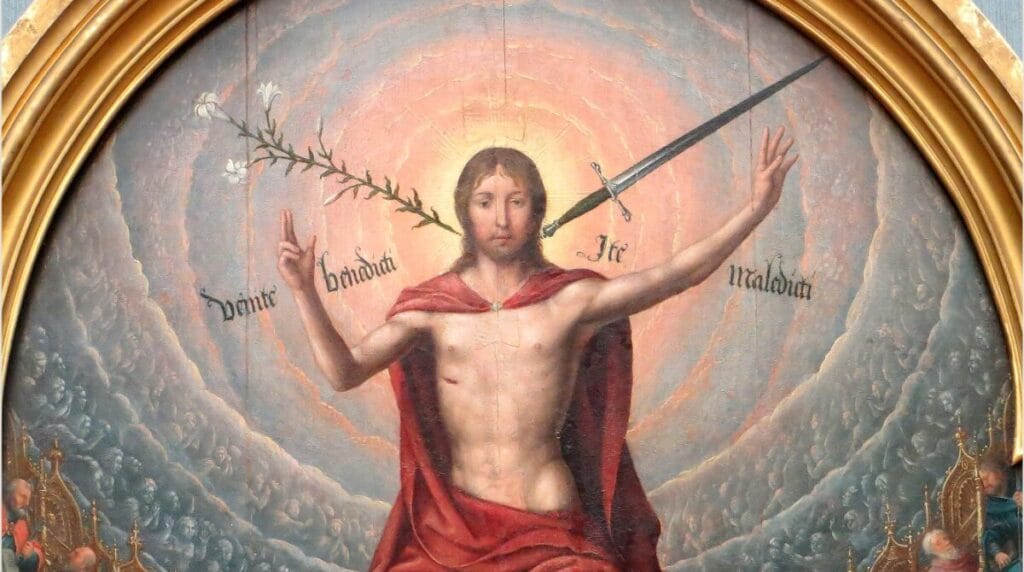
- “I have come to bring fire on the earth, and how I wish it were already kindled!” (Luke 12.49)
- “Do not suppose that I have come to bring peace to the earth. I did not come to bring peace, but a sword.” (Matt 10.34)
- “For I have come to turn ‘a man against his father, a daughter against her mother, a daughter–in–law against her mother–in–law—” (Matt 10.35)
- “For even the Son of Man did not come to be served, but to serve, and to give his life as a ransom for many.” (Mark 10.45)
- “For the Son of Man came to seek and to save what was lost.” (Luke 19.10)
It is worth noting (in passing) that the language of Jesus ‘coming’ is often thought of as Johannine: in John’s gospel Jesus appears to have a very developed sense of his pre-existence, particularly when talking about ‘coming into this world’ (John 5.43, 8.14, 12.46, 14.28, 16.28, 18.37 and elsewhere). But noticing this kind of language in the Synoptics helps to close the gap with John, and remind us that the sense of Jesus’ transcendence and pre-existence was a very early feature of the first communities of Jesus-followers (see Phil 2), and is present in the Synoptics who do not ‘merely’ present a picture of a human Jesus. Luke’s Jesus is an exalted man, but he is always more than that.
The second striking phrase is precisely the language of ‘casting fire on the earth’. There is something of an abrupt contrast here with the desire of the disciples just three chapters earlier, when they wish to call fire down on the opposing Samaritans in Luke 9.54. The difference is that the disciples want fire to express their own frustration and anger, but the fire that Jesus brings is the presence and judgment of God—a judgement that has, for a short while, been postponed until all Israel has had the chance to repent.
The language of fire offers a counterpoint to the watery language of baptism in the next verse, which would literally mean being immersed in and overwhelmed with water, but (as elsewhere) has the metaphorical sense of being plunged into some overwhelming experience. Here we are offered another glimpse of the real human tension that Jesus feels about his ministry, a tension that comes into sharp focus in the Garden of Gethsemane, and one that, from the beginning, we have been warned will affect all those close to Jesus. Rather than finding himself in a broad, open space, Jesus discovers that obedience to his Father’s call means constraint—the same constraint that Paul felt in his compulsion to preach the Word (Acts 18.5), that comes with the compelling love of Christ (2 Cor 5.14), and that even pulls Paul in tension between this life and the life to come (Phil 1.23, all these verses using the same verb). How constrained do you feel by God’s call on your life?
Jesus now appears to anticipate his listeners‘ objection to these comments (whether the listeners are his disciples or the crowd continues to be unclear), as Luke might well anticipate the objections of those hearing his account of Jesus’ life. And the objection will be particularly sharp for readers of this gospel, since a repeated and relentless theme in Luke is that Jesus brings peace.
As noted above, the word ‘peace’ does not occur frequently in Luke-Acts. Nevertheless, peace is critical to the narrative; it is announced at highly significant moments, and it is woven into the very fabric of Luke’s two-volume work, especially the Gospel of Luke…
The word ‘peace’ makes its first appearance in the Benedictus, which ends on the word ‘peace’; it is the culmination of Zechariah’s hope/prophecy—the reality that his son John (the Baptist) will prepare and that the Messiah will bring (Luke 1.68–79). God will mercifully guide the people out of the ‘shadow of death’ into ‘the way of peace’ (1.79), meaning deliverance from enemies, forgiveness and salvation, and service to God in security…
These first three peace texts in Luke—the promise of imminent peace to be brought by the Messiah (1.79), the inauguration of peace in the birth of the Messiah (2.14), and the confession of Simeon (2.29–30)—are programmatic for Luke’s gospel and his entire theological project…
If the Gospel of Luke begins on a repeated note of peace, it also culminates on such a note…All of this is why Peter, in Acts 10.36, can allude to Isaiah 52.7 and 61.1 and rightly summarize God’s activity in Jesus as ‘preaching the good news of peace by Jesus Christ. (Michael Gorman, Peace in Luke and Paul Grove booklet B76).
 All through this gospel, Jesus’ ministry is one that brings peace—but along with peace, it unavoidably brings trouble as well. Those who accept the invitation to live in this peace will be, in some sense, at war with those around, as their loyalty and their lifestyle will be out of step with those with whom they would naturally relate, associate and belong. Jesus is the cause of ‘the rise and fall of many’ and ‘a sword will pierce your heart also’ (Luke 2.35). It is worth noting immediately that this ‘sword’ is entirely metaphorical, and elsewhere in the NT is the sword that comes from Jesus’ mouth, that is, his teaching and his claims about himself, the kingdom, and the nature of God—so there is simply no grounds for endorsing violence as part of the way of discipleship.
In order to make clear the implications of this division, Luke then includes Jesus’s saying about the divided family. It is actually a near quotation from Micah 7.6 and refers to the loss of moral probity that results from the people’s drift from God’s teaching—but here Jesus appears to be drawing on the wider theme of the chaos to be expected in the time just before God comes to his people again—so the theme is eschatological expectation, as fits with this whole section of teaching in Luke. As an incidental, the comment also offers us some insight into the social realities of first century households, which in this case comprises five people: father; mother; son; daughter; and daughter-in-law. This fits the assumption of the nativity narrative in Luke, where Mary and Joseph have come to live with Joseph’s family in Bethlehem before later settling near Mary’s family in Nazareth. But it needs to be read in a culture quite different from most of ours, where one’s first and enduring loyalty was to one’s immediate family and relations; in this context, Jesus’ redefinition of kinship loyalty in relation to his own demands was radically disruptive.
The final imagery, about signs in the sky which tell us about the coming weather, comes later in Matthew, but are included here in Luke because of the verbal connections with what has gone before. (It is worth noting that the use of this kind of language in Matt 24 and Mark 13, and Jesus’ language here about ‘the present time’, confirms that the first part of Matt 24 is indeed about Jesus’ own era, the fall of the temple, and the end of the Jewish nation, and not about some distant future ‘end times’ period.) The contrast between fire and watery baptism relating to Jesus’ ministry come now in reverse order: the threat of a watery deluge of rain (which might lead to dangerous flash floods); and the burning heat of the desert wind. The topology assumed fits a setting in Judea-Samaria-Galilee, rather than Greece, where some commentators posit Luke’s location when writing. Weather from the West coming to Israel has crossed the Mediterranean and so the clouds are laden with water which falls heavily over the hill country. Winds from the south (and the east) come from the deserts of Egypt, the Negev and Jordan; they are a regular part of the seasonal changes in Spring and occasionally in Autumn, and are traditionally thought to occur over a fifty-day period, giving rise to the Arabic name khamsin. I remember experiencing this weather when I lived in Israel; these hot winds have also picked up orange dust from the desert, so you can easily see them approaching, and the dust gives them an almost fiery colour. I remember watching this orange cloud travel relentlessly along Mount Carmel from the south-east, until this fiery cloud was spewed into the coastal plain north of Haifa along the hills of lower Galilee.
If Jesus’ listeners are able to see and interpret these signs, why is it that they are not able to understand the signs of Jesus’ teaching and the implications of his proclamation of the coming kingdom of God, with the division it will certainly bring? Here, ‘hypocrite’ does not really refer to someone who is play-acting as we might think, but rather someone who refuses to face the reality which is set before them.
What does this mean for us in practice? When previously commenting on this teaching in Matthew, I highlighted a pair of complementary questions which arise from Jesus’ teaching here:
a. Seek unity wherever we can find it. This is encapsulated in Jesus response to his disciples’ desires for factionalism in Mark 9.40: ‘Whoever is not against us is for us’. Those who are working for the kingdom, even if in a different group or in a slightly different way, are allies and we should build partnerships with them.
b. Seek truth wherever we can find it. This is urged on us by the opposite saying of Jesus, giving in a context where his teaching is being challenged by his opponents in Matt 12.30: ‘Who is not with me is against me’. When the teaching of Jesus is being undermined, we need to have courage to stand firm, since it is by the word of truth that God’s people are sanctified, protected from the world, and made one.
The two questions we then need to ask of those with whom we are in some tension are: Is this person in Christ? and Is this person speaking truth? When the answer to both questions is the same, then life is straightforward. When the answer to the two questions is different, then we have the challenge to ‘speak the truth in love’ (Eph 4.15) in a way appropriate to the context.
In its context in Luke, I wonder if the questions that arise might be cast in slightly different terms:
a. We should seek and proclaim the peace of Christ wherever we can;
b. We should be prepared for conflict and division when people are not willing to embrace the peace that Christ offers and respond to the claims that he makes.
There is no doubt that Jesus brings peace within—peace within the heart and life of the believer, and peace within the community of believers as they share their lives together. But there is also no doubt that Jesus also brings division, between his followers and their relations, and between the community of followers and wider society. We can trace the first examples of both peace and conflict in Luke’s second volume, as both of these are worked out in the life of the apostolic community.
Come and join James and Ian as they discuss all these issues in their weekly lectionary video:
 Buy me a Coffee





















“I have come to bring fire on the earth, and how I wish it were already kindled!” (Luke 12.49).
Not merely ‘bring’ but ‘cast’. As I point out in When the Towers Fall: A Prophecy of What Must Happen Soon, the picture is repeated in more detail in the Apocalypse:
‘And the angel took the censer and filled it with fire from the altar and cast it on the earth.’
This is one of seven occasions when Christ is visualised as an angel.
Another angel then blows a trumpet. ‘And there was hail and fire, mixed with blood, and these were cast on the earth. And a third of the earth was burned up, and a third of the trees were burned up, and all green grass was burned up.’
In order for this to happen, the coronal mass ejection must be preceded by a severe drought, desiccating the vegetation and rendering the fruit trees, vines and whatever grain crops remain in the field highly flammable.
It is clear that the pre existent Son of God, (as drawn out by Simon Gathercole,in his incarnation, in the Trinity of God, as fully man and fully God inaugurating the escatological kingdom of God, causes division: belief and unbelief.
A great article, thanks.