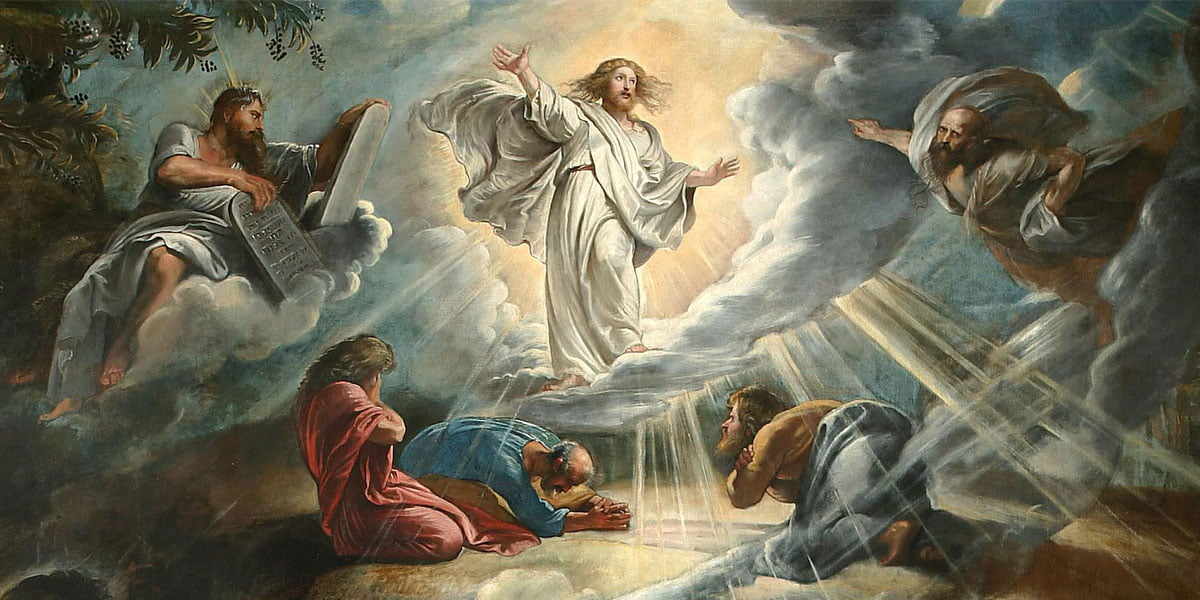
The lectionary gospel reading for the last Sunday before Lent in Year A, is Matt 17.1–9, Matthew’s account of the Transfiguration. You can find video discussion of this commentary here and posted at the end.
The epistle is Peter’s account in 2 Peter 1.16–21; you can find the video discussion of that passage here and also posted at the end.
There some important things to note in relation to Matthew 17 as we think about preaching on it or hearing it preached.
All three Synoptic accounts place this immediately after Peter’s confession of Jesus at Caesarea Philippi, where Jesus then starts to talk about his betrayal and death. They seem to want us to hold these two truths together: that the Son of Man is one who is humble and obedient even to death; and yet he is also the one spoken of in Daniel 7 where he comes to the Ancient of Days and receives a kingdom that will never end. Both of these are true about Jesus, and both must be held together. This is made clear by the final saying of Jesus in the previous pericope (section):
Amen I say to you, some who are standing here will not taste death before they see the Son of Man coming in his kingdom (Mark ‘the kingdom of God come with power’) (Matt 16.28).
(Note that Matthew expresses Jesus’ words in such a way that we notice the link with Dan 7.13, in contrast to Mark, just as he does in Matt 24.30.)
All three gospels then follow this by specifying the short time period of about a week between that and the revelation on the mountain, the only place in Matthew where he is so specific about a time period. The ‘some’ makes sense when we see Jesus taking with him only his inner circle of Peter, James and John, as he does later at Gethsemane (with Andrew, they are the first to be called to follow Jesus, and named first in the list of the Twelve in Matt 10.1–4). John then talks of having ‘seen [Jesus’] glory’ (John 1.14) and 2 Peter 1.17–18 also includes testimony to this incident—which is striking, give that so much scholarship would deny that 2 Peter was actually written by Peter.
The language of ‘transfiguration’ (which derives from the Latin of the Vulgate here), is rather unhelpful. There is a ‘transformation’, but in contrast to the other incident of divine revelation from heaven at Jesus’ baptism in Matt 3, the perspective is that of the disciples, not of Jesus himself. So he Jesus takes the three and leads ‘them’ up the mountain (Matthew is much more direct that Luke in this account, and even at points more direct and dramatic than Mark), he is transformed ‘before them’ and Moses and Elijah appear ‘before them’. In fact, the whole emphasis in Matthew’s account is on the disciples (count how many times ‘they’ or ‘them’ occur). As is clear from the ending of the episode, where Jesus is alone, the point is not a change in Jesus, but a change in their understanding of who he is. The full truth will only come after his death and resurrection, but these privileged three have a foretaste, an anticipation ahead of time, which will only really make sense later.
The three Synoptics vary considerably in the exact language that they use to describe Jesus’ appearance; it is difficult to know what it would have looked like had we been there and filmed it on our iPhones, but what the gospel writers want us to know is its significance. The language Matthew uses here is that of divine presence, picking up Old Testament language of God as clothed in light (compare Ps 104.2); some manuscripts have ‘white as snow’, but the rather unusual comparison ‘white as light’ is more likely original. White clothes can be the hallmark of angelic figures and even the High Priest (compare Matt 28.3, Mark 16.5, Luke 24.4 and Rev 1.13–16 with its reuse of imagery from Dan 10.5–6) but his ‘face shining like the sun’ is an indication of divinity, both within the biblical narrative and within pagan belief.
There are striking connections with Moses’ encounter with God on Mount Sinai in Ex 24.9–18, where he ascends a mountain, with companions, there is an overshadowing cloud, and a revelation of God’s glory. But, although there are parallels here with Sinai, there are also key differences: the glory of Moses’ face was reflected glory which faded with time, but the glory of Jesus here is a revelation of who he really is, and continues even when the vision (Matt 17.9) has passed; this is not so much of a transformation as a pulling back of the ‘veil of flesh’ (Wesley) to reveal the true nature of the Son of Man. (There might be a hint of change in Jesus in the comment in Mark 9.15 that the crowd were ‘amazed’ when they saw him—but there is no equivalent comment in Matthew). The key difference, though, is that where Moses is the focus of transformation in the Sinai account, here the focus is Jesus, and he is radiant with the glory of God himself.
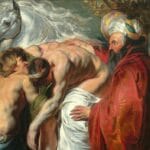
In popular readings, Moses and Elijah are often thought to represent the law and the prophets; this is hinted at in the picture at the top, the depiction by Peter Paul Rubens, who has included the tablets of the Ten Commandments with Moses. But Elijah was not one of the writing prophets, and in Jewish tradition the mysterious circumstances of Moses’ death on Mount Nebo (Deut 34.5–6) and Elijah’s being taken up to God on a chariot of fire (2 Kings 2.11) earned them the title of ‘the deathless ones’. Their presence with Jesus is an anticipation of Jesus’ own conquest of death. They also signify the rescuing of God’s people from slavery to freedom (Moses) and the call to faithfulness (Elijah); both encountered God on the mountain (Sinai/Horeb) and both experienced rejection by and suffering at the hands of God’s own people, which makes the connection between the suffering Jesus has just spoken of and the glory which he will receive.
Peter’s clumsy interjection, offering to make shelters and capture the moment, is ameliorated by Mark and Luke in their explanation that he didn’t know what to say in the context of such an unsettling experience. He appears to want the experience to persist, or perhaps to try and make his own contribution when he really should have been simply attending to what was before him. He has not yet understood that this is a drawing back of the curtain, giving him and the other two a glimpse of the heavenly reality of who Jesus really is.
They are covered with a ‘cloud full of light’ in Matthew’s unique description, and rather than ‘overshadowing’ them as in Mark and Luke, it comes with a startling suddenness marked by the ‘behold!’ (idou) which had also introduced the appearance of Moses and Elijah in verse 3. All through the story of scripture, clouds signify the presence of God (which is more easy to understand if you live in a country where the sky is blue for much of the time) and this evokes fear as well as awe (compare Ezek 1.4); ‘falling on their faces’ is a common expression of fear (see Rev 1.17) or worship and entreaty. The voice of God here echoes what was said at Jesus baptism (Matt 3.17), and this time there is no ambiguity as to whether the words are addressed to Jesus or to those watching—the audience of the three disciples are commanded or invited to listen to him. Jesus is not simply one like Moses or Elijah; he far transcends them as the Son of the Living God, the one in whom we encounter God’s own presence and glory. The words also echo Is 42.1, making again the connection between suffering and glory.
Jesus’ final action—unique to Matthew—is that Jesus ‘comes to them’, touches them, and commands them ‘Get up—do not be afraid’. Only here and at his final meeting with them in Galilee (Matt 28.18) is this intensive form of the verb (proserchomai) used of Jesus; in all other occurrences it is other people who ‘come to’ Jesus. They are left with the memory, but otherwise only with Jesus—but his company is enough.
Luke moves on to the next episode of Jesus’ ministry, but both Matthew and Mark fill out the details of the disciples’ puzzlement. They still do not understand the significance of this vision or insight—and indeed, they will not until they have begun to make sense of Jesus’ death and resurrection. They are slowly putting together the pieces of the jigsaw puzzle of Jesus’ identity and how he is fulfilling the purposes of God. We are like those who have been given the puzzle box, with the finished picture on the outside so that we can see with hindsight where the pieces fit together.
This rather striking, unusual and numinous encounter with Jesus sits in rather stark contrast to the material either side in Matthew’s narrative. Its position in the lectionary hides that rather, though does place it adjacent to the temptations of Jesus in the desert in Matt 4.1–11, offering a different kind of contrast. But this sense of the transcendent irrupting into the mundane is an important reality of the Christian faith. Paul talks of the ‘transformation’ that is effected by God as we continually offer our lives as ‘living sacrifices’ in Rom 12.1–2. Alluding to Sinai, but also connecting with some of the ideas and imagery here, Paul talks of our transformation as we see the transformed face of Jesus:
And we all, with unveiled face, beholding the glory of the Lord, are being transformed into the same image from one degree of glory to another. For this comes from the Lord who is the Spirit. (2 Cor 3.18)
Paul goes on to contrast this spiritual truth with the mundane realities of life by talking about ‘having this treasure in jars of clay’ (2 Cor 4.7).
A little while ago, our church small group were talking about the work of the Holy Spirit; we watched the Bible Project video on the Holy Spirit, and for Pentecost they portray figures as both receiving flames but becoming lit up by them, so they themselves are shining. One member of the group was excited by this as a vivid depiction of what Spirit does, and as she described it her face did indeed light up! Others talked about the transformation that they had seen when friends came to faith. Despite the dominance of materialism, our culture is fascinated by the supernatural, the numinous and the transcendent—though we are often reluctant to talk of our experiences in this area.
The whole theme of the Book of Revelation is that the events we would otherwise understand as mundane and of this world are actually the working out of a cosmic spiritual battle, and that numinous and ‘supernatural’ experiences are part and parcel of this.
In any relationship, it takes time to understand and get to know someone, and even with people we know well, there are times when we gain particular insight into their character by something they do or say which gives us fresh insight into who they are. This seems to be how the Transfiguration functions for the three disciples, and offers key insight into who Jesus is. Is it an insight we have yet gained for ourselves? And is it one which we are living out as his continuously transformed disciples?
Join James and Ian discussing this here, and below the discussion of 2 Peter 1’s complementary account:
 Buy me a Coffee











‘The working out of a cosmic spiritual battle’ is mentioned — and of course in Jewish tradition the descent of the ‘sons of God’ (Genesis 6:1-4) occurred on Mount Hermon and many, despite Christian tradition, see that is the most obvious location of the transfiguration.
Thus, as the ‘sons of God’ (i.e. fallen angels, ‘gods’ in biblical Hebrew) produced incarnate offspring via human women, so God produced an incarnate son of the Most High God (as the demon notes in Mark 5:7) via Mary who displayed his glory on Mount Hermon — taking the battle directly back to the source of the problem — or ‘Reversing Hermon’ as Michael Heiser would say.
Heiser, Michael S. Reversing Hermon: Enoch, the Watchers and the Forgotten Mission of Jesus Christ. Crane, MO: Defender, 2017.
It is a side note, but 2 Kings 2 does not say that Elijah was taken up to God in a chariot of fire. The chariots of fire and horses of fire separated Elisha from Elijah. Elijah ascended in a wirlwind or tempest into the heavens. The fifty sons of the prophets who observed this assumed that Elijah would come down somewhere, and so looked for him, but without success. Also, in 2 Chron 21:12 we find that “Elijah, the prophet” wrote a letter to Jehoram, which must be after the time of 2 Kings 2: Elijah coming out of retirement?
A letter from heaven.
It is interesting to note the sequels of the occasions when God affirmed his Son.
On both occasions Jesus is led into battles with the demonic powers.
Here an afflicted boy and an impotent church.
(1) An Impotent Church
Here, surely, in the Holy Spirit’s thought in giving these details, is the suggestion of an impotent church in the presence of this demon-driven humanity on the plain. It is representative of a condition in this world and in humanity. Would it be going too far to say that the description of this boy’s trouble and how it affected him can be seen in counterpart in the world today?
The world is under the domination of a power with which it cannot cope; a driving force, driving toward destruction; always driving toward self-destruction. It cannot help it; it is mastered by an evil power in this universe, driving, dominating, frustrating every effort; and in this scene of humanity’s helplessness and need, a Church that does not know what to do with it, unable to cope.
That situation can be found in ten thousand things. We are all up against situations with which we cannot cope.
Perhaps in your assembly, perhaps in your own family, perhaps in your own self, you meet with forces that are too much, driving; and it is always in the direction of self-destruction, of evil, of harm, of hurt, of injury; toward the fire and the water, to destroy and to quench. That is a good description of the evil work of the evil one in human life, and we have this small representation of it in this boy.
Without indulging in unworthy criticism, and taking account of all the noble sacrifice and service and labour and toil of the servants of the Lord, we have, nevertheless, to say that the Lord’s people, very largely and in a great many things, are impotent in the presence of these forces. The evil powers are holding the ground; they are defeating and defying every effort.
It is quite patent that those nine disciples had made an effort. ‘Why could not we cast it out?’ They had evidently tried and failed. Their effort and labour was for nought, and the enemy was laughing at them, holding his ground, while no doubt the critical world around was very pleased that these disciples were such poor expressions of their Lord, letting Him down like this.
What is the issue of the Transfiguration? Surely it is this, that there must be brought upon these situations an impact of the exalted and glorified Christ. It is a question of impact!
When I use that word, I am quite sure you will say, Yes, that is what we need: that is what the Church needs; that is what local companies need; that is what I need in my own life – an impact upon situations, upon places. This is what happened later, did it not? These men who had come to understand the meaning of the Transfiguration; these men whose eyes had seen the King – Jesus, perfected, glorified, exalted, attested by Heaven – men who had seen Him thus, went everywhere; and what an impact! Rarely, if ever, did they fail to register on this earth, in the kingdom of Satan.
The preaching of the Gospel of Peter and others was
“we made known unto you the power and coming of our Lord Jesus Christ, but were eyewitnesses of his majesty.
“We were eyewitnesses of His majesty” – His majesty. Is not the need for the impact of the majesty of the Lord Jesus upon this earth? It should be”.
[austin-sparks.net/english/books/men_whose_eyes_have_seen_the_king.html/ Ch.1
What would happen if we preached the same gospel as Peter in the same way?
Solution seekers might benefit?
Solutions Part 2
17:21 “Howbeit this kind goeth not out but by prayer and fasting.”
this kind of devils has a disposition especially opposed to, and reducible by, prayer and fasting.
The disciples were not accustomed to fasting (see ch. Matthew 9:14); and they appear to have been somewhat sell-indulgent (sobrietatem … minus servare) during their Lord’s absence.
it was of an intense and unusual character. The mere word of exorcism, or the name of Jesus, spoken with little spiritual faith, could net overcome the mighty enemy.
The exorcist needed special preparation; he must inspire and augment his faith by prayer and self-discipline. Prayer invokes the aid of God, and puts one’s self unreservedly in his hands; fasting subdues the flesh, arouses the soul’s energies, brings into exercise the higher parts of man’s nature. Thus equipped, a man is open to receive power from on high, and can quell the assaults of the evil one. Matthew 17:21 [Pulpit Commentary]
AND Believe the prayer thatwe pray each week
“Thine is the Kingdom and thePower and the Glory [Majesty]
Shalom.
‘though we are often reluctant to talk of our experiences in this area.’
So Ian, what are your experiences in this area?
I wonder why Jesus chose only 3 to accompany him. Would all 12 not have benefitted from such an experience?
That’s a very interesting question.
Good article, as always. Thank you.
Elijah was taken up to heaven in a whirlwind, surely.
We should be quite shiny – Jesus said that we are the light of the world (Matt 5.14). “…our culture is fascinated by the supernatural, the numinous and the transcendent—though we are often reluctant to talk of our experiences in this area.” That’s North Europeans for you! Less reluctant in places like Africa
Who is being transfigured?
T. austin-Sparks has this:-
“We all, with unveiled face beholding as in a mirror the glory of the Lord, are transformed into the same image from glory to glory, even as from the Lord the Spirit” (or, “the Spirit which is the Lord”)
(2 Corinthians 3:18).
The link between the two passages lies in one word, unfortunately slightly obscured in translation. In the King James’ Version it is ‘are changed into the same image’; in the Revised, ‘are transformed into the same image’. The Revisers certainly have made a slight improvement on the other, and perhaps with a fine sensibility, or sense of fitness, they avoided putting the true translation, and made this slight change into ‘transformed’. The fact remains that we have the same Greek word here as that which is used to describe what happened on that Mount – ‘and He was transfigured before them.’ That is the same word exactly as is here translated alternatively ‘changed’ or ‘transformed’. The exact rendering here would be ‘are transfigured into the same image’. So that the children of God have a transfiguration, even as the Lord Jesus had. His was an event, an act; a thing, shall we say, as of a moment. We do not know how long it lasted, but it was at a definite time point.
Ours is a long process; indeed, right from the beginning of our Christian life to its climax, this is what is supposed to be going on with us: we are being ‘transfigured into the same image, from glory to glory.
Worrell New Testament has this translation :-
“But we all, with unveiled face, reflecting as a mirror the glory of the Lord, are transfigured into the same image from glory to glory, even as by the Spirit of the Lord.”