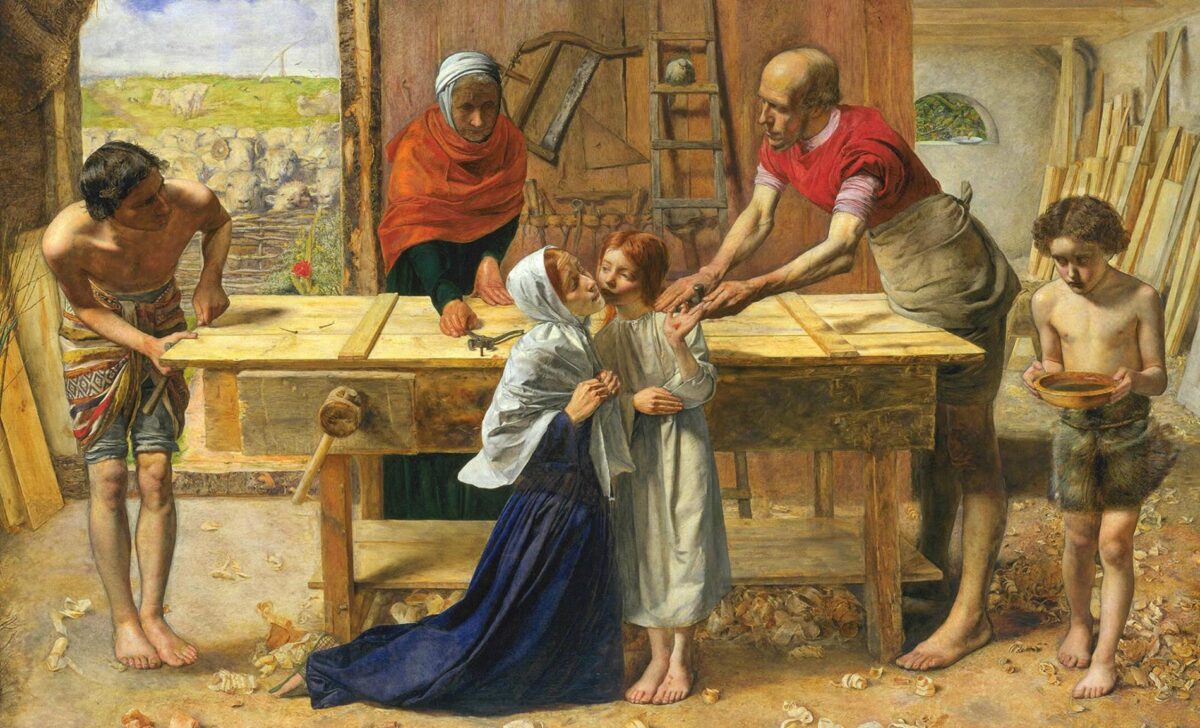
It is fascinating to see the way that traditions have grown up around the celebration of Christmas, and how many of those traditions are not merely absent from the Bible, but in fact contradict not only the content of the Bible, but the heart of its message. Somehow, where the birth narratives in Scripture are all about something amazing that God has done, these Christmas traditions become moralistic tales about what we need to do.
As a result, the central message of the incarnation (and therefore of the Christmas season), that God has come to us, and this demands a response on our part to him (of repentance and faith) ends up becoming a morality tale. Instead of responding urgently to the coming of his kingdom into our lives, we just need to try harder and make some new New Year’s resolutions. It is, in effect, a secularising of the message.
And these traditions are very hard to dislodge! Traditional understanding has a deep grip on us—and this means we are deeply resistant to hearing the real challenge of God ‘tabernacling amongst us’ in the person of Jesus.
I therefore continue to seek to debunk these mythical traditions. One of the most deeply engrained is that Jesus was, unlike most of us reading this, born as an (economically) poor boy into an (economically) poor family, so that we should feel sorry both for him and for the poor people around us. (Note that this message is addressed only to the comparatively wealthy!). This is a long read, but I hope you find it worthwhile, since it seeks to debunk not just this tradition about Christmas, but also a series of unrealistic and inattentive readings of the life of Jesus in the gospels.
Enjoy! (And if you enjoy, share it…!) And this is a reader-supported blog, so do feel free to support it using the options on the right.
One of the repeated themes of short Christmas expositions is that, in the nativity story, we see God coming to the ‘poor’, and as a result the main message of Christmas is that we should pay particular attention to the ‘poor’. I put the term in inverted commas, because in both these contexts the term ‘poor’ has a specific meaning: the distinctively materially poor. Here is a good example:
This Christmas why not ask the gift to love the poor more deeply, with an abiding and deep affection? For poverty and neediness are an intrinsic aspect of the Infancy narratives. The first Christmas was anything but charming or sentimental. It is charged with homelessness, hardship, a lack of decent resources, disregard for human life (by Herod), and the flight of the Holy Family as refugees and aliens in a foreign land…
Yes, Joseph and Mary are swept away from their resources, their family, extended family, and Joseph from his livelihood. They are swept downstream some 70 miles to the town of Bethlehem at a critical time for their family, the 9th month of Mary’s pregnancy. Could you walk 70 miles? And what if you were pregnant?
Homelessness awaited them…Off to the stinking stable, the dank cave. Poverty does stink, and leads to deep and dank places. We may sentimentalize the birth of Jesus among animals, but there was nothing cute about it…Yes, the wondrous mystery is that God so esteems poverty. But the disgrace of this remains at our door…So poverty is an overarching theme in the infancy narrative.
There are some basic errors of fact in this reflection, and lots of unwarranted suppositions, but they are very common in popular commentary. It is more like 100 miles from Nazareth to Bethlehem, and it would be about five or six days walk. But if you lived in a culture where walking was the norm, this would not seem remarkable; it is only a challenge to a sofa-bound culture like ours. Observant Jews from the region would have made this journey at least three times a year for the pilgrim festivals and there is every likelihood that Joseph and Mary would have combined the two purposes in their trip. The journey was, read in context, comparatively unremarkable.
As far as I can see, there is nothing in the gospel accounts that suggests that Mary was on the verge of giving birth when they made the trip. And Luke specifically tells us that Joseph was returning to his ancestral home, so he was mostly likely returning to extended family, not leaving it. And, of course, Jesus wasn’t born in a stinking stable.
I recently got into a little Twitter spat on this issue, with my interlocutors objecting to my comment that material poverty isn’t a particular theme of the birth narratives, and I was accused of offering a ‘middle class’ reading of the texts. I actually think that the truth is exactly the opposite, and there are three elements to my further reflection on this.
The first is that, the simple answer to the question ‘Were Joseph and Mary poor’ is ‘Yes—because 2,000 years ago everyone was poor’. One thing that the kind of reading above fails to take into account is the very different world that the narratives are set in—and this difference has grown massively in the last 50 years. It might be argued that the top 1.5% elite in the Roman Empire (on which see below) were more materially wealthy than many in the modern world, but in regard to some import measures, such as infant mortality and general health, they would still have looked ‘poor’ compared with most people in the world today.
 This graphic from the Brilliant Maps website illustrates the situation well. The accompanying article highlights some key markers which show how different life was then compared with now; the figures are disputed and some of the calculations are out of date, but they are based on some serious research.
What a difference 2,000 years makes. The map above shows the GDP per capita in 14AD of the various provinces of the Roman Empire in 1990 PPP Dollars. On average, the GDP per capita across the whole Empire, was only $570.
This would make the average Roman in 14AD poorer than the average citizen of every single one of the world’s countries in 2015…
According to the World Bank, the Democratic Republic of the Congo is currently the world’s poorest nation with GDP per capita in constant 1990 PPP dollars of $766 in 2012. This makes today’s average Congolese citizen about 34% richer than the average Roman in 14AD.
Life Expectancy in the Roman Empire has been estimated to have been as low as 25 years, due in part to extremely high infant mortality rates that might have been somewhere between 15-35%. Today, Sierra Leone has the world’s lowest life expectancy at 38 years and Afghanistan has the the worst infant mortality rate of somewhere between 14-19%.
 Interestingly, the yawning chasm between the ancient and the contemporary world has only opened up relatively recently. The major impetus to the growth of wealth (and health) first in the West and then globally happened with the industrial revolution. There was a significant increase in the rate of GDP growth after the Second World War, and then a dramatic acceleration following the spread of Neo-liberal economics, where growth was based on borrowing rather than production, from the 1980s. We are dramatically further from the social and economic context of the first century than we were even in the 1960s. (The original of this graphic is interactive, so that you can see the exact years of particular growth and what specific GDP values were. Watching it as an animated unfolding video is particularly sobering.)
What was the reason for this comparative poverty for all?
The Roman world was pre-industrial. Its economy was fundamentally based in agriculture, and its population was largely rural. In modern terminology ‘the Roman economy was underdeveloped’.10 Life expectancy was low (life expectancy at birth was somewhere between twenty and thirty and probably closer to twenty).11 Nutritional deficiencies were widespread.12 But in none of these features was the Roman world clearly distinct from the Hellenistic world or from the world of the archaic and classical Greek city-state.
Poverty in this pre-industrial world was largely determined by access to land.13 Those who owned, or were able to secure the rental of, land could secure their subsistence provided that the area of land at their disposal was large enough, and the climatic conditions favourable enough. How large the plot of land needed to be has been much debated: it is clear that the productivity of land is directly related to the labour put into it – gardening is more productive per unit area than farming – but also that the law of diminishing returns applies – repeatedly doubling the number of gardeners does not repeatedly double the output of the garden.14 What counts as favourable climatic conditions depends upon the nature of the land (‘the grimness of the terrain’15) and the crops grown (barley can withstand drier conditions than wheat). What it is possible or reasonable to grow, however, will often, in turn, depend upon the relationship of the farmer to the market: farming régimes that optimise the yield of the land in calorific terms may not produce the kind of food a family needs to consume. In general large landowners do better than small out of drought conditions, but how badly the small farmer fares will depend upon access to the market.16 Many people, therefore, had reason to be anxious about food, but for those who had access to land the threat of hunger was episodic, not endemic…17
Times of dearth divided communities between those who had and those who had not managed to fill their storehouses. Those compelled to pay the soaring prices of foodstuffs in the market quickly found their conditions of life deteriorating as the need to secure food caused other economic activity to contract. It was in such times that individuals were no doubt tempted to sell themselves or their children into slavery – a practice legislated against by Solon in Athens but still encountered by Augustine.21
For those who were not able-bodied, all times were times of dearth. The disabled relied on the charity of their families, their friends, and ultimately of strangers. If they exhausted local charity and moved away to seek alms from larger pools of beneficence they risked finding themselves isolated from all with whom they had affective bonds. For such people, poverty was structural.
In many ways, later yearning for a return to the classical era was romantic nonsense. In his brilliant study Bearing False Witness, Rodney Stark exposes the lie embedded in the Enlightenment terminology of the medieval period as the ‘Dark Ages’. Compared with the Roman era, this was a time of enormous technological and artistic development, in which humanity made huge strides in health and wealth. He notes in chapter 4 (pp 77–81):
- The development of technology to make use of wind and water power, where the Romans just depended on manual labour by slaves. (Note that the dismantling of Roman ideas of slavery with the growth of Christianity demanded innovative thinking.)
- Revolutions in agriculture, including the development of the three-field system which left areas fallow that then became significantly more productive.
- The invention of the heavy plough and the horse harness, which made more land productive.
- Selective plant breeding in monasteries, leading to more productive and hardier strains, thus giving higher yields. (Monasteries became centres of learning and experimentation in all sorts of ways.)
- The invention of chimneys, which allowed the heating of buildings without either letting the rain in or causing people to live in smokey interiors. (This is fascinating. Find any picture of a Roman city; what is missing? Chimneys on the roofs!)
- The development of true sailing ships which improved trade. (Although the Roman Empire depended on sea power and sea trade for its wealth, as highlighted in Rev 18.17–19, their ships were primitive compared with mediaeval sailing vessels.)
All these had a huge impact on health, wealth and life expectancy—and were accompanied by enormous strides forward both in moral thinking and in other aspects of cultural life. Compared with the Middle Ages, life in the Roman Empire was brutish and short, and much, much poorer.
This then leads to a second question: even though people in the Roman period were poor compared with anything in the modern world, they were not all equally poor, so where did Joseph, Mary and Jesus fit into the hierarchy of poverty and wealth in the Roman world?
This has actually been a subject of considerable debate amongst scholars of the New Testament for some time, though not much of that debate has filtered through to popular discussion. The main protagonists include Steven Friesen, who is a Mennonite and a particular scholar of the Book of Revelation, Bruce Longenecker, who has written much on aspects of material culture, Peter Oakes from Manchester, and Roland Deines, a German scholar who was for several years based here in Nottingham.
Longenecker gives a good overview of the debate in chapter 3 of his 2010 volume of essays, Remember the Poor. His concern is to offer, in dialogue with others, a model for ‘scaling wealth and poverty’ which moves beyond a simplistic binary of ‘rich v poor’ that is based on actual evidence. He cites Steven Friesen’s ‘Poverty Scale’ published in 2004, which gives a helpful delineation of different socio-economic groups:

After some discussion, Longenecker offers this revised scale for urban dwellers in the Empire, switching to the language of ‘Economic Scale’:

There are a number of things to note about this—and of course the arguments about the research evidence are complex. Slaves are not included here as a separate group; they have been estimate to compromise between 15% and 40% of the population of the Empire at different times, but their wealth and welfare depended entirely on the household of which they were a part.
But there are two key things worth noting. First, although it has often been said ‘There was no middle class in the ancient world’, that is certainly true, both in terms of Marxist theories of class identity, and in term of the development of a post-industrial professional, non-manual, comparatively wealthy working group. However, as Longenecker points out (p 56) this is often taken to mean that there were no middling economic groups whose wealth sat between the elites and the ‘poor’—and this is not the case.
It also appears, from the texts of the NT, that many of Jesus’ followers belonged to these middling groups, both in the gospel accounts and later in the first and second centuries. When Mark tells us that James and John leave their father Zebedee ‘in the boat with the hired men’ (Mark 1.20) he puts them squarely in ES4. And as a tekton, a general builder (Matt 13.55, Mark 6.3), working with stone and wood (though not metal), it is more than likely that Joseph (and therefore Jesus) was in ES4 or ES5, so in economic terms above either 55% or 82% of the population not including slaves, across the Empire as a whole.
Roland Deines has a long and detailed consideration of these issues in his chapter ‘God and Mammon’ in the German volume Anthropologie und Ethik im Frühjudentum und im Neuen Testament (Anthropology and Ethics in Early Judaism and the New Testament) (Tübingen: Mohr Siebeck, 2014). After noting the problems with simplistic claims that ‘Jesus associated with the poor’, he notes the complexities even with the kinds of economic scales proposed by Longenecker and others, particular in the context of rural Galilee. Nevertheless, there is plenty of evidence in the gospels that Jesus’ followers often belonged to this economic middle:
When Jesus commissioned the Twelve to spread the message of the kingdom of God he required them to go without provisions of any kind: according to Matthew and Luke they were not allowed a staff, a purse or any money, nor shoes (only Matthew) nor a second tunic, whereas in Mark the restrictions are less rigid; here Jesus allows them a staff and sandals (Mark 6:8f. par. Matt 10:9f.; Luke 9:3, cf. 10:4; 22:35). The point here is that such requirements only make sense if the disciples were able to provide themselves with these things; in other words, if they had more than one tunic etc. From Luke 22:36 it becomes clear that this requirement was not seen as a lasting one but as a symbolic one for this specific commissioning…
According to John 12:6; 13:29 the disciples had a shared purse which was administered by Judas Iscariot, which means that Jesus had money with him when he was on the way. (The possession of money is also presupposed in the reply of the disciples about buying food: Mark 6:37 par. Matt 14:15; Luke 9:13.) Although only mentioned by John, it is confirmed by Luke 8:2f. where three women out of many, Mary Magdalene, Joanna and Salome, were named who provided for Jesus and his disciples out of their means (cf. also Mark 15:40f.).
There is more evidence for this position between the rich and the very poor throughout the Gospels, and even a casual look at the people Jesus is associating with reveals that they are not the “destitute” in economic terms but people with at least some means and not bound in a daily struggle for survival, with some even having a certain surplus they can spend on things other than their own immediate subsistence.
- Simon Peter owns a house (Mark 1:29 par. Matt 8:14; Luke 4:38) and a boat including fishing implements (Mark 1:16)…
- Zebedee, the father of two of the disciples, also has a boat and even employs day-labourers (Mark 1:20); Jesus calls only the sons, not these hirelings, by the way. And in Luke 17:7, Jesus asks a non-specified audience what to say to a servant when he returns from the field to the house (Τίς δὲ ἐξ ὑμῶν δοῦλον ἔχων…). Even if this is merely an illustration for a teaching of Jesus and should not be read as a matter of fact, it is nevertheless worth recognizing that it is formulated from the perspective of the one who has a servant.
- A similar picture emerges from the wider circle of disciples, like the many women who supported Jesus and the Twelve with their money (Luke 8:2f.); Joseph of Arimathea (Mark 15:43, 46 par. Luke 23:50f., 53, Matt 27:57, 59f.; John 19:38, 40f.); and Nicodemus (John 3:1; 19:39).
- Levi-Matthew, the tax-collector (Mark 2:13–17 par. Matt 9:9–13; Luke 5:27–32) is able to invite many into his house, which points to a certain standard of living, even if one should not assume that all tax-collectors are wealthy just because of their profession… (there follows two more pages of examples)
In conclusion, Jesus is not addressing directly the very rich nor the very poor (in economic terms). The really rich and the destitute are actually – with some notable exceptions – rather absent as real persons. Instead, they function as types against which the followers of Jesus have to learn how to follow him with regard to their possessions (pp 350–354).
All this makes perfect sense when you think about it; most of us find the teaching of Jesus relevant, engaging and practical. If he were primarily addressing either the rich elite or the destitute poor, then we would have more trouble making sense of it.
 There are three qualifications to add to the above comments. First (as Deines explores) questions of economic wealth in the ancient world did not map onto social status in a simple way. In his NIC commentary on Luke, Joel Green offers a more complex diagram (p 60) of the interrelationship between wealth and status as a preface to his discussion of the birth narrative. When Mary, in the Magnificat, talks about God raising up the humble (and hungry) and putting down the mighty from their thrones, this is not simply a reference to economic status. She is testifying the grace of God which comes to us regardless of our worth, as estimated by the values of whatever culture we live in, and in striking contrast to expectations in the ancient world.
Secondly, much is often made of the observation from Luke 2.24 that Joseph and Mary offer the sacrifice for her purification after giving birth ‘a pair of doves or two young pigeons’. This is taken as an indication that they are ‘poor’, since in Lev 12.8 this offering is the alternative to bringing a ‘lamb’, and most modern translations say ‘If she cannot afford a lamb…’. In fact, the AV of Lev 12.8 follows more literally both the Hebrew and Greek which say ‘If her hand cannot find enough for a lamb’ by rendering the phrase as ‘If she is not able to bring a lamb…’ leaving open the possibility that there might be other reasons that a lamb is not available. (There is a parallel later in Lev 14.21, where poverty is explicitly a reason for an alternative offering, but that language is not used in Lev 12.8.)
Joel Green is right to express the significance here, not that Joseph and Mary were ‘poor’, but that ‘they were not wealthy’. This fits perfectly well with them being in group ES4 or ES5 in Longenecker’s scheme above—and in fact there might have been any number of reasons why a lamb was not available. Moreover, Luke makes nothing of this issue in the narrative, omitting even the reference to this being an alternative. Rather, the repeated emphasis of the narrative is that Joseph and Mary are pious, Torah-keeping Jews, who have been at every point obedient to the word of God both in the Torah and according to the angel’s message.
[Luke] presents Jesus’ family as obedient to the Lord, and unquestionably pious…Luke highlights not what they do, but why they do it…Mary and Joseph are willing supporters of God’s aims, certifying that Jesus will operate from within God’s purpose (pp 140–141).
Thirdly, outside this there is simply no suggestion that Joseph and Mary were distinctively materially poor, or that this formed any significant part of the birth narrative. When Paul says in 2 Cor 8.9 ‘that though he was rich, yet for your sake he became poor, so that you through his poverty might become rich’, it is clear that ‘richness’ is a reference to his heavenly splendour, that ‘poverty’ is his becoming human, like us, and that in return our ‘richness’ is our inheritance in the kingdom of God. Paul is not here referring to distinctive material poverty but to our inheritance in Christ.
There is no doubt that a repeated teaching of Jesus, the New Testament, and the whole canon of Scripture is that we should care for others, and in particular care for the poor. This is found in any number of places in the Torah; it is a repeated theme of the denunciation of the people in the prophets; it is found clearly in the teaching of Jesus; it is repeated by Paul, and particularly by James. There is no question that concern for the poor is an integral part of Christian discipleship. But it is not true that distinctive material poverty is an ‘intrinsic part of the infancy narratives’.
In fact, when the birth and infancy narratives are read in this way, something rather shocking happens. God shows special favour to ‘the poor’, it is claimed, and as a result we should show special favour to the ‘poor’. This involves a two-fold move. First, the poor whom God visits are not us, and are not like us, but are quite distinct. Secondly, our charity to the poor finds its parallel in God’s beneficence, so that, in effect, we step into the role of God, whilst the poor are the benighted who benefit from our largess. It is this which is a thoroughly middle-class reading, where we take on the role of the rich and powerful who stoop in condescending grace to bestow our wealth on others.
The real story of the incarnation is quite the opposite. Joseph and Mary are not distinctive, but represent ordinary humanity, just like most of us. The only one who stoops in condescension is God, and he touches all humanity with his grace. The story is not in the first instance about anything that we should do (as if all gospels narratives were about us) but what God has done for us, and the invitation that we should receive this before anything else. We are not in the role of God; we are in the role of Joseph and Mary.
Jesus was not born in a stable, the shepherds were not despised outcasts, and Mary and Joseph were rather ordinary. Christmas is not about God coming to others, over there, for whom we ought to feel sorry, but to ordinary people like you and me. In the incarnation, Jesus embraced the poverty that every one of us experiences as a vulnerable, dependant human being. And if he came to us then, he will come to us again this year. ‘Where meek souls will receive him, still the dear Christ enters in.’
(The picture at the top is “Christ in the House of His Parents” by Sir John Everett Millais.)
 Buy me a Coffee



















And what if ‘the poor’ in the gospels is a term of art as Margaret Barker suggests – the poorest of the land being those left behind at the exile and who continue worship in Jerusalem in the ruins of the temple. She argues that these poor maintain faithfulness to the old ways of the temple long after the return from exile and creates a tension with the Judaism which develops in exile (and which comes to dominate through the editing of the Hebrew scriptures). But the spirituality and identity of ‘the poor’ can still be detected in many places in the Psalms and the Prophets – and in the New Testament, most famously in the first beatitude, but notably also in Acts.
Yes, there is certainly a sense in which the ‘am-ha-aretz’, the people of the land, are the ones who have kept faith. And there is an element of that dynamic in the contrast between the pilgrims who come to Jerusalem and cheer Jesus, and the Jerusalemites who call for his crucifixion.
But where in the gospels is Jesus identified with them? The only phrase I can think of is ‘the son of man has nowhere to lay his head’—but isn’t this connected with his itinerant ministry?
there is an element of that dynamic in the contrast between the pilgrims who come to Jerusalem and cheer Jesus, and the Jerusalemites who call for his crucifixion.
Surely it’s the same people who cheered him but then turned against him once they realised that he required them to mend their ways, rather than lead a rebellion that would kick out the Romans?
I agree that it was Jerusalem that wanted him crucified, but that is a further issue.
No, not at all. The two crowds are quite different.
Don’t you think the Palm Sunday crowds who cheered him were quickly disappointed in him? Why then did they not mount a vigorous defence of him?
Jesus identifies with ‘the poor’ throughout the gospels – the first beatitude is addressed to them, preaching to them is the first priority for Jesus – and a sign of the kingdom. Further Jesus embraces poverty in order to become an itinerant prophet/evangelist and calls his disciples to the same radical dependency on God and his people. Likewise he calls the ‘rich young ruler’ to give everything to the poor in oder to follow him. Zaccheaus seems to recognise Jesus focus on ‘the poor’ when he says ‘half my good I give to the poor’. And ‘the poor’ the first welcomed in in the parable of the wedding feast. Etc.
Yes, indeed. We do not need to make the false claim that ‘Jesus was poor’ to realise that this is important.
But note too that, especially in Luke’s gospel, the rich and pious are mention just as much as the poor and marginal. The gospel is always both/and, and not ‘either /or.
No, the first beatitude is *not* addressed to the poor. It’s addressed to the “poor in spirit” or (GNB) “those who know they are spiritually poor.” It refers to an attitude of the heart, not to economic status.
Indeed.
There is something compelling and astonishing that the new born baby Jesus was settled in a manger. I lived in Jordan where caves have been used for animals for centuries, feeding troughs carved out of the rock, and the place is a shelter with sandy comfortable floors. Who knows what building or cave it was for Jesus, but it was safe and sheltered. I found your discourse on the economic life of people in Jesus’ time made sense. I’ve often wondered how the crowds who followed him could leave their daily work or employment, and they must have felt they could choose to go away to be part of something that was too important to miss. As we worship tonight and tomorrow, I hope the wonder of Christ coming to us hits us again with gratitude and awe.
Thanks—how interesting.
I think we struggle just with the translation into the first century. I was amazed to discover that fact about the poverty of the first century generally in comparison with our modern wealth.
Isn’t Leviticus 12:8 “If her hand is not able to bring a lamb then she may bring two tutledoves”? Your translation ‘enough’ made me ask ‘enough what?’ For what reasons might she be unable to bring a lamb, though?
Perhaps being poor is one of them. But Luke does not focus on that. His point here is that they are pious, observant, Jews.
If you won’t suggest an alternative reason, doesn’t that rather make the case for poverty? We know that Joseph and Mary were persons of strong faith who would not withhold from the Lord.
The obvious reason is that it is the wrong time of year. Lambs are born in spring.
The term ‘lamb’ in Hebrew means a young sheep (or goat). In Lev 12:6 the lamb is stipulated to be a year old, but one may doubt that it means exactly a year old, even supposing we knew the time when Mary gave birth. The offering is to made after completion of 40 days of purifying – but again, this may not mean the offering is to be made exactly 40 days after the boy was born.
Isn’t this too strong of an either/or? Yes, he emphasizes piety, but it’s piety of the poor (and his opening beatitude surely says something). Ian, I find the post to be overcooking one side of the evidence. Those charts of Friesen, Longenecker, and Downs — not to ignore the older studies — reveal a widespread life of living at the level of sustenance. One bad year, one bad crop, one bad business year, et al, could make life even more difficult. The studies of Keddie and Jensen matter here because they defeat the line of J Reed and D Crossan, but they don’t deny the realities of poverty.
Dear Scot—thanks so much for commenting!
Yes, I entirely agree: first century life was indeed very precarious—but it was so for almost everyone. Only the tiny elites were immune from this. That is the point I make right from the get-go: almost everyone in the first century was poorer than the poorest in our world today.
What I am seeking to counter is the claim that ‘Jesus was born as the poorest of the poor’, which is manifestly not true. The fact that he was not born a slave already lifts him above a sizeable chunk of the population. And even if his context is at the bottom end of ES5, then about 50% of the remaining population are poorer.
There are two issues here. First, liberal theology appears to need this claim to shape its ethic. We don’t. We need to listen to the teaching of Jesus himself, and the teaching of the Old Testament. That is enough for a mandate to care for the poor.
Secondly, liberal theology, and now Black Theology, needs to make the incarnation about a (Marxist) argument for liberation from oppression. The gospels focus on Jesus recapitulating the story of Israel, and Jesus coming to save us from our sins. When we embrace the first, we lose the second.
See my article on Black Theology here: https://www.psephizo.com/life-ministry/was-jesus-black/
The KJV is literal word for word (apart from reversing verb and subject). There is the little word d-y (Strong’s H1767) which means something like ‘sufficiency’. The same phrase is found in Lev 5:7 and Lev 25:28.
The LXX has the word ἱκανὸν – ‘sufficient’.
The very poor would be unlikely to be in a position to spread the faith. That is presumably one reason why Jesus and the Apostles didn’t focus on them – but he repeatedly encouraged charity to them, which presupposes a little surplus. Interesting!
Debt financing might be OK in the short term but it is contrary to Mosaic finance and likely to lead to a huge crash eventually. ‘Neither a borrower nor a lender be’ as Shakespeare wisely put it. including to/from the financial system, aka mammon.
The contrast between the Synagogue [The term Synagogue is of Greek origin (synagein, “to bring together”) and means “a place of assembly.” And the Ecclesia (or ekklesia) means an “assembly” or “called-out gathering,” originating in ancient Greece as the citizen Assembly of a city-state] and those “called out” seems striking.
Along with “The synagogue of Satan” mentioned in REV. (2:9, 3:9), Spiritual Persecutors: The term identifies those who falsely claim Jewish [ or Christian identity?] but actively harm the Christian community.
: It represents spiritual corruption and deviation from God’s path, not just a physical place.
It’s a metaphor for a deceptive, evil-aligned group that masquerades as righteous, particularly within early Christian-Jewish tensions, rather than a literal synagogue of devil-worshippers, according to scholarly consensus
Not from the elite theological centre but from the poorer [less?] educated poor is the phenomenal impact of the ecclesia, a Judaeo-Christian Body; often appearing as a remnant, a rump ,small, marginalized and ignored but through whom the Wisdom of God will be made manifest to the glory of His Name and Christ being “admired in all them that believe”. Mat 5:3 Blessed are the poor in spirit: for theirs is the kingdom of heaven
Along with ministering to the temporal needs of the poor an invitation to partake of the riches of/in Christ would be
a double portion blessing on their lives. Will Christ be admired in us? Time will tell. Shalom.
Have just returned from our Christingle service – What a Holy moment!
May God bless all with the Holy Dew of Heaven and fill you with all Joy
and Peace through believing and the fragrance of Christ in the coming days, Shalom
I have not finished reading your essay yet, Ian, but I want to make this one point while it is in my mind. I disagree about Zebedee and sons. Fishermen in the ancient world, were notoriously poor, partly because it was seasonal work, partly because the price of fish was controlled by the middlemen who sold to the public. There was a standard size of fishing boat on the lake of Galilee, requiring a crew of five. Zebecee‘s hired men would be two or at most three. They would probably be paid with a share of each day’s catch. I doubt if the family had even a moderate surplus. I don’t think having a house and the tools of your trade – boat and fishing implements – would put you higher than Es5. Perhaps only ES6.
Richard ,
That is interesting- I recall watching a lecture you gave at Otago University in New Zealand in which you asserted that fishermen were very poor (even working naked IIRC) but I don’t recall you saying why you thought fishermen were so poor.
Are there contemporary accounts of the poverty of fishermen?
They weren’t naked because they were poor but because they would be in and out of the water a lot, fixing nets etc. (Recall that everyone swam naked until the 19th century.)
There are certainly references to fishermen being very poor, but i would have to look up the evidence. It should be in my chapter on the Galilean fishing industry in the book I edited about Magdala.
My Burns lectures in Otago were meant to become a biography of James and John, which I still hope to write.
An interesting detail is that the famous boats they dug out of the mud on the shore of lake Galilee is just the remains of a boat that had been repaired and repaired until it could no longer be. They didn’t buy a new boat until they absolutely had to.
Borg and Crossan explore this in, if memory seves, THE GREATEST PRAYER
My understanding when I visited Nof Ginnosar (the ‘Jesus boat’) is that the repeated repairs were due to the shortage of wood, not poverty.
Houses excavated in Chorazin I remember having basalt roof beams because this was cheaper and easier than obtaining wood.
Thank you very much Richard.
I take those points seriously, but also note a. that Galilee appeared to have good fish stocks, and b. that they were located on a busy trade route. Would they depend on middlemen for sales?
But also note that, were they at the bottom end of ES5, they would still be better off than around half the population—before we even consider the status of slaves.
I think the mapping of contemporary scales of poverty against ancient is notoriously difficult. But the modern claim that Jesus came to ‘the poorest of the poor’ is usually based on a trivial comparison between the Jesus of the first century and modern, wealthy, middle class expectations.
I still want to go back my first observation here: in the first century, almost everyone was dirt poor by modern standards.
I could go on and on about this! Much of the trade crossed the lake tonMagdalw, which had literally hundreds of fishing boats supplying the salting industry. The reason fishermen had to rely on middlemen is that typically they fished all night, it was exhausting work, they hadn’t the time or energy to also market their catch in the villages. It’s really important to try to think ourselves into the real life of a fisherman.
With hundreds of boats on the lake I think they may have been over-fishing it. When I told a Galilean fisherman how the disciples were out all night without catching anything, he said they couldn’t have been very good fishermen or they would have known where to fish. I assume that they did, but maybe stocks were not what they used to be.
I don’t have a theological axe to grind on this. I’m just trying to dispel the ignorant ideas people have, like John Robinson’s idea that Zebedee supplied fish to the high priest”s household. For one thing, fresh fish transported that far would not be fit to eat. Jerusalem’s fish came from the Mediterranean and maybe the Jordan.
Thanks. I agree. This is why the growth in the study of the material culture of the time is such an important area now.
On Luke’s infancy narrative, I think you will agree that shepherds (looking after other people’s sheep) were low down the economic scale. Is it not significant that the message of Jesus’s birth comes first to them? This seems coherent with the theme of reversal of status that the Magnificat takes up from the OT, including feeding the starving and leaving rich hungry.
A significant number of the really destitute were those whose disabilities meant they could not earn a living and they had to beg. Quite a lot of these appear as individuals in the Gospels, including one who has a name: Bartimaeus. Such people never appear in ancient biographies and histories. The contempt with which they were treated in Greco-Roman society renders them invisible in its literature. Jesus encounters individuals from every social level (Nicodemus was probably as rich as anyone in Jewish Palestine) but it is significant that so many are on the bottom level.
.
Sorry, the first seven words of that comment should be deleted! They strayed there from another place.
edited.
Well, the good news was announced to the ‘poor’ shepherds in Luke—but also to the ‘religious elite’ priest Zechariah, young but pious Mary, and wealthy and powerful Herod in Matthew.
Zechariah was not a high priest, just an ordinary priest doing his two weeks per year of service in the temple, as all priests did. (That’s why Luke names his ‘course’. The 24 courses took turns to serve in the temple.)
His economic status way below the chief priests. He lived on tithes.
Herod only heard because the magi mistakenly thought the new king would be found in a palace.’
Yes, of course; corrected. But Luke makes a point of including the revelation of Jesus to the religious and pious.
And we must surely assume that it was God’s intention that Herod heard…?
Yes, Luke sets the birth story among people of exemplary OT-style piety, people awaiting the Messiah (Simeon and Anna too). Is anyone denying that?
Oh yes, I think many popular readers (including bishops) deny that. ‘Jesus only goes to those on the margins’, and ‘you will find what God is doing outside the church’ are regular liberal mantras. They are repeated in every session of General Synod, and usually by citing Jesus’ meal sharing with ‘sinners’.
More on fishermen. It is noteworthy that Zebedee employed day labourers, not slaves, who would be much more expensive (they needed to be housed, fed and clothed all the year round). It is a pity that Friesen’s scale does not tell us at what level we might expect people to have owned slaves. I woild guess many people at ES4 did.
That Peter “owned” a house (do we really know that he himself owned it?) tells us only that he is standard of living was above ES7. In a place like Capernaum people built their houses themselves, using materials from the locality available free or cheap, helped by friends and neighbours. This is what happened in rural communities in most places before modern times. When a house was no more than walls and roof, everyone knew how to build one. Houses passed down in families. Once you had a house, it cost nothing to live in it. Peter and Andrew had moved from Bethsaida, and Peter may well have been living in his wife’s family home (we know his mother0inlaw did the cooking). Andrew probably lived there too, maybe with a wife
One house that evidently belonged to a dishing family (a lot of fishing gear was fund in one room) was excavated in Magdala (where there were many fishing families). It is of poor quality, at the lowest level of the three sorts of houses found there (and elsewhere in Galilee) There is some reason to think it may also have been a bakery. Maybe the men in the family fished and the women baked for sale. Both trades were needed to maintain a fairly large family.
The only people who did not live in some sort of house were some f those in ES7. They were characterized by two features: they had no means of earning a living an they were homeless. This sheds light on one saying of Jesus: “Foxes have holes …. but the Son of Man has nowhere to lay his head.” “Son of Man” Key statements of Jesus about his mission and destiny sayings are. Evidently he thought it integral to his mission that he should be homeless. Though he and his disciples had had homes and families, they had chosen homelessness, the condition of the very poo. Though sometimes stayed with sympathetic hosts (like the Bethany family) they often slept rough. They depended entirely on others for economic support. This was not incidental but apparently a necessary part of Jesus’s mission.
When Paul says that “though he was rich, yet for your sake he became poor,” he may have mind, not just the poverty of the human condition compared with the divine life in glory, but the condition of voluntary homelessness that Jesus undertook. Just as in Philippians 2 Jesus humbles himself even to death on a cross, the death characteristic of a slave, so here he humbles himself even to the homelessness that was characteristic of the very poor.
Interesting comments – including the idea that some Jews in Judaea owned slaves. Do we know that from contemporary documents? My surprise, not having thought about it before, comes from assuming that this ceased to be the case following the Babylonian Exile, when all the exiles were enslaved and those who returned to the land decades later were manumitted free men. In those circumstances was not slave-ownership a thing of the past? (Hence John 8:33?)
My understanding is that they did, but I do not know how their treatment compared with the treatment in the wide Roman world.
See links here: https://en.wikipedia.org/wiki/Jewish_views_on_slavery#Talmudic_era
Thanks again Richard.
On Paul’s saying in 2 Cor 8, Paul specifically notes that his poverty enriches us. I am not quite sure how this could be a reference to economic poverty…?
But he didn’t become spiritually poor so that we might become spiritually rich. I think Paul may mean Jesus became homeless and dependent on charity to survive, in order to spread the good news that makes us spiritually rich. Paul is after all embarking on a very economic argument here. Both here and in Phil 2 Jesus humbles himself in starkly material terms. In neither case is it a case of the economic circumstances he was born into, but of the course of life he undertook in obedience to his mission.
OK, Jesus embraced perhaps all aspects of Poverty and imagination can
pursue even more characteristics of the Historical Jesus and temporal ideas of what social Justice might look like.
Jesus did not come to change the world as He said “The Poor you aways have with you and you may do them good when you will but Me you do not have always with you
When she poured this perfume on My body, she did it to prepare Me for burial. 13I assure you and most solemnly say to you, wherever this gospel [of salvation] is preached in the whole world, what this woman has done will also be told in memory of her [for her act of love and devotion].”
At this time of year perhaps it would be apposite to think of the vast riches which His glorified life pours forth from another country, city and kingdom for all rich and poor, He having satisfied the more important Justice of God.
The riches of Christ are the boundless, inexhaustible spiritual blessings, grace, and inheritance believers receive through Him, encompassing forgiveness, eternal life, adoption as children of God, wisdom, peace, power, and a deep, personal relationship with God, all available through faith and revealed in the Gospel. They are “unsearchable” because they are beyond human comprehension, endless, and continually revealing more as one draws closer to Him. These riches are not earthly wealth but profound spiritual realities available to everyone who believes, uniting Jews and Gentiles into one body in Christ. There is an amazing fragrance that emanates from Christ the Crucified and those crucified with him.
Shalom
St.Paul says of his preaching
, “Unto me, who am less than the least of all saints, is this grace given, that I should preach among the Gentiles the unsearchable riches of Christ.” Eph 3:8
Even the poorest can, if enriched by /in Christ can preach the Gospel.
There are riches of justification, riches of sanctification, riches of consolation, and riches of glorification in Christ. All the riches of Christ are unsearchable riches. Shalom.
Jesus humbled himself and takes onto himself, the poverty and bankruptcy and ugliness of our sin to bestow and beautify us with his riches and glory.
Our sin is the he only contribution (after Wm Temple) to the enterprise of our joinder, union with Him in eternity.
Do we desire Jesus above all else and surrender all to Him?
I know it is Christmas and most clergy are probably horizontal with exhaustion, but I think it is a pity that this excellent essay of Ian’s, which contains a lot of important background material for understanding the gospels, has drawn so little interest, judging by the comments.
I’d sugest the horizontal tiredness is, understandably, the dominant reason. I’m retired (stipend speaking) but read it… and it fed into my Christmas day sermon
Dear Richard
Thanks for your interesting comments above, which I will respond to.
Yes, people are busy around this time of year. But more than that, people are very resistant to having their fond traditions challenged. In particular, amongst our leaders in the C of E, it is just too tempting to reach for a left-liberal reading of the tradition, even though it is not supported either by historical evidence or the text of Scripture!
So I keep plugging away! I am encouraging by the increasing number who now say publicly, ‘Jesus was not born in a stable, but in an ordinary home’. So perhaps there is some encouragement.
Are not most clergy on the horizontal level. Richard? Rarely vertical in their biblical theology. Maybe the paucity of biblical theological hermeneutics, which renders the necessity for our host’s essay, ranging through ecomonics, demographics, politics , ( including slavery which so exercised commentators on a previous blog thread) to oppose some social dogmas of today, which result in social sermons on the horizontal level, not centering on the person of Jesus, the incarnation and its necessity for all peoples, all nations, all demographics.
Here, from the opening introduction, is a robust assessment by Dorothy L Sayers in her address to leadership of an adult discipleship progamme in the CoE:
https://www.thegospelcoalition.org/reviews/nicene-creed-books/
Or, what remains is Moralistic Therapeutic Deism of deconstructionism.
Happy Christmas Geoff…
Might I , gently, suggest a New Year resolution about generalisations…
“Are not most clergy on the horizontal level. ”
Not necessary and entirely only your experience… at most
Perhaps more than less?
Hello Ian,
Yours is a generalisation and conclusion from a question asked that I’ll forego, thanks.
Your perceived umbridge may be seen as a vicarious generalisation on behalf of how many clergy?
Our host’s first three paragraphs set the scene for some generalsed conclusions, to which there are exceptions in my experience, inside and outside the CoE.
How far has the CoE progressed and in which direction from Dorothy Sayer’s day.
What is highlighted is that there is scope for research into CoE Christmas service content, particularly centering on sermons.
May our rest be found in Jesus, Prince of Peace.
Yours in Christ, Geoff
At this time of remembrance of the giving of the most awesome
Gift ever given to mankind. a discussion of the possible/probable
Socio-economic group classifications of Jesus and His Disciples
seems a bit too academic, perhaps a bit horizontal?
As with any gift, and this one in particular, these are days of
great thanksgivings.
“Thanks be unto God for his unspeakable gift” 2 Cor 9:15
“Whom having not seen, ye love; in whom, though now
ye see him not, yet believing, ye rejoice with joy unspeakable
and full of glory” 1 Pet 1:8
Unspeakable?
The “unspeakable gift” refers to Jesus Christ, God’s incredible
gift of salvation and grace, as so magnificent that human
words cannot fully express its depth, magnitude, or the
boundless love behind it, meaning it’s beyond description,
inexpressible, incomparable, and beyond full comprehension,
and precious beyond words..
It’s a core concept in Christianity, signifying God’s ultimate
act of love, prompting profound gratitude and generous living.
Those who have seen the great generosity of God are usually the most
sacrificial of giving, financially and of their time, doing the hidden work of church preparation etc. that most of us disdain,
the servant saints.
Perhaps the lower Socio-economic group? Shalom.
Less studying of our navels and more proclaiming
the glorious riches of Christ might result in fruitful Churches
and Church plantings as the Apostles realized. Shalom.
POSSESING THE GIFT
For a Church so vapid that God is about to spue it out of His mouth
God in His longsuffering grace offers gifts of gold, white raiment and
eye salve to His chastened Church.
To those who received of His chastening and these gracious gifts,
those who overcome by/through faith will sit with Christ
in His Throne even as He also overcame, and is set down with His Father
in his throne. The gift of elevation.
3:22 He that hath an ear, let him hear what the Spirit saith unto the churches.
Shalom.
Our host Ian is famous for his Advent reminder that Jesus was not born in a stable.
This is of course correct, but should have been no surprise to anyone who read the Old Testament with care. In the notorious story of the Levite and his concubine in Judges 19, while they are not far from Bethlehem, they are invited into the home of a kindly old man who tells them he has, in his house, hay and provender there for the Levite’s asses (v. 19). Keeping small(ish) domestic animals in your homes was obviously a very ancient practice.
I am reminded of Tony Thiselton’s work on ‘The Two Horizons’. We read (and mis-read) ancient works first through the lens of our own experience and expectations, but the more we learn, the more we adjust to the historical realities until the two horizons merge.
We need to do the same when it comes to polyvalent words like ‘ptochos’ and ‘doulos’. As Inigo Montoya says in ‘The Princess Bride’, ‘You keep using that word. I do not theenk it means what you theenk it means.’
Yes, James, I agree. But don’t we need to do the same with words like ‘in’? So the ‘meaning’ of ‘in his house’ might not be so *obvious*?
Bruce: It’s actually the preposition ‘le’ (‘to’), and my literal translation of Judges 19.21 is ‘and he brought him to his house and he fed the asses’. I misread v. 19 – it is actually the Levite speaking there, not the old man. The immediate impression I get is that they brought the asses into the house. Of course, it might be otherwise, but I have never heard of ancient Israelite houses having outhouses for animals (which could be stolen in the night) – the archaeology doesn’t suport this. Ian has also drawn attention to Luke 13.15 where Jesus says, ‘Each of you on the sabbath unties his ox or donkey from the ‘phatne’ and leads it out to give it water.’ Some versions translate ‘phatne’ as ‘stall’ but it’s the same word for ‘manger’ or ‘feeding trough’ in Luke 2, and I can’t find the meaning ‘stall’ in any of the concordances I have checked. ‘Phatne’ is from the verb ‘pateomai’, to eat.
I see the ESV translates it as ‘manger’, which I think is correct.
Of course this is not correct! Who uses the French-derivative ‘manger’ (from ‘manger’) for an animal food trough? Will we find this on Countryfile on Sunday: ‘I am just going to fill up the mangers for my cows?’
No, it is a hangover from the AV, and another example where tradition triumphs over good translation.
The correct translation is ‘food trough’ or ‘feeding box’.
Au contraire, Ian, ‘manger’ is a fine word and educated people know it means ‘feeding trough’. OK, not so many of them around these days. (Full disclosure: I used to teach French.) My point was that translating ‘phatne’ as ‘stall’ in Luke 13.15 is not right – an animal stall is not the same as a feeding trough.
I just think ‘Away in a feeding trough’ is going to catch on in next year’s carols, but I hope you are working on it now, as you have done a sterling job in demolishing the stable and demobbing the innkeeper.
‘Once in royal David’s city’ is going to need a major makeover as well, when we knock down that lowly cattle shed.
And spellcheck isn’t going to hep us, either. Imagine my discomfort one midnight service years ago when I prepared to read from the printed text (which all the congregation had), ‘and they found Mary and Joseph, and the baby lying in a manager.’
*NOT going to catch on
James, I have never in my life *ever* heard the word manger use in farming programmes in the UK. Have you?
Au contraire, Ian, ‘manger’ is a fine word and educated people know it means ‘feeding trough’. OK, not so many of them around these days. (Full disclosure: I used to teach French.) My point was that translating ‘phatne’ as ‘stall’ in Luke 13.15 is not right – an animal stall is not the same as a feeding trough.
I just think ‘Away in a feeding trough’ is going to catch on in next year’s carols, but I hope you are working on it now, as you have done a sterling job in demolishing the stable and demobbing the innkeeper.
‘Once in royal David’s city’ is going to need a major makeover as well, when we knock down that lowly cattle shed.
And spellcheck isn’t going to hep us, either. Imagine my discomfort one midnight service years ago when I prepared to read from the printed text (which all the congregation had), ‘and they found Mary and Joseph, and the baby lying in a manager.’
“James, I have never in my life *ever* heard the word manger use in farming programmes in the UK. Have you?”
I confess I never listen to such programmes – but I have heard talk of ‘farm managers’ and ‘animals with mange’ – is that close enough?
Herein lies one of the dangers in updating language: a modern steel cattle trough looks rather different from a first century manger.
Tangentially I am reminded of the kind of problems we have with the word ‘slave’ and trying to get that overlay with the way the New Testament uses ‘doulos’. As T. S. Eliot wrote in ‘Burnt Norton’,
“Words strain,
Crack and sometimes break, under the burden,
Under the tension, slip, slide, perish,
Decay with imprecision, will not stay in place,
Will not stay still.”
I think you are confusing culture with terminology. Translation is about mapping words with the closest semantic range in the two languages.
φάτνη maps to ‘food trough’ or ‘food box. There is no common term ‘manger’ use in everyday English. I really don’t think it is complicated!
Now, Ian, you don’t want to be a dog in the manger about other people’s choices in language. I’m not all that interested in ‘everyday English’, but Collin’s Dictionary, Oxford English Dictionary, and the Cambridge Dictionary all define it as ‘a long open box from which horses and cattle eat’. It looks very much like a common term in use in everyday English, if not found much on ‘Countryfile’.
https://dictionary.cambridge.org/dictionary/english/manger
Well, it is not here!
https://www.cravenherald.co.uk/news/19360729.excuse-speak-farmer-farming-terms-never-knew-didnt-know/
Ian, I once worked on a shearing gang in New Zealand and I could tell you plenty of words from that experience as well that are not listed in your link, but perhaps not for a family publication like this!
I am all for clarity in language, but I don’t think I’m ever going to call the Ark of the Covenant the ‘agreement box’ (the GNB said something like that). Indiana Jones at least saved that word for us. I think ‘manger’ is safe for a good while yet. I agree with Winston Smith in fighting the destruction of old words.
Whatever next? Using dictionaries. From descriptions, so very post modern, to a return to definitions, a starting for understanding.
Countryfile is a hotchpotch of rewilding and climate change. Or “Silo thinking” in today’s management speak.
‘Sons,’ as in Ephesians, requires an explanation, not a contemporary change, to ‘children’. ‘Sons’ is altogether deeper and richer.
Not everything benefits from a new twist, a sop to Ae. which was part of the curriculum for an earlier generation of schoolchildren.
This all feel a bit pedantic.
I think ,from Ian’s comments that Ian has a problem with the wording of the AV.
Regardes of the Version used God uses them all to reveal Himself to mortals to give light ,life, savation and sustenance.
Ian, I guess this is my last comment!
You are reacting to the extreme view (as you put it) that “Jesus ONLY those on the margins.” That view is easily refuted. But it is nevertheless plausible, i think, to say that, in his desire to reach everyone (at least within Israel), Jesus made a point of reaching out to those who were widely despised or neglected, and thus was noticed. We need a more nuanced view of this, for which the evidence of material realities in that time and place can help us, as well as comparisons with other literature. Otherwise I fear your opposition to the extreme view you cite can be understood as a bland “Jesus cared about everyone” assertion that neglects the way (in his caring about everyone) Jesus engaged with people in their various socio-economic and other situations for which the Gospels provide us with rich and abundant detail. (Note that the Gnostic gospels are completely different in this respect.) What is the point of all those different stories about very different people if they merely teach us that Jesus loves everyone?
We need to distinguish some different issues:
Jesus’s own family background
That if the disciples
The conditions that Jesus and the disciples voluntarily undertook for the sake of their ministry
The sorts of people Jesus engages with in various ways.
These cannot all be treated under the annual rubric: Jesus was not born in a stable!
Dear Richard, I would entirely agree with everything you say here! But in that sense, I suspect we move in rather different worlds. The world in which I move (in Synod, in national media stories) is full of such claims, and people do not like them being challenging, and are resistant.
I think I would be less worried if this simplistic mantra was not also heard on the lips of some of our bishops…
(And I noticed some research push back from some at the idea that Jesus was not born in a stable…!)
I wonder whether poverty might also be part of the context of John 2:1–11, the wedding at Cana. Why has the wine run out? Why are there no resources within the family to solve the problem? Is a simple miscalculation of the number of guests really the only explanation?
Some argue that the six stone jars point to a wealthy household. Yet stone vessels were often communal or inherited, and ritual purity concerns made them common in Jewish villages. Their presence tells us little about the family’s actual disposable income.
To me, it seems more likely that the family had no resources left — or perhaps even the whole village had exhausted its wine supply. What’s your view on this?
That is an interesting observation.
But
a. this is not Jesus’ family, and
b. I am not sure the theme of poverty is here, rather lack of planning—and of course shame, and
c. The point the gospel writer makes out of it does not relate to economics…