
The experience and sense of encounter with the Holy Spirit in Christian devotion is often set against the rational task of critical evaluation of the meaning of Scripture. But are these two necessarily opposed? And what happens when we bring them together?
There is a widespread view that the work of the Spirit and the work of critical study of the Bible are like oil and water—they simply don’t mix. This is reinforced from both directions. People who read the Bible devotionally often look distinctly nervous when the subject of ‘academic’ study of the Bible comes up. Where mosques and other places of worship have a rack by the entrance where you can take off your shoes and leave them outside, it feels as though for many churches there is a similar rack by the entrance where you can leave your brain as you come in. (It might be metaphorical, but it is there!) On the other hand, there are many in the academy who see ‘committed’ reading as polluting the ‘objectivity’ of the academic process.
The general nervousness about all this is sometimes expressed in relation to university courses. Christians shouldn’t study theology because it will undermine their faith. I have seen the (ironically) unthinking imposition of a liberal ‘fundamentalism’ imposed on Christian students in a very damaging way, but this is less likely today, not least because of the growth of evangelical critical thinking. In fact, it is vital that we connect head and heart in our articulation of faith, for our own wellbeing but also to be effective in an increasing sceptical and post-Christendom context—though there is still a question as to whether a university course is the right place to do this for everyone.
However, the most compelling reason for holding together the work of the Spirit and the task of critical judgement together is because this is just what the Bible does. The Spirit and judgement are brought together explicitly in John 16.8, where Jesus expounds the Spirit’s role in discerning the difference between what is holy and what is not through a process of critical discernment. (The Greek for ‘judgement’ is krisis from which we get the word ‘critical.’) We see the Spirit at work in explicit actions of judgement in Acts 5, in the (baffling to the modern ear) account of Ananias and Sapphira. And against the Corinthians’ superficial ease with judging each other, it is striking that Paul does not reject the notion of judgement as such, but reconfigures it through the lens of the work of the Spirit. Early on, in 1 Cor 2.15, Paul asserts that ‘The spiritual person makes judgements about all things’, and in context we should understand this as being ‘the person with the Spirit’ which is Paul’s definition of a follower of Jesus (1 Cor 12.3). In fact, discernment between people and the ‘spirit’ in which they are operating is one of the gifts of the Spirit (1 Cor 12.10), the word being again a compound of krineo ‘to judge’.
So why have we ended up ourselves with seeing a gulf between the ideas of judgement and discernment, a discriminating evaluation of different viewpoints on the one hand, and the work of the Spirit on the other? In part, the answer is rooted in the Enlightenment paradigm of rational enquiry that has shaped our intellectual life. Discernment is the work of the autonomous, sensing self who sits at the centre of his or her world, and needs no outside agency to help in this process. Indeed, any outside agency is just that—outside the individual, and therefore not to be trusted until sifted and evaluated by the individual.
But another reason is the way we have configured our expectations of the work of the Spirit as we read Scripture within our pietistic spirituality. As I reflect on the pattern of Bible reading I was (helpfully) inducted into, I see four strands to it:
1. Immediacy. We expect to open the Bible and immediately to hear God say something to us. Some years ago a joke was doing the rounds about someone who read the Bible by opening a page and sticking a pin in it. First he read Matt 27.5 ‘Judas went and hanged himself’ and thought that that couldn’t be right. So he did it again and read Luke 10.37 ‘Go thou and do likewise’, and was sure there was some mistake. So he did it a third time, only to read John 13.27 ‘What you are about to do, do quickly.’ The reason that this is funny is because it reflects a lot of people’s approach to how to read the Bible devotionally. We don’t expect to have to wait for an answer or to do any work in listening for it.
2. Clarity. We not only expect God to speak to us, we also expect God to speak clearly, without ambiguity. A popular Christian poster once depicted Abraham hearing God’s call and responding by asking a series of questions, each of which because a question mark that he then had to carry. At the end he has more to carry than he can cope with, and the final slogan was ‘It is hard to be a disciple with all these questions.’ The moral was clear: if you are uncertain about what God is saying, then you lack faith. A vicar of a church I used to attend had a motto: “If God asks you to jump, the only question you ask is ‘How high?”‘ I didn’t find it helpful.
3. Relevance. When God speaks, immediately and clearly, we often expect it to have a direct bearing on our world. One of the things dogging the debate about same-sex marriage is just this question: it is asserted that the Bible has nothing to say, because it does not directly address the context we are in and the questions we have. But the same is true on every issue! It is assumed that, if the Bible is not immediately relevant to our context, it has nothing to say.
4. Familiarity: For many of us, when we first came to faith and the Spirit of God breathed new life and understanding into our lives, it was a strange and wonderful thing that this God continued to speak to us through the pages of Scripture. But often an odd thing then happens. At some point or other, this becomes ‘our’ book, and we feel we know it. It is reassuring and familiar. We know what it says, and it no longer surprises us. I notice this most clearly when I am looking with people at familiar passages and pointing out that (as in the case of John 3.16) most people misunderstand what the text is actually saying.
There is a sense in which all these things are true; God does speak clearly to his people (note the plural!) and form them through the faithful reading of scripture. But I cannot help thinking that these expectations are formed as much by Romanticism (as a reaction against the aridity of rationalism) as they are by Scripture itself. And when we engage in critical study of some sort, there is a rude awakening, because we experience four quite different things:
1. Delay. Spending the best part of a decade in a theological college, where we read the Scriptures in chapel before studying them in class, was instructive. At the end of the reading, when the reader said solemnly, ‘This is the word of the Lord’ there was quite often a collective sense of wanting to respond ‘What is? In what way? And what does it even mean?’
2. Ambiguity. It is quite difficult to be confident in the clarity of God’s word to us when there are 18 possible interpretations of this particularly verse, with three main contenders who have a strong case but are mutually contradictory.
3. Distance: The more I read and study the Scriptures, the more I am clear that the biblical writers lived in a very different culture from ours, and so begin and continue with some very different assumptions about the way the world works. Of course, they share the same humanity and the same faith in God, but it is expressed in ways that are at a distance from our own world.
4. Strangeness. Richard Dawkins has got at least one thing right; the Bible is a strange book, and we should worry when we feel it is too familiar. When I was driving a lot a few years ago, I listened to a recording of John’s gospel read by David Suchet. When I had listened to chapter 6, 7 and 8 my overwhelming feeling was that this Jesus was a very strange person indeed. It might have been the context I was in, or my mood, or David Suchet’s voice—but I have a feeling that it was really something to do with John’s gospel and Jesus I found in it! There is a wonderful short essay at OnFaith explaining why it is best to categorise the Bible as fantasy literature, because it is so strange.
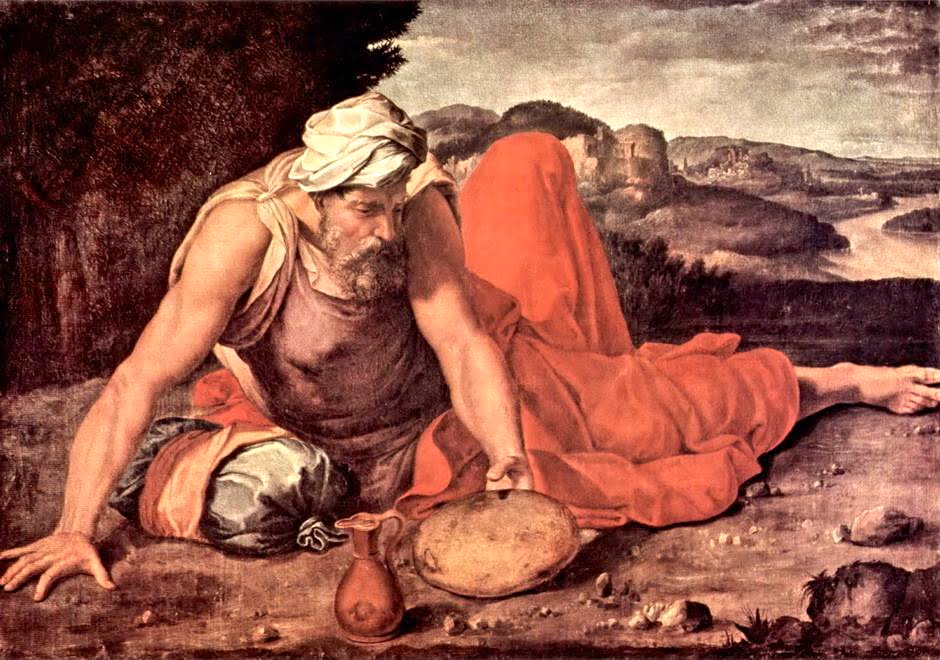 Before we try and resolve these things, we need to note one point of encouragement: these latter four have been the widespread experience of the people of God, and they are the things which prevent us domesticating God and making him in our own image. Think of Elijah on the mountainside in 1 Kings 19; if ever anyone should think that God was clear and unambiguous in what he was saying, it was Elijah, yet here he is baffled and bemused. Or think of Daniel wrestling with Jeremiah’s prophecy in Daniel 9. Or of John the Baptist trying to make sense of Jesus in Matt 11.3. Or the Council of Jerusalem wrestling with God’s new work in Acts 15. If we experience these four things in our reading of Scripture, we are in good company!
Nevertheless, there is a serious challenge in handling these pairs of tensions.
Immediacy — Delay
Clarity — Ambiguity
Relevance — Distance
Familiarity — Strangeness
There are two possible responses to this dilemma. A common one is to retreat from the right hand side, and take refuge in the left. There are multiple problems with this. For one, we deny that the dynamic on the right is present in Scripture. For another, we also have to deny that we find the dynamic on the right present in our own experience and in the experiences of others in our fellowship. To stick with the left means closing ourselves down culturally and relationally, and in the end refusing to grow and learn. We get stuck in a nostalgic moment that is frozen in time, some short while after we first came to faith.
But an equally popular response is to move to the right and abandon the left hand side. This can be found easily enough within academic theology, either amongst those of no faith or those who would have formerly described themselves as people of faith. And it is not uncommon to find this response amongst people who were told that, to be disciples, they had to remain on the left hand side, so when the dissonance became too much, they ‘popped’ over to the right. And this side, in its fullest form, is not hospitable to faith. As Paul Ricoeur highlights, criticism creates a desert, because putting the ‘self’ at the centre as the perceiving subject makes all other things the object of study, to be scrutinised and assessed rather than engaged with—to be treated with a ‘hermeneutic of suspicion’ rather than a ‘hermeneutic of retrieval’. Yet, Ricoeur goes on to say, those who wish to live authentic lives long to be ‘called again, beyond the desert of criticism.’
This kind of response is also found (it seems to me) amongst those who say ‘The evangelical/charismatic tradition was important to me in the past’ but cannot own it now. Very often the things on the left are the things that brought them to faith, but they feel that the things on the right are the ones that are bringing them maturity. This creates a real paradox, in that it appears that ‘mature’ faith does not have the power to bring others to new faith—which must be at odds with just about every thing that we read in the Bible itself.
It is, in fact, possible to live with and continue to inhabit both sides of this dilemma—but to do so requires the formation of a particular attitude, or (perhaps better) the formation of certain characteristics or qualities.
The first is patience. If ‘love is patient’ (1 Cor 13.4) and if we love God, shouldn’t we be patient with God? We usually think of an unanswered prayer as one that has not been answered instantly, rather than (for example, from ‘Heavenly Man’ Pastor Yun’s story) after five months of intense intercession. Are we prepared both to listen carefully, expecting to hear God, but also patiently, read to wait if we don’t hear immediately? Just such patient attentiveness is surely the mark of maturity here.
The second is discernment, which is perhaps the supreme gifting of the Spirit. I explored previously how ‘judgement’ was closely associated with the work of the Spirit; it must also surely be connected with the prophetic, which involves discerning what God is doing and saying, and this explains why they are linked together in 1 Cor 12.10. Discernment or judgement is only needed when there is ambiguity or a conflict of views; where there is clarity and unanimity, discernment has no function.
 The third quality needed is the perhaps surprising one of discipline. In his Grove booklet Scripture and Authority Today, Richard Bauckham talks of the need for a ‘historically disciplined imagination’ in the process of constructing meaning as we read Scripture. Since there is a distance between the context we are in and the context of the text, there is a challenge to connect the two. Meaning cannot reside in the text alone, as this leaves it at a distance from us. Neither can meaning reside in ourselves as readers, since we then make the text mean what we want it to. No, meaning must reside in the disciplined interaction between modern reader and ancient text if we are going to be genuinely open to what God is saying to us through it.
Finally, in entering the strange and often unfamiliar world of Scripture, we need the quality of wisdom. Richard Briggs suggests (in Reading the Bible Wisely) that this is the key virtue we need. There is familiarity in Scripture—in the characters and their situations we often find our own situations mirrored. But we need to be wise in this, and deep familiarity is one that has to be learnt, as we recognise that Scripture’s logic and outlook is often very different from our own.
These four things then take their place in our experiences as follows:
Immediacy — Patience — Delay
Clarity — Discernment — Ambiguity
Relevance — Discipline — Distance
Familiarity — Wisdom — Strangeness
It is clear that the work of the Spirit in these four areas is essential for our reading. (If you are in doubt of that, consider a context of Bible reading where these four qualities are absent.) But it is also clear that the Spirit’s role is not to bring additional information, or to be part of a technique, or to supply a magic answer that we would not otherwise have had access to. The role of the Spirit in us as readers must be analogous to the role of the Spirit in the first writers of Scripture—forming them, giving insight and allowing discernment, rather than dictating words.
To hold on to both sides will involve both criticism of possible meanings of the text we are reading, but also a realist commitment to discern and to act on what we find. To do this, we need to emulate Paul’s approach in 1 Cor 14.15: I will (pray/study) with the Spirit but I will (pray/study) with my mind also. And if we do so, this will be very attractive to others. People do want answers but they don’t just want simplistic answers, and answers that have been sifted and thought through will be answers that have credibility.
(Last published in 2021.)
 Buy me a Coffee












Regular criticism involves asking questions such as: how and why did this book of the Bible get written? ‘Higher’ criticism involves putting the tools of literary criticism above the authority of scripture, and leads to nonsense like JEDP – the four traditions supposedly interwoven in the Pentateuch centuries later. (I’m not going to say why it’s nonsense here – read Paul Lawrence’s fine short book “The books of Moses revisited” for that.)
The other problem is that if you come with an anti-supernatural presumption then you are going to have to deny a great deal of what scripture says, not least about the timing of the prophets relative to some events they predicted, and ultimately about the Virgin Birth, Resurrection and Ascension of Jesus Christ. At that point the maximally dishonest approach is to try to ‘re-interpret’ the text in that way. Such are liberal theologians. Of course they would lose their well-paid positions in theological colleges or universities if they wrote what they really believed in plain English. Truly they have received their reward in full.
Anthony, doesn’t ‘regular criticism’ involve asking questions like how and why did this particular _utterance_ get written? Or is the discussion here going to descend into the usual diatribe against your ‘liberal theologians’ rather than Ian’s excellent post which would be much more helpful?
It’s not a descent. They are hypocrites, and perhaps you would attempt to refute what I say if you disagree with it, or just ignore it if you prefer to engage with Ian’s other points.
The thing would be that people would have to accept the categories ‘regular criticism’ and ‘higher criticism’. But these are not categories that anyone has to accept if they think they have more precise ones. Even if it were clear enough what each of them meant. If people ask questions, then I suppose that is criticism or critical thought, but I just call it asking questions. And not only is asking questions a good thing; not only is it far better than not asking questions; but also, the more questions one asks the better, and the more one will learn.
Agreed Christopher, but I did offer a definition of higher criticism above; and I’d add that the ‘higher critics’ also bring preconceptions to their analyses, such as anti-supernaturalism.
Yes, I saw the definition. I have always seen it as a funny phrase and not paid much attention to it (a bit like ‘Critical Race Theory’, it does not do what it says on the tin). Is the idea that it puts human intellect ‘higher’ than revelation?
Perhaps it is worth remembring the very first question ever applied in what has come to be our modern discipline of Exegtical Theology
“And the eunuch answered Philip, and said, I pray thee, of whom speaketh the prophet this? of himself, or of some other man?”
Acts 8:34
That, along with the conversion and Epistles of St Paul seems to suggest the the Christological shape of the Bible is far and away the main point and should be any Christians lodestone when they attempt to understand the Good Book.
Surely we can safely assume that St Philip, almost certainly, had no access at all to what we would now call “historical context” when he opened the eyes of the Eunuch to the real meaning of Isaiah.
Not what, where, how, or when but – ‘Of whom’.
Strange that all mainstream HB scholars would not agree with Lawrence.
One could say quite a lot on this as relates to laity and priesthood.
The Academic and the Mystic , Greek wisdom and Judaeo -Christianity. Knowledge or Understanding.
Some churches have a preference for an academic centred ministry, others lean towards the Mystic, some welcome a combination of the two which might be more inclusive of all members of society; say in a University town.
Many clerical schools seem centred on the latter option with the hope that the Doctors they produce know how to cure souls and lead them on to perfection (completion, maturity).
One might hope that they might understand also
“the Law of the House”that they are called to build (edify) and their people understand (Ezekiel 43:1-12);
Typified by such as Mordecai or Paul, and of course Christ;
One a simple man in the biblical sense, and the other an accomplished “theologian” and of course the simplicity of Christ ( to be guarded in case folks are robbed of that simplicity)
As Hannah’s song of exultation
Berean Literal Bible
“He raises the poor from the dust; from the ash heap He lifts the needy to set them among princes, and the throne of glory He bestows on them. For of YHWH are the pillars of the earth, and He has set upon them the world. 1 Sam. 2 :8
For “the law of the house” explore @
https://sermonindex.net/speakers/t-austin-sparks/the-law-of-the-house-ezekiel-431-12/
For the motif of the ash-heap @
https://biblehub.com/topical/t/the_ash_heap.htm
Shalom.
Critical thinking, evaluation.
I may have missed it, but I don’t think it was defined in the article. Wikki has a helpful starting definition.
It seems to me that the staring point is to ask, what IS the Bible? That will help to establish the pre- assumptions of any teacher and student.
Geoff – well, we *could* start with the question ‘what IS the Bible?’ I’m recently through reading George Macdonald’s novel ‘Malcolm’ (George Macdonald is reasonably important – since it was through his writing that C.S. Lewis came to faith). One of the characters, Duncan (a Highlander) expresses the view that Gaelic is the holy language and Gaelic is the only appropriate language for the bible.
What, Jock? Are you now too familiar with The Bothers Karamazov?
A friend, a former RC, was a keen advocate of Macdonald, but though he may have influenced Lewis and Chesterton, and I have not read him, through those who have, I doubt that I’d follow his theological convictions.
Especially if the fragrance of the Bible is to be found in Garlic!
I’d rather stick with the theology of the real, late, George Duncan. (His book on Philippians was given to me as a new convert, by a Church of England minister. Haven’t read it since.)
Could you summarise MacDonald’s theology please? Is he a bit syncretic with paganism or is that an injustice?
Anthony – probably an injustice – I’ve read several of George Macdonald’s works and I haven’t seen any evidence that he is syncretic with paganism. He is universalist (everybody is ultimately saved, but they have the ‘bad stuff’ ripped out of them before proceeding to the heavenly kingdom) and that is what caused him serious problems.
Oh yes – another thing – I’ve read a couple of Macdonald’s ‘Silent Sermons’ which I enjoyed – and I can say with confidence that he would have failed the module on ‘how to give a sermon’ with its emphasis on the necessity of humour and engaging the audience with a wee joke to get the ball rolling.
C.S. Lewis deals with Macdonald’s universalism in the imaginary conversation with George Macdonald in ‘The Great Divorce’ (so I’d go way beyond what Christopher Shell says – Macdonald wasn’t just one of many – he was a very serious influence on Lewis not only as one of those who ‘got it’, but also on the nuts and bolts of Lewis’s theology).
Universalism is something that I might like to be true if I hadn’t encountered some very serious gratuitously nasty behaviour perpetrated against me personally about 40 years ago. If these people do not repent before they pass from this life to the next (and they haven’t done so yet) then I really don’t want to see them in the heavenly kingdom (and those who did me harm were white, straight, anglo-saxons, attending a charismatic anglican church). This is the personal experience that convinces me of the reality of Hell – and that there are people who are destined to burn there for an eternity.
One of the main problems I have with Lewis is that he seems to take the view that objection to Christianity is an intellectual objection – and that if you explain it in a good way, over a nice fire-side chat, then people might be brought round to it. I don’t see much understanding in what he writes that there is radical evil that permeates people to the core and that these people enjoy mocking the Lord through gratuitous persecution of His people.
As far as Macdonald goes: I found his novel ‘Malcolm’ very useful. The plot was rubbish and too far-fetched, but it contained an awful lot of good information about the faith of the fishing communities of the North-East of Scotland (where I come from). The problems of ‘the kirk’ are exposed, the problems of the non-conformist groups that sprang up are exposed.
Thank you Jock. I tried MacDonald’s Phantases and got nothing out of it – very much of its time, I think. I hadn’t known he was universalist.
Lewis’ Mere Christianity was a great positive influence on my faith early on, because it gave (in the words of a disparaging acquaintance), ‘analogy after analogy’ – which was exactly what I needed at the time. I disagree with Lewis that ‘the gates of hell are closed on the inside’. That sentence hardly matches ‘wailing and gnashing of teeth’. Soberingly, I go with Dante’s ‘Abandon all hope, you who enter here’.
I don’t understand how you think the author of Screwtape doesn’t have ‘much understanding in what he writes that there is radical evil that permeates people to the core’. He would have known about Hitler.
Anthony – yes, I agree about Screwtape. As far as George Macdonald ‘Phantastes’ goes – well, C.S. Lewis used a lot of it in his ‘Lion Witch and Wardrobe’ (the talking trees, for example). Also, I thought that ‘Lion Witch and Wardrobe’ was degraded by the ‘Lilith’ myth (Adam’s first wife) which he uses to explain why the Witch is not a ‘daughter of Eve’. I don’t really understand why he had to bring this into it – it contradicts Scripture. I had to read Lion, Witch, Wardrobe, because it’s on my son’s reading list for 10 year olds at his school. I think C.S. Lewis’s use of the ‘Lilith’ myth is taken straight from George Macdonald’s novel ‘Lilith’ where you see his idea of ‘univeralism’ – Lilith does see life (in Macdonald’s novel), but most painfully and has to have the evil dragged out of her.
Overall I think I agree with your take on this – Phantastes is somewhat weird and unpleasant – but somehow has to be taken seriously because it was one of the influences that brought C.S. Lewis to faith (and you see its influence in his children’s books). I think that George Macdonald would have been forgotten about completely if it wasn’t for the C.S. Lewis connection.
Largely, yes. Interesting though that MacDonald influenced Chesterton – the Anglican who swam the Tiber and became known (very retrospectively) as the Catholic CS Lewis.
I think Lewis also spoke of God’s unconditional love. I don’t know what context Lewis gave to this comment, so I’m not prepared to say I agree or disagree, but I’d say that (1) God loves his creation project unconditionally, but is very angry that man has mucked it up, and (2) believers in Christ get God’s unconditional love (even when it is experienced as chastisement – cf neglect). This is not unconditional love of the whole human race, of course.
G Macdonald was key but far from exclusive as a cause of Lewis becoming Christian.
He was one of the people on the list that bugged him- how come so many of ‘my’ people, the people who really ‘get it’, happen to be Christians?
Lewis credited MacDonald with ‘baptising his imagination’ – I think on a train journey during which he read Phantases. Tolkien was, I believe, more influential in Lewis’ conversion, and was disappointed that Lewis opted for Anglicanism; Tolkien called the Reformation ‘the great rebellion’.
Sorry, Tolkien called the Reformation ‘the Great Revolt’.
What is the purpose of studying the Bible? The Bible records the answer Jesus gives.
What is disconcerting is when the Bible reads me, and I dont’ like it. It discerns the thoughts and intents of me, judges me.
If God is dead, we can forensically dissect him in the operating theatres of the academy.
A criticism of academics is the propensity, aim to make the simple, complex.
Disambiguation is a critical evaluation of ambiguity.
The Bible is like the Pool of Siloam fed by the Ghion Spring but you still need Jesus to instruct you in what to do. Just sitting beside it and longing for insight will take up a lot of your life.
Yes, judgement is not a bible quiz but what you did with it based on your faith.
Yes.
I suggest the key problem is the ‘scandal of particularity’ — that God should reveal himself to a particular people group in a particular language and culture. And I believe this is now the key tension between the academy and Confessional Christianity.
Because the ancient Near East discoveries of the last 100 years are now being disseminated widely by evangelical biblical theologians (Michael Heiser was a prominent example) — and it requires some effort to assimilate this newly acquired understanding of the original context and apply it to any biblical exegesis.
An example of this tension is seen in this YouTube clip below.
Don Carson is not happy with this ‘original context’ driven approach:
https://www.youtube.com/results?search_query=john+piper+versus+don+carson
Correction: John Piper is not happy – I think Don Carson should have pushed back more.
Here is a shorter one that highlights the differences more clearly:
https://www.youtube.com/watch?v=U5ZQ_ZtPT4I
This is far from new. Carson is a student and teacher and editor of Biblical Theology commentaries, which I think Piper largely isn’t.
I have also heard Piper say that he isn’t a scholar, he doesn’t read quickly enough to cover the groundwork. I have also heard him employ the Golden Rule of statutory interptetation.
Let’s see how the understanding of water baptism is interperated and the tools employed as just one contentious scriptural and theological matter.
Colin H sees a scandal of particularity. Is what you mean Colin, God’s specific revelation in Christ Jesus in space time and place a scandal of particularity? Or some thing else?
Based on what? Philosophical presupposition?
Yes – but an explanation for his being not happy is not hard to find. He did his thinking when younger and it was text based without much context. Now he, or anyone of that age, is older and lacking the energy to start over.
DC is of similar age, but was trained at the same time in context based thinking. He is certainly no less au fait with the text, so in the final analysis, where he finds himself is better in some ways and worse in none.
Yes. I agree.
Carson in my experience has always been impressive. Sadly he has Parkinson’s disease and I believe he has largely withdrawn from public ministry.
Is it worth considering, though, what knowledge of ‘historical context’, if any, St Paul had when he reinterpreted and reapplied so many crucial ancient passages from Deuteronomy and Genesis?
If we take St Paul as our guide in this, as I think confessional Christians ought to, the social and historical ‘context’ in which the scriptures were compiled seems essentially trivial to the deeper spiritual priorities and purposes of Christian exegesis.
It’s not an either/or. The message is the main thing but you are not about to say zero interpretative context is just as good as interpretative context.
It depends what we mean by ‘criticism’ I suppose.
Francis Bacon once truly said that “nature exhibits herself more clearly under the trials and vexations of art than when left to herself”. This view of criticism, later characterised by Leibniz as ‘putting nature to the rack’ forms the continuing basis of the Scientific Method. It is the genesis of trial and error. The language is instructive – it is judicial and executive. It puts the sovereign observer in the seat of judgement.
The problem is, however, is that we now know that that torture – putting to the rack – encourages false confessions. It is all good and well to apply this method to in-animate matter, but when we inflict it upon people, books, words and scriptures that are animate, en-souled, or the product of animated matter, we dominate, we distort, we divert, we very often destroy.
Coleridge spoke of this misguided libido dominandi in his poem Psyche –
“Manifold motions making little speed,
And to deform and kill the things whereon we feed”
When we interrogate, contort, coax, entice, cajole and suborn the Bible in an effort to make it speak we deform it, we induce false-confessions. We kill it. We find ourselves with Saul (and every false prophet since) in Endor – summoning, rather than being summoned.
The Prophets and the Patriarchs were called, siezed, summoned, conscripted by God. Not the other way around. This is how I try to shape my response to prayerful Bible reading.
In the wider world of letters, George Steiner, in his wonderful book length essay Real Presences (highly recommended) railed against the widespread intrusion of a domineering pseudo-scientific modern Criticism (which apes the methods but not the objectivity of Baconian science) into the world of art, music and literature (in which he included sacred literature) to the point where, in ‘Deconstruction’ it had annihilated the original contract between logos (human language/reason) and cosmos (the universe or, for our purposes God).
He called for a rehabilitation of the relationship betwn text and reader. Lexical Courtesy, he called it. He argued that our relationship with a text should be governed by the laws of hospitality, manners, and respect.
We should treat it as an honoured guest, a stranger to be met with all the laws of prudent hospitality. Where else do we meet a Word which became a man which became a spirit and yet remined a unity?
Steiner’s book for me, throws a dizzying perspective on Hebrews 13:2: “Be not forgetful to entertain strangers: for thereby some have entertained angels unawares.”.
We would always do well to remember that our Bible is an inspired text. It is en-souled, We are told it is “quick (living), and powerful” and we are also told elsewhere that, “The secret things belong unto the Lord our God: but those things which are revealed belong unto us and to our children for ever, that we may do all the words of this law”
I try to bear all this prayerfully in mind when I pick up my Bible.
The femininity of wisdom (‘chokmah’ in the Hebrew) is why scientists see beauty in the workings of the creation, and is behind the sexual metaphors that I believe Francis Bacon and other Renaissance men used for the then-new project of probing nature’s inmost secrets. Certainly there is a passion in the doing of science. I know this personally.
One of my favourite quotations from George Steiner
“When the artist must be the architect of his own mythology, time is against him. He cannot
live long enough to impose his special vision and the symbols he has devised for it on the
habits of language and the feelings in his society…” (George Steiner, The Death of Tragedy,
(1961), p 322)
In my analogy, “the artist” is Jesus, and I should say this observation speaks to an essential continuity between (many of) the pre-Christian beliefs of the ancient Near East, and Christianity.
A key word in the discussion seems to be “Understanding,
How is that to be defined? Biblically or Academically.
Understanding is a very broad motif throughout Scripture.
Proverbs 4:7 in the KJV gives “ In all thy getting get understanding “means that acquiring spiritual insight and discernment is more valuable than any material wealth or worldly achievement you might pursue.
Paul has “In understanding be men”
So how best to acquire it?
A brief look at a concordance, [of Understanding] will furnish quite a few insights
AI has “In the Bible, the concept that the Lord gives understanding means that true comprehension of life, morality, and spiritual truth is a divine gift from God, rather than something achieved through human intelligence alone.
This principle appears across several key scriptures—most notably Proverbs 2:6 (“For the Lord gives wisdom; from his mouth come knowledge and understanding”) and 2 Timothy 2:7 (“Think over what I say, for the Lord will give you understanding in everything”).
The biblical meaning breaks down into three core elements:
1. Spiritual Insight vs. Intellectual Knowledge
In the biblical context, “understanding” (translated from Hebrew words like biynah and Greek words like synesis) is not just an elevated IQ or academic learning. It is the capacity to discern truth from error, see life from God’s perspective, and apply that truth practically. The Bible teaches that human minds are limited by a natural blind spot for spiritual matters, which only God can clear away.
2. The Partnership of Human Effort and Divine Gift
The Bible does not imply that believers should sit back passively and wait for a flash of insight. Instead, it highlights a dual relationship:
• The Human Responsibility: You are commanded to actively study, ponder, and reflect. As Paul told Timothy, “Think over what I say…”.
• The Divine Provision: As you diligently do the thinking, God provides the breakthrough. He guarantees the illumination.”
Paul prayed often for the church to be given understanding.
Francis McConnell in his book “Understanding the Scriptures Ch.1, @
https://biblehub.com/library/mcconnell/ understanding_the_scriptures/index.html
Posits that a knowledge of the ancient languages is of small matter
[Digital bible verses can now be compared on sites like biblehub
Type in a verse of scripture and more than a dozen translations are shown, with this wide comparison IF 8 out of10 use the same word
then such is the consensus view. McConnell recommends such wide reading.
He discusses critical analysis the, benefits and the many pitfalls in Ch.1.
[quite illuminating]
From the concordance it will be seen at first mention it is a gift and equipping of God. Subsequent verses gives understanding of and the acquiring of Understanding Shalom.
Currently I am pondering why God and Paul spent so little time in Athens that notable seat of learning.
Geoff,
I seem to be unable to reply to your question so I put the answer that ChatGPT gives:
In theology, the “scandal of particularity” refers to the difficulty—or apparent offence—created by the claim that the universal God chooses to reveal himself and accomplish salvation through particular people, events, places, and ultimately one particular person: Jesus Christ
So Colin, do you agree with that explanation? If so it is indeed the scandal of the Christ of Christianity. Carson and Piper would be in agreement over this scandalous Good News , Gospel.
Colin, where does Holy Spirit fit into your received, theological and scriptural hermeneutic paradigm? Indeed, the whole Trinity of God?
When I was a new Christian my atheist university friends asked why didnt God come now in the person of Jesus given the world is so much more connected than 2000 years ago. Years later I suspect they would ask the same question given the world is even more connected than my uni days given social media etc. Some people are never satisfied, and that question has no doubt been asked in every generation and will be in the years to come.
Certainly the world hates Israel like it hates no other people.
Thanks – this is a useful piece I will share with my students.
One typo I noticed:
“2. Ambiguity. It is quite difficult to be confident in the clarity of God’s word to us when there are 18 possible interpretations of this particularly verse, with three main contenders who have a strong case but are mutually contradictory.”
I think you meant “particular” not “particularly.”
On the subject of the blog post, the Holy Spirit is working in bible study, ‘critical’ or otherwise, if (a) unbelievers are brought under conviction of sin (and hence led to trust in Christ) as a result of the study or (b) the study leads believers to reflect on what Christ has done for them on the cross at Calvary – ‘my sin, not in part, but the whole was nailed to the cross and I bear it no more’ – and draw Spiritual nourishment and comfort from this. I confess that I didn’t find this starting point clearly stated in the article. For example, a study of the book of Job is a study of innocent suffering, which points to the ultimate innocent suffering (and also answers the question what Paul means in Colossians 1:24. It was very bold of Paul to say this, but he was doing, with his eyes open, exactly the same as what Job was unwittingly doing through his own innocent suffering).
The starting point should surely be some clear statement of how the Holy Spirit works through bible study and the goal to which this work is directed.
p.s. If the Holy Spirit is present, then the *same* study should do both – lead to conviction of sin in the unbeliever and give spiritual nourishment to the believer.
I know that we don’t always agree. But thank you for this piece – it has been a blessing.
Firstly, it rang a bell from my wife’s experience as a Theology undergraduate in the 1970s. We went to our respective Universities from an Evangelical youth fellowship and she assumed that she would find a home in the CU. What she found was a cold shoulder. Eventually, she did find a home with Methodists. The CU just seemed to assume that her study of theology meant that she didn’t really believe the Bible. I hope that you are right and that there is less antagonism now.
I have recently started a regular Bible study at our church. This follows from running the SU Bible course earlier in the year, which was well received. It has been interesting to see how people come to terms with a fairly studious approach, mixed with an assumption that we will hear God’s words for us from scripture. I have found that one way to approach this is to accept that the Bible was written by people who lived in a time and place and spoke to those situations and those people. This allows us to understand context.
But we also proceed on the basis that the Holy Spirit inspired those people to write and that this means that there was a message from God into both that time and our times. Reading prayerfully also allows that same Spirit to speak to us from those stores into our own time.
Some of your suggestions in the article look useful and I hope to apply them in future sessions.
Jesus gathered up in a single sentence the process by which the scriptural revelation can be apprehended by man when he said, “He that doeth the will shall know of the truth.”
The entire scriptural unfolding is one vast commentary on this utterance of Jesus. McConnell.
Active obedience and a sincere desire to follow God come before full spiritual understanding.
Surrender precedes insight, Jesus taught that spiritual clarity is not just an intellectual puzzle to solve with pure logic; it requires an obedient and willing heart.
In choosing to put God’s known commands into practice, a person gains the inner discernment needed to recognise divine truth from human invention.
Spiritual ignorance or confusion often stems from an unwillingness to submit to God rather than a lack of mental capability.
It matters not a jot that Isaiah or the Pentateuch were written by one man or seven, or that Mark might have written the Gospels of Matthew and Luke or that the authorship of John and Hebrews are disputed
The Bible as a Book of Life in the sense that its teachings came out of life and that they were perennially used to play back into life.
Its hold on life to-day can be explained only by the fact that it was thus born out of life, and has its chief significance for the experiences of actual life.
We must not allow our modern familiarity with bookmaking as an affair of library research and tranquil meditation in seclusion to mislead us into thinking that the Christian Bible was wrought out in similar fashion.
The Book is full of the tingle and even the roar of the life out of which it was born. Jesus gathered up in a single sentence the process by which the scriptural revelation can be apprehended by man when he said,
“He that doeth the will shall know of the truth.” John 7 : 17 The entire scriptural unfolding is one vast commentary on this utterance of Jesus..” McConnell “The book of Life “ @Biblehub
John 8:31-32
Then said Jesus to those Jews which believed on him, If ye continue in my word, then are ye my disciples indeed; And ye shall know the truth, and the truth shall make you free.
John 8:47
He that is of God heareth God’s words: ye therefore hear them not, because ye are not of God.
Hosea 6:3
Then shall we know, if we follow on to know the LORD: his going forth is prepared as the morning; and he shall come unto us as the rain, as the latter and former rain unto the earth.
Philippians 3:15-16
Let us therefore, as many as be perfect, be thus minded: and if in any thing ye be otherwise minded, God shall reveal even this unto you. Nevertheless, whereto we have already attained, let us walk by the same rule, let us mind the same thing. Shalom.
Take some of the expressions of Paul. The fundamental fact in Paul’s experience was his vision on the Damascus road and his determination to be obedient to that Heavenly vision.
To make his own view of the Christian religion atractive to those whom he was trying to win, it became necessary for him to speak in terms of the Judaism of his time. In fact, he could not have spoken in any other terms, though some of his reasonings seem to us to be remote from actual life.
But when he left argument and came back to experience he was most effective. His terribly compelling utterances are those which were born of driving necessity.
The theology started with the vision and unfolded in obedience to the vision, “What wilt thou have me to do?” McConnell Op sit.
“Follow me for I follow Christ.
One can understand the Academic’s desire for a reasonably educated community, established on theological rigour.
One can well understand their suspicions of the mystical, lived experiences of other Christians,
Not without good reason, our culture, has like many pagan cultures a fascination with visionary phenomena whether drug induced or some Christian movements “seeing pictures”
“Some one will object, however, that the scriptural truths take their start in large part from the visions of mystics — of men who brood long and patiently until they behold realities not otherwise discernible. Some students will uerge upon us that such mystic revelations are granted peculiarly to the mystic temperament as such, and they often come regardless of the quality of life that the seers themselves may be living”. McConnell
IN deed the bible does contain much that is of a mystical nature, what is significant however is the insistence that the scriptural stress is always upon obedience to what is conceived of as revealed truth.
In all promise of revelation the Scriptures insist upon the importance of keeping upon the basis of solid obedience.
Paul’s motivation arose out of his “obedience to the heavenly vision” and his mission to bring others not merely to faith but to “the obedience of faith” that describes genuine faith as an active, trusting submission to God that naturally produces obedience.
.” The Scriptures aim not merely to paint life, but to quicken and reproduce life. How much more, then, is needed a surrender of the will before there can be adequate appreciation of the Scriptures?” McConnell
Saving faith is never purely passive or intellectual; it bows in trusting submission to the lordship of Jesus Christ.
The test will not be that we have a perfect understanding of Scripture or some mystical experience as one of Job’s friends had but whether we obey the light that our reading of Scripture gives us.
For “the obedience of faith” see @
biblehub.com/topical/t/the_importance_of_faith_and_obedience.htm Shalom.
Iain McGilchrist has much to add to this debate and he underpins Ian’s understanding; having shown that our embodied selves (our divided brains) function in two very different modes.
The left side imagines itself to be in charge and persistently usurps….. the right side just somehow “knows” and in some sense is more “intelligent”.
As McGilchrist says the “left apprehends (is grasping) – the right comprehends”
We are morally, intellectually and spiritually less than we might be, if we and our society (and that includes our churches) favours one over the other.
For us to be truly human both need to function together. Jesus, the true human, is the exemplar.
I would even suggest that a striving for this integration IS the essence of wisdom herself.
McGilchrist’s magna opera are worthy of study…..
Hi Chris.
I am not au fait with the physiology or psychology of the brain so am not sure what it is that is being “striven for”.
In the beginning God breathed into Adam “the breath of life”:
So also in the new birth, the breath of life is breathed into us
The Scriptures maintain that breath for the pure in heart.
The “Pure in heart shall see God”,,,, “said I unto you that if you will believe you will see the Glory of God
Pure = an unmixed undivided heart, a single eye and single heart “If you have a single eye your whole body is full of light” “ If the light that is in you is darkness, how great is that darkness”
Understanding is a gift of the riches of Grace
As Paul, it can be prayed for, for all the saints.
“. The scriptural doctrine is that the man who does the will finds himself able to breathe more deeply of the truth of God; and that the very breath itself will satisfy him, and by satisfying him convince him that it is the breath of life”. F. McConnell.
If one is striving, fighting, for breath then one is in a serious condition indeed.
“Breath on me Breath of God ‘till all my strivings cease
Take from our hearts the strain and stress and let our ordered lives confess the beauty of thy Peace”
Shalom.
Alan,
Thank you for your comment – we are not that far from each other…
Perhaps my use of the word “striving” was ill chosen, maybe “struggle” might be better (less left brained!) ……….but I would push back on the notion of “letting go and letting God”-that is not how I read the Scriptures.
What about all the injunctions to keep going, walking in the way and persisting to the end and having a mind and a eye on the goal etc? These can only be enabled by quietness, humility, openness, waiting and patience before our God who does breath his life (Spirit) into who we are.
I would suggest that heart, mind, soul, spirit are all (metaphorical) ways to understand and describe who we are in our embodied humanity.
Our actual feeling, thinking, experiencing, morality, “spirituality” or awe and personal knowledge of God together with an appreciation of being in familial relationships with others is found within our brains and associated neuroendocrine systems.
We will die as Jesus died but “we” (individually and corporately) will be resurrected as he was into a new body and newness of that life.
Indeed Shalom
Chris
This recalls to mind of some time ago, a young friend, let’s call him a kind of young Apollos, fervent but having difficulty understanding the ways of God.
After an Aquila moment (18:26 And he [Apollos] began to speak boldly in the synagogue: whom when Aquila and Priscilla had heard, they took him unto them, and expounded unto him the way of God more perfectly.)
Suddenly my friend burst out “I can breath, at last I can breath”!
Understanding is an inspiration of God
The lifting up of the health of His countenance upon us as being gracious to us, that brings peace;
It is the rising of the sun of righteousness with healing in his wings.
It is the life and health of the bones and marrow,
it is “the words of Life” [the Life] of Christ.
It is the liberating and emancipation of the soul.
Shalom.
I will give some examples from my life on how the Holy Spirit and Scripture interacted in unusual or unexpected ways. I am charismatic with sign gifts. (1) When I was first filled/baptized in the Holy Spirit, I did not even know it was possible or what was happening (as a new believer of a few weeks who had recently been water baptized). I had to study Scripture afterward to see that this was actually possible for a believer. (2) Once, when I was reading about Diotrephes (3 John 1:9), the Holy Spirit spoke directly to me (in a voice in my head) and said, “You have the spirit of Diotrephes!” Yikes! I knew this was not what I wanted, so I asked, “How?” And the Holy Spirit said, “Because you want to be right more than you want to love.” I repented immediately and allowed God to prune me. I realized that these verses were not an exact match for my situation, but I accepted it as God adapting Scripture as a personal word for me (only) at that time. (3) One time I was giving a 9-session teaching over 9 weeks in a church home meeting. I had taught about 2 classes and knew the basic outline of what I wanted to say for all 9. However, I had some extra time and decided to use it to add in some possible new ideas, see how it now looked, and then subtract them if they did not work out. I was going to subtract one specific idea as I did not know how to resolve it and the Holy Spirit spoke to my spirit saying, “I hate that.” meaning that I should not take it out, even though I had no idea at that moment how I was going to handle it in the rest of my planned teaching. I felt exactly like I was going into deep water and had just lost my footing. I was scared, but I also wanted to obey, so I left it in. I certainly put on my prayer cap and my thinking cap for a few weeks seeking more insight until I had come to some resolution that I could use in my teaching. Thoughts?
Donald
My thoughts are that in preparation for your teaching, what you have experienced is what is to be expected when we are “struggling/troubled” with issues and decisions that are important to you.
This is how brains can work and a “spiritual” explanation does not need to be advanced but is often conceptualised in this way in some Christian environments .
Giving yourself time, space, prayer, quietness and sleep allows the right brain do what it is does best, that is to put the “chatter” and insistence of the left brain in its place.
An off quoted example is the conception of the structure of the Benzene Ring by Kekule.