
The Sunday lectionary reading for this week, Easter 6 in Year C, is Acts 16.9–15. We are continuing in this season to focus on the reading from Acts, which (the lectionary tells us) must be the first or second reading. This is a pivotal moment in the gentile mission, since it is the time when, having been prevented by the Spirit from following their intended plans, Paul and his party cross from Asia into Europe. Without this moment, Christianity would not have made the shift to the West, and many of us reading this today might not have found faith. But it is also a startling reading in many respects, and somehow manages to pack a host of interesting issues into its verses.
Come and join Ian and James as they discuss this passage here. The video is also linked at the foot of this article.
Once again the lectionary makes an odd decision in its demarcation of readings. There is no doubt that, from a narrative point of view, this section begins at Acts 16.6. Prior to that, we have been introduced to Timothy, who will become an important companion of Paul, and the overview of the previous part of the journey is concluded with one of Luke’s summary statements ‘So the churches were strengthened in the faith and grew daily in numbers’ (Acts 16.5; compare Acts 2.47, 6.7, 9.31, 12.24, 19.20 and possibly 28.31). If you are reading this passage, do ignore the lectionary and start with verse 6!
The verses omitted by the lectionary, given a series of geographical markers, raise some vital questions of geography, history, economics and power! It is difficult to make sense of them without a map in front of you, so I include two here from the biblestudy.org website.
 The first thing to notice is that Luke uses a mixture of regional names, some of which (Asia and Bithynia) are Roman provinces. But the Romans overlaid their provincial boundaries on top of more ancient regional names (Mysia, which had almost fallen out of use by the first century, and Phrygia), as well as references to ethnic groups (Phrygians and Galatians). This could just be read as Luke noting geographical markers—if it weren’t for the fact that, in both the gospel and Acts, he shows a consistent interest in questions of power, ethnicity and politics.
Perhaps a modern equivalent might be Luke describing Paul’s evangelisation of London by mentioning him going through Billingsgate and the East End, the City, Knightsbridge, Golders Green, before heading west to Slough. There is more than geography at stake here, but wealth and poverty, Jews and gentiles, and areas with historic identity now transformed by ethnic diversity.
I have just bought and started reading the commentary on Acts by Willie James Jennings, and he foregrounds these issues throughout his comments. He sets the scene by noting the mention of Timothy at the start of the chapter as being hugely significant from the point of view of ethnicity:
Timothy appears, the mulatto child…there somewhere between Derbe and Lystra was someone who enfolded interracial space in his body…What every people find [sic] most unsettling is a body formed between two peoples, their people and that of another people, especially and enemy…Timothy constitutes the in-between. His life represents the shifting plates of identity on which we all stand…
Timothy is the truth that no people are closed off and completely sealed unto themselves. No people group is beyond the embrace of God, which is not a hypothetical or ephemeral embrace, but an enfleshed embrace. Timothy is Jew-Gentile-Christian. He is dangerous power born of the Spirit and desire. (pp 152–153).
The importance of ethnic diversity within the new family of those who follow the Jewish Jesus as messiah is prominent at key points in Acts, not least in the beginnings at Pentecost, where Luke lists 17 groups from the diaspora who hear Peter’s end-times message, and in the leadership of the community of faith in Antioch in Acts 13. It all points to the theological summary of the new Israel in Jesus in Rev 7.9.
If Jennings makes a wrong step, it is perhaps in presenting this as the first and controlling aspect of this text—he is happy (as a commendation notes) to read ‘against the grain of the text’. But he offers a fresh and startling reading which brings out these things that Luke surely wants us to notice, and which other commentators have passed over.
 The second thing here is the question of actual geography. Most ETs say that they ‘passed by’ Mysia, which is the usual meaning of the verb παρέρχομαι—but you can see from this second map that you have to go through Mysia to get to Troas, and this is in fact a possible meaning of the verb (the NET Bible notes on this are helpful here). From Troas, a major port, Paul and his group could have sailed to any number of places, but they head to Philippi in obedience to the vision/dream.
The question of geography then connects with the third issue, that of relating Acts to Paul’s letters. ‘Galatia’ refers both to the Roman province, which included fair-skinned Celts in the north of the province, as well as Phrygians in the south, or just the ethnic Celts in the north. (Both ‘Celt’ and ‘Galatia’ are derived from the Greek for ‘milk’; ‘galaxy’ means ‘milky’, so to talk of the Milky Way galaxy is tautology. Both Vienna and Fiona derive from the Celtic for fair; the Celts migrated from here across Europe to Ireland.)
It was long supposed that when Paul wrote to the Galatians, he was writing to the ethnic group in the north, but we have no record of him visiting them even though he writes as if they are acquainted. This would suggest that Galatians was written late, and that Paul’s disagreement with Peter in Gal 2.11–14 was later than the Council of Jerusalem in Acts 15.
But since the work of William Ramsey and others in the last 100 years, it has become clear that southern, non-Celt groups were referred to as (provincial) Galatians. Paul’s letter could therefore follow any time after his ‘first missionary journey’, and so his disagreement with Peter was prior to the Council of Acts 15. There is a good discussion of this here by Thomas Schreiner, who agrees with the majority of recent commentators in believing the ‘south Galatian hypothesis’ which also confirms Galatians as the earliest of Paul’s letters, alongside 1 Thessalonians—though he notes that this does not significantly affect the meaning of the letter, only the history behind it.
Paul and his group presumably plan to continue in their strategy of visiting major cities, establishing communities of Jesus-followers there, and leaving those groups to evangelise the surrounding areas. So heading into Asia, their target would presumably be Ephesus—but the Spirit prevents them, and the church there appears to be planted by Priscilla with Aquila in Acts 18, travelling from Corinth, though Luke quickly patches Paul into the account!
We are not told exactly how either the Spirit ‘prevents’ them from preaching in Asia, or ‘does not allow them’ to go to Bithynia; there is an assumption that as a group they are constantly aware of the Spirit’s direction. This is the only place in the NT where the Spirit is described as ‘the Spirit of Jesus’, but it is entirely in accord with Paul association of the Spirit with confessing and relationship with Jesus (in 1 Cor 12.3 and Romans 8.14–15) and with Paul’s description of the Spirit as ‘Lord’, a term he otherwise everyone uses of Jesus, in 2 Cor 3.17. Moreover, the whole premise of Acts is that this is an account of what Jesus continued to do, by the Spirit and through the apostles and other disciples.
Similarly, the dream-vision that Paul has is a practical demonstration that all this is the fulfilment of the promise of Joel 2 in Peter’s Pentecost speech. Paul presumably recognised the ‘man from Macedon’ by his distinctive dress; and since the Spirit is given to enable the disciples ‘to be my witnesses’ (Acts 1.8), that is what they are to do in this new province they are called to.
Two things are striking about the response to Paul’s vision. First, though the revelation came to Paul alone, the whole group acts on it. Secondly, this is the first time that the narrator starts using the language of ‘we’. Although all sorts of things have been supposed to explain this as a literary device, the simplest and most convincing explanation is that Luke has now joined the party, and accompanies them, though departs for the interval of Acts 16.18 to Acts 20.4, when it resumes again. (For an evaluation of the other ways of interpreting the ‘we’ passages, see Howard Marshall TNCT on Acts, p 263).
Overnighting in Samothrace would be a natural travel plan, and reflect accurately the geography and realities of travel (they are going with the prevailing winds; when travelling in the opposite direction in Acts 20.6. (For details of all journey times around the Mediterranean, see Michael Thompson’s chapter ‘The Holy Internet’ in Richard Bauckham The Gospel for All Christians.) Neapolis, the modern town of Kavalla, is the port of Philippi, ten miles inland. The language of ‘a leading city’ is highly uncertain, with a large number of textual variants; there were four districts of the province of Macedonia, and perhaps Luke intends to say here that Philippi was an important city in the district with is either first of importance, or the first one you come to on that route.
As ever, Luke is meticulous about the titles he uses for provinces, cities and officials, noting that Philippi is a Roman colony, populated in the first instance by veteran soldiers who were exempt from taxes and expected to live out the life of Rome as if they lived there—hence Paul’s language of heavenly citizenship in Phil 3.20. Followers of Jesus are to live their lives as outposts of the New Jerusalem that is to come, just as those in the colony live their lives in an outpost of Rome.
There does not appear to be a Jewish community here, so Paul cannot go first to the synagogue as per his usual strategy (both before and after this incident). So they seek out what appears to be a place of devotion—again, the language of ‘where we supposed’ is unclear—and meet women there. If this is a Jewish group (suggested by the mention of ‘the Sabbath’, then the apparent absence of men would explain the lack of a synagogue, since it needs ten men to establish one.
It is not clear whether Lydia is a proselyte, formally attached to the small Jewish group, or just an interested gentile. It appears she is single, perhaps being a widow, but it is also clear that she is wealthy, since purple cloth the πορφύρα in which she trades is a luxury good (see the use in Mark 15.17, Luke 16.19 and Rev 18.12), and only the elites in Rome were permitted to wear purple, the dye being made from collecting a variety of small marine snail.
Once again, Luke is pairing rich and poor, and later female and male, in his description of Jesus’ continuing ministry by the Spirit through the apostolic mission, with the contrasting story of the slave girl following. Along with his emphasis on ethnic diversity, it is part of his contention that the gospel is for all.
But within this episode, there is a continuing emphasis on the dynamic interaction between human decision and divine activity. Paul and his companions had formed a particular plan, which the Spirit then interrupted, so that they need to attend to what the Spirit was doing and saying, and amending their plans accordingly. Now, they make a common sense decision—to find people who are interested in piety and are already ‘worshippers of God’—yet this important figure comes to faith because God was at work ‘opening her heart’ to listen to the message.
Given Lydia’s importance, it might seem odd that Paul makes no reference to her in his letter to the Christians in Philippi. Yet Richard Fellows offers an intriguing argument that she might indeed feature in that letter, under the alternative name Euodia:
The names Λυδία and Εὐοδία have a degree of phonetic similarity, and this increases the probability of identity (compare Saul—Paul, Silas—Silvanus, Jesus—Justus, Joseph—Justus). The word εὐωδία, a homophone of Εὐοδία, appears three times in the New Testament (2 Cor. 2:15; Eph. 5:2; Phil. 4:18). Phil. 4:18 describes the Philippians’ gift as a ‘ὀσμὴν εὐωδίας’ (fragrant odour). More intriguing still is 2 Corinthians 2:15 where Paul describes himself and his co-workers as ‘the aroma (εὐωδία) of Christ to God among those who are being saved’. Since the hypothesised Lydia = Euodia had opened her home for others to hear the gospel and had ‘struggled beside me in the work of the gospel’, Paul would surely have included her among his co-workers who were ‘the aroma of Christ to God among those who are being saved’.
I haven’t noticed this in commentaries, but I have always been struck by Paul’s initial reluctance to go to her house, so that she must ‘urge’ the group to come, and she ‘prevails’ upon them. Is there a hint that the boundary-crossing hope of the gospel challenges the contemporary norms of decorum?
At one level, all this is of historical interest. And yet we live in the same age of the Spirit, and all the evidence suggests that Luke intends later readers to see this as an example and pattern of ministry for us to follow. We too should see the gospel as speaking into questions of power, wealth, and ethnic diversity, and asked fundamental questions of differences we find in our culture as the gospel relativises them. We too should expect the Spirit to be actively at work, directing and guiding our actions and decision. And we too should expect to see fruitful growth of the word, as people from all walks of life respond to the gospel as we faithfully proclaim it.
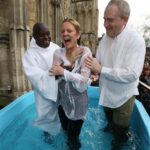
 The picture at the top is of the mosaic in the church building by the river where Paul and his companions probably met Lydia. It was taken by me on our trip to Greece in 2012. To the right is a picture of a modern baptistry, created by diverting part of the river, so that people can be baptised in living (that is, flowing or running) water, as ought always to be the case to communicate the true meaning of baptism! Candidates enter the water from one side and emerge on the other, symbolising leaving behind the old life and beginning to life the new.
Come and join Ian and James as they discuss the reading here:
 Buy me a Coffee








“Timothy appears, the mulatto child…”
No, there is no indication in the Bible that Timothy was a mulatto child. In fact, the biblical text clearly states that he had a Jewish mother and a Greek father. He was bi-racial; The term “mulatto” typically refers to someone of mixed African and European descent, which is not mentioned in the Bible in connection with Timothy.
For an excellent character study of Timothy, I would endorse
https://ftc.co/resource-library/blog-entries/8-important-things-about-the-young-timothy/ Shalom.
One of the most remarkable gifts/ministries of the Holy Spirit is the discernment of God’s mind, by whatever workings He chooses.
1 John 2:20
Amplified Bible
But you have an anointing from the Holy One [you have been set apart, specially gifted and prepared by the Holy Spirit], and all of you know [the truth because He teaches us, illuminates our minds, and guards us from error] .1 John 2 v 20
By the way, “Titus” was Timothy’s praenomen.
Paula Gooder, in her book Lydia (fiction but including critical commentary on Acts and Phillipians) imagines that Lydia had to leave for home in Thyatira shortly after Paul’s departure, due to the adoption of the oracular slave girl. Lydia appears to come back later to keep the business on track
chris
How interesting. Based on any evidence…?
In her notes, Paula wrote:
There is only one more mention of Lydia in Acts, or more accurately of her home, since Paul and Silas returned there after their imprisonment, before travelling onwards to Thessalonica. The only other detail worth noting is one of absence. Despite her central role in Paul’s visit to Philippi recorded in Acts 16:13–15, Lydia is entirely absent from Paul’s letter to the Philippians. We are left to guess whether this means she has simply moved from Philippi, or has lost her faith or indeed her life. I chose to imagine that she moved away (for reasons laid out as the story unfolds), but later found the need to return. It allowed me to re-include her in Philippi’s story even though she is not mentioned in Paul’s epistle.
I found the book gave a real insight into the church at Philippi
Chris
Is this really Lukes’s world view?
QUOTE “At one level, all this is of historical interest. And yet we live in the same age of the Spirit, and all the evidence suggests that Luke intends later readers to see this as an example and pattern of ministry for us to follow. We too should see the gospel as speaking into questions of power, wealth, and ethnic diversity, and asked fundamental questions of differences we find in our culture as the gospel relativises them. We too should expect the Spirit to be actively at work, directing and guiding our actions and decision. And we too should expect to see fruitful growth of the word, as people from all walks of life respond to the gospel as we faithfully proclaim it.
Not sure what point Ian is trying to make here.
The Gospel is a transformation of the Individual who accepts it by personal
revelation and faith and a walk [conversation; in its original meaning not the 21st century meaning] commensurate with the belief. [As in the text]
Is the Gospel an individual transformative encounter
Or is the Gospel a means to changing the cultural milieu, making the world a better place/utopia.
Jesus and Paul quite clearly suggests that the World will
wax worse and worse, perhaps to the point where Jesus asks “will He find faith on the earth,” when He returns?
Relativism can promote tolerance and understanding of diverse cultures and beliefs.
It can also challenge absolute moral standards and encourage critical thinking about different perspectives.
Some critics argue that relativism can lead to moral nihilism or the abandonment of objective standards of truth and value.
Alan – I agree with your substantive points. In your earlier comment here, though, it’s probably worth pointing out that ‘mulatto’ was the other guy’s comment (Ian Paul was simply quoting him) and, to be fair on I.P., he does indicate that he doesn’t agree by any means with everything the other guy says, but that the other guy does bring an interesting perspective, which seems new, and which adds additional light. So he isn’t exactly endorsing it.
As to your substantive point – yes – and again yes. A Christian is someone who has first come to understand the *necessity* of the cross in his own life – that is, that he is a sinner and the cross represents the wages for his own sin that he, by rights, should have collected. Based on this understanding of self, that ‘God so loved the world’ (John 3:16) that Jesus stood in his place, picked up his wages – and that he is saved by the blood of Christ. Everything proceeds on this basis ….. This implies a degree of humility when dealing with those who have not yet come under the conviction of sin.
All the bible study articles I have seen here, present a good, careful, study of the bible and draw out important things from the text that I hadn’t thought of before. I don’t see anything in the articles that contradict my own faith – and, indeed, the transformative effect of the Spirit in the heart and mind of the individual who comes to believe *should* have the effect that I.P. indicates in this article. Indeed, much of what Jesus says can be summarised as ‘develop a social conscience’ (which is exactly what I.P. is indicating here).
At the same time, I can now see quite clearly that nothing here – in this article or the other bible study articles – actually contradicts the ‘synthetic gospel’ understanding; those who follow the synthetic gospel (i.e. without understanding the necessity of the cross in dealing with their own personal sin, without understanding the radical evil within each one of us that necessitates the cross, the ‘gospel’ that concentrates on ‘community’ being careful not to suggest ‘community of forgiven sinners’, which concentrates on the ‘love that Jesus has for us’ without mentioning the key point in how he expressed it – that he died for us while we were yet dead in our trespasses and sins) would not find anything in these bible studies that contradicts their own faith.
Jock, I get the impression that not only do you view the cross as central, but that it is largely ‘it’ when it comes to Christianity. But although central, surely there is more to life with God? Paul makes the cross and resurrection central, but then builds upon them, ie the consequences.
I just feel in your more recent posts theyre a little unbalanced.
PC1 – they’re unbalanced – and on a single issue – because I detect a very serious gap – because *all* life with God needs, as its starting point, the cross and conviction of sin; it is based on the blood that Christ shed for us – and an inward acceptance of why he had to shed it. The ‘joy unspeakable’ and all the good things of life with God which come through faith in Him, with this as the starting point underpinning everything.
Yes – that is one of the things I was trying to say to Alan – Paul *builds* on them and I’d agree with you on this (and I.P. deals very well with how he builds on them in his post) – but I’m having some difficulties seeing that the starting point, the foundation, is there.
Jock I think I have noticed the same as PC1. Is your concern based on the views of an individualistic society rather than a collectivist society? And so my question would be, where does the Bible support an individualistic view?
Bruce – no – it isn’t based on the views of an individualistic society rather than a collectivist society. My own view is quite the opposite – I believe in the ‘communion of saints’ – and I don’t think I have ever written anything to contradict this. I apply ‘communion of saints’ both at the ‘horizontal’ level (as Christians living here and now, we are a community of forgiven sinners) and at the ‘vertical’ level; we have communion with God through Jesus Christ our Lord and, in some sense perhaps – with those in Him who have gone before us – which we will most certainly have in the life to come.
It is based on things that are (a) written in Scripture, but (b) which we already understand at an intuitive level if we are honest with ourselves (and therefore no amount of studies in grammar and alternative meanings can change this).
Indeed, Paul wrote some one-liners to this effect, ‘all have sinned and have fallen short of the glory of God’. (He did not write all participate in some collective understanding of sin). This comes as a summing up (Romans 3:23) of the foregoing; Paul quotes Isaiah (Romans 3:12) when he writes ‘There is no one righteous, not even one;
there is no one who understands; there is no one who seeks God. All have turned away, they have together become worthless; there is no one who does good, not even one.’
This is what it is based on. Bruce – I’d urge you to recognise that this is true of you – that, like the rest of us, you are a sinner standing in need of God’s grace – that, like the rest of us, the cross represents the wage that your sin deserves (Romans 6:23) – and, based on this understanding of self, come to faith – the belief, based on this understanding of self, that Jesus loves you so much that he died for you – that your sin, not in part, but the whole, was nailed to the cross and you bear it no more, through Him and the blood that He shed at Calvary.
And when you come to faith, you discover that you are in the number of the Saviour’s family, the community of forgiven sinners – and there is nothing individualistic about it.
Note here the emphasis on the individual; each individual has sinned
Thank you Jock for your concern and your urging. Though I can’t quite see how your concern is related to my question so I wonder if you have made quite a few assumptions here? And what’s the thing about ‘studies in grammar’?
Bruce – simplified answer – NO – individualistic rather than collectivist view has absolutely nothing to do with it – I thought I made this clear.
It would be interesting to know how you thought it might be.
Bruce – so if I seemingly went off at a tangent, it’s because you presented me with something that looked – and still looks like – a non-sequitur and I didn’t succeed in ‘squaring the circle’.
I’d like to know how you get from A to B here.
I’m still puzzled as to why the women were meeting outside the city, by the river. The apostles clearly knew that this was likely, but how and why? I get there was no synagogue because that needed 10 men: but why weren’t the women meeting in someone’s house? Did they not wish to worship in the city because it was pagan? Please enlighten!
Water is needed for Jewish rituals of cleansing, so the river was importance. And it appears as though Philippi was hostile to Jews (hence not enough male Jews), so meeting outside the city boundaries would have been natural.
It could be that they met there as a natural place where what they discussed would go unremarked. Before piped water women washed mats and clothing in rivers – in some places in England this continues until 1900.