I recently posted on Facebook a link to the decision in the Presbyterian Church (USA) to drop the hymn “In Christ Alone” because the song’s authors refused to change a phrase about the wrath of God.
The original lyrics say that “on that cross, as Jesus died, the wrath of God was satisfied.” The Presbyterian Committee on Congregational Song wanted to substitute the words, “the love of God was magnified.”
The song’s authors, Stuart Townend and Nashville resident Keith Getty, objected. So the committee voted to drop the song.
Critics say the proposed change was sparked by liberals wanting to take God’s wrath out of the hymnal. The committee says there’s plenty of wrath in the new hymnal. Instead, the problem is the word “satisfied,” which the committee says refers to a specific view of theology that it rejects.
In my experience, many Christians want to revise this phrase, and sing something different in practice. When I highlighted this, I was taken aback by the intensity of discussion, which ended up with more than 100 comments. What is at stake in this particular phrase? There are three aspects: what the NT says about Jesus’ death; the status of particular doctrines; and the issue of copyright in hymns and songs.
 On the question of wrath in the NT, several things are worth bearing in mind. First, in the NT, whilst there is plenty of discussion about God’s wrath (or sometimes just ‘the wrath’) God is never described as being ‘angry’. Wrath is always a noun, and never a verb. Stephen Travis in Christ and the Judgement of God talks of it as an effectus not an affectus, an attitude rather than a feeling. I remember his former colleague Michael Green describing God’s wrath as ‘his settled opposition to all that is evil.’
Secondly, it is described as something both present (for example in Romans 1) and future (in Romans 5.9). In fact, Romans 5.9 is the only verse in the NT which links Jesus’ death with deliverance from wrath explicitly, and here Paul clearly has the final judgement in mind, not some transaction which takes place on the cross at the time of Jesus’ death.
Thirdly (for the sake of good Anglicans) it is important to note that the Book of Common Prayer does make use of the idea of satisfaction:
All glory be to thee, Almighty God, our heavenly Father, for that thou, of thy tender mercy, didst give thine only Son Jesus Christ to suffer death upon the Cross for our redemption; who made there (by his one oblation of himself once offered) a full, perfect, and sufficient sacrifice, oblation, and satisfaction, for the sins of the whole world…
But it is worth noting that the ‘satisfaction’ of honour is a mediaeval idea, originating with Anselm of Canterbury in the eleventh century, not one that is found in the NT in relation to Jesus’ death. In any case, the BCP does not talk of ‘satisfying God’s wrath’, and the emphasis here comes from its root in the Middle English satisfien, from Anglo-French satisfier, modification of Latin satisfacere, from satis ‘enough’ and facere ‘to do or make’ and thus means paid or discharged in full. Hence I am very happy to use the words of the BCP, but still not to sing the phrase in the Townend hymn.
The real danger in talking of Jesus satisfying God’s wrath is that we separate the actions of the Trinity in the cross. It appears to portray loving Jesus saving us from an angry God who metes out his punishment upon the innocent. Instead, we should see in the open arms of Jesus a welcome by a loving Father, who no longer counts our sin against us—it is from our sin and its consequences that Jesus saves us, rather than from a hateful God.
This moves us into the question of doctrine of the atonement. This is not the place to tackle this massive subject in full (!), but I noted in the FB discussion that the NT uses a whole range of metaphors for what happened on the cross—apart from the language of taking our place and bearing our sins (1 Peter), the cross and resurrection of Jesus dethroned the powers (Ephesians), ended our shame (Hebrews), brought us into friendship with God (2 Cor), recapitulated the story of Israel (Matthew and Acts), began the redemption of the whole creation (Romans 8), and started the recreation of humanity (Romans and 1 Cor). Tom Smail explores a whole range of images and ideas in his excellent Windows on the Cross which is a great resource for preaching. If we are going to engage our culture with the meaning of Jesus, we would do well to draw on the whole range of ways that Scripture uses.
However, in the FB discussion, one contributor commented:
I believe that the traditional language of the satisfaction of God’s wrath expresses the model at the very heart of the atonement and the Gospel…Further, if you don’t like the doctrine that the cross satisfied God’s wrath, don’t sing it, don’t call yourself a classical evangelical, and leave the COE. Since the BCP is part of the doctrine of the COE, to reject the BCP’s language about satisfaction is to reject the COE’s doctrine, and, for clergy, break their ordination vows. Further, Penal substitution has historically been a key belief for evangelicalism.
I began to see why so many comments were generated—if you don’t believe this phrase (even though it does not occur in the NT, is not found in the creeds, and does not in this form occur in the BCP) you are not really a proper Anglican, let alone an evangelical (though again the phrase is absent from both UCCF and CEEC bases of faith), so I suppose there is a question about whether you could call yourself a Christian at all! At one point, it sounded as though this correspondent was putting the doctrine of ‘penal substitution’ (that Jesus died in our place, being punished by God for our sins, and so satisfying God’s wrath) on the same level as belief in the Trinity, though in fact he pulled back from that in a later comment.
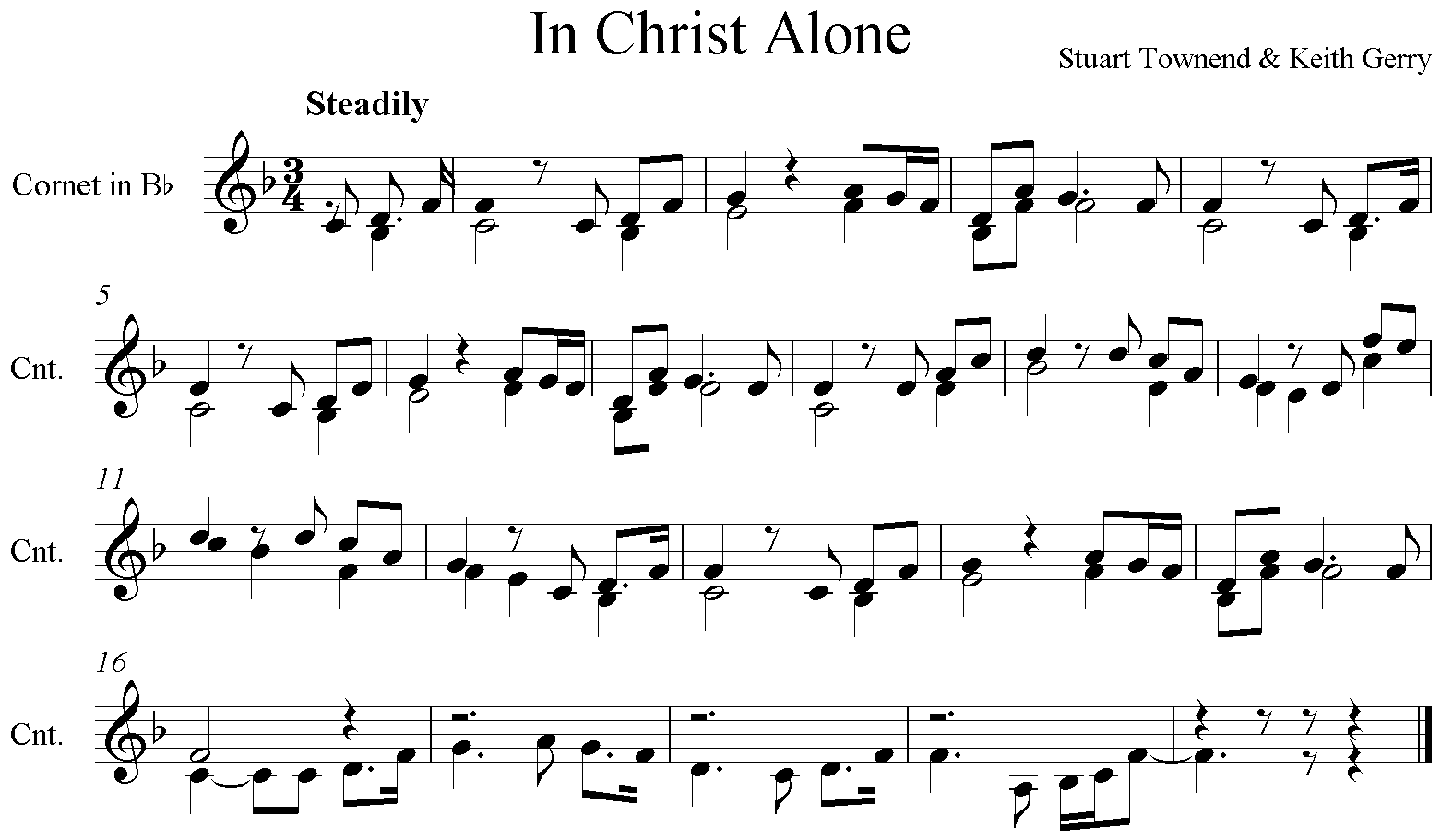 Here, as elsewhere, we have got ourselves into a very bad place of ‘culture wars’ in relation to doctrine, and on this (as well as eg the issue of women in leadership) it seems almost impossible to have a sensible discussion. More than that, for me it suggests a real problem in how we view doctrine. Is Scripture supposed to lead us to right doctrine, or does good doctrine help us to read the Scriptures? In my view, it is clearly the latter—it is Scripture that is ‘God-breathed’ (2 Tim 3.16) and not any doctrine textbook. This isn’t about saying truth is unimportant; it is saying that truth is not best expressed by a set of propositions alone. God did not make a mistake when he gave us the Scriptures, in all their variety and (apparent) contradictions. And our unity is not found in agreement on a particular statement of doctrine. It is found in the person of Jesus, crucified and risen, whom we proclaim as Lord. Our unity is, in fact, ‘in Christ alone.’
When Stephen Travis revised Christ and the Judgement of God, he included an additional chapter specifically responding to those proposing penal substitution as the main way to understand Jesus’ death. The chapter is a tour de force, a masterly exploration of the issue, fully engaging with alternative views, and is worth reading in full. He comments:
Most interpreters of Paul would agree with Howard Marshall, that ‘Paul’s vocabulary expresses the results of Christ’s death rather than its character, and this fits in with New Testament thought in general, which is more concerned with the nature of salvation than with the precise way in which it has been achieved.’ (p 181)
There is no place [in the OT] for the popular idea that in the sacrificial ritual God is somehow punishing the animal…or for the inference that something parallel to that is happening in the sacrificial death of Christ. (p 197)
Paul’s understanding of the death of Christ includes, but does not place at the centre, the idea that he bore the retributive punishment for our sins…To understand the atonement exclusively in those terms involves a misunderstanding of what Paul means by ‘the wrath of God.’ (p 199)
The meaning of the cross is not that God punished his Son in order to avoid punishing humanity, but that in Christ God himself took responsibility for the world’s evil and absorbed its consequences into itself. (p 200)
Finally comes the question of copyright. The Presbyterian Church were right to consult the hymn’s authors before changing the words in a published work. But what is copyright about? Principally two things: recognition of the author; and recompense for the work. It is not about hymn writers controlling our doctrine. In fact, if you read the words of the song, it is full of biblical language, and would be thought of as theologically conservative, even without this one phrase. There is plenty else here that I would hope the writers are pleased that people want to sing. So my recommendation would be to use it, to amend this one phrase, to credit the original writers, to note the amendment, and to pay up your royalty fee. Who knows? You might even end up provoking reflection on what Jesus’ death and resurrection (the NT holds the two together) actually mean for us.
If you have valued this post, would you consider donating £1.20 a month to support my work?
 Buy me a Coffee













Peter, the alternative is not either describing Jesus death as PSA or rejecting—as I have said several times. Jesus’ death is clearly described in substitutionary in key places in Scripture, but it is also described in many other terms, and I am arguing that PSA or something like it is not the only, central or controlling idea.
Robert, many thanks for transferring your comments across–I think it sets out your case very clearly. However, it is also clear that we are talking at cross-purposes (if you will pardon the pun!). You comment at one point: ‘Despite some of Ian’s comments about “satisfy,” the main issue for him and others does not appear to be the verb per se but the claim that God had any wrath at all against sinful humanity that Christ’s death changed.’ Here you are quite mistaken! My concern is precisely about the verb, and how this verb has become the centre-piece in evangelical theology when I believe not only the word but also the idea is absent from the NT. Jesus’ death certainly addressed the problem of God’s wrath, but a. the NT does not talk of the wrath being ‘satisfied’ and b. there are many other important narratives around the cross which I think your pre-occupation with wrath are squeezing out.
Your comment (I think on FB) concerning the relation between the cross and eschatology is a good case in point. You say that the new age can now come because God’s wrath is satisfied, but in Scripture I think the narrative of sin and amends-making and the narrative of eschatological hope are two distinct narratives in the fabric of Scripture. They run parallel, have key points of connection, but are nevertheless distinct. The remarkable thing about the cross is the way that, across the NT, the cross and resurrection and giving of the Spirit address all these narratives. That is why the gospel is such good news across all cultures, not just ones in which the key problem is seen as the justification of those aware of their guilt, and why justification is only one part of Paul’s language. The Benedictus, Zechariah’s song in Luke 1, is a really good example of these intertwined narratives; it is something that Anglicans read every day.
The comparison with the Trinity just will not stand, as I hint at in my post, and explored in my first FB post. There is quite explicit Trinitarian language in 1 Cor 8 and 12, and all through Revelation (as Richard Bauckham comments) in a way which has no parallel at all with ‘satisfaction.’
Agapetos Dude above (who sadly remains anonymous–do send me an email dude) says two key things in his post, which is worth reading:
‘According to church historian Jaroslav Pelikan major historic Christian heresies usually arise not so much as instances of obvious logical error or rank ignorance of scripture as by emphasis of one pole of a dialectical or fuller truth.’ This is what is happening with PSA in general and satisfaction in particular. Something that is of value is being made the only thing of value, and this is distorting our reading of scripture.
And later: ‘Karl Barth’s remark that “systematization is the enemy of true theology” is to this extent an apt reminder of the limitations of any theological methodology that is to any degree “human.”’ As I have commented to John Richardson, his scheme is an over- and a mistaken systematisation, and I notice that he has not responded to this key objection of mine.
The real danger for evangelicals in the States and the ultra-conservatives here who are influenced by them is the replacement of scripture with a system. This phrase is the high-point of this danger.
Btw, thanks for the mention of Exploring. I have really appreciated your work on homosexuality, and hope to be drawing on it in some writing I am doing later this year. And thank you too for your engagement here.
So Ian, what is the economy of atonement on the cross? How does God deal with our sin?
I have no problem with the notion that there is more going on on the cross than just PSA, but PSA seems to be the only account that explains *how* the punishment for sin is expiated. So if Christ does not bear in his body the punishment for our sins, what happens to that punishment?
Firstly, atonement in the NT is more than dealing with sin, though that is key. Second, as I have said quite a few times in the post and the comments (!) and Stephen and Howard Marshall (that great liberal) point out, the NT is hardly interested in mechanisms, but is focussed on effects. So I don’t mind pursuing the question of ‘how’ but I am clear that this is moving away from the NT. I am also interested that you use ‘expiated’ when John R and others will insist on ‘propiated’, and katachriston has a good post on this which he links to. Fourthly, I am fascinating by the way you ontologise ‘punishment’ as though it is a ‘thing’ with which something must be done. I don’t think the NT does this, and I don’t feel the need to either. The ‘judge steps down from the bench and serves the sentence’ illustration is just that–an illustration. When it is used to reifying abstract notions I think we get into all sorts of trouble.
What does God do with our sin? He forgives it, at great personal cost, taking on himself in Christ the full death-dealing significance of it, and so breaking its power. I am at a loss to see why I need to know more ‘mechanism’.
In any case, this blog post was addressing the question of why it is that the notion of ‘satisfaction’ in particular has become a shibboleth for a theology which is supposedly rooted in Scripture (rather than mediaeval theories of honour transactions) despite the fact that it is absent from Scripture.
Robert, another thought on the comparison between Trinity and ‘satisfaction.’ The notion of Trinity is an umbrella term, incorporating within it a whole range of ideas, in seeking to be faithful to all the things that Scripture says about the nature of God, of Jesus and of the Spirit.
By contrast, ‘satisfaction’ seeks to narrow down and exclude other issues, and instead of holding together (in some tension in the case of Trinity) a range of Scriptural ideas, is either eliminates them or presses them artificially into a single model.
So the two ideas are quite distinct not only in terms of their status in relation to scripture, but also in their intellectual, cognitive and pedagogical effects.
Ian, as I’ve pointed out before (and as is fairly obvious), orge, the noun and orgizw, the verb are from the same root.
The English translations tend to translate the former as ‘wrath’ and the latter as ‘angry’, which makes them look like two rather different qualities: ‘God exercises wrath, but he is not an angry God.’
I wonder, however, whether such a fine distinction would exist in the minds of the NT writers and audience. Would not Revelation 11:18 have read to them, “The nations were angry and your [God’s] anger has come”? That or, “The nations were wroth, and your [corresponding] wrath has come”?
In other words, we need to recall that everywhere we read about the orge of God, this is what accompanies and stems from the verbal orgizw: ‘anger’ goes with ‘being angry’, or ‘wrath’ with ‘being wrathful’. Thus, for example, when Jesus is described as “?????????????? ?????? ???? ?????” (Mark 3:5 – having looked around at them ‘with anger’) it was (presumably!) because he was angry. He didn’t bring out a quality of ‘wrath’ but remain dispassionate.
To presume the same of God – that the God whose anger falls on sinners is, in a meaningful sense, angry – is not some piece of theological leger de main, but a straightforward understanding of realities – is it not?
“What does God do with our sin? He forgives it, at great personal cost, taking on himself in Christ the full death-dealing significance of it, and so breaking its power. I am at a loss to see why I need to know more ‘mechanism’.”
So let me understand this correctly. On the cross, God takes on himself in Christ the full *death-dealing* significance of sin?
Why does sin deal death? Serious question. Does sin deal death in and of itself simply because that’s how nature works (I sin and therefore I die) or does sin deal death as a punishment from God for it (I sin and therefore God punishes me for it)? Or, does sin deal death in and of itself (I sin and therefore I die as a fallen creature) and then God deals a second death as punishment? If not, why does my soul go to hell after it dies (assuming I am not saved)?
John, there are several differences in ‘wrath’ from OT to NT:
1. In the OT God can be angry with his people, but he is never so in the NT
2. As I have mentioned, God is never the subject of the verb ‘orgizo’—though strikingly, humans are, as your examples illustrate. This turns God’s wrath into a much less personal and more abstract idea, and this is picked up by good commentators. It signifies God’s ‘steadfast opposition to all that is evil’ rather than being some sort of ‘feeling’, as the English word ‘anger’ suggests, which is why ‘wrath’ is a good translation.
3. Very strikingly, in Romans 1, God’s ‘wrath’ is seen by Paul as being worked out in the way the world is, in contrast to the OT where God’s wrath is visited by his direct action. It therefore embeds God’s wrath in the moral fabric of the universe, as it were.
We do need to pay attention to exactly how words are used in the NT if we want to be faithful to them, since everything we know about the first century and its culture suggests that that is precisely what would have been done by those who wrote and those who first read these texts.
It was God the Father who punished Jesus on the Cross. It was his wrath that was poured out on him. That’s why Jesus prayed “Father take this cup of suffering from me”. He knew he was about to become the very thing his father hated and that is sin. People preach that he was scared to go to the Cross ha-ha… I don’t think so! How is it that Christians die everyday for their faith in Christ and do it singing, glorifying God, and blessing his name? But Christ was afraid? No, I’m sorry my Savior was not afraid to pay for my sins. Look at these passages that clearly say it was God the Father who poured out his wrath on his only begotten son. And do you know why God would do such a thing? Because he’s a Just God but a lot of people seem to forget that, ignore it, or they just don’t read their bibles.
Isaiah 53:1-10
1 Who has believed our message?
To whom has the Lord revealed his powerful arm?
4 Yet it was our weaknesses he carried;
it was our sorrows that weighed him down.
And we thought his troubles were a punishment from God,
a punishment for his own sins!
10 But it was the Lord’s good plan to crush him
and cause him grief.
Yet when his life is made an offering for sin,
he will have many descendants.
He will enjoy a long life,
and the Lord’s good plan will prosper in his hands.
Matthew 26:31
On the way, Jesus told them, ” Tonight all of you will desert me for the Scripture says, ‘God will strike the shepherd, and the sheep of the flock will scatter.’
Sergio, thanks for the comment. I have edited out the Bible passage, since we can read that in our Bibles. But since you talk of ‘people just don’t read their Bibles’ it would be good to pick up on a couple of things.
1. In Matt 26.31 Jesus is of course referring us to Zech 13.7 and not Is 53.
2. In Is 53.4 the writer says he thought that the suffering of the servant was a ‘punishment from God’ but goes on to realise how mistaken he was
3. There is nowhere in the NT where the language of God punishing Jesus (on behalf of anyone) is used
4. Is 53.10 talks of the life of the servant as an ‘offering’ for sin. But there is nowhere in the OT where the animal offered is ever considered to be ‘punished’ in the place of the sinner.
5. When the NT cites the OT, it often adapts it and omits certain points. Jesus’ citation of Is 61 in Luke 4.18 is a good example, where he omits the language of the day of judgement—all commentators agree this is highly significant.
6. In Mark 10.45 Jesus speaks of his death as a ‘ransom’ paid for many. Ransoms are paid over to someone who has held another captive, to set them free. So to whom is this ransom paid? And how does that relate to Jesus being punished?
7. In 2 Cor 5.19, Paul says that God ‘was in Christ reconciling the world to himself.’ If God was in Christ, then God was punishing God according to your language. And how can this effect reconciliation?
8. The NT nowhere uses language of Jesus’ death ‘satisfying’ God’s wrath—so surely we should also therefore avoid such language?
Would be grateful for your thoughts.
In verse 4 the writer was says they thought that he was being punished for his own sins but then the writer points out it wasn’t for his own sins it was for ours. And you’re right Matthew 26:31 was referring to Zechariah 13:7 but I don’t think that really matters considering that he still said “God will strike the shepherd and the sheep of the flock will be scattered.”
Also, you’re right God was in Christ until he was on the Cross. As I’m sure you know when Jesus was on the Cross he said “Father why have you forsaken me?” He said those words because again like I said he became the very thing God the Father hated and that is sin. The holy Spirit cannot be where sin is and since Jesus became sin the holy Spirit had to apart from him. Again that’s why Jesus prayed asking the Father to let the cup of suffering pass from him because he knew he was going to become what his Father hated and the holy Spirit was going to forsake him.
There is no doubt that Jesus ‘suffered’ and ‘was made sin’. But none of these verses say that the Father ‘punished’ Jesus…
Isaiah 53:10, Matthew 26:31, and Romans 8:32 and I’m sure many many more.
Also you said that the wrath of God in the OT was different from his wrath in the NT. Well according to Hebrews 10:26-31, James 1:17 and Hebrews 13:8 and again many many other verses say his wrath is the same and so is he.
Peter, as I said…I am at a loss as to why I need to know more about the ‘mechanism’.
Oh I’m just interested y’know. I like to know how things work….
Ian, you say God can be angry with his people in the OT but never so in the New. This is just a bizarre line of argument as far as I am concerned. First, there is the question of ‘his people’ in the OT who are a pretty mixed bunch within which is a ‘faithful remnant’, but secondly, the God of the OT is the God of the NT. What about the example of Ananias and Sapphira:?
Peter said to her, “How could you agree to test the Spirit of the Lord? Look! The feet of the men who buried your husband are at the door, and they will carry you out also.” At that moment she fell down at his feet and died. Then the young men came in and, finding her dead, carried her out and buried her beside her husband. Great fear seized the whole church and all who heard about these events. (Acts 5:9-11)
OK, not ‘bizarre’, but hard to relate to.
For clarification, Ian, do you have a view on where, when and why God’s attitude changes between the testamental eras?
Not of God’s attitudes per se, but of the understanding of God in the new social, cultural and intellectual context—and I guess the best place to look would be any introduction to NT or a good NT theology. Tom Wright’s New Testament and the People of God gives a good account of intertestamental developments which form the theological backdrop to the NT.
So God’s attitudes didn’t change. The God who is angry in the OT era is no different from the God of the NT era. What changed was people’s theology.
Amen!
Ian, the NT introduction I read at St John’s in the 1970s was Alan Richardson’s, but I don’t recall any such ‘cultural change’ approach being mentioned.
I did find this, though:
“THE word ‘atonement’ is scarcely a NT word at all. It is not found in the RV of the NT and occurs in AV only at Rom. 5.11 (RV ‘reconciliation’). The verb ‘to atone’ is found in EVV of the OT, being used chiefly in connection with Heb. kipper. It means that by which God’s wrath is propitiated or averted, or alternatively that by which sin is expiated or ‘covered’ (e.g. Ex. 30.15f.; 32.30; Lev. 1.4; 4.26, 31, 35; Num. 25.13; cf. ‘appease’ in Gen. 32.20).1 The word ‘atonement’ (lit. at-one-ment) implies a reconciliation after a period of estrangement, and in the EVV of the NT the words ‘reconcile’ and ‘reconciliation’ are used (except AV of Rom. 5.11) to translate KaraXXdww and /caraAAayr}. In general theological usage, however, the word ‘atonement’ has come to denote, not so much the state of reconciliation with God into which Christians have been brought by Christ, as Christ’s reconciling act itself, viz. his death and rising again. This usage is entirely in harmony with the use of ‘atonement’ in the OT as meaning that by which expiation is made; it may therefore be said to be biblical, although it is not a NT use.” (218)
He wasn’t such a liberal, was he?
Hi Ian,
Thanks for your kind comments about my work on homosexuality and the Bible.
On your orge/orgizo discussion with John, I think your argument that God doesn’t get angry with his people in the New Testament is just amazing. There are tremendous number of warnings to God’s people by Jesus and NT writers that essentially say, shape up or God will destroy you. There are so many examples of this that I will be up all night recounting them, were I to attempt to document the whole. Just look at the warnings in the Corinthian correspondence. The discussion of disunity in 1-4, the incestuous man in 5-6, those attending idol’s temples and stumbling weak brothers in 8-10, the abuse of the Lord’s Supper in 11, and the denial of the resurrection of the dead in 15 are all accompanied by serious threats about what God might do to them.
It is also somewhat Gnostic to drive this wedge between the two Testaments on this issue. The OT witness is crystal clear that God gets angry and gets angry a lot. Now suddenly in the NT we are told that God becomes this incredibly passive figure as far as wrath is concerned. Perhaps he has learned to calm down and take a bromide or a sleeping pill when he gets too irritable? There’s a reason why the theme of God’s wrath occurs 7 times in the 1st 5 chaps. of Romans and the theme of fearsome judgment another 15 times or so, and its not because God has learned to calm down about sin. God is kind, longsuffering, gracious, and loving in both Testaments. Granted, the new covenant relationship is founded on an act of grace now completed, the fulfillment of many past hopes, such that the old covenant must look condemnation and death in comparison to the righteousness and life of the new (a la 2 Cor 3). But I don’t see any evidence that any of this eliminates frequent warnings about the wrath and judgment that those who don’t continue under the controlling influence of Christ’s Spirit will face. When Paul says in 1 Cor 10 to those visiting an idol’s temple and engaging in covenant meals with the demonic forces behind idols, “You are not stronger than God, are you?” it’s as good as saying: Don’t push your luck; God will not be mocked: He brought you in and can take you out. There’s a reason that Paul in 1 Cor 10 compares the situation at Corinth with God’s destruction in the wilderness of most of those who came out of Egypt. And it’s not to communicate that God gets angry in the old covenant but is a pretty impassive figure now.
Ian, I still think my “Trinity” analogy doesn’t work. On the one hand you complain against my view of the atonement that it overly systematizes things and on the other hand you hail the superiority of the use of the word “Trinity” over “satisfaction” because it explains so many things and puts all the pieces together in a way that PSA does not. Can’t have it both ways.
You say: “My concern is precisely about the verb, and how this verb has become the centre-piece in evangelical theology when I believe not only the word but also the idea is absent from the NT. Jesus’ death certainly addressed the problem of God’s wrath, but a. the NT does not talk of the wrath being ‘satisfied’ and b. there are many other important narratives around the cross which I think your pre-occupation with wrath are squeezing out.”
I personally hardly every use the word “satisfy.” I prefer expressions like “make amends or restitution to.” At the same time, I don’t argue that a song should be eliminated simply because it contains the one line “the wrath of God was satisfied,” as you apparently do (or have I misunderstood you as siding with the PCUSA hymnal committee?). Of course the precise term “satisfied” (i.e. fulfill the demands of) is not used in the NT, as again the word “Trinity” and countless other words that we fill our theological vocabulary with (I bet I could read your chapter on Revelation in Exploring NT Letters and come up with dozens of words that you use to describe what’s happening in the NT even though such words are not actually used in the NT). But it is false, I believe, for you to claim that the concept is not there. All the references to paying the price of release (ransoming, redeeming) make clear that God’s wrath is satisfied; that the judgment that would otherwise justly fall on us no longer falls precisely because of the price paid of Christ’s life in exchange for ours. The use of the terms hilasterion and hilasmos likewise point to the fact that Christ’s death makes amends for our own. The NT witness is clear that death is the penalty for sin. Christ’s death is portrayed consistently as paying that sentence for us. That’s why God “made him who did not know sin to be sin for us.” He suffered the penalty that we would otherwise suffer. Precisely the point made in Isa 53:4-12 that I referred to earlier.
This is exactly parallel to the Trinity. You say: “The comparison with the Trinity just will not stand…. There is quite explicit Trinitarian language in 1 Cor 8 and 12, and all through Revelation (as Richard Bauckham comments) in a way which has no parallel at all with ‘satisfaction.’” There isn’t explicit Trinitarian language because there is no Greek word in these texts for “Trinity” or a related adjective form, just as there is no explicit Greek word for “satisfaction” in connect with Christ’s death and God’s wrath. But in both cases the concept is there: Father, Son, and Holy Spirit are mentioned in close proximity (though it is nowhere exactly worked out, we have to make some inferences and tie together some ends); and it is said that Jesus’ death pays the price of our release and makes amends or restitution in contexts that have been hammering home that God’s wrath falls on sin, with Jesus being made sin or appearing as a sin offering. But whereas you are happy to have hymns abound in the use of the word Trinity and make all sorts of connections (like praying to the Spirit, which does not occur in Scripture) without any protest that things have been added that aren’t explicitly stated in the NT, when it comes to a single line that says “the wrath of God was satisfied,” that we have to expunge or at least not sing when we come to that part of this lovely song.
Read for the first line above: “does work.” No Freudian slip here!
I love Howard Marshall’s work and his commitment to the gospel but he would be wrong to say (imho) that the NT doesn’t speak to the mechanism of atonement. It does, as I noted above. My concern is not that you should read into the NT something that isn’t there, but rather that you appear to want not to read what is surely there. It seems like you don’t like Calvin’s soteriology much but I think he did put it quite nicely when he said: “If the effect of his shedding of blood is that our sins are not imputed to us, it follows that God’s judgment was satisfied by that price” (2.17.4).
So here we have in Rom 1:18-3:20 completely focused on the problem of our sin and God’s wrath and judgment on that sin; then we read in 3:21-26 about we are justifed by means of Christ’s redemption (his paying of a ransom, apolutrosis formed from lutron ransom), which was accomplished when God set before himself (nice middle there of protithemi, which often in the middle has a direct reflexive sense) as a hilasterion (best rendered, imo, as something like an amends-making offering, a propitiatory-expiatory sacrifice) because otherwise God would be leaving our previously committed sins unpunished, for previously God merely held back his wrath rather than brought actual peace (God’s forbearance). How this is not a narrative explaining how God’s wrath is “satisfied” is beyond my understanding. Later Paul says that Christ became a sin offering for us (8:3). If the effect of Christ’s death is that we are no longer under God’s wrath, then it is self-evident that the demands of that wrath have been satisfied by that price paid. Otherwise, if God’s wrath has not been “satisfied” by Christ’s death, then we are still under it, and that is not a pleasant place to be. Both commercial and sacrificial metaphors are used in 3:24-25; they both get at the concept of amends or restitution for our sins. This point is inescapable imo and it is bedrock gospel.
In saying this, and here it may surprise you but I am going to disagree with you again, I have not in any way, shape, or form, eliminated all the rest of the results of the atonement. I love to talk about justification and reconciliation and defeat of the powers of sin and death, etc. But it is clear in the narrative itself that these are consequences or results of Christ’s death, not the actual mechanism of atonement discussed in such terms as redemption/ransom and amends/restitution. As I noted about Rom 5:9-10 but true also of Rom 3:24 and other places, justification, reconciliation, etc. happen by means of or as a result of the blood/death of Christ.
Even the oft-cited text (by proponents of Christus Victor) about disarming the powers in Col 2:15 completely ignores the point in Col 2:14 that the disarming of the powers is only possible because Christ first “wiped away the hand-written note of debt (IOU) with its legal demands.” Only after the debt is cancelled by Christ’s payment of the price of release does he triumph over the powers (compare the reference to forgiveness of sins with 1:14 where the forgiveness of sins arises from Christ’s payment of the ransom of his life). Paul doesn’t say that justification, reconciliation, and victory over the powers are on the same level as redemption and sacrifice as metaphors for atonement. The former are effected by the latter. It is a point that I need to stress in some future work on Pauline theology.
This view of things that does not cancel out the richness of the NT any more than does the recognition that Christ’s sinlessness is not the actual atonement but rather the precondition for effecting the atonement, namely, to have a sinless lamb be the offering in exchange for our lives. When the unblemished animal sacrifice is handed over to the priest, no atonement has yet been effected. It is not until the knife comes to his throat (sorry about being so graphic here but, as you know, the Tabernacle and then Temple were very graphic places where people were constantly being reminded by the significance of blood and death that we in our sanitized societies so easily forget).
Ian, you say: “Your comment … concerning the relation between the cross and eschatology is a good case in point. You say that the new age can now come because God’s wrath is satisfied, but in Scripture I think the narrative of sin and amends-making and the narrative of eschatological hope are two distinct narratives in the fabric of Scripture. They run parallel, have key points of connection, but are nevertheless distinct. The remarkable thing about the cross is the way that, across the NT, the cross and resurrection and giving of the Spirit address all these narratives. That is why the gospel is such good news across all cultures, not just ones in which the key problem is seen as the justification of those aware of their guilt, and why justification is only one part of Paul’s language.”
When did I ever say that “justification represents the whole of Pauline soteriology”? On the contrary, I said that the justification, like reconciliation and victory over the powers, is one result or benefit of the fact that amends/restitution has been made for our sins. To focus on amends/restitution is as relational and triumphant as it is legal.
Of course “the narrative of sin and amends-making and the narrative of eschatological hope are two distinct narratives.” If they weren’t we couldn’t talk about them in distinct terms as you and are now doing. But they are connnected; and your claim to me and to others is that weren’t or couldn’t be connected or held together. I think they hold together beautifully and indeed there can be real connection between the cross and eschatological hope without them because entrance in the new creation absolutely hinges on amends/restitution for the sins in the old. To say this is not to leave out the resurrection or the gift of the Spirit, which I talk about all the time. Obviously the Spirit is the downpayment of the new creation; but the Spirit’s presence in our lives takes place only because the vessels that the Spirit inhabits have been purified by Christ’s amends-making death. For some reason you have this idea that I talk only about how the atonement works and not also its effects. Not so, not so by a long shot. If one is going to talk fully about soteriology one has to talk about both mechanism and effects.
I don’t even like the word “mechanism” here because there is nothing mechanical about Christ laying down his life for mine. But I am convinced from Scripture and in my heart that Christ’s death truly did make amends to God for my sin, that God made the offering at great cost to himself and out of his love for me, and that God’s inner justice and righteous anger against sin and we who sell ourselves to it was “satisfied” in the sense that God accepted Christ’s death as sufficient to cover my sins and the sins of all those who come to him. That is the core gospel, in my view, and everything else, the justification, the reconciliation, the victory over the powers, the inauguration of the new creation all flow from it.
We never limit ourselves to speaking only about how or why Christ’s death effects these wondrous things. We talk about these wondrous benefits because that too soothes our soul and gives honor to our gracious God. But, though we cannot understand the depths of God’s mystery completely (like understanding fully how God makes amends to himself) God has shared with us some explanation of how it all happens: through a death that, using redemptive and sacrificial imagery, brings amends and restitution for our sins, without which we would be destroyed in God’s wrath against sin. To say that the word precise word “satisfy” shouldn’t be sung because it is not there in the Bible is pedantic and worse.
I repeat: God in his love and grace and at great cost to himself handed Christ over to death, Christ going willingly, and accepted Christ’s death as sufficient to cover my sins and the sins of all those who come to him such that God no longer has to bring the wrath on me that he told me he would otherwise bring. Why any Christian would have any problem singing about that stuns me.
And in the “In Christ Alone” song, God’s love is part of the context: “What heights of love, what depths of peace, when fears are stilled, when strivings cease!” and “In Christ alone, who took on flesh, fullness of God in helpless babe! This gift of love and righteousness.” When people say (and I don’t care who says it) when I come to that part of the song that says “the wrath of God was satisfied” I won’t sing or I’ll replace it with different words, they are not saying that they won’t sing it because it’s not the whole of the gospel (even though people excuse themselves in this way). They are saying: It’s no part of the gospel. There are plenty of other lines in the song talking about other facets of the gospel. We’re not saying that “the wrath of God was satisfied” is the only line in the song or the only theme in the NT witness. But the concept is part of the truth of the gospel.
The love of God is elsewhere spoken of, twice, in the song. It doesn’t have to be mentioned every line in order to be assumed. One of the writer’s of the song, Townend, wrote an entire song in 1995 called “How Deep the Father’s Love for Us.” The writers of the song know about God’s love. They speak about that love in the song. But they are also right to speak about how Christ’s death fulfills the demands of God’s justice/wrath and the relief that it is for us to realize that we will not be recipients of that wrath. Not that God wants to destroy us; he’s done everything to prevent that from happening short of obliterating our decision to say yes or no. But he has told us that we face that wrath if we don’t take the way out that he offered to us in Christ, the only way that could be offered, else God surely would have found another way of saving us than having his own Son undergo an excruciating ignominious death on our behalf.
When I sing a song that talks about how God has justified me or reconciled me or given me victory over Satan, sin, and death but leaves out a description of how God did it I don’t stop singing these other parts of the hymn just because the entire message of the gospel is not in the one song. That would be foolish and it would dishonor what God has done in the area that the song does speak about.
Robert, I think you will find the articles by Roger Nicole, a Baptist theologian of the latter half of the 20th century, very instructive here. He carefully exegetes the difference between propitiation and expiation. In addition, it seems that the Covenant of Grace and for those not allergic to the 17th century, the Covenant of Redemption, provide an excellent basis for resolving any tensions between wrath and love in God. It is the Father who sends the Son. It is the Father who elects the elect and gives them to the Son to save. The Father and Son equally share in hatred of sin. After all, it is to the Son that all judgment is given. He is the one who will separate the sheep and goats at the last day and consign the wicked to Hell. I often use the analogy of a righteous king and his erring son. If the son commits a capital offense, his father still loves him, but as king, he must punish him according to the law. When wrath is separated from justice, it is subject to all manner of confusion. God’s wrath is his holy and righteous response to evil. We do not want a God who is unjust, therefore, we cannot want a God who does not have wrath. The wonder of the Gospel is that our Heavenly Father must satisfy the demands of his justice (an important improvement on Anselm’s view), but will not be denied his elect. But how can He save them, when He must exercise justice against them for their evil rebellion? He substitutes himself in their place. Here the wonder of the trinitarian nature of God sis revealed. The Father sends the Son and the Son undergoes the wrath of God for our sins. Justice and mercy kiss! This is the true doctrine of grace.
Robert, thanks for taking the time to write–but I am not sure this form of discussion is actually fruitful anymore. We are back into the 1 sentence/5 sentence thing, and I am not sure you have understood the shape of the argument from my point of view.
For one thing, I am not clear that anything you have said supports the case the NT sees the Jesus’ amends-making death as ‘satisfying’ the wrath of God. But it is clear that, for the hymn-writers and others in this discussion, this concept is not just one among many in the NT, and not even the most important, but the one, non-negotiable concept. See the comment I quote in the original post.
I will continue to consider your argument about the relation between amends-making and other aspects of atonement—for example, your point about Col 2.15 is well made. But I am also clear that the NT does seem content with a wider variety of explanation for Jesus’ death. This does matter. It could be different in the US (in fact I don’t think it is) but in the UK you will find happen what was listed by John R earlier, where he summed up the story of the cross under five points related to wrath and its satisfaction. I think this is not a fair representation of the story and theology of the NT.
Whatever the NT says about how Jesus deals with our sins, it never says that God punished Jesus, as Travis points out. The ‘satisfaction’ line is dependent on this mistaken understanding. I’m still with Stephen Travis, Howard Marshall, and at his best moments Tom Wright on this one.
And on Calvin, no, I am not persuaded by the language of imputation, and therefore neither by the language of satisfaction.
Ian, just for clarification, I think you’ve got me almost entirely wrong when you say that I “summed up the story of the cross under five points related to wrath and its satisfaction” and then dismissed this by saying, “I think this is not a fair representation of the story and theology of the NT.”
Well you should, because the five points I noted were, as I said at the time, to try to identify what was being disputed — something I’m still hard pressed to put my finger on. Is it the ‘satisfaction’ theory, the notion of ‘wrath’, or what??
These were my five points, and I was trying to find out if the dispute centred on one (or more, or none) of these, not saying “This is the theology of the NT”:
1. That God (including, of course, the Son, Jesus, Rev 6:16) is wrathful against sin and sinners?
2. That sacrifices take away the guilt and penalty of sin, and therefore avert God’s wrath?
3. That this aversion of God’s wrath is through a ‘satisfaction’ for sin made by Jesus on the cross?
4. That the NT concept of God’s character (including his wrath) is the same as the Old?
5. That the NT concept of a sacrifice for sin is consistent with the Old?
Ian, I’m not sure what the issue is in terms of length. So if I provide lots of arguments for my position, this is bad for arriving at a correct understanding? Or I address each one of your claims against my position, plus your claim to John that “In the OT God can be angry with his people, but he is never so in the NT,” rather than answer just one claim, doing so, for some reason, is a problem? Just take my responses one at a time as you can.
Ian, in the only statement from you that I have seen that gets at how Jesus’ death does anything to sin and saves us, you say:
“What does God do with our sin? He forgives it, at great personal cost, taking on himself in Christ the full death-dealing significance of it, and so breaking its power.”
There are several things interesting about this description. First, for a person who dispenses so easily with the concept of Christ satisfying God’s wrath against sin because the precise word “satisfy” is not used in Scripture, I find it puzzling that you employ a description of how Christ’s death works to save us that uses very few expressions that we find in Scripture. Where does Scripture say that God in Christ “took on the full death-dealing significance of sin and so broke its power”? I’m not denying that the concept is there but rather wondering about consistency of argumentation. When is it okay to hold a view about how atonement works that uses terms and phrases not found in Scripture?
Second, what does it mean exactly that God in Christ takes on the whole death-dealing significance of sin and so breaks its power? I presume (in keeping with some Church Fathers) that you mean that because God becomes flesh, dies, and then rises again, thereby triumphing over death, he makes it possible for us to triumph over death too? So sin is viewed as something that takes over our life for which we have no personal culpability or guilt. It just grabs hold of us and makes us die. So if Christ rises from the dead we can too. But this doesn’t explain God’s wrath on US for our sin. It doesn’t explain the use of hilasterion/hilasmos to describe Christ’s death as an act that makes amends or restitution for our sins. It doesn’t explain the language of redemption, ransom, and being bought with a price. When you look at ransom language, for example, in Exod 30:11-16 you see that it involves compensation for wrong. Where does this wrath and our guilt for sinning and amends and paying a price and Christ becoming a sin offering and Christ becoming a curse for us by means of his death fit in when all you’ve got is:
1. God gets into a human body
2. God dies
3. God breaks sin’s power, presumably by rising from the dead.
I don’t see anything in your explanation for how Jesus’ death effects our liberation from sin. In your description, it seems to me, it’s only his resurrection to life that breaks the strangehold of sin.
You have not described how Jesus’ death effects reconciliation (which presumes our culpability for rupturing of the relationship), justification (which presumes our guilt for our unrighteousness), or even victory over the powers but solely how Jesus’ resurrection effects our resurrection. Rom 4:25 might be of some help to this way of looking at things: Jesus was “raised because of (dia + acc.) our justification.” But more likely this simply means: Jesus was was raised to new creation existence because his atonement for our trespasses and our consequent justification enables the initiation of a new humanity. The dominant NT motif is that it is Christ’s death, not his resurrection, breaks the power of sin and makes possible thereafter resurrection. It is not resurrection that breaks the power of sin but rather the death of Christ by virtue of making of amends/restitution for sins, the paying of the price or ransom, the taking on of the curse of God’s law that falls on the guilty, and the cancelling of the debt that we had by virtue of violating the law’s decrees.
Ian, you say: “And on Calvin, no, I am not persuaded by the language of imputation, and therefore neither by the language of satisfaction.”
This may be the most puzzling statement of all, to me, in terms of understanding your position.
You respond to the quote that I made from Calvin: “If the effect of his shedding of blood is that our sins are not imputed to us, it follows that God’s judgment was satisfied by that price” (2.17.4).
To say, “our sins are imputed to us” by God simply means that God holds us accountable for our sins, a point amply confirmed throughout Scripture, including Romans 3:19-20. Surely you do not deny this doctrine?
For Calvin to say that the effect of Christ’s death is that “our sins are not imputed to us” means that we will no longer be punished with death for our sins. Surely you do not deny that the effect of Christ’s death is that we are no longer charged to us?
Although Calvin doesn’t mention it, our sins were imputed to Christ. Surely you do not deny that God made Christ to be sin, that Christ became a curse and a sin offering, that Christ bore our sins?
If you do not deny any of the 3 points above, then Calvin’s conclusion is unassailable:
“If the effect of his shedding of blood is that our sins are not imputed to us, it follows that God’s judgment was satisfied by that price”
If God’s wrath and judgment pronounced on us for our sins are removed from us as an effect of Christ’s death, then the conclusion is inescapable that his wrath and judgment were satisfied by that death.
What am I missing here? If his wrath and judgment were not satisfied by Christ’s death on the cross, what were they satisfied by? And if they were not satisfied, then either God never had wrath/judgment directed toward us for our sins (in contradiction to the biblical witness) or that wrath/judgment still remains on us, with us facing ultimate retribution at the End.
For God’s wrath not to be satisfied means that it is still in place.
The options are very limited here:
1. God’s wrath or judgment were satisfied by the cross so that we are forgiven.
2. God’s wrath or judgment was not against us in the first place; no forgiveness is needed.
3. God’s wrath or judgment were not satisfied on the cross; therefore we are still destined to receive God’s wrath.
Maybe the most basic question to you is:
Do you deny that Christ’s death (initiated by God’s own love) effected the removal from us of God’s wrath on us for our sins, i.e., cancelled our guilt, paid our IOU to God, removed our iniquity far from us, covered over our sins?
If the answer is yes, then the conclusion that Christ’s death satisfied God’s wrath is inescapable.
If it is no, then Christ’s did not effect the removal of God’s wrath on us for our sins, then what happened to God’s wrath and why are no longer the recipients of it. Did Jesus’ death not pay our IOU to God?
Ian, you say: “Whatever the NT says about how Jesus deals with our sins, it never says that God punished Jesus.”
Well, Isa 53:4-12 is, agreed, not NT. Nevertheless, it exercised extraordinary influence on the interpretation of Christ’s death by NT authors. Do you deny that Isa 53:4-12 says that God punished his servant? It states that God strikes the Servant down, wounds him, crushes him, chastises him, strikes him with our iniquity, and makes him a guilt offering. Do you deny that this should be applied to our interpretation of Christ’s death even though NT writers clearly view Jesus as the suffering Servant?
Even strong Christus Victor proponents among the Church Fathers speak of Christ being punished by God.
John Chrysostom (Constantinople; Greek; 344-407) compares God to
“a king, beholding a robber and malefactor under punishment, [who] gave his well-beloved son, his only-begotten and true, to be slain; and transferred the death and the guilt as well, from him to his son (who was himself of no such character), that he might both save the condemned man and clear him from his evil reputation” (Homilies on Second Corinthians 6; trans. NPNF¹ 12.335).
Here Chrysostom clearly states that the king’s punishment of we sinners was transferred to the king’s son. If God transfers to Christ our punishment and punishes him instead of us it is the same as saying God’s wrath fell on Christ instead of us.
Eusebius of Caesarea (Greek; 263-340) similarly states that”
“The Lamb of God … was chastised on our behalf, and suffered a penalty he did not owe, but which we owed because of the multitude of our sins; and so he became the cause of the forgiveness of our sins, because he received death for us, and transferred to himself the scourging, the insults, and the dishonor, which were due to us, and drew down upon himself the appointed curse, being made a curse for us” (Demonstration of the Gospel 10.1).
According to Macarius of Jerusalem (Greek; bishop 312-c. 335) Jesus “came as the Savior of all, and in our name bore, in his own flesh, the punishment owed by us” (Acts of the Council of Nicea, Book 2). The punishment due us is the punishment that comes from God for our sins.
As for the NT, Paul clearly states that Christ was made sin and a sin offering and a curse for us, that is, he experienced the penalty of death on our behalf, was accursed for our sakes, and paid the price (the cost of his life) that we would otherwise have to pay. The very notion of making amends assumes that he satisfied the demands of God’s wrath and judgment against sin. Are you saying that God left sins completely unpunished? Does not Rom 3:25 indicate that God ransomed us through Christ’s death and made his an amends-making offering on our behalf in order that God would no longer simply be “passing over” sins (paresis, from par-iemi), i.e., leaving them unpunished as he did during the time of his “holding back” (anokhe; from an-ekho, hold back) of wrath? Isn’t the presumption of that remark that the punishment that would have fallen on us fell on Christ instead?
James, I have some familiarity with Roger Nicole’s work on atonement and generally agree with it.
Ian, an analogy:
Complaining that my “substitutionary amends” view of how the atonement works does not make full range of the use of the richness of the imagery associated with the cross is like complaining that I do not also use the saw when I want to hammer in some nails. I do use the saw copiously, but not when I want to hammer in nails. I do talk at length about victory over the powers, reconciliation, forgiveness, justification, etc., but not when I have to talk about how the atonement works rather than what the effects of the atonement are.
A few quotes from the Anglican Homilies (which the <a href="http://churchofengland.org/prayer-worship/worship/book-of-common-prayer/articles-of-religion.aspx#XXXV"Thirty-Nine Articles say contain “godly and wholesome doctrine”)
“God sent his only son our Saviour Christ into this world … and by shedding of his most precious blood, to make a sacrifice and satisfaction, or (as it may be called) amends to his Father for our sins, to assuage his wrath and indignation conceived against us …” (One dictionary definition of ‘assuage’ is ‘satisfy’, oddly enough. )
“And yet, I say, did Christ put himself between GODS deserved wrath, and our sin, and rent that obligation wherein we were in danger to GOD, and paid our debt (Colossians 2.14).”
“Let us know for a certainty, that if the most dearly beloved Son of GOD was thus punished and stricken for the sin which he had not done himself: how much more ought we sore to be stricken for our daily and manifold sins which we commit against GOD …”
“For if GOD (saith Saint Paul) hath not spared his own Son from pain and punishment, but delivered him for us all unto the death: how should he not give us all other things with him (Romans 8.32)?”
“… even then did Christ the Son of God, by the appointment of his Father, come down from heaven, to be wounded for our sakes, to be reputed with the wicked, to be condemned unto death, to take upon him the reward of our sins, and to give his Body to be broken on the Crosse for our offences.”
“Was not this a manifest token of God’s great wrath and displeasure towards sin, that he could be pacified by no other means, but only by the sweet and precious blood of his dear Son?”
Now of course the Homilies may be wrong, but in the light of them it seems difficult to argue that Penal Substitutionary Atonement is, at it were, an eccentric or novel doctrine in Anglicanism.
Gents, I think I have made my concerns clear enough in the blog post itself and in subsequent comments. As I have said in various responses, I am not persuaded by your counter-arguments, in part because they are aimed at the wrong target. (Robert, your mistaken articulation of what concerned me was an important signal).
Perhaps some final summary comments, and a genuine question.
I don’t think quoting the fathers, Calvin or the homilies settles much, other than that a number of people believed in this idea. I don’t believe that God punishing his Son is in Scripture. (Yes, Is 53 does have this idea, but as it is appropriated in the NT is it interpreted through the understanding that the Word was God, so as an idea this must remain an approximation, else God is ‘punishing’ Godself.) I believe in Semper Reformanda, and there are centuries of discussion about these sources, which means that it is perfectly possible to disagree with them with scriptural integrity.
When you ask the question ‘If Jesus’ death does not satisfy God’s wrath, what does?’ I think you are asking the wrong question, in that this is not the question the NT asks about Jesus’ death. John, again, I think your five points are asking the wrong questions. Robert, I answered to John and he quoted a statement drawing explicitly on scriptural texts.
In the end, I think the four statements I quote from Travis point the right way, and are supported by his argument in that chapter and earlier in the book.
Here’s the question (and a genuine one, not attempting to score points). This morning I was reading 2 Cor 1, and Paul saying that ‘Christ’s sufferings overflow to us’ which also reminded me of his language in Phil 3.10 of participation in his sufferings. In both places I think Paul is clearly alluding to his passion and death. But if these sufferings are understood as God punishing him to satisfy his wrath in our place, how could we participate in this? I would be interested to hear how you read this.
Ian, it is indeed probably time to draw stumps on this discussion, though it has been somewhat unsatisfactory, due (in my view, I’m afraid) to somewhat arbitrary standards as to the admission of ‘evidence’.
For example, evidence from the BCP (Book of Common Prayer) was admissible (at least negatively) when it supported your own case: “the BCP does not talk of ‘satisfying God’s wrath’”, “this phrase … does not in this form occur in the BCP”. But when I adduce the Homilies, which are credited in the Thirty Nine Articles, as clearly holding a doctrine of PSA, that shows nothing, according to you, “other than that a number of people believed in this idea” and is subject to revision in the light of “Semper Reformanda”.
So would it have mattered if the BCP did contain this phrase (as the Homilies, from the same era, certainly contain the concept)? Would it have settled matters, or simply shown, once again, that is what some people once believed? And what if it were not there even in the Homilies? Would this allow us to apply the principle of ‘Semper Reformanda’ and insert PSA into our doctrines? You would perhaps say no on the basis that you believe it is not in Scripture, but that simply begs the question.
Indeed, it seems you admit it actually is there in Scripture, agreeing, “Is 53 does have this idea [of God punishing his Son ]”. But then you only admit it as “an approximation”, which needs a revision of the theology of the Godhead (and what, pray, is Godself?) to make it work. Well, doesn’t the incarnation of God in Christ require some theological development to make sense of Scripture? I’m just saying, it seems and odd standard on which to reject the evidential status of a text.
Then again, if we ask questions, they are dismissed as ‘the wrong questions’, even if (as in my own case) they are simply seeking clarification about where the disagreement lies so it can be addressed without wasting time on non-issues.
As to your question about our participation in Christ’s sufferings, all the evangelical commentaries I’ve ever read on the subject are clear this is not an ‘atoning’ suffering. Presumably you are clear on this too.
If you ask what, then, it is, the answer seems fairly straightforward and stems from our being ‘members of Christ’s body’. When Paul was confronted on the Damascus road, he asked, “Who are you Lord?” and the answer came, “I am Jesus, whom you are persecuting.” It seems to me reasonable to argue that Paul’s theology of the Church begins from here – the Church is, in a real sense, Christ: “The body is a unit, though it is made up of many parts; and though all its parts are many, they form one body. So it is with Christ.” (1 Cor 12:12). You would expect Paul to say, “So it is with the Church,” and most sermons, interpretations and applications take that line (as does Paul in the subsequent verses). But for him, to speak of the Church is to speak of Christ. Thus when the Church suffers (persecutions, hardships, etc), ‘Christ’ suffers.
As to the punishment for sin, it was laid on him physically, in his body, on the cross (though, I believe, borne by him spiritually in another manner, cf Eph 1:4). Thus, by our inclusion in him — being ‘members of his body’ — we are participators in, and beneficiaries of, his atoning death, even though without bearing the punishment, just as he embraces our sinful nature and takes on its consequences even though he is himself without sin.
I think Martin Luther summed it up beautifully:
The third incomparable benefit of faith is that it unites the soul with Christ as a bride is united with her bridegroom. By this mystery, as the Apostle teaches, Christ and the soul become one flesh [Eph. 5:31–32]. And if they are one flesh and there is between them a true marriage — indeed the most perfect of all marriages, since human marriages are but poor examples of this one true marriage—it follows that everything they have they hold in common, the good as well as the evil. Accordingly the believing soul can boast of and glory in whatever Christ has as though it were its own, and whatever the soul has Christ claims as his own. Let us compare these and we shall see inestimable benefits. Christ is full of grace, life, and salvation. The soul is full of sins, death, and damnation. Now let faith come between them and sins, death, and damnation will be Christ’s, while grace, life, and salvation will be the soul’s; for if Christ is a bridegroom, he must take upon himself the things which are his bride’s and bestow upon her the things that are his. If he gives her his body and very self, how shall he not give her all that is his? And if he takes the body of the bride, how shall he not take all that is hers? (LW 31:351)
“The two shall become one flesh” is, for Paul, a commentary on Christ and the Church and (I believe) key to his doctrine of salvation.
I should hasten to add, all the above represents my views. I am not claiming they are shared by Classical Evangelicals.
And with that, I’m done!
John, thanks for your contributions to the discussion, which I have found very enlightening.
I think your sense that the standards of evidence have been ‘arbitrary’ highlights the issues of method which underlie differences in this discussion.
In my blog posting, I was exploring three questions: is the idea of satisfaction of wrath, and the accompanying idea that God was punishing Jesus on the cross, to be found in the NT? I believe not. Second, I proposed that this was in fact a mediaeval notion which had then influenced subsequent readings and readers. Third, I contested the fact that the satisfaction of wrath was, as had been suggested to me, central and essential to Anglican and evangelical belief. I think my three points stand.
My observations about the debate are that attempts to answer the first question have all depended at a vital point in saying ‘And the biblical writers MUST have meant this even though they don’t say it.’ For me, this demonstrates that the idea of satisfaction of wrath is in the reader’s mind when reading the texts, but not in the texts themselves. I think Stephen Travis shows this very well. Related to this is a really key question about biblical language. To say anything about God using human ideas (of anger etc) depends on analogy from human experience, and in terms of language this is explored by the use of metaphor. There does seem to be a strand of Reformed commentary which appears oblivious to this, and to the subsequent limitations on how we can extrapolate the ideas we find in Scripture.
In answer to the second questions, the frequent citations of Luther and Calvin simply support the point I am making. I think this view is found in the tradition of reading, as well as in some of the Fathers as Robert points out. But here is the massive paradox of evangelical Bible reading: it in effect is shaped by what academically is called history of effects or reader response—the text is thought to mean what later readers have found in it. I do think there is a real blind-spot in ultra-conservative and Reformed readings of Scripture that this is going on. When other reading traditions do it, evangelicals are quick to point out what poor exegesis results.
On my third point, I am very pleased to read your final comment that this is your own view and you are not here making a claim about what defines evangelicalism. I would only ask you to note that this position is not shared by many of your fellow travellers.
On my final question, I think you have inverted it. I agree with you that the Damascus Road encounter was foundational for Paul’s understanding of the ekklesia as the body of Christ. But this means Christ shares in our suffering, not the other way around. By contrast, Paul appears to be saying rather clearly that when he suffers he is participating in Christ’s pathemata, and in doing so is looking back to the cross. This appears to me to be very difficult to reconcile with the ‘satisfaction of wrath’ view.
Just to say, I did read the last comment, but don’t feel the discussion is going any further. I was asked to answer the question, described as “a genuine one, not attempting to score points” how we can participate in the sufferings of Christ is penal substitutionary atonement is true. I answered it with a ‘bog standard’ evangelical response that our own sufferings are NOT REDEMPTIVE (how could they be, if Christ “made there [at the cross] by his one oblation of himself once offered a full perfect and sufficient sacrifice oblation and satisfaction for the sins of the whole world”?)
That the cross atoned is, you seem to be saying, not in doubt.
That the cross ALONE atoned is, I suggest, standard Anglican (and evangelical) theology.
How the cross atoned seems to be in question. But that our participation in Christ’s suffering is NOT ATONING seems to me to be a prerequisite of all models, theories and assumptions.
Thanks, John. That is precisely my point: our suffering is NOT atoning; and yet Paul appears to see our suffering as a participation in the suffering of Christ (not the other way around). This means that, whilst Paul sees Christ suffering as the only atonement, he does not see it as atonement only. He also appears to see it as exemplary and a sign of the ‘in-betweeness’ of this present age, quite independently of his other understandings.
This is significant, because again it demonstrates that other understandings of his death are not derivative from the idea of atoning sacrifice, but sit alongside it.
The cross as exemplary — what, you mean like, ‘To this you were called, because Christ suffered for you, leaving you an example, that you should follow in his steps. “He committed no sin, and no deceit was found in his mouth.”’ (1 Peter 2:21–22, NIV84)?
To use a horrible phrase, “And your point is …?”
Or to give another example, from Martin Luther — a theologian whom I much admire, yet who is so often derided these days for imposing his ‘issues’ on the text and giving us our ‘wrong’ understanding of justification:
“We have all we need in our Lord, who will not leave us, as he has promised [Heb. 13:5]. Suffering! suffering! Cross! cross! This and nothing else is the Christian law!” LW 46:29.
My point? That Jesus’ death as atoning sacrifice is not, contrary to Robert, the one controlling understanding from which all others flow, but that the other understandings sit along side it.
I think it is clear that Luther did impose his ideas on the text at times—as all theologians do. I tried to use his commentary on Ps 8 when preaching a few weeks ago, and it was hopeless. A classic example of someone reading into the text what he wanted to find.
That is why as evangelicals we must allow all commentators, as well as offering us insight, to be critiqued by the text itself. The text does not always or necessarily mean what Luther thought it meant—nor necessarily what any other theologian thought.
So we’re all agreed, Jesus’ death IS an atoning sacrifice and yet that there are other aspects to the cross than atonement – yes?
We disagree whether the propitiatory effect of the atonement involved ‘wrath bearing’ by the incarnate Jesus in relation the Godhead AND whether atonement is the prime effect and significance of the cross, though we agree it is not the only effect and significance – yes?
By the way, when you wrote above, “Is Scripture supposed to lead us to right doctrine, or does good doctrine help us to read the Scriptures? In my view, it is clearly the latter—it is Scripture that is ‘God-breathed’ (2 Tim 3.16) and not any doctrine textbook.” did you not mean “it is clearly the former” — ie that Scripture should lead us to right doctrine? (Mind you, I’d say it’s both. The ‘either-or’ antithesis is not how Scripture treats it.)
Or maybe I misunderstood.
All, here is my articulation of the atonement, properly understood as the God-initiated act by which Christ makes amends for human sin to God and pays to God the price for our release, thereby satisfying God’s wrath toward sin and sinners for those who are in Christ. http://www.layman.org/presbyterian-pcusa-hymnal-vontroversy-around-doctrine-atonement-part-3-scripture-substitutionary-amends/
Ian, a qualification of your remark: “That Jesus’ death as atoning sacrifice is not, contrary to Robert, the one controlling understanding from which all others flow, but that the other understandings sit along side it.” Not Jesus’ death as atoning “sacrifice” is “the one controlling understanding” but Jesus’ death as making amends or restitution and thereby paying the price to God for our release, THAT is the root understanding of atonement in the New Testament. You have said nothing to refute my position that reconciliation, justification, and defeat of the powers are all effects of this act of restitution, amends, and redemption toward God. You have not refuted the fact that Scripture says these results are accomplished through Christ’s “blood” and that this “through” is explicated further in numerous NT texts in the ways that I have described above. At any rate my article lays out the case more fully and others will have to be the judge as to whether I have made my case, though needing to deal with the arguments that I put forward therein.
Funny I had the same feeling when singing it for the first time on Goodfriday in a streetservice in Bedford
and emailed him
“till on that cross as Jesus died the wrath of God was satisfied”
gives a greatly distorted view of God that is not the one that is in agreement with Jesus teaching and would be the last thing he would want us to believe. He did not die to satisfy himself to himself but he took on his role to die on the cross to show is that we are in harmony with God when we deny our individual self for the overall self in God, that our sin is forgiven in coming back to the father accepting his authority over us even in death. He even told us in several of his parables.
till on that cross as Jesus died
the love of God was justified
the sin of self to us displayed
there in the death of Christ I live
I actually would urge you to reconsider the text of an otherwise beautiful song to make it more reflective of Jesus teaching.
If you believe Jesus died on the cross for his own satisfaction you argue worse than an atheist.
Alternatively you could explain to people his strength on the cross instead that at his hour of death he started singing the psalm of lament explaining his death.
The sins were not laid upon him,
“Christ became sin for us,
Took the blame, bore the wrath”
is the biggest misinterpretation of our Lord
e.g. he was not skapegoated, he took on the role of God in refusing to call upon his authority to return back to a life constraint by our material body, He never demanded authority because he had it. Only the ones that have not got authority would demand it. He did not become sin for us but showed us how our sins are forgiven in accepting the cup and drinking it all the way.
1 Thes 1:9-10 says that Jesus delivered us from the wrath to come in addition to Romans 5:9
Yes…interesting that Paul nowhere uses the language of ‘satisfaction’ in this context! Wrath here is future, and it is the generous offer of forgiveness through Jesus which means that we won’t face this.
Good Morning from NZ : ) ; I have come accross this post a little after its written date but nonetheless at an appropriate time nearing Easter as we are!
I have little in the way of extensive scholarly biblical study so bear with my comment if it shows ignorance of such.
I have always loved this song since the newsboys visited NZ some time back and have found the ponderings on this post and your comment interesting. For some reason when worshipping, their songs illicit a sense of authority, perhaps because of they do appeal to scripture.
I have always understood the wrath of God in the OT was represented by a glass of wine. Hence the significance of Jesus around ‘won’t you take this cup away from me’. Leading to the understanding that he took on the cross the wrath due to us for our sins – the punishment that bought us peace was upon him (Isaiah).
I can comprehend wrath is mentioned little in the New Testament and the reference to the coming wrath. But perhaps like the passover lamb protected the Israelites, so we too are protected from the coming wrath because Christ has borne it for those who are His. In this way is perhaps the wrath of God to come satisfied already for Christians (made complete in Christ through Him taking our sins upon himself). As the sacrifices in the OT were only temporary we are reminded in scripture that Christ’s was not, but being the true and eternal lamb of God forgiving sins once and for all. While God may not have been punishing the lamb’s in the OT for certain they experienced punishment while people were forgiven sins.
A friend of mine who came to be a Christian from another faith background when probed said, well it is like I did something bad and my brother took the punishment for what I did (he had been struggling with guilt over something). The result was a strong impression of Love for the One who freed him from his sin/s forevermore, a part of the human condition we cannot escape from ourselves.
While I also see so much depth in the cross, redemption, reconciliation, salvation, hope for mankind, healing, re-creation and the story of God’s people as a whole; I see the in words the ‘wrath of God was satisfied ‘ in the song ‘In Christ Alone’ as quite acceptable and significant.
Best Wishes
Cath
Cathy,
Here’s my own reflection on this. I aoologose to Ian, in advance, for its length.
God’s Glory is a weighty matter
Our Creator is honoured when we offer ourselves and His providences of life back to Him in recognition of His right to do with His creation as He pleases. It is sin that causes us to persist in refusing to recognize God’s rights over all creation. Instead, the human tendency is for forbidden desires to become a defiant demand for independence from Him. How often do we fail to decry the establishment of customs, traditions and laws that contradict His revealed will?
This defiance results in angry exchanges with anyone who voices their concerns and demands of their God-given conscience. Yet. the antidote for our moral apathy is a fresh revelation of God’s glory.
In the Old and New Testaments, the gracious privilege of direct conversational encounters with God would be accompanied by powerful reminders of His all-surpassing superiority as Creator and Owner of the universe.
The Hebrew people used the word, kabad, that originally meant, ‘to be heavy, weighty, or burdensome’, to describe the solemnity and awe effected upon those whom God granted audience on earth. In English, the word is translated as GLORY.
Today, we use similar words that describe the association between authority and its effect on us. Negatively, a person who likes to impose authority is said to be throwing their weight around.
Nevertheless, we also use words about weight positively. Gravitas, which originally meant imposing size or weight (think of gravity), came to describe the authority and respect that certain people can command. Preponderance is another such word describing superiority in weight, significance, or numbers.
When we speak of God’s glory, there is a similar sense that, when we humbly call upon Him to reveal Himself to us, His presence will carry weight, overwhelming us with a sense of His all-encompassing significance to our lives.
Isaiah described God’s unfiltered glory in this way: ‘In the year that King Uzziah died, I saw the Lord, high and exalted, seated on a throne; and the train of his robe filled the temple.’ (Is. 6:1)
In his vision, heaven opens to reveal God as supreme monarch of the universe, with mighty supernatural beings causing seismic reverberations by proclaiming His transcendence and pervasive power throughout creation:
‘Above him were seraphim, each with six wings: With two wings they covered their faces, with two they covered their feet, and with two they were flying. And they were calling to one another:
“Holy, holy, holy is the Lord Almighty;
the whole earth is full of his glory.”
At the sound of their voices the doorposts and thresholds shook and the temple was filled with smoke.’ (Is. 6:2 – 5)
Yet, in the final hours of His earthly life, the gospels give us a glimpse into a very different spectacle of God’s glory revealed in Jesus’ perfection of innocent forbearance towards evil.
Jesus remained silent in the face of perjury against Him. His words about His bodily resurrection: ‘Destroy this temple and I will raise it in three days’ were intentionally misinterpreted to mean treasonous terrorism against Jerusalem’s sacred buildings.
After testifying that He was the One chosen to be God’s Supreme Authority in human form, He was blindfolded, beaten up and ordered to use supernatural power to name his assailants.
Eventually, every pretence of a courtroom procedure was abandoned. It was replaced by a vile and relentless desire to humiliate and torture the One who came from such humble earthly origins to declare the truth about how devotion to God should be rendered and to expose the rank ugliness of self-serving oppressive religious tradition masquerading as genuine God-given spirituality.
During this Holy Week, we reflect on the glory of God revealed in humbly forbearing the evil revenge perpetrated against His Messiah.
His gloriously supreme forbearance of contemptuous rejection, humiliation, physical butchery, and mental and emotional torture reveals a less conspicuous, but no less stunning aspect of God’s nature.
The cross on which our species impaled its Creator provides an overwhelming insight into how the most hideous human efforts to exterminate good became the unwitting means by which God effected an end to the penalty of sin for those who rely upon His Son.
The cross provides a jaw-dropping glimpse into a moment upon which the universe turned upon its moral axis as Jesus, the righteous, chose to hold back His armies of supernatural protection and die as the unrighteous should: sacrificially absorbing the full-strength horror of that demon-fuelled human hatred of conscience to which we all succumb, if bent on revenge.
Our jaws drop further as His almighty restraint is revealed as the only means by which God’s love for us equalled His relentless desire for justice.
It is on this basis, that the blessings of heaven continue upon my life which started over thirty years ago in Trinidad.
It is on this basis that I am spared the eternal horrors that await those whose actions persist in recklessly rejecting the voice of conscience.
It is on this basis that I enjoy the experience of God’s spirit supernaturally fashioning my character to conform to my adoptive status as a son of God.
‘In Christ alone my hope is found,
He is my light, my strength, my song,
This Cornerstone, this solid ground,
Firm through the fiercest drought and storm,
What heights of love, what depths of peace,
When fears are stilled, when strivings cease,
My Comforter, my All in All
Here in the love of Christ I stand
In Christ alone, who took on flesh,
Fullness of God in helpless babe,
This gift of love and righteousness,
Scorned by the ones He came to save,
‘Til on that cross as Jesus died
The wrath of God was satisfied
For every sin on Him was laid
Here in the death of Christ I live.’
God paid the ransom with Jesus
Who was it paid to?
It’s like a bear in the woods has hold of your child…
You offer him honey… You paid the ransom to the bear…
Seems like the bear is the one who is satisfied…
Of course, this particular bear we are talking about,
found out the honey wasn’t worth it.
Nice. And of course that only works if I am not Sovereign over the bear…which I think is your point…?