I recently posted on Facebook a link to the decision in the Presbyterian Church (USA) to drop the hymn “In Christ Alone” because the song’s authors refused to change a phrase about the wrath of God.
The original lyrics say that “on that cross, as Jesus died, the wrath of God was satisfied.” The Presbyterian Committee on Congregational Song wanted to substitute the words, “the love of God was magnified.”
The song’s authors, Stuart Townend and Nashville resident Keith Getty, objected. So the committee voted to drop the song.
Critics say the proposed change was sparked by liberals wanting to take God’s wrath out of the hymnal. The committee says there’s plenty of wrath in the new hymnal. Instead, the problem is the word “satisfied,” which the committee says refers to a specific view of theology that it rejects.
In my experience, many Christians want to revise this phrase, and sing something different in practice. When I highlighted this, I was taken aback by the intensity of discussion, which ended up with more than 100 comments. What is at stake in this particular phrase? There are three aspects: what the NT says about Jesus’ death; the status of particular doctrines; and the issue of copyright in hymns and songs.
 On the question of wrath in the NT, several things are worth bearing in mind. First, in the NT, whilst there is plenty of discussion about God’s wrath (or sometimes just ‘the wrath’) God is never described as being ‘angry’. Wrath is always a noun, and never a verb. Stephen Travis in Christ and the Judgement of God talks of it as an effectus not an affectus, an attitude rather than a feeling. I remember his former colleague Michael Green describing God’s wrath as ‘his settled opposition to all that is evil.’
Secondly, it is described as something both present (for example in Romans 1) and future (in Romans 5.9). In fact, Romans 5.9 is the only verse in the NT which links Jesus’ death with deliverance from wrath explicitly, and here Paul clearly has the final judgement in mind, not some transaction which takes place on the cross at the time of Jesus’ death.
Thirdly (for the sake of good Anglicans) it is important to note that the Book of Common Prayer does make use of the idea of satisfaction:
All glory be to thee, Almighty God, our heavenly Father, for that thou, of thy tender mercy, didst give thine only Son Jesus Christ to suffer death upon the Cross for our redemption; who made there (by his one oblation of himself once offered) a full, perfect, and sufficient sacrifice, oblation, and satisfaction, for the sins of the whole world…
But it is worth noting that the ‘satisfaction’ of honour is a mediaeval idea, originating with Anselm of Canterbury in the eleventh century, not one that is found in the NT in relation to Jesus’ death. In any case, the BCP does not talk of ‘satisfying God’s wrath’, and the emphasis here comes from its root in the Middle English satisfien, from Anglo-French satisfier, modification of Latin satisfacere, from satis ‘enough’ and facere ‘to do or make’ and thus means paid or discharged in full. Hence I am very happy to use the words of the BCP, but still not to sing the phrase in the Townend hymn.
The real danger in talking of Jesus satisfying God’s wrath is that we separate the actions of the Trinity in the cross. It appears to portray loving Jesus saving us from an angry God who metes out his punishment upon the innocent. Instead, we should see in the open arms of Jesus a welcome by a loving Father, who no longer counts our sin against us—it is from our sin and its consequences that Jesus saves us, rather than from a hateful God.
This moves us into the question of doctrine of the atonement. This is not the place to tackle this massive subject in full (!), but I noted in the FB discussion that the NT uses a whole range of metaphors for what happened on the cross—apart from the language of taking our place and bearing our sins (1 Peter), the cross and resurrection of Jesus dethroned the powers (Ephesians), ended our shame (Hebrews), brought us into friendship with God (2 Cor), recapitulated the story of Israel (Matthew and Acts), began the redemption of the whole creation (Romans 8), and started the recreation of humanity (Romans and 1 Cor). Tom Smail explores a whole range of images and ideas in his excellent Windows on the Cross which is a great resource for preaching. If we are going to engage our culture with the meaning of Jesus, we would do well to draw on the whole range of ways that Scripture uses.
However, in the FB discussion, one contributor commented:
I believe that the traditional language of the satisfaction of God’s wrath expresses the model at the very heart of the atonement and the Gospel…Further, if you don’t like the doctrine that the cross satisfied God’s wrath, don’t sing it, don’t call yourself a classical evangelical, and leave the COE. Since the BCP is part of the doctrine of the COE, to reject the BCP’s language about satisfaction is to reject the COE’s doctrine, and, for clergy, break their ordination vows. Further, Penal substitution has historically been a key belief for evangelicalism.
I began to see why so many comments were generated—if you don’t believe this phrase (even though it does not occur in the NT, is not found in the creeds, and does not in this form occur in the BCP) you are not really a proper Anglican, let alone an evangelical (though again the phrase is absent from both UCCF and CEEC bases of faith), so I suppose there is a question about whether you could call yourself a Christian at all! At one point, it sounded as though this correspondent was putting the doctrine of ‘penal substitution’ (that Jesus died in our place, being punished by God for our sins, and so satisfying God’s wrath) on the same level as belief in the Trinity, though in fact he pulled back from that in a later comment.
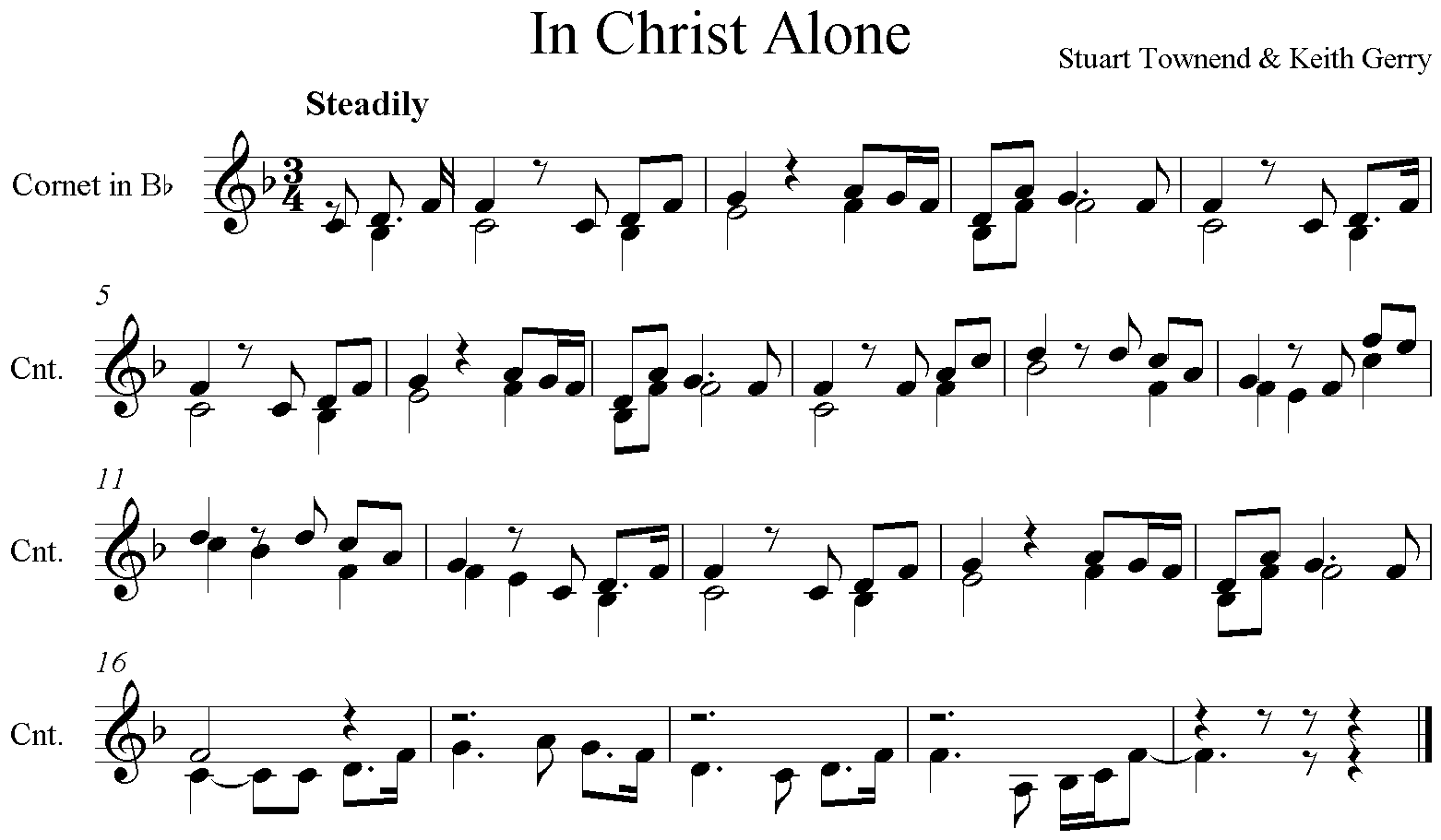 Here, as elsewhere, we have got ourselves into a very bad place of ‘culture wars’ in relation to doctrine, and on this (as well as eg the issue of women in leadership) it seems almost impossible to have a sensible discussion. More than that, for me it suggests a real problem in how we view doctrine. Is Scripture supposed to lead us to right doctrine, or does good doctrine help us to read the Scriptures? In my view, it is clearly the latter—it is Scripture that is ‘God-breathed’ (2 Tim 3.16) and not any doctrine textbook. This isn’t about saying truth is unimportant; it is saying that truth is not best expressed by a set of propositions alone. God did not make a mistake when he gave us the Scriptures, in all their variety and (apparent) contradictions. And our unity is not found in agreement on a particular statement of doctrine. It is found in the person of Jesus, crucified and risen, whom we proclaim as Lord. Our unity is, in fact, ‘in Christ alone.’
When Stephen Travis revised Christ and the Judgement of God, he included an additional chapter specifically responding to those proposing penal substitution as the main way to understand Jesus’ death. The chapter is a tour de force, a masterly exploration of the issue, fully engaging with alternative views, and is worth reading in full. He comments:
Most interpreters of Paul would agree with Howard Marshall, that ‘Paul’s vocabulary expresses the results of Christ’s death rather than its character, and this fits in with New Testament thought in general, which is more concerned with the nature of salvation than with the precise way in which it has been achieved.’ (p 181)
There is no place [in the OT] for the popular idea that in the sacrificial ritual God is somehow punishing the animal…or for the inference that something parallel to that is happening in the sacrificial death of Christ. (p 197)
Paul’s understanding of the death of Christ includes, but does not place at the centre, the idea that he bore the retributive punishment for our sins…To understand the atonement exclusively in those terms involves a misunderstanding of what Paul means by ‘the wrath of God.’ (p 199)
The meaning of the cross is not that God punished his Son in order to avoid punishing humanity, but that in Christ God himself took responsibility for the world’s evil and absorbed its consequences into itself. (p 200)
Finally comes the question of copyright. The Presbyterian Church were right to consult the hymn’s authors before changing the words in a published work. But what is copyright about? Principally two things: recognition of the author; and recompense for the work. It is not about hymn writers controlling our doctrine. In fact, if you read the words of the song, it is full of biblical language, and would be thought of as theologically conservative, even without this one phrase. There is plenty else here that I would hope the writers are pleased that people want to sing. So my recommendation would be to use it, to amend this one phrase, to credit the original writers, to note the amendment, and to pay up your royalty fee. Who knows? You might even end up provoking reflection on what Jesus’ death and resurrection (the NT holds the two together) actually mean for us.
If you have valued this post, would you consider donating £1.20 a month to support my work?
 Buy me a Coffee













Again a great article thank you, I seem to think that hymns have been changed to make them politically acceptable so why not theological changes?
Ian – it might be helpful include your opening comment on the link: “Sometimes evangelicals don’t help themselves. I cannot think of one NT verse which says God’s wrath was ‘satisfied’ on the cross. This is a mediaeval idea, not a NT one–and I wish Townend would acknowledge this.” Which may explain some of the intensity of the discussion.
As to whether God’s wrath was satisfied, Stott puts it well in The Cross of Christ, where after considerable discussion of the question of “propitiation” (also pointing out that it is obvious that wrath and propitiation go together) he concludes (p.204, 20th anniversary edition) “It is God himself in holy wrath who needs to be propitiated, God himself who in holy love undertook to do the propitiating, and God himself who in the person of his Son died for the propitiation of our sins.”
This does not separate the actions of the Trinity on the Cross.
Thanks David. I am not sure I will add the comment, as I do explain both these ideas fairly clearly–though it did prove to be provocative!
Thanks for the reference to Stott, though I think it does illustrate what I found unsatisfactory about his teaching. He holds to what feel like theoretical categories, but these don’t for me answer the question. If God needs to be propitiated, but can do the propitiation, why don’t these things just cancel each other out? Propitiation is an idea involving a powerful deity (who needs propitiating) and a powerless worshipper; once you talk of God doing the propitiating, then this whole idea no longer makes sense. It does not explain why forgiveness was so costly–but of course succeeds in ticking a doctrinal box by making use of the P-word!
Why cannot evangelical theology follow the shape and concerns of the NT, which does not seem to need to get into these logical tangles?
Try 1 John 2:2 “he is the propitiation for our sins”. Or is that John ticking a doctrinal box?
Leaving aside copyright, and sticking to theology and doctrine, I’m going to propose another possible wording.
At the heart of the debate is difference of understanding of technical terms between (on the one hand) theologians and (on the other hand) we ordinary mortals “in the pew”. The classic example is the word “myth”, which theologians view with a technical meaning that is fully compatible with orthodoxy but which we “in the pew” mortals automatically regard as meaning pie-in-the-sky fairy-tale (and thus clearly heretical). By all means let’s use the word myth in Christian theology lectures in universities. But in the ordinary little church, we do well to avoid the word altogether, because of its different, common, meaning in this sphere. This is matter-of-fact pastoral reality with real people in the real world.
Right… back to our song…
Many of us are uneasy about “the wrath of God was satisfied” for reasons already well rehearsed.
But the phrase “the love of God was glorified” is also flawed. It can be seen as compatible with the Johannine account of the crucifixion, but seems almost flat contradictory to the horrors of, say, the Markan account. The phrase is heavily skewed and fails to account for the diversity in the “apprehended mystery” in the various accounts
Could I suggest another possibility, courtesy of a fellow Hymn Society colleague? Something like:
till on that cross as Jesus died

God's love was seen [or shown] exemplified.
David Brock: No I don’t think it is–not least because it occurs so rarely. Hilasmos only occurs here and in 1 John 4 in the whole NT, so it does not look like a controlling metaphor. This raises the question as to why it has become so central in certain parts of evangelical theology.
Moreover, it is not clear that it should be translated ‘propitiation’, or whether in turn this idea includes the ‘satisfaction of wrath.’ The case was made by Leon Morris, and Stephen Travis explores and unpicks his argument in the chapter I refer to.
It is interesting that both NIV and NET choose to translate it as ‘atoning sacrifice’, and as the quotation from Travis highlights, it is not clear that punishment is connected with sacrifice in either Old Testament or New.
David Lee: yes I agree with you on the differences in language for different contexts. However, I think your example of ‘myth’ is not quite the same. In this case, the same word has different meanings, leading to misunderstanding. In the case of atonement, it is a matter of rather technical terms in which it is easy to get lost. ‘Atonement’ itself is an interesting case in point–if I recall correctly, it was invented by Coverdale from the idea of ‘at-one-ment’, in other words, reconciliation.
I’m not quite convinced by your alternative, since it is drawing in quite a different, unrelated idea of the cross. In the context of the hymn, the words that follow ‘For every sin on Him was laid; Here in the death of Christ I live’ focus on his bearing sin and the notion of exchange. I prefer simply to change ‘wrath’ to ‘love’.
The Fall shows us there is a consequence to sin (ejection from Eden and the end of eternal life) which is a punishment; but we can be forgiven. “In fact, the law requires that nearly everything be cleansed with blood, and without the shedding of blood there is no forgiveness.” (Hebrews 9:22.) You and others may find this a hard teaching, but it shows what an immensely loving God we have, who sees the helplessness of his people to put things right, and puts it right himself, by his own sacrifice of himself, available to any who trust in him. We are truly humbled by our magnanimous God.
Ian – it’s your blog and you probably have a reply or objection to that. For myself, I wish you well, but I am now going to bow out of this discussion.
An alternative proposed by a colleague and friend:
“the love of God personified”
David, there is lots in Scripture which is hard teaching, but that is not a reason to reject it. But what I am arguing for is that we accept Scripture, above the systematizing of particular theologians.
I think your comment is interesting, in that you conflate ‘punishment’ with ‘sacrifice’ in a way which owes more to a modernist-shaped evangelical doctrine than it does to Scripture. I, too, am truly humbled by a magnanimous God, but I want that to be formed by the language of Scripture. The fact that you appear to doubt my belief illustrates again the failure of the two sides to listen to each other, as I mention.
I notice that, when I raised a question about your claim of the importance of propitiation, rather than engage with what I have said, you make a general comment about how unsound I am. I think this is a shame.
I’m fascinated by several things in this debate, which I’ve been following (rather distractedly) ever since it surfaced.
As you point out, the actual doctrinal debate is far more technical and narrow in focus than some commentators realise. It’s not about “wrath” as such (a good NT term), but about the Anselmian understanding of “satisfaction”. You point out that “wrath” is always a noun and never a verb in the NT, and that resonates with some ideas that are coalescing in my mind.
1. We need to distinguish between “wrath” and “being angry”;
2. “Wrath” does not necessarily imply “punishment” any more than it implies that God is angry. The object of God’s wrath is not Jesus, but sin. The biblical language of “wrath” expresses God’s implacable opposition to sin, but the old saw about God hating sin but loving the sinner also applies to Jesus in his substitutionary death.
“Is Scripture supposed to lead us to right doctrine, or does good doctrine help us to read the Scriptures? In my view, it is clearly the latter—it is Scripture that is ‘God-breathed’ (2 Tim 3.16) and not any doctrine textbook.”
From your assertion after the dash I take it you meant “former”, not “latter”. Is that right? Anyway, by this statement you simply identify yourself as an evangelical. The fact is that both are true. I can’t see how anyone merely reading the scriptures in the bible could possibly arrive at the doctrines evangelicals espouse. Seems to me the scriptures support, but do not by themselves fully generate, current church doctrine. Hence, christian doctrine has developed over the years.
Andy, no, I did mean the latter. I am not here saying that it is doctrine that determines Scripture–I agree with you that our doctrine must arise from Scripture. But the question I am raising is: what is the goal? is it to end up with a sound doctrine text book for us to read, or is it for us to read Scripture aright? I often get the feeling from some evangelicals that they think God made a mistake in giving us Scripture, and Wayne Grudem has helped God by setting that right!
The relation between the two is hermeneutical–the hermeneutical spiral–so we come to Scripture with some presuppositions, then allow Scripture to reform these, and with these reformed understandings we read Scripture afresh…and so on. But the final goal is NOT that we can formulate propositional doctrine correctly, but that our understanding allows us to read Scripture correctly. For me, this must be the true goal of being evangelical–of being Christian in fact.
Does that make sense?
Ian, you said: “In fact, Romans 5.9 is the only verse in the NT which links Jesus’ death with deliverance from wrath explicitly, and here Paul clearly has the final judgement in mind, not some transaction which takes place on the cross at the time of Jesus’ death.”
I would suggest that your denial here (…’ not some transaction …’) is misplaced. How can that be excluded (given ‘blood’, v9; ‘death’, v10)? Perhaps the apostle can have more than one thing ‘in mind’.
Thanks for the question Pete. The question I was exploring is ‘Does the NT anywhere describe the cross as satisfying the wrath of God’ and you offered this verse. Interestingly, as you point out, it appears to be the only place in the NT which links Jesus death with the term ‘wrath’. (That in itself should give us pause for thought.) But it does not do so at the moment of Jesus’ death—here Paul is saying that the (past) death of Jesus will save us from the (future) wrath ie God’s judgement of sin at the end of time.
So there appears to be no trace of the kind of transaction articulated in the modern theory of penal substitution, whereby Jesus offers himself as a sacrifice to be punished in order to satisfy God’s wrath on the cross. As Stephen points out,
a. the retributive dimension to wrath in Paul is muted in favour of a more relational understanding
b. this is not central in Paul’s thought and
c. the modern theory conflates and confuses several different metaphors in the NT relating to what Jesus’ death means.
In addition, I think Howard Marshall’s comment is key: the NT is not interesting in mechanism, but in effect. PSA appears to be wanting to articulate a mechanism.
Thank you, thank you, thank you, thank you!
Thanks for the retraction Ian,
I think I agree with you: “the (past) death of Jesus will save us from the (future) wrath ie God’s judgement of sin at the end of time”. That is pretty much what I mean when I sing ‘the wrath of God was satisfied’ – that the future eschatological judgement has already NOW been “paid or discharged in full” through the death of Jesus and no longer faces those in Christ. The primary question of transaction/mechanism for me is then what Paul thought it was about Jesus’ blood/death that meant that those united with him would not experience God’s wrath (i.e. esch. judgement).
Hmmm…not sure I retracted anything! Just seems curious to me that it never occurs to Paul to use this language…so why should I? More to the point, why should people get upset when I don’t use Paul’s language, and want to use Paul’s rather than Anselm’s or Calvin’s?
And if that is what you mean, you should sing ‘The wrath of God will be satisfied…’ though satisfied is such an odd term for it.
I’m not upset. I like singing in Greek too.
Your thoughts on the primacy of Scripture over doctrine are incredibly helpful, Ian. I’ve been thinking my way around this area for some time but haven’t been able to articulate it in such lucid way as you do here! Once again we have the paradox that many who (rightly) put Scripture ahead of tradition actually only see it through the lens of a particular interpretative tradition, make that into a shibboleth and discourage any independent thought that comes up with a different conclusion!
(Off topic – I do hope that you and the family are settling into your new home and enjoying the freedom of being outside the St John’s bubble!).
John–thanks so much for your comment. I have been mulling over this issue for some time, and hope at some point to write more on the nature of Scripture, which I see more as an act of communication than a thing in itself. If you would like me to come up to the diocese to do anything, do look under my ‘Speaking’ page.
And yes, I am enjoying the freedom, not least to write on the blog! We are in the throes of moving just now!
Pete: No you are not. But clearly others are! Btw, ‘Rejoice in the Lord always, and again I say rejoice’ works really well in Greek, and scans perfectly. I used to use it in Greek classes…
We’ve changed it at our church to “and on the cross the love of God was satisfied”. Would want to argue that it was an act of love by God.
Thanks for this post.
I wrote about this here:
http://liturgy.co.nz/the-wrath-of-god-was-satisfied/14897
and in a follow-up post.
It certainly generated a lot of debate – some of it with more heat than light.
Blessings
Bosco
Bosco, thanks for the link. Nice to see that I am looking quite moderate by not calling this ‘heresy’!
I notice on Peter Carrell’s blog someone cites Tom Wright, though I not sure from where, as it is not referenced:
“This is what happens when people present over-simple stories with an angry God and a loving Jesus, with a God who demands blood and doesn’t much mind whose it is as long as it’s innocent. You’d have thought people would notice that this flies in the face of John’s and Paul’s deep-rooted theology of the love of the triune God: not ‘God was so angry with the world that he gave us his son’ but ‘God so loved the world that he gave us his son’. That’s why, when I sing that interesting recent song ‘In Christ alone my hope is found’, and we come to the line, ‘And on the cross, as Jesus died, the wrath of God was satisfied’, I believe it’s more deeply true to sing ‘the love of God was satisfied’. I commend that alteration to those who sing that song, which is in other respects one of the very few really solid recent additions to our repertoire. So we must readily acknowledge that, of course, there are caricatures of the biblical doctrine all around, within easy reach.”
For those interested in such things, I have just checked the UCCF basis of faith (which I am happy to sign) and I was reassured to read this about the work of Jesus:
Sinful human beings are redeemed from the guilt, penalty and power of sin only through the sacrificial death once and for all time of their representative and substitute, Jesus Christ, the only mediator between them and God.
This statement includes a wide range of metaphors from Scripture: redemption; sacrifice; representation; substitution; mediation. It also alludes to the Christus Victor model in mentioning the power of sin. No mention here of satisfying wrath.
First, a confession – I have only skimmed the article and not read all the comments, so I may be completely missing a point that has been covered! But I have often thought that a helpful passage in understanding sin, wrath and atonement concerns Phinehas, the man whose action in killing an Israelite in the act of orgiastic fornication with a Moabite woman averted a plague on Israel (Num 25:1-9).
The relevant quote is God’s words in the next few verses:
“And the Lord said to Moses, “Phinehas the son of Eleazar, son of Aaron the priest, has turned back my wrath from the people of Israel, in that he was jealous with my jealousy among them, so that I did not consume the people of Israel in my jealousy. Therefore say, ‘Behold, I give to him my covenant of peace, and it shall be to him and to his descendants after him the covenant of a perpetual priesthood, because he was jealous for his God and made atonement for the people of Israel.’ ” (Numbers 25:10-13, ESV)
A couple of thoughts occur to me:
1. God’s plague is a response to (or, to use the normal expression, a punishment for) sin.
2. God’s plague is the result of God’s wrath. The word ‘wrath’ here (chemah) means ‘fury’, ‘rage’, ‘anger’.
3. The action of Phinehas ‘turns back’ God’s wrath (from shuv, the same word as for repentance).
3. The action of Phinehas is consistent with the ‘jealousy’ of God, which is itself the cause of the plague, which is the punishment for sin.
4. The action of Phinehas is commended by God as a priestly act. Indeed, it confers on him a ‘perpetual’ covenantal priesthood.
5. The action of Phinehas in killing the Israelite and his consort “made atonement” for Israel. The verb comes from the KPR root (as in Yom Kippur, the ‘Day of Atonement’). The LXX translates it ex-hilaskomai – which relates to the notorious ‘propitiation’ word hilasterion. See also Lev 9:7, “?Moses said to Aaron, “Come to the altar and sacrifice your sin offering and your burnt offering and make atonement for yourself and the people; sacrifice the offering that is for the people and make atonement for them, as the LORD has commanded.” (NIV)
So it seems to me, in this instance at least, atonement can be a priestly action which averts the punishment for sin resulting from God’s wrath. In this instance, again, the atoning act is the putting to death of an offender in a manner mirroring God’s punishing of the greater number.
And that, it also seems to me, is a pretty ‘classical evangelical’ understanding of atonement, so I hope this helps.
PS. Article 2 of the 39 Articles says, Jesus “suffered, was crucified, dead, and buried, to reconcile his Father to us“. (Just thought I’d throw that in.)
John, thanks for joining the discussion and making such a helpful contribution. I think it does highlight the very different approaches to the subject amongst evangelicals.
What I find most notable about your text is how relatively obscure it is. Amongst all the texts about sacrifice in the OT, this one text brings together the things which are apparently the centre-piece of this doctrine. I think this suggests that, in terms of biblical theology, this idea is ‘eccentric’–away from the centre of things. And of course the text on Phinehas uses the idea of ‘turning away’ wrath rather than ‘satisfying’ it.
I don’t really know what you intended by juxtaposing Lev 9.7, since in this passage there is no mention of punishment–indeed, the purpose of the sacrifice appears to be purification, or the enabling of relationship.
Thanks for the reference to reconciliation—a different metaphor for what is happening on the cross— from the Articles. This, together with the fact that satisfaction of wrath occurs nowhere in the UCCF basis of faith nor the CEEC basis of faith suggests that it does not have the status in evangelical thought that is claimed.
Ian, your reply is itself arguably a bit ‘eccentric’ regarding the main point, given that the example in Numbers, as you acknowledge, brings together the things in dispute. Surely this means, at very least, they can be brought together? As to ‘obscurity’, I’m not sure how the text merits that description, even in ‘relative’ terms. Num 31:7 seems to indicate that this was a crucial moment for Israel and perhaps even Balaam’s ‘Plan B’. See also Num 31:16.
Regarding whether it is ‘this one text’, you might consider Psa 106:21-23, referring to when Moses interceded for the people, despite God offering to replace the nation with his descendants (ie, he becomes the ‘one man in place of the nation’), and also asked to have his name blotted out of God’s book: “Therefore ?he said he would destroy them—
had not Moses, his chosen one, ?stood in the breach before him,
to turn away his wrath from destroying them.”
Similarly, Job’s friends offer a sacrifice at his hand, accompanied by his prayers, so that the God whom they have angered does not ‘deal with you according to your folly’ (Job 42:8).
Or again, in Ezekiel, after outlining the judgements he will bring on Judah, God says, “Then my wrath against you will subside and my jealous anger will turn away from you; I will be calm and no longer angry.” (Eze 16:42). Is this not a kind of ‘satisfaction’? (See also Eze 5:12, ASV) “?Thus shall mine anger be accomplished, and I will cause my wrath toward them to rest, and I shall be comforted [Heb: nacham – the root word that gives us ‘Noah’]; and they shall know that I, Jehovah, have spoken in my zeal, when I have accomplished my wrath upon them.” Is God’s wrath here not ‘satisfied’ by his judgement?
As to ‘satisfaction’, I wonder if this has been carefully-enough defined. The Book of Common Prayer, of course, says that Jesus made “(by his one oblation of himself once offered) a full, perfect, and sufficient sacrifice, oblation, and satisfaction, for the sins of the whole world”. I presume we have no problem with the meaning of ‘satisfaction’ here, only with its application to ‘God’s wrath’. But the point being made in the BCP is that nothing was lacking becasue nothing was missed. In that sense, to say ‘the wrath of God was satisfied’ means there was ‘no more wrath’ – which is surely true as an outcome of the crucifixion.
(Incidentally, we shouldn’t overlook the fact that ‘satisfied’ also rhymes with ‘died’, and that may also have affected the choice of words.)
My reason for referencing Lev 9:7 was simply to point out that the ‘atonement’ wrought by Phinehas is a ‘sacrificial-type’ atonement at the altar.
Incidentally, unless I’ve misunderstood it (and it is complicated to follow), the offering referred to in Leviticus includes a male goat as a “sin offering” for Israel. This word chattah also means ‘sin’ or even ‘punishment for sin’ (Lam 4:6; Zech 14:19). ‘Guilt for sin’, and ‘punishment for guilt’ would seem to be envisaged in the purposes of the sacrifice.
Furthermore, when he discovers later that the goat has not been eaten, but instead has been burnt, Moses chastises Eleazar and Ithamar, saying, “it has been given for you [to eat] that you may bear the iniquity of the congregation, to make atonement for them before the Lord”. Not only is there atonement for sin, which implies punishment, but there is ‘substitutionary’ sin-bearing.
John, I do think our different comments illustrates again a significant difference of approach. You comment ‘Surely this means, at very least, they can be brought together?’ and yes, this is clearly possible. But I just don’t buy into this way of reading scripture, which seems to be: identify an issue; hunt through the Scriptures for possible support; put the different verses that might support this together into a kind of pastiche; where idea A is put with idea B, then in other verses wherever A occurs assume B goes with it. I think this flies in the face of common sense in relation to reading, how language actually functions, and the shape and priorities of Scripture itself.
Instead, we need to look at the central passages on sacrifice, atonement, and the cross (central according to where Scripture itself puts weight), and see what emerges–and then let that shape our understanding. As Stephen Travis points out, some keys things emerge:
. wrath has a different dynamic to it in the NT than the OT, and we need to take seriously both continuity and discontinuity in the way the NT appropriates OT imagery
. Is 53 is an important text, but as a number of studies point out, its NT use (such as it is) reads in ideas which are not present in the OT text itself.
. it is really striking throughout that the idea of ‘sacrifice’ and ‘punishment’ are really distinct in the OT sacrificial system, and its appropriation for explaining the death of Jesus.
. even if there is a relatively minor note in the NT of Jesus’ death dealing with, somehow, or turning away God’s wrath, the idea of ‘satisfaction’ is never used.
At the very least, this means that the phrase ‘the wrath of God was satisfied’ owes nothing to biblical theology, so to claim this is somehow central to evangelical thinking looks implausible–unless by ‘evangelical’ one means a tradition which is not itself shaped by Scripture.
Ian, I would personally have said that the business of relating disparate parts of Scripture to one another is the discipline of systematic theology (those as Colin Gunton noted, there’s an important difference betwee aiming at a theology that aims at a ‘system’ and ‘systematic theology).
As one of our Scottish theologians noted, there is an absence of systematic theology in the English tradition, and I think this discussion shows why that is a weakness. It is also a problem having a discussion if any biblical material presented to the contrary of one case is ruled by the holder of that position to be insufficiently central.
However, I will bid au revoir with one question. The BCP and Articles say Jesus’ death was a satisfaction for sin. What, or who, was ‘satisfied’?
John, I am sure you will realise that both Stephen and I have all the way through the discussion been relating different parts of Scripture together. But it can be done well or badly. Hal Lindsay was very good at relating different bits of Scripture together–in quite a random way in order to prove his point. He described is at ‘biblical hopscotch.’ By contrast, I think Stephen is looking carefully at the key texts, and evaluating them on their own terms, allowing Scripture to shape the priorities. That is how his chapter on the question is shaped.
The case put by my correspondent mentioned in the past was that believing the wrath was satisfied is so important and so central that you could not call yourself an Anglican or an evangelical if you did not believe in this. That is what the discussion is about. So, I don’t deny that you might be able to find a text which puts this–but that cannot bear the weight that is being put on it.
I believe that it was God who was satisfied, again as the blog post says.
Ian, from what you’re saying, I’m having trouble working out what is being disputed here:
1. That God (including, of course, the Son, Jesus, Rev 6:16) is wrathful against sin and sinners?
2. That sacrifices take away the guilt and penalty of sin, and therefore avert God’s wrath?
3. That this aversion of God’s wrath is through a ‘satisfaction’ for sin made by Jesus on the cross?
4. That the NT concept of God’s character (including his wrath) is the same as the Old?
5. That the NT concept of a sacrifice for sin is consistent with the Old?
It seems to me that none of these are really being disputed, so what’s the big problem with singing “the wrath of God was satisfied”? All it need mean is that the wrath of God was averted by the cross because the cross took away all reason for God’s wrath to be exercised against sinners.
If the dispute is about the means by which it did this, that’s another matter, but it is not mere stubbornness, ignorance of Scripture or over-systematizing that has consistently led evangelicals to understand (and preach) that Jesus bore God’s wrath and the subsequent penalty for sin at the cross. How often have you heard sermons to that effect on the word from the cross, “My God, my God, why have you forsaken me?”
BTW, as to God being described as angry in the NT, don’t forget Heb 3:10 and Heb 3:17. However you translate it precisely, it is a verb!
One other comment – if evangelicals don’t preach that Jesus bore the penalty for our sins on the cross, who will? And they have been doing it to great effect for a long time!
I remember many years ago at a party being cornered by someone who was doing marriage prep with his local vicar. What he couldn’t work out, he said to me, was why Jesus had to die on the cross, and how this dealt with our sins. The vicar kept giving him various reasons, but he still couldn’t see the point.
Feeling rather foolish, I did a standard ‘presentation’ of Jesus as our sin-bearer who took the punishment in our place. I may even have used a book transferred from one hand to the other to illustrate the point.
Like I said, I felt foolish. It does sound silly, saying someone else stood in our place to take our punishment. But after I’d gone through it, he said to me, “I don’t agree with you, but I finally understand it.”
It was a humbling moment.
Forgive me if I’ve missed the answer amongst the extensive comments here, but I’m puzzled by something in the original article here. It is admitted that “satisfaction” is found in the Prayerbook liturgy, yet argued that such satisfaction has nothing to do with God’s honor or wrath. What, then, is the Prayerbook satisfaction supposed to be alluding to?
Let’s push the Prayerbook line further (1662 for sake of common ground). Both the prayer of confession in the Communion service as well as The Litany identify God’s wrath as something sinners experience. The former declares that we provoke God’s wrath by sinning; the latter beseeches God to deliver us from His wrath and from everlasting damnation.
Granted, the satisfaction/appeasement/dealing with God’s wrath is a minor point in the course of St. Paul’s writings, but surely its few shout-outs can’t go completely ignored. If the satisfaction of wrath is not one of the many aspects of Christ’s work of atonement, then what are you saying the Prayerbook is trying to say in these various instances?
John, what is being disputed here is the comment made to me which I mention above (have you had time to read the whole post yet?):
a. that Penal Substitution is the central idea in the NT understanding of the cross
b. that at the centre of this is the ‘satisfaction of wrath’, ie Jesus was punished by God in our place to satisfy his wrath towards us
c. that is underpins all other ideas, and without it no other NT metaphors make sense
d. that believing in the above is the essential hallmark of anyone who claims to be evangelical or Anglican
I think all four are mistaken. It is possible to be a biblically shaped evangelical and take a different view.
In relation to your five-point scheme, no I don’t agree with the scheme or the individual parts of it. I have offered my own ‘summary of the Bible’ in another post, and it might be interesting to compare. On the specific points:
1. The NT does not use the verb related to ‘wrath’ (orgizo) with God as the subject. I explore the significance of this in the post at a couple of levels. That is not to say that wrath is not in the NT—just that it is not the central theme.
2. I agree that in his sacrifice Jesus bears our sin, but you can offer yourself as a sacrifice in ways other than as taking someone else’s punishment, and the NT draws on a range of ideas here eg the shepherd laying his life down for the sheep.
3. Jesus’ death was a satisfaction only in the sense that it was sufficient. As I say in the post, the idea that God’s wrath was satisfied is a mediaeval idea, and not one that is in the NT
4. and 5. I strongly believe in the unity of God’s character in the OT and NT. But we also need to read them in their respective literary, historical and canonical contexts, and take seriously elements of discontinuity as well as continuity in reading them together.
In your comment on Facebook, you put in capitals that Jesus’ death EFFECTS the solution to sin, and is not ‘merely’ an example of God’s love. I don’t like the ‘merely’ bit of it, but I agree that the cross effects something. But our point of departure is this: you don’t need to explain the mechanism to believe in the effect. Those who do not agree with you on PSA don’t then think the cross is somehow merely symbolic.
But I do think that evangelicals have over-systematized, and I think this leads to misreading the NT. Your scheme (which I was taught as a teenager by David Watson, using a glove) separates the cross from the resurrection; apart from vindication, your understanding of the cross has no need of resurrection. (Having been brought up on this, I did wonder for some years why the resurrection was necessary.) This was not true for Paul—he does not appear to be able to think of the one without the other. You also separate the cross from eschatology—again impossible for Paul—and from the gift of the Spirit. Paul seemed to see them all intertwined together—which strongly suggests he did not operate with your scheme ‘behind the scenes’ as it were.
I think your story of the ‘standard presentation’ highlights the problem. If we cannot explain the cross without such a scheme, I think we are lacking in pastoral imagination or engagement with what the NT actually says—or both. And I think your scheme perpetuates this. Once people have a scheme, they don’t need any longer to read the NT carefully, since the scheme does all the work for them. I preached on sacrifice from Hebrews recently, without any reference to ‘punishment’ (because it was not in the text) and someone came to me and said ‘Now I understand—thank you!’
Tom Smail’s Windows on the Cross demonstrates how to draw on all the different ways the NT talks of what Jesus’ death and resurrection effects very well, as (someone has suggested) the book The Wrath of God Satisfied? though I don’t know this book myself.
Ian, at the center of notion that Christ died for our sins or that we were justified or reconciled to God by Christ’s death is the notion that Christ made amends for our sin, which amends could only have been made to God since it is God’s wrath, God’s judgment, and God’s holiness that are at issue (not Satan’s). Your attempt to explain how it is that Christ’s death justifies us and reconciles us to God by saying “the shepherd laying his life down for the sheep” is not an explanation of how it is that Christ’s death/blood justifies/reconciles us to God such that we do not receive God’s wrath and condemnation at the end (Romans 5). Of course Christ voluntarily lays his life down. The question is: Why does this do anything? I can lay my life down but it won’t effect forgiveness of sins for anyone. You want us to use our “theological imagination” to come up with other reasons for explaining how it is that Christ’s death justifies us and reconciles us to God but I have not heard from you either in your article or subsequent responses how it is so. You don’t like the concept of God’s wrath being given a significant place in explaining atonement and yet it features very prominently in the most significant epistle in the NT, in that section that deals precisely with the human problem and the divine solution to that problem (Romans 1-5).
Ian, just on the point of ‘being angry’, you seem to be saying that God has anger (orge usually translated ‘wrath’), but does not ‘do anger’ (orgizo. That’s a rare trick. Wouldn’t you say that someone who ‘has wrath’ is ‘wroth’?
But in any case, there are numerous uses of the verb in relation to God and sin in the LXX. Do these not count?
Surely one of the problems here is that most (though not all) English translations (and Stuart Townsend) use one word for the noun form of orge and another for the verb form orgizo. Thus the former is usually rendered ‘wrath’ and the latter ‘angry’.
But to be consistent, we ought to use ‘anger’ and ‘angry’ (or ‘wrath’ and ‘wrathful’). That way, passages like Rom 12:9 would read, “Do not avenge yourselves, but leave it to the anger of God.” Or 1 Thess 2:16, “The anger of God has come upon them at last.”
And I suggest that if that were followed, we wouldn’t be having this discussion in quite this form! ‘Wrath’ has almost become a way of distancing God from ‘anger’, but that can’t be right, surely?
And that should have been Rom 12:19, not 9!
John, to note that God is never the subject of a the verb orgizo is not a trick–it is a feature of the NT, and signifies a shift in the understanding of wrath from the OT to the NT. What I am asking for is not tricks, but careful attention to what the NT is actually saying. Every time you argue for the notion of ‘satisfying God’s wrath’, you cite some verses, and then have to add in the idea yourself, since ‘it MUST have been like that’.
But I don’t think it ‘must’. The NT talks about Jesus’ death ‘saving’ us or ‘rescuing’ us from God’s wrath, but never of the wrath being ‘satisfied.’ I think that doing so turns God into a celestial accountant in the way the NT doesn’t.
I am still at a loss to understand why, when I believe that there is salvation in Christ alone, that Jesus is Lord, and that his death fully effects freedom from sin—along with all the other things that the NT says it does—because I do not subscribe to a phrase that is NOWHERE in the NT I am still a heretic.
Robert, thanks for contributing to the discussion on the blog. I think your comments about John 10 are circular, since you are coming to the text with the single question ‘How can I find forgiveness for my sins?’ This is clearly a key question in the NT, but it is not the only question the NT engages or answers. John 10 does give a reason for the shepherd laying down his life—because this shepherd is the only one with the power to protect us and the only one who loves us perfectly.
I haven’t said that I ‘don’t like’ the idea of wrath being given prominent. It is not a question of ‘what I like’ (though I don’t think any of us should ‘like’ the idea of wrath and judgement—it is too easy to bandy these terms about). I am asking the specific question of whether the ‘satisfaction’ of wrath is the key to atonement, as has been argued by others, and as is set out in the song.
I am glad that scholarship of the last 30 years or so has recognised that Lutheran obsession with sin and conscience has imposed a framework on Paul which is not as prominent in his theology as has been argued. I agree that if we come to the text with the question ‘How can I be free from the guilt of sin which I feel?’ then Romans 3 looks central to this. But I am not convinced that all Paul’s theology centres around this in the way you describe—and as I mention in the comment above, God’s wrath is never described as ‘being satisfied.’
we need to think very hard to understand why it is that evangelical theology has so constructed itself that a phrase which occurs NOWHERE in the NT has somehow gained such importance that it is seen as the centrepiece of orthodoxy.
Ian, how does the idea of ‘anger’ shift from the OT to the NT, especially with regard to God? You’ve lost me there.
Also, are you not, as I suggest above, trying to distinguish ‘anger’ from ‘wrath’ on philological grounds?
Finally, I offer here the amendment that I put on my own blog:
“Till on that cross as Jesus died,
The wrath of God was turned aside.”
Acceptable – or not?
Ian, Thanks for your response. Btw, at Pittsburgh Theological Seminary I use the Exploring the NT Letters IVP textbook put out by Howard Marshall, Stephen Travis, and you. Good work. My students appear to like it also.
You say: “We need to think very hard to understand why it is that evangelical theology has so constructed itself that a phrase which occurs NOWHERE in the NT has somehow gained such importance that it is seen as the centrepiece of orthodoxy.”
How about the Trinity? I don’t recall that word being anywhere in Scripture but it seems to have unusual importance such that it is “the centrepiece of orthodoxy.” The argument that the precise phrase “satisfy God’s wrath” does not appear is thus not a particularly strong argument.
The question is whether the concept appears in the NT, not the specific words. The concept of Christ’s death making amends or restitution to God through Christ’s death, with God’s judgment toward us changing from wrath/punishment to salvation, is found in the NT in a number of highly significant texts. To say that Christ’s death satisfies God’s wrath is simply shorthand for this clearly scriptural view.
On John 10, you say: “John 10 does give a reason for the shepherd laying down his life—because this shepherd is the only one with the power to protect us and the only one who loves us perfectly.” Your response begs the question: Yes, Jesus loves us (that’s not under debate here and in no way antithetical to the view of atonement that I am espousing) but how does laying down his life protect us? That still has not been explained by you.
An important theme in John is that Jesus is the Lamb of God who takes away the sins of the world by his death, thereby changing God’s response to us from one of wrath or condemnation to one of eternal life (God is at the same time the one who gives or hands over his Son to death for our sakes at great cost to himself and love for us). The sacrifice of the Lamb of God to God and initiated by God can only be described as making amends for our sin to God, thereby solving the problem of how God in his holiness can simply pass over sins and leave them unpunished. Ian, in your view, why does the sacrifice of the Lamb of God effect anything? What does it do? Does it not make amends to God for our sin?
Rob
Ian, you say:
“I think your comments about John 10 are circular, since you are coming to the text with the single question ‘How can I find forgiveness for my sins?’ This is clearly a key question in the NT, but it is not the only question the NT engages or answers…. I am glad that scholarship of the last 30 years or so has recognised that Lutheran obsession with sin and conscience has imposed a framework on Paul which is not as prominent in his theology as has been argued. I agree that if we come to the text with the question ‘How can I be free from the guilt of sin which I feel?’ then Romans 3 looks central to this. But I am not convinced that all Paul’s theology centres around this in the way you describe.”
First off, the description of salvation in Romans 1-5 must be viewed as central, no matter how one slices things on the particular issue of satisfying God’s wrath. The letter, while still having an occasional nature, is the closer thing that we have to a full presentation of Paul’s gospel (since Paul is, to some extent, introducing himself to a community not fully familiar with his views) and it is the product of mature reflection toward (what became) the end of his ministry, bringing together most of the most significant themes of his ministry (not all, to be sure, but most). Romans 1:18-3:31 lays out the human problem and God’s solution in Christ to that problem in such a way that Paul can confirm “I am not ashamed of the gospel because it is the effective power of God to save all who believe it.” Chapter 4 provides further scriptural confirmation regarding Abraham and chapter 5, while starting a new section, draws some conclusions from it for the Roman believers regarding in boasting in what God has done in Christ, further elaborating some themes from 1:18-3:20. Any description found therein regarding how Christ’s death saves us from God’s wrath would have to be treated as having particular importance for the church of God.
In that section the question that does dominate is: Why is God’s wrath and judgment upon all humanity, Jew and not just Gentile, and how does God change the fate of many from destruction to life? That is the central question and its place in the opening of Romans indicates its centrality for Paul’s gospel, by definition. I am well aware of the New Perspective view. (Some years ago I critiqued Krister Stendahl’s Introspective Conscience of the West, and by implication some later New Perspective thought, at the Society of Biblical Literature meeting with Stendahl, Richard Hays, and Tom Wright sitting in the front row no more than 20 feet from me.) Some of that view is good but it doesn’t get everything right (imo). Romans 1-4 (5) is still asking and answering the question of how humans can move from a situation of being under God’s wrath to a situation of being recipients of God’s salvation. Gentiles are of course in deep trouble since their sins are generally both more egregious and more numerous than those of the Jewish people. But even those under the law, Paul argues, are under God’s wrath and need a way out in order to move from the condition of being recipients of God’s wrath to recipients of eternal life.
Note that I am not describing my position in quite the way that you appear to be formulating it: The issue of life and salvation is not limited to forgiveness of sins and the alleviation of guilty consciences. But the text of Romans 1-4 (5) does address the objective question of how it is that all humanity stands under God’s wrath and how God changes that situation for those who put their trust in Christ (and, as 6:1-8:17 shows, walk in his Spirit). The view that Christ made restitution and amends to God for human sin by his death, thereby moving people from God’s wrath (judgment) to God’s righteousness (salvation) plays a pivotal role in answering these questions.
Imo, three points germane to our discussion arise from a reading of Romans 1:18-3:26 in particular and Romans 1-8 in general.
(1) The concept of God’s wrath against sinful humanity is a dominant concept, as also the related concept of God as the one who judges and decrees death (viz., exclusion from eternal life) as the punishment to befall unrighteous humanity.
(2) Satan nowhere figures in the discussion. Sin is consistently presented as an affront to God that incurs God’s punitive judgment.
(3) God in his grace provides a way for humans to be justified and reconciled to himself without simply leaving sins unpunished: namely, through the means of Christ’s death, which is viewed both as redeeming people through payment of a ransom or price of release (the cost of Christ’s life) and as a sacrifice that makes amends or restitution for human sin. If indeed Christ’s death makes amends/restitution to God (not Satan) for our sins such that God’s wrath no longer falls us who believe, there can be little question of denying that Christ satisfies God’s wrath.
This is not a minor element of the gospel. It appears in the most important letter of the New Testament within the letter’s most significant unpacking of the message of the core gospel.
Yes, the NT has many images for salvation but most of them express the results of Christ’s amends-making death, not atonement proper. Justification, forgiveness of sins, reconciliation, and victory over the powers all express the results of the fact that Christ’s death made full restitution for human sin (exemplar shouldn’t even be put in the category of atonement). The term hilasterion (amends-making offering) and the words for redemption best express the basis for justification, reconciliation, etc. Christ paid a price for our release. That price was his death. And the price paid or restitutition/amends made makes possible all the benefits of Christ’s atoning work.
In your FB page you responded to this by saying:
“You distinguish between language of atonement ‘per se’ and language which is the result of atonement. But to support this, you would need to demonstrate that Paul uses distinct patterns of language for these two kinds of things—which he does not appear to do. You give the example “reconciled to God by the death of his Son,” from Romans 5, but this is not in a different form from your language of ‘the price paid by the death of Jesus’.”
I confess that I don’t understand your point. A means is clearly designated in Rom 5:9-10 by the prep. en (justified by means of his blood) and by the prep. dia + gen. (reconciled through his death). I don’t know how much clearer you want Paul to be that justification and reconciliation are accomplished by means of something that happens in Christ’s death. What I’m trying to get from you is an explanation of what that something is.
You also expressed to me on your FB page the following (a point that you also raise in your postings above in response to John Richardson and others):
“My main concern … is that the kind of scheme proposed under PSA takes the place of Scripture, and fails to hold together what Paul holds together. If the core of atonement was the price being paid, and this alone (with all other images flowing from it), how does Paul see Jesus’ death and resurrection as inseparable? How does this bring in the age to come? Guarantee the gift of the Spirit? Through the different metaphors in the NT, these things all seem to hold together, and cannot be separated. But with PSA as central, they can be.”
Transferring our discussion on your FB page to the more accessible form here, let me say that I fail to see how the view that I have put forward doesn’t hold things together. The resurrection coheres with his death because, once Christ has made amends for human sin to God, it becomes necessary to inaugurate the new creation through his resurrection. No one enters the new creation whose sins have not been atoned for by Christ’s blood. And atoning for the sins of others doesn’t yet create the new sphere of existence necessary for eternal life; so the resurrection is an essential complement to Christ’s atoning death but is also only possible through that death. How is that not a connection? Once the temple of these bodies has been atoned for, it becomes possible for God to inhabit them in the person of his Spirit. I don’t understand your complaint here.
This image presented here is consistent with the one offered in Isa 53 of God’s Servant, so influential for the Early Church’s interpretation of Christ’s death:
“Surely he [the Servant] … [was] struck down by God and humbled [or: afflicted]. And he was wounded for [or: because of] our transgressions, crushed for our iniquities. The chastisement for our well-being was upon him… And Yahweh has let the iniquity of us all strike [or: befall] him [or: has laid on him the iniquity of us all]…. And it was the will of Yahweh to crush him…. you make his life a guilt offering.” (my trans.)
This certainly sounds like God’s wrath being poured out on the Servant. You have responded: “‘This sounds like God’s wrath is poured out’ when God’s wrath is not here mentioned.” The fact that I used the phrase “sounds like” of course acknowledges that the exact expression “God’s wrath” is not used, so to critique the comment by saying “God’s wrath is not here mentioned” seems off the mark to me.
The fact is that Isa 53 states that God strikes the Servant down, wounds him, crushes him, chastises him, strikes him with our iniquity, and makes him a guilt offering. If that is not an instance of the Servant receiving God’s wrath being poured out on him, I don’t know what would be.
Again the pivotal significance of the Suffering Servant texts for the church’s understanding of Christ’s and the church’s mission suggests the pivotal significance of the view that Christ in his death took on God’s wrath (i.e., God’s punitive judgment on sin) in our place.
You also noted to me in your general response on FB:
“I think we need to take metaphors as metaphors, and not use them to explain mechanism. To take the one you have just written: Christ pays the price of release through his death for our sins. But pays to whom? Clearly not to Satan or to sin (even though Paul’s language suggests this at points). So ‘to God’ But how can Christ pay a price to God, when ‘I and the Father are one’? Pushing the metaphor into mechanism makes nonsense of a Trinitarian understanding.”
I don’t find this response effective because the NT says lots of things that might not work with preconceptions about what a doctrine of the Trinity allows or disallows. Scripture also talks about God handing over Christ to death; how can God hand himself over to death? 1 Cor 15 talks about how Christ reigns only until all things are put at God’s feet; but how is it possible that God can only reign until things are put at his own feet? God made Christ sin but presumably not himself. How is that possible? Jesus asks God why he has forsaken him on the cross: How can God forsake himself? The list is endless. You would essentially have to chuck much of NT Christology on the basis that it doesn’t fit assumed Trinitarian logic.
Christ’s death is prominently viewed under the metaphor of sacrifice and sacrifices are made only to God so what is God doing making a sacrifice to himself? And how is that any different from Paul’s remark in Rom 3:25 that God offered Christ to himself as an amends-making offering? Is there anyone else in the Bible that one is supposed to make a sacrifice to?
I also don’t see how you can disavow a priori that a metaphor can be used to describe a mechanism: “I think we need to take metaphors as metaphors, and not use them to explain mechanism.” Where is your justification for such a claim? You already acknowledged that redemption is a metaphor and surely you admit that the metaphor of paying a price for release is about how the atonement works. In what sense is a price being paid if not through the act of Christ’s death that makes amends or restitution to God for our sins?
John, Ian will of course respond for himself but I doubt, based on his earlier remarks, that he will be happy with your new form:
“Till on that cross as Jesus died,
The wrath of God was turned aside.”
Despite some of Ian’s comments about “satisfy,” the main issue for him and others does not appear to be the verb per se but the claim that God had any wrath at all against sinful humanity that Christ’s death changed. It still insinuates for them that God is an angry and even capricious God that Christ has to placate by his death … even though this spin of things is not part of the biblical framework of speaking about Christ’s restitution or amends to God for our sins.
What Ian and others are not picking up, perhaps, is that Christ’s death does not end God’s wrath on sinful humanity. That’s still coming and many face dire consequences. Christ’s atoning death has not changed God from a wrathful God to a gracious God (contrary to what Ian and others think the line in “In Christ Alone” is saying); it has changed God’s response to those who receive Christ’s amends-making death as their own. God has always been, and will yet be, wrathful toward those who have refused to repent and accept the way out that God has offered, just as God is always loving and gracious in seeking to bring people to repentance and faith in the gospel (and in having offered Christ with the latter’s consent and on our behalf).
Christ’s death satisfies God’s wrath. For those who embrace its atoning effects it means that God has accepted the restitution and amends made in Christ’s death and will not pour that wrath out on them.
Even Orthodox translate hilasterion/hilasmos as “expiation” (as opposed to propitiation) so you could render it as
“on that cross, as Jesus died, was the debt of our sin satisfied” if you prefer the expiation route.
You can’t get around this. You can’t only say, “Jesus just was a good example of love” or “Jesus shows an example of love” on the cross.
Let’s go a step further. If there was a debt that was satisfied ala expiation, 1) why was it a debt, 2) who was the debt against, 3) why is it a problem? I leave that with you to ponder.
Here’s one analysis for instance:
http://katachriston.wordpress.com/2011/06/22/propitiation-or-expiation-did-christ-change-gods-attitude/
I guess for myself the questions are simply this.
i) Is God wrathful against sin?
ii) Is God therefore wrathful against sinners?
iii) If he is, how does the death of Jesus sort that out? What is the economy of the atonement? How is that wrath diverted?
For myself the cross is the spiritual act of economy by which Christ (in taking my sin and brokenness AND in imputing to me his righteousness) becomes present at every point in my life. But that requires *something* to happen and it is that something which is the point of discussion. If you want to reject PSA one has to have a narrative as to what Jesus *did* spiritually on that piece of wood.