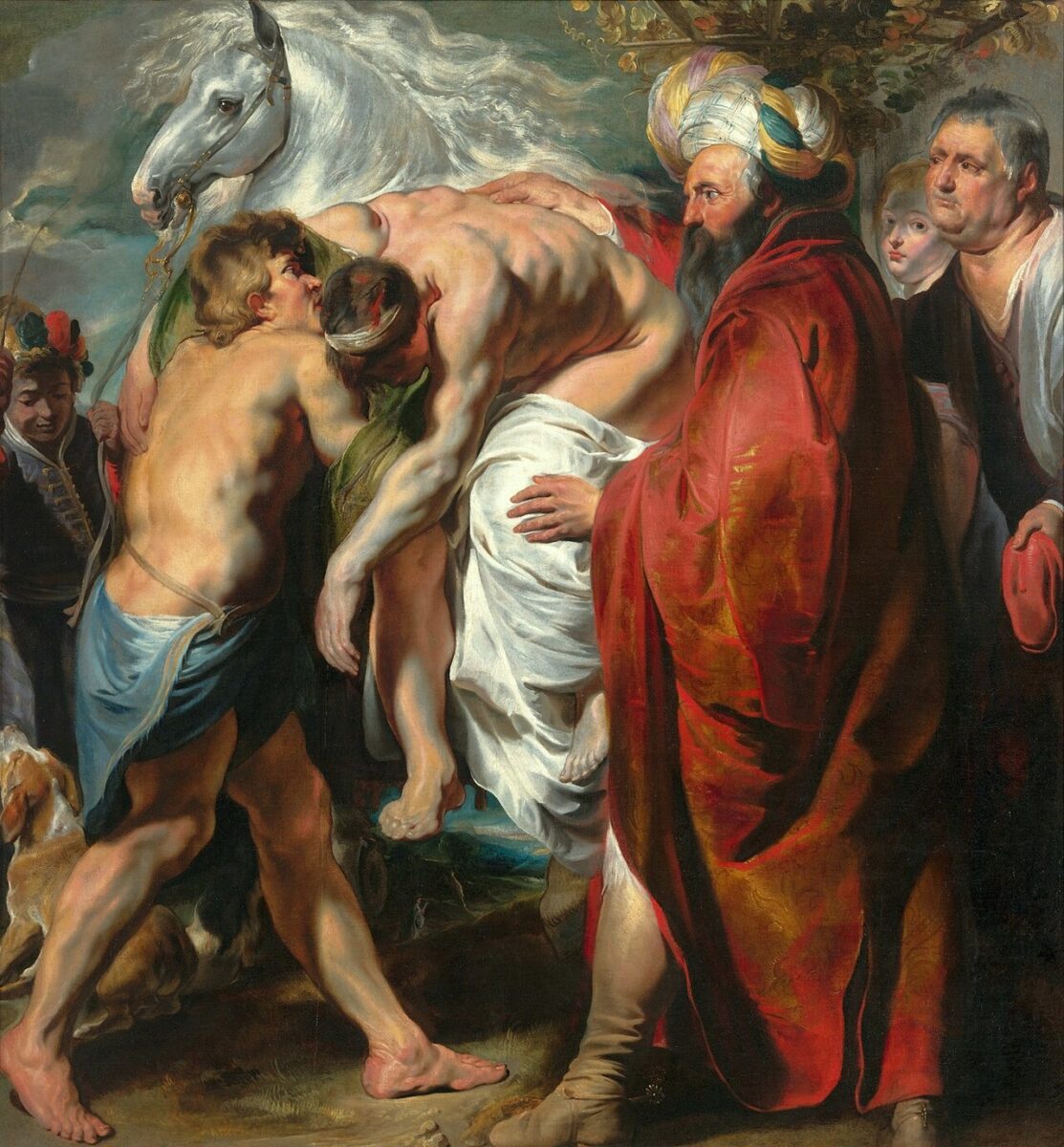
What do you think if someone says “Samaritan”?
John Hudghton writes: Mention the word Samaritan and your understanding may be shaped by Revd Chad Varah and the listening Samaritans in Britain. Similarly, there are numerous other charitable humanitarian organisations sharing the same name world-wide who may produce the same effect. We also know Jesus told the story of the good Samaritan, who helps his “neighbour,” despite negative Jewish-Samaritan relations. Many therefore get “good vibes” and associate Samaritans with acts of kindness—but should we? This article explores the Samaritan-Judean animosity, its origins in the Old Testament period, its dramatic unfolding and development between the Testaments, and the state of relations in the time of Jesus. We examine how Jesus addressed the issue and finally note a dark and ironic twist to the story, with a glimmer of hope at the end.
Who were the Samaritans? Old Testament period
You probably know that there still is a small Samaritan Israelite community. Who are they? Where are they from? “It’s complicated,” as they say, because it all depends on who you are listening to. In brief there is shared history between the Judeans and the Samaritans until just before the time of King David (c 1010—970 BC). Before then the tribes of Israel operate as an alliance, generally (with notable exceptions) having a degree of common purpose, ethnic cohesion, and mutual defence. When the tribes are united as a kingdom, it does not take long for tensions to emerge. (I always thought they should have listened to Samuel’s warning against demanding a monarch in 1 Samuel 8, but hindsight is a wonderful thing).
Samaritan Israelites take the view that David made a mistake in making Jerusalem the capital and that Solomon perpetuated that mistake in building the temple there. Samaritans maintain Mount Gerizim and the City of Samaria should have been the site of both. Judeans, we know, take the opposing view, well represented in the post Pentateuchal histories.
Interestingly, I Kings 11 ultimately and ironically lays the blame for the division of the kingdom at the feet of Solomon, who married foreign women and consequently engaged in idolatry. For this God promises the rending of his kingdom. (Why Solomon is lauded as being a prime example of wisdom utterly eludes me). This finds prophetic annunciation in the word of Ahijah, in the rebellion of Jeroboam (1 Kings 11:29–33). Jeroboam was one of Solomon’s officials, in charge of forced labour from the whole of Israel, engaged in constructing Jerusalem. Jeroboam flees from Solomon’s death threat and self-exiles in Egypt (1 Kings 11:40). He returns after the death of Solomon and acts as plenipotentiary for the Northern tribes, requesting improved treatment from Rehoboam, Solomon’s son.
Rehoboam takes poor advice, against that of the older and wiser counsellors of Solomon, and threatens an even harsher regime. Tensions turn into schism and the kingdom is divided (930–922BC). Judah and Benjamin form the Kingdom of Judah, the other tribes become the Northern Kingdom of Israel under the kingship of Jeroboam I. From herein it gets even more messy (1 Kings 12:1–24).
The Biblical sources from Judah record: wars between Northern and Southern kingdoms; idolatry on behalf of the Northern leadership (the irony); but also record faithfulness from the likes of heroic prophets such as Elijah, Elisha, Hosea, Amos and many more, courageously persevering under persecution. The picture is neither clearly black nor white, even within the Judean canon of scripture. The sins of the elite result in the conquest of Israel by Assyria (c 722 BC) with the deportations and population transfers that subsequently take place (2 Kings 17:7–23).
Again, there are differences of opinion and emphases regarding deportation and exile. How many of the population were deported? Was it a total replacement or was it the leadership and the artisans who were removed? Did those transplanted into Israel convert to the ways of Israel or did they bring further religious error into the land? Were Samaritans true Israelites or had their bloodline been “polluted” by foreigners? How many fled as refugees from Israel and ended up assimilating in Judah? There is a plethora of debatable questions.
Around 587 BC we witness the destruction of Jerusalem by Babylon, the deportation of the Judean leadership and high value inhabitants to Babylon. This, and events following their subsequent return from exile (537 BC), compound with historical tensions. Samaritan offers to assist in the rebuilding of the temple were rejected, with accusations that they were “half breeds” who had intermarried with those the Assyrians had resettled in the land (Ezra 4; nothing like burying the hatchet, eh?). Governor Sanballat is recorded as leading the Samaritans in opposing the rebuilding of Jerusalem’s walls—a threat so serious that Judean builders were on military standby while work proceeded (Nehemiah 4). Archaeological evidence reveals the Samaritans also built their own temple on Mount Gerizim, work commencing in the 5th century BC. All this created further division and enmity. Could the expulsion of the son of Joiada in Nehemiah 13:28 have contributed to this?
Who were the Samaritans? Between the Testaments.
It never helped the Samaritan cause in the eyes of Judeans that they did not take part in the Maccabean revolt against the Seleucids. Moreover, during the 167 BC uprising, the Samaritans corresponded with Antiochus IV, distancing themselves from the rebellion, requesting they should not be considered as enemies, asking for protection, and (allegedly) volunteering to rename the temple on Mt. Gerazim the temple of “Zeus Hellenius”.
In the later second century BC tensions become further strained. The Hasmonean prince and High Priest, John Hyrcanus (134–104 BC) assaults the Samaritan temple, destroying it in 110BC! This is all part of the Judean kingdom’s invasion of Samaria, annexing it for economic, political and military purposes. The Samaritan priesthood was exiled. The Samaritans failed to rebuild their temple but privately worshipped amongst its ruins, with close observation and restrictions (Josephus, Antiquities 13.254–281).
Contemporaneously, we witness Jesus ben Sira, the author of the Book of Sirach (otherwise known as Ecclesiasticus) a Jewish wisdom text, writing about three groups he detests. He saves the worst insult for the Samaritans.
Two nations my soul detests, and the third is not even a people. Those who live in Seir (Edomites) and the Philistines, and the foolish people that live in Shechem (Sirach 50:25-26).
Shechem of course was solid Samaritan territory, the ancient capital of Israel, a focal point of covenantal promises, tribal gatherings, and the afore mentioned division of the Israelite kingdom.
The idea of calling someone a “fool” in biblical Hebrew often carries a religious connotation, implying more than stupidity, but that the person is spiritually senseless, having rejected God’s true law—a thought to hold on to for later in this article. This is the reality, just over a century before Jesus was born and is clearly a recipe for sectarian bitterness and conflict.
Hyrcanus’ successor, Aristobulus I (104–103 BC) consolidated Judean rule over Samaria while “generously” allowing them a degree of limited autonomy (Antiquities 13.301–318).
Alexander Jannaeus (103–76 BC) expanded the Judean kingdom into Galilee. He severely suppressed Samaritan revolts, besieging Samaria (for a year) and once victorious, purposely destroying it, in addition to other Samaritan urban areas (Josephus, Antiquities 13.324–7, corroborated by archaeological evidence). If you were a Samaritan, it would not be surprising if you utterly hated the Judeans with a vengeance. The Samaritans do not suffer the same degree of enforced Judaization, unlike the Idumean (Edomite) and Galilean populations of this time, as a thread of their common heritage is recognised—more irony as the Judaization of the Idumeans would come back to bite them with the ascendancy of the Herodian dynasty.
Judean dominance begins to recede following the reign of Salome Alexandra (r. 76–67 BC). At her death, the civil war between her sons Hyrcanus II and Aristobulus II takes the pressure off the Samaritans. The war becomes a low-level proxy war between Parthia (backing Aristobulus II) and Rome (backing Hyrcanus II). Hyrcanus is captured, has his ears cut off, and issent into exile, to later return as a puppet king, initially under Antipater and then Herod, as Roman military power flows back into the land. The paranoid Herod murders Hyrcanus. This is all good for the Samaritans because they were no longer openly persecuted by the Hasmoneans. (Josephus Antiquities 14.1–2)
Following Hyrcanus II, Herod the Great pursued a vastly different policy towards the Samaritans. His opposition to and manipulation of the hated Hasmonean dynasty meant he gained the favour of the Samaritans, creating a willing source of military recruitment. Herod recruited foreign troops, including a growing number of Samaritans. They helped form the very core of his military. Josephus evidences six thousand inhabitants being resettled in the rebuilt city of Samaria, including a significant number of veterans (Josephus Antiquities 15.292–296).
Samaritan troops are believed to be instrumental in the campaign against Galilean bandits (39–38 BC); they fought alongside Roman legions in the short siege/assault on Jerusalem 37 BC. You can almost hear the Samaritan cheers as they breached the city walls and then the temple mount. For the Judeans it had to be the cause of bitter resentment!
Herod rebuilt and Hellenized Samaria 30–25 BC, gifted by Augustus after the battle of Actium. He renamed the city “Sebaste” the Greek equivalent of “Augustus,” his new patron. Such investment further won the loyalty of the Samaritans; no one had ever been so beneficent towards them. Once re-established as king, Herod was able to use his Sebastine (Samaritan) army who (according to Josephus) delighted in enforcing Herodian rule and repressing Jewish rebellions. The boot now being firmly on the other foot becomes even more problematical. The Samaritans were now enabled to settle ancient scores.
Following Herod’s demise, the Galilean and Jewish revolt of 4BC and the failed succession of Herod Archelaus, Caesar Augustus imposed direct Roman rule over Judea and Jerusalem. The Herodian Samaritan troops were soon re-established as Roman Auxiliaries under the first Roman Prefect Coponius. These were known as the Cohors Sebastena and continued in their role of policing the Judean populace with no quarter given to rebels. That they adopted a harsh policing style is surely an understatement. The idea of Jewish independence was anathema to them. Could this have emboldened those Samaritans responsible for defiling the Herodian Temple with bones of the dead (Josephus Jewish War 2.232)?
Jesus and the Samaritans
All this is the historical context of the prevailing Jewish attitudes towards the Samaritans. Anyone with a shred of feeling for Jewish independence saw them as collaborators with Rome. Pharisees accused them of being “half breeds.” Sadducees deemed the Samaritan cult as blasphemous. The “Pious” (precursors to the Essenes) were most rigid in their separation, viewing any intermingling with Samaritans as a severe violation of Mosaic Law. The general population were fed up with the “policing” they received and the enforcement the Samaritan troops brought to tax collection.
If a Jew did not avoid Samaritan territory for reasons of “ritual defilement” then they may have done so on grounds of safety. Evidence of violent harassment in 52 AD, when Galilean Jews were massacred by the residents of a Samaritan village on their way to a festival in Jerusalem, attests to this. Not every journey resulted in massacre, but they did not exactly “roll out the red carpet” for pilgrims to Jerusalem either (Luke 9:51–56)!
Jesus’ approach was most unconventional. Just as he was happy to associate with the tax collectors of Herod Antipas (in his jurisdiction of Galilee) who worked indirectly but ultimately for Rome, Jesus also was purposed to associate with Samaritans, who also supported and were sympathetic to the Roman regime at this time.
More than once Jesus ventures into Samaritan territory. In John 4:1–42 he meets a Samaritan woman at Jacob’s well near Sychar. That there is dialogue is a surprise to the woman, in both terms of gender and ethnicity. In response to her statement that he is a prophet (after he reveals her interesting relationship history), while she raises the issue of Gerizim or Jerusalem being the correct place to worship, Jesus speaks of true worshippers, worshipping in the manner that God wants “in spirit and in truth.” Jesus makes Gerizim or Jerusalem irrelevant. Jesus acts atypically for a Jew of his era and incisively cuts through centuries of tension, injury, and enmity. She relates her longing for the Messiah, something common to both Samaritans and Judeans. Jesus identifies himself as the expected Messiah.
Following her testimony, Jesus is now invited by the Samaritan community to stay and does so for two days. They come to faith in Jesus, telling the woman, “Because they had heard for themselves.” They confess “we know that this man really is the Saviour of the world.” What a remarkable achievement by Jesus, a Jew.
Jesus here has real intent to converse, unlike the encounter with the Syro-Phoenician woman for whom he initially had little time, despite her emotive need. Clearly there is a degree of understanding Samaritans are a valid part of his mission to the lost sheep of Israel and that they are not outliers thereof.
A different reception is given to Jesus as he is travelling toward Jerusalem in Samaritan territory (Luke 9:51–56). He sends disciples to request hospitality. That Jesus should seek hospitality from this community is significant in itself! This is not forthcoming though because the Samaritans see his pilgrimage as sectarian. Angrily James and John echo Elijah’s judgement on the troops sent by King Ahaziah of Samaria (2 Kings 1:10–12) asking Jesus whether they should call down fire from heaven, Jesus rebukes them, eschewing retaliation.
In Luke 17 as Jesus is travelling to Jerusalem on the border of Jerusalem and Samaria, ten lepers receive healing. Jesus remarks that the only one to return and give praise to God, is this “foreigner” who is, of course, a Samaritan!
Next, the parable of the good Samaritan (Luke 10:25–37). I disagree with those who say there was little “shock value” in the story or that all three of the characters were outliers. I go with the traditional idea that two “holy” men valued ritual obedience over and above moral obedience to the commandment to “love your neighbour as yourself.” A most unexpected character—a Samaritan (and not what they may have expected, a Jewish lay person) fulfilled the law. However, it is not as shocking as if Jesus told the story and used a complete pagan as the third example. Yes, there were stark and violent divisions between the two communities but Jesus purposely uses one who has moral adherence to Torah despite severe cultic differences.
Finally, regarding Jesus’ ministry, I suspect that his words in Matthew 5:22 have a direct bearing on the Jewish-Samaritan question. “But I tell you that anyone who is angry with a brother or sister will be subject to judgement, Again, anyone who says “Raca” is answerable to the court. And anyone who says, “You fool” will be in danger of the fire of hell.” Is it possible Jesus is referencing partisan language and attitudes against their regional co-inhabitants? I believe it could well be the case—a very different line to that taken by Jesus Ben Sirach!
Patently, Jesus has an unusually generous approach to Samaritans. With them, he spends time in mission; demonstrates compassion; and acceptance, despite many years of rivalry, dispute, violence and warfare between them and the Judeans. Did he believe they were part of his mission to “the lost sheep of Israel”? I think so, when in contrast, the likes of the Syro-Phoenician woman were not.
Bad Samaritans or just doing their job?
The final encounters of Jesus with Samaritans may happen towards the end of the gospels. I hope most people realise that we did not have Hollywood-style Italian Roman soldiers doing the dirty work at the crucifixion of Jesus. Classical first line troops were primarily deployed for legionary warfare, rather than policing duties. The only unit firmly attested to serve under Pilate in Judea is that of the Cohors Sebastenorum. (Yes, it is possible other units may have been present but there is no firm contemporary attestation to this). They probably were re-enforced because of the crowds attending the festival of Passover, but where from and by whom?
Later we do read, in the Acts of the Apostles (Acts 10), of the Augustine cohort (likely to be Sebaste = Augustus) and the Italian cohort (a more prestigious unit, less likely deployed for ethnic policing) present in Ceaserea Maritima. However, it is far more likely for reasons of distance and logistics that deployment occurred from Sebaste (40 miles by military road 2 to 3 days infantry march) rather than Caesarea Maritima (65 miles by military road 3 to 4 days march with one of the routes passing through Sebaste). We therefore conclude that we know for certain that: Sebastine cohorts served in Judea; they operated under Roman prefects; were deployed against Jews. It is highly likely they were in Jerusalem at Passover, either as resident troops at the Antonine fortress or re-enforcements for the festival and that they were the troops that assisted in the arrest of Jesus, torturing and crucifying him.
How ironic that the likely military unit on duty at the arrest of Jesus and his crucifixion is, at the very least, largely composed of Samaritans! Yes, the people Jesus the Jew demonstrated such atypical generosity towards in his mission, conduct, and teaching. Can I prove that they were all Samaritans? No! Would I bet my clergy pension that most of the crucifixion crew were? Without doubt!
They do not indeed know what they are doing; they are just having their fun with another despised Judean rebel, upon whom they can pour centuries of revenge, resentment, and scorn from the bottom of their bitter collective Samaritan experience. Compassion was not within their agenda. They were indeed “The Bad Samaritans,” but Jesus still forgave them.
Could these also have been the (unfortunate?) troops on duty when Jesus was resurrected (Matthew 27–28)? According to the Gospel, they were paid off to lie, but clearly, even this story did get out. Could Samaritans have unwittingly been the first terrified witnesses of the resurrection? Might the happenings surrounding the tomb of Jesus have got back to the Samaritan community?
Re-uniting the kingdom?
Shortly before his ascension, Jesus lays the foundation for The Great Commission to Jerusalem, Judea, Samaria, and the ends of the earth (Acts 1:8). It finds some fulfilment by the apostolic mission to Samaria (Acts 8:4-25). In this early chapter of Christian faith, some Samaritans, like some Jews, come to faith in Jesus, the long-expected Messiah of a divided kingdom. They are reunited with their former adversaries as fellow believers in Jesus the Messiah. The very Jesus who preached the kingdom of God and that Samaria and Jerusalem were ultimately irrelevant.
A postscript
I did try to determine the identity of the centurion in charge of the crucifixion party. However, I must admit that as much as I would have liked to have identified him as a Samaritan, who makes a confession of faith, there is no conclusive evidence available to do this.
Ultimately the centurion was responsible for the organization of the crucifixion of Jesus, his treatment before this happened and then his certification of death. He would have witnessed the process through from start to finish. The scourging was regular punishment, a part of standard Roman operating procedures for a crucifixion. While mockery is not unknown in the east of the empire it is not exclusive. Philo records similar mockery of a mentally ill victim named Carabas in Alexandria and the whole tradition reflects the ritual poured out on defeated captive rulers at a Roman Triumph, robe, rood, and crown, the lot. Reading the crucifixion accounts, one cannot help but see something deeply personal and hurtful in the way Jesus was treated. Unlike the other victims of the day his experience left him so weak that he could not carry his own cross.
I am not disappointed to discard centuries of ecclesiastical twaddle based on the fourth century story of Longinus. Despite it being a nice story, it is merely layer upon layer of legend with no historical credibility to its detail beyond the accounts in the canonical gospels.
While it is possible that the centurion was of Italian origin, equally it is possible that the officer on duty was also Samaritan. To be a centurion you had to be a Roman citizen but not necessarily Italian. Could a Samaritan become a Roman citizen?
The routes to Roman citizenship were manifold: birth; manumission from slavery; direct imperial grant to an individual; imperial grant to a community; by holding office as a magistrate or an imperial priest; through purchase; veteran settlement; or the completion of service in an auxiliary unit. This latter route is the one I would speculate is the qualification of a Centurion of Samaritan origin serving in Judea. Citizenship could even be extended to the troops of a client King if they became formally integrated into the Roman military system.
It is known through epigraphic evidence that many Eastern centurions were promoted through the ranks. Examples include Marcus Ulplus, Gaius Julius and Tiberius Claudius who were promoted to Centurion status through the ranks of Cohors Sebastenorun. Ulpus, under Trajan, Julius under Julio-Claudian grants and Claudius under the Claudian enfranchisements.
Therefore, it is possible that: a man may have joined up as a Roman auxiliary at the age of 17 to 20, possibly in the Cohors Sebastenorum; after 25 years’ service granted citizenship; re-musters/is promoted to centurion rank serving further from around the age of 42 to 45 years of age.
Beyond such speculation we cannot be certain of the identity of the centurion. His confession of faith in either of the synoptic forms does not follow a Samaritan term identifying Jesus as Messiah and does indeed point to more classical origins of Imperial influence. Yes, the Cohors Sebastenorum were a Hellenized and indeed a Romanized auxiliary unit so either form of expression may have belonged to the language of a centurion, even a Samaritan one, but, disappointingly, nothing is there to determine, beyond doubt, from whence he came or who he was.
(The picture at the top is The Good Samaritan by Jacob Jordaens, c. 1616.)

Revd John Hudghton is a retired Anglican clergyman, having been ordained for 42 years. He is married with six adult children and 14 grandchildren. He lives on the Yorkshire coast and currently enjoys allotmenteering and motorcycling, and is one of the leaders of Bikers Church UK.
 Buy me a Coffee




























Fascinating stuff. Thanks John.
Thank you Chris
I thoroughly enjoyed this article and its use of verifiable sources external to Biblical Scripture. Thank you for the rigour you have employed in its authorship.
Thanks. Yes very good indeed. And you can find all the other sources online.
Thank you Sue, that is very generous of you
The article mentions the reuniting of the kingdom. Jeremiah 3:1−8 sees that the northern Kingdom was exiled with a divorce certificate which according to the Deuteronomy 24 law means she could never come back to her first husband (no one has successfully explained that aspect of the divorce law).
Nonetheless Jeremiah 31:31−32 says:
‘Behold, the days are coming, declares the LORD, when I will make a new covenant with the house of Israel AND the house of Judah, not like the covenant that I made with their fathers on the day when I took them by the hand to bring them out of the land of Egypt, my covenant that they broke, though I was their husband, declares the LORD.’
Particularly for those that see John is using individuals to represent different identifiable groups of people − the (‘divorced’) Samaritan woman in John 4 stands for the whole Samaritan people (northern Israel) and, with its many allusions to a bridal theme, she receives from the bridegroom Messiah an offer of remarriage, despite the deuteronomic law, in fulfilment of the Jeremiah 31 promise (cited at length in Hebrews 8) − seemingly to be made possible by the cross.
Nice observation Colin.
John,
It is this Deuteronomy 24 law – ‘the law of the husband’ to which Paul refers in Romans 7:1−4.
But this was lost to the Reformers and to contemporary exegetes, causing C. H. Dodd to declare that Paul had ‘lost the plot’ with his reference to it – and thus we lose Paul’s argument in Romans 7 – and is the reason why the various branches of Christian tradition cannot agree on what he’s talking about in that chapter.
Thank you John
What a delight, what a joy.
You have lifted up the mirror for us, {Aka James 1 :22 -26 the perfect law of Liberty, the law of Christ, the Royal Law!}
for such a time as this, given the many internecine “issues” clogging up the works and becoming a Joke for some of us.
I came across johnmarkum.org “Was Jesus a Samaritan? beautifully compliments your words;
And takes us into a practical application of all
Furthermore -How do we “pour in Oil and Wine
into our “issues”?
Jesus did not change the current cultures of His time
but opened up a New and living way, a new kingdom,
Happy are they who walk in it, it is full of Glory and Joy unspeakable. Shalom.
I shall take a look at that, thank you.
In answer to Colin Hamer, I have always wondered whether the Deuteronomy 24 rule was meant to protect women from husbands who prostituted them out…
Re the article in general, how do the incomers to Samaria in 2 Kings 17 who worship both the Jewish God (after being attacked by lions) and other gods fit into the heritage?
Forgot to say, very interesting article!!
Thank you Penelope. I am pleased you found it to be of interest.
Jeremiah Ch.3 is an excellent commentary on 2 Kings 17 which depicts a syncretic religious stance.{not uncommon today}
i.e. practising a form of Yahweh worship whilst living like hell,
or as Jesus said “having a form of godliness but denying
the power thereof”.
Isreal’s whoredoms resulted in an expulsion which has perhaps not yet been resolved for thousands of years.
“having a form of godliness but denying the power thereof”. I think this is 2 Timothy 3.5, not a direct quotation from Jesus. Still apposite though!
Thank you Richard for this reflection
One the subject of “pouring in Oil and Wine ” into the wounds
of a robbed and beaten soul.
It is incumbent on any such ministry to always travel {walk}
with an ample supply. see
Tony Schachle ” He Poured in the Oil and the Wine”.
@ https://sermons.logos.com/sermons/1445401-he-poured-in-the-oil-and-the-wine. Shalom.
CORRECTION TO MY LAST POST
Link should read –
facebook.com/OfficialEmekaAnslem/posts/before-you-start-your-ministry-get-both-oil-and-wine-the-oil-represents-the-anoi/1390744522413490/
I shall take a look at that. Thanks Alan
Thanks Richard, age realated I think!
John
As to the genesis of the Samaritan Temple.
Sanballat and Tobias, Nehemiah 2 v 19 representing
Internal and external opposition to the 2nd Temple
Cultus development.
Sanballat and local allies in Jerusalem [aka Tobiah and Eliashib] attempted to entrap Nehemiah in the Second Temple, but the scheme fails
Sanballat thought a sacred site was necessary to unite Samaria and its populations. The Levite priesthood had migrated to Judea, and the priests of Baal were idolatrous.
He chose, from tradition, Mount Gerizim, over whose site he chose a high priest from a noble family in Jerusalem, a grandson of Eliashib, to preside, and to whom he gave his daughter in marriage. He established a temple to Yahweh on Mount Gerizim, over which his own descendants, born into priestly blood, could minister; Josephus describes his construction of the Temple on Gerizim and says it was modelled on the Temple in Jerusalem.
In the Elephantine papyri and ostraca,
Sanballat is said to have had two sons, Delaiah bar Sanballat and Shelemiah bar Sanballat.
The Jews of Elephantine ask Sanballat’s sons for help rebuilding the Temple at Elephantine, which had been damaged or destroyed by rioters.
Their significance in biblical, specifically Nehemiah’s, context, they represent persistent, external, and internal obstacles to divine purpose, which were ultimately overcome through Nehemiah’s faith and leadership.
They are often used as a, metaphor for any opposition that attempts to hinder spiritual growth or progress.
Quite topical, I think?
Very enjoyable
I noticed recently that the Jerusalem church in Acts 11 were shocked and critical that Peter went to Gentiles, but not similarly shocked that the Samaritans had received the gospel
Would love any further thoughts on the difference in perception between Gentiles and Samaritans at the time
Yes that is an interesting observation Marcus. I shall have a ponder on that one.