
The Sunday gospel lectionary reading for Trinity 4 in Year C is Luke 10.25-37, most commonly known as the Parable of the Good Samaritan. I suspect many people preaching on this will be looking to wring some new truth from this, but might well lapse back into the ‘Jesus wants us to do good to others’ trope. For the video discussion of this passage, see here (also linked below); for the video discussion of the epistle for this Sunday, Colossians 1.1–14, see here.
It might be hard to find anything new to say on such a well-known story—such is the power of Jesus’ story telling that the phrase ‘pass by on the other side’ and the description of someone as a ‘Good Samaritan’ have passed into proverbial English use (though I don’t know if that is true of other cultures and languages).
But as I have reflected on the story, it occurs to me that there are a number of common misuses of this text.
- Antinomianism: ‘Jesus wanted to do away with legalism and the Mosaic law; in the end, all that matters is caring for people’.
- Reductionism: ‘Jesus only gave us two commandments, and both of them were positive’.
- Moral ‘oughterism’: ‘Jesus told us that we ought to care for people, so this I what we ought to do.’
- Liberal inclusivism: ‘The parable uses a despised outsider as the model of right action, so the truth is found in the lives of the marginalised.’
Some careful attention to the biblical text addresses these issues and offers us a better understanding of what is going on, and highlights seven surprising things that we might not have noticed.
First, we need to note that, though the story Jesus tells is only in Luke, the question of which is the greatest commandment comes in all three Synoptic gospels. It is not clear whether each of the writers puts his own interpretive angle on the encounter, or whether in fact this question arose on more than one occasion; if Jesus did indeed minister for the best part of three years (as the Fourth Gospel suggests), then the latter option is highly likely.
| Matthew 22:34-40 | Mark 12:28-31 | Luke 10:25-28 |
| Hearing that Jesus had silenced the Sadducees, the Pharisees got together. One of them, an expert in the law, tested him with this question: “Teacher, which is the greatest commandment in the Law?” Jesus replied: “‘Love the Lord your God with all your heart and with all your soul and with all your mind.’ This is the first and greatest commandment. And the second is like it: ‘Love your neighbor as yourself.’ All the Law and the Prophets hang on these two commandments.” | One of the teachers of the law came and heard them debating. Noticing that Jesus had given them a good answer, he asked him, “Of all the commandments, which is the most important?” “The most important one,” answered Jesus, “is this: ‘Hear, O Israel: The Lord our God, the Lord is one. Love the Lord your God with all your heart and with all your soul and with all your mind and with all your strength.’ The second is this: ‘Love your neighbor as yourself.’ There is no commandment greater than these.” | On one occasion an expert in the law stood up to test Jesus. “Teacher,” he asked, “what must I do to inherit eternal life?” “What is written in the Law?” he replied. “How do you read it?” He answered, “‘Love the Lord your God with all your heart and with all your soul and with all your strength and with all your mind’; and, ‘Love your neighbor as yourself.’” “You have answered correctly,” Jesus replied. “Do this and you will live.” |
There are things to note about the differences here. As is common, Mark’s account of the opening dialogue is longer and more detailed than either Luke or Matthew; Mark includes the introduction to the Shema from Deut 6.4 that Jesus quotes, and Jesus goes on to commend the ‘lawyer’ and note that he is ‘not far from the kingdom of God.’ [We need to note the quite different sense of ‘law’ and ‘lawyer’ here; we are looking at a dispute about religious texts, and debates between the religious ‘experts’; and the ‘law’ was the first five books of the Bible, much of which was narrative.] Luke has interpreted this, possibly for an audience less familiar with Jewish theological terms, into the promise that ‘you will live’, though has the answer on the lips of the questioner rather than Jesus. Both Matthew and Luke interpret the question as somewhat negative, whilst Mark’s interpretation is more positive.
The second surprise to be aware of is that the request for a summary of the law has some very clear parallels. In Jesus’ day, two of the main rabbinical schools were those of Hillel (first century BC) and the later Shammai (50 BC—AD 30). Hillel and his school were generally thought to be more relaxed and open in their thinking, whereas Shammai and his school were often more rigorist—and so Jesus is often compared with Hillel in his approach.
One famous account in the Talmud (Shabbat 31a) tells about a gentile who wanted to convert to Judaism. This happened not infrequently, and this individual stated that he would accept Judaism only if a rabbi would teach him the entire Torah while he, the prospective convert, stood on one foot. First he went to Shammai, who, insulted by this ridiculous request, threw him out of the house. The man did not give up and went to Hillel. This gentle sage accepted the challenge, and said:
“What is hateful to you, do not do to your neighbor. That is the whole Torah; the rest is commentary—go and study it!”
(It is worth noting that with regards to ethical teaching, Jesus is often more in agreement with the school of Shammai, the most striking example being that of divorce. John Ortberg summarises David Instone-Brewer’s take on this on beliefnet.com)
It is important to spot what Hillel is doing here. He is not telling the would-be convert that there is only one commandment and that is all he needs to know. Instead, the man needs to go away and study Torah—but now knowing what it is fundamentally about, so that he does not fail to see the wood for the trees. There is, we might say, a mutual interpretive dynamic at work. If I want to make sense of the individual commandments, then I need to know the big picture that they are building into. But if I want to live out the big picture, I do need to study the individual commandments and the detail.
There seems to be something similar going on in the teaching of Jesus. It always strikes me as odd that so many read individual commandments of Jesus as if they were just features of an interesting text, and not the product of a mind that had a coherent and integrated outlook. Of course, Jesus offers us many commandments, not just two (‘turn the other cheek’, ‘bless those who persecute you’, ‘do not worry’, ‘do not judge’ and so on), so the question is: how does his summary of the law relate to his other teaching?
The third surprise is that, in reading the gospels, to find such a compelling story only in one gospel is in fact not that surprising, given that each gospel has its own unique material, and given both the extensive nature of Jesus’ teaching and ministry, and the strictly limited space that each writer had. In a brief conversation I had on the London Underground a while with an English Literature graduate, he commented that he had always found the Bible ‘very dense’ to read—and I replied that this was because the ancient writers had space for few words, so used each of them to the full! That also meant being highly selective about what they included.
Luke has a distinctive interest in Jewish-Samaritan relationships, including the rejection of Jesus by Samaritans in the previous chapter, and the mention of the grateful leper in Luke 17.16 who was a Samaritan, as well as recounting the Samaritan ‘mission’ in Acts 8.25f. It is striking that Luke assumes his readers know about the enmity between Jews and Samaritans, even though he appears clearly to be writing for a non-Jewish audience. It is quite difficult to capture the rhetorical impact of the mention of the Samaritan, in contrast to the very respectable figures of the priest and the Levite, and English translations miss the emphasis in the text with the word ‘Samaritan’ coming first in verse 33, in contrast to the mention of the other two figures in the previous verses. In the 1980s, the Riding Lights Theatre Company retold it as the Parable of the Good Punk Rocker (on the train from London to York, ‘London to York, London to York’…) which attempted to replicate this effect. We might do well to try and find a similar contrast in our own day.
It might be claimed that this demonstrates Luke’s focus on the marginalised and the outsider—but Luke also mentions the wealthy (in a positive light) and influential Jewish leaders more than the other gospels. So his focus is not so much that the gospel is for the marginalised, but that the gospel is for both the marginalised and the wealthy, both insider and outsider equally.
This leads to our fourth surprise, as highlighted by Alastair Roberts in his interesting reflection on this passage. The mention of Samaritans to the Jews Jesus is speaking with is part of a longer story of broken relationships.
It is worth noticing that in the previous chapter Jesus has not been welcomed by the Samaritans because they saw that he had set his face toward Jerusalem, but on two occasions we have good Samaritans. There is the one in the parable, but there is also the good Samaritan who was a leper and who returns to give thanks. The fact that that character is a Samaritan is highlighted.
So the Samaritans are part of the story Luke is telling. They aren’t just a generic outside group that is particularly unloved. Rather, they are part of the story of Luke, and Luke wants us to recognize their importance.
In the book of Acts, too, he gives attention to the Samaritans that are converted. In chapter 8, they receive the Spirit as much as the Jerusalem church and the people of Judea received the Spirit…
In the parable of the Good Samaritan, you see something of God restoring Israel and Judah, restoring this broken kingdom through the work of Christ. In that act of mercy, in that act of neighbour-making, there is a new people being formed, just as there was a new unity formed between the Samaritans and the Judeans in the act of mercy in 2 Chronicles 28.
The inclusion of the Samaritans within the blessing of the New Covenant, then, is an important part of the restoration of Israel as one true new nation…The question [Jesus invites us to ask] is “How am I going to be part of the restoration of the people of God, this restoration that takes place in the relationship between the good Samaritan and the Judean—these two groups that had formerly been at enmity being brought together?”
For our fifth surprise, we also need to note that the parable does not contrast legalism with compassion, since the Mosaic law also demands that we care for the stranger—in fact (rather ironically) this part of the summary of the law (‘Love your neighbour as yourself’) comes from the heart of what some readers would see as the most problematic law text in the Old Testament, Leviticus 19.18, not even a full chapter later than the notorious Leviticus 18.22! The issue is not compassion versus law, but the right understanding of the law, and the possibility of using Scriptural teaching for one’s own convenience rather than for the purpose for which it was intended.
This is confirmed by another of Alastair Roberts’ observations about the detail of the narrative, the use of oil and wine.
Some have observed that the parable of the Good Samaritan is, in part, a commentary upon Hosea 6:6: “For I desire mercy and not sacrifice, and the knowledge of God more than burnt offerings.” The pouring on of oil and wine is a sacrificial action; that is how you might act toward a sacrifice.
Now the priest and the Levite are characters associated with the cultic worship of Israel, people who would be serving in the temple. Some have suggested that they are trying to keep ceremonially pure by not encountering a body that might prove to be a corpse. But the important thing in the parable, as Jesus indicates, is that true sacrifice is found in this act of mercy and compassion performed by the Good Samaritan, and in this act of compassion a sacrificial pattern is being played out. He is treating the man to whom he is showing mercy as if he were a sacrifice.
In other words, Jesus isn’t overturning Old Testament prescriptions, but entering into the debate within the Old Testament itself about what worship and sacrifice are all about.
The sixth surprise is perhaps the most important. The parable has been interpreted in a wide range of different ways, and one of the best known (though least persuasive for modern readers) is the allegorical reading first proposed by Origen:
The man who was going down is Adam. Jerusalem is paradise, and Jericho is the world. The robbers are hostile powers. The priest is the Law, the Levite is the prophets, and the Samaritan is Christ. The wounds are disobedience, the beast is the Lord’s body, the [inn], which accepts all who wish to enter, is the Church. … The manager of the [inn] is the head of the Church, to whom its care has been entrusted. And the fact that the Samaritan promises he will return represents the Savior’s second coming. (Homily 34.3)
This reading was virtually universal throughout early Christianity, being advocated by Irenaeus, Clement as well as Origen, and in the fourth and fifth centuries by Chrysostom in Constantinople, Ambrose in Milan, and Augustine of Hippo—whose version is perhaps best known:
A certain man went down from Jerusalem to Jericho; Adam himself is meant; Jerusalem is the heavenly city of peace, from whose blessedness Adam fell; Jericho means the moon, and signifies our mortality, because it is born, waxes, wanes, an dies. Thieves are the devil and his angels. Who stripped him, namely; of his immortality; and beat him, by persuading him to sin; and left him half-dead, because in so far as man can understand and know God, he lives, but in so far as he is wasted and oppressed by sin, he is dead; he is therefore called half-dead. The priest and the Levite who saw him and passed by, signify the priesthood and ministry of the Old Testament which could profit nothing for salvation. Samaritan means Guardian, and therefore the Lord Himself is signified by this name. The binding of the wounds is the restraint of sin. Oil is the comfort of good hope; wine the exhortation to work with fervent spirit. The beast is the flesh in which He deigned to come to us. The being set upon the beast is belief in the incarnation of Christ. The inn is the Church, where travelers returning to their heavenly country are refreshed after pilgrimage. The morrow is after the resurrection of the Lord. The two pence are either the two precepts of love, or the promise of this life and of that which is to come.
There are all sorts of problems with this approach to the text, not least that it appears to have little connection with what Jesus actually meant, but also that it appears to annul the moral imperative. But the modern reaction to such a reading is to head in the opposite direction, and reduce the impact to mere practical morality, devoid of any Christological significance and detached from what the rest of the New Testament says about sin, atonement and ethics.
In fact, Luke’s careful approach to numerical composition helps us here. The turning point of the story is that the Samaritan sees the man, and is ‘moved with compassion’ (some ETs blunt this a little by saying ‘had pity on him’). The Greek term here, splagchnizomai, ‘literally’ means ‘his bowels were moved’ (hence the AV translates the cognate term in Phil 1.8 ‘I yearn for you with the bowels of Christ’). This term only occurs three times in Luke’s gospel:
- Luke 7.13 The raising of the widow’s son
- Luke 10.33 The parable of the man who fell among thieves
- Luke 15.20 The parable of the two sons and the forgiving father
And in each case, not only is this verb the narrative turning point of the story—it is also the word which is numerically at the centre of each pericope, with an equal number of words before and after this term, to emphasise its importance. (This also tells us something about the care with which Luke has composed his gospel!).
And the striking thing is that, in the other two instances, it is Jesus who is moved to compassionate action. This implies that, whilst the allegorical reading has major problems, it has at least noted one thing of importance: it is the Samaritan who is taking the part of Jesus in the story. We might want, then, to reflect further and understand theologically that, beaten and bruised as we have been by sin, it is Jesus who has refused to pass by on the other side, but who has brought us help and healing by paying the price that was needed for us.
This is not to rob the story (pun not intended!) of its moral force—but it shifts the register. We do not help others because we ‘ought’ to, but because we have received for ourselves from Jesus the life-changing compassion which we then share with those around us, as part of sharing the love of God in word and deed.
We love because he first loved us. If we say we love God yet hate a brother or sister, we are liars. For if we do not love a fellow believer, whom we have seen, we cannot love God, whom we have not seen. And he has given us this command: Those who love God must also love one another. (1 John 4.19–21)
As you go, proclaim this message: ‘The kingdom of heaven has come near.’ Heal the sick, raise the dead, cleanse those who have leprosy, drive out demons. Freely you have received, freely give. (Matt 10.7–8)
The practical lesson of the Parable of the Good Samaritan is to give to others what we have already been given.
(And don’t miss the bonus, seventh surprise: the word for ‘inn’ here is πανδοχεῖον, and this word occurs nowhere in the birth narrative in Luke 2. What is mentioned there is a κατάλυμα, an (upper) guest room, thus confirming that Jesus was not born in a stable!)
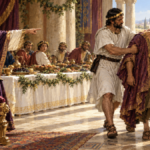
The illustration at the top is a detail from ‘The Good Samaritan’ by the 16th century Flemish painter Jacob Jordaens.
Come and join Ian and James as they discuss this passage, and also their discussion about the epistle for the day Colossians 1.1–14.
 Buy me a Coffee




















Jesus spoke this parable to a man who asked, in respect of “Love your neighbour as yourself”, who one’s neighbour was. The answer to be drawn is: Anybody whom you personally encounter who is in immediate need of help which you (and probably only you, in that situation) are able to provide.
Jesus views the law in terms of responsibilities rather than rights – so different from the ‘Gimme’ approach in the modern secular notion of human rights, which encourages selfishness and inevitably puts the State into every part of human life.
But note the particularity of this parable. And note it is an *explanation* of the law, not a refutation of it.
Augustine was not denying the usual understanding, but the allegorical view was held to be deeper. It is too clever by half and is obviously not the short, sharp point that Jesus made about who your neighbour is when he told the parable. The effect is to make people think they cannot understand scripture for themselves, that its meaning is reserved for professional theologians and academics and philosophers to work out and hand down (a view promoted in the fourth century by the Cappadocian Fathers). Yet God said “I will make foolish the wisdom of the wise” (1 Corinthians 1:19-20).
Many church fathers have allegorised this parable; much of Augustine’s allegory is adapted from Origen, as we see above (Homilies on Luke, 34.3). But Origen took Jericho to be the world rather than the moon, and called the manager of the inn the head of the church, not St Paul. That neither of these differing interpretations can be said to be right or wrong is a warning. Origen and Augustine are taking their wider understanding of scripture, which they got from its plain meaning, and using it to reimagine the parable. The result makes no point which cannot be got more clearly from other scriptures.
The development of allegory in Christian exegesis – although it is really eisegesis – is traced, with further examples of such silliness, in Edwin Hatch’s 1888 Hibbert Lectures (specifically the third lecture); the series is published as ‘The Influence of Greek Ideas and Usages upon the Christian Church’.
Thanks, that is all helpful and interesting. And of course the ‘fourfold meaning’ is a key thing rejected by the Reformers.
From memory, I think Fee has a good take on this, in How to Read the Bible for all it’s Worth.
It is submitted that the key is the comparison and contrast with the despised Samaritans and Hebrews who are not fulfilling God’s mission to the world, other nations, including Samaritans who worship amiss, not the covenantal God of Israel.
There is a moral aspect to this.
It has long intrigued me that twice in Luke’s gospel someone asks Jesus, “What must I do to inherit eternal life?” (10:25 and 18:18) but that his answers differ, each being brilliantly tailored to bring the specific challenge needed by the questioner.
That is a great observation—which I had missed! Adds to the reality that this question was asked more than once.
That’s a great point and echoes Alastair Roberts’ point about Luke saying things twice.
Thank you Ian, surely this is also wonderful opportunity to preach on Justification? I think Luke’s commentary on the Lawyer’s question is key.
https://biblehub.com/greek/1344.htm
The downward road from the City of God
To the City of Destruction I have trod,
Robbed of life, I lay beside,
How I did believe the lies.
The blood of bulls could never cleanse,
My works cannot endure His lens.
But here comes One on a donkey
With oil and wine to make me Holy.
My burden borne, my wounds healed,
My redemption ever sealed!
Safe in His church, under His care
I await His return from the air.
Doggerel, albeit the theology is sound.
Except that that is not what Jesus was teaching! This hymn is based on the discredited allegorical reading.
Ian, what do you think Luke’s purpose is then with his “But he, willing to justify himself…” and placing this immediately before the story? Surely there is something here about Justification?
And Sam, it is notable that it is a lawyer asking the question, tied to OT ‘law’ ?
Similarly not all allegory is removed from scripture as in Sarah and Hagar with it’s multiple scriptural canonical extrapolations, cross references: covenantal and pre Mosaic law.
Thanks Geoff, yes exactly. When thinking about parables I am always reminded of their purpose:
“that it might be fulfilled which was spoken by the prophet, saying, I will open my mouth in parables; I will utter things which have been kept secret from the foundation of the world.” Matt:13:35
It is also suggested that a parable isn’t restricted to making only one point.
Sam, Geoff. Maybe one of Don Carson’s ‘Exegetical Fallacies’ is rearing its head here? Just wondering.
BS,
Do tell us more.
Don Carson subscribes to canonical Biblical Theology, is editor of a series of commentaries, New Studies in Biblical Theology, and other books.
He accepts allegory.
For an extended example of his exegesis he has written and spoken on the person of Melchizedek widely found with a simple search.
Here is one with links embedded.
https://creationtonewcreation.com/getting-excited-about-melchizedek-by-d-a-carson/
Thank you for your invitation, Geoff. Sam linked ‘justify himself’ in the parable with Justification (I used ‘J’ rather than ‘j’ to refer to the more technical theological concept). You linked ‘lawyer’ with ‘OT “law”‘. Are you in danger of moving into the exegetical (or homiletic) ‘practice’ of ‘totality transfer’?
Or have you not come across (yet?) Carson’s Exegetical Fallacies?
Please do explain what they are, BS.
You have yet to provide any substance, as usual nor comment on the article, not even on Carson’s Melchizedek talk and his espousal of a Biblical Theology hermeneutic.
Maybe open/process theology would fall into Carson’s exegetical fallacies, as maybe NTWright’s new perspectives and views on justification.
Maybe, the very word, justification has triggered your response without actually showing how in the context it is a fallacy. Bye.
Further BS,
Are there any exegetal fallacies in my first comment. How or how not?
An answer of substance would be helpful.
I’m sorry, Geoff. I thought Ian’s purpose in his weekly articles on the lectionary readings was to encourage reading Scripture carefully. What I pointed out was that going from the teacher of the law wanting to *justify* himself to a sermon on the (supposed) NT doctrine of Justification might not be reading the text carefully (and sort of similarly your going from ‘lawyer’ to OT Law). I used a hint towards Don Carson’s Exegetical Fallacies (Baker, 1984) (it’s a book, Geoff) to support what I was pointing out. You responded referring to an article linking to a Don Carson talk on Melchizedek (I found that a number of the links in the article actually didn’t work) that Carson’s ‘espousal of a Biblical Theology hermeneutic’ somehow was relevant to what I pointed out. Is this an accurate enough description of our exchange?
Now you bring Open Theism and NT Wright into the discussion (and possibly also a question about my beliefs about Justification, i.e. whether I am *really* a Christian). Yes, Geoff, I do understand why you introduced these ‘bad’ people.
Ironically, both the Open Theism people and NT Wright do have something to contribute to how we read Scripture (the point of Ian’s weekly posts) but (I suspect) not in a way that you would be happy with. In fact, I wonder if your use of Sanders, Boyd, Pinnock and Wright comes more from prejudice than reading and thinking about what they wrote on how we read Scripture (just sayin’). The absolutely ironic thing is that in writing Wright off in the way you do, you remove one of the foremost advocates of your Biblical Theology hermeneutic (if I am understanding what you seem to mean by BTH).
So which of us is really commenting on the discussion of Ian’s original post?
PS you might consider reading Exegetical Fallacies before you comment any further on hermeneutics.
PPS I did listen to some of Don Carson’s talk. OK, but (of course 😉 ) I might have quibbles on some of his linguistic arguments.
Still no answer of substance.
1. I first made a comment on the article and passage. Was that an exegetal fallacy? Please help. It is noted that you have not made any comment at all on the passage.
2. I made a comment on the question of allegory. You made no comment on that. Others have also made comments that could be classed as allegory. You made no comments there. (Carson accepts some scriptural allegory and metaphors).
3. Sam made a comment on a point I hadn’t seen before and I saw some scriptural support from who was asking the question and the question asked (exegesis).
4. As for exegesis, we have to look at the text in context . But there are a number of contexts, the immediate, the surrounding, time, place, people, eventually, place in the Bible. We have the benefit of the context of the whole canon of scripture, to pore over, that wasn’t available to the first, hearers, readers.
5 Can remember who it was who put forward the point that there was only one point to be gleaned from a parable. I disagreed. You made no comment on that.
Conclusion, you seek to quarrel, particularly with me and rarely make a comment of substance.
It would be good and helpful if you could explain how and why one comment may be a exegetal fallacy and another, perhaps not.
The burden of proof is yours.
There is a wonderful co-relation between our two passages this week.
The two lectionary readings this week dovetail wonderfully this week.
Here Jesus gives a nugget and Paul hammers it out into an ornament fit for a king.
On Understanding.
Ian’s stated aim is that we the pew-dwellers might “Understand the bible better”
Jesus had the same difficult task in His time.
despite copious teachings about the nature of His Kingdom.
They heard but didn’t understand.
Hearing alone is no assurance of understanding (Dan 12:8).
The theologians had imagined a return to the golden age of
The Davidic kingdom – a warrior king
Jesus was/is always giving us to “understand”
Paul is always praying, crying out, along with Epaphras, for understanding for the saints Col 1:9- Eph 1:17 & 18 and 2 Tim 2:7
In this they echo the Psalmists, Prophets and the Preacher.
“…in all your getting get understanding”
What are we to “understand” best?
To this end see biblestudytools.com
Understanding – Meaning – Bible Definition and References
I would also Highly recommend
Homilies of Chrysostom on Colossians Ch. I, @ Biblehub
Great wealth and meaty: Though a bit wordy, he is a man of his time, not given to soundbites. Shalom.
The point is that the Gospels are the kindergarten and the
Apostle’s Doctrine is the grown up teaching which aims to produce the perfect man i.e,…”in understanding be men”, mature, full grown, filled full,Perfect.
Alas through long association and praxis with the Lectionary
the Gospels have been preferred above the NT as a whole
Indeed some “major”[?] theologians denigrate the apostle’s doctrine, it was ever thus, thereby maintaining folks
in a perpetual state of childhood.
For some the Gospels are a comfort blanket shielding them from
the rigours of growth in the NT. [It is quite observable] and
subsequently a lack of growth in the churches. 1 Cor 13:11
We may well preach the Gospel as Jesus did but something else
is required to bring in a good understanding.For Paul and Epaphras it was earnest persistent prayer for the “eyes of our
underatanding might be opened”
Shalom.
Thanks James and Ian.
Very good article by Guite on the benefits of pipe and porter and pub here: https://www.plough.com/en/topics/life/health/in-defense-of-pint-and-pipe?utm_source=Plough+-+English&utm_campaign=9371a5d66f-WEEKLY_2025_07_05&utm_medium=email&utm_term=0_-150a330f40-297072044
To quote “…In his Songs of Innocence and of Experience William Blake often gives voice to the poor and marginalized, the unnoticed and voiceless. In one such poem he speaks from the voice of someone who finds himself more welcome in the pub than the church:
Dear Mother, dear Mother, the Church is cold,
But the Ale-house is healthy & pleasant & warm;
Besides I can tell where I am used well …
“He (Blake) goes on later in the poem to say that if church were only as welcoming and nonjudgmental as the alehouse, then:
modest dame Lurch, who is always at Church,
Would not have bandy children nor fasting nor birch.
“Surprising though it may be to some of my stricter Christian brothers and sisters, there is something of a history of thinking of the church in this way. When Christ tells the parable of the Good Samaritan (Luke 10:25–37), he cannot think of a better place to take the wounded man for healing, until he comes again, than an inn. The early church commentators say the inn in the parable is meant to be a type of the church…”
I have started to see that there is some good in the allegorical interpretations after all which previously i had been trained to dismiss!
Further BS,
Are there any exegetal fallacies in my first comment. How or how not?
An answer of substance would be helpful.
Geoff, I’m glad to say that there don’t appear to be any of Don Carson’s Exegetical Fallacies in your first comment (the one where you cite Gordon Fee, right?).
My only observation would be that in that comment and all your subsequent ones you appear to be ignoring what Fee and Stuart actually say about ‘How to read parables for all they’re worth’. They talk about ‘points of reference’ and ‘unexpected turn’ (or, if you like, punchline) and point out the problem (trouble in understanding) when we look for ‘special interpretive keys’.
Is that enough ‘substance’?
Thank you, Bruce.
It only goes so far.
It doesn’t show how my first comment is exegis and the second isn’t.
It’s years since I read Fee, but I don’t think he draws out who central person in the parables is. Jesus is the central person, who Jesus is.
Fee in some of his other works accepts ‘picture’ language and metaphors.
Geoff, I didn’t say that your first comment is exegesis and your second isn’t. What I am saying (as usual!) is that when we do exegesis we need to think about how language works in communication, this time from the perspective of the Exegetical Fallacies that Don Carson wrote about in 1984 — fallacies like ‘False Assumptions about Technical Meaning (‘assum(ing) that a word always or nearly always has a certain technical meaning’ p.45, justify–justification?? ‘lawyer’, so this is ‘about’ OT law).
Maybe you need to really think about your statement(s) ‘who central person in the parables is. Jesus is the central person, who Jesus is.’ Jesus is the central person in the NT, sure, and arguably the ‘centre’ of the whole Bible. But to say that he is the central person of each parable, especially the one that Ian and James are discussing really doesn’t seem to work as a piece of exegesis. The occasion (that is, context) for Jesus telling this parable was in response to the question ‘who is my neighbour?’ not to his previous question ‘How do I inherit eternal life?’ The hearer (the ‘lawyer’) ended up clearly understanding who is ‘neighbour’, possibly to the extent that he could hardly bring himself to say ‘Samaritan’. Presumably then this particular parable told him something about the question that he asked.
In fact a possible consequence of trying to make Jesus the centre of every parable could very well be tumbling into one of Don Carson’s exegetical fallacies. We may need to make the language do something that it wasn’t intended to do.
You have mentioned ‘picture language’ and ‘metaphors’ (and you pointed me to a talk by Don Carson about Melchizedek, although Carson’s talk (and Melchizedek) have nothing to do with ‘parable’ and how to read one). I don’t think talking about ‘metaphor’ quite works here either. What do you mean by ‘metaphor’? (Serious question). This is how one writer clarifies the (usual) discussion about literal vs metaphorical language: ‘we need to recognise that the literalness which we have taken as “normal” is not, in fact, the default option … we use “loose resemblance” [BS: if you like ‘non-literalness’] all the time in everyday speech. … We have become so accustomed to the use of figurative language that we are no longer aware of its ubiquitous presence.’ That is, we say very very little that doesn’t involve only ‘literal’ language. Using metaphor seems to be the way that we humans think about and describe our world. For example we talk and think about ‘time’ in terms of distance and directionality (what we *see* — ‘before’, ‘behind’, ‘short’, ‘long’). So, saying someone *accepts* picture language and metaphor actually doesn’t say anything.
Sorry, should be: ‘we say very very little that involves only so-called ‘literal’ language.’
Robert Farrer Capon suggests that
1. Jesus’ concern is that people respond to him, not just his teaching but his very self;
2. the Christ figure in this story – the one to be embraced – is not the Samaritan, who rescues, but the one lying beaten and battered on the road; the he represents Christ on the cross.
I don’t know if this is an original interpretation.
(This is from memory; from ‘Parables of Grace’ or ‘Parables of Judgement’.)
That seems to be a good interpretation to me. Jerusalem is figuratively heaven and The lowest point on earth, Jericho, is figuratively the earth. I’ve noted before how David’s ambassadors spent time recovering in Jericho before returning to Jerusalem. They spent the time it takes for their beards to grow. +or – 40 days. Jesus spent 40 days after the resurrection. I think there are parallels here that is intriguing.
So our religious scholar *stands up*
Why?
Was Jesus already standing and this allowed him to look Jesus in the eye, on the same level?
Or was Jesus seated and this gave his interlocutor some height – and psychological – advantage, a petty power play?
Well, either way he stands up.
And he *stood up to test Jesus*
It’s not a question asked in good faith.