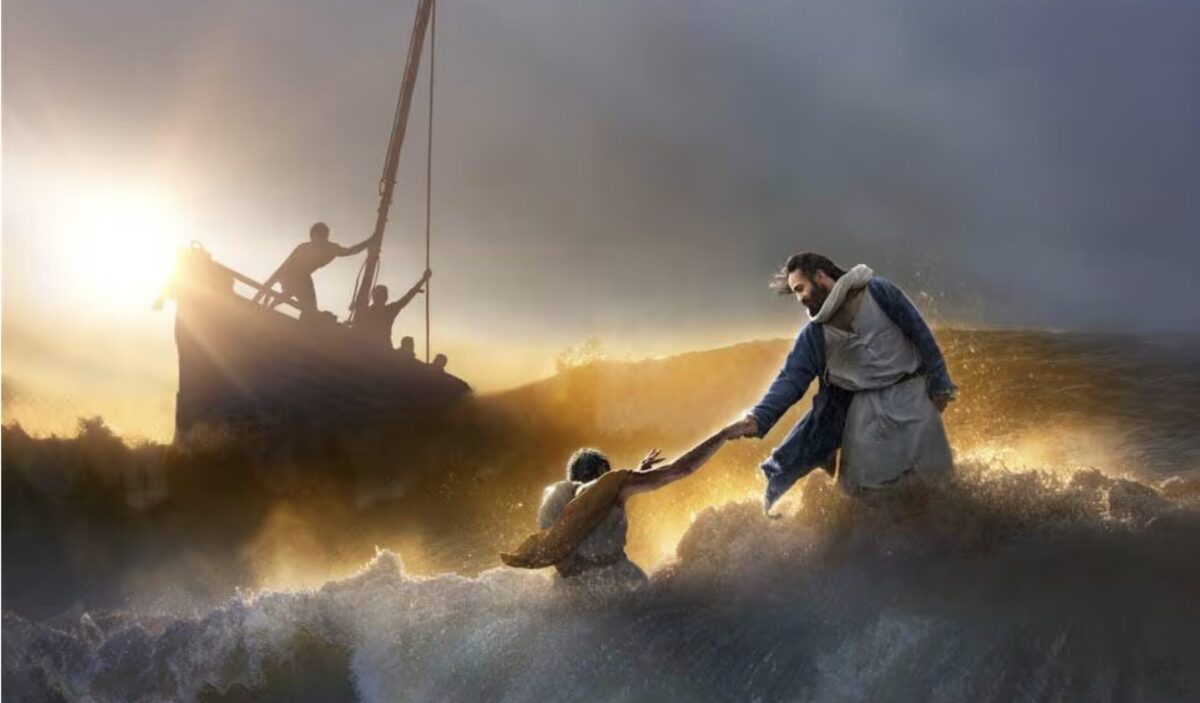
The common reading of Jesus (and Peter) walking on the water is: when there is a storm, and you get out of the boat, keep your eyes on Jesus. But the passage is more intriguing than this, and the danger is that, in reading it this way, we are precisely repeating Peter’s error!
The Sunday lectionary reading for Trinity 10 in Year A is Matt 14.22–33, Matthew’s distinctive account of Jesus walking across the water and Peter’s response to it. I am finding this recent, sustained immersion in Matthew’s narrative very interesting. We have often noted how Matthew’s accounts are more compressed than the other gospels, particularly Mark, and that he compensates for that by including additional episodes. But the compression itself actually gives the narratives an intensity and power that I had not expected. (The video discussion of this article will be in the next post.)
In the previous episode, Jesus has been seeking solitude (with his closest followers) after hearing the news of John the Baptist’s death, with all its discouragement and foreboding. But, just as he postponed the urgent task of responding to Jairus’ daughter in order to attend to the needs of a woman in Matthew 9, so he postpones the meeting of his own urgent need to respond to the desires of the crowd.
He took command in feeding them, and now he takes command in dismissing both them and the disciples, so that he will be truly alone. There is one fascinating detail here: once all have eaten and are satisfied, Jesus ‘immediately’ dismisses them. This pericope is the only place in the whole of Matthew where Jesus acts ‘immediately’—a contrast to Mark where the term occurs ten times in his first chapter! Jesus has been postponing his own need for solitude and reflection, and his desire to be alone with his Heavenly Father can wait no longer. This time, the phrase κατ᾿ ἰδίαν ‘by himself’ means that he is, physically, truly alone.
In Matt 14.15, evening (that is, the time after sunset but before complete darkness; compare Mark 1.32) was approaching and this prompts the debate about feeding the crowd. Now, evening has come; some considerable time must have passed, so R T France translates this ‘well into the night’. This need not make seeing the boat impossible if the darkness is moonlit.
Matthew tells us that the boat was ‘many stadia’ from the land, and John 6.19 (interestingly) supplies more specific detail, that they had rowed ‘twenty five or thirty stadia’, translated as ‘three or four miles’. It is slightly odd that they are so far out, since ‘crossing’ the top of the Sea of Galilee means running not far from the shore. But Matthew points out that the problem is the wind blowing them off course. The simple sails of boats of the time would make tacking into the wind that modern sailing boats undertake with ease a real challenge, so they would have had to rely on oar power. And it is worth noting that this casual, corroborated geographical detail rules outa ‘naturalistic’ explanation of Jesus walking on submerged stones near the shore before anyone even thought of it!
The ‘fourth watch of the night’, when Jesus came towards them, is a Roman term covering the period of around 3 am to 6 am, so the light of dawn would be approaching. Fishermen on the lake would often work at night, when the fish come to the surface without fear of predators, and we have several episodes where night working is evident or assumed (‘We have toiled all night’ Luke 5.5). In the dim light of dawn, it is not surprising that the disciples cannot make out the figure that approaches them.
Both Matthew and Mark repeat the fact that Jesus is ‘walking on the lake’, but the remarkable nature of this act is enough to record without any further elaboration. In fact it is such a powerful image that ‘walking on water’ has become proverbial in popular culture as a way of saying someone is remarkable. Despite this, there appears to be little symbolic freight attached to it; like many of his miracles, Jesus is using his power to meet a need or address a situation, rather than as any kind of ostentatious display of power for its own sake. As we noted previously, Jesus is no magician.
There is theological significance to this, and in fact Mark draws this out more explicitly than Matthew. In his expanded phrase ‘he meant to pass them by’ (Mark 6.48), he drops a heavy hint that we should hear echoes of Job 9.8, 11: ‘He treads on the waves of the sea…when he goes by, I cannot perceive him’. But the reaction of the disciples once Jesus climbs into the boat leave us in little doubt as to the significance of his action in their perception.
If Jesus’ actions have theological meaning, the disciples response lacks it! They are terrified, and think this is a ‘ghost’; the word here, phantasma, occurs nowhere else in the NT, and has no theological sense to it. Curiously, Matthew articulates their impression in reported speech, where Mark simply describes what they are thinking; this is unusual, as Matthew’s abbreviation of Mark’s narratives usually means the reverse. It is a frequent and sobering aspect of all the gospel accounts that Jesus is enigmatic, puzzling, even terrifying almost as often as he is encouraging and reassuring. Though he is truly ‘one of us’ in the incarnation, he is just as truly quite other than us, the master whom we can never quite master.
There are numerous variations in wording and style between the three accounts in Matthew, Mark and John, though (as is typical with the different gospels) their wording converges when it comes to reporting Jesus’ speech: ‘Take heart; it is I; fear not’. John trims off the first encouragement, in order to put the ἐγώ εἰμι ‘I am’ in the most prominent place, as we might expect. It is not very clear from Matthew’s account whether we should see, in this, an echo of the ‘divine name’ in Exod 3.14, not least since this phrase is the natural one a person would use to give reassurance about their identity. But of course we read these words in a different light following the resurrection and ascension than the disciples would necessarily have taken them at the time.

In Mark and John, Jesus’ assuring words lead straight into his reception into the boat; only in Matthew do we read this additional episode of Peter, impulsively, wanting to join Jesus on the water. Two things are particularly striking about this episode.
First, this is the point where the narrative becomes much more laden with symbolic significance—so much so that, for example, John Ortberg could title his best-selling book on discipleship after this episode (If you want to walk on water, you’ve got to get out of the boat).
- Life is a storm, yet Jesus calmly walks on the surface.
- We think we can follow him, though it looks impossible.
- Then he himself calls us, and as we hear his voice, we are filled with courage.
- We step out of the metaphorical boat of our safe assumptions and self-made protection in order to follow him.
- Our faith fails as we are distracted from looking at Jesus and instead look at the wind and waves around us, and we feel as though we are drowning.
- Yet Jesus reaches out and rescues us, and takes us once again to a place of safety.
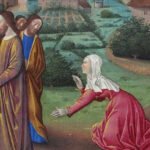
The powerful symbol of the waters that threaten to overwhelm us is a common motif in the Psalms, appealing as it does to that archetypal sense of troubles that overwhelm us as the waves of the sea overwhelm a drowning person, especially poignant in a culture which, on the one hand, depends on fishing, but on the other probably does not do swimming. I love the way that the picture above picks this up, offering an unusual drowning-Peter’s-eye view of Jesus’ outstretched hand.
One of my favourite scenes in my favourite film(s), the Lord of the Rings, comes near the end of the first film in the trilogy. Frodo has decided that he can trust no-one else in the fellowship, so jumps in a boat and pushes off from the shore. Samwise Gamgee runs down the shore, shouting at him. ‘I am going to Mordor alone!’ cries Frodo, to discourage him. ‘Yes, you are—and I am going with you!’ insists Sam in reply. He launches himself into the water after Frodo, with more determination than faith, only to realise that he cannot swim. As he sinks beneath the water, a hand reaches down to pull him out, and the two are reunited for the beginning of their epic trip together as Frodo hauls Sam into his boat. What makes this image more powerful is that it is repeated, in reverse, at the end of the third film as Sam reaches a hand down to rescue Frodo from the destructive power of the molten lava in Mount Doom.
And here is the second point about this narrative, and the paradox: it is not at all clear that this is how we are meant to read the episode!
No obvious reason is given for Peter’s impulsive action. Jesus comes to them across the water to offer comfort and encouragement, and he has no other way to get to them—but what purpose is served by Peter doing the same? The episode fits well with the general depiction of his character—speaking before he has thought through the implications of what he says, and acting on impulse. R T France comments:
It is not so clear, however, whether Matthew intends us to see Peter in this incident as an example of valid faith which went wrong, or as from the beginning taking a foolhardy risk either to impress the others or simply as a childish search for exhilaration… The eventual failure of the experiment perhaps suggests that Matthew does not intend it to be taken as a model for others to follow, but rather as a cautionary tale. (NICNT, pp 567–568).
Peter is actually rather prominent in this section of Matthew’s gospel, and whilst Matthew generally softens the failures of the disciples as a whole compared with Mark, he leaves Peter’s failure on display for all to see. Peter gets a sharper rebuke in Matt 16.22f than in the other gospels, and his denial of Jesus in the courtyard fails to be given the customary Matthean abbreviation (Matt 26.69f).
Additional note: I am grateful to online friend James Oakley, who previously preached on this assuming that Peter was being reckless—though now thinks he might change his mind! But one thing that influenced him was John Calvin’s reading:
‘If it is thou,’ he says, ‘bid me come to thee.’ But he had heard Christ speaking. Why then was he doubtful and bewildered? In his small and weak faith there breaks out a thoughtless wish. He should have kept to his proper limits and rather sought from Christ an increase of faith so that by its leading and guidance he might at last rise above all seas and mountains. But as it is he wants to fly without the wings of faith, and without Christ’s voice having a genuine firmness in his heart, to make the waves solid under his feet. There is no doubt that his desire sprang from good principle, but because it degenerated into a faulty excess it ceased to be praiseworthy. This is why Peter quickly suffered for his rashness. By this example believers are taught to beware of over-much rashness. Whithersoever the Lord calls we must energetically run; but anyone who goes too far will experience at last the unhappy outcome of transgressing his limits.
We might ask why Christ grants Peter’s wish. By doing so He seems to approve it. But the solution is easy. God often looks after us better by denying what we ask. But sometimes He gives way to us so as to convince us of our foolishness by experience. Thus by yielding to them more than is expedient He daily trains His believers in sobriety and moderation for the future. Add that this was profitable for Peter and the rest and is profitable for us today. Christ’s power shines forth more brightly in Peter when He makes him His comrade than if He had walked on water alone. Yet Peter knew, and the others saw plainly, that because he did not abide in a firm faith and rest on the Lord’s Word the secret power of God which had made the water solid failed. But Christ deals kindly with him, for He did not want Him to sink completely. Both these things concern us also. Just as Peter began to sink as soon as he was overtaken by fear, so our frail and transient fleshly ideas sometimes cause us to sink in the course of our activities. Yet the Lord pardons our weakness and stretches out His hand lest the waters should swallow us up. We must also observe that when Peter saw that his temerity had turned out badly, he committed himself to Christ’s mercy. Wherefore we also, even when we are suffering a punishment we deserve, must flee to Him to have mercy on us and give us the help we do not deserve. (Commentary on Harmony of the Gospels, Volume 2, page 153)
(There is some reflection on the ambivalence of the whole narrative in scholarly debate about the phrase ‘he walked on the water to come/and came to Jesus’. Are the verbs there to express the fact that he succeeded in walking across the water and reaching Jesus, or merely that he attempted to do so and failed?)
Further additional note: Another online friend, David Moscrip, has suggested that our debate about the interpretation of this narrative actually echoes the narrative itself. We get focussed on the person of Peter in the story, his actions, his responses, and whether he was a good example or a dire warning—and, in the narrative itself, we take our eyes off the person of Jesus. So Peter in the story demonstrates what we often do in interpreting the story! Our interpretation becomes ‘fractal’—geometric images that represent themselves in miniature!
The lesson of both the story and our interpretation of the story is: keep your eyes on Jesus!
The closing dynamics of the story are important, and easily misunderstood. Jesus’ rebuke to Peter ‘Why did you doubt?’ sounds more than a little ironic, given that they were in the middle of the sea, in the near-dark, in a storm. Peter had good reason! But we should not take this as a rejection of doubt, or questioning, in the usual sense; the Greek term here distazo occurs only here and in Matt 28.17 in the New Testament, and has a sense not of asking questions but of being in two minds. The notion here is similar to that expressed in James 1.6–8, which also (coincidentally!) mentions waves.
Four times Jesus rebukes his disciples for being ‘you of little faith’. The term here, oligopistos, comes in Matt 6.30, 8.26, here in 14.31 and in 16.8, (and only once elsewhere in Luke 12.28) and he uses the related term oligopistia in Matt 17.20 in relation to ‘faith the size of a mustard seed’. Some have suggested that, rather than being a rebuke, this is a gentle encouragement to have faith. I am not persuaded by this, not least since this is Matthew’s softening of Mark’s recording of Jesus saying ‘You of no faith!’ (see Mark 4.40).
If Peter had had even faith the size of a mustard seed, he would have succeeded in his quest. R T France sums up:
The faith which can move mountains would have kept Peter safe, if he had not allowed his obedience to Jesus’s call to be overwhelmed by his very natural perception of the danger to which he had rashly exposed himself. It is thus an illustration of the vulnerability of the disciple who allows doubt, the natural human perspective, to displace the faith which relies on the supernatural power of God. (NICNT p 567)
Perhaps the best way to resolve this ambiguity is to note, once again, that we need to read not anthropocentrically, focussing on the action of the human characters as examples to follow or warnings to avoid, but theocentrically, focusing on the person and actions of Jesus. Whether we are reckless like Peter, or fearful like the other disciples, it is Jesus who is lord of creation and who is more powerful than anything that threatens us. It is to him that we bow down in awed worship.
(A video discussion of this passage will be posted next.)
 Buy me a Coffee























The Job reference is interesting – but perhaps more obvious is Psalm 107:23-29 – ‘those who go down to the sea in ships… who see the works of the LORD…’
‘they were at their wits’ end.
Then they cried out to the LORD in their trouble,
and he brought them out of their distress.
He stilled the storm to a whisper;
the waves of the sea were hushed.’
The image of walking on the water is dazzling but can distract from the principal thing which is that the story is about salvation. Peter cries out ‘Lord save me’ and Jesus rescues him – and rescues them all from the storm. The story follows the contours of Psalm 107:23-29.
Salvation is a major theme in Matthew, though often obscured by translation – so the woman with a flux of blood is saved ‘sozo’ but bibles say she was made well or whole or healed. Likewise, in verse immediately following ‘the walking on the water’ Jesus heals the multitudes but again the word is ‘saves’ – diasozo.
The point isn’t just that people get saved but that saving is a much wider and immediate concept and happens through encounter with Jesus. That proves who he is – whiich matters because questions about who Jesus is get voiced in Matthew 13.54-56 –
“Where did this man get this wisdom and these miraculous powers?” they asked. “Isn’t this the carpenter’s son? …”
Matthew 14 begins to answer the questions set up at the end of ch 13. He’s the evangelist who says at the start ‘You shall call his name Jesus because he will save…’ Saving is what the LORD does – and Jesus saving proves he is the LORD, and why they conclude ‘Truly he is the Son fo God.’
Thanks Paul—very helpful!
I’d be interested to know your definition/understanding of the word ‘saved’ in that case. What does it mean for a woman with a flux of blood to be saved when the actual result is that the flow is stanched?
Elihu echoes Jesus at the point of despair.
Elihu barged into the increasingly unhelpful dispute between suffering Job and his ‘friends’. Elihu carries a spirit (32:18); the word OV in 32:19 means this in its other 16 uses in Hebrew scripture. Use of its occult gifts would be a capital offence in Mosaic Law (e.g. Leviticus 20:27). Elihu is angry (32:2-5) and full of words, and after hearing the dispute he talks *at* his elders, even using the vain argument that he knows what he is talking about and is right (36:2-4). He sometimes is right but he is like the fortune-teller who followed Paul around yelling (Acts 16:16-18). Job does not respond to him.
Hmm. No translator seems to agree with you. The most likely reason is that ‘mediums’ (the word is in the plural) would hardly cohere with the other words in the sentence. The poetic parallelism between the two parts of the verse are clear. Both are comparisons, “like wine…” and “like wineskins”. How does “like mediums” fit the sense? I also note that the verb at the end is 3ms so matches ‘belly’ not wineskins/mediums”.
For speed, putting the LXX of Job 32:19 into Google translate give:
“And my stomach is like a bag of wine tied up, or like a bellows of a copper vessel, full of slander.”
which has a different second comparison, but also one about being full to burst.
My response to you would be identical to one I’ve made to Steve Feist below; by all means engage further with me there.
Anthony, apologies. I 5hink you are right about Elihu. He is not a type or a theophany…he is ..
A master of deception. I wish it wasn’t so. Go’s addressed him first. He doesn’t need to be sacrificed for because he is not human.
I notice that God doesn’t mention Elihu when censuring Job’s friends, but I can’t see anything in the text that suggests he is a demon or fallen angel – just someone carrying one. And I am aware that I say this on the basis of the word OV in Hebrew, a language I am far from fluent in. Comments from Hebraists on this subject are very welcome.
Perhaps Elihu is just Job’s soliloquy. A 4000 year old literary device? Like St. Paul’s, “ I do the very thing I hate”. A way of expressing his internal anguish. Anyway , this is a digression
We may conjecture what was in Peter’s mind at this time
But one thing is evident, Peter doubted it was Christ he saw.
V28 “Lord, if it is You,” Peter replied, “command me to come to
You on the water.”
Peter always had problems “hearing” the “voice” of Jesus,
even post resurrection.
People do love an “Action man” someone who gets things done,
as in feeding 5000 “we should make this man king, he could end poverty for us”.
Our latest PM is lauded as a “messiah” an “Action Man”.
It is a high pedestal to fall from!
Throughout Holy Scripture the flaws of most action men of the bible are much in evidence, which show us that they were just “earthen vessels”.
Paul recognised this and said….”but we have this treasure in earthen vessels, that the excellency of the power may be of God, and not of us. 2 Cor 4:7.
It is always a hazard to be lauded as an action man by folks or to appreciate their encouragements. It robs God of His Glory.
Perhaps Peter wanted to be known as an action man alongside Jesus,
He was ever thus.
In raising Peter up, we see the motif throughout Scripture repeated of the Resurrection life and power of God to raise fallen flawed vessels [and Nation]to display His Glory.
Unbelief hinders God from “doing many mighty works “
[Mat 11:23 & Mat 13:58 ]
For a detailed example of Resurrection Life and Power
Consider Elisha, the prophetic “voice” of Resurrection life and power
via “The Starting Place of Heavenly Fullness”
@ austin-sparks.net/english/books/001940.html
OR More in depth see
austin- sparks.net/english/books/power_of_his_resurrection_
the.html
Shalom
Perhaps Peter wanted to be known as an action man alongside Jesus,
He was ever thus.
In raising Peter up, we see the motif throughout Scripture repeated of the Resurrection life and power of God to raise fallen flawed vessels [and Nation]to display His Glory.
Unbelief hinders God from “doing many mighty works “
[Mat 11:23 & Mat 13:58 ]
For a detailed example of Resurrection Life and Power
Consider Elisha, the prophetic voice of Resurrection life and power
via “The Starting Place of Heavenly Fullness”
@ .austin-sparks.net/english/books/001940.html
OR More in depth see
.austin- sparks.net/english/books/power_of_his_resurrection_
the.html
Shalom
Not sure why part of last post was repeated.
Because you repeated it.
Matthew’s account is the final nail in the coffin of any belief that an unusual natural phenomenon was at work: Peter sank as his faith failed him. The Holy Spirit is given to Christ’s church throughout the church era, so can we walk on water today? Jesus said that “If you have faith as small as a mustard seed, you can say to a mountain ‘move from here to there’ and it will move” (Matthew 17:20). I did not try it while on a tourist boat on the Sea of Galilee, although I doubt I could have done it even if I had the faith, because my reasons would have been egotistical. That is presumably why no plaque can be found on the jetty inscribed with the names of anybody who has succeeded.
You are saying that because he, my God (Elihu) is contemptible (Buzite) he isn’t blessed by God (Barachel) enough to be typologically significant? I like Elihu.
I think that’s a reply to my response to you further above about Elihu in the Book of Job. What about the fact that he carries an OV, use of which is punishable by execution in Mosaic Law? Not enough non-Jewish commentaries spot this.
this was probably in the time of Abraham. Job’s age fits well with the age of Terah etc. and I don’t see anything remotely occult going on with Elihu. His friends certainly do. Where do you get this stuff?
From verses 32:18-19.
In Job 32:18, Elihu says that he is “full of words – the spirit in my belly presses me [to talk]”.
The word translated as wineskins in the next verse appears only in this verse throughout the entire Old Testament. It contains the crucial ‘OV’ but bears no resemblance for the word for wineskin appearing elsewhere in the Hebrew scriptures. Nor is it anything like the word for wine (which appears earlier in the verse). ‘Skin’ is ‘OR’, and on this basis I hold that a mistranslation has been constructed. But the Hebrew is perfectly clearly OV, and wherever else it appears in the Old Testament (16 times) it means a spirit of divination, use of wheich carries the death panealty in Mosaic Law. Elihu even tells you he has a spirit in the previous verse. Please verify these statements for yourself.
Anthony, here you are discussing something about language and how we use it. But as an Ordinary Working Linguist I would also ask you steve’s question ‘Where do you get this stuff?’
Bruce,
I considered the phrasing of the question “Where do you get this stuff” mildly disrespectful – and your repetition of it clearly is in view of our history – but I wished not to escalate with Steve and so I gave him a factual answer based on the Hebrew. Did you not read it? Are you accomplished enough in Hebrew to respond meaningfully? I would welcome dialogue about it with Hebraists.
Didnt Jeremy Clarkson?!
At the beginning and end of the Exodus, the Israelites met a water barrier. Fleeing Egypt, they were trapped on the shore of the Re(e)d Sea with Pharaoh’s army in pursuit. When they reached the River Jordan they could see across to the west bank and Jericho, in the land God had promised them. But they did not have the faith to walk on water and get across – so near and yet so far! Each time, God did a miracle. At the Red Sea, he sent a wind that parted the waters (Exodus 14:21). The crossing of the Jordan also took place in the spring (Joshua 4:19), 40 years later. The river would have been in flood from snowmelt off the Mt Hermon range, fast-flowing and treacherous. Before 1940, when modern irrigation schemes diverted much of the water, it might burst its banks to a width of half a mile. God exposed the riverbed (Joshua 3) by piling up the water upriver, near a town called Adam (appropriately in English – a dam!) Scholars believe that this is modern Damiya, 18 miles north of the crossing point near Jericho. The Jordan valley is a boundary between two continental plates, which extends south down the Red Sea and through the great Rift Valley in Africa. The geophysics professor Amos Nur looked at historical records and found that smaller earthquakes occasionally trigger mudslides of the riverbank – which in places is quite steep. These mudslides may temporarily block the river and cause the water to back up. In 1267AD, for instance, a bridge project was in difficulties until the flow stopped for several hours and workers rapidly built proper foundations. The local sheikh, intrigued, found that a landslide had taken place upriver. Obviously the same thing happened near Damiya when the Israelites reached the river. When Israel came out of Egypt… the Jordan turned back, the mountains leaped like rams, the hills like lambs… tremble, O earth, at the presence of the Lord – from Psalm 114. That particular miracles was in the timing, rather than a violation of scientific law.
That sounds like a naturalistic explanation that effectively removes the miraculous. People have tried to do that time and again. It doesn’t fit with the picture painted in the text. Where are the walls of water? Yet you seem to argue God caused the natural phenomena to occur but that just made the whole event look like a natural phenomenon.
I don’t deny the miraculous walls of water in the Red Sea! I majored on the crossing of the Jordan and still see no reason why the miracle there was not simply in the timing of a landslip upriver.
Perhaps if Peter had said, “It is the Lord!” and jumped in, things would have worked out fine, but he asked a question first; the answer came: “Come”. Not, “It is I, Jesus, come.” Now there was room for him to ask himself the question — who said come?
Here is another article setting the episode in the context of the Old Testament (fulfilled?);
https://www.thegospelcoalition.org/article/jesus-water-old-testament/
Thanks for this. I also find Larry Hurtado’s work on proskuneo in Matthew really helpful here. He emphasises the differences from Mark and the significance of the disciples’ worship of Jesus both at the time and for the early church. He points out the deep significance of the use of proskuneo throughout the gospel – 13 instances in all, only exceeded in the NT in Revelation. It comes in the visit of the Magi, in several instances when supplicants come to Jesus and also in the resurrection narrative in chapter 28.
Some quick thoughts:
This is a good example of the “Peter is usually wrong” theory of the Gospels – that if St Peter is mentioned by name, he’s probably about to make a mistake. It’s quite admirable if we believe that the synoptic Gospels are drawing on St Peter’s own testimony. What’s encouraging for us is that even though St Peter is so consistently misunderstanding, getting it wrong, having profound moments of weakness, it’s still him that Christ turns to and says this is the rock on which I will build my church.
I think we often get the miracle stories wrong. Some people like to cite them as proof of Jesus’ divinity. But the disciples who were there don’t ever sound really convinced of this. In this story they may end saying Jesus truly is the Son of God, but they’ve forgotten all that by the time we get to the cross. So if the men in the boat weren’t convinced, it doesn’t make a lot of sense to expect anyone else to be convinced because they read the story in a book. We get it the wrong way around: we’re not convinced that because Jesus walked on water, he must be divine; it’s because he’s divine, that being asked whether to believe he walked on water is trivial.
So what is going on? Why include this story in the Gospel? I think the point is to tell us not to worry that we’ve been taken too far away from God. Jesus has gone to the mountain. The disciples are out in the boat and buffeted and blown about. They are cut off from Jesus. They cannot reach him. But… he can reach them, and it’s very simple – he just walks over to the boat.
And what about Peter? I don’t think his “little faith” is about taking his eyes off Jesus and being concerned by the wind. Peter is only out on the water as a test: it’s Peter who is testing Jesus saying “Lord, if it’s you, tell me to come to you on the water”, and he gets picked up by Jesus when he acknowledges who Jesus is: “Lord, save me!” Jesus, I think, is needling him about him not thinking it was Jesus walking towards the boat. That I think fits with the narrative as a whole (at least as I see it). You are not beyond God’s reach. He can always get to you, now matter how far you’ve fallen, how much the winds have battered you, or how far your boat is from the shore. Don’t doubt it.
I think Peter’s ‘mistakes’ are often included because per John, Jesus firmly restored him despite his failures. Without that restoration Peter would likely have tried to forget about such incidents because of the shame they brought.
Just a thought Peter, when Jesus said, “on this rock I will build my church” . It comes across like a teacher giving a dim pupil praise. He doesn’t give the ones who get it constant affirmation, he gives a big thumbs up to Peter as one who needs to hear it. It’s like the whole class has got the point and when Peter blurts out his moment of epiphany Jesus makes a special point to give him affirmation. Peter is someone who is behind in understanding not someone who is top of the class.
Peter gets a bit over confident sometimes and leaps to conclusions , or water, in this case. His actions and words should be taken in context with the rest of the class of 0001. He’s a noisy pupil.
You may very well be right Steve.
I picked up on “he meant to pass them by” ,almost as if he were going to ignore them ; but my thought went to Exodus 33v 22 where God tells Moses about “when his glory passes by” …..a similar and important phrase ; here revealing Jesus as a part of the Godhead.
Yes that’s a well established understanding of this event. Jesus’ divinity is being revealed in different ways.