There has been a growing movement claiming that Christianity calls for a certain kind of masculinity, protesting against a perceived feminisation of the faith. Is there any grounds for this? What kind of language do we find in the New Testament?
This article explores the issues around Paul’s language ‘act like men’ in 1 Cor 16.13; digs into its Old Testament origins; relates it to Paul’s other language about discipline and struggle; and teases out the pastoral implications for all of us.
Towards the end of his second letter to the Corinthians, which we have in our New Testament as 1 Corinthians, as Paul wraps up his travel plans and greetings, he gives a short string of commands:
Be on your guard; stand firm in the faith; be courageous; be strong. Do everything in love. (1 Cor 16:13–14, NIV)
The words in Paul’s Greek read: grēgoreite, stēkete en tē pistei, andrizesthe, krataiousthe; panta hymōn en agapē ginesthō (γρηγορεῖτε, στήκετε ἐν τῇ πίστει, ἀνδρίζεσθε, κραταιοῦσθε· πάντα ὑμῶν ἐν ἀγάπῃ γινέσθω). (It is worth noting in passing the connections here with the teaching of Jesus. The verb gregoreo is his consistent command in the light of our anticipation of his return at an unknown hour in Matt 24.42, 25.13 and elsewhere, and krateo describes the way Jesus holds the seven starts in Rev 2.1).
The word the NIV translates ‘be courageous’ is the Greek verb andrizomai (ἀνδρίζομαι), here in the plural imperative andrizesthe (ἀνδρίζεσθε). It comes from the word for a man (anēr, andros; ἀνήρ, ἀνδρός), and so older translations rendered it quite literally. The AV has ‘quit you like men’, and the ESV still has ‘act like men’. It is the only time the word occurs in the New Testament—a hapax legomenon, something said only once.
(An earlier verse also used highly gendered language in a similar way—’In understanding be men’, 1 Cor 14.20, KJV—which was then used as the title of a well-known book about Christian doctrine. However, the Greek here is not gendered at all; the term is teleios meaning ‘complete’ or ‘mature’.)
It is not hard to see why the translation matters here. Read in one way, Paul is calling the church to a particular kind of masculinity, and the verse regularly turns up in that context in some circles. Read in another, the gendered root is incidental and the NIV’s ‘be courageous’ captures the sense. How do we decide?
The best way in, dear reader, is to ask where Paul learned the word. The answer lies in the Greek Old Testament he read and preached from, rather than in the gymnasium or the moral philosophers of Greek and Roman culture. Once we look there, the verse opens up in some quite striking ways, both for how we read Paul and for what it means to follow Jesus faithfully now.
Where Paul found the word
In the Septuagint (the Greek translation of the Old Testament, usually abbreviated LXX), andrizomai (ἀνδρίζομαι) occurs around twenty times. It usually translates the Hebrew verb ʾamats (אָמַץ), ‘be firm, be bold’, and most often appears in a fixed pair: ischue kai andrizou (ἴσχυε καὶ ἀνδρίζου), ‘be strong and courageous’. English readers will know the phrase from Joshua 1—and might even have sung it in a children’s chorus!
The occurrences fall into a few clear groups.
Handing on the task. The formula first appears when Moses is about to die. He says it to all Israel as they face the nations across the Jordan (Deut 31:6), then to Joshua in front of the people (31:7), and then God says it to Joshua himself at the tent of meeting (31:23). God repeats it three times at the start of Joshua (Josh 1:6, 7, 9), and each time it is grounded in something: the promise of the land; careful obedience to the law; and above all God’s presence (‘the Lord your God will be with you wherever you go’). Then the people say it back to Joshua (1:18), and Joshua says it to his commanders after a victory (10:25). The words of commissioning become the shared language of the whole community.
Building the temple. David uses the same formula when he hands over to Solomon the task of building the temple (1 Chr 22:13; 28:20). Again it is tied to keeping the law of Moses, and again to God’s presence: ‘he will not fail you or forsake you until all the work… is finished.’ This is clearly modelled on Moses and Joshua. Hezekiah uses it too, when Jerusalem is besieged by Sennacherib: ‘be strong and courageous… with him is an arm of flesh, but with us is the Lord our God’ (2 Chr 32:7–8). We should note that, being in Chronicles, this is in a quite different theological and narrative tradition from the Deuteronomistic history of which Joshua is a part.
On the battlefield. Joab says to his brother Abishai before battle, andrizou kai andrisōmetha (ἀνδρίζου καὶ ἀνδρισώμεθα), ‘be strong, and let us be strong’ (1 Chr 19:13; similarly 2 Sam 10:12), and adds, ‘may the Lord do what seems good to him.’ There is also one rather dark use. Absalom tells his servants to murder Amnon and stiffens them with the same word (2 Sam 13:28). Resolve can be put to evil purposes, and the Bible does not pretend otherwise.
In worship. Two psalms use it, both in the context of waiting on God: ‘Wait for the Lord; be strong, and let your heart take courage’ (Ps 27:14), and ‘Be strong, and let your heart take courage, all you who hope in the Lord’ (Ps 31:24). The second is addressed to the whole worshipping community.
In the prophets. The most surprising use comes in Micah 4:10, where the Greek reads ōdine kai andrizou… thygater Siōn (ὤδινε καὶ ἀνδρίζου… θύγατερ Σιων), ‘be in labour and be courageous, daughter Zion’. A woman giving birth is told to andrizou (ἀνδρίζου), ‘act like a man’! It is clear that for the translator the word meant endurance and resolve, without any sense that it was limited to men. (This is a key text behind the image of the woman in labour in Rev 12, which shows she stands for the expectant (pun intended!) people of God who ‘give birth’ to the Messiah, and is not a reference to Mary.)
Nahum 2:1 uses it ironically, summoning Nineveh to brace itself for a defeat it cannot avoid. And in Daniel 10:19 (in the Theodotion Greek text) the angel says to the overwhelmed Daniel, ‘peace be with you; be courageous and be strong’ (eirēnē soi; andrizou kai ischue, εἰρήνη σοι· ἀνδρίζου καὶ ἴσχυε), and Daniel finds that, as the words are spoken, he is strengthened.
Under persecution. Finally, and beyond the canonical Greek Old Testament, in 1 Maccabees 2:64, the dying Mattathias tells his sons, ‘be courageous and be strong in the law’ (andrizesthe kai ischysate en tō nomō, ἀνδρίζεσθε καὶ ἰσχύσατε ἐν τῷ νόμῳ). This comes from the period of resistance to the Seleucid persecution, and so is the use closest in time to Paul.
What this means for reading Paul
There are good reasons to think Paul has this tradition in mind, rather than Greek ideals of manliness (andreia, ἀνδρεία).
The first is the pairing. Paul writes andrizesthe, krataiousthe (ἀνδρίζεσθε, κραταιοῦσθε), ‘be courageous, be strong’. That is almost exactly the language of the two psalms (Ps 27:14; 31:24), which pair andrizou (ἀνδρίζου) with krataiousthō hē kardia (κραταιούσθω ἡ καρδία), ‘let your heart be strong’. A Greek moralist would not naturally put the words together like this. Someone who had prayed the Greek Psalter all his life would.
The second is the audience. The command is plural, and it is addressed to the whole church in Corinth. That church included Chloe’s people (1 Cor 1:11) and the women who prayed and prophesied in worship (1 Cor 11:5). Paul is quite capable of distinguishing between men and women when he wants to, as chapter 11 shows. Here he doesn’t. Like Psalm 31 (‘all you who hope in the Lord’) and Micah (‘daughter Zion’), the command belongs to everyone.
The third is the setting. The verse is bracketed by ‘be on your guard’ (grēgoreite, γρηγορεῖτε, ‘keep awake’, as we saw, a word Jesus uses about watching for his return) and is followed immediately by ‘let all that you do be done in love’ (1 Cor 16:14). That last phrase matters a great deal in Corinth. The church there was full of people who thought themselves strong, wise and already reigning (1 Cor 4:8), and who were dividing over it. Paul is not asking for more of that. Whatever courage he means, it has to be exercised in love, and verse 14 acts as a deliberate check on anyone who would hear verse 13 as a licence to be assertive.
There is also a narrative echo, which we should perhaps not press too hard, but which is suggestive. The Deuteronomy and Joshua passages all come at a moment when the leader is leaving and others must carry on. That is exactly the situation of 1 Corinthians 16. Paul is absent, his plans are uncertain (1 Cor 16:5–9), and he is commending Timothy and Apollos to them. He even asks them to make sure Timothy can be with them ‘without fear’ (aphobōs, ἀφόβως, 1 Cor 16:10). In Joshua, ‘be strong and courageous’ always came alongside ‘do not be afraid’ (mē phobou, μὴ φοβοῦ). Paul seems to be giving something like a Moses-to-Joshua charge to a church which must stand firm without him—notwithstanding his later relationship with them and other letters.
Strength and struggle elsewhere in Paul
This fits a wider pattern in Paul’s letters. He often speaks of being strengthened, and the strength almost always comes from outside. ‘I can do all things through him who strengthens me’ (tō endynamounti me, τῷ ἐνδυναμοῦντί με, Phil 4:13). Abraham ‘grew strong in faith’ (enedynamōthē tē pistei, ἐνεδυναμώθη τῇ πίστει, Rom 4:20). Timothy is to ‘be strong in the grace that is in Christ Jesus’ (2 Tim 2:1). And most strikingly, ‘when I am weak, then I am strong’ (2 Cor 12:10).
Paul also loves the language of the athletic contest, the agōn (ἀγών), and of military service. Here he does borrow from the Greek world, and we should admit that the line between Jewish and Greek ideas of courage was not watertight. 4 Maccabees, written around Paul’s time, describes the endurance of the Jewish martyrs both as a divine contest and as an expression of andreia. In this very letter Paul pictures the Christian life as a race and a boxing match, and says that ‘everyone who competes (agōnizomenos, ἀγωνιζόμενος) exercises self-control in all things’ (1 Cor 9:25–27). He tells the Philippians to ‘stand firm in one spirit, striving side by side (synathlountes, συναθλοῦντες) for the faith of the gospel, and not frightened in anything by your opponents’, since they share the same struggle (agōn) as he does (Phil 1:27–30). That is very close to 1 Corinthians 16:13—standing firm, in the faith, without fear. He describes his own ministry as ‘struggling (agōnizomenos) with all his energy that he powerfully works within me’ (Col 1:29), and near the end of his life he can say, ‘I have fought the good fight’ (ton kalon agōna ēgōnismai, τὸν καλὸν ἀγῶνα ἠγώνισμαι, 2 Tim 4:7).
The military images point the same way. ‘The weapons of our warfare are not of the flesh’ (2 Cor 10:4) sounds very like Hezekiah’s ‘arm of flesh’. And Ephesians 6 gathers together the whole cluster we find in 1 Corinthians 16: be strong in the Lord (endynamousthe, ἐνδυναμοῦσθε, 6:10), put on God’s armour so that you can stand (stēnai, στῆναι, 6:11, 13–14), and keep alert in prayer (6:18). In all of these the struggle is real, and it demands discipline and effort, but the strength for it is given. Paul’s athletes and soldiers train hard, and they compete in the power of another. That is exactly the shape of andrizesthe, krataiousthe.
Gentile believers and Israel’s story
There is much debate about how the ‘church’ relates to ‘Israel’ in Paul’s theology; we need to note that the Greek term ekklesia is used of both. But 1 Corinthians he is doing something highly significant: drawing a largely Gentile congregation into Israel’s story as if it were their own.
So he tells these former pagans that ‘our fathers were all under the cloud’ (10:1). The wilderness events happened as examples (typoi, τύποι) and ‘were written down for our instruction, on whom the end of the ages has come’ (10:6, 11). Christ is ‘our Passover lamb’ (5:7). He can even describe their past as ‘when you were pagans’ (12:2, literally ‘when you were Gentiles’, ethnē, ἔθνη), as if they were no longer belonging to that non-israelite group.
Seen in that light, andrizesthe (ἀνδρίζεσθε) addresses the Corinthians as a people standing where Israel stood at the Jordan, on the edge of the promise. What I find most striking is that Paul doesn’t argue for this—he simply speaks Israel’s scriptural language to Gentile believers and expects it to make sense to them. Their identity is assumed in the grammar of his exhortation.
The passages from Chronicles add another layer. There, ‘be strong and courageous’ is said to the one who will build the temple. Earlier in this letter, Paul describes himself as a ‘skilled master builder’ who laid the foundation (3:10), and tells the Corinthians that they themselves are God’s temple, in whom God’s Spirit dwells (3:16). The words once spoken to Solomon are now spoken to people who are both the builders and the building.
Presence, Spirit and the end of the ages
In almost every Old Testament use, the reason for courage is God’s presence. ‘The Lord your God goes with you.’ ‘I will be with you.’ ‘He will not leave you until the work is finished.’ Courage is the human response to a promise that God will be there.
For Paul, that promise has now been kept in a new way. The God who went with Israel now lives in his people by the Spirit (3:16; 6:19). That changes the character of the command in at least three ways.
First, courage is something received as well as something we do. Paul’s second verb, krataiousthe (κραταιοῦσθε), is passive in form: ‘be strengthened’. Daniel had already discovered that the word spoken by God’s messenger itself gave him strength. Paul spells it out when he prays that believers will be ‘strengthened with power through his Spirit in the inner being’ (krataiōthēnai dia tou pneumatos, κραταιωθῆναι διὰ τοῦ πνεύματος, Eph 3:16). The command is real, but it is a command to become what the Spirit makes possible.
Secondly, Hezekiah’s contrast between ‘an arm of flesh’ and ‘the Lord our God’ runs through the whole of the Corinthian correspondence. The Corinthians wanted impressive speech and spiritual status. Paul insists that God’s power is made perfect in weakness (2 Cor 12:9) and that God chose what is weak in the world to shame the strong (1 Cor 1:27). So when he says ‘be strong’, he can only mean the strength of people who know that they are weak.
Thirdly, the setting has shifted from conquest to waiting. Joshua’s courage was for taking the land. Paul’s readers live between the resurrection and the return of Jesus, and the letter ends with the Aramaic prayer marana tha (μαρανα θα), ‘Our Lord, come!’ (16:22). That is why ‘keep awake’ comes first. The courage now needed looks more like Psalm 27 (‘wait for the Lord’) and Micah 4 than like Joshua’s battlefield. It is the endurance of people in labour. Paul uses exactly that image when he says that creation groans in the pains of childbirth (Rom 8:22), and when he tells the Galatians that he is in labour until Christ is formed in them (Gal 4:19).
And the long chapter just before this one provides the content. ‘Stand firm in the faith’ (16:13) picks up the gospel ‘in which you stand’ (15:1) and Paul’s conclusion to his argument about the resurrection: ‘be steadfast, immovable, always abounding in the work of the Lord, knowing that in the Lord your labour is not in vain’ (15:58). Joshua could be courageous because the land had been promised. The Corinthians can be courageous because death has been swallowed up in victory.

What this means for discipleship
What difference does all this make for us? Several things follow.
Courage is a response to a promise, not a personality type. Scripture never says, ‘Be courageous because you are that kind of person.’ It says, ‘Be courageous because God is with you.’ That is good news for the timid, and a challenge to the naturally bold. Following Jesus does not require us to manufacture a temperament. It asks us to put our weight on what God has said.
It belongs to the whole church. The word is said to Zion in labour, to ‘all who hope in the Lord’, and to the whole congregation in Corinth. Any account of discipleship that reserves courage and steadfastness for men, or for leaders, has misread the text. At the same time, the word resists a version of Christian faith that is all gentleness and no backbone. ‘Act like men’ sounds odd to modern ears, and it is tempting to soften it in translation. But the force is there, and it is given to all of us.
It is shaped by obedience. In Joshua and Chronicles, courage is tied to keeping the law. In Maccabees, it is courage ‘in the law’. For Paul, it is standing firm ‘in the faith’ and acting ‘in love’. Christian courage is rarely about innovation or defiance. Much more often it means not moving from what we have received (15:1–3) when there is pressure to drift.
It is governed by love. Verse 14 is the decisive check. Courage without love quickly becomes the kind of factionalism that Paul spent most of this letter taking apart. That has obvious relevance whenever the church argues. Paul does not set contending for the truth against love. He asks for both, in the same breath.
It often looks like waiting. In Psalm 27, Micah 4 and Daniel 10, nobody does anything. They endure, they wait, and they are strengthened by a word when they feel overwhelmed. That is a useful corrective to very activist models of discipleship. Much of the courage asked of us is simply staying faithful through long seasons when nothing seems to be happening.
It is passed on. The people of Israel said the words back to Joshua. Joab and Abishai said ‘be strong, and let us be strong’ to one another. Paul asks the Corinthians to receive Timothy so that he need not be afraid. Courage in the Bible is mutual; we strengthen one another, and we strengthen our leaders. Encouragement, which literally means putting courage into someone, is not a pleasant optional extra in church life. It is one of the ordinary ways in which the Spirit makes Paul’s command possible to keep.
It has a horizon. ‘Be strong and courageous’ was always said with a future in view: the land, the temple, deliverance from the enemy. For Paul, that future is the resurrection and the coming of the Lord. Marana tha (μαρανα θα) is the setting for andrizesthe (ἀνδρίζεσθε). Discipleship without that hope tends to become either grim duty or anxious striving. With it, steadfastness makes sense, because, as Paul puts it, our labour in the Lord is not in vain.
So when we read ‘act like men’ in 1 Corinthians 16, we are not being handed a lesson in gender roles. We are being given the words Moses gave Joshua, David gave Solomon, and the psalmist gave every worshipper who waited on God. Paul now gives them to a mixed and messy congregation in a pagan city, filled with the Spirit and waiting for their Lord. And he gives them to us.
(Thanks to Mike Crees for asking the question about this term in the first place! The article has turned out to be considerably longer than originally intended…)
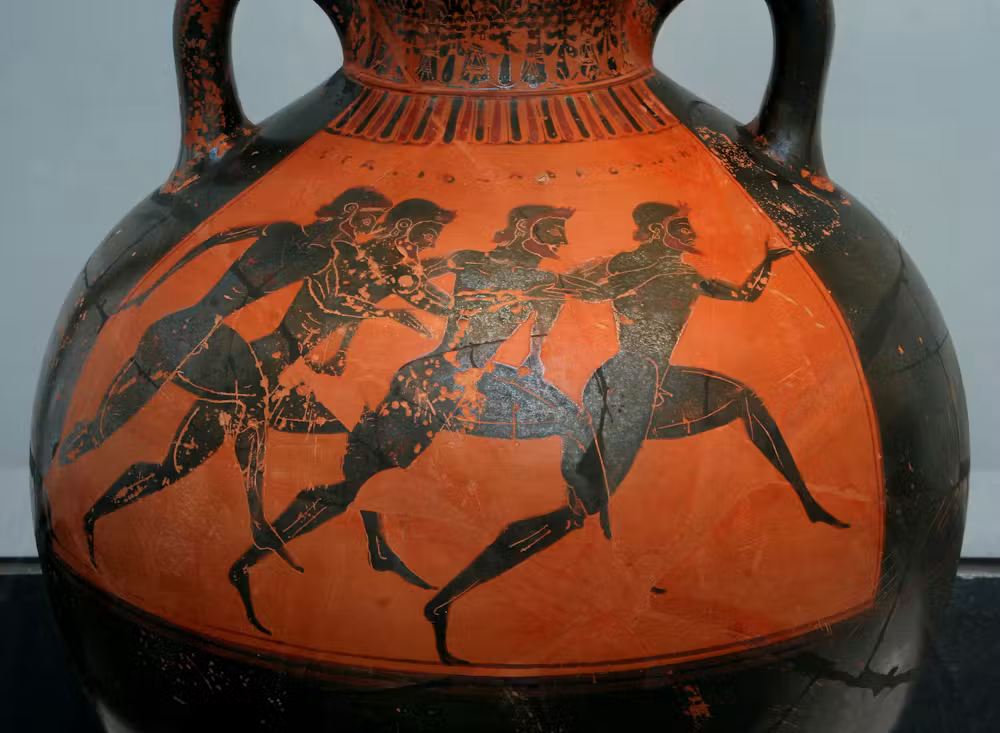
(The image at the top is of a Greek vase depicting runners at the Panathenaic Games c. 530 BC)
 Buy me a Coffee
























The book ‘Why Men Hate Going to Church’ by David Murrow is a call – not for men to return to the church, but for the church to return to men. He shows what has happened and how to respond. If you (men) have ever felt slightly sick singing words to Jesus that you would never say to another man (‘You’re altogether lovely, altogether wonderful to me’), words the disciples never used that make him sound like the singer’s boyfriend (try changing ‘Jesus’ to ‘baby’), closer to the Song of Songs than the Psalms – eros-love rather than agapē – then this message is for you. Like King David, men want to sing thanks to God for victory in strife, not beg him for a hug. Here is an extract from Murrow (p.140, 1st ed):
Tony went to the men’s small group at his church – once. First, the men sat in a circle and sang praise songs for about 10 minutes. Tony was asked to introduce himself and ‘share’ about his life. Next, he was paired with a stranger and asked to share one of his deepest fears. Then everyone was asked to share a prayer or a praise report… Finally the men stood in a circle and held hands for what seemed like hours, while one by one they bared their souls to God. One man was quietly weeping. The guy next to Tony prayed for 10 minutes straight, and his palms were sweaty. Once the meeting was over, Tony didn’t stay for coffee. He hasn’t been back. Men’s ministry often falters for this reason: It’s women’s ministry for men…
Murrow [p.136-7, quoted extensively in the present paragraph] sees that the very language we use in church has become feminised – ‘sharing,’ for instance. Regular men don’t talk this way. Imagine a gang leader saying, “Ed, would you please share with us how you hot-wired that BMW?” We are exhorted to have a relationship with Jesus, even a passionate one. This is an inappropriate metaphor for what should be called Discipleship. When a man loves another man, he uses terms such as admire, look up to, and respect. Men simply do not speak of passionate, intimate or even personal relationships with their leaders or male friends. Would bikers ever have this conversation: “Hey Vic, let’s go for a ride in the hills so we can develop a passionate relationship.” – “Great, Dave, I’d like to enjoy some intimacy with you.”
How will a feminised church appeal to bikers, or soldiers? Murrow points out that women will follow women or men, but men will follow only men. That is why men drain away from female-led congregations. St Peter told women converts to win their husbands for Christ by loving them better (1 Peter 3:1-7), not by preaching (nagging), which is for a male convert to do toward his wife. Whereas women are more need-oriented, men are more goal-oriented, relishing a challenge and finding satisfaction in overcoming it. Jesus equips them to tackle problems in their lives and communities. His first call to potential disciples (Matt 4:19) was: “Follow Me!”
Feminised churches present Jesus as a wonderful friend rather than an infallible guide along life’s thorny path and the supreme leader in the battle between good and evil – in the world and in oneself. But not everybody wants a new friend, whereas all are sinners. Gushing words about a friend are more likely to elicit the reply “That’s nice for you” than “I must meet him too” (especially if they can’t see him). Another common feminised form of evangelism, particularly in charismatic churches, is to preach Jesus first as healer of negative emotions rather than forgiver of sins. This heresy leads to churches filled with people who have not repented deeply or – consequently – have not had their unhappiness lifted from them. But who is this man?
I saw… a white horse, and He who sat on it is called Faithful and True, and in righteousness He judges and wages war. His eyes are a flame of fire… From His mouth comes a sharp sword with which He may strike down the nations, and He will rule them with a rod of iron; He treads the wine press of the wrath of God Almighty. On His robe and on His thigh He has a name written, KING OF KINGS, AND LORD OF LORDS. Then I saw an angel… and he cried out… to all the birds which fly in heaven, “Come, gather for the great supper of God, so that you may eat the flesh of kings and commanders and mighty men, and the flesh of horses and those who sit on them, and the flesh of all men, free men and slaves, small and great”… they were killed with the sword which came from the mouth of Him who sat on the horse.
Jesus could command mountains to move (Matthew 17:20), but at his first coming he set that power aside, living as lamb rather than lion. Against the Pharisees, who sought to kill him, he used the sword of the Spirit for rhetoric only. The Pharisees found his mouth sharper than a two-edged sword. Meek and mild?
Jesus as judge and executioner lies ahead. But he proved his worth for these tasks by performing the archetypal act of male heroism, as seen in war films: He gave his life for his brothers. Jesus chose the cross himself (John 10:18). The Christian faith offers a noble leader who sacrificed himself for his friends yet defeated even death; a freeman’s choice between good and evil; and a hero’s reward for the steadfast. In the early church many brave men of arms became Christians, and spread the faith around the Roman Empire. Christian life is a battle as much as any in the Norse Sagas, Homer, the Mahabharata or (of course) the Old Testament.
Although our battle is spiritual, our opposition resorts to physical force: persecution. Rather than grumble that it is not fair, we should be glad if our faith is enough to threaten Satan (Matthew 5:11; Luke 6:22). Paul warned that all who wish to live a Godly life will suffer for it (2 Tim 3:12); the early church was persecuted. Can a feminised church stand in the face of persecution? Persecution brings out the best in Christian men: agapē, sacrificial love in leadership. And persecution is on the horizon in our land. It would purify the church. Christ disciplines his faithful (Rev 3:19) but he will never abandon us. Can you imagine Sarah Mullally and the bishops having a clue how to lead their denomination into persecution?
Yes, but it is quite an old wake up call! Has anything good been written more recently I wonder?
But the feminisation of the Church of England has continued apace, with women bishops and now a woman ABC who embodies every meme that conventional manly men cannot relate to. I cannot see it pulling out of this descent because that would mean recognising that the church made a mistake. But the evidence of decline is everywhere.
And as Christianity recedes from public consciousness in Britain, a very aggressive, misogynistic kind of religion, Islam, increasingly claims the public square – quite literally, praying in Trafalgar Square and near Downing Street.
I am at least glad that the men’s ministry I am associated with is unapologetic about being men – even gentlemen – and a band of brothers.
Men have been complaining about the feminisation of the Church for 2000 years!
Paul was definitely an alpha male. Jesus not so much.
Actually, Lewis Podles dates the phenomenon to the 13th century. Perhaps that is when Marianism became a dominant theme in western Catholicism, along with courtly love.
The Crusades of the 11th and 12th centuries which pretty much for alpha+ males. I do not think there were many complaints about feminisation of the church in the 16th century.
‘Paul was definitely an alpha male. Jesus not so much.’
Did Paul fast for 40 days and nights? Was he scourged to the point of death? Was he crucified?
‘Paul was definitely an alpha male. Jesus not so much.’
Cleansing the temple wasn’t done with Shake ‘n’ Vac.
A great phrase James!
We need to be careful about imposing our views of alpha male (informed as they are by 2000 of Christian culture and thought) back onto the 1st century. Did people at the time regard a man being crucified as alpha in any way? Or was he a pathetic, humiliated figure, stripped of his masculinity? Christ after all can’t actually carry his cross all the way to Calvary. Have we lost some of the shock value of the crucifix because we’ve become used to it?
And whilst the crusades look very masculine with their warrior monks dressed in chainmail sitting in their fortresses, they were also running hospitals and pilgrim hostels, and this was also the time of saints like Hildegard of Bingen and Clare of Assissi. Indeed, right through church history we have women taking important roles: see Hilda of Whitby, Catherine of Siena, Julian of Norwich, Teresa of Avila, Katherine Drexel etc.
Islam is not ‘misogynistic’, brother. The subordinated place of a woman in the Islamic system is not based on hatred or aversion.
I don’t think we learn much or gain much by misapplying terms like ‘misogyny’ out of the narrow context of the modern social sciences. In saying Islam is ‘misogynist’ I fear we merely deceive ourselves without convincing – let alone evangelising – our Muslim neighbours.
What of the fact that a man can have up to 4 wives in Islam, that a woman’s testimony counts half of a man’s in sharia, and that the Quran permits the beating of a woman whom her husband merely suspects of infidelity?
There is nothing automatic about decline because of women clergy. Pentecostals have women priests and are fast growing in terms of new followers and churches. Just because we allow freedom of worship in the UK for Muslims as with any other faith does not mean we need to copy some Muslim majority nations which restrict womens’ rights to higher education and a professional or managerial career and see them required to pray behind men
And yet why is it that many businesses and public services with women as the head or high up in management are rarely if ever referred to as ‘feminised’?
Is having a female judge mean the court has been ‘feminised’? Or the female Ministerial head of a government department?
Why is it only in the church that such language is used? Oh I know, it’s because they dont think women should have any real authority in the people of God, certainly not as rectors or pastors or bishops. Apparently that’s only for the boys.
Indeed when Thatcher was PM was the government feminised? When Queen Elizabeth II was on the throne was the monarchy feminised? Of course not and as you say the same applies to female chairs and CEOs of large companies in the private sector and to female judges and senior civil servants
Murrow wrote in 2005. There’s also ‘Wild at Heart’ by John Eldredge, published in 2001. As James says, their message has been politely ignored by many churches and so they remain relevant.
There is ‘Losing the good portion’ by Leon Podles, a specifically Catholic book but which includes deep cultural analysis that I warmly recommend to protestants. And of course ‘Reclaiming Masculinity’ by Matt Fuller, a vicar in Mayfair, published a few months ago.
Perhaps Tony would have been better going to a Church which sang hymns, not the sentimental pap of some worship songs. There’s plenty of women who can’t stand Jesus is my boyfriend sentiments too.
Amen, sister! (I’m from a different tradition to yours….). Your comment reminds me of a meme that made me laugh recently commenting that modern worship involves singing ‘I just want to feel your presence Jesus’ on repeat for twenty minutes whilst old hymns have covered the whole of the Council of Nicaea by the end of the second verse……
No, Greg, it’s not ‘feel’. It’s FEEEEEEEEL. Imagine Dylan singing the word in ‘Like a Rolling Stone’.
Anthony – the song writer’s wife said to him ‘I want to feel your presence’ and he thought she was giving him a nice lyric for a song.
The doctrinal superiority of the older hymns is beyond question, as well as their lyrical standard. It takes great skill and learning to take complex ideas and render them into simpler language in rhyming quatrains. I think it was Ambrose of Milan who began the practice of writing rhyming hymns to catechise his largely illiterate congregation, and that practice continued for centuries. The great hymnwriters of the past were often highly educated in theology.
The captivity of modern evangelical worship to the whims and abilities of contemporary song writers influenced by the commercial pop world is one of the burdens of the present.
Most pop songs of the 1960s have far superior tunes to most contemporary worship.
There’s a long history of hymnwriters using popular music – hence the great hymn “I Cannot Tell” is sung to the tune of Irish folk tune Londonderry Air which is also used for the song Danny Boy.
I agree, Penelope! But I don’t want a frozen-chosen church either. I want the Holy Spirit, but I’m not sure many of us know how to recognise Him. Charismatics who sing the trash to which you refer confuse the spiritual and the emotional, but these are not the same, and miracles should follow us rather than us chasing after miracles.
I believe the spiritual and the emotional can work together, but it’s all too easy to say that I find that in a Mozart Requiem and not in Hillsong! One must be wary of cultural/spiritual snobbery (I must be).
Agreed! High church types who claim to find God in Allegri’s Miserere, and charismatics who sing ecstatic worship songs and repeat the chorus six times, are making identical mistakes. I love much traditional church music, but I don’t confuse what it does in me with what Jesus does.
What is wrong with Allegri?
Nothing is wrong and plenty is right about Allegri as a classical composer, Ian. I am questioning whether listening him (or others) does anything significant for one’s relationship with Jesus Christ.
I guess it depends how good your Latin is. It is just Psalm 51…
I know. But the power of Psalm 51 scarcely increases for being set to music. And many people say – confusedly – that they experience God through purely orchestral music that they love.
This is not a dig at Allegri!
Perhaps the music conveys well the sense of our sin, God’s grace, and his generous forgiveness in our weakness…?
Perhaps, but it is in a 17th century idiom very different from our culture.
it’s not all trash. I think that’s a disservice to the writers.
Indeed. Only about 95% of it.
“There’s plenty of women who can’t stand Jesus is my boyfriend sentiments too”.
Though speaking as a man… I think that’s absolutely true. Its accompanying ill is that “if one doesn’t feel Jesus then something is wrong with our faith “.
Penelope – it is a manifestation of what Emil Bruner described in his ‘The Mediator’. Even though they talk about Jesus, all this ‘feeling Jesus’ business is basically trying to get right with God in a way that bypasses Christ as Mediator. Bruner phrased it as ‘sinking in on divine ground’ to describe this. But it only goes to show that there’s basically nothing new under the sun.
At that point in his book, he was showing the deficiency of the speculative philosophy of Immanuel Kant (which seemed to him to be trying to establish communion with God through speculative philosophy – which, as far as he was concerned, was an attempt at establishing communion with God through pious philosophical thinking – which bypassed the need of a Mediator) and, while the mystical ‘sinking in on divine ground’ (which was, I suppose, the 1920’s way of saying ‘feel the presence of Jesus’) approach was somehow at the other end of the spectrum, they were both anti-Christian, in the sense that they tried to establish communion with God, bypassing the need of a Mediator.
<iMurrow points out that women will follow women or men, but men will follow only men.
Just an aside, but it sounds like Murrow has never met an Englishman. We’re not short of dramatic points of our history where men are devotedly following women – see Drake and Raleigh under Elizabeth I, Marlborough under Queen Anne, Disraeli under Queen Victoria, most of the Conservative party under Margaret Thatcher etc. etc..
Thatcher was an exception, although most of her cabinet followed her out of base desire to keep their jobs. As for the others, what do you understand by the phrase ‘constitutional monarchy’?
Indeed. The soldiers and sailors who followed the one who had ‘the heart and stomach of a king’ were following in the first instance her generals and captains. Although the entertainment business and even school education try to gaslight us about the past by inventing a mythical one, there is no disguising who were in the trenches and the front line, as we will recall next month.
I think Churchill had a point when announcing the death of George VI and accession of Elizabeth II in 1952:
“Famous have been the reigns of our queens. Some of the greatest periods in our history have unfolded under their sceptre… I, whose youth was passed in the august, unchallenged and tranquil glories of the Victorian era, may well feel a thrill in invoking once more the prayer and the anthem, “God save the Queen!””
My observation is that for the half dozen or so young blokes that have randomly rolled up at our church asking questions and seeking Christ, they are indeed looking for what it means to “act like men” in a world where it is almost entirely absent in western liberal thought.
1 Cor 16:13 and the call to love in 16:14 come in the context of Paul’s call for the Corinthians to be subject to their leaders/hosts in 16:15-18. This supports your interpretation, Paul, because we have very similar thoughts in close proximity to each other in other letters. Paul calls the Thessalonians to stand firm (5:8, 11, 14) and in this contexts he asks them to recognize their leaders (5:12-13). Paul calls the Philippians to stand firm (4:1) and immediately endorses the leadership of Euodia and Syntyche (4:2-3) (and note συναθλέω in 4:3). The “keep alert” in 1 Cor 16:13a seems to refer to the parousia, which Paul also mentions in Phil 3:20-21 and 1 Thess 5:1-10. The call to love in 1 Cor 16:14 parallels 1 Thess 5:8, 13. Thus, these passages seem to be calling the readers to rally round their leaders and love each other so that they can stand firm in the face of persecution, knowing that Christ will return. Or something along those lines. I also think that Paul is calling for submission to the church leaders in Phil 2:12-15 and Rom 13:1-7 and we find similar parallels surrounding those passages, but that is all a longer story.
You mentioned the renaming phenomenon the other day. Another example, I am convinced, is Eclecte in 2 John 1.
I meant “Ian”. I did it again.
Ironically, you changed my name!!
Or perhaps I just switched your names, just like Irenaeus (or perhaps Justin) switched the names “Matthew” and “Mark” when attributing his gospels!
‘Thus, these passages seem to be calling the readers to rally round their leaders and love each other so that they can stand firm in the face of persecution, knowing that Christ will return. Or something along those lines.’
Yes, I think so Fellows (!). I confess to being taken completely by surprised by the consistent clustering of these ideas.
Although these are present in the OT background in different places, I think they only really come together in Paul’s language in the NT.
On Eclecte in 2 John 1, does that dovetail in with Margaret Mowzcko’s argument about it being a real letter to a real person?
Yes, I too was surprised to find these clusters of thoughts surrounding Paul’s mention of local church leaders. I know of only: Seyoon Kim, “Paul’s Common Paraenesis (1 Thess. 4–5; Phil. 2–4; and Rom. 12–13): The Correspondence between Romans 1:18-32 and 12:1-2, and the Unity of Romans 12–13”, Tyn Bul (2011): 109-139. https://www.tyndalebulletin.org/article/29310-paul-s-common-paraenesis-1-thess-4-5-phil-2-4-and-rom-12-13-the-correspondence-between-romans-1-18-32-and-12-1-2-and-the-unity-of-romans-12-1
The relationship between Love/Humility and allegiance to local church leaders is discussed by Jacob N. Cerone, “Love and Humility as the Cure for Στάσις: First Clement’s Imitation of Pauline Argumentative Strategies” Vigiliae Christianae (2026).
Yes, all the data on Eclecte suggests that she was a real person. Marg has been a trail blazer in interpreting the addressee as a real woman. Recently we have Lincoln’s Blumell’s book, and two very recent NTS articles by Kyu Seop Kim.
In my opinion the elder’s allusion to Eclecte’s name in 2 John 13 is best explained if Eclecte was a symbolic new name. The meaning of the name would be front of mind. Also, the rarity of the name is not a problem if it was a new name. Furthermore, the rarity of the name explains why people had difficulty with the article that comes before kuria in 2 John 1. The article demands that Eclecte was the name of the addressee. Someone omitted the article and someone else moved it to before eclecte. Some manuscripts retain it and this was surely the harder reading.
Thank you Ian. I think your whole overview is superb. Strength that acknowledges our own weakness, but which draws its courage from the presence of God and the faithfulness of God. It is not a gender-based attribute of men rather than women. It is an attribute of real Christian men and real Christian women. I’ve saved this article to my favourites and it’s been a valuable reminder to me, to be recalled in times of trouble. As you express it:
“The reason for courage is God’s presence. ‘The Lord your God goes with you.’ ‘I will be with you.’ ‘He will not leave you until the work is finished.’ Courage is the human response to a promise that God will be there.”
I see those qualities in my daughters’ faith. I see it in the Christian lives of male friends too. I give thanks to God. Your article is so encouraging and a valuable reminder that we are not alone in the long journey of life.
When it comes to spiritual strength and courage there is no male and female for we are one in Jesus Christ.
Thanks Ian. Really helpful. I love this sort of detailed but applied study and exegesis.
Great. It is what I do!
Courage (andreia) is one of the four natural virtues, and it the longstanding view of Christian moral theologians that it can indeed be learned through habituation and through the golden mean: an excess of spirit is foolhardiness, an insufficiency is timidity.
Learning to overcome our fears by confronting them is one of the most important lessons of life. We fear death and pain, but we also have an inordinate fear of discomfort. The essence of training, whether for war or athletics (and the two were closely related in the ancient world) consists of experiencing and overcoming a smallish measure of pain so that we are progressively strengthened.
The problem today is that unfamiliarity with discomfort makes it seem more terrifying than it is. Probably every generation thinks this about the one that follows it. The temptation to comfort is always present, as we see in a world filled with obesity and fears, and the constant search for quick fixes.
(If you put a line space between paras, your comments are easier to read…)
The health-and-safety-uber-alles viewpoint that dominates the Civil Service eliminates courageous leadership in favour of cover-your-ass. Just look at the government response to Covid which is currently in the news. In the 19th century we needed more health-and-safety; now we need less.
What a pleasant departure, an examination of precepts.
Exhortations to be manly in the face of emasculation.
How do we transition from “my little children”to Holy Warrior ?
It does involve quite a bit of travail, until Christ is formed in us.
We might be “born again” but it is tragic if we remain as children
and never come to maturity which was ever Paul’s travail.
How is the transition accomplished?
How is bold manliness exemplified ?
Well, Peter was a bold manly fellow, never taking a backward step, devoted to Christ, he was great if he had a sword in his hands slashing at the hated Temple servant{s] as some would count manliness,
he knew who the enemy was and how to dispatch him.
He was to discover that he was fighting on the wrong turf.
But the enemy he discovered was in fact himself.
The Cross really did for Peter, it finished him completely.
How was he recovered – through the Resurrection
This Jesus, crucified in weakness, raised in power!
But how to become a Holy Warrior ?
“Not by might nor by power, but by My Spirit said the Lord”.
The way up is down.
The formation of the Man-Child began as a promise in Eden,
Portrayed in Isaac, fleshed out in the travails of Hannah through Samuel, David and Solomon, to the Glory of God filling the House,
A far cry from the house pertaining to Hannah; through Paul’s
supreme confidence –
“The God of peace will soon crush Satan under your feet.”. Romans 16:20 ; to culminate in a woman clothed with the sun and the company of the Holy Warriors.
Man of himself cannot Man-up – he must go down to go up as per the
Scriptural role models.
Onwards and Upwards. Shalom.
It is unfortunate that versification sets 1 Corinthians 16:13 and 14 apart. We can be sure that Paul had no such thought in his mind when he wrote: “Be on your guard; stand firm in the faith; be courageous; be strong. Do everything in love.”
And he put no gap between verse 14 and verse 15. See my first comment.
PS. – Alex Kocman has some good insights on
The Source of Biblical Boldness – @
https://founders.org/articles/the-source-of-biblical-boldness/
I think you have to make your mind up here. Either the word only appears once as you claim or it appears 21 times. Either you accept the Septuagint as an accurate rendering of old testament scripture or you don’t.
Perhaps it is entirely appropriate for Joshua to tell his troops or indeed people, in an entirely patriarchal society to act like men, and that in fact means be courageous. The alternative would be what? Act like boys? Children? Women?
Could it be that Paul, also alluding to the same thing, but in fact also writing within a highly patriarchal society saying the same thing? Could it be true that the cultural gulf to todays modern western society which is so very different to “the shared language of the whole community” found in both the new and old testaments?
The term undoubtedly means to be courageous, often in the face of strong opposition, but could it be that it is an encouragement to take on a quality of a warrior in spiritual terms, as opposed to the often physical ones facing for example Joshua. Could it be that David when instructing Solomon was a warrior king encouraging his son to take on his role as a mature man to a hive what qar needed, could it be an encouragement to him to leave behind childish things and get focussed?
I don’t think anyone (or anyone I have heard or read) has ever made the claim that being courageous is “limited to men”, and one could also make the observation that in the few examples in the old testament (for example in the story of Deborah) that where women came to the fore, they were indeed acting like men of courage, where perhaps it was lacking among the men, and as a result the glory and honour went to the women. And they deserved it well.
The sense is not that it is limited to men (a very modern obsession) but that it is to display both a very masculine (and in the right context very Godly) tendency, and the shame when it is missing for men, especially when absent. The opposite would be timidity and cowardice and I deed a lack of faith in the one who actually gives victory.
Perhaps here we have the image of what the Christian should look like, or how one should behave when dealing with situations where courage is required – to act like men.
When addressed to men, to tell them to “man up” is indeed an encourage ment to fight on, to push through, and to persevere.
It’s quite legitimate to observe that instructions to do all these things are equally applied to both men and women, but the timidity of getting nervous about the term in case it upsets women who might be offended when an entirely masculine term is used is telling.
You are quite right that “Paul is quite capable of distinguishing between men and women when he wants to”, and he often does. But that one opens up and entirely different can of worms, as much of what he writes is addressed to “brothers” – though most translations have chosen to insert the “and sisters” that does not appear in the text, seemingly because of the same nervousness that if a scripture is not directly addressed to women they will be unable to grasp or apply apply principles unless the text is altered to be inclusive of them.
I would be a wealthy man if I had a pound for every time I had heard the justification for other doctrinal gymnastics which have fallen back on the “fact” that various scriptures were written to “brothers and sisters” therefore there can be no difference between men and women in any aspect of life and ministry or even marriage. Yet the insertion of these words is a very modern phenomena I’m sure you would agree.
It indeed “fits a wider pattern in Paul’s letters” that it seems that Paul is primarily (though I’m sure not exclusively) addressing men in his letters, in the context of a primarily patriarchal society in a world where leadership in both the world and indeed the church is primarily male. That in a context of the seamless transition of the old covenant to the new, and an extension and transition from what we might now (with a perhaps false dichotomy) call Judaism to Christianity. In international words we don’t see Jesus or Paul doing away with basic patriarchy in the ekklesia, but working within it. It could be argued (and strongky is) that patriarchy is in fact part of the design.
If indeed the scriptures ‘were written down for our instruction, on whom the end of the ages has come’ then to re write this to exclude any aspect of this design would be entirely pagan. The very thing that we are encouraged to come out of.
I think it’s a fair comment to say Paul “simply speaks Israel’s scriptural language to Gentile believers and expects it to make sense to them.” And that is what he is doing since they knew all about the patriarchy and did not question it.
But I completely agree with you that “‘Act like men’ sounds odd to modern ears, and it is tempting to soften it in translation. But the force is there, and it is given to all of us.”
The danger here is that the focus moves away from the desire to see Christians (yes all of us!) man up, and the offence of those who chose to see all of scripture through the egalitarian/feminist lense does exactly what you say you don’t want to see.
I also agree that “we are not being handed a lesson in gender roles” since the scripture is amply able to teach us what those look like, and how different they are to the very pagan western society we live in that champions the destruction of the unborn, the weakening of the family, and the open sexual “freedoms” that are such a detriment to God’s good design.
The lessons in gender roles in scripture are quite clear elsewhere, and yes that is an open challenge to egalitarianism.
Egalitarianism would not be true even if it were well-defined. It is neither.
Watch how the difference between equality in dignity and average equality in attributes is elided.
Think how many attributes there are. Are we supposed to lie that males and females have the same average ‘score’ in all of them? It would be remarkable if they did in more than a small fraction.
Great comment! Longer than your original post I think!
And on three points of substance:
1. The term occurs ONCE in the NT and around 20 times in the OT.
2. It is well established that the LXX varies enormously from book to book on whether it is a close translation of the MT or whether it is a free-wheeling expansive commentary.
3. The fact that women both in the OT and the NT acting in ‘manly’ ways both challenges our stereotypes of the ancient world AND undermines the idea that patriarchy is God’s intention. In both contexts, men often rule, but not always.
Would Paul have known Micah 4.10 in the LXX form that has come down to us? It’s interesting that the Hebrew doesn’t actually say ‘be courageous’ but ‘groan’ (‘like a woman in labour’). I haven’t come across an example of ‘amats or hazaq where the person addressed isn’t masculine (Hebrew imperatives are gendered).
Incidentally, the Vulgate renders hazaq in Psalm 27.14 (V 26.14) as ‘viriliter age’, ‘act manfully’, and this became a popular motto of the boys’ schools founded by the Christian Brothers order.
As a Greek-speaking diaspora Jew, Paul would certainly be familiar with the LXX. Note, for example, that in 1 Cor 2.16 he cites the LXX of Is 40.13 (mind of the Lord) and NOT the MT (Spirit of the Lord).
Yes, I imagine Micah would have been in a scroll of the Minor Prophets, but for me the more persuasive evidence would be how andrizomai was used in the first century. My abridged Liddell and Scott gives ‘to become a man, to think and act like a man’, but it doesn’t give any text citations. It would be helpful to see how the related word andreia ‘manliness, courage’ is used in that context. I’ve always thought synchronic context should be our first port of call, while very aware that NT writers inhabit a Scriptural world – which is your major point. For me, the decisive factor is that 1 Cor 16.13 is addressed to all the church, so it concerns a virtue (woops – from ‘vir’!) that both men and women are meant to embrace. That’s why something like ‘be courageous’ makes a better contemporary translation.
At the same time, the actual etymology gives a good reminder to *men what being a *man is really about.