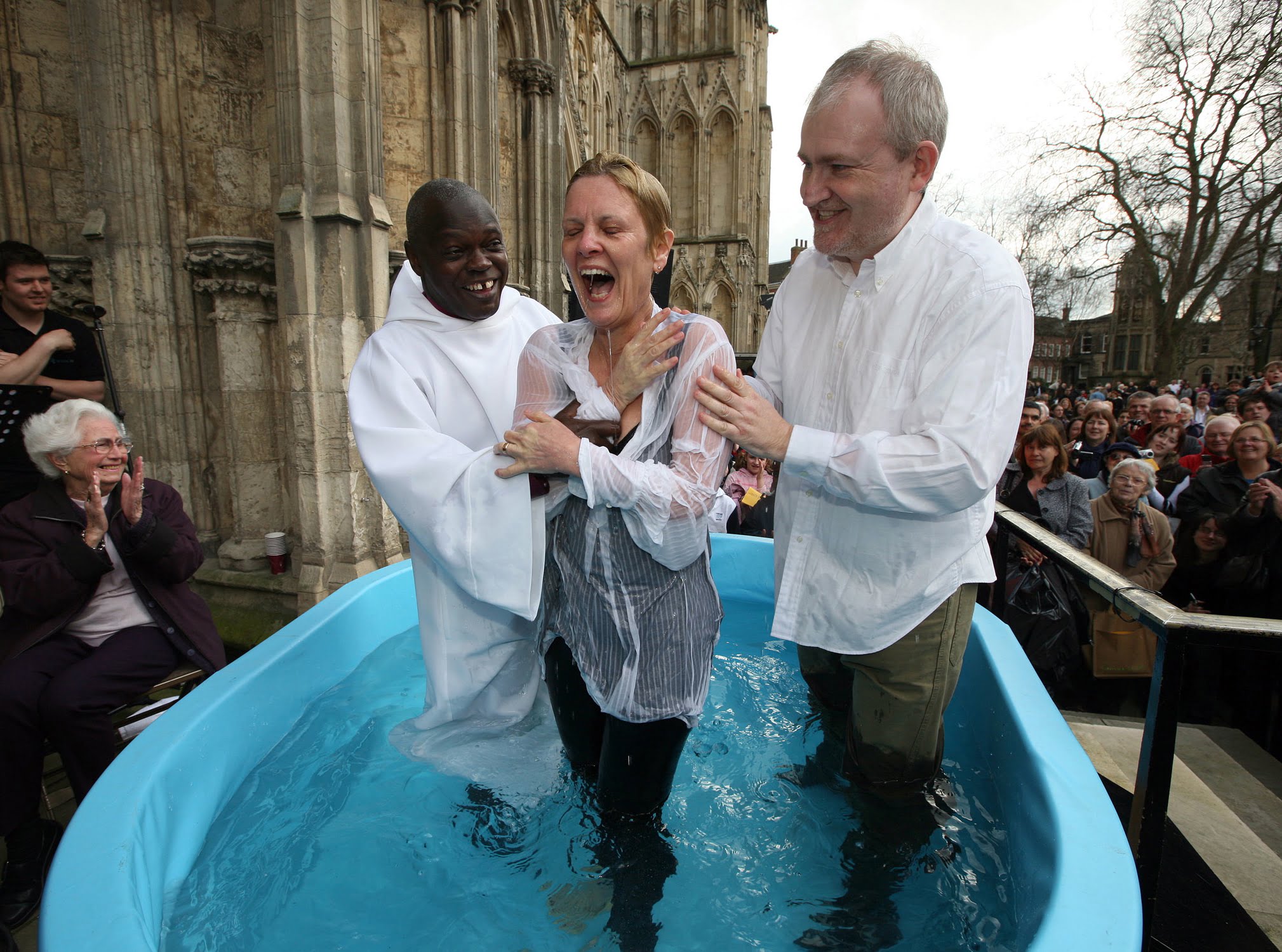
Why was a faculty application for a portable baptismal pool in a church in Southwell and Nottingham rejected? What does that tell us about processes in the Church of England—and are they fit for purpose?
It is not often that a consistory court judgment makes the national press, and when it does it is usually because of a disputed churchyard memorial or a row about a nightclub partnership. So it was something of a surprise to see headlines last month announcing that a judge had thrown out a church’s plans for a ‘baptism pool’ because it would be a ‘needless waste of water’. It was doubling surprising for me, since this was in my own diocese (Southwell and Nottingham).
The headlines were, as usual, misleading. The water point was explicitly not the basis of the decision, as Law & Religion UK quickly pointed out. But the actual reasons for the decision are in some ways more striking than the press reports, and they deserve closer attention than they have so far received.
The case is Re St Mary, Radcliffe-on-Trent [2026] ECC S&N 1, decided by Christopher Ockelton, Chancellor of the Diocese of Southwell and Nottingham, and dated 24 August. In refusing a faculty for a portable immersion baptistery, the chancellor concluded that the claimed need for baptism by immersion ‘has no theological basis’ (para 16), and that in the Church of England there is ‘never any need’ for immersion where another lawful mode is available.
It is worth considering this judgment seriously, because it is, in some respects, learned, carefully argued and clearly written. The chancellor has done real work here, including in the Greek and the Latin. But I think it is mistaken at several key points—historically, liturgically, theologically and (I suspect) legally. And since it is the only recent reasoned judgment on the question, it is likely to be cited well beyond the borders of our diocese. That matters for every parish that is seeing adults come to faith and asking to be baptised in a way that expresses what is happening to them.
What the parish asked for
The request itself was modest. St Mary’s is a Grade II listed parish church with a traditional font. The vicar and churchwardens asked for permission to buy and store a portable baptistery—six timber sections that bolt together into an oval pool, with a waterproof liner, holding up to 940 litres. It would be set up in the chancel for ‘single baptism services’, drained afterwards, and stored out of sight in an unused vestry. The Diocesan Advisory Committee recommended approval.
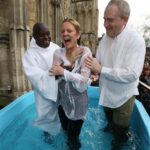
The reason was simple and, I suspect, familiar to many readers of this blog. A small but growing number of adults have been coming to faith, many through Alpha, and others who were never baptised as infants. When they ask for baptism, they ask to be immersed. The parish described these requests as ‘universal’, and had been borrowing pools from other churches to meet them. Buying their own seemed the sensible next step.
The chancellor accepted at the outset that the pool would cause no harm to the building’s significance. That is usually what faculty cases turn on. But he held that this was not the real question. The fittings and usages of a church must promote, and not counteract, the doctrine of the Church, so the question was whether using the pool would be appropriate. And that, he said, was ‘a question sounding principally in the theological and liturgical understanding of the rite of baptism’.
He returned the petition to the parish once, drawing their attention to the House of Bishops’ Guidance on Fonts from 1992. The vicar and curate replied with what he graciously called a full and thoughtful response. But the faculty was refused.
The chancellor’s reasoning
The argument runs in four steps.
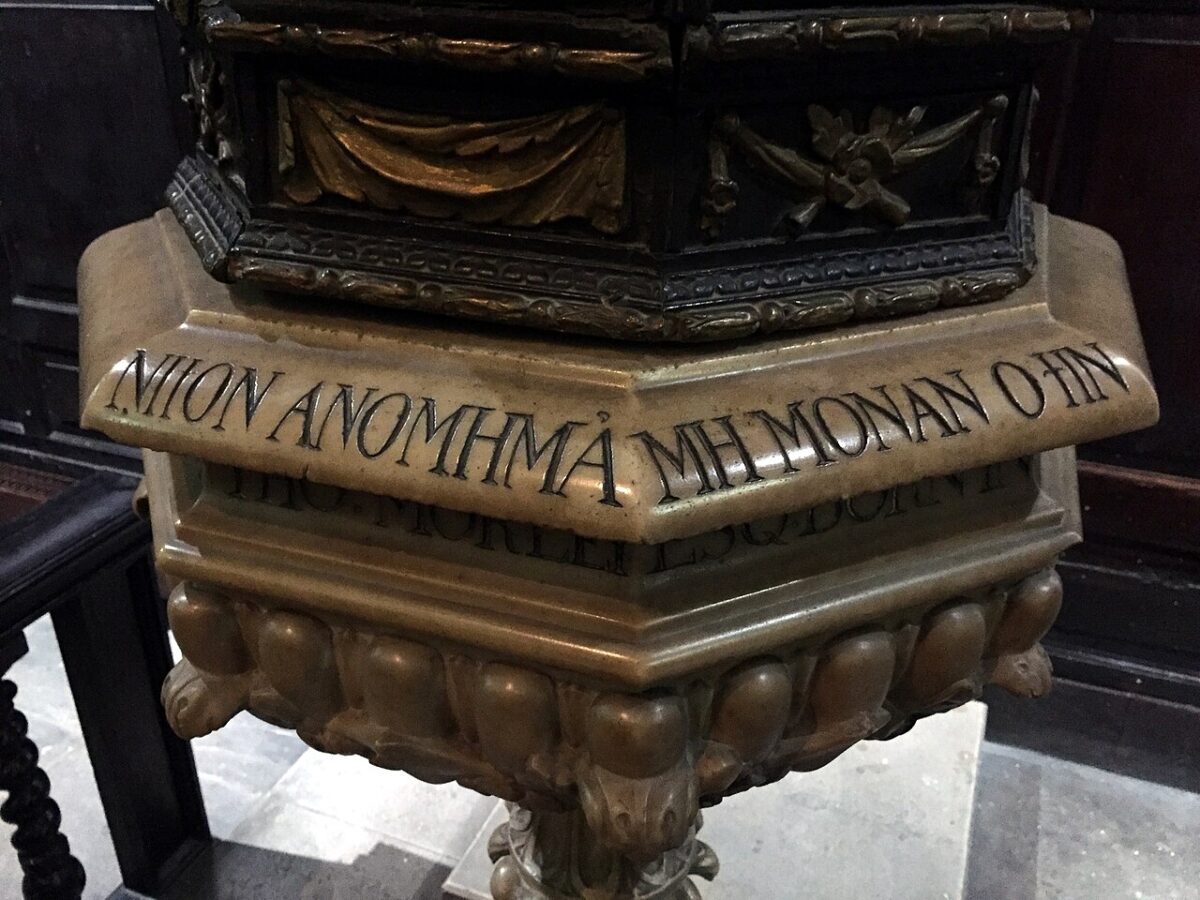 First, history. The chancellor notes that βαπτίζω in the New Testament implies submersion, but that the Latin Fathers used tingo, which can mean anything from wetting to dipping. He cites Didache 7 as permitting baptism in running water, still water, or by pouring three times on the head. He points to the palindrome attributed to Gregory of Nazianzus, νίψον ἀνομήματα μὴ μόναν ὄψιν (‘wash the sins, not just the face’), found on a number of fonts. He observes that most medieval fonts could not immerse an adult. And he offers a careful reading of the 1134 Council of Ravenna, which prescribed baptism by triple aspersion or immersion, as a restatement of existing practice rather than an innovation. The Book of Common Prayer’s rite for those ‘of riper years’ then confirms the position: the priest shall ‘dip him in the water, or pour water upon him’.
From this he concludes that the parish’s claimed necessity has no theological basis. If there is a pastoral need, it is for teaching that the mode makes no difference. And, in what is probably the most quoted line, the doctrine and practice of the Church ‘is not determined by those about to join it’.
Secondly, he accepts without hesitation that immersion is lawful. It is part of the tradition and allowed by the formularies. So the question becomes whether a parish should offer candidates a choice.
Thirdly, he answers that question from the 1992 Guidance, which he treats as authoritative even though it is not formally law. The Guidance holds that there should be one font in a church, that a second is ‘an anomaly’, and that multiple fonts risk suggesting different kinds of baptism. He concludes that the sacramental reception of grace should not become ‘akin to the consumer choices available in worldly life’.
Fourthly, and explicitly as an aside, there is the water. A 940-litre pool uses perhaps ten times a domestic bath, and thousands of times more than a font. Even if doctrine and law had favoured the parish, he says, the court might have declined to endorse such waste.
Where the reasoning goes wrong
‘Need’ is not ‘necessity’
The first problem is a straw man. No one at Radcliffe claimed that baptism by pouring is invalid. The parish’s ‘need’ was pastoral and missional; adult converts were asking for something the Church’s own liturgy allows. The chancellor tested that need against a standard of sacramental validity it never claimed to meet, and found it wanting. But once you concede, as he rightly does, that immersion is lawful and part of the tradition, ‘nobody needs it’ is simply not a reason to refuse it.
The Didache says the opposite
The historical argument is weaker than it looks. Didache 7 does not set out three equal options. It sets out an order of preference: baptise in living (running) water; if you have none, in other water; if not cold, then warm; and only if you have neither, pour water three times on the head. Here is the Greek text:
1. Περὶ δὲ τοῦ βαπτίσματος, οὕτω βαπτίσατε· ταῦτα πάντα πρειπόντες, βαπτίσατε εἰς τὸ ὄνομα τοῦ πατρὸς καὶ τοῦ υἱοῦ καὶ τοῦ ἁγίου πνεύματος ἐν ὕδατι ζῶντι. 2. ἐὰν δὲ μὴ ἔχῃς ὕδωρ ζῶν, εἰς ἄλλο ὕδωρ βάπτισον· εἰ δ’ οὐ δύνασαι ἐν ψυχρῷ, ἐν θερμῷ. 3. ἐὰν δὲ ἀμφότερα μὴ ἔχῃς, ἔκχεον εἰς τὴν κεφαλὴν τρὶς ὕδωρ εἰς ὄνομα πατρὸς καὶ υἱοῦ καὶ ἁγίου πνεύματος. 4. πρὸ δὲ τοῦ βαπτίσμος προνηστευσάτω ὁ βαπτίζων καὶ ὁ βαπτιζόμενος καὶ εἴ τινες ἄλλοι δύναται· κελεύεις δὲ νηστεῦσαι τὸν βαπτιζόμενον πρὸ μιᾶς ἢ δύο.
Note the pun in Greek (also present in the New Testament) expressed in the metaphor for what we call ‘running water.’ It is ‘living water’, meaning that it moves rather than still—but the double (metaphorical) meaning is that it is water that brings life.
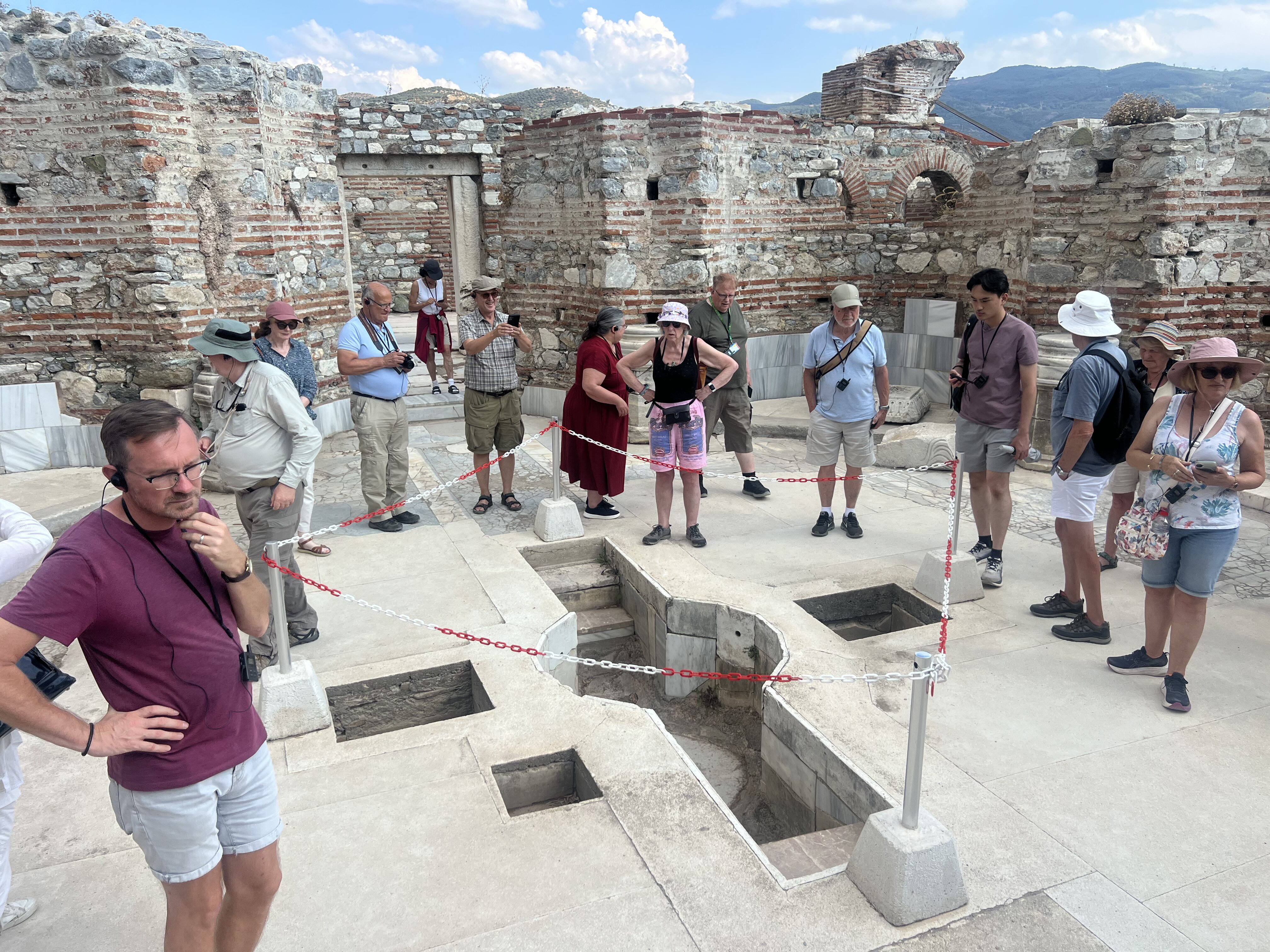 So this is evidence that immersion was the norm and pouring a concession, which is close to the opposite of what the judgment draws from it. We have not long returned from leading a study trip to Turkey, and on multiple occasions we can across examples of cruciform baptismal fonts demonstrating the widespread and normative practice of immersion. Many had their own baptistry in order to allow for the large numbers coming forwards for immersion.
The other evidence is either late or beside the point. Latin tingo tells us about translation, not apostolic practice. Depictions of Christ standing in the Jordan come from the third and fourth centuries. Medieval fonts date from long after infant baptism had become the norm—and what the judge completely misses is that such fonts are the size of baby baths, since immersion remained the norm even for infants!
The Gregory palindrome is a moral contrast between sins and face, not a liturgical rubric—in fact, the use of the word ‘face’ (rather than any other part of the body) arises from the need to make the palindrome work. Meanwhile the large early baptisteries, including those at Ravenna itself, go unmentioned, as does the broad scholarly consensus (Everett Ferguson’s monumental study is a good place to start) that immersion was normative in the early Church.
The moral of the story is this: it is great to do your homework, and consider the history. But if you are going to do so, then you need to get it right.
Sprinkling is not in the Prayer Book
Here is the curious thing. The chancellor’s conclusion is that aspersion or affusion is the Church’s settled practice. But the Book of Common Prayer never mentions sprinkling. For infants, the default is that the priest ‘shall dip it in the water discreetly and warily’, with pouring permitted only if the child is weak. For adults, dipping comes first. Even the 1992 Guidance describes aspersion as a post-Reformation fashion of northern climes! The judgment imports sprinkling from a twelfth-century Western canon into the Church of England, against the plain wording of our own formularies.
Validity is not the whole story
Most significantly, the judgment collapses the question of what baptism does into the question of what is valid. Of course baptism is ‘of equal effect however administered’. But sacraments are signs, as Articles 25 and 27 insist, and the sign matters. Paul’s language in Romans 6.3–4 of being ‘buried with him by baptism into death’ is not easily illustrated by a few drops on the forehead. The ecumenical consensus of Baptism, Eucharist and Ministry (1982) recognised this, as has Roman Catholic practice for adults since Vatican II. And so did the 1992 Guidance itself, which conceded that immersion reflects Romans 6 ‘most completely’, called for ‘lavish symbolism’, and (irony alert!) looked forward to large fonts suitable for immersion as ‘the coming norm’.
2.6.5 The thrust of this paper is to point to a large, single font in which baptism can be administered in the three ways indicated previously. This we impenitently regard as the coming norm. However, churches have their own momentum, both in terms of developing liturgical practice, and in ways in which their liturgical furniture is adapted to changing pastoral needs. In the immediate future, we hope that sufficient fonts of this style can be encouraged in key parishes (and all cathedrals?) throughout the dioceses.
In other words, the Guidance was pushing towards more water, not less. It is odd to see it used to defend the minimal sign it was hoping to move beyond.
The liturgy leaves it to the minister
Finally, there is a legal question. The Prayer Book leaves dipping or pouring to the minister’s discretion, and Common Worship Christian Initiation, the Church’s current authorised rite, does the same while encouraging a generous use of water. As far as I can see the judgment never mentions Common Worship at all. Refusing the only practical means of immersion in effect removes a lawful liturgical option through the back door of a furnishings decision. That is not what the faculty jurisdiction is for.
Consumers or converts?
The rhetoric of ‘consumer choice’ is, I think, the least persuasive part of the judgment. Adults who have just come to faith, been taught Romans 6 on an Alpha course, and want their baptism to look like dying and rising with Christ are not shopping. Many will have friends or family in Baptist or Pentecostal churches, where immersion is simply what baptism looks like. Their request is a sign of catechesis working, not failing. Ironically, the judge sees the need here for teaching about different forms of administration of the water within Anglican discussion—whilst ignoring both the need and the actuality of teaching about the meaning of baptism itself.
The judgment also passes over the rationale of Canon B21, which it quotes at the outset: baptism takes place in public worship so that the congregation may witness it and be reminded of their own baptism. It is hard to think of anything that does that more powerfully than an adult going down into the water in front of the whole church.
There is a wider problem too. The judgment raises the question of whether it is even lawful to use borrowed pools, and dismisses a photograph of a former Archbishop of York with one. Yet bishops and parishes across the Church of England regularly baptise in portable pools, rivers and the sea. To cast doubt on all of that, on the papers, without a hearing, without submissions on the chancellor’s own historical research, and without input from the bishop, is a great deal of weight for a single parish petition to bear. The 1992 Guidance itself suggested that such questions might need episcopal direction.
And what about the water? It would drain onto the churchyard, not into the sewer; one fill can serve several candidates; and the parish was already borrowing pools. If we are going to start auditing the environmental cost of our worship, I suspect the heating bill will come some way ahead of the occasional baptistery.
Conclusion
The chancellor is right that there is one baptism, and right that pouring is fully valid. But the Church of England has never been indifferent to the fullness of the sign, and our own Prayer Book puts dipping (immersion) first. More than that, Church of England doctrine is always self-effacing, in that it claims merely to be an expression of biblical teaching. It therefore encourages us to return ad fontes (pun intended!) and look to the biblical practice and teaching on the meaning of baptism, which unequivocally requires immersion.
As Tim Wyatt notes in his discussion of the case:
Our tradition of a gentle sprinkle clearly doesn’t meet the cultural moment. There may not be a measurable Quiet Revival, but what is clear is that adults are anecdotally coming forward in growing numbers to be received into the church. Men and women who have felt the urge to grab a Bible or visit a church and have unexpectedly met the risen Jesus. And if the national church cannot rise to this occasion and offer the full-bodied whole-hearted form of baptism today’s converts are earnestly seeking, it will get left behind.
The question facing parishes is not whether immersion is necessary, but whether, when new believers ask to be buried and raised with Christ in the most vivid way our liturgy allows, we should say yes. I think we should—and I hope this judgment is not the last word on the matter.
That in turn raises two further question. Given the poor basis of this judgment, how might it easily be reversed? And then the wider question: why are we encumbered by legal processes which do not support the mission and ministry of the Church on the ground? Is it time for a serious rethink?
 Buy me a Coffee
















Excellent analysis. The judgment was partial and selective. One can easily see how a conveyor belt could lead to a reduction in ceremony/complexity. As to which things are Anglican, one often hears that question, but that is to approach things from the reverse angle to the one that takes priority (the assumption can seem to be that anything anglican must be right, but where does that indefensible assumption come from?). In this case, anyway, the judgment is neither just nor anglican.