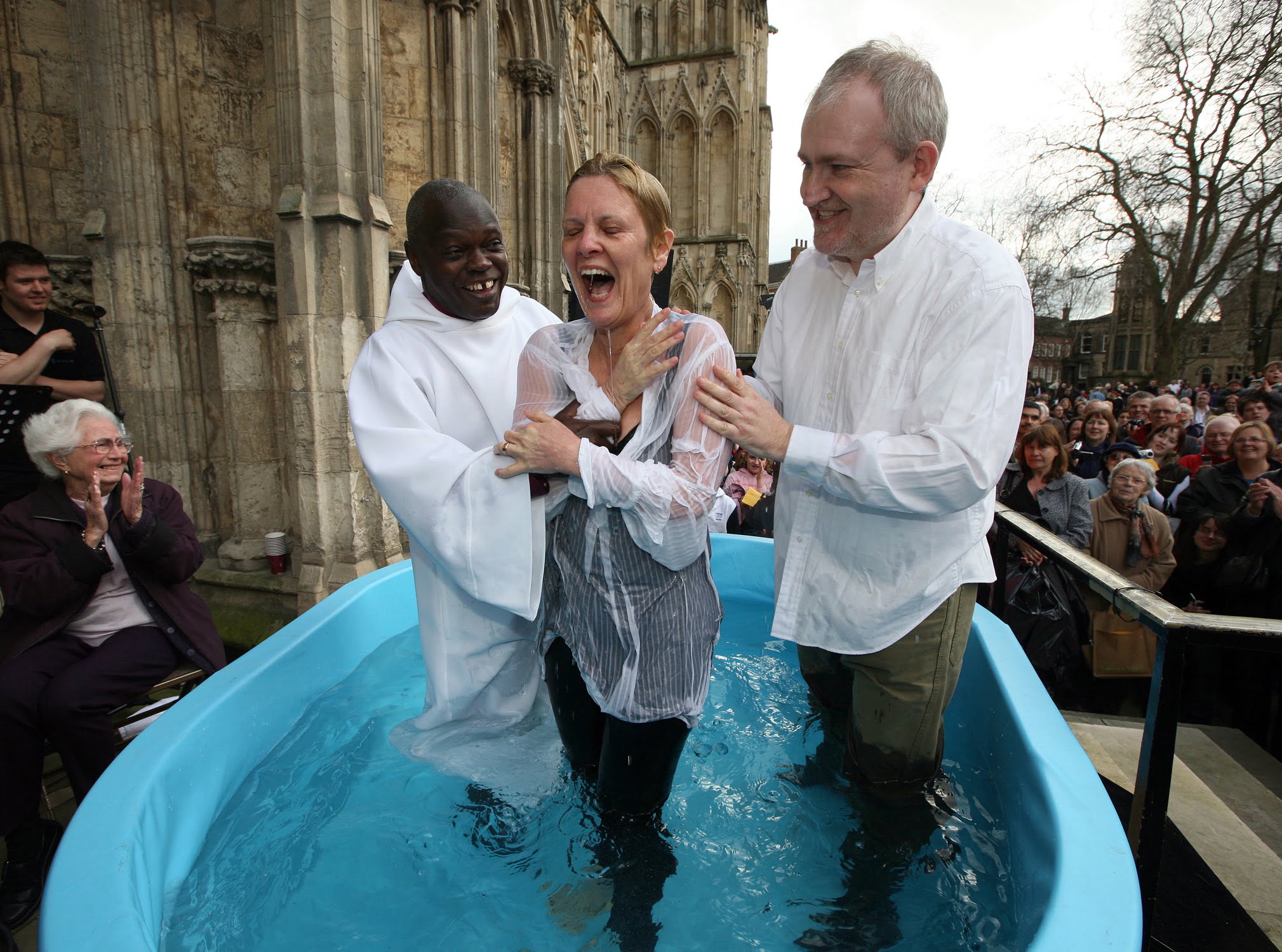
Why was a faculty application for a portable baptismal pool in a church in Southwell and Nottingham rejected? What does that tell us about processes in the Church of England—and are they fit for purpose?
It is not often that a consistory court judgment makes the national press, and when it does it is usually because of a disputed churchyard memorial or a row about a nightclub partnership. So it was something of a surprise to see headlines last month announcing that a judge had thrown out a church’s plans for a ‘baptism pool’ because it would be a ‘needless waste of water’. It was doubling surprising for me, since this was in my own diocese (Southwell and Nottingham).
The headlines were, as usual, misleading. The water point was explicitly not the basis of the decision, as Law & Religion UK quickly pointed out. But the actual reasons for the decision are in some ways more striking than the press reports, and they deserve closer attention than they have so far received. (I suspect that the press picked up on the ‘water’ comment since they found the rest of the argument too obscure to make sense of…)
The case is Re St Mary, Radcliffe-on-Trent [2026] ECC S&N 1, decided by Mark Ockelton (also known as Christopher), Chancellor of the Diocese of Southwell and Nottingham, and dated 24 August. In refusing a faculty for a portable immersion baptistery, the chancellor concluded that the claimed need for baptism by immersion ‘has no theological basis’ (para 16), and that in the Church of England there is ‘never any need’ for immersion where another lawful mode is available.
It is worth considering this judgment seriously, because it is, in some respects, learned, carefully argued and clearly written. The chancellor has done real work here, including in the Greek and the Latin. But I think it is mistaken at several key points—historically, liturgically, theologically and (I suspect) legally. And since it is the only recent reasoned judgment on the question, it is likely to be cited well beyond the borders of our diocese. That matters for every parish that is seeing adults come to faith and asking to be baptised in a way that expresses what is happening to them.
What the parish asked for
The request itself was modest. St Mary’s is a Grade II listed parish church with a traditional font. The vicar and churchwardens asked for permission to buy and store a portable baptistery—six timber sections that bolt together into an oval pool, with a waterproof liner, holding up to 940 litres. It would be set up in the chancel for ‘single baptism services’, drained afterwards, and stored out of sight in an unused vestry. The Diocesan Advisory Committee recommended approval.
The reason was simple and, I suspect, familiar to many readers of this blog. A small but growing number of adults have been coming to faith, many through Alpha, and others who were never baptised as infants. When they ask for baptism, they ask to be immersed. The parish described these requests as ‘universal’, and had been borrowing pools from other churches to meet them. Buying their own seemed the sensible next step.
The chancellor accepted at the outset that the pool would cause no harm to the building’s significance. That is usually what faculty cases turn on. But he held that this was not the real question. The fittings and usages of a church must promote, and not counteract, the doctrine of the Church, so the question was whether using the pool would be appropriate. And that, he said, was ‘a question sounding principally in the theological and liturgical understanding of the rite of baptism’.
He returned the petition to the parish once, drawing their attention to the House of Bishops’ Guidance on Fonts from 1992. The vicar and curate replied with what he graciously called a full and thoughtful response. But the faculty was refused.
The chancellor’s reasoning
The argument runs in four steps.
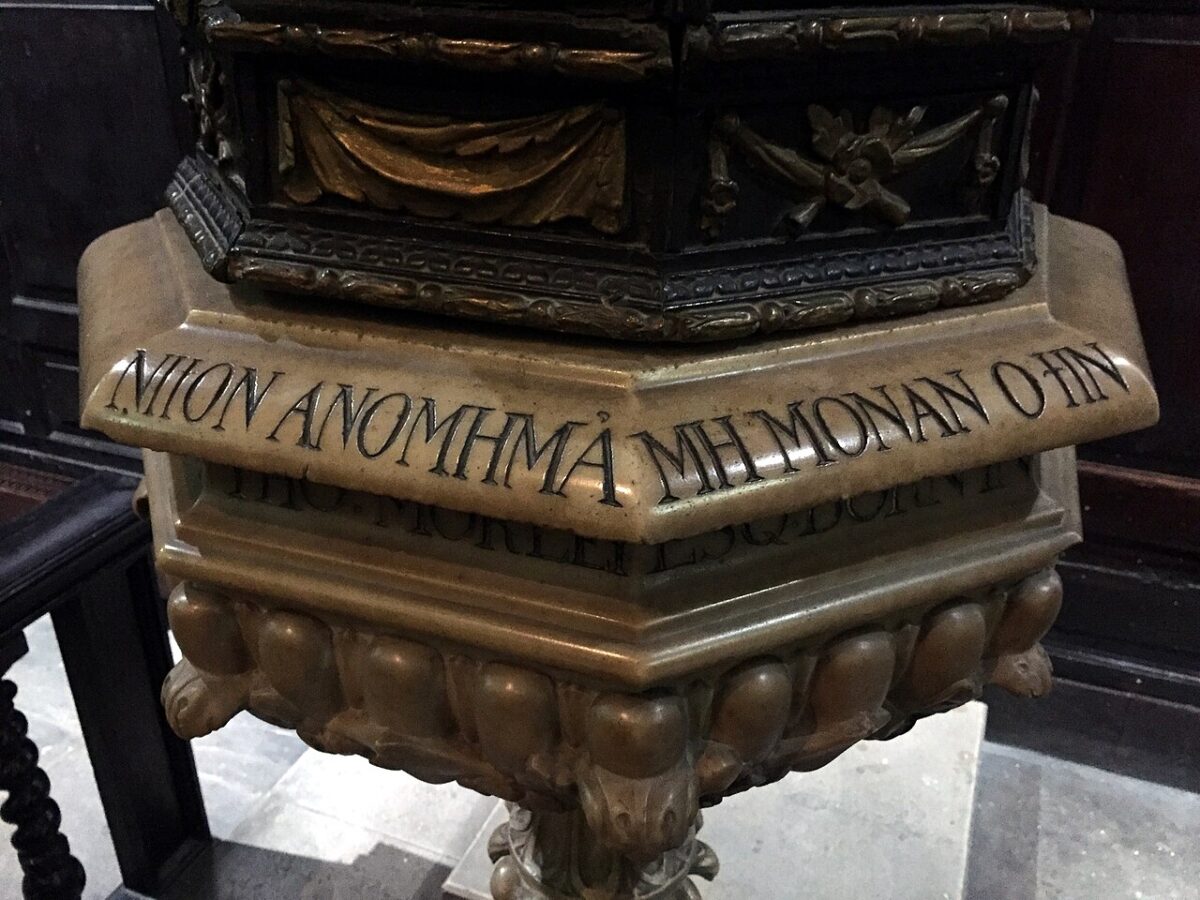 First, history. The chancellor notes that βαπτίζω in the New Testament implies submersion, but that the Latin Fathers used tingo, which can mean anything from wetting to dipping. He cites Didache 7 as permitting baptism in running water, still water, or by pouring three times on the head. He points to the palindrome attributed to Gregory of Nazianzus, νίψον ἀνομήματα μὴ μόναν ὄψιν (‘wash the sins, not just the face’), found on a number of fonts. He observes that most medieval fonts could not immerse an adult. And he offers a careful reading of the 1134 Council of Ravenna, which prescribed baptism by triple aspersion or immersion, as a restatement of existing practice rather than an innovation. The Book of Common Prayer’s rite for those ‘of riper years’ then confirms the position: the priest shall ‘dip him in the water, or pour water upon him’.
From this he concludes that the parish’s claimed necessity has no theological basis. If there is a pastoral need, it is for teaching that the mode makes no difference. And, in what is probably the most quoted line, the doctrine and practice of the Church ‘is not determined by those about to join it’.
Secondly, he accepts without hesitation that immersion is lawful. It is part of the tradition and allowed by the formularies. So the question becomes whether a parish should offer candidates a choice.
Thirdly, he answers that question from the 1992 Guidance, which he treats as authoritative even though it is not formally law. The Guidance holds that there should be one font in a church, that a second is ‘an anomaly’, and that multiple fonts risk suggesting different kinds of baptism. He concludes that the sacramental reception of grace should not become ‘akin to the consumer choices available in worldly life’.
Fourthly, and explicitly as an aside, there is the water. A 940-litre pool uses perhaps ten times a domestic bath, and thousands of times more than a font. Even if doctrine and law had favoured the parish, he says, the court might have declined to endorse such waste.
Where the reasoning goes wrong
‘Need’ is not ‘necessity’
The first problem is a straw man. No one at Radcliffe claimed that baptism by pouring is invalid. The parish’s ‘need’ was pastoral and missional; adult converts were asking for something the Church’s own liturgy allows. The chancellor tested that need against a standard of sacramental validity it never claimed to meet, and found it wanting. But once you concede, as he rightly does, that immersion is lawful and part of the tradition, ‘nobody needs it’ is simply not a reason to refuse it.
The Didache says the opposite
The historical argument is weaker than it looks. Didache 7 does not set out three equal options. It sets out an order of preference: baptise in living (running) water; if you have none, in other water; if not cold, then warm; and only if you have neither, pour water three times on the head. Here is the Greek text:
1. Περὶ δὲ τοῦ βαπτίσματος, οὕτω βαπτίσατε· ταῦτα πάντα πρειπόντες, βαπτίσατε εἰς τὸ ὄνομα τοῦ πατρὸς καὶ τοῦ υἱοῦ καὶ τοῦ ἁγίου πνεύματος ἐν ὕδατι ζῶντι. 2. ἐὰν δὲ μὴ ἔχῃς ὕδωρ ζῶν, εἰς ἄλλο ὕδωρ βάπτισον· εἰ δ’ οὐ δύνασαι ἐν ψυχρῷ, ἐν θερμῷ. 3. ἐὰν δὲ ἀμφότερα μὴ ἔχῃς, ἔκχεον εἰς τὴν κεφαλὴν τρὶς ὕδωρ εἰς ὄνομα πατρὸς καὶ υἱοῦ καὶ ἁγίου πνεύματος. 4. πρὸ δὲ τοῦ βαπτίσμος προνηστευσάτω ὁ βαπτίζων καὶ ὁ βαπτιζόμενος καὶ εἴ τινες ἄλλοι δύναται· κελεύεις δὲ νηστεῦσαι τὸν βαπτιζόμενον πρὸ μιᾶς ἢ δύο.
Note the pun in Greek (also present in the New Testament) expressed in the metaphor for what we call ‘running water.’ It is ‘living water’, meaning that it moves rather than still. There are two metaphors that are at work here: the first, that water which moves is in some sense alive; and that such water brings life. New Testament theology of water baptism bringing the life of the Spirit to those who are born again leans heavily on this.
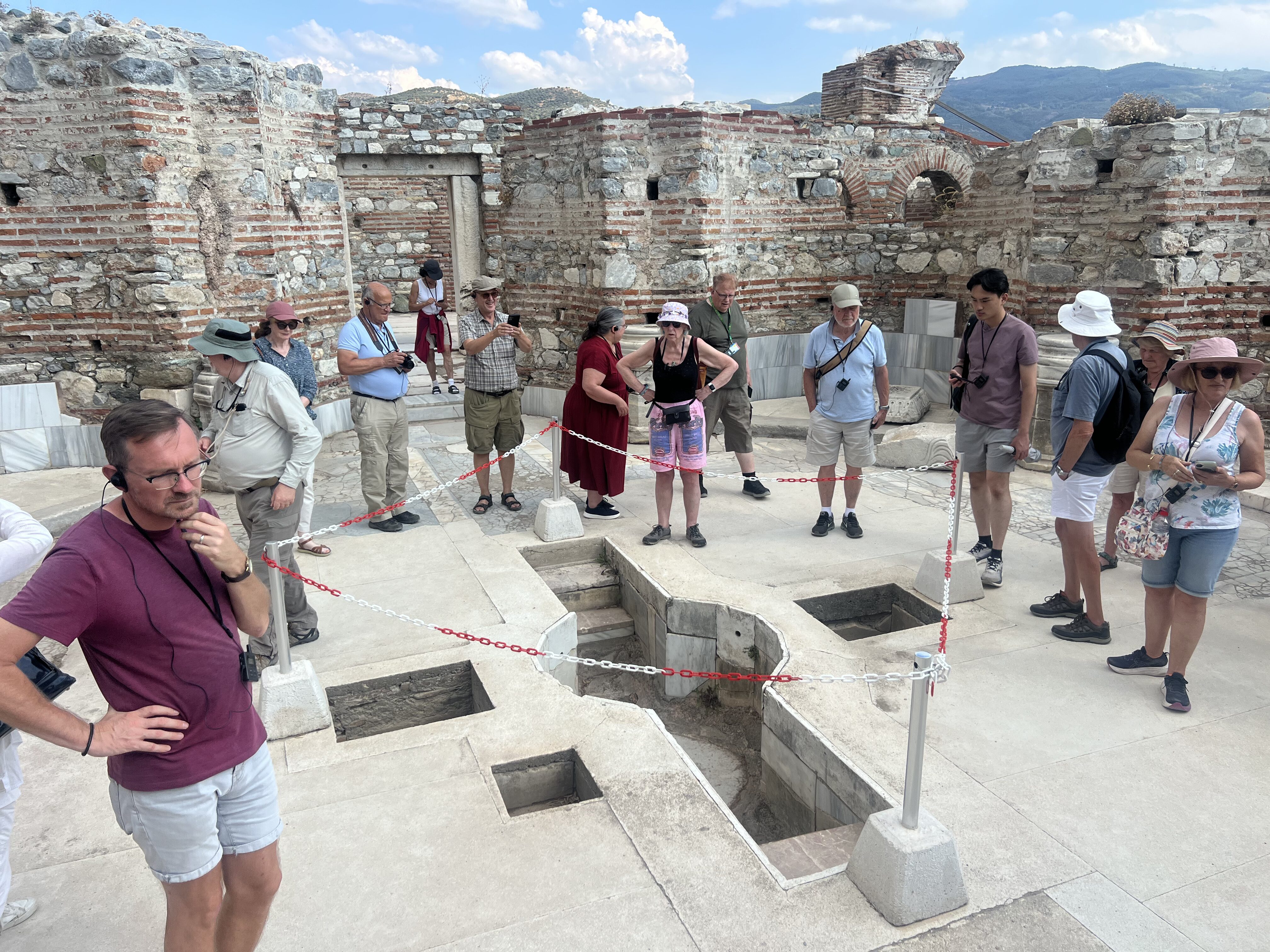 So this is evidence that immersion was the norm and pouring a concession, which is close to the opposite of what the judgment draws from it. We have not long returned from leading a study trip to Turkey, and on multiple occasions we can across examples of cruciform baptismal fonts demonstrating the widespread and normative practice of immersion. Many had their own baptistry in order to allow for the large numbers coming forwards for immersion.
The other evidence is either late or beside the point. Latin tingo tells us about translation, not apostolic practice. Depictions of Christ standing in the Jordan come from the third and fourth centuries. Medieval fonts date from long after infant baptism had become the norm—and what the judge completely misses is that such fonts are the size of baby baths, since immersion remained the norm even for infants!
The Gregory palindrome is a moral contrast between sins and face, not a liturgical rubric—in fact, the use of the word ‘face’ (rather than any other part of the body) arises from the need to make the palindrome work. Meanwhile the large early baptisteries, including those at Ravenna itself, go unmentioned, as does the broad scholarly consensus (Everett Ferguson’s monumental study is a good place to start) that immersion was normative in the early Church.
The moral of the story is this: it is great to do your homework, and consider the history. But if you are going to do so, then you need to get it right.
Sprinkling is not in the Prayer Book
Here is the curious thing. The chancellor’s conclusion is that aspersion or affusion is the Church’s settled practice. But the Book of Common Prayer never mentions sprinkling. For infants, the default is that the priest ‘shall dip it in the water discreetly and warily’, with pouring permitted only if the child is weak. For adults, dipping comes first. Even the 1992 Guidance describes aspersion as a post-Reformation fashion of northern climes! The judgment imports sprinkling from a twelfth-century Western canon into the Church of England, against the plain wording of our own formularies.
Validity is not the whole story
Most significantly, the judgment collapses the question of what baptism does into the question of what is valid. Of course baptism is ‘of equal effect however administered’. But sacraments are signs, as Articles 25 and 27 insist, and the sign matters. Paul’s language in Romans 6.3–4 of being ‘buried with him by baptism into death’ is not easily illustrated by a few drops on the forehead. The ecumenical consensus of Baptism, Eucharist and Ministry (1982) recognised this, as has Roman Catholic practice for adults since Vatican II. And so did the 1992 Guidance itself, which conceded that immersion reflects Romans 6 ‘most completely’, called for ‘lavish symbolism’, and (irony alert!) looked forward to large fonts suitable for immersion as ‘the coming norm’.
2.6.5 The thrust of this paper is to point to a large, single font in which baptism can be administered in the three ways indicated previously. This we impenitently regard as the coming norm. However, churches have their own momentum, both in terms of developing liturgical practice, and in ways in which their liturgical furniture is adapted to changing pastoral needs. In the immediate future, we hope that sufficient fonts of this style can be encouraged in key parishes (and all cathedrals?) throughout the dioceses.
In other words, the Guidance was pushing towards more water, not less. It is odd to see it used to defend the minimal sign it was hoping to move beyond.
The liturgy leaves it to the minister
Finally, there is a legal question. The Prayer Book leaves dipping or pouring to the minister’s discretion, and Common Worship Christian Initiation, the Church’s current authorised rite, does the same while encouraging a generous use of water. As far as I can see the judgment never mentions Common Worship at all. Refusing the only practical means of immersion in effect removes a lawful liturgical option through the back door of a furnishings decision. That is not what the faculty jurisdiction is for.
Consumers or converts?
The rhetoric of ‘consumer choice’ is, I think, the least persuasive part of the judgment. Adults who have just come to faith, been taught Romans 6 on an Alpha course, and want their baptism to look like dying and rising with Christ are not shopping. Many will have friends or family in Baptist or Pentecostal churches, where immersion is simply what baptism looks like. Their request is a sign of catechesis working, not failing. Ironically, the judge sees the need here for teaching about different forms of administration of the water within Anglican discussion—whilst ignoring both the need and the actuality of teaching about the meaning of baptism itself.
The judgment also passes over the rationale of Canon B21, which it quotes at the outset: baptism takes place in public worship so that the congregation may witness it and be reminded of their own baptism. It is hard to think of anything that does that more powerfully than an adult going down into the water in front of the whole church.
There is a wider problem too. The judgment raises the question of whether it is even lawful to use borrowed pools, and dismisses a photograph of a former Archbishop of York with one. Yet bishops and parishes across the Church of England regularly baptise in portable pools, rivers and the sea. To cast doubt on all of that, on the papers, without a hearing, without submissions on the chancellor’s own historical research, and without input from the bishop, is a great deal of weight for a single parish petition to bear. The 1992 Guidance itself suggested that such questions might need episcopal direction.
And what about the water? It would drain onto the churchyard, not into the sewer; one fill can serve several candidates; and the parish was already borrowing pools. If we are going to start auditing the environmental cost of our worship, I suspect the heating bill will come some way ahead of the occasional baptistery.
Conclusion
The chancellor is right that there is one baptism, and right that pouring is fully valid. But the Church of England has never been indifferent to the fullness of the sign, and our own Prayer Book puts dipping (immersion) first. More than that, Church of England doctrine is always self-effacing, in that it claims merely to be an expression of biblical teaching. It therefore encourages us to return ad fontes (pun intended!) and look to the biblical practice and teaching on the meaning of baptism, which unequivocally requires immersion.
As Tim Wyatt notes in his discussion of the case:
Our tradition of a gentle sprinkle clearly doesn’t meet the cultural moment. There may not be a measurable Quiet Revival, but what is clear is that adults are anecdotally coming forward in growing numbers to be received into the church. Men and women who have felt the urge to grab a Bible or visit a church and have unexpectedly met the risen Jesus. And if the national church cannot rise to this occasion and offer the full-bodied whole-hearted form of baptism today’s converts are earnestly seeking, it will get left behind.
The question facing parishes is not whether immersion is necessary, but whether, when new believers ask to be buried and raised with Christ in the most vivid way our liturgy allows, we should say yes. I think we should—and I hope this judgment is not the last word on the matter.
That in turn raises two further question. Given the poor basis of this judgment, how might it easily be reversed? And then the wider question: why are we encumbered by legal processes which do not support the mission and ministry of the Church on the ground? Is it time for a serious rethink?
 Buy me a Coffee










Excellent analysis. The judgment was partial and selective. One can easily see how a conveyor belt could lead to a reduction in ceremony/complexity. As to which things are Anglican, one often hears that question, but that is to approach things from the reverse angle to the one that takes priority (the assumption can seem to be that anything anglican must be right, but where does that indefensible assumption come from?). In this case, anyway, the judgment is neither just nor anglican.
It is interesting how much of this mirrors, albeit in reverse, the debate within my own Baptist tradition. The second para of the Baptist Union’s declaration of principle reads:
“2. That Christian Baptism is the immersion in water into the Name of the Father, the Son, and the Holy Spirit, of those who have professed repentance towards God and faith in our Lord Jesus Christ who ‘died for our sins according to the Scriptures; was buried, and rose again the third day’.”
And yet, while this sounds excusive, a great many exceptions for full-immersion exist, not least some of the ones covered here. For the elderly, the infirm, or where it simply cannot be practical, pouring is not considered invalid, or illegitimate.
Even the higher reactionary dogmatism of 1689 confession, in it’s para on Baptism, states
“Immersion, or dipping of the person in water, is necessary to the due administration of this ordinance.”
So yes, we do find the language of necessity there, and yet alongside it the language of ‘dipping’, allowing that even among the earlier Baptists there was some freedom within the precise form of the rite.
The very minimum one needs to acknowledge, as you do, is that the historical record is not exclusively the domain of a single tradition.
Main point is/was that if there are different models, is it the case that one is the origin/norm and the other is the concession?
Thanks Mat. As you can see, C of E preference has long been for immersion! We are baptists too!
‘….a great many exceptions for full-immersion exist…’ You guys are all a bunch of middle class wimps. Baptism should be done in the North Sea, off the north east coast of Scotland, in the middle of winter. No expensive baptismal pools which use valuable water necessary.
Ancient church practice was that the baptizand was naked. I hope you followed this ancient discipline in your winter baptisms. Many are cold but few are frozen.
I visited a church in Romania about 20 years ago. The experience of others on earlier visits was the marvellous opportunity to be involved in baptisms in the local river…
When I got there they’d had enough and built an above ground pool in the Church, glass fronted with trees painted on the back wall. It was much like a large aquarium….
Like meat pies in Cumbernauld (Rev IM Jolly)
Hahahahaha….last Saturday 550 people were baptised in the sea at Bridlington. Some stood in the sea waiting for well over an hour. The next day one of them came to our church. The story of God in his life was beautiful to hear.
Seriously? That is amazing! Did it make the press?
It didn’t make the news, no surprises there, but it was very real and an amazing sight. You can find it on X or Facebook. This is an encouraging sign.
Not to start with. It was more on Social Media. Most of the folk were from far and wide – with some from Bridlington. The fella that came to church was all the way from Liverpool.
Look up biblelad or bibleladuk
I saw it on our live feed – it is wonderful, and similar things are happening in the USA among the young, and in Bournemouth.
There is nothing like it – kingdom advance in the open air. John the Baptist just steps out and brings it on.
More, more, more.
As a native of St Combs I agree but am thankful my conversion took place in the Central Coast of Australia! The last big sea baptisms I remember in the North East took place during the ministry of Roger Blackmore. To have those days back!
Fascinating. The strongest argument against is the worry about multiple fonts giving rise to a suggestion of a hierarchy of baptisms. But without a practical objection (e.g. if the immersion font damaged the fabric of the building) I can’t agree with the refusal in this case.
An aside:
St Michael le Belfrey in York is currently in the middle of a full renovation of their church building. One thing they’re doing is building an in-ground baptism pool in the middle of the church, and they think it’ll be the first in the UK with a hydraulic lift allowing it to be accessible for wheelchair users et al:
https://www.belfrey.org/impact
It might the first Anglican church to have one. 🙂
Nope…. my last team parish had two…
The central thrust of the Chancellor’s judgment appears to be that a portable immersion baptistry represents a departure from the normative use (symbolism) of the font. However, whilst I understand that reasoning in principle, I struggle to see the practical distinction between the approach we proposed and arrangements that are already commonplace in many churches.
Quite apart from the local circumstances at St Mary’s, namely the position of the font and its limited accessibility for candidates and congregations, many churches routinely administer baptism in a separate bowl or vessel situated elsewhere within the church. In such cases, the sacramental act is not physically undertaken at the font itself.
I therefore find it difficult to understand why the use of a portable baptistry for full-immersion baptism is regarded as materially different in principle from the use of a bowl. Both approaches appear to involve a degree of separation between the font and the place where the baptism is actually administered. The distinction drawn in the judgment is therefore one that I would welcome further clarification of.
I am grateful to the Chancellor for the wonderful palindrome from Gregory of Nazianzus.
As for the rest of his spouting: water palaver (puns intended).
If the baptistery isn’t stored in the church, I can’t imagine a faculty is needed.
Is a faculty needed for decking out a church for holiday clubs? Or even … rainbow flags and altar cloths?
As for other business: time to get on with providing congregations with small cups for communion (maybe grape juice as well) before the next pandemic strikes.
You would need a faculty for a pride ‘altar’ cloth but it has been ruled illegal. (I was the complainant.)
Good to know.
Search for ‘St Nicholas Leicester altar frontal’
Ah, St Nicholas Leicester. There was a strange story about that place and a harassing ‘preacher’ (one of Anne Dyer’s protégées) in the BBC last year.
I wondered why a faculty would be required for something that isn’t fixed in a permanent place. For something that’s designed to be packed up and put away after use I would have been inclined to just go ahead without asking.
‘I would have been inclined to just go ahead without asking.’
I think that is what everyone else does. And if they did not do it before, they will certainly do it now!
That might be the main result of this ruling…
We have a moveable pool as well. I don’t think it ever had a faculty.
This would, in fact, have been our preferred approach. However, the Archdeacon advised that a faculty would nevertheless be required. That advice raises a wider question as to what constitutes a fixture or fitting, and at what point a moveable liturgical item becomes subject to faculty control.
“time to get on with providing congregations with small cups for communion”
Supporting legal opinion already exists…..
An interesting development in recent years has been Anglican churches promoting not only baptism by immersion but ‘renewal of your vows in water’ for those baptised previously (presumably as children). Not a few evangelicals in ordained ministry will have been through this themselves. Perhaps this is what the Chancellor had in mind in his warning against ‘degrees of baptism’. IIRC, Colin Buchanan used to inveigh against second baptisms and even thought people (ordinands at St John’s?) should be given certificates repudiating the second rite as ‘not my baptism’. I don’t think anyone took him up on this.
There is an authorised liturgy for this!
I’m interested in the ‘no more than one font’ argument in the decision. According to canon law there should be a fixed font and a fixed altar table in a church. But there is an inconsistency here – no-one objects when a fixed altar is ignored and a wonky table is wheeled out on which to celebrate the Eucharist, so why are the powers-that-be concerned about a second font? But perhaps I’m being naive in expecting consistency.
I would agree with you, in part.
First, it is more common to have a moveable font—and that should be the first objection.
Secondly, the word ‘altar’ occurs nowhere in authorised Anglican liturgy, so we should only ever talk about tables!
Not to be picky, but the canons don’t require the font to be fixed. Canon F1 only says that there must be a font which is kept clean, and you can’t use the font bowl for anything other than baptisms. It expresses a preference for a font standing near the entrance, but the Ordinary can direct otherwise.
I think the claim that it should be fixed might come from the 1992 document?
Sort of. It’s stated as a legal requirement in the Chancellors’ questions to the Bishops as if that’s what the canon says:
Is it the view of the bishops that the legal requirement of a font with a cover, in a fixed position, should be the only facility for Baptism in a church?
It’s an interpretation of F1, but F1 doesn’t explicitly say the font should be in a fixed position.
Yes, I agree. The problem here then is an interpretation by the chancellor of a document which is itself an interpretation of canon law, which in turn is an interpretation of the New Testament.
The chancellor really needed to return ad fontes…
“…the word ‘altar’ occurs nowhere in authorised Anglican liturgy…”
Except in the Coronation Rite (and in other Anglican provinces).
Thanks. I am not sure the coronation rite goes through the usual channels of liturgical approval. Also worth noting that the King vows to uphold the ‘Protestant Reformed faith of the Church of England.’
Other Anglican provinces have different doctrines from the Church of England—hence the problems with the Communion!
I think the difference is that when people ignore the fixed altar in favour of the table, the altar is being ignored (in my experience either because the layout of the church means half the congregation wouldn’t see what was happening if you used the altar, or because the altar physically prevents you presiding whilst facing the people). It would be different if at a Eucharist you had one priest at the altar presiding one way with one liturgy, and another priest at the table presiding with a different liturgy, and the congregation invited to choose who they received from. And that I think is akin to the fear that was being expressed about multiple fonts.
The churches I’ve known with fixed fonts always have the issue that for good symbolic reasons it’s by the door at the back of the church. For some that hasn’t presented a major problem: baptism involves the congregation getting up, turning around, moving about and arguably adds a bit of excitement to the proceedings (a really important thing is happening). In the church I grew up it would have been impossible to physically do it because of the way the layout of the church was changed over the years so we always we had a temporary font at the front for all baptisms. Neither are offering an aesthetic choice of font, or inviting you to judge that one is better than the other. They have the way they do baptisms with the font that they have.
Not a problem—but I always find it odd. And it is unhistoric.
Fonts by the door?
If we worried about historicity, when did the Church start putting baptisms into the ordinary Sunday morning service?
Altar is an idea that people imbibe but goes against the book of Hebrews and NT (and the work of Christ) in general. In their access to sources they put minor sources before major ones.
Except that an Orthodox priest I knew (a former Anglican vicar) used to quote Hebrews 13.10 to me.
To all those on church committees and court sitting
“Have you had your Weetabix today” ?
A simple glance at Wikipedia, – On Baptism, would furnish a history of church baptisms.
Early Church praxis involved a season of fasting preparation, candidates were baptised, immersed naked ( with reasoned teachings ) Gradual interpretations and accommodations followed.
The Eucharist ( Thanksgiving ) and Baptism are the central expressions symbolic of The Cross.
In many places they seem but mere rituals, as is the ubiquitous Peace.
It is assumed that candidates have attended “baptismal classes”
What they involve is anyone’s guess as there are few if any sermons on Baptism as a Cross Encounter. A death and resurrection encounter.,
The early church evangel of “Repent and be Baptised” [Transformed] has similarly been subject to various “accommodations”
Similarly the Eucharist is not a ritual for occasional absolutions’
What a muddle. Typically Anglican, or so it seems.
BAPTISM
Starting with the first, here is link to a five day, but short teaching series, which seeks to avoid controversial matters:
1. The Promise of Baptism- 31/08/26
2. The Meaning of Baptism-01/09/26
3. Why Was Jesus Baptised? -02/09/26
4. Baptised: A New Identity -03/09/26
5. Named in Baptism (the central truth in Baptism). – 04/09/26
There is much to chew over here, but it really avoids the scripturally unavoidable- of having died and raised to new life, a symbolism which is only properly illustrated by full immersion.
It is a sacrement, it is suggested, which can not be vicariously affirmed, confirmed, proclaimed by adults on behalf of infants but only by believers personally, maybe after a short teaching course.
As for me, as a new adult believer on a CoE ‘Why Jesus?’ course I along with my wife and two friends were fully immersed in a rivulet in N. Yorks.
My CoE minister at that time carried out a full immersion adult believer’s baptism in a river, a stones throw from a C12 CoE building.
Starting with the first day:
https://learn.ligonier.org/podcasts/things-unseen-with-sinclair-ferguson/the-promise-of-baptism
Excellent.
‘Sacraments are signs, as Articles 25 and 27 insist, and the sign matters.’ I look forward to a similarly strong challenge to the now almost universal practice in Anglican churches of substituting a tasteless and meaningless wafer for the eucharistic bread.
Just as the water of baptism symbolises purification and death of the flesh, the bread symbolises nourishment and the new life of the Spirit. John 6:35, I Cor 10:16.
Worth noting that the BCP itself rejects the notion of wafers.
I didn’t know that. Ben Crosby has an article on the subject, I’ve discovered:
https://bencrosby.substack.com/p/against-communion-wafers
including this interesting snippet:
‘It was the Ritualist movement of the nineteenth century that reintroduced the use of wafers in Anglican churches. Indeed, the use of wafers rather than the customary leavened loaves of bread was one of the so-called Six Points of advanced ritualism, along with eastward celebration, incense, altar lights, the mixed chalice, and eucharistic vestments. And, like the rest of these points, the use of wafers was originally condemned in the strongest terms.’
To my observation, the main reason for wafers these days is laziness (and indifference to what is symbolised). Much easier to keep wafers that can be stored indefinitely than have to bring a real loaf each time. Similarly with baptism: it is much easier to sprinkle the forehead than to organise full immersion. Convenience is all.
(1) If you’re inclined to maintain a register, counting individual wafers allows a much easier statistic of how many communicants there are at a eucharistic service, marking a lower bound on attendance.
(2) Thomas Aquinas famously asked “Quid mus sumit?” ie. exactly what does the mouse eat, when it eats a particle of a consecrated host. All I know is that whenever we have had crusty loaves, pitta breads, etc at a communion service, there are crumbs everywhere – encouraging mice and also moths.
Thanks for the comment.
1. That is the statistical tail wagging the eucharistic dog.
2. The BCP, which defines Anglican doctrine, liturgy, and practice, is unequivocal: And to take away all occasion of dissension, and superstition, which any person hath or might have concerning the Bread and Wine, it shall suffice that the Bread be such as is usual to be eaten; but the best and purest Wheat Bread that conveniently may be gotten.
3. What does the mouse eat? The BCP again is clear: For the Sacramental Bread and Wine remain still in their very natural substances, and therefore may not be adored; ( for that were Idolatry, to be abhorred of all faithful Christians;) and the natural Body and Blood of our Saviour Christ are in Heaven, and not here; it being against the truth of Christ’s natural Body to be at one time in more places than one.
4. ‘There are crumbs everywhere.’ Buy a dustpan and brush!
But whatever you do, do NOT allow intinction! Not pleasant when it goes wrong.
I was taught in the 1970s to cut the crust off each slice of bread and then to score it with a sharp knife into squares. There was even a “wood template ” (not sure what the correct name might be) to guide the knife and prevent cutting right through.
If I provide the bread I do this freehand.
No problem to count what remains….
Elephant in room time….
“And then the wider question: why are we encumbered by legal processes which do not support the mission and ministry of the Church on the ground? Is it time for a serious rethink?”
You (as you know I’m not Anglican) are encumbered by such legal processes because you are an ‘established’ church deeply entangled with the state, unequally yoked with the world as a result, and all too often trying to ‘serve two masters’, the state as well as God. This goes way beyond the Romans 13 principle of being properly ‘subject to the powers that be’ and well into the territory of the one exception, the ‘Prime Directive’ that Christians “….must obey God rather than man”. The simple fact is that the CofE has been, to say the least, awkwardly compromised with the state from its separation from Rome under Henry VIII and faces demands and pressures that a church should not be under.
And at present the CofE is also in a weak position with rather minimal regular attendance, the statistic of membership that actually means something. Last time I ‘did the sums’ the supposed national church was regularly attended by under 2% of the population.
I am unclear as to whether the existence of a chancellor in a diocese, and the approach of this particular chancellor, are really connected with establishment.
Do you know the answer?
Establishment works very well for the C of E thanks very much. It ensures it remains a church encompassing liberals and conservatives, Catholics and Anglicans. Plus that everybody who wants a wedding or funeral in their local Parish church can get one. As you are a Baptist not an Anglican it is otherwise not your concern.
‘It ensures it remains a church encompassing liberals and conservatives, Catholics and Anglicans.’
That has nothing to do with Establishment. And it is not what the Articles say either!
Of course it has to do with establishment, do you really think liberal Catholics would be in the same church and denomination as conservative evangelicals in England if the Church of England was not the established English church?
Simon, I don’t doubt that some people are hitching a ride because of perceived privilege even when they don’t actually believe the doctrine of the Church, as you suggest.
But that is not really a theological or rational connection. People should be ordained and participate in the C of E because of its doctrine, not its privileges.
Perhaps the Chancellor missed the CofE website page inviting adults to be immersed… alongside photos of Archbishops ministering water at the service … Will disciplinary proceedings be started?
My final team parish has two C20th baptism pools….. presumably given legal permission by another Chancellor…..
…sometimes is sea being used as one church is next to the beach… Bring back Canute (in the Common but incorrect understanding)
This Chancellor of the Diocese (another ecclesiastical rank exceeding that of Jesus Christ during his time on earth?) is an ass. He arrogantly exalts tradition above scripture in its original language. But he might actually have done this congregation a favour, because dedicated portable contraptions for baptism by full immersion cost ridiculous sums of money. I find it hard to believe that profiteering isn’t taking place. Just buy a large paddling pool, fill it by hose and use it in the nave, and empty it by bucket chain after the service.
Many, many years ago when I was a student, I was part of an Anglican church which did do baptisms in a paddling pool. On one occasion a young lady of rather large dimensions was baptised, and the vicar, a onetime missionary in the tropics, had to baptise her top half first, then her lower half.
I wouldn be surprised if Jesus is rolling His eyes over all this.
But you should sort it out before the release of Mel Gibson’s ‘The Resurrection’ as there may be a few queues.
So I found the Bishops’ Guidance from 1992:
https://www.ecclesiasticallawassociation.org.uk/images/fonts1992.pdf
It’s worth noting a few points.
1. The Bishops did not issue this guidance out of the blue. The Chancellors at the time asked for them to provide and gave some explicit questions. It doesn’t have the same status as canons but we can hardly blame a Chancellor for paying particular heed to guidance that his predecessors asked for, and the Bishops of the day explicitly gave for Chancellors in precisely this situation.
2. The central problem the guidance has is with the suggestion that a church could have multiple fonts. The principle they want is for a church to have a single font as the clear and visible norm. That, not some idea that baptism by immersion is unAnglican, is at the crux of this. The concern they have is that a multitude of fonts creates the idea that there are different sorts of baptism, when there is in fact only one baptism, and they raise a particular concern over inadvertently suggesting that infants get christened but adults are baptised. Having a single font is the key point: there is no real argument about whether baptism by immersion is permissible or ‘Anglican’? It is.
3. The Bishops do not suggest any problem with baptism by immersion. In fact, their ideal for the one font is a font that is large enough to accommodate baptisms by affusion, immersion, or submersion. They finish saying, “the Church needs to come to terms with the fact that we are living through a time which could be described as ‘The Baptism Movement’, just as our predecessors lived through ‘The Parish Communion Movement’.”
Baptism of infants by immersion is the norm in the Orthodox Church. The naked child is placed into the baptistery by the priest.
If we restore baptism by immersion for everyone (except where it is impossible or dangerous) maybe the argument recedes?
But the underlying concern remains, that child baptism “isn’t really baptism”, a feeling that gets stronger in an individualist post-Christian age.
James Thomson – well, I have always taken the view that child baptism ‘isn’t really baptism’ – but, as a result, I never considered formal membership of the Church of Scotland – even though I attended a C. of S. (Holyrood Abbey, Edinburgh; minister James Philips) when I was a student – and I decided well and truly against getting baptised by him, because he had accepted that the C. of S. way (infant baptism) was OK.
So I do see a logical contradiction here – for centuries, the Church of England has done infant baptism – and indeed regards it as normal – so what on earth are people who take a different view (that child baptism ‘isn’t really baptism’) doing in the C. of E.? And why on earth do they want to get baptised (as adult believers) in the C. of E.? Sounds suspiciously like people who hold to Marxist economic principles joining the Conservative party.
I think the Orthodox also give the baby communion using a spoon …
Adam, I am glad you found the guidance—not least because it is hyperlinked in the article!
But, yes indeed, the main thrust of it is that we need to recover the practice of baptism by immersion.
The chancellor appears to have focused on the gnat and missed the camel altogether!
Errr the thrust of the 92 guidance is the insistence that one font is the norm.
Yes–but alongside the desire that all forms should be available, and we should not limit to aspersion—which is the opposite conclusion from the chancellor.
I think you’re inverting the guidance Ian. The guidance is that churches should have one font, but that font doesn’t have to be limited being only usable for one form. The guidance is not that you should try to offer as many forms as you can, and ideally have them with a single font if you can manage it.
Pray excuse my ignorance but, for my part, I find the extended fascination with the precise mechanical form of the first sacrament amongst otherwise sober minded reformed evangelicals to be puzzling. I would like to know more about why the rite attracts so much zealous enthusiasm and partisan feeling? Do we remember whose business we are about?
The term itself, I believe, has rather more to do with the idea of washing and sprinkling ( Ezekiel 36:25) than immersion and soaking. Washing hands, cups, vessels and so forth. (Luke 11:39, Matthew 23:26). The metaphor is appositely homely. Pans being scoured, not men being showered. One drop is as good as a river full if the Spirit of the Lord is in the solution.
The action, for our purposes therefore and in light of the scriptural context, is all inward – in direct contrast to the ostentatious ritual washings, for instance, of the Pharisees.
As our Anglican catechism tells us, it is ‘an outward and visible sign of an inward and spiritual grace’.
The useful outward purpose of the rite is symbolic, covenantal, and significant – not experiential or performative.
Inwardly, it ought rightly to be mysterious, gracious, and regenerative. An unseen and ineffable spiritual work, the likes of which we can barely encompass with words.
We know, as Reformed Bible reading men that the state of the heart of the believer matters more than all the ostentation of the outward form,
Why then this attachment to ritualised immersion? What profits lies in the ritual for its own sake?
Let us be about the Lords business.
‘ I would like to know more about why the rite attracts so much zealous enthusiasm and partisan feeling?’
Because non-conformists were at one point ejected as a result of their objection. There is a lot of historical water passing under the bridge (or the font!)
Quoting Ezek 36:25 does not establish a connection, nor does drawing a parallel with ‘washing hands, cups, vessels and so forth’. The New Testament explicitly tells us what baptism involved, firstly in using that Greek word (to immerse, not sprinkle), and secondly by describing what John the Baptist did at the river. As Paul says, ‘We were buried therefore with him by baptism into death.’ Burial implies being covered. Peter says that the global flood in the time of Noah, when even the tops of the mountains were covered, is also a picture of baptism.
Baptism is not a ‘ritual’ – your pejorative word. And it is not an act that of itself effects regeneration, as you state. Baptism symbolises a regeneration that has already happened, and which will happen. Not partial regeneration but total, because in Christ we are a new creation, and in Christ we rose with him into glory. Death-to-life transformation. That is why baptism should be according to the biblical model, and the biblical model not belittled. If God tells the church to baptise new believers, not sprinkle them, who are you to argue otherwise?
Thank you for your informed and substantial response, brother. I come to this place to learn from those who know what they are talking about, and I will pray and meditate upon your response at length.
Yours in Christ.
WHA
Thank you for your gracious response.
Steven, there just seems to be a few problems in your first paragraph here. The New Testament does not actually ‘describe’ what happened at/in the Jordan with John the Baptist, the word baptizo itself does not necessarily tell us what happened (language does not work like that) and if burying implies ‘being covered’ then Jesus wasn’t buried.
The BCP infant baptism rite:
‘Then the Priest shall take the Child into his hands, and shall say to the Godfathers and Godmothers, Name this Child. And then naming it after them (if they shall certify him that the Child may well endure it) he shall dip it in the Water discreetly and warily, saying,
N. I baptize thee in the Name of the Father, and of the Son, and of the Holy Ghost. Amen.
But if they certify that the Child is weak, it shall suffice to pour Water upon it, saying the foresaid words,
N. I baptize thee in the Name of the Father, and of the Son, and of the Holy Ghost. Amen.’
i.e. only weak children are not to be immersed.
The adult rite is less directive:
‘Then shall the Priest take each person to be baptized by the right hand, and placing him conveniently by the Font, according to his discretion, shall ask the Godfathers and Godmothers the Name; and then shall dip him in the water, or pour water upon him, saying,
N. I baptize thee in the Name of the Father, and of the Son, and of the Holy Ghost. Amen.’
Therefore the BCP is internally inconsistent, though perhaps inevitably given the church furniture that the CofE inherited!
Meanwhile earlier in the adult rite:
‘At the time appointed…, the sponsors shall be ready to present the person to be baptized at the Font, and standing there the Priest shall ask whether the person presented be baptized or no, and if he shall answer, No, then shall the Priest…’
So the priest is instructed to proceed on the basis of the candidate’s statement without further investigation. Perhaps we should choose to accept what the candidate believes without asking difficult questions? Given that the CofE doesn’t really believe anything much, perhaps this would be appropriate. Anglicanism has always declined to seek to look into a person’s soul…
I don’t think the BCP is inconsistent as such. I think it is working in a world where infant baptism is the norm, and where adult baptism is the exception.
But what stands out is that dipping (ie immersion) is the expectation. Not surprisingly.
Years ago, when I was a deacon in a Baptist Church, the local vicar was asked by 2 adults for baptism by immersion. He took the service in our church and I accompanied him into the baptistery!
So I wonder how we might explain this to the child who at seven decides that they love Jesus and want to be baptised – and for whom baptism is being baptised the way Jesus was?
I love this in-depth analysis and found myself chuckling at times, you have a way with words – no doubt about it! Thank you for your continued work, truly a breath of fresh air and not just a drop of living water!
Every blessing
Thanks!
So I wonder how we might explain this to the child who at seven decides that they love Jesus and want to be baptised – and for whom baptism is being baptised the way Jesus was?
Rhona – the baptism of Jesus was followed by 40 days and 40 nights in the wilderness, nothing to eat and getting tempted by Satan. There was cause-to-effect; baptism, declaration ‘this is my Son in Whom I am well pleased’, Satan choosing this particular moment. If the 7-year old child had an understanding of what Jesus went through, I’m not sure that he/she would be so eager. Many friends of mine who were baptised as believers, tell me that immediately after their baptism was precisely the time that Satan chose to have a go at them.
For me the link to the book on baptism went to a church history book by the same author. His book on baptism is this one: https://www.amazon.co.uk/Baptism-Early-Church-Theology-Centuries/dp/0802871089/ref=zg-te-pba_d_sccl_1_1/523-7652249-7444830?pd_rd_w=MJgqc&content-id=amzn1.sym.c072daa0-3920-4b4d-83e5-1f5f31c763e0&pf_rd_p=c072daa0-3920-4b4d-83e5-1f5f31c763e0&pf_rd_r=9D93CEMQRFNPG0P1ANH2&pd_rd_wg=0cgra&pd_rd_r=c00f2db7-bcd6-45f6-b25b-cc9c51641635&pd_rd_i=0802871089&psc=1.
As an elder in a Baptist church, I may have come to this article with certain likely views, but what I didn’t expect was for a Chancellor to refuse an Anglican parish church a request to permit a portable baptismal pool! The point we as Baptists have to repeatedly make is that true baptism is believer’s baptism, so we rule out baptising babies who manifestly can’t say what they believe. The question of how much water and how it is applied to the convert’s body is sometimes secondary. My church had an elderly lady who couldn’t make it into pool (the thought of installing a lift a la St Michael’s didn’t cross our minds!), so we sat her on a chair and poured water over her. She was thus a baptised believer.
Thanks. I just hope you are aware that infant baptism in the C of E is also believer’s baptism. Just because they cannot talk does not mean they cannot trust.
Our model is Jesus. I assume you don’t believe that he did not have a perfect relationship with his father until he was seven…?!
…. but He didn’t get baptised until he was (approximately) 30 – so baptism wasn’t part of the process of establishing a perfect relationship with the father. His baptism was rather a public declaration of who He was – and it was immediately followed by Satan’s temptations.
But our baptism does. Theologically, many people see baptism, marking entry into the people of God, as equivalent to circumcision in the Mosaic covenant.
The real question I ask my Baptist friends is: when do you treat your children as members of the people of God?
Before their baptism as older children or adults, do you say to them ‘One day, you will know that God loves you, but of course you do not know that yet’? I have not met a single one who does.
Ian Paul – the questions you pose to your Baptist friends are very strange questions – and say much more about you than they do about them. I would have thought that all Christian parents treat their children as members of the people of God (with the same caveats that Job expressed) irrespective of whether they have had their children baptised or not. The question ‘do you say to them ‘One day, you will know that God loves you, but of course you do not know that yet’?’ does both make a mockery of Scripture – and show a misunderstanding of the Baptist position. You’re also suggesting that Jesus was perhaps unaware that his Father loved him until he had been baptised at the age of approx. 30.
It is extremely important that baptism *isn’t* part of the process of establishing a relationship with the father – your questions do somewhat seem to assume that it is.
Such questions never arose in our household – I suppose because my mother was a Salvationist – and the Salvation Army, quite sensibly, doesn’t bother with Baptism at all. The answer to the question: when should a child be baptised? is: when the child actually wants to be baptised. It’s important that this isn’t something in the pocket of the parents.
Although I had been a Christian for approximately 20 years before my baptism, I didn’t get baptised until I was 26. I didn’t view it as a part of the process of establishing a relationship with God (that was already established), or of making an entry into the people of God (I was already in the number of the Saviour’s family – my ultimate salvation assured). I got baptised because (a) it is a commandment (and I found a fellowship where I felt comfortable getting baptised) and (b) a very important part of the process of *declaring* my faith.
It is very important to note that the temptations of Christ occurred immediately after His baptism – and that seems to be the experience of many believers who actually get baptised as believers. Infant baptism misses this.
Jock ‘It is extremely important that baptism *isn’t* part of the process of establishing a relationship with the father – your questions do somewhat seem to assume that it is.’
The reason I assume that it is, is because that is the uniform and consistent teaching of scripture! Baptism is the sign of our being born again ‘by water and the Spirit’.
The objection that not all baptised continue in faith only holds water (!) if you take an instrumentalist view of symbolic actions. Baptism puts you into Christ—if you will be put.
To that extent, the parallel with circumcision is close. Paul says that circumcision is real and important—but only if it is an outward and visible sign of the inner and spiritual reality of circumcision of the heart.
The commandment ‘to be baptised’ is one that is given at the moment of faith, not for 20 years afterwards. Baptism is Christian initiation. All this is well established ecumenically and biblically.
But aren’t most child baptisms/christenings carried out when they’re babies? In reality it is often the family speaking for the child, not the child themselves speaking. I’m not convinced such baptisms would have been supported by Paul. Though I accept in Acts whole households are referred to.
Peter, I don’t think there is any real historical doubt that ‘household’ meant everyone, regardless of age.
You are quite right.
Baptists are often quick to point out the speck in the others’ eye (Baptism of those who cannot confess Christ being seemingly at odds with the New Testament practice) while being often unwilling to look at the beam in their own (what then is the place of the children of believers in the Covenant community?)
This has been the back and forth between the branches of reformed protestantism for well over four centuries. We will never resolve it here. 🙂
And you have said that circumcision did not mean a person was part of the true Israel. Indeed that is the problem, Jews claim to be part of Israel as they were circumcised as babies and some claim to be part of the church because they were baptised as babies. Isn’t that rather misleading?
Ian Paul – so baptism is the *outward sign* of us *having been* born again by water and the Spirit; we have *no right at all* to the rite if we don’t believe that this is true of us (but we are obliged to undergo the rite as soon as we believe that it is true of us). In Romans 6, Paul likens Baptism to burial; which means that we are *already* dead to sin (and alive in Him) when the corpse is buried. You don’t bury a corpse if it isn’t a corpse (and if it still has some life in it. Unfortunately, Romans 7 teaches us that, nevertheless, the corpse still does have some life in it). If you’re following Scripture, the baptism makes no sense if we have not already died the death to sin.
So therefore I probably *don’t* take an instrumental view of Baptism (whatever that means); it is something that we do as an acknowledgement of what Christ has already done in us (but something does happen – for may Christians, including myself, there is a period of temptation that immediately follows Baptism).
So Jock, you only believe that it is possible to be born again from a certain age? Why?
Ian – well, you have to be on LSD or something hallucinogenic to be able to infer something so off-the-wall from anything that I wrote. What are you on? I’d like some of it! (I only once ever had experience of wacky drugs – a few months ago when I was in hospital and I asked for a mild painkiller. The nurse put me on a drip. I have no idea what she gave me, but it was really wonderful and I am very grateful for such an experience).
I was mainly pointing out that in Romans 6, Baptism is likened to burying a corpse. The key point here is that it really has to be a corpse before you bury it! (i.e. if you take Romans 6 seriously, baptism comes *after* being born again).
In my own case, I have to confess that I can’t really remember a time that I wasn’t a Christian (and can’t remember a time when I wasn’t ‘born again’ – although I am). Any good teaching that I received simply seemed to put a logical structure onto what was already there.
I got baptised when I was 26, which was probably at least 20 years after I had come to believe (so I suppose it could be taken to represent a burial of a corpse that was not only dead, but had spent an awful lot of time decomposing too). Importantly, it was at a time of *my* choosing. I’m grateful to my parents for not getting me baptised as an infant and never even bringing up the subject of baptism when I was growing up, because I understand my own psychology sufficiently well to know that this would have been counter productive.
The only thing I can think of is that you somehow associate baptism with being born again (from Romans 6, baptism has to come *after* being born again) or perhaps somehow you associate the water used in baptism with ‘by water and the Spirit’? If so, then you attach *way* to much power to church ceremonies!
Sorry, but that really doesn’t add up. There is no evidence of repentance and faith, and the only evidence open to the church when the child is presented is that the parents say they are bringing the child for baptism.
I agree with others who point out that Jesus submitted himself for baptism in his adult years despite having been presented as an infant at the temple. He aligns himself with John’s baptism for repentant sinners – which does rather mess with the theologies which those outside Baptist theology so often propound. That also suggests that when Christ humbled himself (as Phil 2 says) it was a very conscious act as well as profound identification.
David, Phil 2 refers to his humbling himself by becoming human, not by adult baptism.
As so often happens, are we Christians not paying too much attention to the packaging and too little to the contents here? In the case of the Church of England, attention to packaging frequently seems to reveal too much hierarchical pomposity, politics and power on the one hand and too little individual self discipline and humility on the other. Contents involves getting to grips with the truth of what the Bible teaches us, accepting it, and then applying it to what we should be doing.
Baptism has always seemed slightly strange to me. Presumably when it began with John the Baptist it heralded the radical change which the new covenant would bring by reimagining a practice (ceremonial washing) which involved the soon to be ended terms of the law? The new covenant era of grace would be transformational and for each individual it involved the kind of new birth where there was no yelling and screaming but genuine repentance and a new spiritual life thereafter. The one time ceremony (baptism) would be saying goodbye to the past order of repeated (but never sufficient) legal observance and hello to a new life in Christ where grace superseded legality.
So the point of baptism must surely be that it is essentially an individual and personal event, marking reception and gratitude rather than a public celebration and declaration of intent. That’s not to say it should be behind closed doors from which a congregation is excluded, but that it is a pivotal personal moment which recognises both an ending as well as a beginning – something solemn and thought provoking for which a round of applause might not really be as appropriate as the quiet, heartfelt prayers of those who know about the spiritual battles which lie ahead. Imagine the Philippian jailor, his wife and children, having just gone through a heart stopping night where suicide had been the only rational option, discovering and receiving the saving grace of Jesus and marking the moment forever just for themselves in the presence of Paul, Silas, and some rather gobsmacked prisoners. It wasn’t the baptism which saved them but I imagine it forever would be a unique moment in their lives to remember…
Beside this, fonts or baptisteries, immersion or sprinkling, are not so very important are they?
They are important to the extent that symbolic action communicates something real about that which it symbolises.
That is why I think it is important to note that the C of E has in fact always prioritised baptism by immersion.
Is it real in the cases of baby baptism as is often the case? Or wishful thinking.
Thanks for this Ian. I have always interpreted the BCP dipping as immersion and that as the preferred mode. In 1958 a report said that adult baptism is the theological norm for the CoE. We should then, in my opinion be building suitable baptismal tanks as a part of liturgical renewal. I have seen in Roman Catholic churches fonts (for children) from which the water flows into the tank (for adults). There is then only one baptism. The decision is very strange.
Thanks. I know at least one C of E church which has done that—but why not immerse infants if you have a pool?
What is the 1958 report? I have not come across that.
I’m delighted to have done just that…. at the same time as an adult. One has to be a little more careful about water temperature!
This is all a bit kindergarten; HEB.6:1 – 3
I note in v.2 that Baptism is in the plural, baptisms.
Perhaps there were several iterations of same even in those
early days. ?
This might lead us into the concept of Adoption
Does the Father align with the Greek thinking on adoption?
In this a son is born but adopted later in life.
At His baptism the Father affirmed Jesus but at the Transfiguration
the Father confirms Jesus in whom He is “well pleased”
as He prepares for His Exodus ?
Is “new birth” and baptism sufficient or is something further required ?
1 Cor 11:19 2 Cor 10:18 2 Tim 2:15. Shalom.
A heartfelt thanks Ian for this when I saw the story in the Church Times it made me wonder particularly as I have been the Vicar of two churches with permanent Baptisteries one in St Martha’s Broxtowe in your own Diocese and one at Aston Parish Church installed by someone who is now an Archdeacon. Im currently preparing two adult men for baptism here in Liverpool and have not ruled out “full immersion” as it is such a powerful symbol of the spiritual reality of their new life in Christ.
Why was this even an issue? As I understand it, the request was to buy and store a portable pool. Privately funding the pool would not have necessitated the petition, and still would not – correct? Or am I missing something? Which leaves storing it, and from what I gather the chancellor did not seem much concerned about that.
It would not seem to be a violation of the decision were someone to buy the thing on their own dime instead of asking for church money to do it. Yes, they should not “have to” but it gets the parish where they wanted to go.
Indeed. This should never have been contested. That is the problem.
The more this discussion goes on, the more sympathy I’m starting to have for the Chancellor. Some people are getting worryingly close to saying that immersion is the true baptism. We have a standard for what makes a baptism valid or not, and whether you were immersed isn’t it. We wouldn’t consider baptising someone who said they were baptised as a baby but it was affusion, and they’d quite like the immersion experience as a adult.
I think what we are saying is:
a. Immersion is the universal NT practice
b. Immersion offers the correct symbolism for Christian initiation, as new birth, immersion into the death and resurrection of Jesus, and washing away of sins by his death.
c. Historically, immersion has been the clear preference of the C of E.
d. In this current moment, people coming to faith want the full biblical, historical, and symbolic act to express their new life in Christ.
To airily dismiss this on the grounds that people don’t know the theological equivalence between the different forms seems to many to be out of touch, patronising, and actually theologically ill informed.
Immersion is the true baptism?
a. Immersion is the universal NT practice
b. Immersion offers the correct symbolism for Christian initiation, as new birth, immersion into the death and resurrection of Jesus, and washing away of sins by his death.
c. Historically, immersion has been the clear preference of the C of E.
So, yes?
In terms of theology, baptism involves the use of water, the invocation ‘I baptise you’, and mention of Father, Son, and Holy Spirit. But we need to note that:
a. Immersion is the universal NT practice
b. Immersion offers the correct symbolism for Christian initiation, as new birth, immersion into the death and resurrection of Jesus, and washing away of sins by his death.
c. Historically, immersion has been the clear preference of the C of E.
So, whilst immersion is not absolutely necessary, it should be the norm.
Perspectives that major on this or that ritual detail are wrong headed, while the priority of conscience (1 Peter 3.21), the believer’s attitude, is what should be majored on.
There is no reason to make ‘immersion’/’dunking’ into anything else.
Nor does anyone do so unless they have in formative years known another norm and (illogically) cannot then believe that this was not the norm for all people at all times (as shown by the centralising of the actually minor question of whether something is Anglican or not).
Michael Green, Baptism (Hodder) slightly paraphrased. Regarding the spiritual and churchly sides of baptism:
‘If one asks which is the more important, it is a silly question, but the answer would have to be the spiritual side.
If one asks which is the less important, it is an even sillier question, but the answer would have to be the churchly side.’
Similarity or otherwise to the convocations of John and the day of Pentecost is another good barometer; while the model of Paul’s baptism (cf. the eunuch) shows conscience/commitment alone as central, and situation or nature of water as beside the point.
The word ‘baptise’, βαπτίζω, itself indicates immersion.
https://outils.biblissima.fr/fr/eulexis-web/?lemma=%CE%B2%CE%B1%CF%80%CF%84%CE%B9%CE%B6%CF%89&dict=LSJ
No Greek-speaking person in the 1st century world would have considered aspersion remotely sufficient, and when the NT specifically describes the practice, it takes place in a river, not at a font.
Immersion is the expectation in the BCP for infant baptism. Not quite the same as saying its the preference.
But we wouldn’t entertain baptising someone by immersion who’d already been baptised by affusion, would we?
You cannot baptise someone twice. It is initiation.
Unless the first baptism is invalid. For example, if someone had been a Jehovah’s Witness, they would have been baptised and it would have been immersion. We would baptise that person.
What is meant by ‘the true baptism’?
First, the point is made that Anglican foundations largely had immersion in mind;
second, the word in Greek means ‘immersion’ or ‘dipping’/’dunking’;
third, something being ‘true’ or not is not a matter of ritual details. As with anything in life, better understanding of details is better than worse understanding.
This:
https://www.onesmallchild.com/greek-orthodox-baptism-from-generation-to-generation
has a lovely picture of a Greek Orthodox baptism of an infant in a rather magnificent ‘font’: immersion even if not total immersion.
This:
https://orthochristian.com/146567.html
has pictures of a “mass baptism” of adults at a London Orthodox church, which by the look of it has a permanent adult baptistry and immersion is definitely used!
This:
https://journeymacedonia.com/archaeological/ohrid-plaosnik-baptistery/
has some information about the baptistry in Ohrid in North Macedonia dating from 4th-6th centuries. I have visited this. Like any proper baptistry, it has two sets of steps: one for going down into death of the old man and one for coming up to life.
As in “Other Issues”, I think the CofE should realise that it is part of the One Holy and Apostolic Church. Immersion is definitely a significant practice.
The best example of this is by the river outside Philippi. Do you know it?
Baptism as a renaming sacrememt, is being baptised into the Name of the Father, the Son and the Holy Spirit. It is trinitarian.
It is, in that regard, also a new identity.
It is a Name (and identity) that can be subsequently renounced (Ferguson again).
See Ferguson linked above. Jock, above, has correctly mentioned the spiritual battle against satan and if I’m correct the CoE baptismal liturgy does too, but that has gone unmentioned, been bypassed, by CoE commentators so far as I can tell.
Where there has been infant baptism, has there been testimonies from parent, God parent, of a newly manifested, spiritual battle, that Jock has mentioned as being encountered by adult believers?
The idea that circumcision and baptism are the same equivalent is very dubious.
John Piper [ as a Baptist ] gives an in-depth confutation of some Anglican thinking or assumptions.@
desiringgod.org/messages/how-do-circumcision-and-baptism-correspond [Spoiler! they do not ]
AND
.desiringgod.org/articles/infant-baptism-and-the-new-covenant-community
As Hebrews 6:1 – 3 we need to move on to establish perfection [completeness/ maturity]
We do need to be cautious about what we are dogmatic about.
Shalom.
‘So infants incapable of faith are not to be baptized.’ If Piper thinks that babies cannot trust, then he needs to think again!
‘There are differences between the new covenant people called the Church and the old covenant people called Israel.’
The problem here is that the same word is used of both: ekklesia.
The issue is not here whether babies can ‘trust’, but whether they know anything about what Jesus did on the cross, and have received the Holy Spirit. Biblically, receiving the Holy Spirit and understanding who Jesus is are prerequisite for baptism.
Many parents have had their children baptised even though they are not themselves believers. Essentially, that is Rom 2:28-29. God justifies the circumcised (or baptised) by faith and the uncircumcised through faith.
Many Christian church-going parents have had their infant children baptised and found that, when the children reached adolescence and adulthood, they had no living faith of their own. In my experience, the majority of such parents have not succeeded in passing their faith onto their children. And this is backed up by stats, which show that church membership has long been in decline. If parents fail in this, how much more is the Church failing to make disciples in its relationships outside the family?
Why have parents failed? Chiefly, they have been content with the spiritual equivalent of sprinkling instead of full immersion, and tasteless wafers instead of bread you can feed on. And as Jock points out, there is an Enemy out there – in the world of pop music, celebrities, sexual promiscuity and evolution dogma – who is relentless in his efforts to sow tares among the wheat (Matt 13:25-29) and lead the young away from what is true and wholesome.
Their baptism as infants is of no avail.
Steven, your argument is: baptism of infants fails because neither church nor parents catechise.
There is an obvious answer to this: catechise the baptised.
i.e. before they get baptised. So here is another area where good practice as commended by the BCP has fallen out of use.
https://www.google.com/search?client=firefox-b-d&q=when+was+catechism+common+practice+in+the+anglican+church+
Godparents are supposed to give Christian values to their godchildren
and as I said above, Paul dismissed the idea that being physically circumcised meant anything without actual faith. It seems there will be quite a few circumcised males who will not be ‘gathered’.
‘But is it of no value? Not at all!’
That seems a very trite response to me Ian, somewhat splenic.
Perhaps time for a coffee ?
Just a concise response to your dumping links to articles!
that’s you told Alan!
I think ill have a coffee even if Ian isnt.
I wouldn’t want to pick a fight with an Irishman. Shalom.
Let’s go to Revelation and interpret the Mighty angel as John the Baptist appearing after the silence . Jesus and the Holy Spirit then go about as the two witnesses.spend a bit of time thinking about the baptism of baptisms.
The wisdom from above is first pure, then peaceable, gentle, open to reason, full of mercy and good fruits, impartial, and sincere (James 3:17)
I hope I am not repeating points already well made (I have tried to follow an excellent article & a flood of comments), but herewith two thought starters, and a two-part question for the Diocese of Southwell:
(1) Beware of Church Lawyers determining what is church doctrine.
(2) Beware of letting Latin translation determine the ORIGINAL Greek’s meaning (not just with baptizo, but also, i.a., ekklesia, episkopos, euangelion, musterion (sacramentum), etc.).
(3) How does the Chancellor’s demand that those desirous of baptism must first have baptismal niceties explained to them, fit in with:
(a) Sarah Mullally’s view that the CofE should be welcoming to all regardless of their background (I apologise for over-simplification), and
(b) As I have heard, Southwell Diocese’s recent appointment of an Associate Archdeacon, apparently to facilitate a more welcoming Church?
Great points Richard. I especially like your no 2! (I hope you are not surprised by that…)
My no.2 is probably the most important of my points, with the widest application, though needing the most development.
No, I am not surprised. I do, however, appreciate your ‘liking’ it.
From HS2 to baptism pools, it seems impossible to get anything done in this country without lawyers or interest groups getting in the way and making the whole thing disproportionately expensive or impossible.
Thanks Sam. What do you put that down to? Loss of trust? Bureaucratisation? Both?
The timidity that comes from decadence? Which is not confined to England.
It is down to the complete lack of any kind of courage or moral fibre among those in positions of authority. Cover-your-ass is the base way of putting it.
When at the next election (or certainly in the next decade) either the white working class, or the extreme Left and the Muslims rise up (depending on who wins), and the 190-year era of civil peace in this land draws to its close, the wet timeservers and cheese-and-wine eaters who comprise the Anglican hierarchy won’t have a clue how to respond. Nobody will be listening to them anyway. But the real church (including many Anglicans) will continue anyway, probably under persecution. Jesus Christ has given us long enough to get the church in shape and we havenet, so He will do it Himself in His way.
Anthony,
Interesting that you think we are headed for civil disorder in this country. That is my sad conclusion, too, because of the unheard of levels of immigration, of a scale that Britain (or western Europe) has never experienced before and the constant denigration of British people trying to articulate their unease at the unwanted transformation of their country.
Mass contraception and abortion, and the middle class abandonment of marriage destroyed the birth rate, while modern medicine added a few years of dependent existence to our lifespans. The result has been a great financial burden on taxpayers and the wholesale importation of people from south Asia and sub-Saharan Africa: a burgeoning mass of people without any intergenerational sense of belonging to this nation. It is no wonder the social fabric of Britain has been undone. The Church of England has been blindsided by this and an do nothing but praise the unsustainable status quo.
James and Anthony, I would be interested in how you think your ‘observations’ worked out in places like Australia and New Zealand.
I am talking only about Britain. There will undoubtedly be parallels in countries like Australia and NZ, but I don’t know enough about the situation there to comment. Furthermore we are in the middle of this sorry story.
There is an issue, tangentially related to baptism, where I am interested in what people think, which is the basic idea of conversion (i.e. life before coming to Christ, conversion, life after coming to Christ). As I indicated above, I can’t remember any time when I wasn’t a Christian and for a long time I felt guilty about this (since the model in Scripture does seem to have a conversion experience). When I lived in Ireland, I attended a vibrant Baptist fellowship, where most people seemed to have had conversion experiences – life before coming to Christ, conversion, life after coming to Christ. When I sheepishly confessed that this wasn’t true of me and I couldn’t remember any point in my life when I wasn’t consciously ‘in Him’ – and I wondered if that meant I wasn’t a ‘proper’ Christian – their response seemed to be that I should count myself very fortunate and blessed by God – since the prior life (before coming to Christ) was still a down-drag, even after conversion, which one would be better off without.
For these people who had had a conversion experience, the issue of Baptism was clear cut. At some point in their lives, Jesus had brought them into the number of the Saviour’s family; when they understood that they had been ‘born again’, that they had passed from death to life, they got baptised (representing the burial of the ‘body of death’ – the meaning of baptism in Romans 6). For me, it was simply a case of dotting the i’s and crossing the t’s (Scripture tells us that we have to get baptised if we are ‘in Him’), but I did experience the time of trial immediately following my baptism.
Long, long ago, an archbishop of Sydney, that most evangelical of dioceses, told his congregation he couldn’t remember a time when he wasn’t a Christian. But that didn’t mean repentance and conversion wasn’t part of his life. Far from it. Every day is an occasion to turn from our sins and to turn to Christ, and the Christian life should not be thought of primarily as a singular crisis of conversion, as if one was going one way, then suddenly went the other. Rather we should think of our lives as a continual upward spiral of repentance and turning to God, growing in Christlikeness along the way. I think Paul managed to combine both, in his recollection of his previous life as a persecutor of the church, and in his frequent exhortations to his congregations to put on Christ and make no provision for the flesh. In other words, the Christian life is about the active acquisition of virtue, especially love of neighbour and knowledge of oneself.
Jim Packer defined repentance as ‘turning from as much of your sinfulness as you know it toward as much of God as you know Him’, the operative word being ‘as’.
Conversion stories can make good reading and listening, but they come with a price, not least the harm we may have caused others. I find it hard to think that the perfect happiness of heaven isn’t tinged with some sorrow over the wrong we have done. Forgiveness is wonderful, but a greater testimony to God’s prevenient grace is not to have sinned in the first place. This is one of the things that household baptism (the correct name for ‘child baptism) testifies to.
We mostly hear from first and second generation Christians in the NT. So, adult conversion and baptism was their primary experience of the Christian life. When Christianity moved beyond those generations, being born, baptised, and growing up as a Christian would have been more normal.
But Augustine in the 4th century was brought up with a strongly Christian mother (but pagan father) in what was the Bible Belt of the ancient world, North Africa. He did not consider himself a Christian in his younger days and he was not baptised until his early 30s, when he was definitely converted. I don’t know what the normal age of baptism was in the 4th century. Perhaps child baptism was still undecided then? I think Kurt Aland (and his wife?) wrote a monograph on this.
Here’s Aland’s book – I haven’t looked at it yet:
https://archive.org/details/didearlychurchba0000alan
In ch. 10 of his book (‘When and why was child baptism introduced?’), Aland argues the practice began c. AD 200, and the fact that baptism could be deferred to later years (as in Augustine’s life) points to an earlier practice of baptising adults and older children.
Paedobaptists (an unfortunate expression today) have long argued that the baptism of the Philippian jailer’s family in Acts 16 ‘must have’ included infants but there is no positive evidence for this. On the other hand, there wasn’t much instruction time in the wee small hours of that morning and no indication that any of the family dissented from being baptised!
Indeed; there is not one description in the NT of someone who was definitely a baby being baptised. And Paul points out that children are made holy by their parents’ faith (1 Cor 7:14).
Great point, re. first and second generation believers.
But, ‘growing up as Christians’ needs expansion, an explanation Does baptism, of itself, confer, effect, post birth conversion, without belief of the one baptised?
Or is this merely, Westernised, social, societal, customised- collective-culture- Christendom?
I was a first generation Christian!
Geoff – did you experience anything like a ‘time of trial’ immediately following your baptism?
Hello Jock,
I was converted, a repentant believer, before full immersion water baptism! But, yes. My wife and I were unaware of the reality of spiritual attacks and battle, before then. As were a number of others, we know .
If I recall correctly, the Why Jesus? course provides preparatory teaching, but nothing can really prepare for the actuality, reality, of satan and his minions. The Screwtape Letters drew attention to some, but not all of the manefestations.
One family were so affected that the CoE diocese exorcist was engaged by the minister!
Yes, there were such ministries in the CoE. I have no idea whether there are any such positions in the CoE today.
Those who we used to call exorcists are definitely still around, although the formal terminology is now deliverance ministry (because what they get called for is a lot more than exorcisms, e.g. you’re actually dealing with a mental health crisis).
Geoff – very interesting. Yes, the time of trial following baptism is real. As I indicated, I was unaware of it before – and I got baptised simply as a question of dotting the i’s and crossing the t’s. I wonder about those who are baptised as infants – this experience, directly following baptism, won’t be part of their experience. I do think that ‘exorcism’, ‘deliverance ministry’ all comes from the pagan end of the Church of England (and the C. of E. clearly does have a substantial pagan component). If you really have been born again, this implies the indwelling Holy Spirit – and this therefore excludes the possibility of ‘demon possession’ or whatever else the ‘exorcist’ is supposed to deal with. As Adam points out, the so-called ‘deliverance ministry’ seems to suffer from ‘mission creep’ and now deals with so-called ‘mental health’ (which again has nothing to do with post-baptism trials). Nowadays there seems to be a very weird definition of mental health. They equate good mental health with happiness and stability. On the contrary, the sinner who is falling under the conviction of sin with all the anguish that this entails, has good mental health, while the person who is not at all bothered by his sins is the one who has bad mental health.
James and Penelope – James, many thanks for this – when I was attending that church and talking to those people, I had a deep sense that, like Pinocchio, I was not a real boy, since I had not had a conversion experience. The Archbishop of Sydney whom you mentioned seems to have hit the nail right on the head as far as my own situation is concerned; I can’t remember any time when I was not ‘in Him’. At the same time, I’m fully aware of my own sinful nature, repentant, and thanking Christ for what He did for me personally at Calvary (and understanding its necessity).
Penelope – I’m not at all sure it’s as clear cut as that (and thanks James for the information about Augustine); I do think the heavenly kingdom needs both (i.e. those who were lost, and were converted, also those who are ‘in Him’ and have no memory of a time when they were not saved). Even in ‘Christian’ households, you’ll get rebellious children reacting against the sanctimony of their Christian parents – so being Christian parents (and having ones children baptised) does not guarantee a positive outcome. In fact, I’ve seen many examples (particularly among brethern) of children rejecting their Christian upbringing. In fact, this is why my father, even though he came to faith in a brethern meeting hall, kept us well clear of the brethern.
What I would say is that those Christians whom I met who had previously not been Christians, had had the conversion experience and were now in Christ, were usually more sympathetic and understanding of besetting sin. They certainly recognised sin as exceedingly sinful; at the same time, they seemed to show a greater level of charity, sympathy and understanding towards those who suffered from besetting sins. Those of us who had never had a conversion experience were more likely to have ‘off pat’ theologies where everything was pigeonholed and in the right box – and we were more likely to have a Pharisaical intolerance of sinners perpetrating sins (I’d put myself into that category and – frankly – I don’t think I like what I was in my younger days).
Does this have much to do with baptism? Well, probably not. As I indicated above, I take seriously the fact that Jesus was baptised at the age of (approx) 30. He didn’t need to be born again (so his baptism wasn’t about that). He was no doubt aware of who he was as soon as he was aware of anything at all (i.e. that he was the Son of God and in eternal communion with God the Father). His baptism was basically a *declaration* of who he was, publicly endorsed by the Father, ‘this is my son in whom I am well pleased’. And in stepped Satan with the trials and tribulations immediately after the baptism.
RICHARD
Regarding your point 3 a
In my experience of Anglicanism, folks are generally given what they ask for, e.g.
We have two cups at Eucharist one serving real bread and wine or the other administering
None alcoholic “wine” and wafers, with the option given of plain or dipped in the said wine.
I suspect regardless of little local difficulties most Churches will accommodate what people ask for, as happened at a recent baptism and confirmation event some sprinkled some immersed.
In answer to the question is baptismal immersion Anglican?
Yes, but we can accommodate all preferences, far be it from us that we are dogmatic on the issue. This all sounds like two Dogmas having a barney. Shalom.
This reminds me of college days in the 70’s
A well known “church planter” had been invited.
He offered time for those desiring to be Baptised in the Spirit
to meet him in his provided room.
Hi’s first question was “Have you been baptised in water ?
Those who had not. he offered to Baptise them in the Principal’s Victorian cast iron bath, some were.
Thinking of my own baptism in a Brethren Hall
The plug unfortunately was inefficient so at the end of a row of candidates I was tipped backwards into 9 inches of water. Never the less I was immersed in Joy and gladness
The only preparation I had was in being asked if I was a Christian.
It was only later that I came to understand it’s awesome significance.
It seems to me that whatever our experience of baptism
“ The Lord knows them that are His”
Shalom.
This is a very interesting discussion. How does 1 Cor 15:29 fit in to all this?
Note that some commentators have argued that 1 Thess 4:16 is evidence that Anglicans will be raised first..
Careful. Chris! However, there is a pre-condition, a gospel imperative, prepositional position, to death!
‘Anglicans raised first’? I think it was Stuart Blanch who told of a Yorkshire Church, which had a dispute with a neighbouring parish over using its churchyard. They had erected a sign saying “This Church is reserved for the dead of this parish”. The Archbishop commented that he could totally understand!
As Article XXVII of the C of E Articles of Religion makes clear ‘The Baptism of young Children is in any wise to be retained in the Church, as most agreeable with the institution of Christ.’
So the norm in English Anglican churches should be to baptise as children. There may be exceptions in churches where lots of adults wish to be baptised, in which case they can buy a pool with their own not diocesan or central funds in my view. Adult baptism should not be the norm in the Church of England though otherwise it would be closer to a Baptist or Pentecostal than Anglican church
Simon,
Surely, you don’t subscribe to all of the Articles, as normative today, do you?
On what scriptural basis do you put forward this one as the norm?
Where does conversion to Christ, fit in the normal CoE institution, if at all? And what is it? And how? And where? And when?
What does it mean to be (a) Christian?
Conversion to Christ is what any Christian denomination aims to do. The Articles help define what makes the Church of England unique in contrast to other denominations in England
The Articles contain not so much a contradiction as a qualification. Article 6 says that authority of Scripture determines everything and only what can be shown from Scripture is to be believed.
On the basids of that, the other Articles are subject to revision and corection by Scripture; they represent the best opinion of the time, but it can turn out they are mistaken and need correction. Article 6 is a call to constant checking of the past conclusions.
Article 6 is equal to the other Articles not supreme over them, Synod interprets what the C of E decides scripture means for English Anglicans
‘Synod interprets what the C of E decides scripture means for English Anglicans’.
You have claimed that before, and it is still nonsense and without any basis.
Synod is not equipped to interpret scripture; it depends on the consensus of scholarship, and cannot simply wave it away.
Stephen, you are quite right there: there is a hermeneutical tension built into the Articles, and I think quite deliberately.
We are a church both reformed and always reformed. Ecclesia reformata, semper reformanda.
No it is true, who decided scripture could now be interpreted to allow women priests and bishops, divorce and PLF for same sex couples in C of E churches? A majority of Synod not a consensus of scholars
Simon Baker
Article 6 does not need to be formally/legally supreme over the others as such; it simply needs to be true and correct to carry the necessary implication that the Church’s doctrines MUST be in accordance with Scripture and if found to be unscriptural MUST be corrected.
Yes but it is Synod who decides whether church doctrines are in accordance with scripture in the C of E
It wasn’t multiple choice, Simon maybe you don’t have the answers. Just as you have been unable to answer what the Good News of Jesus is.
‘The Articles help define what makes the Church of England unique in contrast to other denominations in England.’
Nope. The articles help define what makes the C of E part of the one, holy, catholic, and apostolic church in this land—not what sets us apart.
Of course they set us apart in part. The Articles allow for priests and bishops to marry and says Romish doctrines of purgatory and images are not acceptable to the word of God and transubstantiation is repugnant to Scripture and the Bishop of Rome has no jurisdiction in England and that the Church of Jerusalem, Alexandria, and Antioch as has the Church of Rome in ceremonies and faith. Setting the C of E apart from the Roman Catholic and partly from Orthodox churches. too They also say infant baptism is agreeable to the institution of Christ, setting the C of E apart from Baptists and Pentecostals. They also affirm the Trinity, distinguishing the C of E from Unitarians, Mormons and Jehovah’s Witnesses
Simon, you are hot on people immediately taking up tribal positions, and not hot on their doing research before and after they do so.
That is precisely the wrong way round. The less independent thought and research and nuancing, the more you seem to like it.
Forming tribes is something even primary school children can do.
You are writing as though Gilbert and Sullivan, Iolanthe were right: Every little boy or girl that’s born into this world alive is either a little Anglican or else a little Pentecostal etc..
God forbid they should ever do any thinking or nuancing.
I have happily undertaken crossdenominational missions with many churches working in partnership. Self-conscious navel gazing, incurvatus in se, is the problem not the solution.
Positions and stances should not be held at the beginning of one’s searching. Who concludes at the beginning? By definition we conclude at the end. So a position or stance worth its salt is one that is reached at the end of one’s life.
The is nothing wrong with denominations working together and ecumenical work but denominations should still remain distinct
Simon, why should denominations remain distinct? Did Jesus teach that?
If you don’t want to be in a distinct Anglican denomination, there is the door. We are Anglicans because we don’t follow Papal authority and unlike Roman Catholics and Orthodox have women priests and bishops as we interpret scripture but we also believe in weekly communion and infant baptism unlike Baptists and Pentecostals. We also have bishops of apostolic succession unlike Presbyterians and Methodists (and unlike the latter the C of E also does not perform same sex marriages)
I’m confused. Why was it necessary for the church to have permission from the chancellor to use a portable baptistry. I can understand if they were making a change to the building, But how is this any different from buying a music stand?
They were advised to by the archdeacon…
It would have been great if Luke could have given a bit more detail about where people were baptised on the day of Pentecost. Large amount of people got baptised, someone using a jug (pouring) or maybe using a mikvah (immersion)?
Personally, I think immersion is normative but iirc I remember I.Howard Marshall saying that βαπτίζω, meant being covered with water and was about the condition of being soaking wet rather than the process of how that happened.
This morning four women were baptised by full immersion. Ages ranged from 16 to 60+. The eldest had to be helped into the pool and had a jug poured over her. Some dynasty Christians, some completely new to the faith. A great demonstration of the Word of God working in ordinary lives. A great worship service. A celebration.
Back in about 1982, I remember being vexed over the whole practice of water baptism. It seemed to me that everything hinged on the repentance and conversion of the individual, because otherwise they could not be Christians or ‘born again’.
Dick Lucas at St Helens, Bishopsgate, kindly afforded me an hour of discusssion, where he turned my thoughts around on the subject.
The symbolic precursor of baptism, he reasoned, was the way God led the Israelites down into the depths of the ‘Red Sea’, parting the waters, and delivering them from the pursuing enemies and leading them up out of the water the other side.
Reflect on all those people, he proposed – the old, the young, the good, the bad – were they not all delivered through those baptismal waters and ordeal by God? he asked me.
Now, he continued, what makes the baptism of infants and babies consistent with the baptismal principle of the scriptures is this: baptism and deliverance is an initiative of God, not earned by the holiness and perfection of the human beings who are delivered. God’s faithfulness comes first. We only respond, with the rest of our lives (or we don’t).
Dick reminded me that in the New Testament whole families were baptised, which would include children and babies, and might even include slaves in the household. And how that was also consistent with the way Jesus said ‘Let the children come to me’ and attributed them with capacity for wisdom and child-like faith and trust.
I was persuaded by Dick’s reasoning. It seemed cogent and persuasive, always putting the initiative and dependence on God’s first move, and not on our own rectitude. He went on to stress that God’s action being the important one, we should not be baptised twice. Once baptised, God has called us into God’s household already. What we do with that is down to us.
There are, of course, many other prefigurings of the spiritual significance of baptism, and the idea of ‘going down’ in an ordeal, being effectively buried and lost, and being drawn out from the ordeal: Jonah in the whale, which Jesus alludes to as a key sign; Joseph in the pit; Daniel in the lion’s den; Noah in the ark; the four people present in the fiery furnace; and the parting of the waters of the ‘Red Sea’.
But the heart of ‘real’ baptism is the Cross of Christ. Jesus explains to his disciples that He had a baptism to undergo, ‘by which He meant His death’. And He explained that as disciples, we would be baptised with the baptism He was baptised with and in. In short, our death to self and our burial into the baptism of Christ – by the way of the Cross. The heart of baptism, initiated by Christ not us, was to die to our selfishness, and accept the cost of compassionate love for others – as we are drawn by grace into the compassionate nature of God, and open our hearts to the flow of God’s Love. Being born again in a new way. Following Christ.
This is the heart of baptism that our practice of baptism represents. And it is not just symbol. It is God taking an active initiative in a person’s life… even a baby’s. Because we are being drawn into new and risen life – even here on earth – and drawn to Christ, as Christ comes to dwell in us. It is a sacramental action of God’s faithfulness and mercy and love toward us.
And by the way of the Cross – that burial of old self and selfishness – God also opens us so the Holy Spirit may flow in ‘streams of living water’ within us and through us to others… the sacrifice, and devotion of ourselves, and spiritual baptism through which we open to the eternal flow of compassion and love.
That baptism – that call and ordeal and blessing – is a daily and ongoing devotion… because love is costly, love can require self-sacrifice, and yet love… the ever-initiating Love of God… is so worth it and enriching. Day by day, the invitation is to be ‘crucified with Christ’. To live out baptism. To love God and love our neighbours.
But all the grace, all the compassion, all the mercy comes from God, and is initiated by God. We are conduits, but the love comes from God. As for the methods of baptism being discussed, I agree that any one of various methods should be allowed. But the real heart of baptism – its deepest meaning – is about the devotion and sacrifice of Christ in givenness to the point of no turning back. We respond to baptism, but it is God who gives it value and meaning.
A baby may have no idea about all this, but through God’s grace, and grace in family, they may come to respond… whether sprinkled, poured over, immersed. Christ has undergone it all already. He initiated sacrifice, covenant, grace, and rescue. The sacrament of baptism is itself an instrument of grace, far beyond our own frail and fallible capacities. We need rescuing from self, and drawn into love and the eternal life of God – who is in very nature compassion and love, grace and mercy – and God has shown the way, in life, in death, in resurrection.
In a single hour, Dick Lucas changed my heart and mind about baptism, in his study. I am still learning the consequences of what he taught me all those years ago.
Good to see you back Susannah, you’ve just reminded me of Jeremiah being rescued out of the mire. That would be a stunning baptism, a well filled with mud to be hauled out of!
Thanks. That parallel is expressed by Paul in 1 Cor 10, and used in the prayer over the water.
Yes, that is what is at the heart of baptism, and you put it well. However, as I pointed out in an earlier comment, it is evident from the demographics of the Anglican Church, which is where most infant baptism takes places, that few children of believing parents themselves become followers of Jesus and while, theoretically, ‘through God’s grace, and grace in family, babies may come to respond’, the majority do not. That is a standing contradiction of the main argument favouring infant baptism. We do not see God saving whole families, if by ‘saving’ is meant granting faith after infancy. At the present time it would be truer to say we find ‘father against son and son against father, mother against daughter and daughter against mother, mother-in-law against her daughter-in-law and daughter-in-law against mother-in-law’.
Acts 16:
‘And they said, “Believe in the Lord Jesus, and you will be saved, you and your household.” And they spoke the word of the Lord to him [the jailer] and to all who were in his house. And he took them the same hour of the night and washed their wounds; and he was baptised at once, he and all his family.’
Luke affirms that salvation was through believing in Jesus and recognising him as Lord. Paul and Silas spoke that word both to him and to everyone who were of his household – wife, children and possibly grandparents and slaves. While it is conceivable that the jailer had children who were not capable of understanding, the text does not say this, and paedobaptists should not be reading the text as if it did in order to support their doctrine, which drives a coach-and-horses through the Reformed position that salvation is by faith and by faith alone.
In the ancient Roman and Jewish world, families were patriarchal, and generally one did not choose one’s religion, partly because it was not a matter of ‘faith’ as we understand the term but of identity and culture. Romans commonly included household gods – the lares and penates -among the spirits they worshipped, spirits that guarded the family and the home. It was unthinkable that family members would worship on a merely individual basis. The father took the lead in this, and all his dependents followed. Paul and Silas made sure, nonetheless, that they all had a sufficient understanding of what they were being baptised into.
Why does this church need a faculty for portable equipment? Why have they made a petition? I can’t think of any reason why they need permission.
Only that the archdeacon suggested it…!
I remember as a child the church we attended was very small. Thus baptisms were done in the lake. Full immersion, picnic celebration afterward, prayers, songs, fellowship. Wonderful memories!
Ian,
Congratulations on 6our return to General Synod. Fight the good fight with the armour of light and the weapons of light.
I meant to write ‘weapons of love’.