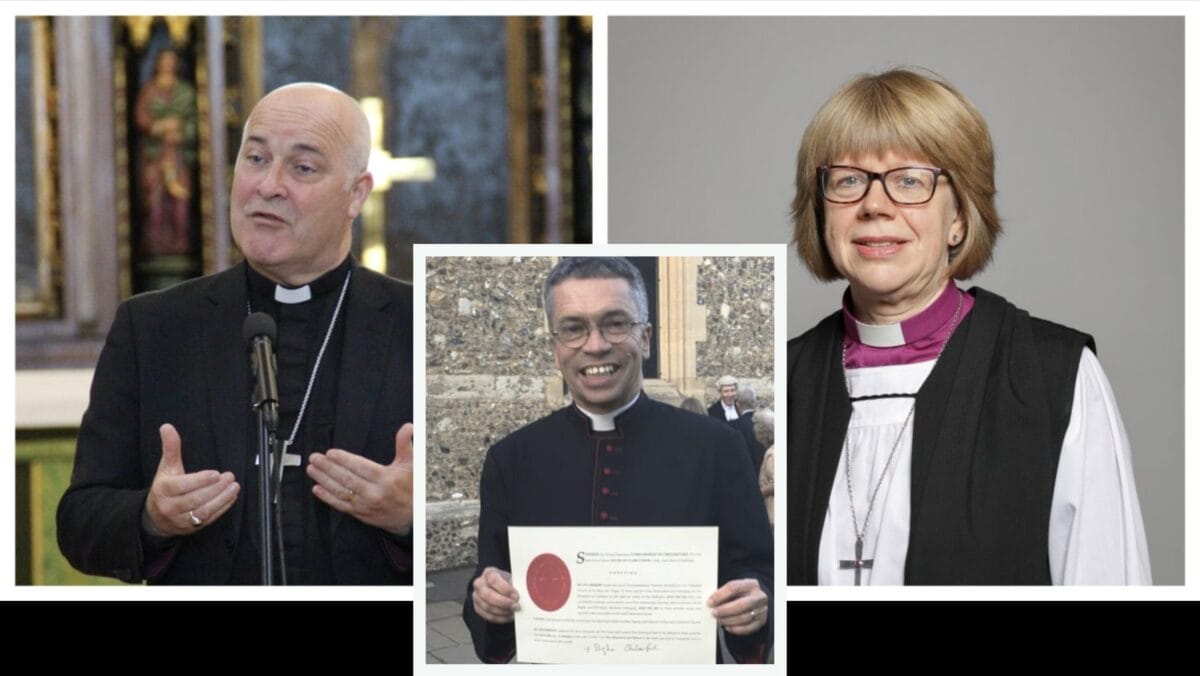
David Tudor was ordained in the Church of England, and served in Southwark Diocese in the 1980s, and then in Chelmsford Diocese from 2000, as Rector of Canvey Island. As a BBC report from a year ago notes:
In 1988, David Tudor was a defendant in two criminal trials
In the first trial, he was acquitted of indecently assaulting a 15-year-old school girl although he admitted having sex with her when she was 16
In the second trial, he was convicted of indecently assaulting three girls and was jailed for six months. The conviction was quashed on technical grounds because the judge had misdirected the jury
In 1989, Tudor was banned for sexual misconduct by a Church tribunal but was allowed to return to ministry after 5 years
In 2005, Tudor was suspended as police investigated an allegation he had indecently assaulted a child in the 1970s. He was not charged and was allowed back to work under conditions
From January 2008, Tudor had been working under a safeguarding agreement preventing him from being alone with children or entering schools in Essex—and yet months later he had become an area dean in charge of 12 parishes.
All this was known by Stephen Cottrell when he was appointed bishop of Chelmsford in 2010. In 2012, Cottrell was told about the £10,000 payout Tudor had made to Jessica, who says she was sexually abused by him, sometimes very violently, from the age of 11 during the 1970s when Tudor was training to be a minister. Cottrell nevertheless reappointed Tudor, not once but twice, as Area Dean, and also (as part of a new diocesan policy Cottrell introduce) made him an Honorary Canon of Chelmsford Cathedral.
In 2019, fresh allegations were made, and Tudor was suspended from ministry. There was a long delay in bringing a formal tribunal against Tudor, I think because the police were slow to review the case and decide that they would not prosecute, but finally a Church disciplinary tribunal found Tudor guilty of gross misconduct and banned him for life.
Immediately after that tribunal judgement, a complaint under the Clergy Discipline Measure (CDM) was brought against Stephen Cottrell for his handling of the case. The complainant has been granted anonymity; it might have been by one of the people who brought the fresh allegations on which Tudor was convicted. CDM complaints normally have to be made within one year of the alleged offence, but in this case permission was given to consider it ‘out of time’. To ascertain whether it should now be passed into the regular CDM process, a judgement must be made by the President of CDM Tribunals, Sir Stephen Males. He made a ruling in December, and it was published in the middle of January.
I am surprised that it has not made more headlines—because the content of the ruling is quite extraordinary, and you can read it here for yourself. Please take a few minutes to do so.
The first extraordinary thing is the timing of the ruling:
A complaint against an Archbishop would normally be handled by the other Archbishop, in this case the Archbishop of Canterbury. However, in view of the current vacancy in the See of Canterbury, responsibility for handling the complaint was delegated to the Bishop of London as the next most senior Bishop in the Church of England.
This process was taking place in the second half of 2025—at exactly the same time that Stephen Cottrell was being asked to make a ruling (on advice, of course), about none other than the Bishop of London, over her response to another historic safeguarding failure related to the death of former priest Alan Griffin. Stephen Cottrell announced his ruling, about Sarah Mullaly, just two weeks after this ruling, on behalf of Sarah Mullally about Stephen Cottrell, was completed.
How can a system like that look in the slightest bit credible? Both would have been aware of this conflict of interest—so were not other senior bishops invited to take their place?
The ruling then lists Tudor’s earlier offences, and comes to this conclusion:
I would observe that the existence of and perceived necessity for these restrictions ought to have been the strongest possible indication that David Tudor was not suitable to be allowed to minister as a parish clergy person. However, it was not the respondent’s decision to allow him to return to ministry or to serve as a vicar in the Canvey Island parish.
We need to note that Stephen Cottrell was fully briefed on this history when he came to the diocese in 2010, and so would have been fully aware of this situation. This ties in with Stephen’s claims that the situation was ‘intolerable’, and that the concern was to ‘minimise risk’. But it is in this context that Stephen re-appointed him as Area Dean twice, and made him an Honorary Canon of the Cathedral, which is hard to square with either of these claims.
The next extraordinary thing in the ruling is the criterion that Stephen Males deploys in reaching his conclusion. At first, he states that the matter has been referred to him…
to decide, in accordance with section 17(2) of the Measure, whether there is a case to answer in respect of which a disciplinary tribunal should be requested to adjudicate. (emphasis added)
However, repeatedly through his report, he refers to quite a different standard of proof:
I have considered carefully whether, in these circumstances, a disciplinary tribunal could reasonably find that the respondent was guilty of misconduct for making these appointments. (para 53; see also paras 56, 60, 63).
He returns to the original criterion again in para 64, but this seems out of step with the content of his previous argument.
The fourth extraordinary thing relates to the way that this case had been handled earlier in 2025. Sarah Mullally had initially dismissed the complaint, on the grounds that ‘the complainant had been unable to provide evidence of what precisely the respondent knew about the abuse committed by David Tudor when he became Bishop of Chelmsford in 2010’ (para 23). And yet Stephen Cottrell had already, several times, said in public that he had been fully briefed and so knew all the facts—not least in this television interview on Good Morning Britain, broadcast in March 2025, a month before Sarah Mullally’s decision.
Stephen Males comments:
By a decision dated 6th May 2025, I held that the decision of the Bishop of London was plainly wrong, principally because the Registrar’s report (whose reasoning the Bishop had adopted) had proceeded on the basis that there was uncertainty as to what the respondent actually knew about David Tudor’s previous misconduct when he became Bishop of Chelmsford in 2010. In contrast, public statements made by the respondent had made it clear that he had been fully briefed about David Tudor on becoming Bishop of Chelmsford. The Registrar’s report was therefore founded on a false premise.
So the Bishop of London had made a ‘plainly wrong’ decision on the advice of her Registrar, because neither had actually paid attention to public, broadcast information that was available to them. This surely raises major questions about her own judgment and competence in relation to safeguarding processes.
The fifth extraordinary thing in the ruling is the comment made about decisions in the diocese which affected the status of David Tudor. On the decision to reappoint Tudor twice as Area Dean, Stephen Males summarises:
The respondent makes clear, however, that although he believes that this was the rationale for reappointing David Tudor as Area Dean, he now accepts that this was a mistake and should not have happened because it failed properly to take account of the position of Tudor’s victims.
But note that the second decision was taken only in 2018, when we were all well aware of the importance of safeguarding issues; this is not ancient history, or the 1980s. And there was no information about the history of Tudor’s case of which Stephen Cottrell was unaware. And note that the criterion for Stephen Males’ ruling should have been whether there was a ‘case to answer’ in terms of safeguarding failure. How could this complete failure to consider the status and well-being of victims not represent such a failure?
Further, Stephen Males then goes on to exonerate Stephen Cottrell for the decision to appoint him as an Honorary Canon:
In 2015 David Tudor was appointed as an Honorary Canon of Chelmsford Cathedral. However, this appointment was not (as it is in some dioceses) an individual appointment to reflect some element of personal merit or contribution to diocesan life. Rather it was the result of a new diocesan policy that all Area Deans (44 in all) should be appointed as Honorary Canons for the duration of their holding this position. It is apparent that the respondent considered the position of David Tudor at this time and decided that there was no basis on which to exclude him from the new policy of general application which the diocese had introduced. The respondent was, however, aware that this might be a sensitive appointment which would attract some public comment (para 37).
So Stephen Cottrell was fully aware of the implications of the policy in relation to Tudor, was aware that this would be controversial, and yet agreed to go ahead with the policy decision in any case. Why not exclude Tudor from the policy? Why not make selected Area Deans canons? Why not decide against the policy—which has since been reversed—given this likely controversy?
The sixth and final extraordinary thing here is not obviously apparent unless you have been following the story. One of the allegation in the CDM complaint is that Stephen Cottrell should not have re-appointed Tudor as Area Dean twice. Stephen Males thinks this is a serious and important allegation:
The allegation that the respondent re-appointed David Tudor as Area Dean in 2013 and again in 2018 is, in my view, the most serious of the allegations against him. As appears from what I have set out above, the respondent now accepts that this was a mistake, which did not take account of the pain which this would cause to Tudor’s victims, including the complainant, and that these appointments should not have been made. I agree with that view (para 49).
What is then odd is that Stephen Males at this point shifts his criterion, and instead of asking ‘is there a case to answer?’, asks ‘would a tribunal likely find him guilty’. Males does in fact appear to think that there is a case to answer, so it is very odd that he does not refer the case on.
But the most extraordinary thing here is that the testimony of Stephen Cottrell, as recorded here, completely contradicts what he said publicly in his defence in the Good Morning Britain interview. At 3.26, h is pressed for the second time on why Stephen Cottrell twice re-appointed Tudor as Area Dean:
This was an individual who had been banned from being alone with children this was an individual who had paid compensation to a sexual abuse victim I’m not sure how you could then twice reappoint him well as an Area Dean.
Stephen offers this defence of his actions:
Well his office was as a as a team rector of a parish um that was the office that he held the Area Dean thing was an additional thing which, which went with his office.
This of course is not true; the two appointments are quite distinct, and though there was no legal power to remove him as rector, it was within Stephen’s gift to remove him and/or not reappoint him as Area Dean. The problem is that the interviewers do not know that, and so stop pressing this question.
At 4.40 into the interview, Stephen claims:
What happened which allowed him back into ministry in the 1980s could not happen today. I received, er, those were the decisions that were the mistakes which I received from the past and I dealt with them in the way that I was able to at the time.
In other words, all the mistakes were in the past, and his hands were tied, and he did whatever he could. But reading through his testimony in the ruling, the opposite is clear: he repeated says that many of the mistakes made in handling Tudor were his own.
So at least twice in this interview, Stephen Cottrell says things in his defence which are not true—as we know from his testimony recorded in this ruling. There must be a word for saying things you know to be untrue, in public, in your own defence…
Gavin Drake, who was a lay member of General Synod from my own diocese, has scrutinised this ruling on his own website here. I don’t always agree with Gavin in his comments on safeguarding, but I think he puts his finger on the key issues here in a very clear and helpful way. He offers this summary of the problems with the ruling (though the details are worth reading too):
A senior Church of England disciplinary decision has concluded that there was “no case to answer” in relation to the Archbishop of York’s handling of the David Tudor safeguarding case. That conclusion does not withstand scrutiny.
The President of Clergy Discipline Tribunals rewrote the legal threshold he was required to apply. Instead of asking whether there was a case to answer — the statutory test in the Clergy Discipline Measure — he applied a stricter, invented standard: whether there was a “real prospect” that a tribunal would ultimately find misconduct. That test appears in neither the Measure nor the Clergy Discipline Rules. It allowed him to decide the merits himself, at the gateway stage, without a tribunal ever hearing the case.
The decision repeatedly acknowledges serious failings: that mistakes were made, that decisions were “regrettable”, and that the Archbishop “could and should have been more curious” when new information suggested the possibility of further victims. Yet it then treats “good faith” as effectively dispositive — a near-complete defence — despite the fact that misconduct under the Measure expressly includes neglect or inefficiency in the performance of office. In safeguarding and regulatory contexts, good faith does not cancel neglect.
Gavin goes on to ask larger questions about safeguarding structures in the C of E—but the facts around this case themselves are disturbing enough. The evidence of the ruling shows that both Stephen Cottrell and Sarah Mullally have made serious misjudgements, and that they have been part of a process where they are supposed to be scrutinising each other at the same time. Stephen in particular is shown to have made repeated errors and misjudgements, and protected and even honoured someone who was a known safeguarding risk. Subsequently, he has made claims in public which are demonstrably untrue in order to protect his own position.
This, for me, leaves at least three large questions for the institution.
How can the Archbishops’ Council oversee aspects of safeguarding with confidence, with Stephen one of the two senior figures on the Council and its notional chair?
How can the General Synod make decisions on safeguarding implementation, with Stephen as one of its presidents?
How can the wider Church have confidence in safeguarding policy, when someone responsible for such serious failures remains in post?
As far as I can see, there is no obvious mechanism to address these issues as long as Stephen remains in post.
 Buy me a Coffee











We in Liverpool saw the CofE paralysed by indecision and endless process when our previous bishop faced accusations by, among others, his suffragan. We had an issue in our own parish where a lay person was behaving inappropriately and the diocese seemed unable to help. I thought on both of these when undergoing my third of four safeguarding training events recently.
The issue of the Archbishops is beyond my ken, but the above article seems damning.
I think the attitude of the CofE hierarchy (national and diocesan) is that we’re all good Christian people and this kind of thing shouldn’t happen. Therefore, when it does, it is an abberation and we should all move on asap. Whether the Christ who was furious with child-abusers would agree is another matter.
The bishop did nothing that was not in full view of many people.
His family’s life and livelihood was destroyed.
This was to serve a Cathy Newman narrative, on a roll, that C of E bishops per se are likely to be suspect and ‘We’ve got a BIG story for you.’.
And at the end of it, the national body said the church was not stringent enough.
The truth of the matter is perfectly obviously that they are caught between the devil and the deep blue sea (letting miscreant continue; ruining life of someone who’s actually innocent), and moreover in cases where typically there will be no other witnesses so firm knowledge is impossible. They know they will be pilloried (by the professional shocked-and-disturbed) whichever way they jump.
Safeguarding could not be more important in the Church context since here we have the quintessential voluntary organisation that not only everyone can join but everyone can be welcome and used in.
The fact that people are constantly pointing to cases of 40-45 years ago (which were part of, or subject to or surrounded by, the new norms promulgated by the secular sexual revolution) as the most relevant today (i.e. they are following their media puppetmasters) says it all about the present belt and braces situation, where safeguarding itself is particularly strong but clear resolution of a high proportion of cases (or alleged cases) necessarily as nigh-impossible as it must needs always be.
Chris, are you arguing that John P was a scapegoat? Have you not read the accounts of his behaviour? Or that members of the CNC were informed that there were safeguarding concerns…?
If someone in power behaves inappropriately in a public space, but no-one feels able to challenge them because they are in a position of power, that that then means they are not accountable…?
Yes, if that was indeed the situation.
Things that (a) happen in public and also (b) are not remarked or remarkable at the time must be at the low end of questionable.
He comes from a close family culture, a touchy feely culture, but today’s prickly divorce laden culture acts prurient/damaged in the presence of such.
The only feature where he is certainly in danger of being culpable is the woman’s anatomical description if true; but the trouble is that we have here a matter of fine lines. Not only can someone (a) not always know what precisely is below a square inch of clothing, but also (b) they may brush unintentionally or (c) they may have been jogged. (d) They may not be analysing too deeply.
Meanwhile, C Newman (with her track record of entire unnuanced antipathy to the C of E, even when it is really a matter of other denominations) is avowedly looking for every scrap she can get. Twitter: ‘We’ve a BIG story for you[r delectation].’.
The fact that the diocese[s] already investigated and exonerated means nothing
To be a bishop is to be suspect. And if the more gossipy scenario lost the hearing, the hearing must be wrong.
The woman scorned scenario is faithfully reproduced – at least in his own account.
But why is his own account, shorter and longer, withdrawn and retained, not prioritised? It is full of circumstantial detail. No stereotypes.
(A N Wilson, The Vicar of Sorrows, with its narrow corridor brushing-against manufactured-‘incident’, faithfully portrays a peculiarly Anglican trope.)
you seemed to be implying it’s all media hype. And I doubt anyone actually thinks ‘to be a bishop is to be suspect.’
What you say is so broadbrush that it is hard to comment on it. There are various simultaneous things that are to be contended with:
-The willingness of so many to think it was likely that in (a) very public/family settings where (b) nothing was remarked at the time, anything particularly dreadful could be done;
-The ignorance of so many of JP’s longer and heartfelt personal statement that was quickly withdrawn, presumably for legal reasons;
-The customary exalting of the most gossipy version of any story to the top of the pile, in concert with the progressive feminisation of the church…
-And of course the ignoring of church-court judgments already made, when it is obvious that church-courts have *higher* standards than secular, as they deal with both moral and legal matters rather than legal only;
-The sheer number of those prominent commenters who will 100% of the time side with the female party;
-The quasi-bloodthirstiness of C Newman’s party and the impression that episcopal scalps were being sought;
-The contemporary lowering of the bar for what counts as ‘sexual assault/abuse’ till even a later-regretted hug (for example) comes to be classified as such;
-The contemporary women-are-never-wrong fashion. (All this reached its height with the Everyone’s-Invited initiative, where, as with #metoo, the ground rules were that *all* culprits had to be male, and, in this case, there could be a jolly good gossip at the same time. Dream combination, for some.)
On Ian’s points:
-I don’t think JP was a scapegoat, since I do not think there was anything for him to be a scapegoat for. After all, it seems quite likely that nothing significantly wrong had been done, and therefore no punishments were in order – apart from that by moral standards (which are the only standards worth anything) the first woman in question should have been discouraged from trying to get close to JP; while the second woman in question was certainly caught up, clearly partly by her own doing, in an extremely timewasting scenario which prioritised short-term over long-term, private matters over public service, showcased the absurdity of certain aspects of the present safeguarding procedures, and allowed only one version of implicit communication to have validity, namely the present UK one.
(‘Safeguarding’, incidentally, is a bad word to the extent that it is preemptive and treats innocent and guilty alike as dangers before we even start, which is a cruel and immoral thing to do in the case of the innocent.)
-It is inevitable but unremarkable that the ‘case’ (if it indeed was a case) that arose in Chelmsford would have been raised in interviews for Liverpool. However, that is not a separate point from the point that the ‘case’ arose in the first place, quite possibly unnecessarily.
Astonishing.
A case to answer is, in effect, a pre trial review, not a trial.
Bearing in mind the burden of proof and standard of proof relates to civil proceedings, not criminal, it is all the more remarkable. Standard of proof is, ‘on the balance of probabilities’ that is, more likely than not. Similar fact evidence, while it may apply in criminal proceedings, it is suggested would build up to a weight of evidence in civil matters, that would more than satisfy the standard of proof.
Unsettling.
It is suggested that if this had taken place in other streams of Christianity, such as baptist, or others, which have been followed up with independent reports, there would be, and have been, public scandal.
The fact that some of this has taken place within a statutory framework, should not make it less so, but more so.
Res ipsa locquitur?
Where is there accountability? Is the system fit for purpose?
Sorry to be cynical, Geoff, but it is common currency in the upper echelons of our society that the elite are virtuous and benevolent, and therefore should not be subject to “little people” rules. Only when a Mandelson drops fellow-elitists in the mire is there any response – and, as we have seen, it is furious and defensive.
We are in “End of Empire” times. The rise of Reform and the Greens seems to indicate that the little people have had enough. No doubt, the institutional CofE will continue to back the wrong horse until it also becomes overwhelmed by the revolution of the next twenty years. Great prayer required from us all.
David,
Is it erroneous to look for integrity within Christianity, as part of discipleship? Does it dishour Jesus, the name of Christ, bring dishonour and disrepute to his church, body? Is that not a measure, not only for those in office, but for all Christians, in self examination.? In patterns of behaviour?
No, it isn’t erroneous, it is fundamental.
However, I’m not talking about Christianity but about the CofE as a human institution, not a collection of Christians. In that respect it (sadly) resembles all the other UK institutions captured by the elite.
Starmer to be fair to him removed Mandelson from his Ambassador post and he had to leave the Labour Party and the Lords. Reform have not been immune from some having scandals in their ranks either, including some with links to the far right and one MP who was elected to Reform who has been in prison and Jenrick’s links to Richard Desmond’s planning application and Braverman sending an official document from her personal email account. The Greens are just rehashed Corbynism with Polanski and still only 4th in most polls behind Reform, Labour and the Tories and about level with the LDs.
The C of E has much to improve on but so does most of the establishment and political class in case of safeguarding and complying with the law and rules
Starmer moaning that Mandelson lied to him is a ridiculous attempt at deception. Starmer was warned by the Americans that this was not a good idea and as PM he had the security services available to check whether Mandelson was lying.
Everybody is saying that this is the worst political scandal in Britain for a generation. Wrong adjective -it is the best.
Starmer was a political appointment, as Director of Public Prosecuctions by the Labour party when Gordon Brown followed on from Tony Blair was PM, a time when Mandleson was prominent, influential.
Starmer’s legal career can readily looked up with a search assistant.
Personally, what I find remarkable is, in light of his legal career, that he seems to have set it all aside in the appointment of Mandelson, and merely believed him. It seems that political expedience and influence has overridden all his legal qualifications, judgements and experience.
Everybody in Britain knew Mandelson is corrupt with a history of financial dishonesty about his mortgages. What nobody has been able to talk about, at least openly, is the demi-monde of homosexuality in politics, which is particularly strong in the Labour Party, but is there in the Lib Dems and the Tories as well, and is very open among the Greens. It is an interesting question why homosexuality is so common among British MPs.
Mandelson also had a very strong influence upon Tony Blair, who has kept uncharacteristically quiet recently. Wes Streeting is also a Mandelson protégé.
Homosexuality is legal in the UK, as is same sex marriage now about 10% of UK 16 to 24 year olds now identify as LGBT and about 5% of UK adults overall. There are also plenty of same sex couples in stable relationships in politics, like Streeting or Ruth Davidson, Davidson indeed has a son with her same sex partner
Simon: your statistics are nonsense and reflect your own wishful thinking.
But your lot is certainly common in British politics, and there is more about Keir Starmer soon to come out when the Ukrainian boys appear in court.
Streeting is certainly aiming to be the first openly homosexual Prime Minister in Britain but he may not succeed in this. But let me assure you that Ruth Davidson did not have a son with her female lover. Sperm is still needed for conception.
James Thomson
For the record I am married to a woman I am just not homophobic, as your latest post borders on. In legal terms Davidson and her female partner’s son is their own and of course biologically one of theirs too
Simon, can you stop rewriting not only science but the most fundamental science of all. People are bound to read what and think the author not full of truth or honesty, and liable to skate over not only data but the most central data.
The ancients called the equation of human machinations with divine miracles ‘hubris’.
Denying same sex couples child is their own Christopher is not only rejecting UK law that confirms it is but also potentially grossly offensive homophobia to them and in breach of the Malicious Communications Act now if they read it
Plus potentially in breach of s127 of the Communications Act 2003
‘A person is guilty of an offence if he—
(a)sends by means of a public electronic communications network a message or other matter that is grossly offensive or of an indecent, obscene or menacing character; or
(b)causes any such message or matter to be so sent.’
Dear Ian
Please ban Simon Baker from your blog for these clear but implicit threats against reasonable free speech. And congratulations on your mention in the Telegraph today.
Warning of the consequences of a grossly offensive online post saying a same sex couple’s child is not their own is no grounds for a ban and I will not be cowed!
It is you who are trying to cow people, Simon, by running to Big Brother. I am merely trying to get you banned.
Simon, you know perfectly well that reality does not change when the law changes. Some laws are accurate to reality and others are not. What on earth is so special about ‘law’? It is just a few (mostly nonexpert) people walking into one or other lobby. Anyone with any IQ can do that.
Do you actually think that all children everywhere stopped actually needing a father, having all previously needed one, at the precise moment when the law was passed saying they officially do not need a father?
Are there really people (law fundamentalists) who think things like that?
So in shock news, Chistopher comes out for same sex male couple parents as they have 2 fathers!!
But as Geoff comments to me above, one would hope an institution created in the image of God might look rather different to the others. Instead, it looks like the ending of Animal Farm where the pigs become indistinguishable from the humans.
Comment re Simon’s original post.
99% of clergy and members of the C of E are not sexual abusers but there will always be some bad apples. Most of the abuse in the C of E by Smyth, Ball, Tudor, Pilivachi etc happened in the 1970s, 1980s and 1990s largely before DBS checks came in. Since then safeguarding has been improved but there is still more to do as there is for other churches and institutions who have had abusers and as the Tudor case in particular shows
Starmer “removed” Mandlson (with a £50,000 sweetener) because had he not done so Starmer would be toast.
Starmer knew enough, and was advised enough, not to have appointed Mandelson in the first place (I’m sure that somewhere in “international law” there must be something about not appointing known fraudsters, grifters, and misusers of office (EU commissioner altering trade rules to suit his friends with big yachts?) to important ambassadorial jobs)
“Links with the “far-right”?” What does that mean? What about the far more dangerous “far left”, and militant Islam? (After all, there is only one group that has blown up children at a pop concert, bombed underground trains, and murdered soldiers) Meanwhile the fruit-and-nut party is happily recruiting extreme Islamists, as is the equally mad Greens (any connection with the colour of a certain prophet’s war flag?)
SC has convinced himself and many others that he is a vital part of the life and health of the Church of England, so we have another three years of this. In the meantime it would be easy, and honourable, to recuse himself from safeguarding matters. True leadership would be resignation (0% chance) but it would be a kind of leadership to at least say ‘I am undertaking further safeguarding training to help avoid making the same errors’. It is easier than defending the indefensible. People ask why morale is low in the CofE. Part of the answer is having to live with double standards, doing mental gymnastics to justify the inconsistencies, having to smile at our leaders while looking elsewhere for inspiration and example. I write nothing new. There is a great diagnosis here already with some practical proposals. https://www.churchofengland.org/sites/default/files/2024-06/gs-2354-trust-and-trustworthiness-within-the-church-of-england-a-preliminary-report.pdf
Yes, and we appear to be completely ignoring that report.
I cannot recall SC ever saying ‘I need further training’.
The critical thing is not just the dissection of these particular cases but the overall culture of the C of E which enables this. See this review in this week’s Church Times of my brother’s book ‘Safeguarding the Institution’ by someone with huge experience of safeguarding within the C of E which says its her vote for Christian book of the year: https://www.churchtimes.co.uk/articles/2026/6-february/books-arts/book-reviews/book-review-safeguarding-the-institution-how-the-culture-of-the-church-of-england-facilitates-abuse-by-stephen-kuhrt
“Protecting the institution” is right – this seems the prime objective in many bishops’ minds, especially SC. It reinforces an overall image of the C of E as an organisation seeking to “perpetuate” itself rather than carrying out its calling. The “edifice” of the institution – whether its buildings, its hierarchical structures, its over-riding sense of privilege, its emphasis on “keeping the roof on” as well as “keeping the lid on” – has seemingly become its only focus.
As an ordinary Bible believing Christian I am naive enough to hold fast to what God is calling the church to do – something the C of E has lost – and trusting Him to “keep the roof on”!
There have been sex abuse scandals in the Roman Catholic church, in Baptist churches, in Pentecostal churches, in football clubs, in the BBC, in Parliament, amongst top businesspeople, in the Scouts, in boarding schools, in Hollywood, even in the royal family all come to light in the last decade or two. It is certainly not just the C of E that needs to improve its safeguarding
Largely because most of those named are so colossally large organisations that it is difficult to see how there could not be.
Certainly C of E safeguarding is better than it was, DBS checks only came in in 2012 after all replacing Criminal Records Bureau checks which had only begun in 1997 and the ISA barred list only created in 2006. Tudor’s 1988 conviction even had it been upheld would not have come to light therefore at that time. In 2024 he was also banned for life from ministry whereas in 1989 he was only suspended from ministry for 5 years.
Nonetheless Cottrell needs to answer why he reappointed Tudor as an Area Dean and an Honorary Canon despite being told of payouts made by Tudor to a victim. Particularly given Sir Stephen Males ruling on the mistakes Cottrell made in Tudor’s Area Dean reappointment hard to see the Archbishop of York having any further senior position in the C of E once his term in York ends.
“once his term in York ends.”
He’s not on a fixed term “contract” though .
He has to retire as an Archbishop at 70 (and indeed no bishop can be in post older than 70). Cottrell is already 67
Cheers.. I’d forgotten that.
But I can’t imagine (or think what this might be) any senior position being “open “at 70 years old.
He’s not on a fixed term “contract” though .
We all are.
Send this essay to everybody who is hosting an event attended by Cottrell. Embarrassment is the best weapon.
Distressingly excellent, Ian.
Upon reading this I wonder how the apostle Paul would have handled this? Look at his requirements for a deacon. Why is this man still in ANY position of authority in the Church? Unbelievable how far the Christian churches have strayed. God help us!
This is hard to comment on as someone outside the CofE.
On the one hand, it clearly does seem to ask serious questions about the integrity of senior clergy, and of their professionalism in office. Both Archbishops ruling in each other’s case seems to be an appalling abuse of power if true, and it will do almost nothing to assuage the very significant and real pain of victims still pushing for justice and acknowledgement. I would not have thought that the Bishops could act in any more of a ‘self-preservatory’ way, but it seems they can, and it’s immensely disappointing.
But on the other hand, I am not sure there is any position of neutrality here in the church, and I am certain that even in my Baptist and Congregational ecclesiology similar things can happen, and in all likelihood have.
The best I can say here is that I wish all Christian leaders were more openly transparent, more accountable with their power, and more humble when the time is right for admonishment and/or censure.
We all fall short, some of us are just more willing to admit it than others.
Mat
Thanks Mat. So what to do?
I don’t know…..
But to be clear, I wasn’t arguing that nothing should be done, just that I don’t know what the something is.
Whatever happened to the Jay recommendations?
For the latest news, Google “Church of England Safeguarding Structures Programme Board”.
Their paper, GS2429, is up for debate at Synod on Wednesday. I’ll let you make your own assessment but you may need a bottle of whisky handy.
There’s a couple of blog posts about it on our website, http://www.faithfulresponsibility.com with links to articles by Gavin Drake and others.
Thanks for drawing attention to this.
Too my simple christian mind, the CofE has got things the wrong way round in dealing with these matters. These cases should not be dealt with in an upwards direction, but in a DOWNWARDS direction.
Complaints about parish clergy should be handled by lay people from another parish.
Against Archdeacons and Bishops by priests and lay-people from another diocese.
Against Archbishops by lay-people.
And NO Lawyers.
Just a small aside:
I’m not sure that the test of “a case to answer” and “whether, in these circumstances, a disciplinary tribunal could reasonably find that the respondent was guilty of misconduct” are that different.
Doesn’t it seem to you that Stephen Males is simply trying to apply a version of the test that the CPS ask themselves when deciding whether to prosecute or not: i.e. “is there enough evidence against the suspect to provide a realistic prospect of conviction?”
The difference and distinction is between civil law and criminal law, a very big distinction. A crime is an act against the state.
CDM is part of civil law where there is a claim/petition v defendant/respondent, where the claim/petition is set out in a statement, particulars of case and pleadngs and there is a written response to each particular.
Again, to repeat, the standard of proof, substantially differs. This is basic stuff.
updates on Tudor
https://lawandreligionuk.com/2026/02/28/ecclesiastical-court-judgments-february-4/
https://www.churchofengland.org/sites/default/files/2026-02/determination-on-penalty-the-revd-david-tudor-09.02.2026.pdf
Seems HoB get away with marking their own homework (Cottrell, Mullally)
Besides [this thread] on Safeguarding and accountability, I urge all to view Ian’s [other]
https://www.psephizo.com/life-ministry/the-problems-with-the-c-of-es-reparations-project-spire/
and especially the comment from Don Benson, where GS et al are ignoring the elephant in the room and not calling out the naked emperor(s).
We should be joyful that Our Lord is coming soon to drain the swamp to usher in New Heaven and New Earth,but meantime we have to bear the evil times that “must be”.
Happy Easter and Soli Deo Gloria !