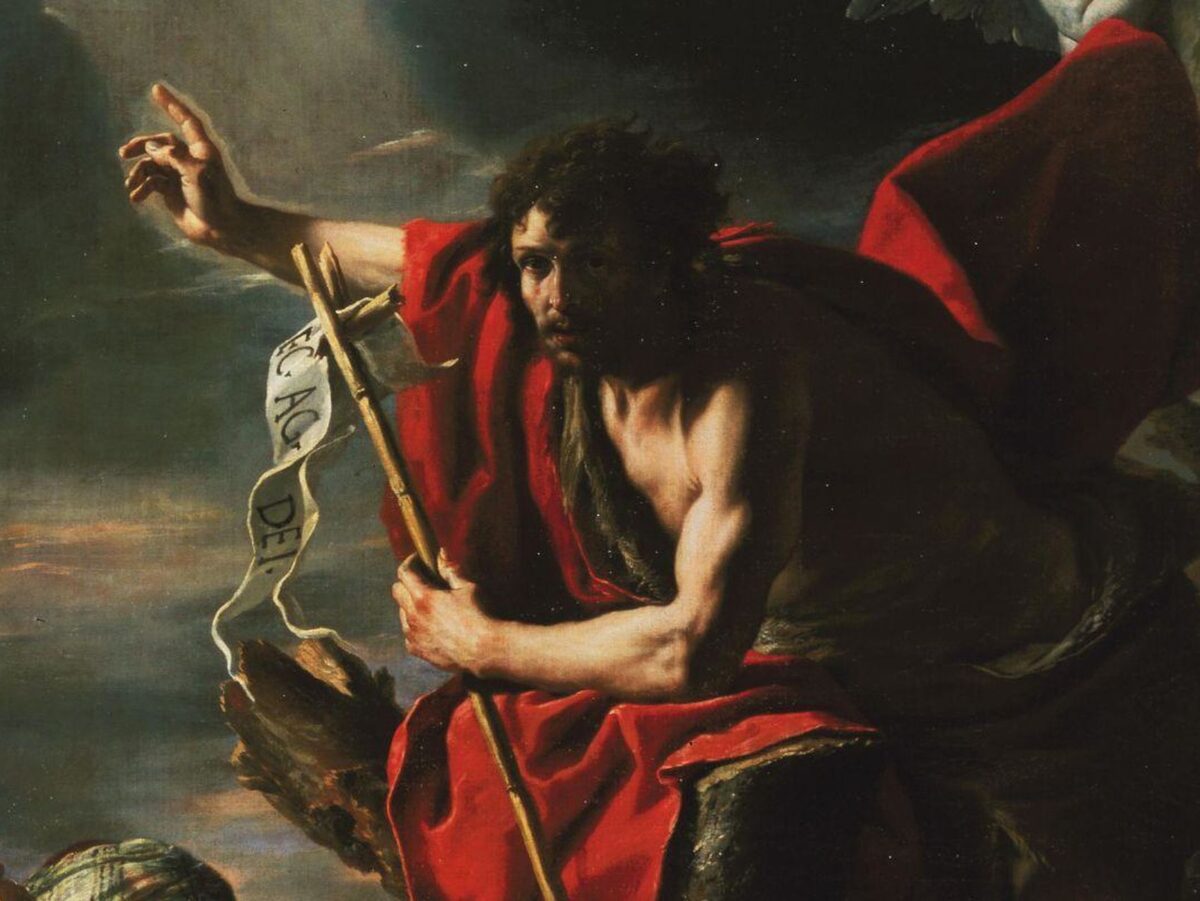
The Sunday gospel lectionary reading for Advent 3 in Year C is Luke 3.7–17, and it follows closely on from last week’s reading; verse begins ‘He therefore said to the crowds…’ which some English translations omit. The content of his teaching raises some fascinating issues about repentance, judgement, and discipleship, and the way in which the teaching of the kingdom is (or is not!) radical and revolutionary.
It is not completely clear whether the linking ‘therefore’ points us back to the verses from Isaiah that Luke has just quoted, or the fact that John ‘preached a baptism of repentance…’ In any case, the two are closely linked together; as we noted last week, Isaiah’s message was that the one who prepared the way for the visitation of God to his people was to make the crooked straight, a metaphor for change and straightening of life.
John’s greeting to the crowd hardly looks encouraging! Language of ‘brood of vipers’ introduces a persistent theme in this section, that of fruitfulness. The language of ‘brood’, γέννημα, refers to ‘that which is produced’, the offspring, sometimes called ‘the fruit of the loins’; verses like Deut 28.4 link this with other kinds of ‘fruit’, of loins, of land, and of livestock. Whether you are the offspring of vipers, or of Abraham, will be shown by what your offspring is in terms of the kind of life you lead. The play on this idea continues right to the end of our passage, in that the language of ‘fruit’ in the New Testament includes reference to the grain of the harvest, which sounds odd to our ears. But in this way the question of who is our true ‘father’, what kind of life we lead, and how we will fare on the day of judgement are all linked together.
The term translated ‘viper’, ἔχιδνα, has entered English as the name of the spiny anteater, echidna, through an error of etymology—but is in fact a general term for snake which does not allow us to identify a species. In the Jewish and canonical context, snakes are associated with the work of Satan as primeval opponent of God, all the way from the Garden of Eden to the Book of Revelation (see Rev 12.9 which uses the alternative for snake ophis); in a Greco-Roman context, the idea of animal physiognomy would imply that, because a snake slithers on the ground, a snake-like person is ‘cruel, harmful, insidious…, terrible when it decides to be, quick to flee when afraid, gluttonous… Such men are… devoted to evil doing’ (cited in Parsons, Paideia on Luke, p 66). Either way, it is hardly flattering!
There is some irony in his question ‘Who told to flee the coming wrath?’ because, in a sense, it is John who has done so! It suggests that the proclamation of the kingdom of God by John and Jesus is both good and bad news, in that it both proclaims liberty to captives but also judgement for those who have not turned to God’s ways, where we, in contemporary discussion, often treat it as an unqualified blessing. Luke’s gospel is often pointed to as a narrative where judgement has been excised or postponed, particularly in relation to Jesus’ so-called ‘Nazareth manifesto’ in Luke 4—yet it is in this gospel that the fall of Jerusalem is most unambiguously associated with the judgement of God on his people for failing to show the repentance and response that John calls for here (see Luke 19.44).
(We should note, in passing, that the New Testament writers never describe God as ‘being angry’ with anyone; the language of ‘wrath’ as a noun signifies God’s steadfast holy opposition to all that is sinful, rather than being an emotion directed towards people with whom God is cross.)
The language of verse 8 makes it clear why the verse 7 began with a ‘therefore’; John is here expounding what his ‘baptism of repentance’ actually means. It is no mere rite, but is a visible sign of a change of heart and mind, leading to a change in life. (The idea that anyone ‘whether Christian or not, everyone has the right to ask their local parish church to provide baptism’ is a theological nonsense; spiritual life is not a medicine that can be doled out, as if the church was like the NHS!) Producing fruit is not so much about showing virtues or qualities, as much as acting in particular ways. That is true here just as much as it is in the well-known verses in Gal 5.22; the list there is of particular ways of conduct, as is shown by the contrast with the preceding list of the ‘works of the flesh’ (‘acts of the sinful human nature’) in Gal 5.19–21. The New Testament is consistent in portraying judgement as being on the basis of actions—note the repeated refrain in Rev 2 to 3, ‘I know your works’—since it is a changed life which is the unequivocal evidence of a changed heart. There is no separation here between the inner and the outer life, as if you could believe something without acting in a way that did not express it.
It is not present in the Greek text here, but behind John’s language there might be a pun on the language of ‘sons’ and ‘stones’, since in Hebrew a ‘son’ is ben and a ‘stone’ is eben. But the contrast of the ideas remains, in that sons or children are living people who come from the fruitful life of the parent, whereas stones are the epitome of lifelessness. God who is the source of life is able to bring life from that which is lifeless.
But John here raises a crucial issue most explicitly expounded by Paul in Romans 2: in contrast to what we might expect (from a certain way of reading the Old Testament), it is the response to the grace of God in repentance and obedience which truly determines your membership of the ‘offspring of Abraham’, and not your ethnic identity per se. In fact, this should not surprise us at all, since it is a repeated theme of the prophets; it explains why some of Israel are excluded from the promises of God, whilst many who are not part of Israel ethnically are included.
The image of the ax being ready to chop down the tree is another picture of judgement which reinforces the language of ‘wrath’ earlier; though no agent is mentioned explicitly, it is clear that God is the one who judges and so is the one who also wields the ax. This images connects both with Jesus’ later language in the parable of the fig tree in Luke 13.6–9, which in Matt 21.18–22 and Mark 11.12–25 is enacted by Jesus, as well as Jesus’ teaching in John 15 about branches that do not bear fruit being cut off and burnt.
Luke characteristically recounts the teaching to groups of people in the form of a dialogue, with the crowds responding to John’s provocative proclamation with the question ‘What, then, should we do?’ A similar questions is repeated by the toll collectors in Luke 3.12, the soldiers in Luke 3.14, a lawyer in Luke 10.25, a rule in Luke 18.18, the Jerusalem audience in response to Peter’s preaching in Acts 2.37, the jailer in response to Paul’s miraculous deliverance in Acts 16.30, and a zealous Jew in Acts 22.10. The action of the Spirit and the preaching of the kingdom consistently provokes a personal crisis which leads to the question of response; ‘the redemptive visitation of God demands response’ (Joel Green, NICNT on Luke, p 177).
Neither translations ‘tunic’ or ‘shirt’ really work for χιτων—which referred to the garment worn by women and men next to the skin, over which something heavier might be worn in colder times—simply because habits of dress have changed. The point is not about the particular garment, but about the need to share with others anything beyond the simple necessities of life. In the same way, the language of broma signifies food in general, and is used interchangeably with the term for ‘bread’ in the ‘bread of life’ discourse in John 6.
Jesus doesn’t have a beef with the Inland Revenue; we need to read the (traditional) language of ‘tax collectors’ in its social context. Taxes on land and on people under Roman rule were actually collected by local Jewish councils; the telones mentioned here were responsible for collecting what we might call indirect taxation—customs duties on goods, tolls and other duties. This would be particularly important on trade routes and at borders, so it is no surprise that they feature here by the Jordan and on the shores of Lake Galilee. The right to collect these tolls and duties was ‘privatised’ by the Romans, who gave the license to the highest bidders, so that there was both authority and motivation to exploit the situation as much as possible and charge the maximum. (Isn’t it a good job that, in the enlightened times we live in, such corrupt practices as giving such roles to the highest bidders would not be countenanced in a democracy…?)
The role and the way it was assigned made toll collectors hated as both wealthy and exploitative, as well as making them collaborators with the occupying power. Yet Luke’s focus on the ‘inclusive’ nature of the gospel means that the wealthy, compromised and corrupt are included in the gracious call of God to receive forgiveness and to amend their way of life.
There is no particular reason to think of the ‘soldiers’ mentioned here as Romans; they might equally well be Jews in the service of Herod Antipas, who ruled this region of Perea. John’s response fits the general temptations of those with (military) power who are able to take advantage of the local populace to their own personal advantage. (This kind of exploitation was such a problem that, according to Josephus, Julius Caesar had to issue a decree forbidding soldiers from extorting money from those living in the territories of the Jews; Antiquities 14.204 and 14.392, cited in Parsons, Paideia p 67). It is perhaps striking that John’s primary rebukes here relate to the misuse of power—financial, social, and military.
John condemns certain practices of the toll collectors and soldiers, but does not follow the tradition of the Jewish prophets in condemning unjust structures. Does that make his ethics compromised or bourgeois? Not at all:
John calls for a radical generosity in which everything beyond subsistence necessities is vulnerable to the claim of need. Jesus asks for no more. He adds only the clarification that such generosity is not only for those of one’s own group, but shows its true nature especially in being extended to the enemy (Luke 6.35–36) (John Nolland, WBC on Luke, p 149 cited in Parsons, p 67).
John’s proclamation ensures that his baptism is understood as an assault on the status quo, that to participate in his baptism is to embrace behaviours rooted in a radical realignment with God’s purpose (Green, NICNT, p 173).
Only Luke includes here the speculation of the crowds (the third mention of crowds/the people) that John might be the promised, anointed (Christos) one who would bring God’s deliverance to his people—but their understanding of who this would be appears at this stage to be quite unformed. The clarification of what this ‘Christ’ would do becomes one of the themes of the gospel.
There are several significant images of eschatological judgement in John’s response. First, the promise of the Holy Spirit being poured out (‘baptism’ means being immersed in or overwhelmed by) is connect with ‘the last days’ in Joel 2.28. Although we might naturally associate ‘fire’ with the tongues of flame at Pentecost in Acts 2, but in fact it is an image of judgement, as the phrase ‘unquenchable fire’ makes clear. (Two interesting things to note here. First, the Greek term for ‘unquenchable’ is asbestos from which we get, well, asbestos! Second, fire is primarily an image of destruction, not torment.) John seems to expect Jesus to be one who will bring the judgement of God to his people and to the wider world.
In Luke’s gospel, there is a sense that judgment is postponed until the end of Jesus’ ministry, with an intervening period of grace creating an opportunity to respond. By contrast, Matthew is less reluctant to record the language of judgement in the teaching of Jesus, and this is particularly noticeable in Jesus’ six-fold use of the phrase ‘weeping and gnashing of teeth’ in Matt 8.12, 13.42, 13.50, 22.13, 24.51 and 25.30.
The coming of the kingdom of God means the coming of the longed-for presence of God with his people. But that will also mean a challenge to the reigning powers of this world, and the personal challenge to us: to whom do you owe your allegiance? Will you respond to the urge call to welcome what God is now doing, and change your ways and your priorities? And this challenge comes most sharply in the ministry of Jesus himself, who will one day return as judge and king over all the earth. For John’s hearers, there is practical action to be taking as they wait to meet the coming of God—and for us, too (as expressed consistently in the parables of Matt 24.36f and Matt 25), our patient waiting for the return of Jesus should be marked not by ‘looking for signs’ but simply by getting on with our Master’s business (Matt 24.46).
John is right about judgement and Jesus, with two important qualifications. The first is that this judgement is postponed—in the case of Israel until the destruction of the temple in 70AD, and in case of all humanity until the return of Jesus as judge at the end of the age. And the second qualification is that the basis of judgement shifts; for John it is avoided by repentance, baptism and the fruit of that change in tangible change of life. In Jesus’ teaching this is taken up into the question of decision about following him: judgement is no longer on the basis of being part of the ethnic Jewish people of God; nor on the basis of whether we change and begin to obey God’s just commandments; but it is now on the basis of being incorporated into the renewed people of God by accepting Jesus as Lord, and living a new life of holiness empowered by the Spirit. And all this is possible only because of Jesus’ atoning death and resurrection for us.
Come and join James and Ian as they discuss many of these issues and think about their application:
 Buy me a Coffee












There is a lot in this article!
But this is a key point:
“Whether you are the offspring of vipers, or of Abraham, will be shown by what your offspring is in terms of the kind of life you lead.”
This is Genesis 3:15 as explained by 1 John 3:8–12. It is the great division of mankind — not those ‘in Adam’ and those ‘in Christ’, but those who belong to Satan (the serpent) and those who belong to Christ. Unbelievers are the former. Thus John 8:44, you can be the literal seed of Abraham but metaphorically the seed of Satan.
But I was disappointed by this:
“The list there is of particular ways of conduct, as is shown by the contrast with the preceding list of the ‘works of the flesh’ (‘acts of the sinful human nature’) in Gal 5.19–21.”
The link for Gal 5.19–21 is to ESV with no mention of ‘sinful nature’, and it is not in the 2011 NIV — it harks back to the 1984 NIV which imported the Augustinian understanding into its translation of ‘sarx’ but removed them in 2011 – but sadly, not all of them.
See this article:
https://freeinchristblog.wordpress.com/2016/12/03/how-niv-translators-confused-you-regarding-the-sinful-nature/
My two comments are connected.
If we believe we have an imputed sinful nature from Adam, the important thing is to get out of this ‘Adamic sinful nature’ — therefore ‘out of Adam’ — and the theological concept of the ‘seed of Satan’ and which ‘seed’ we belong to, is pushed into the background — as it is in all Reformed theology.
John Ronning in his PhD on this convincingly demonstrates that by default since Adam we are all born the seed of Satan: “The Curse on the Serpent (Genesis 3:15) in Biblical Theology and Hermeneutics.” PhD, Westminster Theological Seminary, 1997.
I do not want to hijack the blog, but as nobody else has yet commented:
Matthew 19 and Mark 10 when they cite Gen 2:24 — which speaks of a new family created by the marital affinity union — employ the word ‘sarx’ (from the LXX).
I suggest that Paul employs it with the same ‘family’ meaning. But for him ‘sarx’ is the ‘seed of Satan’ family — the ‘wrong’ family and he uses it synonymously with ‘the world’. In contrast, he refers to the new family not as ‘sarx’, but as the ‘body of Christ’/the church. NIV in this verse I think translates ‘sarx’ correctly:
‘I could not address you [the church at Corinth] as people who live by the Spirit but as people [lost Adamic humanity] who are still worldly [sarx, i.e., of this world]’ (1 Cor 3:1, NIV).
The ‘wrong family’, and ‘human frailty’ (and occasionally literal ‘flesh’) I think account for the understanding of ‘sarx’ in the entire Pauline corpus. I cannot for the moment think of any exceptions.
Colin, Im confused as to what real difference it makes if your understanding is correct.
Ah, the Gospel being preached!
What I find as significant is the final verse [v17]
John encapsulated the agenda, mission and message of Jesus.
The image is off winnowing and sifting [tossing and shaking]
On the one hand separating wheat from chaff in general.
We must so prepare the way that He can come and can reign. There must be forethought as well as good will; preparation as well as diligence.
John prepared the way for Christ by declaring private righteousness preparatory to public reformation. “Change yourselves, or to you at least no kingdom of God can come.”
Secondly sifting in individuals.
Nearly all the incidents of individual sifting in the Old Testament are to purify to himself a holy people;
Hence Moses was sifted not only removing him from Egypt
But removing Egypt out of Him.
Similarly, Joseph, Nebuchadnezzar, Israel [Amos 9:9]
For, lo, I will command, and I will sift the house of Israel among all nations, like as corn is sifted in a sieve, yet shall not the least grain fall upon the earth.] e.g. Peter [Luke 22]
Or Paul, sifted until there was nothing of the Pharisee left in him.
In contrast to the preparation of John and a self- preparation of the people; Jesus Has the intension of purifying a people zealous of good works, of bringing to perfection and glory.
1Peter 4:12 & 13 “Beloved, think it not strange concerning the fiery trial which is to try you, as though some strange thing happened unto you:
4:13 But rejoice, inasmuch as ye are partakers of Christ’s sufferings; that, when his glory shall be revealed, ye may be glad also with exceeding joy.
1 Pet 1:7 That the trial of your faith, being much more precious than of gold that perisheth, though it be tried with fire, might be found unto praise and honour and glory at the appearing of Jesus Christ:
Mal 3:3
And he shall sit as a refiner and purifier of silver: and he shall purify the sons of Levi, and purge them as gold and silver, that they may offer unto the LORD an offering in righteousness.
The wonderful fact is that as with Peter, Christ prays for us that our faith might not fail. And become strengtheners of our fellows.
‘The idea that anyone ‘whether Christian or not, everyone has the right to ask their local parish church to provide baptism’ is a theological nonsense.’ Maybe, but there’s more than theology in play here and it’s part of the specific charism of the Church of England that it is parish based and not primarily a series of gathered congregations of uniform theological tradition. (Of course gathered congregations are more often the case in urban areas but much less so in rural ones.) Everyone has access to their parish church and their vicar and that includes for the traditional three offices of baptism, marriage and funeral. How we use them and enable them to be doors into the grace of God is a huge pastoral challenge and joyful privilege, but we can’t back off and opt out of the bits of parish ministry we struggle with because of our theological stance. And the boundary between what used to be called ‘folk religion’ and ‘real’ faith is a good deal fuzzier than we were taught at theological college. It’s sometimes a messy pattern of ministry and involves compromise but that’s how it is. We can still offer a clear challenge and a clear invitation to faith, but we are the church for anyone who asks for our services, nor can we totally dictate the terms on which to offer that service as if we were the ones in control. I can see why it’s not for everyone and why it can certainly be frustrating but it’s part of the whole package.
I think that is an astute observation and is why the Cof E will never be a ‘doctrinally correct or ‘pure’ church for everyone who is in it, although there must be limits as to how much latitude is circumscribed or permissible.
Thanks, Chris. The desire to be pure doctrinally or morally and to clearly draw a line between members (true believers) from non-members (the as yet unsaved) is not something the Church of England can give in to. Which is not to deny the imperative we all have to seek to discern and follow the will of God and to proclaim Christ.
“The idea that anyone ‘whether Christian or not, everyone has the right to ask their local parish church to provide baptism’ is a theological nonsense”
Ian: you are very quick to point out what the CofE doctrine of marriage is based on the historic formularies. Yet here you want to overturn the doctrine of baptism as the CofE has historically practised it.
‘The doctrine of baptism as the C of E has historically practised it’? Are you serious?
Have you read the baptism liturgy? Have you read the BCP? Are you seriously claiming that baptism, expressed clearly as the rite of initiation into the Christian life, (the clue is in the word ‘initiation’!) is for people *regardless* of whether they are Christian?
Yes, I am serious. This is what the CofE has always done. The only reason that a Parish Priest can delay a baptism is for the purpose of instruction.
Baptism is what makes a person a Christian.
I think baptism is the outward, public sign a person has become a Christian. I dont think it ‘makes’ a person a Christian.
If baptism could “make” Christians priests could bless water cannons before deployment.
Maybe, but it remains the case that whoever seeks baptism for their child is entitled to receive the ministry of baptism in their parish church, and a priest cannot intrude their theological scruples to refuse their request except in very unusual circumstances. We may (or may not) agree with that but it is what the Church of England has practised. And the BCP service states that by baptism a child is ‘regenerate and grafted into the body of Christ.’ The risk is that an overly rigorous approach leads inevitably to the denial of infant baptism even for the children of committed Christian parents. Which is why we have a Baptist church which disagrees with the Church of England’s understanding of baptism. Does this sometimes require compromise – yes, of course it does, and we may not always be clear what’s happening. That’s what ministry in a messy world is sometimes like.
It is certainly legitimate to delay baptism for the purposes of catechising.
Yes, delay definitely, but my reading of the rubrics is that we cannot refuse baptism except in very exceptional circumstances. In today’s society a request for baptism has to be a cause for joy as it is no longer the cultural norm. And when it comes to Thanksgiving for the Gift of a Child the initiative appears to be with the parents not the minister when deciding if that is the service to be used rather than baptism. There’s a bit of a trend towards parish websites promoting Thanksgiving Services rather than offering baptism to those who request it as if clear and articulated faith is the sole yardstick we should use.
The late Canon Michael Saward in his fascinating autobiography describes the superstitious ‘folk religion’ among the working class in the 1960’s where families would bring their children for Baptism ‘as the child wouldn’t do well without it’ or, that ‘Grandma wouldn’t have the child in the house’ even though the parents had no intention of keeping their vows or had any regard for them.
Some clergy then, refused to baptise, pointing out to the parents that they would perjure themselves before God. A lot of the parents accepted this argument but these clergy were then ostracised by their peers who would do the baptism regardless at a neighbouring church.
I think it unlikely that this kind of situation would happen now and parents who do bring their child for Baptism in the Cof E do so because they have a modicum of faith however small, and want to feel that the child is ‘protected’ in some way – although I imagine there are still those who like it done just as a social occasion.
In our Baptist church we have thanksgiving services for the local toddler mums who ask for it but we do not baptise the infant. We also do not make baptism a condition of membership preferring to let people be convicted of that need themselves.
Baptism, Mariage and Funerals are indeed “doors” into the Church.
And gentleness is a chief characteristic of Jesus in dealing with penitents.
However the whole of JB and Jesus’ ministry was not that they gave the people what they wanted but what they needed, indeed numerous are the occasions when Jesus ignored individuals’ requests for help.
Their chief aim was to provide a doorway into the Kingdom which resulted in an almighty explosion of Church growth and kingdom citizenship.
If this is “ folk” religion then it had /has an awesome dynamic as they preached that God commands [ not invites] all men to repent Act 17:30; They turned the world upside down.
There are many “Baptisms” Cf. Heb 6:1 ~ 3 Therefore leaving the principles of the doctrine of Christ, let us go on unto perfection; not laying again the foundation of repentance from dead works, and of faith toward God,
6:2 Of the doctrine of baptisms, and of laying on of hands, and of resurrection of the dead, and of eternal judgment.
6:3 And this will we do, if God permit.
These ar but the foundational teachings of the Church the aim is to go on to perfection [Mature completeness, Full grown]
Doors might well be opened “Real religion” (?) to meat the demands of the people but a wise Master builder will give them what they “need”.
Simply confessing sins as church rituals inculcate is not the same as repentance.
2 TIM.2:24 And the servant of the Lord must not strive; but be gentle unto all men, apt to teach, patient,
2:25 In meekness instructing those that oppose themselves; if God peradventure will give them repentance to the acknowledging of the truth;
2:26 And that they may recover themselves out of the snare of the devil, who are taken captive by him at his will.
Re “N.T. writers never describe God as ‘being angry,’ with anyone: wrath is not an emotion.” Umm. It is not emotional but it is a thoroughly rational indignation against wickedness (Cranfield), his awesome No to our denial of him (Barth on Rom.1) and we do well to fear it and urge others to the same. It is whole-hearted, flowing from his attitude (TWNT), the ‘outcome of an angry frame of mind + a legitimate feeling on the part of a Judge’ (Arndt+Gingrich), Its combined use with thumos (indignation), Rom.2:8 and Rev.14:8, bespeaks its fearful reality and in the NT its objects are consistently people. I’d have thought it is more NT to urge people to flee from God’s wrath to come, than to assure them he’s not angry with them.
Thanks, Chris. I think most C of E clergy would identify with the experience that Michael Saward had but might handle it differently. In my experience it hasn’t changed all that much except in the numbers who ask for their child to be baptised. Where I might nuance what Saward said is that I think there’s plenty of ‘folk religion’ in every area and in every social group, including the very committed. There’s no neat, agreed line between folk religion and real faith. Unlike the Baptist church the C of E does’t leave so much up to the decision of the local church or the minister so baptism policy has to be within the overall national approach, which is the same as with forms of service where we can only use permitted forms and aren’t free to do whatever we or the congregation want.