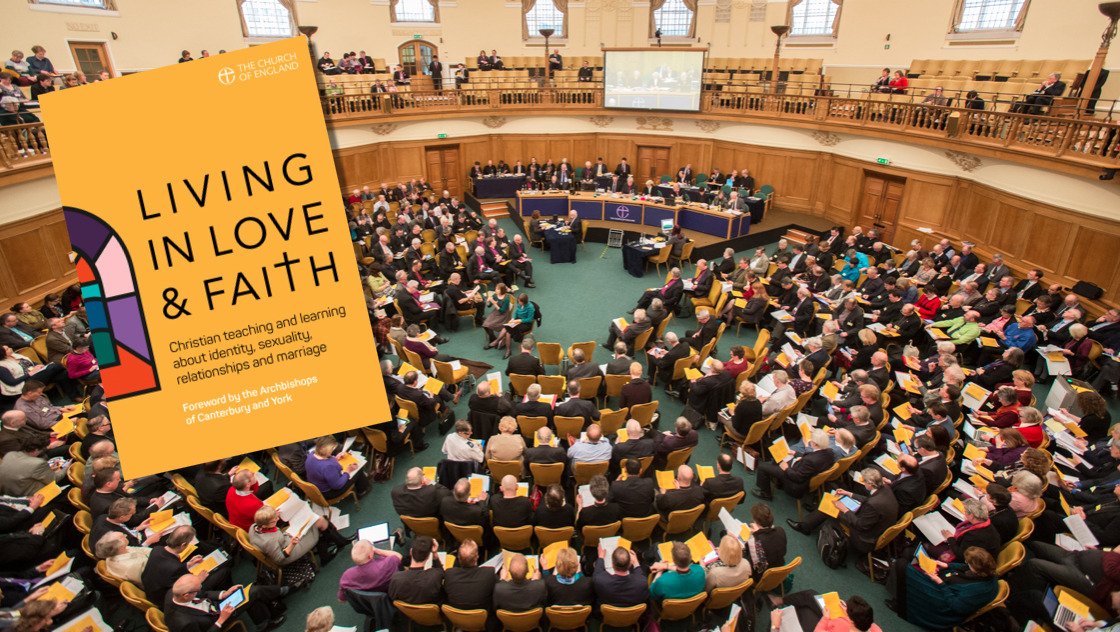
In reflecting about anything in the Church of England, and especially in relation to General Synod, it is worth bearing in mind this mantra from the Troubles in Northern Ireland:
If you are not confused, you don’t really know what is going on.
The newspapers seemed to be very clear what had happened:
The Church of England has approved blessings for gay couples for the first time. In a historic vote, the General Synod, the Church’s legislative body, voted to officially recognise same-sex couples on Thursday.
You can understand why they would understand the vote in that way—since the Archbishops of Canterbury and York have both used that language. Unfortunately, that is not what happened! The proposals that the bishops brought to Synod were that the doctrine of marriage, as a lifelong union between one man and one woman, would not change, but within the constraints of that they would propose some ‘Prayers of Love and Faith’ which might be used to bless those people in same-sex relationships of some forms or other (as yet unspecified), but not function as a proclamation of God’s blessing on the relationship itself. (Please refer to my opening mantra!). What Synod narrowly voted for, after about eight hours of debate on Wednesday afternoon and Thursday morning, was for the bishops to continue to work on this, with some serious qualifications. For ecclesiastical nerds, this is the wording of the final motion as amended:
That this Synod, recognising the commitment to learning and deep listening to God and to each other of the Living in Love and Faith process, and desiring with God’s help to journey together while acknowledging the different deeply held convictions within the Church:
(a) lament and repent of the failure of the Church to be welcoming to LGBTQI+ people and the harm that LGBTQI+ people have experienced and continue to experience in the life of the Church;
(b) recommit to our shared witness to God’s love for and acceptance of every person by continuing to embed the Pastoral Principles in our life together locally and nationally;
(c) commend the continued learning together enabled by the Living in Love and Faith process and resources in relation to identity, sexuality, relationships and marriage;
(d) welcome the decision of the House of Bishops to replace Issues in Human Sexuality with new pastoral guidance;
(e) welcome the response from the College of Bishops and look forward to the House of Bishops further refining, commending and issuing the Prayers of Love and Faith described in GS 2289 and its Annexes;
(f) invite the House of Bishops to monitor the Church’s use of and response to the Prayers of Love and Faith, once they have been commended and published, and to report back to Synod in five years’ time.
(g) endorse the decision of the College and House of Bishops not to propose any change to the doctrine of marriage, and their intention that the final version of the Prayers of Love and Faith should not be contrary to or indicative of a departure from the doctrine of the Church of England.
This amended motion was carried in each of the three ‘houses’ of Synod (laity, clergy, and bishops). Bishops voted for it by 36 to four, with two abstentions, while clergy voted for it by 111 to 85, with three abstentions. The house of laity approved it 103 to 92, with five abstentions.
As is characteristic of this whole debate, statement (a) is deeply ambiguous. Are we apologising for genuine failures of welcome, or are we apologising for the Church’s doctrine of marriage which is ‘according to our Lord’s teaching’? Jayne Ozanne put down an amendment to delete this because of the ambiguity, and I had some sympathy, but it was not carried.
Sam Margrave, who has been a vocal lay campaigner on this issue, had a number of detailed amendments, but most of those were not discussed since 25 members of the Synod did not stand to indicate their interest.
The first substantive amendment was presented by Busola Sodeinde, who is a Church Commissioner, asking for proper consultation with the Anglican Communion:
Before paragraph (d), insert
“( ) request the Secretary General of the Synod to consult personally the Primate of each Province of the Anglican Communion about the potential impact of the proposals in GS 2289 on its relationship to the Church of England, the life of the Province and the effectiveness of their mission, and report on the outcome of those consultations for consideration by this synod before the prayers are commended.”
This amendment was resisted by Sarah Mullally, the bishop of London, on something of a technicality—that the Secretary General (William Nye) was the wrong person to do this. (On this and other amendments, it would have been perfectly possible to edit the wording to avoid the technical problem—but Sarah did not initiate that conversation.) But as Busola pointed out, this decision will not just affect the Communion ‘over there’ (as it were) but the Communion ‘in here’, members of the Anglican Communion who are now part of C of E churches—including most strikingly in the HTB network:
There is an arrogance which I recognise, maybe unintended of, one time colonialism which insists that western culture is progressive while dissenting voices in Africa and everywhere else is silenced…I want to address the impending racial injustice, disunity and racial segregation in the church if we were to introduce same sex blessings without further consultation…I am worried that there may be an exodus of diverse communities from our parish churches and of having a profound impact on racial diversity which until now we have tried so hard to encourage.
It was in this context that Justin Welby gave his ‘tearful’ speech about violence faced by Christians around the world.
This isn’t just about listening to the rest of the world. It’s caring. Let’s just be clear on that. It’s about people who’ll die; women who’ll be raped; children who’ll be tortured. So, when we vote, we need to think of that…We must also do right here as part of the church Catholic.
So it seems that Justin thinks that appearing to bless gay marriages will harm Christians around the world—yet he rejected the amendment to fully consult, and supported the final motion at the end which was being interpreted to do just that. I confess, I struggled to make sense of that. Why would Justin vote for something that he himself says will harm Christians around the world?
In the chamber were two representatives of the Communion and the wider church. Samy Fawzy is Archbishop of the Episcopal/Anglican Province of Alexandria, and was invited to respond for the global Anglican communion:
We affirmed that resolution 1:10 of the 1998 Lambeth conference as the teaching on marriage and sexuality of the Anglican Communion. One of the clauses states, this conference cannot advise, legitimising or blessing of same sex unions, nor ordaining those involved in same gender unions… This is how we understand the scriptures tradition and reason of the Anglican Church… In our understanding of marriage and sexuality, there is a red line, we will never cross. Crossing this line of blessing same sex unions will alienate 75 per cent of the Anglican Communion and endanger the ecumenical and interfaith dialogue. This shift in practice will lead eventually to impaired and broken communion. We inherited the traditional Orthodox faith of the Church of England. So please, please do not surrender your unique position as the mother church of the Anglican Communion. It is your choice.
Archbishop Angaelos, of the Coptic Orthodox Church and co-chairman of the Anglican-Oriental Orthodox International Commission, told Synod:
Decisions here will impact the life of the Church outside this chamber; it will have implications. I am very aware of the difference between a blessing and Holy Matrimony—it is used here in the chamber and in the Church of England—but that distinction will not be readily understood by many around the world. The distinction will sound like a mere technicality.
So, with two important Communion and ecumenical voices pleading with Synod not to go forward, not only did Synod ignore them, but Justin Welby himself set their views aside. It is not very surprising that the Global South Fellowship of Anglicans, led by Justin Badi from South Sudan and claiming to represent 75% of the membership of the Anglican Communion, responded immediately:
The role of the Archbishop of Canterbury in leading the House of Bishops to make the recommendations that undergird the Motion, together with his statements, alongside the Archbishop of York, and the Bishop of London leading up to the General Synod, cause the GSFA to question his fitness to lead what is still a largely orthodox world-wide Communion.
In view of these developments, the GSFA will be taking decisive steps towards re-setting the Anglican Communion (as outlined in our ‘Communique’ following the 2022 Lambeth Conference). Orthodox Provinces in GSFA are not leaving the Anglican Communion, but with great sadness must recognise that the Church of England has now joined those Provinces with which communion is impaired. The historical Church which spawned the global Communion, and which for centuries was accorded ‘first among equals’ status, has now triggered a widespread loss of confidence in her leadership of the Communion.
A simple acceptance of Busola’s amendment might have avoided this rupture.
A number of further amendments aimed to qualify or clarify the motion, asking for confirmation of things that had been promised informally, including future consultation with Synod. Sarah Mullally resisted all but one of them (meaning that Synod would need to indicated it did indeed want discussion) even though she frequently said that she more or less agreed with the intent of the amendment. This did not endear her to Synod, and it felt as though someone had instructed her to follow this path.
The feeling of the chamber was expressed rather dramatically when Stephen Hofmeyr made a point of order: the fact that we were, on every amendment, taking a vote by houses meant that the bishops had, in effect, the right of veto on everything, and had used it on every vote so far. Was this really the way synod was supposed to work? If they were serious about listening to Synod, should they not abstain and allow the other two houses to decide? Stephen was only half way through his comment when the chamber burst into loud and prolonged applause, signalling widespread discontent with the way the bishops were behaving—and a number of bishops looked very disturbed by this.
Along the way, Andrew Selous, Conservative MP and Second Church Estates Commissioner, clarified the question of Parliament, the doctrine of marriage, and disestablishment. Despite the publicised meeting of 12 MPs who (it was claimed) were pressing for change, many others had been in touch with Andrew privately to state the opposite view—but were too fearful of media reaction to do so publicly.
It is not the job of parliament to decide what the doctrine of the CofE should be, but I am conscious that parliament’s patience may not be infinite and indeed there have already been cross party meetings of MPs to look at a private members’ bill to require the church to go further. Should synod decide to change marriage doctrine at a future point, a measure produced here going through parliament will provide the necessary legal opt-in. There is no need therefore for parliament to act independently to change the 2013 Marriage Act. Those here and in parliament who wish to force that or to remove the rights of conscience from equality law should be careful what they wish for. It would infringe on the settled principles of religious freedom, overturn a century of measured devolution from parliament to synod and be likely to call into question the rights and protections of conscience for other denominations and faiths as well as the Church of England. .. I was deeply moved by Archbishop Justin’s passionate plea for unity on Monday but I am struggling to see how we achieve that as the present position has managed to upset many on both sides of this debate and a small number of MPs tell me they believe churches will leave the Church of England over this issue.
Kate Wharton proposed an amendment, backed by a number of bishops, asking for further clarification before the prayers are brought back to synod, and I also table something very similar:
The Revd Dr Ian Paul (Southwell & Notts) to move: ‘Leave out paragraph (e) and insert:
“( ) Invite the College and House of Bishops to offer a full theological rationale for the proposed Prayers of Love and Faith, grounded in the Scriptures and the formularies of the Church, and which engages with the previous statements made by the House on the nature of marriage.”
Both of us presented our amendments as friendly, and both had written to Sarah inviting her support. Both were resisted. I spoke in support of mine thus:
To love someone is (according to Aquinas) to will the best for them. To do theology is to reflect carefully on the will of God for our lives—to reflect on what the divine best is for ourselves and for each other. If we do not do that, we are not truly showing ‘love’. Too often in this debate have we introduced a false dichotomy between pastoral care and theological thinking. That which God has joined let us not put asunder.
In Jesus’ prayer in John 17 he did not say ‘That they may be one’. Rather, he offered a threefold movement. First, he asked that God would ‘sanctify them in the truth; your word is truth’. And then he prays that ‘they might be one’, with the result that the ‘world might know’ the Father. In other words, this whole desire is rooted in theology (sanctification through the word of God) and directed towards missional fruitfulness. There is no institutional unity apart from theological coherence, and it is only this kind of unity, rooted in truth, which will be missionally effective.
We are deeply divided on this and I think in many parts of the church, trust and confidence in episcopal leadership is at a catastrophic low. We long to trust you, we long to follow your leadership, we long to be guided by you as our shepherds. But we cannot do that if you will not show us the theological working, how you are building on all the good work that’s been done in the past. If you do not do this I think we will find, now and in July, we are more divided than ever.
In resisting my amendment, Sarah Mullally claimed that the resources were in the LLF book, and that the work had been done. But neither of these things are true! The LLF material was never intended to provide the theological answers, and the answers to LLF Questions earlier in the Synod made it abundantly clear that none of the key thinking has even been begun! There is no clarity about the application of current doctrine; there is an unfounded claim of a difference between (civil) marriage and ‘Holy Matrimony’; there has been no explicit engagement with previous statements; there has been no discussion about the impact on the Communion; there has been no engagement with statement from other churches; there has been no reflection of the impact of these proposals on issues around church growth, clergy deployment, clergy well-being, or on evangelism amongst young people. It is difficult to see how anything can be brought to July Synod without all these things being addressed—but where will they find the time and resources to do this?
The one amendment that was accepted by Sarah, and then voted through, was from Andrew Cornes, and it became item (g) in the amended motion above. Yet again, all it was asking for was something that had already been promised informally—but it makes all the difference that it is now in writing, and agreed. Andrew presented it with this speech, which was one of the best of the debate:
In my ministry, I have walked and wept with many gay men. And I know this amendment will be painful for some to hear. I have no desire to hurt anybody. Please forgive me if I do.
One question has been persistently asked: Is the Church of England changing its teaching about sex? It’s a question every couple asking for the church’s blessing need to be clear about. It’s a question the congregation at any public service needs to be clear about. This amendment simply says: the Church is not changing its teaching.
Christ is the Lord of the Church. So the key issue is: What did Jesus teach? Jesus taught a lot about marriage and sex. He often met those who didn’t follow sexual norms. And he reveals himself as radically inclusive and radically conservative. When what Luke calls ‘a woman of the city’ kissed and anointed his feet, Jesus’ host thought ‘He should know she’s a sinner and spurn her’. He knew exactly who she was, and said she had poured her love on him. When he met a woman married 5 times and now cohabiting, she was astonished that he talked to her. But he did, and transformed her life.
So he was radically inclusive. He was also radically conservative. He confirmed Jewish teaching on sex and marriage, and made it more demanding. His teaching on remarriage surprised his disciples by its difficult demands. He called lustful thoughts sinful, and urged action to avoid sexual sin.
Inclusive and conservative: both are seen when they brought a woman committing adultery. He refused to humiliate or condemn her. And then he said: ‘Go and leave your life of sin’. It was sin, he said, and she must leave that sin now.
The Jews knew they were different in two ways: They didn’t worship idols, and sex was reserved for marriage. There was a general word for sex outside marriage—in Greek πορνεια—which Jesus said wells up from the human heart. For 7 years I have been researching for a book on Greek and Roman homosexualities, including many loving, committed, generous homosexual relationships. I have studied every extant Jewish writing on the subject between 200 BC and 200 AD. They are absolutely univocal. They say that any homosexual sex is sin. So when Jesus used the word translated πορνεια, all Jesus’ hearers will have assumed he included homosexual sex. If he did not regard that as sinful, he grossly misled his listeners.
So, as followers of Jesus the Church’s Lord, we must lovingly welcome all who enter our doors. We can joyfully offer Prayers to those who want to live sexually celibate lives. But surely—painful as this will be to some of us—we cannot bless a relationship which, in its sexual aspect, Jesus calls sinful. That has always been the Church of England’s teaching. And we owe it to all, and above all to Christ, to say that this teaching has not changed.
Acceptance of this amendment has made formal and explicit that the doctrine of the Church not only does not change, but cannot be seen to have change—the prayers ‘cannot be indicative of a departure from the doctrine of the Church.’ This constrains not only the content of the prayers themselves, but the context in which they are used and the way they are deployed.
For me, and many other ‘orthodox’ Anglicans in the chamber, one of the most heartening things about the debate was the quality of the contributions from those upholding the current doctrine. I append two at the end of this article. I do think there was a significant contrast with the speeches in support of the motion and rejecting the amendments. A large number of them focussed on the feelings of those affected, especially gay clergy who cannot express their emotional and sexual love as they would wish according to current doctrine. There is no doubt that these feelings need to be attended to—but the question is whether this forms the basis for the Church to determine its understanding of the teaching of Jesus. Other speeches lifted proof texts from Scripture in some bizarre ways—claiming that Jesus’ offer of ‘fulness of life’ must mean that no-one should be denied a sexual relationship, or that Paul’s acceptance of diverse approaches to food meant we could have the same approach to sex and marriage, even though Paul himself did not—or that Gal 3.28 implies that sex differences no longer exist. It is hard to see how any of these arguments could form a part of the bishops’ theological rationale for the Prayers.
One theme mentioned several times was the idea that not being able to marry would consign a person to a lifetime of loneliness. It was rather odd hearing those who reject the doctrine of the Church elevating marriage to such a pinnacle, as if it was the solution to all our problems—and very good to hear several single people saying that this was not true.
Where does this all leave the process and what lies ahead for the House of Bishops? It seems to me that there is more work to do than ever before—and both Synod Questions and the debate has exposed this more starkly than ever. The challenges include:
- How has the relation of sex and marriage been understood in previous statements?
- On what grounds could these consistent statements be changed or rejected?
- How does the Church of England engage with ecumenical statements, especially from the Roman Catholic Church?
- What are the implications for the Communion?
- What impact will the perception of what is being proposed have on the Church itself—on mission, church planting, plans for growth, clergy deployment and morale, and our work with young people?
- If these prayers are commended for use in a church service, in what sense is that not liturgical provision? So how can we avoid needing a two-thirds majority in Synod for their approval?
- Where did the claimed distinction between marriage and Holy Matrimony come from? How can that be sustained in the light of contrary evidence from all previous statements?
- Why were the proposals brought under Canon B5 (local use and decision) rather than Canon B2 (national approval), against the obvious legal conclusion, when these are being offered national and commended by the House of Bishops?
- How could the Pastoral Guidelines allow clergy to enter same-sex marriages, if the doctrine of the Church remains unchanged and ordination vows commit clergy to belief, uphold, teach, and pattern this doctrine in their own lives? How can there be any room for manoeuvre here?
- In addition, what comments and feedback were given by members of Synod in their reflections, and what difference will that make?
- In what context will the prayers be offered, with what rubric and introduction?
- How can all this be squared with the consistent teaching of Scripture? This cannot be lightly set aside, since Canon A5 delineates our doctrine as being ‘rooted in the Scriptures’, and Article XX of the XXXIX Articles states that ‘it is not lawful for the Church to ordain any thing that is contrary to God’s Word written.’
If this is any kind of ‘victory’ for those who wanted to moved forward, it looks very much like a Pyrrhic victory. ‘If we are victorious in one more battle with the Romans, we shall be utterly ruined’ (Plutarch’s account of Pyrrhus of Epirus).
The motion was passed, with a significant addition which explicitly limits the scope for manoeuvre, so the work will continue. But I think the cost has been immense damage to the reputation and standing of Justin Welby, the final nail in the coffin of the Anglican Communion, damage to ecumenical relations, a further loss of confidence in the leadership of bishops within the Church, and the first signs of fracture at local and diocesans levels. And for what gain? On the (liberal) site, Thinking Anglicans, one proponent for change comments:
The core thing that remains is that there has been no movement in the C of Es understanding of marriage, nor sexual relationships. It is exactly the same as it was. These prayers do not bless in the same way the prayers in the wedding liturgy bless couples. That is all explicit in the legal advise.
If anything this legislation has really enshrined in a much clearer fashion a conservative view of marriage and sexual relationships.
I really do not understand how anyone thinks there has been any actual progress.
So the bishops appear to have upset everyone, and pleased no-one; the Anglican fudge has got thicker and nuttier. And the next few months will involve further conflict and difficulty, and Synod in July will likely see a repeat of all these debates. This could all have been avoided if the bishops had done what everyone, on every side of the debate had asked for: clarity. A clear position, with a clear rationale, and a proposal of practice which was consistent with doctrine. Instead, everyone is now left confused.
There were many excellent speeches in the debate, but these were two that stood out for me.
Paul Chamberlain: Synod colleagues, I am a gay man who holds to the historic teaching of the church on marriage and sex. Despite my desires for sexual intimacy with other men, I have sought to fashion my life, and forge my relationships according to that teaching. This has not been easy. In my 20s, I met a guy. I really wanted a relationship with him. But I believed, and believe, that the teaching of scripture is clear. Not once have I regretted the decision not to pursue that relationship.
And until now, the teaching of the Church of England has been clear. As the House of Bishops said in 2005: ‘Sexual relationships outside marriage, whether heterosexual or between people of the same sex, are regarded as falling short of God’s purposes for human beings.’ If that is the case, why now are we proposing to recognise in a service, relationships that are “falling short”? I don’t know the answer to this question, because GS2289 gives us no theology, no reflection on the church’s historic teaching, and no critique of the sexual ethics of contemporary culture. All we are given is the vague statement that “we value and want to celebrate faithfulness in relationships”.
I thank God for the grace found in lives every day – love, joy, happiness, peace, commitment – these are good things given to humanity by God who “makes his sun rise on the evil and on the good, and sends rain on the righteous and on the unrighteous.” But when it comes to relationships and sex, what we have been given is marriage.
I trained at Cuddesdon. If I had written GS2289 as an essay during my ordination training, it would have received a very low mark. As Ian Paul just said “Show your working”, this would have been written in large letters at the bottom. Until the bishops tell us why, theologically and pastorally, they are making these recommendations, we should not change the historic teaching and practice of the church. As a gay man, I am for marriage as the church has understood it. And I am for the bishops giving us deep and rich theology to explain their proposals.
Right now we do not have this—but we desperately need it. I therefore urge you therefore to vote for this amendment.
Anna De Castro: I am thrilled to see that the House of Bishop’s have declared their desire for the discernment process to be guided by Scripture, tradition, reason, and theology as we have received it, and for the sake of human flourishing in the context of today. I want this too….obviously!
This is profoundly NOT what I see in this motion as a whole though. I welcome the endorsement of the historical biblical doctrine of marriage – and yet, there is a deafening silence around the place of sex and sexual intimacy. We have been told that we will receive this information in the Pastoral Guidance which is yet to be drafted, but how can we vote in favour of a motion when we don’t have clarity on these issues in the Pastoral Guidance, nor do we have any assurance around the responsibility of our ministers to shape their lives around the church of England’s professed and preached doctrines. I am a minister to children and young people, they should expect me to live my life in accordance with the doctrine I preach and profess. This amendment provides the motion as a whole with more integrity.
My particular concern is with how this motion affects the church’s mission to grow younger. I want to speak against the idea that a motion like this will somehow entice young people into our churches—this is simply not true. Across the board, there is an enormous amount that needs to be invested into reaching young people, but the vast majority of our young people are worshipping in churches who are not seeking to revise the church’s doctrine of marriage—the data is there for you to see. It is a myth that these churches are not teaching about God’s design for sex and marriage and that somehow these young people don’t know or don’t agree with what they are part of—I can personally testify that we are and they do!
The ambitious mission for the church to double the number of young people worshipping in the Church of England by 2030 is totally wonderful – yes please! I’m in! Sign me up! BUT, this motion is detrimental to this goal without amendments like the one Ms. Buggs has provided us with. Children and young people prize and value authenticity and integrity and they need to be inspired by leaders who they can trust, not least in issues of sexual ethics. They don’t need a church who is willing to be swayed by the world’s constantly shifting and changing voice on these issues.
Children and young people are on the front line of mission and evangelism, and are regularly receiving pressure from outside the church for that, counting the cost for following Christ—they don’t now need to receive pressure from within the Church too! They need to feel inspired and supported by the most senior leaders of our church, watching them display integrity when it comes to living out the church’s doctrine on sex and marriage, rather than undermining it with the Prayers of Love and Faith. This amendment helps to give young people assurance that their leaders are practising what they preach. Please vote in favour for this amendment.
Please vote in favour of this amendment.
See also here the legal advice from a group of lawyers, mostly members of Synod, challenging the legal note that Synod was given.
 Buy me a Coffee









74% of 18 to 24s in England support homosexual marriage as do 64% of 18 to 24 year old Anglicans in England. Clear majorities of both the population overall and Anglicans in England back it too.
Rejecting homosexual blessings, despite the compromise to retain heterosexual lifelong marriage only as holy matrimony, would have turned most young people off even further from the Church of England
https://yougov.co.uk/topics/politics/trackers/support-for-marriage-of-same-sex-couple?crossBreak=1824
https://www.thetimes.co.uk/article/majority-of-church-of-england-worshippers-back-gay-marriage-896937b3n
Sorry—that YouGov survey is propaganda, not information—as are all surveys that fail to ask a question about actual attendance.
That may be so for anglicans; but your remark doesn’t apply to 18-24 english people (anglican or otherwise).
So what? The church has often been out of step with culture. 75% of Christians in churches on a Sunday go to other churches than the C of E, most of which are not changing their teaching.
The conservative evangelical fringe (not the whole of the evangelical wing of the Church of England mind, just the non-affirming bit of the C of E evangelical movement) has capitulated to culture. It’s just it has capitulated to the homophobic culture of the 1950s. And now it’s failure is coming home to roost.
‘Just the non-affirming bit’. What a bizarre construal!
There is no watertight wall isolating Church from society. As in society at large, generational replacement will settle things down (not the way you like).
Think at the state of affairs in Church 30 years ago – and compare with today…
30 years ago Christians were asking newsagents not to have ‘top shelf’ magazines on display, especially where children could see them. 30 years on, the culture has moved on to align with this view. Sometimes when the church speaks prophetically it does eventually listen. The same will prove true in this case, in time.
You think we won that one?
You think we won that one?
One more victory like this and we are lost!
I don’t disagree with it being propaganda, but there can be no clear message from these types of survey because attendance and identification are directly related to the question being asked. If you agree with the CofE then you are more likely to identify and attend CofE churches than if you don’t. The majority don’t.
Not to mention, even those questionable percentages have been shaped by several decades of propaganda from society and government itself.
T1, any opinion poll that isn’t about voting intention is a campaigning tool which will reflect the intended view of the organisation who paid for it. It’s very easy to make a poll say what you want it to say. Google Yes Minister and opinion polls for a funny demonstration of just one way this can be done.
Furthermore, a study of self-identifying Anglicans in just such a survey in 2014 showed that around half of them were atheist/agnostic, and only 15% went to church at all! Nonetheless, the results were paraded as ‘Anglicans think X’, when in fact the results showed that instead of around 50% support for SSM, of the 15% who attended church, support for SSM was only 25%.
So a headline of 75% of Anglican churchgoers oppose same sex marriage would have been just as accurate as the one given.
ttps://www.churchtimes.co.uk/articles/2022/4-march/news/uk/yougov-poll-more-than-half-of-anglicans-believe-same-sex-marriage-to-be-right
Peter Ould unpacks these issues more here https://www.premierchristianity.com/opinion/a-new-survey-claims-most-anglicans-back-gay-marriage-but-the-truth-is-very-different/6183.article
In short, let Christians decide Christian doctrine and expect it to clash with the world’s view, it’s meant to.
I actually doubt this to be the case and I think it is a major hermeneutical mistake from liberals. Can I suggest that the majority of young people are put off Christianity per se not because of any moral standards it puts forward but because it makes no demands on them. Progressive Christianity asks nothing. The overall message is that Jesus is not really a saviour as you have nothing to be saved from. It is consumer Christianity. The Scottish episcopal church has had no revival and the American episcopal church is in free fall, yet both have everything on the menu.
Absolutely.
Ian
On these posts you often comment on how churches with more conservative theological views are growing more than liberal ones. This does seem to be the case.
However it is not so straightforward to extrapolate that all adherents of those churches have a unified attitude to LGBQTI+ issues.
People’s reasons for belonging to a church are many and various, and it would be reasonable to assume that many may be conflicted by leadership attitudes to this issue
However it is not so straightforward to extrapolate that all adherents of those churches have a unified attitude to LGBQTI+ issues.
Indeed. My own suspicion is that the reason for the correlation is that there is a third variable at play, which is the seriousness with which the church in question treats Christianity as a matter of truth-claims rather than a lifestyle choice.
Those churches which treat Christianity as a matter of truth-claims are more likely to have a ‘high’ (for want of a better term) view of Biblical authority, because the Bible is where the evidence for many of those truth-claims comes. They are less likely to think that the Bible is ‘a mixture of mud and precious gems’. This in turn makes them more likely to hold the more conservative position on sexuality.
They are also, for the same reason, less likely to be universalist.
Similarly, those churches which treat Christianity as a matter of truth-claims are more likely to attract committed adherents, who stick around, becsuse if Christianity is seen as not something which is true, and which therefore matters, but simply something aesthetic or which makes you feel good or gives you comfort in hard times, then people will only do it so long as they feel they are getting something from it that outweighs the effort they are putting in. Whereas if someone thinks that it is simply true that they have only been saved from damnation by Jesus’ sacrifice then they will rearrange their life so they can come to church, rather than only coming to church if it fits into their life.
That’s also where the rejection of universalism comes in; if your church teaches that God loves you and has saved you whatever you do, and God also loves all those people who don’t come to church and has saved them just the same, then why go to church?
So no, it’s not that people are flocking to conservative churches because of their view on sexual matters; but that the same thing which leads them to their view on sexual matters is also what makes them grow.
Which is why you couldn’t just come up with the magic ‘balanced ticket’ of a conservative church with liberal views on sexuality. It wouldn’t work because the same basic fundamental principles are at the root of both.
People’s reasons for belonging to a church are many and various, and it would be reasonable to assume that many may be conflicted by leadership attitudes to this issue
Oh no doubt they are. But that’s nothing new. Christians have been conflicted about Christian teaching for centuries.
What’s new is the idea that if you are conflicted about teaching, the teaching should change, and that’s indicative of an attitude that the teaching isn’t ‘real’, that it’s not based on actual truth and fact. Because if you think the teaching is about something real, then the fact that it isn’t what you wish it was is just something you have to accept, even if you hate it. You can’t argue with reality.
Whereas to say that if you don’t like the teaching then the teaching has to change is to take a step back from saying the teaching is based on reality, and you’re back to the division I point out above between churches that really that Christianity as something real and true, and ones that treat it as an aesthetic or a lifestyle choice.
So in fact I think that being conflicted about their church’s teaching might actually be something that — you might think paradoxically — attracts them to that church. Because if you don’t like something, but you accept it because you think it’s true, then you know that you’re really trying to find the truth. But if what you think is true always happens to match what you would like to be true, then there’s always the sneaking suspicion that it’s not, in fact, real, and that you are making God in the image of what you would like God to be.
See also: ‘I wouldn’t worship a God who…’. Well, okay. But the fact you wouldn’t worship God if God was like that doesn’t make any difference to whether God actually is like that. Your conditional worship does not define reality. And if you say, ‘I wouldn’t worship a God who was like that, so I refuse to believe God is like that’ then you are explicitly admitting that you are basing your beliefs not on what you think is true, but what you want to be true. And that puts you firming on the ‘lifestyle choice’ side of the divide I mention above.
But if you say, ‘I hate that God is like this, but I am convinced, by logic and evidence, that He is, and I’m going to worship Him anyway’ then you know that while you might have got it wrong, at least you haven’t got it wrong because of wishful thinking.
I have been looking for, but cannot find (perhaps someone else might have better luck?) a C.S. Lewis passage where Jack says that Christians should be more open about doctrines they find difficult or wish were not true, because that would make it harder for their opponents to argue that they only believe in Christianity because they think it good, or helpful, or comforting, or useful. It would show that a Christian is no more free to just come up with a theology that they like than a scientist is to come up with a theory they like and ignore the results of their experiments. Christians, like scientists, are constrained in their beliefs by the data.
It seems to me that attenders of conservative churches who are conflicted over those churches’ positions on sexual ethics embody exactly this, and we need more of them to be more open about it, for exactly the reason Lewis states: if their commitment to seeking the truth leads them to Christianity and to doctrines that they wish were not true, then it proves that believing in Christianity is not simply a matter of believing comforting fairy-stories out of wish-fulfilment, but a real grappling with the facts to try to find the truth, however much not to our liking that truth might be.
Hitler was supported by majority of Germans, does that mean that Nazism was right and he was right just because majority of germans thought it was OK? First I think the view that marriage is about “love” reduces it to banal eroticism. Love I believe is not about sex just as marriage is not about love. Now western minds have been culturated into this thing called “marrying for love” yet God obviously did not think Adam had to have loved eve to marry her, nor appreciate her. He didn’t know her yet he proclaimed her as a part of Himself. God commands to love our neighbours, yet we don’t marry them or have sex with them, we love our parents and our children yet we don’t have sex with them or marry them. Marriage is a divine union where man and woman become one to perpetuate humanity. It is not RECREATIONAL. Humans throughout history have sought to sanitise and legitimise that which is evil, if this flies what wont, soon the church will be called upon to bless incestious union and who will have the spine to say no?
“ A YouGov survey last week asked 5,120 people, including 1,165 people who identified as Anglican…” – so now >1/4 of all English are faithful regular church-going Anglicans, right? That would mean 15 million+ in CofE churches alone every Sunday… (the real figure is c.800,000). Clearly self-identifying as an Anglican does not equate to being a faithful church member. So it is simply not true to say, on the basis of this survey, that 46% of faithful CofE members (ie Anglicans who believe the creeds and regularly take communion) support gay marriage. Please stop quoting this meaningless ‘survey’.
For the record, and because some rather quick counterfactual accounts are being thrown at bishops already after yesterday’s votes, it was not the case that the bishops blocked all the amendments in an brutal exercise of episcopal power. The House of Clergy voted exactly the same way as the House of Bishops on every amendment that was tabled. It was only in the House of Laity that there were ever enough votes to get any amendment passed, and not many of those either.
I realise that there was a well-received intervention during the debate making this claim, but the reality is the opposite to what was claimed, and the speaker in that intervention had fully participated throughout the debate in attempts to use procedure to get his way.
We need to be grown up about our disappointments and – I keep suprising myself in saying this – not blame the bishops for the outcomes. We own the decisions together whether we like them or not.
I’m delighted with the outcome yesterday. The tone has changed and the burden of our disunity has shifted to the whole church and not just falling on the shoulders of LGBT+ people. The prayers will be authorised – and the pastoral guidance will remove all the discipline that has been imposed. We avoided all the attempts to reimpose prurient and intrusive questioning on sex into our pastoral ministry and clergy can get on with ministering and celebrating committed and sexual relationships between same sex couples.
Pyrrhic victory? Nonsense. Time for us to stop trying to solve this on a win/lose basis which this sort of warfare language implies . Time to work on how to maximise unity in generous dialogue (hopefully on the basis of the relationships already built in the St Hugh’s Conversations).
A wonderful contribution, Simon! As I wrote, this is no insignificant step for many of us.
If -as Ian Paul says-all the bishops are allowing is a blessing of the individuals and “not a commendation” of the relationship then it honestly seems a disingenuous exercise in sophistry.
Clergy were always allowed to bless individuals whether partnered or single…if they want lgbt people to feel accepted, it’s the partnerships or marriages that need blessing or commending.
Exactly so. It will satisfy nobody.
So the question begs to ask” are we in adherence to the authority of scripture?”or is the answer,’ no chaplain Ron on some roles, we’re letting the culture do the church’s thinking for us.” Chaplain, very seldom do we think of scripture as our authority for faith and practice” I was told
Ron
I doubt secular culture would have come up with blessings for individuals in SSRs that the press office can sell as same sex marriage. Modern culture is intrusive and often outage driven, it’s not seeking platitudes or pretense
Why would I want unity before the command of Paul to separate from sexual sinners? I don’t know any conservative clergy on the ground who value unity for its own sake at all.
I am taking measures to separate myself from those who are pursuing this to the highest degree possible.
Thomas… if on judgement day God tells me I was on the wrong side of the fence on this or any other peripheral issue that Christians disagree on in good conscience, I will ask His forgiveness and thank Him again for Jesus. Do you not think for now, that disagreeing with each other kindly is a better option? Martin
Except that Scripture never sees this as ‘peripheral.’ Jesus says these desires, in unchecked, ‘defile’ us; Paul says those who continue in these things ‘will not inherit the kingdom.’
And Jesus warns us of leading ‘little ones’ astray. The language he uses here exactly matches Paul’s language about going astray in 1 Cor 6.9.
They are neither trivial or peripheral.
Thanks for interacting with me Ian. I think so many issues that cause brothers and sisters to disagree are peripheral TO THE GOSPEL, which is of course about grace. I don’t think selecting a few scriptures and asserting that they settle the matter will help us to disagree agreeably.
I am not ‘selecting a few scriptures’. I am noting something that Jesus and others in the NT clearly thought was important.
The gospel isn’t merely about grace, as if it were cheap. It is about the costly price God paid to deal with our sin and offer us forgiveness, and the invitation for us to turn, leave our former life, and receive this costly gift.
Interesting. But gnomic. Who you are. Whether you hold a position in the C of E, and what you are intending to do. And are others involved would put your post in a more understandable context.
This was in answer to Thomas’s post above. Not sure why it appeared here
It is appearing in line under Thomas’ comment in answer to him, below other answers to him.
Thanks again for interacting with me Ian… I’m learning stuff. I suppose I would reflect that we could focus on or “select” other scriptures to amplify my point about grace. Eg Romans 3 v 23&24 to balance your focus on 1 Corinthians 6v9. Both scriptures are relevant to our topic but bring different emphases. You and I are disagreeing, kindly I hope, on the correct emphasis.
Hi Martin
I don’t ‘have a focus on’ 1 Cor 6.9. Because people claim it means something that it doesn’t, I offer a response to their arguments.
But I agree with you: Rom 3.23 and ff are crucial. This is the hinge point of Paul’s argument.
Because *all* have sinned—both gentile and Jew—and fallen short of the glory of God, all need the grace and forgiveness that is offered to everyone who repents and believes.
In Rom 1, Paul replays classic Jewish critiques of pagan culture to show gentiles have sinned, which includes same-sex sex but then includes the whole gamut listed in Rom 1.29f. And in Rom 2 Paul draws on Scripture to show that Jews have sinned as well.
Hi Simon, I am not aware of any ‘counterfactuals’ in this article (though I think you are using the wrong term here… )
The laity voted for five amendments, and if the bishops were truly in ‘listening’ mode, then, once the call for a vote by Houses was made, they could easily have abstained. I haven’t anywhere claimed the outcome would have changed; what I have noted is the impact that this made on Synod.
You were sitting in the chamber when the very loud and long applause rang out at Stephen Hofmeyr’s observation; I don’t know what alternative interpretation you could put on it other than that many people were very unhappy with the House of Bishops. (Justin was shocked by the response.)
And I am glad to hear that you were pleased with the outcome. If we can all agree to ‘endorse the decision of the College and House of Bishops not to propose any change to the doctrine of marriage, and their intention that the final version of the Prayers of Love and Faith should not be contrary to or indicative of a departure from the doctrine of the Church of England’ for the foreseeable then perhaps we can agree to focus our energies on others things.
The ‘endorse’ amendment is only an endorsement of the decision the bishops made at the time of their response. They say that it’s not possible to move towards equal marriage at this time. So be under no illusion that this is the beginning of a journey coming towards equal marriage and that, along with Ed Shaw, Vaughan Roberts, Steven Croft and others, my focus will be on securing a settlement which brings an end to our long standing division.
I think you’re rather naive in imagining that anyone on either side – apart from a few – will be content to leave things where they have got to. That’s what yesterdays vote achieved and so we move on in the search for a godly and amicable settlement.
It’s been great to work with and get to know conservative colleagues in our discussions on differentiation and I’ll hopefully be continuing to encourage the highly relational approach that has begun and which sustained much of the gracious discussion around the debate yesterday
‘So be under no illusion that this is the beginning of a journey coming towards equal marriage’.
What is your evidence for that? Given the catastrophic damage this decision has already caused, there is not much evidence for it.
What catastrophic damage? Conservative provinces are semi-detached anyway. Uganda and. Nigeria boycotted Lambeth. LGBT+ people live in fear in those and other global south countries – fear of their lives, because in part of a rhetoric of hate pushed by Christian leaders. They falsely conflate homosexuality with paedophilia, the way people used to here. That’s where the real damage is, catastrophic damage. But you are either ignorant of it or don’t care. The refugees from this hateful religious homophobia sometimes end up here when they flee their homelands. They are in Nottingham, too.
Praising and supporting these “orthodox” leaders makes you and those like-minded accessories to a deadly campaign. When I hear some active work from CEEC to call this out and defend the defenceless then we can tithe some mint and dill together. Until then, think about the real victims, the ones whose lives are catastrophically damaged by your conservative pals.
Jeremy, you might like to sign my petition.
https://www.psephizo.com/sexuality-2/statement-on-the-criminalisation-of-lgbtqi-people/
Simon, could I also ask you two other questions.
First, which of the arguments in the speeches for change did you find most persuasive? Which do you think are the strongest?
Secondly, does it bother you that this decision has destroyed the Communion and undermined ecumenical relations? Do you just think that is a price that is worth paying?
Ian
Could you explain what you think the decision is (I thought it was merely to allow gay individuals to be blessed, which was allowed at least a decade ago) and why you think it has split the communion (GAFCON are also in disagreement over other issues and have been rivals of the CofE for some time, several members of the communion seem never to have seriously agreed to Lambeth 1.10 and that was 25 years ago)?
Could you explain what you think the decision is
Can anyone? The decision seems to include multiple self-contradictions, which would make it impossible to explain as it simply cannot mean anything coherent.
Ian Paul does not “think” the Anglican Communion has been spilt. He has just taken the time to read the statements made by its leaders. They are publically available.
Can we please not gaslight people. The Communion is split. It’s not an opinion. It’s a fact
Peter
My question was genuine.
I agree the communion is split, but arguably it has been split since at least the 90s and certainly for the last decade.
Some “Anglican communion leaders” have returned in order to get a second or third go at leaving in protest
The statement of the GSFA is available for all to see. It represents 40 provinces and 75% of all of the Anglican Communion.
Dr Paul has cited a section of it in this article. ++Alexandria (part of GSFA) has also spoken in response at GS.
“I thought it was merely to allow gay individuals to be blessed” – that’s what it looks like on paper, but in practice these Prayers of L&F are a de facto liturgy – indeed the ABY called them ‘services’ – and when a gay couple hold hands throughout the prayers, exchange rings and kiss the nicety that “any blessing prayers being strictly for the individuals concerned and not their relationship itself” will be lost on all but the most literal-minded. Can’t we just be honest and say, henceforth we’re happy to bless SS couples (including their relationship)”. This departs from Anglican doctrine so will need a new canon and new differentiation for those clergy & others who want to keep to the canons as set out when they were ordained. In short, a new Diocese and/or province, either for the heterodox or the orthodox, depending on what GS votes for. Or perhaps the Church in Wales could rename itself ‘The Anglian church’ (The Anglican Church in England and Wales) & plant an English province for CofE revisionists to join?
I have learned brother never to accept the premise of such loaded questions!
No premise. I am just curious. I could not hear any decent theology in those speeches. Could you? I’d be genuinely interested to know where.
And it is curious that neither you nor Jeremy comment on those other issues about ecumenism and the Communion. So what do you think of them? Do you think they matter or not?
The very best theology was from Miranda Threlfall Holmes.
We need much more of that.
See my comment above
See my reply.
Although it was moving to listen to the two Primates who spoke and to sense their challenges. In the end I judged it worth following the lead of the head of the Anglican Communion, who I supported in the communion facing amendment
So you do think it worth ending the Communion for the sake of getting this through? Thanks. That is clear.
Whilst as an evangelical I’m disappointed by yesterday’s vote, I don’t recognise the version of events you describe re what has been agreed. We haven’t had the new liturgy yet, and whilst I’m sure some priests will be given an inch and take a mile, spin doesn’t change reality.
If amendment 67 makes a difference then how could any new liturgy possibly bless same sex marriages etc? There was clearly not even a simple majority for same sex marriage, let alone 2/3rds in any house, as some had suggested. Any hope of movement to SSM will rely on wholly different synod election results in a few years time, and there’s no evidence that swing is happening.
So I would say that whilst the changes are saddening, and yes they do go in the direction you suggest, we’re not sure yet how far they’ll actually go, and I can see why both sides feel deep disappointment. Plus they’re a incoherent muddle which makes no sense! Now it seems some don’t mind that, but we should, we all should.
Ian,
The questions you rightly raise will never be answered, as I am certain you know.
Vaughan Roberts called for a mediated settlement. So did the Bishop of Guildford. The Archbishop of York called for a settlement.
Is it not time for this to be the agenda ?
Peter
The problem is, the bishops are required to answer these questions.
A settlement is one thing. A separation is quite another. There is simply no appetite for that. It is the route with the most questions. It will not happen, and the main reason is that neither party will be prepared to give up being part of the Anglican Communion. Conservatives recognise that ACNA is not actually Anglican, even if they don’t say it very loudly. Liberals recognise that there is no will to have homophobia enshrined in the Anglican Communion by the adoption of the discredited Covenant.
There are loud voices calling for separation, but there are not anywhere near enough of them in the structures that would set the agenda.
It will not happen, and the main reason is that neither party will be prepared to give up being part of the Anglican Communion.
But if the Anglican Communion itself fractures, surely that becomes irrelevant? I can’t see conservatives fighting to stay part of an Anglican Communion that only includes the American, Canadian and New Zealand churches, the rest having formally left.
I tend to agree that the real question is what happens to the rump communion provinces (TEC, Wales, SEC) after GSFA reconfigures their association to Cantab, and that measured against a Cantab who appears not to want to lose his role vis-a-vis the latter.
GFSA doesn’t include Provinces like South Africa, Central Africa, Korea, Japan, Philippines, Melaneasia, Sri Lanka, Australia ( apart from the Sydney empire, the United Churches of N and S India , Pakistan, Burma, and I suspect some Provinces might split if it came to formally forsaking Canterbury ( West Africa perhaps)
Andrew, people in local congregations need the war to end. It has to end.
I want Simon Butler, Vaughan, Ed and Stephen Croft and others to deliver us all from this cauldron.
I am a conservative. We have to walk apart. There has to be a way
Peter see Simon Butler’s note above about what settlement means. It’s spot on. Walk apart if you have to. But that plan is not on the agenda.
Read the posts in this thread Andrew. There is a state of total confusion as to what has been agreed, what it actually means, what happens next.
Read the statement by CEEC. Read the statements from the AC leaders.
It’s all very well making breezy assertions about what is or is not on the agenda. There is going to be chaos. Nobody can predict what is on the agenda
“Nobody can predict what is on the agenda”
In that case please stop predicting that this is now going to be all about a separation?
I have read the statements from CEEC and GSFA etc. They are all sadly predictable. Pretty much the same stuff as was written after the appointment of Jeffrey John. The Global South will no doubt invent the ‘Real’ Anglican Communion and repeat the same old stuff about torn fabric. If they really have to depart then we wish them God’s blessing.
The CEEC have other structures they can look to. James reminded us here yesterday of AMiE. What is the problem with them joining that body if they (and you) need to depart? Why invent yet another split when there are already structures in place?
AG writes: “The Global South will no doubt invent the ‘Real’ Anglican Communion and repeat the same old stuff about torn fabric. If they really have to depart then we wish them God’s blessing.”
This is all very generous and so forth but it represents things from an English-centric perspective quite obviously.
The 75% of the AC isn’t departing. They are saying goodbye to those who have forfeited their right to leadership and carrying on. As the Anglican Communion.
++Justin Welby clearly does not want to be left behind and he covets his role and his relationship to the GSFA. He has made that clear. One can pray for him in this present tough position vis-a-vis the AC.
I am.
Chris I’m sure your offer to start an Anglican Communion Institute Mark 3 will be well received by those starting up the new structures, whatever they decide to call them.
The problem with these conservative leaders threatening this and that is that now they are forced to actually do something and hope they really have the followers to support them. That, of course, remains to be seen.
Thank you, Ian, for your report on Synod. It is interesting to read it alongside all of the others on Facebook, especially from the other side of the fence. For those of us desired more progress on this issue than this Synod achieved, many of us welcome what has happened through mildly gritted teeth. However, we are clear that for the first time, and very soon, many of us will be celebrating the relationships of people in same sex relationships in our Churches. Some of us are already taking bookings. You can suggest that this is pyrrhic but it will not feel so. It will change the whole mood music for us in that slowly but surely the theological positions that we hold to will be being made concrete in prayer and worship. For those of us who are clergy, there will also surely be the opportunity to enter into marriages ourselves since that is obviously the direction of travel, and what many Bishops are telling us privately. So, for now, what seems to you as a small step in a direction you do not like; to many of us, this is a moment of some thanksgiving and increasing opportunities for mission and blessing.
The theological position you hold (assuming that you hold that it is appropriate to have sexual relationships outside of marriage, and appropriate to bless them) has explicitly not been affirmed. This was the point of the amendment. Using the prayers in a way contrary to the doctrine received and set forth in the canons of the church will be illegal.
And how, exactly, do you expect such a change to impact on those churches and clergy who disagree with you, both here and abroad?
Also, what impact will such a change have on UK church growth… or shrinkage?
Well, that rather depends on whether those who were disappointed see this modest accommodation of LGBT+ people as having crossed a red line. I note that some are saying it has, and are closing their purses. But I hope more will come to a different view. The dividing lines over divorce were fierce, and I am still perplexed as to how those who so fiercely defend the present Canon on Marriage ever accommodated that – but perhaps it was because it affected the heterosexual majority and not the gays!
Conservatives seem to think the bible is “clear” on gays, but less clear on divorce. I think it comes from reading the bible from a heterosexual perspective.
It’s about sexual behaviour, not ‘gays’. Personally, as a gay man, I find it rather offensive when people refer to ‘gays’ as if that sums up the person they are.
As for divorce, I tend to agree. But then if they were ‘clear’ on divorce, you would still object to their ‘clarity’ on gay sexual relationships.
PC1
To some conservatives there certainly is a problem with even identifying as ‘gay’, let alone forming any kind of romantic relationship.
Sorry, but it’s not just about sexual behavior.
I suppose that depends on how one defines ‘modest’. It appears they have voted to declare such sexual relationships ‘good’ when previously they viewed them as ‘sinful’. That’s quite a change.
That some have been given an inch and will take a mile, is nothing new. It will just add to the tension in the Church I’m afraid. Often in politics I find liberals more willing to use the idea that if you act like something is true, then it kind of is. As long as you make everyone think it’s true, then it is (2+2=5 Winston!), and I get that this does have an effect.
But if the new prayers prohibit you from blessing the sexual aspect of a same sex relationship, what will do you do? Because it looks like they will, even if everyone acts like they won’t.
Hi Ian,
I’m interested in comments such as those by Anna De Castro about young people attending theologically orthodox churches. This is obviously true, but she suggested that there is data that can be found on this. Are you aware of any peer reviewed research on the subject? This is a genuine question – I’m interested in this area from an academic point of view and would appreciate if there’s anything you can suggest for reading on the subject.
Many thanks,
Alex
Yes, the research has been done in Church House and we reviewed it only the other week in Archbishops’ Council.
So where is it? We’d all like to see it. Show us your working.
It is on the C of E website. We reviewed it in AC the other week. It is also evidence in almost any city in England. In Nottingham there are a number of large, growing churches attracting large numbers of young people. Not a single one of them is ‘progressive’ on this.
More young people will attend C of E services on occasion for Christmas or Easter or weddings and funerals and be pro homosexual marriage though than the number who attend weekly services in anti homosexual marriage evangelical churches
More young people will attend C of E services on occasion for Christmas or Easter or weddings and funerals and be pro homosexual marriage though than the number who attend weekly services in anti homosexual marriage evangelical churches
So what? They aren’t Christians. They don’t get a say.
Yes they are Christians and in England as the Church of England is the established Church ALL Anglicans get a say no matter whether they go to Church weekly, monthly, once a year or never. Evangelicals have got to learn if they want to stay in the C of E they must respect its role as the established church, including providing weddings and funerals to all residents of its Parishes!!
Yes they are Christians
No, they aren’t. You can’t be a Christian and only go to church once or twice a year; you simply can’t.
Evangelicals have got to learn if they want to stay in the C of E they must respect its role as the established church, including providing weddings and funerals to all residents of its Parishes!!
Civic religionists like you have got to learn that the Church of England is a Christian denomination, not a public sector body tasked with providing meaningless ceremonies on demand.
Yes that are. Evangelicals may desire to turn Christianity into a cult which only includes them (ie only those to go weekly to an anti homosexual marriage evangelical church) but that would even exclude me as an Anglican who attends a liberal Catholic Church of England church weekly.
So no you cannot redefine the Church of England to suit your agenda and exclude everyone else from Church of England Parishes when as the established church the Church of England has an obligation to marry and bury everyone in the Parish no matter how regularly they attend church.
I would suggest that someone who attends a Church of England church only a few times a year but believes the King should be its Supreme Governor still and likes BCP 1662 services is more English Anglican than an evangelical who attends Church every week but wants to disestablish the Church of England and prefers worship band services to BCP.
Both are Christian, the latter maybe more vehemently so but the former is more traditional Church of England
I would suggest that someone who attends a Church of England church only a few times a year but believes the King should be its Supreme Governor still and likes BCP 1662 services is more English Anglican than an evangelical who attends Church every week but wants to disestablish the Church of England and prefers worship band services to BCP.
They might be more Anglican but they’re not Christians at all.
A Christian is someone who follows Jesus and obeys His commands. That means worshipping Him on a regular basis.
It doesn’t mean believing the king of England should be supreme governor. There were Christians centuries before there was a king of England and there will be Christians long after the last king of England is long dead.
In fact, such an occasional and nominal attender is not even an Anglican in the Church of England’s own terms. To be on the electoral role you need to be a ‘regular’ worshipper.
We are talking the Church of England here not just any old Christian denomination. If you want evangelical anti homosexual marriage churches with worship bands you could go along to your local Baptist Church or Pentecostal or charismatic Evangelical churches and find them.
Only churches which offer BCP services as well as Common Worship, come under Bishops and recognise the King as their Supreme Governor are truly Church of England churches.
They are not ‘evangelical anti homosexual marriage churches’. They are churches which uphold the doctrine of marriage of the Church of England, who believes in Canon A5 and the Articles. Your propaganda here is not very persuasive.
Everyone who lives or was born within a Church of England Parish is entitled to be married or buried there, regular worshipper or not. That is part of what makes the Church of England the established church
That does not make them practising Anglicans or ‘members’ of the C of E.
In the broadest sense everyone who lives in a Church of England Parish is a member of the Church of England given it is still the established church and have the right to be married or buried in their Church of England Parish church
In the broadest sense everyone who lives in a Church of England Parish is a member of the Church of England
You can’t be saying that everyone who lives in a Church of England parish is a Christian. What about all the Hindus? The Muslims? The atheists? The Sikhs? The Quakers? And so on, and so forth?
Yes they all come under the Church of England. For it still has the same basis for its Parishes as in Medieval times, everyone who lives in the Parish comes under the Parish church and that even includes non Christians who are still entitled to be married in the church of the Parish they live in. You only need to be confirmed or baptised in the Parish church, or regularly attend services at the church for six months, if the church you want to be married in is not your local Parish church
Yes they all come under the Church of England.
So you think Hindus and atheists are members of the Church of England, because of their postcode.
Do you even read this stuff back?
Yes, technically they are. You make not like it but as it is still the established church in England, everyone who lives in a Church of England Parish, including atheists and Hindus, as well as Christians is a member of that Parish and entitled to get married in their local Church of England Parish church. Now most of them may not take advantage of that, unless they marry a Christian or the Church is very beautiful but it is still an option for them as members of their local Church of England Parish
Yes, technically they are.
Okay, so you’re not even going to pretend any more that you think the Church of England has anything to do with Christianity.
What am I saying? You never pretended that. No wonder you’d be happy to see it abolished and replaced with a National Multi-Faith Community Network. That’d probably be the best all around, you can get rid of the Christianity you obviously despise while keeping the worldly baubles that are all you really care about, and all the Christians can get on with worshiping God.
Just, you know, don’t come crying on judgement day that you were never warned.
Rubbish. The fact the Church of England as the established church means it offers weddings and funerals to anyone living in its Parishes does not stop it being Christian too. After all C of E churches still offer weekly communion, bible readings and sermons as well. In any case I highly doubt whether you are Christian or not on the day of judgement you will be judged on your weekly Church attendance rather than how you lived your life in line with Christian principles
The fact the Church of England as the established church means it offers weddings and funerals to anyone living in its Parishes does not stop it being Christian too.
But according to you, everyone who lives in a Church of England parish is a member of the Church of England, right? Well, count up all the atheists, Muslims, Sikhs, Jews, Hindus, and so on, and there’s more of them living in Church of England parishes than Christians.
So according to you the majority of members of the Church of England are not Christians, right? That’s what you said.
So how can you claim the Church of England is Christian when, according to you, well over half its members are not Christians?
In any case I highly doubt whether you are Christian or not on the day of judgement you will be judged on your weekly Church attendance rather than how you lived your life in line with Christian principles
Indeed. You will be judged on whether you kept God’s commands. Tell me, did God command anything to do with keeping a certain day of the week holy? Might not keeping that day holy perhaps be symptomatic of a certain… lackadaisical attitude towards obedience to God?
(I note you repeatedly describe yourself as a ‘liberal Catholic’. You are aware, presumably, that attending Mass every Sunday is obligatory, not optional, for Catholics — even liberal ones?)
Not in many Parishes as Roman Catholics, Baptists, Pentecostals, Methodists etc will also be members of their Church of England Parish and more combined than atheists, agnostics or other religions.
In rural Church of England Parishes especially Christians will still likely be the majority of the local population, albeit Christians will likely only be a minority in big cities and university towns
I am a liberal Catholic Anglican (as opposed to an evangelical Anglican). I am not a Roman Catholic.
The King is head of my church, the Church of England, not the Pope
Not in many Parishes as Roman Catholics, Baptists, Pentecostals, Methodists etc will also be members of their Church of England Parish and more combined than atheists, agnostics or other religions.
The distribution isn’t even, of course, but overall, you’re wrong: census has 46.2% of the population saying they’re Christians, and of course not everyone who says they are a Christian is really a Christian, so the true proportion will be less.
So by your definition, more than half the members of the Church of England aren’t Christians.
In rural Church of England Parishes especially Christians will still likely be the majority of the local population, albeit Christians will likely only be a minority in big cities and university towns
Don’t have the figures to hand, but actually I suspect that proportion of Christians tends to be higher in big cities than rural areas, due to that being where immigrants live and most Christians being immigrants.
Well you are wrong then. The breakdown of the latest census figures in England show that the areas with the highest percentage of Christians still ie over 50%, are almost all rural. For example Cherwell, Copeland, Cotswold, Derbyshire Dales, East Devon, Fenland, Herefordshire, New Forest, Ribble Valley and Rutland.
By contrast big cities have lots of atheist young graduates eg Brighton is just 30% Christian, Bristol only 32% Christian, Cambridge 35% Christian, City of London 34% Christian, Manchester 36% Christian, Oxford 38% Christian, Redbridge only 30% Christian and plurality Muslim, Luton 37% Christian and Bradford 34% Christian see a similar pattern.
https://www.telegraph.co.uk/news/2022/11/29/uk-census-christians-now-minority-england-wales-first-time/
Well you are wrong then. The breakdown of the latest census figures in England show that the areas with the highest percentage of Christians still ie over 50%, are almost all rural.
Well, highest proportion of people who say they’re Christians. Proportion of actual Christians is different, I expect.
But the main point is: by your definition, overall membership of the Church of England is majority people who don’t even say they’re Christian. You can’ tv dispute that.
People who say they are Christutch of ian are Christian, you don’t need to attend an evangelical anti homosexual marriage church every week to be a Christian.
As I showed you in most rural areas the majority of Parishioners in rural Church of England Parishes are still Christian and of course half of Church of England churches are in rural areas. Even in the other half a plurality will still be usually Christian
People who say they are [Christian] are Christian,
No, it doesn’t work like that. Not everyone who says they are a Christian is a Christian. Matthew 7:21-3.
As I showed you in most rural areas the majority of Parishioners in rural Church of England Parishes are still Christian and of course half of Church of England churches are in rural areas. Even in the other half a plurality will still be usually Christian
Do you admit that the majority of Church of England members, by your definition, are not Christians, and are reduced to trying to claim that the Church of England is still Christian because a mere plurality are Christian?
Do you realise how increasingly ridiculous you sound?
Thanks Ian. I’ve read through the other comments, googled pretty heavily and clicked on every link on the Church of England website that I thought might be relevant, but I can’t find the study. Could you please tell me what it’s called, or direct me to it? Thanks again.
No, as I define Christians as those who believe in God and Jesus as their Messiah. I don’t define Christians as only those who attend anti homosexual marriage evangelical churches as you do
No, as I define Christians as those who believe in God and Jesus as their Messiah
Okay so you’re saying you know better than Jesus what makes someone a Christian? Brave!
But of course even if you were to be right and Jesus were to be wrong (!), the fact remains that by your definition of ‘Christian’ and by your definition of a member of the Church of England, less than half the members of the Church of England are Christians.
And every time you try to dig yourself out of this hole you sound more and more ridiculous.
Jesus never said weekly church attendance was required to follow him, just accept him as the Messiah.
This language ‘anti homosexual marriage evangelical churches’ is just trolling. Use it again and you’re out of here.
It is hardly trolling to point out the fact that most of the churches within the Church of England which won’t bless homosexual couples as Synod now allows but instead will use the opt out Synod has also given are evangelical churches. Most of the other non C of E Protestant churches that oppose homosexual marriage are also evangelical ones.
Indeed Protestant evangelicals have more in common with Roman Catholics and Eastern Orthodox churches in their opposition to homosexual marriage than they do with liberal Catholic Anglicans and Lutherans and Methodists and Presbyterians in the Church of Scotland who do bless homosexual couples or perform homosexual marriages in their churches now
Churches which believe that marriage is between one man and one woman are churches which simply uphold the C of E’s own doctrine.
Many are evangelical, but not all by any means. To characterise them as ‘anti-‘ is just name calling.
Alex
Correlation is not necessarily causation.
I’d be surprised if even a quarter of those young people could accurately state what their church’s teaching on gay people is.
Yes, churches that worship in a modern style with accessible music and top-drawer audio-visual also tend to be theologically conservative. Is the latter driving their impressive attendance or, as I strongly suspect, the former?
I think it’s more complicated than that, but most young Christians are certainly drawn to churches with good modern music and other young people.
Lots of these young people do not have a choice or don’t have a full say in where they attend. Younger ones will have decisions made by their parents, older ones constrained by transportation.
There are other factors that I can think of
* UCCF runs most universities Christian Unions and they certainly encourage young people to attend very Conservative churches
* Conservative churches are more likely to draw people from a long way away, liberal churches are more likely to focus on their own parish (which ends up interacting with young people want to find other young people)
* Conservative churches are more likely to be urban and young people are drawn to cities, especially London
* Young people for whom LGBTQI inclusion is important are most likely not to want to attend any CofE church because of the corporate discrimination
I’m as partial to a dose of demographics and sociology as the next woman but it’s not going to save you from theology.
I overheard a conversation between an Anglican clergyman, Rector of a liberal parish right at the heart of a University campus, who got chatting at a local ministers’ meeting to the leader of a local free church with a couple of hundred 18-30 year-olds in his congregation.
Rector: Could we go out for coffee to talk about how you get so many students to come to your church? It was a genuinely humble and kind question but he was genuinely bemused.
Reply: We don’t need to go for coffee. I preach the gospel and they come. (This was also a kindly meant and gently stated, if bracing, response).
You can bemoan it, you can qualify it, you can complexify it – but, as Karl Barth reminded us, Christian faith is revealed religion. That doesn’t make every question simple (and Anglicans do like their ‘nuance’) but it gives a sense of authority from above and beyond the church, any church. That is what is at stake in the sexuality discussion and that is why people of all ages will go to churches that say that this is so and act accordingly.
Interested Non Conformist
For about a decade I attended a church that would be counted as Conservative in the CofE. They were the most popular church in the area with young adults. Rarely did we hear a sermon on the gospel or even scripture.
Before that, while at university, I attended a church which would be counted as Conservative in another denomination. Every sermon was serious bible exposition. At maximum we had 5 students.
Lots of churches are popular with young people, but have little to do with the bible. Lots of churches are serious about the gospel and their youngest member is in their 60s!
For about a decade I attended a church that would be counted as Conservative in the CofE. They were the most popular church in the area with young adults. Rarely did we hear a sermon on the gospel or even scripture.
I think you may be missing the point. The question isn’t ‘Did they explicitly talk a lot about scripture?’ Rather, it’s ‘did they give the impression implicitly, in the way they lived, that they thought Christianity is real (ie, God exists and isn’t just something humans make up to give meaning to their lives; Jesus reality is God and really did die and rise again and really is alive today) and matters (ie people need to be saved, they won’t just all go to Heaven when they did because God is nice & loves them just as they are)?’
That’s what makes people come: licking like it’s real and it matters.
You can’t get better music (including modern music like Rutter, Maxwell-Davies etc) than our magnificent cathedrals. But you can count the numbers at Sunday School & youth group at these churches on the fingers of one hand. “Quality worship” will v soon lose its lustre if it’s not backed up by genuine interest & care and clear & easily-accessible structures to make Y&C feel welcome, make commitments and stay being nurtured. That’s what evangelical churches offer, simples (oh, and clear Bible-based teaching of course!)
S
I’ve attended quite a large variety of churches. I’ve never attended any that didn’t behave as if they didn’t really believe Christianity!!
I’d say the biggest difference is really that Conservative churches are more likely to tell people what the correct interpretation of the bible is and liberal churches are more likely to encourage discussion about what the bible means, but neither says the bible or Christianity isnt real.
I think you are perhaps confusing liberal or progressive Christians with atheists!
‘I’d say the biggest difference is really that Conservative churches are more likely to tell people what the correct interpretation of the bible is’
I agree with you that there is an issue here, and some of these churches need to encourage more critical thinking. But the other big difference is that, in these churches, people read and know their Bibles very well, whereas in liberal churches they do neither by and large.
Francis Scott
Most young people are more into Hillsong music style than John Rutter style music
I’ve attended quite a large variety of churches. I’ve never attended any that didn’t behave as if they didn’t really believe Christianity!!
I’ve heard a sermon preached from an actual pulpit, the message of which was that it doesn’t matter whether the Resurrection actually happened or not, and saying that it is is like telling people they can only have one correct reaction to a painting.
Andrew Godsall has made it repeatedly clear that he doesn’t think that the supernatural claims of Christianity (the virgin birth, the nature miracles, etc) are factually true and we need to ‘demythologise’.
There are plenty of churches where people will tell you that God loves everyone and everyone will be saved, so even if Christianity is true it doesn’t matter; we’ll all end up in Heaven whatever we do.
If you really haven’t encountered any of these then you may have been to ‘plenty of churches’ but I’m afraid your experience is quite sheltered and atypical.
Oh yeah, ‘Jesus was a great moral teacher who was killed because he told people to love each other and do as they would be done by’, that’s another one I’m shocked you haven’t encountered in your tour of ‘plenty of churches’.
“Andrew Godsall has made it repeatedly clear that he doesn’t think that the supernatural claims of Christianity (the virgin birth, the nature miracles, etc) are factually true and we need to ‘demythologise’.”
Completely untrue. I have expressly said that I do believe in the virgin birth and that clearly there was some event associated with the nature miracles.
Completely untrue. I have expressly said that I do believe in the virgin birth
You think that Jesus had a human father. So you don’t believe in the virgin birth, do you?
and that clearly there was some event associated with the nature miracles.
You were clear that you don’t think that the event involved a suspension of the laws of nature. Do you don’t think that anything miraculous happened (a miracle being, by definition, a suspension of the laws of nature).
So you do think that the nature muscles are not factually true, because you think that whatever it was actually happened, it wasn’t miraculous.
Unless you’re here to say that I’m fact you do think that the Y-chromosomes in Jesus’ cells did not come from any human father; and that when Jesus stilled the storm, the normal laws of nature were temporarily suspended?
Well?
Look, it’s perfectly right and proper to say that one believes things like the Virgin birth and the nature miracles without saying *exactly* what happened. I don’t know the details of these miraculous things. If I did, they would not be miraculous. Mystery in this case means silence and respect in the face of the unexplainable. The person who is demythologising here is S.
“You can’t get better music (including modern music like Rutter, Maxwell-Davies etc) than our magnificent cathedrals”
Guess what. The Kings Singers concert in Florida was cancelled because the organisers objected to the fact that some of the singers were homosexual. That kind of thing is nothing other than homophobia.
Look, it’s perfectly right and proper to say that one believes things like the Virgin birth and the nature miracles without saying *exactly* what happened.
It is. And I don’t know, or claim to know, EXACTLY what happened.
But I can say that I think it is factually true that the normal operation of the laws of nature was suspended, somehow. I can say that I think it is factually true that the genetic material in the Y-chromosomes of Jesus’ cell came from no human man.
Exactly how did that happen? I have no idea. If I did I would be God. I’m not God.
But I can say that I think it did happen.
Can you say the same?
Thought not.
So don’t call yourself a Christian.
S you write self righteous nonsense and are simply not worth engaging with.
you write self righteous nonsense and are simply not worth engaging with.
I ask simple, pertinent questions that you, for some reason, are ashamed to answer; despite the fact that your very refusal makes it clear what your answers are.
Anyway, there you are Peter JERMEY: you wanted someone who goes to a Church of England church and doesn’t believe in Christianity. There’s one, right there. And Andrew Godsall is, sadly, far from alone.
Hillsong is of course a Pentecostal church not C of E. Fine if beautiful good looking young ministers leading near pop concerts draw in young people to Christianity.
However Rutter and older Vicars and traditional choirs in ancient buildings is far more C of E
Fortunately S, as others have observed, you have no knowledge of the Church of England and that is evident in every comment you make.
Andrew Godsall believes in the virgin birth and the miracle of the miracles. What he doesn’t seek to do is explain them. He leaves that to God.
Andrew Godsall believes in the virgin birth and the miracle of the miracles.
If you believe in the virgin birth, then write the words ‘I believe that Jesus had no human father’.
If you can’t honestly write those words then you don’t believe in the virgin birth, do you?
As for the miracles, you are on record as saying you think that God never interferes in the working-out of natural laws. Would you like me to post the links again? So you are on record as saying you don’t believe in miracles.
So either you were lying then or lying now, because you’ve contradicted yourself.
Which is it? Lying then or lying now?
Actually I’m fascinated to hear more about this nonsense. A virgin hasn’t had sex. But you think that Jesus had a human father. So you must think that Mary had had sex before Jesus was born (them not having any artificial insemination clinics in Nazareth).
So in what possible sense can you claim to believe in the virgin birth, if you don’t think Mary was a virgin when Jesus was born?
What do you even think ‘virgin birth’ means?
What really amuses me is why you feel the need to be so coy. Marcus Borg was open about his disbelief in the virgin birth. So was Bultmann. So were the Jesus Seminar lot.
And yet you — though clearly sharing their view — feel the need to claim you believe in something you clearly don’t believe in. You refuse to own your disbelief.
It can’t be comfortable, huddled up there in the closet. So what are you scared of? Come out! Follow your heroes! Say, ‘I’m Andrew Godsall, I don’t believe in the virgin birth, and I’m proud!’
Or take David Jenkins, clearly the inspiration for your ‘conjuring trick with chromosomes’ line. He was far more explicit about his disbelief in the virgin birth than he ever was about his denial of the Resurrection, saying: ‘ I wouldn’t put it past God to arrange a virgin birth if he wanted. But I don’t think he did.’ https://www.theguardian.com/world/2016/sep/04/david-jenkins-obituary
Again: as this is clearly your view too, and as David Jenkins was open about denying the virgin birth, why can you not be equally open? Why try to keep up what is now a totally vain pretence?
Can it really just be because you want to keep being able to claim that you can say the Nicene Creed without crossing your fingers?
High time to table motions of no confidence in bishops and archbishops who support these changes in every possible ecclesiastical forum; to table motions of refusal to pass diocesan budgets in such dioceses; and for parishes who stick to a scriptural understanding of sexual relations to withhold their entire parish share. Then we can reconvene in July at York.
The proposals for homosexual marriages have been approved by the Archbishops, Bishops and Synod. That is now the official position of the established Church.
Any evangelical church which proposes votes of no confidence in Archbishops and Bishops who put them forward and refuses to pass diocesan budgets despite being given an opt out from these budgets and witholds Parish share therefore risks being expelled from the Church of England.
By going independent effectively they have left the Church of England so their expulsion would be inevitable
The proposals for homosexual marriages have been approved by the Archbishops, Bishops and Synod. That is now the official position of the established Church.
This is incorrect, of course, but this is the way it is being reported and it is important that the truth is disseminated through churches and in the media, and followed up if necessary by legal challenges to any churches which use the prayers in ways that are indicative of being contrary to doctrine.
Otherwise it will become ‘common knowledge’ that the Church of England does blessing services for same-sex marriages, if you can find a member of the clergy willing to do so; and in five years that will be used as an argument to change the doctrine on the grounds that ‘everybody thinks we do gay weddings anyway, let’s just make it official’.
The battle for the votes has ended; the battle for the narrative has just become more urgent.
First, no proposals for homosexual marriages have been approved by General Synod.
Second, I do not think you understand how the Church of England operates. Until you do, your comments have no force.
Until you do, your comments have no force.
Oh but they do. Well, maybe not here. But if those comments are the unchallenged narrative in the media then they absolutely will have force, because that understanding, though inaccurate, will become the generally-accepted public view of what just happened. And if that becomes the case it will make it much harder to hold the line against changing the doctrine of marriage in future, if everyone outside the Church of England, and a lot of people within it who don’t pay close attention to the working of General Synod but just pick up their news from the media, think (erroneously) that it has already been changed.
A lie, repeated often enough, can become the truth.
“High time to table motions of no confidence in bishops and archbishops “
I think you will find that Sam Margrave tabled such a motion. It didn’t make enough progress.
I don’t think so. I don’t think there is such a thing.
Here is the letter he sent to Justin
https://anglican.ink/2022/07/26/motion-of-no-confidence-threat-for-justin-welby-over-the-lambeth-calls-surrender/
Nothing less than the truth. About time someone started speaking like that.
Er, just because Sam Margrave says something exists does not make it so!!
I meant the tone.
On the subject of Sam Margrave, who has received death threats for speaking against Queer Theory and LGBT pride events, I was appalled to learn that he received a formal letter of rebuke from the two archbishops.
https://www.telegraph.co.uk/news/2023/02/05/archbishop-rebukes-general-synod-member-tweets-attacking-same/
https://christianconcern.com/news/archbishops-rebuke-synod-member-over-same-sex-blessings-challenge/
He is highlighting on twitter Peter Tatchell’s fairly recent protest against Southwark Labour thus immortalised in a Southwark News headline: ‘Stopping gay men having sex in bushes is homophobic, says Peter Tatchell’.
A classic summary of the gutter point to the sexual revolution and terror at not being plural and tolerant has led much of society. Beautiful and evocative places like Hampstead Heath have been similarly sullied.
But the Archbishop has been seen practically in an attitude of appeasement to Peter Tatchell (at the Lambeth Palace protest late in January, etc). Just as Edmund pleaded with the White Witch ‘Please, Your Majesty, I’ve brought them as close as I can’, the church authorities’ plea re the most recent bishops’-proposals has sometimes been ‘Please [O great chief representative of the sexual revolution] we did all we could.’
The attitude to Peter Tatchell, far from being akin to the appeasement of a rather unlikely deity (though the sexual revolution does indeed rule this country and is indeed a cruel god, and he is indeed its most apt representative, having disrupted many things pure ever since the Festival of Light 1971), should be to wonder why he is in a Christian protest as a nonChristian (because of his social agenda, is the answer), and to bring him to Christ. He should not be given respect as he now is. At one point he seems to have greatly helped in (but certainly not initiated) the leading astray of poor Justin Fashanu, who is from a Christian family and was a Christians in Sport speaker. He ended up in enormous despair from what he encountered in the gay movement. John Stott never gave respect to the childish behaviour of Richard Kirker, because he (JS) had been for years involved in a movement that took Christian character formation very seriously, and he could very easily spot where it was and where it wasn’t. But that is not to fail to love someone. Quite the opposite. Any parent knows that immature behaviour is not to be rewarded, and that rewarding it will be bad for the child.
Sam Margrave is spot on in highlighting the church authorities’ ridiculously incoherent, antichristian, anti-children attitude to Pride and to Tatchell’s movement. But why on earth have others not highlighted something so obvious?
for ‘point to the’ read ‘point to which the’
The protest at Lambeth Palace was primarily about the bishops failure to deal with cases of abuse and conversion therapy (nothing to do with sex!) and Justin Welbys response was denial, not appeasement
As you say, Christian character formation is a serious matter, and these days spiritually mature, deep thinking Christians are thin on the ground. Which answers your final question.
It is why Jesus says to the last church, “I counsel you to buy from me gold refined by fire.” The fire is coming. Some will find gold through it, others alas will merely perish in it. Let he who thinks that he stands take heed lest he fall.
Thanks Ian
I was surprised that so many bishops (of the 14 in the separate submission paper) voted for (or abstained) from the in voting. I wonder what had changed and would have liked to know. I was/am looking for a lead….. But like much else “show your workings” was absent.
It seemed a bit like one of the speeches that amounted to (almost literally said) “let’s take the decision and do the theology later”. Not only is that ridiculous in any decision making sphere but disingenuous… he had clearly “done” his theology.
Indeed.
Thank you for this compendious account of one side of the debate, Ian. I think that your characterization of the response of those who take a different view is mistaken. This was indeed a watershed moment, and the intention and hope of a significant number is to go further until we have equal marriage.
My read of the one amendment that the bishops did not resist is that they accepted it because it said nothing that they themselves had not stated, and they hoped that it might provide some reassurance for evangelicals. They were wrong. But the Bishop of London was clear that the amendment as accepted was not a constraint on future developments.
Many of your questions are perfectly fair and I have thought them myself, but most will need the passage of time for us to discover the answer. Some will be clarified by the Pastoral Guidance which will replace Issues, which achieved mythic status for a document which claimed to be ‘a contribution to a discussion’. Some of its language and many of its attitudes are entirely unacceptable to a church that claims to want to include LGBT+ Christians. As for clergy, it will be odd to permit those who wish to to use prayers of blessing for people in same-sex civil marriages and civil partnerships. You know as well as I do, that if you pray for God to bless people, at the very least you cannot be at the same time holding that this is sinful and wrong. So it would be odd to bar this state of life to clergy. But we will see see what the bishops will do.
My view of ‘the other side’ has largely been formed by reading their own comments. One key element of the whole process is that the doctrine of the Church on marriage is not changing, and is not likely to.
Any ‘blessing’ of relationships will not be allowed to be indicative of any departure from the teaching. How the bishops are going to square that circle is as yet unknown, not least because it faces a whole series of challenges, liturgical, procedural, and legal.
I am curious that you don’t seem to be worried about the fracture that will now surely happen in dioceses, the certain end of the Communion, or the evidence of completely different theologies at work in the debate.
I suppose I should conclude from that that none of these things actually matter very much…?
Ian, the Bishops will square the circle by remaining silent on a whole range of issues that allow you, if you want, in good conscience to continue to be in the Church of England, and for me, in good conscience, to stay! That is how it has always been, and is likely to always be. Even where they might not be as silent as some of us would wish, practice on the ground will, possibly, be as varied and as diverse as the parishes in the Church of England. What you, however, will have to live with is the real perception, and in fact the actuality, that the LGBTQI+ community are receiving from our established Church something absent hitherto which is official recognition of their loving, faithful and stable relationships and services (for that is what they will be) where these blessings will take place. Both Bishop Sarah and Archbishop Stephen in the press conference admitted that it would be the case also that some of these relationships might be sexual. This is a Church that neither of us have yet seen, and I, for one, cannot wait.
That cannot happen, because of ordination vows and canon law.
If people use services that are not approved, then they will face discipline from one quarter or another.
You mean like all the unauthorized services that (some) evangelical churches use?
No evangelical uses a service which ‘is indicative of a departure from the doctrine of the Church.’
And I constantly encourage my clergy colleagues to ensure that their services do confirm to agreed patterns. Why wouldn’t I?
Ian, the Bishops will square the circle by remaining silent on a whole range of issues that allow you, if you want, in good conscience to continue to be in the Church of England, and for me, in good conscience, to stay!
So if I understand this, you’re saying the plan is for ambiguous proposals to be put out and clarification deliberately withheld in order to allow everyone to pretend that the proposals mean what they would like them to mean.
Is that not massively dishonest? Is not everybody who came up with such a plan and everybody who goes along with it guilty of participating in a huge lie, of maintaining the deceit that there is unity when in fact there is no unity of belief at all?
(I am imagining Andrew Godsall as Sam the Eagle saying ‘Yes… it is the Anglican way!’)
Truth matters, Ian. Fracturing relationships not so much.
If truth matters, how can the bishops remain silent on the key questions as Mark suggests?
And, Jeremy, I would be interested to know which of the speeches for the motion or against the amendments you found most theologically compelling.
Miranda Threlfall-Holmes
…who made a number of historical errors, and completely confused the question of the doctrine and belief of the church with institutional organisation.
Is that it then?
Miranda’s was simply the best speech in the debate and provided the historical context which LLF lacked and which was otherwise absent in the debate.
This is why we hear such simplistic nonsense about the ‘doctrine of marriage’.
The history of what marriage meant was oft discussed 15-20 years ago, and quite right too.
As to betrothal, it is the formal, organised beginning of being an item / being one. Maybe the practice is a realisation of the huge size of the step from single to married, which requires not one ceremony but many.
As to handfasting, I never heard that the church ever spoke positively of it. C18th Scotland was a very oppressed land.
As to bundling, the definition I read was non sexual. It sounded rather sweet.
These discussions often proceed thus:
1. Marriage has not always been conceived or envisaged precisely the same way.
Well – yes. There have been many countries, cultures and times.
2. Therefore sex before marriage is fine, because that too is a variant.
Which was of course the conclusion they wanted to come to all along, and the reason for the history topic coming up in the first place. But boy the dearth of logic and honesty.
Trillions of things happen in history. They are everything from very beneficial to very harmful.
There is nothing of the nature of sex outside marriage sanctioned in New Testament ethics.
But plenty of it condemned.
And what is condemned is strongly condemned.
So if we are to seek authority as Christians, do we go to the NT or to later history?
And if we go to later history (why?) do we go to a cherry picked bit of later history? A bonobo rather than a lovebird, so to speak?
That’s a bit of a stretch Penelope. Good history is the story told for its own sake.
Miranda told the story to prove her point.
I was reading about the suffragettes recently. It seems Conservatives accused them of wanting to destroy the doctrine of marriage that had been in place for millennia too.
If you believe Genesis then marriage cannot be destroyed unless humans are destroyed because being in relationship is part of what it means to be made in the image of God. This is why doctrinal bans on gay people being in relationships are so harmful.
If you believe Genesis then marriage cannot be destroyed unless humans are destroyed because being in relationship is part of what it means to be made in the image of God.
It’s not ‘being in a relationship’ that is part of what it means to be made in the image of God, as if poor God is lonely, it’s being split into different, complementary sexes that unite into one flesh (just like God is different persons and also one substance).
But indeed: marriage cannot be destroyed. But societies can fail to recognise the truth of it, with terrible consequences.
S
Christians believe in a triune God, not two gods of different sexes
‘You know as well as I do, that if you pray for God to bless people, at the very least you cannot be at the same time holding that this is sinful and wrong.’
Which is why the C of E is about to get the order of the boot from the Global Anglican Communion.
And yet I prayed for a couple yesterday, whilst also suggesting they should get married and maybe save sex till then. I prayed for their health and peace, but I didn’t condone their unmarried status. So it is quite possible, if that’s what you intend to do. Of course, liberal priests will stretch and stretch it and weak Bishops will do nothing, some will nod, and all this will do is further tear the communion. But for some, it seems this sine qua non ethic of allowing same sex relations is almost like a Godzilla ethic… it doesn’t matter what stands in the way, it must happen at all costs. That’s what makes unity so hard.
James
The difference is that the CofE is telling the couple that you prayed with that they should save sex until marriage, but otherwise being supportive of them and their relationship
But telling gay people that they must end all romantic expression and commit to a life of singleness and isolation and even then they wont be supported.
The teaching is requiring a *lot* more from gay people than straight people and I think Conservatives would understand the issues better if they understood exactly what they are telling gay people to do
Blessings allowed for civil homosexual marriages in Church of England Parishes is now the official C of E position
Evangelicals have been given an opt out from the blessings, that is more than enough
Er, no it isn’t. But don’t let the facts get in the way of your opinion.
Yes it is, that is what Synod approved this week ie Living in Love and Faith which allows Parishes to conduct blessings of homosexual couples after civil same sex marriages
Sorry, have you not actually read the article?
But according to the lawyers and the ABC they have approved blessings of individual gay people who happen to be in an SSR, not the SSR.
You are simply wrong. To be fair to you the confusion is so complete I am certain it is an honest mistake
I lost my thread a bit there, but I think what I am saying is fairly obvious. Apologies.
Thank you for generating understanding, light without heat, Ian.
I, for one, appreciate bringing a fuller understanding and balance, some of the counter legal arguments which open up, foreseeable contentious litigation, with clergy at the frontline, unsupported.
I’d ask, further, whether the Bishops way forward and supporting legal opinion would open -up a cause of action for Judicial review, with a pending stay of implementation.
Furthermore, I’m particularly intrigued by the point of order raised. Was Synod acting ultra vires by Bishops voting in their own cause, (and blocking) and as played out in the manner of leading the process, including amendments, of Synod? There was an open *conflict of interest*, that wasn’t present in the other Houses, a conflict that may have raised discussions about Bishops recusing themselves from voting.
I do think it’s wrong that the HoB basically meet in private and don’t publish full minutes of their meetings. Transparency and accountability would be preferable to secrecy and opacity
I agree.
As I understand it, the decision of the decision makers has been to to delegate the decision? I listened to most of the debate yesterday and Wednesday – which for much of the time felt like two entrenched sides at battle. There were some notable exceptions. It now feels like the decisions are to be delegated down to parishes where incumbents alone can make the decisions as to whether or not to use new prayers of blessing when they are eventually agreed? Where does this place the people of the parish who will just have to go with whatever decision the incumbent makes and how about those more ‘junior’ in a team who have a different view to the ‘senior’ minister? What about SSMs and LOMs? While I acknowledge the wider and indeed global, issues at play, at the local level this effective silencing and lack of apparent insight, concern and understanding on the likely impact at ground level I find both sad and concerning. It feels like clericalism when the whole LLF process was suppose to be about collaboration and listening.
“Where does this place the people of the parish who will just have to go with whatever decision the incumbent makes ……”
They can withdraw their support.
Rhonda
Yep and theres also problems like the outgoing incumbent is in favour of full gay inclusion and gives the maximum allowed celebration of a same sex couple, then his successor is a Christian Concern class Conservative who tells the couple their marriage isn’t a real marriage and they must repent of being gay (and send their kids back to the orphanage!)
The chance of that happening in the usual appointment process is virtually nil… Unless the incumbent has overridden the general consensus of the parish or they have been careless in their appointment.
PCCs sometimes use words to describe their parishes which are not on the mark. In those cases the appointed incumbent can find that things are not as he/she expected. Dragons lie that way…
I take your point, but successive incumbents dont always agree on anything.
I remember there was a case, I think RCC, not CofE, where an incumbent allowed a gay married man to play the organ for services, but his successor did not
‘I hope they will come to a different view.’ Judging from the accelerated shrinkage in same-sex affirming churches such as the Episcopals in the USA or the Church in Wales, they probably won’t. When a denomination gets progressive, the orthodox tend to leave. The church that marries LGBTQ+ couples in one generation, will probably fall derelict in the next. That’s… quite a cost.
Yes it is.
It won’t, especially given the billions of assets of the Church of England and the US Episcopalian Church. There congregations also tend to earn more than average and be more upper middle class.
Evangelical churches need bigger congregations as they don’t have vast accumulated assets and investments to fund their newer buildings and churches and fund their ministers and activities. Established churches don’t
It won’t, especially given the billions of assets of the Church of England and the US Episcopalian Church. There congregations also tend to earn more than average and be more upper middle class.
I ain’t sayin’ he’s a gold digger, but he ain’t messin’ with no broke denominations
In the Western World, ALL christian denominations will decline along this century, gay-affirming or not. At different times and paces. There are many more contentious subjects between churches and society other than sexuality (and wich run deeper).
That is not true. Several in the UK are growing.
Century / times / paces.
Take it, if you wish so, as a forecast, a prognostic – but based on observation and reasoning.
The only churches growing in the UK are a few charismatic evangelical churches like Vineyard and the Free Church of Scotland but from a very low base.
The United Reformed church, Roman Catholic church, the Church of Scotland, the Methodists, the Church in Wales, the Scottish Episcopal Church are all declining in membership more than the Church of England. Even the Baptist church in the UK is in decline
https://churchmodel.org.uk/2022/05/15/growth-decline-and-extinction-of-uk-churches/
Within that it is evangelical and charismatic churches that are in fact growing in the C of E.
First time I’ve heard the Free Church of Scotland described as “charismatic”!
Indeed, the growth in Christianity is in Sub Saharan Africa mainly and Asia outside the Middle East and Latin America. In the western world it will decline and is mainly a matter of holding as much of the share of the population that is Christian as it has now
https://www.pewresearch.org/religion/2015/04/02/religious-projections-2010-2050/#:~:text=As%20a%20result%2C%20according%20to,the%20first%20time%20in%20history.
Chris
I think I’m right in saying *all* of the major western denominations are in terminal decline.
The RCC, CofE and Baptist Union dont marry same sex couples, yet all are in decline.
That is not strictly true Peter. Some Baptist churches in the BU do marry SSC under the auspices of the Baptist Declaration of Principle and the right of each Baptist church to exert its own high level of church autonomy for which the BU has little influence over.
The BU currently does not permit its accredited minsters to be in a SSM or relationship which its regards as ‘conduct unbecoming’. If it did so then the BU would have officially resiled from its position that marriage is only between a man and a woman.
There are some voices in the BU trying to get this proviso removed and if successful, the BU will be in a divisive situation like the CoE is currently experiencing and in all probability, will split the Union and accelerate its decline.
Playing out currently on the United Methodist Church in the US. I’m afraid the trajectory seems familiar.
Holly
My church left the UMC a few years ago over the issue of LGBT inclusion.
Their denominational issues are much more complicated and are more about governance than SSM, both conservatives and liberal churches are leaving. However neither of the two sides of the major split (conservative leavers and the remnant) support SSM. On paper even the remnant is more Conservative on LGBT inclusion than the CofE because they dont officially allow people who have any same sex attraction to be in ministry.
One side want all *members* to agree to oppose gays in ministry and the other want the status quo where members are not required to agree with church teaching. I think many Conservative Churches who are leaving are also leaving because it’s a useful issue to become independent on – it costs less to leave now under this issue than if you just randomly wanted to leave.
Fortunately nearly everyone in our church wanted to leave. In some places the decision to leave is splitting communities
I was very glad that Andrew Cornes contributed so well, but mostly that he is writing a new work on the Greco Roman background etc.. If it is half as good as his div*rce book it will be substantial. It did show again that the best available at this kind of thing are his generation, still now.
Who are these endless apologies for?
They simply upset everyone – gay people are upset that the CofE keeps apologizing for doing harmful/hurtful behaviours, but then keeps doing them – often in the same speech/letter as the apology!! Conservatives are upset because quite an obvious interpretation is that the CofE is apologizing for its theology. I’m sure everyone else doesn’t particularly like the constant apologies, but no change. It’s not modelling repentance well apart from anything. (Gay people also dont appreciate being accused of providing justification for rapes by straight people in other countries, but of course JW seems on a mission to be as offensive as he can on these occasions!)
The above summary is really helpful, but I think it may be a bit partisan on the quality of the speeches. Both the conservative speeches shared rely on the feelings of the people involved. I don’t see this as a bad thing at all! I didn’t really follow the logic of the second shared speech, but the first one absolutely needs to be heard. How dare the bishops teach that gay people must remain single and celibate with one breath and ignore it with the next. They are *still* not understanding that this is real people’s whole lives that they are bungling around with.
I can see the same points being made in 10 years time over assisted dying. One developed nation after another has now made allowances for it. ‘Liberals’ who support assisted dying argue mainly from a position of compassion for those who are actually suffering. ‘Conservatives’ who disagree with them have equally compelling reasons to do so. And it will be unelected Bishops who have a say on this matter in the UK.
An appeal to “real people’s whole lives” doesn’t really resolve these issues (I don’t mean that as a barbed comment)
I can see the same points being made in 10 years time over assisted dying. One developed nation after another has now made allowances for it.
One can only hope that other countries will see the horrors unfolding in Canada and be able to resist the pressure.
It only takes one country to stand up against the tide (as hopefully is now happening in the UK on the trans issue, what with the shutting down of that captured clinic, and the unfolding Scottish débâcle) to blow apart the ‘you have to do this, it’s inevitable, you don’t want to be on the wrong side of history, do you?’ non-argument.
Yes, and the “horrors in Canada” only seem that way if you subscribe to a particular theology. Progressives can and will make a case that they aren’t horrors. Christians will no doubt come forward to advocate on behalf of a loving God who respects an individual’s right to end their personal suffering. Someone will make the case that a ‘conservative’ minority should not impose their theology
on everyone else (in the context of a society that does seem to place autonomy as the highest value).
And yes the comparison with affirming SSM will seem offensive to some (it is not my intention to be offensive)
Yes, and the “horrors in Canada” only seem that way if you subscribe to a particular theology.
Over 3% of all deaths being medical suicides, and about to climb with the extension of the scheme to children, is a shocking statistic whatever theology you subscribe to. Once enough people know of a family trying to deal with the trauma of a medical suicide, it will be impossible to hide the real results of the policy behind a cloud of platitudes about ‘dignity’.
Same as the Scottish scandal. People are all in favour of these thing when they are described in soft euphemistic terms. But once it becomes clear what they really mean — women locked up with violent men, people encouraged into suicide as the first option — public support will (surely) turn.
people encouraged into suicide as the first option — public support will (surely) turn
It’s not a first option in any country yet. Again, those who propose these changes do so for reasons that they consider good/noble. Their focus is always on relieving suffering. It’s difficult to predict where public support will land or point fingers and say that those we disagree with have evil intentions (they rarely do). I can see the progressive/conservative Christian debate on that issue playing out in much the same way SSM – after the secular majority have taken the first steps towards legislating a (limited) right to die.
It’s not a first option in any country yet.
It is in Canada. People are being offered suicide as the first option.
after the secular majority have taken the first steps towards legislating a (limited) right to die.
As Canada is proving, it’s not possible to legislate a limited right to die. Once the legislation is on the books you have stepped onto the slippery slope, and the inevitable result must be suicide on demand.
and the inevitable result must be suicide on demand.
Most people in this country, even if they identify as atheist/agnostic, still subscribe to a value system that would rule out suicide on demand.
Most people in this country, even if they identify as atheist/agnostic, still subscribe to a value system that would rule out suicide on demand.
Indeed. So once they see, from the Canadian experience, that passing legislation for ‘a limited right to die’ (as the Canadian legislation was claimed to do) will inevitably lead to suicide on demand, they will resist such legislation. Because they won’t want the country to start down that slippery slope.
That’s the point. The strongest argument against limited medical murder is ‘this is a slippery slope to suicide on demand’. The liberal rebuttal to that is, ‘no, it’s not, we can pass limited legislation with safeguards that will stay limited’.
So when the debate becomes public, opponents of the legislation need only point to Canada to disprove that rebuttal and show that the slippery slope is real and inevitable.
Joe
I realise we are so stuck in our perspectives, but Conservatives keep declaring that they are following scripture, but liberals are following emotions and compassion…as if somehow the bible opposes compassion!
But look at the main arguments being given again against SSRs – fears about the impact on Christians in S Sudan, claims that it will hurt celibate Christians, some wierd argument that young people are attracted to strong teaching. It’s all emotional. And, from my perspective, Conservatives wont talk about scripture and get angry if you try to because their ideas about what the bible says are so fixed.
Peter: but Conservatives keep declaring that they are following scripture, but liberals are following emotions and compassion
That isn’t accurate. Conservatives and liberals simply disagree over what scripture says about a wide range of topics. That’s why I proposed a similar pattern of moral debate (and action) will soon play out over assisted dying.
Conservatives and liberals simply disagree over what scripture says
And that’s not true. The disagree over what scripture is, not what it says . Conservatives think it is God’s Word; liberals think it is ‘a mixture of mud and precious gems’.
That’s the heart of the disagreement.
Joe
I 100% agree that pro and anti SSM factions merely disagree on interpretation of the same bible, *but* people on the anti side keep claiming that this isnt true and claim that the anti side dont agree with scripture.
‘ *but* people on the anti side keep claiming that this isnt true and claim that the anti side dont agree with scripture.’
That is because the vast majority of scholars agree that Scripture clearly prohibits same-sex sex in any form. See my article on Brueggemann for a list of comments.
Joe
Perhaps so. But it will be a different split. A lot of Conservatives have at least an open ear to assisted suicide and a lot of liberals do not.
I predict if the CofE discuss it then they will be a lot more receptive to hearing directly from people impacted than they have been over SSRs
Apologising for ‘distress caused’ while not apologising for ‘actions taken’ is what we call a “politician’s apology”. It is, as a lot of people are pointing out, rather meaningless at best and outright dishonest at worst.
Unless I’m mistaken (I was watching live on Thursday), I didn’t think anything procedurally required Justin Welby to speak, and I thought he would probably chose to say nothing at all. He was going to upset a significant portion of the room anyway, so why not do it with silence…?
To be honest in the last few weeks every time I heard him speak or read a report of him speaking, he seems to be deliberately being antagonistic towards gay people. I can understand that it’s only human to feel very frustrated that other people won’t just agree with him, but perhaps he should resign if he is burnt out rather than behaving like this?
For me, the conservative evangelical scandal is
“We don’t discriminate against gay people – as long as they don’t do gay things”.
This adds hypocrisy, chemicaly pure hypocrisy, to homofobia. And hypocrisy is worser, much worser, than homophobia. Would they say “Yup, we discriminate gay folks” it would be better – an intelectual error, not a character default.
That has been said. There is right and wrong discrimination. Right discrimination is allow in law. I can discriminate against a Muslim applying to be a Christian youth worker.
The C of E believes that the teaching of Jesus is that marriage is between one man and one woman. Therefore it is right to discriminate—not against people—but against certain forms of relationship.
Fortunately, Christians don’t believe that sexuality defines a person’s identity. See Paul Chamberlains’ speech above.
I’m glad you assent you discriminate. And I’m willing to replace “homophobia” by “heteronormative exclusivisme”, HNEX, since “homophobia” is a loaded term (also by ethimological reasons, of course). Thus, you are a HNEXist, a faith based, biblical based HNEXist: you do discriminate gays on biblical basis. All right.
Now, you may see (on this particular subject – there are lots of them) why Christianity and nowadays society don’t match. People think discriminating gays is wrong; you think is right – on biblical premises. But people don’t take the Bible as inerrante source of morality. You have a problem. You have, gays haven’t.
Christians don’t believe that sexuality defines a person’s identity, but blessings for a gay person in a same sex relationship is going to split the Anglican communion?
Because it is asserting the sexuality defines us, and it is in clear contradiction to the teaching of Jesus. That is rather important.
I’d disagree on both counts!
Jose (apologies for inability to transfer accents) . You accuse conservative evangelicals of being (among other terms) hypocrites. Ian Paul may have his faults, but hypocracy is not one of them. He has stated simply and clearly, not only his own theological understanding but the official position of the Cof E.
So far you have (I believe ) made 3 comments on this post. Nowhere have even hinted at your own *theological” take on these issues.
Could you please inform us of (a) What is your understanding of *God* that leads you to these outbursts? and (b) What is the intellectual and moral foundation on which your obviously, sincerely held beliefs are based?
I have just received a text from Paul in wich he assumes he discriminates gays – so hypocrisy is not a default of his (at least here). And I have thanked him by his honesty. Of course, in his words, there are right and wrong discriminations; his are right, since they are Bible based.
My theological positions? I’m an out-of-box Roman Catholic, who doesn’t give a shxt about the doctrine of faith – Faith suffices me. Disgusted with the central position pubic subjects play in Christian ethics. Taking the Bible as a mixture of mud and precious gems – gems to extract by using God-given reason. I don’t take the Bible as inerrant/normative in morals: there are there abhorrent human behaviours demanded by God. Thus, on this particular subject, I base my opinion primarly on reason and experience.
And clearly not on the RC Magisterium.
And clearly you’ve not approached itwith any semblance of extra biblical not culturall critical reason.
Clearly.
Thank you Jose! On the one hand you say “faith suffices me” Faith in who; faith in what? Clearly it is not based on revelation; the foundation on which divine truth is based; nevertheless a revelation that does not deny what you call “God- given reason”.
But here is the rub: there is a complete contradiction here! On the one hand you affirm your belief in “God-given reason” and yet on this particular subject, you “base your opinion *primarily* on reason and experience”.
You can’t have it both ways: on this particular topic, by your own affirmation your “God” is based on *your* reason and *your* self.
In short, your justification is based on self – not God! Ultimately your views are in keeping with contemporary secular thought; not Christianity.
God Revelation is to be taken as God giving us a hand to human flourishing. God Revelation becomes effective in Human Realization. If you are an expert on Bible exegesis and extract from the Bible a coherent moral theology, but, when applied to human realities, it causes human misery – them you have failed: good theology cannot imply bad psicology. I take moral theology as a human science, theory/experience/correction, a trial and error process, God giving us the input for the theory.
Of course: I know this to be Anathema both for Evangelicals and Catholic Magisterium (but Catholic theology has a much larger scope than Magisterium – believe me). Of course I know, but I don’t care.
Also, for me, Fall is meaningless. Think of a jew, about 2600 years back. God is perfect, but the World He created is obviously imperfect. We have a problem here: how a perfect God created an imperfect World? Solution: the Fall.
Today, we know better: man is not a Fallen Angel, rather an animal who rises.
Portugueses is my mother-tongue and French my culture-language. I have studied English by myself for three years and have never been in an english-speaking country. I appologize for the errors.
You mean like all the unauthorized services that (some) evangelical churches use?
Penny, I am not aware of any evangelicals using forms of service which are indicative of a departure from the doctrine of the Church. Nevertheless, I regularly please with my colleagues to ensure that public worship in their Church conforms to an authorised pattern.
I wasn’t attacking you Ian. But we all know that some churches use unauthorised liturgy. AC ones too.
Even some people leading worship at General Synod use unauthorised liturgy. (Or has Iona Community liturgy been authorised?)
Letter from the ABoY, yesterday.
https://www.christian.org.uk/wp-content/uploads/living-in-love-faith-archbishops-letter_4.pdf
There doesn’t seem to be any separation between blessing the people, not the civil marriage?
And what existing prayers are there that could be used, which he says should not be used?
The AB of Y seems to be the liberal spin doctor in chief on this matter, alas. Then ABC gets wheeled out to assuage the evangelicals. But alas we can all hear both, this Janus thing doesn’t work.. sad.
I am one of those (and I think there are a great many of us) who feel very strongly that this is not an issue on which Christians or churches should divide. We welcome an “Anglican fudge,” with its ambiguities and silences, that can preserve, at least for a while, our fragile unity. We are inclined to resent the fact that some seem determined to analyse and define to the point of removing the fudge and reducing us again to irreconcilable opposites and deny us the the means of good disagreement tat LLF seemed to be offering. We put our hope in the C of E’s long proven ability to muddle through, as it did eventually with all the serious doctrinal disagreements raised by the Oxford movement.
Thanks Richard. I would love to agree with you—the difficulty I have is two-fold.
First, the teaching of Jesus, and all of Scripture, is clear, and its reception in the church has been so consistent.
Secondly, the sudden (very sudden) interest in same-sex marriage is driven by a quite fundamental change in anthropology in our culture, related to what some have called ‘affective individualism’. It is a very damage way of understanding ourselves, and I think it really matters.
Ian
I agree with your second point.
A huge problem is that pretty well ALL of the straight people in the CofE have flowed into this change in anthropology (with an emphasis on pursuit of life long relationships that are happy, mutual attraction and love in marriage, easy divorce, adoption, surrogacy), which means that not allowing gay people to do likewise doesn’t work for two reasons
1. It is imbalanced justice, which the bible repeatedly calls sin, expecting gay people only to adhere to this set of rules and not straight people
2. Outside of monasteries its pretty well unheard of for straight people to have committed to lifelong singleness and not heard of at all for them to reject all of their romantic side. Therefore there are the structures built up in Christian communities to provide community for any gay people doing that. And the straight people see the gay people who do that as a bit wierd and sad.
Thank you to Richard Bauckham for putting into words my own frustrations with some of the engagement/resistance in this long process. Unless Ian Paul believes that Jesus himself was ‘determined to analyse and define to the point of removing the fudge and reducing us to irreconcilable opposites and deny us the means of good disagreement’ then he has rather missed Richard Bauckham’s point. In fact, I would suggest that so by often choosing to teach through the slippery the medium of story and parable Jesus more often deliberately leads into fudge rather than pursuing precise textual definitions.
I might add that I remain hugely grateful to the evangelical tradition that continues to form my faith and discipleship. But I note it has not generally been the place I have learned to journey with the tensions, confusion, contradiction, mystery and enigma that are part of life and faith – and, in this context, the necessary nuances that reading and interpreting together always requires.
That’s interesting, though odd. In my weekly commentaries on the gospels, and James and I in our weekly videos, often comment on the challenge of Jesus’ stories and actions.
What are we missing?
(You will find the same exploration in any good evangelical commentary, including those by Richard.)
David, indeed, Jesus uses story and ambiguity to provoke and challenge.
Odd then, that on this issue, he leaves no ambiguity whatever. ‘It is these things, from within, [including] porneia, that defile a person’.
I am not sure there is any ambiguity here at all. Why do you think, of all the issues that Jesus speaks about, it is sexual immorality that stands out as the one he is unambiguous on?
If you really do not know why others find that claim misleading in this context I am not going to repeat the arguments here. The comments here rather illustrate the points made by Richard Bauckham.
Ah ha – I see – so you and Richard Bauckham favour the Copehagen interpretation of Schrodinger’s cat (there seems to be a good analogy here between the C of E and Schrodinger’s cat – we seem to have no idea of the current state).
Unless Ian Paul believes that Jesus himself was ‘determined to analyse and define to the point of removing the fudge and reducing us to irreconcilable opposites and deny us the means of good disagreement’ then he has rather missed Richard Bauckham’s point.
Richard Bauckham’s point is that we should deliberately avoid hard questions for fear of the effects of trying to answer them.
Quite apart from being fundamentally dishonest, because it aims to perpetuate the lie that there is unity where there is in fact no unity, how do you think this makes Christians look to a mostly-atheistic world?
The world thinks that the things Christians believe in are (at best) comforting fantasies and fairy stories. How can we show them that no, they are real — God really does exist, and He really did become a Jewish carpenter who really was born of a woman but without a human father, and that carpenter really was killed but then afterwards really did physically walk and talk and ascend to Heaven?
I’ll tell you how you don’t do it: you don’t do it by refusing to answer difficult questions. Because every time you say, ‘Let’s not go there, for fear of what trying to answer it might do to us’ the atheistic world hears, ‘they know that trying to answer that would show their fairy tale to be fiction, and they want to be able to keep their delusion and maintain the fantasy’.
Every time you say, ‘let’s keep the judge and ambiguity’ you bolster the world’s view of us not as truth-seekers but as fantasy-constructors, of theology not as something we discover like archeologists but as something we make up like J.R.R. Tolkien constructing his mythology of wizards and demons in Middle-Earth.
You increase the world’s sense that Christianity isn’t something we believe in because we think its claims are true, but is a big make-believe game that we do because we enjoy it, and the rules are things that we make up to aid our game, and therefore if we disagree about the rules we can keep the game going by agreeing just to leave those bits ambiguous.
Is that really what you want people to think of us?
Is it what you think of us?
I seem to recall that Jesus taught about irreconcilable differences between light and darkness, truth and falsehood, sheep and goats.
Have you read what Jesus said to the churches in Revelation?
Ian
I too deplore the ascendancy of “affective individualism” in our culture, not only in the spheres of sexuality and culture. It has indeed resulted in the acceptance of all manner of sexual relationships and gender identities. But instead of n informed engagement with all that, the church has been focusing on the issue of committed faithful same-sex relationships. As you know there are many Christians who merely think that the church should extend to such relationships the same moral requirements as traditional marriage entails. There are many Christian gay couples who live by such standards. Arguments are based (correctly or not, I am not concerned to enquire here) on what we now know about homosexuality, not on the ideologies of affective individualism. This is the issue on which I do not think we should divide. I imagine you think that by fighting on this particular battlefield you will win the war. The danger is that you will lose this battle and we shall all lose the war.
‘Arguments are based (correctly or not, I am not concerned to enquire here) on what we now know about homosexuality, not on the ideologies of affective individualism.’
Im not sure what you mean by ‘what we now know about homosexuality’. If you mean as to its causes, there is still disagreement on that – genes or other physical causes such as hormonal differences during pregnancy, or emotional/psychological reasons such as unmet needs from same-sex parents etc or a combination of both. Sorry but the jury remains out on that, though the ‘answer’ is likely rather complicated.
What can be said, however, is that the number of environmental factors that are increased 100%+ among homosexual men compared to the population as a whole (usually multiple 100s) is large, whereas I do not know of any genetic or hormonal factor that does that (their increases are lower).
Sexuality alone doesn’t define anyone. Everyone is a complex mix of identities that go to make up who they are. Some are chosen, some innate, some given. Whereas in times past where social structures were more rigid individual identity was an apparently simpler matter, in fact those stereotypes could and did mask all kinds of shades of difference.
Claiming a primary identity as a Christian is never the end of the matter. I would claim exactly that, but it can’t obliterate my race, my class, my education, my sex, my gender, my sexuality, my national status, my identity is economic terms (I am what used to be called an “old age pensioner”), my status in relation to kinship groupings, my political affiliations, and so on. I am not special; everyone has this lots for to integrate into what they understand to be themselves. While this a long way from the security and relative simplicity of ascribed identities that persisted until the mid-20c is is not, per se, ‘expressive individualism’. (By the way, I am entirely unconvinced that many of those who toss this phrase around have gone to the trouble of grappling with Charles Taylor’s writings).
This phrase is something that relates much more to those who want emphasise individual choice in identity formation, to deny the givenness of all identity markers, and try, fruitlessly in my view, to pretending they can, as the phrase goes, ‘ be who they want to be’. The desire of LGBT+ Christians to see equal marriage is actually a move away from “expressive individualism” and a move towards the integration of this undeniable part of themselves into a ordered pattern of faithful relationships within a history and a tradition of faith.
I would also add the the impossibility of such a fudge is shown by the numerous times the bishops have contradicted themselves, and said opposite things on the same subject. It shows how confused they actually are.
And is confusion now a virtue, to be encouraged, or worse to be exploited to serve a purpose of our own.
Is there confusion in Divine Simplicity? Aseity, Immutability?
Who is the sower of doubt and confusion.
Do we honour judges who are confused in there thinking and judgements. Sure in appeal Courts there are majority and discenting judges decisions, but they are clear, and clearly set out reasoning, findings of fact and legal authorities, followed or distinguished.
That is so very far from what has taken place.
Do we honour judges who are confused in there thinking and judgements.
There is indeed a school (and this wasn’t helped by Lord Denning, it must be said) that does see the job of a judge as to give the ‘right’ (in the observer’s opinion) decision (one that will advance some cause or agenda of which the observer approves), and that this is more important than sound reasoning.
It’s not a new thing, of course, one of the most influential examples was the Yanks’ Roe vs Wade case, the reasoning of which is frankly ludicrous (ever tried to explain to someone that for a long time US abortion law rested entirely on a reading about the right to privacy?) but it gave the ‘right’ result so it assumed totemic status.
(Not that thus is confined to the USA, judges in Europe have also found the Article 8 ‘right to privacy’ a convenient, albeit flimsy, hook on which to hang all manner of totally unconnected, and totally novel, but thoroughly bien pensant ‘rights’.)
S,
While probably accepting what you seem to be hinting at with Denning, and it:s too late for me to write further about it, his finding of fact and reasoning was always clear in the use of his trade-mark short sentences. Probably a main point, I’ d draw out in comparison with the Bishops, is that I don’t think it could be said of Denning that he brought the law into disrepute. I’m not sure the same could be said of the Bishop’s with what seems to me is their studied and deliberate long-game obsfucation. Lambeth, and leaks and synchronised Synod are cited in support.
I believe the Archbishop of York’s term is “creative tensions,” which suggests they are aware of the phenomenon but evaluate it differently. But I do not think this worth debating.
Really Richard?
(Apologies for the familiarity.)
That is a cop out. It is plain to see what is being done with weasle words. And in that regard it is not worth debating, as there is no debate to be had. It is little more than supercilious arrogance and manipulation, treating us as fools
“Creative tension” in reality here, is what? Deconstructive declension?
At root it is far more than indifference.
And while we are at it, just what is scripture to you?
What is a road sign? It signifies reality in the road. But it’s message is more than that! A warning, a change of awareness, a change in driving! A metaphor for Sanctification? For continued justification/salvation?
I am one of those […] who feel very strongly that this is not an issue on which Christians or churches should divide.
Out of interest, then, on what issues do you think Christians should divide?
I can give an example of one… say one lot of Christians thought the Bible is the written Word of God, set down by human hands but with God as its guiding hand and ultimate author, God’s revelation do us about who He is and what we are.
And another lot think the Bible is ‘a mixture of mud and precious gems’.
Now it seems to me they can’t stay in the same church. That’s such an unbridgeable difference over one of the basic fundamentals of Christianity that they would have to divide.
Would you agree? If not, could you give an example of an issue of doctrine over which you think Christians should divide?
S,
It is clear and has been for all of the time I’ve visited this site, that this is a cultural hot potato “presenting” issue, not the underlying causes. It can be summed up as Christian, Biblical theological teaching training; pretence or dishonest vows in ordination, lack of integrity in not standing down, when office holders have veered away from orthodoxy, too many unbelievers with Doctorates.
There was a link to the Rector of All Souls who said that he wasn’t believed that he would carry through with witholding funds.
And that may also be part of the game plan : evangelicals will not follow through.
Richard B (sorry Richard if you are still in the room) could be seen as a more indirect softening, T1 and Andrew G as hard-line pressure, when local ministers are the ones at the forefront of any fallout.
In short, underlying causes are systemic.
I think the division between Nicene Christians and Arians was necessary.
Richard
I have spent all my life within the Anglican fold and there is part of me which still “embraces the fudge”; particularly when it comes to upholding, for example, Biblical truth but not in such a way that I am drawn into a web of Pharasaical self – righteousness.
However, when it comes to what we are discussing here, I would question your comparison between the Oxford movement and the present. First, much of what is happening now ( contrary to some of the comments in this post) is driven by secular reasoning and concerns. But secondly (and related to my first point) for those who operate primarily at “the coal face”; they will have to deal with a myriad of issues and, not only in the context of ,say, their own personal concerns, but in relation to the normal functions of parish life. Those, for example , who form an integral part of the “mining community”and who wish to uphold and propagate a biblical understanding cannot afford the luxury of fudging the issues.
Thank you, Colin. The coal face is where it’s at and I greatly respect what you think about it. I expressed my opinion only because I think it is quite widely shared and is not otherwise represented in this discussion.
I think sometimes the secular world can usefully draw the church’s attention to something we should be attending to, but of course from then on genuinely Christian considerations must come into play. I do think that something like that happened inthe case of the ordination of women.
What I thought about the fudge was that, if people would leave it well alone, it leaves clergy like yourself able to use the prayers of blessing or not, according to your own convictions and pastoral discretion. It leaves you free to explain your convictions, while pointing out that there are divergent views within our church, and even among the bishops. Isn’t that more or less how the remarriage of divorced persons in church works?
An important point about the fudge is that it surely represents the most that, learning from the LLF process, the bishops themselves are able to agree. The ambiguities and silences belong to their attempt to continue to”walk together” and to lead the church in a way that preserves our unity by containing our disagreements.But it looks like General Synod, at least, doesn’t want good disagreement and good ambiguity. I still think we willmuddle throught, but I do not know hoe.
What I thought about the fudge was that, if people would leave it well alone, it leaves clergy like yourself able to use the prayers of blessing or not, according to your own convictions and pastoral discretion. It leaves you free to explain your convictions, while pointing out that there are divergent views within our church, and even among the bishops.
And what does that make Christians look like, to the outside world? Like a bunch of children play-acting at fairy tales.
I suspect most non-Christians would view it as a positive move, given that many now think gay marriage should be legitimate, at least in western societies. Let’s be honest, most of them believe like Stephen Fry that the Bible was written by a bunch of nomads in the Bronze Age (he didnt even get the timing right) which is largely irrelevant now. I dont think having a particular stance on gay sexual relations would have any effect on that.
Peter
I dont think having a particular stance on gay sexual relations would have any effect on that.
My question wasn’t about the consequences of adopting any particular stance on gay sexual relations; it was about ‘leaving [the fudge] well alone’. And my point was that doing that makes it look like we think the Bible was written by a bunch of nomads in the Bronze Age.
The main attitude non-Christians have to Christians, in my experience, is a patronising one of ‘it’s so nice you have your fairy stories, it must be a help to you in hard times, even though you know and I know none of it is actually real’. Usually summed up in the phrase ‘I wish I had your faith’ (trans: ‘I wish I could delude myself like you do’).
This is why they get annoyed with Christians for not just changing on same-sex relationships; they think we’re all making it up anyway, so why can’t we just change the rules of our little game to be more in keeping with the modern world. Usually summed up in the phrase ‘It’s 2023, for goodness’ sake!’.
It’s hard enough to convince them that no, we actually do think this stuff is true; it’s not a game of let’s pretend we’re all playing because we like it, we enjoy the community, etc etc. And that we can’t just ‘change the rules’ because
Now, given all that, how does it make us look if our response to disagreements is not to try to figure out who is right, but just to fudge over things and let different people believe whatever they like and just adopt a sort of ‘don’t ask, don’t tell’ policy?
I’ll tell you: it makes it look like they were right all along and we don’t really believe in this stuff. Because if we believed in it it would matter what was true.
‘Don’t worry, we can fudge over this bit’ is what you might say if you were children building a fantasy world for your games, and you couldn’t decide whether the North Pole was the home of Santa Claus or a fearsome ice-breathing dragon. ‘We’ll just never go there and then we can keep all playing together.’
But ‘let’s fudge over this’ is not an option for people dealing with truth and reality, like historians, archaeologists, scientists — and Christians. Because you can’t ‘fudge over’ reality. The most you can do it hide from reality — and if you try to fudge over this that’s the message you send to the world, that we’re hiding from reality, because we know that the reality is it’s all, all the stuff about virgins giving birth and storms being stilled and water turning into wine and people surviving in fires and lions’ dens and dying and coming to life again, all of it, all fairy stories.
The remarrying of divorcees in church (in preference to reconciliation) was the dolorous blow, and like any cancer it will by its nature both spread and debilitate.
I am shocked here by the myopia implicit in the claustrophobic Anglican-solipsism. There ought to be the broader horizons of the worldwide church catholic/militant as a whole.
The remarrying of divorcees in church (in preference to reconciliation) was the dolorous blow,
Eh, no, that was just a step along the way, and it was a big step, but it was neither the first step nor the last step nor the step that went past the point of no return.
But don’t you think that there was a point at which the laws for the first time went directly against Christianity/Bible, followed by a second point when the church laws/official practices for the first time did exactly the same thing. A point followed by a flood, to mix metaphors.
I have thought for a while (and have published the same) that perhaps the main danger lies with the dubious coherence and dubious logical integrity of the word ‘views’. A view can be anything from a research conclusion to a selfish ideology, including everything in between. Consequently the concept ‘view’ is not fit for purpose.
I have thought for a while (and have published the same) that perhaps the main danger lies with the dubious coherence and dubious logical integrity of the word ‘views’.
And I would say leave the Sapir-Whorf nonsense to the liberals. The problem is the idea that there is no such thing as ‘objective truth’, but that everyone can have ‘their own truth’ which is just as valid as anyone else’s; the idea, not misuse of any particular word. When the fifth-in-line to the throne can write, ‘ There is just as much truth in what I remember and how I remember it as there is in so-called objective facts’ and have it lapped up , then something has gone seriously wrong; and the word ‘view’ doesn’t even appear.
Don’t waste energy getting het up about particular words. They don’t matter as much as liberals think. You can’t change how people think by changing the words they use. The words people use are a symptom of how they think, not the cause. Change the words and people will think the same, they’ll just express those thoughts in different words. Change the way they think and they may use the same words but they will mean different things.
Attack the disease, the ideas, not the words, the symptoms.
Richard B,
I think you are seriously mistaken about the benefits of uncertainty the local ministers will be left in. Evidence would suggest that they would not have a freedom if to do so would bring them in conflict with the Bishop.
The ABoY in his previous office did not support a minister who was on a school board of Governors, when he opposed the involvement of Mermaids and their trans ideology teaching at the school.
Dr Bernard Randall was not supported by his Bishop.
But more than that, it puts clergy at significant risk of
being defendants in personal court litigation cases, a very heavy financial and family relationship burden.
Geoff
Theres a huge difference between trying to block support for LGBT children in school, which arguably is an action inconsistent with Lambeth 1.10, than refusing blessings to adult gay people in a relationship that synod and the bishops have explicitly said will be personal choice and which Justin Welby himself is taking no part in.
Its frustrating to me that every time Lambeth 1.10 is broken in the Conservative direction then the rule breaker is hailed as some sort of Champion of Faith, but if it’s broken in the liberal direction then its destruction of the communion
Dear Richard,
I respect your concerns here. However rethe “divergent views”: as I see it, given the deeply – rooted and sometimes explosive emotions surrounding this whole issue, we are way beyond “ambiguities” and even “walking together”. As someone who would be described as a traditionalist ( I usually refuse now to glue labels to my chest) the signs are not affirming. Irrespective of questionnaires and surveys, I sense that many churches are internally divided and a younger generation, with and without the church, is bewildered by the traditionalist stance. Sorry! But what you describe as fudge, they will see as waffle (no disrespect!) . We are in thr midst of a spiritual battle; ostensibly for reasons of human sexulity, but in reality for the heart and soul of Christianity.
Colin
I’m not that young so I hesitate to speak for young people, but what they see as fudge, I see as deliberate dishonesty. The people who tell me my marriage is a dreadful sin are once again practicing lying as if it is going out of fashion.
Thank you for your comment. I fail to understand why this is an issue of such import that it should divide us. I recognise that most of the people here believe that an evangelical can only see this as wrong. I also know there are others who would call themselves evangelical who do understand the Bible to say something different. This is a view put very well by Jonathan Tallon in his recent book “Affirmative: Why You Can Say Yes to the Bible and Yes to People Who Are LGBTQI+”.
Why can we not take the counsel of Gamaliel in Acts 5:38-39 and wait and see whether this is from men or from God.
Thank you, Ian; I thought your report was beautifully clear.
I recommend visiting the anglican.ink site for further understanding of the present position. Below I highlight some of the most recent posts.
Letter from All Souls Langham Place to their bishop in advance of the vote. A few days ago the PCC voted to suspend further payments to the diocese pending the vote and further deliberation.
Bishop Jill Duff of Lancaster: an orthodox voice.
The Church of England Evangelical Council gives notice that some disengagement will be recommended.
Archbishop of Uganda: ‘There is no way we are walking together. … The Church of England has departed from the Anglican faith and are now false teachers.’
Foley Beach for GAFCON: ‘The Archbishop of Canterbury has abrogated his fiduciary responsibility and violated his consecration vows to “banish and drive away from the Church all erroneous and strange doctrine contrary to God’s Word” with his advocating this change in the Church of England. He is shredding the last remaining fragile fabric of the Anglican Communion.’
Statement from the Global South Fellowship of Anglican Churches: there will be further deliberation but communion is now impaired.
The statements from many bishops following the publication of GS2289 a week or so ago give insight into the thinking of the House of Bishops and may be found further back on the site. They make it clear, I think, that the present fudge is unlikely to hold for long.
Homosexuality is of course illegal in Uganda. The C of E have never expelled the Ugandan church from the Anglican Communion because of that! However if the Ugandan Church will not even stay in the Communion if the C of E allows blessings for homosexual marriages, legal in England, while maintaining holy matrimony as between a man and woman then so be it. The Ugandan Church is welcome to leave
“Wellcome to leave”, literally, is bordering on nonsense… He has just come, he has been well received – and is right now about to leave?
Talking seriously: When JW speaks about the horrors people will suffer in Africa if CofE changes doctrine on marriage, two things come immediatly to my conscience: 1) How important he presumes to be his Church. 2) Being so important, why is he not more vocal about the horrible treatment of gay anglicans by anglican churches in Africa?
True
There was a time when homosexuality was illegal here. Archbishop Michael Ramsey and other bishops argued for decriminalisation. Primates in Nigeria and Uganda whip up hatred and fear of very vulnerable minorities.
And they are wrong to do so. I and others have opposed this.
I recognize that theres no single voice of Conservative evangelicals in the CofE, but it is frustrating that we get told CoUganda etc are supposedly condemned for their treatment of gay people (that is undeniably deliberately breaking with the communions official position) one breath and the next being hailed as a moral authority on gays.
Ian
I think this is a fundamental issue that the corporate CofE has failed to address that should have been a prerequisite to talking about SSM. Do people who are intrinsically only attracted to the same sex exist or not? My reading of Lambeth 1.10 is that the official Anglican teaching on this is “yes”, but this position doesn’t actually seem to be accepted in most of the communion or amongst many in the CofE!
I agree there is no gay gene. I dont agree that attraction to the same sex is not genetic, intrinsic or any of those other things Christopher claims.
I don’t agree that the major influence is the environment.
A huge problem with social studies of gays is that they struggle to collect a representative sample and also tend to be talking about MSMs who are not actually the same group at all!
However we should be able to say just from experience that Gay people occur in every type of environment and upbringing across the world.
I think this is a fundamental issue that the corporate CofE has failed to address that should have been a prerequisite to talking about SSM. Do people who are intrinsically only attracted to the same sex exist or not?
Why do you think that is a necessary prerequisite? It doesn’t seem to me to make any difference what the answer to that question is, but perhaps you could explain why you think it does?
Peter, you are saying you don’t agree that these things are predominantly environmental. Why cannot you see that it does not matter two hoots what I or you agree with? It matters only what those who have devoted time and brains to study agree with.
S
Yes because if there are naturally occurring gay people then you either need to make pastoral accommodation (I don’t necessarily mean allowing SSRs) for such people or say that Christianity is for straights only.
If there arent naturally occurring gay people then you dont
Yes because if there are naturally occurring gay people then you either need to make pastoral accommodation […] If there arent naturally occurring gay people then you dont
Okay, so it doesn’t make any difference to the theology, is the point. Merely to pastoring.
And Welby (who was otherwise a model of discretion) weaponised this in a plea for not endangering our siblings in other continents. It is not the first time he has sacrificed gay people for a spurious unity.
Ought they to be endangered or not?
They were not so endangered before but now they are – that is regress.
Professed homosexual people were less endangered before homosexuality was a hot topic, and are more endangered since it has become one – that too is regress.
A lose-lose situation.
Ought they to be endangered or not?
Christopher
When were LGBT people less endangered?! Are you claiming this for Uganda or England?!!
For everywhere. If the issue sometimes called LGBT is on the radar, it will cause trouble, often the sort of trouble that harms people. Far better therefore that it not be on the radar, because in a proper society sex is not in the public space but a matter for the happy couple themselves, and secondly a mystery. How gross.
Christopher
LGBT is not an issue, LGBT is a group of people about which there are, unfortunately, a whole host of current political issues.
These include criminalization of LGBT people, which both the Anglican communion and RCC officially oppose.
And marriage equality
And discrimination in goods, services, accommodation
And access to healthcare
And equal justice
And gays in the military
And whether same sex couples should be allowed to have sex or not.
LGBT issues are not all about sex and being LGBT is not more about sex than being ginger is about sex.
Er no, because ginger is endemic, intrinsic, observable, verifiable, genetic. LGBT is none of the 5, since there is no genetic component which ensures it or even produces a 100% increase in professing L or G or B.
That is one massive difference, and I can only imagine you have been duped by the relentless media repetition, which they know 99% of people will not know how to check out.
Christopher
What you have written is fiction. We have scientific results that prove beyond any reasonable doubt that there is at least a genetic component to orientation.
Peter, the genetic component is quite small, estimated by some at about 11%; the major influence is environmental. See my article ‘Are we born gay?’
Uganda is looking some way of indicating the degree of harm done to the body politic by undermining family structure and thereby real families and people. They want to indicate that that is a matter of high importance. Killing people will solve nothing and just create extra problems and anguish. The awful idea of doing so is born of naturally and rightly trying to indicate just how important the issue is.
Gays are constantly accused of undermining the family structure, but it’s never our fault. Lots of gays are actually parenting children that heterosexuals rejected.
Easy divorce undermines the family structure.
The Conservative church is ridiculous- marriage is between one man, three women and a stripper…dont worry if you cant remember how many children you have had…we will just blame it all on the gays.
‘The Conservative church is ridiculous- marriage is between one man, three women and a stripper…dont worry if you cant remember how many children you have had…we will just blame it all on the gays.’
What a very odd comment!
The Conservative church is ridiculous- marriage is between one man, three women and a stripper…dont worry if you cant remember how many children you have had…
The Church of England is petty far gone but I’m pretty sure that isn’t its current doctrine of marriage.
S
Practice doesn’t match doctrine
Ian
Maybe you have not been following the major international scandals about Conservative church leaders in the last few years? It undermines the argument that gay people must remain single when the leaders who are saying that dont require straight people (or themselves) to follow their teaching about heterosexuals
Practice doesn’t match doctrine
This is true. Practice needs to be made to match doctrine.
Sanctions against the Episcopal church in the US. But never for Uganda. Disgraceful.
Thank you for this quick summary.
The fact that the GSFA has consolidated in the manner it has is worthy of note — no longer a Gafcon alone (quite large) bloc. They attended Lambeth, and have charitably given ++Welby and the CofE every chance.
What they write is in the same spirit. But it is clear they see we are in a new day now.
Just to add that the Church of Uganda has not accepted communion teaching on gays since at least the 1990s (they reject Lambeth 1.10) and Foley Beach *left* the communion decades ago. From what little I’ve heard of her Jill Duff seems to be promoting the worst aspects of purity culture (encouraging young women to derive their sense of worth from sex).
These are not “orthodox” voices. These are extremists who either care nothing for the sheep or are at least unwilling to educate themselves on recent failures in shepherding
Hello Ian and all,
A handful of slightly disconnected thoughts and questions…:
If your sketch of ‘pro change’ people’s arguments is fair (if), it sounds as though there’s a pressing need for the richer theology that’s out there to be drawn on much more widely (thinking of work by Sarah Coakley, Rowan Williams, James Alison, Gareth Moore OP, Rabbi Steven Greenberg….can I be forgiven this amount of name dropping…). Then again, “it is not the critic who counts….the credit belongs to the one who is in the arena” and maybe my armchair frustrations are worth little.
With Andrew Cornes’ comment in mind, is there not a risk that the argument based around ‘porneia’ is somewhat circular/ question-begging? & whether or not this is valid, what do you believe Jesus (would have) taught about the lending of money at interest?
Thinking about rationales for what the bishops are proposing – I agree that they needed to ‘show their working’. I can’t help thinking John Milbank’s view might provide one possible option. Another might come from Steve Holmes’ contribution to the ‘Two views’ collection (ed. Preston Sprinkle, Zondervan 2016) – a book I don’t think you reviewed, Ian.
Lastly a thought experiment: if instead the proposal was for blessing of ‘covenant friendships’ for same-sex couples (think I’m borrowing from the 14 Conservative bishops’ paper), with a promise / clear rubric of celibacy, would you have voted for it, and how do you think other conservatives (if that label is acceptable) would have responded?
My tiredness has made this rather ragged but I hope at least some of it was worth the typing of…
In friendship, Blair
Dearest ones: you are truely obsessed with celibacy in gay unions! It has become for you a touch-stone of Christian Faith … I presume you are adding it as an apendix to the Apostles and Nicean Creeds.
Here, Portugal, even hard-line catholics (a very thin tribe in itself) are, compared to you, debauched liberals.
The bride of Christ must keep herseslf clean.
Dear Jose,
Thank you for your thoughtful question. The Council of Nicaea did add a series of appendices to the creed – “The Canons” which you can find online. Some of these concerned sexual immorality – e.g. Canon 3. I am grateful that they did not include them in the creed as it would be tedious to read them out every Sunday, but it seems clear to me that the Fathers at the Council of Nicaea did believe that sexual immorality was a matter over which to break fellowship. I assume one of the many things that made them think this was the letter of our Lord Jesus to the church at Thyatira (Rev 2:18-29).
As Anglicans, our liturgy already includes numerous references to the dangers of fornication as deadly sin. Andrew Cornes’ speech at synod made it clear that fornication (porneia) has always been understood to include the actions of men who have sex with men, and women who have sex with women.
We don’t need to add anything to the creed – we just need to pray the liturgy we already have.
What we do need is the Lord’s wisdom as we face this situation where a synod of the church has tried to introduce prayers which contradict the historic Christian teaching.
It is not unprecedented. If future generations remember the February 2023 synod they will talk about it in the same way as we now talk about the Third Council of Sirmium (357); a blasphemous event where church leaders back by secular power tried to squeeze the church into the world’s mold – and appeared to succeed for a while.
May you know the Lord’s guidance as you prayerfully seek what pleases him.
‘May you know the Lord’s guidance as you prayerfully seek what pleases him’
Yes, absolutely Paul. Prayerfully seek what pleases him. That important phrase is an open question, not a means of emotional blackmail. Justin Welby put it very well:
“For the large majority of the Anglican Communion the traditional understanding of marriage is something that is understood, accepted and without question, not only by Bishops but their entire Church, and the societies in which they live. For them, to question this teaching is unthinkable, and in many countries would make the church a victim of derision, contempt and even attack. For many churches to change traditional teaching challenges their very existence.
For a minority, we can say almost the same. They have not arrived lightly at their ideas that traditional teaching needs to change. They are not careless about scripture. They do not reject Christ. But they have come to a different view on sexuality after long prayer, deep study and reflection on understandings of human nature. For them, to question this different teaching is unthinkable, and in many countries is making the church a victim of derision, contempt and even attack. For these churches not to change traditional teaching challenges their very existence.”
For them, to question this different teaching is unthinkable, and in many countries is making the church a victim of derision, contempt and even attack.
If the world hate you, ye know that it hated me before it hated you.
If ye were of the world, the world would love his own: but because ye are not of the world, but I have chosen you out of the world, therefore the world hateth you.
I lived in Lisboa for many years (now in a village in the NorthEast, 55 people, 52 cousins), where I had some german friends from the Evangelical Church. I’m friend with Dutch people and Swedes, who hapen to be (protestant) christians (a rarity there!). English-speaking evangelicals (UK, USA and exports) seem to have come from another planet. Why is it so? What is your history? The puritan heritage? Calvinism? (But Swiss, French and Dutch calvinists of my aquaitance are unlike you …).
Are they Anglicans or from a nonconformist (ie, English non-Anglican protestant) background? I believe you will find the answer to your question in this question. The Puritans were the most serious Christians in England in the 16th and 17th centuries and were persecuted by the Church of England in the 1630s.
The Puritans did not believe in Bishops or the Book of Common Prayer and Oliver Cromwell executed the King. They were not proper Anglicans
Quite right, T1. I never said they were. But all they asked for was the freedom to worship peaceably outside the Church of England – a request for which the Church of England persecuted them, thereby showing very clearly which were the real Chrisitans and which the nominal ones. The Puritan cause became interwoven with that of parliamentarians who objected to Charles I levying taxes without parliamentary consent (as had been the custom for centuries). Neither Charles nor his opponents were willing to back off, and the dispute escalated gradually to civil war which Charles lost.
Too simplistic. Initially Puritans were Anglicans of a particular stripe, who had no problems with either episcopacy or the BCP. Only when their demands for the English Reformation to go further in a Genevan direction were rejected did they become more extreme and started the process of leaving the C of E.
I guess people raise the issue of the Puritans as the term tends to be used by some perjoriatively. Given their association with the Parliamentary cause, perhaps Seller and Yeatman’s assessment of the two sides in the English Civil War is apposite. The Roundheads were “right but revolting” whereas the Cavaliers were “wrong but romantic.”
Does this apply to the parties in the CofE?
Look, I’m not going to offer a summary of Collinson’s book about the Elizabethan Puritans in a thread on last week’s synod!
“It was in this context that Justin Welby gave his ‘tearful’ speech about violence faced by Christians around the world.”
I found Froghole’s usual clarity about that refreshing.
“It’s straightforward gaslighting, frankly. However, the payroll fell for it, but then that is what they are supposed to do (since Synod is a stacked political playpen). It also shows that Lambeth has a pretty severe case of neo-colonial thinking: the presumption that it is the ‘head’ of a worldwide communion of ‘dependent’ (or, at any rate, psychologically dependent) churches.
What seems to be the case is that these churches want to assert their ‘independence’ from Lambeth when it suits their political purposes, and also want to assert their ‘dependence’ when it suits them. Successive archbishops have proven susceptible to flattery (which bolsters their amour-propre) and threats. As in Francafrique, the neo-colonial mindset works in both directions.“
Correction: they want to assert their independence from Lambeth when Lambeth departs from the Bible, and their relatedness when it is faithful to it.
It isn’t just up to the Christians in those countries how people react to those that the Anglicans are in communion with celebrate same-sex sexual relations. There are other watching; looking to rile people up.
You opponents of historic Christianity are playing a double-handed one-two punch against Christians. You in the north due your hair and bless sin. Then your friends in the south exclaim ‘Looking at these degenerates! Not content to say God has a son, they are lapdogs of western degeneracy.”
You might be content to only sneer at southern Christians and call them names. But the acceptance by Canterbury of this will lead to even more southern Christians raped, murdered and kidnapped.
There are gay people and even gay Christians in those countries too. Their lives matter too.
In some countries the Anglican church has encouraged anti gay sentiment and laws which have meant gay people have to flee as refugees.
Lots of “gay” Christians subscribe to historic Christian teaching. Their lives are endangered by the passing of this act of Synod.
Our job is to manage the harm that the Church of England is doing – not to “whataboutery” look for motes in the eyes of Africans.
And indeed our voice is stronger, louder and clearer when rejecting the criminalization of sodomy when we are on the same page on the sinfulness of sodomy. We have essentially removed England from have a place in discussions on this issue. That’s hardly a good thing, if you’re seeking decriminalisation.
Kyle
I agree that gay Christians lives are endangered regardless of whether they have sex or not. I really don’t see how allowing priests to bless gay people (which they could already do!) specifically endangers anyone’s lives
For the reason, I’ve laid out. It like Christians in those countries with foreign degeneracy.
Kyle
I cant see where you have laid that out, but unless I am missing something I would expect gay people to continue to the focus of violent homophobia in these countries and not straight Christians (who support the violent homophobia!)
I don’t see how an announcement, which is effectively no change at all and which the majority of Christians in country X supposedly oppose, will somehow get them brutally murdered…unless you are saying that violent homophobes in these countries support the bishops in the CofE and are angry that their local Christians ostensibly do not?!
They might be “homophobes”, but they might . Neither things are the relevant point, which is their anti-Christian attitudes. They are not murdering people because they are “homophobic”, they are murdering them because they hate Christians and they can. The leaders of these terrorists hate Christians, and won’t let a little thing like the position of the African Bishops keep them from attacking Christians. And you are providing these terrorists with a propaganda coup, and don’t seem to care.
It is such a self-regarding attitude to think be shouting about “homophobes”. There aren’t communities of homosexual getting raided, their children kidnapped, and their women raped. The terrorists might be “homophobic”, but the reason that they are terrorists because they hate historical, traditional and Biblical Christianity.
Since, you do care about homosexuals consider the hypothetical: It is claimed – and widely believed – that the leaders of Stonewall rape children. Homosexuals on the ground condemn such a sin. Would not the claim still endanger ordinary homosexuals? Embolden the homophobes to act? Encourage at the margins, people to look the other way? If you would agree that those claims would endanger homosexuals, is it not clear that these blessing will endanger Christians (a much more vulnerable group in a much more violent situation).
Kyle
I hope we can safely agree together that people who murder others because their victims are gay are homophobic?
I’m doing nothing. I strongly oppose these proposals. I dont see how they cause a propaganda coup since the churches in these countries also dont support the proposals and in some cases support criminalization and even execution of gay people…and in any case the proposals dont change anything.
LGBT people in general and especially LGBT rights organizations have for decades been accused of raping children. Its not true. Your hypothetical actually happens. Indeed in the US, where I live, MAGA Republicans have been encouraged to call all gay people pedophiles and there has been a mass shooting at a gay club linked to this. The fault lies with the people spreading the dishonesty, not with the people who treat gay people as if we are human beings
No it won’t. Boko Haram hate Christians simply because they are Christians, they couldn’t care less what the Church of England General Synod view of homosexual marriage is. They hate atheists too and indeed anyone who is not Muslim and ultra strict Muslim for that matter
They’re not mass murdering people for being Atheists or not “ultra strict Muslim “.
Boko Haram is not as successful as the leaders would like it to be. They’re are not killing as many Christians as they would like to. The blessing of same-sex marriage with be a recruitment tool, it will help fire-up the footsoldiers, and dampen down interventions by non-terrorist Muslims.
It is an utter betrayal of Christians already in such dangerous situations.
It is utterly naive and dangerous to think that we don’t need to be careful since think can’t get any worse. Things in this fallen world can always get worse. We do not appreciate the grace that we are given.
They’re not mass murdering people for being Atheists or not “ultra strict Muslim “.
Though to be honest given as what they really hate is ‘Western degeneracy’, inasmuch as this is evidence of Western degeneracy and atheism is also associated with Western degeneracy, the fallout from the decision probably hits atheists as much as Christians.
But.
‘If we do X, terrorists will kill people’ is NEVER a reason not to do X.
Because if you do that, the terrorists have won. Their whole aim is to make you change your course out of fear — that’s why they are ‘terror’ists — and so you must never do that.
And I say that as someone who thinks this decision was the wrong thing to do. But if it had been the right thing, then it should not have not been done out of fear of what it might cause terrorists to do.
Whether they come from Boko Haram, ISIS, or the IRA, you must never allow threats of violence to influence your thinking and must always do the right thing because it is the right thing, and never do, or not do, anything because you are scared of a bunch of murderous thugs.
They are murdering Shia Muslims actually ‘When the group was first formed, their main goal was to “purify”, meaning to spread Sunni Islam, and destroy Shia Islam in northern Nigeria.’
https://en.wikipedia.org/wiki/Boko_Haram
They only murder a few atheists as virtually nobody in Africa is atheist .
They hate all Christians, pro gay or anti gay, Anglican, Evangelical or Catholic, as they don’t accept Mohammed as their main prophet
They hate all Christians, pro gay or anti gay, Anglican, Evangelical or Catholic, as they don’t accept Mohammed as their main prophet
No, they hate Christians because Christians say that Jesus is God, which is the greatest sin in Islam — to say Allah has equals.
@S
I suppose we ought to save money then by defunding MI5 and similar. Of course we change our actions in response to a threat. It would be irresponsible not to.
We don’t pay the Danegeld. Absolutely. I agree with that. But Boko Haram are not threatening to do damage if this is passed. Indeed, I think their leaders are probably feeling rather pleased and righteous. Leaders in the Church of England have other people’s lives in their hands and they ought to take that responsibility seriously.
@T1
Shia is no less strict than Sunni.
I suppose we ought to save money then by defunding MI5 and similar.
What? No. As well as not changing our behaviour we obviously need to catch the terrorists, put them on trial, lock them in gaol, and throw away the key. That is one of MI5’s jobs (it has others).
Of course we change our actions in response to a threat. It would be irresponsible not to
We guard against the threat. It would be irresponsible not to do that.
We do NOT, repeat NOT, change our actions.
@S
Guarding against the threat is a change of actions.
The police (and other agencies) in this country cultivate good relationships with moderate Muslims in order to protect our lives. This resolution will antagonize moderate Muslims in the global South endangering our brothers’ lives.
Guarding against the threat is a change of actions.
No it’s not.
If someone tells me, ‘Quit your job or I’ll beat you up’ and I quit my job, I have changed my actions.
If, on the other hand, I keep my job, hire a bodyguard, and when they come to beat me up my bodyguard beats them up instead, I have not changed my actions as a result of their threat. This is therefore what I should do.
If a terrorist group says, ‘Cede sovereignty over this bit of territory or we will start bombing you’, and we cede sovereignty, then we have changed our actions. This we should NEVER do. It is giving in to the criminal threats of thugs.
If on the other hand we retain compete sovereignty, while stepping up security, infiltrating the terrorists, sowing discord among them, and eventually bringing them to justice and locking them up for the rest of their lives, we have not changed out actions. This is what we should ALWAYS do.
The police (and other agencies) in this country cultivate good relationships with moderate Muslims in order to protect our lives.
Which is fine. As long as we don’t change our behaviour in response to the Islamist terrorist threat, eg by banning schools from showing cartoons of Mohammed in lessons.
This resolution will antagonize moderate Muslims in the global South endangering our brothers’ lives.
This is not a reason not to do it. We shouldn’t do it because it is against the Bible, but if it wasn’t, we should do it, and send in troops, or whatever it takes, to keep our brothers safe.
We must not, EVER, let terrorists dictate our actions by their threats.
@S
OK, fine. The Islamic terrorists are not issuing threats to the Bishops to not change their teaching on this issue. (As I said before, I think the terrorist leaders are probably quite happy.) Therefore no change in the actions of the Bishops can be “changing their actions” and this is all a moot point.
By rejecting the clear word of God – so clear that even the Muslims and Jews acknowledge – we make are brother even more abhorrent in the eyes of (in often case) the majority religion. It is like the Police given bacon butties at their inter-faith dialogue, only much muck worse; as at least we have grace to eat bacon.
Jill Duff on TWRUK and ABoY at least clarified that the blessings aren’t available for immediate use, but a little typo in your post, Ian, obscured a point (which is already well and truly obscured by all the media coverage–and does being on the other side of the planet make that even harder?): do the prayers have to come back to the July GS, or do the bishops now have authority to commend/publish/issue them when they choose? And more importantly, what is the arbitration process for determining whether the prayers are ‘contrary to or indicative of a departure from’ the unchanging doctrine. Psephizo readers are likely, I suppose, to know about the Anglican Church of Australia (hey, down here!)’s Appellate Tribunal majority (5-1) finding that prayers for SSB did not contradict our constitution, a finding wrapped up with their definition of doctrine. The AT said that it was for our Oz GS, not the AT, to clarify doctrine, and the subsequent GS chose not to clarify doctrine (through the famous 12-10 vote in HoB). In the CofE is it only a two-thirds majority in GS that defines doctrine (or is that only what is needed for doctrine to be changed?) or is there another arbiter?
Thank you for your explanation of what actually took place at Synod. It is very helpful. I am not a theologian but I wonder if the Bishop of London might have misunderstood St. Augustine’s instruction that we “should pray as if everything depends on God then act as though everything depends on us?”
I am away on business for several weeks in France and want to extend my heartful thanks to Dr Paul for this invaluable service.
Discussions fructueuses et bénédictions du Carême, bon courage, AP
Here is a contribution from Gavin Ashenden.
Just what is this weird Christianity that involves and invokes Holiness even in such matters as sexual morality, that is clear and plain not confused; a Golden rule of scripture understanding and application.
https://www.christiantoday.com/article/the.church.of.englands.moral.drift.will.not.stop.here/139827.htm
The Golden rule in combination with the Mischief rule of construction of statute/scripture, and scripture interpreting scripture, in this matter of sexual activity and sin leaves no doubt, no room for so-called *constructive tensions* which are in reality postmodern deconstructive declensions.
There really is no tortuous biblical debate to be had, nor is it a matter of indifference.
Gavin is triggered by women with coloured hair. Bless him.
Gavin is triggered by women with coloured hair
In nature creatures use bright, vivid colourings to send the message: ‘stay away from me, I’m toxic!’.
Penelope ‘Bless him’ – are you trying to tell us that the C. of E. has a special blessing for men who get triggered by women with coloured hair?
Of course they have Jock. It has the same name but you have to be ordained to pronounce it. It is called mockery.
Well he’s an RC now, but I doubt the Magisterium will oblige!
Coloured hair as part of lively experimentation, fine – but ingrained coloured hair is against the integrity of the combination of well-tuned colours and textures that you were given at birth – and is one step down the road to tattoos and piercings. It’s a rebellion against nature, which (as is obvious and as Paul emphasised) is precisely the point.
Chris you never fail to inject humour!
And the answer to my points is….
…simplistic. You make simplistic points and you get simplistic answers.
Chris I didn’t realise you had made any points. Just a rather funny aside about the slippery slope of colourful hair leading to tattoos and piercings!
You make simplistic points and you get simplistic answers.
If you have simplistic (preferably, simple) answers to simple questions that would be a step forward. But you don’t give any answers to simple questions at all, simple or not.
It is so obvious that you rate points by how culturally conformist they are, and about whether you will risk being laughed at by your peers (loss of face – o woe!). The common denominator of these is that 80% of people say that they think what they expect to be socially acceptable! True does not come into it.
Neither of these criteria has anything to do with whether the points are actually true. They are more to do with retaining friends. The failure to address them extends into its second chapter, and counting.
Its unfair and very bad faith to lump gay marriage in with recreational sex. It’s also arguably hypocritical since, in practice, Conservatives tend to treat SSM more seriously than heterosexual promiscuity
Where is the evidence for that last sentence, Peter J. I doubt if Christians would do so, It is clear Gavin A. wouldn’t. It is ungodly, unholy.
But round and round we go on this tragic lament-go-round.
And I ask you the same question I asked Blair?
Where is the evidence for that last sentence
I’m reminded of the finding that political conservatives were much better at predicting the beliefs of political liberals than the other way around.
What happened was they gave a bunch of self-identified conservatives one of those ‘political compass’ type questionnaires and asked them to fill it in first as they really thought and then as if they were liberals, and vice versa.
The conservatives did a pretty good job of getting inside the liberal’s heads, working out the first moral principles they were operating from, and extrapolating from those to how the liberals would answer unfamiliar questions.
The liberals just assumed the conservatives were conservative because they were evil, and picked the maximally evil answer for each question. Unsurprisingly that didn’t match very well with the actual conservatives’ results.
Perhaps the same thing happens in theology? Theological liberals don’t bother finding out what theological conservatives actually think, or working out why they believe what they do, and therefore they just assume that they must be evil and therefore will be evil in every other way, such as being hypocritical, too?
Lived experience!!!
The thing about being gay is you are privy to the lives of straight people. Theres a lot of explaining away of straight sex that goes on in the church!
Most obviously Conservatives often allow remarriage after divorce, even if there is adultery involved, but say that gays marrying is ending the whole show. I know because I have been to the weddings!!
In a CofE church I attended a gay man was removed from the worship band because he was dating someone. Yet the band had at least one straight member who was sleeping with his girlfriend and that was fine.
That straight guy should have been removed too. It is precisely this inconsistency in behaviour which makes the church hypocritical.
PC1
Which was exactly my point that you cant lump recreational sex between straight people in with SSM or even a same sex drink in the pub. In practice Conservative churches don’t treat them with the same degree of seriousness
So why is PC1 treating them with the same seriousness now? The fault lies with your sweeping generalisation and anecdotal evidence.
Having just read Gavin Ashenden’s article it seems overblown and miles off the mark to me (I’m well aware this won’t get wide agreement on here…). “Narcissistic”, “solipsistic”, all about “self expression” – yet not once does he quote anyone he disagrees with to ground or back up his comments. It seems to me he tries to gain points by rhetoric that he can’t back up with actual argument.
In friendship, Blair
Are you really saying he can’t back it up.
If you were truly convinced that God was against sss as sinful, unholy, would you seek to deny yourself, in a greater love of God with all your mind, will, souls and body? Or would there be a greater love of self?
Anyway, Blair, it is good to have you back, here.
But like all regular revisionist it would be good to see significant comments on the substance of Ian Paul’s regular articles on scripture. The comments are stubbornly absent and deeply significant.
Geoff Ashendons article is provably false in lots of aspects. I think he thinks he knows what he is talking about because he once was kind to some gay students back when Moses was a child.
His entire premise is that the sneaky progressives have fought for and won blessings for same sex sex, but secretly they want same sex marriage.
The reality is most progressives are quite angry about the proposals because it isnt anything at (and ignores all the things that they have been arguing for change on) and have been openly calling for full equality for gay people in the church for longer than SSM has been legal
Being on the side of the sexual revolution with its catastrophic family stability statistics is really ”progressive”, right?
Those who prefer stability are really regressive, therefore?
You couldn’t make it up.
I have just seen a ‘bad theology’ button gif on Twitter. We need this for every time Ashenden speaks.
And the answer to his points is….
….multi faceted…..
So out of all the *many* answers that could be given, zero are. That is a high degree of omission. 0/many is far worse than 0/1.
Geoff
Interesting that Ashenden is the second Conservative this month I have seen admit that his theology leads to negative outcomes for gay people, but justify that by saying that correct theology doesn’t necessarily lead to “good fruit” in this life. The other was an American who claimed that “good fruit” meant only obedience to the theology he personally believes(!)
From my perspective Conservative theology on the topic of SSM is riddled with holes that need to be explained away like this and I think Conservatives fall down on theology by only applying a few select passages to gays instead of the whole of scripture. I personally could not say that I believed Jesus teaching and yet adopt theology I knew caused harm. Jesus taught that all the law and the prophets rely on loving God and loving your neighbour as yourself. Interpreting the law in anyway that hurts your neighbour is wrong theology according to Jesus.
These are indeed sad days.
God always welcomes those who will accept Him. We accept people on God’s terms, not our own. It seems that what different groups use the word ‘welcome’ we mean very different things.
If society, the world, whoever, doesn’t like what God’s people are doing, let’s remind ourselves they hated our Saviour first, then make sure we can crystallize the reasons we we are taking any particular action in specific language and let the world think what is it will.
I don’t think the issue of Human Sexuality (or whatever name is best to accurately describe this) as it is designed by God is not the main issue; it is the place we give to the means by which God instructs us in our individual and corporate lives. That has a wider reach and impact. That war is now being fought on this particular ground. It will always be fought somewhere because it is important. I don’t want to stand before God on the day I do to discover I’ve been fundamentally wrong, not just for me but because of the others my life and witness influence.
Synod’s decision as it stands was likely intended to strike a balance between grace and truth and my hat is off to anyone involved in keeping it that way. But the outcome seems to show it’s done neither.
No nation is better than its church. The bar isn’t being raised any higher.
Evening Geoff,
Thank you for the welcome back – it’s appreciated.
I am really saying Gavin Ashenden can’t back it up, yes. As I said above, he doesn’t substantiate his assertions at all. And if being gay is equated with narcissism, solipsism etc, that i suggest amounts to the old slander that gay people are unable to love. If you’re going to make such a comment about a group of people you really need to back it up – else it’s just prejudice dressed in fine words.
You said “it would be good to see significant comments on the substance of Ian Paul’s regular articles on scripture” – out of interest did you mean general articles on scripture or particularly those on sexuality?
In friendship, Blair
The main body of his blog, if that wasn’t clear.
Perhaps you could all start with Matthew 6?
How about answering my question?
My eldest son went to Poland, married a Pole (a woman! – you don’t have to hold your breath) and converted to judaism.
Yesterday, we had an interesting and long conversation about the EAMG (= English Anglican Mess on Gays).
Duarte (old Portuguese for “Edward”) assured me that the Torah speaks not on lesbian sex (of course – on judaism women are 2nd level: God relates with Humanity through men, males, vir; my words, not Duarte’s). Concerning gays sensu strictus, gay males, the Torah is clear on intercourse (=anal penetration) – that’s an abomination! But speaks not on other actions with sexual content in a relationship between two males: cudling, kissing, oral sex are allowed! Amazing! These technicalities denote a notable downtoearthism … Indeed the prohibition of gay sex in (tradicional) Cristianism is fog imersed: what constitutes “gay sex”?
But the most interesting remark of Duarte’s was: there are in the Torah more than 600 divine injunctions (positive/do and negative/don’t). Why fix the attention on this particular don’t?? He thinks that’s out of proportion, that there is something unhealthy there …
What the written laws of Moses actually prohibit is “man lying with man as with woman”. You are correct that lesbianism is not mentioned in the Old Testament. (See Romans 1 in the New Testament for that.) But man lying with man as with woman can be taken to mean not only anal sex but also the other things you describe, can it not?
Duarte takes his religion very seriously. He took three years of Torah study to be accepted by Warszawa jewish community and he tries very hard to behave accordingly. For instance, he doesn’t switch lights on Sabath (!!!) He assured me that’s the standard understanding in Oryhodox Judaism: blowjobs are OK. Some stricter authorities think you must not cum whilst your partner is blowjobing you.
I insist: a very downtoearth attitude. I’ve looked in “Issues …” for a table to state precisely what is (forbiden) gay sex – but found nome.
The reference in the written laws of Moses is Leviticus 18:22 and Leviticus 20:13. Please check them at this swebsite which gives a word-for-word translation of the Hebrew:
https://biblehub.com/text/leviticus/18-22.htm
Orthodox Jews add a great deal to the written laws of Moses, some of which they claim was given to Moses at Mt Sinai at the same time but with divine instruction not to write it down but to be handed on orally. It has since been written down, of course; as it refers to the written books hundreds of times but not vice-versa, I don’t accept the claim – I believe this material comprises commentary on the written laws that later became binding on Orthodox Jews. (The kosher regulations on food and its preparation contain far more things that you can’t do and must do than the written books of the law, for instance.)
This is a key question- what is it that is actually prohibited in CofE teaching? This has been asked before in Synod, but there is no answer, no attempt to interact with reality.
In practice most Conservatives oppose any romantic expression from gays because, as they see it, going on a date, kissing or sharing a hug expresses an interest in sex and/or marriage and/or is sex.
Some Conservatives also oppose anyone even identifying as gay because they see this as a label associated with sexual sin or defining themselves as outside Conservative theology of creation. This opposition is a rejection of Anglican communion teaching which acknowledges the existence of gay people (lambeth 1.10). Its this theology that encourages so called conversion therapy because it requires every Christian to be a heterosexual
But the theology should be about sexual practice.
PC1
The theology needs to be clear because these are real peoples lives
Is a kiss or a hug sexual practice or not?
Is going for a romantic meal?
How about activities of arousal that dont involve any penetration?
More likely that Romans 1 isn’t a proscription of lesbianism but of something like women being on top during sex which was considered filthy and a danger to men.
If that were true then the men wouldn’t put up with it, would they? Lesbianism was unknown in ancient Judaism but Paul was well educated in the Greek world and would have been aware of Sappho’s poetry.
Ah, but some men like it so much they were prepared to pay prostitutes more for it.
Lesbianism was not unknown in Judaism.
No reason to believe that Paul read Sappho!
Ah, but some men like it so much they were prepared to pay prostitutes more for it.
No reason to believe Paul knew about that.
Lesbianism was not unknown in Judaism.
It’s not in the old Testament. Can you give me a reference to it in Talmud?
No reason to believe that Paul read Sappho!
In Acts 17 Paul quotes – off the top of his head – Aratus of Soli, Cleanthes and arguably Epimenides (whom he certainly quotes in Titus 1:12). He was deeply familiar with Greek culture.
But Greco Roman knowledge of homosexuality was not what it is today.
Greece and the Holy land were both part of the Roman Empire. In elite Roman culture marriage was mostly about societal status and sex was mostly about dominance.
The standard evangelical claim that gay sex was unheard of in Galillee Samaria and Judea, but there was a sophisticated understanding of human sexual diversity in Greece is way too simplistic to be useful.
Even today in the west lots of church leaders and bible translators deny the existence of gay people. The idea that Paul and his colleagues had a better understanding of gay people than Conservative church leaders do today is an implausible stretch.
Acts and Titus weren’t written by Paul and we have no idea how extensive his reading of Greek authors was, especially authors from centuries earlier.
I don’t know about the Talmud. There are references in later rabbinic writings, cf. Bernadette Brooten.
Acts and Titus weren’t written by Paul
Paul didn’t write Acts but Luke records what Paul said, including quotations Paul made.
I find it bizarre how some twist the text to suit their views. V27 gives the clue to the correct understanding of v26 – “In the same way…and were inflamed with lust for one another.”
It’s clearly about women having sexual relations with other women.
It is this sort of misunderstanding of the text (probably on purpose) which shows how weak their argument is. Grasping at straws…
I’m a conservative on this issue, but it seems to me that the plain reading of Romans 1:26 is women having unnatural sex with men as Romans 1:27 is (likewise) about unnatural sex with men.
‘Men’ is a much simpler and more natural concept than ‘person of the same sex’.
It would also be strange if Paul was more explicit about the more visible (and explicitly prohibited) male homosexual relations than the female.
PC1 it depends which verses you are allowing to consider
If you take the first few chapters as a whole then Paul is using the Christians hatred/fear of the *straight* pagan Roman elite to show that salvation is open to all.
The same sex sexual activity here is not described as a sin, but as a punishment for idolatry, which is the sin.
Conservatives use this passage as a gotcha against gays, but actually its saying the exact opposite of what they want it to say. Salvation is open even to the orgy attending Roman pagan elite.
It is not a proscription against modern gay people.
In the same way means just that. In the same way women are giving up natural sexual relations with men to do something that would be considered unclean and unnatural.
Much more likely than lesbianism which is never proscribed in the OT and treated more lightly than male/male acts in Rabbinic writings.
Much more likely than lesbianism which is never proscribed in the OT and treated more lightly than male/male acts in Rabbinic writings.
Jesus was of course usually, and in the case of sexual ethics invariably, stricter than the rabbis. So the fact something was treated (more) lightly in the Rabbinic writings is no evidence that Jesus (ie: God, because Jesus is God) treats it more lightly.
Jose – ah – a Polish connection – now I understand your position better. I’m basically strongly against church blessings on SSM, but if anything could make me change my mind it is the way that gay people are treated in Poland. There seems to be a rabid faction of the church (which includes the leader of the PiS-artists – their ruling party) which make the Pharisees of the New Testament look like a bunch of liberal nancy boys – and it isn’t very nice.
If that was really true, orthodox Jews down the centuries would have endorsed (or at least not have prohibited) same-sex sexual activity short of penetrative sex. They didnt. Wonder why.
The fact that your son converted to Judaism shows he is not interested in the truth or reality, as Jesus is the embodiment of Truth. He has rejected the Jewish Messiah, predicted to come and die long ago, in AD33.
PC1 – to be fair, I know the Polish scene reasonably well – and I think it would be very difficult for someone to actually hear the truth about Jesus and the once-for-all nature of His work on Calvary in Poland (where Jose’s son is).
Hi José,
“Why fix the attention on this particular don’t?? He thinks that’s out of proportion, that there is something unhealthy there …”
—because the church is being asked to bless it.
One problem is that in Scripture—marriage (like work) is a creation ordinance and was only brought under the control of the church in the Middle Ages. Perhaps the Anglican church should revert to that biblical concept? Why bless a marriage—any more than ask for a blessing on your new job?
Adam and Eve were not married and didn’t actually exist. The creation stories, of which we have just two, are very powerful parts of our salvation history. But they can’t be read literally, as is obvious from reading them.
Adam and Eve were not married and didn’t actually exist. The creation stories, of which we have just two, are very powerful parts of our salvation history. But they can’t be read literally, as is obvious from reading them.
The stories can’t be read literally, no. But God wrote them and put them in the Bible to tell us real things about how He created the world and how we rebelled against Him, and caused the world to become corrupt. The creation stories weren’t just developed by people and they didn’t just make their way into the Bible by accident. God planned for them to be there, in order to communicate with us. The question is, what is He trying to communicate?
Well, He Himself, when He walked among us, pointed out that one of the things He was trying to communicate with the creation stories was why people get married. It’s because He created humans as two sexes, in His image.
No, you can’t take the creation stories literally. But literally God Himself, when He was a human, literally said that in so many words.
Hummm …
“Male and female He created them”. Well, He created night and day – but also crepuscule and dawn. I’m afraid, folks, you are transfering to Him your lack of imagination. Perhaps He has a more broader breathing than you.
“Male and female He created them”. Well, He created night and day – but also crepuscule and dawn.
You’ll understand, I hope, why I don’t think it’s worth discussing this with someone who thinks God’s Word is ‘a mixture of mud and precious gems’.
I’m happy to read them “literally”…. they are “literature” after all. Style, content, genre etc have to be considered by the literate reader. “Literalistic” is another thing… which takes no account of any of this.
The Good Samaritan… It’s truth surely does not “come from” it being a real Samaritan but from who told the story. Literally read not literalistic… Even if he existed it’s the conveyor of the story who gives it authority… Jesus. His identity is the foundation… rubbish that and everything falls.
It is precisely because of that heretical belief – including the contention that Jesus did not teach the truth (Matt 19:4), nor Luke (Luke 3:38) nor Paul (Rom 5:14, I Cor 15:22, I Tim 2:13) that wrath is coming on the world – that wrath is coming on the world. As the Scripture says, referring to the first creation, “Fear God and give him glory, because the hour of his judgment has come, and worship him who made heaven and earth, the sea and the springs of water.”
Any readers who have been led to think that the fossil record tells a different story should inform themselves at:
https://www.earthhistory.org.uk/transitional-fossils/man
The truth is out there. You, Andrew, have no excuse in persisting in your error.
Steven
Jesus parables are narratives that explain his teaching. They are not intended to be taken as historical events.
I’d contend that if the leadership of the CofE took Jesus seriously that there would be overwhelming support for SSM … and the bishops would be able to point to scripture as to why they support it.
Yet Jesus used them in making a point about marriage and divorce. Which is the point. His hearers understood what He was saying.
Colin – pretty much exactly what I was thinking (although I don’t know the history). I’m not an Anglican – and I asked myself several questions: (a) what does it mean for the church to bless something? (b) where does Scripture indicate that the church should officiate when two people get married? (for example – I don’t see any church ceremony or any priest in the marriage between Isaac an Rebekah. Paul gives Christians guidelines on marriage – these guidelines don’t include getting permission from a church person or getting a blessing from an ordained church person).
Marriage is a creation ordinance – the ordinance is one man and one woman in lifelong union – even if we were (hypothetical conditional) to establish that the whole concept of church blessing has somehow been ordained by God, this would not include SSM – but I can’t actually see any indication from Scripture giving the church authority to bless any marriage (or indeed anything else).
Jock The 1662 Book of Common Prayer contains the following prayer relating to The” Solemnization of Matrimony” . I quote part of it. ” O merciful Lord,and heavenly Father, by whose gift mankind is increased: We beseech thee, assist with thy *blessing* , these two persons, that they may both be fruitful in the procreation of children, and also live together in godly love and honesty–“.
The following points emerge from this: First this is a *prayer* – to God. It is God who blesses; the role of the person conducting the service is merely to pronounce the divine blessing. As you rightly affirm: only God can bless . Secondly, the prayer in saying ” and also live together –” clearly affirms that this is the blessing of a marital relationship . But finally, it clearly affirms the sexual nature of this relationship, and given the reference to procreation it can only be heterosexual in nature. It can only be between a man and a woman!
I wouldn’t dispute the first part of what Colin Hamer has written above, (and addressed to Jose) But the second part bothers me when he says: “why bless a marriage – any more than ask for a blessing on your new job”.
I believe that the foregoing prayer for blessing for marriage fits the biblical criteria. But to equate that with *work* – given the overall nature of the discussion in this post – involving as it does a matrimonial understanding of *blessing* not in keeping with the Anglican position quoted above and where “wedding blessing” (for many) has taken on a different complexion.This could trivialise the debate.
Colin – thanks – the question is: why this should be done in church with an ordained person saying the prayer; surely praying to God and asking for the divine blessing is something the couple should be doing in the privacy of their own home.
The whole point here is church involvement. If this prayer is reserved for an ordained person in that person’s capacity as a church person, then there is a problem. As soon as you make up a set of rules and regulations about which marriages ‘the church’ will or will not involve itself, then either they are too strict or too loose. As far as I can see, the C. of E. made a proper fool of itself by organising a nice ceremony for Charles and Camilla (no matter what they say about repentance) and it made an even bigger fool of itself by marrying playboy fornicator Prince Harry with a divorcee – who never once suggested that her previous husband had perpetrated any fault worthy of divorce.
Hence leaving it to the discretion of the ordained person who is being asked to conduct the ceremony can make the church look like a joke (as it did on these two occasions). On the other hand, there do seem to be occasions where there has been previous divorce or fornication when it would probably be wrong to withhold the church blessing.
I quite agree that a marriage blessing is in a completely different category from asking for a blessing on one’s new job.
The basic problem here is that the pronouncements of Jesus on matters of morals and ethics (for example the Sermon on the Mount) are of an eschatological nature – the ideal which we cannot actually attain in this life – and they were never intended for clever legal-minded people to turn into something called ‘canon law’, or a convenient set of rules and regulations.
I beg to differ. Christian obsession with homosexualiity predates by centuries SSM (in Church or society): Tudor England, XIX century England, XVIII century United Provinces … and so on. It runs deep – and my son is right: it’s unhealty
“The feeling of the chamber was expressed rather dramatically when Stephen Hofmeyr made a point of order: the fact that we were, on every amendment, taking a vote by houses meant that the bishops had, in effect, the right of veto on everything, and had used it on every vote so far. Was this really the way synod was supposed to work? If they were serious about listening to Synod, should they not abstain and allow the other two houses to decide? Stephen was only half way through his comment when the chamber burst into loud and prolonged applause, signalling widespread discontent with the way the bishops were behaving—and a number of bishops looked very disturbed by this.“
A careful look at the voting figures does not support the much ballyhooed discontent with the bishops voting. In nearly every case all three houses voted the same way. In four cases (53, 56, 60, 62) the House of Laity voted in favour whilst the other two houses voted against. But in all four the amendment would have been defeated even if the vote had been of the whole synod.
He also moved that the vote on the very next amendment be er… by houses.
Clarification. He stood to support a vote by houses
Ian – thanks for your clarity and thoughtful contribution to the Synod debate. Just one question. The eventual motion provided that ‘their intention that the final version of the Prayers of Love and Faith should not be contrary to or indicative of a departure from the doctrine of the Church of England’. But surely when the prayers are published NOT reflecting the position that the only appropriate place for sexual intimacy is within lifelong heterosexual marriage, the Synod as presently constituted is just going to wave them through isn’t it?
If it would amount to a de facto change in doctrine, no matter the words used, it could be open to legal challenge, judicial review, and injunction of prohibition, it is suggested.
I love how conservative evangelicals drop their adherence to the simple meaning of scripture in 1 Corinthians 6 when salivating over taking Christians to a secular court.
h yes, because that is a good parallel to rejecting the biblical vision of humanity made male and female…!
Defacto change to doctrine isn’t open to legal challenge is it?
It doesn’t change the liturgy, therefore it doesn’t change the doctrine, therefore there is nothing to be challenged.
I was under the impression that the proposed prayers don’t allow anyone to do anything that they couldn’t have done before. Just that this time the specific wording is “commended”.
Also note that (g) does not, as some people seem to think, say that “that the final version of the Prayers of Love and Faith will not be contrary to or indicative of a departure from the doctrine of the Church of England”.
It says that “their INTENTION that the final version of the Prayers of Love and Faith should not be contrary to or indicative of a departure from the doctrine of the Church of England”.
The prayers CAN be “contrary to or indicative of a departure from the doctrine of the Church of England”, it’s just that IF they ARE then Synod (and others) should realise it’s not the Bishops intention… hard cheese if they are.
Plus a lot of Bishops have already been clear that this is a first step to changing the doctrine to allow gay marriage. They are telling you what they are planning for. If a priest performs for all intents and purposes a gay marriage, is the AoY going to discipline him/her/them/zir/wolfself
The church’s one foundation
is Jesus Christ her Lord;
she is his new creation,
by water and the Word;
from heaven he came and sought her
to be his holy bride;
with his own blood he bought her,
and for her life he died.
Though with a scornful wonder,
men see her sore oppressed,
by schisms rent asunder,
by heresies distressed,
yet saints their watch are keeping,
their cry goes up, “How long?”
And soon the night of weeping
shall be the morn of song.
True. But the Church is not oppressed (either necessarily or intrinsically) by this particular schism. Sectors of it are, for which they have only themselves to blame.
Some things are inherently sources of division (the present case, and also abortion given that there will always be a culture war wherever abortion is treated as above board). This pattern should have been sensed and spotted, even by those to whom the breaking of natural law was not obvious (or who just hadn’t thought about it).
Creation and decreation.
Read very carefully Genesis 7-8:117
Male and female, male and female;male and female…. everything that had the breath of life. Destroyed through God’s judgement…and yet there was salvation and rest through judgement and a new creation…with a new breath/wind.
Saved through the obedience and faith of of one man.
Just as we are saved, male and female, new creation by the perfect obedience and faith of one Man, Jesus. We are saved by his obedience through judgement, and become a new creation, the old passed away, that in Him we are saved into a new, Spirit breathed life, and rest in Jesus.
Geoff
We are not in danger of dying out as a species, but even if we were banning gay people from marrying wouldn’t help matters.
I note that you ignore Gen 2.18-25!!!
No I haven’t Peter. That was our text for today. It reinforces, male and female, pairing, mating likewise man and woman. The whole of scripture is of a piece in this matter.
(Natural law, teleological theology)
I did ask that the scripture be read carefully. ( Not that anyone would take notice of any of my comments.) And I repeat the main message at church today ( which wasn’t mine). And the post flood was a male + female new creation (even while it didn’t finally iradicate sin).We’ve been looking at Genesis 6 and moving to 7 -8.
If you are to honour me by responding to a comment I may make, Peter, could you please address the points. Perhaps I’m asking too much, granting that maybe the points are a little too oblique.
Yours in Christ,
Geoff
Hi Geoff,
So who were the sons of god in in Genesis 6:2?
Compare Jude 6-7.
Ian
I dont care how other people describe themselves for themselves, but this whole discussion is primarily about how people who only experience attraction to the same sex should lead their lives. It seems to me it would be very convenient for everyone if all of these people were also attracted to the opposite sex and this discussion would probably not have needed to happen or at least not been so intense.
Do you accept that the passage says the following?
1. Says it’s not good for man to be alone. Whereas the current CofE teaching says gay people must be alone
2. Says that God tried to find a *suitable* partner for Adam
3. Emphasises that Eve was created as the partner because she was similar, not different, to Adam
1. Says it’s not good for man to be alone.
It does. But I don’t think that means that God was worried Adam was going to mope about in the Garden all lonely. That’s making Adam out to be some kind of Smiths-listening teenage loser, and God as sympathetic to such.
God wasn’t worried that the man would be lonely .
2. Says that God tried to find a *suitable* partner for Adam
Yes.
3. Emphasises that Eve was created as the partner because she was similar, not different, to Adam
No; it emphasises that Eve is a suitable partner because she is ‘bone of my bone’; ie, because she is complementary to Adam. Taking Adam’s rib makes him incomplete; then Eve, the missing piece, arrives to make him complete again.
So what we have is someone who is a suitable partner because the two are complementary halves that make a whole. Like the north pole and the south pole of a magnet. Like a man and a woman.
S
1. God created humans in their image, which means living in relationship. Needing a partner is not some weakness, it’s part of what it means to be human created in the image of God.
2. If we are agreed on this then it cannot be interpreted as God wanting Adam to be alone or partnered with someone unsuitable
3. Well exactly. This is the same for heterosexuals as homosexuals. Theres no ban in scripture for seeking your missing half (or better half)
‘3. Well exactly. This is the same for heterosexuals as homosexuals. Theres no ban in scripture for seeking your missing half (or better half)’
Indeed. And I have a number of gay friends who, living out their God-given identity as men, have very happily met, fell in love with, and married women and had children with them. One of their stories is in the article above.
1. God created humans in their image, which means living in relationship.
Yes. But saying that has to be a specifically romantic relationship is nowhere in the text. We live in relationships with, for example, put brothers and sisters in our churches; but these are not romantic relationships.
A human being who had no relationships at all with other humans is not fully human. But it is perfectly possible to be fully human without a romantic relationship.
<i€2. If we are agreed on this then it cannot be interpreted as God wanting Adam to be alone or partnered with someone unsuitable
The problem is that you are equivocating: going from ‘God did not want Adam to be alone’ (true) to ‘God did not want Adam to be romantically lonely’ (nowhere in the text).
You seem to want to read God as a sort of divine Mr Sandman, bringing Adam a dream with two lips like roses and clover so that his lonely nights will be over. But no, that will not stand.
3. Well exactly. This is the same for heterosexuals as homosexuals. Theres no ban in scripture for seeking your missing half (or better half)
Indeed, but the point is that the human race is divided into two complementary halves: male and female. Each is one half of the picture. When these come together as one flesh, that aspect of the image of God is completed. But the image can’t be completed by two males or two females because of you have two men the picture isn’t complete: it’s missing the female half of the image, and vice versa.
Or to put it another way, God is unity of substance and difference in persons. God is Father, Son and Spirit; not three Fathers or three Sons. So to echo the divine image you need unity and difference; two humans, different sexes.
Peter, no single people need be alone. We are part of the new family of God; that is why ‘brothers and sisters’ is the primary mode of address in Paul.
The partner is ‘suitable’ but also different; that is the meaning of the phrase in Hebrew.
The narrative emphasises both similarity and difference; the animals are different but not similar; another ‘adam’ would be similar but not different; the woman is both similar and different, in fulfilment of the first creation account of God making humanity ‘in his image, male and female’.
These are basic realities of the creation account. It is odd that we need to keep going over these things again and again…
It is odd that we need to keep going over these things again and again…
Yes, it is odd, not to say tiresome.
Many contributors to the debate on this page do not have the Spirit so far as I can see, and therefore do not understand Scripture at a basic level – one can tolerate differences on the finer points. It is a debate between those who know God and those who do not, just as in the Synod itself. Depressing.
‘It is not good that the man should be alone.’ The loneness was not simply that Adam had no mate, and the solution not simply that God should give him a mate. Had God stopped there, the world would have consisted of one couple and they would still have felt lonely. God’s solution was to create the ability to procreate. Together the man and the woman were to multiply.
It is significant, eschatologically, that at the same time as the western Church is so aged and riven by questions of sex, birth rates in the West are at an all-time low. In every respect man is rejecting the will of his Creator.
Ian
If they have fallen in love with women then they are technically bisexual, not gay
‘they are technically bisexual’ Peter that is not how they describe themselves, so who are you to impose?
Ian
We have to keep discussing scripture because we all have different perspectives of it.
I dont see in Genesis where it commands gay men or women to be alone, which is the current CofE position, as far as I can tell.
Peter, no indeed. In Genesis, the command is for all to enter male-female marriage. It is on that basis that some of my gay friends have done just that.
However, with the coming of the promised kingdom of God, a new way of relating has been opened up—celibate singleness in which our loneliness is ended by belonging to this new family of God, and in which our fruitfulness is spiritual, so that we have spiritual sons and daughters who come to new birth through our testimony to the good news of God’s love.
So there are now two honoured patterns of life. There is no ‘third way’ offered of ending loneliness thorough a same-sex sexual relationship, since a. this is not needed and b. it contradicts God’s creation intention.
Ian
I cant see any such command in Genesis could you perhaps cite which verse you see this command in? Thanks
Sorry, but I’m confused. Earlier you said that your gay friends married women because they had fallen in love with them. Now you seem to be saying that it wasnt love/mutual attraction. Or are you talking about two different groups of gay friends?
I am glad that the CEEC are taking immediate direct action to arrest what is a direct blasphemy against the Holy Spirit – blessing is not an abstract idea, it is a real energetic work of the Holy Spirit – it was an intentional act to defile the work of the Holy Spirit and it falls into one of the Revelation 22:15 categories.
I’d been led to believe that the new General Synod had actually swung somewhat towards a more conservative membership and that last Thursday’s motion should have been rejected. So I wonder if Amendment (g) muddied the waters and actually served to snatch defeat from the jaws of victory? The vote by the laity was very close. Without that amendment (which effectively created an incoherent resolution) it might all have been so different! Sometimes it’s better to call the opposition’s bluff and at least get a clear decision. There’s now plenty of evidence that the synod of February 2023 has simply kicked the ball forward to the synod of July 2023.
But perhaps orthodox people will have looked into the jaws of defeat and finally realised that they’ve either got to put up a properly organised fight for what they believe or make proper plans for a church and a life outside an apostate C of E. It’s dreadfully late for either course: the tedious years of LLF (including the down time created by the nation’s disastrous reaction to Covid) were when this should have happened.
What a mess.
Does the indictment from the front page of today’s Sunday Times apply to any office holder or anyone in a position of influence in the CoE who swam with mermaids?
It is not nearly as severe as the indictment from the lips of Jesus.
Did you miss yesterday’s article looking at an app from “threesome hook-up”? The Times is a mixture of the good and constant sex-related articles… And people accuse evangelicals of being obsessed with sex.
Rarely buy any newspaper these days, for the very reason you mention, Ian.
Truth, reality, orthodox Christian position on sexual ethics. ABoC and LGBT claims.
The whole discussion needs to be viewed.
https://m.youtube.com/watch?v=HRAREJL8hwk&feature=youtu.be
Hello Colin H.
Didn’t take notes. Our minister preached last week, but he mentioned main views of commentators, but concluded it wasn’t angelic sons of God. The surrounding verses of Genesis 6: 2 were the context, particularly 6:4b “These were the mighty men who were of old, the men of renown.”
They would be those in the generations up to Noah.
Looking back to Genesis 6: 1 -3 (as the summary/conclusion) Genesis 6 v 4 is an example of that summary. (My explanation a week on and without looking at any commentaries.)
And Nephilim were mentioned again in scripture.
But this is of a whole with the totality of evil in all of the Generations up to Noah and the generations of Noah and God’s covenant with him: Genesis 6:5
Yours, Geoff
Hi Geoff,
This subject I believe is closely related to SSM and why God is against homosexual relationships (it is not just an ethical thing), but probably now outside the scope of this blog.
Your minister followed the Reformed demythologised understanding, which it is why it is interesting to hear Peter Gentry, a Hebrew Bible specialist and Professor at SBTS in the USA—a bastion of Reformed teaching—speak briefly on this:
https://www.youtube.com/watch?v=qKtHwc3mMY8
Thanks Colin. Tis interesting. What was missing is any consideration of “generations”, toledoth, as is found here:
https://theopolisinstitute.com/toledoth-and-the-structure-of-genesis/
But yes, the ministers are, unapologetically, reformed. The sermon even alluded to total depravity, but went no further on that point.
Agreed, this is not the time nor place, nor format to take this further, nor was it the main reason I raised it. The question of what is meant by *wives* in this passage of scripture remains unaddressed even while it continues the binary, male + female category.
Colin
If God was so opposed to gay people marrying dont you think he would have said so, rather than rely on his followers to have access to ancient rabbinic traditions?
Remember it’s only really a few generations since the majority of Christians could read let alone track down relatively obscure texts
You really are not listening not reading carefully, nor plainly are you Peter, anything or all that Ian Paul has written? Nor scripture? On which the comments of Colin and myself are based. And yet you make no effort to seek to understand nor contribute, other than a facile irrelevance.
What is scripture to you?
Answer this, I ask again, if you were convinced that God of orthodox Christianity was opposed to SSS/m as sinful, would it matter at all to you? Would you, could you desist, or even want to?
As you are in USA why don’t you do what you want to do? And worship which ever God or none you chose?
Otherwise you’ve got nothing further to say nor add, and neither have I. It’s all been said many times and better, too, by others.
Look again, or for the first time to the you tube link, for reality, truth false claims.
Read in greater depth. Carl Trueman’s, “The Rise and Triumph of the Modern Self”, that is, if you can even move beyond yourself to look at it.
Just incredibly rude …
Geoff
I doubt I agree with Ian Paul much, but I’m certain we would both agree that he is not God nor an author of scripture.
Scripture doesn’t mention gay people and doesn’t mention same sex marriage. Any theology that relies on it doing so is dishonest.
I left the CofE and England, but their teaching still directly impacts people in my family and I have friends who are gay clergy and Laity in the CofE. These issues of theology are directly about my life and those I care about unlike the vast majority of people commenting here.
David R.
* Rude* Is that like the ABoY was with Ben John, at synod?
Or is it as in rude health – robust rejoinder. I don’t have your gifting I’m afraid.
Just what is Holiness? Of God and of Christians. Please help and remind me again as age isn’t on my side.
David Runcorn (to Geoff) : I don’t like your manners!
Geoff : I’m not crazy about yours. …. I don’t mind if you don’t like my manners. I don’t like ’em myself. They are pretty bad. I grieve over them long winter evenings, ….
(Raymond Chandler – from The Big Sleep)
Christopher
I thought the Conservative argument relied on “everyone in the first century knew all about gays”?!
Peter-
I should hope that there is no ‘conservative argument’ – because that would be tribalism, and all honest people don’t join tribes but follow evidence eclectically.
Also I would hope there is no tactical argumentation. For a group to rely on a certain argument means that they hope the conclusion is going to be of a certain nature. Honest people never hope for any particular conclusion – they just go with the evidence.
Everyone in the first century did not have air travel and therefore there were many cultures that did not mutually interact. But assuming we are talking the Roman Empire and the broad Mediterranean centred world, then yes communications were very good.
Whether or not Jews were aware of it, it was not an issue within their culture, which was (in terms of regulations) a more closed culture than most.
Paul, very much an interactor with Gentiles, and a Roman citizen, would be well aware of it. He was not a typical Jew in this respect nor in some others.
Christopher
I apologise for suggesting that there is any such faction. I will rephrase.
I thought the people who oppose full gay inclusion in the church (including SSM) interpreted scripture as Paul and his readers as having a full and comprehensive understanding of orientation and in particular homosexuality?
Ian
But it’s only in the last 100 years (and I’m being very generous there!) that people who experience no attraction to the opposite sex have been widely understood as existing in western culture and, I can tell you, that lots of people still dont accept this. I simply do not understand how you can claim that Ancient Romans Greeks and Jews had a better understanding of this category of person than English people in the early 20th century.
‘But it’s only in the last 100 years (and I’m being very generous there!) that people who experience no attraction to the opposite sex have been widely understood as existing in western culture’
Sorry I don’t think that is true.
I thought the people who oppose full gay inclusion in the church (including SSM) interpreted scripture as Paul and his readers as having a full and comprehensive understanding of orientation and in particular homosexuality?
Does it matter what Paul understood?
Surely what matters is that God, who was communicating through Paul, has a full and comprehensive understanding of everything .
S
Yes it matters because the bible was not written in modern English. Paul’s letters were written in Ancient Greek to people who used that language and they had a shared cultural understanding of the words used.
The group of people commenting here do not even agree on the modern definition of the word “gay” and do not agree that being gay is intrinsic or not, yet for Conservative theology to cite the NT “clobber” verses we are to believe that Paul and the people reading his letters *did* have a full shared understanding of the modern concept of gay people
There is no such thing as a clobber verse, and you know it.
The verses you call by that name are verses that you subjectively do not like. There is nothing different from other verses in their inner nature.
Peter – you are talking about thousands of people. I should imagine that those who can think for themselves will have a range of insights and perspectives here.
‘Gay inclusion’ prejudges the issue before we start. The word gay indicates a nature. Does that nature exist, or only the later desires or behaviour? The word ‘inclusion’ begs the question. If it is widely understood that we are talking about behaviour and habits not an initially innate state, then of course lots of behaviours and habits are regarded negatively. But this is what we see all the time. People set the terms of debate and the conclusions are hidden within these presuppositions. The presuppositions are often multiply tenuous. But I would not expect honest people to act like that.
You speak also of ‘orientation’. If I feed certain desires then I will be oriented towards certain behaviours, some of which will do me good and some not. That is why orientation is not an immovable feast but depends on circumstances, environment and training. Our lives are not static but dynamic.
It is just wrong to expect that everyone has to frame their theories in the same way as you do and using the same terms. People observe and read up, and formulate theories accordingly.
Yes it matters because the bible was not written in modern English. Paul’s letters were written in Ancient Greek to people who used that language and they had a shared cultural understanding of the words used.
Yes, and that’s relevant when we try to work out what God is trying to communicate.
But do you accept that the Bible is God’s Word; and therefore it is Good trying to communicate with us through, say, the letter to the Romans, not Paul; and that therefore the argument ‘Paul didn’t know about X, therefore the text can’t be about X’ is false, because God, who is communicating through Paul, certainly does know about X.
Consider, for example, all the texts in the Old Testament about Jesus. The writers of those texts didn’t know they were about Jesus; but nevertheless they are about Jesus.
PJ, Why on earth is ‘if against, the text would say so’ a better argument than ‘If in favour, the text would say so’?
You must surely be intelligent enough to realise that if a question is posed in terms that are recognisable only in a different culture, then that question will not be posed.
You are, secondly, surely intelligent enough to realise that anything that is condemned can’t suddenly become sanctified.
Christopher
That’s not my argument.
My argument was that if it was such a key part of theology then it would be addressed directly in scripture, not in commentary by an ancient rabbi
There are other possibilities which you did not think of.
Things that are addressed are only things that have occurred to people.
Either that, or been seen as possible.
Something which had either never entered people’s heads or was considered impossible or both would not merit discussion.
However, if someone posited it, that would spark a discussion.
99.9% of all possible discussion topics are in this category.
Peter J,
Scripture doesn’t mention *gay* people. Why? And this has been mentioned with metronomic regularity – it is modern invented category, yet is described in scripture. And now you are saying Ian Paul (and anyone who follows orthodox Christianity in this matter is being dishonest).
And if you want to look at false claims look at the video I posted about ABoY and LGBT. But I doubt you will.
I’m sure Ian Paul is pleased to learn that he isn’t God, not even God of orthodox Christianity. You are just being silly.
Of course we don’t need an expert in ancient Hebrew, just read the text, but are you saying you can not gain any benefit, and are unteachable?
Please answer the questions I asked.
Geoff
Scripture doesn’t mention gay people. It is a modern category/understanding.
I’ve read and read the bible and I cant see anywhere it mentions gay people, unless you count Jonathan getting naked with David (which is a stretch).
All ancient cultures that I am aware of understood that some people were what we would call ‘gay’, that is, they had a settled attraction to people of the same sex. We even find speculation about why that might be, in quasi-biological terms.
But this is not a categorisation that the Bible recognises, since it works with the paradigm that humanity is created male and female in the image of God. It is this, and only this, which determines our identity and our sexual ethic. That is why Scripture consistently prohibits all forms of same-sex sex, and shows no interest in whether or not such activity happens in a context of abuse or power imbalance. All forms are a rejection of God’s intention in creation, and are therefore seen as a rejection of God.
Ian
I’m sorry to go on about this, but its really a fundamental prerequisite to talking about SSRs and one I don’t believe that even the CofE has really resolved, let alone the secular(pagan) ancient world.
If the ancient world was so well acquainted with the notion of orientation then why has it taken so long for this understanding to permeate the modern western church? There are still plenty of church leaders, not to mention members, who deny gay people are anything more than people who are deluded, addicted or driven by lust. I know because lots of them have told me exactly what they think of me!
Dear Peter – In both testaments, the concept of “gay”(or in its ancient equivalents) was *never” a part of biblical “theology*, as you assert. However it was certainly *contained *in Scripture ( witness Sodom and Gomorrah – Genesis 18 and 19) as being contrary to the will of God.
Nor was it a *theological* issue in the NT. On the contrary it was viewed as inimical to the Gospel.
How often have I heard among clergy and in the media (et.al) that it was never an issue for Jesus. Jesus was born a Jew and lived and died as a Jew. Moreover he affirmed he had “not come to abolish the law and the prophets, but to fulfil them[Matthew 5:17] – to bring out their full meaning! The “alternative” that it simply didn’t matter to him is a travesty of the truth!
Sodom and Gomorrah were not destroyed because all the men there were gay.
The bible says that they were destroyed for being “inhospitable”. Do you really believe all gays are rapists?! If so I suggest you get to know sone real life gay people. Ian apparently knows some so maybe you can ask him if his friends are rapists
‘The bible says that they were destroyed for being “inhospitable”‘
No it doesn’t. It includes that in their sin, but this, along with wanting sex with anyone, were the offences of the city.
And a story that has nothing whatsoever to do with loving, committed relationships with anyone either.
You can’t argue a positive from a negative.
Where does holiness in SSS fit into your narrative.
If Sodom had been open to welcome hospitable SSS, iT wouldn’t have happened.
Peter J thank you for answer my questions that even if you were convinced tha God was opposed to SSS, you wouldn’t nor couldn’t desist.
Not only that, David R.
A fuller understanding of this episode comes when it is read in conjunction with the holiness of sexual activity in the Holiness of Leviticus.
David R, I don’t think anyone is claiming that that story relates to committed relationships.
But it is part of an overall narrative in which same-sex sex is rejected regardless of context, because it defies God’s creation pattern of humanity made male and female in the image of God.
That is the consistent view of Judaism; it is the teaching of Jesus; and it became the ethic of the early Jesus movement, in striking contrast to all Greek and Roman practice.
To the contrary Ian. The story and name of Sodom is forever attached to the supposed divine and biblical condemnation of ‘homosexuality’ despite being a story of attempted gang rape by ‘all the men from every part of the city of Sodom—both young and old’. This false association, and by Christians too, has had appalling consequences through history and still does. It is very disturbing to find the link still being made here, even in general terms.
David, what I said is that the story is not about committed relationships. I agree with you that the story is attached to divine condemnation of same-sex sex, not least because of the mention in Jude 7.
But that is neither surprising nor inappropriate, because Scripture consistently rejects same-sex sex as flouting divine intention, and (as Philip Jenson points out in his Grove booklet on OT law) the story draws on this to show how depraved Sodom was.
A few years ago I attended an SBL group on Queer Hermeneutics, and queer biblical scholars argued that NT English translations ought actually to use the term ‘sodomy’ precisely to show how rejection of same-sex sex fits with this clear biblical narrative.
Scholars from all perspectives agree that this is the shape of the biblical narrative. What they disagree on is whether scripture is correct and should be followed.
It is not a coincidence that out of all scripture the same who are bywords for evil are the same that are involved in same sex intercourse or the lust for it. Sodomites and men of Gibeah.
However by your theory David you would have to say this is coincidence. But it is rather a steep coincidence considering Scripture is over 1000 pages long.
Geoff
What?!
Rape has nothing to do with being gay.
Ian I think we are actually agreed. Trying to rape your visitor is an extreme act of inhospitablity.
I think we are actually agreed. Trying to rape your visitor is an extreme act of inhospitablity.
That’s where you agree.
Where you disagree is on the question of whether it would still have been sinful if the visitors had been well up for it.
S
Jesus says angels dont get married.
We are talking about marriage here, not gang rape
And nothing to do with sex.
“Do you really believe all gays are rapists?”
Where on earth did you get that from? It’s a truly ridiculous assertion /accusation.
Of Sodom…. Why was it that the father offered his daughter to try to redirect the rape? Either is grossly wrong… but does it not appears same sex rape was one step further beyond the pale in his mind? Even a greater of two evils?
The narrative in Genesis neither says not implies anything about same sex rape being one step further beyond the pale in Lot’s mind. It says that Lot offered his daughters to the baying mob of would-be rapists to try to protect his guests:
“Behold, I have two daughters who have not known man; let me bring them out to you, and do to them as you please; only do nothing to these men, for they have come under the shelter of my roof.” (Genesis 19:8)
Later, after fleeing from Sodom, Lot settles in a cave with those two daughters of his, gets drunk, and deflowers them himself – although it is the daughters themselves who put him up to it. (Genesis 19:30-36)
To take this unedifying story as a guide to morality, sexual or otherwise, is absurd.
How significant it is that the first example of the execution of God’s wrath on an entire community after Babel – for there are many example (Egypt, Jericho, Ai, Nineveh, Jerusalem, Babylon …) – should be on account of this particular matter. And that Paul, at the beginning of Romans, should also consider sodomy to represent the final stage in the corruption of society before the curtain falls. And that the symbol chosen by the LGBT movement should be a rainbow, which God gave to humanity as a sign that he would not again destroy the earth by water. Both in the OT and in the NT Sodom is archetypal.
But there is one thing worse in God’s sight than Sodom, and that is a people that once knew God but then learned to despise his mercy (Lam 4:6, Ezek 16:48, Matt 11:24). That so many in the Church should unconcernedly ignore his warnings, just as Jerusalem ignored the prophets sent to her, shows how dire the situation is. They are simply beyond God’s reach.
At the same time as God’s people are rejecting his commands and crossing his red lines, the nation to which they should be witnessing is regressing into sexual bedlam, social psychobabble and scientific illiteracy. I’m not a predictor of end times but neither am I the only one to observe signs across the globe of collapse into moral and consequential organised chaos. Have we ever witnessed a major military confrontation in the West where there’s almost universal enthusiasm for war and no serious effort towards negotiating a ceasefire and a permanent end to hostilities? Yet that’s exactly what’s happening here in Europe.
There is now plain evidence of what can only be described as demonic forces with ambitions to take total control of people’s lives everywhere. Video of John Kerry can be openly seen claiming that he and the organisation to whom he was speaking (the WEF) were like ‘extra terrestrial beings’, gods who have been sent to ‘save the planet’. 12 months ago people were still scorning such reports as ‘conspiracy theory’. No longer can anyone do so with any credibility. Whatever one’s take on how things may play out, there’s corroborating evidence everywhere of a spiritual battle (at least in the Western world) the like of which we’ve not seen before in our own lifetimes. When a major Christian church is toppled it’s pointless to deny the serious implications. If we don’t fear what judgement may come, we are fools indeed.
But I do believe the faithful Christian’s task at such times is not to speculate on what’s going to happen, nor to descend into hysteria, but to continue in faithful living while giving a clear warning of what happens to people and nations who turn their backs on God. I don’t see how we can pretend that it’s possible to do that from within some kind of organisational silo which remains embedded in a church which is in determined rebellion against God.
Don
As I keep saying: As I see it all the first step should be for all Evangelicals who believe the doctrines of Original Sin, Propitiation of God’s wrath by the death of Christ, the atonement doctrine of Penal Substitution, Eternal Retribution on the unsaved, the necessity of believing and preaching the terrible warnings as well as the wonderful invitations and promises should unite under the leadership of CEEC to challenge the whole Church at every synodical level to believe and preach these truths.
Phil Almond
My view, and who are they to take advice from me, is that all the people saying gay people must remain single should commit to holiness and actually demonstrably live the values they seek to place on others.
If you are one of the people that they are placing the burden of singleness on then it’s very distressing watching the same people lie, cheat, honour adulterers and be mean spirited and, perhaps more importantly, it totally undermines their argument.
If you are one of the people that they are placing the burden of singleness on then it’s very distressing watching the same people lie, cheat, honour adulterers and be mean spirited
No doubt it is and I’m sure everyone agrees with you here.
and, perhaps more importantly, it totally undermines their argument.
But you’re totally wrong here. Someone’s personal behaviour not matching their argument does not in fact undermine their argument one little bit. You need to read https://yourlogicalfallacyis.com/ad-hominem
S
Of course it undermines someone’s argument if they are doing the exact opposite of what they demand from others. It’s not an ad hominem. An ad hominem is when you ignore the subject and attack the person, not when the person is not living out the values that they demand of others – the correct term is hypocrisy
Of course it undermines someone’s argument if they are doing the exact opposite of what they demand from others. It’s not an ad hominem.
It is an ad hominem. An ad hominem is any time you bring up the person making the argument instead of addressing the argument itself — it doesn’t have to be an attack. It would be just as much an ad hominem to say, ‘this person’s argument must be true — look at what a blameless life they lead!’
An ad hominem is when you ignore the subject and attack the person, not when the person is not living out the values that they demand of others – the correct term is hypocrisy
Yes, it is hypocrisy. But hypocrites can make true arguments. And totally morally blameless people can make false arguments. If you want to prove an argument false, you have to prove the argument false, not just point out that the person making it is a hypocrite. Because the moral character of the person making an argument is totally irrelevant to whether the argument is true or false.
Remember that:
– Jesus called the Pharisees hypocrites (Matt 23:13)
– Jesus told his followers to follow their teaching but not their example (Matt 23:3)
So, hypocrites can get it right in what they say, even if they do not implement it in their own lives.
We are all sinners. That does not exclude us from a grasp of the truth.
S
I’d argue all of the true arguments are made by hypocrites.
The problem is that gay people are being prohibited from having the same freedom that straight people enjoy in the church on two levels
1. Church teaching requires an immense amount of sacrifice, pain and hardship from gay people that it does not require from straight people
2. Straight people are seemingly allowed to just ignore teaching on sexuality, whereas gays are not, even to the extent that the church has covered up serious sexual crimes on the behalf of straight people. Consider the treatment of Jonathan Fletcher, who was allowed to remain in church leadership, despite sexually assaulting members of his congregation versus Jeremy Pemberton at al who were banned from any ministry because they got married
It never ceases to amaze me how an argument can progress in all sorts of directions and in ways at variance from the original point. My (only) contribution on this post was to challenge Peter Jermey’s assertions that (1) “Scripture doesn’t mention gay people”[Feb 13th -4.58] and (2) “If it (the concept of “gay”) was such a key part of *theology* then it would be addressed directly in Scripture” [Feb 13th -500pm]
Let me make it abundantly clear: In order to counteract the first part of the argument, I simply used Sodom and Gomorrah as *an illustration* – nothing more, nothing less!
To counteract the second part, I said that “a theology of gayness ” does *not* exist in Scipture – neither in the OT, nor in the New. By way of illustration, I maintained that the “silence” of Jesus was *not* an indication of his support (tacit or otherwise).
The twisting of my argument by David Runcorn (“a story that has nothing to do with loving, committed relationships “) only serves to show a “my truth” mentality is slowly but surely penetrating to the core of a type of evangelicanism, that once believed itself be a leading light in spiritual renewal, to the dumbing down of a truly radical biblical understanding of God’s will and purposes for human existence.
There are plenty of people who (deliberately?) fail to comprehend the essential point of an illustration and instead project their own particular obsession into it instead. Welcome to the death of rational discourse!
Ah! A fellow traveller.
Colin. I was responding to Ian here not to you anything you said. But my comment is self evidently true. I cannot fathom why you think otherwise. Evangelicalism bears a terrible burden of responsibility in history, and still today, for the way this story has become a weapon against gay people. The use of Sodom in this debate has certainly involved a dumbing down of biblical understanding. But not in the direction you claim. Friends of mine who hold a traditional view on same-sex relationships – which I respect but do not share – have long avoided using this story in any way in debates about scripture and same-sex relationships. And rightly so.
… have long avoided using this story in any way in debates about scripture and same-sex relationships.
How do your friends use the story, may I ask, since the Bible in so many places accords it such special significance? When Jesus says, “Just as it was in the days of Lot—they were eating and drinking, buying and selling, planting and building, but on the day when Lot went out from Sodom, fire and sulfur rained from heaven and destroyed them all” – how do your friends apply his teaching, to themselves as well as others? There’s no reference here to anything immoral (so Jesus might be taking your side of the argument), yet God destroyed them all. If some of the inhabitants had not said themselves “I’m not a predicter of end times” but instead listened to Lot (Gen 19:14), they would have escaped the disaster.
Stephen Greetings – and thank you for your respectful and friendly tone. You ask how me and my friends understand the S&G story. Very briefly: we in no way diminish the iconic significance of S&G in expressing the judgment of God. The issue is what exactly is under judgment. In evangelical preaching and teaching the prevailing assumption has long been that this story was about judgment on homosexuality. We question that. Rather, the core of the story is inhospitality. In the bible hospitality to strangers is a hugely important in a way that in western culture we simple do not understand or practice. In the 9 refs to Sodom in the NT inhospitality is the dominant focus. Two key moments in the story make this plain. The story begins with Abraham at the entrance of his tent – welcoming the strangers. He shows them hospitality. The next key moment in the story is at the entrance to Lot’s house. He too offers hospitality but the city refuses this in the most extreme way. Hospitality leads to blessing. Inhospitality leads to destruction. Biblically Sodom’s sin is inhospitality, injustice and idolatry. The story has nothing to do homosexuality. This misplaced the focus has had deadly, violent consequences. But we have missed what the story is actually teaching. Rejecting and honouring those who should be welcomed – ultimately God. Well, how very topical! Very brief – but an attempt to respond to your question. Thanks again.
Sorry – ‘Steven’
Thanks for the reply. I might agree that Sodom was not destroyed just because of its homosexuality but you say that the story has nothing to do with that. Not even the fact that the alleged failure to offer hospitality took the form of attempted homosexual rape. Among my difficulties with your interpretation are:
1. Their sin (state of sin) was very grave already before the visit of the angels. The reason the angels visited the city was to rescue Lot from a destruction that had already been ordained.
2. Hospitality was offered to the angels, by Lot. It was the angels who refused it initially – but then they accepted! There is no indication that Lot offered hospitality only after waiting for others to offer it first. Where in Genesis 19 do you get your idea that this was their chief sin?
3. You say: ‘In the 9 refs to Sodom in the NT inhospitality is the dominant focus,’ but that is not correct. In the gospels the focus is on Capernaum’s failure to respond to the message of the ‘mighty works’ done in its presence. Sodom functions merely as an example of the consequence of not repenting (Matt 11:20). In Romans, 2 Peter and Jude Sodom is explicitly an example of God’s judgement on fornication and the indulgence of unnatural desire (Jude 7). I don’t find an association of Sodom with inhospitality anywhere.
4. God himself says that his displeasure was not just because of their sodomy, but because of their ‘pride, excess of food, and prosperous ease, their not aiding the poor and needy’ (Ezek 16:49).
In all these respects western civilisation has become very like ancient Sodom – would you not agree? Jesus himself seems to draw the parallel (Luke 17) and in the light of that we should warn the world of what is to come. As Ezekiel is told in another passage (ch. 33), if God makes a man a watchman and the man does not blow the trumpet, he will make him answerable for his disobedience. That is certainly the message that I heard. Whether anyone listens to what I have been passing on before God himself blows the trumpet is not of course my responsibility.
Steven
But Angels are not human males and the men of Sodom were not asking them on a date.
I’d argue that the most widely known context for male male sex in that culture was when straight men raped other men. That’s what I would argue Leviticus 18 is also referring to.
This is still really common, but doesn’t get talked about
A really excellent overview. As you say, the importance of hospitality (involving trust, and protection of guests) is perhaps not so routinely exercised in modern England in the totemic way it is held in some other cultures. My family is from the Highlands, and right up to the times of my youth this principle of hospitality – in the context of wild places and providing shelter for travellers – was seen as a fundamental code of honour. That’s why the Massacre of Glencoe was such an outrage: massacres were always happening in the Highlands between rival clans, but in this case the Macdonalds provided the Campbells with shelter from the Highland winter, and the Campbells violated that trust and principle by rising up and slaughtering their hosts. That was the deepest cause of outrage (and still recollected as a lesson in my youth). In a similar way, the violation in the Bible passage is a combination of hospitality abused, and downright violence. The nature of the physical violence (which I don’t even like to mention) was I’d say similar to the sexual violation carried out by occupying soldiers in invaded countries (we may have read of examples quite recently) with the purpose of humiliation and subjugation, as well as crass evil.
As David has pointed out, this has zero to do with sexual morality, even less to do with loving and committed relationships, and anyone who can’t see that is either stupid or naive or ideologically-driven. Sodom and Gomorrah were places under judgment, not because people were gay, but because evil had entered their hearts, and dark, ugly violence seems to have been normalised.
‘As it was in the days of Sodom…’ refers to what happens when people and communities let evil enter their hearts, and a warning of the judgment to come. I ran a national centre for over 100 of the worst sex offenders, and no-one who’s been raped would equate the violence with loving, caring, committed relationships. It’s just violence. In many cases, what drives the offender is the need for violence and the experience of power. In warfare, male-on-male violence of this kind is similarly about the perverted use of power and the unleashing of evil through their bodies. This is a very, very serious issue, and it’s wrong to conflate it with the debate about gay sex, especially in the context of devoted and caring relationships.
May I add, David, I think it’s really good that you and your friends have conversations which are so wide-ranging and do not exclude the question of what the Sodom story is about. I suspect the common experience (among conservatives anyway) is that it is not discussed at all, not in sermons and still less in conversation.
David Runcorn – while I’m convinced that you take the line you do in good faith, I believe that it is harmful for those you are supporting. Whenever something incurs God’s wrath in Scripture, that something turns out to be harmful – and I’m convinced that same-sex sexual activities are harmful to the people who engage in them, both physically and also to the soul. I think the same is true (albeit perhaps to a lesser extent) with heterosexual sex for purely recreational purposes.
The church should be reaching out to sinners – and we’re all sinners. Romans 7:14-25, the ‘wretched man’ written in the present tense is the self-description of a mature Christian – the apostle Paul at the time he is writing his letter to the Romans – and he knows full well that he is still a sinner. Anything that puts up barriers preventing the church from doing this is clearly wrong.
But whatever Richard Baukham might say (he indicated that the issue was framed in terms of loving relationships), everybody is well aware that the blessing of same-sex couples is basically saying that their same-sex sexual activities within such a relationship are basically OK – which they’re not. They’re very damaging and I can’t see how, even if they’re consensual, they can be considered an act of love.
Jock. Where do you find any example of a loving, committed same-sex couple incurring God’s wrath in the bible? It is true that all instances of same-sex sexual activity in the bible are condemned – but they are all abusive, coercive, idolatrous and generally loveless. But you surely know this is the response folk like me make to such claims?
David – I would consider same-sex sexual activity between two consenting people to be a form of self-harm and there is plenty in Scripture to indicate that self-harm is not something that God approves of.
Well I do not understand what makes loving intimacy expressed between two people ‘self harm’. But I am not willing to discuss the sex lives of other people here anyway. It is none of our business.
So why are you so flatly at odds with Jesus, Paul and the prophets in saying it is none of our business?
It is just repeating a cliche of the sexual revolution. The sexual revolution does not map onto Christianity and is in fact its enemy.
David – but this has everything to do with it. If (hypothetically) you decided that you would like to be killed and eaten by a German cannibal, he killed you, chopped you into pieces, put you in his deep freeze and then took bits of you out every time he wanted meat for dinner, the police would be onto him like a ton of bricks and have him banged up in jail – conclusive evidence that his victim actually wanted to be killed, chopped up and eaten wouldn’t save him.
So if same-sex sexual activities are harmful to either of the parties involved, then this is a crucial point (even if they both agree to it and it is done in the privacy of their own home).
I’d say that there are much worse things – for example if the C. of E. were to give a blessing to the person of someone who was a professing Vladimir Putin supporter, that would be a much worse outrage than blessing two partners in a SSM.
Ah – this perennial tendency here to compare faithful, loving relationships with the worst extremes of behaviour that no one would dream of supporting. Can’t you both see what you are doing?
Ah – this perennial tendency here to compare faithful, loving relationships with the worst extremes of behaviour that no one would dream of supporting.
That’s not what was being done.
Can’t you both see what you are doing?
Well, you seem to either be honestly misunderstanding or being disingenuous — can’t you see that?
David – I’m not – I’m simply pointing out that harmful behaviour, even if it is consenting, is our business – or at least that is the line that the law
has traditionally taken and currently takes.
The traditional understanding of same-sex sexual activity is that it harms those involved.
Jock. The ‘traditional understanding of same-sex sexual activity is that it harms those involved.’ What is this ‘traditional’ understanding exactly? Where did it come from? Have you checked this out with any gay couples?
And on your other post to me – why do you call something that, we are told, ‘all the men of the town, young and old’ tried to do ‘homosexual’ rape? The text does not say they were all gay. It was just anal rape. Even today in war and ethnic conflict rape is a familiar way of humiliating your enemy or victims. It has nothing to so with being homosexual, still less with sex.
The text does not say they were all gay. It was just anal rape. Even today in war and ethnic conflict rape is a familiar way of humiliating your enemy or victims. It has nothing to so with being homosexual, still less with sex.
This wasn’t a war or an ethnic conflict; there’s nothing in the text about wanting to humiliate the visitors. The implication is that they want to use the visitors for pleasure.
David – I’m somewhat confused here – I don’t think I used the word ‘rape’ and I don’t think I got involved in the what-does-the-Sodom-and-Gommorah-text-mean discussion. So I don’t know what you’re referring to.
Jock. Apologies. The ref to rape was a response to Steven’s comment to me. I am getting muddled with the different strands here.
But please respond to my queries about what you call a ‘traditional understanding’.
‘It is true that all instances of same-sex sexual activity in the bible are condemned – but they are all abusive, coercive, idolatrous and generally loveless.’
David, what is the evidence for your claim here? Most scholars see none.
David – well, I don’t have much to go on, but I take ‘traditional understanding’ from what I read in the commentary on 1 John by Robert Candlish, what he wrote about 1 John 5:16.
Of course, I believe that his understanding of the ‘sin that leads to death’ is wrong, but he goes into some detail. He doesn’t parrot verses to back up his case – it does not come across as the brainwashed style that is depressingly familiar. He does try to explain it and gives what (I believe was) the standard Victorian understanding of a homosexual relationship between two men which involved sexual activity, a relationship of an unequal nature, where one was dominant, the other subservient, etc ….
The point is that I think he was simply writing what was (at the time he was writing) generally assumed to be the case for male homosexual relationships.
I only ever turned to Robert Candlish for 1 John because all the modern commentaries I looked at seemed to be infected by the Johannine Community rubbish – and after some digging I discovered that this was the influence of Raymond Brown – so I needed an earlier commentary which had been written long before Raymond Brown was ever on the scene and wasn’t infected by his work (I’m not a great fan of interacting the literature in order to explain why it is wrong). If modern commentaries had been able to ignore RB then I’d probably have never been forced into reading Robert Candlish.
It was a very good read and I’d strongly recommend it – although it did make some assumptions which were ‘of the time’. I’d say that Robert Candlish’s understanding of 1 John 5:16 was wrong, but did reflect the standard way of thinking at the time he wrote it – and this is more-or-less what I mean by the ‘traditional understanding’.
Jock. You are seriously relying on a Victorian bible commentary on 1John for your ‘traditional’ understanding of contemporary gay relationships? And the relationships you describe there are wholly unhealthy. How did Candlish know anything of actual gay love – men or women – in age when it was illegal, repressed and punished by hard labour if ‘caught’? Do you actually know any gay people personally? The Church of England has spent the last few years exploring all this with everyone welcome in the room. Do have a look. All the stories on on line. You really need something much more up to date!
I need to back out now – thanks for engaging.
Meanwhile Ian Paul needs to find me some affirming/blessed examples in the bible of loving same-sex relationships. The only references I know are to same-sex sexual activity (not actual relationships that we know of) and they are condemned for the reasons I give. So I do not understand his claim here.
‘Meanwhile Ian Paul needs to find me some affirming/blessed examples in the bible of loving same-sex relationships. The only references I know are to same-sex sexual activity (not actual relationships that we know of) and they are condemned for the reasons I give.’
Sorry David, I don’t think I understand. Scripture prohibits all forms of same-sex sex, because it rejects God’s creation order of male-female.
The explicit prohibitions make no reference to the form of the relationship, since that it irrelevant. Being a ‘loving’ relationship does not redeem it in the eyes of scripture, since such a sexual relationship still rejects God’s creation.
Every major commentator in this area agrees that this is the position of Scripture. You have not explained the grounds on which you reject this.
The demand that scripture must identify and then condemn a ‘loving same-sex relationship’ is the equivalent of asking for a sign which says ‘All cars prohibited’ must name my own particular make of car before it is relevant.
David – well, I for one am not in the habit of trying to make peoples lives more difficult – or of supporting measures which do so.
No – I probably don’t know any gay people in real life. But I’m not prepared to write off the `Victorian’ understanding that s.s.s., even within a loving relationship, is harmful for both parties – and that there are very good reasons to avoid it. Although, as you rightly point out, my view isn’t informed by any direct life experience of my own.
Jock, I think that is an amazing admission. Do you really not know any gay people?
I know lots!!
Do you really not know any gay people?
It’s not impossible. The ONS says ‘ An estimated 3.1% of the UK population aged 16 years and over identified as lesbian, gay or bisexual (LGB) in 2020,’
https://www.ons.gov.uk/peoplepopulationandcommunity/culturalidentity/sexuality/bulletins/sexualidentityuk/2020
So if you know 200 people, the chance that none of them are gay is (1 – .031) raised to the power of 200, or 0.07%. So unlikely but not impossible; with 68 million people in the country it suggests that about 44,000 of them won’t know any gay people.
Of course that assumes an even distribution and we know that’s not the case; so that increases the chance of someone in an area with a lower-than-average gay population not knowing any gay people, while c someone in, say, Brighton, probably knows lots.
Perhaps more importantly though, you could easily know a gay person and not know they were gay. It’s not like you can tell by how close together their eyes are. If you work with someone, for example, why would you know anything about their personal life? Do you could know them for years and not know whether they had a boyfriend or a girlfriend.
0.07% is ‘very, very, unlikely’. And we are living in a highly connected world, and Christians are more connected than most.
Ian – If any of the people I know are gay, then I’m not aware of it – and they haven’t informed me about it. Of course, I don’t pry into such things.
In fact, I’d say that I probably don’t know many ‘straight’ people either and I tend to like my own company.
Your vocation requires you to meet and interact with lots of people – so it isn’t surprising if a good number of them turn out to be gay.
One criticism I have of churches in general is that they all seem to assume that people like lots of company – and they take the view that one isn’t a proper Christian if one isn’t joining in with lots of church social events. They don’t seem to be so good at making room for people who like their own company.
0.07% is ‘very, very, unlikely’.
But in a nation of 68 million people, ‘very very unlikely’ events will happen sometimes. To about 44,000 people in fact.
And we are living in a highly connected world,
So you think 200 was too low a figure for ‘people people know’? Possible. Though of course partly it might depend on your definition. Some people might count people they have interacted with over the inter-net but never met as ‘people they know’; I wouldn’t, but that would for some people substantially increase that number.
and Christians are more connected than most.
Source for that?
(I do think it’s much more likely that something who thinks they don’t know any gay people actually does know one or two, just doesn’t know that they are gay).
I was once in a church evening meeting on this topic, not my own parish. At the end of this, a lady said to me ‘You are obviously very passionate on this topic [yes, I am, because I can see the big picture and the present and future harm] – are you by any chance gay yourself? I say this because I am trying to meet a gay person and have not yet succeeded.’ ‘I am terribly sorry to disappoint you but….’ However, there are certain ways in which people so self identifying will cluster towards certain circumstances and away from others. It would be improbable for someone urban, young, in a university, having friends’ families throughly ensconced in the sexual revolution, taking what the media says to be norms as norms – to be in this lady’s position. But statistically it is not especially unlikely that many people do not know anyone who has vouchsafed to them that they so self identify. Later generations have less restraint so this is becoming less likely as time goes on.
There’s progress for you.
Not every generation is compelled to have the obsessions of this one very particular age and point in history.
(1 – .031) raised to the power of 200 is 0.18%, I believe, not 0.07%.
Steven
> (1 – 0.031) ** 200
[1] 0.001839736
which is 0.18 percent.
Hillsong is of course a Pentecostal church not C of E. Fine if beautiful good looking young ministers leading near pop concerts draw in young people to Christianity.
However Rutter and older Vicars and traditional choirs in ancient buildings is far more C of E
T1 by Hill song, I presume you mean the Jimmy Hill song, which is a footballing song and not a Pentecostal song.
It was written by some football supporters after Jimmy Hill described Dave Narey’s great goal against Brazil in the 1982 world cup as a ‘toe poke’. Here is the goal.
https://www.youtube.com/watch?v=b_qAyKtoUs4
I won’t repeat the words of the song here.
Peter J,
Re: Your comment to me @2:40pm today
Are you being deliberately dull? Conflating errors of category?
This is something David R has an aversion to: ignoring the question of Holiness in sexual matters.
Together with your avoidance, the question of Holiness in sexual matters seems to have brought you both out in a rash of self-serving illogicality.
On the subject of porneia, I note that the Church of England is happy to invest in companies that profit from pornography so long as the revenue therefrom is not more than 3%. The belief that it is OK to bless homosexual relationships so long as they’re not called marriage (even if that is what the couples themselves call them) seems rather similar.
https://www.ukcolumn.org/blogs/the-church-of-england-ethically-investing-in-pornography-weapons-and-embryonic-stem-cells
So as not to go off topic and raise Ian’s ire, I would only say I wonder if, strictly speaking, the likes of youtube would profit in that way, at least in ‘soft core’ pornography? Or Google or Twitter for that matter. If we all use such websites, then we are all similarly guilty (if they do ‘profit from pornography’).
But Ill leave it there.
It’s just more hypocrisy from the leaders. Happy to invest in pornography, but not loving relationships!
Pornography can be far more destructive to a straight couples marriage than allowing the gays next door to also be married
A is better than B therefore A is necessarily good??
No way.