Summary: the statement from the House of Bishops is much as anticipated in terms of drawing the LLF process to a close with none of the further promised changes being introduced but putting a new process in place to report to Synod sometime between February 2027 and July 2028. There is therefore much here to encourage those committed to current teaching and practice in contrast to most statements in the last three years or more.
But there are also concerns about the statement. These relate to the lack of pastoral provision and the possible restarting of a new process with similar goals albeit now following due process. More seriously, the statement makes starkly clear the depth of pain and division the LLF process has now produced across the whole church and particularly for gay, lesbian and same-sex attracted Christians whatever their convictions. However, in its account of unity and disagreement the statement fails to offer anywhere near an adequate analysis of why this disagreement has caused so much pain and ended as it has done.
There is also little evidence that the House collectively has a sufficiently clear sense of its episcopal responsibilities and how to exercise them better in future in the light of what has happened and where we now are. This means major concerns must remain that we are still some way from avoiding a repeat of the difficulties of the last three years when the bishops bring something back again to the new Synod to be elected this summer.
Andrew Goddard writes: After the House of Bishops met on Wednesday (14th January 2026), it issued an important statement on Living in Love and Faith (LLF) in the form of a 9-page, 41 paragraph “letter” which had the support of 35 bishops, 1 dissenter and 4 abstaining. This vote signals what the letter refers to as “a high degree of consensus” as evidenced in the accompanying press release with extensive quotations from the Archbishop of York and the bishops of Winchester, Sheffield, Chelmsford, Blackburn and Oxford (but none from the Archbishop of Canterbury-designate).
The statement falls into 5 parts:
- Introductory overview of who and where we are (paras 1–14)
- Prayers of Love and Faith (paras 15–19)
- The conduct of ordinands and the clergy (paras 20–25)
- Pastoral Reassurance (paras 26–32)
- Drawing the Living in Love and Faith process to a close and next steps (paras 33–41).
There is much here for everyone to consider carefully, across all perspectives, on the issues which divide us. Despite the critique which follows, it offers a clear and helpful statement of where the House as a whole now finds itself, and how it views the situation in the wider church.
“I come to bury LLF”
Attention will particularly focus on the specifics in the central three sections, relating to the three main areas that have dominated the last three years. Here, in an outcome that will likely please absolutely nobody, there is basically an acceptance that nothing more will now be attempted as part of the LLF process begun nine years ago. The agenda that should have been brought to this February’s General Synod, after getting support at the July 2024 General Synod, is now to be taken up by a new Working Group which will “report back to the General Synod with recommendations within the first two years of the new General Synod quinquennium” (36) ie by July 2028 but possibly earlier. This means that:
- PLF remain commended as “an optional and pastoral provision” (16) for “use in existing services in local churches” (15) but not for use in bespoke or standalone services which will (reverting to their October 23 decision which they then reversed) require use of the canon B 2 synodical processes (18). There are no plans to consider solemnisation of same-sex marriages (19).
- No “general permission for clergy to be in a same-sex civil marriage” (24) and so “existing [2014] guidance from the House of Bishops will continue to apply” (24). This includes clergy entering into same-sex civil marriages receiving “an informal rebuke” and being “not permitted to undertake new roles” (23) and no bishops “sponsoring ordinands who are already in same sex marriages through the discernment process and training” (25). Issues in Human Sexuality has however ceased to be the way this guidance is communicated in the discernment process (21).
- No proposals for “any new arrangements for pastoral reassurance beyond the commitments offered in this statement” (32) but recognition that in future should there be changes in either of the two areas above then “pastoral reassurance and provision will need to be provided that is proportionate to the degree of change envisaged” (32).
What has been achieved?
Despite this representing a failure to deliver any of the promised changes which have been the focus of so much time, money, debate and conflict in the two years since the commendation in December 2023, it is claimed that, while the process of the last three years is drawing to a close “in a way which is imperfect, untidy and which leaves some important questions unresolved” (34) nevertheless
We believe we have fulfilled, albeit imperfectly, the February 2023 General Synod motion as best we can…without departing from or indicating any departure from the Church’s doctrine of marriage (13)
The statement even manages to conclude:
We remain thankful for what has been achieved through the process and in fulfilling the motion passed by General Synod in February 2023 (40).
It will be interesting to read the promised report “detailing the different motions carried by the Synod and the ways in which they have been taken forward” (fn 3) that justifies this remarkable claim. A strong case can, on the one hand, be made that much of what was promised in the original motion (and even more in documents and episcopal statements alongside it) has now been shelved, notably PLF in standalone services and new pastoral guidance relating to the conduct of ordinands and clergy. But, on the other hand, it also must not be forgotten that in October 2023 (presumably with reference to unpublished legal advice showing that PLF was even if arguably legal nevertheless contrary to the February motion as amended) the House informed Synod that
We have also been advised that it would be difficult to say that making the PLF available for same-sex couples without there being an assumption as to their sexual relationships was not indicative of any departure from the Church’s doctrine (para 17).
These two contrasting failures point to a fundamental problem with the statement: it does not face up to what has transpired and not transpired since February 2023 and it still fails to offer an adequate analysis of why we are in the distressing and painful situation of failure it articulates.
Pain, Distress and Failure
The opening words of the statement are:
We are deeply conscious of the pain and sensitivities in the life of the Church of England in this moment around questions of identity, sexuality and same sex relationships
This is located particularly among “LGBTQI+ sisters and brothers” and “those whose trust in the processes of the Church of England has been undermined”, two groups which of course overlap not least because the latter is now probably the overwhelming majority of people who pay attention to issues of governance within the church. There is, however, no recognition that for many the pain has not simply been procedural but seeing so many bishops contradict the church’s teaching. This focus on pain and distress becomes a recurring theme throughout the statement:
- “Many, holding a variety of convictions, have felt, and still feel, bruised, hurt or unsafe by the conversations and the discussions we have had, particularly LGBTQI+ people. We are very sorry that the process has become so protracted and painful” (7)
- “We are acutely aware that, over the course of the past three years, hopes have repeatedly been raised and dashed, and anger has mounted at the perceived disregard for due process. We are aware that, as a result, many LGBTQI+ people feel less welcome, not more so, in our churches. This is a cause for profound sorrow” (10)
- “We realise that the decisions communicated in this statement are the cause of profound anguish to many LGBTQI+ people and their allies, who had believed further progress was imminent. We bitterly regret the pain our decisions have caused” (11)
- On clergy who enter same sex civil marriages – “We recognise that this is creating situations of pastoral hardship and difficulty for such clergy, their families and parishes” (23)
- “It is important to avoid a further cycle of hopes or anxieties being raised only to be disappointed” (35)
Despite all this, the final reference to LGBTQI+ people is the astonishing:
We dare to hope that the LLF process will leave a legacy of greater inclusion of LGBTQI+ people in the life of the Church (34).
There is, again from the start when they speak of being “conscious of our own shortcomings” (1), a certain degree of taking episcopal responsibility as a House. This is expanded later when they write:
- “The House of Bishops, for our part, must take responsibility for this situation and we apologise to all who have been harmed by shortcomings in our leadership” (10)
- “We want to apologise for the ways in which the Church of England has treated LGBTQI+ people – both those who worship in our churches and those who do not” (12)
There is however, little specific as to WHAT these “shortcomings” comprise. It is noticeable that the wording that “hopes have repeatedly been raised and dashed, and anger has mounted at the perceived disregard for due process” (10) does not admit that this was due to the actions of the House collectively and of specific bishops and Archbishops. There is also no significant analysis of WHY we are in this mess other than a recurring interplay of the themes of unity and disagreement.
Unity and Disagreement
After acknowledging the pain and failure, the next four paragraphs seek to focus on what unites us. Here—and later in the statement—what is noticeable is that when this unity is related to the areas of disagreement it almost always remains at a rather general level with which it would be hard to disagree. Although such agreement is important and needs to be recognised it is in danger of being ecclesial “motherhood and apple pie”, unable properly to address, never mind resolve, our disagreements which are about what these commitments mean in practice:
- “God’s invitation to know, love and follow him…extends to all people…including all those who are LGBTQI+” (2)
- “God’s will is for the flourishing of each person in a world transformed by that peace and justice which are the marks of God’s kingdom” (2)
- “The call to proclaim the faith afresh requires continual, humble, loving reflection together on the formulation of doctrine and practice in the light of scripture, tradition and reason” (3)
- “As your bishops, we are united in seeking to build a generous, welcoming church to all in this generation” (5)
- “We have found common ground in our desire to love and welcome all people, to be honest about our views and differences with humility, and to hold together as one Church” (9)
- “We also continue to recognise, in humility, the presence of Christ in different parts of his Body, the Church, and the widespread commitment to grace and to love” (40)
- “We therefore hope and pray that, together the whole Church will continue to work to fashion a generous Church for this generation which stands in such need of the good news of Jesus Christ (41).
Interwoven with such statements are repeated references to our differences, debates and disagreements. The first of these helpfully captures a central one:
Differing views on whether and to what extent these lifelong, faithful and stable same sex relationships and marriages can be recognised and honoured in the light of scripture and the tradition of the Church (6).
Here three positions are sketched:
- “such relationships can rightly be understood as akin to marriage”
- “uncertain”
- “taking such a step runs counter to the message of scripture and the Christian tradition”
There are also three (similar but not quite the same) broad positions sketched later in relation to the introduction of PLF:
- Some “rejoice that we have reached these decisions together, and warmly embrace them as positive developments while continuing to long for further progress” (26)
- Some “cannot themselves use the prayers…nevertheless content to be fully part of a Church which allows other parishes to offer PLF….” (26)
- Some “believe that the Church of England is in error in making this provision” (27) and some of these “have sought patterns and degrees of differentiation from a Church which they believe to be in serious error and the provision of episcopal ministry with separate and independent jurisdiction” (28)
It is also noted that some in the second category “would regard any further developments of this kind (such as bespoke services) to be a step too far” (27).
All this is fair and helpful as far as it goes in terms of a description—but it also omits some key elements and fails to consider the implications of all this. Three areas of deep disagreement in particular are not really addressed either at all or anywhere near sufficiently to explain where we now are and so perhaps help us to find a way out of the pain and failure.
The nature of difference
Firstly, implicit in the bishops’ description of the responses to PLF, is that our disagreement is also over the seriousness of our disagreements. This question of the level or order of our disagreement and what may and what may not be considered adiaphora was helpfully explored in one of the recent FAOC papers (“Ecclesiology, unity and differentiation” in GS Misc 1406) and needs to be made much more central going forward by the bishops if we are to make any progress.
Secondly, and related, it is not sufficiently recognised that our differences are, in most though perhaps not quite all cases, fundamental doctrinal differences. They are over whether or not the church’s received doctrine of marriage as a male-female union and the divinely-ordained proper place for sexual activity is still accepted and so sets clear limits on what it might mean for the church…
To respond lovingly and faithfully to recent insights and understandings about sexuality and in particular to the affirmation and acceptance in much of our society of lifelong, faithful, stable same sex relationships and marriage (5)
We have really failed to address these doctrinal differences and the fundamentally incompatible beliefs relating to marriage and sexual ethics now acknowledged as present at every level of the church. Instead, the focus has been to claim significant developments can be consistent with the doctrine and simply a form of pastoral accommodation or provision.
The reality is that very few people really view them in these terms. Most of those wanting developments believe the doctrine itself needs to develop, most of those resisting developments believe they are contrary to or indicative of a departure from the doctrine. Refusing to face that reality and name that is part of the bishops’ problem and a weakness in this statement. The simple fact is that once the Cornes amendment was passed and Synod endorsed the bishops’ decision not “to propose any change to the doctrine of marriage” and “their intention that the final version of the Prayers of Love and Faith should not be contrary to or indicative of a departure from the doctrine of the Church of England,” it became probably impossible to implement the motion in full and certainly to deliver all the other promises which were rashly being made.
It has taken nearly three years to admit this is where we are but that this deep doctrinal incompatibility is the reason is still not being stated clearly or addressed—despite all the material setting this out in the LLF book and FAOC papers.
Ecclesial Structures
Thirdly, there is no recognition in the statement of the significant differences that exist concerning our ecclesial structures and how these relate to our disagreements. Having been given the new wine of PLF and even more if we are to move to bespoke services and clergy in civil same-sex marriage, we need to recognise that the old wineskins of current church structures are not in practice going to be able to contain it.
There is here it seems a strong ‘gag reflex’ on the part of many bishops, including most of those who are willing to swallow significant developments in relation to doctrine and practice, but little or nothing in relation to polity or structures of episcopacy. A major reason we are where we now are is captured in the report (GS 2358) to the July 2024 General Synod:
There is one significant area where this proposal differs from earlier versions. This is in the description of pastoral provision as framed around the notion of developing three spaces. The language of three spaces sought to acknowledge that responses to LLF appear to be emerging in roughly three ways: broad agreement; strong disagreement; and many congregations or individuals for whom there is a mixture of the two, or who do not want to make a decision on this at this time. The notion of three spaces was an attempt to describe this and to frame pastoral provision accordingly. However, in discussions at the College and House of Bishops, concerns were raised that the identification of ‘spaces’ could be seen, or develop, in ways that emphasise separation and that a majority of individuals, congregations or parishes may not see the need for any additional provision. Therefore, the notion of three spaces is not used in this outline proposal (GS 2358, para 10)
A strong case can be made that, rather than exploring that creative proposal from the Leicester groups (which represented the breadth of views in the church), the bishops simply strangled it at birth, and so we were destined either to go no further, and so eventually end up where we now are with this statement, or to proceed and cause significant fracturing.
As noted above, the bishops do seem to recognise “three spaces” (broadly “can live with where we are now, but no more”, “gone too far already” and “need to go further”) but they also believe that even such a relatively small and not unprecedented step as Delegated Episcopal Ministry would amount to “disruption to Anglican ecclesiology and mission” that “would be very significant” (28) and fail “to preserve our distinctively Anglican understanding of the Church and God’s mission” (29). The Bishop of Chelmsford likely spoke for many bishops in saying that she could not support “special arrangements, including separate episcopal structures” and believed that “such changes would result in the fracturing of our common life and the undermining of our Anglican identity”.
The difficulty is that unless there is room—probably significant room—for movement here, then the recognition that any further developments will require “pastoral reassurance and provision…proportionate to the degree of change envisaged” (32 cf ToR of new group at 36c) will face the same problems and so create the same choice between either the status quo or splits.
Perhaps close to the heart of this problem is the reason given by the bishops for not offering such provision now. They believe it would:
…seriously jeopardise our calling as bishops to be a focus for unity in the church as set out in the ordinal (28)
This leads to the third significant area of the statement: the vision of the episcopacy and its calling.
What are bishops for?
The ordinal and canons do not reduce the bishops’ call to one of “being a focus for unity,” or even speak of that important aspect of episcopal ministry as a calling somehow separable from the office of bishop more widely and fundamentally. In particular, canon C 18 defines the bishop as…
…the chief pastor of all that are within his diocese, as well laity as clergy, and their father in God; it appertains to his office to teach and to uphold sound and wholesome doctrine, and to banish and drive away all erroneous and strange opinions
The reality is that—as evidenced by all the references to pain and distress—the bishops have not in their conduct as a House over the last three years in relation to PLF been experienced by most of the church as good pastors, particularly by those who identify as gay, lesbian, or same-sex attracted. A major reason for this is their inability collectively and, in many cases, individually, to fulfil their other responsibilities set out above as guardians of the truth. These, as well as setting the framework for pastoral care, are also the necessary means to the important end of being a focus of unity. There are two interesting signals of this failure in the statement itself.
Firstly, there is not anywhere in the statement a clear articulation of the church’s teaching on marriage, let alone an exposition of it explaining its basis in creation, Scripture and tradition and why it is a good gift of God.
The LLF book offered a helpful account of the doctrine we have received and a group of bishops committed to the church’s teaching did offer an exposition at the start of the PLF process. The Pastoral Guidance (which I have just discovered from that link has been reissued in a second edition last month) also offers a very short summary re-statement of it as it opens. The divisions and disagreements among the bishops are, however, now such that it appears they are unlikely to be able to fulfil their “office to teach and to uphold sound and wholesome doctrine” as a House in this area or even explain how what has already been done and any further developments are, as claimed, not “departing from or indicating any departure from the Church’s doctrine of marriage” (13).
It is also noteworthy that the rationale hurriedly developed as a theological basis for PLF (focussed on ‘pastoral provision in a time of uncertainty’) has, like the original legal basis, now vanished from sight. A major task of the new group is therefore to respond to the major questions raised by FAOC, especially if any canonical change in relation to clergy in same-sex marriage is to be theologically justified.
Secondly, the only one of the 41 paragraphs explicitly to cite Scripture opens with this claim:
St Paul reflects in the Letter to the Philippians on the challenges of the Church being called to live with differences which are doctrinal (3.2-4); personal (4.2-3) and ethical (3.18-20).
Here it might be thought the bishops are giving us biblical teaching on how to live with the sort of doctrinal and ethical differences that we have seen we are living with and that are a contributory cause to so much pain and distress. Here perhaps is the basis that shapes their own response as bishops in the apostolic succession. What do the texts cited on living with doctrinal and ethical difference actually say?
Watch out for those dogs, those evildoers, those mutilators of the flesh. For it is we who are the circumcision, we who serve God by his Spirit, who boast in Christ Jesus, and who put no confidence in the flesh—though I myself have reasons for such confidence (Phil 3.2-4)
For, as I have often told you before and now tell you again even with tears, many live as enemies of the cross of Christ. Their destiny is destruction, their god is their stomach, and their glory is in their shame. Their mind is set on earthly things. But our citizenship is in heaven. And we eagerly await a Saviour from there, the Lord Jesus Christ (Phil 3.18-20).
It could be said we have here an apostolic example being drawn to our attention by the bishops of what it means to “teach and to uphold sound and wholesome doctrine, and to banish and drive away all erroneous and strange opinions”. There is, however, no evidence of anything like this Pauline approach being put into practice in any of the statement or in their corporate leadership of the church. It is hard to describe these texts to which they point as being a basis for their approach “which is seeking both to be generous and inclusive, and to hold together those of very different views” and “commend…continuing dialogue and study…to the whole Church and to every local church in the coming years” (33). It would appear that pointing to Philippians 3 as a biblical rationale for living with doctrinal and ethical differences was a weird choice as its words seem counter to so much of their own approach.
Of course, the reason for this disjuncture is precisely because in the current situation of the Church of England and its episcopate, the depth of doctrinal and ethical disagreement means that to heed what they say Paul teaches us about the “challenges of the Church being called to live with differences which are doctrinal (3.2-4); personal (4.2-3) and ethical (3.18-20)” in relation to “questions of identity, sexuality and same sex relationships” (1) would
…seriously jeopardise our calling as bishops to be a focus for unity in the church as set out in the ordinal (28).
Where do we go from here?
Our deep disagreements mean of course that, given the state of the church, “dialogue will and must continue” (34) although Philippians 3 is again not the best text to appeal to if you are arguing for “tolerance of individual differences” (34). It is therefore right and proper that the bishops should seek to provide a structure for this going forward from where we now are. However, this letter signals that there is still a long way to go if over the next year or two we are to achieve the goals it sets out in these terms:
Lessons need to be learned from the process of the last three years. It is important to avoid a further cycle of hopes or anxieties being raised only to be disappointed (35).
It is unfortunate that the 5-point agenda that follows for the Working Group (36a-e) has no explicit remit to look at these deeper questions and gives the impression of finding a new way, significantly following due process this time, to deliver what the LLF/PLF process has failed to deliver. That does not bode well for the good of the church. It powerfully struck me, after writing up the recent history earlier this week, that how this long, drawn-out process has impacted the church, and especially many gay and lesbian Christians, has a horrible similarity to the dynamic in a relationship where someone has an abusive partner—repeated apologies and promises that next time will be different, and that things will change going forward, only for the same pattern of raising hopes and then dashing them to be repeated once again.
This dynamic, and the pain and distress that dominates the new statement, was foreseen by some back in 2017 who defended the decisions then not to proceed further in the ways attempted by the bishops over the last three years with PLF and now aborted. In defending the decision set out in GS 2055 before Synod refused to take note of it, Bishop David Walker of Manchester, a leading supporter of change, said (in words applicable also to what the bishops decide to recommend to the next Synod) there is…
no point trying to change the law if we don’t think that we can achieve it…Offering a legal change we couldn’t deliver—that would be a betrayal.
Malcolm Brown, one of the staff most involved in drafting that proposal commented, sadly rather prophetically it has turned out:
How pastoral would it be to initiate a long process with all the continued pain it would cause with no serious likelihood (in the present state of the church) of success?
All the consequent pain and distress is not of course because anyone intends it. People across the spectrum of views are, as the statement recognises, following their conscientious convictions concerning the call of God. Rather, the driving factors are (1) our deep and unaddressed doctrinal differences and (2) the constraints of current episcopal structures and certain understandings of unity and what it means to be a bishop and “a focus of unity”.
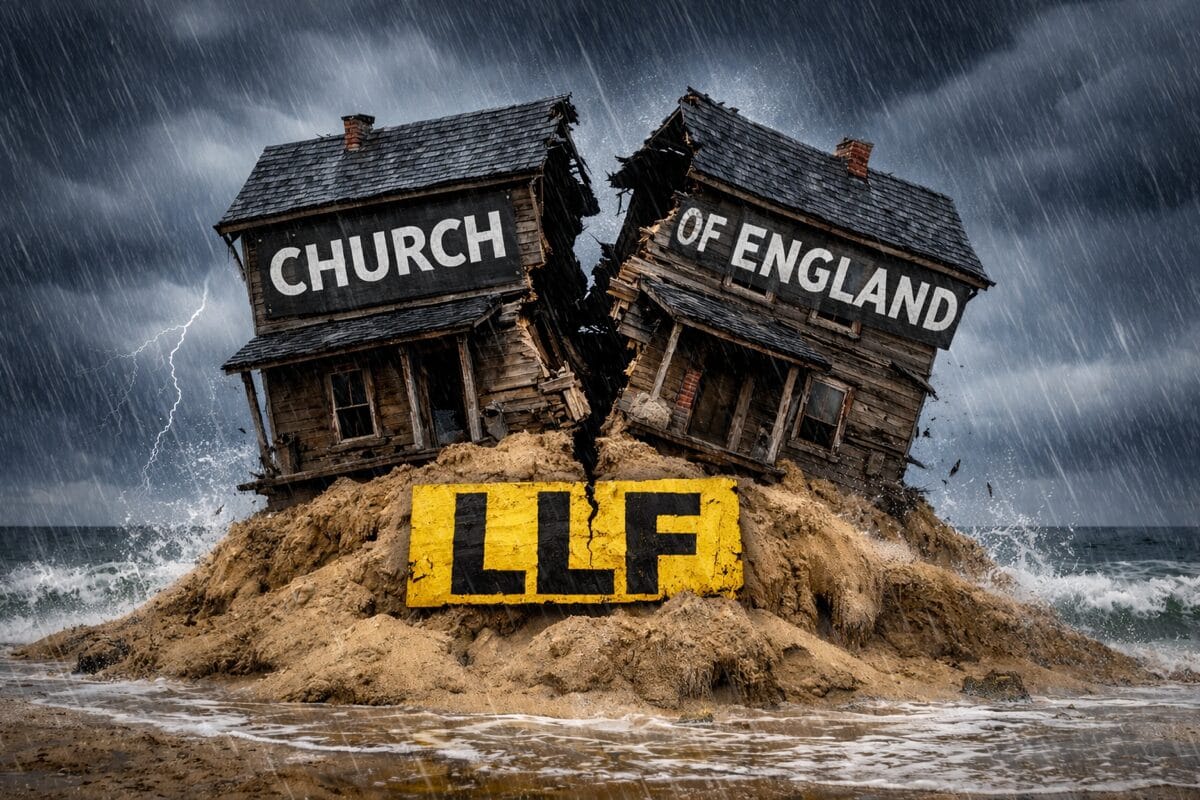
Sadly, there are two other New Testament texts that have come to mind as providing accurate descriptions of where, as this statement articulates, we in the Church of England are as a body at the moment. Despite the “high degree of consensus” (18) claimed for this statement, the whole of the PLF process has revealed us to be ‘unstable in all we do’ because, far from being of one mind, we are ‘double-minded’ (James 1:8) and needing to ask God in faith for wisdom. We are, it seems, increasingly ‘a house divided against itself’ (Mk 3:25) and so, like that which is built on sand (Mt 7:26), a house which cannot stand.

Revd Dr Andrew Goddard is Assistant Minister, St James the Less, Pimlico, (where his wife Lis Goddard is vicar) Tutor in Christian Ethics, Westminster Theological Centre (WTC) and Tutor in Ethics at Ridley Hall, Cambridge. He is a member of the Church of England Evangelical Council (CEEC) and was a member of the Co-Ordinating Group of LLF and the 2023 subgroup looking at Pastoral Guidance.
 Buy me a Coffee










PLF was voted for by majority of all 3 houses of Synod, LLF received unity and agreement by most of Synod to allow prayers for same sex couples in church services. Even if there is still not the 2/3 majority needed for bespoke stand alone services or same sex marriage in C of E churches, the Bishops via LLF at least got a proposal through that was able to receive the majority of votes in Synod
Simon, this is a bit of a broken record. Synod voted on the basis of false information.
The minutes of the HoB meetings show that a vote to withdraw ‘commendation’ was only defeated 17 to 18. So the House themselves are not of one mind that the PLF are actually permissible.
Did it? Really, even on your own figures the HoB still voted by a one vote margin to defeat a vote to withdraw LLF. This Labour government and most of Parliament also made clear they would not accept the nation’s established church in England not providing any recognition of same sex sex couples at all now married in UK civil law.
Even the Pope now allows Roman Catholic priests to offer non liturgical prayers for same sex couples so for the C of E to become more anti LGBT even than the Roman Catholic church would have been ludicrous for the English national church. After all it was founded in the first place to be more liberal than the Roman Catholic Church as the Pope would not allow Henry VIII a divorce of his first wife to marry Anne Boleyn
What do you mean? The word ‘liberal’ means freedom-bringing. Divorce, especially at the hands of an egotistical individual like Henry VIII, is bondage-bringing and unremitting till the victims’ deathbed.
Nonetheless supporting divorce would be considered a liberal move and banning divorce, as the Roman Catholic church still does except with a difficult to get annulment, as more conservative
Lol. It ‘would be considered a liberal move’ by cynical purveyors of doublethink and by those who have been duped by them, apparently including yourself. We all know that is the standard way of terming it, it ”would be considered” liberal, but that’s irrelevant – the question which I raised and which you avoided is whether that makes any sense.
Henry VIII did not think of being liberal, he thought of the opposite – of being *selfish* and not caring about the destruction of others’ lives. People who divorce today are latter day Henry VIIIs very often. They are being selfish and do not care about the destruction of others’ lives. Even their closest loved ones they do not care about.
This is what you call ‘liberal’?
Liberal?
Those with such rigid opposition to divorce like you should never have been in the Church of England anyway, you would be better off as Baptist or Roman Catholic than in a church founded by a divorcee
It wasn’t founded by ‘a divorce’. It was founded on the principle that biblical commands take precedence over the later unbiblical tradition of the Roman church. That was the actual issue at stake.
Who says I am ‘in the Church of England’?
I am in God’s Church, which incorporates all the bits (or regiments) which all contain brothers and sisters.
You are putting the trivial issue of denominations or regiments before the all-important question of whether one is a Christian or not, which means you do not understand.
That is your first error.
Your second error is to think that it is best if people stick with people who are a bit like them. Quite the contrary, that is the surest way of ensuring they will stagnate in their learning, and will inhabit echo chambers. You surely agree?
No, it wasn’t, that was what Luther and Calvin and Zwingli and Knox were doing to found Protestantism. Henry VIII however founded the Church of England originally to be a Catholic church just headed by him not the Pope, it only really moved in a Protestant direction under his son Edward VI, became Roman Catholic again under Mary Tudor and only became the Catholic but Reform church it is now under Elizabeth I
Yes, they marginally voted not to withdraw commendation, I suspect because the backlash would be even worse.
But note that ‘commendation’ is not authorisation, and it tells us nothing ‘about the Church of England’. It expresses a view of some bishops. And that view is fairly much contradicted by the legal advice.
My bishop has told his clergy not to use the prayers, because he does not think they are legally secure.
I suspect your bishop has told his clergy that because your bishop is ultra conservative in this matter – and he is hiding behind one legal opinion as a convenience.
No he isn’t. He’s Christian. The word conservative cannot be used with reference to tiny-horizoned western 21st century norms, because that would mean that it had already been established that those random short-term norms were somehow more basic than the temporally and spatially far wider norms of the rest of history and geography.
The word conservative cannot be used in that way, because you are imagining one particular random via media. But the via media changes through time and space. Because your presuppositions deny that it changes, your presuppositions fail. Conservative by what measure?
No legal advice has said the prayers PLF endorses, which are close to those even the Pope has now allowed for same sex couples, are not legal in C of E law. The only legal advice saying canon B2 must be used is for stand alone services of blessing for same sex couples, which the bishops have now agreed with. Hence PCCs of parishes like ours have already agreed to use the prayers as set out in PLF for same sex couples in our parishes with the full support of the diocesan and suffragen bishops
You are a law fundamentalist who believes in the infallibility of laws, even of laws that keep on changing.
The constitution of the universe changes every time that laws change, right?
Do people actually believe these things?
I am not at all sure that is why your bishop has forbidden clergy to use the prayers 🙂 I hope they ignore him.
Because, like about half the House of Bishops, he believes that the legal advice they were given demonstrates that the use of the prayers IS indicative of a change of doctrine.
And I think he is right. His concern is the protection of his clergy.
‘Indicative of a change of doctrine.’ Ludicrous, even the Pope now allows prayers for same sex couples to be conducted by Roman Catholic priests
Ian I am afraid this doesn’t ring true at all. It smacks of the phrase ‘we have a law, and by that law he ought to die’.
The recent statement from the House is quite clear that PLF are commended for use under Canon B5.
Do you think,, given the current climate and the number of exemptions the CofE has from equality legislation, that any court would want to try such a case?
Your bishop is well known for being ultra conservative in this matter, likes to ask intrusive questions, and has voted against any moves toward fuller inclusion. For you to claim that he simply wants to protect his clergy is just not believable.
If you’re basing your hopes on this govt and it’s majority of MPs so out of touch with national opinion it hurts, I wouldn’t. What if a Reform govt were to say the opposite? That the establishment of the Church of England is based on it being a Biblical church, in line with its own historic doctrines and same sex blessings were a deviation from that? Maybe they would, maybe they would not, but be careful when asking for secular intervention, cos you might just get it.
Even Farage has said he would not reverse same sex marriage, he preferred civil unions but even they are still some recognition of same sex couples. Reform lead the polls as UK voters want to take an even harder line against immigration mainly, not as UK voters have suddenly become homophobic and decided they want to scrap same sex marriage!
What false information would that be?
This seems to read like a letter of apology to some.
The moral of the story seems to be ” You cannot change,
Alas neither can we.
Thanks, Andrew. I remember us hacking through many of these arguments 30 years ago.
It reflects the wider Church’s current dilemma as to whether to stand by the authority of the scriptural revelation or subsume some of this (and ultimately all of it) to secular and cultural preferences.
Maybe the answer is to let some churches get on with it and see which of them the Spirit blesses and grows?
Well, we have done that—they are called Methodists, SEC and Church in Wales. How is it going?
The Methodists and SEC allow full same sex marriages in their churches now. LLF was way short of that and doesn’t even allow stand alone services in C of E churches and services of blessing for same sex couples like the Church in Wales, just prayers for same sex couples within services
Yes, indeed they do allow that; and look how that lethal infusion has killed once-flourishing plants.
Simon, you seem to be missing the point: all these denominations are in much steeper decline than the C of E, and will likely not be here in 10 years.
Maybe, we will see, the Church in Wales has cathedrals though I suspect will still be there for decades to come
They all have buildings and money. They don’t have congregations.
Their cathedrals still get a reasonable congregation and visitors paying for tours too
Simon,
It is clear that you passionately want same-sex marriage in the Church of England. But since that isn’t going to happen any time soon, the best advice for you is to join one of those churches like the Methodists or the URC. They best fit your goal.
We shouldn’t advise people towards perdition as opposed to showing the better way.
No I don’t, I am fine with PLF, it is conservative evangelicals like you who often reject even that who could go Baptist or Pentecostal or independent if you feel that strongly about it (despite the fact you have an opt out anyway). In any case as someone who leans toward the Anglo Catholic wing of the C of E the Methodists and URC are far too low church for me
‘I am fine with PLF, it is conservative evangelicals like you who often reject’.
Simon, you can only be ‘fine with PLF’ to the extent that their use is not indicative of a departure from the doctrine of the Church. How do you know that is so?
It is faithful Anglicans, who believe the doctrine of the Church, who have problems with PLF.
To you, style is the most important consideration??
As PLF is not a same sex marriage service in church. As I said conservative evangelicals like you just want to reject any recognition of the relationships of any same sex parishioners, even those married in UK law. Faithful English Anglicans believe in the King as their supreme governor and the BCP, everything else is up to how Synod interprets scripture!
Faithful English Anglicans believe in the King as their supreme governor
I’m sure I know a few Church of England republicans (including some I think would be in favour of same-sex marriages).
Are they not faithful Anglicans?
Not faithful English Anglicans no, they could maybe be faithful US Episcopal Church Anglicans though
Well in terms of female ordination and bishops that is already the case, C of E churches that agree with it can have female priests and churches which don’t can still only have male priests and a male flying bishop if they desire too. That will continue, even though the new Archbishop of Canterbury is female
Indeed so Russell.
1. Taking responsibility. What does/will that look like, involve?
2. Trust is evidence based.
3. The commitments, the first two bullet points are theologically, scripturally, flabby and fatuous, flaccid, marinaded in western extant cultural philosophy and language; notwithstanding the collective accumulation of years, callow and inept. No change there as starting and finishing point, it seems.
4. Maybe a key, taking of responsibility is to the taking and upholding of ordination vows.
Geoff,
Yes – and I think it highly significant that the House of Bishops in section 3 of their letter chose to quote those (short) vows but miss off the end bit: “I will use only the forms of service which are authorised or allowed by Canon”.
Looking back on my long career in BT, the Bishops’ paper reminds me of so many managerial statements made as the industry changed from one of public service to one dedicated to private profit – statements that sought to justify power and wealth gains over against the loss of customer service. The wording to me shows the influence of recent episcopal appointments from the “CEO seedbed”, whose pastoral and theological experience has often been far less than one would normally have wished. Rather than serving others, the Bishops might be accused of serving themselves by (a) calling a halt to LLF in order to (b) protect their positions from the inevitable split and loss of episcopal influence and power that furthering the LLF cause would bring.
I write from a diocese where there is little evidence of orthodoxy and doctrinal faithfulness – but I am thankful that a few are “holding fast to that which is good”. May the Lord reward them for contending for the faith of the Church of the England.
(which diocese are you?)
Newcastle – God help us!
Oh dear.
Yes – oh, dear! – but the few churches holding fast are the ones being blessed. Pray FOR us – but also praise the Lord for his blessings ON us.
Why was the Bishop of Newcastle not called to account for thinking she should be able to (selfishly, unilaterally) enforce that even the *Interim* Theological Advisor – let alone the *actual* theological advisor – should be appointed according to, of all criteria, how secular their outlook was, rather than how much they had studied the topic?
She does have a reputation for “ploughing her own furrow” whatever the consequences. Her reputation as an assistant bishop in New Zealand rang alarm bells long before her arrival first in Ripon then in Newcastle.
It is great to follow conscience (against orders if necessary). Whereas it is dreadful to follow a self-contradictory ideology that relegates study and evidence. Even more so when one is a PhD.
Interesting what David Shipley has to say about the Bishop of Newcastle’s time in New Zealand as an assistant bishop. Peter Carroll, the Bishop of Christchurch NZ often used to sing her praises but it was hard to see how, if at all, she had helped her diocese to grow.
In fact, the NZ Anglican church split precisely because of the insistence of brining in ‘same sex blessings’ and a new diocese, the ‘Confessing Anglicans of Aotearoa New Zealand’ was created, taking away some of the largest parishes in Bishop Carroll’s city – while other, liberal catholic parishes have since closed. It was a condition of being elected Bishop that Mr Carroll promised to allow SSBs in the diocese.
The same pathologies in the C of E can be seen in the NZ Anglican Church but more advanced. It is no wonder if we see the same things happening now in Newcastle diocese, which must be one of the most unchurched places in the country.
Not sure why my post has not appeared? Have I crossed a line?
Yes, you have. The line is called ‘typing your email address correctly’…!
A common failure of us card-carrying Luddites! Thanks, Ian!
Apologies if this has been raised already, but given their failure to follow proper due process (now acknowledged by them) and given the carnage caused in the past 9 years (not to mention the cost and time elements), how will this current cohort of bishops be held to account for all this?
They won’t, majorities of the houses of clergy and laity backed LLF as proposed by the bishops too
So, Simon, you don’t think it matters that there has been dishonesty, lack of transparency or accountability, a failure to follow due process, misuse of power, or deception of Synod?
Those things are not important to you?
There hasn’t, conservative evangelicals like you want no recognition of same sex couples at all by the English established church and whatever the bishops proposed and however they proposed it you would reject it
What is so odd about that? 99% of people through history have held exactly that position. Any other position is therefore highly eccentric.
Have they, Christopher?
I’m sure you’ll be able to provide evidence of that assertion.
99% of people have lived at a time when same-sex couples were not even a thing, and, while living, have not advocated for them either.
Of those now living, this has been the case, on average, for the majority of their lives.
99% is a shorthand for almost all.
This may or may not be true. But it is not the point here. My question relates to the procedural, not the theological. If the bishops had followed due process in a transparent process and the CofE had voted two thirds in all houses for a more inclusive regime, then those of a more traditional persuasion would have to accept it and decide in good conscience whether to stay or go
That is the correct question. A motion of No Confidence in their bishop at Diocesan synod would be a good start.
Embarrassment is powerful and is based on the exposure of hypocrisy. Repeated peaceable demonstrations could be arranged outside bishops’ residences with placards asking “Does this bishop believe in God?” and “Should this bishop resign?” Flyers could be handed out explaining in brief and simple language the incompatibility of liberal theology with the Christian faith. Included would be the bishop’s salary, quotes from his (her?) liberal writings and speeches set against scripture, pointed questions about hypocrisy, and statistics for the number of administrators in the diocese and the number of regular Communicants during recent decades. (A website could maintain this information for every diocese.) Similar demonstrations could be held before services outside every church at which these bishops give a sermon, and also at their other public engagements; local media could be alerted in advance. Boo them when they appear. Nail the flyer to the doors of their cathedrals after the manner of Martin Luther.
Display the 39 Articles on the door of every CoE ‘church’ building.
The ‘twelve conclusions’ of the Lollards were posted on the doors of England’s Parliament and St Paul’s Cathedral 122 years before Luther’s act, but John Wycliffe was dead by then and nobody of Luther’s stature stood behind them.
https://en.wikipedia.org/wiki/Twelve_Conclusions_of_the_Lollards
Fine but the 39 Articles are now mainly symbolic, Synod has the final say on doctrine within the C of E now as affirmed by Act and measure of Parliament
You seem to think that Synod outranks God.
Yes, you do, Simon. This point is made to you repeatedly, but a satisfactory answer is not forthcoming. Shall what is created speak back to the one who did the creating (Rom 9.20)?
Synod interprets the word of God for the C of E
‘Synod interprets the word of God for the C of E’ Where do you find that stated Simon? If it were so, why is there no requirement to be competent in the knowledge, understanding, and interpretation of Scripture to stand for Synod?
Yes, and as you have not digested despite repetition, only a tiny percentage of them can even read the Bible (the remainder read it in translations, an appreciable number of them having very little knowledge of it even in English). You have effrontery if you think their ‘interpretation’ is better than that of the translators themselves or of the international scholarly community.
Well, we know you are not of the Church of England, Simon, a deist in disguise who would render ordination vows incompatible with the CoE. to be enthusiastically set aside.
It is set out in the Church of England Assembly (Powers) Act 1919 and Synodical Government Measure 1969 by which Parliament gave the Church of England Assembly, which renamed itself the Synod in 1969, the powers of governance and worship and doctrine over the C of E. Parliament never legislated for any bible test to stand for Synod
That does not say that Synod interprets the Bible.
Calling the 39 Articles “symbolic” reminds me of a line from Robert Bolt’s “A Man for All Seasons”. To paraphrase: tearing down laws to get to the Devil would leave nothing of which to accuse him.
Similarly, watering down the principles of the 39 Articles to appease the culture of the world has resulted in a church that is in danger of having nothing of meaning to declare.
Which would achieve what? They are at the end of the day Bishops of the established church of England, a relatively liberal nation, not leaders of a sect
If a nation is liberal, that means it is full of groupthink. If its inhabitants could think for themselves, then there would be no single characterisation.
Your use of the word liberal above shows you have not thought this word through anyway.
You also claim the nation is liberal without considering that it may be the media that is liberal and that the media has great power to normalise things. Most are terrified of not being normal, of being a minority. The media can capitalise on that. They have a reach none of the rest of us has. They are also demographically atypical and full of dishonest, very constrictive, non-evidence-based editorial policies.
GB News, the Sun, Mail, Express, Telegraph etc are not liberal
Not so Simon. Papers like The Times and The Telegraph are liberal in the historic sense of being open and non-dogmatic. I find they generally have much better critical coverage of things than the Guardian (which I also read).
Have you seen the Mail femail pages? Almost every single day, it makes the hair stand on end, and produces headlines which, if the sexes were reversed, they would never hear the last of.
I suspect cynicism. They want to inject some awful wokery into the cosy middle class, and thereby normalise it.
Editorial policy is incredibly constricting for those with eyes to see.
Ian
The Times. The Telegraph, and the Guardian are non dogmatic?
Really?
1) On the best analysis I can do, ‘T’ and ‘I’ are not the same kind of moral issue as ‘LGBQ’ and should be dealt with separately.
2) The big difficulty here is that many in the CofE are making the assumption that ‘gay’ is something people ‘are’ in the same sense that people are ‘black’ or otherwise ethnically different – something which is unchosen and unavoidable. It is understandable and we should be sympathetic to it that where that position is believed in good faith (and I think for most of those involved it is in good faith) it will appear that to object to homosexuality is a terrible wrong in the same way that racism is, and that the Church must avoid that sin. However
3) That is actually a bad analysis. The issue in homosexuality is not about things people just ‘are’, the issue is about conduct, about what people DO. The wrongness is in having ‘sex’ between two people who, unlike a heterosexual couple, are not designed to do sex together. Things people do are also rather by definition things people CHOOSE to do, not unchosen like skin colour. And in relation to what people choose to do, what they underlying ‘are’ is not as morally neutral as skin colour; rather it involves urges and desires. And over a far wider area than sexuality, urges and desires are not necessarily ‘right’ just because you have that urge or desire. Urges and desires to steal or lie are not acceptable, no matter how strong.
Love between people of the same sex is totally proper – see David and Jonathan for just one biblical example. But for Christians God has rather clearly said that sex is at least inappropriate for two people of the same sex, and trusting God – the faith that saves us – includes trusting Him on that too.
At this point the so-called ‘real world’ is intervening, I’m not at home and I’m soon going to have to pack up the computer – I’ll get back to this later …..
And, once again, most sexual intimacy between straight couples is identical to that between gay couples. Or, are you suggesting that heterosexual couples should engage only in PIV sex?
Penelope – I think the answer to that is that I’m suggesting it because biblically God slightly more than suggests it. That’s an argument you need to take up with God rather than me. Christians will trust what God says in such matters … if you don’t trust God about it, are you meaningfully a Christian…??
The ‘Biblical’ God (I’m tempted to ask which one) approves only of male/female PIV sex? Where does the ‘Biblical’ God say this (and if God approves only of PIV sex, I must ask, once again, why did They create the clitoris)?
The headlines from Anglican Futures’ good analysis of the Bishops’ 9-page statement just emphasise that this continues to be an ever-greater slow-moving car-crash of the brainwashed who cannot even conceive of not bowing to Big Woke:
1. The House of Bishops are above all else committed to working together.
2. The House of Bishops continue to comment the ‘Prayers of Love and Faith’.
3. The House of Bishops only apologise for the pain caused by them for not moving further, faster. (My comment: In which of the possible directions? Need one ask? The foreordained one. They knew it was foreordained because they heard someone whispering that inside their head.)
4. The only discipline proposed by the House of Bishops for those who infringe their guidance is ‘informal’ and ‘possibly optional’. (My comment: They might tap you on the wrist, and then again they might not. In the Pauline fashion.)
5. The only criticism is for those who have taken a stand against the use of ‘PLF’.
6. As the ‘LLF’ process draws to a close, another process begins.
If the Bishops were really bowing to the ‘woke’ as you call it, they would have proposed full same sex marriage in church and openly trans vicars would have been encouraged. They did neither, LLF was a compromise endorsed by Synod
The trick is to place the middle ground in some extreme spot.
Then extremity can seem middle of the road. That is the purpose of the awful Overton window.
And indeed of the Anglican viamedia website.
Your perspective is clearly wrong for two reasons. First you speak as though everyone agrees and knows where the middle ground is, whereas that is obviously not the case. Secondly, you imply that truth is a matter of middle ground not of evidence.
Just a thought: how can you have a “middle ground” between two diametrically opposed “grounds”? It seems to me that there is no middle ground on which anyone can stand between the conservative and progressive groups – just a yawning gulf. Hence the need for restructuring if the Church of England is going to have any sort of future in which even the slightest unity can be maintained.
You are so right.
” ‘I suppose there are two views about everything,’ said Mark. [Note: Mark is actually an academic, and still thinks this. Lewis observed the ways of his academic colleagues.] ‘Eh? Two views?’ [said MacPhee]. ‘There are a dozen views about everything until you know the answer. Then there’s never more than one.’ ”
The implication is that there are never precisely 2 theories. Of course, if it is a matter of Proposition A is true or is false, then there will be two.
But this is what the media does. They make questions binary, themselves select what the two positions are (normally because the evidence-based one and the wishful-thinking one [total: two] will both be followed by particularly large numbers of people), and themselves thereby create a perception that the middle ground (which is an incoherent concept) lies as close to their own wishful-thinking position as is possible. The entire Overton window (which, incestuously and circularly, they themselves created) is based on that.
LLF IS the middle ground which a majority of the house of bishops, clergy and laity has voted for in Synod
Simon, LLF is not a ‘middle ground’. There isn’t any possible middle ground between whether marriage is between one man and one woman, or between two people of any sex.
And Synod voted to affirm the doctrine of the Church as it remains, that marriage is between one man and one woman, and nothing should be done to suggest any change to that.
That is neither ‘middle ground’ nor any kind of compromise.
And since you seem to take Synod’s word as law, I guess you will be bound by that…?
But everything in the world is middle ground unless it is an ultimate extremity.
You claim you can say that middle ground belongs exclusively in one plcace. You are wrong, because you have no more right than anyone else to define what the parameters are between which that so-called middle ground lies.
Of course there is no middle ground for you as you will not compromise at all and want complete rejection of all same sex couple relationships in the C of E. Despite the fact it is established church of a nation where same sex marriage is legal and the fact even the Pope now allows prayers for same sex couples.
You are not in the middle of the C of E though but its very conservative wing. However. unlike you most of Synod, the houses of clergy, laity and bishops voted for PLF and prayers for same sex couples within services.
Synod affirmed that marriage is between one man and one woman anyway.
It is certainly news to me, as to many others, that I am ‘conservative’. Given that my whole method is to oppose all ideologies, I could not very well be. All I am is an independent truth seeker who aims to be evidence based. It is natural that evidence will often point to answers which have already become widespread: that is why they became widespread: because the evidence existed. To that extent, evidence-based people will often reach ‘conservative’ conclusions (odd word, as though the main consideration were fashion or chronology). At other times, they don’t, especially if they are intelligent, because all more detailed analyses are held and understood only by a minority at first.
A couple of years ago, a question was put to Synod which was very much to the point. Was it put by Sam Margrave or another?
They are mindlessly using this acronym ”LGBTQIA+”. But-
What is the definition of T? (Someone who has undertaken surgical/pharmacological transition? Someone who has found themselves having certain feelings? The two are not equivalent.)
What is the definition of Q? (If it means queer, that is not even a category that a lot of people would either affirm or consider coherent. Yet it is imposed as though it were somehow universally accepted.)
What is the definition of +? (It certainly seems extremely open ended, and one would end up affirming anything at all.)
How dare the House of Bishops continue uncritically with this secular-imposed and ill-conceived acronym? They have much to teach secularism and yet they grovel to it instead.
So it is the intelligent who can actually analyse and who can actually think critically who get relegated to the bottom of the pile.
Christopher:
You and I disagree very sharply on certain matters, and we shall no doubt continue to do so, but I have to say that I am in complete agreement with you regarding the mindless use of the illogical and misleading “LGBTQIA+” initialism. It is high time that it – together with all of its equally tiresome and ridiculous variations – was permanently ditched.
Being a word, some will continue to use it and others will not.
This is useful, as it is a simple way of identifying in one step which people can think and which people’s thought-level, by contrast, is such that they passively submit to incoherent fads.
Agreed, given that TQIA+ people can enter into Holy Wedlock fully and unreservedly, the use of the acronym adds insult to injury.
One might ask how dare you question identities which are perfectly coherent to those who hold them, and which have coherent definitions – though some queer folk would claim that a definition is a very ‘unqueer’ thing. But, once again, you are imposing your very particular, very modern ideology on others. What right have you to do that?
This is not so much about identities as definitions, such as what is a woman? We still await a definition from the Trans lobby.
What would your definition of a cis woman be?
Or a non-trans woman, if you prefer.
The one that every peasant understood for thousands of years, of course. You have to be very highly educated indeed to find such a concept difficult. Or playing silly legalistic loopholes that apply to about 0.001% of the population.
” ‘Why, you f**l, it’s the educated reader who CAN be gulled. All our difficulty comes with the others. When did you meet a workman who believes the papers? He takes it for granted that they’re all propaganda and skips the leading articles. He buys his paper for the football results and the little paragraphs above girls falling out of windows and corpses found in Mayfair flats. He is our problem. We have to recondition him. But the educated public, the people who read the high-brow weeklies, don’t need reconditioning. They’re all right already. They’ll believe anything.’ ”
From CS Lewis, That Hideous Strength.
Re the reconditioning: re-education and unconscious bias training are both part of wokery.
Yes, Anthony, I thought you wouldn’t be able to answer that question 🙂
The “cis” prefix is redundant. A woman is an adult human of the female sex. No other kind of woman exists. A “trans woman” is not a woman; he is a man.
Penelope’s classification system (adopted in a conformist spirit, as has come to be expected) can be analysed as follows:
(1) It says that non-apparent data are more solid than apparent;
(2) It says that data which are capable of change are more solid than those which are not;
(3) It says that data which are based only on verbal report are more solid than those which are based on more than that;
(4) It says that data which can potentially be lied about are more solid than data which cannot be.
Since it is perfectly obvious that in each of 1-4 the exact reverse is the case; and since it is further true that there is no aspect in which this new ‘cis’ classification system is even equally good evidence to the other, let alone better evidence, then it follows that what we have here is a capitulation to a fad (given that we know how widely people DO capitulate, and their fear of dissenting from the orthodoxies of the moment), and if other fads were current it would probably be those that they were pushing.
Penelope,
I refer you to any dictionary of the English language written before the 21st century.
Penelope,
Every person with even a KS knowledge of iology knows there is no such thing as a “cis woman”. There are simply women, who are adult female humans – even if some legal people struggle to understand this very basic fact. Stupidity is not confined to people of low IQs.
You cannot conjure something into existence simply by creating a name. That is the business of fantasy, not science – or reason.
There are people who really wish they belonged to the opposite sex. This is a distressing psychological affliction called gender dysphoria. Their emotional suffering is real, just as real as the suffering of thos who think they have extra limbs growing on their body.
But human beings can no more change their sex than they can change their species.
As a sometime participant here has often noted, the ‘T’ has been a terrible incubus on the LGB movement, especially where effeminate boys have been concerned, leading them to having catastrophic chemical and surgical interventions on their bodies. The transgender movement has suffered some significant reverses in the past couple of years and the US Supreme Court is probably going to deliver another one. This is wonderful news for the sake of women (note: women, not “cis women” who exist only in the mind of American lesbian sociologists), but it is good for all of us because it helps to deconstruct the whole homosexual programme by pointing us back to biology and the plan and purpose of out bodies. Natural law is a great place to start (but not finish) in understanding humans correctly. Gnostic lesbian sociology – not so good.
One of the more staunch characters at the late lamented Archbishop Cranmer blog used to amuse himself by reading and reporting the wars at the website of Pink News (which isn’t the Financial Times, by the way) between gays who were pro-trans and anti-trans.
James: in fairness, calling a woman an adult human female simply moves the issue to what is ‘female’. But any dictionary compiled before the 21st century suffices to settle the matter of definition.
Since the Supreme Court reasserted sanity last April by ruling that ‘sex’ in the Equality Act 2010 means biological sex (at birth), woke institutions have been dragging their heels. The result is that they will be sued, as the Black Belt Barrister warns:
https://www.youtube.com/watch?v=RttLzboZFiI
Hi William
As mentioned before, a clear difference between our positions is that you say that sexual feelings are undeniable and endemic whereas gender feelings are nonsense. Whereas I say that both are feelings; both may genuinely be felt by people; and feelings by their nature can be in different cases helpful, harmful, or neutral.
Anthony
Still won’t answer. Or can’t?
James
I am a cis woman. Cis is an adjective.
And, as you probably know, the regret rate for gender affirming surgeries is minuscule. Much, much lower than for knee surgery. And, as you probably also know, not all trans people have surgeries.
And, as you may know, if you ever move beyond basic biology, sex is much more complex than you acknowledge. And, lastly, female is a sex/gender; woman is a social construct.
Sorry, one more observation, language is exactly how you conjure things into existence.
This is all quite straightforward.
Language is how you conjure things into existence?
Conjuring it certainly would be. Our cat could never have come into existence unless I had fortunately one day said ‘Let there be cat’, and there was.
And how on earth would you know what the regret rate for gender manipulation is when most of it has happened only in the last few years? All you know is what the initial euphoria rate is. the honeymoon period.
Penelope,
I twice said that the pre-21st century dictionary definition was adequate. I exepcted you to look it up but perhaps you don’t keep antique books.
A woman is an adult human female, and a female is the sex that bears children.
Your turn. Can a man get pregnant or will you duck the question like this coward?
https://www.youtube.com/watch?v=jYTSBGBuT6Q
Penelope:
“Gender affirming surgery” is merely a euphemism for “sex denying mutilation”. In so far as it can be said to affirm anything, it affirms a delusion. The claim that the regret rate is “much lower than for knee surgery” has been parroted incessantly, but we don’t know the real rate, firstly because regret can take around a decade to develop, and secondly because so many cases have been lost to follow-up, 30% or more. The psychiatrist Dr Az Hakeem has stated that 26% of his patients at the Tavistock and Portman, where he used to work, regretted their “transition” (another example of language used misleadingly by the “transgender” cult – transition from one sex to the other is impossible).
Human sex is complex, no doubt, but we do know that it is congenital, binary and immutable.
Female is a sex. (Feminine is a gender – a grammatical category.) Woman is not a social construct but a sexed biological category: a woman is an adult human of the female sex.
Anthony
I have lots of dictionaries. But, again, you fail to understand, that a definition simply describes what a word means to the culture in which it appears at a particular time. It doesn’t necessarily describe reality.
William
Your post is simply offensive.
Penelope
Can a man get pregnant?
How on earth does being offensive make something any less true?
Why is the central issue of truth ducked? Looks suspicious.
And why is the issue that offence is subjective not objective faced up to?
Penelope:
Maybe so, but you can’t change or erase reality by finding it offensive.
I mean ‘not faced up to’.
Anthony writes: “James: in fairness, calling a woman an adult human female simply moves the issue to what is ‘female’. But any dictionary compiled before the 21st century suffices to settle the matter of definition.”
But it isn’t a tautology. Male and female are objective biological, chromosomal facts: XY and XX. That’s all I was saying.
It might be all. But it’s by no means sufficient. Sex is not reducible to chromosomes.
In that case ‘sex’ becomes an unwieldy slippery concept.
Which cannot be, since it is one of our basic categories.
So, no.
There is no limit to the number of words that can be created. ‘Sex’ (in the sense of male/female) can continues to mean sex, just like ‘parent’ and ‘man’ and ‘woman’ and other core basic words mean what they mean. Other words can be used for other things.
We are not taken in when the most basic realities are not even allowed a word of their own in a world where the Greater Oxford Dictionary is 20 volumes long. In each case, they have previously had a word of their own. We see the pattern of invasion and occupation of these concepts. We are not stupid.
Penelope: you are not a “cis woman”, you are simply a woman – and fortunately, one who doesn’t long to be a man or who pretends to be one. “Cis” isn’t an adjective it’s a Latin preposition (trust me, I was a Classics teacher), and nobody is “assigned” a sex at birth – a grest lie! – you are simply born female ot male – and if there is any doubt, a chromosomal test resolves it. Sex is biological and clear. A person’s happiness or otherwise about being a man or woman is another matter but it isn’t biological, it’s a problem of emotional development (gender dysphoria).
The fallacy of conjuring ideas into existence by giving thrm a name is also known as the fallacy of Reification. This error is common amongst lesbian sociologists and “sexologists”.
Penelope, the evidence from Johns Hopkins University in Washington DC is that the suicide rate for trans people having undergone surgery and those who have not is the same, as it the sadly very high rates of depression. There is no evidence that such transitioning surgery reduces the issues of dysphoria, and indeed why would it? For that reason, a leading JH surgeon stopped performing such operations, because he realised that he was maiming healthy bodies to no good purpose.
You don’t seem to understand how language works. Cis is used adjectivally in English. And I am a cis woman.
And chromosomal tests do not necessarily resolve things. Moreover, most of us don’t have chromosomal tests, so we have no idea what our chromosomes might be!
You don’t seem to understand how language works. Cis is used adjectivally in English.
You don’t seem to understand how language works. A word needs to be in common usage before it’s really part of the language; before that it’s just jargon. A bunch of activists can’t just make up a term, use it among themselves, and then start claiming that it’s part of the language.
Moreover, most of us don’t have chromosomal tests, so we have no idea what our chromosomes might be!
That’s not even remotely true, is it? Anyone without noticeable physical abnormalities can be 99.99999% sure what their chromosomes are, can’t they?
S
“PCD; Moreover, most of us don’t have chromosomal tests, so we have no idea what our chromosomes might be!
S responding; That’s not even remotely true, is it? Anyone without noticeable physical abnormalities can be 99.99999% sure what their chromosomes are, can’t they?”
Penelope is right; most people have not had full genetic tests and also not had tests in other areas relevant to the trans issue – detailed studies of hormonal activity in their system. It was pretty much luck that a trans friend of mine had had certain tests of his hormonal activity some time before he ‘came out’ about his gender dysphoria.
And although chromosomal abnormalities are rare, they do happen to a surprising number of people, as do hormonal imbalances which can result in appearances in conflict with the chromosomes.
Penelope is right;
Incorrect.
It was pretty much luck that a trans friend of mine had had certain tests of his hormonal activity
I’m willing to bet it wasn’t ‘luck’ at all, and those tests were done because of reported symptoms.
However also hormonal tests are not relevant unless your friend also has a chromosomal disorder, because the question was not about hormonal disorders but about chromosomal disorders.
And although chromosomal abnormalities are rare, they do happen to a surprising number of people,
Almost never without symptoms.
The point is that if you have a chromosomal disorder (ie, are not one of XX or XY) then you will have some symptoms related to the disorder. So anyone without such symptoms does not need ‘tests’ to know their sex chromosomes.
And no, gender dysphoria is not a symptom of a chromosomal disorder!
as do hormonal imbalances which can result in appearances in conflict with the chromosomes.
Appearances are irrelevant. A man who looks like a woman — even one who has had cosmetic surgery to remove his penis and create a simulated vagina — is still a man.
Penelope:
Sex chromosomes were discovered in 1905, but people knew the difference between male and female humans thousands of years before that. Well over 99.9 % of the human population have the typical XY (male) or XX (female) chromosomal configurations. But even the small minority who don’t are, like the majority, either male or female.
If a person’s anatomy is of the kind which, when fully functioning, will produce small gametes (spermatozoa) they are male; if it is of the kind which, when fully functioning, will produce large gametes (ova) they are female. And that is so even if it is not, for whatever reason, fully functioning. No-one’s natal sex can be changed – even if they have the delusion that it is somehow the “wrong” one.
S
One of the problems you’re missing here is that people can have surprisingly drastic physical abnormalities but it will only be realised that they are abnormalities if the chromosomal tests are done, because they appear to be normal. Two cases in point (and there are quite a few more) are androgen insensitivity and the ‘guevedoces’ (at least where that phenomonon occurs outside one well known ‘cluster’). In androgen insensitivity the affected person is genetically male but because of what I’m told is a regulatory enzyme deficit the body cannot respond to testosterone and they develop apparently as normal females (though they will be infertile). The guevedoces, again because of a regulatory enzyme fault, develop as females till puberty when a different enzyme kicks in and they develop into full males. There are quite a few other such cases where the fact of abnormality is not immediately obvious. That is, it is not realised that there is abnormality even though there are ‘symptoms’.
On the basis of how often it’s explicitly reported – though can be inferred from descriptions after the fact – it does seem that the hormonal checks my young friend had are more random than they should be even when gender dysphoria is reported.
One of the biggest problems here is simply that currently with the NHS overwhelmed and even people who are not full adults legally entitled to seek ‘unregulated providers’ of gender affirmng/changing services, and with assorted pressure groups pressuring about it, the science is currently not being adequately done and all kinds of questionable assumptions are made. We need to replace mystical ideas like ‘a woman born in the wrong body’ with more objective science; there may still be cases where it will appear reasonable to do the ‘transition’, and there will certainly be cases where it will be difficult to affirm the biological gender, but clarifying the science must be the first step and is an area where churches should be leading in a positive and sympathetic way.
One of the problems you’re missing here is that people can have surprisingly drastic physical abnormalities but it will only be realised that they are abnormalities if the chromosomal tests are done, because they appear to be normal.
Untrue.
In androgen insensitivity the affected person is genetically male but because of what I’m told is a regulatory enzyme deficit the body cannot respond to testosterone and they develop apparently as normal females (though they will be infertile).
No, they don’t ‘develop as normal females’. At puberty, they will not start having periods (because they have no womb). This should therefore trigger investigation which will reveal that they are actually male.
The guevedoces, again because of a regulatory enzyme fault, develop as females till puberty when a different enzyme kicks in and they develop into full males.
How is that not a symptom of the disorder?
There are quite a few other such cases where the fact of abnormality is not immediately obvious. That is, it is not realised that there is abnormality even though there are ‘symptoms’.
There is no case where the fact of the abnormality is not obvious at puberty, (even if it wasn’t before). Therefore anyone who has gone through a normal puberty does not need a test to know what sex chromosomes they have.
It is not the identities per se that are being questioned: it is the banding together of those identities into a term that results in their loss of individuality – and thus groups very different people into a whole that is neither ideal nor representative of their condition.
Replying on the ‘Trans’ issue in general
I was recently forced to look into this in some detail because a young friend declared himself to be, well, ‘herself’. And it turned out to be quite complex from situations which probably are better resolved by counselling than surgery (including counselling of those around the ‘trans’ person who may have over-rigid concepts about sex roles and may be somewhat bullying about the issues) to situations of clear genetic atypicality ( to use as neutral a word as I can manage) which I think in quite a few cases will justify the ‘transition’. For a couple of examples of these extremes consider ‘androgen insensitivity’ (which some believe affected the late Wallis Simpson, Duchess of Windsor) and the case of the ‘guevedoces’ ( a condition which can happen anywhere but is best known from a ‘cluster’ of cases in Latin America. That one is complex, check it out online for yourselves please….
Also I’d advise reading Hannah Barnes’ book “Time to think” which makes clear how chaotic this business is, how sketchy the science, and how much what happens is being affected by dubious pressure groups.
Somewhere on the way through my investigations a point emerged from my young friend J’s experiences which seems also likely to apply to many cases, though I’m certainly NOT saying it is the ONLY explanation of the ‘trans’ phenomenon. In J’s case it turned out that he had been experiencing unusual levels of oestrogen in his system some time before he ‘came out’ as trans. There are as I understand it some half-dozen or more ways this can happen, many involving the actions of regulatory enzymes which control hormone production, and there are other situations which could add to that production. (Note that boys/men do produce some oestrogen normally and necessarily, and girls/women produce some testosterone naturally – we are talking ‘unusual levels’ in these cases)
Initially I was seeing this as indicating a situation that might truly justify the transition in his case; but I’ve gradually come to think of it rather differently, though with quite a few ifs buts and maybes. We need an endocrinologist to sort it out but here is an outline of what I’m currently thinking.
1) It seems that if a person has a genetically male body but such atypical hormones sloshing round his bloodstream it can affect his self-perception, making him seriously uncomfortable with that male body and having some of the other feminising effects seen when the hormones are used as ‘gender-affirming’ treatments. Thus the affected person may well subjectively feel that sensation of being ‘in the wrong body’; and currently if he ‘presents as trans’ it seems that will be the preferred assumption and he will be put on the path to transition. I have an impression that alternatives aren’t being adequately considered….
But I find myself wondering – is that the best interpretation of the situation? I mean, those hormones are certainly not ‘normal’. Such irregularities only affect a few thousand in a UK population of 60 million+. Should we instead interpret these as cases where something has definitely ‘gone wrong’ in the same general way, but with different consequences, as when insulin production goes wrong producing diabetes? And should we regard the ‘born in the wrong body’ feeling not as an unquestionable fact but rather as in effect a hallucination caused by the atypical hormones, and though not death-threatening, surely health-threatening because the affected person will want to destructively interfere with his very real genetic body to accommodate what the hormones are telling him?
The question then I think becomes “Can this hormonal imbalance be corrected so that the brain will be accurately seeing the male body as reality rather than having an essentially untrue perception of it? And is that correction easier, and cheaper even if it involves lifelong hormones or whatever, than the drastic hormonal and surgical changes involved in the ‘transition’?” And if the answer is yes to those questions, then should not the correction of those hormones be the appropriate treatment? Would not the more elaborate ‘transition’ look rather like those cases where a ‘cowboy’ builder or mechanic persuades a householder or car owner to pay out huge sums for unnecessary repairs while often not dealing with any real original problem?
Correcting the imbalance may not be easy and is likely to involve a lot of counselling and support until the balance is restored. It almost certainly won’t be as simple as “stuff him with testosterone” but more likely identifying a more subtle cause of the imbalance and correcting that.
The bishops speak in the language of Therapy rather than Theology.
Thought experiment: Assume CofE is an original church founded by Paul. But with the same issue. What would Paul’s Letter to the CofE say?
Or John’s? Or Peter’s?
I would not know. But I think we could all hazard a guess.
It wouldn’t have been, unless Paul visited England as the Church of England is only a church within England not a global church like say the Roman Catholic church
Paul only established local churches, so Im not sure what your point is.
That sidesteps the question of what it would say. Am I surprised?
The Church of England officially regards itself as part of the One Holy, Apostolic and Catholic* Church of Jesus Christ. This is something which seems to have been forgotten by its bishops in all of this. The relationship to our brothers and sisters in Christ in other countries is much more important than our relationship to the secular structures in our own country. Our ‘politeia’ is in heaven, not on earth.
*in the original sense which applied prior to the Great Schism.
Yes, that appears to have been completely lacking from consideration.
Thst is precisely the issue – one I put to a bishop years ago and he had no reply.
If the C of E is “part of the one holy catholic church”, how can it change its doctrine (not its discipline, which is snother matter of internal self-regulation) without the agreement and concert of the other historic episcopal churches? The alternative is schismatic self-assertion.
To be clear, this is also why I have been unconvinced for a long time about the ordination of women. How can one branch of the Church Catholic change its orders independently from the others and yet remain catholic?
Maybe Simon Baker can explain this? Simon seems to think that national synods of churches can change Christian doctrine independently of others. That doesn’t sound at all catholic to me but hyper-Protestant or rather Quaker (the Spirit saying different, contradictory things to different people).
Well because it was started by changing its doctrine from that of the Roman Catholic church to allow divorce, most notably the divorce of the King from Catherine of Aragon thus allowing him to marry Anne Boleyn and become Supreme Governor of the Church of England.
The Church of England since Elizabeth I has also been Catholic but Reformed NOT pure Catholic. It is governed by Synod, not the Pope and Vatican and Synod voted for ordination of women and female bishops even if the Vatican and Pope are clear that only men still can be clergy and bishops.
Ironically of course LLF and the prayers for same sex couples it allows has brought the Church of England closer to the Roman Catholic church than it is on remarriage of divorcees or ordination of women. For the Pope now allows non liturgical prayers for same sex couples to be performed by Roman Catholic priests too
Simon, The Church of England, like other protestant churches, rejected the erroneous developments of the Roman church because they had drifted from or rejected the teaching of Scripture.
Included in that was the error of believing that marriage is a sacrament and is indissoluble. It did this because scripture does not teach either.
Simon,
You are WRONG on history and doctrine – though you are not alone in your error, it is a very common one.
First, Henry VIII did NOT divorce Catherine of Aragon.
Rather, on 23 March 1533 Archbishop Cranmer declared Henry’s marriage to Catherine to be INVALID. In other words, Cranmer claimed to be granting Henry the ANNULMENT he sought from the Pope which the Pope refused to give.
As you know, an annulment is not a divorce, it is a declaration that a valid marriage did not exist. So the break with Rome was not a change in doctrine.
second, errors don’t become truth through the passage of time. For a large part of the 4th century many churches held to a kind of semi-Arian error on the Trinity and the natures of Christ. These errors persisted through many of the years from 325 until the Council of Constantinople in 381 corrected them. There is nothing new in local churches teaching error for a while until they are corrected by an ecumenical synod. St Athanasius’s life was frequently in danger from Arians, despite the ruling of Nicea in 325.
Anyway, look up the history and you will see that Henry VIII was NEVER divorced, at least in the eyes of the Church of England.
Henry VIII founded The Church of England to be a Catholic church headed by him not the Pope so he could divorce Anne Boleyn. Henry had even written a Defence of the Seven Sacraments attacking Luther. It only became Protestant under Edward VI, was restored to full Roman Catholicism under Mary Tudor and only finally became a Catholic but Reformed church under Elizabeth I. The Church of England was not started to be a fully Protestant church at the Reformation, unlike say Lutheranism or Calvanism. Even if Henry like you did not agree marriage was a sacrament and thought it was dissoluble.
Cramner declared Henry’s marriage to Catherine to be invalid as he had married his dead brother’s wife. It was just a grounds whereby he could obtain the divorce the Pope had refused him, as the Pope had declared there was no grounds for an annulment. Only Papal authority Roman Catholics believe can grant an annulment.
Simon: you keep repeating your mistaken understanding of history.
For the last time: according to the Church of England, Henty VIII was NEVER divorced and he NEVER sought a divorce from the Pope.
He sought an ANNULMENT. This was not a change in doctrine and at no time did Hrnry think he was changing any doctrine. Look up the difference.
(Of course, Henry was an evil tyrant and murderous monster. But that is a different matter: like you, he strove to be a good English Catholic – in his own eyes – with no time for Protestants.)
So what? You just said the C of E was still part of one Catholic church, yet the Pope alone has the authority to grant an annulment in the eyes of Catholics so no, an annulment in the C of E was NOT a divorce in Catholic eyes as it had no papal authority just the King’s authority.
So effectively it was a divorce and the C of E started to become Catholic but Reformed not fully Catholic as it no longer acknowledged the Pope as its head with sole power to grant an annulment
So effectively it was a divorce
Simon Baker does not, and is determined to never, understand the difference between a divorce and an annulment, so this exchange is pointless.
One might reasonably ask what would have happened to a courtier who, had Catharine of Aragon given birth to a boy who lived, looked closely at the facts and informed Henry that he was not married…
Meanwhile, the papacy had just granted Henry’s sister Margaret an equally questionable annulment. But the Holy Roman Emperor, Charles V, was Catharine’s nephew and not a man whom the Pope wished to anger. The Pope never said No to Henry; he simply sat on Henry’s petition for annulment until Henry lost patience (and continence, having got Ann Boleyn with child).
And Cranmer never pointed out that in Judaism you were SUPPOSED to marry your dead brother’s wife if he died wiithout issue.
What a shower!
David
The original united Church (at least within the Roman Empire) became significantly changed when it was hijacked to become the Empire’s national(ised) religion and inter alia became diluted by lots of nominal members in the supposedly Christian state that resulted. That led to a doctrinal slippage eventually serious enough to provoke the Reformation in the West. Even the Reformation largely retained the problems of being ‘nationalised’ institutions and having, again, a membership diluted by the only once-born. We are still in the phase of recovering from that error by restoring the independence of churches from their states to operate at the NT says churches (or rather, The Church) should. Many of the CofE’s current problems derive precisely from its ‘establishment’ and the inevitable compromises and pressures which amount to a church ‘serving two masters’ – which as Jesus pointed out, doesn’t work. Unfortunately the supposed (but actually unreal and unbiblical) advantages of ‘establishment’ have become something like Tolkien’s Ring, ferociously hung onto even while destroying the church…. Almost all the world’s churches need to extract themselves from being or trying to be state churches, and go back to the NT version of state/church relations….
No, being established church ensures the Church of England is a broad church, containing conservative evangelicals as much as liberal Catholics, open evangelicals as well as still some conservative Anglo Catholics. Plus offering weddings, funerals and baptisms to all parishioners who want one.
If the Church of England was disestablished it would become a church dominated by liberal Catholics, as most western Anglican churches now are. Conservative evangelicals would become Baptist, Pentecostal or Independent or Free Church, open evangelicals would become Methodist, Lutheran, URC or Quaker and the remaining conservative Anglo Catholics would become Roman Catholic or Orthodox.
Simon you know that your beef is with Jesus in Matt 5, ‘you have heard that it was said…but I say to you’, with the apostles in Acts 15 removing many laws and regulations as obligatory, etc. Where New Testament is different from Old Testament then it is quite impossible to ‘obey the Bible’ because its dispensations differ, But it is possible to obey the New Testament. And all followers of Jesus would want to do that, and to agree with him about which parts of the OT he has made redundant. So why are you behaving differently to the other followers of Jesus. You should argue against Jesus and the apostles, whom you oppose on this point, not with us who follow them.
Fine but by prioritising the NT over the OT you choose to ignore much of OT scripture
Simon, when will you admit that it was Jesus (Matt 5, John 5), the work of Jesus (book of Hebrews, Jeremiah 31), and the apostles by divine command (Acts 10-11, 15) who prioritised the new covenant over the old? Nothing to do with me.
What is the reason that you are opposing yourself to Jesus and the apostles on this point? How can any Christian do that? Will you instead stop opposing Jesus, opposing the apostles, and agree with them that the reason that there is a new covenant is that it improves on the old?
If the two are different, as indeed they are, then no one on earth can possibly abide by both. Yet you are putting the impossible and unnecessary burden on people to abide by both or else be unbiblical. No, what we call the Bible has development within it.
Why are you opposing the position of Jesus and the apostles?
Fine so you prioritise the NT and word of Christ and the apostles. By doing so though you choose to ignore parts of the Bible in the OT in Leviticus
Simon Baker has an amazingly poor and confused grasp of Christian Scripture and logic.
He cannot understand that the Divine Lawgiver may give a dispensation for His people for a certain time, and then later, the same Divine Lawgiver – God Incarnate – may issue a new law for them, what we call the New Covenant, ending some of the conditions of the Old Covenant.
Simon Baker shows that he doesn’t understand even the most basic principles of New Testament theology, how the coming and self-sacrifice of the Messiah fulfils and ends some of the provisions of the Old Covenant (e.g. circumcision, animal sacrifices, kosher food ĺaws). Seriously, a ten year old can understand this idea. But Simon doesn’t even grasp this basic principle which runs all the way through the New Testament. I am reminded of kids in an algebra class still struggling with arithmetic.
Christians think that, orthodox Jews certainly don’t, they still stick by all the OT laws and prohibitions. So by very choice of being a Christian you do not follow all the bible from Genesis on, you prioritise the NT over the OT
Simon,
In the OT God was running a nation, in the NT He is running a volunteer movement. That is why they have different constitutions. One is an opt-out entity (by quitting the Holy Land), one an opt-in. God has not changed his mind about anything.
Simon
You are rather proving my point – the Anglican Church is broad to the point of major inconsistency, held together for worldly rather than spiritual reasons. It needs to be God’s church, not a ‘mixum gatherum’ of worldly attitudes and motives; and to be that it needs to be first and foremost biblical – there is no other adequate authority. And bear in mind that while you go on about a rather mystical ‘apostolic succession, the Bible is in fact thoroughly apostolic, written by directly commissioned apostles including Paul or by their close co-workers such as Mark and Luke. Realistically even people ‘in apostolic succession’ need to be consistent to the Bible or they are rather obviously stepping outside apostolicity and ‘doing their own thing’. Indeed it is far from clear on what authority you yourself operate, Simon, given your acceptance of gay sex and marriage and that you want women in ministry even while insisting that is unbiblical.
I can’t totally predict what might follow disestablishment; but I am pretty sure the ‘liberals’ will lose out because essentially they have nothing to offer. Evangelicals are likely to remain strong, as are I think the more conservative Anglo-Catholics. I would expect the church to lose lots of nominal adherents but likely gain more by being less woolly and more coherent and purposeful. I assume there would initially be a loss of LGBTQI+ because I would expect a disestablished church would be freer to teach biblical sexuality – but in the longer run a more biblical church will I think recover many who face sexual temptations.
=
No, it works because it brings together Christians of all traditions rather than dividing them. How scripture is interpreted is of course down to Synod and as a member of the C of E that is the authority I operate under. If you want biblical purity on everything (ie from Genesis on not just the NT) you would of course not eat shellfish, let alone have women clergy or remarriage of divorcees, before you even get to same sex couples. It was St Peter who Jesus asked to start his church on a rock and Anglicans still descend via apostolic succession from that as a Catholic but Reformed church.
In disestablishment liberals would of course take the inherited assets and most of the buildings as they have in most western Anglican churches. Evangelicals would leave to become Baptists and Pentecostals etc, as they have other options, as do conservative Anglo Catholics who would go to Rome or become Orthodox or open evangelicals who could become Methodist. Liberal Catholics, pro female ordination, pro remarriage of divorcees etc, pro services for same sex couples don’t. It is Anglicanism or nothing for them so they would never leave it and ensure they took over the C of E completely and at all costs in the event of disestablishment. Indeed once the evangelicals had gone, either after leaving or being thrown out and their churches taken back, then full same sex marriage in the C of E as in the US, Scottish and likely soon Welsh Anglican churches would be inevitable. Indeed far from a loss of LGBTQ there would be a shift to more LGBTQ
So the buildings would be grabbed by the less Christian grouping who would not have a hope of even one quarter filling them nor of providing financially for their and their charges’ upkeep in the future.
Why can’t people see that the whole thing is predestined to produce absolute chaos? Screwtape would be proud.
Another mention of shellfish without any reference to subsequent discussion confirms you are not capable of digesting the points made in response, meaning you have, to date, lost that particular Sep. But you have the chance to respond and regain ground. If you have integrity, then please do so.
Simon
Actually when a ‘national church’ has regular attendance of barely 2% of the population it clearly ISN’T working. And it’s rather meaningless to go on about the baptisms, weddings and funerals of people who are not serious enough Christians to turn up for Christian fellowship regularly.
It hs already been explained to you that the shellfish thing and various other OT requirements, particularly the animal sacrifices, are stated in scripture itself to have been part of a preparatory arrangement which is unnecessary after Jesus in much the same way thar wearing a school tie is no longer necessary once one has grown out of school. It is ‘biblical purity’ to take account of THE WHOLE OF SCRIPTURE including the bits where an early provision has been superseded; perpetuating the superseded bits would actually be biblical IMpurity!!
On women clergy evangelicals who accept it will in fact have done detail study and will believe the NT overall supports their position. Which I submit is a good deal better than yourself who insists that the NT rejects the concept but nevertheless you want to have it against your own interpretation of scripture….
Be careful what you wish for – if the ‘liberal catholics’ do “get it all”, I think they will find there aren’t actually enough of them to sustain it anyway…. ‘liberal’ churches are generally in decline worldwide, not just in the UK.
Legally they would have ownership of most of them and the £8 billion of C of E assets and investments to sustain them for centuries to come
Leviticus 11:10 ESV / 327
‘But anything in the seas or the rivers that does not have fins and scales, of the swarming creatures in the waters and of the living creatures that are in the waters, is detestable to you.’
Disobey that and you are not following part of the bible
As established church the Church of England is open to everyone, not just those who go to church every Sunday. Anyone who wants a wedding, funeral or baptism in their local Parish church is entitled to one.
So you want to prioritise the words of Jesus over a key passage of the Bible, so already you are interpreting the Bible with your preconceived view, you do NOT follow every passage of it. Orthodox Jews on the other hand do still not eat shellfish in accordance with Leviticus.
Evangelicals who accept female priests are of course ignoring the words of Paul that a woman must not teach or authority over a man. So again, ignoring a part of the bible. I never pretend to follow all of the bible, it is open to interpretation and indeed some of it contradicts itself eg on shellfish.
The C of E has billions of assets and hundreds of millions in investment income and is one of the biggest landlords and landowners in the country. If they really wanted liberal Catholics could keep it going with share and investment income and rental income for centuries with barely any congregation at all, plus the income from paying tourists to cathedrals, concerts in churches etc
In any case I back the C of E remaining established, so it should not be an issue
Simon – you write
“Leviticus 11:10 ESV / 327
‘But anything in the seas or the rivers that does not have fins and scales, of the swarming creatures in the waters and of the living creatures that are in the waters, is detestable to you.’
Disobey that and you are not following part of the bible”.
The Bible is God’s Word. But it is also a revelation given over literally millennia and on that timescale things develop. Some things are given at a particular stage because they are needed at that stage; when they have served their purpose they are no longer needed and may actually become obstructive of the longer term purposes. When a structure is being built it may be surrounded in scaffolding which is necessary to support the unfinished and to facilitate access for the builders. When the structure is complete, the scaffolding no longer serves a purpose and is removed. If left in place it gets in the way…..
In the Biblical revelation it is clear that applies to the rituals of animal sacrifice; they prepared for the sacrifice of Jesus and knowing of them and their symbolism helps us to understand that sacrifice. To carry on performing the sacrifices would be pointless and an unnecessary cruelty to the animals. To abandon them is not “not following part of the bible” – it is actually to coherently follow the Bible as a whole and to honour the ‘scaffolding’ parts by giving them their rightful place. Your approach both massively disrespects the scripture and produces incoherence and muddle.
Simon
Contrast my comment
“Be careful what you wish for – if the ‘liberal catholics’ do “get it all”, I think they will find there aren’t actually enough of them to sustain it anyway…. ‘liberal’ churches are generally in decline worldwide, not just in the UK”.
with your
“The C of E has billions of assets and hundreds of millions in investment income and is one of the biggest landlords and landowners in the country. If they really wanted liberal Catholics could keep it going with share and investment income and rental income for centuries with barely any congregation at all, plus the income from paying tourists to cathedrals, concerts in churches etc”.
And what would be the point, the actual use, of all that property, all those assets, with ‘barely any congregation at all’? While others got on wiith the proper purposes of the Church, of evangelising, of increasing congregations of people actually ‘born again’ as Jesus says is necessary…. This is not good stewardship of what is supposed to be God’s property – rather I find myself thinking of a phrase involving dogs and mangers…..
And what would be the point, the actual use, of all that property, all those assets, with ‘barely any congregation at all’?/i>
Look, is it not obvious that Simon Baker thinks the whole point of the Church of England is to provide the aesthetic experience of BCP services in old buildings, along with life-event ceremonies for residents of their parishes and some pageantry at national occasions?
That’s what Simon Baker likes, the aesthetics: the music, the language, the buildings. And you don’t need a congregation for those things, at least if you have the money (Simon Baker does underestimate the cost of upkeep of all those old buildings and rather overestimates how long those billions would actually last maintaining them without any current income, but that’s besides the point). That’s what Simon Baker would miss if the Church of England were to disappear. Not the religious bits, not the salvation — the aesthetics.
So why ask a question that you know the answer to?
(In this, of course, Simon Baker is not alone: it’s the view of probably the vast majority of the residents of England, a significant minority of Church of England laity, and I’d guess about half the clergy?)
So as I said you ignore Leviticus and eat shellfish as your prioritise the NT over the OT. Fair enough but you are no longer following all of scripture from Genesis on when you choose to eat shellfish
So better keep the conservative evangelicals in the tent then and keep it as an established church. If disestablished as I said the liberal Catholics and maybe a few open evangelicals would effectively take over most of the C of E and most of the conservative evangelicals would leave and become Baptists or Pentecostals or Free Church and most of the remaining conservative Anglo Catholics would become Roman Catholic or Orthodox. As is the case in the US and most western nations with non established Anglican churches now. It is you wanting to disestablish the C of E, not me!
S The C of E has plenty of income from stock market investments and rental income as a landlord. Plus visits from paying tourists and tour groups to its cathedrals. Plus fees from wedding couples for C of E church weddings
Simon
“So as I said you ignore Leviticus and eat shellfish as your prioritise the NT over the OT. Fair enough but you are no longer following all of scripture from Genesis on when you choose to eat shellfish”
If you are being ‘literal’ in the dumbest possible way, no I am not ‘following all of scripture’ on the rare occasions I choose to eat shellfish. And likewise when I do not practise animal sacrifice, or circumcision. But the reason I don’t follow those passages is because God in the scriptures has told us that those provisions were not intended to be followed forever, but were of the nature of scaffolding on which later revelations are built, but which are not needed when the building is completed. Thus in the most meaningful sense I AM ‘following all of scripture’ because I am taking it ALL in its proper place and proportion in God’s Word AS A WHOLE. I follow the ‘fulfilled’ portions but also use and appreciate the temporary ‘scaffolding’ portions which help me better understand those fulfilled portions, and have me praising God for the wonderfully appropriate way he worked it out, and for the perfect salvation that has resulted.
Thank you Ian and Andrew
We owe both of you a great debt and much gratitude, thank you
Re-‘There is also little evidence that the House collectively has a sufficiently clear sense of its episcopal responsibilities and how to exercise them better in future in the light of what has happened and where we now are’
Sadly, what we understand in reading the HoB’s statement are Bishops talking ‘about themselves’- ‘to themselves’ and ‘lets try again’ to convince GS in 2 or 3 years time!
A brilliant summation, David! And indicative of the current HoB malaise!
Look at the analogies:
-Conversion therapy
-Assisted suicide.
In all 3 cases, because it is a circle-squaring, and includes incompatible worldviews. worldviews moreover of which one is self-contradictory and merely ideological, there can never be progress.
But the longer people persist in each of these, the more damage is done. It is their fault for thinking that their *wish* that circle-squaring situations should not exist in the world, when they know that plenty such will indeed exist, should trump what they know to be true.
GS voted for LLF by majority vote in all 3 houses, clergy and laity as well as Synod
Sorry, as well as Bishops
I think, Simon, that it is better to say that a majority – albeit a slim one – of Synod members in each house were in favour of LLF but that the VOTE was NOT carried because the required 2/3 majority was not achieved. You seem to believe that the simple majority was sufficient for the changes to go ahead when that is plainly not the case.
No it was carried as all that was proposed was prayers for same sex couples within services, ie little different to the non liturgical prayers for same sex couples the Pope now allows Roman Catholic priests to achieve.
The Bishops have now confirmed that a 2/3 Synod majority would be required for bespoke stand alone services for same sex couples as a 2/3 majority of Synod would be needed for same sex marriage services in C of E services
Simon, Synod voted that the doctrine of marriage should not change. It also voted for maximum pastoral practice, with the proviso that this should not be indicative of any change of that doctrine.
Are you content with that?
Yes and the doctrine of marriage has not changed, prayers for same sex couples were approved, not same sex marriage in C of E services which the Bishops determined would require a 2/3 Synod majority. As would bespoke stand alone services
This is but an hiatus. a pause in the Cosmic Battle.
All sides now await the outcome of the future Synodical Elections.
{Laughter sounds}
Some think and pray for the Baptism of Fire;
For only fire can bring deep and perfect cleansing.
His fan is in His hand and He will thoroughly cleans/purge
His threshing floor {the foundation ground of the/His Temple}
I came to cast fire on the earth, and would that it was already kindled!
Luke 12 :49.
“Is not My word like fire,” declares the LORD, “and like a hammer
that smashes a rock?” Jeremiah 23:29
“The pure in heart shall see God” because He sits {note} as a Refiner and
Purifier of Silver that we might offer acceptable sacrifices in Righteousness
Therefore all consuming thee are consumed, And all thine adversaries — all of them — Into captivity do go, And thy spoilers have been for a spoil, And all thy plunderers I give up to plunder. Jeremiah 30:16
Christ Loves the Church and gave himself for us,
for our God is a consuming fire”
Shalom
It has been interesting to observe that not a single person is happy.
The conservatives/traditionalists aren’t happy because either they felt this was inevitable, or even if they didn’t, they view the entire things as a destructive, divisive, distracting and ill-conceived waste of time, energy and resources. What WW1 did to a generation of young men, this process (beginning at SC and through LLF/PLF) has done to a generation of faithful Anglicans.
The progressives/revisionists aren’t happy because they feel they’ve been lied to, promised an outcome that could never be delivered on, apologised to repeatedly with nothing changing, while simultaneously being blamed for all the constant road blocks and rollbacks in the process. The comparison to an abusive relationship is a fair one, and it is right that this makes me uncomfortable.
They are both right.
The failure of this lies squarely on the shoulders of the house. The inability of the Bisphops to accept this, and the impotence which many of the laity feel in the face of failed episcopal leadership, is only going to make everything worse.
Agreed Mat, but what is the solution? Those who could see from the outset that it was circle squaring would have just expected to continue along a normal Christian path with all its inestimable benefits. Then no solution would have been needed.
Yet a majority of the House of Clergy and Laity voted for LLF as well as a majority of the House of Bishops. There was not even a simple majority in them for same sex marriage or bespoke stand alone services for same sex couples and conservative evangelicals also failed to defeat LLF in Synod.
So the Bishops actually got through the only position on same sex relationships a majority of Synod would back ie LLF and PLF
So people follow the trends of their age. Who knew?
No, otherwise Synod would have voted by 2/3 majority for same sex marriage already. LLF was a compromise, prayers for same sex couples and some recognition for their relationship, much like even the Pope now allows non liturgical prayers for same sex couples. It was not same sex marriage in church though or even stand alone services for same sex couples
Simon,
You can fulfil your strong desire for same sex ‘marriage’ by joining the Methodist Church (whose ministers and sacraments are wholly recognised by the Church of England).
Sex outside of (heterosexual) marriage is a sin, as the Church of England teaches, but sex is a same-sex ‘marriage’ won’t be a sin if you’re a Methodist.
No I cannot, as I am on the Anglo Catholic wing of the Church of England and the Methodist church is far too low church and evangelical for me, even if open evangelical. In any case as I said before I have no problem with PLF, I have no desperate desire for same sex marriage either in C of E churches but for me the prayers recognise same sex relationships at least. Effectively the C of E no longer condemns sex between same sex couples, anymore than it condemns sex between remarried divorcee heterosexual couples, even if it reserves marriage between one man and one woman
Effectively the C of E no longer condemns sex between same sex couples, anymore than it condemns sex between remarried divorcee heterosexual couples, even if it reserves marriage between one man and one woman
Does the Church of England not condemn sex between people who are not married? I thought it did. When did that change?
The last Archbishop of Canterbury himself said sexual activity between committed, stable relationships, heterosexual or same sex should not be condemned by the C of E. Even while keeping the line sex should ideally be between married heterosexual couples
The last Archbishop of Canterbury himself said sexual activity between committed, stable relationships, heterosexual or same sex should not be condemned by the C of E.
So the Church of England thinks that sex between unmarried people is fine provided they are in a ‘committed, stable relationship’?
You keep saying that Synod is the body which decides Church of England doctrine, not Archbishops. So when did Synod decide that sex outside marriage was no longer a sin?
Well, Synod has voted for remarriage of divorcees in church and now for prayers for same sex couples
Well, Synod has voted for remarriage of divorcees in church and now for prayers for same sex couples
Not the question I asked.
Has Synod ruled that sex between unmarried people is no longer a sin?
Because if it hasn’t then — by your logic that Synod interprets the Bible for ye Church of England — then the Church of England still says sex between unmarried people is a sin, right?
Simon:
If Welby said that, he was wrong. Sex outside marriage is fornication and sin, and Welby’s opinions are as irrelevant as his leadership was abysmal.
Clergy in civil partnerships are meant to be sexually abstinent. This is a condition for appointment, because civil partnerships don’t have any sexual conditions in law attached to them. Which is just as well because it’s impossible for two people of the same sex to consummate their relationship.
In theory, in practice they mostly aren’t. Does the C of E refuse to marry heterosexual couples who have had sex before their wedding day? Of course not
In theory, in practice they mostly aren’t. Does the C of E refuse to marry heterosexual couples who have had sex before their wedding day?
So has Synod ruled that sex between unmarried people Is no longer a sin in practice? When did Synod make that ruling?
Because if Synod didn’t make such a ruling then it must still be a sin, right? Synod being the body which interprets Church of England doctrine and all.
Even Welby didn’t say that, just that couples who have sex before marriage or faithful same sex couples shouldn’t be condemned by the English established church. After all there are lots of heterosexual couples who have had sex before marriage who C of E Vicars marry in their Parish churches every year
that couples who have sex before marriage or faithful same sex couples shouldn’t be condemned by the English established church.
When did Synod decide that? I remind you, in your words:
‘The C of E is based on its governance, worship and doctrine being decided by Synod. […] at the end of the day the will of Synod in the C of E is final’
If the will of Synod is final and Synod hasn’t decided that sex outside of marriage is no longer sinful then sex outside of marriage is still sinful in the Church of England, right? Whatever an Archbishop says, because an Archbishop is not Synod and according to you Synod is final. And whoever is married by individual clergy because they are not Synod and, according to you, only the will of Synod counts.
So when did Synod decide that sex outside of marriage is not sinful? Or is sex outside of marriage still sinful in the Church of England?
Synod has never required C of E Vicars to not marry engaged couples who have had sex with each other before they are married. To do so would also be ludicrous given the C of E is established church and thus offers marriage services to any of its Parishioners who want them as a result of that in its Parish churches
Your latest comment on the portentous doings of the infallible, all-knowing Synod?!-
‘Synod has never’-
No, because it has only existed for 56 years, having replaced the Church Assembly.
And 1970 was, nationally, a very revisionist time re marriage, not in a good way.
Synod drags the church secularwards at the best of times, and that is only exacerbated in times of greater secularisation.
Synod has never required C of E Vicars to not marry engaged couples who have had sex with each other before they are married.
So? It still regarded the sex outside marriage as sinful, didn’t it? It just said that that sin was not reason to forbid there couple from marrying.
So, when did Synod change doctrine from sex outside marriage being sinful to sex outside marriage not being sinful?
Or had Synod never made that change, and sex outside of marriage is still a sin in the Church of England?
The Church Assembly was founded in 1919 and took over governance of the C of E from Parliament, although Parliament still needed to approve its measures as it does those of Synod. If Synod was that obsessed with following the secular mood of the day it would already have voted for same sex marriage in C of E churches in all 3 houses by the required 2/3 majority
Not at all. It follows the shape of the secular graph. However, it does so at a less secular level than society as a whole.
Just a comment on the Orwellian sneakiness of language currently being practised by the anti-Christian activists of the Sexual Revisionist Movement.
Until the day before yesterday, men with gender dysphoria were usually called ‘transwomen’ by their supporters’, which was at least an admission that they are not biological women.
Now the orthographic practice (reflected above in Penny’s posts) is to write “trans women” – and indeed, the BBC report the other day about the nurses who brought a case against the NHS Darlington Trust over having to share changing rooms with Rose Henderson, a “biological male trans woman”. This terminology is fallacious. Rose Henderson is not a “trans woman” or any kind of woman: he is a man who wants to be a woman but isn’t. The article tied itself in knots, referring to Henderson as “they” to avoid saying ‘he’ or ‘she’. In any case, the Newspeak “trans woman” must be completely rejected. It is an abuse of language and reason.
Some of the old pro-gay activists thought like Lorenzo thought their movement made a bad mistake by adding the ‘T’ to their letters, and the present unravelling of transgenderism and the big pushback in the courts and schools suggest they were right. But they weren’t sufficiently radical in their own thinking about what it means to be embodied as male and female – a matter on which Pope John Paul II was most eloquent, in his ‘Theology of the Body’.
Lorenzo, as a former Dominican teacher, may appreciate that (even as he disagrees with his former church). But the present Church of England bishops are so theologically thin, they wouldn’t know where to start.
And that includes the new Archbishop of Canterbury, probably the least theologically qualified holder of that office in history.
In any case, the Newspeak “trans woman” must be completely rejected. It is an abuse of language and reason.
Not really. A space isn’t magical. A trans woman is just no more a woman than a sea horse is a horse.
It’s a seahorse, not a sea horse. Remember the old saying: ”God is now here” is not the same as “God is nowhere.” Space is not just the final frontier.
If you fall into the Newspeak trap of saying and writing “X is a trans woman”, you have been tricked into the lie of saying “X is a kind of woman” when he isn’t. “X is a transvestite who wants to be thought of as a cliched kind of woman” is the correct way of speaking.
Isnt transvestite a man who dresses in women’s clothing but feels no need to physically change their bodies? The two are not the same.
Peter: note my whole sentence: ‘a transvestite who wants to be thought etc’. Actually most transgenders don’t want to change their bodies either. AFAIK, most don’t undergo surgery.
But someone may correct me on this.
So, James, is ‘old woman’ a ‘kind of woman’? (a slightly sexist question, but since we are ‘following’ the OED…). Anthony Williamson, you might like to consider this as well 🙂
So, Bruce, is ‘trans woman’ a derogatory term and understood as such by everyone when used of someone who is obviously a man and dresses as a man? Obviously not. It is never used in such a context. It means – for those who use the term – a ‘kind of woman’, one who expects to use women’s toilets and changing rooms, take part in women’s sports teams, be accepted by others as a woman and be called ‘she/her’ – but is actually a biological man.
Is a ‘greedy pig’ a ‘kind of pig’ or is it a derogatory term for a greedy human being?
One would have to be very foolish not to understand this.
Is ‘old woman’ a ‘kind of woman’? Of course it is, when it is used of an adult female of advanced years. But as you know, when it is used of a man, it is intended as a sexist insult. To say ‘Agnes is an old woman’ is a fact. To say ‘Robert is an old woman’is an insult.
We are not stupid or ignorant, Bruce. We know how our own language works. ‘Trans woman’ is not intended by its users as an insult. It’s an Orwellian mindgame of trying to conjure a fantasy into a fact through reification, You might like to consider better what you were trying to say.
James I’m intrigued how you yourself avoid your ‘reification’. And how you, yourself, understand how language is used in communication. Can’t you imagine contexts in which ‘greedy pig’ might be a term of endearment? Or ‘trans woman’ (with or without the space) be derogatory? So can *words* in themselves be derogatory or not — in other words can words *have* meaning apart from context?
For contexts, remember that comments on Ian’s blog also constitute a ‘context’.
Bruce, you clearly don’t understand how language works in ordinary communication. Read my reply and answer its central point about Newspeak, if you can. Avoid the irrelevant diversions.
James, bringing ‘context’ as understood in, say, Sperber & Wilson’s Relevance Theory (or Pragmatics, generally) is an ‘irrelevant diversion’ in talking about meaning of words? Really?!
Bruce, the diversion lies in your failure to observe a simple difference between a factual statement and a metaphorical insult that every competent user of English understands.
‘She is an old woman’ is easily understood as a factual statement (or claim).
‘He is an old woman’ is easily understood as a metaphorical insult.
In the first case, ‘old woman’ is evidently a kind of woman (one of advanced years).
In the second case, ‘old woman’ is not a kind of woman but a metaphor, just as saying ‘My brother is a greedy pig’ does not refer to any member of the family Suidae. No need to quote pragmatics theory to know this.
James, you are still not getting the point about context, or ‘how words mean’. You say: “‘old woman’ is not a kind of woman but a metaphor”, but how does it being a metaphor affect the *function* of the adjective? Are you saying that ‘metaphor’ is a different *’kind’*of language?
So when you say (Jan 20, 5.55pm) ‘That’s why the term “trans woman” is Orwellian and false’ you are possibly relying on an inadequate view of language to make what seems like a linguistic argument.
There, I’ve ‘marked your homework. 🙂 Can we get on now?
Orwellian
Newspeak
It’s important to remember that Sapir-Whorf is wrong and language does not constrain thought.
And Orwell knew this: if you read Nineteen Eighty-four, it’s clear that while the party thinks that they can, if they can control the language, make resistance impossible because no one will be able to even form disloyal thoughts if they don’t have the words to do so, and the narrator (inasmuch as he really considers it) buys into the idea, but the actual narrative shows that to be a lie (all the bits about how they keep trying to get to the point of exclusively using Newspeak, but the date keeps being pushed into the future, for example, is the same sort of thing as the news of the victories that keep getting closer to home and shows that the ‘triumph of Newspeak’ is just as much propaganda-by-lies as the ‘victory over Eurasia’. the party is always on the verge of declaring victory, whether over language or over whichever of the other blocs in currently the enemy, specifically in order to distract the population from the fact that actual victory is impossible.
So there is no need to be paranoid about exactly what words one uses, as if words are some kind of mind-virus that, if you’re not careful, will infect your mind and stop you from being able to think certain thoughts. You’ll only tire yourself out needlessly if you’re forever trying to second-guess your own word choice.
Save your energy for critiquing ideas, not words. It doesn’t matter whether the term is a ‘transwoman’ or a ‘trans woman’ or a ‘blobble’: the point is that the concept is logically incoherent.
Focus on that, not the words. Precision in language is vital, but only so that you can precisely express concepts. The relationship is one-way: thoughts are expressed in words, words do not mould your thoughts.
while the party thinks that they can,
Actually a caveat to that: it’s unclear, in the novel, the extent to which the party believes its own propaganda (whether that be about the war, about Big Brother, or about Newspeak). So I shouldn’t make such a blanket statement there.
Bruce, I’m not interested in your musings or your curious assumption that nobody here except you knows how to use English. Why, some of us bourgeois gentilhomes have been speaking prose all our lives! An eleven year old understands the difference between a factual statement and a metaphor. There is nothing “inadequate” about my view of language. If you have something to contribute about theology, say so. This isn’t a Facebook group on pragmatics.
S,
Of course the concept of “trans woman” – or “transwoman” – is incoherent- to people who think in objective scientific terms.
But not to people like Penny, who deprecates biology and thinks there IS a class of women called “trans” and another class called “cis”. In other words, she thinks there is a grand set called “women” with two or more sub-sets, “trans” and “cis”, all of whom belong to the large set “women”.
Penny also thinks there is a large set called “men” with sub-sets “cis” and “trans” – although a lot fewer than in the “women” set.
Why a lot fewer? Because while women suffer more neurosis (anxiety) than men, men suffer more extreme psychological development problems than women (e.g. twice as many men develop SSA as women, many more men have gender dysphoria than women do, as well as their own weird version, autogynephilia).
For the sake of all the female nurses who have been harmed by this madness, as well as female athletes caused so much distress, we must refuse to be coerced into this political language game.
Confucius said the first rule in public life is the rectification of names.
James, the space in ‘trans woman’ is not something new. It has been used since the 1990s, and is detailed as such in the Oxford English Dictionary.
Or to quote the Collins Dictionary:
“The spelling transwoman (as a single word) is considered offensive by many people. If it is necessary to refer to a person’s gender identity, the preferred spelling is trans woman (as two words).”
On the issue of ‘transvestite’ and on people who actually transition surgically, I think it’s helpful to understand that the term ‘trans’ is an umbrella term, that includes a variety of categories, not all of them very much related, except in the context of each suffering discrimination.
The subset of trans women who might identify as ‘transsexual’ are much more likely to seek and undergo gender surgery, but they are a different category to those frequently described as ‘transvestite’, many of whom have no desire to undergo gender surgery, in part because a lot of them are attracted to men, and wish to keep their male genitals.
I am not engaging in further comment or debate, but I hope this helps. The term ‘trans woman’ as two separate words is not something that has emerged in the last year or so. It has been established since well before the Gender Recognition Act of 2004.
That Act (still law) states that a trans woman with a GRC (predominantly ‘transsexual’ women) is “for all legal purposes” a woman.
Even the Equality Act of 2010 uses the pronouns ‘she/her’ when referring to a trans woman.
The Law is in a state of anomaly on this issue.
So is the Church of England.
best wishes and (I mean this) may God bless you and keep you.
Susannah
That Act (still law) states that a trans woman with a GRC (predominantly ‘transsexual’ women) is “for all legal purposes” a woman.
Except that’s not true because even within the same Act there are exceptions where someone with a Gender Recognition Certificate is considered for some legal purposes to be of their true sex, not their certified gender; for example https://www.legislation.gov.uk/ukpga/2004/7/section/16
It is correct though to say the law is a bit of a mess and hopefully some government will clean it up soon by repealing (or at least substantially reforming) the Gender Recognition Act.
The law is an ass. Anything can be declared as a matter of law: the Nuremberg Laws in 1935 made all kinds of declaration and brought in all kinds of rules how to speak about and treat other human beings. These laws were introduced constitutionally according to German law. They were also deeply false and evil. In God’s eyes, no law that is not based on truth has any standing in God’s eyes. Christians are people who are called to live in truth. Part of the truth is that we are broken creatures affected by sin. This includes having wrong desires that must be submitted to Christ while we live in this world.
‘Trans women’ are not women, they are biological men who want to be women and who dress as such. Most haven’t had surgery to amputate their genitals. But even those who are still male: every cell of their bodies says XY, not XX.
I have no doubt the feelings are very strong and the distress is real. But you can’t change sex any more than you can change species.
That’s why the term “trans woman” is Orwellian and false.
You are out of step with the teaching of your church and a grave safeguarding risk.
Nobody expects the Tranish Inquisition!
I mean the ‘Trans-cis’ Inquisition.
Or is it the Deutsche Christen?
Yes, I’m out of (goose) step with them.
Dear Susannah
You are brave to engage with this vile rhetoric, but I fear you’re casting pearls before swine.
God bless.
Well, some may already know this- a former lecture at Oak Hill is now a former Baptist of some theological prominence, and author, is now Anglican.
Here Matthew Barrett’s explanation. The people who have helped him in the move are mentioned as he draws to a close.
As author of ‘None Greater- the undomesticated attributes of God’ he does not appear to have left those teachings behind, but has found a welcoming new audience.
https://matthewbarrett.substack.com/p/i-am-leaving-the-sbc-and-becoming
Geoff – the Southern Baptists of the USA are somewhat different to the Baptists of the UK, and very different to Anabaptists like myself. They are more like Trump’s “Christian Nationalists” and are trying to make the US a Christian country; and they are generally ‘hawkish’ in supporting the US in war….
I can understand his discomfort over the Nicene Creed debate. Although some are at pains to say the SBC has not rejected the Nicene Creed, you don’t have to go very far to find SBC members who will say they disagree with it (e.g. “one baptism for the forgiveness of sins”).
It is fascinating though that Barrett didn’t move to a form of Anglicanism that is closest to the SBC in style/appearance. He’s gone to a BCP Anglican church with a lot of Anglo-Catholic trappings (vestments, incense etc.). When you read Barrett’s article what jumps out is that he’s clearly spent a good deal of timing thinking about the Church fathers and the patristic era, and it’s clearly hard for him to square that with the SBC approach of no creeds, no bishops, and no infant baptism. It reminds me of similar stories about guys who switch over to Roman Catholicism or Eastern Orthodoxy.
In all our deliberations we cannot forget God
who is the Faithful Sovereign.
Frome the very beginning He made a unilateral
Covenant by Fire Gen.15 v17.
Follow the motif of Fire and Burning through
Scripture through to the glorified Christ whose eyes
are a burning flame and feet of burnished brass and the
Seven-Fold burning Spirit. The lake of fire etc.
The early Salvationists caught the vision
“O God of burning, cleansing flame, send the fire!”
His Covenant with His Church is inviolable.
He will not leave or forsake His Church
Fire which consumes or purifies.
Whatever the future of the Anglican Church remains to
be seen.
For those wishing to dive deeper see
austin-sparks.net/english/books/004792.html
“The Burning Fire of the Spirit” Shalom.
Hello Stephen,
As you will read, the reasons for moving, given by Barrett, were not political, rather they were to do with 1. church/denominational governance, 2. Creedal, 3 baptism: mostly theological.
It is a change that clearly wasn’t made lightly, with financial, family and career ramifications. To me, it also shows an integrity, lacking in much of the LLF farago, particularly from the bishops, even all those professing allegiance to the CoE the 39 Aricles, BCP and formularies through their public vows who have not subscribed to them from the outset, or have deviated subsequently, but hold on to their positions, pushing for change, revision, rather than leave.
Majorities of the houses of clergy and laity voted for LLF not just the house of bishops
They were misled by the Bishops.
But as usual, you deliberately ignore the substance.
Does truth and integreity not really matter to you.
They weren’t, most conservative evangelicals voted against LLF in Synod but were narrowly defeated anyway by the majority of liberal Catholics and open evangelicals and a few conservative Anglo Catholics like Marcus Walker who voted for it
A question avoided, yet again.
Truth and integrity don’t matter to you, do they? The key point was how that has manifest in vows of Bishops, all ordained clearly.
It the CoE is not based on truth and integrity of its ministers it is based lies and deceit at its undisciplined core in the inception and continuation of ordination.
Why would anyone trust.
This is far deeper than the singular topic of ssm/b.
The C of E is based on its governance, worship and doctrine being decided by Synod. Unlike the RC church, where what the Pope and Vatican and Bishops say goes for Roman Catholics worldwide, in the C of E bishops can only make proposals to Synod. The houses of clergy and laity can still reject them but both the house of clergy and house of laity and their elected representatives voted for LLF in all 3 houses. If you disagree, their are Synod elections later this year conservative evangelicals can stand in but at the end of the day the will of Synod in the C of E is final
I had read it before my reply (I’m ‘hyperlexic’). Just wanted to clarify that the Southern Baptists are a bit different to UK Baptists….
Perhaps for a nuanced view of Barretts transition see
The Longing for Liturgical Depth Must Never Come at the Cost of Doctrinal Clarity.
https://centerforbaptistleadership.org/theology-in-transition-why-matthew-barretts-departure-from-the-sbc-demands-discernment/
The point of linking this was over truth and integrity.
While I’ve not had time to read your linked article, the main reasons for Barrett moving was over doctrine, including creed and baptism.
The test of all ministry must come at last in the day of trial and fiery inquisition of God; this and not the world’s opinion will be the real approval (1Corinthians 3:11-15). If the work of any teacher abide. his reward will be exceeding great; if it “be burned,” woe to him! “He himself shall be saved, yet so as by fire,” scathed by that which shall consume the rubbish he has raked together; the faith which prompted such a man shall save him, but no reward can follow useless teaching; nor can there be escape for his own soul, except he wrought honestly.
Ellicott’s Commentary James 3v11+
CORRECTION James 3 v 1
Bruce, you clearly don’t understand how language works in ordinary communication. Read my reply and answer its central point about Newspeak, if you can. Avoid the irrelevant diversions.
This may be interesting to see how it develops, as Barrett co -authors (2012) a review of NT Wright’s book ‘How God became King- the forgotten story of the Gospels’:
https://www.thegospelcoalition.org/reviews/god-became-king/
Geoff, do you support the ‘fairness’ of that review?
Fairness? What do you mean?
Using your word, do you assess the review as ‘unfair’?
If so, please set out your reasons?
I simply mean that would the ‘three serious blemishes’ that the reviewers discuss be recognised by Wright himself or by many (most?) readers of the book. Have you read the book, Geoff?
Writers rarely recognise the blemishes in their own books. That’s why we don’t get to review our own work (or mark our own homework).
Different reviewers pick out widely different aspects of the same work. This review is as might be expected from intelligent baptists who have form in wrestling with NT Wright’s work. It should not be taken as an urReview or default review.
Stephen Langton concludes below:
‘But from the review my reaction is that Wright has failed to notice that the new covenant makes a difference here.’
I rest my case.
The kingdom of God was Jesus’ no.1 preaching subject – as my favourite exegete, David Pawson, used to point out – and I find absurd any suggestion that the church has neglected this fact. The question is what this kingdom actually comprises during the present interval between Christ’s first and second comings. Not a worldly theocracy, to be sure, in gentile nations at least, for Christ told his followers to simply ignore persons who rejected His message, and St Paul made clear that heretics were to be excommunicated rather than executed. Christ’s answer to people who asked about governance during the church era is simple: just spread the gospel, and if you do it properly then you will be persecuted for it by the prevailing culture (‘the world’) – and a persecuted movement has no political power. This implies that, for example, the Lollards were the true church of Jesus Christ in pre-Reformation England, while Catholicism had become ‘the world’; likewise the Waldenses were the true church around the Alps.
Wright is correct that the Creeds, written to vaccinate believers against the deadly spiritual threat of Arianism, have been overplayed since then. Today the spiritual opposition comes from secular humanism, occult humanism (New Age) and Islam. The Creeds do a good job of emphasising the atoning Crucifixion and the divinity of Christ as against Islam, but I’d add that Christ was also the last prophet to be given words for all of God’s people; and I’d try to bring to life more clearly the doctrine of Creation and the identity of Christ and the Creator, to kybosh the New Age movement.
I also think, with Wright, that the so-called church fathers are over-rated.
Except Christ wasn’t a prophet; He was God. And Christ wasn’t the last with words for all people, otherwise what are the writings of Luke, Paul, Peter, James and John which are subsequent to the Gospels doing in Scripture?
Of course Christ was a prophet. He prophesied. Deuteronomy 18:15 refers to him, and describes him as a prophet. Do you think I am denying his divinity by calling him a prophet? Of course I am not saying he was ONLY a prophet.
The gospel writers were not prophets, but I’ll grant you the prophecies by Paul and others in the New Testament letters and Revelation; thank you. I should have written that the apostolic era gave the last prophecies for all of God’s people. (I am not a cessationist and I believe that prophetic words are sometimes given for individuals and for congregations today.)
But what about Matthew 16? Isn’t that Jesus telling us that it’s not right to see the Son of Man (i.e. him) as one of the prophets?
The adherents of Islam are quite happy counting Jesus as a prophet, and they really are denying his divinity when they do that. There is nothing to be gained, and much to be confused (or worse) by bringing that into the creed – not that everyone making up and re-writing their own creeds is a good idea anyway.
It is not right to see Jesus *merely* as a prophet. We agree about that, because His divinity is the most important thing – a belief that does indeed differentiate us from Muslims. But He was among other things a prophet, because (1) he prophesied, and (2) Deuteronomy 18:15 says so (unless like Muslims you think this verse foresees someone else).
Is ther really anything more to say about this?
The review is in the public, domain. Make of it what you will.
It will be interesting, now that Barrett is an Anglican to see if there will be any more interactions with N T Wright’s theology. It seems to be something rare within Anglicanism although Simon Gathercole is also a well known critic within the UK.
I’m obviously going to have to read the Wright book. But from the review my reaction is that Wright has failed to notice that the new covenant makes a difference here. Of course we should have some influence in our society, but formal ‘Christianisation’ goes too far and confuses things. From Jesus’ words about a ‘kingdom not of/from this world’ and from almost the whole of I Peter the new covenant idea appears to be that in the world there is on Christian nation, and only one, which is the Church itself. Peter portrays the Church operating like the Jewish ‘Diaspora’, though unlike Jews with Israel we have no earthly land but are ‘citizens of the kingdom of heaven living abroad’, resident aliens even in what is humanly speaking our native land. And our job is not to superficially Christianise the surrounding world and use worldly power to ‘lord it over’ others, but to call people out of the world into God’s voluntary kingdom.
Since around the 4th century CE (the 300s not the 400s please note) that biblical idea has been obscured and confuserd by worldly rulers trying to exploit Christianity on behalf of their nations, and the church has often been distorted by that. The CofE is a particularly bad example actually, being founded as so to speak “CHRISTIAN NATIONALISM IN CAPITAL LETTERS”, though it has become a bit more lower case over the centuries.
Hello Stephen,
While I am no way part of a Barrett fan club, his ‘Gods Word Alone’ published as part of the 5 Solas series has been highly commended, as has his ‘None Greater’. I have both and have benefited from both.
He is/was instigator/editor of the Credo web site, which I’d not looked at for months, but now seems to contain quite a lot about his movement to Anglicanism.
Personally, I’m not persuaded that scripture supports pedo baptism in isolation, rather adult believers baptism of first generation believers (including the 1 Corinthians 1 passage that our host discusses in the most recent chat, above). Theologically, scripturally, I think full submersion adult believers baptism, is more in line, symbolically with dying and being raised in union with Jesus.
How is any of this relevant to the original article above? Mention of Barrett is relevant as a direct contrast to what is happening in Anglicanism outside of the parochial inward looking CoE.
The Kingdom of God.
Where is it? What is it? When is it? How is it? And Why is it?
This is a theological topic that seems to have been totally absent in LLF, same/ b farago in the CoE.
Geoff
“How is any of this relevant to the original article above? ”
Starting what may seem a bit off-topic at first
As an Anabaptist I of course see ‘credo-baptism’ as the ideal for all. I do not believe that God condemns unbaptised children or puts them in a kind of ‘limbo’, but would not profess to know exactly what He does do. There is a form of pedo-baptism practised in ‘non-conformist’ churches which I don’t think is ideal but would not make a great fuss about, where the children of believers are baptised in infancy, so long as it is made clear that the baptism is not ‘magic’ and that a conscious being ‘born again’ in faith is still ultimately necessary for those who have reached ‘years of discretion’.
The problem is when baptism of infants is combined with the idea of a ‘Christian nation’. When the line is blurred between the really born again and the people who assume they are Christian because born in a ‘Christian nation’ and baptised, things get confused, and even worse when there is persecution of non-believers or of non-conformist Christians. A confused ‘national’ church finds itself effectively ‘serving two masters’ which as Jesus pointed out doesn’t really work…..
And one of the problems of a national church is that in the modern world, though it may no longer persecute dissent, it will be affected by pressure to be acceptable to the nation, and thus under pressure to conform to worldly ideas like same-sex sex and marriage. Which is the relevance to LLF/PLF. Both too many church members, up to and including bishops and archbishops will not be born again but in some kind of worldly conformity, and even the born again in the leadership feel the pressure to satisfy trends in society….
The Kingdom of God is as Jesus said to Pilate the people who ‘hear’ Him – clearly in context not just the word going into the ear, but it being accepted and responded to in faith. That response cannot be made to happen by worldly governments passing laws which superficially Christianise society, but it can be superficially imitated in and by a supposedly ‘Christian’ nation….
Do you recall the biblical passage when Shishak invaded Rehoboam in Jerusalem and nicked Solomon’s wonderful 300 golden shields? So the King replaced them with bronze ones. I’m reminded whenever I pass through Immigration at Indira Gandhi International Airport at New Dehli. Were the citizens fooled by the deception? Neither are faithfil C of E congregants by what the bishops have done ever since 1998’s Resolution 1.10.
Ian,
For those of us who have never been to New Delhi what are you referring to?
We (and especially we men) need to be very aware of what is at stake in this transgender side to the culture wars – something that the recent win by the Darlington nurses against their NHS Trust has underlined.
Like most men, I give hardly any thought to ‘female spaces’ because these are places I never go.
So it is salutary to be reminded of the real distress caused to women by this culture war.
Men are not troubled by “transmen” because they hardly exist and no woman would actually want to use a men’s toilet or changing room – and if one did, men wouldn’t feel threatened at all, probably they would be highly amused.
And no male athlete would be challenged by a “transman” wanting to play in men’s sports. There would be no advantage at all for the biological female.
Women, on the other hand, like the Darlington nurses, are naturally distressed by a biological male wanting to undress with them in their changing room. Female athletes are naturally distressed by biological males running away with their medals.
And Christians should not be at all surprised by this. Men and women are not the same: we are created differently to relate (and often conflict) at the level of our differences. The sexes are made differently so that we many learn to seek out and supply what is missing from one sex alone, so that marriage and family life can be the healthy and happy things God wants them to be.
That is why I speak so forthrightly about these issues, and why I focus on biology (and the pathology of gender dysphoria) and refuse to allow anti-Christian ideologues to frame the language falsely. “Transwomen” are not women: they are transvestite men who want to be thought of as women. Penny is a captive to these ideologues and she shows very little awareness of the grief that transvestites cause to women in the workplace – a strange outcome for a professed feminist but a predictable outcome, given the secularist roots of these ideas..
That is also why I refuse to be distracted by Bruce’s special interest in some linguistic theories – as well as his repeated and unfounded assumption that people here ‘don’t know how human language works’ What he means is: ‘They haven’t studies the same theories that I have.’ If Bruce actually has anything to say as a theologically informed Christian on what is means to be created male or female, he needs to express his ideas simply as *statements, and to stop asking oblique ‘knowing’ questions as if he was talking to dim undergraduates. The matter is too important for that, as very many female nurses in Britain know.
Following the UK Supreme Court’s welcome ruling of the totally obvious, that “sex” in the Equality Act 2010 means biological sex, a number of cases are working through the courts that will end in bloody noses for woke and/or spineless managers in public organisations. The government, meanwhile, is deplorably and deliberately dragging its heels in publishing corresponding advice to public organisations. The irritating thing is that nobody is going to be sacked or held accountable, and the taxpayer is going to have to foot the bill.
“It is hard to imagine a more stupid or more dangerous way of making decisions than by putting those decisions in the hands of people who pay no price for being wrong” – Thomas Sowell, 2000.
That is exactly the problem we have today: government by lawyers, and the worst kind, “human rights” lawyers who make their living by taking a slice off the public purse.
Most of these problems go back to Tony Blair and his execrable “human rights” legislation. Instead of having precise bespoke legislation debated and decided by Parliament, we had liberal generalities (e.g. “the right to family life”) foisted upon us by Blair’s legislation, leaving the courts to decide and do what should have been Parliament’s responsibility.
David Starkey has said this was entirely Blair’s intention: to take away the power of Parliament and put it in thd hands of the courts.
It’s not clear to me that over major constitutional matters our late Queen should have been as supine as she was.
She didn’t do too well with her kids and grandkids either.
She preferred the Paddington method – a raised eyebrow, a long hard or quizzical stare, or failure to read out certain measures in the Queen’s Speech. Or failing to show enthusiasm when she was subjected to pop music. Actions prove louder than words, she trusted, in the long term.
As to the children, they were relentlessly dogged by the media when all the while their parents had a frantically busy life imposed on them. As was the case with Billy and Ruth Graham. And in each case, they could not have lived at a worse time in history for attacks on families.
It’s not clear to me that over major constitutional matters our late Queen should have been as supine as she was.
Would you really have wanted that precedent established, given what a thick dud her son is?
I have no wish to discuss her familial qualities but, Christopher, her use of the soft power you describe was ineffectual. She was there as a living embodiment of the British constitutional settlement while remaining above politics. Some of what Blair did was very clearly constitutional and vandalism, and it is a pity she didn’t let it be known publicly at the time. I do not know if this was due to bad advice or blackmail over the threatened release to Blairite media of damning personal information about the Royal Family, but bullies should always be stood up to.
Dear S, far from upholding constitutional precedent she actually retreated from it.
James, I do think that this matter is important. In fact, important enough to ensure that any *linguistic* arguments put forward rest on sensible statements about language and meaning. (I would say the same for any exegetical *linguistic* arguments). That is, statements that are more insightful than the following two examples:
‘But any dictionary compiled before the 21st century suffices to settle the matter of definition’ (Anthony, 17Jan 2.59pm)
‘you are not a “cis woman”, you are simply a woman … “Cis” isn’t an adjective it’s a Latin
preposition’ (James, 17Jan 6.24pm)
That’s all James.
You are saying my statement is not insightful merely because you disagree with it.
Language usage is the one thing that really does belong to the people, and that government cannot legislate. So shall we have a vote on the matter?
Anthony, my difficulties are about the idea that a dictionary *defines* words, and that by *defining* a word (with binary features??), we ‘understand’ its meaning.
So what is the solution? Increasing complication and confusion is not a solution.
Yes, only the Academie Francaise has the hubris to think that it can define words, rather than summarise their generally accepted usage, in a dictionary. I have said already in this exchange that language is one thing that really does belong to The People. I’m pleased that you agree with me, although I’m amused that you feel the need to caveat the word ‘understand’ with inverted commas. You have to be very highly educated above the peasantry indeed to find such things difficult.
This means, obviously, that sometimes there may be differences of opinion between different sectors of the population over the meaning of a word. People never gave the present matter a second thought for thousands of years, until men started claiming they were women and getting their testes professionally chopped off – an act hitherto administered only by Renaissance Catholic choirmasters and managers of slaves who served the Sultan’s harem (and vets). They are free to call *themselves* women, but we who hold to the usage of all other cultures than the postmodern West, across the whole of human history and geography, are going to defend that longstanding usage. Orwell understood such arguments and their basis. As of last April we have the law on our side (although not it seems the government).
Two questions for trans advocates (and the government):
1. When a man says he is transitioning to a woman, what exactly is it that he is transitioning to? Not genotype XX. Not the absence of the need to shave. So, what?
2. Of mind and body, which can lie?
Some commentators here believe that the dictionary definition of word describes or dictates its reality
It does not. It simply records what that word meant in (say) a White, Western culture when the dictionary was published.
Penelope,
In regard to the meaning of ‘man’ and ‘woman’, these words have had the same meaning for thousands of years across all cultures. You seem to be having a dig at white Western culture, yet that is the one culture in which these terms are now disputed by the Trans movement which you support. Aren’t you undermining yourself?
Sensible cultures take the best from other cultures with which they interact. In popular music, the 1950s saw a shift from sentimental white dross like “How much is that doggie in the window (the one with the waggly tail)” to energetic black-inspired rock and roll, to advantage.
In mathematics, when the Jesuit missionary Matteo Ricci gained access to the court of the Chinese emperor in 1601 he showed the court mathematicians that you could prove a theorem step by step starting from axioms. Euclid had been first to do that, 19 centuries earlier in the ancient Greek world. This lets a complicated calculation be broken into simpler steps. Euclid’s mathematics textbook (‘Elements’) deeply impressed Chinese scholars, as centuries earlier it had impressed mathematicians in the Islamic world.
Unforunately postmodernists, who cannot bear the thought that mathematical truth might be objective, talk nowadays about Black Mathematics and Native American Mathematics, and of ‘decolonising’ the mathematics (and science) curriculum. This is code for throwing out work done in Western Europe and its emigrant colonies. It is insidious, for there is only right mathematics and wrong mathematics, and all races and cultures are welcome to join in right mathematics, which should be seen as a gift from the West to the world. Postmodernists who deny the universality of mathematics are following Nazis who spoke not only about Jewish scientists and Aryan scientists, but Jewish science and Aryan science. The idiotic government of New Zealand, undeterred, has proposed teaching Maori ‘ways of knowing’ in school science classes. Would these decolonisers wish to deny electricity, modern medicine, powered transport and other Western inventions to Maori, Indians, Africans and Chinese? Or does ‘cultural appropriation’ apply as criticism only to the West?
Anthony
No, they don’t. In antiquity the word ‘woman’ wouldn’t have included female slaves. They weren’t defined as women because they didn’t have the status of women.
I think the paterfamilias knew all too well that female slaves were women. But if you want pedantry, just change ‘woman’ to ‘female person’ throughout my posts. The logic then applies identically to ‘female’.
In antiquity the word ‘woman’ wouldn’t have included female slaves. They weren’t defined as women because they didn’t have the status of women.
Gosh! Is that really true? Then where did they think the little slaves came from? Stork slaves?
“No, they don’t. In antiquity the word ‘woman’ wouldn’t have included female slaves. They weren’t defined as women because they didn’t have the status of women.”
Utter nonsense.
Anthony, on your 12.21pm comment. I did add ‘with binary features’ which is important. Defining ‘zebra’ as a four legged animal with stripes (or any other features) does not help us to *understand* that an animal with only three legs and stripes could also be a ‘zebra’.
So it’s not a matter of being highly educated or post-modern or thinking I’m cleverer than anyone else (don’t borrow James’ ad hominem assumptions) but thinking about how language actually seems to work.
Christopher, how are three legged zebras complicated ? And how is penguins being classified as ‘birds’ confusing? If defining using ‘features’ doesn’t work why not look for an alternative?
Bruce
I’m not interested in discussions about discussions. If you have something to say about the trans debate, just say it using terminology that is uncontested by either side of the debate. That isn’t difficult.
In regard to the meaning of ‘man’ and ‘woman’, these words have had the same meaning for thousands of years across all cultures.
In antiquity the word ‘woman’ wouldn’t have included female slaves
The word ‘woman’ has only been used for about one thousand years. So it hasn’t ‘had the same meaning for thousands of years’ and neither did it include or not include anything in antiquity, because in antiquity they would have been speaking Greek or Latin.
What has existed for thousands of years — because it is an objective fact about reality — is the concept of a female member of the human species.
Arguing about language is stupid, and plays into the hands of the trans lobby. Language shifts; what matters is reality, not the words we happen to use to describe it. In other cultures, other times, other languages, different words are used; but reality is the same everywhere.
So don’t get distracted talking about words. Always address reality.
If you call a tail a leg, how many legs does a dog have?
The answer is four: because calling a tail a leg doesn’t make it a leg. It’s still a tail.
If you say trans women are women, does that mean a trans woman is a woman?
No, he’s still a man, because calling a man a woman doesn’t make him a woman.
James
I’m rather surprised that someone with a classical education doesn’t know that, in antiquity, womanhood and manhood were statuses that could be gained or lost. Not, of course, ‘biological realities’, but social and cultural constructs.
in antiquity, womanhood and manhood were statuses that could be gained or lost
What you’re doing there is confusing ‘manhood’ and ‘womanhood’ with ‘citizenship’.
S
I’m not the one who’s confused here.
It is impossible to generalise about slavery, since it was a universal phenomenon, found in every culture we know as far back as we go. There were many degrees of enslavement in ancient Athens (for example), not infrequently with property and family rights, and people could move in and out of slavery. Slavery was always considered a shameful state, one that free Greeks despised even as they held many slaves themselves. But even in their worst days, nobody of repute held that slaves could be killed like animals. Isocrates was clear about this.
Classical antiquity, of course, covered a long period of time (600 years or so) and a wide expanse of Europe, west Asia and North Africa. In the 50s and 60s AD we find the Stoic philosopher Seneca (in Letter 47 to Lucilius) condemning the corporal punishment and sexual exploitation of slaves and urging slaveowners to respect slaves as moral beings capable of freedom. He wasn’t quite at the level of Gregory of Nyssa in the 4th century in his condemnation of slavery but he was on the right path.
only the Academie Francaise has the hubris to think that it can define words, rather than summarise their generally accepted usage, in a dictionary.
‘Summarising the usage of a word’ is what ‘define’ means. It can be done explicitly in advance (‘in this article I will use “splurgle” to refer to …’) or implicit and deduced from use (‘put that over there with the other splurgles’), but that’s what all dictionaries are doing.
But the important thing is to distinguish between words , with are arbitrary, and the conceptsto which they refer, which aren’t.
Concepts — such as the concept of an adult human female — are objectively real and exist even though the words we use to refer to them are attached to those concepts only by a shared subjective process of understanding.
Which is to say that even if the attempt to redefine the word ‘woman’ to include men were successful in the sense that it became what people commonly understood by the term, the concept of an adult human female would not disappear because that concept is rooted in objective reality. It would just be referred to using different words.
Despite what the postmodernists and queer theorists think, language does not define reality. Language doesn’t even determine how we perceive reality. Reality comes first, and then we use language to describe reality.
Sapir-Whorf — even the weak form — is just wrong.
OK S. But shouldn’t the ‘correct’ statement be: ‘put that over *that* with the other splurgles’, rather than ‘over *there* with the other splurgles’? Just sayin…
Bruce,
My statements are perfectly sensible and insightful, and are understood by anyone who understands the difference between a factual statement and a metaphor; as well as everyone who understands something about the political and manipulative use of language to control debates and limit discussions. We used to call this ‘political correctness’ before it morphed into ‘wokeness’ as few years ago.
You like to imply you understand communication better than the rest of us plebs but I am not convinced of this. You shouldn’t think it necessary (or perhaps even helpful?) to subscribe to your favourite linguistic theory in order to understand normal, communications, any more than I should think a detailed knowledge of Hebrew grammar is necessary to understand the Bible accurately enough. I have never met a mathematician who thought you had to wrestle with Russell’s ‘Principia Mathematica’ before you could do arithmetic. You should think carefully what Polanyi has to say about implicit understanding in ‘Personal Knowledge’.
If you think you have a BETTER understanding, than SAY what you believe and WHY.
Otherwise your objections are contentless.
To the disgraceful treatment of the Darlington Nurses, who had to go to a tribunal to defend their right to get changed without a man watching them in their underwear, we must now add the treatment of Christian nurse Jennifer Melle, who had to sue to get her job back because of a transvestite and Melle’s refusal to speak falsely to this man.
The gender madness and the language police have brought chaos to the NHS (or rather, the NHS ideologues brought this into the NHS).
James, thank you for the reference to Polanyi. Can I ask what you are expecting me to learn from this?
Bruce, don’t ask people here questions as if you were their teacher. If you have ideas or opinions to share, then do so openly as the rest of us do, in extenso, so they can be evaluated and critiqued.
As I ssid before, if you think you have a better understanding, then SAY what is and WHY you think your understanding is better. Otherwise it’s just posing, and the real world issues affecting women being assailed by the transgender movement are too important for that.
James, here is part of my understanding of how language works in communication.
We human beings communicate using language, but in understanding and interpreting what is said we rely on much more than simply the words used. We need to ‘work out’ the bits of a sentence that may be missing – like in ‘Coffee?’. We work out much of what a speaker means through inference. We work out what we need to infer from a number of ‘places’, for example: our understanding of how the world etc. ‘works’ (including but certainly not limited to our own previous experience); the context of what is said – where the conversation is taking place, what time, what else is happening/has happened/may happen; other bits of the conversation. We need to work out any words that are ‘fuzzy’ – not only having different senses like ‘bank’ or ‘box’, but also the referents of any words like pronouns, ‘here’, ‘there’, ‘then’, ‘yesterday’, particularly ‘the X’ and what (in English) the verb tenses are doing. All this is saying is that the language used in actual utterances is radically underdetermined. Only enough is said *pointing to* the speaker’s thoughts for the hearer to understand and interpret those thoughts.
This means that the *code view* of communication isn’t adequate – the code view being that a speaker encodes their thoughts in an utterance and a hearer simply decodes those words. Understanding results largely from inference, not from simply decoding.
You might say ‘of course, I know all this already’. And you are right because this is what we do all the time (virtually instantly), this is how communication seems to work (isn’t language and aren’t our brains incredible?) But I would reply, ‘Fair enough, but giving the dictionary meaning of a word is not enough if we are talking about meaning. I didn’t actually mention literal vs metaphorical language anywhere in the list above. Because firstly, most words are ‘fuzzy’ apart from context (even prepositions). Secondly, even if we could distinguish literal and metaphorical *meanings* of a word or phrase, how does that actually help us to understand what a speaker is saying (as in my previous question – could calling someone ‘a greedy pig’ be a term of endearment)? Thirdly, metaphor seems to be much more widespread in language than Aristotle’s ideas about metaphor – in other words metaphor is not a particular ‘type’ used for ‘colour’ or ‘interest’ or ‘emphasis’ but an inherent part of our thinking and so ubiquitous in language.
Now, if in any given discussion we use arguments that imply that communication is simply through encoding and decoding, like ‘dictionaries give us the meaning’, ‘this part of a phrase is a preposition not an adjective, these are unlikely to advance the discussion. If we are going to use arguments that look linguistic we should use good ones. Sound like a teacher? – maybe. But years of teaching introductory linguistics can do that to you. But there are enough books around that have (for good reasons) brought general linguistics into biblical studies that this might be worth thinking about.
And a part two:
It may be also worthwhile looking at what questions we might ask for understanding the biblical text from an inferential understanding of communication rather than a code-view. That is how does an inferential view of language *work* in exegesis. An underlying assumption here is that speakers/writers use no more words than are necessary to help a hearer/reader understand their thoughts – they leave the hearer/reader to fill in the ‘gaps’ through inference. This is what Richard Fellows was talking about in a previous post on Ian’s blog. I would be very interested to see if and what pushback he receives from his explanation.
So in doing exegesis from an inferential perspective we can think about a number of areas. One is in the little words that a speaker/writer uses to guide a hearer/reader in how to understand/interpret what they are saying. So some have suggested that rather than look at the dictionary meanings of words like (in Greek) gar, hoti, hina etc. we might ask what is the *function* of those words (what are they *doing* rather than what do they *mean*).
Another area is that looking at the ‘meaning’ of words through how they are used in other contexts *may* help us to understand that ‘meaning’ in the particular utterance we are considering but that also *may* be quite irrelevant, since context (which is more than just the surrounding words) is *so* important in our inferring what a speaker/writer is saying. (In NT Greek, think kefale). Also using different words does not necessarily mean talking about different things. (In NT Greek, think ‘submit’, ‘love’).
A third area is in asking what a writer/speaker is *doing* in a particular utterance. This means something similar to looking at the *function* of the little words as above, but why are bigger chunks of language there. This is an offshoot from earlier Speech Act theory being built on the same sorts of phenomena – how do we use language to actually do things, like make promises, make bets, or ‘I pronounce you husband and wife’ and why is there mismatch between the forms of statements, questions and commands and their use/meaning, — ‘It’s cold in here’, ‘Could you please shut the window’, ‘Close the window!’
How does this work? A couple of examples from Colossians. In Col 4:17 Paul says ‘And say to Archippus …’. Commentators often introduce wide ranging inferences to explain the words Paul uses – like ‘Paul wants the entire community of believers to participate in this reaffirmation of Archippus and his calling’ (Arnold, p.785). But, the most straightforward context to understand or explain why Paul asks the ‘Colossians’ to ‘Say X to Archippus’ is that Archippus was not at Colossae. Where was he? Since just before this Paul talks about swapping letters with the Laodicean church, maybe he was at Laodicea.
In Col 4:9 Paul gives two bits of information about Onesimus: ‘a faithful and beloved brother’ and ‘who is one of you’. Commentators often take this as saying Onesimus was from Colossae. But this is not necessarily so – he could have been from the wider area. But especially if he were from Colossae why did Paul need to tell the Colossians that? If we use minimal encoding to convey our thoughts why would Paul cause his readers extra cognitive effort to tell them what they already knew – unless, maybe there might be some in Colossae or Laodicea who assumed that Onesimus was no longer ‘one of us’, let alone a ‘faithful and beloved brother’. Clinton Arnold would reject such an understanding since ‘Epaphras is also described by Paul as [‘who is from you’] (Col 4:12)’. (Arnold p.766 n44). But this simply doubles the ‘redundancy’ rather than explaining it.
Maybe, then, if Archippus is in Laodicea and Onesimus has a bigger place in Paul’s mind in what he is writing about to the Colossians, then Philemon just might be the mysterious ‘letter from Laodicea’ (Col 4:16) after all.
Of course there are many ‘maybes’ – but that is the nature of inferences. If communication is inferential then it is the inferences we need to deal with, not simply the code. And it isn’t necessarily a question of the code supporting the inferences, but of the inferences helping us understand the code.
Sorry, Ian, for taking up so much space on your blog. But it might be helpful to clear up the idea that linguistics is somehow esoteric and unrelated to talking about ‘meaning’. Maybe all your readers still think so after this … oh, well.
Bruce, thank you for replying. Some responses.
1. Of course everyone understands that language is contextual, even if they cannot articulate all the dimensions of the contexts. Most understanding is implicit because it involves subconscious processes we cannot express (how I ride a bike, how coffee smells to me), and we are not entitled to say to someone, ‘You don’t know’ because he can’t say further than that. Other knowledge looks to me to be simply axiomatic, esp. Euclid’s axioms and mathematical theorems: you either get them or you don’t.
2. My basic point about metaphor and factual statements remains, and it doesn’t make any difference if “greedy pig” could be a term of endearment, it would still be a metaphor, I wouldn’t be calling the other a member of the species Suidae. If I said ‘My brother is a greedy pig’, you know at once it is metaphor.
OTOH, if I say “There’s a woman at the door” and you find a bald bearded person in jeans and t shirt with a hairy chest and meat and 2 veg, you would think, “James doesn’t know what ‘woman’ means.” But then I explain, “This is Rose. She’s a trans woman who hasn’t shaved for two weeks” – and then you would (or should) conclude I am playing a word game. If the words ‘male’ and ‘female ‘aren’t anchored in physical realities (genotypes) they are socially useless.
3. I’ve actually read quite a bit about linguistics and biblical studies, starting with Silva and Vanhoozer 25 ot 30 years ago, and of course I affirm their sensible findings (some of which go back to Austin and before him), but I don’t see how linguistics in Biblical studies does much to help us here, beyond affirming that God did indeed create us male and female, and that is indeead a great and wonderful truth. I imagine (from Romans 1) that Paul may have known of transvestism in the Greco-Roman world because the Galli, the castrated priests of Cybele, had a shrine in Rome and they paraded there, and Suetonius reports that Nero castrated and ‘married’one of his slaves; and there is a good deal of transgender material in Petronius’s ‘Satyricon’, which is from the AD 60s. That is part of the context for understanding Paul, and I have no doubts what he would have thought about it.
90% (or maybe all) of our problems in biblical interpretation arise siimply from the fact that we don’t live in the ancient world and can’t ask the writers what precisely they meant. So we have to second guess them, using archaeology, historical studies, language theory etc. We don’t have that problem today because we are talking about the world we actually inhabit. And we know about genetics and sex chromosomes, and the impossibility of changing sex (a theme in classical pagan texts).
James, some comments.
(1) I’m not talking about language being contextual, or understanding being implicit. I would deny that the ‘implicit’ parts only involve things ‘we cannot express’ – (thanks for the heads up to Polyani, but not relevant). This would seem to still rely on the code view – that the words ‘contain’ all that is necessary. My two loooong posts talked about an ‘inferential theory of communication’, not ‘a contextual theory of communication’.
(2) One of your original questions was: ‘Is a ‘greedy pig’ a ‘kind of pig’ or is it a derogatory term for a greedy human being?’ (Jan 18, 11.01pm). For these to be the only alternatives here relies solely on a code-view of communication. That is why I mentioned ‘context’ and ‘term of endearment’. So I’m not talking about literal vs metaphorical — that doesn’t come into the picture at all. I ask instead is ‘greedy pig’ *inherently* derogatory. Incidentally ‘trans woman’ can certainly by derogatory (contra your claim in that same Jan 18 comment) – for example, in the way it is discussed by some commenters on this blog!
In a similar way your example of a ‘woman at the door’ really doesn’t work because it is very unlikely that I ‘would think, “James doesn’t know what ‘woman’ means”. In a contextual theory of communication that might be the case, but not in this inferential theory of communication. The assumption is that simply saying something to a hearer raises the expectation that the utterance is understandable (or relevant).
Thank you for your illustrations from history. These are interesting, but seem to give the lie to the claim that ‘trans woman’ or ‘trans man’ is a ‘recent’ concept.
Bruce, you keep missing the point. Calling another human being a pig (greedy, sweet, I don’t care) implies you know what a pig is and what a human is; and the usage is plainly metaphorical. No doubts about it. I don’t care if the usage is seen as positive or negative, it is simply metaphorical. You can’t sideline that foundational fact with any linguistic theory.
On the other hand, if Penny says “Rachel Mann is a woman’, Penny means “Mann belongs to the same genus as Sarah Mullally and the Princess of Wales”, and that is something that I and J K Rowling forthrightly deny. A woman means an adult human female who has passed through girlhood and all that that means biologically and psychologically, and that is something Rachel Mann and Dylan Mulvaney etc plainly have not done.
James, is ‘He has a round face’, metaphorical or literal? Is ‘Netherlands is flat’, metaphorical or literal? Is ‘She went up the street’, metaphorical or literal? Is ‘My mouse isn’t working’, metaphorical or literal? So where does your ‘foundational fact’ (the distinction between ‘literal’ and ‘metaphorical’??) actually help you in understanding and interpreting utterances?
Bruce, as Anthony said, we are not interested in discussions about discussions. If you have something to say about the ethics of biological males claiming the right to use women’s toilets, join women’s sports teams, be sent to women’s prisons if convicted, be admitted to all-women Labour Party lists etc etc, say so here. This is our actual concern. Otherwise, there is probably a Facebook group for your questions.
Due to various distractions I have missed a lot of the discussion of ‘trans’ issues here subsequent to my post on Jan 18. My particular concern is with teenagers with gender dysphoria and especially those who are also autistic which complicates things quite a bit.
At the moment my provisional conclusion is that for a lot of these young people there is a genuinely distressing confusion; and that in a significant number of cases (though not all) this is caused by what might be called ‘rogue hormones’, an imbalance which may have half-a-dozen or more causes but which essentially means that between deficiencies of some hormones and excess of others they really feel discomfort with whatever gender body they are born with. With the science of this stuff a mess, ‘transition’ seems to them obvious and much of the medical profession is going along with that. Many of the issues you refer to above are largely about adult ‘transition’ with often mixed motives which don’t really apply to these teens. Unfortunately with the NHS overwhelmed these young people often seek the help of ‘unregulated providers’ some of whom are ethically dubious.
In this area we need to ‘get the science right’ – it isn’t going to work for a supposedly national church which barely 2% of the population actually attends to just shout “Our Bible says….” And our credibility is further diminished by the fact that abouthalf of that 2% are liberal theologians who don’t take the Bible seriously anyway….. The first step to sorting this out is to contact endocrinologists about how the body’s internal chemistry works – Is anybody out there in Psephizoland actually an endocrinologist, or knows one, or knows someone who does know one …..
my provisional conclusion is that […] in a significant number of cases (though not all) this is caused by what might be called ‘rogue hormones’
As far as I am aware there is absolutely no reason to believe that ‘rogue hormones’ have anything to do with it. You might as well say your provisional conclusion is that in a significant number of cases it’s caused by invisible pixies that whisper into people’s ears as they sleep — there’s exactly as much reason to think that is the cause as your theory.
The one thing it definitely isn’t is people being ‘born in the wrong body’.
S – the ‘rogue hormones’ phenomenon definitely exists in general terms; for one of the more extreme cases see the Latin American ‘guevedoces’. And excess female hormones were definitely detected by NHS staff in a young friend of mine. ‘Pixies’ are not normally detectable by science. And part of the problem here is how such atypicality gets interpreted even by professionals. I agree that it’s not “being ‘born in the wrong body’”…. but it seems there are real conditions that can make it feel like thar…..
the ‘rogue hormones’ phenomenon definitely exists in general terms; for one of the more extreme cases see the Latin American ‘guevedoces’.
So as I understand it you are referring to 5α-Reductase 2 deficiency, which is not caused by ‘rogue hormones’. Disordered hormones are a symptom of the condition, not the cause. At this point you are effectively saying ‘wet streets cause rain’.
But more to the point, this is irrelevant to the point because there is absolutely no relationship between disorders of sexual development and gender dysphoria.
So on the topic of ‘guevedoces’ you are both wrong, and irrelevant to the ‘trans’ phenomenon.
And excess female hormones were definitely detected by NHS staff in a young friend of mine.
So? Not only is correlation not causation, but one single case isn’t even a correlation. If your friend had blue eyes, would you be claiming that blue eyes caused gender dysphoria? You’d have as much reason to.
And anyway, think about it logically. What do the ‘trans lobby’ want? For young men who identify as girls to be given female hormones. What would be the point of that if the cause of their gender dysphoria was an excess of female hormones in the first place? Why, if their body was producing too much female hormone, and that was causing their problems, would they fight so hard to be prescribed extra female hormones? Surely they could just let their natural over-production of female hormones take its natural course, if that was the issue.
They don’t, because gender dysphoria has nothing to do with hormones.
Your friend had gender dysphoria and, totally coincidentally , also had elevated levels of female hormones. That is all. I’d say you were seeing patterns where there are none, but one case isn’t even a pattern.
Not only is your ‘rogue hormones’ theory utterly without evidence, it doesn’t even pass the sniff test.
S
I agree with all you say apart from that it is far from being a total coincidence that elevated female hormones might correlate more than average with elevated gender dysphoria.
Research shows that most cis women are absolutely supportive of trans people, both men and women. And of you don’t know any trans men, I pity you. People who are hysterical (or testerical) about trans women are a tiny, but noisy, minority captured by ‘gender critical’ ideology. Some, like you, dress it up as a Christian concern. It is not. Its simply hysteria and ignorance and deeply harmful to vulnerable people including your Christian siblings.
Research shows no such thing, Penelope; and being ‘gender critical’ is not an ideology, just an awareness of material reality which passed as common sense till little more than a decade ago. When this medical scandal is over (and trans identification is already in free fall among young people), your other, worthwhile, theological opinions will be discredited by this blind support of yours.
Nonsense. No one cared two hoots about trans people until GC ideology suddenly became fashionable around ten years ago. And I don’t give two hoots if transphobes are put off my other theological views by my love for my queer siblings. This love is an integral part of my theology; it’s not an optional extra
No one cared two hoots about trans people until GC ideology suddenly became fashionable around ten years ago.
Wrong. No one cared two hoots when the issue was ‘we should be compassionate to this poor people who have a mental illness that makes them so distressed by their bodies that they have to pretend they are the opposite sex, or even get cosmetic surgery on their genitals, to function.’
Of course nobody had a problem with that! Of course they thought we should be compassionate to people who were so mentally ill! Of course we should be!
What changed is that it became fashionable to claim that these mentally-ill people actually are the opposite sex to what they actually are.
Obviously that’s nonsense, and that’s the isssue.
But we should still be compassionate to the mentally ill people, of course we should. We should help them as much as we can, in ways that don’t conflict with, eg, allowing women to change without men in the room. We just shouldn’t act like their delusions are true.
I have answered below. No idea why it skips to the end of the thread.
Trans ‘men’ do not hardly exist, transition is now more frequent among girls, particularly lesbians, than boys.
The big question for Christians is whether it is credible that the ‘transgender’ condition is of what might be called ‘Plan A’ status – something that God always intended as part of the ‘human condition’? And seriously I don’t think that can be said; to be ‘trans’ is a distressing condition (and I mean in itself, not just because of the reactions of others); and how distressing in shown by what people are prepared to go through to alleviate that distress, lifelong body and mind-altering chemical treatments and some of the most drastic surgery there is, but which still does not achieve anywhere near a real ‘sex change’.
No, far from being part of God’s wonderful variety in humanity, it looks very clearly like one of the disruptions caused by what we sum up as ‘the Fall’; something that has very much ‘gone wrong’. At the same time it seems clear that those who suffer such confusion should not necessarily be assumed to be more sinful than others – all of us suffer some such disruptions and disorders in our lives, and where the disorder is genetic we are in the same territory as the case in the gospel of the ‘man born blind’. Sympathy and help are more appropriate than condemnation.
“God doesn’t make mistakes” – except if you’re transgender? Hmmm.
That’s why the pro-gay movement made a big mistake adding the ‘T’ to their alphabet, because it undermines the pseudo-religious mantra ‘That’s the way God made me.’
It also caused an enormous spillover of that movement into youth and social contagion, as numerous unhappy girls on the autistic spectrum started thinking maybe they should be boys, and boys with SSA started thinking they were ‘really’ girls. Insane ‘sociologists’ and stupid GPs jumped in as well and the rest is history.
Of course, if you believe (as I do) that sin affects every part of our being, that obviously includes our sexual feelings and sense of self. Being heterosexual, for example, doesn’t mean one is in a state of sexual wholeness; there is too much counter-evidence for that. Every one of us needs the constant help of the Holy Spirit to bring our desires and self-understanding into harmony with God’s purposes for us, and that is a project that is never complete this side of the grave.
I find this entire subject utterly depressing. The world is stricken with satanic poison seeping into every part of our lives. However I think your response is good common sense and I wish it was predominant in our bad mad world. Thank you.
Thanks.