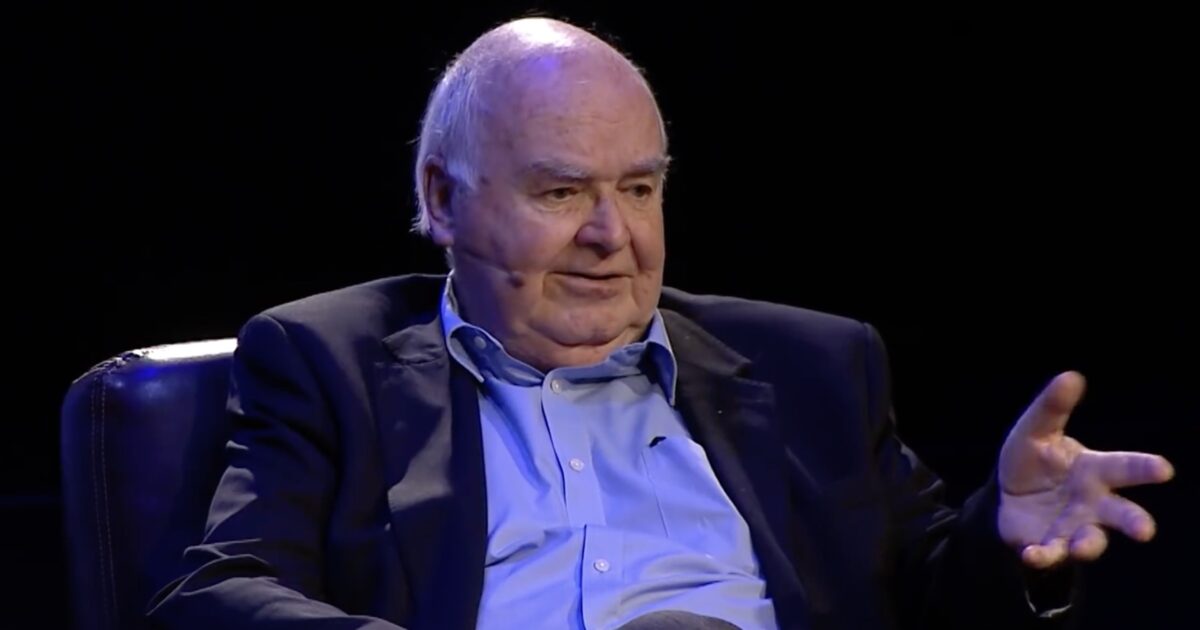
Dr Zachary Ardern writes: John Lennox is near universally loved across broad swathes of the evangelical Christian world and likely wide beyond as well. It is clear that many thousands of people have come to faith in Jesus Christ or been aided in their discipleship in loving God through John’s work. However, I believe that some of the core lessons he wishes to teach are not widely heeded, and are even actively taught against. His recently released autobiography “My Story” provides an opportunity to hear and consider these lessons again.
Here I give an overview of five themes he speaks on, which are somewhat inter-related.
- (not) two classes of Christian
- the life of the mind
- engaging secular arguments
- science and Creation
- gospel patronage
(Not) two classes of Christian
All work is to be done for the Lord, so Christians are not to be divided into two classes: those in ‘full time’ Christian work and those in ‘secular work’ who finance the first group and yet are regarded by many as second-class citizens in the kingdom of God. This categorisation […] has often led to a situation where churches have little or nothing to say by way of encouragement or guidance to those who wish to serve the Lord in their trade or profession (p 429).
“.. churches are not taking Christianity seriously enough and are giving the erroneous impression that it has nothing relevant to say about the very thing that most of us spend the largest part of our lives doing—working (p 152).
I believe this might be the central lesson in the book. Teaching that there are two classes of Christian life is, I believe, a huge problem. It is closely related to an evangelical version of clericalism which I suspect might be particularly rampant in the UK. This phenomenon, while no doubt able to be supported with various well meaning statements, is profoundly unbiblical and goes against the hard-won insights of the Reformation.
It reduces Christian ambition in lay people and adds unnecessary burdens to clergy who must fill gaps that could and should be filled by suitably gifted lay people. Fortunately multiple excellent organisations exist which point in the opposite direction such as UCCF, Transform Work, CMF, the Lawyers’ Christian Fellowship, and the Association of Christian Teachers – but still relatively few people are involved.
The life of the mind
It is a slander on the gospel to give people the impression that God is not interested in the life of the mind (p 81).
I think if we occasionally anonymously surveyed members of our churches we’d learn a lot about what they really thought. One thing we could ask them is whether they think God is interested in their intellectual development. This is not a new theme—variations on this are covered by classics such as The Christian Mind (1963, Harry Blamires), Your Mind Matters (1972, John Stott), and The Scandal of the Evangelical Mind (1994, Mark Noll). The title of Noll’s book was infamously repeated in the opening sentence of the book:
The scandal of the evangelical mind is that there is not much of an evangelical mind.
Of course, many will assure us that things have changed, or that the UK never had the problems of our American cousins anyway. I personally suspect the UK evangelical church has in some ways regressed since the high point of John Stott’s ministry and related developments.
Developing a Christian mind requires work and training which I think few churches are engaged in. Different theological streams have their own challenges in this, and objections or beliefs which tend to undermine taking the project of developing a Christian mind seriously.
For instance, the tradition I’m most familiar and comfortable with tends to be relatively rationalistic and teaching-focussed, and so it is often characterised as “intellectual”—but it doesn’t follow at all that there is widespread interest in “the life of the mind”. Developing a Christian mind able to reason through a Christian intellectual approach to diverse subjects involves not just teaching people what to think, but how to think and how to engage with other worldviews.
Whatever one thinks of my musings here, clearly the idea of the Christian mind that can engage intellectually in a way shaped by biblical truth is very important to John Lennox, and I believe it is an area where he sees continuing gaps in the UK church. Could this be right, and could some of us be called to address this?
Engaging secular arguments
It was clear that there is a great need for pastors, clergy, and teachers to engage more with the secular culture and learn how to combat the arguments emanating from it. In order to do that, it would help if they were to identify Christians in their congregations who are academically qualified and give them a platform to help their churches by using their expertise (p 342).
This third theme is closely related to both the first and second. Many churches have a large store of untapped expertise for engaging the surrounding culture, embodied in the expertise and experience of their members. By no means is this restricted to those with advanced academic training, but such training is one example of a “talent” which can be very useful if stewarded well. I urge church leaders to consider where such member-led teaching could fit in their church.
Here’s one phenomenon related to the first three themes. It is common for students in Christian Unions choosing speakers for mission weeks or other events to preferentially choose their pastors or student workers over others with (often more) relevant expertise and experience for communicating the credibility of Christian faith in a secular context. This preference of students is something that has been taught. Pastors can use their role and significant power to either encourage or undermine (actively or passively) the ministry of other Christians. Similarly, I often hear of ministers giving school assemblies and preparing them at the last minute – could some of these invitations be spread more widely across the church?
Science and Creation
This section doesn’t need a supporting quotation as it is clear that John Lennox has a love for science and the natural world. This includes major time investments in the hobbies of astronomy and bird watching. Appreciation of the natural world is not just a quaint hobby however. The doctrine of Creation underpins so much of the public Christian work that Prof. Lennox has done. How often is it taught about in our churches? Does the gospel really make sense if we tend to keep skipping ahead to redemption?
The widespread antipathy towards “natural theology” in both academic theology and many evangelical churches is not something that it seems John Lennox shares (although I don’t know what he thinks of the term). It is clear through many of his books that he thinks there are real pointers in nature to God’s reality – his eternal power and divine nature.
Gospel patronage
It was [the sacred secular divide] that prompted a businessman to say ‘the church appreciates my tithe, but not the enterprise that gave rise to it.’ A Good Return, p 86.
[Defining Gospel Patronage] I suppose I can summarise it as the combination of different kinds of wealth, flowing together to generate effective and strategic gospel outreach.
For some, proper gospel patronage starts and more or less stops at supporting the work of the local church. Other causes are mere hobbies and distractions from the real place where God works – the local church and perhaps the missionaries its leaders choose to support. Even if these are our convictions we surely must thank God that those who funded John Lennox’s ministry, mentioned at various points in the book, did not take this view. Of course, our local congregation should be a key feature of Christian giving and generosity. But many of us can do much more than this. Median income in the UK is approximately 4x the global median income.
Concluding notes
Now for some general review comments. The book is largely organised as something like a travel diary and so has many details which could have been left out. The inclusion of many references to memorable meals was quirky. At points the story is profoundly personal, as when mentioning recent health challenges faced by himself and his wife. I was surprised that there was no mention of his Open Brethren background, which surely shapes some of his theological emphases (such as lay ministry and his approach to the book of Revelation, although the latter does not get much attention in this book).
A few groups of people are not seen very favourably. There is some wariness or negative feeling regarding the Established Church in the UK (notwithstanding a couple of positive anecdotes), there is clear hostility towards Calvinism, and similarly there are some comments critical of mainstream biologists. As an evolutionary biologist who is both Anglican and theologically reformed I see some aspects of this as a pity, but our areas of agreement are more important.
While this might not be generally true of the audience for this book, I would have liked to have heard some summary of John’s mathematical work; an area he spent decades of full time work on. The casual reader might get the impression (despite multiple disavowals of this) that most of his life was spent in preaching and Christian teaching. I have only the vaguest sense of what a “Soluble Group” is, but from the list of published academic papers it clearly has been an important character in his story.
The themes I’ve highlighted here are a highly biased selection based on my own interests and vocation as a Christian academic involved in apologetics ministry and my sense of what John really wants to emphasise as important for the church. There are some points which he considers important which I have not included, though I think the five I’ve chosen cover most of the key ones which he emphasises. They are: that the Christian life is properly lived in the midst of the world and so the ministry of lay people is critical; that Christians should love the Lord with their mind and engage with the worldviews of those around us; that we should appreciate Creation as foundational for our worldview; and that many of us have the opportunity to do a lot of good with our so-called “secular” careers and our finances. All of this should be done to the glory of Jesus.
 Dr Zachary Ardern is a researcher in microbial evolutionary genomics; previously based in Cambridge and currently a visiting researcher at the University of Surrey. He is also an Associate of the Faraday Institute for Science and Religion and a Fellow of the International Society for Science and Religion (ISSR). For occasional writing from him, see his Substack, Convergent Wanderings.





I would add the London Institute for Contemporary Christianity (a legacy of John Stott’s ministry) to your list of organisations seeking to redress the sacred secular divide.
I would add to the list of organizations which help Christians live out the faith Monday to Saturday the London Institute of Contemporary Christianity (LICC: licc.org.uk). This was set up by John Stott.
In particular, they have the concept of each person’s “frontline”, which is where they are interacting with the world outside of ‘church’. One idea they had years ago was having a spot in a Sunday service “this time tomorrow” where a member of the congregation would be interview over what they would be doing, and then that person and place would be prayed for.
Yes, wonderful and much needed! It is closely related to “Transform Work” but goes back earlier.
It is remarkable how much Stott achieved!
I think it is excellent to integrate the world of work into Sunday worship. I have long wanted this to feature in sermons and intercessions.
Love the interviewing and praying for an individual in church idea!
David – I’d say that this sounds absolutely dismal. Some advice on how to witness in the workplace may be in order, but if we’re not very careful, this sort of things takes the eye off the ball; an act of worship must be God-centred – and interviewing a person about his work and then praying for him can, if one isn’t very careful, very quickly centre it on the individual. The aim of an act of worship is to renew the worshipper’s conviction of his own sin and what Christ did for him at Calvary – and I don’t see how interviewing a computer programmer from jolly Milton Keynes about his difficulties of life debugging his programmes and witnessing for Christ in this context is going to be useful.
It all looks like another one of this gimmicks, which take attention away from the central gospel message and to try and make worship more exciting for those who don’t really want to be challenged.
Yes…..to considering the life of the mind and intellectual development of Christian thinking. One of my key reasons for attending church is for the teaching, and I find that a 15 minute sermon once a week contributes but little. I appreciated the Alpha course when I did it online during Covid. But haven’t found anything in church to satisfy intellectual curiosity beyond that. daily inbox contemplative spirituality readings are helpful in promoting experiential awareness, but facilitating studying and developing thought intellectually is definitely an area the church could consider exploring
Thank you for the summary of the book which encapsulates something of current theological, scriptural, systematic, amnesia or denial.
This week, looking at some old notebooks I came across notes of Lennox mininistry at the Keswick convention, where I have been a regular attender, until the last handful of years. It was the fullest Keswick I’d attended.
And yes, John Stott was a substantial voice along similar lines, and across denominations, but while his voice may not have been snuffed out in the CoE, it has been significantly sidelined.
There is an interesting Critique of this critique
of Lennox by Googling-
Critique Dr Zachary Ardern “My Story”
It is sometimes good to critique a critique. Shalom
The thread seems to be taking us away from the subject of this post that Ian prefers.
All Academics like all “spirits” require thinking people
to test whether they be of God “
There are two interesting Critiques of Lennox
The Exciting Christian Life of John C. Lennox
.thegospelcoalition.org/reviews/my-story-lennox-interview/
AND
John Lennox and a Sad Divide @
https://answersingenesis.org/reviews/books/john-lennox-and-a-sad-divide/?srsltid=AYCX9vK3w1ZxtvM0_BEuRpP9h7H4wH_B7PwBgtc60MpK15BLPvWTmjsv
Of the latter I have one observation
on his interpretation of Genesis 1 &2
IF Christ sent the Holy Spirit to lead us into ALL truth
would the Holy Spirit advise us not to take Genesis 1&2
as gospel truth ? Rob God of His Glory ? Shalom.
Just a couple of questions:
1) What do you mean by “Gospel Truth”?
And
2) How does his interpretation of Genesis 1 & 2 “rob God of His glory”?
Would be good to answer with actual Lennox quotes if possible
Thanks
Eirene
Ive enjoyed some of his books, but sadly he still largely dismisses evolution. He seems to rely mainly on IDers, not exactly a good source on evolution.
Nevertheless his general scientific arguments are well formed and has made valid criticisms of the likes of Dawkins and Hawking.
Indeed Peter.
I don’t know any of those who may critique Lennox (and who is beyond criticism) have publically taken on, in debate, one of the main vociferous voices of the New AIheist movement and who has also written in response to the scientism, philosophical roots of science. of Hawking.
Who knows how many have come to faith in Jesus through his ministry as he has perhaps apologetically addressed what has been described as presupposional and underpinning ‘defeater beliefs’ subscribed to in the secular world view, even the basic, so -called science v religion divide.
Yes, Intelligent Design is trash.
Hi Anthony, I’m not sure ID can be dismissed so easily. Both ID and YEC groups have publicly welcomed the recent developments within evolutionary biology, best exemplified by Denis Noble’s (et al) Royal Society conference in 2016. The classical Neo-Darwinian paradigm is being challenged even by evolutionists, with arguments that overlap with what IDs and YECs have been saying for decades. The debate is too complex and nuanced to write all ID off as “trash”.
As an engineer myself I find ID arguments to be compelling, serious, and demanding of rigorous engagement:
“Fudge and Reeves (2024)’s [266] conclusions can be accounted for within the theory of ID given the observation that intelligent agents often reuse efficient functional components or designs in different systems. This observation has been applied in other ID-based engineering analyses. Burgess [165, 312, 313, 321, 323] used a mechanical engineering analysis to examine vertebrate joints and limbs, creating performance maps, performing kinetic and structural evaluations, and making multivariable trade-off maps from a design perspective. While common ancestry is typically employed to explain why the vertebrate limb pattern is reused in diverse organisms (e.g., bats, whales, horses, dogs, humans, etc.), Burgess (2024a) found that there are good functional reasons for this reusage, as the limb-structure is optimal and can be fine-tuned for a variety of vertebrate modes of locomotion and lifestyles [165].
These insights could have applications for human- designed technologies, since “The vertebrate limb has significant potential for the bioinspired design of robotic and prosthetic limbs” [165]. Burgess (2021) applied similar analyses to show that the reuse of linkage mechanisms in many diverse animals enables the “optimisation of forces and motions” as well as multifunctional components that efficiently compact “a high degree of functionality into a small space” [313]. An engineering analysis of the human foot and ankle complex [312, 321], knee [323], and wrist [165], conducted in rebuttal to “bad design” arguments, revealed numerous insights about the design and construction of bones and joints in the human body that are crucial for locomotion. For example, although design critics argued that “most or all the bones of the ankle-foot complex have no purpose or function,” from a design perspective, Burgess (2022)’s investigation shows that “all the bones of the ankle-foot complex have very important roles in the specialised design features” [321]. These design-based engineering analyses of vertebrate joints and limbs have thus uncovered functionality of components, coordination of parts, reuse of efficient functional designs via common design, and optimization to fulfill multiple design constraints effectively applying design criteria to understand how these systems operate.
Burgess (2007) [325] and McIntosh (2009) [326] have shown that bird feathers have a similarly efficient design. The materials used to build feather structures (keratin), and the design of feather filaments and the hierarchical barb-hook-barbule design show “the existence of multiple functions and multi-optimisation in a single component or mechanism” [325]. Again, design-based expectations of hierarchical function and reuse of functional components have yielded insights into why biological systems work the way they do.
These engineering-design-based studies yield insights not only into the workings of nature but also have applications for improving human technology through biomimetics. This field seeks to model human technology based upon biology, but it is most fruitful when operating under the paradigm that biological systems themselves were designed and therefore can serve as templates for human technology.
Lastly, design theory also shows utility for making medical advancements. Egnor and colleagues [166, 167] predicted and demonstrated that brain blood flow uses design principles known from “mechanical engineering (a dynamic vibration absorber), electrical engineering (a wavetrap circuit), acoustic engineering (a cavity resonator) and systems analysis (a band stop filter)” [166]. These insights have the potential to lead not only to improved understanding of brain function, but also to new treatments for hydrocephalus and other disorders”
https://bio-complexity.org/ojs/index.php/main/article/download/BIO-C.2026.4/BIO-C.2026.4
Sam Tippetts – I agree with Anthony Williams concise summary of ID. It is absolutely basic to Christianity that God is above and almighty and the author of creation, but the basic surmise of ID seems to be to limit and belittle God by making it look as if he couldn’t come up with a decent set of laws of nature in the first place, made a bit of a botched job, and has to intervene continually to set it right. I think that any reasonable person can see that current evolutionary theory leaves a lot to be desired and there are huge holes in observed behaviour that seem unexplained. The ID people then go leaping to the ‘miraculous intervention’ explanation – rather than trying to come up with a better scientific theory. In your own comment, you wrote absolutely nothing to suggest anything to the contrary; you simply suggested that in some areas the scientific theory leaves something to be desired and has to be improved. The ID solution to this is a total cop-out.
I found it very interesting that, in the introduction (or preface) to his ‘Origin of the Species’, Charles Darwin seemed to pit evolutionary theory as evidence against a creator God, while ‘miraculous intervention’ (the phrase he used) would (for him) have indicated evidence of a creator God.
With Darwin, as with everybody else who rejects God, the issue at stake is the moral issue. If you find someone who has problems with God as ultimate Author and Creator, you’ll find that the person also has serious problems with the moral implications of this.
Thanks for responding Jock, I agree with much of what you say, although your representation of ID does not fit my understanding of it. I think the main point these authors are trying to make is that the Neo-Darwinian model does not necessarily predict optimality, but when living systems are subjected to engineering analysis this is exactly what is found. Assuming optimality at the outset, on the basis that they have been designed, is therefore an effective way to understand living things, and this approach is bearing fruit.
I don’t hold to the ‘miraculous intervention’ idea you state here, I’ve not seen this in anything I’ve read on ID, and this is almost certainly not Stuart Burgess’s own position. The idea that God did a botched job and has to intervene is, I agree, a flat contradiction of everything in Genesis 1-2.
And I heartily agree with your final paragraph. When I started wrestling with these things I came across a letter from Darwin to his son which I found interesting:
“I have lately read Morley’s Life of Voltaire & he insists strongly that direct attacks on Christianity (even when written with the wonderful force & vigour of Voltaire) produce little permanent effect: real good seems only to follow from slow & silent side attacks.”
https://www.darwinproject.ac.uk/view/letters/DCP-LETT-9105#Lfoot_f7
Sam – thank you for clarifying the definition.
Well, we know that God is above and Almighty and, ultimately, his way is perfect. But optimal by human standards? and in a way that we can see this – and where it might be helpful for scientific investigation to start with this assumption? If creation were so optimal (by human standards) then it’s difficult to see how we would need any medical research (with a view to curing illnesses) at all.
I wonder what Job would have thought about such an optimality assumption. Of course, ultimately, his innocent suffering accomplished great things in the service of the Lord; it may have been very difficult, though, to persuade Job that the Lord’s approach to this was optimal – at any rate, he may well have wondered why he was the optimal candidate for such innocent suffering.
ID is certainly a new-fangled thing; we never heard of it before the late 1980’s. That doesn’t make it wrong. What does make it very suspicious, though, is that the ID scientists seem to understand the mind of God so well that they understand the divine definition of optimality.
So I remain sceptical and unconvinced.
Thanks again Jock, but I do think you are demanding more from ID than it claims for itself. It is a limited proposition, developed in response to those of a Neo-Darwinian persuasion who often claim that if living things really were the product of intelligence, they would not look as they do, but would be better designed.
The ID response has been to demonstrate that these claims do not bear scrutiny, that the designs of living things exhibit remarkable functional optimisation, and that tweaking particular features, even in relatively small ways, can actually compromise their performance.
ID, as far as I can tell, makes no attempt to address sickness or suffering, nor does it pretend to knowledge of divine optimality.
ID needs defining, of course, and in a sense the entire universe is shot through with it – Romans 1:20 says so, and I can see intelligent design in the beauty of the laws of physics, my own subject. But biology is so much more complicated that to claim you can see ID in it? You’d need to be a lot smarter, and to rule out explanations that we are only just beginning to explore – see Nick Lane’s books.
Anthony – Whenever I’ve seen it, I’ve found the term ID used in a specific way. It does not mean that God created a beautiful set of natural laws and then let it run its course (my own view), but ID is invariably opposed to this – and means ‘supernatural intervention’ – i.e. God needs to keep tweaking around with His laws of nature, presumably because he made a botched job in the first place.
Actually, I found Emil Brunner’s ‘The Mediator’ (written 1927) useful in understanding the deficiency. Of course, in that book he is concentrating on one thing – God incarnate, the crucifixion, the resurrection – it is the moral issue, radical evil, why we need a redeemer, God’s plan of redemption. That, for him, is *the* supernatural event, which marks out Christianity as entirely different from any other religion; one event at one specific time point in history, the lowest time point, ‘crucified under Pontius Pilate’. All other ‘supernatural’ appearances of God (e.g. to Moses in the burning bush, to Elijah, etc …) point towards this.
At some point in the book, he points out that other religions have mythical, recurrent events where the god meets his followers; as Brunner points out, if an event (or type of event) is recurrent, then it is (by definition) no longer a supernatural event, but is actually (by definition) part of nature.
I like Brunner’s logic here (even though he was writing many years before these ID people came along) and, according to this logic, these supernatural miraculous interventions are no longer supernatural, but actually become bog-standard part of nature – and therefore the sort of thing that scientists should be studying in the usual scientific way (without reference to God) trying to find the pattern (or scientific law).
By the way Anthony – did you see anything about redemption in the article?
Thanks Anthony, yes I agree definition is vital in this discussion. As I said to Jock the value I see in the ID approach is the starting assumption of optimality, and as a Christian I see this as following directly from Genesis 1-2.
Thanks for you comments, contributions here Sam.
I agree with them all, and I am not sure that Anthony nor Jock have properly engaged with them which I see as something of a knee jerk responses to ID, which does not deny micro adaptations, nor Genesis categories.
It is recalled that Lennox pointed out that the text of Genesis omits the definite article such as ‘the’ first day, but is day one.
It is also recalled at Keswick, where Lennox pointed this out (and he is not the only one to do so) I got chatting to a German who said the German text omitted the definite article.
As far as ID not mentioning redemption, why would it, is at the stage of forming prior to the Fall.
Thanks Geoff, yes ID makes no soteriological claims. It is YEC that insists an original good creation, with no death before sin, is necessary to understand Jesus’s work of redemption.
Hi Sam,
here’s some context which may be useful/informative.
Burgess and McIntosh are young Earth creationists, which involves rejecting or massively reinterpreting the results of multiple subfields of multiple historical sciences (astronomy, geology, biology, etc.). It’s not a real scientific option and only exists because of a presuppositionalist approach to the evidence (the idea that in effect presuppositions can overturn any empirical evidence).
“Intelligent design” includes a few young Earth creationists and various kinds of old Earth creationists. It doesn’t even try to give a theory of the Earth’s history and biology as evolution does.
Often design and evolution are set up as contrasts. I believe that God used evolutionary processes in achieving His design aims and that evolution is designed for this end – “evolution by design”.
My substack has some more detailed info on the scientific claims and I intend to add more over the next few months.
on ID. a clue is in how God describes Leviathan and creation. It is alive, has will, cannot be tamed by man but can be directed by God. Therefore God’s creation is something bursting out in all directions and God uses it, tames it, directs it. He intelligently tweaks it as he goes along, like a rider on a horse. It leaves in its wake a fossil evidence. Man has fallen …. before a rampaging herd of bison. God directs nature like a CEO directs a company.
Does that not describe God’s superintendent providence?
And does not what you describe as multiple sub fields of multiple historical sciences describe presuppositional philosophical scientism, even while you seek to draw it all together with an unscientific presupposition, without evidence, ‘evolution by design’ and without defining, distinguishing terms such as macro and micro and micro evolution.
Thanks for this analysis, Zachary. John Lennox has increasingly made reference to AI and the book of Revelation recently. I would be interested to know Ian’s take on this.
A friend recommended Lennox’s online talks about AI.
I haven’t yet followed it through.
I know zilch about Lennox but only of the critiques that I have read.
He sounds quite an accomplished man in several fields.
I merely question his interpretation of a Scripture.
Like a chilled Paul Phil 1:18 or Jesus Luke 9 vs.49 -50
I am not fazed. Shalom.
Alan, a friend has lent me his book on Revelation and AI. I can’t be bothered to read it. I dipped into it to check a few way-points and found he has nothing new to say.
It is interesting, Alan, that you know nothing of John Lennox but your first response is to look for online critiques.
Yes Steve.
I find that many academics don’t rev my engine,
not like the Bible does anyway.
I suppose sheep just wanna eat grass and leave the poison ivy and other undigestible stuff to the goats; only they want to eat the grass too, and head butt anyone who gets in their way. Are academics the goats??? 😉
And who will separate them? 🙂
Geoff
The critiques that I referenced were one favourable,
by one of your oft referenced sites, and one opposing.
I think that good academia gives a balanced view of the debate, not just quoting those who hold your
own opinion.
It is much like consulting Trust Pilot before you spend your money or waste your time.
Alan – what is this Trust Pilot? Do you type in the name of your pilot and it tells you whether or not he has a track record of crashing the plane? Good to know ….. but most pilots who have done this have ended up dead (or been sacked by the airline ….)
Re: the two critiques which you read – I’d be grateful for a brief summary.
Ho ho ho! Jock you are a card.
For my stated critiques see my post above to read
at your leisure, Shalom,
This reminds me of the teaching given by Fr Victor Stock at the London University Church of Christ the King.
Most of he congregation (not myself) were undergraduates from across the colleges, mostly UCL and Kings, but also Imperial and QMC and the medical schools.
1. You are intelligent adults, not children, planning to be in professional jobs of one sort or another. You are studying for your degrees and future: as Christians you must also study and grow so that you are able to give an account of the hope that is in you, as intelligent adults.
2. You are privileged (this was before loans) and have been given advantages: never forget what you have received and use your gifts to benefit others.
3. As Christians, your work and family life are part of your christian calling and witness; not something separate from your faith. Your faith must affect your whole life and calling.
4. Being a Christian witness in life, professions or any other work is probably a harder and more difficult calling than being clergy. Do not forget that you need support and encouragement. Value your time in worship, use the sacraments which are there to support, and, whilst being ready use your skills to support the church, understand that you will also need to take a back seat and allow yourself to be supported when you need it.
I have tried always to act on this